Showing posts with label trans representation. Show all posts

Wednesday, June 3, 2026

MAD EDEN: A Novel, long may Morgan Thomas create characters to enrich our imaginations


MAD EDEN: A Novel
MORGAN THOMAS

MCD x FSG (non-affiliate Bookshop.org link)
$14.99 ebook, available now

Rating: 4.5* of five

The Publisher Says: From a pathbreaking writer, a thrilling, form-bending novel about a trans healthcare worker whose carefully built life is suddenly imperiled.

Ro and Liam live in a ramshackle cabin in a secluded stretch of Florida. Neither their home nor their sometimes-tumultuous relationship is what the world would call perfect, but to Ro—newly diagnosed with autism and working as a patient navigator for people seeking gender-affirming care—their life, despite the deeply inhospitable political climate, is a kind of paradise.

It's hard to pinpoint exactly what shatters their peace. There’s Quentin, the unpredictable teenager for whom Liam and Ro are quasi-parents, who visits on his way to college, where he plans to finally start T. There’s the appearance of “Mad Eden,” an online fantasy serial about heroic dragon riders that increasingly becomes Ro’s obsession. And then there’s a seemingly innocuous patient video call that results in consequences both unexpected and grave. This triad of circumstances sends Liam's and Ro’s world spinning toward disaster—unless Ro can become the real-life hero their situation demands without betraying who they are and who they love.

With colossal heart and preternatural skill, Morgan Thomas crafts a deliciously destabilizing debut novel that challenges us to confront and reinvent questions of language, sex, prejudice, identity, and the shifting scales of morality. Playing with the possible relationship between autism and time to forge an ingenious new kind of storytelling, Mad Eden imagines, with exhilarating courage, how we might yet joyfully live in a precarious world.

I RECEIVED A DRC FROM THE PUBLISHER VIA NETGALLEY. THANK YOU.

My Review
: "Intersectionality" is a buzzword, it's true; the idea behind a person having intersecting identities has always seemed self-evident to me, so I'm been a bit eye-rolly in my response to its polysyllabifactive neologization.

Whatever, old man, what's your point?

The intersectionality of Ro's adult-diagnosed autism and Ro's trans identity would never have been used in a mainstream, high-budget novel in my youth. It would have lurked in the bottom-of-the-midlist pity-porn area of publishing throughout the entirety of the twentieth century. (Leave aside autism's hideous, abusive history for now, it's not relevant in this context. Let's just be delighted that it is not the case anymore.)

And Author Thomas would have been deprived of their métier. To all our great loss. (Singular "they" is neither error nor solecism.) To make this exploration of human...grunginess, messiness, animal-function reality...there had to be a generation of writers pushing pushing pushing against the polite prudery of nice people who act like they've never smelled, let alone touched, an asshole. If you've changed a diaper, cleaned yourself after a shit, cleaned up after your pet, yes you have. Many a nose is wrinkling now. Maybe this read is not for you, because it's very forthright in its body-ness. I think all y'all ought to unpucker and stop with the fakeness of pretending you're shocked, shocked! to find there's animal reality to beings living their life.

I suspect it will cause some people to re-evaluate their transphobia, however minld it may be, to realize that it's rooted in a concept of body-ness that belongs to a bygone era. Much like "eww-ick" homophobia, the reality of the twenty-first century is we can fix/clean/care for many, many things that killed people in older times. Keep up! Plug in! Grow some empathy for others' needs and wants, if you expect to go unchallenged in your perception of yourself as a good person.

Ro, the autistic trans guide through the deliberately desgined to be complex medical system that enriches many corporations and immiserates and impoverishes millions who live in the US, uses their autism to guide those in need through a labyrinth. Think, in this case, of the original Labyrinth and its intended function: a prison to hold a monstrous being created out of mismatched partners' uncontrollable, animal (!) passion. Is this making sense now? Ro is less Theseus, more Ariadne. A humane person, one caring for the welfare of others, helping them finr ways through the unforgiving maze, not always a "monster"-slaying self-righteous prick.

I don't offer a perfect five stars because I was less convinced by the "Mad Eden" text that Ro becomes obsessed with being all that worthy of their obsession. I was also more interested in leaning more about Ro, their partner Liam, and the couple's found-family child Quentin in relationship than I was in "Mad Eden." So, purely on personal-enjoyment grounds, I've got to go with a solid four-and-a-half stars for this rich, enriching, selfness-nourishing tale of one person's choice to use their lifee to help others find their own true selves.

Saturday, June 28, 2025

SHAMPOO UNICORN, nice YA story with a surprisingly successful gimmick


SHAMPOO UNICORN
SAWYER LOVETT

Hyperion (non-affiliate Bookshop.org link)
$18.99 hardcover, available now

Rating: 4* of five

The Publisher Says: Shampoo Unicorn: (noun)
1. A shower hairstyle in which one styles their lathered hair into the fluffiest soapy unicorn horn possible.
2. A podcast by two mysterious hosts exploring rural queer life--the isolation, the microaggressions, the boredom, and occasionally, the sky-shattering joy.


In the small town of Canon, West Virginia, most people care about three things: God, country, and football.

Brian is more into Drag Race, Dolly Parton, and his gig as one of the mystery hosts of his podcast, Shampoo Unicorn.

Greg's life should be perfect as the town's super-masc football star, but his secret is he's just as gay as Brian.

Leslie is a trans girl living in nearby Pennsylvania, searching for reasons to get out of bed every day. Her solace is listening to her favorite podcast. . . .

When a terrible accident occurs, it's Shampoo Unicorn that brings the three teens' lives together. And what begins as a search for answers becomes a story of finding connection.

Sawyer Lovett's powerful and ultimately joyful debut novel is about three teens, one podcast, and carving out a rainbow pocket in an otherwise red state.

I RECEIVED A DRC FROM THE PUBLISHER VIA EDELWEISS+. THANK YOU.

My Review
: Mixing three tenses to mark the three major PoVs...well, not likely to thrill me. I've referred to the "Satanic second" and the chest-pokey 'you'" often enough to set up a serious takedown of a story that mixes first, second, and third persons in one narrative.

I didn't hate it.

Wait! Before you call the butterfly-net-bearers, let me explain. First-person Brian is out, gay, and proud...he gets to tell us his story face-on because it will cost him nothing he isn't used to paying in terms of acceptance of himself and by others. Brian is so fully inhabiting his queerness that he podcasts about it.

Like someone who never quite faces you as you talk to them, studly Greg puts distance between his internalized homophobia and his powerful queer desires every way he can. Using the intimate, yet distancing, second person is a very effective way of starting to own his "shadow" side, the part of himself that he knows is there but has no map in his world for bringing forward. He's learning the secret that hiding something is bringing it to the center of your identity but without honesty.

Poor wee Leslie! She's trans in a culture that fears the mere mention of transness. She, quite logically, speaks in the third person of "Leslie" until she can find her way out of a multiply-locked prison of biological maleness. She is protecting Leslie, nurturing her, bringing her up in a sense until she can be in a place that is less risky to life and limb.

So there is a reason for this initially awkward splitting of tenses. It's also the case that I'm very old, and don't need klaxons to figure stuff like this out...the fifteen-year-olds this book is aimed at could use a nudge like this to think more deeply. Interspersed with direct address come transcripts of podcasts Brian does to reach isolated gay people. It makes the story's stakes feel immediate in this highly mediated age we live in.

I found myself enjoying this read more than I'd feared I would after discovering the unorthodox narrative strategy. It is a book I hope reaches, physically reaches to be explicit, its intended audience. In the prevailing climate of rage and hatred being stoked from so many corners, it could prove a lifeline to some badly in need of one.

Please, if your gaydar pings around a young person, please gift that young soul this story as a lifeline.

Wednesday, February 12, 2025

LOCA, debut found-family novel of New York's Dominican diaspora


LOCA
ALEJANDRO HEREDIA

Simon & Schuster (non-affiliate Amazon link)
$14.99 ebook edition, available now

One of Electric Literature’s Best Novels of 2025!

Rating: 3.75* of five

The Publisher Says: From Lambda Literary Award–winning author Alejandro Heredia comes a spellbinding debut about intersectionality, enduring friendship, and found family set at the turn of the millennium in 1999, following two Afro-Caribbean friends as they journey beyond the confined expectations of their home country in the Dominican Republic and begin new lives in New York City.

It’s 1999, and best friends Sal and Charo are striving to hold on to their dreams in a New York determined to grind them down. Sal is a book-loving science nerd trying to grow beyond his dead-end job in a new city, but he’s held back by tragic memories from his past in Santo Domingo. Free-spirited Charo is surprised to find herself a mother at twenty-five, partnered with a controlling man, working at the same supermarket for years, her world shrunk to the very domesticity she thought she’d escaped in her old country. When Sal finds love at a gay club one night, both his and Charo’s worlds unexpectedly open up to a vibrant social circle that pushes them to reckon with what they owe to their own selves, pasts, futures, and, always, each other.

With both friends feeling the same pressures in New York that forced them from their homes, a chance outing at a gay bar introduces Sal to Vance, an African American gay man whose romantic relationship with Sal challenges him to confront the trauma of his past. Through Vance, Charo befriends Ella, an African American trans woman, and Ella’s refusal to be who or what society dictates she should be inspires Charo to reckon with the role she’s grown comfortable in. Sal and Charo soon find themselves part of a queer intersectional community who disrupt the status quo of gender politics and conformity, allowing both to create the family and identities they’ve always longed for.

I RECEIVED A DRC FROM THE PUBLISHER VIA NETGALLEY. THANK YOU.

My Review
: "No matter where you go, there you are" meets "The secret of change is to focus all of your energy, not on fighting the old, but on building the new." Socrates and Buckaroo Banzai in one sentence has to be a new record of weirdness even for me. When I read a book with Spanish and English side by side, I'm inspired to make connections. In my daily life I'm surrounded by Spanish-speaking folk, I grew up a denizen of La Frontera, I was taught Spanish in school...read my first foreign-language novel in junior high Spanish class...I am, in short, at home.

That is how this novel felt to me, like a homecoming. I'm upset that many of y'all will avoid the read like it gots the cooties *because* there's another language in it. Some because there's transgender representation. Some because it doesn't center, or to the best of my recollection contain, any wypipo. (Look it up.) Adding to the reasons I liked the read, and others won't, is New York City. That great cultural lightning rod with its century-old antisemitic epithet, its much-maligned by flyover country denizens Harlemness, that haven and home for Others. How that's a bad thing, honestly, is beyond my scope of imagination. I see it like Sal and Charo do, a place not to be defined by others but a place to do one's own defining. How can that be bad?

Sal, who provides the bulk of the narrative, is coming of age in a place as little unlike his home as he can bear. The Latine diaspora in New York City has enough cultural similarity and still enough cover to hide from the ugliness of his past. He's been traumatized, as a queer boy I don't imagine I need to spell it out for you, and feels safer in New York. After all, it's harder to hate people when you don't know them, right? Disappearing into a crowd is safety?

Hmmm. Us oldsters are pretty sure that's fallacious already on first hearing but young people need to learn the hard way. Which explains in part why there are fewer old people than young ones.

1990s New York is the one I remember best. Things were changing and that's utterly ensorcelling to young people seeking personal change. The problem comes when the young person ignores the fact that change isn't a function of location, as Peter Weller memorably says in the clip linked above. Socrates (allegedly; at this distance in time, who really knows who formulated the thought?) elucidates the other issue Sal confronts in his desperate bid to change by escaping what he was told he was. It isn't until he meets a role model for his queerness who, like him, is a Black man but is also from the US, that he begins to *build* an identity not run from a label slapped on him.

Charo might have the harder task. She does NOT want to be a punching bag for some man, in sexual slavery to him and a breeding machine for babies. Guess what. Moving to New York City on the cusp of a new century, a new millennium, doesn't change her less-obvious struggle any more than it does Sal's. Luckily for her, this is a soulbrother she's found, this is a connection they won't break. Sal is a role model for moving forward into being, into crafting, a new self. I expect these kids did just fine for themselves, and that is a great feeling to end a read on.

So why not more stars? Because, even though I get that the chaotic timeline with flashbacks and PoV changes is very much the way we live our lives in reality—complete with intrusive ruminations—fiction needs more order than life to work as a story. This book was, from the get-go, going to be more than one story with more than one main character. What happened was what so often does: One of the characters has more to say to the author than the other. It comes down to page-time. Sal's is the dominant PoV but we're more acquainted with him than really close friends, as a single PoV novel allows us to feel.

The truth is that's not a flaw when it's by design as it is here...we're apparently meant to feel we're conversationally getting to know a person's history and life events...but that carries an inherent issue of diminished investment in that PoV. When we don't focus hard on something, due to different kinds of interruptions in narrative flow, we don't necessarily get the same level of reward for our attention.

It's a braided-stories novel, a set of vignettes with beginnings and middles, whose ends we mostly know from their being flashbacks. It's a valid storytelling technique simply not one I love with the kind of passion I had to invest in this very involving set-up taking place in a world I knew, and remember fondly. So three and three-quarters of a star subjectively awarded.

Objectively I laud this debut novel by an author with a resonant voice, and encourage you to encourage him and his publisher by reading his book.

Saturday, December 21, 2024

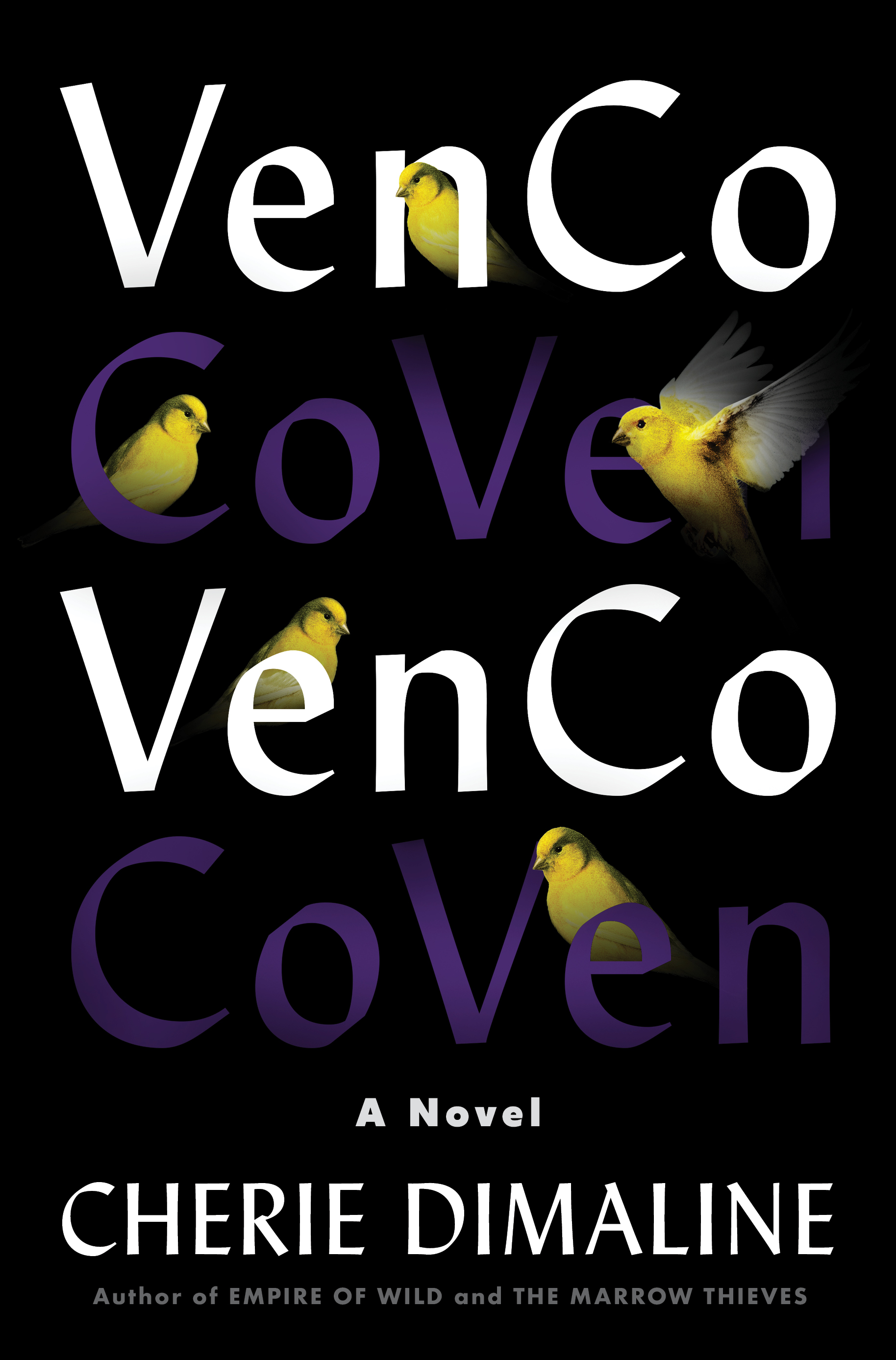
VEN.CO, sapphic Indigenous fantasy drenched in gynergy to keep you sane this Yule


VEN.CO
CHERIE DIMALINE

William Morrow (non-affiliate Amazon link)
$12.99 Kindle edition, available now

Rating: 4* of five

The Publisher Says: Lucky St. James, a Métis millennial living with her cantankerous but loving grandmother Stella, is barely hanging on when she discovers she will be evicted from their tiny Toronto apartment. Then, one night, something strange and irresistible calls out to Lucky. Burrowing through a wall, she finds a silver spoon etched with a crooked-nosed witch and the word SALEM, humming with otherworldly energy.

Hundreds of miles away in Salem, Myrna Good has been looking for Lucky. Myrna works for VenCo, a front company fueled by vast resources of dark money.

Lucky is familiar with the magic of her indigenous ancestors, but she has no idea that the spoon links her to VenCo’s network of witches throughout North America. Generations of witches have been waiting for centuries for the seven spoons to come together, igniting a new era, and restoring women to their rightful power.

But as reckoning approaches, a very powerful adversary is stalking their every move. He’s Jay Christos, a roguish and deadly witch-hunter as old as witchcraft itself.

To find the last spoon, Lucky and Stella embark on a rollicking and dangerous road trip to the darkly magical city of New Orleans, where the final showdown will determine whether VenCo will usher in a new beginning…or remain underground forever.

I RECEIVED A DRC FROM THE PUBLISHER VIA NETGALLEY. THANK YOU.

My Review
: VenCo, a front corporation for a CoVen (get it?) is a really fun gynergetic fantasy of what it would take to overwhelm the patriarchy and restore women to power.

Do you need something else to get one for this hijacked-by-jesus (who has a sly off-kilter cameo) sacred solstice holiday?

How about this: Lucky, our PoV character, is at a low ebb when we meet her...she's been struggling along, caring for her dementia-ridden paternal grandmother, scraping the money to survive, and now...the capitalist axe comes down, they're losing their home. Relatable, if in a grim way, to most all of us in or after middle age. Plot twist: It's now that Lucky discovers she's a witch, and the coven that's forming needs her...but not in Toronto, in New Orleans. The coven is forming to bring the world that Lucky's been angry with for most of her life, patriarchal racist exploitive horror that it is, to an end. She's got to assist the assembled women...including transfem Freya, explicitly accepted as a woman...in locating and assembling the spoons that'll generate the power they need to accomplish the task.

There are lots of names that don't always have solid characters attached, there is a notable holeyness to the plot, there is a powerful aura of wish fulfillment here. There is also an even-handed treatment of adversarial relationships. There is a demonization of Patriarchy, it's true, but not (to my surprise) of men.

The reason I gave it four stars is that this story was just plain fun to read. I wish it had been a wee tiny tidge tighter of plot. I'm not going to hold it up as a best of my reading year book. But I loved feeling so at home with Lucky, her deeply stressful life, and her middlescent discovery of her powers and her purpose. I thoroughly agree, in 2024, with the need to smash the Patriarchy and all its boosters and adherents. I was deeply gruntled by the transfem Freya simply...being...unremarkably one of the coven.

If you're going to be among the unenlightened, even the benighted, this coming Yule, bring this on your Kindle. You'll have an escape into a much nicer version of the world at hand, and a little spirit boost as the impending events of 2025 loom ever larger.

Friday, June 28, 2024

THE SAVIOR OF 6TH STREET does not earn my praise


THE SAVIOR OF 6TH STREET
ORLANDO ORTEGA-MEDINA

Kindle edition (non-affiliate Amazon link)
$9.99, available now

Rating: 3* of five

The Publisher Says: Urban Magical realism novel for fans of Haruki Murakami, Toni Morrison, and Junot Diaz

Deserted by his father at the age of four and raised by his voodoo queen mother on the fringes of Skid Row, Los Angeles street artist Virgilio Santos believes it his mission to save the down-and-outers in his neighborhood. But when he crosses paths with Beatrice Schein, an alluring Westside art collector with an aim to promote him to the international art world, Virgilio is tempted to turn his back on his friends. That is, until he discovers that Beatrice's father is a principal financier of organized crime in his neighborhood with plans to tear it all down for redevelopment.

'Rendered with urgent intensity, The Savior of 6th Street is a literary tour de force that confirms Orlando Ortega-Medina as one of the most original storytellers of our time.' (quote unattributed in the original)

I RECEIVED A DRC FROM THE PUBLISHER VIA NETGALLEY. THANK YOU.

My Review
: Need I belabor the "Virgilio/Virgil" and "Beatrice" call-backs to The Divine Comedy? There's really all you need to know in this book's defecnse. We're on A Quest, we will be meeting adversaries, we will not feel fully present in the narrative...unless the author puts it in the first person of course! So the author puts it in the first person.

The inclusion of a trans character in Concha gets this book a slot in the #PrideMonth blast. Also, the author's latesr book will be reviews in less than an hour. The fact is, I'm not a fan of this fantasy retelling of Divine Comedy. Santería, the magic system we get in this magical-realist novel, does as little for me as other variations on catholicsm do. Putting it in a first-person retelling of Dante's epically long, epically weird poen, only in prose, got an amused smile at the conceit. The execution doesn't match the ambition for me.

As rhetorical stand-ins for the forces of gentrification as expressions of the rancid neoliberal hellscape of 21st century LA, the author's villains are fine caricatures. The issue of writing an otherwise straightforward story of a talented, impoverished nobody finding his voice and getting the attention he merits as a modern take on a world literarure monadnock is the characters in the former need to be fleshed out. The characters need to command my sympathy and attention in immediate ways. In the latter, the characters are archetypes, are so removed from any need to know more than a liberal-arts course teaches you about them (relegated to the footnotes) that drawing deeper lines around them is akin to touching up Mona Lisa with some pink acrylic to make her skin look more "realistic".

A book equivalent of a pot of pink axrylic gets stars for ambition not achievement.

Saturday, April 6, 2024

THESE FRAGILE GRACES, THIS FUGITIVE HEART, hypercapitalist hellscape meets trans Terminator


THESE FRAGILE GRACES, THIS FUGITIVE HEART
IZZY WASSERSTEIN

Tachyon Publications
$16.95 trade paper, available now

Rating: 4* of five

The Publisher Says: In a queer, noir technothriller of fractured identity and corporate intrigue, a trans woman faces her fear of losing her community as her past chases after her. This bold, thought-provoking debut science-fiction novella from a Lambda Award finalist is an exciting and unpredictable look at the fluid nature of our former and present selves.

In mid-21st-century Kansas City, Dora hasn’t been back to her old commune in years. But when Dora’s ex-girlfriend Kay is killed, and everyone at the commune is a potential suspect, Dora knows she’s the only person who can solve the murder.

As Dora is dragged back into her old community and begins her investigations, she discovers that Kay’s death is only one of several terrible incidents. A strange new drug is circulating. People are disappearing. And Dora is being attacked by assailants from her pre-transition past.

Meanwhile, it seems like a war between two nefarious corporations is looming, and Dora’s old neighborhood is their battleground. Now she must uncover a twisted conspiracy, all while navigating a deeply meaningful new relationship.

I RECEIVED A DRC FROM THE PUBLISHER VIA EDELWEISS+. THANK YOU.

My Review
: There are some tropes in the noir genre I love more than others. One is the private dick with a complicated love history. Rick and Elsa in Casablanca. Marlowe and Ruth in The Maltese Falcon. Jake and Evelyn (and her daddy) in Chinatown. Walter Neff and Phyllis Dietrichson in Double Indemnity.Not one tiny shred of honest, forthright communication and commitment to any relationship's future in the lot. This being my deeply cynical belief about the reality of all marriages' basis and fates, I thought I'd got a solid bead on the way the genre will work on this topic.

Laddies and gentlewomen, Izzy Wasserstein blew the (closet) doors off this one.

Dora, our protagonist, lives in a deeply dysfunctional dystopian near-future (a couple decades) post-apocalyptic USA. We don't explore the apocalypse much, just live day-to-day with Dora...Theodora, né Theodore...as she tries to survive in the wreckage of hypercapitalism. She (chosen pronoun) spent years in a hardscrabble anarchist commune with her pretransition Theodore-self's lover and commune co-founder, Kay. The pair split up, and Dora left the commune, over Kay and the others' rejection of her desire to tighten the commune's security about new members and the commune's handling of data. The others felt it was not in the spirit of the effort to be so closed and paranoid; she did. So she closed the door behind her on the way out. Maybe slammed is fairer; maybe slammed the damn door so hard it splintered, even.

And now Dora has to return to the commune, using all her skills acquired while she was Theodore, to solve the murder of Kay. Why was Kay murdered? What did Dora tell the communards about security? Is this thing on? So begins a fast-lane tour of the hellscape that is Kansas City in this deeply divided world, as Dora ferrets out facts and confronts Big Bads. Naturally, there are ties in the story Dora unfolds to the Theodore past...and, not coincidentally, Dora is confronted with the cruelest, most cinema-friendly enemies imaginable: clones of Theodore.

This, then, is the heart of the story. The world, and the world-building, are not deep because you're not here for the wrapping paper but for the gift. Dora has to battle Theodore-faced enemies bound and determined to kill her! Can there be anything more visually appealing than that?! Can the cruelty of deadnaming be more bluntly portrayed?

I really doubt it can. The setup, the story, the world...all part of the point of the read: Identity, its power, its costs, and the sheer nightmarish house of mirrors the trans person must live with, and through, simply to claim what cisgender people walk around blissfully unaware that they possess.

Themselves. Their unquestioned selfhood, unimpacted by the feelings, opinions, judgments of others, unquestioned by the self-appointed guardians of...you know, I just don't know what they are guarding. No one's attacking my maleness by being transmasc or transfem. What needs guarding about that? Anyway, I exist in a bubble of privileges of many sorts, and reading books like this that take me into the unprivileged side of my life do me a gigantic service. Perspective is something I treasure, even when I don't unreservedly enjoy getting it.

I did not read the book with unalloyed pleasure. There'd be a fifth star on my rating had that been the case. I enjoyed the pace; the author starts fast and doesn't slow down. I enjoyed the message; see above. I was squirmy about the echoes of The Man Who Folded Himself. That wasn't unnecessary; but I had to read the author's Afterword to get why it was not gratuitous. I was a bit unconvinced by the Big Bad's motivation. Not eyerollingly so, but in that niggly little itch that says, "really? all this because of that?"

I default back to, readers aren't here for just one experience, just one focus, a single reward for their time spent in Dora's world. It's just a thing I felt vaguely unsatisfied by, and should try to explain to others in advance of their reads.

I think Author Izzy deserves your afternoon and evening to get this involving story into you. I'm glad it's in me now.

Friday, February 16, 2024

THE PERFUME THIEF, WWII espionage in a beautifully evoked Paris setting


THE PERFUME THIEF
TIMOTHY SCHAFFERT

Doubleday
$17.00 trade paper, available now

Rating: 3.8* of five

The Publisher Says: A Gentleman in Moscow meets Moulin Rouge in this stylish, sexy page-turner about Clementine, a queer American expat and notorious thief of rare scents, who has retired to Paris, only to return to her old tricks in hopes of protecting the city she loves when the Nazis invade in 1941.

Clementine is a seventy-two year-old reformed con artist with a penchant for impeccably tailored suits. Her life of crime has led her from the uber-wealthy perfume junkies of belle epoque Manhattan, to the scented butterflies of Costa Rica, to the spice markets of Marrakech, and finally the bordellos of Paris, where she settles down and opens a legitimate shop bottling her favorite extracts for the ladies of the cabarets.

In 1941, as the German's stranglehold on the city tightens, Clem's perfume-making attracts the notice of Oskar Voss, a Francophile Nazi bureaucrat, who comes to demand Clem's expertise and loyalty in his mysterious play for Hitler's favor. Clem has no choice but to surrender fully to the con, but while she knew playing the part of collaborator would be dangerous, she never imagined it would be so painfully intimate. At Oskar's behest, and in an effort to win his trust, Clem recounts the full story of her life and loves, this time without the cover of the lies she came to Paris to escape.

Complete with romance, espionage, champagne towers, and haute couture, this full-tilt sensory experience is a dazzling portrait of the underground resistance of twentieth-century Paris and a passionate love letter to the power of beauty and community in the face of insidious hate.

I RECEIVED A DRC FROM THE PUBLISHER VIA NETGALLEY. THANK YOU.

My Review
: Lush, lovely prose telling a story that made me squirm so hard I wore a hole in my upholstery.

Stories about coercion of trans folks using their identity as trans are not comfortable reads. I do not think this was intended to be a comfy-cozy kind of a read but it was clear in its empathy for its trans main character. So, blessedly, I was not left with the rather unclean film of exploitive appropriative use of trans identity as a negative signifier on my lens into the story.

Still, this story causes me horripilation. As things that have Nazis as the antagonist should.

The felt-like-he-was-factual Oskar Voss, nasty boss Nazi spymaster, based like the rest of the story—as per the author—on real people who were in Paris to escape the judgments of Society in the safety of the big city. Then, the worst-possible worst result happens to them all when the vileness of the Nazis come barging in with their giant, outsized hatreds, and their very overblown sense of purpose. Oskar is typical of the cynical bandwagon-hoppers that puritanical movements attract like horse apples attract dung beetles. He is very much not interested in the ideology of his paymasters. He wants power over others. His means of getting more of his drug is to use whoever and whatever he can to buy himself a seat at a higher-placed table.

Enter Clem(entine). And a lot of Clem's fellow misfits. They need to survive, and their Otherness has equipped them to do this any and every way they possibly can including stealing and blackmailing any and everyone they need to. Oskar wants to ensorcel Hitler with some super-special scent, which TBH just fell flat for me as a motivation...but it led to butch lesbian/transman Clem recounting, for honestly flimsy reasons, her lifetime's-worth of stories to the rapt Oskar. Whatever excuse made that happen is good enough for me.

Clem, a very old person for that era at seventy-two, has Lived A Life, maybe three or even four, in those years. A born tale-teller, as anyone making a living as a con artist and thief operating among the very rich must be, Clem completely wraps Oskar up in the memory palace of the past. How much of it would pass the fact-checking of the internet age, well...who cares. I do not really buy into the motivations of Oskar for any of his actions, but that left me no less delighted to spend time with Clem.

The horrors of Nazi-occupied Paris, the horrors that were to come, all seemed to Clem to be clear because these puritanical control freaks are just like the others from the past. None of it is downplayed, and there are terrible passages in this story, but the way it is presented feels...convenient. Oskar is easily led by his greed for power, Clem is easily swayed by a murky sense of responsibility that all just jelled a bit too patly for this reader.

I will not, though, say anything to discourage anyone who longs for ancestral representation for their own kind to get stuck in right away. I think the transmasculine Clem, while imperfect, is perfectly delightful to spend page time with. The hurts and betrayals of lives long over make for great stories, even knowing they were painful and hard to live. You will come away edified for knowing the honorable, sensible, deeply relatable hero that is Clem.

Monday, December 4, 2023

BEGIN THE WORLD OVER, what happens if other hands hold the keys


BEGIN THE WORLD OVER
KUNG LI SUN

AK Press
$17.00 trade paper, available now

Rating: 4.5* of five

The Publisher Says: A revolutionary tale of Black and Indigenous insurrection. History as it should have been.

Begin the World Over is a counterfactual novel about the Founders’ greatest fear—that Black and Indigenous people might join forces to undo the newly formed United States of America—coming true.

In 1793, as revolutionaries in the West Indies take up arms, James Hemings has little interest in joining the fight for liberté—talented and favored, he is careful to protect his relative comforts as Thomas Jefferson’s enslaved chef. But when he meets Denmark Vesey, James is immediately smitten. The formidable first mate persuades James to board his ship, on its way to the revolt in Saint-Domingue. There and on the mainland they join forces with a diverse cast of characters, including a gender nonconforming prophetess, a formerly enslaved jockey, and a Muskogee horse trader. The resulting adventure masterfully mixes real historical figures and events with a riotous retelling of a possible history in which James must decide whether to return to his constrained but composed former life, or join the coalition of Black revolutionaries and Muskogee resistance to fight the American slavers and settlers.

I RECEIVED A DRC FROM THE PUBLISHER VIA EDELWEISS+. THANK YOU.

My Review
: Counterfactual histories like this are my meat and drink in reading life. I love to see well-informed authors play with little things that, had they not happened in *exactly* the way they did, would have resulted in a completely different world than the one we live in. There is, of course, an element of wish fulfillment in this for me. And not just in modern times.

The ways and means of colonial oppression are alive and well in Anglophone literature, French literature...all the colonists' languages...as we can see by the marginalization of works by and about nonwhite peoples around the globe.
Literally everything that went wrong in the wars of Haitian, and Jamaican, liberation went right in this book; and that was sooo satisfying to this reader who find the smugness of US exceptionalism grating. On and on, the litany of "they won" rings its victory bells in my ears and my smiles of pleasure keep getting wider as, on reflection, I contemplate an alternative universe where this is history, not alternative history.

For reasons I'll never really understand, magical realism must be in any alternative history novel. I don't like it but it's going to be there, so be ready for that.

The part of the story where we see same-sex couples and coupling being accepted and acceptable is, for me, the best bit of the book. James Hemings, Jefferson's factual Paris-trained enslaved chef, is here a queer gentleman who provides an important central PoV, and that inclusion means that a LOT of attention is paid to food, and the eating of same, in groups and alone. Our trans and genderqueer siblings are well-represented in indigenous and enslaved quarters. This is something I truly can't praise the author for highly enough, the simple, matter-of-fact inclusion of people that the QUILTBAG community of today does far too little to include and celebrate. What's a harder sell, I think, to most people is that the revolution isn't bloodless and that's very much center stage for good swaths of the story. I am routinely appalled by the violence that many slaveowners enacted on their slaves' bodies. It isn't *better* when they, in their turn, enact that violence on their enslavers...it just reminds me that there are no truly good humans.

Starting our journey with James's PoV and then broadening the scope to include many others' PoVs was, I can see, a necessary way to get this story told. I will note that it felt frustrating because James won me over so completely that I wanted to return to him like a homing pigeon. That broadening does allow for more representation at the expense of depth of characterization. Part of the point of this particular story, as I see it, is to take the reader outside the usual and customary colonial hegemonic individualistic mode of storytelling. We're presented with an organic polyphony of PoVs. It pays to have that need in the reader's mind to get them into the spirit of the rebellion and its aims.

A read I strongly urge on you to understand and perhaps even align with the revolution so eagerly sought by young people and its aims. Younger readers, take heart! You're seen. Your concerns for liberation and justice aren't invisible.

Monday, August 8, 2022

THE BRUISING OF QILWA, debut fantasy set in Persian-culture inspired world


THE BRUISING OF QILWA
NASEEM JAMNIA

Tachyon Publications
$15.95 trade paper, available now

FINALIST for a World Fantasy Award for Best Novella!

Rating: 4* of five

The Publisher Says: In this intricate debut fantasy introducing a queernormative Persian-inspired world, a nonbinary refugee practitioner of blood magic discovers a strange disease that causes political rifts in their new homeland. Persian-American author Naseem Jamnia has crafted a gripping narrative with a moving, nuanced exploration of immigration, gender, healing, and family.

Firuz-e Jafari is fortunate enough to have immigrated to the Free Democratic City-State of Qilwa, fleeing the slaughter of other traditional Sassanian blood magic practitioners in their homeland. Despite the status of refugees in their new home, Firuz has a good job at a free healing clinic in Qilwa, working with Kofi, a kindly new employer, and mentoring Afsoneh, a troubled orphan refugee with powerful magic.

But Firuz and Kofi have discovered a terrible new disease which leaves mysterious bruises on its victims. The illness is spreading quickly through Qilwa, and there are dangerous accusations of ineptly performed blood magic. In order to survive, Firuz must break a deadly cycle of prejudice, untangle sociopolitical constraints, and find a fresh start for their both their blood and found family.

Powerful and fascinating, The Bruising of Qilwa is the newest arrival in the era of fantasy classics such as the Broken Earth Trilogy, The Four Profound Weaves, and Who Fears Death.

I RECEIVED A DRC FROM THE PUBLISHER VIA NETGALLEY. THANK YOU.

My Review
: I am all the way here for a Persian storyverse-inspired QUILTBAG-inclusive secondary world with a not-silly science-cum-majgickq system based on blood. This idea has me all excited, with the nigh-on irresistible urge to send the author CARE packages of food and crowdsourcing their laundry so they will not have to leave their writing desk unless answering the call of nature.

What keeps me from offering the story all five stars is the first-publication longueurs that are so very common as to feel universal. The storyverse is astonishingly successful in compelling my attention, given how brief the story here told is. There is a depth to Firuz's native Sassanians, a minority group not beloved in their world, and named by the author after the last pre-Muslim Persian empire in our world...echoes of the religious monopoly being enforced in many parts of the world, the intolerance that entails and encourages. The blood-magic system, with its science-tinged presentation, was presented as a source of fear and persecution; yet, during the plague that strikes Qilwa, it is urgently needed to help fix the problems this plague presents. The tables are turned and those so recently deemed outcast are needed to fix what the many are suffering. Always a great direction to aim a story!

So you can see that the story possesses many layers just from the little I've said; there are other normative things (eg, introducing one's self with pronoun and name, like I'd be "him–Richard" then just Richard after that...a lot like royalty gets to explain how they're addressed to us mere commoners on those rare occasions we're presented to them) that can unpack over the course of a long series of stories set in this place while instantly adding a lush richness to the present reading experience. What doesn't work so well is Firuz's social anxiety/awkwardness being borne down on narratively at every turn. I get it...they're very awkward, it's not necessary to repeat this every other page. There are points where their trans brother could've taken the stage more completely and thus enriched the read's texture; seeing him only from the outside is fine, like all inclusion, but his transition is so very much a driver of the story that allowing him to take center stage could've given me so much more. Satisfying my curiosity about how he sees this world would've given the plague, the clinic where Firuz practices healing, and what it is that Firuz and Kofi share that makes the clinic so real-feeling, needed dimensionality.

The surprisingly secondary character Afsoneh is a wild child, we're told; we're never really shown this facet of her character. Firoz mentors her and so should've had more of a struggle with her acting out if she's such a chaotic person. Instead it's brushed past. I know it's a function of the novella format. I'm even willing to go along with the clipping of storylines that this format requires uncomplainingly...IF I can trust that the characters are going to get more stage time later. Not too much later.

I bestow on this deeply involving read my most difficult-to-earn accolade: More, please.

Saturday, June 25, 2022

MANYWHERE, nine short but powerful fictions in debut collection


MANYWHERE: Stories
MORGAN THOMAS

MCDxFSG
$26.00 hardcover, available now

Author Thomas wins a 2022 Judith A. Markowitz Award for Exceptional New LGBTQ Writers!

Rating: 4* of five

The Publisher Says: Morgan Thomas's Manywhere features lush and uncompromising stories about characters crossing geographical borders and gender binaries.

The nine stories in Morgan Thomas's shimmering debut collection witness Southern queer and genderqueer characters determined to find themselves reflected in the annals of history, whatever the cost. As Thomas's subjects trace deceit and violence through Southern tall tales and their own pasts, their journeys reveal the porous boundaries of body, land, and history, and the sometimes ruthless awakenings of self-discovery.

A trans woman finds her independence with the purchase of a pregnancy bump; a young Virginian flees their relationship, choosing instead to immerse themself in the life of an intersex person from Colonial-era Jamestown. A writer tries to evade the murky and violent legacy of an ancestor who supposedly disappeared into a midwifery bag, and in the uncanny title story, a young trans person brings home a replacement daughter for their elderly father.

Winding between reinvention and remembrance, transition and transcendence, these origin stories resound across centuries. With warm, meticulous emotional intelligence, Morgan Thomas uncovers how the stories we borrow to understand ourselves in turn shape the people we become. Ushering in a new form of queer mythmaking, Manywhere introduces a storyteller of uncommon range and talent.

I RECEIVED A DRC FROM THE PUBLISHER VIA NETGALLEY. THANK YOU.

My Review
: Whenever I read new story collections, I try to think of the reason(s) the writer had for writing that story, for including those words in a selection of them intended to make a reader form an idea of their creator. When that test gets me into a swivet, a frustrated screaming match with that absent author, I know I'm onto something worth following to the end of the trail. I had that sensation reading Morgan Thomas's words from the beginning.

As an example, there's "Taylor Johnson's Lightning Man." This was one of those fantastical reads that grows as you recede from the words but get the feelings so much more powerfully as memories. Those high places got scaled again in the strange, futuristic "Transit," in which the story's liminal between-space left me slightly sadder that I'd been born. There's no way that much longing and unrequited need can not teach you the truth of samsara. And the less-than-desired results of reading other stories, eg "Alta's Place," bring that into ever-sharper focus. The balance of going with Author Thomas's peripatetic imagination to its manywheres comes down on the positive, occasionally excellent, end of the literary map's scale.

In the time-honored tradition of this blog, I shall use the Bryce Method to elucidate my opinion of each piece within the whole.

Taylor Johnson’s Lightning Man poignantly discovers a trans ancestor in a folk-tale told by a non-conforming cisgender parent. The ways we all need to feel Seen and accepted are many, innumerable perhaps, but real drivers of identity and success. It's a charming story, all centered around photography as it reveals and conceals:
But they're waiting for you upstairs, the Board of Special Inquiry. Of course, you'll have to bring them a photo. You choose one of the good, familiar photos. In it, you sit in your hat and spectacles, facing the camera, your head tilted just a little to the right, your mouth a firm, flat line.
"At the risk of saying too much," I say, I'm a fan of that photo. Everything I am is because of that photo."

It says just enough. Magical realism does Ellis Island. 4.5 stars

That Drowning Place is a polyphony in one voice, "we", for people with Hansen's disease who lived in Katrina's path, who lived as long as they could in a place that no one else wanted, and who eventually got themselves neighbors in the relocated Cajuns, not entirely voluntarily. But the price of joining the rest of the world? Not small. "They" are everywhere. And we'd best get ourselves ready for it. There will be a LOT more of "them" soon.
You can't hide from the water forever.

The end of all things: The water. 3.5 stars, a story that repays close attention and makes demands.

Transit posits a weirdly different climate-changed Louisiana, one with the most delightful little town of freakishly supernatural beings...shades of Sookie!...only it's on a major train corridor, and it's got a faux (?) vampire visiting as the world around drowns and leaves them stranded on their way back from an institution for the anorexic desiring not to be Women.
"If I wasn't a girl would you date me?"

Happy grinned and I knew I'd lost her. "If you're not a girl, then what are you?" Happy pulled her bottom lip in against her teeth, her incisors poking out long and sharp. "Someving supernatural?"

"I'm whatever. I could be whatever."

If that doesn't break your heart. Broke mine. 4 stars

The Daring Life of Philippa Cook the Rogue has the best line I've read yet:
It's astounding that {she} has any memory of that day at all, though I suppose it's true that as the lanterns darken yesterday, they brighten yesteryear.

Excellent! And perfect for this oddball tale of a transwoman/hermaphrodite (it's not totally clear which) in Colonial Jamestown. Epistolary delight, a truly moving account of the terrible price being forced to choose a binary identity exacts on those not inclined to the absolutist demands of The World. Moving, terribly sad, ultimately a joyful reading of Reality trumping the fantasy of the past we're sold as the one immutable truth. 4 stars

Bump tells us of Louie, their lover Len, and Len's wife Melinda, as they navigate the shoals of Figuring Family Out. It isn't, I know you'll be shocked to learn, a smooth process.
We. A word I hated. A word that declared to the listener, You Are Not One of Us.

Louie's "country Cajun" Nana, who lives with them and is supported by them, is also the sanest person in this piece. She just gets on with her life, making her needs known and dispensing The American Way advice to her increasingly reality-challenged grandchild: taken to wearing a pregnancy bump, in competition with Melinda's actual baby ("the aphid"), Louie gets trapped in the implicit lie at work by failing to correct a co-worker's presumption that it's a real pregnancy.

More hijinks ensue and, in the end, Len's unusual family comes apart. You know already who's "we" and who isn't. 4 stars

Alta's Place makes me so sad...what is persecution if not denying a person a living, a house, a way not to starve and/or freeze? Why is this so hard to comprehend?

Because this is the land of the free to discriminate, and the brave if you don't put it to the test, Othered people will tell you. Being from here, or elsewhere, Othered people will tell you what refuge means: Not Wanted, go away. (Cory, the party of the second part in the dialogue, is a drip.) Not the best of these stories. 3.5 stars

The Expectation of Cooper Hill shed a little light on the war of the medical profession against all those who didn't want to medicalize everything a human body does. It's been a long, expensive peace; maybe we should get back to warring. A woman being a midwife seems like a pretty good alternative to going into a hospital.

But I don't love the idea of the world as it was, either, though maybe that's how things are headed. 3 stars

Surrogate meditates on the gigantic cost of environmental degradation, the cruelty of expectations loaded onto a relationship, and the tyrannical hold of Hope on our spirits. Brighten, in need of a purpose, tells her husband Orson that she's decided to become a surrogate for $50,000. He does his best to dissuade her. He says really clearly that he'd rather she didn't. She does anyway.

As the rural poverty of Arkansas makes Orson's job at the fracking facility a good one, and as she's sure their well isn't polluted, Brighten makes a mistake by drinking tap water while carrying her surrogate child. The problem of being alive in this ugly, dirty world has never been more stark than Brighten's corner of it. 4 stars

Manywhere finishes the journey with a Vegas trip. A transmasc narrator, Charlie, is sure that caring for the father that walked out of her mother's life the same way he walked into it...unexpectedly...and now that Charlie's caught up with him, he's filled their life too. And now, a peripatetic life led the two of them back to each other only this time with one major difference: Obligation.

Who's obliged to whom? There's never only one answer to that question and this exploration of it doesn't offer anything pretending to be it to the reader. But the scourges of mental illness, loneliness, unhappiness follow people no matter where they walk to or from or around. There is, at last, no longer any way to be out of reach of the sorrow we inherit from all the ancestors we never met. 4 stars

Thursday, October 7, 2021

THE WRONG END OF THE TELESCOPE, vintage Alameddine prose, story...what better way to start your week?


THE WRONG END OF THE TELESCOPE
RABIH ALAMEDDINE

Grove Press
$17.00 trade paper, available now

Congratulations to Author Alameddine! THE WRONG END OF THE TELESCOPE took home the 2022 PEN/Faulkner Award for Fiction! See the announcement here!

A LIT HUB FAVORITE BOOK OF 2021!

A BOOKRIOT BEST BOOK OF 2021!

Rating: 5* of five

The Publisher Says: By National Book Award and the National Book Critics’ Circle Award finalist for An Unnecessary Woman, Rabih Alameddine, comes a transporting new novel about an Arab American trans woman’s journey among Syrian refugees on Lesbos island

Mina Simpson, a Lebanese doctor, arrives at the infamous Moria refugee camp on Lesbos, Greece, after being urgently summoned for help by her friend who runs an NGO there. Alienated from her family except for her beloved brother, Mina has avoided being so close to her homeland for decades. But with a week off work and apart from her wife of thirty years, Mina hopes to accomplish something meaningful, among the abundance of Western volunteers who pose for selfies with beached dinghies and the camp's children. Soon, a boat crosses bringing Sumaiya, a fiercely resolute Syrian matriarch with terminal liver cancer. Determined to protect her children and husband at all costs, Sumaiya refuses to alert her family to her diagnosis. Bonded together by Sumaiya's secret, a deep connection sparks between the two women, and as Mina prepares a course of treatment with the limited resources on hand, she confronts the circumstances of the migrants displacement, as well as her own constraints in helping them.

Not since the inimitable Aaliya of An Unnecessary Woman has Rabih Alameddine conjured such a winsome heroine to lead us to one of the most wrenching conflicts of our time. Cunningly weaving in stories of other refugees into Mina's singular own, The Wrong End of the Telescope is a bedazzling tapestry of both tragic and amusing portraits of indomitable spirits facing a humanitarian crisis.

I RECEIVED MY DRC FROM THE PUBLISHER VIA EDELWEISS+. THANK YOU.

My Review
: When you are faced with an overwhelming event...say, the Syrian refugee crisis of 2016...which is, in itself, the result of a series of overwhelming events outside the control of any individual who is suffering the consequences of others' bad decisions...where do you even begin to process the emotional and psychic overwhelm of the event?

In Rabih Alameddine's The Wrong End of the Telescope, you begin by finding the voice you need to make alienation, victimization, and the abjection of fleeing everything you've ever known against your will, truly personal. Enter Mina Simpson. She is a trans woman in a lesbian relationship (one thing I found ever-so-slightly on the nose was setting a lesbian's tale on Lesbos...but that's where it happened in reality) with a Haitian psychologist, and fellow Chicagoan, Francine. She is a physician summoned to help with the overwhelming floods of refugees from Syria's dissolution by her friend and fellow transwoman (but heterosexual), Emma. Also a doctor, Emma cries for help that Mina arrives to offer exactly as the Holidays result in a vast sea of wealthy-Westerner disaster tourists showing up to "do their bit" to help...Them.

Mina's life as a trans person in Lebanon was harrowing, as I expect most trans people's live are everywhere. There is so much hate directed at trans people all over the world, from every imaginable quarter, that it was a genuine pleasure to see Mina's older brother and sole remaining family member was loving, accepting, and even if not capable of going against the Will of the Family in public, honestly supportive of Mina as her real self. What it has done *for* her, however, is made her adept at navigating the undercurrents of family life. Mina's actions relating to Sumaiya, one of "Them" and possessor of a powerful will in a dying body, prove that Mina is a woman of the most beautifully tender spirit, capable of understanding that love for another can not conquer all and does not confer metaphysical or physical superpowers...but does summon forth reserves of strength that inspire awe in her, and in me.

The story isn't always obvious. I mean by that the presence of the author, Alameddine, on the page is second-person and the main character, our narrator, is addressing him. (He includes a very amusing, exaggerated self-caricature at 12% in the Kindle file that does not give him near enough credit for being so delightful a persona.) The pattern of addressing "you" in MSS is one I am generally not in favor of...I've gotten out of bed, dressed myself, and driven to a charity-box run by people I dislike to deposit a book told in second person so I wouldn't ever run across it again...but done as Author Alameddine does it here, makes me feel included, a part of a larger story. That alone would merit all five stars!

There are many other reasons I loved this read as immoderately as I did. The Lesbian setting makes the fact that this refugee crisis isn't the first in the area, bringing up events that not that many of his readers will know about like the Anatolian expulsion of the millennia-old Greek population and the tragedy of Smyrna, both in 1922 at the birth of modern Turkey. The 2016 refugee crisis, likewise a manufactured event meant to hurt vulnerable people, and similarly is still ramifying through European society (goddesses please bless the departed Chancellor Merkel for her willingness to commit to rehoming a million Syrians in Germany, however self-serving it was in light of their collapsed birth rate), though not always to Europe's credit, is powerfully involving. But they did *something* and we, in the USA, did bugger-all. Like we're doing for the Afghans we abandoned. Like we did for the Kurds we abandoned.

But I digress. And disagreeably.

Author Alameddine's Lebanese queerness allowed him to be Mina in more ways than another writer could. This results in a series of beautiful insights:
...the aforementioned Mediterranean, yes, glorious. Or was this the Aegean, which Aegeus threw himself into when he thought his son Theseus had failed against the Minotaur? The clouds were such that both the asphalt and the water had the same color, a bluish slate, the color of oxidization on copper with a tinge of periwinkle violet.

Tinges of violet...the Minotaur, who ate both boys and girls equally, whose one weakness the ineffable Theseus found by penetrating his labyrinth...the despair of a rigid father setting his son a path in life and imagining that, despite the boy's strength and his quick wits, that he has failed to achieve the father's goals for him...the clouds of obfuscation, the sense of the Present being a fog-bank and only the keenest senses can suss out the proper course (whether it be towards or away from some obstacle). And more, given that this is a moment that Mina's just arrived and is in her car, trying to navigate while overwhelmed by the vastness of clouds obscuring her path to be of service...I could go on, but why? You'll read it, you'll find your own reasons to love the words on these pages.

Mina's marriage to Francine, which she dates to thirty years before the book's events...January 9, 1986, to be precise...began when, as Mina says, she saw Francine "...{dancing} as if she was exploring her body in space." Anyone, anyone who could inspire such a sentence is a worthy object of love as well as partner in commitment! And to make Mina, the awkward and the marginal, the object of reciprocal love and attention, was a stroke of genius. How many of us have the experience of marrying in accordance with Iris Murdoch's deathless marriage (and writing) aperçu: "One should never commit oneself until one is amazed at one's luck."

Possibly the wickedest moment of the book is the ending, where the story of how the story came to be told is told at last: The question posed by psychiatrist Francine to the writer (whose "...default state of being" is whining), in her comfortable Chicago apartment:
"Have you considered writing about an American couple in suburbia to help the Syrian refugees? If you did a good job, Syrian refugees would be able to inhabit the skin of Americans, walk in their Cole Haans, empathize with their boredom and angst."

And this, more than anything else Author Alameddine wrote in this beautiful work, stopped me in my tracks. Like the people in the scene, I bolted upright. Isn't this what we who read voraciously have always claimed Literature does? Allows its devotees to live a million lives, not just focus on one (probably tedious and humdrum) little existence? I like to think it can, and does, and clearly so does Author Alameddine.

But I caution the gentleman against pursuing the Frankenstein retelling he posits...Ahmed Saadawi already staked that corner out, don't you know. (That whole scene of writerly angst and desperation was slapstick funny, and made me chortle chuckle and guffaw...thanks!)

What I'm getting at here is a simple thing: I gave this book five stars, and I think it could get the annual nod of "six stars of five," barring something else this amazing coming across my field of vision. That means, in case I'm not quite making myself clear, that I think this book belongs on your shelf, reading device, or library holds list, wherever you triage the must-read-nows of your literary life. It is profound, profoundly beautiful, and fearless in its ambitious scope and craftsmanship.

I wait for this experience every time I open a book. It is a thrill to get it.