Pages
- Home
- Mystery Series
- Bizarro, Fantasy & SF
- QUILTBAG...all genres
- Kindle Originals...all genres
- Politics & Social Issues
- Thrillers & True Crime
- Young Adult Books
- Poetry, Classics, Essays, Non-Fiction
- Science, Dinosaurs & Environmental Issues
- Literary Fiction & Short Story Collections
- Sookie Stackhouse/Southern Vampire Books & True Blood
- Books About Books, Authors & Biblioholism
Showing posts with label lesbian PoV. Show all posts
Friday, June 12, 2026
I MAKE MY OWN FUN, a title you'll look at differently after the read
I MAKE MY OWN FUN
HANNAH BEER
House of Anansi Press (non-affiliate Bookshop.org link)
$19.99 paperback, available now
Rating: 4.5* of five
The Publisher Says: An unhinged romp through fame, obsession, and fandom
Everyone knows Marina, the A-list movie star. But very few know Marina, the absolute monster.
Years at the top have proved that whatever Marina wants, she gets. But when she meets bartender Anna, Marina discovers something that can't be Anna's affection. As Anna remains unmoved, Marina's advances become more desperate, and her obsession more dangerous.
The price of fame is heavy—and someone will have to pay for it …
I RECEIVED A DRC FROM THE PUBLISHER VIA EDELWEISS+. THANK YOU.
My Review: Mmmkay...so...see it's like this. There is not one shred of realism in this weirdness. Marina has five Oscars and she got them when not yet thirty.
Five. OSCARS.
Park them carpin' natterin' nabobs of emotional negativity in the punchbowl, y'all. Go with it. So Marina's in London for...something, I forgot what, doing her "Miss Relatable Superstar oh I'm just plain folks" shtik that sells out theaters, bored with the fact it keeps working, but nothing gonna change her runnin' the con, because a superstar girl's gotta feed the hordes of hangers-on. Marina goes out, worn out after another day of faking sincerity in search of booze and babes (the hot PR-inspired boyfriend is with his little sidequest lad—everybody's bi). (Oh, Marina? She likes girls too.)
And there SHE is: Anna the food-service worker, starstruck and ripe for the plucking. Marina plucks, well tries to anyway. Anna is...not impressed.
This cannot be allowed. You just know the whole world, from the folks Marina catfishes on various dating apps to the fellow A-lister "friends" she's secretly fed to the internet wolves for shits and giggles, has always fallen right into or back into her orbit at the merest crook of a pinky from Marina. Anna, though, declines the part she's been cast to play.
I hope you saw Tár. Marina's the Hollywood version of her, very very sure she is worth all the trouble and pain she causes all around her because she is A Star. There is more than a little of the Fatal Attraction thing goin' on with the way Anna keeps ducking out and trying to get away, which Marina's sure is just playing hard to get. Not so much Marina...Anna sees your real face and wants no part of looking into the abyss of selfishness and self-regard you represent. You're running out of time, passing the line of 30 aka career death, and Anna is failing to hide your desperation and trappedness from you...how dare she?! You *deserve* Anna's utter devotion! You're YOU!
Bitter, angry celebrity-obsessed woman caught in what she knows inside is the beginning of the end refuses to examine her actual reality to see what she wants to try next. Told in a headlong, obsessive rush, maybe even too much of one, Author Beer's debut novel is a howl of outrage that the /marinas of the world get as far as they do, that what the Marinas of the world do to others is only partial repayment and charged to the wrong account for what's done to them. The ending, honestly rushed and abrupt, works because there are unreliable narrators like Christie's Dr. Sheppard, and then there are the Marinas. This ending, abrupt as it is, makes the sheer awfulness of Marina fluoresce. It's so so sad, and so so appropriate, and just truly satisfying for what it subtextually points to.
There is not one soul in this book I felt like I wanted to rescue, teach sense to, or even get to know better. I know it's a novel but it truthfully made me look askance at everyone involved in the celebrity-influencer world again.
Summer sudsy thriller fun! I say feed your inner cynic a story to keep it from gluing you to the next season of The Traitors.
Thursday, April 16, 2026
AMERICAN SPIRITS, sapphic suds with a side of sly social commentary
AMERICAN SPIRITS
ANNA DORN
Simon & Schuster (non-affiliate Bookshop.org link)
$14.99 ebook, available now
Rating: 3.5* of five
The Publisher Says: A love letter to pop music, American Spirits charts an icon’s fall—and an obsessive fangirl’s rise.
Thirty-eight-year-old Blue Velour has finally achieved the critical acclaim she’s long been chasing. Over the last decade, she’s released six studio albums to mixed reviews, landing her somewhere between performance artist and niche legend. But her latest album, Blue’s Beard—a cheeky reference to the subreddit fanatically dedicated to her suspected secret relationship with longtime producer Sasha Harlow—has rocket-launched her reputation. Blue hires nerdy superfan Rose Lutz as her assistant to handle the pressures of the upcoming tour.
When the pandemic shuts down the tour, however, Blue decides to hole up in the redwoods with Sasha to make another album. An aspiring singer herself, Rose is frothing at the mouth to be isolated in a cabin with these two legends, but what begins as a creative retreat spirals into a flurry of chaos and betrayal—culminating in a tragic act that changes their lives forever.
Smart, entertaining, and edgy, American Spirits is a compelling exploration of the dark side of fame.
I RECEIVED A DRC FROM THE PUBLISHER VIA NETGALLEY. THANK YOU.
My Review: A Star is Born with Lana del Rey as Norman Maine. Let that sink in.
So I was pretty invested early on, I like the idea of a lesbian A Star is Born more than you can probably imagine, and from Author Dorn's very, very capable pen...! Home run ball, meet bat, amirite? Well, I was right. Just...not all the way to the fences for that ball.
I don't see much point in going over the plot, it's accurately summarized in the publisher's synopsis. The flavor of the book is more what I rate this author's work on. I enjoy the line-by-line reading of Author Dorn's work so much, f/ex Blue Velour's description of Ayn Rand as "the original girl boss", that I was carried along on a satisfied cloud of smiles as I absorbed her digs and jabs at the culture of Fame, its corrosive loss of perspective for the famous and the fans, the careful but there delineation of the societal systems that Fame depends on and reinforces as toxic and harmful. I was set to give this story a rave review.
Then came The Twist℠.
The observant among you will note the rating above. That is how much I disliked, and always dislike, this framing device as revealed near the end of the book. No I will not discuss details, no one dares do such a thing while the Spoiler Stasi lurk among us. It is a framing device that is completely ordinary, does not cause others the anger it evokes from me, and will bother very few, if any, of y'all. It's my quirk. I write reviews of books because sometimes someone discovers a new writer when I gush (or excoriate, I know of one case where someone read my line "...I, a charter member of the “Eradicate Ivy Compton-Burnett” Society" in a two-star review and found her newest reading passion), and to help people on the bubble about picking up a new book to gather information about it, and to vent my feelings about writers and writing. I've written a lot of reviews...there are over 2,000 posts on this blog alone...so the reader can get a bead on my personal taste. It's good to know your source's biases. So if you feel I'm being unfair to Author Dorn by not rating this particular book in line with the majority of the story's genuine excellence, understand that my opinion of her writing talent and expertise is as strong as ever...I simply do not like at all the particular twist she, in her authorial capacity, chose to use in this story.
It's not meant to discourage potential readers seeking sapphic melodrama, fame-culture takedowns, or the sheer pleasure of reading her prose, from getting the book. If you've been thinking about Perfume & Pain and wondering when the next dose is going to soothe your craving, don't drop it...just maybe borrow this one from the library first. You might adore what bothers me, and want a copy to keep on your shelves.
I can very much see this reaction. In fact, I hope you feel that way because I want Author Dorn's next book as soon as Simon & Schuster can get it out.
Wednesday, April 8, 2026
WORK TO DO: A Novel, like "The Office" only meaner
WORK TO DO: A Novel
JULES WERNERSBACH
University of Iowa Press (non-affiliate Bookshop.org link)
$19.95 paperback, available now
Rating: 4* of five
The Publisher Says: When Eleanor founded Guadalupe Street Co-op in the early 1980s, she was in her mid-twenties and madly in love with her girlfriend, Meg. Together, they envisioned an idyllic grocery store owned by its workers and customers.
Forty years later, Guadalupe Street Co-op is an iconic Austin business with a loyal customer base, an antiquated business model, and a disgruntled staff. Roz, one of the store’s senior managers, is too caught up stalking her ex-wife online to notice that her girlfriend, Molly, is plotting with her coworkers to unionize. Roz also doesn’t see that Molly is not-so-secretly in a situationship with Randy, the dairy manager leading their collective.
Unfolding over the course of a single week during Texas hurricane season, Work to Do pings between the co-op’s first year and present day, as the unionization bid reaches fever pitch. The wind howls, the power goes out, and water creeps through the front door, as questions of who owns the grocery store and who has a right to its future are posed. And will the workers ever be paid enough to buy the organic groceries they shelve?
I RECEIVED A DRC FROM THE PUBLISHER VIA EDELWEISS+. THANK YOU.
My Review: Hierarchies change people, at the top and at the bottom. They're good for, and at, that...yet we're told that being "a family" is not to be in a hierarchy by the kind of lefty person who sets up a co-op. (I was transported to Wheatsville as I read this.) If that's the case, what kind of family did you grow up in? Parents are our first bosses, our first gods. The idea of hierarchy is instilled in us by "bedtime" and "naptime" and, most hated of all, "bathtime." These activities are policed by Authority, ie parents. Thus from a young age we are in a hierarchy called "family"; soon enough, we begin to rebel. We desire to make our own choices, our own lessons learned our own way.
A unionization drive at a co-op is the business equivalent of adolescent rebellion. It felt to me as though all the characters were coping with adolescent emotional states throughout the story. The nature of any group is to experience friction in different strengths and around different topics of disagreement. This story pits idealism...no co-op anywhere ever is founded to make a profit...and pragmatism...how the hell can I pay rent and buy food this month? It's all tangled up with personality conflicts, old grudges, and the inevitable recrudescence of Being Right in any group attempting to make decisions.
Eleanor, the founder of the co-op, is parent to the idea and has powerful, forty-year-old ideas about the concept of the workers as family. Of course no one's paid enough, no one ever is because capitalism runs on scarcity. No matter that you're structuring a business on a cooperative model, you're still in a capitalist system, its pressures still apply. As the founder (owner is not applicable, they all own the co-op) Eleanor's investment is truly, intimately personal. It explains but does not excuse how thoroughly unpleasant Eleanor is during the whole book.
In point of fact, everyone from Randy the unionizer to Roz the manager, through to Eleanor the founder, is thoroughly unpleasant. Not one of them behaves empathetically, with kindness, or in any way not narcissistically. This is not the read for someone who needs to like the characters they're reading about. It's well-observed, with lots of clever lines; it's got the hurricane and its aftermath to give the reader a serious jolt of adrenaline; it's been part of everyone's experience to be a member of a hierarchy that's experiencing change. I was kept in the flow of the story by these structural realities while not invested in any one character's success. It was an interesting experience of being on the outside of a story, looking on as events unfolded, feeling myself caring in an abstract way about these folks.
Anyone who wonders if queer people running things, leftist running things, or multigenerational structure including all ages, are happier workplaces should read this story. Anyone who thinks life is better when x thing is the center of your work, your relationship, your mind should read this story. People are people. They do and say stupid, ill-advised things. Sometimes hurtful words are fixable, sometimes they aren't...don't think you're being Right will carry you through to inevitable victory...or even to happiness. It's all laid bare in Author Wernersbach's smoothly polished prose.
Read Work to Do when you're after a cautionary tale about hubris, a reminder that empathy is always a better choice, that cooperation trumps selfishness but does not necessarily mean getting what you want. It's a very grown-up person's book, and looks at queer people in all their messy, human glory...and snickers behind its hand.
Wednesday, March 25, 2026
ALMOST LIFE, the ghostly sound of unrung bells in unlived lives
ALMOST LIFE
KIRAN MILLWOOD HARGRAVE
Summit Books (non-affiliate Bookshop.org link)
$14.99 ebook, available now
Rating: 4* of five
The Publisher Says: Two young women meet in Paris in this decades-spanning tour de force about the enduring power of young love and the poignant heartbreak of missed chances—perfect for fans of One Day and Normal People.
Erica and Laure meet on the steps of the Sacré-Coeur in Paris, 1978. Erica is a student, relishing her first summer abroad before beginning university at home in England. Laure is studying for her PhD at the Sorbonne, drinking and smoking far too much, and sleeping with a married woman. The moment the two women meet, the spark is undeniable, but their encounter turns into far more than a summer of love. It is the beginning of a relationship that will define their lives and every decision they have yet to make…
Erica and Laure’s love story spans decades, marriage, children, secret trysts, and the agonizing changes—both personal and political—that might mean they can be together, after all. But when life brings them within touching distance again, will they be brave enough to seize a future together?
Beautifully capturing young love and all its complexities, Almost Life is a story of longing for the paths not taken, and the almost lives we live.
I RECEIVED A DRC FROM THE PUBLISHER VIA EDELWEISS+. THANK YOU.
My Review: Messy lives are so much more interesting than tidy, orderly ones. Messy for the right reasons...like being in love with two people for the usual complex, complicated reasons we humans fall in love...make for even better, more involving reading. Then there's the ultimate messiness of not being able to decide what to do about any of it. That is the most relatable thing of them all.
Of course, the emotional cost of being in two equally important relationships...well, grief and guilt and anger are spread around pretty thickly, pretty widely, and really heavily. Erica and Laure are connected but in ways that are demanding, requiring choices to be made. Erica is the one with A Plan (children, career as a novelist), so she chooses her Plan over the loose, freeing love of Laure (that will never get her one step closer to fulfilling her Plan).
Laure. Her plan for life is to love, to make love, to build around her loving chosen family of outsider misfit gay folk a nexus of happiness and support. As this story begins in 1978, I needn't tell older readers what was about to ram into the walls of the world...suffice, for those who were not there, to say that COVID was not the first deadly plague that came out of nowhere your elders faced. Laure being in the gay world of Paris feels it, bears it, as it scythes through her circle of loved ones. Erica, insulated in marriage and children, feels it less, but she feels love for Laure and the deeply conflicted happy delights and miserable lows of being a human in a family.
Author Hargrave is not going to trudge through the lives of Laure and Erica, taking us into bedrooms and kitchens and school meetings; we hop and bounce and move through their worlds, seldom seeing them together, but always connecting, and always dreaming of what might have been if....
It's a technique whose use means that a reader wanting a saga, a densely woven tapestry of emotional connections explored and explained, is not going to be satisfied. This story explores how the truly, intensely important loves in our lives crystallize us. Shaping the futire is not all that often a deliberate act, despite the mountains of books and stories that tell us we can take charge, we can direct our own life-movie. Erica meeting Laure awoke to her bisexuality, and I am here on this Earth to tell you that sexual awakening is not under the awakened's conscious control and is seldom a force for good until lots of painful lessons about emotions and plans gone awry are learned. Erica and Laure set in motion changes and processes of healing and cycles of misery and destruction in their lives. Lives lived, of course, but more interestingly roads not taken. These are the strands of Author Hargrave's story that sang and shimmered in my mind's eye.
I must say that this technique militates against deeper explorations of the women's relationship to each other. There is an inevitable sense of unsettledness, of being in motion without being headed in any particular direction, as a price exacted for seeing into the "almost lives" that pepper every person's experience—without most of us being aware of them, aware of their ghosts anyway.
I'm sure this story would ignite terrific book club discussions. It's tailor-made for the present moment of multiple inflection points converging on unknowable futures that preclude each other. Well worth your time and treasure.
Thursday, January 29, 2026
MISSING SAM, urgently tale urgent told
MISSING SAM
THRITY UMRIGAR
Algonquin Books (non-affiliate Bookshop.org link)
$29.00 hardcover, available now
Rating: 4* of five
The Publisher Says: From bestselling author Thrity Umrigar, a thrilling and haunting story of an Indian-American woman who becomes the prime suspect when her wife goes missing.
When Aliya and Samantha have a fight one night, Samantha goes for a run early the next morning—and doesn’t come back.
Aliya reports her wife Samantha as missing, but as a gay and Muslim daughter of immigrants, she’s immediately suspected by her neighbors in Samantha's disappearance. Scared and furious and feeling isolated as everyone around her doubts her innocence, Aliya makes one wrong choice after another. All the while, Samantha is being held captive, strategizing how to escape before things escalate even more. Meanwhile, Aliya must fight to prove her innocence in the public eye and save her wife. But is safety ever truly possible for these women even after Samantha is rescued?
A provocative examination of suburban mores, Missing Sam captures the terror manifested in today’s political climate, and the real dangers, both physical and psychological, of being Brown and queer in America.
I RECEIVED A DRC FROM THE PUBLISHER VIA NETGALLEY. THANK YOU.
My Review: I was leery of reading this expansion on the "be careful of your words, you do not which will be your last" aphorism. I took the DRC because I like stories by and about my lesbian siblings in Otherhood, and because I'm pretty damned sure we're going to see this kind of horror again in the future so I wanted to get it out there.
Sam and Ali are well-drawn, fully realized people. We see each one's PoV, so we know what Ali doesn't, that Sam is alive. It should diminish the stakes, yet Author Umgar uses the technique well enough that it did not.
I was, for the most part, glad to keep reading the story though as parents and social media and investigators kept becoming more toxic by the page I wanted to say, "Thrity! enough already!" When piling on the trouble the story begins to feel like the artificial construct it is. Never mind that reality does this ad more to people...fiction is different, plays by different rules. When COVID hit, I hit the wall. It took some time for me to come back.
After Sam is rescued, the true horror (for me) began: How do you put yourself...your wife...you entire life...back together after the sheer awfulness of what each of you has been through? What alchemy do you need to work in order to remake bonds that have been, without either one's volition, shattered? This horror was very well, very believably, explored. The ending was the culmination of multiple strands of un/making and remodeling.
What kept me from making a bigger fuss about the book was the dropped and abandoned threads, eg Kabir's development. I loved the challenged queer marriage that had to sustain or fail the spouses...it's the way reality is when you're in a committed relationship. The resolution Author Umrigar presents is pitch-perfect. I think the story of an immigrant, a Muslim, a queer woman, interacting with the power structures that see her as enemy Other, is one we should all reckon with.
It's not like the world is waiting for us to wake up to injustice on our own. It is ringing alarm bells and sounding klaxons and stories like this one are the easy way to see why waking up to it is so important.
Wednesday, December 17, 2025
LOWEST COMMON DENOMINATOR, first in a fictional series called The Autobiographical Trilogy
LOWEST COMMON DENOMINATOR (The Autobiographical Trilogy #1)
PIRKKO SAISIO (tr. Mia Spangenberg)
Two Lines Press (non-affiliate Bookshop.org link)
$12.00 ebook, available now
Rating: 4.5* of five
The Publisher Says: For readers of Eileen Myles and Patti Smith, Lowest Common Denominator is an ecstatic coming-of-age novel by the Finlandia-prize-winning author of The Red Book of Farewells
Writing in the wake of her father’s death, the narrator of Pirkko Saisio’s autofictional novel (translated from Finnish by Mia Spangenberg) transports us to the 1950s Finland of her youth, where she navigates life as an only child of communist parents. Convinced she will grow up to become a man, a young Saisio keeps trying and failing to meet the expectations of the adults around her. Writing with her trademark wit and style, each formative experience—with the Big Bad Wolf, a bikini-clad circus announcer, and Jesus Christ “who has a beard like a man but a skirt and long hair like a woman”—drives her further and further from her family and others.
Struggling to understand her place in the world around her, it’s in language that she discovers a refuge and a way to be seen at last.
I RECEIVED A DRC FROM THE PUBLISHER VIA NETGALLEY. THANK YOU.
My Review: I have to believe Author Pirkko (as distinct from Narrator Pirkko, her stand-in) when she says this is autobiographical fiction, not a memoir; but honestly it reads like a memoir. It's that immediate, it's that intimate, it takes on the core issue of queer life...identity...so fully and so bravely. I suppose the reason for novelizing something that otherwise would get criticized for being invented but passed off as factual. Instead, write it as a novel and tell the truth that way.
I looked triumphantly at Father, who was in his shirtsleeves drinking black coffee and reading the Työkansan Sanomat newspaper.I was drawn in, as I'm confident all my queer siblings would be, to the story of knowing you're different, Other, thus feeling like you're a disappointment. Or, more terribly, being told you're a disappointment. Like Author Pirkko I had the experience of viewing myself and my world from the outside as a child. In my case it was my utter certainty there was no god at all and religion was a deliberate lie. My gayness, known to myself from about the same time, was nebulous until adolescence brought the specifics into focus. So my relationship to the central fact of this story was immediate and powerful.
Mother stood by the entryway mirror spreading a touch of rouge from her lips to her cheeks as has hummed "Harbor Nights."
Neither of them noticed that I had become she, the one always under observation.
It's a trauma to be required by your sense of yourself to see the Otherness, to experience the selfhoods of your family at too early an age occasioned by that explosion of the idea of community. The family never looks the same, never feels safe and welcoming, when you see yourself as unequivocally an outsider to it. That realization should come in adolescence with more life under one's belt. Author Pirkko stunned me by explaining this fundamental truth of my life to me in terms of her (or her stand-in's) own life; she did it both matter-of-factly and with the greatest emotional honesty.
The story takes us around and about in time, revealing generational traumas that all families carry. In a novel format the time-hopping can logically come at key moments not from an organizing principle like non-fiction imposes. We're never far from another point of change in her family's history that resonates with her Otherness. It wove a net that caught both the reality of solitary experiences of reality being all we have and the often obscure fact that families are made of communities of Otherness. Closeness is hard when the Otherness is pathologized as queerness is...as political unorthodoxy does...by most outside cultural forces.
Author Pirkko writing as she does from personal resonance with this reality makes this read a deeply satisfying one for me. I suspect many, if not most, will find many points of fellow feeling for this story. It's a shame she was only inspired to write it by her father's death.
What opportunities for healing were squandered. Very saddening to me.
Tuesday, December 16, 2025
THE COIN, fascinating trip into a stressed woman's consciousness
THE COIN
YASMIN ZAHER
Catapult (non-affiliate Bookshop.org link)
$12.99 ebook, available now
Rating: 4.75* of five
The Publisher Says: A bold and unabashed novel about a young Palestinian woman's unraveling, far from home, as she gets caught up in a scheme reselling Birkin bags
The Coin follows a Palestinian woman as she pursues a dream that generations of her family have failed at: to live and thrive in America. She teaches at a school for underprivileged boys in New York, where her eccentric methods cross conventional boundaries. She befriends a homeless swindler and the two participate in a pyramid scheme reselling Birkin bags, the value of which "increases, year by year, regardless of poverty, of war, of famine." The juxtaposition of luxury and the abject engulfs her as she is able to con her way to bag after bag, preoccupied by the suffering she knows of the world.
Eventually, her body and mind go to war. America is stifling her—her willfulness, her sexuality, her ideology. In an attempt to regain control, she becomes preoccupied with purity, cleanliness and self-image, all while drawing her students into her obsessions. In an unforgettable denouement, her childhood memories converge with her feelings of existential statelessness, and the narrator unravels spectacularly.
Enthralling, sensory, and uncanny, The Coin explores materiality, nature and civilization, class, homelessness, sexuality, beauty—and how oppression and inherited trauma manifest in every area of our lives—all while resisting easy moralizing. Provocative and original, humorous and inviting, The Coin marks the arrival of a major new literary voice.
I RECEIVED A DRC FROM THE PUBLISHER VIA EDELWEISS+. THANK YOU.
My Review: Jack Edwards of Jack in the Books, aka "the Internet's Resident Librarian," convinced me to procure this book by the way he warbled his fool head off about its glories.
Trust Jack, y'all.
Dangerous, that pretty boy, very dangerous. I'm glad I could get the DRC or this could become far more expensive than I can support very quickly.
The story of a woman's obsessions, her compulsive need to root herself, her intense physicality:
In the morning I brushed my teeth with a soft toothbrush and my favorite Cattier toothpaste. Then I washed my face with an oil-based cleanser, followed by a water-based cleanser, followed by toner. All imported from Korea, the world capital of skin like porcelain, purity, and nothingness. Two thousand more years of snail cream and you will see a woman's brain through her face. Then, after drinking a glass of hot lemon water, a glass of lukewarm water, and a cup of coffee, I emptied my bowels. This happened easily, gloriously, requiring no effort or thought, like flipping through an abridged history of the fall of an empire. All out, insides clean....all of a piece with her exile and search for the indefinable sense of Home.
It's a certain kind of narrative technique that, in the hands of some, can repel me faster than the Enterprise can raise its shields. I'm not a very big fan of "list fiction" where the cataloging of...stuff...stands in for showing me the narrator's a shallow, surface-obsessed person (cf. Quichotte by Rushdie). It gets old and repetitive fast, so is best deployed in shorter bursts in shorter works. Like this one.
A Palestinian is a stateless person, and a rootless person by definition. There is nothing on Earth that can fix this, and yet there nothing on Earth that can prevent a person, any person, from trying to accomplish that result. The narrator's endless fixations, it seems she develops them on the spot as events present her with their objects...I had to look up "Birkin bag" to see if it was a real thing...so she can cause some desired result. "You have to understand that everything outside of me only serves a function," she says at one point. It's not a viewpoint I myownself find all that easy to empathize with.
Yet I feel great sympathy for the narrator. She is cut off from her fortune, she is a lesbian in a misogynistic world that hates her for her genitals and the use she puts them to, she's in the thankless teaching profession. All of these are reasons to feel discontentment. Her tendency to instrumentalize others is both a logical outcome of her life circumstances and a mildly repellent kind of narcissism. It is a difficult balancing act for an author to achieve...realistic character flaws that elicit sympathy while evoking stronger, more visceral negative responses. Author Zaher does a bang-up job of it here.
I recommend the read to any who appreciate a deeper dive into a character's consciousness, as well as those in need of a story that suits the materialist mood of this moment in time. I'm eager for Author Zaher's next work.
Sunday, December 7, 2025
THE SALVAGE, sapphic Gothic Scottish fun
THE SALVAGE
ANBARA SALAM
Tin House Books (non-affiliate Bookshop.org link)
$9.99 ebook, available now
Rating: 4* of five
The Publisher Says: A twisting, gothic literary thriller sure to delight fans of Our Wives Under the Sea by Julia Armfield, The Wonder by Emma Donaghue, and The Paying Guests by Sarah Waters.
It is 1962, and Marta Khoury, a trailblazing marine archaeologist, has been called to Cairnroch, a small island off the east coast of Scotland. A Victorian shipwreck, dragged from arctic waters, holds the remains of a celebrated explorer and the treasures of his final expedition. But on her first dive down to the ship, Marta becomes convinced she has seen a dark figure lurking amid the wreckage.
When the Cuban Missile Crisis and the deep chill of a record-breaking winter keeps Marta stranded on Cairnroch, she forms a relationship with Elsie, a local woman working in the island’s only hotel. When the ship's artefacts inexplicably disappear, Marta and Elsie have to brave the freezing conditions to search for the missing objects before anyone else catches on. As something eerie seems to follow her at every step, Marta must confront if the haunting is a figment of her imagination, the repercussions from a terrible mistake from her past, or if something more sinister is at play that will trap her and everyone on the island—and their secrets—in an icy wilderness.
I RECEIVED A DRC FROM THE PUBLISHER VIA NETGALLEY. THANK YOU.
My Review: Sapphic gothic ghost story set in the icy winter waters of the North Sea off Scotland? Meat and drink! Get in my eyeholes!
Marta, a woman in the dangerous business of commercial salvage diving in 1962, is a rarity. It's her husband who runs things, and maybe it's just me but seems to me he's not averse to taking on jobs that put Marta in very significant danger. As the story unfolds, there are secrets in this marriage that, well, that cast doubts....
She's evidently, however, still down with this. Not only does her narrative voice convey very significant pleasure in the underwater world, she's at her sharpest while observing the wreck off Cairnroch. The eerie shadow? That's not an object, that's a being and no being not suited up like her belongs down there. Anyone would get the hell away as fast as possible!
Returning to the surface, badly shaken but with her inventory of the salvage to be collected, there occur things to prevent her from going down to begin salvage right away. On the return trip, she discovers there are very significant items missing...she inventoried them, now they're not there. (Listing them would be spoilery, so no on that.) What's happened? It's not like deep salvage diving is something just anyone can do, nor is it obvious how the heck the stuff was removed, or where it could've gone.
It makes the cold reception of the (quite Calvinist) Cairnroch people more pronounced...the treasure belonged to a very revered local hero, whose family has commissioned the recovery of material to fill a museum on the island. The extreme cold of that winter, the greatly heated up Cold War (this was the year of the Cuban Missile Crisis), and the weird behavior of the islanders towards her make Marta...uneasy...plus, after the artifacts she was to salvage got disappeared, things got no better. Worse, in fact as now she can't shake the sense of being followed...since the Presence on the wreck gave her a scare.
With all the troubles piling up, Marta needs backup. Her husband isn't there, wouldn't be likely to help if he was...he's still angry over some stuff...though he is still her boss. Anyway a local will be more help because things are weird in this place she's isolated inside by weather, world events, and the job she still needs to pull off in order to get paid.
Enter Elsie. She's so local she works at Cairnroch's only hotel. She and Marta are...eyeing each other up...so maybe she will act as Marta's go-between to see what the hell's happening here. And on this super religious rock, Elsie's probably never had a better opportunity for a hook-up. And I do not think anyone on the island's at all fooled by their sneakin' ways. It's another layer of Other in a world obsessed, in that terrible, cruel Calvinist way, with Us-v-Them. I was pretty unconvinced by the way the "special friendship" developed considering Marta's dramatically obvious Otherness and Elsie's being One of Us to the islanders.
The resolution to the different situations arrives as one would hope it would, arising from the events Author Salam's created; but honestly it was waaay later than it would ideally have been. Marta and Elsie aren't any closer at the end than is decorous. It felt to me that, for three-quarters of the book, I was hoping Marta's husband would show up and stir the pot, or something equally dramatic.
This is not a dramatic book. It's all vibes. Really, really good vibes...I put my cardigan on half a dozen times despite it being seventy degrees in here...but short on the stuff of drama. Fights? Not even verbal ones. Hauntings? Self-inflicted ones galore. All very interesting to me. Not terribly exciting.
As someone who appreciates a narrator who isn't seeing what's really happening but instead what her shadows let her see, I was fine with this. Marta, Syrian/Scot like the author is, is a woman out of every place she's ever been put. Check. Marta's really sure she Knows the Score, despite not seeing the hoop half the time. Check. Marta's never let her defenses down, not for anyone; too risky. Check. The list goes on.
Reading diary entries is a very gothic way to build suspense. I myownself don't think it works in favor of low-conflict, high vibes stories so that seems like a miss to me. It would be a five-star read as an only-vibes novella; it only gets to four stars as a heavy-vibes gothic eerie haunted-house novel, with too little (and too incredibly uncritically unexamined) sapphic stuff to really get past the gate into the churchyard.
So I can't recommend it unreservedly but can definitely say there's a pleasurable red here for a vibes reader seeking wintertime chills; anyone who likes underwater scenes is going to purr happily, as they're some of the most effective writing in the story; and those in love with a ghost story for Yule.
Wednesday, December 3, 2025
PANDORA, starting to see PlagueReads to explain our trauma to us
PANDORA
ANA PAULA PACHECO (tr. Julia Sanches)
Transit Books (non-affiliate Bookshop.org link)
$17.99 ebook, available now
Rating: 4* of five
The Publisher Says: Confined to her apartment, a professor falls into an unlikely romance—with a pangolin.
Ana, a literature professor, plans her remote classes while confined to her apartment during lockdown. Her lover, Alice, has died of Covid. In her place are a series of animals that demand Ana’s care and attention: an overbearing pangolin, a swarm of insects, a giant bat.
Amid changes in medication and fraught faculty meetings, Ana’s grip on reality loosens. She begins to devise a syllabus on the financialization of art and life, posing questions about labor and intimacy she will use her own body to answer. Her apartment fills with creatures, her teaching slides into absurd allegory, and her sense of what is real, permissible, or politically legible fractures.
Equal parts tender and grotesque, Pandora is a hallucinatory portrait of a mind and a world in collapse, a razor-sharp meditation on desire, delusion, and the absurd endurance of the human.
I RECEIVED A DRC FROM THE PUBLISHER VIA EDELWEISS+. THANK YOU.
My Review: Lockdown.
Shuddering yet? Five and a half years on, lots of people seem to have tossed the memory of COVID's terrifying early days down the oubliette in their brains' castle wall. This weird, weird little story reminds us of how very Kafkaeque the first six months of the plague were. Alice, Ana's other half, was lockdown-trapped away from her and Ana assumes she's dead. At least, that's how I read it...nothing so pedestrian as clear explanations are on offer here.
As lockdown wears on, Ana relies ever more on skype calls with her therapist, "White Beard", who does the medication route to help Ana get through her...unorthodox..life as she reports it to him/us. As Alice and Ana had been working on setting up a lesbian live-porn site before COVID hit, some parts of Ana's São Paulo academic's life were cast away in the now-solitary apartment, a virtual seminar on money, depression, the legal system sodomizing...wait that's not in the seminar...nor is a pangolin, and a very important role he will play. Bats, insects, critters are all memorably present, reminding us how very confusing it was in those early days trying to figure out how the heck this virus blazed through the world. Again in Kafkaesque terms, these are the main culprits of the mental map then prevailing...and in Ana's isolated, grieving, frightened mind they take on deeply disturbing sexual roles in her life as reported to "White Beard" and thus to us.
Her mind fragmenting, as we're seeing it happen, there arrives more medication from "White Beard"...that sends Ana further into psychotic break territory as she's transformed into an eagle.
I'm not making you understand how deeply relatable this story's most peculiar excesses are. I'm afraid I don't know how to. I was nodding along as Ana got it on with the pangolin, because I could *feel* her desperation as reality utterly, irrevocably altered, ripped her sense of herself into ragged shreds. Why shouldn't she have torrid sex with a pangolin? Alice is no longer with us...gotta get it somewhere....
There is nothing easy or non-confrontational about this read. It is meant to put the reader into a time, a place, a person's mind, that cracks under immense pressure. In so many ways, reading this short novel was catharsis for me, was a reminder that the times can create the break in a normal-presenting person without any unexpected or unsuspected inner flaws, faults, broken spots.
There but for the grace of the goddesses goes any one of us. I'd give it a full fifth star bit for les jeux avec les animaux. Disturbed me; it was the point to do that, but....
Wednesday, July 16, 2025
NO BODY NO CRIME, interesting exploration of the old saw's veracity
NO BODY NO CRIME
TESS SHARPE
MCD Books (non-affiliate Bookshop.org link)
$14.99 ebook, available now
Rating: 4* of five
The Publisher Says: Murder either bonds you or breaks you.
Rural PI Mel Tillman knows this well. She's seen her fair share of bloody cases and botched cover-ups. But killing with someone? That is a different kind of mess all together, and Mel's got real experience with it.
No one's heard from Toby Dunne since Chloe Harper's sweet sixteen party—because the birthday girl and sixteen-year-old Mel buried him so deep in the backwoods, no one's ever finding him. Mel loses little sleep over it—Toby had been terrorizing them.
What she does lose sleep over is Chloe, the girl with whom she survived that horrible night in the woods. Chloe, the girl she fell in love with. Chloe, the girl who disappeared and hasn't been seen in more than six years.
Tasked with locating Chloe by her family, Mel can't resist the call of a good chase, or finding the one who got away with her heart (and with murder). When Mel finds an armed and vigilant Chloe living off-grid in a highly booby-trapped patch of Canadian wilderness, she realizes that Chloe had been expecting someone other than her ex to come looking for her. The thing that's kept Chloe going for years is that she's kept Mel safe by running. Now, the truth must come out as they run for their lives once again.
Because when they buried Toby Dunne in the backwoods, they buried something else, too. Something Toby took. And the powerful family he stole it from? They'll do anything to get it back.
I RECEIVED A DRC FROM THE PUBLISHER VIA NETGALLEY. THANK YOU.
My Review: Crimes are sticky. Like blood, though obviously not all crimes are bloody, but if you've ever cleaned up after a nosebleed you know the phenomenon. The crime here is...complicated. Some people deserve to be unalived. Sometimes a crime is simply balancing the scales.
Those are the best stories to read. They ask us to distinguish among shades of grey. I prefer this to black-and-white stories more often than not. In this case, Mel and Chloe commit a crime. It's not murder, because the killing was richly deserved self-defense. It was what they did afterwards that was the crime: They tried to conceal the body. This is where stuff gets sticky. *gleeful hand-rubbing*
As a work of fiction, then, we've got seriously good stuff to work with. What works the best for me, an old cisqueer white guy, is the soul-searching the young women do together. It feels like the sorts of conversations I had with the boys I wanted to...be with...when I was that age. It's part of a narrative strategy that shifts PoVs to tell parts of the story without an omniscient narrator taking us out of the immediacy of the action...which the soulful chats stop dead. So, well, where's your personal balance point? Do you want the action before the bonding talks? I don't, so this worked for me.
What I didn't really connect with as well was the overly specific conflict between Mel and Chloe. They debate extremely small points and so I get uninvested. It's in character for people this age, but it just gets so tiresome to someone who can think "in three months this will not matter." But more importantly there are just too many voices competing for attention, which gives me a headache. Shaving it down to just Mel and Chloe, I cared more about their actions and their thoughts. Rick is funny, and a fun character, but could easily and profitably been limited to appearances within the women's PoVs.
I'd say this read is solidly executed, though not perfectly for my reading tastes. If you've watched Yellowjackets and resonate with its flow, this book will delight you. It was a solid "A" in my reading.
Wednesday, July 9, 2025
MISS VEAL AND MISS HAM, touching, moving story of lesbian life and love in 1950s England
MISS VEAL AND MISS HAM
VIKKI HEYWOOD
Muswell Press (non-affiliate Amazon link)
$8.99 Kindle edition, available now
Rating: 4.25* of five
The Publisher Says: Public companions, private lovers.
1951: behind the counter of a modest post office in a Buckinghamshire village Miss Dora Ham and Miss Beatrix Veal maintain their careful facade as respected local spinsters. But their true story is one of passion, and together they have built a life of quiet dignity and service in rural England.
Their true story is one of suffragist activists who fell in love at a rally in the 1900s, danced in London's secret gay clubs between the wars, and comforted one another during the first night of the Blitz. Now over the course of one pivotal day their carefully constructed world begins to fracture. Through Beatrix's wry perspective we witness the severe impact of post-war changes on their peaceful existence. Changes that will lead to heart-breaking decisions for Miss Veal and Miss Ham.
At the heart of this intimate, moving and witty novel is a story of resilience, the dignity of love that cannot be spoken, and the challenges that come when the future no longer feels safe.
I RECEIVED A DRC FROM THE PUBLISHER VIA NETGALLEY. THANK YOU.
My Review: The antique dramatic structure of setting the action of your tale over the course of one day is antique for a reason: Focus. Audience focus, author focus, character focus, are all enhanced...even compelled...by setting all the action in one day. Author Heywood does that very well in Veal and Ham's life-challenging day.
These women are, very quietly, living as open a queer life as is possible in most of the world even today. Keep your head down, do your job, and people will mostly ignore you. Best you can hope for is that it will be a benign form of ignoring, not one of silent sneering. Veal and Ham, since they do work that's useful and even pleasant to the villagers they serve, get a big dose of selective attention on their service not on their behind-the-scenes lives; their dishonesty, though, in not being open does create mild ill-will instead of quiet acceptance. It's the last piece of even qualified good luck the ladies have on this terrible day.
Losing one's home ia an absolute emotional tornado. Veal and Ham, after moving out of London to escapr the Blitz, have lived the quiet village life...with excursions back to London for lesbian companionship...for a decade. In fact, the world around them is not the world they know, and still less the world they knew as suffragettes. The economic realities of the 1950s are austere and unforgiving, they are focused on survival as the people adjust their lives to being one among many markets not The British Empire. The main income Veal and Ham have had, expensive candy, is drying up in this new world so they can no longer make a go of it as they have been earning steadily less.
Does any of this ring any bells?
In the story we're told, no plan is in place for their future. They are...numb...at the overwhelming nature of losing home, livelihood, and status all at the same time. The one intention they had formed, a very permanent one, is for several reasons not carried out. But what are they to do? A mild enough venting of feelings against their odious landlord isn't a plan for a future.
Does there need to be a future? Are we...am I...so deeply conditioned as to find an ambiguous ending intolerable? No; not at all. I'm only giving this book four stars because it is a solid piece of plotting and a lovely job of writing about one day in a long life together. It is a complete story, as is the later-published (1973) original ending of Mrs. Dalloway called Mrs. Dalloway's Party. It was excised for a reason; where the novel ends is exactly where it should. Likewise, in this book, there are things as missing that should not be. Or, if a truly satisfying one-day novel was to come to being here, a different ending point (at 97%, if you're a curious Kindle reader) should have been chosen. As it stands, this is a marvelous story only a bit away from being excellent.
It is still a story I hope you will find and read.
Friday, June 27, 2025
PALM MERIDIAN, Grace Flahive's satisfying lesbian-love in retirement set in 2067
PALM MERIDIAN
GRACE FLAHIVE
Avid Reader Press / Simon & Schuster (non-affiliate Bookshop.org link)
$14.99 ebook, available now
Rating: 4.25* of five
The Publisher Says: A rollicking, big-hearted story of long-lost love, friendship, and a life well-lived, set at a Florida retirement resort for queer women, on the last day of resident Hannah Cardin’s life—for readers of Less and The Wedding People.
It’s 2067 and Florida is partially underwater, but even that can’t bring down the residents of Palm Meridian Retirement Resort, a utopian home for queer women who want to revel in their twilight years. Inside, Hula-Hoopers shimmy across the grass, fiercely competitive book clubs nearly come to blows, and the roller-ski team races up and down the winding paths. Everywhere you look, these women are living large.
Hannah Cardin has spent ten happy years under these tropical, technicolor skies, but after receiving a terminal cancer diagnosis, she has decided that tomorrow morning she will close her eyes for the very last time. Tonight, however, Hannah and her raucous band of friends are throwing one hell of an end-of-life party. And with less than twenty-four hours left, Hannah is holding out for one final, impossible thing…
Amongst the guest list is Sophie, the love of Hannah’s life. They haven’t spoken since their devastating breakup over forty years ago, but today, Hannah is hoping for the chance to give her greatest love one last try.
As Hannah anxiously awaits Sophie’s arrival, her mind casts back over the highs and lows of her kaleidoscopic life. But when a shocking secret from the past is revealed, Hannah must reconsider if she can say goodbye after all.
Spanning the course of a single day and seventy-odd years, and bursting with irresistible hope, humor, and wisdom, this one-of-a-kind novel celebrates the unexpected moments that make us feel the most alive.
I RECEIVED A DRC FROM THE PUBLISHER VIA NETGALLEY. THANK YOU.
My Review: The idea that people born in the 1990s will be retiring to (surviving) Florida in 2067 feels...exuberantly optimistic...but I'll go with it. More especially I'm thrilled at the notion of the right to die being well established in this future, and the existence of queer elder spaces is just ordinary, and hell! sign me up!
Of course I'd be well into supercentenarianhood in 2067, the year the book's set, which ya know what, maybe not so much, thanks anyway.
The point of this story is satisfying to me, the way at the end pf life one wants to take stock and to see what can be fixed among the innumerable errors we've made. Sophie, our PoV character's "one that got away," is invited to Hannah's end of life celebration. We see their relationship in flashbacks, which does not add suspense in the usual way...we know the relationship collapses...but does make Hannah's desire to see Sophie again before she chooses to escape the awfulness of her end-stage cancer more impactful.
It's really moving in a quiet, contemplative way. Wrenching losses remembered, not lived through in real time...choices muffed, but long ago...people loved and cherished for an entire lifetime who only know the event we're reading about and the actors in this present resolution as names, or as their survivor selves. It's poignant, it's moving, and I think it's done very well indeed.
It is not a Big! Dramatic! Finish!
I wouldn't've liked the read had it been so. I did very much wish I'd felt the flashbacks into Sophie and Hannah's early relationship in the 2020s had somehow sowed seeds for their world of 2067. I get just how spoiled a readerly reaction that is, yet as it is the flashbacks don't do more than tell me how awful the two people were in their youth. It isn't all that interesting, that point, and the net result is to take more away from the effect of the read than add to it.
I'm not at all trying to discourage you from reading the book. I hope you will because the imperfect future ahead of us is so hopefully presented in Hannah's story. It's got lots of problems, but when has the world not had problems? Have you not yet had enough of doomscrolling?
If so, come to Palm Meridian, settle in, and be told that the world will muddle through, that we will manage somehow to love and care for each other, and make it work as best we can.
Saturday, June 14, 2025
SPEAK EZ, clever, endearingly endowed with dog energy, paranormal lesbian romantic suspense
SPEAK EZ
ELLE E. IRE
Bywater Books (non-affiliate Amazon link)
$20.95 trade paper, available now
Rating: 4* of five
The Publisher Says: When a mysterious dog shows up during the renovation of the Big City Little Theatre, one woman falls in love with the victim of a century-old homicide who might not be as dead as she seems. And now it's a race against time to ensure she stays that way.
On New Year's Eve, in 1923, someone walked into Michelle "Mickey" McFadden's queer speakeasy hidden beneath the Big City Little Theater and shot her and her dog, EZ, dead. Or . . . sort of, mostly, kind of dead, maybe? Because instead of crossing over, they become trapped within the bar's cinderblock walls. And though EZ eventually manages to wriggle his way free, Mickey remains, her spirit frozen in time.
In 2022, employees of the Big City Little Theater begin encountering a stray dog sneaking in and around the premises. When Ciara, the theater's bookkeeper, saves the dog from being hit by a truck, she begins to suspect there's something odd about the mysterious canine and makes it her mission to catch him and either return him to his owners or keep him as her own.
That is until Ciara and her friends happen upon the sealed-up speakeasy in the theater's subbasement --and find the dog inside. But how did he get in there when the door was locked? And why are there bullet holes in the otherwise beautifully preserved bar? Their discovery launches them on the investigation of a lifetime, complete with an ancient murder to solve, strange occurrences to explain, and a missing person to find.
When Mickey's spirit, which has been trapped in the mysterious in-between for the past hundred years, begins to find her way out, she and Ciara finally come face-to-face. And it's more than the speakeasy's old wiring that makes sparks fly. Ciara's falling hard for Mickey and Mickey for her. Can they solve the murder and figure out how EZ returned to the world of the living before the clock strikes midnight on the next New Year's Eve?
Because if they don't, they're pretty certain Mickey's time will finally be up—this time for good.
I RECEIVED A DRC FROM THE PUBLISHER VIA EDELWEISS+. THANK YOU.
My Review: EZ the dog better be coming back. The women, well...if that's how I get EZ back, okay.
I had a lot of fun with this read because I'm all about ghostly love, and even lovin'. It's very clear these women would smoke up a train station with their chemistry. Any author who can get me to invest in the love of two women is an author whose chops as a storyteller are superior. Developing Mickey into someone I was interested in seeing get justice for her century-old murder took some doing. Her post-death time in the walled-up speakeasy in the basement of the theater where Ciara works isn't detailed...in fact the way Mickey's existence gets handled is mostly with believable "I don't know"s and much pondering without a lot of resolution, which is fine by me.
All the characters are fun to listen to. Mickey's not all that different from the others, something I'd usually frown over, but the four in the group are witty enough that I let it go. What counts in a crime novel is solving the crime, right? Not to me, though I'll admit the pleasure of reading a series mystery is a satisfying solution to the crime and the crew around the sleuth. I don't know the author's plans, but it seems to me that, after this story, she's likely to stop. As long as she brings back EZ somehow, okay by me.
So the murder does have a solution that we are given adequate means to think through. I won't talk about it because the Spoiler Stasi is ever-vigilant, but it makes sense and it works. It's also part of the reason I think this could be a satisfying standalone story. I like the idea of this story existing in and for itself, not needing to carry forward baggage.
What cost a half-star off perfect-fivedom was my sense that Ciara needed too little time to adjust to Mickey's...unorthodox...existence. How does Ciara just buy into this decidedly offbeat mode of being? No obvious anxiety around any of it, which I'm not really prepared to accept all the way; so a measly half-star off instead of a whole one, because once they get to bantering, well, it's just utterly clear why they love one another.
Very much a story to keep the #PrideMonth reader involved, entertained, amused, and invested.
Friday, April 25, 2025
EVERYTHING IS FINE HERE, debut novel of coming-of-age and coming out in queer-hostile Uganda
EVERYTHING IS FINE HERE
IRYN TUSHABE
House of Anansi Press (non-affiliate Amazon link)
$9.99 ebook, available now
Rating: 4* of five
The Publisher Says: A tender coming of age novel set in Uganda in which a young woman grapples with the truth about her sister in a country that punishes gay people.
Eighteen-year-old Aine Kamara has been anticipating a reunion with her older sister, Mbabazi, for months. But when Mbabazi shows up with an unexpected guest, Aine must confront an old her beloved sister is gay in a country with tight anti-homosexuality laws.
Over a weekend at Aine’s all girls’ boarding school, sisterly bonds strengthen, and a new friendship emerges between Aine and her sister’s partner, Achen. Later, a sudden death in the family brings Achen to Mbabazi’s and Aine’s home village, resulting in tensions that put Mrs. Kamara’s Christian beliefs to the test. She issues an ultimatum, forcing Mbabazi to make a difficult choice, but Aine must too. Unable to convince Mama to reconsider, Aine runs away to Mbabazi’s and Achen’s home in Kampala. There she reconnects with Elia, the sophomore at Makerere University she’s had a crush on for a while.
Acclaimed writer Iryn Tushabe’s dazzling debut novel, Everything Is Fine Here, explores the choice Aine must make, and its inevitable and harrowing results.
I RECEIVED A DRC FROM THE PUBLISHER VIA NETGALLEY. THANK YOU.
My Review: How any parent, let alone one who has actually given birth, could reject their child to obey a bizarre (and demonstrably untrue) imaginary bully in the sky's idiotic rules is utterly beyond my ability to comprehend.It made this story one I could never fully commit to. In setting this dynamic at the center of several characters' awakenings, societal and personal, the author's veracious presentation of Mrs. Kamara's conflict between her religion and her love for her children left me out.
It isn't simply that I don't *like* it, this reality, the truth of many many families...some I've known quite well...is so alien to what I know of parenting and the love of a parent for a child that I quit believing the story's heart of truth. It *is* truth, I'm fully aware. I simply can't get over that utterly insane and viciously cruel behavior attributed to "moral" people, so I end up outside looking in.
That's why this powerful, beautifully written novel only gets 4 stars.
The love and the hope and the genuine human interlinking that is a family takes place among the people rejected by this vengeful god. I think if that as a powerful indictment of the belief system. The young women all seem to accept the reality of god while declining to accept the rules they're told are ordained by him. That resistance is delightful to me, and is expressed as a firm rejection of patriarchy: "...she'd read enough novels to suspect when patriarchy was disguising itself as romance," as I practically weep with jubilation.
A note to my more vocal women negative commenters: Logic and evidence dictate that honest men oppose patriarchy solely for its demonstrable and unconscionable wastefulness; self-preservation demands that gay men...I am one...oppose its procrustean dualistic insistence on a gender binary. That I benefit from it does not mean I must be blind to its evils and insensitive to its costs. Please stop DMing me about it. (This same attitude is applicable to my old white man's opposition to racism.)
The most fun I had reading this Uganda-set novel was its evocations of the life lived there, the backdrop of the natural world...not paraded in some weird tourist-trap way, rather that Aine (our PoV character) notices what is natural for her to notice. It's a solidly built world. It feels to me like I could get off a bus there and not feel culture shock because the rhythms and the ethos aren't completely unfamiliar after reading this story. That is some excellent writing, Author Tushabe.
A truly honest, very emotionally centered, coming-of-age and coming out story. One that is set in a world very hostile to women and to queer people. This is a gift to US readers from a place and at a time when understanding the costs and injustices of repression could not possibly be more important. Reading is, always, an act of resistance. Resist ignorance of what misogyny and homophobia deprive their human victims of.
Thursday, April 17, 2025
A LINE YOU HAVE TRACED, lesbian-led Cloud Atlas riposte, only done truly well
A LINE YOU HAVE TRACED
ROISIN DUNNETT
The Feminist Press at CUNY (non-affiliate Amazon link)
$9.99 ebook, available now
Rating: 4* of five
The Publisher Says: Cloud Atlas meets This Is How You Lose the Time War in this gorgeous speculative novel that explores how a mysterious red journal connects three women born centuries apart in East London.
In the Jewish East End of post-World War I London, Bea, a young shopkeeper's wife, is visited by an uncanny figure she believes is an angel. She tries to understand the meaning of these visits as the life she is building with her new husband is threatened by fascists who are increasingly targeting her friends and neighbors.
Kay spends nights partying with her friends in contemporary East London's underground queer scene, where one of them is gaining fame as a drag queen. She entertains herself by imagining that people she passes on the street are time travelers who have come back in time specifically to visit her. As she becomes infatuated with the brilliant O, she discovers an aged red notebook that seems to be the journal of an ancestor who was also visited by a mystical being.
One hundred years in the future, against a backdrop of climate emergency and violent oppression, Ess lives off the grid as part of a collective that's planning for the end of human life on Earth. After uncovering an ancient worn red book in an archive, she is invited to a nearby commune to help with a critical journey into the past to possibly help save the present.
Epic in scope, with unforgettable characters and a rare clarity of vision, A Line You Have Traced asks profound questions about how we might survive and engage with the world, and with each other before it’s too late.
I RECEIVED A DRC FROM THE PUBLISHER VIA EDELWEISS+. THANK YOU.
My Review: I was not the biggest booster of Cloud Atlas, book or film. Ambitious, complex, occasionally obscure...I've mellowed in the decade-plus since it showed up and no longer assert "obscurantist"...that work was not for me.
Maybe add lesbians and I'll find its plot charming?
Tuna, Mackerel and Sardine (the c-a-t-s) almost derailed the exercise in rehabilitation.
The past, present, and future gag is retreaded for this iteration with queer text, in place of the far more prevalent subtext, and set in motion by the unfolding traumas of each era's culture and all leading into the future's existential changes threatening civilization. It works well because it simultaneously provides perspective and focuses the reader onto the severity of the stakes overall.
Turns out adding lesbians, just like in life, fixes most things.
No fifth star from me because, do I need to say it, c-a-t-s. Be impressed and amazed it didn't knock my usual four-and-a-half stars off! The author's got solid writing chops and a very accurate story-laser to get four stars out of me. Telling a story of how each generation feels it's meeting its challenges, showing how they always interconnect, and never giving a single indication that any one of these characters could be straight and still have the same story, is good work indeed.
Go get one. It will please the weirdos who don't hate cats as much as I do solidly more than even me.
Saturday, March 29, 2025
YOUR LOVE IS NOT GOOD, exploring queer desire's darker corners
YOUR LOVE IS NOT GOOD
JOHANNA HEDVA
And Other Stories (non-affiliate Amazon link)
$18.95 trade paper, available 15 April 2025
Rating: 5* of five
The Publisher Says: Finalist for the 2024 Republic of Consciousness Prize
An artist of color becomes obsessed with a white model in a novel with the glamour of Clarice Lispector and the viscerality of Han Kang.
At an otherwise forgettable party in Los Angeles, a queer Korean American painter spots a woman who instantly controls the room: gorgeous and distant and utterly white, the center of everyone’s attention. Haunted into adulthood by her Korean father’s abandonment of his family, as well as the specter of her beguiling, abusive white mother, the painter finds herself caught in a perfect trap. She wants Hanne, or wants to be her, or to sully her, or destroy her, or consume her, or some confusion of all the above. Since she’s an artist, she will use art to get closer to Hanne, beginning a series of paintings with her new muse as model. As for Hanne, what does she want? Her whiteness seems sometimes as cruel as a new sheet of paper.
When the paintings of Hanne become a hit, resulting in the artist’s first sold-out show, she resolves to bring her new muse with her to Berlin, to continue their work, and her seduction. But, just when the painter is on the verge of her long sought-after breakthrough, a petition started by a Black performance artist begins making the rounds in the art community, calling for the boycott of major museums and art galleries for their imperialist and racist practices.
Torn between her desire to support the petition, to be a success, and to possess Hanne, the painter and her reality become more unstable and disorienting, unwilling to cut loose any one of her warring ambitions, yet unable to accommodate them all. Is it any wonder so many artists self-destruct so spectacularly? Is it perhaps just a bit exciting to think she could too?
Your Love Is Not Good stuffs queer explosive into the cracks between identity and aspiration, between desire and art, and revels in the raining debris.
I RECEIVED A DRC FROM THE PUBLISHER VIA EDELWEISS+. THANK YOU.
My Review: The way I know queer folk are, for want of a more accurate and inclusive term, assimilated into the
Here's a novel about a mixed-"race" (a term I hate with all my passion mobilizable...we are all humans none of us are neanderthals or antecessors!!) lesbian at the ragged edge of youth shading into middle age finding out how easy it is to fall into obsessive love when your hypercapitalist life starts to spontaneously deconstruct under the weight of expectation. Becoming fixated on someone like you see yourself being, only moreso, someone refined, and just...better...is justifiable to others and yourownself when the object is from the group at the pinnacle of society's desire hierarchy.
The object is then defined by the terrible, reductive term "muse," one definition of which that I think is relevant here is: A muse represents more than a mere subject or source of inspiration; it embodies the very essence of creative energy and inspiration itself. The muse possesses a unique allure that captivates the artist’s senses, provoking emotions, ideas, and a deep connection that fuels their artistic expression. It is not limited to a passive role but actively participates in the artistic process. They stimulate the artist’s vision, evoking a profound response and encouraging the exploration of new artistic territories. And Hanne, the white woman in her current, sold-out (!) painting series, is not her first "muse" nor her first racialized lust object.
In many ways, our unnamed narrator...called "Johanna" as a proxy for the author, but still explicitly stated not to be the author, so not named...painting Hanne (note how similar the beauteous muse's name is to the author's) for a highly prestigious gallery show is falling into the ugly territory that dogged Nabokov when he wrote the bitter, angry, utterly misunderstood Lolita. Inspired by the conventional white-woman prettiness of Hanne, so distinct from the narrator's own constructed "mixed" identity, she's creating beautiful artworks that are (she tells herself) critical of and interrogating the primacy of whiteness in the construction of a concept of beauty.
The art collectors and institutions who will see the show, however, will most likely buy them because she's painting a pretty picture of a pretty woman whose skin is white.
The deep-seated inner conflict between her Korean father's immigrant economic striving and Asianness and her white artist-mother's centrality to everything she's desired to become as well as escape is brought to crisis point when a Black friend issues a manifesto, calling on artists of color to boycott the white-centered art/beauty industry. If she ignores the call, she's made implacable enemies out of longtime friends, but most likely saved her school-debt-ridden, broke-ass economic life. Getting down to the nitty-gritty of this particular story, however, for all the complex and fascinating issues it raises and grapples with, is a simple sentence fragment: "...it takes hours to paint a portrait, and this is who I wanted to spend hours looking at."
There it is. Has the narrator burned out her exoticizing fascination with the women of color who served as muses before Hanne, or is this loudly, argumentatively toxic assumption of control that is the relegation of a person to the role of "a muse" a form of revenge on whiteness like the paintings are? Or, and this seems likely to be true to me, is the artist painting Hanne finally giving in to hypercapitalism's siren song of money, approval, and fame?
Are any of these untrue, or mutually exclusive? Not in my eyes. They're all likely to form part of the mosaic (another word related to the original Muses) of the core truth of this dark, brave narrative. Queer desire is as murky and incomprehensible as all desire is; made up of dark and angry stuff, bright and uplifting stuff, all rolled into the minds of the lovers...though all too seldom examined, or shared, or even acknowledged. Hanne feels the muse's rage and outrage at being Othered; the narrator the desperation of feeling intensely an unshared emotion.
It ends, as great and passionate loves must, in tears and bitterness.
This is exactly why I loved it as much as I did. The prose earns four and a half stars for economy of imagery, just enough not too much. The messy, angry queer desire slipped that extra half-point on for the full five.
Thursday, January 2, 2025
THE SAFEKEEP, debut novel of lesbian awakening and compulsive, possessive desires

THE SAFEKEEP
YAEL VAN DER WOUDEN
Avid Reader Press (non-affiliate Bookshop.org link)
$13.99 ebook, available now
WINNER OF THE 37TH Lambda Literary Awards for Lesbian Fiction!
WINNER OF THE 2025 WOMEN'S PRIZE FOR FICTION! Read about it, and the author's heartfelr thank-you speech, at The Guardian (no paywall; please support them.)
Rating: 4* of five
The Publisher Says: An exhilarating, twisted tale of desire, suspicion, and obsession between two women staying in the same house in the Dutch countryside during the summer of 1961—a powerful exploration of the legacy of WWII and the darker parts of our collective past.
A house is a precious thing...
It is 1961 and the rural Dutch province of Overijssel is quiet. Bomb craters have been filled, buildings reconstructed, and the war is truly over. Living alone in her late mother’s country home, Isabel knows her life is as it should be—led by routine and discipline. But all is upended when her brother Louis brings his graceless new girlfriend Eva, leaving her at Isabel’s doorstep as a guest, to stay for the season.
Eva is Isabel’s antithesis: she sleeps late, walks loudly through the house, and touches things she shouldn’t. In response, Isabel develops a fury-fueled obsession, and when things start disappearing around the house—a spoon, a knife, a bowl—Isabel’s suspicions begin to spiral. In the sweltering peak of summer, Isabel’s paranoia gives way to infatuation—leading to a discovery that unravels all Isabel has ever known. The war might not be well and truly over after all, and neither Eva—nor the house in which they live—are what they seem.
Mysterious, sophisticated, sensual, and infused with intrigue, atmosphere, and sex, The Safekeep is a brilliantly plotted and provocative debut novel you won’t soon forget.
I RECEIVED A DRC FROM THE PUBLISHER VIA NETGALLEY. THANK YOU.
My Review: Opposites attract. Hard to argue with that for most grown folks; but it's also hard to see what these women see in each other. Their oppositeness is deep-rooted, identity-forming stuff. That level and degree of oppositeness is hard to overcome; one partner's ordinary life is an existential rejection of the other.
Isabel takes the idea of the houseproud Dutch woman very much to an extreme. Eva presages women's liberation's rejection of housewife as an identiry; she's free-spirited and unmaterialistic. That comes across to Isabel as outrageous disrespect to herself and her poor, abused house.
What caused these radically ill-suited women to fall for each other? Forced proximity? I don't rightly know. They manage to have sex. I won't call it making love; and honestly how did pissy, controlling Isabel ever let herself get involved in something as inherently dirty, messy, and collaborative as sex in the first place?
I have questions about this. None are answered.
I read most of the book thinking I'd be stretching to three stars. The events at the end of the book...the way their romance does what Love really does to the Lover and the Beloved...got me a fractional hair over the four-star line. It's a first novel and there are some ways events are presented that do not help the reader invest in the plot. It's a strain to do some of the emotional heavy lifting because Isabel and Eva are so weirdly assorted as partners for more than a one-night fling that I kept needing to remind myself to tamp my eyebrows back down out of my hairline.
But Isabel says a line that shoved me there, one I can't repeat because the Spoiler Stasi has its truncheons and tasers ever at the ready...grow the fuck up, y'all...but its delicate evocation of the awareness od the inportance of the persona in intimacy that explained a lot of the book to me.
It's a big risk to leave something so important so late. I'm glad I didn't bail before I got there. I hope Author van der Wouden does something new soon.
Saturday, December 21, 2024
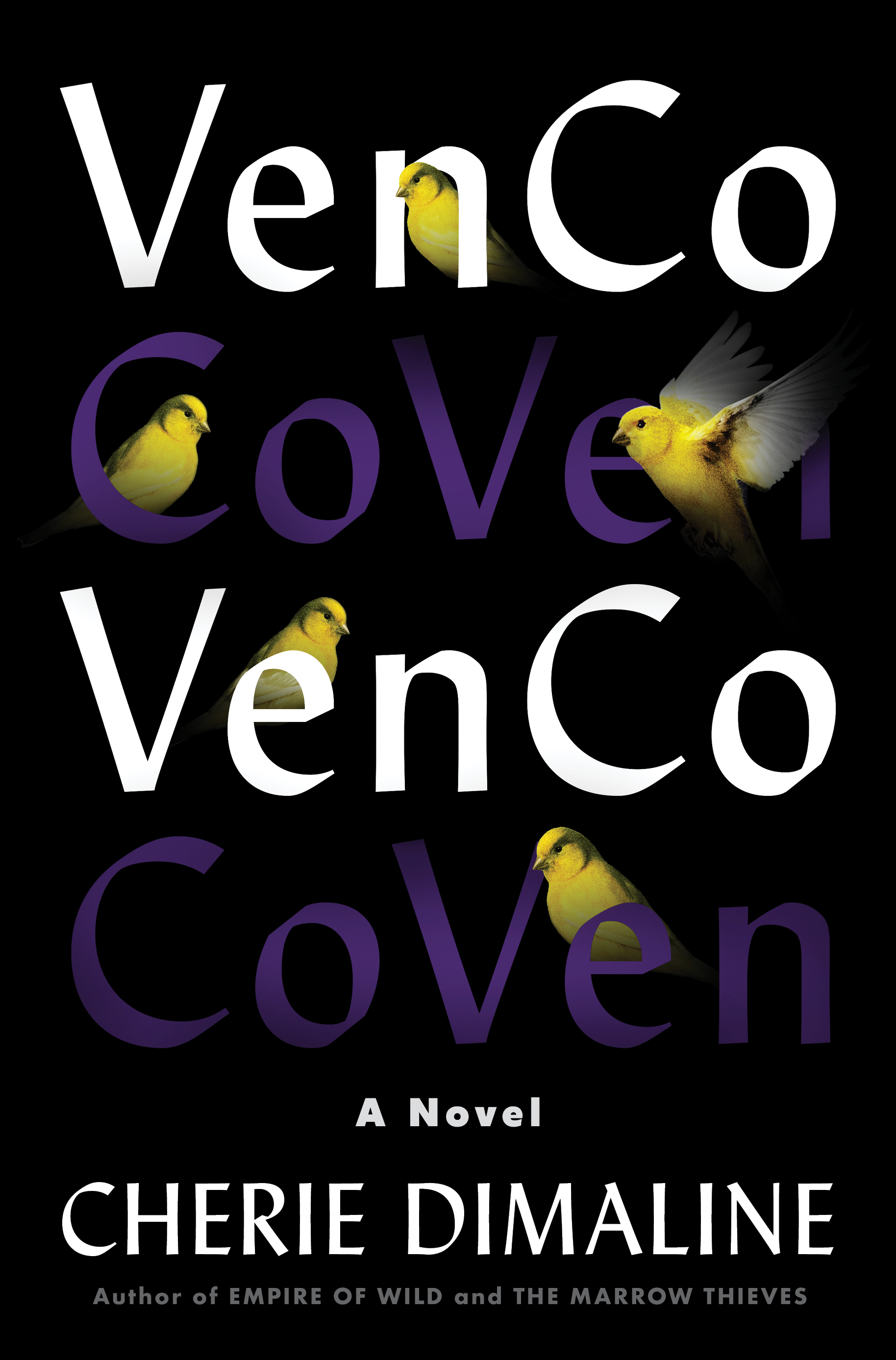
VEN.CO, sapphic Indigenous fantasy drenched in gynergy to keep you sane this Yule

VEN.CO
CHERIE DIMALINE
William Morrow (non-affiliate Amazon link)
$12.99 Kindle edition, available now
Rating: 4* of five
The Publisher Says: Lucky St. James, a Métis millennial living with her cantankerous but loving grandmother Stella, is barely hanging on when she discovers she will be evicted from their tiny Toronto apartment. Then, one night, something strange and irresistible calls out to Lucky. Burrowing through a wall, she finds a silver spoon etched with a crooked-nosed witch and the word SALEM, humming with otherworldly energy.
Hundreds of miles away in Salem, Myrna Good has been looking for Lucky. Myrna works for VenCo, a front company fueled by vast resources of dark money.
Lucky is familiar with the magic of her indigenous ancestors, but she has no idea that the spoon links her to VenCo’s network of witches throughout North America. Generations of witches have been waiting for centuries for the seven spoons to come together, igniting a new era, and restoring women to their rightful power.
But as reckoning approaches, a very powerful adversary is stalking their every move. He’s Jay Christos, a roguish and deadly witch-hunter as old as witchcraft itself.
To find the last spoon, Lucky and Stella embark on a rollicking and dangerous road trip to the darkly magical city of New Orleans, where the final showdown will determine whether VenCo will usher in a new beginning…or remain underground forever.
I RECEIVED A DRC FROM THE PUBLISHER VIA NETGALLEY. THANK YOU.
My Review: VenCo, a front corporation for a CoVen (get it?) is a really fun gynergetic fantasy of what it would take to overwhelm the patriarchy and restore women to power.
Do you need something else to get one for this hijacked-by-jesus (who has a sly off-kilter cameo) sacred solstice holiday?
How about this: Lucky, our PoV character, is at a low ebb when we meet her...she's been struggling along, caring for her dementia-ridden paternal grandmother, scraping the money to survive, and now...the capitalist axe comes down, they're losing their home. Relatable, if in a grim way, to most all of us in or after middle age. Plot twist: It's now that Lucky discovers she's a witch, and the coven that's forming needs her...but not in Toronto, in New Orleans. The coven is forming to bring the world that Lucky's been angry with for most of her life, patriarchal racist exploitive horror that it is, to an end. She's got to assist the assembled women...including transfem Freya, explicitly accepted as a woman...in locating and assembling the spoons that'll generate the power they need to accomplish the task.
There are lots of names that don't always have solid characters attached, there is a notable holeyness to the plot, there is a powerful aura of wish fulfillment here. There is also an even-handed treatment of adversarial relationships. There is a demonization of Patriarchy, it's true, but not (to my surprise) of men.
The reason I gave it four stars is that this story was just plain fun to read. I wish it had been a wee tiny tidge tighter of plot. I'm not going to hold it up as a best of my reading year book. But I loved feeling so at home with Lucky, her deeply stressful life, and her middlescent discovery of her powers and her purpose. I thoroughly agree, in 2024, with the need to smash the Patriarchy and all its boosters and adherents. I was deeply gruntled by the transfem Freya simply...being...unremarkably one of the coven.
If you're going to be among the unenlightened, even the benighted, this coming Yule, bring this on your Kindle. You'll have an escape into a much nicer version of the world at hand, and a little spirit boost as the impending events of 2025 loom ever larger.
Friday, June 14, 2024
GIRLS WHO LIE TOGETHER, exactly what it says on the tin
GIRLS WHO LIE TOGETHER
JESSA RUSSO
Kindle Freebie
$0!
Rating: 2.5* of five
The Publisher Says: Easy summers lead to hard falls in this Grease meets Mean Girls contemporary romance…
When seventeen-year-old Renata Carpenter hijacked her stepdad’s classic car, she hadn’t planned on totaling it and landing her best friend in a cast from hip to heel. She definitely hadn’t planned on being sent to a work program in New Orleans as punishment. And she certainly hadn’t planned on falling in love.
But Ren’s summer of forced manual labor has a bright side: her name is Brit, and she’s everything Ren never knew she needed. First love becomes first heartbreak when their summer romance comes to a crashing close earlier than anticipated. Adding insult to injury, Ren’s break-up with Brit is followed by a big move to a small town.
As if starting senior year completely alone isn’t bad enough, Ren soon discovers that the Hell on Heels mean girl who rules Sun Ridge Prep with an iron fist and a vicious tongue is none other than her first love. Too bad this Brit is far from lovable.
But Ren knows the girl beneath the façade, and she refuses to give up on rekindling their relationship. Secretly, the girls pick up where they left off, falling deeper in love and risking it all to be together. But when their affair is exposed by Brit’s boyfriend, Ren and Brit are faced with the ultimate choice: love or acceptance.
Because they certainly can’t have both.
I RECEIVED THIS BOOK AS A PROMOTION. THANKS!
My Review: The author markets this as a YA title. I disagree. I'd hesitate before I gave it ti a sixteen-year-old, or a naïve seventeen-year-old. So let's say it's more a New Adult title.
It's definitely on the money with the Mean Girls comparison. Ren is a classic Mean Girl. She's also a very horny character, and no respecter of boundaries. Brit: "I'm not gay!" Ren: "Get a load of those tits! Such a sweet pair of [upper]lips!"
Then there's the slur usage. I get reclaiming words, and even use queer myownself these days. That was a nasty one in my youth. But using slurs and only slurs? Not now, not ever. That's reinforcing abuse.
While I thought Brit was toying with Ren's feelings...denying you're gay does NOT absolve you of responsibility for behaving sexually with someone of the same sex...I found Ren deeply dislikable and overbearing. Brit's manipulative. Neither is someone I'd like to spend any more time with.
The main issues above weren't made better by the way the story is structured, with time-gaps that just make the chemistry between these two feel very unlikely for teens to experience. The writing was okay, with flashes of creative interest once in a while. Not a favorite read. Caveat emptor re: sexual content.
Subscribe to:
Posts (Atom)