Showing posts with label family drama. Show all posts

Wednesday, September 9, 2026

THE LIGHT BETWEEN THE PINES, even Kirkus likes it!


THE LIGHT BETWEEN THE PINES
WARREN READ

Ig Publishing (non-affiliate Bookshop.org link)
$18.95 all editions, available now

Rating: 4.5* of five

The Publisher Says: In the stillness of a pine grove, a wrecked car tells a story no one wants to hear.

Red Miller has lived long enough to know when someone is lying, especially his daughter, Gina. On an afternoon in early fall of 1979, Red gives Gina’s boyfriend money he knows he won’t see again, then watches his daughter slip further away, wondering where it all went wrong. Five years later, a call from an Idaho deputy changes everything: Gina has vanished after a fatal car crash, and Red has a grandson he’s never met. Haunted by his failures and the memory of a wife lost too soon, Red travels to a small Idaho town in search of answers. But what he finds is more than a mystery; it’s a reckoning-of love misspent, of the fragile ties that bind us, and of the strange, stubborn hope that still lingers in the quiet spaces between regret and redemption.

The Light Between the Pines is a powerful, slow-burning portrait of family and fallout, told with the sparse beauty and emotional precision of Kent Haruf’s Plainsong and Richard Ford’s Wildlife.

I RECEIVED A DRC FROM THE PUBLISHER VIA EDELWEISS+. THANK YOU.

My Review
: A grandparent who goes into battle for a dead child's child is a story that resonates with old-man me. By far my favorite iteration of it is Let Him Go by Larry Watson. This one's a close second.

Red Miller has the relatively common parenting experience of looking at a child's mate choice and thinking, "did I do *that* crappy a job?" Another not-uncommon event is the child whose own child is hidden from the parent for complicated emotional reasons, or uncomplicated practical ones; there are a million ways a family can fall apart, and Red's living through one or two...if the Idaho deputy on the other end of the phone telling him about his daughter's involvement in a fatal accident and subsequent disappearance, he's feeling like there's a few of her steps down the road of irresponsibility that he is due to catch up on.

Seeing everything unravel is likely a very common experience among the older people, no matter how hard one works there's often enough something that comes along to muck it all up. His wife's early death, his subsequent descent into private grief, his daughter's youthful rebellion, all leading to this moment...well, the details are likely different but you probably know these emotional blows from having endured them.

Now, of course, he has to head east into territory he doesn't know, isn't excited to get to know, and meet people he could do without ever having known existed to see what the hell he has to do to get this mess cleaned up, see if he can actually find a future with his family after losing the heart of it, losing his heart, and making every last mistake he could for the past five years right again.

The quiet, compact...just over 250pp...story is never mired down in the gloopy goofy introspection that can get so tiring when what you want to read is a story not a mea-maxima-culpa. Instead we see the life that Red Miller wants is not the one he has because he's doing a lot of work in the present to create a different one. It's so refreshing; it shows Author Read really took on board the lessons of writing his first book, The Lyncher in Me, about his appalling family secret. It's best to set the scene, say the least possible number of words, and let we-the-reader think it over and decide what we're going to do with it all.

Well applied, that lesson; it's made a terrific story into a pleasure to read.

Sunday, April 19, 2026

BLOOM, what we all hope we'll have space to do but more often do not


BLOOM
ROBBIE COUCH

Gallery Books (non-affiliate Bookshop.org link)
$14.99 ebook, available now

Rating: 3.75* of five

The Publisher Says: From the New York Times bestselling author of If I See You Again Tomorrow comes a delightful and heartwarming novel about family, love, grief, and one precocious houseplant, that reminds us of the beauty of living a life in full Bloom.

Morris Warner is withering away. After the sudden death of his husband, Fred, he has shut himself off from the world. No more going to movies with friends, or swims in Lake Michigan, instead preferring the quiet loneliness of his history books and Jeopardy episodes with only the cat to hear his answers.

Morris’s stepdaughter, Sloan, feels like she has nowhere to grow. She’s about to get married to the man of her dreams, if only her mother will let her actually plan her own wedding and trust her to build her own life after her father’s death.

Jade is drying out. Literally. As a plant in Morris’s home, she and her plant housemates have been slowly wasting away, leaf by falling leaf, since Fred’s death and Morris’s lack of care. She needs to come up with a plan to make her new owner come back to life, no matter what it takes.

New York Times bestselling author Robbie Couch’s Bloom is a wondrous novel where family, love, kindness, and yes, Mother Nature, triumph.

I RECEIVED A DRC FROM THE PUBLISHER VIA EDELWEISS+. THANK YOU.

My Review
: Masses of w-verbing = one star irrevocably, irretrievably gone.

Y'all need to stop that. Jade wouldn't like it, stolidly practical being that she is. Neither do I.

It's the PoVs...Jade the succulent jade plant, abandoned by Fred's untimely passing and neglected by Morris; Morris the bereft widower of Fred, who's really withering up and giving up his life from grief (been there, bud); and Sloan who's Fred's youngest daughter, stuck in a cesspit of grief for her favorite parent and still going through with her ghastly, Babbitty mother's vision of what her wedding to her one true love Todd ought to be.

It all kicks off as Sloan has a bridezilla moment in the florist shop and runs right TF away from her bickering mother and aunt as each tries to force her own choices on Sloan. Even though she's never been close to Morris, her father's teaching colleague and now his widower she runs to her dad's house to talk to Morris about walking her down the aisle. Maybe a giant middle finger at her mom, who got left by Fred for Morris ten-plus years ago...but also, the more Sloan tries to get up the nerve to ask him for the favor, a damned good idea. She had Morris as a teacher in the aftermath of The Affair, that turned into the happy marriage. Her Babbitty mother was not likely to be supportive of Sloan spending a lot of time with the happy couple. So she has never really been in close contact with Morris for long, and so does not already know how destroyed he was by Fred's death.

It causes Sloan to stop thinking about her rage at her Babbitty mother to begin to do things with and for Morris, starting with rescuing Jade from the dark corner she was absent-mindedly shoved into and forgotten by grieving Morris. It's how Jade survives, even thrives, as the story unfolds with its very grown-up restructuring of family ties among all these players and more. Todd isn't a flashy or noisy character, yet he loves Sloan enough to get along with her Babbitty mother, her snotty sister, her gross brother and invisible brother-in-law.

Deserves a damn medal, does Todd.

I'll cut the book report short to observe the story continues its gentle way through the different parties as each processes the grief and the inevitable regret of loss sinking in, in the most surprising ways that you can never see coming. A lot of old hurts...Sloan was never the daughter her Babbitty mother wanted her to be, Morris was the love of her Babbitty mother's one great love's life with all the terrible pain that brings, Jade is dealt a violence and fears she will actually die this time...all interleafed very deftly, very structurally appropriately. You don't need to know details until you get there.

I'd say the ending felt...irresolute...but it feels exactly like the endpoints of real-life complex family situations feel. It's not The End, it's the place the strands come together, cross into a knot and start a new strand of everyone's interrelationship. If you liked Remarkably Bright Creatures or Love & Saffron, this will appeal to you.

Wednesday, April 8, 2026

WORK TO DO: A Novel, like "The Office" only meaner


WORK TO DO: A Novel
JULES WERNERSBACH

University of Iowa Press (non-affiliate Bookshop.org link)
$19.95 paperback, available now

Rating: 4* of five

The Publisher Says: When Eleanor founded Guadalupe Street Co-op in the early 1980s, she was in her mid-twenties and madly in love with her girlfriend, Meg. Together, they envisioned an idyllic grocery store owned by its workers and customers.

Forty years later, Guadalupe Street Co-op is an iconic Austin business with a loyal customer base, an antiquated business model, and a disgruntled staff. Roz, one of the store’s senior managers, is too caught up stalking her ex-wife online to notice that her girlfriend, Molly, is plotting with her coworkers to unionize. Roz also doesn’t see that Molly is not-so-secretly in a situationship with Randy, the dairy manager leading their collective.

Unfolding over the course of a single week during Texas hurricane season, Work to Do pings between the co-op’s first year and present day, as the unionization bid reaches fever pitch. The wind howls, the power goes out, and water creeps through the front door, as questions of who owns the grocery store and who has a right to its future are posed. And will the workers ever be paid enough to buy the organic groceries they shelve?

I RECEIVED A DRC FROM THE PUBLISHER VIA EDELWEISS+. THANK YOU.

My Review
: Hierarchies change people, at the top and at the bottom. They're good for, and at, that...yet we're told that being "a family" is not to be in a hierarchy by the kind of lefty person who sets up a co-op. (I was transported to Wheatsville as I read this.) If that's the case, what kind of family did you grow up in? Parents are our first bosses, our first gods. The idea of hierarchy is instilled in us by "bedtime" and "naptime" and, most hated of all, "bathtime." These activities are policed by Authority, ie parents. Thus from a young age we are in a hierarchy called "family"; soon enough, we begin to rebel. We desire to make our own choices, our own lessons learned our own way.

A unionization drive at a co-op is the business equivalent of adolescent rebellion. It felt to me as though all the characters were coping with adolescent emotional states throughout the story. The nature of any group is to experience friction in different strengths and around different topics of disagreement. This story pits idealism...no co-op anywhere ever is founded to make a profit...and pragmatism...how the hell can I pay rent and buy food this month? It's all tangled up with personality conflicts, old grudges, and the inevitable recrudescence of Being Right in any group attempting to make decisions.

Eleanor, the founder of the co-op, is parent to the idea and has powerful, forty-year-old ideas about the concept of the workers as family. Of course no one's paid enough, no one ever is because capitalism runs on scarcity. No matter that you're structuring a business on a cooperative model, you're still in a capitalist system, its pressures still apply. As the founder (owner is not applicable, they all own the co-op) Eleanor's investment is truly, intimately personal. It explains but does not excuse how thoroughly unpleasant Eleanor is during the whole book.

In point of fact, everyone from Randy the unionizer to Roz the manager, through to Eleanor the founder, is thoroughly unpleasant. Not one of them behaves empathetically, with kindness, or in any way not narcissistically. This is not the read for someone who needs to like the characters they're reading about. It's well-observed, with lots of clever lines; it's got the hurricane and its aftermath to give the reader a serious jolt of adrenaline; it's been part of everyone's experience to be a member of a hierarchy that's experiencing change. I was kept in the flow of the story by these structural realities while not invested in any one character's success. It was an interesting experience of being on the outside of a story, looking on as events unfolded, feeling myself caring in an abstract way about these folks.

Anyone who wonders if queer people running things, leftist running things, or multigenerational structure including all ages, are happier workplaces should read this story. Anyone who thinks life is better when x thing is the center of your work, your relationship, your mind should read this story. People are people. They do and say stupid, ill-advised things. Sometimes hurtful words are fixable, sometimes they aren't...don't think you're being Right will carry you through to inevitable victory...or even to happiness. It's all laid bare in Author Wernersbach's smoothly polished prose.

Read Work to Do when you're after a cautionary tale about hubris, a reminder that empathy is always a better choice, that cooperation trumps selfishness but does not necessarily mean getting what you want. It's a very grown-up person's book, and looks at queer people in all their messy, human glory...and snickers behind its hand.

Saturday, March 7, 2026

REPETITION, recursion...refashioning...recasting....


REPETITION
VIGDIS HJORTH
(tr. Charlotte Barslund)
Verso Books (non-affiliate Bookshop.org link)
$9.99 ebook, available now

One of Maris Kreizman’s Best of Books of 2026 So Far

Rating: 4* of five

The Publisher Says: Prize-winning novel by one of the foremost writers of her generation, explores the horror and beauty of being sixteen-years-old.

In a Norwegian November, when it is dark at waking and dark at sleeping, a novelist in her sixties sits next to a teenaged girl at the opera, and through their padded jackets feels a dreadfully familiar tension conducted from the parents seated on her far side. She thinks back to her sixteenth year. The year she first got drunk and the year she first had sex with a boy. A year of being circled by an anxious, hawkish mother and, at a notable distance, her silent father.

The year her family made an unspoken decision, and an unspeakable sacrifice.

I RECEIVED A DRC FROM THE PUBLISHER VIA NETGALLEY. THANK YOU.

My Review
: "Repetition" and "repetitive" have pretty negative connotations in literary discourse. We'll generally reach for "recursion" (the older term by nearly two centuries) and "recursive" to move the affect into a more positive light. Most of this very short read I was leaning towards grousing about repetitive prose making me feel kinda seasick, like Invisible Man always has; I've never managed to finish the read because of it. This being a novella there was no time for me to get really, really tired of it.
Hope is like a new garment—stiff, tight and glittering—but until you try it on, you won't know if it fits or suits you, while memory is like an old garment: no matter how pretty it is, it no longer suits you, you've outgrown it.

Repetition, however, is like a durable garment that hugs you tenderly, but never constricts or swamps you. I was glad that I hoped for nothing, but why then this feeling of dread?
Early on, we're told there will be repetition, and it's the bloody title of the story; I cannot whinge that I was blindsided or misled. As I said in my review of
Is Mother Dead?, "'Do I confront my deepest self?' asks Johanna, our narrator, in a passage that honestly sums up the entire experience of reading Author Hjorth's writing," an assessment I equally happily apply to this read.

But that repetitive prose...it was not until the Big Reveal about three-quarters into the read that I realized we were in recursive territory, we were shading there all along, as every iteration of the memories our narrator, a woman of my age, recalls her sixteenth year's events and feelings, alive now to their emotional and practical freight in a way impossible to a sixteen-year-old.
She was suspicious and she had cause to be, but I didn’t know that at the time—though I had an inkling that not everything was as it should be with me—that something lived deep within me, was working away in me, and if it led to confirmation, then what? She was looking for signs of something she simultaneously suspected and feared, desperately hoping not to find anything in order to be reassured and so far she hadn’t found anything, but still she didn’t feel safe, because she didn’t know what she was looking for. She wanted to get rid of her unnerving, intrusive suspicion of what might have happened to me by finding evidence that would prove her suspicion was baseless, but seeing as that was impossible, she sought instead to prevent the potential consequences of what she suspected and feared but didn’t actually want to deal with, from a twisted belief that it was possible to do so by smothering me, by forcing me, by nudging me into acting and behaving like a healthy, normal teenager. Only she didn’t realise that her hysteria and fear ultimately suggested and homed in on the very thing she didn’t want to know.
Knowing what you don't want to know is corrosive. It destroys happiness, safety, even selfhood dissolves in its caustic bath. I should know, it's been my reality since 1982.

I was not primed to feel the shock of this story's revelation, then, but rather to bear witness with the narrator. The very best gift to give her is to be with her on her level, in her time, without drama that draws the focus away from her.
I rewrite and I reproduce like Munch painted several versions of The Scream, I repeat and I vary the repetition, shamelessly, with my heart on my sleeve and suffering inevitable heartburn in order to process and understand and put it behind me or to reinforce the bitterness and excitement inside me, in order to change myself through repeating and varying patterns . . .
Recursion, in other words. That's a word mostly used in math or computer science, occasionally someone trots out Chomsky's no-longest-sentence reasoning; but mostly this word is treated like it's wearing a starched white lab coat and a pocket protector (is my age showing or what?) in my opinion quite unfairly. This story is the most recursive thing I've read this year and proudly so. It's the zoomed-in fractal of trauma. It's the infinite capacity of language to iterate until the reader's eyes bleed. In under 150pp.

Truth is always hard to endure. This novel is truthtelling, degrading and repugnant truths told like it or not. The reason I think you should read it is simple: You can put it down. You can take some time to get your head around it. You can, in a pinch, apply the Pearl Rule.

Unlike life.

Facing truth as it's told is hard and it costs you many hard-to-lose things, like illusions and the warm loving comfort of being lied to. Practice in a novel; think about how the second person works as a narrative device; put your chest in the narrator's poking finger's path.

Imagine if there is no choice afforded you.

Welcome to the ugly side.

Sunday, December 7, 2025

SOME STRANGE MUSIC DRAWS ME IN: A Novel, trans awakening story


SOME STRANGE MUSIC DRAWS ME IN: A Novel
GRIFFIN HANSBURY

W. W. Norton & Company (non-affiliate Bookshop.org link)
$16.99 ebook, available now

Rating: 4* of five

The Publisher Says: From an award-winning author, this provocative novel tells an emotionally gripping story about friendship, family, and transgender awakening in a working-class American town.

It’s the summer of 1984 in Swaffham, Massachusetts, when Mel (short for Melanie) meets Sylvia, a tough-as-nails trans woman whose shameless swagger inspires Mel’s dawning self-awareness. But Sylvia’s presence sparks fury among her neighbors and throws Mel into conflict with her mother and best friend. Decades later, in 2019, Max (formerly Mel) is on probation from his teaching job for, ironically, defying speech codes around trans identity. Back in Swaffham, he must navigate life as part of a fractured family and face his own role in the disasters of the past.

Populated by a cast of unforgettable characters, Some Strange Music Draws Me In is a propulsive page turner about multiple electrifying relationships—between a working-class mother and her queer child, between a trans man and his right-wing sister, and between a teenager and her troubled best friend. Griffin Hansbury, in elegant, arresting, and fearless prose, dares to explore taboos around gender and class as he offers a deeply moving portrait of friendship, family, and a girlhood lived sideways. A timely and captivating narrative of self-realization amid the everyday violence of small-town intolerance, Some Strange Music Draws Me In builds to an explosive conclusion, illuminating the unexpected ways that difference can provide a ticket to liberation.

I RECEIVED A DRC FROM THE PUBLISHER VIA EDELWEISS+. THANK YOU.

My Review
: There is always a class divide in capitalist societies. There are reinforced, heteronormative binaries; there are intense pressures to conform. In 1984, these things were unquestioned, and enforced by laws prohibiting "crossdressing" and enabling parents to abuse and harm their children physically and psychically to "straighten them out."

There was a lot more, but that's plenty for now, if you weren't there you should be glad you missed the AIDS deaths, the hoo-rah for Reagan shit, the pillaging of Social Security...oh dear, starting to sound familiar? Oh, I forgot: the war on workers, the plant closures, the pension-fund thefts....

None of that shit is foregrounded but it very much makes the attitude (transfem) Sylvia carries, downright truculent, make more sense than it already does. Melanie...Mel...is attracted to Sylvia for her serious edge, her survivor's black humor, her wealth of knowledge Mel wants and needs. Mel wants to become Max. Mel has no way to verbalize that, has no framework to put a new mind into, is reeling from the very existence of someone...someone she knows...holding a slightly skewed mirror to her thus showing that she is real, there are others.

Of course, capitalist patriarchy is not about to let Mel go.

I'm queer but not trans; I've known it since 1966 without knowing what it was or meant, just that it was me. As a male, my path was hugely easier than Mel's or even Sylvia's. I got threatened and bullied in school. No one ever followed through because I'm also large and tall. It was entirely bad enough; these characters would've given anything to be in my so-easy place. I hurt for them now, in this miraculously better world we've wrestled into being that can never be left to just run the right way because "They"...the god squad, the macho pindicks, the scumbag transphobes...will not allow it. Our lives, our happiness, our progress, all threaten "Them" in some inexplicable way.

I still don't get that. I have the one "christian" sister who said to my face (okay, my ear, it was by phone) that gay marriage threatened her church because "what if "They" make us perform a wedding?! It will diminish my marriage!"

I was more patient then and did not simply hang up and never speak to her again. We had a discussion, but I was so sick with rage that I remember little of it except telling her that if someone sued their church to force them to marry a couple queers I'd contribute heavily to their legal defense fund.

Again, this is mild compared to what the characters face in this story.

It's never been easy to be Other. It leads to the emotional and physical violence of being Othered. As the story moves from 1984 to 2019, I felt a lot of the emotional rawness, the highs and the lows, leaching out; the author wanted, like me, to make some points, and in the context of a novel that drains dramatic tension below optimal levels. It doesn't ever recover, though. We get a satisfactory ending where from the jump I was primed by the intensity of the story for a satisfying one. It's not bad, it's not poorly thought out; it just didn't go to the next level. Things like Mel becoming Max don't resonate like the woofers at a concert because we never delve, or even dabble, in the dysphoria inherent in transness pre-transition; we don't get, let's say, the bathroom-usage nightmares that make the pervasiveness of transphobia and its implicit capacity for potential lethality immediate.

So I land on four stars and strongly recommend you give this (after some probing questions, though) to someone trans you know and love. I think they'll really mean the thank you they offer.

Wednesday, November 26, 2025

THE PORCELAIN MENAGERIE, fiction about the world's most important object of industrial espionage


THE PORCELAIN MENAGERIE
JILLIAN FORSBERG

History Through Fiction LLC (non-affiliate Bookshop.org link)
$9.99 ebook, available now

Rating: 4* of five

The Publisher Says: In a world where ambition is as fragile as porcelain, two lives are shaped by a king's dangerous obsessions.

In 18th-century Dresden, the dangerous whims of King Augustus the Strong shape the court and the lives of those held captive, both people and animals. Johann Kändler, a talented young artist, is drawn into the world of King Augustus the Strong. The king's relentless desire for a lifelike porcelain menagerie could make or break Johann's future. As Johann works to meet the king's impossible demands, he finds unexpected allies in former royal mistress Maria and her daughter Katharina. Johann's art might secure his future-or ruin it if he fails to satisfy the king.

Decades earlier, another story unfolds. Fatima, a Turkish handmaiden, is chosen to replace Augustus's discarded mistress. As she tries to create a menagerie of exotic animals and navigate the intrigues of an unpredictable court, Fatima must learn to survive in a world that values beauty and power above all. She must fight to keep her identity and unlock her own cage in the king's dangerous realm.

Two timelines, bound by a king's art and survival intertwine as Johann and Fatima navigate the king's unpredictable demands and the deadly allure of court life, where ambition can be as fragile as porcelain.

I RECEIVED A DRC FROM THE PUBLISHER VIA NETGALLEY. THANK YOU.

My Review
: Royalty has never had much reason to behave pleasantly to the lower orders...what, after all, can they do to a royal personage?

1789 still scares tyrants. But that's decades away from Augustus the "Strong"'s reign in Saxony. The story of Fatima, a beautiful young servant who catches the King's eye and is traduced by him, and how she manages life as Maria the lowly mistress of the King, exemplifies this.

Before I go on: Animal cruelty in this book turned my stomach. It's well known as a real activity in this royal court. Do not look it up. Trust me. If you read the book for other reasons, do not read chapter 30. At all.

If porcelain had never made it to Europe, the *astonishing* wealth transfer beginning in the 1400s into China, and later into Japan, would never have drained the economy dangerously. It is immensely superior to pottery in strength and durability. It is beautifully translucent, it takes colored glazes readily...being by nature soft white when fired properly...and can be made into very fine, very small shapes, like miniature marble. You most likely don't give much thought to the porcelain in your kitchen cabinets, and only a little more to Granny's stuff in the breakfront, or the figurines Mom used to make you dust.

Augustus the Strong gets credit for that. His decades-long search for the secret to making porcelain...in English we mostly call it "china" nowadays...was a quest to stem the treasure hemorrhage to the country of East Asia where they made whichever of the tens of thousands of pieces he coveted. It's bloody incredible to read about his collection.

Those facts are related in a rather tedious history book called The Arcanum by Janet Gleeson, which has the virtue of being well-researched so worth reading if you really enjoy your china. This novel, being fiction, isn't limited to the history. It delves into a story, based on real people's real lives. Of course it's necessary to burnish up the bones of fact, to pad in some likely-sounding dialogue, to speculate on unrecorded emotional factors that all lives possess.

The resultant novel is a very emotionally affecting read. Maria/Fatima-that-was and her bastard royal daughter Katharina come to life, though not modern life (a good thing), making the very best of the choices open to women in 18th-century Saxony. Johann's efforts as an artist, his careful treading as a man beholden for both living and life to a capricious, moody obsessive of a king, and his relationship to the women of the story all coalesces in a satisfying, if not truly happy, ending.

If not for (factually accurate) chapter 30, I'd rate it higher. Just can not dismiss, diminish, or relativize this one.

Thursday, October 16, 2025

TEQUILA: A Story of Success, Love & Violence, a story of family, business, and love


TEQUILA: A Story of Success, Love & Violence
TIM REUBEN

Meridian Editions (non-affiliate Bookshop.org link)
$19.95 paperback, available now

Rating: 3.75* of five

The Publisher Says: Tequila is the gripping saga of three generations of the Ramirez family. From Sotero Ramirez's humble beginnings to his struggle for success, he and his family must overcome a harsh environment plus the frequent deadly encounters with Mexican drug cartels.

Still, the family's tequila business blossoms into a multi-billion-dollar international conglomerate, and his granddaughter Maria is chosen to manage the company, which relocates from Mexico to downtown Manhattan. But she is plagued by the peccadillos of her L.A.-based brother Tomaso, and the evil scheming of her other brother, Miami-based Miguel, who bring their family business to the brink of ruin and even threaten the lives of Maria and the adversary she falls in love with, Los Angeles lawyer Brian Youngman.

This fascinating intrigue spans the globe, from the farms of Tequila, Mexico, to the skyscrapers of New York, from bayside mansions in Miami to law courts in Los Angeles, jet-setting to the Cayman Islands, the moors of Scotland, Jamaica's beaches, and financial centers in Paris. The story unfolds in unpredictable and at times tragic ways.

I RECEIVED A DRC FROM THE PUBLISHER VIA NETGALLEY. THANK YOU.

My Review
: I did not want to like this story as much as I did. The prose is not excellent, nor is it incompetent; instead, it leaves little to no impression of itself after consuming it.

So why rate it this high? I got wrapped up in the many characters' intertwining lives, their very shady-but-legal wranglings as they determinedly, doggedly built a business of consequence out of an agricultural product. It's quite a fascinating feat to create a "brand" out of a commodity. We live in the time of brands, and mostly we're not examining the ide behind them.

Tim Reuben examines that feat, using as his lens the drive of a family's natural desire to make more for themselves, their people, than simply surviving on doing basic-to-existence work. I had a task to keep the dramatis personae straight. I honestly put a lot of that on Tim, because it's not always clear who's speaking...no one really has A Voice in the literary sense. Some catchphrases, but that's the sitcom version of A Voice.

Resolving María, our root-for character's, dilemma, and seeing her wrestling with the eternal "is family more important than morality?" dilemma, makes this a very worthwhile read. Do not expect to be thrilled by the writing and it becomes a much more exciting story. I just wish it was a better novel. Maybe his next one will be.

Friday, August 8, 2025

THE SOUTH, Booker-Prize longlisted first queer love in Malaysia


THE SOUTH
TASH AW

Farrar, Straus and Giroux (non-affiliate Bookshop.org link)
$14.99 ebook, available now

One of The Guardian's The best fiction of 2025 list!

Time's The 100 Must-Read Books of 2025 selection

A New York Times 100 Notable Books of 2025 selection

Longlisted for the 2025 Booker Prize.

Rating: 4.25* of five

The Publisher Says: A luminous and intimate novel about the weight of inheritance, the bonds of loyalty, and the awakening of love, set against the backdrop of a changing Malaysia.

The South unfolds during a visit by the Lim family to their rural clan estate after a long absence. Jay, in his mid-teens, and his two older sisters are less than thrilled to leave their city for the remote house in the south, but their parents, Sui Ching and Jack, are adamant.

Jay finds he's expected to share a room with Chuan, the son of the estate's overseer, a bit older than Jay but seemingly much more mature and capable in the world. The two soon form an intense bond, but with their very different backgrounds, and even more disparate expectations for the future, the course of their relationship is always an unspoken question.

Meanwhile, change presses in, including the destruction of the farm's beloved orchards, and the sale of the estate is mooted. The relationships between Chuan's father and Jack and Sui Ching go deep, but pressures both internal and external threaten to sever old bonds and upend an entire way of life. The South, at once sweeping and intimate, is a masterful portrait of a family navigating a period of great transformation.

I RECEIVED A DRC FROM THE PUBLISHER VIA NETGALLEY. THANK YOU.

My Review
: Farms feed us. At the vast, unceasing exaction of labor, they feed us. Do they feed farmers? That is, do farmers get fulfillment and satisfaction from the labor they do? (Are there people being farmers in 2025?) And the cost of that labor, the relationships it bends to exigencies city-dwelling consumers don't worry their pretty heads about, how is it borne? Never equally...Nature seems to forbid anything like ease in farming, droughts, excesses of rain, it is literally always something on the socially elite Lim family's inherited land.

Author Tash Aw has done that thinking in this story. He observes and occasionally examines the workings of a family with a farm in Malaya (as it was at the beginning of the narrative) as they farm, live, love, doubt, together and apart. It's a book of calm, eerie stillness as the characters live lives they begin to question...is this necessary? am I necessary to it? am I doing good for the world?...and analyze how things are and aren't making them happy. Love is in the air between boys whose families have known each other most all their lives; loves slides out of mom Sui and dad Jack's grasp; love, true to its reputation, ruins everything with its exquisite torturous promises of pleasure, happiness, belonging that are so elusive to the Lim siblings. “We feel as though our entire world changes when we get older, every object, every person, has been rearranged into some strange new configuration, but in fact nothing at all has changed.” Nor will it ever. That realization stymies and disheartens many. I find it exhilarating in its challenge to redistribute attention, wisdom, knowledge within the unchanging reality of Life.

Maybe Jay Lim won't get Chuan, the boy he loves (In that moment, forever seems like a comforting notion. But at that age, what does either of them really know about time?), maybe Jack Lim will stop him as his culture demands despite his own complicated past, maybe Sui Lim won't be able to move past regrets for things undone. Maybe Malaysia's long tradition of relative harmony among its constituent groups is about to blow up into full-on Sinophobia. What will the Lims do then? We can't call it an orchard if it no longer bears fruits pretty much sums up the dilemmas in the whole book.

Family drama is evergreen because family is universal. Jay's older sisters are plumping for connection in the form of religious nuttery, the other in the embrace of rejection. (Parents believe this, so she rejects it; a stance adolescence damn near demands.) Jay's struggles with finding queerness in his world, knowing it's there and just out of his reach, is how I know the author understands me across generations and cultures: "This emptiness feels like hunger but Jay thinks that it is really a longing, though he doesn't know what he is longing for."

I was delighted to read this story of queer self-discovery against a backdrop of cultural and economic shifts that both enable and inhibit the journey. It is not a negative, but an observation, that hearing from so many points of view does not center queerness in the story quite the way I'd thought it would based on how it's marketed. It wasn't enough Jay to make the queer angle the only one in the telling, so I took three-quarters of a star back.

But how very beautiful and quietly profound and enfolding this read was! I recommend it to all including the "eww-ick" homophobes.

Sunday, June 1, 2025

I LEAVE IT UP TO YOU, do not read while hungry!


I LEAVE IT UP TO YOU
JINWOO CHONG

Ballantine Books (non-affiliate Amazon link)
$13.99 ebook, available now

Rating: 4.25* of five

The Publisher Says: From the award-winning author of Flux comes a dazzling novel about love, family, and the art of sushi that asks: What if you could return to the point of a fateful choice, wiser than before, and find the courage to forge a new path?

A coma can change a man, but the world Jack Jr. awakens to is one he barely recognizes. His advertising job is history, his Manhattan apartment is gone, and the love of his life has left him behind. He’s been asleep for two years; with no one to turn to, he realizes it’s been ten years since he last saw his family.

Lost and disoriented, he makes a reluctant homecoming back to the bustling Korean American enclave of Fort Lee, New Jersey; back into the waiting arms of his parents, who are operating under the illusion he never left; and back to Joja, their ever-struggling sushi restaurant that he was set to inherit before he ran away from it all. As he steps back into the life he abandoned—learning his Appa’s life lessons over crates of tuna on bleary-eyed 4 AM fish runs, doling out amberjack behind the omakase counter while his Umma tallies the night's pitiful number of customers, and sparring with his recovering alcoholic brother, James—he embraces new roles, that of romantic interest to the male nurse who took care of him throughout, and that of sage (but underqualified) uncle to his gangly teenage nephew.

There is value in the joyous rhythms of this once-abandoned life. But second chances are an even messier business than running a restaurant, and the lure of a self-determined path might, once again, prove too hard to resist.

Why do we run from those we love, and why do we still love those who run from us? A highly entertaining and poignant story about second chances and self-discovery, I Leave It Up to You pilots through the loss, love, and absurdity of finding one’s footing after the ground gives way.

I RECEIVED A DRC FROM THE PUBLISHER VIA NETGALLEY. THANK YOU.

My Review
: The Bear starring Daniel Dae Kim, only queer. Like that show, it's about the people doing the work of feeding others not the act of making and serving the food.

The lead is Jack, Junior. He has never been one to deal with anything he can run away from; waking up from a coma to find that his fiancé has moved on with his own life without a proper ending...well...it's a condign punishment. Far more unnerving is having to return home to the family he treated the way his belovèd treated him.

Being Korean, they take him in; being Korean, there's a steep emotional cost to their reintegration of the queer prodigal. Now it's all on Jack's shoulders to do the thing he ran away to escape...run the restaurant that supports them...plus make his amends for the truly terrible, and in their ancestral culture deeply dishonorable, way he abandoned them.

Their homophobia does not excuse him of feeling guilt even in his own mind. He's forced to grapple, belatedly but inescapably, with coming of age and coming out instead of running away from this existential conflict. Delaying this always complex and usually painful process does not make it one bit easier. A raft of new complications are added on top of the old, homophobic ones: what the hell is COVID? Why won't his fiancè talk to him? How can he presume to advise his nephew, son of his recovering-alcoholic brother, on life when he has royally screwed his own? Can he learn to want the legacy of restaurant-running his deeply unhappy father and super-pragmatic mother are so desperate to wish on him? How can he ask Emil, the nurse who cared for him during his coma, to be...to be...well, what exactly does he want Emil to be?

You can see how the layers and the complications bring to mind Carmie and The Bear. It's not like a mystery novel, it's more like an episodic show, in that you're expected from the get-go to invest in the people doing the stuff rather than the stuff being done. I'll always batten on any story that takes a man on the emotional journey of self-discovery, self-actualization. It's much more interesting to me than another facile-but-fun falling in lust/love/like in any order story could be.

I can't quite offer all five stars because the story can't quite offer enough of an ending. Yes, Jack is on a new road through life. He has a sense of himself as in control of more of his life than ever before, and gets that from a very realistic decision to let go of many of his self-limiting beliefs. This is done, however, by implication. No scene illuminates this decision, and that absence...likely done to avoid being smacked in the face with it...means Jack continues to *feel* to readers like his old self but inexplicably making better decisions. Umma, the mother, is short-shrifted as a person...like she would be in the culture she comes from. It felt a bit raggedy of Author Chong to give her a mysterious boyfriend and not do more with it. Chekhov's gun, anyone? And the bigly under-thought-through inclusion of COVID and its impact on the small family businesses of the US. The loving, delightful use of use of evocative description for sushi ingredients, preparation, and its cultural resonances for this Korean family made me wish to see more of this cursory subplot. Describing the food and leaving the business underlying its service out wasn't fully satisfying.

What was satisfying was the manner of Author Chong's incorporation of Jack, JUNIOR'S, queerness. Yes, a point of conflict; no, not a source of rage and rejection. Jack's running away was more of a problem than his sexuality.

I love this story's good parts a lot, I think the author deserves our eyeblinks and treasure. A very good story well-told is a thing we all need.

Sunday, May 4, 2025

NIGHT OF THE LIVING REZ, Native American author Morgan Talty bursts onto the literary radar bigtime


NIGHT OF THE LIVING REZ: Stories
MORGAN TALTY

Tin House Books (non-affiliate Amazon link)
$9.99 ebook editions, available now

Rating: 5* of five

The Publisher Says: Winner of the PEN/Robert W. Bingham Prize, National Book Critics Circle John Leonard Prize, American Academy of Arts & Letters Sue Kaufman Prize, The New England Book Award, and the National Book Foundation 5 Under 35 Honoree

A Finalist for the Andrew Carnegie Medal for Fiction, the Chautauqua Prize 2023, and Barnes & Noble Discover Book Prize

Named a Best Book of the Year by The New York Times, NPR, Esquire, Oprah Daily, and more


Set in a Native community in Maine, Night of the Living Rez is a riveting debut collection about what it means to be Penobscot in the twenty-first century and what it means to live, to survive, and to persevere after tragedy.

In twelve striking, luminescent stories, author Morgan Talty—with searing humor, abiding compassion, and deep insight—breathes life into tales of family and a community as they struggle with a painful past and an uncertain future. A boy unearths a jar that holds an old curse, which sets into motion his family’s unraveling; a man, while trying to swindle some pot from a dealer, discovers a friend passed out in the woods, his hair frozen into the snow; a grandmother suffering from Alzheimer’s projects the past onto her grandson; and two friends, inspired by Antiques Roadshow, attempt to rob the tribal museum for valuable root clubs.

A collection that examines the consequences and merits of inheritance, Night of the Living Rez is an unforgettable portrayal of an Indigenous community and marks the arrival of a standout talent in contemporary fiction.

I RECEIVED A DRC FROM THE PUBLISHER VIA EDELWEISS+. THANK YOU.

My Review
: When a new voice speaks in a jaded crowd, it feels like being next to a rocket launch does. The sound is so loud, so intense, its pressure unbalances your legs and knocks you back on your heels.

Morgan Talty, laddies and gentlewomen. From the first story, where we're confronted with cultural touchstones not in upper-class white peoples' frames of reference, we're in assured hands...the limning of the setting, the colors of the relationship dynamics, the milieu, all in three paragraphs...and challenged to accept the entire package as it is.
"Fucking bullshit, fucking goddamn winter, what the fuck."
I laughed.
"It ain't funny, Dee."
"Look," I said. "Do you want me to cut my braid too?"
I shall, comme d'habitude, use the Bryce Method to assess the stories one-by-one.


Burn is the story I quoted above. A short, sharp shock, a shot across the bow of your luxury literary yacht, a foghorn on a sunny cruise. Disorienting by design, this is your chance to return to familiar shores.

I didn't. 5 impressed stars

In a Jar follows David studying his fractured family as it re-forms in unfamiliar ways. His much older sister, first an absence, then a hard sharp corner; his Mumma, inscrutable to kid-eyed David, touchy and strange; Frick, a man new to David and in a place his abandoned father once didn't want.

All the surprise in this concatenated chain of beings comes from knockings in walls, from jars of ill will, from refrigerated poisons ingested through other mouths. 5 more stars

Get Me Some Medicine follows low-life Fellis...the one talking to Dee in the quote all the way above...as he and Dee scrape the bottom of the barrel, drain the butt-end-filled last can of beer, and do themselves no good whatever doing it.

You can't save people. Nor should you, after a while, try. I don't think these boys, these pushing-thirty boys, can be saved. And neither do they. Dee is, at the very least, possessed of glimmers of self-awareness; Fellis, none. 4*

Food for the Common Cold shakes the ugly bits you never tell your partner loose. David, eleven now, can't quite grasp why Frick is so angry; Mumma can't tell him, he's too young; his Dad's far away and shut out like always; so it festers and seethes, finally David lances the boil out of fear for his mother, and out it all oozes for everyone to see, smell, and finally clean up.

Leaving David sick with, what, a cold? A cloggy, soggy cold? Maybe, maybe more. 4.5*

In a Field of Stray Caterpillars gets useless shitty Fellis even deeper into the badness, as he's now got Dee driving him home from his ECT treatments then spending the night there...and Dee's got a white woman on the line, knowing there's never going to be a good ending to that story, still running from what he knows he needs to do by using Fellis.

And this night, the one we're joining the boys to live through, is in the midst of a major mating season overload. The reek of the rotting animals mirrors Fellis and Dee's vacuity by filling the world with a passing stink that won't even result in better-nourished weeds. Fellis is so far gone the nurses are taking about putting a port in him so they don't have to hunt for a vein when they need to fry him with ECT.

How perfect. 5*

The Blessing Tobacco is a family...David's family, now with his much-older sister home...coming to terms with the end of an elder's life, when her body will not die at the same rate as her mind. It's just terrible and painful and all folded in with each others' craziness, fear, and anger.

Outliving your mind is a terrible curse. Outliving your family? Oh. It's scalding water on an icy windshield. 5*

Safe Harbor isn't...when is it ever? How do you ever know when you're going to have that moment of final fear? The one that changes your orientation in the world, the one where you are not the same person between seconds? David becoming Dee doesn't happen in front of us. But happen it does and we don't know him one speck better than before. 5*

Smokes Last brings me face-to-face with one of my most beloathèd addictions: cigarettes. I despise smokers. They reek, they're so unbelievably selfish, taking up all the air in a room and then flinging the leftover chunk of spit-soaked stinking garbage wherever and however it suits them, slowly drowning in the phlegm they hack onto streets and sidewalks for other people to deal with.

And here's fourteen-year-old David shovin' one into his mouth, "just suck a cock! it tastes better and at least somebody's happy!" I want to (maybe did) shout at him. He and his buds out bein' hooligans, beatin' each other up, chuckin' rocks...kids are so much the same everywhere.

Growing up. Not getting any guidance. No wonder what happens happened. 4*

Half-Life is the sharp part of the descent. It's harrowing and appalling and brutally bitterly honest. 4.5*

Earth, Speak is rock bottom. Harrowing. 5*

Night of the Living Rez would've been more palatable if it'd been zombies, or pugwagees; instead it was all over the fucking TV because of course it was and, if it'd been a white woman, it would've been self defense. 5 appalled stars

The Name Means Thunder burns in my head. The sheer horror of what happens when you can't undo a deed. The never-ending awfulness of life's worst moments defining you, charting your course. Too many undone deeds that lead to a done one. The worst of it is: you can't not see it in every moment of every awful undone deed. 5*

Morgan Talty's debut. Can you even imagine having this in you and no way for it to come out that won't change...everything.

Friday, February 7, 2025

THE BEE STING, Paul Murray's calling-card book


THE BEE STING
PAUL MURRAY

Farrar, Straus and Giroux (non-affiliate Amazon link)
$12.99 ebook editions, available now

Rating: 3.5* of five

The Publisher Says: From the author of Skippy Dies comes Paul Murray's The Bee Sting, an irresistibly funny, wise, and thought-provoking tour de force about family, fortune, and the struggle to be a good person when the world is falling apart.

The Barnes family is in trouble. Dickie’s once-lucrative car business is going under―but rather than face the music, he’s spending his days in the woods, building an apocalypse-proof bunker with a renegade handyman. His wife Imelda is selling off her jewelry on eBay, while their teenage daughter Cass, formerly top of her class, seems determined to binge-drink her way through her final exams. And twelve-year-old PJ is putting the final touches to his grand plan to run away from home.

Where did it all go wrong? A patch of ice on the tarmac, a casual favor to a charming stranger, a bee caught beneath a bridal veil―can a single moment of bad luck change the direction of a life? And if the story has already been written―is there still time to find a happy ending?

I RECEIVED A DRC FROM THE PUBLISHER VIA NETGALLEY. THANK YOU.

My Review
: This book is A Lot. Long, deep, densely packed.

I enjoy reading anything that plays in the quantum fields of many worlds. The idea of one.little.change. making all the difference in one's life is very empowering, as well as nonsense, and honestly hazardous. All of those are reasons we love to mess with it safely in our fiction. Here Paul Murray goes full-tilt boogie down this waterslide, wets us to the bone in the spume of his landing, and completely destroys our hairdos.

Is it good anyway? Well...honestly...yes, but in a curious way no. Want to laugh hollowly at the folly of the merely mortal? Come hither, disciple dearest. Want to process your grief at the titanic (or Titanic) sinking of the life you planned? This is your altar call. Or is the appeal of a stonking novel immersive and redemptive reading? Hie thee hence, pilgrim. Nothing for you here...there is no redemption here, no one's gettin' what they think they deserve before the Apocalypse that's looming calypses. Need rigorous copyediting with Oxford commas, periods, line breaks, and other such embankments to channel the flow of the words? Ite, missa est. No communion cookies for you, though madeleines will be served in the Sodality of Marcel's post-tea.

Digressive is my word for this seemingly Irish specialty of novels (Milkman's another favorite) that don't give a feck for your English rules. Me, I'm down with it, I like things that don't slavishly straiten their gates to some Authority's pre- and proscriptions just cuz. Cry havoc and let slip the dogs of the culture wars! Whatever you do, don't be boring!

That said...well, honestly I found the central thesis of the family tedious and predictable: Dad's crushed, Mom's hogtied and struggling, Junior's got his antennae out so far they can find meaning in electric currents imperceptible to an ammeter, Sis is in thrall to the Mother of All Crushes on the most dreary poseur in all of literature...really, does this need retelling? The Man in the Grey Flannel Suit, To the Lighthouse, The Prime of Miss Jean Brodie, and every Colleen Hoover book ever written fill these separate niches extremely ably...have for most of a century. (It felt like a century passed when I read 102pp of It Ends With Us. *shudder* I {mildly mis-}quote that nasty little creep Truman Capote: "That's not writing, that's typing.")

So my bag was mixed. I loved parts, liked most of it, and was impatiently awaiting liftoff that never quite generated enough thrust to get me over the literary Kármán line. Hence my stingy-feeling 3.5 stars. It might be stingy but it's waaay better than most stuff I read and toss aside. I'm really umpressed with Author Murray's swinging for the fences in all his writing and storytelling. I mean, mad respect for going toe-to-toe with the twentieth century's greats (and megabestselling hack Hoover)! But coming for the monarch isn't safe lest you fail to slay them.

No slaying here, though some serious wounds were delivered.

Saturday, December 21, 2024

WELLNESS, a truly moving, involving, deeply-felt trip inside Commitment with a capital "C"


WELLNESS
NATHAN HILL

Alfred A. Knopf (non-affiliate Amazon link)
$13.99 Kindle edition, available now

Rating: 4.75* of five

The Publisher Says: A witty and poignant novel about marriage, middle age, tech-obsessed health culture and the bonds that keep people together

When Jack and Elizabeth meet as college students in the '90s, the two quickly join forces and hold on tight, each eager to claim a place in Chicago's thriving underground art scene with an appreciative kindred spirit.

Fast-forward twenty years to married life, and alongside the challenges of parenting, they encounter cults disguised as mindfulness support groups, polyamorous would-be suitors, Facebook wars, and something called Love Potion Number Nine. For the first time Jack and Elizabeth struggle to recognize one another, and the no-longer-youthful dreamers are forced to face their demons, from unfulfilled career ambitions to painful childhood memories of their own dysfunctional families. In the process Jack and Elizabeth must undertake separate, personal excavations, or risk losing the best thing in their lives: each other.

I RECEIVED A DRC FROM THE PUBLISHER VIA NETGALLEY. THANK YOU.

My Review
: The struggles that all who form, and sustain, the heavy bonds of matrimony are everfreen plots because most of us have some experience of them. It doesn't matter how much you love each other, it matters how committed you each are to the friendship you share with your chosen partner. Love ebbs and flows, common interests wax and wane, people grow and change, and what makes couple-stories so endlessly interesting is how they are shown managing...or not...these deeply familiar challenges.

It is absolutely clear to me that Author Hill, in his second novel after the startlingly assured The Nix, has honed his craft to a sharp edge. He doesn't shy away from the difficult or the painful parts of commitment. The hateful, hurtful things people say when they are in a deeply enmeshed relationship are both unique and common. There is a certain kind of dynamic in US couples of different socioeconomic backgrounds that's central to this book. We are taught that ours is a classless society, but it is not. The wealth of one family is always a weapon in the couplehood of one its members; a more effective one when the other partner is not from equal wealth.

That bludgeon goes both ways, of course. After a child is born, dynamics change, often for the worse, as incompatible parenting goals are a major cause of divorce. In this story, the couple...a daughter of wealth and privilege, a psychologist, and a deeply wounded soul who feels shackled and devalued by her working class artist husband...are twenty years into a commitment neither can remember why they made.

It absolutely does NOT help that they're living in a surveillance-capitalist society that valorizes getting and spending, when neither has a set of core values instilled from solid bases in love to resist these relentless pressures. It is obvious Author Hill has little use for facile patching-up life hacks or quick-fix lifestyle gurus. He dedicates a lot of space to social media's machiavellian algorithm driven effects. (Coulda been less for all of me, but hey...) The thesis is, however, what good is hacking or fixing stuff too fragile and hollow to last? Your old marriage is not delivering the same thrills...move on, get something new and better.

Right?

Not necessarily. Not even desirably. Open your mind to the possibility that just maybe your life doesn't need to be fixed. Maybe instead your relationship to your life needs to be recalibrated, reassessed, revalued. This being a message I resonate with, I found the read compelling and involving.

Does learning to make the best of it mean settling? Mean getting less out of life? Or is it instead the way to find deeper, more important ways of being who you are inside this long-term commitment to yourself, and your partner, to be well and truly together?

Wellness is that endlessly relatable journey, set in a time where even asking that kind of question isn't encouraged by anything around us. Anyone in a couple, past or presnt, ongoing or ending, will find a lot of deeply interesting details to muse over. A lot of richly textured background to admire, even envy. A lot of deep and scary emotions to batten on from the safe remove of fiction.

I'd rate this the full five of five were it not for what felt to me like the author's rather-too-evident need to overshare. A funny thing to say in a review of a novel about intimacy, I know, but I'm left a bit overfamiliar wuth his opionons of the self-help/new-age/quick-fixery. A couple times, okay; after a while, what is this really about, Author Hill?

I'm highly recommending this read for all partners in a long-term relationship to load onto the /kindle this #Booksgiving. It is manna from heaven to feel seen in stressful times; family "Togetherness" is rough any time, but now...? Bring some independent comfort with you this Yule.

Thursday, November 7, 2024

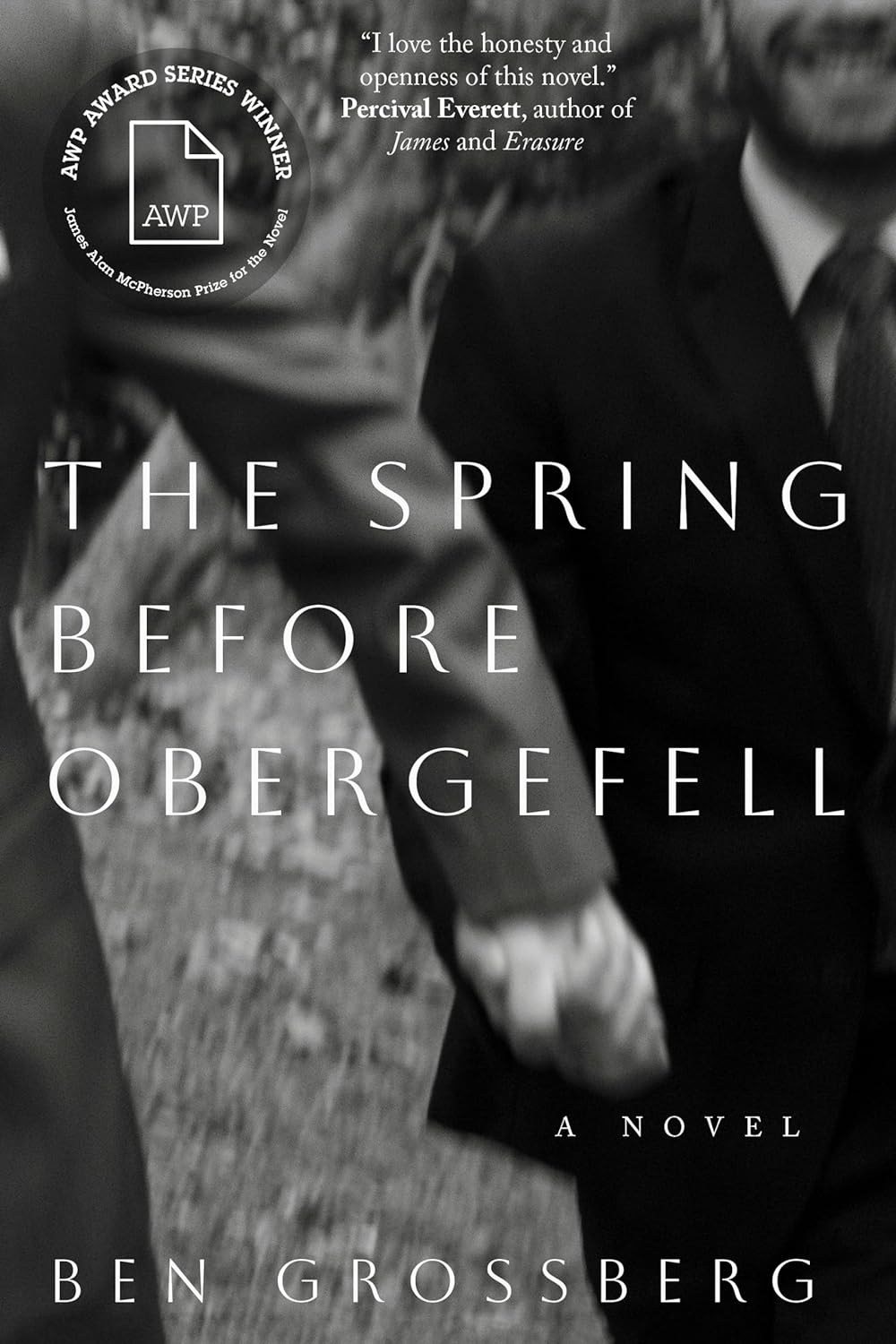
THE SPRING BEFORE OBERGEFELL, hope in dark times...aimed directly at older gay men


THE SPRING BEFORE OBERGEFELL
BENJAMIN S. GROSSBERG

University of Nebraska Press (non-affiliate Amazon link)
$20.85 Kindle edition, available now

WINNER OF THE 37TH Lambda Literary Awards for Gay Romance!

Rating: 4.5* of five

The Publisher Says: It’s not easy for anyone to find love, let alone a middle-aged gay man in small-town America. Mike Breck works multiple part-time jobs and bickers constantly with his father, an angry conservative who moved in after Mike’s mother died. When he’s not working or avoiding his father, Mike burns time on hookup apps, not looking for anything more. Then he meets a local guy, Dave, just as lonely as he is, and starts to think that maybe he doesn’t have to be alone. Mike falls hard, and in a moment of intimacy, his pent-up hopes for a relationship rush out, leading him to look more honestly at himself and his future.

Winner of the James Alan McPherson Prize for the Novel, Ben Grossberg’s The Spring Before Obergefell is about real guys who have real problems, yet still manage to find connection. Funny, serious, meditative, and hopeful, The Spring Before Obergefell is a romance—but not a fairytale.

I RECEIVED A DRC FROM THE PUBLISHER VIA NETGALLEY. THANK YOU.

My Review
: I so relate to Matteo, Mike's first RL shot at Love. Catalyzes something good and big; doesn't get to participate, too acerbic and just Too Much.

It's a curse, unless of course it's not. It felt very very good to read Dave and Mike's borning relationship.

A story set ten years ago about the challenges of forming relationships as gay men in homophobic Murrika. There has never been a moment where this subject, treated with hope, has been more welcome. We're now looking into the maw of Project 2025. *horripilation*

Nothing in this book leads me to believe the author was predicting the future as he wrote it. It's still a welcome moment of hope in a bleak landscape. Part of keeping hope alive is to feed it. The Spring Before Obergefell offers readers, gay men in particular, and older gay men for sure, a story that deals with the reality of family in this new age of darkness. There is always hope. It feels like there is not sometimes. Mike and his world...well...hope is what he found. That message trumps all the noise and chaos of the world.

Thursday, August 8, 2024

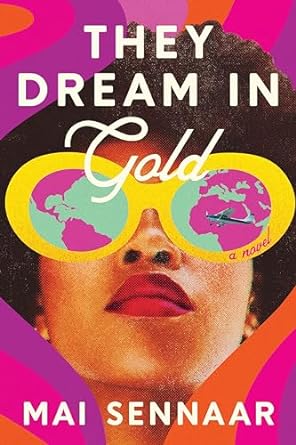
THEY DREAM IN GOLD, debut novel from tyro publisher SJP Lit...both worth watching


THEY DREAM IN GOLD
MAI SENNAAR

Zando/SJP Lit
$28.00 hardcover, available now

Rating: 4* of five

The Publisher Says: A “luminous” (Tara Conklin) literary debut following two dreamers, one intercultural family, and the diasporic pursuit of home.

When Bonnie and Mansour meet in New York in 1968―his piercing gaze in a downtown jazz club threatening to carry her away―their connection is undeniable. Both from fractured homes, with childhoods spent crossing the Atlantic, they quickly find peace with each other. And as Mansour’s soaring Senegalese melodies continue to break new ground, keeping time with the sound of revolution and taking him and Bonnie from Paris to Rio and Switzerland, it seems as though happiness might finally be around the corner for them both.

Then Mansour goes missing. His Spanish tour was only meant to last three weeks, but three months later, he and his band have not returned. In his absence, Bonnie reckons with her memories of him, and comes to understand that the hopes of so many women―her mother and grandmother; his mother, aunt, childhood friend―rest on her perseverance. Stirred by the life growing inside her, Bonnie puts a plan in action to find him.

Spanning two decades and moving through the hotbeds of the African diaspora, They Dream in Gold is an epic yet intimate exploration of the migrant hunger for belonging and a powerful, intergenerational testament to our shared humanity, for lovers of Tara Stringfellow’s Memphis and Abi Daré’s The Girl with the Louding Voice.

I RECEIVED A DRC FROM THE PUBLISHER VIA NETGALLEY. THANK YOU.

My Review
: Buckle up...this is a complicated read. Long at over four hundred pages, complex in its interrelated cast of characters, difficult to summarize as a result. Senegal, Paris, New York...the Twenties, the Sixties...familys seen in passing, a family being formed...this novel's a web.

It's a debut novel for the storyteller and close to a debut for the publisher. Sarah Jessica Parker's SJP Lit is part of a company called Zando Projects (Zando's website). SJP Lit's mission statement is:
Sarah Jessica Parker’s SJP Lit publishes sweeping, expansive, thought-provoking, and discussion-driven stories that are inclusive of international and underrepresented voices. SJP Lit books capture the contemporary imagination and reflect a wide range of ideas and experiences.

So someone famous decided not to start a book club, or an imprint in the Corporate World, but a company publishing books she curates and pays for and edits for us to see what she wants to read and offers us as worth it to read, too. As I would expect from Parker's résumé, the story told here is very much focused on character development. Bonnie and Mansour are not, despite what you could reasonably expect from the synopsis, the only or even the best developed characters. Because the story does not conform to linear time's slightly tedious constraints, we get the family polyphonics as well as the dynamics. This is a fancy way for me to say, if you're expecting a straightforward family saga, you're going to be left wanting. If you really want a book you can inhabit, one that feels more like a series (I mean this in the good way!) than a standalone, here's a great summertime immersion.

The way we move from time to time, from place to place, demands of the reader a level of participation, of code-switching, that might be off-putting for some. I think you'll twig quite quickly to the cues that indicate we're going to shift, though they are not the same from one instance to the next. What I like about that is the mood of the read never stagnates, a danger that family sagas can fall into readily. After a time many of them feel like trauma porn, or a weird triumphalism celebrating a character's Strength, Nobility, and Fortitude. Yeeeccchhh

Author Mai Sennaar doesn't succumb to that too-easy, too-incredible stuff. Her women are beset by worries and doubts. They wonder if things are worth it if they hurt this much, demand this much of them. They stumble, fall, and fail. But they never stay down for good.

It is a distinction, not a difference, but it is a consequential one that speaks to the author's intent. She is not going for the facile road to storytelling success. That is clear from the start. For this old white man, that made the read all the more interesting and involving. Some of that could be down to the slightly more...distant...way the narration is deployed, it gets an overview feeling across. Back to that polyphony of PoVs. This is a natural outgrowth of it. I found it enhanced my reading experience, in part because it enabled Author Sennaar to put me more firmly into the time and place the different strands of her story-web flow through.

I found I was disgruntled by one big, star-losing thing: Like Sweet, Soft, Plenty Rhythm (whose author flatteringly blurbed this book), every one of these women is circling a man. The story's center is a man (absent though he be). Is it that hard to make these women interrelate around themselves and each other?

A crotchet of mine. The Bechdel test still matters to me because the queer equivalent is abysmal still...gay characters feature more than ever, less than reality says is fair. So, no fifth star for you, debut novel. Author Sennaar is deeply talented and should be supported, make no mistake.

Maybe she's got more to say, soon. Let's show we're listening.

Friday, June 28, 2024

THE FITFUL SLEEP OF IMMIGRANTS, messy the way life is, real the way fiction needs to be


THE FITFUL SLEEP OF IMMIGRANTS
ORLANDO ORTEGA-MEDINA

Amble Press (non-affiliate Amazon link)
$9.99 Kindle edition, available now

Rating: 3.5* of five

The Publisher Says: Award-winning author and immigration attorney Orlando Ortega-Medina returns to 1990s San Francisco in The Fitful Sleep of Immigrants, a powerful family drama that plays out within a captivating legal thriller.

Attorney Marc Mendes, the estranged son of a prominent rabbi and a burned-out lawyer with addiction issues, plots his exit from the big city to a more peaceful life in idyllic Napa Valley. But before he can realize his dream, the US government summons his Salvadoran life-partner Isaac Perez to immigration court, threatening him with deportation.

As Marc battles to save Isaac, his world is further upended by a dark and alluring client, who aims to tempt him away from his messy life. Torn between his commitment to Isaac and the pain-numbing escapism offered by his client, Marc is forced to choose between the lesser of two evils while confronting his twin demons of past addiction and guilt over the death of his first lover.

I RECEIVED A DRC FROM THE PUBLISHER VIA EDELWEISS+. THANK YOU.

My Review
: Very interesting take on the insanely vicious US immigration system pre-marriage equality. Add in a battle against the monster of addiction and you have quite a ride of a read.

People driven to action by ever more foreclosed options to achieve their goals are the raw meat whose roast-and-veggies we call fiction. Marc's dark past includes substance abuse and a very troubling death. He's haunted by the way his ability to be there for and give help to Isaac is limited by his past.

So far, so good. The story's got lots of material anyone over, say, 25 or 30 will relate to. What keeps a fifth star off my rating is the sheer idiocy of a lawyer not knowing for sure and certain his own intimate partner's immigration status! He wasn't born in the US, and you never asked? "Honeybunch, let's get you a bank account, so whip out the green card." This is lax in the extreme and no lawyer I've ever known would just not think to check on this even if not formally.

While I had fun reading the book I was never swept into the story. It is all down to me being picky about the thinking-through of characters' reasonable actions and responses.

Wednesday, April 10, 2024

SNAKE ISLAND: A Novel, another good "discover Australian culture through violence" thriller


SNAKE ISLAND: A Novel
BEN HOBSON

Arcade Crimewise
$16.99 ebook, available now

Rating: 3.75* of five

The Publisher Says: For fans of Cormac McCarthy, Phillip Meyer, Fargo, and Justified, a gritty rural noir thriller about family, drugs, and the legacy of violence.

In an isolated town on the coast of southern Australia, Vernon Moore and his wife, Penelope, live in retirement, haunted by an unspeakable act of violence that sent their son, Caleb, to serve time in prison and has driven the couple apart. Ashamed, they refuse to talk about him or visit, but when a close friend warns Vernon that Caleb has been savagely beaten, he has no choice but to act to protect their only child.

The perpetrator of the beating is a local thug from a crime family whose patriarch holds sway over the town, with the police in his pay. Everyone knows they trade in drugs. When Vernon maneuvers to negotiate a deal with the father, he makes a critical error. His mistake unleashes a cycle of violence that escalates to engulf the whole town, taking lives with it, revealing what has been hiding in plain sight in this picturesque rural community and threatening to overtake his son.

Told from shifting perspectives at a sprint, in language that sometimes approaches the simple profundity of parable, this gritty debut was hailed on its Australian publication as “a darkly illuminating thriller that soars across genre constraints . . . [and] engages with pressing contemporary issues while exploring timeless questions. Hobson writes as if his life depends on it” (The Australian).

I RECEIVED A DRC FROM THE PUBLISHER VIA EDELWEISS+. THANK YOU.

My Review
: The comps in the first line of the description are spot-on. This is a very *Australian* book, though. It could not have happened in the US or Canada in the way it's presented here. For one thing Author Hobson is careful to set his scenes in rural Victoria state, not some generic hot dry small town. The action is intense, and it's really the point of the read.

By which I mean a compliment...the violence in the story isn't pointless, purposeless activity to distract the reader from something...and a knock: The characters are, to be polite, thin. It is a feature of the majority of high-violence stories that the characters are not the most thoroughly fleshed out. I didn't expect them to be. I was, to my surprise, not particularly able to see how I would've known these were retirees, and their son an older man, had I not been explicitly told so once in a while. Many older couples have that kind of relationship that doesn't look very active from the outside. These two, estranged by their shared shame in their son's terrible actions, barely even register as a unitary family. I'm not implying this is unrealistic, only that it makes the course of the story less comprehensible. Penelope in particular comes across as...detached.

This not being what I was reading the book for, I mention it to others who find the absence of a character to root for a deal-breaker. This is a book about a couple living in an Australian coastal town whose lives are upended in a violent, shaking wind; they then go on to ignore their feelings in that very Australian way; then as the violent wind morphs into a whirlwind, they are forced to find a new and better response to their awful, transformed lives.

The mystery is, will they? I won't tell. I will tell you that I left this thriller entertained and glad for its availablilty in the US.

Friday, March 1, 2024

THE SIX: The Lives of the Mitford Sisters, bringing Us-v-Them all the way home


THE SIX: The Lives of the Mitford Sisters
LAURA THOMPSON

Picador
$20.00 trade paper, available now

Rating: 4* of five

The Publisher Says: The contrasting lives of the Mitford sisters—stylish, scandalous and tragic by turns—hold up a mirror to upper-class life before and after the Second World War.

The eldest was a razor-sharp novelist of upper-class manners; the second was loved by John Betjeman; the third was a fascist who married Oswald Mosley; the fourth idolized Hitler and shot herself in the head when Britain declared war on Germany; the fifth was a member of the American Communist Party; the sixth became Duchess of Devonshire.

They were the Mitford sisters: Nancy, Pamela, Diana, Unity, Jessica and Deborah. Born into country-house privilege, they became prominent as ‘bright young things’ in the high society of interwar London. Then, as the shadows crept over 1930s Europe, the stark—and very public—differences in their outlooks came to symbolise the political polarities of a dangerous decade.

The intertwined stories of their lives—recounted in masterly fashion by Laura Thompson—hold up a revelatory mirror to upper-class English life before and after World War II.

I RECEIVED A DRC FROM THE PUBLISHER VIA NETGALLEY. THANK YOU.

My Review
: I have read The American Way of Death. I have read Love in a Cold Climate. That these books were written by sisters never fails to astonish me. If you have not yet, read them to see just how little two sisters can share...the folks in Nancy’s novels own the corporations that rip off the bereaved in Jessica’s book.

The gossipy goodness of a big family that has oodles of money and wildly talented members is a cultural icon these days, thanks to Succession and its imitators...but honestly, what kind of world would we live in if we couldn’t look at the source material with a more compassionate eye? The Mitford sisters were not villainesses. They disagreed on a lot of things...but won’t any six people when examined as closely as their fame enabled the Mitfords to be? Nancy, the eldest, was not overtly political, yet spent her life among the people she grew up among, the wealthiest in the world. That did not prevent her from shopping Diana and her repugnant fascist husband Oswald Mosley to the Intelligence services during WWII. She might have been rich and upper class, but she had limits that could not be transgressed, including treasonous actions against the UK that the fascists led by her brother-in-law were planning. That did not extend to Decca, Jessica’s family nickname, and her leftist principles...despite Jessica being so committed to those principles that she allowed her own child to die rather than accept help from her family.

So, clearly, this is a juicy, gossipy read. Does that make it a worthwhile one? We are, as of this writing, in a time of wealth inequality as stark as the one in the Mitford sisters’ lives. The natural consequence of battle-lines being drawn is depersonalizing the Other Side, attributing inhuman levels of focus to Them, all against what Our Side...clearly the side of God and the Angels, self-evidently Right in all ways and destined to prevail over Them...thus excusing ourselves in advance from the annoying burden of empathy with people we disagree with.

What Author Thompson does in this book is give us the gory details of rich people’s lives, while bringing our attention to the immutable nature of Family in forming its members...would Nancy, the eldest, ever have been able to turn into the radical that late-in-order rebel Jessica, or middle-child Diana, did? Likely not. Her world, Thompson shows, is that much different from theirs. Like any big family, the Mitfords were a very mixed bag of people formed by the pressure cooker of differing expectations and opportunities into very, very different people. What looks from the outside like a bloc of wealth and privilege is, from a closer view, a forest of unique trees.

This is a useful reminder now, when we look at the Othering that is so prevalent in modern society. They are not Them, they are all part of Us. We are, in fact, always an Us, just like the Mitfords were.

Thursday, February 29, 2024

INSIDE THE MIRROR, a feminist tale in 1950s newly independent India


INSIDE THE MIRROR
PARUL KAPUR

University of Nebraska Press
NOW $16.17 trade paper until 30 April 2024

Rating: 4* of five

The Publisher Says: Winner of the AWP Prize for the Novel
Ms. Magazine's Most Anticipated Feminist Books of 2024


In 1950s Bombay, Jaya Malhotra studies medicine at the direction of her father, a champion of women’s education who assumes the right to choose his daughters’ vocations. A talented painter drawn to the city’s dynamic new modern art movement, Jaya is driven by her desire to express both the pain and extraordinary force of life of a nation rising from the devastation of British rule. Her twin sister, Kamlesh, a passionate student of Bharata Natyam dance, complies with her father’s decision that she become a schoolteacher while secretly pursuing forbidden dreams of dancing onstage and in the movies.

When Jaya moves out of her family home to live with a woman mentor, she suffers grievous consequences as a rare woman in the men’s domain of art. Not only does her departure from home threaten her family’s standing and crush her reputation; Jaya loses a vital connection to Kamlesh.

Winner of the AWP Prize for the Novel, Parul Kapur’s Inside the Mirror is set in the aftermath of colonialism, as an impoverished India struggles to remake itself into a modern state. Jaya’s story encompasses art, history, political revolt, love, and women’s ambition to seize their own power.

I RECEIVED A DRC FROM THE PUBLISHER VIA NETGALLEY. THANK YOU.

My Review
: A debut novel that won the right to come out from a very distinguished press (see the link to the prize details above), this read is treading a well-worn path in its use of twin sisters on opposite sides of the eternal struggle for freedom of self-definition. Resisting patriarchy, Jaya refuses to knuckle under to her father's will for her future. It is of course the case that she suffers personal and social consequences for her self-willed rebellion.

Her obedient sister Kamlesh suffers, too...but the issues she faces down count for less in the storyverse because they are those faced down by multitudes of women around the world. The main take-away for me was that the father's quite surprising resistance to the women's desire for autonomy came from a genuine concern for them and their future happiness, not from mustachio-twirling meanness. He did, after all, make a radical (for the time) choice to educate his daughters. It isn't a development completely out of the blue, though...their grandmother was an active anti-colonial force, and the old saying about apples and trees is an evergreen for a reason...and still they face intrafamilial resistance to their using their educations for themselves.

Author Kapur is a former travel writer, UN press officer, and a current resident of the US. Her travels and her extended residence in Mumbai have all honed her observational skills to a great degree, resulting in a read that feels more immersive than I ever expected it to feel. Evoking so vividly a place as alien to my privileged white US upbringing as the India of the 1950s is a great feat of craft. To do this as deftly and effortlessly as Author Kapur does is to feel myself in talented hands indeed.

The feminist agenda in the story is the best bit for me. I am all in on the role of patriarchy being limned in completely unflattering shades. It does not like gay men, possibly even more than it does not like women. We have a common enemy. As the possibly well-intentioned old man tries to squash his already-unusually educated daughters' desires for control over their own futures, I nodded along and even felt a lot of empathy for Kamlesh...I too knuckled under for the sake of harmony and found only dissatisfaction and a deep sense of injury.

So why am I so mingy with my stars? I admire the story, the storytelling voice, the character-building...sounds like a solid five, right? Nope. I rolled my eyes so hard I saw my brain at the fact that the women formed a love triangle with a man I can't even recall the name of. I was actively irked by the powerful, freedom-fighter grandmother's odd powerlessness in guiding the women to more, and better, uses of their minds with full family support.

It just didn't come across as well thought-out to me. So the inevitable first-novel longueurs are indeed present. The fact of them means I really can't give the last star. It is a read I recommend because it hits more sweet notes than clanging ones, and tells a very interesting, involving story well.