Showing posts with label Africa setting. Show all posts

Saturday, August 22, 2026

THE HAND OF IMAN, a title that's a statement of acts that carry tons of freight


THE HAND OF IMAN
RYAD ASSANI-RAZAKI

Arachnide Editions (non-affiliate Bookshop.org link)
$19.95 paperback, available now

Rating: 4.5* of five

The Publisher Says: Finalist, Governor General's Award for French-language Fiction

Dreaming is a luxury that few can afford. And yet, however inadvisedly, Iman dreams
.

In an unnamed African country devoured by rampant urbanization and haunted by the mirages of Western prosperity, where for a few CFA francs a child can be bought and sold into slavery, Toumani's earliest education is in the tolerance of suffering. He endures one master then the next, holding his survival—his very self—with open hands.

For Iman, a black and white biracial boy with an elusive presence, the only viable option appears to be an escape to bountiful Europe, where everything must be easier. Obsessed with this idyllic elsewhere to the point of losing himself completely, he remains, for those close to him, an object of fascination difficult to define.

When Iman reaches out his hand to rescue Toumani from certain death, he sets in motion a friendship that may satisfy their need for connection but cannot fundamentally change their circumstances. What is the point of survival without hope for a more livable future? And what happens to them when they both love the same girl?

In this stunning translation of Ryad Assani-Razaki's award-winning debut novel, dreaming is a luxury that few can afford. And yet, however inadvisedly, Iman dreams.

I RECEIVED A DRC FROM THE PUBLISHER VIA EDELWEISS+. THANK YOU.

My Review
: It's hard to read about children abused by parents; harder still to realize they cared so little about the child as to sell him into slavery. It is a child who is the only one to see humanity in Toumani, the only one to care enough about his personhood to do the minimally decent thing, putting out a hand to stop Toumani from being killed.

In the context of this read, this is *the* ray of hope.

There is nothing happy going on in this Francophone African country. The author emigrated from Benin to Canada so it's easy to make the leap as to where we are, and how we should be seriously respectful of the revealed reality of the characters' lives. It's really not so much a novel as a series of heartbreaking character sketches that perforce tell the stories of some small, insignificant lives. Which of course makes them look large and their very "smallness" on the cosmic stage makes them universal, relatable.

It's dark and difficult to read at times, the world's an uncaring place; and, remember this very clearly: No good deed goes unpunished.

Ever heard of Mani? These characters live in his world.

I am not uplifted by this story. I am impressed so many lovely sentences, so many trenchant images, form stacks and ricks and piles of clever images that never once leave off being bleak. North Sea in 1953 bleak; all set in sunny Benin...proof there is no geographic cure for what ails us as humans.

I'm very glad I read it, but it takes a match between mood of reader and mood of book to create that positive experience.

Monday, May 25, 2026

NOTHING ON EARTH, spy thriller for the Rachel Cusk reader


NOTHING ON EARTH
IAN MacKENZIE

The Unnamed Press (non-affiliate Bookshop.org link)
$28.00 ebook, available now

Rating: 4.5* of five

The Publisher Says: "I often traveled for work." So begins Nothing On Earth, a propulsive novel that tells the story of Anna Hendrix, an American spy, as she seeks answers for the appearance of a mysterious and potentially powerful metal of unknown origin.

For a long time, Anna was in counterterrorism, but now she is on a new mission, one which has friends and enemies across the globe scrambling to find answers. Her pursuit will take her from the Horn of Africa to Southeast Asia—through expatriate enclaves and the NGO communities in which she cultivates her cover and extracts information from a wide cast of characters: aid workers, diplomats, foreign correspondents, energy magnates, insurgents, dissident, and of course, other spies.

As the pressure mounts to find the original source of the metal, Anna must make choices with life-changing implications not just for herself, but for the people with whom she deals, always bearing in mind the young daughter waiting for her back home. In Nothing on Earth, novelist Ian MacKenzie reimagines a pivotal decade in the Pax Americana, from the killing of Osama bin Laden to the storming of the Capitol. Anna’s voice—lean, understated, unflappable—is our companion and guide through the dark topography of geopolitical power, and in the end, the furthest reaches of human comprehension.

For fans of Rachel Cusk and John Le Carré alike, this is a story of power and secrecy, geopolitics and science, parenthood and loss, and the question of how we know what we think we know, how we make sense of our existence on Earth.

I RECEIVED A DRC FROM THE PUBLISHER VIA EDELWEISS+. THANK YOU.

My Review
: The macguffin in this story is a metal called for convenience "The Resource." It's never precisely named, but it has sci-fi-esque qualities that make it very important to the US and our new global competitor China. It also drags Anna Hendrix from pillar to post in a grail quest set at the end of the American imperial project.

The reading experience is the thing that peopelled me through the story, as Anna faces obstacles and overcomes opponents whose parallel grail quests for The Resource she thwarts and redirects and generally uses her personal charm and concomitant network of allies and enablers, and the occasional useful idiot, to shape events.

Events that are shaped are rife with consequences. Empires have ill-defined goals that form entire futures for people with no stake in the success of those imperial goals except surviving their aftermath. Anna Hendrix, unlike spies I'm accustomed to spending time with *cough*Bond*cough*, in delivering the story directly to us, allows her audience access to her ruminations on the enterprise she's embarked on, though always couched in interpersonal terms.

That makes her sound like a women's-fiction manipulative heroine. She's not that...she is but she isn't...Anna Hendrix, in Author Ian's hands, is a subtle character whose narration has layers of awareness and intentionality that are worthy of the publisher's comparison of the story to one by Rachel Cusk. As in Author Cusk's fiction, I found Anna Hendrix to be a self-aware narrator of her story, while remaining within that story. It's a tricky narrative effect to pull off. It requires sophisticated, self-aware use of tropes and conventions. (I'd cite examples were I writing a critique or analysis for scholarly purposes but I ain't got them chops.)

Setting the story amid the massive upheavals of the Teens and early Twenties allows Author Ian to, from the safe distance of Anna's story-role of first-person narrator, comment on the nature and responsibility of espionage. What result justifies the costs (there are always costs) of meddling in the affairs of sovereign nations, and more importantly the quotidian workings of people's lives? What happens to goals when those setting them change those goals? What is Anna Hendrix's responsibility as the world shifts in directions she can't predict?

That undersells the action part of the storytelling. I'm as susceptible to a chase scene as any other guy. I like Anna Hendrix telling me about how she rips and runs and fights off physical threats, because it's not mechanical...Anna's a mother, her stake in the world is as a result much deeper than her male counterparts in fiction. If she's fighting for her life, she's fighting for her motherhood at the same time.

Sexist though it may be to acknowledge it, mothers are fundamentally different from fathers in affect and effect. I'm not really interested in going deeply into that argument in reviewing this story but I feel it's important to say that the issue of Anna Hendrix As Mother is not glossed over, nor is it obsessed over; another fine balancing act Author Ian navigates with more aplomb than I'd expect from a man writing from a woman's PoV. So now let's talk about that.

I can't offer a full fifth star to this story because Author Ian, as a man, is projecting some cultural baggage of motherhood onto Anna Hendrix and her choice of a career that takes her away from her child. I regard that fact as an unfairness on my part, but I have to do it in the name of reporting my own honest reaction to an important fact of the story. Anna's just given birth as the story opens. I'm aware of that fact for the first quarter of our current action but then, as in life, my awareness of it drops away. I don't know this for a fact, obviously, but I...not a member of the Cult of Mother...found Author Ian's periodic refreshing of her motherhood both appropriate and awkward, as though the Author-Man thought "waitaminnit what about the kid?" I could easily be talked out of that perception by a woman taking issue with my statement. I was also unclear as to why Anna's relationship with her daughter Thea's Korean father was not more part of her calculations regarding The Resource and her pursuit of it.

Another writer would've leaned on The Resource's ill-defined otherworldliness, very much to the detriment of Anna Hendrix's story of how she sets about controlling events surrounding this Resource. I mention this to reassure those who experience story-hives at the lightest contact with things SFnal that you're not asked to invest more than passing interest in the nature of The Resource.

I'll say that as spy thrillers go I couldn't think of another one that so deftly combines the quest elements with the depth of a more interpersonal literary novel. It was a story praised by multiple very high-quality writers, and deservedly so. It's well worth your time and treasure to acquire, literary consumers, and yours too, spy-story folk.

Monday, October 13, 2025

SIDDHARTH KARA'S PAGE: THE ZORG: A Tale of Greed and Murder That Inspired the Abolition of Slavery; & COBALT RED: How the Blood of the Congo Powers Our Lives


COBALT RED: How the Blood of the Congo Powers Our Lives
SIDDHARTH KARA

St. Martin's Press (non-affiliate Bookshop.org link)
$11.99 ebook, available now

Rating: 5* of five

The Publisher Says: The revelatory New York Times and Publishers Weekly bestseller, shortlisted for the Financial Times Best Business Book of the Year Award.

An unflinching investigation reveals the human rights abuses behind the Congo’s cobalt mining operation―and the moral implications that affect us all.

Cobalt Red is the searing, first-ever exposé of the immense toll taken on the people and environment of the Democratic Republic of the Congo by cobalt mining, as told through the testimonies of the Congolese people themselves. Activist and researcher Siddharth Kara has traveled deep into cobalt territory to document the testimonies of the people living, working, and dying for cobalt. To uncover the truth about brutal mining practices, Kara investigated militia-controlled mining areas, traced the supply chain of child-mined cobalt from toxic pit to consumer-facing tech giants, and gathered shocking testimonies of people who endure immense suffering and even die mining cobalt.

Cobalt is an essential component to every lithium-ion rechargeable battery made today, the batteries that power our smartphones, tablets, laptops, and electric vehicles. Roughly 75 percent of the world’s supply of cobalt is mined in the Congo, often by peasants and children in sub-human conditions. Billions of people in the world cannot conduct their daily lives without participating in a human rights and environmental catastrophe in the Congo. In this stark and crucial book, Kara argues that we must all care about what is happening in the Congo―because we are all implicated.

I RECEIVED A DRC FROM THE PUBLISHER VIA NETGALLEY. THANK YOU.

My Review
: Remember King Leopold's Ghost: A Story of Greed, Terror and Heroism in Colonial Africa? More than a quarter-century later, that story of exploitation and abuse of human beings from the vilest era of European colonialism had no effect on the world. Handwringing and smug self-assurance that we would never, it can't happen again, are herewith disproved. We did; it did.

And not many of "us" care, or act like we care, or say or do anything to indicate to our corporate masters that we disapprove. After reading this book, maybe a few will take some time to hunt up contact details for their pad/laptop/cellphone manufacturer and let them know...

...

...well, it's pretty much useless to finish that sentence. Siddharth Kara writes his fingers to the bone, he goes hot miserable places, and he comes and tells us the impassioned truth about how our "clean" energy devices depend on the slave labor of millions...so does every plateful of food you eat...and we go full Joker mode...
...and move on.

After reading Author Kara's interviewee who interrupts him to finish the sentence, "...you work in horrible conditions..." with
"No, we work in our graves."
And you and I sit here and stare at our cobalt-powered screens.

++++++++++++++++++++++++++++++++++++++++++++++++++++++++++++++++


THE ZORG: A Tale of Greed and Murder That Inspired the Abolition of Slavery
SIDDHARTH KARA

St. Martin's Press (non-affiliate Bookshop.org link)
$15.99 ebook, available now

Rating: 5* of five

FINALIST for the 2026 PEN/John Kenneth Galbraith Award for Nonfiction! Winner announced 31 March 2026.

Time's The 100 Must-Read Books of 2025 selection

A New York Times 100 Notable Books of 2025 selection

The Publisher Says: From Pulitzer finalist and New York Times bestselling author of Cobalt Red: A notorious slave ship incident that led to the abolition of slavery in the UK and sparked the US abolitionist movement

In late October 1780, a slave ship set sail from the Netherlands, bound for Africa’s Windward and Gold Coasts, where it would take on its human cargo. The Zorg (a Dutch word meaning “care”) was one of thousands of such ships, but the harrowing events that ensued on its doomed journey were unique.

After reaching Africa, the Zorg was captured by a privateer and came under British command. With a new captain and crew, the ship was crammed with 442 slaves and departed in 1781 for Jamaica. But a series of unpredictable weather events and mistakes in navigation left the ship drastically off course and running out of water. So a proposition was put forth: Save the crew and the most valuable of the slaves—by throwing dozens of people, starting with women and children, overboard.

What followed was a fascinating legal drama in England’s highest court that turned the brutal calculus of slavery into front-page news. The case of the Zorg catapulted the nascent anti-slavery movement from a minor evangelical cause to one of the most consequential moral campaigns in history—sparking the abolitionist movement in both England and the young United States.

Siddharth Kara utilizes primary-source research, gripping storytelling, and painstaking investigation to uncover the Zorg’s journey, the lives and fates of the slaves on board, and the mysterious identity of the abolitionist who finally revealed the truth of what happened on the ship.

I RECEIVED A DRC FROM THE PUBLISHER VIA NETGALLEY. THANK YOU.

My Review
: Whistleblowers are reviled by the greedy capitalists because they interfere with the satiation of the actually evil levels of greed that propel acts like these in the book.

There is a reason y'all's religions, one and all, condemn greed. Not that it ever has the tiniest effect on most "religious" people's behavior, nor the behavior of those who claim they work for the common good, nor really any other human being I've ever known. Yes, before some annoying twidgee says it, I include myself.

Like Cobalt Red (q.v.), Author Kara knows exactly what will give you nightmares, and deploys that thing in search of your conscience. It's history, not current events, I hear you echoing my bleat of self-justification. Back to Cobalt Red you should go.

The relief from guilt is the sheer outrageousness of the court case fought over this murderous event. It's something that I definitely see making a huge splash in the press of the day. It would be a Frontline documentary today. In any event, it is historical record, so there is no escaping the ugly truth:
We have known the facts of slavery for generations and done the bare minimum to end it, more to ameliorate our feelings of greed and guilt than because we see the enslaved as real people.

Sleep tight.

Monday, September 15, 2025

ALAIN MABANCKOU'S PAGE: DEALING WITH THE DEAD: A Novel, return to Pointe-Noire in fantasyland


DEALING WITH THE DEAD: A Novel
ALAIN MABANCKOU
(tr. Helen Stevenson)
The New Press (non-affiliate Bookshop.org link)
$24.99 all editions, available now

Rating: 4.5* of five

The Publisher Says: From one of Africa’s greatest living writers, a ghostly reckoning with Congolese history

One day in the Congolese town of Pointe-Noire, Liwa Ekimakingaï wakes to find himself in a cemetery where, three days earlier, he had been buried at the age of twenty-two in a pair of flared purple trousers in which he is now trapped forever. All around him are the other residents of the cemetery, all of whom have their own complex stories of life and death to share.

Bewildered by his predicament and unwilling to relinquish his tender bond with his devoted grandmother, Liwa makes his way back home to see her one last time, against all spectral advice. As he does, disturbing rumors swirl together with Liwa’s jumbled memories of his last night on earth, leading him to try and solve the mystery of his own untimely demise.

Sure to appeal to readers of George Saunders’s Lincoln in the Bardo, Dealing with the Dead is an exuberant, phantasmagorical tale of ambition, community, and forces beyond human control and a scathing satire on corruption and political violence by one of the most-recognized chroniclers of modern Central Africa.

I RECEIVED A DRC FROM THE PUBLISHER VIA EDELWEISS+. THANK YOU.

My Review
: As Pointe-Noire enters my awareness more and more, I realize why Author Mabanckou focuses his storytelling in this fictionalized hometown. He works inside a head that, like all of us, was intensely of a very specific time and place, now gone; he uses it with delicacy to cast its shadows broadly; and he knows it so well to know how it maps onto the world.

Liwa's journey in a fantasy afterlife is aptly compared to Lincoln in the Bardo above. It resembles that story in that it assumes an afterlife, or a between phase between death and nothingness more precisely, in which a soul may wander to seek answers. I myownself found, for one of the few times ever, the use of second-person narration for Liwa's PoV to be very effective. It truly works because it points up the here-but-not-here nature of a dead narrator. However much I doubt this space exists on some immaterial plane, that is not how it is used in this story. Liwa's self is not dead yet, and is surrounded by other not-dead-yet folk (whose narratives are all presented in third person, blessèdly sidestepping that twee trap) who populate his spectral graveyard. He needs to finish something before he can pass into whatever comes next. The other dead folk discourage him, but he does it anyway.

They are right, of course, because he can't prevent his grandmother from feeling her feelings and, as he begins to process his jumbled, violent last memories to solve for himself why he is dead at only twenty-four, the answers are deeply, well, upsetting and traumatizing...as I expect anyone dead at twenty-four would find them, no matter what the reasons were.

It is in the use of a fantasy world, one magical and tailored to Liwa's exact needs, that the story works its universalizing magic. As Liwa moves through his graveyard peers, he listens to their various tales and discovers his own. "Once you've been laid in the earth, time will start to do its work, and for all their good intentions, the people who knew you will gradually forget, till one dry season comes when not a soul ventures forth to your tomb." The truncated youth is only going to fade from others' lives. It is best to let go sooner rather than later; learning too much about your death won't make Death better.

I was very taken with the way this fantasy world was populated by persons previously alive as well as personifications of cultural great ones, like Black Mamba, the big boss of the dead. I totally got Liwa's inability to let go of the need to know what happened to himself, and his disgusted outrage at the facts around his death. It is Author Mabanckou's writing career to bring to light the consequences of blind superstition, greed, and amoral indifference to others' suffering. In this vivid, intense narrative of those consequences for one young purple-trousered ghost/entity, he shakes a well-informed finger in our readerly faces.

Of my three Mabanckou reads, this one is the standout, and the one I'd encourage you all to read.

Monday, April 7, 2025

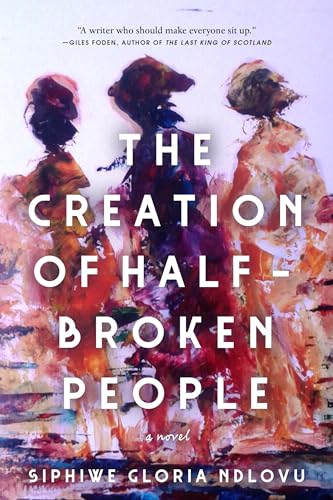
THE CREATION OF HALF-BROKEN PEOPLE, new African Gothic novel from Windham-Campbell Prize winner SIPHIWE GLORIA NDLOVU


THE CREATION OF HALF-BROKEN PEOPLE
SIPHIWE GLORIA NDLOVU

House of Anansi Press (non-affiliate Amazon link)
$16.99 ebook, available tomorrow

LONGLISTED for the 2026 Dublin Literary Award...the shortlist of six will be announced on 7 April 2026, the winner(s) in May's festival.

Rating: 4.25* of five

The Publisher Says: Stupendous African Gothic, by the winner of Yale University’s Windham–Campbell Prize

A modern Gothic story set on the African continent, The Creation of Half-Broken People tells the tale of a nameless woman plagued by visions. She works for the Good Foundation and its museum, a place filled with artifacts from the family’s exploits in Africa, the Good family members all being descendants of Captain John Good, of King Solomon’s Mines fame.

Our heroine is happy with her association with the Good family, until one day she comes across a group of people protesting outside the museum. Instigating the protesters is an ancient woman, who our heroine knows is not real. The nameless woman knows too that the secrets of her past have returned. After this encounter, she finds herself living first in an attic and then in a haunted castle, her life anything but normal as her own intangible inheritance unfolds through the women who inhabit her visions.

With a knowing nod to classics of the Gothic genre, Siphiwe Gloria Ndlovu weaves the threads of a complex colonial history into the present as she examines the collusion of colonialism, patriarchy, and capitalism in creating and normalizing a certain kind of womanhood.

I RECEIVED A DRC FROM THE PUBLISHER VIA EDELWEISS+. THANK YOU.

My Review
: What I loved about this read started from the first line: "There was a time before this. I did not always live in the attic."

I defy anyone who reads my reviews not to want to know what happens next.

One thing that happens is our narrator (nameless here, and like the second Mrs. de Winter, seamlessly unobservedly nameless throughout) meets and becomes entangled with the ominously named "John B. Good IX"—did your arm hairs just prickle with anticipatory dread or is it just me?—at the scary age of twenty-one. Legally responsible, emotionally clueless. Truly a moment in one's life when The Worst can happen without any way to avoid it.

*gleeful hand-rubbing*

So the story unfolds as a heartfelt homage to the centuries of gothic novels and tales that have come before it. The events, the relationships, the emotional devastations that come to each living one of us, all occur in a logical order as demanded by the arc of acceptance in emotional maturation. The struggles, the demands we place on Life for it to conform to our momentary desires, the sudden storms of others' emotional demands blowing our lifeships ever farther from safe harbors...all present and accounted for. As an experienced purveyor of stories...she's a filmmaker, several earlier novels to her credit, graduate of Stanford's film studies program...Author Ndlovu doesn't slow her roll for anything unnecessary, or lard in the always tempting useless "grace note" that reduces the reader's momentum.

Lush descriptive language will always get praise from me, I enjoy it for its own sake, and this is replete with it. It's a plus that I, old white US man, am taken into a sensory world not already familiar to me. I'm also fully on board with the not-subtle anti-colonial and anti-patriarchal messaging of the entire enterprise. What, then, explains my chary star rating? Surely my delighted warbling comes in a full-five review!

Nothing's perfect. I kept feeling the ghost of gothics past brushing by me, trope by trope. It's not a *bad* thing in and of itself, the story told here is remixed from the very best of its forerunners. It is, however, still a remix. I do not have a way to tell a gothic story that breaks new ground, not being a supergenius or time-traveling visitor from the storytelling future. Yet as I kept reading (and I never stopped from giddy-up to whoa) I got these flashes of "that's from this story!" I do not know if they were precisely the ones Author Ndlovu had as inspirations. I do feel, when that sensation comes very frequently in a story, a small sense of disconnection from my full-on engagement with the narrative flow.

I doubt this would present anyone but the most seasoned readers any kind of problem. It did not reduce my enjoyment of this story's merits by much at all. I recommend it to all y'all who want to read a deeply emotionally resonant story.

Wednesday, November 13, 2024

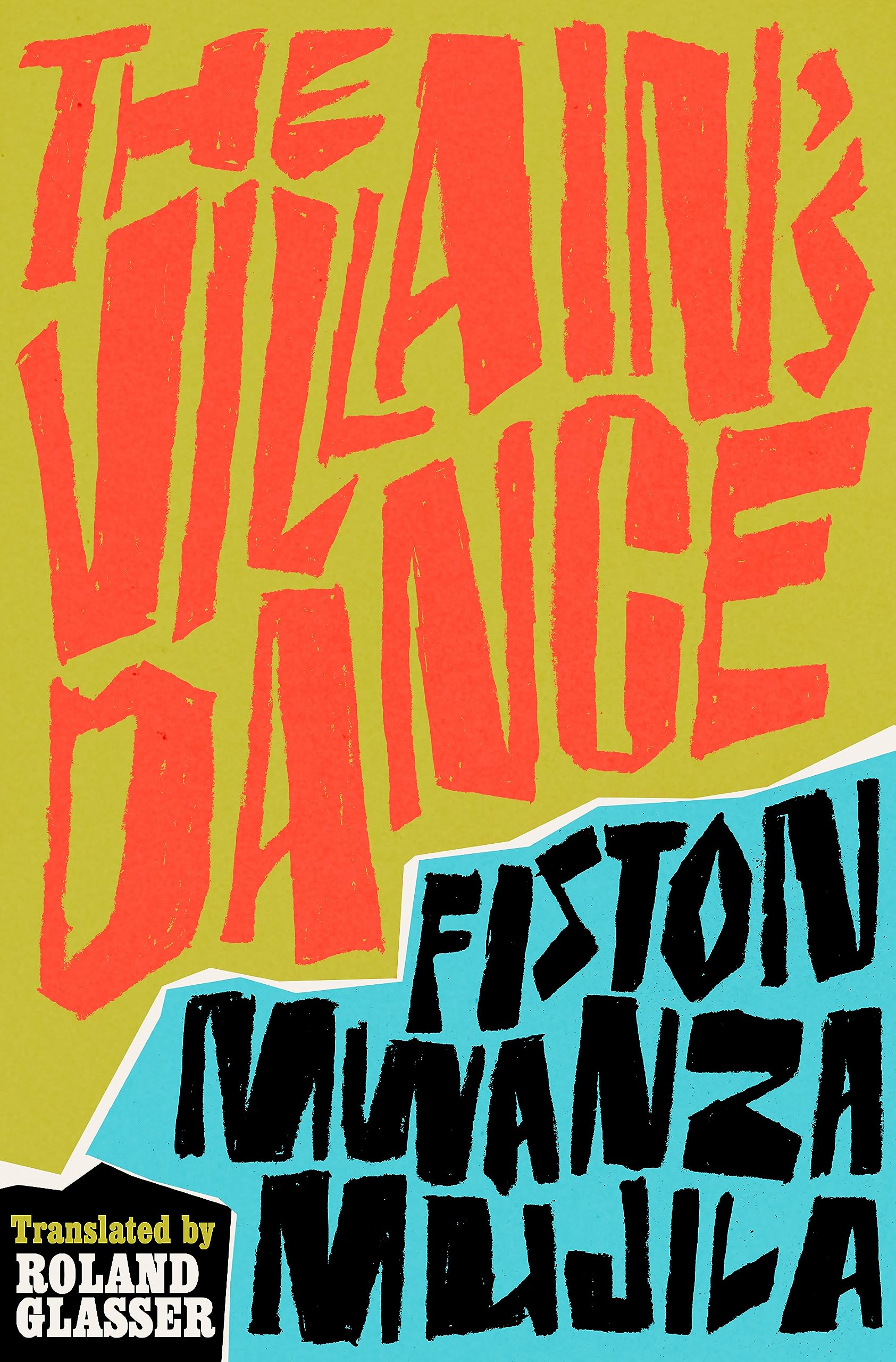
THE VILLAIN'S DANCE, apt title for this cautionary tale of the societal chaos of civil war


THE VILLAIN'S DANCE
FISTON MWANZA MUJILA
(tr. Roland Glasser)
Deep Vellum (non-affiliate Amazon link)
$9.99 Kindle edition, available now

Rating: 4.5* of five

The Publisher Says: Following the international success of his debut novel Tram 83, Fiston Mwanza Mujila is back with his highly anticipated second novel, which follows a remarkable series of characters during the Mobutu regime.

The Democratic Republic of Congo, otherwise known as Congo-Kinshasa or DRCongo, has had a series of names since its founding. The name of Zaire best corresponds to the experience of the novel’s characters. The years of Mobutu’s regime were filled with utopias, dreams, fantasies and other uncontrolled desires for social redemption, the quest for easy enrichment and the desecration of places of power.

Among these Zairians’ immigration to Angola during the civil war boycotting the borders inherited from colonization, as if the country did not have its own diamonds, and the occupation of public places by children from outside. The author creates the atmosphere of the time through a roundup of the diviner Tshiamuena, also known as Madonna of the Cafunfo mines, prides herself of being God with whoever is willing to listen to her. Franz Baumgartner, an apprentice writer originally from Austria and rumba lover, goes around the bars in search of material for his novel. Sanza, Le Blanc and other street children share information to the intelligence services when they are not living off begging and robbery. Djibril, taxi driver, only lives for reggae music.

As soon as night falls, each character dances and plays his own role in a country mined by dictatorship.

I RECEIVED A DRC FROM THE PUBLISHER VIA EDELWEISS+. THANK YOU.

My Review
: Want to know how much I appreciate Author Fiston Mwanza Mujila's talents?

I didn't pan, belittle, or insult his poetry. All y'all know how I feel about poetry. And I gave it more than three stars! Be amazed, be impressed...I hope you'll be inspired to go get one. Tram 83 worked for me, as well; I know a lot of folks were't fans but it felt like a breeze from Africa to me, hot, wet, heavily freighted. This impression left me for dead in the first instance; I was less enrapt with its story and atmosphere then than I am in retrospect. In part that's down to my subsequent experience of reading The Villain's Dance.

In common with my earlier reads of the author's books, I began this one with an awareness of atmosphere. He is always, or so it feels to me, careful to begin as he means to go on. I'm reasonably sure the huge majority of my readers are unaware of Mobutu's identity, and are more or less uninformed about tthe name "Zaire" and its history...many in my generation will have known the name Zaire vaguely applies to a huge place near the Congo River but be blissfully unaware that the name is no longer used, or why that happened.

I think that gives the novel almost an SFnal appeal. There's little sense of geography encompassing the story in US readers, so why not just go all the way and market it as taking place on a different planet entirely? *I* can do this, I'm a book reviewer, the publisher can't. The level of outrage engendered would be epic. However, let me propose this to you: If you're willing to learn the names of made-up places like Middle Earth, Arrakis, Pern, Atlantis, Downbelow Station, and their different inhabitants, conflicts, social norms, what's the hold up on Zaire and Brazzaville?

Maybe the tiniest taint of racism? Worth some energy to think about.

Assuming you're in the already-overcame-it or the overcoming-it-now group, this story's got great conflicts between dark-grey, pitch-black, and palest shades of violet people trying their best to make it in a world where up and down just switched places...like being on a space station whose spin just changed speeds dramatically.

Maybe my increased appreciation for this read makes more sense than I thought it did at first.

The people in this book aren't just as well-realized as the setting, for the most part; see below. The pace of the story is provided by history, as it's based on the realities then prevailing. The entire enterprise of nation-building collapsing into civil war (by definition a chaotic break in the life of a society) honestly needs little of that tarting up to make it compelling, even riveting, reading. What Author Fiston does very well here is to fragment the locations of the chaos to give different people reason to speak their truth without losing the core purpose of telling us this story. Like Do Androids Dream of Electric Sheep?, we are taken into realms of deep desperation and left there long enough to get it; then we're offered a peek into the purpose of the extraction and the exploitation that requires...we're not left to wallow, the way The Octopus, f/ex, does with us in service of the same sharp criticism of the cutting edge of capitalism. Poe said it very succinctly in the nineteenth century:  "{C}orporations, it is very well known, have neither posteriors to be kicked, nor souls to be damned." (Thanks for showing me the accurate quote again, P-E!)

Edges, as noted above, cut; in this story we're in the path of the blade so see both the wielding and cutting inherent in its very existence. People fail. It is inevitable. Challenges go unmet still less mastered. As often as not that is a design feature of the challenge. It engenders judgment and contempt for failure, but leaves the challenge, well, unchallenged. I suspect the true-to-life experience of people showing up for a minute then vanishing will affront a lot of complacently smug story-structure addicts. It's not by accident, y'all; it's a feature not a bug. Like life in an unstable place at a volatile time, different people will come, only to go without fanfare, or even explanation. Most of the characters trying to make it any old how they can haven't got the wherewithal to care, often enough to notice, who is who except at the precise flash of the camera that "now" represents.

I am trying as best I can to explain away the most common issues I've seen raised in others's assessments of the book. I'm not sure it matters. I hope y'all will attend to my 4.5* rating more closely than to my blandishments. A book of this trenchance is not to be dismissed. I'm hopeful that a few will take this moment of US culture shock to see what has happened in other places at this kind of inflection point.

Forewarned is forearmed.

Thursday, August 8, 2024

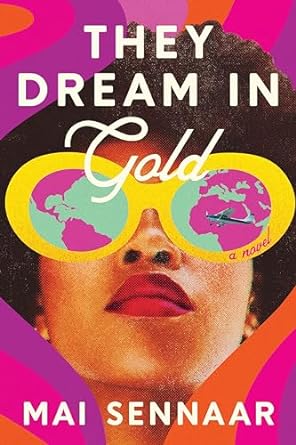
THEY DREAM IN GOLD, debut novel from tyro publisher SJP Lit...both worth watching


THEY DREAM IN GOLD
MAI SENNAAR

Zando/SJP Lit
$28.00 hardcover, available now

Rating: 4* of five

The Publisher Says: A “luminous” (Tara Conklin) literary debut following two dreamers, one intercultural family, and the diasporic pursuit of home.

When Bonnie and Mansour meet in New York in 1968―his piercing gaze in a downtown jazz club threatening to carry her away―their connection is undeniable. Both from fractured homes, with childhoods spent crossing the Atlantic, they quickly find peace with each other. And as Mansour’s soaring Senegalese melodies continue to break new ground, keeping time with the sound of revolution and taking him and Bonnie from Paris to Rio and Switzerland, it seems as though happiness might finally be around the corner for them both.

Then Mansour goes missing. His Spanish tour was only meant to last three weeks, but three months later, he and his band have not returned. In his absence, Bonnie reckons with her memories of him, and comes to understand that the hopes of so many women―her mother and grandmother; his mother, aunt, childhood friend―rest on her perseverance. Stirred by the life growing inside her, Bonnie puts a plan in action to find him.

Spanning two decades and moving through the hotbeds of the African diaspora, They Dream in Gold is an epic yet intimate exploration of the migrant hunger for belonging and a powerful, intergenerational testament to our shared humanity, for lovers of Tara Stringfellow’s Memphis and Abi Daré’s The Girl with the Louding Voice.

I RECEIVED A DRC FROM THE PUBLISHER VIA NETGALLEY. THANK YOU.

My Review
: Buckle up...this is a complicated read. Long at over four hundred pages, complex in its interrelated cast of characters, difficult to summarize as a result. Senegal, Paris, New York...the Twenties, the Sixties...familys seen in passing, a family being formed...this novel's a web.

It's a debut novel for the storyteller and close to a debut for the publisher. Sarah Jessica Parker's SJP Lit is part of a company called Zando Projects (Zando's website). SJP Lit's mission statement is:
Sarah Jessica Parker’s SJP Lit publishes sweeping, expansive, thought-provoking, and discussion-driven stories that are inclusive of international and underrepresented voices. SJP Lit books capture the contemporary imagination and reflect a wide range of ideas and experiences.

So someone famous decided not to start a book club, or an imprint in the Corporate World, but a company publishing books she curates and pays for and edits for us to see what she wants to read and offers us as worth it to read, too. As I would expect from Parker's résumé, the story told here is very much focused on character development. Bonnie and Mansour are not, despite what you could reasonably expect from the synopsis, the only or even the best developed characters. Because the story does not conform to linear time's slightly tedious constraints, we get the family polyphonics as well as the dynamics. This is a fancy way for me to say, if you're expecting a straightforward family saga, you're going to be left wanting. If you really want a book you can inhabit, one that feels more like a series (I mean this in the good way!) than a standalone, here's a great summertime immersion.

The way we move from time to time, from place to place, demands of the reader a level of participation, of code-switching, that might be off-putting for some. I think you'll twig quite quickly to the cues that indicate we're going to shift, though they are not the same from one instance to the next. What I like about that is the mood of the read never stagnates, a danger that family sagas can fall into readily. After a time many of them feel like trauma porn, or a weird triumphalism celebrating a character's Strength, Nobility, and Fortitude. Yeeeccchhh

Author Mai Sennaar doesn't succumb to that too-easy, too-incredible stuff. Her women are beset by worries and doubts. They wonder if things are worth it if they hurt this much, demand this much of them. They stumble, fall, and fail. But they never stay down for good.

It is a distinction, not a difference, but it is a consequential one that speaks to the author's intent. She is not going for the facile road to storytelling success. That is clear from the start. For this old white man, that made the read all the more interesting and involving. Some of that could be down to the slightly more...distant...way the narration is deployed, it gets an overview feeling across. Back to that polyphony of PoVs. This is a natural outgrowth of it. I found it enhanced my reading experience, in part because it enabled Author Sennaar to put me more firmly into the time and place the different strands of her story-web flow through.

I found I was disgruntled by one big, star-losing thing: Like Sweet, Soft, Plenty Rhythm (whose author flatteringly blurbed this book), every one of these women is circling a man. The story's center is a man (absent though he be). Is it that hard to make these women interrelate around themselves and each other?

A crotchet of mine. The Bechdel test still matters to me because the queer equivalent is abysmal still...gay characters feature more than ever, less than reality says is fair. So, no fifth star for you, debut novel. Author Sennaar is deeply talented and should be supported, make no mistake.

Maybe she's got more to say, soon. Let's show we're listening.

Monday, July 4, 2016

A MAJOR international literary prize will be awarded this evening! Read on for more info!


THE CAINE PRIZE FOR AFRICAN WRITING 2016
Link to the main page of the website.

I am, in case you're stumbling across me and my blog for the first time, a major consumer and reviewer of short stories. These bite-sized bits of a writer's consciousness are, ironically, much much more difficult to write well than is, say, a novel. I recognize this in a deeply personal way as I have tried to write short stories and failed miserably at it. I realize that I'm hollering down a well by trying to get the civilians on the street to try reading short stories. From deeply bitter experience, I can assure you people recoil in horror from my urgent shoving of any book at them, pleading eyes and begging tones notwithstanding. But even regular readers seem to shy away from short stories. I've heard every explanation in the world, I think: "it's too hard to change gears that fast," "I can't see why the author doesn't just make this into a novel," "ew! a BOOK!" ad infinitum, ad nauseam.

But a funny thing happens when I trick people into reading my story-by-story reviews of anthologies and collections (the first has many authors, the second only one). Some get intrigued. A few seek out other reviews I've written of collections and anthologies. And, even though I seldom hear about it directly, I notice more reviews for some of the collections I've raved about. That is *the* most gratifying result a reviewer can have. You'll notice a complete lack of advertising here on the blog. I'm only affiliated with one other blog on a regular basis, The Oak Wheel, whose senior blogger, Jeff Martin, lets me push story collections at his way-bigger-than-mine audience the first Thursday of every month...for free. In short, I have no profit motive for doing this, I am rewarded by 1) free books from *most* publishers (frowns and grumbles at the unwilling and/or cheapass holdouts), 2) thank-yous from the occasional grateful author, and 3) the sheer joy of reading, thinking about, and analyzing books, then reporting my findings. I love it. I can't not do it. (Well, there was the time I tried to off myself and ended up in the goofy garage for a while, but I kept notes of the *flood* of books my dear, wonderful, generous, and saintly friends sent to me.) I have a TBR pile that has its own gravity, a wishlist that fills a lot of server space, and not one but two facility libraries composed of 90%-plus my read and donated books. (The goofy garage and the assisted living facility I currently occupy.)

And that means that I am, or think I am, pretty au courant with the world of books. I keep a weather eye on the literary prizes, watch for outsider/indie authors whose work speaks to me and therefore might speak to others, and generally organize my social and material life around books, writing, and readers. Imagine my horror when NOT ONE PERSON I knew had a clue what the Caine Prize was! These are regular readers of Chimamanda Ngozi Adichie! Nnedi Okorafor, Ph.D.! Leila Aboulela! And the prize wasn't familiar...because it honors short fiction. *sigh* I have a lot of work to do. So I'm starting this US Independence Day, the day the Caine Prize winner is announced, to shout and wave my arms and point to more works by African writers as often as I possibly can. While I consider that an announcement, some will see it as a threat...all those hard-to-pronounce names, all that cultural information that's not familiar...but I ask of all of you that you google everything you don't get, spend some time immersed in a world you don't have referents for, and try your damnedest to enjoy the escape from the insanity that is 2016's USA into the largest continent in the world. Please? C'mon, it's no harder than immersing yourself into a fantasy or SF novel! Honest!

I've read all five shortlisted stories for the influential Caine Prize for African Writing 2016, presenting its seventeenth annual award. I've reviewed them all individually because this prize is the starting gun for its nominees and winners, launching their various careers into a more prominent and prestigious orbit in the world's literary firmament.


The Caine Prize Shortlist reviews (titles are links to story PDFs) in the accustomed Bryce Method:

The Lifebloom Gift
Abdul Adan, Somalia/Kenya

Abdul Adan is the second shortlisted author I'm reviewing for the run-up to the 2016 Caine Prize for African Fiction, announced on the 4th of July. He presents us with the life story of Ted Lifebloom, a 30ish mama's boy living in Missouri. Ted is, in some odd way, a carrier of the rarest of qualities: Pure happiness, a green world of love, comes to those susceptible to it merely by Ted's touch. The narrator describes the sensation of Ted's touch as experienced for the first time:
His mum wasn’t gone five minutes before Ted reached over and placed his
hand on my shoulder and pretty much (as I came to learn later) settled. I am not sure how long his hand was there because I got carried into a greenish world I had only seen
in dreams until then. Everything seemed as though I was on some yet-to-be-formulated drug. It was a thing of the heavens. Let me put it this way: I heard the song of birds and
sneezes of horses, smelled the fur of dogs, felt a twitch in one of my nipples which, in turn, transformed into a brown lactating nipple… In short, I understood the meaning of love
– almost. And this was just the shoulder! Suppose he got to my mole! Can you imagine that?
Ted's gift for bringing this transcendant joy to those he touches makes him seem like a bodhisattva. Tellingly, the narrator present us with the information about Ted and his mother (loving, but distant), his father (loving, but smothering), and how they combined to produce a fat, strange, useless son whose gifts make them both nervous.

Adan makes the journey the narrator takes while learning about and from Ted both poignant and humorous. As a finalist for the extremely prestigious, career-launching Caine Prize, he's well placed to bring a big load of talent to the publishers who will fight to sign him up if he wins. IMHO, it's a shame they aren't all clamoring for his work now.

What It Means When A Man Falls From The Sky
Lesley Nneka Arimah, Nigeria

A shortlisted story for this very prestigious prize in African literature, which is limited to short fiction but has launched numerous of its sixteen previous recipients into the international literary stratoshphere, Arimah's story is post-apocalyptic climate change fiction set in a world where the entirety of North America and Europe are submerged, the remaining planet absorbing the white refugees according to willingness and ability. Arimah's Nigerian background has led her to posit a "Biafran-British Alliance" wherein Nneoma, a Mathematician licensed by the Furcal Center to use her unique grasp of the Furcal Theorem (the Theory of Everything mankind's been seeking for so long) to ease, indeed remove, the experience of grief from the world's many grief-crippled people. She is one of fifty-seven so licensed left in the world, as two others have collapsed and suicided or vanished.

This late-21st-century dystopia still has its upper class, and Nneoma specializes in treating their very real ills. Her ex-lover Kioni specializes in the extremely high-need refugees and war-displaced folks whose teeming masses essentially all need grief treatment. It is this wide disparity in choice of service that leads Kioni to sever their relationship and continue her own, morally superior in her judgment, work in New Kenya (identified but undescribed) without Nneoma the hand-holder to the rich. Then Nneoma's mother dies, her father needs a Mathematician to help, and Kioni angrily refuses. Nneoma tries to help her father, but his grief merely enlarges her own, and now she can't even be in her father's presence for the horror it evokes in her.

At the end of the day, Nneoma's loneliness is magnified many, many times when a bitter and unexpected event confronts her with the limits humans can't escape despite having Furcal's infinite theory of everything to use to manipulate the world. As the title suggests, hubris is still part of human make-up and the myth of Icarus is as relevant now as it was in the past and will be in the future.

The author already has a book deal with Riverhead Books, a tentacle of Penguin Random House, to publish a story collection in 2017. This is great news for story lovers (me!) and proof that even being shortlisted for this powerful prize that most Murrikinz have never heard of confers a star-dust aura to writers. I say that's the best news ever! To paraphrase NoViolet Bulawayo, a previous Caine Prize winner, we need new voices. Now more than ever, in this precarious end stage of the capitalist extraction economy.

Genesis
Tope Folarin, Nigeria

A short story nominated for the Caine Prize in African Literature 2016, this is the first time in the history of the prize that a previous winner (2013) has been re-considered for the Prize. There is a good deal of controversy surrounding this in the African literary community, as the previous 16 awards have never included previous winners even in the longlist.

I haven't read Folarin's previous prize-winning story, but based on this story, I'm amazed and disappointed that he hasn't been widely and eagerly sought after by international book publishers. Perhaps he doesn't have an entire book of stories ready? No novel sitting in a desk drawer? But this work of identity fiction is accomplished, powerful, and it speaks directly to me and my experience of being raised by a mentally ill mother who was emotionally abusive of my father to the extent that he feared her too much to try to get me away from the unhealthy environment my mother created.

As the idea of the Caine Prize to date has been to shine a spotlight on literary lions previously unknown and help them assume their rightful place in the world of international letters, the nomination of a previous winner could mark a sea-change from awarding the deserving but unknown talents that teem in their masses around Africa, a continent of myriad countries and very, very few presses, to a reward prize for the Best African Short Stories {insert date here}.

Like any change in the established literary firmament, this causes disorientation and deep, divisive debate. (Does anyone remember what the Orange Prize is called now? Or the Whitbread Prize? Both still exist but changed sponsors, to much hullabaloo and debate. I for one lost track of them after their name changes.) Good thing or bad, policy shift or happenstance, Folarin's story is one that any story-based contest would have a hard time ignoring.

At Your Requiem
Bongani Kona, Zimbabwe

A very, very powerful small story. I was extremely emotionally involved from the first words, and Kona did not let me go. At all. I'm still thinking about this tale. It was hard to read and impossible not to finish. I can't say more because spoilers, but to my friends I can offer this inducement/warning: The narrator and I share a huge life-changing experience.

Memories We Lost
Lidudumalingani, South Africa

Another Caine Prize nominee, this story is about a thing I'd never so much as considered: Mental illness among the isolated rural population of South Africa, or anywhere else for that matter. It isn't all that different than anywhere else: Sufferers are isolated, feared, shunned, and if they're lucky, just drugged into submission instead of murdered.

Cheery little bagatelle, no; honest, searing, brave? Most certainly yes.

Another case where anything else I say is guaranteed to be a spoiler.
* * * * * * * * * * * * * * * * * * * * * * * * * * * * * * * * * * * * * * * * * * * * * * *
From the Caine Prize for African Writing's press release:

The winner of the £10,000 prize will be announced at an award ceremony and dinner at the Weston Library, Bodleian Libraries, Oxford, on Monday 4 July. Each shortlisted writer will also receive £500.

Each of these stories will be published in New Internationalist’s Caine Prize 2016 Anthology in July [as well as by Interlink Publishing in the US-RMD] and through co-publishers across Africa, who receive a print-ready PDF free of charge from New Internationalist.

Sunday, July 27, 2014

Book-A-Day #27: WORST Parents in Fiction--WE NEED NEW NAMES

WE NEED NEW NAMES: A Novel
NoVIOLET BULAWAYO

Reagan Arthur Books
$3.99 ebook editions, available now

Rating: 2.75* of five

WINNER OF THE 2014 PEN/HEMINGWAY AWARD!

The Publisher Says: A remarkable literary debut—shortlisted for the 2013 Man Booker Prize! The unflinching and powerful story of a young girl's journey out of Zimbabwe and to America.

Darling is only ten years old, and yet she must navigate a fragile and violent world. In Zimbabwe, Darling and her friends steal guavas, try to get the baby out of young Chipo's belly, and grasp at memories of Before. Before their homes were destroyed by paramilitary policemen, before the school closed, before the fathers left for dangerous jobs abroad.

But Darling has a chance to escape: she has an aunt in America. She travels to this new land in search of America's famous abundance only to find that her options as an immigrant are perilously few. NoViolet Bulawayo's debut calls to mind the great storytellers of displacement and arrival who have come before her-from Junot Diaz to Zadie Smith to J.M. Coetzee-while she tells a vivid, raw story all her own.

My Review: Okay.

Someone please, I implore you, please sit down in front of me, where I can see your lips and hear your words, and in short, simple, declarative sentences, please please oh please explain to me how the Booker people could NOT shortlist TransAtlantic, an amazing novel by an amazing writer, but CAN shortlist a novel with this in it:
I don't like going to church because I don't really see why I have to sit in the hot sun on that mountain and listen to boring songs and meaningless prayers and strange verses when I could be doing important things with my friends. Plus, last time I went, that crazy Prophet Revelations Bitchington Mborro shook me and shook me until I vomited pink things. I thought I was going to die a real death. Prophet Revelations Bitchington Mborro was trying to get the spirit inside me out; they say I am possessed because they say my grandfather isn't properly buried because the white people killed him during the war for feeding and hiding the terrorists who were trying to get our country back because the white people had stolen it.


Gosh, never heard that before. Never thought of telling a story about an African country's poverty from the PoV of a child before. Why no, it's just unique and unprecedented.

And it's not like it's ever been done before, even Dave Eggers (not a favorite of mine) did it in What is the What, and then there's Say You're One of Them...but what is that objection falling from your lips, those are BOYS telling their stories, not GIRLS telling theirs?

Which is it, all experience is human, or gender creates a special and different relationship to the world? Both cannot be true. Think carefully before answering that question, because one answer makes a chink in the armor protecting a very very very touchy equality argument....

But each experience of the world is unique! All should be celebrated! Uh huh. So you'll be buying a Joyce Meyer book about how she survived incestuous sexual abuse by the healing grace of gawd through Jeebus. Oh no? Too white-church-lady conservative, all because a Man helped her find resolution and a measure of peace because a girl can't do it herself?

What happened to all experiences being celebrated?

The above roughly encapsulates a call-and-response session I had with a fan of the book. She (naturally) stated I was behaving in a sexist manner and implied, with dark tones of voice, that I was probably a racist too, because I don't think this is a particularly good book, and *certainly* don't think it's Booker-worthy.

This is not a long book, and it's not, regardless of the cover, the title page, and the sales bunf, a novel. It's interlinked short stories that share a background. The author has used a rather flat, matter-of-fact tone to deliver her stories, and that's just fine for a story in a collection. It's wearing as hell when it's the ONLY tone used. It does not lend itself easily to a smooth, page-turning read. It required of me that I expend mental effort to stay engaged for the ~10-12pp the story lasted.

Now that is something, laddies and gentlewomen. In only 12pp, an author can make someone who has spent most of his life (48/54 years) reading and savoring many, many kinds of books by every conceivable terrestrial human phenotype feel the need to force his attention back to their work.

I certainly didn't hate the book, and I don't think the author should be put in the stocks thence to learn the error of her ways. I dislike the book, yes, but I commend the person who struggled to bring it forth and make it as good as she possibly could imagine it being, for doing the work, making the effort, creating an artwork that rings true in her ears.

I assume many agree with her. I am not one. I think it's a decent first book. I would pick up another book of NoViolet Bulawayo's to sample, if I happened across it. Contrast this with my response to that Purple Bruise and Yellow Sun woman Chimamanda What's-it: how fast can I run, how far can I hurl, how hard can I stomp the next and the previous books she's written.

But this isn't a particularly good book simply because it's not horrible. If you find my copy on the train, pick it up and idly leaf through. Maybe you'll like it, because goodness knows I didn't.

Thursday, April 25, 2013

A CARRION DEATH, first in a new Africa-set mystery series


A CARRION DEATH (Detective Kubu #1)
Michael Stanley
HarperPerennial
$15.99 trade paper, available now

Rating: 3.5* of five

The Publisher Says: Smashed skull, snapped ribs, and a cloying smell of carrion. Leave the body for the hyenas to devour-no body, no case.

But when Kalahari game rangers stumble on a human corpse midmeal, it turns out the murder wasn't perfect after all. Enough evidence is left to suggest foul play. Detective David "Kubu" Bengu of the Botswana Criminal Investigation Department is assigned to the case.

The detective's personality and physique match his moniker. The nickname "Kubu" is Setswana for "hippopotamus"-a seemingly docile creature, but one of the deadliest on the continent. Beneath Kubu's pleasant surface lies the same unwavering resolve that makes the hippopotamus so deceptively dangerous. Both will trample everything in their path to reach an objective.

From the sun-baked riverbeds of the Kalahari to the highest offices of an international conglomerate, Kubu follows a blood-soaked trail in search of answers.

Beneath a mountain of lies and superstitions, he uncovers a chain of crimes leading to the most powerful figures in the country-influential enemies who will kill anyone in their way.

A memorable detective makes his debut in this gritty, mesmerizing thriller. Set amid the beauty and darkness of contemporary Africa, A Carrion Death is the first entry in an evocative new series cutting to the heart of today's Botswana-a modern democracy threatened by unstable neighbors, poachers, and diamond smugglers. Those trying to expose the corrupt ringleaders will find themselves fighting for their lives...


My Review: I want to smack the copywriter who created the promo copy above, and on the dust jacket of my library's hardcover. “Detective” Kubu is “Assistant Superintendent” Kubu. And there's something very uncomfortable to me about the “darkness” of modern Africa cited above. Just tin-eared phrasing, I'm sure. No one in publishing could be unconsciously playing with stereotypes. No no.

Mm. That's as may be. I found Kubu and his Botswana to be a welcome new angle on territory once owned, in the US market and mind, by McCall Smith's rather more twee Mma Ramotswe series. Kubu, the dangerous hippo of a detective in the series, is a Mozart-singing grocery hound, a kind of African Nero Wolfe-cum-Inspector Morse with a very nasty boss, a very appealing wife, and a large country to help police.

It's a nice debut novel about an interesting character with a lot of promise. The writing team, one Afrikaner and one Minnesotan, do a lot with their man's appetites for food, truth, justice, and facts. They're a bit less facile with the villains, using a lot of shortcuts...wealth equals evil...and failing to avail themselves of opportunities to work in some believable offsets to the faults.

The Superstitious Natives Who Are Right trope isn't one I like much, either, but I'll let that go for this book. If it happens again, there will be discussion of it then.

On balance, the series deserves another shot, and the sleuth a chance to grow and shine. Until next year, then.