Pages
- Home
- Mystery Series
- Bizarro, Fantasy & SF
- QUILTBAG...all genres
- Kindle Originals...all genres
- Politics & Social Issues
- Thrillers & True Crime
- Young Adult Books
- Poetry, Classics, Essays, Non-Fiction
- Science, Dinosaurs & Environmental Issues
- Literary Fiction & Short Story Collections
- Sookie Stackhouse/Southern Vampire Books & True Blood
- Books About Books, Authors & Biblioholism
Showing posts with label polyphonic novel. Show all posts
Thursday, December 4, 2025
FALSE WAR, Cuban author's polyphony mirrors diaspora
FALSE WAR
CARLOS MANUEL ÁLVAREZ (tr. Natasha Wimmer)
Graywolf Press (non-affiliate Bookshop.org link)
$9.99 ebook, available now
Rating: 4* of five
The Publisher Says: An ambitious, panoptic novel about exile as both condition and state of being by a major young Cuban writer
The characters in False War are ambivalent castaways living lives of deep estrangement from their home country, stranded in an existential no-man’s land. Some of them want to leave and can’t, others do leave but never quite get anywhere.
In this multivoiced novel, employing a dazzling range of narrative styles from noir to autofiction, Carlos Manuel Álvarez brings together the stories of many people from all walks of life through a series of interconnected daisy chains. From Havana to Mexico City to Miami, from New York to Paris to Berlin, whether toiling in a barber shop, roaring in Yankee Stadium, lost in the Louvre, intensely competing in a chess hall in Cuba, plotting a theft, or on a junket for émigré dissidents in Berlin, these characters learn that while they may seem to be on the move, in reality they are paralyzed, immersed in a fake war waged with little real passion.
The fractured narrative, filled with extraordinary portraits of ordinary people, reflects the disintegration that comes from being uprooted. At the same time it is full of tenderness, moments of joy and profound release. False War confirms Carlos Manuel Álvarez as one of the indispensable voices of his generation in Latin American letters.
I RECEIVED A DRC FROM THE PUBLISHER VIA NETGALLEY. THANK YOU.
My Review: Complex narrative told in multiple styles...it requires paying attention...but like the most exciting stories, it repays you with an interlocking puzzle of identities giving a full-color image of exile.
Few times do you get a challenge set you in a long reading life that feels both longer, for its richness, and shorter, for its fascinating concise storytelling across styles, than its page count. Yes, there are a lot of people talking to you; yes, they act as though you're in medias res with them. You will be.
What a bunch these people are! Petty crime, grand theft (there are tech workers everywhere), music makers...all united by the fact of leaving Cuba, their home, for all sorts of reasons. All twine around the central narrative of the writer creating the novel from the stories he's been, is being, told, then telling us: "And right now, reader, neither you nor I can know what it is I’m thinking about this book you’re holding (your right now is not the same as my right now; the right now is always tragically different from the right now of writing)."
Shades of the time slices so beloved of physicists explaining why there is no now due to relativity! Part of that disorienting purpose is also served by the polyphony's voices being labeled, like the time slices needing labels (Observer A, Observer B), and others being job titles, others still (most disorientingly, are they real or invented?) receiving normal names.
The Cuban diasporas having left over the course of sixty years, they are often strangers to each other as much as the places they're staying. A man who learned his dance moves in the 1970s has little chance of making a good showing in a crowd who learned theirs thirty years later;but they're all united by the one main identity: Cuban Exile.
In braiding the many voices telling the different stories of why, of how, of that moment when, exile was the solution, Author Álvarez via Translator Wimmer has handed us the kaleidoscope with no instructions on how to use it. Twisting it a bit to that side, into shade, away from blinding searchlights, Author Álvarez takes your eyeline with him, letting you hold the device but showing you *his* pretty colors.
Made of the numerous rays in the story, he's found beauty in hard and endless toil...to fit in? to stand out? to find, lose, escape, respond? to the endlessness of crafting an identity.
Thursday, August 21, 2025
VIVIAN, #WITMonth biographical novel illuminating a complex woman from many angles
VIVIAN
CHRISTINA HESSELHOLDT (tr. Paul Russell Garrett)
Fitzcarraldo Editions (non-affiliate Bookshop.org link)
$17.95 trade paper, available now
Rating: 3.5* of five
The Publisher Says: In her new novel, Christina Hesselholdt delves into the world of the enigmatic American photographer, Vivian Maier (1926-2009), whose unique photographic body of work only reached the public by chance.
On the surface, Vivian Maier lived a quiet life as a loving, firm and feisty nanny for wealthy families in Chicago and New York. But throughout four decades, she took more than 150,000 photos, mainly with Rolleiflex cameras. The pictures were only discovered in an auction shortly before she died, impoverished and feasibly very lonely. In a time when self-obsession and representation are at an all-time high, Vivian Maier holds a particular fascination. Who was this eccentric person? And why did she not try to make a living from her art?
In VIVIAN, a chorus of voices, including Vivian's own, address these questions. We watch Vivian grow up in a severely dysfunctional family in New York and Champsaur in France, and we follow her as a nanny in Chicago and as a photographer on the streets of these American cities and in rural France. The novel comprises multiple voices: Vivian's, her mother's, one of the children she looked after and her parents. And crucially, the voice of the inquisitive narrator, who pulls the threads together and asks Vivian prying questions.
I RECEIVED A DRC FROM THE PUBLISHER VIA EDELWEISS+. THANK YOU.
My Review: There's a chorus in this book, all right, one that talks around Vivian Maier's life...because there are so few real reliable sources on the life of this odd, fragmented woman...because the film about her already plowed the factual field of her life...because she was a pretty ordinary person as well as an extraordinary observer.
All of which adds up to a life that doesn't have enough factual meat but has very interesting story-bones to carry a text treatment that adds to the excellent films that center her wonderful visual legacy. A polyphonic novel can stitch together points of view that can't bear non-fiction's scrutiny while making truthful points about how Vivian became the figure, the outsider icon, the feminist parable that she was so perfectly suited to become.
A woman doing childcare as a career while creating hundreds of thousands of photographs, many iconic now they're public, is proof of women's clear statements that The System&8480; is set up to ignore women's creativity. Her life wasn't just odd, though, because she was brought up oddly; I think her personality as it comes through literally everywhere she is discussed is that of an outsider. It makes one a better observer to feel and to be perpetually outside the herd, away from the hearth, looking in at it with removed detached clarity.
This novel, from structure to execution on a sentence level, reinforces that sense. As I read the story, I realized how much it added to my appreciation of Author Hesselholdt's presentation of Vivian to realize that she researched her subject in a foreign language source pool; wrote her story in Danish (to wide praise); and then I read it in English translation.
It is perfection as an origin story; it has some concomitant infelicities on the gestalt. The multiple PoV structure gets wearing because it demands one exercise memory to connect what that character said quite a reading-while ago. It also, while illuminating Vivian in the light she blocked for different people, makes me wish for fewer shifts and a shorter book. At under two hundred pages, I was sure I'd knock out the read in a day and a half; it took over five years because he aforementioned required concentration wasn't always available for me to give leading to five separate re-starts.
While I ended up a true aficionado of the story I was there because I'm really stubborn. Others might not feel like putting in the effort of resolving polyphony into its complex harmony, in focusing the varying wavelengths of light into a very slightly blurry image. I'd recommend you do, but I know it's a style that won't suit all. If possible read the ebook sample available to check how you vibe with the style.
Authors who take unusual approaches to storytelling are to be praised; it's down to your unique taste if they're to be supported. I'm praising, are you supporting?
Wednesday, May 21, 2025
HEART, BE AT PEACE gave me agita
HEART, BE AT PEACE
DONAL RYAN
Viking Press (non-affiliate Amazon link)
$14.99 ebook, available now
Rating: 3.75* of five
The Publisher Says: From one of the most acclaimed Irish writers today, a new novel about smalltown Ireland that explores a community on the mend and the power of love and trauma to both bring people together and divide them
“I said it before. Madness comes circling around. Ten-year cycles, as true as the sun will rise…”
In a small town in rural Ireland, the local people have weathered the storm of economic collapse and now look to the the jobs are back, the dramas of the past seemingly lulled, and although the town bears the scars of its history, new stories have begun to unfold.
But a new, insidious menace creeps through back-alley shadows and into the lives of this community. Old grudges fester and new ones arise. Young people are lured by the promise of fast money while the generation above them tries to hold back the tide of an enemy beyond their control. And the peace of this small town is about to be shattered in an unimaginable way.
A stunning, lyrical novel told in twenty-one voices, Heart, be at Peace reveals a community that together looks to weather the storm of betrayals, secrets, and grudges that can divide families, towns, and entire generations.
I RECEIVED A DRC FROM THE PUBLISHER VIA NETGALLEY. THANK YOU.
My Review: I got a copy of Steerforth Press's hardover of Author Ryan's debut, The Spinning Heart, years ago. I was not a fan. It felt to me like a lightened up, shallowed out, misery porn oratorio. This novel-in-stories (though Viking would not like that description, stories being anathema on the US market) is the thematic and setting follow-on to the first book. It isn't really a sequel because it makes perfect sense, nuance and all, to someone who has never read the first book.
It is, I'm unsurprised to say, written in the same style as the first book, and that is not greatly to my taste. It's not incompetent, or poor, or clumsy. It just...is. For barely over two hundred pages, it's fine, unexciting but fine. Any longer, though, and I'd be mental for need of some kind of verve, some hint of passion for or prejudice against. Like this: “That was always the way in Ireland, he said. You’d be hung for robbing an apple and made king if you robbed a castle.” Or this: “That’s what young ones do once the madness starts coursing through them. It’s a dangerous place in a person’s life, that shadowy path between childhood and adulthood, and it’s pocked and hexed with all sorts of traps and trials.” Or this: “Pokey had a friend from Malta or one of those quare places who was living down near the lake, just back from the foreshore, in one of those big low houses that was built on a foundation of bribes and bullshit back in the eighties.”
No one's ever said, thought, or written that before, have they.
So I found the execution wanting, and was not excited by the extremely short chapters that change viewpoints and function as slighly underdeveloped stories. If you're telling stories making them wgolly their own thing is best...but these are interdependent fragments of a narrative, I think, so neither fish nor fowl. If this was a deliberate choice, an intentional development of storytelling, it did not hit the mark for me. Too much slid past the PoV switches for me to feel fully satisfied.
Others will disagree, and will thoroughly relish all my cavils as features. I'm not warning anyone away from a poor product; your own tastes be your guide, and Kindle up a sample to see what you think of the writing.
For me, this is my last foray into this bit of Irish literature.
Monday, March 10, 2025
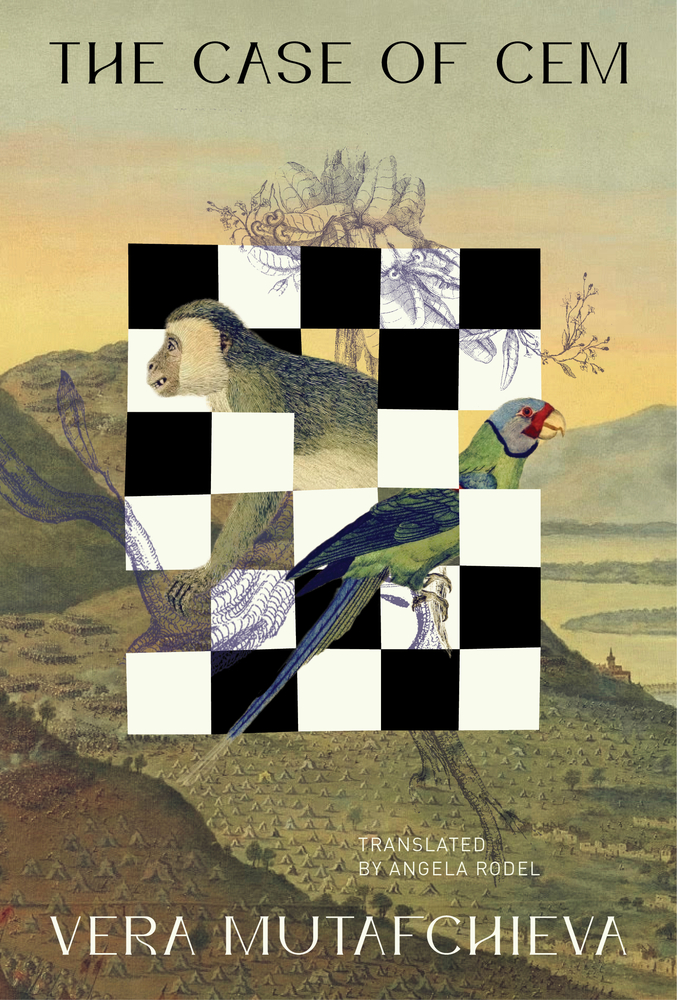
THE CASE OF CEM, shortlisted for the 2025 Republic of Consciousness Prize—United States & Canada—for Small Presses
THE CASE OF CEM
VERA MUTAFCHIEVA (tr. Angela Rodel)
Sandorf Passage (non-affiliate Amazon link)
$9.99 ebook editions, available now
Rating: 5* of five
Shortlisted for the 2025 Republic of Consciousness Prize—United States & Canada—for Small Presses
The Publisher Says: Vera Mutafchieva’s The Case of Cem, presented as a series of depositions by historical figures before a court, tells a straightforward tale: Upon the death of Ottoman Sultan Mehmed the Conqueror in 1481, his eldest son Bayezid takes the throne. However, discontented factions within the Ottoman army urge Mehmed’s second son Cem, a well-educated and experienced warrior, to oppose his brother’s ascension. Bayezid refuses, setting off a ruthless power struggle and forcing Cem into long years of exile, a pawn for European powers as they try to slow the Ottoman Empire’s expansion.
This enticing novel of court intrigue maintains lasting resonance for being a personal exploration of emigration and loss as told through the historical era during which the politics of the East and West were sketched out with utter clarity. These early lines of demarcation, as voiced through Christian and Muslim emissaries, power hungry rulers, unflinching warriors, and poets, have indelibly influenced the word as we know it today.
I RECEIVED A DRC FROM THE PUBLISHER VIA EDELWEISS+. THANK YOU.
My Review: This Bulgarian historical novel blew my mind: How the HELL has this long, deep, fascinating art object existed for most of my life and I am only now, at *mumblety*-five, hearing about it?! Life is not fair, we all know that, but this gem of writing and thinking remaining unread by Anglophones for most of six decades is a borderline crime against humanity.
Cold Wars, political spats among the too-powerful and too-rich, are to blame for this kind of asininity. Cem's life and times were as transitional as the paradigm shift we're undergoing today. Cem's imagined trial, inspired by a casual remark made by a too-powerful man of that time, is Author Mutafchieva's inspired rendering of History's treatment of the eponymous Cem.
In presenting this case, the first decision Author Mutafchieva had to make was to whom the case was being presented. That decision then dictates where the case is set, how the witnesses are going to present their evidence, all the trappings of a court case. The witnesses are all dead; they address us directly from the afterlife, with their direct knowledge of events and, somehow, of the events that have transpired since their own deaths.
The dreaded second-person narration, the eternal chest-pokey "you," is thus inevitably the main choice the author makes. It was that choice which left this novel unread on my Kindle for months. I will say that this narrative choice was...not my favorite. I was not as irked as I would ordinarily be, however, because the framing device explains the necessity of its use...we're reading depositions from witnesses in a court case.
In the course of reading about the case of Cem, a picture of him emerges. The idea that this dreamy, loving, insufficiently ruthless man could rule an empire is laughable...and the empire would've been all the better for his reign. He would've been a humane leader, and we all know what happens to those honorable souls (ask the late US President Jimmy Carter). Therein, of course, the need for a "case" to be made...a decision rendered in the court of History, which is naturally enough made up of thee and me as History's heirs, successors, and assigns.
What we do not get is anything from Cem himself. He is acted upon, never an actor, as his life from birth as his father's favorite child, born of a christian wife (sin of sins!), is always defined by the loves, hates, and needs of others. His proposal made to his elder half-brother to divide the immensity of the Ottoman Empire was, I think, actually very sound; of course that idea was never going to fly in a world of winner-takes-all and us-v-them thinking. It wouldn't fly today in, say Ukraine for the sake of argument, for those same reasons.
What made this tale of Realpolitik in translation from the Bulgarian a five-star read is the way each deposition/chapter adds another layer of words and thereby ideas over the space that is Cem's. The heart of the book, the sine qua non of the story, the gravity so powerful it lenses the entire Ottoman Empire, and Europe its enemy, from each and every direction the light emitted by all the actors and each reporter of the action thus illuminated occupies. The layers thus accreted form a strange shape. There is no motion from under these layers; Cem is absent and thus volitionless.
How that reality can create an animated image is, frankly, alchemical. It's like the celluloid of the stories told about Cem pass through an undetectable development bath that causes the shadows of him we're seeing to move as different reporters shine light through that celluloid. We're seeing a movie, a polyphonic miniseries, an opera with a huge cast whose parts were written by different composers...all in the same key and tempo.
It should feel shaggy and have holes everywhere; it should be a sieve not a bowl. It is instead a cauldron with rippling waters from many sources and the light from many points combines to cast an unquiet image, now sharp now wavy, interference become more than a pattern.
I applaud the author, long dead (1929-2009), for doing the immense work of researching then reimagining that data. The result is, based on Rodel's work translating it, a masterwork of polyphony. Often when reading historical fiction, there comes a moment of storytelling that is inauthentic. It's an anachronism, or it's not part of the historical record. It *feels* wrong, or at least not right.
I never found that moment reading this story. It earns all five stars from me.
Thursday, August 8, 2024
THEY DREAM IN GOLD, debut novel from tyro publisher SJP Lit...both worth watching
THEY DREAM IN GOLD
MAI SENNAAR
Zando/SJP Lit
$28.00 hardcover, available now
Rating: 4* of five
The Publisher Says: A “luminous” (Tara Conklin) literary debut following two dreamers, one intercultural family, and the diasporic pursuit of home.
When Bonnie and Mansour meet in New York in 1968―his piercing gaze in a downtown jazz club threatening to carry her away―their connection is undeniable. Both from fractured homes, with childhoods spent crossing the Atlantic, they quickly find peace with each other. And as Mansour’s soaring Senegalese melodies continue to break new ground, keeping time with the sound of revolution and taking him and Bonnie from Paris to Rio and Switzerland, it seems as though happiness might finally be around the corner for them both.
Then Mansour goes missing. His Spanish tour was only meant to last three weeks, but three months later, he and his band have not returned. In his absence, Bonnie reckons with her memories of him, and comes to understand that the hopes of so many women―her mother and grandmother; his mother, aunt, childhood friend―rest on her perseverance. Stirred by the life growing inside her, Bonnie puts a plan in action to find him.
Spanning two decades and moving through the hotbeds of the African diaspora, They Dream in Gold is an epic yet intimate exploration of the migrant hunger for belonging and a powerful, intergenerational testament to our shared humanity, for lovers of Tara Stringfellow’s Memphis and Abi Daré’s The Girl with the Louding Voice.
I RECEIVED A DRC FROM THE PUBLISHER VIA NETGALLEY. THANK YOU.
My Review: Buckle up...this is a complicated read. Long at over four hundred pages, complex in its interrelated cast of characters, difficult to summarize as a result. Senegal, Paris, New York...the Twenties, the Sixties...familys seen in passing, a family being formed...this novel's a web.
It's a debut novel for the storyteller and close to a debut for the publisher. Sarah Jessica Parker's SJP Lit is part of a company called Zando Projects (Zando's website). SJP Lit's mission statement is:
Sarah Jessica Parker’s SJP Lit publishes sweeping, expansive, thought-provoking, and discussion-driven stories that are inclusive of international and underrepresented voices. SJP Lit books capture the contemporary imagination and reflect a wide range of ideas and experiences.
So someone famous decided not to start a book club, or an imprint in the Corporate World, but a company publishing books she curates and pays for and edits for us to see what she wants to read and offers us as worth it to read, too. As I would expect from Parker's résumé, the story told here is very much focused on character development. Bonnie and Mansour are not, despite what you could reasonably expect from the synopsis, the only or even the best developed characters. Because the story does not conform to linear time's slightly tedious constraints, we get the family polyphonics as well as the dynamics. This is a fancy way for me to say, if you're expecting a straightforward family saga, you're going to be left wanting. If you really want a book you can inhabit, one that feels more like a series (I mean this in the good way!) than a standalone, here's a great summertime immersion.
The way we move from time to time, from place to place, demands of the reader a level of participation, of code-switching, that might be off-putting for some. I think you'll twig quite quickly to the cues that indicate we're going to shift, though they are not the same from one instance to the next. What I like about that is the mood of the read never stagnates, a danger that family sagas can fall into readily. After a time many of them feel like trauma porn, or a weird triumphalism celebrating a character's Strength, Nobility, and Fortitude. Yeeeccchhh
Author Mai Sennaar doesn't succumb to that too-easy, too-incredible stuff. Her women are beset by worries and doubts. They wonder if things are worth it if they hurt this much, demand this much of them. They stumble, fall, and fail. But they never stay down for good.
It is a distinction, not a difference, but it is a consequential one that speaks to the author's intent. She is not going for the facile road to storytelling success. That is clear from the start. For this old white man, that made the read all the more interesting and involving. Some of that could be down to the slightly more...distant...way the narration is deployed, it gets an overview feeling across. Back to that polyphony of PoVs. This is a natural outgrowth of it. I found it enhanced my reading experience, in part because it enabled Author Sennaar to put me more firmly into the time and place the different strands of her story-web flow through.
I found I was disgruntled by one big, star-losing thing: Like Sweet, Soft, Plenty Rhythm (whose author flatteringly blurbed this book), every one of these women is circling a man. The story's center is a man (absent though he be). Is it that hard to make these women interrelate around themselves and each other?
A crotchet of mine. The Bechdel test still matters to me because the queer equivalent is abysmal still...gay characters feature more than ever, less than reality says is fair. So, no fifth star for you, debut novel. Author Sennaar is deeply talented and should be supported, make no mistake.
Maybe she's got more to say, soon. Let's show we're listening.
Subscribe to:
Posts (Atom)