Showing posts with label 1920s setting. Show all posts

Friday, August 28, 2026

THE LIPETSK CONSPIRACY: The True Origins of Hitler's Luftwaffe (Tom Munro Aviation and Espionage Series #4), interwar Bonding


THE LIPETSK CONSPIRACY: The True Origins of Hitler's Luftwaffe (Tom Munro Aviation and Espionage Series #4)
WILLIAM FERNIE
Fernie Publishing Ltd (non-affiliate Amazon link)
$5.99 Kindle edition, available now

Rating: 4* of five

The Publisher Says: Before the Luftwaffe terrorised Europe, it was forged in secrecy.

In the uneasy peace before WWII, Captain Tom Munro is flying for Deutsche Luft Hansa when he uncovers a clandestine military airfield hidden deep within Soviet Russia.

Coerced into supporting Germany's secret rearmament programme, he risks his life flying experimental aircraft and developing new, untested operational techniques all prohibited under the Treaty of Versailles. This test flying provides a unique opportunity to gather military intelligence of immense value to the British Secret Intelligence Service.

But Tom knows that he will not be allowed to survive with this vital intelligence and must attempt the impossible: escape with Germany's secrets before he disappears forever.

An interwar aviation/espionage thriller for readers of David Downing, Philip Kerr and Robert Harris.

I RECEIVED A DRC FROM THE PUBLISHER VIA NETGALLEY. THANK YOU.

My Review
: Tom Munro is a very enjoyable PoV to follow as this based-on-facts thriller of Nazi Germany's preparations for war in the air. The prior three volumes in the series deal with the Great War, the Treaty of Versailles era, and now the period that enables the rise of the Nazi state.

It's a period I'm very interested in, and one that saw gigantic advances inn aeronautical engineering, materials science, and other sciences that are useful in wartime. As always it's the horrors of slaughter that drive change, and the economy's growth, and the terrible Othering of people in no way wrong, bad, or evil as the scum at the top try to justify the war "They" want by manufacturing enemies within and without.

What makes Tom fun to follow is mostly his test-pilot nous. It's fun for me to read about the planes realy being tested, really being studied in this pre-Depression time that has so much hope for a peaceful future that recedes and recedes while Tom and his ilk try to keep it alive. Yet here he is flying violation-of-treaty equipment to a secret base! One in Russia, no less...more serious skulduggery...and consequences for Tom in terms of using spycraft for...good?

Come for the history, stay for the gearhead talk, which you'll need to be getting along with that to be in the full story. I was captivated, you might not be, so be aware the jargon is plentiful and needed to make sense of the Lipetsk Russian airfield subplot. There are many politicosocial developments but they almost all incorporate technology and discussion of same.

There is yearning for his lost, belovèd fellow spy Alice, which is getting a bit wearing if I'm honest. Oh well. One must have a woman in a thriller, she motivates the main man. *sigh*

A complex and very very sensitive matter, Germany's resurgent ambitions and rebounding desire to lead the technological world, and the worries of her very recent opponents all buried in piles of dead people from that stupid war. And an ending to this story that's exactly right. All designed to give this old man reader the happy.

Be ready for the complexities on multiple fronts and it might do the same trick for you.

Wednesday, August 5, 2026

LIARS IN PARADISE, Olesya Lyuzna's1920s queer-led mystery series gets its book 2


LIARS IN PARADISE
OLESYA LYUZNA

The Mysterious Press (non-affiliate Bookshop.org link)
$11.99 ebook, available now

Rating: 4.25* of five

The Publisher Says: With five days to clear her partner’s name after a horrific crime, private detective Ginny Dugan infiltrates a cultish secret society on Long Island’s Gold Coast in this champagne-soaked followup to Glitter in the Dark.

New York City, 1925. A night of high-stakes gambling at the Empire Club ends in gunfire and Jack Crawford is found at the center of the carnage—covered in blood, gun in hand. The club’s ruthless owner offers Jack an ultimatum: find the real shooters within five days, or die for their crimes.

Ginny Dugan hasn’t known Jack long, but as his partner in their detective agency, she needs to believe she’s trusted the right man this time. Their only lead is Lila, the sole survivor of the massacre. They follow her to a queer dance hall in Glen Cove, a Long Island Gold Coast town whose glittering summer estates now stand empty in the November chill. Among those who knew Lila, one name keeps surfacing: Echelon, a seductive society where fortune is promised to those who surrender everything. Convinced the answers they seek lie within, Ginny and Jack infiltrate its ranks, where they encounter silent masked attendants, serpents sliding over bare skin, and members who seem to know more than they should—especially about Jack.

As the body count climbs and Jack’s past resurfaces in unsettling ways, Ginny begins to doubt her instincts, her partner, even her own reality. Maybe she was never in control. Maybe she was brought here to play someone else’s game.

I RECEIVED A DRC FROM THE PUBLISHER VIA NETGALLEY. THANK YOU.

My Review
: Author Lyuzna's previous book Glitter in the Dark gets a sequel. I was delighted to hearit was coming, I missed the wonderful immersion in the slightly-too-full hot tub of Lyuzna's 1920s glamour

People who want, who yearn for something are the ones easiest to manipulate. Show them a path that guides them through the yearning process and you've got 'em in your conytol. There's always something left behind in achieving a goal. That something is...useful...to someone who wants to control the yearner for fun and profit. And that something needs receipts to be truly, enduringly useful, as well as backed up by demonstrated willingness to use it to harm others (but never me, says the voice of hubris very quietly).

Ginny does not believe any secret is worth dying for, it's what makes her such an effective investigator. She's taken Jack on as her...partner, possibly maybe in more than one sense of the word, this is still in flux...knowing there are secrets in his past, though not what precisely they are. She's confronted with them after she foils a knife attack on a stranger.

Are you feelin' the vibe here? We're in a melodrama. We're heading into the choppy waters off the rocky coast leading to Safe Harbor; our vessel is a bit too small to plow through the waves, maybe the wind's shifting to lift spray into our eyes, where are those damn life jackets anyway? It's a familiar setting in general, but the specifics are what burnish the brasses.

Jack's darkish past is tied to the Big Bad of this story, Dickie Stryker. He's a very familiar character in the twenty-first century: charismatic cult leader, prosperity gospel pusher, blackmailer extraordinaire. Jack's entanglement with him is the ostrich-sized chicken that came home to roost. Ginny's own secrets, the woman who got away for example, are unsurprisingly going to need some dealing with as the waves get fiercer smashing against the rocks outside Safe Harbor. Dickie knows a lot, doesn't have a second's heitation about using what he knows to force Ginny and Jack to deal with his problem or face their vessel being holed (Jack's impending murder) in the heaving story-seas.

Overheated? Yes. Fun? Yep!

It's well-constructed as a mystery. I found not plot holes that didn't feel like secret doors to future installments in the series. I thoroughly enjoyed the bisexual representation...something I don't see too much of in mysteryworld...and appreciated Ginny being drawn as a woman very much in charge of her fate in a time period where that was believable but still very difficult. (Not that it's ever been easy.) It makes the Jazz Age setting have greater depth to see these glistening highlights against the dark, terrible background of Power being flexed.

Echelon, our nexus of Power, is appallingly familiar to readers in 2026. If you read this story and still need a map drawn of how the hideous cult of Power we're watching unravel in 2026, you're probably best suited to religious stories and should not be reading my reviews. It's very much a tropical island transferred to Glen Cove (a lovely place that deserves better). As Author Lyuzna builds out the ugly way the Echelon cultists dig the canals leading to Safe Harbor only through dangerous territiry, the twist and doublebacks and unexpected locks that impede the trip become more and more baroque. The slang of the era is lots of fun to read, making this world feel Other and lived in at the same time. It's a storytelling technique I always like to see. Firefly and Battlestar Galactica and Riddley Walker and A Clockwork Orange have all used the same idea; all are celebrated as successful on a storytelling basis at least in part because the creators were attentive to the details at this high of a level.

I'm not all the way convinced the more melodramatic flourishes are necessarily a good ide in a series. Cecil's knife attack tying back only coincidentally to Jack's secret past is my best not-spoilery examplee (it's literally the beginning of the story). It feels forced; it's there that I suspect the bridge to the period setting could let the author down a bit. This exact storytelling trope is torally of the period we're within. A lot of less talented authors might run with the faux-Golden Age-ness of the story with an intrusive framing device. Author Lyuzna leaves the frame in 2026, tells the story that could best happen in the Jazz Age with a modern societal lens but does not force the action to conform with 2026's expectations. The consequences, the need to obey older cultural norms, are still present.

But there's always a course between the rocks, up the canal, into Safe Harbor at last. Makes for an exciting journey.

Monday, March 30, 2026

DAUGHTER OF EGYPT from the reigning Rani of women in historical fiction


DAUGHTER OF EGYPT
MARIE BENEDICT

St. Martin's Press (non-affiliate Bookshop.org link)
$14.99 ebook, available now

Rating: 4* of five

The Publisher Says: New York Times bestselling author Marie Benedict, returns with a sweeping tale of a young woman who unearths the truth about a forgotten Pharaoh—rewriting both of their legacies forever.

In the 1920s, archeologist Howard Carter and Lord Carnarvon of Highclere Castle made headlines around the world with the discovery of the treasure-filled tomb of the boy Pharaoh Tutankhamun. But behind it all stood Lady Evelyn Herbert—daughter of Lord Carnarvon—whose daring spirit and relentless curiosity made the momentous find possible.

Nearly 3,000 years earlier, another woman defied the expectations of her time: Hatshepsut, Egypt’s lost pharaoh. Her reign was bold, visionary—and nearly erased from history.

When Evelyn becomes obsessed with finding Hatshepsut’s secret tomb, she risks everything to uncover the truth about her reign and keep valued artifacts in Egypt, their rightful home. But as danger closes in and political tensions rise, she must make an impossible choice: protect her father’s legacy—or forge her own.

Propelled by high adventure and deadly intrigue, Daughter of Egypt is the story of two ambitious women who lived centuries apart. Both were forced to hide who they were during their lifetimes, yet ultimately changed history forever.

I RECEIVED A DRC FROM THE PUBLISHER VIA NETGALLEY. THANK YOU.

My Review
: I like this sentence as a statement of purpose for this story:
I've been a student of Hatshepsut since the day Mr.Carter entered my world. The narrative of her existence is one I've been constructing as long as I can remember. The nature of her life and the manner in which her successors were positively determined to erase her from history is a puzzle I'm determined to solve myself.
Based on the few extant facts of two erased women's lives, intertwined in a way I found very compelling, this novel of erasure is so infuriating I want to chew nails to relieve my frustration. How many women, strong, intelligent, and capable, have suffered this fate without the unique concatenation of societal circumstances that preserved the barest bits and patches of their life like these two?

It doesn't do to dwell on it. I'm prone to rumination as it is.

I found the story of these two flinty women very involving. Their shared unwillingness to make themselves small enough to be unthreatening to the men around them truly inspired me to look more deeply into their factual lives. Historical fiction often does the opposite for me, leaving me more or less as informed as I ever want to be; these lives were sufficiently powerfully rendered that I wanted still more. There is not any evidence of Lady Evelyn doing any discovering, but she was clearly deeply intrigued and passionately invested in her father's and Howard Carter's discoveries in Egypt.

I was not entirely delighted by the, to my way of thinking, cursory nods at the deeply contentious subject of Empire and imperialism more generally. After all, Hatshepsut's own imperial project draws a distinct parallel to England's commercially motivated one. I know asking for more is asking for Author Benedict to choose to write *my* preferred story not her own, so I'm not holding that against the rating.

I felt this was a four-star read mostly because I found the ending a bit contrived for my taste. I do not think it is an ending that flows naturally from the two intertwined stories preceding it; more it was the set-piece everything on the way was going to support. It didn't ruin my pleasure in the read, but it did tarnish that pleasure just a bit to feel I was being pandered to when, until then, I was being lured along with strong storytelling.

Liking for ancient Egypt as a storytelling venue will go a long way towards wrapping you into the tale. It's not perfect but nothing is, and it's far more perfected than the lives these women were left with by the patriarchy of their times. Our times ain't great, but things have been worse.

Thursday, January 29, 2026

THE MIDNIGHT CAROUSEL, debut magical novel of loss, grief, and redemption


THE MIDNIGHT CAROUSEL
FIZA SAEED McLYNN

Park Row / Harlequin (non-affiliate Bookshop.org link)
$17.99 paperback, available now

Rating: 3.75* of five

The Publisher Says: The Night Circus meets Water for Elephants in this enchanting, darkly glittering story of grief, obsession, revenge, and enduring love.

Come children, come children from far and near. Come choose your steed, you galloping knights, to enjoy the fun of the carousel . . .

1920, Chicago
Maisie Marlowe has come to America for a fresh start. After discovering an antique fairground carousel, she is seized by the idea of running a glittering amusement park. But little does she know that the wondrous object has a sinister past of its own.

Paris
A decade ago, fairgoers inexplicably vanished riding an extraordinary carousel, and Detective Laurent Bisset closed the case with a suspect behind bars. So when rumors of fresh disappearances in Chicago also linked to a carousel make their way across the Atlantic, Laurent sets out for new answers to an old mystery.

Maisie and Laurent both hold clues to this dark puzzle.

But can they piece it together before the carousel claims someone else?

I RECEIVED A DRC FROM THE PUBLISHER VIA EDELWEISS+. THANK YOU.

My Review
: Carnivals are intentional, designed liminal spaces. Carousels, maybe more than most attractions at a carnival, are meeting-places for mundanity...powered separate spaces that go in endless circles like the ritual dances of so many cultures accompanied by endlessly repeating music...and magic.

Magic always demands a price, a sacrifice of treasure. It works like all the other balancing systems in nature. Benefit given, cost exacted...it is the universal law, it functions across time and (on terrestrial scales for sure) space, many cultures have a divinity whose purpose is maintaining or restoring balance: in my case I refer often to Ma'at, the Egyptian goddess of balance and rightness. In this story a terrible painful tragedy rips the balance utterly and without redress...so a perspectiveless human seeks out a powerful way to exact a price for it.

Tragedies ensue, all linked to that loss...though not obviously or directly.

What works best for me in this read is the atmosphere of unreality, made stark by the very quotidian writing. This enhances the surreal events being evoked in the direct prose. It's a debut novel, so I can't say from experience with the author if this is a stylistic trope of hers or not. As a novel, it's got some flaws. There is a great reliance on coincidence, which might or might not have been intended to heighten the sense of mysterious forces in action to redress that balance discussed above; there are dangling threads that could be intended to evoke the certainty that no pattern is ever truly complete.

Debut novels get the charitable interpretation from me. Especially debut novels that evoke similar reading experiences to The Night Circus, a read I adored in the Aughties. I hope some more work of Author McLynn's will come out soon for my delectation.

Monday, September 1, 2025

THE GIRL IN THE GREEN DRESS, well-fictionalized historical murder case


THE GIRL IN THE GREEN DRESS
MARIAH FREDERICKS

Minotaur Books (non-affiliate Bookshop.org link)
$14.99 ebook, available now

Rating: 4.5* of five

The Publisher Says: From the author of The Lindbergh Nanny comes an evocative mystery about the 1920 murder of the gambler Joseph Elwell, featuring New Yorker writer Morris Markey and Zelda Fitzgerald.

At the dawn of the Jazz Age, Morris Markey arrives in New York to become a writer. Having served in France, he needs to be in a place so distracting he cannot hear himself think. New in town, Markey hovers at the edge of the city’s revels, unable to hear the secrets that might give him his first Big Story. Finally one night he spots Joseph Elwell, a man about town known for courting wealthy married women, with a glorious girl in a dress of silver and dollar green.

The next morning, Elwell’s housekeeper runs out into the street screaming that Elwell has been shot. Every door and window in the house is locked. Did the ravishing woman kill her paramour? At last, Morris Markey has his story.

To penetrate the glittering world of Joseph Elwell, Markey turns to the newly famous Scott and Zelda Fitzgerald, who met Elwell the same fateful night he night. Bored while Scott is working on his next novel, Zelda offers to help Markey with his investigation.

Together, Markey and Zelda learn that there were many people in Elwell's life who had reason to want him dead. And when a second man is found shot in his home in a very similar way, Markey begins to suspect that the truth may be more complicated—a story so dangerous that after he finishes it three decades later, he himself is found dead in his home, a single bullet through his head.

Mariah Fredericks's third standalone novel based on a true story from New York City's glamorous past, The Girl in the Green Dress is a truly standout historical mystery.

I RECEIVED A DRC FROM THE PUBLISHER VIA NETGALLEY. THANK YOU.

My Review
: The past is an inexhaustible goldmine for novelists. Author Fredericks works it with skill, and a very discerning eye...there's enough fact to get a really good story here, but not enough to make a microhistory true-crime book of. That's a storyteller at work, discerning the bones of an involving story!

The story told is pretty emblematic of prosperity's victims. Young, ambitious, seeing around them all the world through the envious lens of desire, of greed for more; and yet, innocent youth does not see the cost of it despite their focus on a failure of existing social rules. We're all blinkered by something we do not examine in youth, and Zelda Sayre Fitzgerald was the poster girl for it. She lived a life of glamour and sophistication in the 1920s that utterly beguiled many...especially Morris Markham, newly arrived reporter seeking the case that could make his name in Jazz Age New York.

I was very aware of the 2000s "manic pixie dream girl" vibes coming from Zelda in a way I had not seen before. There's a sadness and frailty in Zelda's real life story, but this use of her troubled mind bothered me...Markey used Zelda for her connections, fell for the of her image that he created (like so many others in her life), and she was so bored she hopped on his ambition to bag the story to amuse herself. It felt uneasily like a transactional acquaintance. Hence the missing half-star.

As that was not unusual for the times, those or ours, I merely note the fact in case it bothers others as well. It feels like the sort of thing Zelda would've been deeply familiar with, being an intelligent woman in a society that does not much value those beings.

So Markey, with Zelda's help getting into the Right Sort's parties and homes, sets about learning all he can about the murdered man. We're along with him, in third person close PoV, so it does feel like a real-time unfolding of the absurd and artificial world of the moneyed elite in crisis. Asking questions and listening in, discussing the murder victim's many shenanigans, all of it happens as we see the people in that world enacting some very peculiar social rituals around drinking, drugging, and sexing each other up. The Great War recently past damaged those off the battlefield, differently to be sure, as those on it. These times were in flux as institutions rattled and broke; the idols were changing; and Zelda was shoving statues off pedestals to the admiring eyes of Markey in the crowd around her.

As expected after her fictionalization of the Lindbergh kidnapping, Author Fredericks is scrupulous in pointing out her inventions, embroiderings, and naming her sources for the story. It is a big part of the reason I trust her to tell me a tale...she tells me when she's departing from the facts. The biggest departure was the central sleuthing duo...they never met in real life! I suppose that's a spoiler. oh well, so be it, you're reading a review so it can't be too surprising. I was completely convinced by their world as drawn here, so just accepted it was all real for the duration. Great work!

As this story centers on an unsolved murder, bookended by a very suspicious death, the very nature of it is to be uncertain...however, it does not feel unfinished as a story. No one who has lived a long enough life really believes in neatly tied-up ends, that's often why people read series-character mystery novels. I don't think that reader will necessarily be thrilled by the looseness of the ending as it is not a tidy resolution on that level.

It very much is a good story, for all that, and a terrific way to wile away a day.

Sunday, August 3, 2025

THE REMEMBERED SOLDIER, Flemish writer explores the Great War's breakage in intimate detail


THE REMEMBERED SOLDIER
ANJET DAANJE
(tr. David McKay)
New Vessel Press (non-affiliate Bookshop.org link)
$22.95 all editions, available now

Rating: 5* of five 2025's SIX stars of five from me!

WINNER of the Republic of Consciousness Prize, US & Canada, 2025!

FINALIST for the 2026 PEN Translation Prize

2026 International Booker Prize longlistee!

One of Publishers Weekly's Best Books of 2025!

One of LitHub's 100 Notable Small Press Books for 2025!

Wall Street Journal's The 10 Best Books of 2025

The Publisher Says: An extraordinary love story and a captivating novel about the power of memory and imagination.

Flanders 1922. After serving as a soldier in the Great War, Noon Merckem has lost his memory and lives in a psychiatric asylum. Countless women, responding to a newspaper ad, visit him there in the hope of finding their spouse who vanished in battle. One day a woman, Julienne, appears and recognizes Noon as her husband, the photographer Amand Coppens, and takes him home against medical advice. But their miraculous reunion doesn’t turn out the way that Julienne wants her envious friends to believe. Only gradually do the two grow close, and Amand’s biography is pieced together on the basis of Julienne’s stories about him. But how can he be certain that she’s telling the truth? In The Remembered Soldier, Anjet Daanje immerses us in the psyche of a war-traumatized man who has lost his identity. When Amand comes to doubt Julienne’s word, the reader is caught up in a riveting spiral of confusion that only the greatest of literature can achieve.

I RECEIVED A DRC FROM THE PUBLISHER VIA EDELWEISS+. THANK YOU.

My Review
: Deeply satisfying, immersive, emotionally intense, and really long.

Okay. You can go buy one now. Ebook, trade paper, whatever, the choice is yours on format. Reading it ought not to be a choice not to.
Maybe this is the last time he will walk down the familiar corridor as the man called Noon Merckem, that door there on the left with those welcoming panes of glass could mean the end of his existence, weak in the knees like a man being dragged to the gallows, that's how he feels in this instant, as the hope that sustained him, the certainty that everything would be new and better beyond imagining and normal at last, that he would pass through that everyday door and be another man when he came out, a man with a home and a family and a life outside these walls, all drains away. And he comes to a halt on the sun-dappled tiles and Brother Reginald turns toward him and sees the desperation on his face and murmurs that God will never test Noon more harshly than he can bear, and gives an encouraging nod, and Noon remains silent, because in his four years here he has not seen much to reassure him about God's notions of what is bearable.

The ecstatic terror of being someone..."this is what it is like to be someone"...who belongs to someone, who is known to someone, whose voice and habits and smells aren't case notes but facts of a shared life...permeates Noon (Amand now) from every axis and angle. Julienne is now real. He has a wife and she not only knows him but wants him (unlike other men in the asylum whose wives families whoevers do not have strength to bear them up) back with her and their children (children? oh god) to create anew the life that war stole from them all. But here are losses too, what is to become of Basiel his electively mute buddy? what of Maurice Constant Jules? and this is where Julienne becomes, to my mind, the single luckiest person on this planet to rediscover a man she was amazingly lucky to find in the first place. He (Amand) has room in his hour of grace bestowed to care for and about those he will leave to become someone, restored to life, to his life again. At last. But the men he leaves in the asylum? Only in body. They're still with him.

Bodies. How incredibly important bodies are in, and after, war breaks them. A body is a thing we use to carry our memories that grow our feelings and shape our personas. All of those are plurals. Plurality and duality and dichotomy are the lot of all bodies, most especially as we move them through...whatever time is, listen if the physics geniuses assembled at Solvay in Belgium a mere five years after this book takes place didn't have a clue what time *is* what chance do I have...time, and things happen to around in us. Children, for example, happen. How? "The usual way" glibly tossed off, but how usual is any way?

What makes me so very happy as I re-experience this story after abandoning it back in March, stuck in my hate-fog as Felonious Yam and cronies began their assault on us, only to pick it up on Thursday morning and finish all close-to-six-hundred pages on Friday afternoon, is the respect for my intelligence this book embodies from beginning to end. Julienne never once comes across as anything other than sincere, Amand never steps into any role but the one of honorable man, no one tells me what to think of their foibles, failings, fallings-short.

What I look for, every time I pick out a story to read, is the one that will make it impossible for me to do the ordinary thing, find faults, even ones that normal people wouldn't care about, and instead surrender to the story's currents and tides, falling in falling down falling in love.

That's what happened here. I hope you'll follow me, hope you'll have that experience, hope this read will fulfill you the way it did me.

I'll note that Goodreads has hundreds of Flemish-language reviews that award four and five stars.

Thursday, August 8, 2024

THEY DREAM IN GOLD, debut novel from tyro publisher SJP Lit...both worth watching


THEY DREAM IN GOLD
MAI SENNAAR

Zando/SJP Lit
$28.00 hardcover, available now

Rating: 4* of five

The Publisher Says: A “luminous” (Tara Conklin) literary debut following two dreamers, one intercultural family, and the diasporic pursuit of home.

When Bonnie and Mansour meet in New York in 1968―his piercing gaze in a downtown jazz club threatening to carry her away―their connection is undeniable. Both from fractured homes, with childhoods spent crossing the Atlantic, they quickly find peace with each other. And as Mansour’s soaring Senegalese melodies continue to break new ground, keeping time with the sound of revolution and taking him and Bonnie from Paris to Rio and Switzerland, it seems as though happiness might finally be around the corner for them both.

Then Mansour goes missing. His Spanish tour was only meant to last three weeks, but three months later, he and his band have not returned. In his absence, Bonnie reckons with her memories of him, and comes to understand that the hopes of so many women―her mother and grandmother; his mother, aunt, childhood friend―rest on her perseverance. Stirred by the life growing inside her, Bonnie puts a plan in action to find him.

Spanning two decades and moving through the hotbeds of the African diaspora, They Dream in Gold is an epic yet intimate exploration of the migrant hunger for belonging and a powerful, intergenerational testament to our shared humanity, for lovers of Tara Stringfellow’s Memphis and Abi Daré’s The Girl with the Louding Voice.

I RECEIVED A DRC FROM THE PUBLISHER VIA NETGALLEY. THANK YOU.

My Review
: Buckle up...this is a complicated read. Long at over four hundred pages, complex in its interrelated cast of characters, difficult to summarize as a result. Senegal, Paris, New York...the Twenties, the Sixties...familys seen in passing, a family being formed...this novel's a web.

It's a debut novel for the storyteller and close to a debut for the publisher. Sarah Jessica Parker's SJP Lit is part of a company called Zando Projects (Zando's website). SJP Lit's mission statement is:
Sarah Jessica Parker’s SJP Lit publishes sweeping, expansive, thought-provoking, and discussion-driven stories that are inclusive of international and underrepresented voices. SJP Lit books capture the contemporary imagination and reflect a wide range of ideas and experiences.

So someone famous decided not to start a book club, or an imprint in the Corporate World, but a company publishing books she curates and pays for and edits for us to see what she wants to read and offers us as worth it to read, too. As I would expect from Parker's résumé, the story told here is very much focused on character development. Bonnie and Mansour are not, despite what you could reasonably expect from the synopsis, the only or even the best developed characters. Because the story does not conform to linear time's slightly tedious constraints, we get the family polyphonics as well as the dynamics. This is a fancy way for me to say, if you're expecting a straightforward family saga, you're going to be left wanting. If you really want a book you can inhabit, one that feels more like a series (I mean this in the good way!) than a standalone, here's a great summertime immersion.

The way we move from time to time, from place to place, demands of the reader a level of participation, of code-switching, that might be off-putting for some. I think you'll twig quite quickly to the cues that indicate we're going to shift, though they are not the same from one instance to the next. What I like about that is the mood of the read never stagnates, a danger that family sagas can fall into readily. After a time many of them feel like trauma porn, or a weird triumphalism celebrating a character's Strength, Nobility, and Fortitude. Yeeeccchhh

Author Mai Sennaar doesn't succumb to that too-easy, too-incredible stuff. Her women are beset by worries and doubts. They wonder if things are worth it if they hurt this much, demand this much of them. They stumble, fall, and fail. But they never stay down for good.

It is a distinction, not a difference, but it is a consequential one that speaks to the author's intent. She is not going for the facile road to storytelling success. That is clear from the start. For this old white man, that made the read all the more interesting and involving. Some of that could be down to the slightly more...distant...way the narration is deployed, it gets an overview feeling across. Back to that polyphony of PoVs. This is a natural outgrowth of it. I found it enhanced my reading experience, in part because it enabled Author Sennaar to put me more firmly into the time and place the different strands of her story-web flow through.

I found I was disgruntled by one big, star-losing thing: Like Sweet, Soft, Plenty Rhythm (whose author flatteringly blurbed this book), every one of these women is circling a man. The story's center is a man (absent though he be). Is it that hard to make these women interrelate around themselves and each other?

A crotchet of mine. The Bechdel test still matters to me because the queer equivalent is abysmal still...gay characters feature more than ever, less than reality says is fair. So, no fifth star for you, debut novel. Author Sennaar is deeply talented and should be supported, make no mistake.

Maybe she's got more to say, soon. Let's show we're listening.

Tuesday, October 3, 2023

THE SECRETS THEY HID, WWI family drama


THE SECRETS THEY HID
ROBERTA KAGAN

Self-published (non-affiliate Amazon link)
$5.99 Kindle edition, available now

Rating: 3.5* of five

The Publisher Says: All's not fair in love and war.

As the Great War rages, two brothers, Leo and Alex, are ensnared in a captivating love triangle with the stunning Adelaide. While Leo is the unwavering protector, Alex, the enigmatic seducer, ultimately captures Adelaide's heart.

Their lives are further complicated by a baby girl of hidden Jewish lineage—a secret burden Leo chooses to bear alone. When the brothers are drafted to war, their world is torn apart, leaving Adelaide to navigate the treacherous waters of survival and betrayal.

As years go by and the landscape of their homeland changes with Hitler's rise, the family secrets become a ticking time bomb. Margot's true lineage, hidden in plain sight, becomes the very thing that may tear the family apart.

Dive into Roberta Kagan's heart-stopping saga of love, secrets, and the harsh price of betrayal during one of history's darkest times.

I RECEIVED A DRC FROM THE PUBLISHER VIA NETGALLEY. THANK YOU.

My Review
: Another day, another family saga.

Secrets, lies, reprobate men, stupid women who believe them; why does this plot still appeal? Because all of us like to see the struggle of life played out in such a deeply misguided way so we can feel smug, is my guess. "I wouldn't do that," we say, without thinking of the innumerable bad decisions we've made on any number of fronts.

I myownself liked the viewpoint of an ordinary, working-class family coping with the endless horrific challenges of economic and social chaos in the wake of devastating wartime losses and privations. Not so great for this reader was the writing style, which I'll characterize as "serviceable." So the focus of my attention is squarely on the way the grim costs of war and then defeat are borne by women. The role Adelaide fulfills, provider, nurturer, support and helpmeet, is frankly superhuman. The stoic resignation of the Heroic Woman was overplayed; the longing, yearning, crying out stuff wore on me.

The second part of the book is clearly the one that the author was more interested in. The three sisters raised by Saint Adelaide the Mother are coming of age just as Hitler is rising to power by promising to Make Germany Great Again. (This line never fails to get the stupids into line behind it, does it?) Of course, we know the future they're groping towards will explode a time-bomb that Alex planted decades ago, and Saint Adelaide the Mother isn't even aware of the awfulness ahead despite knowing only a little of the story.

Kitchen-sink drama and a setting we don't see often, from a viewpoint we see even less of than the setting. The one caution I'll repeat is that the writing isn't more than okay at any point, so if the time and place don't appeal, it's not likely to thrill you.

Sunday, May 28, 2023

MAGNIFICENT REBEL: Nancy Cunard in Jazz Age Paris


MAGNIFICENT REBEL: Nancy Cunard in Jazz Age Paris
ANNE DE COURCY

St. Martin's Press
$14.99 ebook editions, $29.99 hardcover, available now

Rating: 4* of five

The Publisher Says: Anne de Courcy, the author of Husband Hunters and Chanel's Riviera, examines the controversial life of legendary beauty, writer and rich girl Nancy Cunard during her thirteen years in Jazz-Age Paris.

Paris in the 1920s was bursting with talent in the worlds of art, design and literature. The city was at the forefront of everything new and exciting; there was no censorship; life and love were there for the taking. At its center was the gorgeous, seductive English socialite Nancy Cunard, scion of the famous shipping line. Her lovers were legion, but this book focuses on five of the most significant and a lifelong friendship.

Her affairs with acclaimed writers Ezra Pound, Aldous Huxley, Michael Arlen and Louis Aragon were passionate and tempestuous, as was her romance with black jazz pianist Henry Crowder. Her friendship with the famous Irish novelist George Moore, her mother’s lover and a man falsely rumored to be Nancy’s father, was the longest-lasting of her life. Cunard’s early years were ones of great wealth but also emotional deprivation. Her mother Lady Cunard, the American heiress Maud Alice Burke (who later changed her name to Emerald) became a reigning London hostess; Nancy, from an early age, was given to promiscuity and heavy drinking and preferred a life in the arts to one in the social sphere into which she had been born. Highly intelligent, a gifted poet and widely read, she founded a small press that published Samuel Beckett among others. A muse to many, she was also a courageous crusader against racism and fascism. She left Paris in 1933, at the end of its most glittering years and remained unafraid to live life on the edge until her death in 1965.

Magnificent Rebel is a nuanced portrait of a complex woman, set against the backdrop of the City of Light during one of its most important and fascinating decades.

I RECEIVED A DRC FROM THE PUBLISHER VIA NETGALLEY. THANK YOU.

My Review
: How the hell do I rate and review this book? Author de Courcy writes very well, has clearly done research I have no reason to suspect contains careless errors (ie, I as a non-expert possess no knowledge that contradicts anything contained in here), and clearly understands the role of conflict and drama in non-fiction...yet I hated every minute of the read.

Let me explain.

Nancy Cunard knew everyone, went everywhere, did everything adventurous and fun one can dream up to do when there is a giant pot of cash under one's checkbook. She was also a narcissist, and probably a sociopath. She had no moral compass I could discern from any anecdote herein. She was "mad, bad, and dangerous to know," because she could and did turn on people who had given her no cause to dislike them.

And men flocked to her orbit! They wanted sex, of course, but quite a lot of them fell for her! All the mor amazing because of her one reasonably good quality, by modern standards: she never bothered herself to dissemble. As the great majority of people prefer to be told pretty little lies by their lovers, I'd say this shows that the men who fell for her really, truly fell, to accept her honest and usually very scathing opinion of them and keep coming back. Her "honesty" (which, as presented herein, is really just brutal unnecessary unkindness) comes in for a helping of praise I don't feel is warranted. She did many laudable things in pursuit of social justice, which no one should try to minimize. Her addiction issues and mental illness, which the author is careful to make unmistakable for the reader, is obvious in hindsight from the present century's ludicrously low "heights" of enlightenment, do not excuse the abusive and manipulative behaviors she displayed. To Author de Courcy's credit, she makes no excuses for the troubling behviors but goes out of her way to explain how the Cunards were less a family than threesome of selfish, oblivious rich people. How else could Nancy have turned out?

So I liked the book. But I loathed the subject. I am not glad I know more about her than my previous awareness of her name and sterling literary taste and activities. I feel...soiled...by the knowledge that this awful person is a feminist icon to some because she was as free as the male abusers and rotters of her day. Yuck! "But they were worse!" hardly seems like a justification for someone to behave badly.

I've settled on four stars, all for the felicity of Author de Courcy's discourse, and none for this awful, abusive human being.

Wednesday, November 16, 2022

OUTSIDE, Ragnar Jónasson's non-Dark Iceland thriller & DEVIL TAKE THE HINDMOST, 1920s London noir about lost innocence


OUTSIDE
RAGNAR JÓNASSON
(tr. Victoria Cribb)
Minotaur Books
$27.99 hardcover, available now

Rating: 3.5* of five

The Publisher Says: Four friends. One night. Not everyone will come out alive . . .

When a deadly snowstorm strikes the Icelandic highlands, four friends seek shelter in a small, abandoned hunting lodge.

It is in the middle of nowhere and there's no way of communicating with the outside world.

They are isolated, but they are not alone . . .

As the night darkens, and fears intensify, an old tragedy gradually surfaces - one that forever changed the course of their friendship.

Those dark memories could hold the key to the mystery the friends now find themselves in.

And whether they will survive until morning . . .

I RECEIVED A DRC FROM THE PUBLISHER VIA NETGALLEY. THANK YOU.

My Review
: Short, intense, and darkly atmospheric novella by one of Iceland's most valuable exports.

This honestly feels like a climactic scene from a longer novel that Ragnar didn't think was working, but it was just too darn good to let go to waste. We join the dramatis personae in medias res, we experience the building tension of a climax, and then...that was it...? Abrupt ending that doesn't do a lot of explaining, at least to me. It makes the whole exercise of reading the book just a bit frustrating to invest in the idea of this kind of pressure-cooker plot and then...stop.

I think everyone over 21 knows that we're defined by our worst moments, our biggest lapses of judgment. (If there are kids in your life, you *really* know this!) And we all know there are people in our lives whose place is more theirs by habit than by any desire on your, often nor their, part. People change and when we're young we think that won't matter. It's only as the weight of coping with our own lives becomes more and more demanding that we realize the weight of carrying someone whose place in our life is no longer a good investment of our energy.

The problem for me, in reading this chilling short take, is that these emotions are so common to all adults that to see them turned into a justification for chillingly, cruelly premeditated murder is asking me to go a bit farther than I'm generally prepared to go. The murderer in this piece is so coldly obsessed with a terrible event that no other thing can be allowed to enter their mental sphere.

Sociopaths aren't delightful company, and the ugliness of the murderer's interior is too much the focus of the story for me to get anything I wanted in the way of understanding out of the read. I left as revolted as I entered, and that's not a good reult for me.

+++++++++++++++++++++++++++++++++++++++++++++++++++++++++++++++++


DEVIL TAKE THE HINDMOST
MARTIN CATHCART FRODEN

Freight Books (non-affiliate Amazon link)
$9.59 trade paper, available now

Rating: 3.5* of five

The Publisher Says: A gripping historical noir set during the amphetamine-fuelled craze for velodrome racing which took London by storm in the late 1920s.

Into this world stumbles Paul, a bewildered Scottish farmboy running away from home. Powerfully built with a fierce passion for cycling, he is taken under the wing of Silas, a local loan shark, and from there enters a world he is ill-equipped to survive.

As the races get harder, the bets get larger, and the terrifying Mr Morton starts to take an interest in Paul's career. For fans of Peaky Blinders and Brighton Rock, Devil Take the Hindmost is a thrilling ride through a historical London that is rarely visited.

I RECEIVED A DRC FROM THE PUBLISHER VIA NETGALLEY. THANK YOU.

My Review
: So, you've read the synopsis. You've seen the way the parade's headed. And, you clever thing, you've seen my rating. Why isn't it up to a four?

Because it was a very good story that didn't need to make Silas, the intermediary between the owner and the athlete, have a queer passion for the athlete to make its point.

It's not like it never happens. There's an entire subsection of M/M romances based around this plot. But those are *reciprocated* queer feelings. These, with the best will in the world, are not. I hasten to say this isn't ever promised to us. It's never even said out loud in the story's description. It's still there, though, one gets the little tickle behind the eyeballs that means either excess pollen or gay subtext is in the blurb's air.

Then we get to the story itself. To the author's credit there isn't a lot of dishonesty in the presentation of the gay subtext. It's there, it's known...just nothing comes of it. So, though I found this oft-told tale well done, and the author's gift for dialogue pretty darn decent, this story suffers from the same thing that My Policeman suffered from: Yes, in the 2010s; not so much in the 2020s.

What led to a whole star-and-a-half going back onto the rating is the way the athlete, a raw innocent from the nowhere that was Scotland in the 1920s, simply doesn't care about the man who's in love with him being a man. I mean, it's not for him, but it's also not a problem because they're really good friends and that's what he values the most. The ending, which did not surprise me one bit, did satisfy me. I was completely comfortable with the way Author Froden sent these characters off into the world to meet their destinies. Why? Because, in every case, there was a powerful sense of each one grabbing the power to *create* that ending. Win, lose, or draw, each characted earned their destiny.

Nothing whatever wrong with a revenge story, in my book at least.

Monday, September 26, 2022

THE SLEEPING CAR PORTER, Black Queer Canadian historical novel & CABIN COMMOTION, a fun romantic read


THE SLEEPING CAR PORTER
SUZETTE MAYR

Coach House Books
$17.95 (US) trade paper, available now

SHORTLISTED for the 2024 Dublin Literary Award!

CONGRATULATIONS to Coach House Books & Suzette Mayr for THE SLEEPING CAR PORTER, a #queer #Black & #Canadian being THE WINNER OF THE 2022 Giller Prize! Watch the shining moment here.

The author's search for models among people who don't necessarily want to be used as models, from Lit Hub.

Rating: 4.75* of five

The Publisher Says: When a mudslide strands a train, Baxter, a queer Black sleeping car porter, must contend with the perils of white passengers, ghosts, and his secret love affair

The Sleeping Car Porter brings to life an important part of Black history in North America, from the perspective of a queer man living in a culture that renders him invisible in two ways. Affecting, imaginative, and visceral enough that you’ll feel the rocking of the train, The Sleeping Car Porter is a stunning accomplishment.

Baxter’s name isn’t George. But it’s 1929, and Baxter is lucky enough, as a Black man, to have a job as a sleeping car porter on a train that crisscrosses the country. So when the passengers call him George, he has to just smile and nod and act invisible. What he really wants is to go to dentistry school, but he’ll have to save up a lot of nickel and dime tips to get there, so he puts up with “George.”

On this particular trip out west, the passengers are more unruly than usual, especially when the train is stalled for two extra days; their secrets start to leak out and blur with the sleep-deprivation hallucinations Baxter is having. When he finds a naughty postcard of two queer men, Baxter’s memories and longings are reawakened; keeping it puts his job in peril, but he can’t part with the postcard or his thoughts of Edwin Drew, Porter Instructor.

I RECEIVED A DRC FROM THE PUBLISHER VIA EDELWEISS+. THANK YOU.

My Review
: The burden of racism lands without rhyme or reason. In no way does R.T. Baxter, dentist in training, want to believe he needs to be "George" to the oblivious white people his job as a porter on this particular cross-Canada trip from Montreal to Vancouver. They call him George anyway; he knows better than to correct them. And he knows that he's retaining a degree of his selfhood by allowing them to use a name that isn't connected to his self. It's not his self the oblivious don't see. It's not his self the crude jeer at, demean, demand from. It's George, the porter.

The beginning of the book makes you, a twenty-first century reader, ill with the shame of being a witness to a man's humiliation at the whims of people no better and mostly significantly worse than he is. There's a repugnant attempt at sexual assault; there's a nasty trick played regarding a tip; most of all, Baxter...George, really...is w-bombed by one of the continent's most repulsive specimens of whiteness. And you're only on your first leg of the trip, Reader! BaxterGeorge is so very not on his first, fourth, fifteenth even. And the hits keep comin' with the company's Bartlebys announcing he has new demerits. New ways to risk losing this job that could, if he just makes himself stick the landing enough...enough more...times, get him closer to the goal of becoming a dentist.

What transpires in this 1929-set tale of oblivious, privileged people behaving as badly as they are capable of without tipping too far into actual malice...even their obliviousness is used to shield them from the reality of those who serve them!...is seen through the stream of Baxter's desperately fatigued consciousness. His never-ending round of service isn't met with thanks, gratitude, or praise; just with demands for more. His brain serves up the memories of men he's cared for, he's served in the manner he's happy to serve them. He can't always connect the "reality" outside himself with the needs and wants of the young man he really is. He doesn't have a second to himself to dive back into The Scarab from Jupiter, for heaven's sake, even though a landslide trapped them...train-them, keep up!...in a pass and the Egyptologists are just finding out where on Jupiter they've been taken by their captors. Esme, little newly orphaned scrap of flesh that attached itself to him to escape a Gorgonops of a granny, won't let him go long enough to keep Pulp and Paper, those pompous bombastic business travelers, keep them from complaining about his unconscionable lack of information as to why the railroad allowed their train to be delayed by an Act of God, and then there's Mad Mary making all the sorts of noises as only his conductor-queen self can about Baxter also watching over Templeton's sleepers-only car...but in Baxter's car the Doctor's having A Crisis over his David, his colleague David, being arrested and, well, couldn't Baxter...you know...stay?

It's a sadly unchanging situation. People who, themselves, want and need are instead wanted and needed at, and only the right ones get those needs met. What Baxter gives up in his one wild and precious life is meant to be an investment in a better personal as well as social tomorrow as a dentist caring for needful peoples' teeth. What happens to him in the meantime is the out-of-body experience of sleep deprivation, the absolute and utter abnegation of meeting the needs of people who can't so much as bother to learn, still less use, your name, the all-consuming pandering demanded by those whose lives are built on shoals of "I PAID FOR THIS" without ever seeing the vast deeps of suffering the shoals stand in.

Capitalism is cruel, and the comfortably fixed for money like it that way. There's nothing wrong with the system, says the pale faces and pink gums of the privileged. Look, I tipped George, didn't I?

Simultaneously moving, infuriating, beautiful, and deadly, this is a superb choice for the Giller Prize.

++++++++++++++++++++++++++++++++++++++++++++++++++++++++++++++++


CABIN COMMOTION
BRINA BRADY

non-affiliate Amazon link
$4.99 available now

Rating: 3.75* of five

The Publisher Says: High-paid escort Marcus graduates college and he’s ready to leave The Manor. Working for pimp Kalepo for four years, Marcus believes there’s no way out without paying a fatal price. When Kalepo ends Marcus’s apartment lease and moves him into his home as his full time escort without his permission, Marcus leaves California on a train to New York City and a bus to a rented Vermont cabin for one month to hide from Kalepo and to think about his future.

Playboy Blaze is the son of Sal Bossio, a New York City Italian mobster. His father orders him to his Vermont cabin for one month while he settles mob business. Blaze hires a rent boy for one month, but unexpected events occur and he finds himself alone in Vermont. When he reaches his cabin, he finds a stranger sleeping in his bed. The gorgeous gingered-haired man could be a hitman sent by his father’s enemies.

Two lonely men solve the cabin commotion by sharing the only bed in the cabin during their sex fest, saving hidden pasts and tough decisions until the month ends.

I RECEIVED A DRC FROM THE PUBLISHER VIA BOOKSPROUT. THANK YOU.

My Review
: One of those "join my mailing list, get a free book," come-ons that worked out just fine. It's a meet-cute, with a slutty edge to it, kind of story about how hard it is to break the habits of a lifetime's training and trust people, talk to people, who stay long enough to listen to you.

Marcus's parents aren't. They left him with a nasty uncle whose rage at him for being a faggot (a word we see a lot in this short book) led to his living the life of a highly paid escort. I mean, it's good to earn your keep by using the weapon that got you chucked out, right? Talk about lemonade from lemons!

The life of a seriously pricey escort isn't materially deprived. Marcus still feels abandoned, feels rejected, and then feels everything in the world reorient itself when he meets Blaze (and Blaze's anger issues). Blaze's dad is a mafioso, and is perfectly aware that his son's a hothead who gives men head. Yeah, so? My son, my priority, not you and your stupid issues.

Well, it's a romance, you know we're gettin' our HEA. You also know we're gettin' our drawers warmed up, some smexytimes and a little helping of spanking kink along the way. These guys don't waste a lot of time fully clothed. Their sex wasn't fresh or new to me, but it wasn't rote or mechanical. I believed these two characters would have this sex. And I believed they'd have these exact, precise miscommunication problems, one prideful and arrogant (Blaze) and the other wary and untrusting (Marcus). What I didn't expect was that Blaze's Pop would adopt Marcus with such tenderness. He genuinely sounds pissed off when Blaze acts the dickhead and drives Marcus away. He even gives Marcus the plan to make Blaze pay for it by igniting his jealousy via a fake date!

Anyway, a free treat for signing up on Author Brina's newsletter list made this a just-fine Sunday afternoon-passing story of young, horny hotties finding out early that the family you give yourself is worth fighting for.

Wednesday, April 20, 2022

SUBTLE BLOOD, third and (almost) final Will Darling Adventure, and HOW GOES THE WORLD, tidy-up small tale to complete this series


SUBTLE BLOOD
K.J. CHARLES
(Will Darling Adventures #3)
KJC Books (non-affiliate Amazon link)
$3.99 Kindle edition, available now

Rating: 5* of five

The Publisher Says: Will Darling is all right. His business is doing well, and so is his illicit relationship with Kim Secretan--disgraced aristocrat, ex-spy, amateur book-dealer. It’s starting to feel like he’s got his life under control.

And then a brutal murder in a gentleman’s club plunges them back into the shadow world of crime, deception, and the power of privilege. Worse, it brings them up against Kim’s noble, hostile family, and his upper-class life where Will can never belong.

With old and new enemies against them, and secrets on every side, Will and Kim have to fight for each other harder than ever—or be torn apart for good.

ANOTHER GIFT FROM MY YOUNG GENTLEMAN CALLER. HE TRULY IS THE BEST.

My Review
: This is how you end a series...not with a whimper, but a loud, resounding bang.

The entire world could've finished exploding and I'd've ignored it. I needed to know how this tale ended. I needed the series to live up to the start. (It did.) This is a rare enough occurrence that I wanted to mention it especially, and early in my review. If you're looking for a series to read, read this one; it's got the exciting action and the romantic tension and the period details that make a good read a superior one. Take a look at The Sugared Game's review to see how serious I am...despite the w-bomb Author Charles dropped on me, I still recommend the series. (Might not've had there been another one in this book. But there wasn't.)

In this last planned story of Will Darling and his belovèd Kim Secretan, we're treated to the strange spectacle of Kim without commitments to anything more than Will's bookshop, Will's bed, and Will himself. It's sweet, it's domestic, and it's peculiar! It also is destined to be but an interlude, as we know since the series is called "The Will Darling Adventures" not "The Will Darling Stories." As Kim's life is...unmoored...so Will's is ever more firmly anchored in Kim. Their expanded time together suits Will so completely that he can only be happy, even though...well, there's the little problem of boredom, isn't there, in the dailiness of life.
The list, as he well knew, comprised most of {his bookselling rival}’s hopes, dreams, and sexual fantasies, since he shared the deceased Lord Aveston’s love of Elizabethan and Jacobean music. Will couldn’t tell a madrigal from a macaroon, but he hadn’t got the job for his bibliographic skills. In fact, he’d spent much of his time with the Avestons simply chatting to the new viscount, a pleasantly dim young man who was far more interested in swapping war stories and rattling on about cricket than in anything that might be classed as intellectual pursuits.

Fear not...the long arm of Author Charles isn't about to leave us mired in the muck of Life as most people live it.
Will sighed. “We didn’t all go to Eton.”

“Aristocracy means ‘rule of the best’, and I can’t think of any company in which Chingford would be counted as best, including the average gaol. Yet the hereditary principle demands we grant power, authority, and vast swathes of land to a man who couldn’t run a whelk stall if you gave him a copy of How To Run A Whelk Stall with corners turned down to mark the good bits.”

–and–

Will felt a whole-body wave of refusal. It was bad enough Kim being Lord Arthur Secretan: he couldn’t become a marquess. It would be impossible. He’d vanish into a world of stately homes and impossible wealth, somewhere Will couldn’t hide and would never belong. They’d never belonged together in the first place. Everything between them had been built piece by piece over a chasm, and that bridge had proved fragile enough in the past without having to bear the crushing weight of Kim’s heritage. They wouldn’t survive this. He’d lose him. “Oh shit,” he said.

It's Kim's family, you know it's bad and going to get worse; you also know that Will's anxiety about Kim's privileged upbringing, Kim's membership in the aristocracy, and Will's unworthiness to be with such a Personage is going to hit overdrive...along with Kim's complete and utter indifference to anything except what keeps him apart from Will. Which, if he has any say whatever about it, will be nothing now, nothing to come, nothing ever.

Kim, like most members of his class, has a lot to say about what happens in the world.

And, as noted above, we're whisked from Will's inherited bookshop into Kim's ancestral manse, with Kim driving the vehicle of their love-match at the destination of not inheriting the worldly goods he so deeply detests.
“Because even if they did think we were fucking, they wouldn’t believe I was anything more than your bit of rough, would they?”

“No,” Kim said. “That’s the daily drip of insult you can expect as things are now, which is why I don’t want them to get worse. Because you are everything more, and I resent to the bottom of my soul that you should feel any other way. Wait for me; I’ll call you. Be good.”

–and–

It wasn’t just that the place was so big and so lavish and so horribly empty. It was that as they walked through room after room, decorated with trappings Will didn’t know how to appreciate, the tomblike silence of the place descended on them both. Kim’s descriptions were mannered and forced, and when he didn’t speak, it was not in the usual way they were quiet together, but in a nothing-to-say way that made an empty space between them. And how could Will talk when it felt like he was on a Cook’s Tour of a stately home, and everything he said was an advertisement of how little he belonged?

Of course, this being a situation that Cannot Be Discussed with Kim's laughingly-termed-family, and his odious brother Chingford is going to make things hard for the faggot loser traitor brother he's spent his entire life detesting, despising, and resenting, despite the fact that the aforementioned man is doing his utmost to prevent Chingford from being hanged for murder.

He's not only ungrateful and a jackanapes, he's deeply stupid. Every action he takes in the course of this story is evidence of the fact that Chingford is all that is bad and unworthy about the aristocracy. And there is not a single second at which he changes course. In some people, there is no impulse to decency. Chingford is one of those people.

But Kim, with his Will standing ever vigilant and always prepared for violence, at his shoulder, does not give up. He runs out of ideas for actions to take on Chingford's behalf; he loses his cool, abandons his self-assurance, and still...with a lot of help from Will's observational skills and his own finely honed instinct for making a lot of waffle sound portentous...comes into the very information that will allow him to rescue his clot of an elder brother and never so much as see him, or his objectionable father, again.

This being a K.J. Charles novel, you know that will not be the end of it.

Chingford, like so many thick people, snatches defeat from the jaws of victory.
He led the way along, and round, and down the stairs to a corridor where they came face to face with Lord Chingford. He was wearing plus fours. Will had always thought they were the stupidest way you could wear trousers short of putting them on your head, and Lord Chingford’s appearance wasn’t changing his mind.

“Christ,” the Earl said in lieu of greeting. “Must you be underfoot all the damned time?”

“I’d prefer not to be,” Kim said. “Perhaps we could have the conversation that I came here for, and then I can remove myself from your presence.”

I can sense your despairing moan from here. You're correct: This is Chingford dodging the shield Kim is prepared and able to offer him, so he can make a much, much worse hash of things.

But that is just the icing on the cake. The rich, buttery madeira cake. The full-bodied, overloaded friutcake. The truly astounding stupidities that Chingford commits aren't for this brief review to reveal. For one thing I don't want to be shouted at about spoilers and for another, there is so very much pleasure to be had in the journey this story takes to get our men to their Happily Ever After that I want to leave it to you to explore and experience. It is...absolutely...bloody...perfect.

I can't recall too many times I've said that. I can recall that, each time I have, I've meant it.

A three-plus book story about a pair of gay men in a time and a place that doesn't like that mode of existence, that brings them together over class lines and around high-stakes spy-story threats, and brings the pair of them and their found family safely home believably (within the universe depicted) is a beautiful thing. In this story cycle, a man damaged by what he had to do to survive in the Great War's trenches meets a badly damaged aristocrat, a queer younger son with quirky (by the standards of his class) moral principles, who declines to serve in that war in any way, and from those opposite poles they fall in love. Along the way, spycraft is used to bring very, very nasty people to justice, if not always via the law. In the course of this, our main men hash out issues between themselves, issues that stem from their miserable pasts, and they discover the true joy of the tales being told: Making a Life out of what was only an existence.

Their discussions of the problems they've faced already, of the issues they can foresee, and the deep-seated terrors of Being Together in the Cold, Cruel World that any couple of any configuration must face are very real.
“A future. You know the concept? The shape you want the rest of your life to take? I want mine with you, all of it. A future, a forever. I love you.” He said it quite calmly, as if it was an established fact. “People say I love you to madness, but I love you to sanity, because loving you is the sanest thing I have ever done. You are everything to me, Will, and I cannot lose you to my miserable family and an accident of birth.”

–then–

“Stop being strong at me. You weren’t ready for that conversation, that’s all.”

“No. I wasn’t. Thanks for understanding that. I just...”

“Panicked.”

“I did not panic.”

“I don’t think the less of you for it. But you definitely panicked.”

“Sod off.”

“It’s merely an observation.”

“Sod off.”

“If it’s any consolation, I’m still more of a shambles than you.”

“I’m beginning to wonder,” Will muttered. He brushed his lips over Kim’s fingers, and felt the sense of—not panic, obviously, but extreme nervous tension recede.

Real conversations. Ones I can hear myself having. Ones I have in fact had. And that's the beauty of the whole-series read, as the capstone of a series of stories wherein we've made an emotional investment in the characters: It's not life, it's better than, more organized than, and more fully fleshed than the life mere mortals can expect to lead.

Will, I think, has the best way of putting his—probably all of our—feelings into his relatable perspective.
So he’d do better. He had to: he wasn’t giving this up now. There was something in Kim that called to something in himself with a fierce urgency like the baying of hounds on the scent, and that was all that mattered. Yes, there were going to be problems and he’d have to make sure he didn’t add to them by, for example, punching any more rich people. But he’d never felt the sort of connection with another human soul that he did with Kim, and he wasn’t letting it go either by choice or by stupidity, and that was all there was to it.

That is, in fact, all there ever is to it.

+++++++++++++++++++++++++++++++++++++++++++++++++++++++++++++++++


HOW GOES THE WORLD?
K.J. CHARLES
(Will Darling Adventures #3.5)
Author's website
Free PDF download

Rating: 5* of five

The Publisher Says: The Positively Final Appearance: a two-part epilogue with Daniel and Archie at a house party and Kim and Will in a gentleman's club, because those are definitely settings that go well for them.

Epilogue to Think of England/Will Darling Adventures.

My Review: As the author says: "This isn’t a standalone story at all. It will make sense only if you’ve read Think of England, Proper English, and the Will Darling Adventures trilogy, and contains spoilers for some of those."

This is absolutely true, and one would do well to heed her words.
Bill and Jimmy, Pat and Fen and Daniel: at dinner, they all looked to Archie almost as they had twenty years ago, with no glare of electricity to expose weary eyes and wrinkles. That in itself made him reflect on quite how much they had, or had not, changed.

–and–

“...I’m sure I told you I met him in my club? Not the Symposium. And...well. I saw him look at Curtis.”

Will, it is safe to say, does not have the gift of spotting people’s inclinations and affections. If there is a direct opposite of that gift, in fact, that’s what he has. At least he takes my word for these things.

“Really? Sir Archie? Bloody hell.”

Will and Kim meeting Daniel and Archie...it is a heart-filling, eye-watering, nose-blowing moment. It means a lot to see the world from one's agèd viewpoint acknowledged and made part of the future. It was inspired of Author Charles to have Archie and Will meet, but to tell it from Kim's point of view. We don't need to hear the two of them connecting, in fact it would feel so invasive as to cause embarrassment. Daniel and Kim, however...well. Sneaky, weaselly bastards the pair of 'em, can't violate their space since they'll violate yours without a qualm.

But only if they must. And that really is one of the main messages of this series. Boundaries, while they are there to be pushed, must also be respected. And that was the burden of the refrain throughout these delightful reads.

I don't know about you but I need to believe this world can exist. It contains an honor and honesty so much more deeply rooted than the stereotypical conceptualization of the concepts we're accustomed to. It doesn't shy away from hard choices or minimize risks behind lazy, or worse, dishonest screens of Propriety.

Neither Archie nor Will would consent to be in harness next to a dishonest man. A liar, well...clearly that's got to be done, doesn't it, to accomplish the goals. As to those goals, it's the clever ones that figure those out. Archies and Wills feel the trust they feel for their men because they see what the sneaks point at and are smart enough to get it, though utterly incapable of articulating it for themselves.

In this short read, we cap five books and a story with the assurance that, come what may, these men whose love and whose lives are valued at little to nothing by the rest of the world are all right, will be all right, and have made their place in that unforgiving and intolerant world big enough to bring more of our kind into, their safety to assure.

World without end.

Monday, April 18, 2022

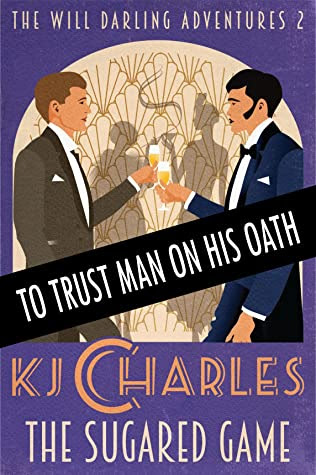
THE SUGARED GAME, second of three Will Darling gay spy adventures, and TO TRUST MAN ON HIS OATH, its coda


THE SUGARED GAME
K.J. CHARLES
(Will Darling Adventures #2)
KJC BOOKS (non-affiliate Amazon link)
$3.99 Kindle edition, available now

Real Rating: 4.5* of five, rounded down because even though we went alllllmost a whole MM romantic mystery without a single w-bomb splattering my Imperial aesthetic hems, there the bastard was, so call it four...well, no, leave it at four-and-a-half stars because it was bloody good fun

The Publisher Says: It's been two months since Will Darling saw Kim Secretan, and he doesn't expect to see him again. What do a rough and ready soldier-turned-bookseller and a disgraced shady aristocrat have to do with each other anyway?

But when Will encounters a face from the past in a disreputable nightclub, Kim turns up, as shifty, unreliable, and irresistible as ever. And before Will knows it, he's been dragged back into Kim's shadowy world of secrets, criminal conspiracies, and underhand dealings.

This time, though, things are underhanded even by Kim standards. This time, the danger is too close to home. And if Will and Kim can't find common ground against unseen enemies, they risk losing everything.

MY YOUNG GENTLEMAN CALLER KNOWS TO BUY ME EVERY RELEASE FROM THIS AUTHOR. HE IS THE BEST.

My Review
: I did not see the ending coming. It's very hard to fool someone who's been reading as long as I have about something this central to the story for two whole books. I am clearly a sociopath because, as the finale debuted in the theatre (note misspelling intentional) of my mind I, the audience, was on my (mental) feet shouting for more gore. Gore there is, be forewarned.

But oh how satisfyingly deployed.

In my review of Slippery Creatures, I commented that the story resembled Notorious (Ingrid Bergman, Cary Grant {who is the perfect model of Kim Secretan IMO}, Nazi spies) only with 1940s hunk Steve Cochran (my mental casting director's choice for Will Darling) in the Bergman role.
This time, as Richard Hannay is directly referenced in the text of the story, I thought of The Three Hostages because we're doing a similar amount of worry about and protecting people from unseen assailants and malefactors. But honestly, I say seek your parallel in the twists and turns, the puppetmaster-pulling-strings artfulness of North by Northwest. The hostages, their fates, the supporting characters' various interrelationships...similar enough that I kept picturing Will in Eva Marie Saint's wardrobe.
I will say that it was a tad disturbing. Nothing compared to what Will would've thought of it, of course.

This outing is more, shall we say, meaty than the first...we're starting from what every lover dreads, being ghosted by the belovèd:
“Don’t look at me,” Will said. “I’ve no idea what he’s up to. I haven’t heard from him since I don’t know when.”

He knew exactly when: the second of January. It was currently the twenty-second of February. That was a sore point he had no desire at all to discuss, so he added, “I’m not sure if he ever uses the title. It’s not compulsory, is it, if it’s one of those whatsits?”

–and–

Will wasn’t a country girl, courted and cast aside by a London seducer, and it would not do to give the impression that he felt jilted. Kim’s demeanour gave no indication of regret, still less a desire to resume relations, and Will was damned if he’d embarrass himself by behaving differently.

Only you very much are, Will, you're in love so far out of your league it isn't remotely funny. The wonderful part is that, unlike the incredibly unrealistic plot of Maurice, we're not left wondering what on Earth the two of you will talk about the twenty-two hours a day you're not actually fucking. And Kim's world has already cast him out, to the edges and fringes at least if not all the way out, so there's little danger of you having the awful luck of attending too many of the parties that Author Charles skewers so beautifully in this story...and where Will acquits himself creditably, if not brilliantly, all to serve his mate Maisie as she and Phoebe, Kim's fiancée and Will's friend, start Maisie's rise in the World of Fashion:
"...You need to dress for your own body, not pretend you’ve someone else’s, don’t you think?” (Quite revolutionary, Maisie!)

–and–

“I don’t know how to break it to you, dear boy, but if Maisie pursues a career in fashion, she is likely to meet people of the homosexual or sapphic persuasions. Try not to be shocked.”

“So?”

“So Phoebe thought she should learn to react in an environment where a misstep wouldn’t hurt. As it turned out, she is sure-footed, and a quick study. I see why you both like her so much. I’d like to know her better myself.”

From Kim, that is the highest praise imaginable! And it makes me think more of him as Maisie is the simplest kind of person to underestimate: The honest, forthright, always-herself good-mannered cheerful soul. It doesn't do to underestimate them, yet people so often do. And here's very aristocratic Kim, son of a marquess, seeing her and valuing her appropriately. I enjoy that facet of the character quite a lot. It's of a piece with his genuine, growing love for Will. Who, need I mention, is utterly in love with Kim. Being men, things aren't great in the communication department...but the sex is smokin' so the connection is there.

Ahhh...so, about the sex...yep, it's there and belongs there. It is decidedly not straight-people friendly. You know your own tolerance for reading about sex, listen to your instincts. If you're willing to be adventurous, this series will definitely reward you with a cracking good spy story and a couple seeking their happiness in spite of a hostile world...which does not include any of the people that matter the most to them.

In this entry the stakes for Will and Kim are astronomical and the results are long-lastingly resonant. They're required, in the course of resolving the matter of the first book's primary antagonists, to confront demons within and without human forms to which they each...both...have deep ties. It's clear that Kim possesses facts he isn't sharing, and while that can be good spycraft, it's unmitigated hell on relationships:
He didn’t delude himself that asking Kim to tell him the truth meant it would happen, either. They’d been honest with one another as far as it went, and that was something, maybe even a lot, but Will had a feeling all it had achieved was to dig their foxhole deeper.

–and–

“Go on, go,” he said. “Don’t come back. Keep your precious secrets if that’s all you care about, and leave me alone. This isn’t forgivable.”

Kim went. He didn’t even have the decency to give Will a fight or slink out shamefacedly; he just picked up his coat and hat and left. The door closed behind him, setting the bell jangling.

–and–

Will had more self-respect than to trail after him any more.

Horseshit. There is, in every love story, the moment when communication breaks down, both parties are backed up against different walls, and things are at an impasse. In that moment, one feels as though "The End" has appeared on the screen and it's time to gather one's detritus and toss it into the bin on the way out of the theatre. This is almost never true in real life, and pretty much never, ever in fiction. Self-respect and being in love are two ends of one balance beam only in the most simplistic stories, and Author Charles does not traffic in those.

But, as usual, it takes Very Very High Stakes to overcome the grumpy pride of men and compel them to reassert their pair bond. The stakes in this story, which were already quite high, elevate to existential-threat levels. There is so very much riding on Kim getting this issue, the one from last book, resolved...so very much for the men, for their found family, for the U.K. as a whole...that the savvy reader knows the price for Kim will be high. Will, given the choice of what to do and how to do it:
“Do you know Lepanto?”

“The Chesterton poem?”

“There was a bit I was trying to remember...I looked it up afterwards. ‘Dim drums throbbing in the hills half heard, Where only on a nameless throne a crownless prince has stirred, Where risen from a doubtful seat and half-attainted stall, The last knight of Europe takes weapons from the wall.’”

Kim’s lips parted. Will held his eyes, willing him to believe. “That’s you.”

–and–

“I,” Kim began at last, and had to try again. “I would like to be—not alone.”

“Shoulders right here. Suitable for leaning on, crying on, or standing at for the purposes of a fight.”

Have you ever, in all your born days, heard a more moving, more vivid and intensely felt, declaration of love than that? This is the spine-stiffening speech, the statement of commitment, that Will uses to arm Kim for a confrontation his entire lifetime's worth of guilt and insecuritites tells him he can only lose.

It's no spoiler to say that Kim and Will prevail...it's a series! this is two of three!...but there are the necessary costs to the men. They are deep, painful extractions of value, they are seriously out of proportion to the success the men have delivered, and they are going to lead to a fireball of a series-ending book three, Subtle Blood.

...if only she hadn't befouled the experience with that w-bomb at 89%/page 214....

+++++++++++++++++++++++++++++++++++++++++++++++++++++++++++++++++


TO TRUST MAN ON HIS OATH
K.J. CHARLES
(Will Darling Adventures #2.5)
Author's website
Free PDF download

Rating: 4.5* of five

The Publisher Says: A Will Darling Adventures interlude.

Set a week after the ending of The Sugared Game (so contains mild spoilers for that book).

My Review: It's important to understanding the gestalt of Will and Kim to read this short piece. It feels to me like it was clipped off the end of the book, and made into its own thing, instead of being the epilogue it feels to me like it should've been.

I was very moved by the sweetness of Will's acceptance of Kim's faults, amply displayed in previous instalments of the series; and his acceptance of Kim's worthiness of trust. It takes a lot to expose your vulnerability to someone whose track record of treating you is spotty on the plus side. Importantly, though, Will acknowledges that Kim has always come through when the stakes are high and the situation is grave.

I'm also very moved by the way the author frames the conversation, as it accords well with what I know of biphasic sleep: a period of wakefulness in the middle of one's night that disinhibits the usual censorship functions, that allows one's conversation to open doors and breach walls that seem impossible during ordinary daytime. Then, when the needful things are said, sleep returns and the day that dawns, dawns brighter than it would have otherwise.

I was charmed; I was also better prepared for Subtle Blood, so I recommend the read to you, too.