Showing posts with label Soviet Russia setting. Show all posts

Friday, August 28, 2026

THE LIPETSK CONSPIRACY: The True Origins of Hitler's Luftwaffe (Tom Munro Aviation and Espionage Series #4), interwar Bonding


THE LIPETSK CONSPIRACY: The True Origins of Hitler's Luftwaffe (Tom Munro Aviation and Espionage Series #4)
WILLIAM FERNIE
Fernie Publishing Ltd (non-affiliate Amazon link)
$5.99 Kindle edition, available now

Rating: 4* of five

The Publisher Says: Before the Luftwaffe terrorised Europe, it was forged in secrecy.

In the uneasy peace before WWII, Captain Tom Munro is flying for Deutsche Luft Hansa when he uncovers a clandestine military airfield hidden deep within Soviet Russia.

Coerced into supporting Germany's secret rearmament programme, he risks his life flying experimental aircraft and developing new, untested operational techniques all prohibited under the Treaty of Versailles. This test flying provides a unique opportunity to gather military intelligence of immense value to the British Secret Intelligence Service.

But Tom knows that he will not be allowed to survive with this vital intelligence and must attempt the impossible: escape with Germany's secrets before he disappears forever.

An interwar aviation/espionage thriller for readers of David Downing, Philip Kerr and Robert Harris.

I RECEIVED A DRC FROM THE PUBLISHER VIA NETGALLEY. THANK YOU.

My Review
: Tom Munro is a very enjoyable PoV to follow as this based-on-facts thriller of Nazi Germany's preparations for war in the air. The prior three volumes in the series deal with the Great War, the Treaty of Versailles era, and now the period that enables the rise of the Nazi state.

It's a period I'm very interested in, and one that saw gigantic advances inn aeronautical engineering, materials science, and other sciences that are useful in wartime. As always it's the horrors of slaughter that drive change, and the economy's growth, and the terrible Othering of people in no way wrong, bad, or evil as the scum at the top try to justify the war "They" want by manufacturing enemies within and without.

What makes Tom fun to follow is mostly his test-pilot nous. It's fun for me to read about the planes realy being tested, really being studied in this pre-Depression time that has so much hope for a peaceful future that recedes and recedes while Tom and his ilk try to keep it alive. Yet here he is flying violation-of-treaty equipment to a secret base! One in Russia, no less...more serious skulduggery...and consequences for Tom in terms of using spycraft for...good?

Come for the history, stay for the gearhead talk, which you'll need to be getting along with that to be in the full story. I was captivated, you might not be, so be aware the jargon is plentiful and needed to make sense of the Lipetsk Russian airfield subplot. There are many politicosocial developments but they almost all incorporate technology and discussion of same.

There is yearning for his lost, belovèd fellow spy Alice, which is getting a bit wearing if I'm honest. Oh well. One must have a woman in a thriller, she motivates the main man. *sigh*

A complex and very very sensitive matter, Germany's resurgent ambitions and rebounding desire to lead the technological world, and the worries of her very recent opponents all buried in piles of dead people from that stupid war. And an ending to this story that's exactly right. All designed to give this old man reader the happy.

Be ready for the complexities on multiple fronts and it might do the same trick for you.

Wednesday, September 3, 2025

THEIR FOUR HEARTS, intense, appalling, urgent, amazing


THEIR FOUR HEARTS
VLADIMIR SOROKIN
(illus. Gregory Klassen; tr. Max Lawton)
Dalkey Archive Press (non-affiliate Bookshop.org link)
$17.95 all editions, available now

Rating: ?5*? but on what scale....

The Publisher Says: In many respects, Their Four Hearts is a book of endings and final things. Vladimir Sorokin wrote it in the year the Soviet Union collapsed and then didn't write fiction for ten years after completing it—his next book being the infamous Blue Lard (q.v.), which he wrote in 1998. Without exaggerating too much, one might call it the last book of the Russian twentieth century and Blue Lard the first book of the Russian twenty-first century. It is a novel about the failure of the Soviet Union, about its metaphysical designs, and about the violence it produced, but presented as God might see it or Bataille might write it.

Their Four Hearts follows the violent and nonsensical missions carried out by a group of four characters who represent Socialist Realist archetypes: Seryozha, a naive and optimistic young boy; Olga, a dedicated female athlete; Shtaube, a wise old man; and Rebrov, a factory worker and a Stakhanovite embodying Soviet manhood. However, the degradation inflicted upon them is hardly a Socialist Realist trope. Are the acts of violence they carry out a more realistic vision of what the Soviet Union forced its "heroes" to live out? A corporealization and desacralization of self-sacrificing acts of Soviet heroism? How the Soviet Union truly looked if you were to strip away the ideological infrastructure? As we see in the long monologues Shtaube performs for his companions—some of which are scatological nonsense and some of which are accurate reproductions of Soviet language—Sorokin is interested in burrowing down to the libidinal impulses that fuel a totalitarian system and forcing the reader to take part in them in a way that isn't entirely devoid of aesthetic pleasure.

As presented alongside Greg Klassen's brilliant charcoal illustrations, which have been compared to the work of Bruno Schulz by Alexander Genis and the work of Ralph Steadman as filtered through Francis Bacon by several gallerists, this angular work of fiction becomes a scatological storybook-world that the reader is dared to immerse themselves in.

I RECEIVED A DRC FROM THE PUBLISHER VIA EDELWEISS+. THANK YOU.

My Review
: Before I begin, let me say:
→H↔E↔E↔D↔T↔H↔E↔C↔O↔N↔T↔E↔N↔T↔W↔A↔R↔N↔I↔N↔G←

If you need a content warning for gore, body horror, transgressive...anything...horseman, pass by. This is Sorokin, of Blue Lard fame, playing Literature's organ with the unsettling pedal fully depressed and the weird stop pulled all the way out. Comme d'habitude, then.

So, the audience now being self-winnowed, I'm going to tell you as little as I can about the transgressions and more about why I care enough to suggest you read this tooth-ripped bloody gobbet shoved in a sweaty gym sock of a book. Because you still can, that's why. This is a litmus test for collapse. If you read it and are not repulsed fairly often, you're probably on the barricades now. If you read this and think, "oh my gawd how'd he geta away with THAT?!" twice a chapter, you're marching somewhere, and shitposting about the 2025ness of it all, and postcarding the hell out of red districts. Everyone else, the "this is repulsive!" to the "this should be banned!" folk, why are you even here? It is not safe for you to be reading anything here when you're under curfew. Off to The New York Times, now, quick as you like, no hands outside the windows!

Like Blue Lard, like Moderan, like everything Burroughs or Dennis Cooper ever wrote, this weird, janky, slightly collapsing edifice of artifice requires you to participate. Very few things in the content-consuming 2025 we live in *require* you to participate to make them work. Sorokin's works aren't simple, even simplistic, slickly made entertainments, they are viscera of story hoicked out of places you didn't think there was spare narrative flesh. There wasn't spare narrative flesh. Vital organs of awareness and complicity and oblivious cruelty are wrenched out and held up before your dumbfounded gaze...and the chapter-opening art adds to that impact.

Sound unappealing? It's not here to appeal to you, it's here to make you reach inside yourself and find the pieces...they're only going to be pieces, I don't think inchoate monstruous sadists read my blog...of these characters in crises they did not make, or try to make better in any way. It is in all of us to look away, to accept pretty surfaces on ugly things, ugly selves. That response is not possible while reading Their Four Hearts.

And that's the point of reading it. I think it could do you a power of good between retches.

Saturday, August 24, 2024

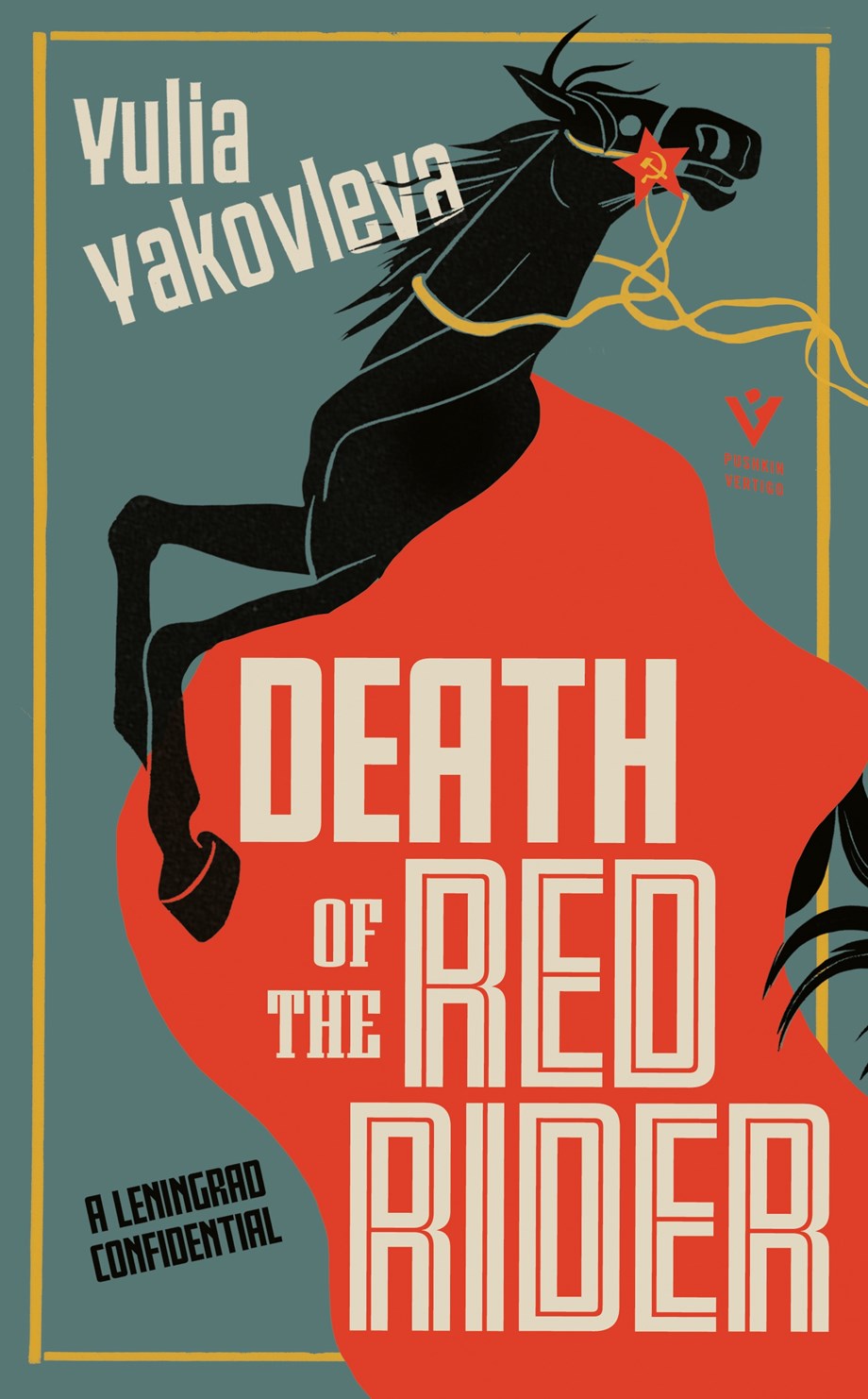
DEATH OF THE RED RIDER, The Leningrad Confidential series #2


DEATH OF THE RED RIDER
YULIA YAKOVLEVA
(The Leningrad Confidential series #2) (tr. Ruth Ahmedzai Kemp) Pushkin Vertigo (non-affiliate Amazon link)
$9.99 ebook editions, available now

Rating: 4.5* of five

The Publisher Says: As the Red Terror gathers pace, a horseman and horse mysteriously collapse in the middle of a race in Leningrad. Weary Detective Zaitsev, still raw from his last brush with the Party, is dispatched to the Soviet state cavalry school in Novocherkassk, southern Russia, to investigate. As he witnesses the horror of the Holodomor, and the impact of Soviet collectivisation, he struggles to penetrate the murky, secretive world of the cavalry school.

Why has this particular murder attracted so much attention from Soviet officials? Zaitsev needs to answer this question and solve the case before the increasingly paranoid authorities turn their attention towards him...

Don’t miss the second installment in the atmospheric and relentlessly dark detective series set in Stalinist Russia, where corruption, informers, and purges take paranoia to the next level.

I RECEIVED A DRC FROM THE PUBLISHER VIA EDELWEISS+. THANK YOU.

My Review
: Less gray-skied than Punishment of a Hunter, just as paranoid, just as nail-bitingly intense. The action moving south of Leningrad to "Cossack country," a nomenclatural sidestep from the modern name of a place Little Vladdy Pu-Pu doesn't much like having mentioned at present, changes the externals and, if anything, ramps up the internal conflicts between self and State present in every single breath taken in Stalinist times.

Zaitsev has a new...comrade? minder? internal spy?...in Zoya, a woman with a chip on her shoulder about being judged unfairly (because woman), a woman with a difficult attitude of disrespect for the people among whom she and Zaitsev must do their investigative job, and a general poor substitute for last book's Nefyodov. When you're among people who are extra-suspicious of you because you're Russian when they were already unhappy to see someone sent by the central authorities to poke around in places they'd just as soon leave unpoked, thanks, to solve a crime that took place a world away, to someone whose life was a-rattle with the skeletons in his closet...this will not end well for plenty of folks.

It's heavenly!

No one can be trusted! About/with/for ANYthing! Every time Zaitsev finds something out he has to unwrap more shades of meanings than Tut had embalmers' bandages! Impressively, Author Yakovleva manages to make the thriller-y bits cohere well. There's a secondary theme in who was murdered, where, and why, though it's not particularly energetically explored. It very much comes with the murdered man's identity, and I found it and its deeper ramifications interesting, but if I don't holler about it the importance won't be obvious to most. And I won't. This series has, as one of its main pleasures, the pressure cooker of Zaitsev sweating out the clues, in the teeth of multiple prongs of opposition, while uncovering realities of his life lived in Soviet Russia that break him on a human level.

So my attention was riveted again...last book I gave an extra quarter-star to, elevating it almost to fivehood. Not this one, despite my praising it; so why?

As pleasure reading, deeply interesting history of the Red Terror is...challenging. The information Zaitsev discovers as his investigation goes on would've gotten him shot in 1937 Russia. He could not have survived learning what he did...too much evidence to the contrary exists in the identities of the many murdered. So my disbelief muscle was sore from overuse. Also, why didn't he just shove Zoya under a tram or into a combine harvester and have done with it? She was more than a poor partner for an investigator, she was a provocatively bad investigator herself.

So there's the missing fractional star. Noe of that made me less eager to get to the next chapter, and I could not wait to pick up the read every day.

So a big #WITMonth win for Pushkin Vertigo, and me; y'all, too, if you go get one now.

Tuesday, June 27, 2023

SPRING IN SIBERIA, a well-honed spear of a story is thrust into one's readerly guts


SPRING IN SIBERIA
ARTEM MOZGOVOY

Red Hen Press
$18.95 trade paper, available now

Rating: 4* of five

The Publisher Says: 1985. Russia. As the Soviet Union disintegrates and Western capitalism spreads its grip across their land, the Morozov family finds itself consigned to the remote, icy wastes of Siberia. It is here that their only child, Alexey, is born.

A sweet and gentle schoolboy, Alexey discovers that reciting poetry learnt by heart calms his fears. That winter gales can be battled with self-invented games, and solace found through his grandmother’s rituals and potions. But when Alexey’s classmate, the son of KGB agents, confesses his love, the desire of two boys to be together clashes violently with the mad world around them.

Exploring the healing power of literature, the magic of first love, and the ways our family and homeland can save (or shatter) us, Spring in Siberia is a coming-of-age novel that, in the darkest of times, glows with hope and the yearning for freedom to be oneself—completely.

I RECEIVED A DRC FROM THE PUBLISHER VIA EDELWEISS+. THANK YOU.

My Review
: A sweet, gentle childhood spent among adults who love him doesn't mean Alexey/Artem wasn't always made aware of how different he was from other boys. His father's mother, whose earthy peasant lifeway he came to root inside, never made anything easy but always taught him that he, and he alone, was responsible for his life by never excusing him from the work of wrestig food for his supper from the unforgiving Earth of Siberia. She taught him to accept the gift of belonging where you plant yourself with her stories of her own early life spent in the Russian west before she was sent to Siberia to care for her brother and then made her life there.

This lesson, above all, would serve the young man well: Make your own life, and thus your own happiness.

The entirety of Artem's...do pardon, Alexey's...life was spent in upheaval and dislocation as the old Soviet Union collapsed and a new old country Russia was (re)born. Being a child with a firm grounding in self-reliance, he takes the new world in his stride. I found his mother's transformation from a depressed, moping lump into a purposeful and energetic capitalist very interesting...and Alexey's trotting right along behind her, using the first money he ever earns by selling flower arrangements on a set of beautifully bound Pushkin books he sees in the local post office. It challenges this planned-economy-raised kid's willpower to save his money instead of spend it well beyond its breaking point, which everyone here should probably relate to. He sees his very first TV commercials and nothing on this wide green Earth will do but he must have some vile, neon-colored sludge to drink...much to his grandmother's appalled confusion, as he's been working with her to pick and preserve wild berries his whole life. What is suddenly so appealing about this new stuff?

In this quiet little moment in a boy's life, the entire tragedy-to-come of Russia: An old, bad system ends with nothing to replace it and a new on with inscrutable rules that aren't like the old rules confuses the bejabbers out of most people who aren't like Alexey's freshly liberated mother.

Her love for her son isn't smooth...he's mistaken for a girl a lot, is clearly a femboy, and is bullied mercilessly. Alexey's father, less successfully capitalist than his wife, is repulsed by the growing strangeness of his only child; the family disintegrates under the many stresses of the world. As Alexey enters adolescence, his isolation from his peers is ameliorated by the love of Anton, expressed in a sweet, sweet, strange and menacing scene on a balcony. Things for th young lovers go poorly, as one would expect them to, given the world's homophobia. Anton and Alexey, eventually, are driven apart by adult cruelty and hatred. How that plays out is so deeply sad, and so universally relatable, that I wanted to jump into the story and shepherd them through the hateful nastiness of small-souled bigots.

Alexey, smart as a whip and hell-bent on not being like Them, goes to university on a "red diploma"—a free pass into the higher education system. He chooses, as did Artem the Author, to train as a journalist in a country about to lose even its unfree statee-supported press. He's trained to observe from birth by being Other, so he has a clear vision of how unfair the new system is to the old system's relicts. Here, then, is the main pleasure I got from reading this sad, oft-told tale of growing up Other in a world that genuinely and utterly, in a bone-deep way, hates you for being yourself.

It's not just gay people, it's not just smart people, it's Them...whoever it is that isn't like the one hating with all their tiny soul's capacty...and every living one of us is Them to someone. Alexey realizes this in a blinding, road-to-Damascus moment in a school hallway.

Life is cruel to Others. This well-honed spear of a story is thrust into one's readerly guts. You'e never again going to look at that butch girl or that femme of a boy and think "Other" after reading this story. Artem/Alexey is a human being and, as we follow him through a rough and turbulent upbringing in a hostile world without a safety net of any material, social, or spiritual sort, we can no longer pretend that we're not all guilty of glossing over the costs of our own quiet little prejudices. Emma Goldman, social activist and poet whose lines are on the Statue of Liberty in New York's front door to the USA, said:
There is no greater fallacy than the belief that aims and purposes are one thing, while methods and tactics are another.

Saturday, November 26, 2022

PUNISHMENT OF A HUNTER, Soviet historical thriller & DEAD AND GONDOLA, cozy cozy cozy series debut


DEAD AND GONDOLA
ANN CLAIRE
(Christie Bookshop #1)
Bantam Books
$17.00 trade paper, available now

Rating: scraped up the goodwill of the season so 4* of five

The Publisher Says: When a mysterious bookshop visitor dies under murderous circumstances, the Christie sisters and their cat Agatha call on all they’ve learned about solving mysteries from their favorite novelist in this new series debut.

Ellie Christie is thrilled to begin a new chapter. She’s recently returned to her tiny Colorado hometown to run her family’s historic bookshop with her elder sister, Meg, and their friendly bookshop cat, Agatha. Perched in a Swiss-style hamlet accessible by ski gondola and a twisty mountain road, the Book Chalet is a famed bibliophile destination known for its maze of shelves and relaxing reading lounge with cozy fireside seats and panoramic views. At least, until trouble blows in with a wintery whiteout. A man is found dead on the gondola, and a rockslide throws the town into lockdown—no one in, no one out.

He was a mysterious stranger who visited the bookshop. At the time, his only blunders were disrupting a book club and leaving behind a first-edition Agatha Christie novel, written under a pseudonym. However, once revealed, the man’s identity shocks the town. Many residents knew of him. Quite a few had reason to want him dead. Others hide secrets. The police gather suspects, but when they narrow in on the sisters’ close friends, the Christies have to act.

Although the only Agatha in their family tree is their cat, Ellie and Meg know a lot about mysteries, and they’re not about to let the situation snowball out of control. The Christie sisters must summon their inner Miss Marples and trek through a blizzard of clues before the killer turns the page to their final chapter.

I RECEIVED A DRC FROM THE PUBLISHER VIA NETGALLEY. THANK YOU.

My Review
: Meg and Ellie Christie, bookshop owners of Last Word, Colorado's, The Book Chalet, mystery solvers when a man who bumbles into their shop's séance turns up dead one gondola over from theirs on the funicular, and charming women trying to bring their worlds into agreement.

Meg, single mother of fourteen-year old Rosie, and her younger, newly unmoored sister Ellie, are invited by their retiring parents to come home and run the family's bookstore in their ski-resort hometown with her. It's a set-up that's an evergreen for a reason...it plays on the familiarity of a native place while still allowing the returned native a chance to "catch up on" the time they've been away. It also establishes the family's relations to each other, in that one would get a whole different idea of Meg had she seemed grudging or reluctant to accept younger, single Ellie to join the business. I think one is immersed in the sense of a happy family from the second their Gram comes onto the pages, knowing she has been their rock throughout life. That, too, sets a facet of the family's character as a system in addition to demonstrating the cozy-series bona fides Ann Claire is seeking to establish.

I'm a sucker for bookstores in fiction going back to the first mystery series set in one that I fell in love with: Claire Molloy's Book Depot in the Farberville, Arkansas, set humorous cozies by the late, lamented Joan Hess. This debut is joining a long and belovèd lineage. I am delighted to report that this is a happy meeting of fantasy (bookstores require *huge* amounts of labor and run on the slimmest of margins) and storytelling. The ski resort setting is nice, in that I'd always rather read about cold, snowy places than hot ones, but not outstandingly detailed. I suppose this is all a matter of what one wishes to have in a series-starting story...the sense of possibility is there in this story so there's plenty of room for additions and expansions.

Rosie annoyed me. She's fourteen, of course she was going to, but really this is a trope I can do without, the adolescent eyeroller. Anyway. At least she wasn't a bookstore cat, those horrible, misery-making creatures...like Agatha C. (for "cat" ickshudder) Christie. I mean, *obligatory warning of sexist stereotyping to come* I know I'm not a woman so I don't really get the appeal of cats *end sexist stereotyping*, but can there be a bookstore without a cat in mysteryworld now? Please?

What's right about the read far outweighs my grumbles about details. None of them ruined my reading experience. I am sure Author Ann Claire (also known as Ann Myers and/or Nora Page) knows her craft from practicing it for quite some time across several series. I expect a high level of polish from such an author and was not let down in this read. Recommending a book such as this is always touchy...what causes a series to soar is so often alchemical symmetry between author and reader...but consider this: I read this entire book that features a cat as a character...my most deeply beloathèd animals!...and am here writing a positive review.

This is an author with chops. Trust her, follow her through this story, and I predict a lot of y'all will have a new series to enjoy.

++++++++++++++++++++++++++++++++++++++++++++++++++++++++++++++++


PUNISHMENT OF A HUNTER
YULIA YAKOVLEVA
(The Leningrad Confidential series #1) (tr. Ruth Ahmedzai Kemp)
Pushkin Vertigo (non-affiliate Amazon link)
$16.95 trade paper, available now

Rating: 4.5* of five

The Publisher Says: The debut of the ultimate noir detective series: set in Stalinist Russia, riddled with corruption, informers, and purges that takes paranoia to the next level

MURDER
1930s Leningrad. Stalin is tightening his grip on the Soviet Union, and a mood of fear cloaks the city. Detective Vasily Zaitsev is tasked with investigating a series of bizarre and seemingly motiveless homicides.

MAYHEM
As the curious deaths continue, precious Old Master paintings start to disappear from the Hermitage collection. Could the crimes be connected?

MISTRUST
When Zaitsev sets about his investigations, he meets with obstruction at every turn. Soon even he comes under suspicion from the Soviet secret police.

The resolute detective must battle an increasingly dangerous political situation in his dogged quest to find the murderer―and stay alive.

I RECEIVED A DRC FROM THE PUBLISHER VIA EDELWEISS+. THANK YOU.

My Review
: This is a newly translated series-starting thriller. I'm eager for the second one to appear, so go buy this one now.

Seriously. The only way the publisher knows there's a market is if there are sales, so go on now.

What do you mean, "but why should I?" Oh very well. Look at this image, of the same title as the book:
Doesn't that simply say it all in artistic form? And the painting's in the Hermitage collection in Russia, too.

The 1930s were a scary, scary time to be a Soviet citizen. The surveillance state's apparatus was risibly primitive by comparison to today's hypercapitalist surveillance model, but it was effective. Like those old Hitchcock movies where men in slouch-brimmed hats smoked on streetcorners by your apartment, the pervasive atmosphere was paranoid and terrified. (Our {great-}grandparents had more sense than we complacent and indifferent acquiescers do.) To be a policeman in a state-sponsored terrorist society, to be studied minutely as one tries to achieve the ever-elusive goal of bringing justice to transgressors while avoiding the political pitfalls of society's mad/badness, adds a layer of suspense to thrillers.

Author Yakovleva does a truly creditable and credible job with Zaitsev, her sleuth. He doesn't miraculously float above The System somehow, nor does he set out to provoke The System's minions to make his points. He falls victim to the excesses of the times (CW for torture!) and he still stubbornly insists on doing the right thing by the victims of personal violence. It is very much in the vein of the "lone truth-seeker" genre of thriller. I think those stories can go wrong quickly, turning into libertarian screeds against any and all forms of government by equating them with oppression. This book dodges that bullet by being about, explicitly taking as its subject, that nightmarish oppressive government and its warped and broken victim/citizens. I wish more libertarians would read this kind of historical take because it puts into a cold, unfriendly light the mild checks on their worst selves that so chafe them.

Author Yakovleva is ably assisted in telling her story by Translator Ruth Ahmedzai Kemp. There are bursts of informative explanatory things in the text that I'm sure are her work...no one in modern Russia likely needs as much explanation of the role of the OGPU, for example (the domestic secret police, like the FBI or latter-Soviet-days KGB). That this information, among so much other information needed by Anglophone readers not Russophone ones, was woven into the text pretty darn seamlessly is a testament to Translator Kemp's grasp of and skill at presenting the reader the best version of the original text.

What makes it a perfect book to get your thriller reader giftee, or your thriller loving self, is that very thing: It's the best version of what was, if my Spidey-senses do not deceive me, a top-quality read from the get-go. Translations are often serviceable, telling the story as it was told in the original and not grasping, or conveying at any rate, whatever special sparkle the original had. It sounds weird to tell you that the cold, grim, gray landscape of Stalinist-Purge era Leningrad, peopled with terrorized victims and subjected to psychic violence, physical violence, and sensory deprivation on an industrial scale, has a sparkle to it. But it does.

Not a joyous resolution to the weird, theatrically staged and colorfully over-the-top crimes committed here...but a resolution I believed and I supported with my whole readerly heart. More of Zaitsev, please, Pushkin Vertigo. We need this kind of "history as sly social commentary" Russian fiction; we in the Anglophone West need the warning klaxon of what *real* oppression feels like, why it does to its victims, so we will stop our loud, pointless whinging.

Thursday, August 25, 2022

NATASHA PULLEY'S PAGE: THE WATCHMAKER OF FILIGREE STREET; THE KINGDOMS; THE HALF LIFE OF VALERY K


THE HALF LIFE OF VALERY K
NATASHA PULLEY

Bloomsbury USA
$28.00 hardcover, available now

Rating: 4.75* of five

The Publisher Says: In 1963, in a Siberian gulag, former nuclear specialist Valery Kolkhanov has mastered what it takes to survive: the right connections to the guards for access to food and cigarettes, the right pair of warm boots to avoid frostbite, and the right attitude toward the small pleasures of life so he won’t go insane. But on one ordinary day, all that changes: Valery’s university mentor steps in and sweeps Valery from the frozen prison camp to a mysterious unnamed town that houses a set of nuclear reactors and is surrounded by a forest so damaged it looks like the trees have rusted from within.

In City 40, Valery is Dr. Kolkhanov once more, and he’s expected to serve out his prison term studying the effect of radiation on local animals. But as Valery begins his work, he is struck by the questions his research raises: why is there so much radiation in this area? What, exactly, is being hidden from the thousands who live in the town? And if he keeps looking for answers, will he live to serve out his sentence?

Based on real events in a surreal Soviet city, and told with bestselling author Natasha Pulley’s inimitable style, The Half Life of Valery K is a sweeping new adventure for readers of Stuart Turton and Sarah Gailey.

I RECEIVED A DRC FROM THE PUBLISHER VIA NETGALLEY. THANK YOU.

My Review
: There is nothing one Earth more appalling to me than the attitude "My ignorance is better than your education, training, and expertise." It's not just wrong-headed. It is dangerous. It leads to very, very deleterious results for the people who have no say in...often no awareness of...the risks they are being subjected to by the wilfully ignorant. The Yucca Flats, Nevada, nuclear-bomb testing disaster that People magazine broke the story of in 1980...the 1956 filming of The Conqueror ring any bells, fellow oldsters?...wasn't the only such official-denial event in the world. In the USSR, there was the Ozyorsk disaster, outed to the world in the New Scientist magazine in 1976 by a brave scientist called Medvedev. (I have to say that Siberia has a very unlucky past. This disaster occurred in 1957; the Tunguska event in 1908 was a holocaust; and sixty miles away from Ozyorsk is Chelyabinsk, of 2013 meteorite explosion fame!)

The story of the many "closed cities" in the USSR, and in today's Russia, is similarly grim, similarly marked by denial and obfuscation and outright lying. The Chernobyl disaster in 1986 was going to be treated that way, only it was far too big to tamp down and deny. So, Author Pulley has me by the nose-hairs again. Again! I am putty in this wicked writer's hands. She tells stories that make my ears perk up, the hair on the back of my neck do its wolfman imitation, and my breathing to become labored in eagerness.

Valery K. the nuclear scientist, exiled to a colder and less hospitable part of Siberia than City 40/Ozyorsk is in, is suddenly ripped from his wretched routine without explanation or preparation. He's in the gulag...this is terrifying. But his worst fears...interrogation? execution?...aren't realized. He's sent to this comparative demi-Paradise of a place to study field mice. To assess them for effects of radiation exposure.

So, all is explained. He's a criminal, but also a thorough scientist trained in matters nuclear. Trained, talented, expendable.

What follows is a litany of nuclear-waste exposure nightmares. The effects on people, on the environment, are grisly. In the one plot strand I am absolutely sure is fiction (it says here) the authorities conduct radiation-exposure experiments on the people of City 40. The other plot strands, the environmental disaster, the carelessness and mismanagement that led to and characterized the ongoing handling of the disaster, are real. (Follow the links!) And gosh golly gee, wowee zowie, those sorts of things don't *ever* happen now. Especially the official lying and misleading! That could never happen in any authoritarian state in the twenty-first century, we have satellites and technology to sniff out problems, and scientists who would *never* lie to us here in the West.

So, the timing of the title's publication is now explained.

As one expects from Author Pulley, there are two men falling in love with each other amid the chaos and carnage that they are powerless to stop. Also as one would expect, there are events that occur that cause them trouble personally and interpersonally. I've said it before, the curse of adulthood is one never, ever has an unmixed emotion. Valery tries, in his what-got-him-gulaged way, to force officialdom to face up to the scale of the disaster. He wants to help people, to save them. Shenkov, his belovèd, is a married father, is in the game because it's the way to get ahead. And stay out of the gulag. The story, in other words, of generations of gay and bisexual men. Hide! They won't kill you if they don't have to notice your deviance.

But like calls to like. Valery knows that Shenkov loves him; he knows he loves Shenkov; things won't go well for City 40, but can things go well for them as men, as people, as...a couple? Fortune, as always, favors the brave. There must always be blood sacrificed before one gets one's rewards.

Morally grey characters, men past pretty on life's curve, the necessity of moving the world's blockages to make room for your authentic life: boxes all checked. The life you want, well...what do you know about how much it will cost, about what it will extract from you. You'll find out, if you're lucky. Or maybe unlucky. Most likely both. Consider, after reading the book, the title and its layers of meaning.

The right kind of read for me, right now, and it went down like the oldest, smoothest, most deceptively sweet tequila there is.

++++++++++++++++++++++++++++++++++++++++++++++++++++++++++++++++


THE KINGDOMS
NATASHA PULLEY

Bloomsbury USA
$28.00 hardcover, available now

Rating: 5* of five

The Publisher Says: A time twisting alternative history that asks whether it's worth changing the past to save the future, even if it costs you everyone you've ever loved.

Joe Tournier has a bad case of amnesia. His first memory is of stepping off a train in the nineteenth-century French colony of England. The only clue Joe has about his identity is a century-old postcard of a Scottish lighthouse that arrives in London the same month he does. Written in illegal English—instead of French—the postcard is signed only with the letter “M,” but Joe is certain whoever wrote it knows him far better than he currently knows himself, and he's determined to find the writer.

The search for M, though, will drive Joe from French-ruled London to rebel-owned Scotland and finally onto the battle ships of a lost empire's Royal Navy. In the process, Joe will remake history, and himself.

I RECEIVED A DRC FROM THE PUBLISHER VIA NETGALLEY. THANK YOU.

My Review
: An exciting visit to the Aetherverse, to which we were introduced in The Watchmaker of Filigree Street (below)...or so it seemed to me.

It cost me so much to read this book, with its star-crossed lovers, its perception of time as layered and mutable, and its grotesque unfairness, the first time. It wasn't easy a second one, either, even though I knew what was coming.

Yes. I, testy oldster with less than two decades left to him, read a book twice.

There is that much to unpack. There is that much to process. There is that kind of thought put into the structure of the story. All that makes an investment of eyeblinks that big both desirable and at some level necessary.

The nature of Time (as the Tenth Doctor called it, "wibbly-wobbly timey-wimey...stuff") and the nature of family feature heavily in this tale. Two men whose fates...whose lives entangle across timelines of startling "points of divergence" or "PoDs" but never forget each other. Imagine loving someone enough, with so much of yourself, that you remember them when you don't remember yourself.

That is the definition of the stakes in this alternate history/time travel novel. There's a weird place, in Scotland for once, where time doesn't behave as we think it should. This remains a weird, slightly underexplained, phenomenon throughout the iterations of the story. In every timeline, Man A meets Man B, falls in love with him, then for Reasons leaves him. Man B doesn't change much, if at all. His name is Kite. His past isn't fixed, though it's the little things that change. For Man A, the one who does the leaving, the past, the present, and the nature of each is...mutable. The world is, oddly, full of people like him who come to themselves in a place where they have no memories and no trauma to explain that lack.

We, readers, know what it is. We know because there is a man, red hair, terrible burn scars, and Man A...call him Joe, call him Jem, what you will...recalls him with love. He doesn't really know why. He isn't happy anywhere. He can't find connection to anyone around him. He floats, unanchored, when away from Kite. Who is a Napoleonic-Wars naval officer with a bad past. He's building a better future, he hopes, by letting Jem/Joe go through the Scottish time gate. But it's at his own expense. He's too used to that, to doing hard and painful things, as a result of his bad past.

What came through to me most strongly was the nature of Love. There is a scene early in the book where Joe, as he was at that time, was raped. By his wife. Who should've been his sister-in-law. And she gives birth to his daughter Lily, whom he adores. He struggles against his love for Kite for several years to stay with her. In the end, he can't fight it and they reunite...and Lily is never born. Yet always alive to Joe, Jem, Man A. A truly Torquemadan torment, losing your child.

What the hell! A man getting raped by a woman?! What's the old lunatic talking about? My own life: It's happened to me, perpetrated by my mother. And that is how I know that Author Pulley got the sensation, the misery of that kind of coercion, exactly and precisely correct. It was shattering to read. It was the very first time in my over-sixty years on this planet that I have read anywhere my private and unshareable truth. It healed and soothed me in a way I didn't anticipate ever experiencing.

If that is not enough to convince you to read the book, then how's this? These men are very dishonest with themselves. They can't afford not to be. But neither man has ever, for a single moment, lost his love for the other.

Come for the wibbly-wobbly timey-wimey...stuff. Stay for the family that only love can form. Revel in the struggles of true lovers to live their truth.

++++++++++++++++++++++++++++++++++++++++++++++++++++++++++++++++


THE WATCHMAKER OF FILIGREE STREET
NATASHA PULLEY
(The Watchmaker of Filigree Street #1)
Bloomsbury USA
$26.00 hardcover, available now

Rating: 4* of five

The Publisher Says: 1883. Thaniel Steepleton returns home to his tiny London apartment to find a gold pocket watch on his pillow. Six months later, the mysterious timepiece saves his life, drawing him away from a blast that destroys Scotland Yard. At last, he goes in search of its maker, Keita Mori, a kind, lonely immigrant from Japan. Although Mori seems harmless, a chain of unexplainable events soon suggests he must be hiding something. When Grace Carrow, an Oxford physicist, unwittingly interferes, Thaniel is torn between opposing loyalties.

The Watchmaker of Filigree Street is a sweeping, atmospheric narrative that takes the reader on an unexpected journey through Victorian London, Japan as its civil war crumbles long-standing traditions, and beyond. Blending historical events with dazzling flights of fancy, it opens doors to a strange and magical past.

I CHECKED THIS ONE OUT FROM THE LIBRARY. USE THIS FREE SERVICE OFTEN. THEY'RE ALREADY PAID FOR.

My Review
: I was hoping this would be a five-star read. I hope that every time I open a book, albeit often with a forlorn sense of the hopelessness of such a thing. But this one, with Queer desire and relationship on offer? Yes please! Gimme!

Mori and Thaniel, the men in question, are indeed heading down Relationship Road. In no kind or sort of hurry, mind you. They live in *London, *Victorian times, with...magic? sort-of kind-of magic...that involves seeing the multiverse and manipulating your present to bring about a future you like the best from the possibilities. I love this idea, and the use of this trope alone would've gotten the book four stars!

The way it's handled is also really compelling to me, with Mori making his odd little machines to nudge reality into new shapes. I was also fascinated by Thaniel's kinesthesia...D# is yellow, for example...but too little was made of this for my taste, more of a small grace note. In particular I was sad that Thaniel didn't twig to something he heard being the proof he needed of what was happening around him...but he was simply too stressed out, I think was the reasoning behind that failure.

Quite a lot that I missed first time round.

I was sure I recalled this read pretty accurately, and was mildly taken aback by the amount of information I glided past before...for example, the way Thaniel says things to his, um, er, to Grace that, um, kind-of unhappen as the ending approaches...and now, on a years-later re-read seem *hugely*significant* and almost spoilery.

But that's because I really already knew them, and how they'd play out.

So what would I call this read, a re-read or a new read? It's kind of both. I've read The Kingdoms (see above) between that initial experience and this one, I'm hip to the author's tricks in a way I wasn't before; I was revisiting the story because I'm reviewing The Half Life of Valery K (see above) now, as well. It's clear as crystal that any author develops stylistic tropes, won't call them tics unless they irk me somehow, and Author Pulley's a one for hiding relationship signals in plain sight. It's a bit disappointing that Grace, after her *horrible* behavior, isn't made to suffer any consequences. Given that there's a second book with Thaniel and Mori at its center, which I haven't read, that could still be possible.

I've got the best of both worlds, then, revisiting an older read that's altered in interesting ways in light of later reads by the same author. It made this meditation on the etheric reality of chance and destiny intertwining so much richer than it was at first.

Monday, May 30, 2022

ALONE ON THE MOON: A Soviet Lunar Odyssey, alternate history of the Space Race!


ALONE ON THE MOON: A Soviet Lunar Odyssey (Altered Space, #5)
GERALD BRENNAN

Tortoise Books
$17.00 trade paper, available now

Rating: 4* of five

The Publisher Says: May, 1970. A two-person Soviet crew approaches the moon, ready to accomplish the greatest feat in human history—provided they can overcome their own petty jealousies, and the unforgiving harshness of space.

Alone on the Moon chronicles a Soviet moon mission through the eyes of Boris Volynov, a backup who’s been pressed into service helping Alexei Leonov (a man he despises) attempt humanity’s first lunar landing. Thoroughly researched, it’s a detailed and plausible rendition of two larger-than-life personalities facing incredible challenges. It’s also a meditation on luck, trust, the nature of observation, and the burden of being chosen—plus the way our personal narratives can shape (or poison) our perceptions of the present. Do the stories we tell ourselves shape our fate, or can we write a new chapter? The answer awaits.

The titles in the Altered Space series are wholly separate narratives, but all deal with the mysteries of space and time, progress and circularity. Each one is an ensō of words in which orbits of spacecraft, moons, planets, and people allow us fresh perspectives on the cycles of our own lives.

I RECEIVED A DRC FROM THE PUBLISHER VIA EDELWEISS+. THANK YOU.

My Review
: Remember Mary Robinette Kowal's Lady Astronaut of Mars series? Alternate space race with hugely accelerated stakes, a lot of international and interspecies cooperation? Like, even women going to the stars?!? Well, that tore it. I had to have more space-but-not-this-way stories.

So here I am reviewing the next most different take on the Space Race...a Soviet first-lunar-landing story! And I hated it!

More precisely, I hated the narrator: Bitter Boris the Bore. Banging on about how unlucky he is, how a Jew is always held back, how deeply he hates Alexei the Golden Boy...his nickname's fuckin' BLONDIE facryinoutloud!...and his tedious wife, the chilly withholding climber.

I'll never read this book again. But goddam what a story! What a sheer, pulse-pounding rocket ride of a story!

The whole burden of the refrain "unlucky" is simple: Don't be different. Don't stand out. Be there but never be noticeably better than anyone in power unless you're so good there's not a corner that they can sweep you into. Because they will. In other words, big organizations are all alike and whatever alphabet the nameplate's are printed in the behaviors are the same.

What happens to Boris is utterly terrifying. At every turn, his shot is blocked. His spot is taken. When he gets to do anything,it goes wrong. Not just people, then, but gawd hates him. And it's no wonder they do, he never met a joy he couldn't squelch or a happiness he couldn't chill to absolute zero. Even his son is being raised by this dark, unhappy cloud of a belief that nothing goes right because it's inevitable.

Yuck.

What this does for Blondie, the first man on the moon, is give him a partner in space who believes it's all going to shit anyway but he's going to check, recheck, then check the recheck so no one can say it was his fault. He calculates things Control has already fed into his computer. He's always got a finger on the cut-off switch so he can make the computers and the thrusters and the machinery of every sort obey his calculations. Which are, of course, correct. Blondie's always been the fair-haired boy and the lucky one so he's just indifferent to the details.

And do you know what? He should't've been *quite* so sanguine. I delight in that bit. I thrilled to the ways the inevitable problems that crop up got handled, solved, and Boris vindicated. There's a reveal at the end of the book that wasn't a surprise to me, there's a lot of technical stuff that will likely put off a casual reader, and there's the basic problem of feeling whined at for almost 300pp. But there was no damned way I was closing this book until I was sure the story ended...well.

And that's why it gets four whole stars.

Tuesday, March 15, 2016

THE HEART OF A DOG: Even before THE MASTER & MARGARITA, Bulgakov's imagination was unstoppable


THE HEART OF A DOG
MIKHAIL BULGAKOV
translated by Michael Glenny
Melville House
$15.95 trade paper, available now

Rating: 4* of five

The Publisher Says: A new edition of Bulgakov’s fantastical precursor to The Master and Margarita, part of Melville House’s reissue of the Bulgakov backlist in Michael Glenny’s celebrated translations.

A key work of early modernism, this is the superbly comic story of a Soviet scientist and a scroungy Moscow mongrel named Sharik. Attempting a medical first, the scientist transplants the glands of a petty criminal into the dog and, with that, turns a distinctly worryingly human animal loose on the city. The new, lecherous, vulgar, Engels-spouting Sharik soon finds his niche in governmental bureaucracy as the official in charge of purging the city of cats.

A Frankenstein fable that’s as funny as it is terrifying, The Heart of a Dog has also been read as a fierce parable of the Russian Revolution. It was rejected for publication by the censors in 1925, and circulated in samizdat for years until Michael Glenny translated it into English in 1968—long before it was allowed to be officially published in the Soviet Union. That happened only in 1987, although till this day the book remains one of Mikhail Bulgakov’s most controversial novels in his native country.

My Review: Anyone who's ever read The Master and Margarita already knows that Bulgakov is a rebel, an anarchist, and damn good and funny with it. His thoughts were, based on the novels I've read, contrarian in the extreme as well as profoundly sensitive to practical concerns:
“The rule apparently is – once a social revolution takes place there’s no need to stoke the boiler. But I ask you: why, when this whole business started, should everybody suddenly start clumping up and down the marble staircase in dirty galoshes and felt boots? Why must we now keep our galoshes under lock and key? And put a soldier on guard over them to prevent them from being stolen? Why has the carpet been removed from the front staircase? Did Marx forbid people to keep their staircases carpeted? Did Karl Marx say anywhere that the front door of No. 2 Kalabukhov House in Prechistenka Street must be boarded up so that people have to go round and come in by the back door? What good does it do anybody? Why can’t the proletarians leave their galoshes downstairs instead of dirtying the staircase?’
‘But the proletarians don’t have any galoshes, Philip Philipovich,’ stammered the doctor.”
And the simple truth about revolution that probably contributed heavily to the book's suppression in the Soviet era:
“People who think you can use terror are quite wrong. No, no, terror is useless, whatever its colour—white, red or even brown! Terror completely paralyses the nervous system.”

He saw the terror around him, saw the results, and distilled a response into a short phrase. That's writing that's a joy to read.

But we can't leave revolutionary-era Moscow without hearing from the eponymous heart-haver. Early in the book, we're told the sad tale of an unwanted dog whose people-savvy beats that of most of the humans I've ever met:
Eyes mean a lot. Like a barometer. They tell you everything—they tell you who has a heart of stone, who would poke the toe of his boot in your ribs as soon as look at you—and who’s afraid of you. The cowards—they’re the ones whose ankles I like to snap at. If they’re scared, I go for them. Serve them right...grrr...bow-wow…”

All hail Michael Glenny, of blessed memory since dying in 1990. Without him, Bulgakov's banned and suppressed works might remain out of the English-speaker's reach.

Monday, October 7, 2013

DEATHLESS, Catherynne Valente's Leningrad Diptych #1 7 October 2013

DEATHLESS
CATHERYNNE VALENTE
(Leningrad Diptych #1)
Tor Books
$18.99 trade paper, available now

Rating: 4.25* of five

2 JUNE 2021 KINDLE EDITION ON SALE FOR $2.99

The Publisher Says: Koschei the Deathless is to Russian folklore what devils or wicked witches are to European culture: a menacing, evil figure; the villain of countless stories which have been passed on through story and text for generations. But Koschei has never before been seen through the eyes of Catherynne Valente, whose modernized and transformed take on the legend brings the action to modern times, spanning many of the great developments of Russian history in the twentieth century.

Deathless, however, is no dry, historical tome: it lights up like fire as the young Marya Morevna transforms from a clever child of the revolution, to Koschei’s beautiful bride, to his eventual undoing. Along the way there are Stalinist house elves, magical quests, secrecy and bureaucracy, and games of lust and power. All told, Deathless is a collision of magical history and actual history, of revolution and mythology, of love and death, which will bring Russian myth back to life in a stunning new incarnation.

My Review: Remember how I said I didn't like books with majgickq and elves and stuff, and how very resistant I'd be so such stories?

Ha.

Magical to a fault, mystical and full of eyerollingly silly things like big black cars with chicken's feet instead of tires, and factories where soldiers are hand-loomed by the Tsar of Life's cast-off mistresses under the supervision of Baba Yaga.

And what can I say? Like every hard and fast rule, this rule went flooey in no time at all, thanks to some ecstatic carolings and appreciative lowings from some very talented reviewers. You terrible people know who you are. I don't love you for causing me to eat my words so publicly.

Russia is a strange, strange place to me. During some really vicious pogroms they tossed in the 19th century, a Polish Jewish ancestress of mine...great-grandmother...walked away from her shtetl, her family, and her identity, got to Bavaria and married an old Catholic man with no living children but who had a shop, and started again. He died, she sold up, she moved on to the USA via Paris, two kids and an American lover in tow. So thanks Russians for being murderously anti-Semitic or I wouldn't be alive today! But the culture that gave rise to the anti-Semitic stuff has always filled me with disgust and not a little horror at the christian hate and apostolic misery doled out on all the people. The myths of the peasantry seem so unforgiving and tricksy and just plain vicious. Then I contemplate the way the country was run (being polite, not well, not ever)...it makes sense...but it still always made me feel icky to read about it.

Then comes this melding of myth and materialsm, supernatural and Supreme Soviet...and I fell head first into love with the package.

Valente's use of language is exemplary. She never stints or holds back. Descriptions are abundant yet they are never obfuscatory; the idea is to create a 3-D experience in the reader's mind and by GUM (old Cold War humor, sorry) she does just exactly that. She never reaches beyond her grasp or talks down to her audience. If only a Russian word will do, there it is, and the nuances are not Spelled Out For You and neither must you resort to Google and Good Luck to find out what the hell this woman's on about.

This (revoltingly) young writer has the temerity and the confidence and the chops to pull off this melding of modernity and medievalism without breaking a (visible) sweat. That's one sweet achievement. This is a book that's as Russian as hot tea with sour cherry preserves and as American as serving it in a Starbucks cup.

And it's beautiful. And it's moving. And it's graceful and lovely and possessed of the most marvelous ability to switch from tango to waltz to jitterbug. Dance with her. This opportunity doesn't come every day.