Showing posts with label #NationalTranslationMonth. Show all posts

Sunday, September 27, 2026

September 2026's Burgoine and Pearl-Rule reviews


Author 'Nathan Burgoine posted this simple, direct method of not getting paralyzed by the prospect of having to write reviews. The Three-Sentence Review is, as he notes, very helpful and also simple to achieve. I get completely unmanned at the idea of saying something trenchant about each book I read, when there often just isn't that much to say...now I can use this structure to say what I think is the most important idea I took away from the read and not try to dig for more.

Think about using it yourselves!

++++++++++++++++++++++++++++++++++++++++++++++++++++++++++++++++
++++++++++++++++++++++++++++++++++++++++++++++++++++++++++++++++


Laws of Solomon (Martyr Maker #4) by Eriq La Salle

Rating: 3* of five

The Publisher Says: Redemption isn't given. It's fought for.

After years of violence, Solomon leaves the brutal backdrop of New York and its underworld to find peace in California where he settles for the quiet life of a gardener defined by routine, restraint, and a fragile kind of peace that had alluded him. Having been a former child soldier, mercenary, and hit man, he is determined to put his past behind him. But as violence erupts on the grounds he tends, his hard-won tranquility shatters when he encounters a young boy named Gaby whose life is in danger.

Protecting the child pulls Solomon back into a world he swore he'd buried. As they set out on an unexpected journey, hunted by men who will stop at nothing to get what they want, Solomon must confront not only the threat closing in but the darkness he carries within.

Propulsive and deeply human, Laws of Solomon is a story of redemption, found family, and the cost of choosing compassion in a brutal world. In saving Gaby, Solomon may finally discover whether peace is something a man like him can earn—or something he must sacrifice everything to protect.

I RECEIVED A DRC FROM THE PUBLISHER VIA NETGALLEY. THANK YOU.

My Review
: The fatherly love Solomon lavishes on the child Gaby is very welcome to see in a literary landscape where men are solely violent and hateful, or redeemed by some woman or another. Solomon's world has only ever been violent so he's redeemed, but by the need to protect and guide a child not his.

Not to say he's non-violent...many readers will love that, but I didn't, and I can't get all the way to a fourth star despite how well-written the story is.

Poisoned Pen Press (non-affiliate Bookshop.org link) wants $7.99 for an ebook. Tolerant of violence? Go ahead.

++++++++++++++++++++++++++++++++++++++++++++++++++++++++++++++++


She's a Killer by Kirsten McDougall

Rating: 3.75* of five

The Publisher Says: Alice is struggling to find things to care about.

Branded 'smarter than most' at the age of seven, she now works in Enrolments at the local university and spends her time stalking the internet for shoes she can't afford.

Meanwhile, the climate is in crisis and wealthy immigrants are flocking to New Zealand for shelter, stealing land, driving up food prices and taking over.

When Alice meets teenage genius Erika, life suddenly gets a lot more interesting.

But Erika soon reveals a dangerous plan to set things 'right', forcing Alice out of indifference and into action of the most radical kind.

Just what is a slacker to do? Bold and brilliantly bizarre, She’s a Killer is the satirical dystopian cli-fi thriller you never knew you needed. Until now.

I RECEIVED A DRC FROM THE PUBLISHER VIA EDELWEISS+. THANK YOU.

My Review
: Buy it for the new (to me, anyway) coinage of "wealthugees." The rich are taking over beautiful New Zealand and screwing it both up and over, a too-smart-to-be-happy woman's caught up in a scheme to do something permanent about it, and hijinks ensue. Very slowly, but they do ensue.

I'm not over the moon because cli-fi and satire are odd bedfellows, the Māori in the story come across to me as more a white person's vision than real people, and I ran out of patience with Alice before I ran out of book.

Pushkin Vertigo (non-affiliate Bookshop.org link) needs $14.99 for the openable ebook. In the proper mood....

++++++++++++++++++++++++++++++++++++++++++++++++++++++++++++++++
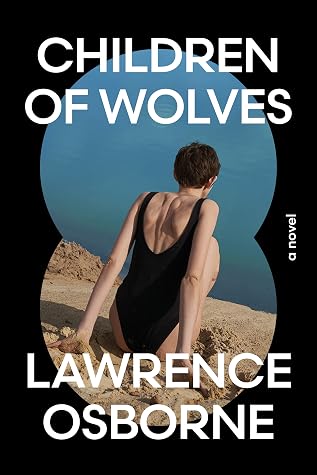

Children of wolves: a novel by Lawrence Osborne

Rating: 3* of five

The Publisher Says: Never fall for your prey....

A thrilling tale of manipulation and deceit about an American private investigator who travels to Turkey to track down the daughter of a wealthy family, unwittingly setting off a sinister plot.


Four children from wealthy families are sent to a strict prestigious boarding school for troubled teenagers. Haunted by the horrors they experience, they vow to disrupt the status quo by all means necessary.

Years later, Tyler is a private investigator with a failing career who has been hired by petrochemical billionaire James Arthur Knight Jr. to find his run-away daughter, Chana. At a seaside hotel in Turkey, he finds Chana lounging with her three wealthy friends and living with a fake name.

Enthralled by Chana’s shyness and elegance, Tyler decides to keep his discovery to himself, accepting Mr. Knight’s payments while feeding him elusive information and partying with Chana and her friends over wine and raki. One night, when Tyler lets slip his relationship with the American consul, Chana lights up with interest and asks if he can orchestrate a meeting.

With a backdrop of of glitzy ex-pat parties, diplomatic galas, and the gritty underworld of Istanbul, Chana conjures a plot involving the consul that sets into motion a dark chain of events.

I RECEIVED A DRC FROM THE PUBLISHER VIA NETGALLEY. THANK YOU.

My Review
: Glitzy surfaces that sound nice, have interesting shapes, and doesn't do much with them beyond note their surfaces' shine and elaborately describe to color and texture. Tyler's failings are self-inflicted; Chana's rebellion is pique at how her rich dad, a scumbag to be sure, failed to give her *enough* so now she and her buds want to take it away.

It was nicely paced, had a fascinating geopolitical setting that's mostly squandered in travel-magazine puffery, and ultimately ends in sequel bait. It was not a huge success for me.

Summit Books/S & S (non-affiliate Bookshop.org link) thinks $12.99 is fair for the book. Library's free....

++++++++++++++++++++++++++++++++++++++++++++++++++++++++++++++++


Thoughts Be Bloody by Auden Patrick

Rating: 2.5* of five

The Publisher Says: A struggling student, a resident golden boy, and the curse that will bring them together: this queer, trans retelling is Hamlet as you’ve never read it before

Exploring classism, identity, and the true meaning of revolution, this dark academia novel is perfect for fans of R. F. Kuang’s Babel


The summer before his sophomore year, Horatio Bithersea walks into the university library to find Carson Hamlett, resident golden boy and master magician, cradling his father’s dead body. Life at Elsinore, one of the most prestigious universities in the secretive magical world, simply goes on when the professor’s death is ruled an accident—despite the mysterious circumstances and the bloody scene.

A year later, Horatio is keeping his head down, attempting to graduate without his out-of-control magic harming his classmates. That changes when the ghost of Hamlett’s father appears and places a curse on Horatio and Hamlett: avenge his death by destroying Elsinore and its heart, lest the ghost robs them of their minds, memories, and their very souls.

Elsinore has given Horatio everything—knowledge of his magical ability, an escape from his abusive family, and freedom to pursue his life as a transgender man—and now he’s to be its doom. As the two uncover more of Elsinore’s secrets, Horatio finds himself becoming more and more ensnared in Hamlett’s dark but charismatic web.

The question is not if Horatio will manage to destroy Elsinore. The question is if Hamlett will destroy him first. This twisty, queer, dark academia is a brand-new take on the questions that haunt Shakespeare’s Hamlet.

I RECEIVED A DRC FROM THE PUBLISHER VIA NETGALLEY. THANK YOU.

My Review
: To read, or not to read: that is the question. Whether 'tis nobler in the mind to suffer the slings and arrows of outrageous youthful solipsism, or to take leave from Horatio's roiling inner-sea of troubles, and by opposing the demand to re-tread deepworn paths leading to that ever-stormy inner-sea, end them at bloody last; to die to this endlessly refought battle, finally to sleep through more youthful Sturm und Drang; and by a sleep, to say we end...at least my unwilling awareness of...the heart-ache, and the thousand natural shocks that solipsistic young transmasc Flesh is heir to? 'Tis a consummation devoutly to be wished.

I read the whole bleedin' thing and I want those hours back.

DAW (non-affiliate Bookshop.org link)
thinks $15.99 works as a price for the ebook...I disagree.

++++++++++++++++++++++++++++++++++++++++++++++++++++++++++++++++


Three Hitmen and a Baby (Assassins Anonymous #3) by Rob Hart

Rating: 3.25* of five

The Publisher Says: Welcome back to Assassins Anonymous, where family is everything and danger lurks around every corner.

Assassins Anonymous isn't just a weekly recovery meeting for reformed killers—it's also a family.

When Valencia receives troubling news that her brother has gone missing, she wants rush off to LA to find him. But she can’t bring her baby girl, Lucia. Enter the other members of Assassins Anonymous—Mark, Astrid, and Booker, who offer to watch the toddler while she's gone. After all, they're three of the deadliest, most highly skilled people on the planet; what could go wrong?

Turns out, a lot. Shortly after Valencia leaves, Mark is summoned to the lair of Zmeya, a Russian mob boss calling in a deadly favor—she wants him to kill Astrid, his protege and friend. Mark refuses, but Zmeya reveals that she knows the identity of Mark’s ex-girlfriend . . . and his son. Either Astrid goes, or they do.

Meanwhile, Lucia spikes a dangerously high fever, and when Booker and Astrid take her to urgent care, they realize too late, that their fabricated identities are a real liability. Also, they don't know Valencia’s last name, let alone Lucia's. They can hardly blame the staff for calling the NYPD.

Suddenly the splintered group is on the run from both the Russian mob and the police, dodging bad guys and do-gooders while trying to find refuge in a city full of surveillance cameras—all without killing anyone. That is, until Zmeya captures Sara and Bennett, and Mark is ready to throw his sobriety out the window.

I RECEIVED A DRC FROM THE PUBLISHER VIA NETGALLEY. THANK YOU.

My Review
: I lost steam, lost the thread, lost my sense of humor...SOMEthing happened to reduce my enjoyment of the silliness of this series to a new low. Maybe it's the baby's fever...?

Whatever it was I chuckled a couple times early on then sat stonefaced in front of my Kindle flipping pages with no trace of a smile, no moment of rib-tickling daffy fun I could see on my mental TV screen.

G.P. Putnam's Sons (non-affiliate Bookshop.org link) requires $14.99 to completely transfer you a reading license that they can revoke at any time, for any reason. At least the library isn't capricious. (see? humorless)

++++++++++++++++++++++++++++++++++++++++++++++++++++++++++++++++


Dead Weight by Hildur Knútsdóttir (tr. Mary Robinette Kowal)

Rating: 3.25* of five

The Publisher Says: An Icelandic night may hide secrets and affairs—or even bodies—in this gruesomely cathartic horror thriller from the author of The Night Guest.

Unnur was living a normal, if lonely, life until a black cat showed up at her door.

Trying to do the right thing, Unnur reunites the lost pet with its owner—a young woman named Ásta who is in desperate need of some help. Unnur reluctantly agrees to take in the cat until Ásta is able to care for it again herself.

Soon, Ásta becomes a fixture in Unnur's life and the two form an unlikely friendship. But like a black cat, trouble is tailing Ásta, and Unnur is the only one there when things take a violent turn.

Nothing tests a friendship like blood on your hands.

I RECEIVED A DRC FROM THE PUBLISHER VIA NETGALLEY. THANK YOU.

My Review
: Dark, horrifying story of how vicious the world is to women, how victimization of women is met by apathy, and how few women step up to help each other in hours of need. Nothing else in this story made me afraid and angry...I was pretty eye-rolly about the "horror" in this story.

At a hair over 150pp, this is a novella which is exactly long enough to spend with dreary, depressing Unnur and ridiculously unintrospective Ásta...about three and a half hours and I was gnawing on my Kindle's case to escape the dreary sadness I was feeling with some microplastic consumption.

Tor Nightfire (non-affiliate Bookshop.org link) wants $12.99 for an ebook, but the library's free.

++++++++++++++++++++++++++++++++++++++++++++++++++++++++++++++++


To Rob a Bank Is an Honor by Lucio Urtubia (tr. Paul Sharkey)

Rating: 3.9* of five

The Publisher Says: For the first time in English, the life story of the revolutionary outlaw who brought Citibank to its knees.

In 1981, Lucio Urtubia received a suitcase full of cash from Citibank executives, handed over the plates he’d used to forge 20 million dollars in traveler’s checks, and walked away a free man. This is the true story of the most famous Robin Hood of the twentieth century, a lifelong anarchist who robbed from the rich to give to liberation struggles the world round.

Born to a poor family in the Basque Country, Urtubia was conscripted into Franco’s army at seventeen, where he began smuggling rations from military stores. In 1954, he fled to exile in Paris, where he learned to work as a mason, laying bricks by day and collaborating with Catalonian anarchists by night. Soon, he was planning bank heists to fund the Spanish struggle, stealing weapons, and masterminding the escape of resistance fighters. Following the uprisings of May 1968, Urtubia opened a printshop, producing political pamphlets while amassing a crew of operatives to counterfeit passports, ID cards, and workers’ paychecks.

By the late 70s, Urtubia hit on the plan that would make him infamous: changing the serial numbers on traveler’s checks and depositing them simultaneously. Citibank’s early global banking system offered the prime target, and checks spread to revolutionary movements in Europe, Latin America, and the United States. “He who robs a thief is a thousand times forgiven,” Urtubia argued. Over decades, Urtubia funneled material support to groups including the Red Brigades in Italy, the Baader-Meinhof group in Germany, the Black Panthers in the US, and the ETA Basque separatists.

Told with Urtubia's characteristic warmth and humor, To Rob a Bank Is an Honor collects the adventures and political convictions of this larger-than-life figure of an incendiary era.

I RECEIVED A DRC FROM THE PUBLISHER VIA EDELWEISS+. THANK YOU.

My Review
: Gets into inspiration porn pretty quickly, is 75pp too long, and deals with rebellion in a world that simply does not exist in today's societal panopticon.

OTOH he's got good stories to tell, makes an excellent example of "who robs a thief is a thousand times forgiven," and very clearly does not succumb to the right-wing-encouraged "moral purity" bullshit afflicting leftists for centuries.

AK Press (non-affiliate Bookshop.org link) charges $21.99 for an ebook...I'd make the obvious joke but....

++++++++++++++++++++++++++++++++++++++++++++++++++++++++++++++++


When the Tamarind Tree Blooms by Elaine Russell

Rating: 3* of five

The Publisher Says: Geneviève Dubois, half-Lao, half-French, turns eighteen and leaves the French orphanage where she has been trapped for fourteen unhappy years. She is determined to uncover the story of her parents and locate her missing twin brother.

Stepping into the deeply divided world of 1931 French colonial Laos, she finds neither French colonists nor native Lao readily accept her mixed heritage. Even falling in love is fraught with the cultural restrictions of two dissonant societies. Where does she fit in?

I RECEIVED A DRC FROM THE PUBLISHER VIA NETGALLEY. THANK YOU.

My Review
: Interesting setting, interesting mixed-race woman's PoV in colonial patriarchal cultures (plural), and somehow it never comes together. From the outset I was not clear as to why I was so involved in the story as I read it; when I'd put it down, I'd forget about it. It's a two-year-plus odyssey, my finishing the story.

Yet finish it I did, and without much flipping back to refresh my memory; unusual experience, honestly I just don't get it at all.

Belles Histoires (non-affiliate Bookshop.org link) asks $4.99 for an ebook. If the premise interests you, it's not a bad read.

++++++++++++++++++++++++++++++++++++++++++++++++++++++++++++++++
++++++++++++++++++++++++++++++++++++++++++++++++++++++++++++++++


This space is dedicated to Nancy Pearl's Rule of 50, or "the Pearl Rule" as I've always called it. After realizing five times in December 2021 alone that I'd already Pearl-Ruled a book I picked up on a whim, I realized how close my Half-heimer's is getting to the full-on article. Hence my decision to track my Pearls!

As she says:
People frequently ask me how many pages they should give a book before they give up on it. In response to that question, I came up with my “rule of fifty,” which is based on the shortness of time and the immensity of the world of books. If you’re fifty years of age or younger, give a book fifty pages before you decide to commit to reading it or give it up. If you’re over fifty, which is when time gets even shorter, subtract your age from 100—the result is the number of pages you should read before making your decision to stay with it or quit.

So this space will be each month's listing of Pearl-Ruled books. Earlier Pearl-Rule posts will be linked below the current month's crop.

++++++++++++++++++++++++++++++++++++++++++++++++++++++++++++++++
++++++++++++++++++++++++++++++++++++++++++++++++++++++++++++++++


Warning to the Crocodiles (41%) by António Lobo Antunes (tr. Karen Sotelino)

Rating: 3* of five because there was no reason it should've been this obfuscatory

The Publisher Says: Set in the aftermath of the Carnation Revolution of April 25, 1974, Antonio Lobo Antunes's Warning to the Crocodiles is a fragmented narrative of the violent tensions resulting from major political changes in Portugal.

Told through the memories of four women who spend their days fashioning homemade explosives and participating in the kidnap and torture of communists, the novel details the clandestine activities of an extreme right-wing Salazarist faction resisting the country s new embrace of democracy."

I RECEIVED A DRC FROM THE PUBLISHER VIA EDELWEISS+. THANK YOU.

My Review
: I don't know what's going on here, I'm told there are four narrators and okay that's nice but who are they and why are they helping the men doing these horrible things to decent, upstanding communists anyway? Like, they're men who're bruised by losing but you're going to be better off so what the what is the cheapness of the family treasures causing such gold-plated anxiety about?

It's never been harder to say "No thanks" to a read because I liked the strange, not-ordinary descriptions (that church shadow *shudder*), the way the prose wrapped around itself; but when you don't like these women and you can't tell who's who and there's not one shred of help...ya gotta bail eventually.

Dalkey Archive Press (non-affiliate Bookshop.org link) has a yen for getting $9.95 per ebook.

++++++++++++++++++++++++++++++++++++++++++++++++++++++++++++++++


Swallows (46%) by Natsuo Kirino (tr. Lisa Hofmann-Kuroda)

Rating: 3* of five

The Publisher Says: The highly anticipated new novel. When a young single woman in Tokyo decides she’s ready to sell anything—even her womb—to escape the precarity of her life, an agency pairs her with a wealthy couple desperate to have a child. The match seems made in heaven. She even looks a little like the wife. But is anything ever that simple?

Nothing has ever gone right for Riki. She left her boring hometown in Hokkaido, where she worked at a nursing home, for a better life in Tokyo. But as a temp in the big city she has no job security, and barely scrapes by. She eats the same old discount boiled egg for lunch every day, sometimes for dinner, too. Many of her peers have to take on a side hustle just to make ends meet. So when her friend discovers an agency offering a hefty sum for egg donation, both leap at the chance for an interview.

Meanwhile, former ballet star Motoi Kusaoke and his wife, Yuko, have been trying to conceive for years. After trying what feels like every available option, it seems futile—until Motoi dives deep into his research and learns that, while surrogacy is technically illegal in Japan, there is a company that’s found a loophole.

Before long, everyone has an opinion on the from Yuko’s sex-obsessed, asexual best friend, to Motoi’s controlling prima ballerina mother, and even the affable sex-worker-slash-therapist that Riki has been to a couple of times, after she accepted a down-payment to be a surrogate.

Acutely funny and addictively page-turning, Swallows pulls at the seams of society, reassessing our understanding of motherhood, self-worth, bodily autonomy, and class. What does it mean to be “in control”? And can money really buy happiness?

I RECEIVED A DRC FROM THE PUBLISHER VIA NETGALLEY. THANK YOU.

My Review
: My discomfort reached the breaking point at the end of chapter two, when the ironic distance between Ririko and those around her crystallized into the overarching phoniness of the entire story's relationships being so in-my-face I couldn't unsee it. It could simply be a mood-based dislike of that, it could be there's humor in how it was being done that I simply didn't cotton on to, or it could just be a sea-change in me, away from interest in stories about fa¸ades, is real.

Whatever the source, I'm not continuing reads that lose me, no matter where they do so.

Alfred A. Knopf (non-affiliate Bookshop.org link) charges $12.99 for the ebook. Read a sample first.

++++++++++++++++++++++++++++++++++++++++++++++++++++++++++++++++


Fallow (61%) by Sarah Anderson

Rating: 3.5* of five

The Publisher Says: Slyly funny and disarmingly tender, Fallow is the story of a young woman who signs up to be the world’s first in-house corporate surrogate, then finds herself caught up in a social experiment of another kind.

Natalie knows one truth: There is no such thing as a good job.

As the clock ticks away at the workplace harassment call center, she tries to ignore the increasing pain in her jaw. She has no dental insurance. She has no skills or ambitions. She has student loans. And, minute by minute, she hears the many ways workers are not just not getting by, but actually getting hustled.

Then, at the blood bank where she sells her plasma, a mysterious flyer leads her to The Company. Natalie turns out to be the perfect candidate for their pilot in-house surrogate. The Company pitches it as an opportunity to help women access greater gender equity, motherhood without maternity leave. Finally, she will be adequately—generously—compensated.

For years, her every need is stacks of healthy meals in the refrigerator of a luxury condo, fitness coaches and nutritionists, around-the-clock healthcare. Between deliveries, she takes time off—no obligations or expectations. For the first time in her life, she is good at her job; for the first time, she feels free.

But just as she’s about to fulfill the terms of her contract, a staffing decision upends everything and drags her deep into another social experiment. There she meets new questions about her future, her freedom, her purpose, and what she can expect from the world.

Woundingly funny and deeply moving, Sarah Anderson’s Fallow is a tender, hilarious, alarmingly real vision of a woman balancing on the knife-edge of capitalism as she comes to realize who she wants to be.

I RECEIVED A DRC FROM THE PUBLISHER VIA NETGALLEY. THANK YOU.

My Review
: K.M. Szpara's Docile made my skin crawl, with its pharmacologically induced submissiveness as an enforcement of sexual servitude to repay debt. This is, somehow, worse. I was all the way into part three of three when a twist occurred that caused me to mark a character's speech given to Natalie...very amusing name to give her, Author Sarah...and decisevely type "Uncle" and nope out. I can't say why because I hope you will be deeply intrigued by this not-unrealistic end-stage-capitalist cautionary tale of why we need tumbrils, guillotines, and Mme Defarge to recrudesce, and to give it a fair shake.

My breaking point is entirely, idiosyncratically personal so irrelevant to the quality of the book.

FSG (non-affiliate Bookshop.org link) charges $14.99 for your ebook passport to capitalist dystopia. Only if it gets me *out*....

Thursday, September 17, 2026

NOW I SURRENDER, La Frontera's history told very differently...on the 2026 Longlist for the National Book Award for Translated Literature


NOW I SURRENDER
ÁLVARO ENRIGUE
(tr. Natasha Wimmer)
Riverhead Books (non-affiliate Bookshop.org link)
$14.99 ebook, available now

On the 2026 Longlist for the National Book Award for Translated Literature

Rating: 4.5* of five

The Publisher Says: A visionary novelist imagines the fiercely fought end of an epoch of almost unimaginable freedom and radically recasts the story of how the West was “won.”

In the contested borderlands between Mexico and the United States, a woman flees into the desert after a devastating raid on her dead husband’s ranch. A lieutenant colonel in service to the fledgling Republica, sent in pursuit of cattle rustlers, discovers he’s on the trail of a more dramatic abduction. Decades later, with political ambitions on the line, the American and Mexican militaries try to maneuver Geronimo, the most legendary of Apache warriors, into surrender. In our own day, a family travels through the region in search of a truer version of the past.

Orchestrated with a stunningly imagined cast of characters, both historical and purely fictional, their storylines playing out in multiple eras, Now I Surrender is Álvaro Enrigue’s most expansive and impassioned novel yet. Part epic, part alt-Western, it weaves past and present, myth and history, into a searing elegy for a way of life that was an incarnation of true liberty—and an homage to the spark in us that still thrills to its memory.

I RECEIVED A DRC FROM THE PUBLISHER VIA NETGALLEY. THANK YOU.

My Review
: Yes, it felt to me like the narrator was a self-insert, was a bit showoffy in a story that honestly was not in need of ornamentation; just add footnotes and this is a non-fiction corrective to settler colonialism's lying mythmaking. Funny how when a rotten to the core politico needs a way to juice his polling before a rough election battle it's always at the cost of a darker skinned man being sold a bunch of bullshit about making peace and meaning murder (his, not the politico's) and it's frankly weird how often Florida is involved either directly like Alligator Alcatraz or indirectly like Geronimo learned. I'm stunned by how little imagination it takes to dupe people who don't learn even the lies and half-truths they're sold. Reuse threats even names and the audience is inclined to shrug at most, lap it up at least.

The violence of the events of how the West was "won" is breathtaking. Author Enrigue does not soft-pedal its stomach churning reality. It was the stuff of public record at the time, why lie about what "They" were clearly proud of? And speaking of "Them," it is one of Author Enrigue's narrative tactics to reduce characters to labels, the colonel or the warrior or suchlike in paragraphs lacking quotation marks or certain kinds of line breaks...heads up. I know many of y'all really hate when authors do that. It's in service of a teaching. It's not really important to have a family or personal name for a cog in the machine of treachery theft and genocide, and equally unhelpful to present a victim's personal data like that because it's not how their murderers victimizers abusers see them. They're not even important enough to the thieves to merit numbers tattooed on their arms.

When names are give it is to reinforce what is lost in their extermination. Otherwise it's cultural extirpation's great success to use labels. The terrible cost, the awful price, the nightmare of depersonalization and dehumanization...all, at every turn, reinforced and durable in its suffocating rage-baiting cruelty and pointless judgment.

The 2026 longlist for the National Book Award for Translated Literature is *stacked* with good reading. Start here.

Wednesday, September 2, 2026

THE EYE OF GOLIATH, Argentine Jekyll-and-Hyde take after the Great War


THE EYE OF GOLIATH
DIEGO MUZZIO
(tr. Rahul Bery)
Pushkin Press (non-affiliate Bookshop.org link)
$13.99 ebook, available now

The Independent Press Top 40 Bestsellers: Fiction For the week ending September 15, 2026

Rating: 4.5* of five

The Publisher Says: A dark, propulsive literary gothic novel that puts a modern twist on Stevenson and Poe, from a thrilling new voice in Latin American horror.

“Impossible to stop reading. It has all the fascinating tension of great literature.” — Mariana Enríquez, author of Our Share of Night

In this deliriously inventive twist on The Strange Case of Dr. Jekyll and Mr. Hyde, Argentine powerhouse Diego Muzzio conjures a haunting story of shattering war trauma and the disturbing proximity of sanity and madness in his English-language debut.

In 1920s Edinburgh, war veteran Dr. Edward Pierce develops experimental therapies to treat mentally ill patients whose cases have been rejected by conventional psychiatry. One night, he receives a visitor who asks him to take on an unusual new patient: David Bradley, an engineer who was sent to inspect the conditions of a lighthouse on a remote island in southern Argentina. The sojourn was a disaster, and he returned completely mute, his body overwhelmed by a single compulsion: to swim and swim, in any environment, to the point of total exhaustion.

Bradley’s fragmentary diary reveals how this rational, disciplined man became the deranged individual brought to the sanatorium. Full of bizarre details and echoes of macabre events, it guides Pierce in his studies of his patients, propelling him into scientific terrain that grows increasingly grotesque.

With an ingenious structure that creates doubling and uncertainty at every turn, The Eye of Goliath is a masterfully tense novel that unites classic gothic atmospheres with disturbingly modern psychological horror.

I RECEIVED A DRC FROM THE PUBLISHER VIA EDELWEISS+. THANK YOU.

My Review
: A lot like seeing the narrative's events in the sweeping beam of the lighthouse that figures so heavily in poor David Bradley's utter unwinding. Pierce tries to tug the strips of anxiety back into overlapping armor-plate relationship as the are in most of us. Pierce's major problem with that technique has been, until now, the Great War's soulless killing machine dehumanizing men in battle.

David Bradley's issue is not the same though his condition, a mind unraveled by inputs beyond the owner's capacity to process and respond to in any adaptive manner, is the same. Compulsions to repetitive action are present in the men not able to build mental spaces that can contain their horror very often resort to obsessive actions to create rituals of safety. Spurious safety is still preferable to the events that left their minds in wreckage. We're vouchsafed access to the diaries Bradley kept at the lighthouse where...something...destroyed his psychological equilibrium; yet neither we nor Pierce, tasked with reversing this damage, know what the heck it was even *with* the diaries.

It's a very good thing the novel is short because that would be really tough to sustain over an Ann Radcliffe-length novel. We're definitely in gothic horror territory here, particularly given Pierce's own responses to everything, but not so deep into it there are ghosties and ghoulies and other accoutrements of gothicness.

It says here.

Ambiguity is always your friend in writing and reading good gothic fiction; don't pin too terribly much of the story to recognizable territory and the reader will do the work for you, will in fact make your story "better" because you love this trope and the author does not so doesn't explicitly use it so your mind fills it in where ambiguity is left. I wish more horror writers saw the utility of that! If you, o writer, are not as weird and twisted as Clive Barker, do what Author Muzzio did: keep it short, leave room for we-the-reader to people the events to our scare levels, and off you go...and so will your readers.

I'm only down a half-star because I found Pierce's entry into the gothic felt forced, felt incompletely integrated into the way the men he's treating's mindset. I don't think my pleasure in the read would've increased had his own psychotic break been more completely explored. It would've added page count without necessarily improving my eerie experience.

Which was, as said above, eerie and satisfying; it was the flipside of the model story's splitting the personality on purpose. It was a very involving, fast read. Psychological-disturbace avoiders, go to the next book on the shelf! Eerie creepy weirdness fanciers, come sit with me by the fireplace.

Maybe we can light a fire.

Sunday, August 9, 2026

STEFAN ZWEIG'S PAGE: LETTER FROM AN UNKNOWN WOMAN and Other Stories, & ENCOUNTERS AND DESTINIES: A Farewell to Europe


LETTER FROM AN UNKNOWN WOMAN and Other Stories
STEFAN ZWEIG
(tr. Anthea Bell)
Pushkin Press Classics (non-affiliate Bookshop.org link)
$7.99 ebook, available now

Rating: 4.5* of five

The Publisher Says: Stefan's Zweig's Letter from an Unknown Woman and other stories contains a new translation by the award-winning Anthea Bell of one of his most celebrated novellas, Letter from an Unknown Woman, the inspiration for a classic 1948 Hollywood film by Max Ophüls, as well as three new stories, appearing in English for the first time.

A famous author receives a letter on his forty-first birthday. He doesn't know the sender, but still the letter concerns him intimately. Its story is earnest, even the story of a life lived in service to an unannounced, unnoticed love.

In the other stories in this collection, a young man mistakes the girl he loves for her sister; two erstwhile lovers meet after an age spent apart; and a married woman repays a debt of gratitude. All four tales, newly translated by the award-winning Anthea Bell, are among Zweig's most celebrated and compelling work-expertly paced, laced with empathy and an unwaveringly acute sense of psychological detail.

I RECEIVED A DRC FROM THE PUBLISHER VIA EDELWEISS+. THANK YOU.

My Review
: It's the fate pf a popular, I mean with readers more than critics, writer to fall out of favor. Without critics in one's corner, the voice of the people who voted with their time and their treasure to engage with one's stories gets ignored.

This was the public's loved one Zweig's fate. Modern critics don't like him either, one saying he "...tastes fake...the Pepsi of Austrian writing." Ouch.

It's true to my experience of his writing that there's no deathless quality the I can discern, the sort of intense transporting intensity I experience in Thomas Mann or Kafka. At his most eloquent Zweig brings me an appreciative lightness of spirit; at his most Germanic he's pissy, irritable, and unbearably portentous. On balance he's the precise kind of writer who becomes popular because his (very real) talent does not have threatening depths. It seems a shame to me the world that loved him best, the US and Brazil, has left his memory in a drawer. Not a great, but still a good, storyteller, it feels to me like Pushkin Press Classics is doing good work to keep bringing him to our notice.

In my usual, fussy (so I'm told) fashion, the four stories will be dealt with by the Bryce Method.

Letter from an Unknown Woman is unsettling, uneasy-making; a woman writes to a famous author in terms of the greatest, most appreciative intimacy...but he has absolutely not one clue who she is. It is clear from the terms she's using for him that there was a legitimate connection between them. It is chilling how deep this connection truly is, given his unawareness of her as a person. (It could have something to do with her age at their first meeting....)

It's certainly true in my own life this kind of connection has formed, so I might be a bit more in tune with the awfulness of it. It ends a damn sight more tragically than anything like I've ever been a party to, and uses what would then be a current event...the 1918 flu pandemic...as both a resolution and an intensification of how terrible his guilt truthfully is.

A 1948 film was made of Letter from an Unknown Woman starring Joan Fontaine and Louis Jourdan that did not slap a happy li'l bow on its end. It's been preserved for posterity by the National Film Registry, probably in part for that courageous act of honesty in preserving the source material's more nihilistic intent (despite much jiggery-pokery to satisfy the Hays Code). It would be a terrific adaptation to make, faithfully this time, in the 21st century. all five stars

A Story Told in Twilight explores the first-kiss mishegas of a very ordinary boy. It happens in circumstances that, if you squint, might possibly lead to the, um, inattention and subsequent mistaken identity that plague this most commonplace rite of passage.

The translation's deft, the language felt like the entire enterprise was fun for the translator, but a more outdated premise would be tough to conjure in 2026. Not memorable, not terrible, not much of anything really. 3 stars

The Debt Paid Late looks at the running theme of missed/mistaken connections in these stories at a more mature angle. Like the old saying about "even small men cast big shadows at sunset" comes the accidental meeting of a woman with an old man who once meant everything to her. Because the story is about older people who reconnect from a genuine, if squicky by today's lights, connection it involved me more. Not a lot more, but more. 3.5 stars

Forgotten Dreams happened to me. It was as unpleasant as Zweig writes it. If you put yourself back into the path of your past self you will not come out unscathed. No man should ever expect the women from his past to spare his feelings, I'll tell you that for free. 3.5 stars

++++++++++++++++++++++++++++++++++++++++++++++++++++++++++++++++


ENCOUNTERS AND DESTINIES: A Farewell to Europe
STEFAN ZWEIG
(tr. Will Stone)
Pushkin Press
$13.99 ebook, available now

Rating: 4* of five

The Publisher Says: A new selection of essays by Stefan Zweig: tributes to the great artists and thinkers of the Europe of his day

Stefan Zweig was one of the twentieth century's greatest authors and a tireless champion of freedom, tolerance and friendship across borders. Encounters and Destinies collects his most impassioned and moving tributes to his many illustrious friends and peers: literary, philosophical and artistic luminaries from across the Old Europe that Zweig loved so much, and which he grieved to see so cruelly destroyed by two world wars.

Including pieces on Rainer Maria Rilke, Marcel Proust, Sigmund Freud, Maxim Gorky and Arturo Toscanini, this essential collection is also Zweig's tribute to the ideal of friendship: an ideal he clung to as the world he knew was torn apart.

I RECEIVED A DRC FROM THE PUBLISHER VIA EDELWEISS+. THANK YOU.

My Review
: "Gorky" means bitter? I'd always known Peshkov chose a pseudonym, who wouldn't with a collection of ugly spitty sounds like "Peshkov" staring you down, but "bitter?" Wow. A lot of details I'd forgotten I noticed clicked into place in my long-ago readings of Gorky...The Lower Depths, The Artamonov Business...suddenly make all the sense in the world.

Zweig knew the great and the good of the Interwar Period wherein he spent the bulk of his life. He would've been a lot of fun at a dinner party because, while it does not seem that he had a bitchy bone in his body, he had a very retentive memory and a strong desire to keep the friends he made so he heard a lot about them.

I am hard-pressed to imagine anyone who does not know who John Drinkwater was without the aid of Wikipedia will be inclined to pick up a book of musings on people like Toscanini, Arthur Schnitzler, and Emile Verhaeren. (For someone who doesn't like poetry, I sure know who a lot of poets are.)

If for no other reason than to bask in the glow of warm, appreciative writing by a friend who treasured friendship writing about his friends, this is a Zweig book to immerse yourself into. It brought me up short to realize how much the culture of that time formed my sense of aesthetics. I still revere Remarque and Joyce. I think many serious readers do. But it goes deeper, forming a bedrock sense of what is "worthy" in the art world, and that interested me to realize.

So here's Zweig, eighty-four years dead and mostly forgotten, still teaching a now-old man about himself. Published again and again after being forgotten for decades.

I hope there's an afterlife just so he can know it was, in fact, all worth it.

Sunday, August 2, 2026

JEAN GIONO'S PAGE: Fragments of a Paradise & Occupation Journal & Ennemonde


OCCUPATION JOURNAL
JEAN GIONO
(tr. Jody Gladding)
Archipelago Books (non-affiliate Bookshop.org link)
$7.99 ebook, available now

Rating: 4.5* of five

The Publisher Says: A captivating literary and historical record, Jean Giono's Occupation Journal offers a glimpse into life in collaborationist France during the Second World War, as seen through the eyes and thoughts of one of France's greatest and most independent writers.

Written during the years of France's occupation by the Nazis, Jean Giono's Occupation Journal reveals the inner workings of one of France's great literary minds during one of the country's darkest hours. A renowned writer and committed pacifist throughout the 1930s—a conviction that resulted in his imprisonment before and after the Occupation—Giono spent the war in the village of Contadour in Provence, where he wrote, corresponded with other writers, and cared for his consumptive daughter. This journal records his musings on art and literature, his observations of life, his interactions with the machinery of the collaborationist Vichy regime, as well as his forceful political convictions. Giono recounts the details of his life with fierce independence of thought and novelistic attention to character and dialogue.

Occupation Journal is a fascinating historical document as well as a unique window into one of French literature's most voracious and critical minds.

I RECEIVED A DRC FROM THE PUBLISHER VIA EDELWEISS+. THANK YOU.

My Review
: Knowing that these quotidian topics of no great interest are Author Giono's middle-of-WWII maunderings while his pacifist life was under the Vichy apparatus of Nazi occupation's close scrutiny makes them fascinating. It's a universal truth that life goes on, kids need clothes and meals and trips to the doctor. Author Giono navigates his way around every obstacle with his money and his persistence and his connections. Being in the toils of legal proceedings for his well-documented lifelong pacifism meant he was never a serious threat who needed close custody. Left to read and write, though subject to censorship, Author Giono writes unselfconsciously in these journal pages (always intended to remain private) of his process as a writer, his frank assessment of other writers' work, and the people of the village of Contadour.

It reminded me that the evergreen thought experiment "whatever you're doing now is what you'd be doing under Nazi occupation" makes one stop short and think hard for a reason. Author Giono took his privilege as a reason to spread the good fortune around: he never has any cash, and owes the government a pile of money, all because he's supporting his whole family...nine people in total...as well as bankrolling the escapes of those who are at lethal risk from that government he owes so much money to.

Using "their" money to keep "them" from committing murder against people whose morals he shared. Full marks, sir. And he did not stop there. He completed six novels (translated another...oh, there were plays too!) during the German occupation. Author Giono was a truly inspiring example of how to live a morally good life in bad times and under dark circumstances.

++++++++++++++++++++++++++++++++++++++++++++++++++++++++++++++++


FRAGMENTS OF A PARADISE
JEAN GIONO
(tr. Paul Eprile)
Archipelago Books (non-affiliate Bookshop.org link)
$13.99 ebook, available now

Rating: 3.5* of five

The Publisher Says: “Giono’s prose is a singularly fine blend of realism and poetic sensibility.” — The Washington Post Giono’s very own Moby-Dick, a sensational maritime journey that follows a crew inwards on a spiritual tale of evocative sea-glimpses

An allegorical critique of modern civilization and the damages of war, Giono’s oft-overlooked seafaring tale sweeps the reader along a narrative as poetic and undulating as the wind, tacking between the sea’s mysteries and the intricacies of the men’s conversations and inner thoughts as they attempt to grasp the sensory reality around them.

“I no longer have any interest in living under the conditions that this era allows,” writes the Captain of L’Indien, a ship whose radio remains packed in a crate in the hold. The men aboard won’t be needing it; they have no interest in connecting with the world of ordinary men. With enough provisions to last them five years, they set sail in July of 1940 for the South Seas, leaving civilization behind in search of the unknown.

Hastening onwards, Giono’s men steer deeper into themselves, seeking a purpose beyond the “world in upheaval” they left behind—a moving and spiritual work written by one of Europe’s most ardent 20th-century pacifists.

A sensational novel that delves into the unknown reaches of the sea and soul, perfect for readers seeking a poetic escape that challenges the political and social status-quo.

I RECEIVED A DRC FROM THE PUBLISHER VIA EDELWEISS+. THANK YOU.

My Review
: Really, do I even need to say it?

This read was a beacon of psychic coolness in a summer beset by wildfires, smoke particles, and the looming, ugly threat of super-El Niño to come with its heat and its drought. It's beautiful, as one would expect from a writer of Author Giono's stature, sentences making images that endure on the eye the nose the ear of the mind as the men on this sailing ship leave their families and friends behind to fight their war, rebuild their world, however they like.

No one who leaves the world does so without leaving others behind.

It's beautiful until the thought, "you have provisions for FIVE YEARS and you left a literal WAR ZONE to escape into a cosmic search for love, truth, and beauty?!" hits.

Stay there and use that magical power to feed hungry wounded orphaned victims.

Yes yes yes, it's a fable, an unreality meant to instruct and to offer guidance on one's search for Meaning, all very well. Author Giono was a pacifist who was punished for opposing the Vichy regime...see above for his journals in review...but this kind of navel-gazing is for the time leading up to war, in an attempt to forestall the slide; this tale appeared in 1948, as the rebuilding of the continent was gathering steam. That was the moment to support peaceful action not hightailing it off to sea to have cool adventures.

Anyway. Beautiful sentences, we're not rebuilding stuff (though we should be), so read and enjoy.

+++++++++++++++++++++++++++++++++++++++++++++++++++++++++++++++


ENNEMONDE
JEAN GIONO
(tr. Bill Johnston)
Archipelago Books (non-affiliate Bookshop.org link)
$12.99 ebook, available now

Rating: 4* of five

The Publisher Says: One of the final novellas by the acclaimed French writer Jean Giono, Ennemonde is a fierce and jubilant portrait of a life intensely lived

Ennemonde Girard: Obese. Toothless. Razor-sharp. Loving mother and murderous wife: a character like none other in literature. In telling us Ennemonde’s astounding story of undetected crimes, Jean Giono immerses us in the perverse and often lurid lifeways of the people of the High Country, where vengeance is an art form, hearts are superfluous, and only boldness and cunning such as Ennemonde’s can win the day. A gleeful, broad sardonic grin of a novel.

"Roads move cautiously around the High Country..." So begins the story of Ennemonde, but also of her sons, daughters, neighbors, lovers, and enemies, and especially of the mountains that stand guard behind their home in the Camargue. This is a place of stark and terrifying beauty, where violence strikes suddenly, whether from the hand of a neighbor or from the sky itself.

Giono captures every wrinkle, glare, and glance with wry delight, celebrating the uniquely tough people whose eyes sparkle with the cruel majesty of the landscape. Full of delectable detours and startling insights, Ennemonde will take you by the hand for an unforgettable tour of this master novelist's singular world.

I RECEIVED A DRC FROM THE PUBLISHER VIA EDELWEISS+. THANK YOU.

My Review
: Not remotely comfortable reading, Giono using this female body's looks and size as commentary on her character and morality. Perfectly ordinary in its time; sixtyish years ago people said terribly cruel things about those larger than, or in any way divergent from, "average."
The young women, while they're still maidens, possess a fruit-like beauty; then the beauty bursts, and fragments of it can be seen in their children. Truly nothing remains of these women's former state. Some Venuses turn into fearsome monsters; almost all of them have seventeenth-century mouths, toothless or, even worse, with a handful of loose teeth on which they suck. It's pretty ghastly. But their simple-minded appearance shouldn't be taken at face value. Almost all of them are commanding women. With their back to the wall they achieve wonders. People still remember Ennemonde Girard.
It does not hit the same register in 2026 as it did in 1968, when it first appeared. It feels false, hostile, spoken for effect in the #MeToo world.

There's probably a good reason for that: the French are not so terribly far from the US despite their fantasies:
The tool that people around here have most often in their hand is a shotgun, whether it’s for hunting or for, let’s say, philosophical reflection; in either case, there’s no solution without a shot being fired...
–and–
The Protestants of these parts had since time immemorial protested against Protestantism. They’d ended up worshipping anything at all, so long as the anything at all demanded intolerance. Crown of thorns were consumed in every household, at every meal. Religion was a sort of commerce in which discomfort was always preferred to joy, scorn to pleasure, and ultimately vice to virtue.

"These parts" are Author Giono's native Provençal mountains, where he lived his life.

It's not so weird after all, fellow intolerant lefties; humans been MAGAts a long damn time.

I can't claim to love this story, I can't tell if it's because I'm a judgmental old man or I'm just a product of the times that brought this novella (150pp barely) into being, holding its subjects up for a cold-eyed considering examination. Author Giono does not vouchsafe a verdict; I do.

Me no likee.

Monday, September 29, 2025

VLADIMIR SOROKIN'S PAGE: Oprichnik's Russia duology


THE SUGAR KREMLIN (Oprichnik's Russia #2)
VLADIMIR SOROKIN (tr. Max Lawton)
Dalkey Archive Press (non-affiliate Bookshop.org link)
$18.95 trade paper, preorder for fulfillment tomorrow

Rating: 4* of five

The Publisher Says: A puzzle of colorful, sardonic episodes that come together as a portrait of totalitarian society as a whole.

Sugar Kremlin follows the near-future universe of Sorokin’s Day of the Oprichnik, crafting a set of 15 chapters that all return to the symbol of the The Sugar Kremlin. Thousands of these creations are being given away to citizens on the street, from lucky children to secret political dissidents, torture-obsessed civil servants, sex workers in a nearby bordello, and more.

As Sorokin moves from story to story, he draws the reader through the dark streets of life in Russia, creating a metaphysical encyclopedia of the Russian soul through a deceptively sweet sugary treat. Presenting a wide variety of genres and tones, Sugar Kremlin lays out a frightening vision of speculative mercilessness and quirky political horror.

I RECEIVED A DRC FROM THE PUBLISHER VIA EDELWEISS+. THANK YOU.

My Review
: Not a novel. A collection of fifteen stories set in the storyverse of Day of the Oprichnik but without overlapping or recurring characters. The structure here is centered around a literal "sugar Kremlin", a treat made of sugar in the shape of the Kremlin that's like an Advent calendar or a fruitcake or other holiday treat in ubiquity and celebratory affect.

That alone makes this unnerving, dystopian fantasia of a 2028 Russia unsettlingly like the Project 2025 US we're living in. The characters are constantly munching on, consuming, discussing the lusciousness of, this nutritionless pure sugar abomination.

On the nose much, Author Sorokin?

Expect the usual transgressive behaviors (I've been uneasily eyeing my hammer), the expected degradation and cruelty, the obligatory violent and vicious conduct. Sorokin is not going to coddle your imagination. The stakes here are too high. This duology (this one published in 2008 in Russian, 2025 in English, printed now that Dalkey Archive's under new ownership) is a trumpet blast, containing every dissonant and perverse note in Literature's instrumentation, to get the reader to see, really see, what is going on. It's been the brief of this press since its founding in 1984.

What made this a slightly-less-stellar read than Day of the Oprichnik for me was the episodic nature of stories...they don't really synergize to create a paralyzing terrified awareness of the overarching story's validity and possibly even applicability to 2025 US life. It's not what stories do, nor are they supposed to. What they've done as collected here is make the whole feel more melodramatic than dramatizing reality as a novel does. I was a bit thrown by a story titled "The Queue" because that's also an (unrelated) novel by Author Sorokin. It was brief but it threw me out of my flow state.

I am, then, one of those who are not au fait with Author Sorokin's contention that "The contemporary world is so complex and protean that it is no longer possible to describe it with linear prose and squeeze it into a traditional novel's structure." (From his interview with Joshua Cohen that forms the Introduction to the book.) I read a lot of linear novels; they do a creditable job of linear presentation of an inherently nonlinear world; I do not see that what I've just read has a notable advantage over, say, The Words That Remain (a linear-prose novel that presents complexity, pathos, cruelty, and love effectively). I readily stipulate that I'm possibly missing the point of his statement, or too dull of apprehension to get more than a dim gist of it.

Nonetheless, I experienced this read as a collection of well-made stories ready to épater les bourgeois as they...we...so badly need literature to do. Author Sorokin is ready, willing, and able to do this duty, with verve and panache, and scatology and violence.

It needs doing. It needs reading.

++++++++++++++++++++++++++++++++++++++++++++++++++++++++++++++++


DAY OF THE OPRICHNIK (Oprichnik's Russia #1)
VLADIMIR SOROKIN (tr. Jamey Gambrell)
FSG
$9.99 ebook, available now

Rating: 4.5* of five

The Publisher Says: Moscow, 2028. A cold, snowy morning.

Andrei Danilovich Komiaga is fast asleep. A scream, a moan, and a death rattle slowly pull him out of his drunken stupor—but wait, that’s just his ring tone. And so begins another day in the life of an oprichnik, one of the czar’s most trusted courtiers—and one of the country’s most feared men.

Welcome to the new New Russia, where futuristic technology and the draconian codes of Ivan the Terrible are in perfect synergy. Corporal punishment is back, as is a divine monarch, but these days everyone gets information from high-tech news bubbles, and the elite get high on hallucinogenic, genetically modified fish.

Over the course of one day, Andrei Komiaga will bear witness to—and participate in—brutal executions; extravagant parties; meetings with ballerinas, soothsayers, and even the czarina. He will rape and pillage, and he will be moved to tears by the sweetly sung songs of his homeland. He will consume an arsenal of drugs and denounce threats to his great nation’s morals. And he will fall in love—perhaps even with a number of his colleagues.

Vladimir Sorokin, the man described by Keith Gessen (in The New York Review of Books) as “[the] only real prose writer, and resident genius” of late-Soviet fiction, has imagined a near future both too disturbing to contemplate and too realistic to dismiss. But like all of his best work, Sorokin’s new novel explodes with invention and dark humor. A startling, relentless portrait of a troubled and troubling empire, Day of the Oprichnik is at once a richly imagined vision of the future and a razor-sharp diagnosis of a country in crisis.

I RECEIVED A DRC FROM THE PUBLISHER. THANK YOU.

My Review
: From the vantage point of late 2025, a post-Putin neo-medieval Russia in 2028 sounds...oddly optimistic...as well as wrong. From 2005's standpoint it probably seemed more likely; even though nothing in this book could be called hopeful, it was probably sounding good to Sorokin just not to have Little Vladdy Pu-Pu on the tsar's throne.

Predictions always miss something. Usually they're too optimistic, too hopeful, and weird to say that's the problem with this bleak prediction-fest. *waves at Little Vladdy Pu-Pu on his throne* I'm not entirely convinced the religious fervor of the Oprichnia, as revived from the days of Ivan the Terrible (an epithet with multiple valences in English, all of them applicable to the bearer then...and by extension now), is not active in 2025 let alone 2028.

With his characteristic OTT revulsion-inducing behaviors foregrounded, this book is automatically beyond the pale of all too many squeamish readers. I would say "try to get past it" but honestly...don't. One is meant to be revolted and put off by it, much as the 1972 John Waters shocker Pink Flamingos is not meant to titillate but shock and offend (fifty-plus years on, it still does). The world Author Sorokin posits is intended to be just as appalling and revolting, to disgust you and repel you! The entire reason to hold a dark mirror of satire up is to draw attention to the wrongness and cruelty of the world being posited. By no means is it accidental that so much of it is grimly familiar. The theocratic angle is the one not quite fully rolled out by our allegedly separate government. Just wait.

This edition was published in 2011, and it is only more relevant and more horripilating in 2025's world of ICEstapo and wholesale social upheaval caused and inflamed by the most powerful in our country.

Saturday, September 27, 2025

MURDER IN THE HOUSE OF OMARI, modern iteration of the Japanese locked-room mystery


MURDER IN THE HOUSE OF OMARI
TAKU ASHIBE
(tr. Bryan Karetnyk)
Pushkin Vertigo (non-affiliate Bookshop.org link)
$12.99 ebook available now

Rating: 3.75* of five

The Publisher Says: Osaka, 1943: as the Second World War rages and American bombers rain death down upon the city, the once prosperous Omari family is already in decline, financially ruined by the terrible conflict. Then the household is struck by a series of gruesome murders.

Can anyone solve the mystery of these baffling slayings before the Omari line is extinguished entirely? To do so, and unravel the killer's fiendish plot, they will have to delve into the family's past, where a dark and deadly secret has been festering for decades...

I RECEIVED A DRC FROM THE PUBLISHER VIA EDELWEISS+. THANK YOU.

My Review
: Dark secrets! Wartime as economic disaster! Lies and murder in a beauty-products business! What more can a mystery reader want?

How about a family saga (bookmark the list of characters or all is lost), with an old family business floundering after losing...somehow...the heir to the place, the prestige slice of the health-and-beauty market they'd banked on keeping to wartime supply and in general the economic depression inherent in postwar economies, and the new head (adopted after marrying the lost heir's sister) not having the power to make changes?

All that and more coming soon. First, though, understand the pace is not twenty-first-century but period-appropriate. The book was written and published in the 2020s, but it feels more vintage than it is. I myownself think this is a feature not a bug, but you might not. Take heed.

This isn't a story with huge revelations, or shocking twists, but with the women who decide to solve it working it through because, well, what's another death in a country so very recently ravaged by World War II and its often-fatal privations? Natsuko, a doctor, is primarily a rational thinker and a keen observer...doctors tend to be both...who sees things differently from the other women, Mineko and Tsuruko, who are her fellow sleuths.

It's not the fair-play playbook, but the clues *are* there; you can indeed solve the murders, and trace the lines of motive, if you're attentive. I paid attention and got it 50% right...it was one of two people and one indeed was guilty.

I found a lot of the interpolations of newspaper stories and the like to be pacing-killers (those missing stars), but enjoyed them nonetheless. I was kept happily engrossed the entire read. I hope you will be as well.

THE TOKYO ZODIAC MURDERS, a fair-play, betcha-you-won't-solve-it Japanese locked room mystery


THE TOKYO ZODIAC MURDERS
SŌJI SHIMADA
(tr. Ross MacKenzie & Shika MacKenzie)
Pushkin Vertigo (non-affiliate Bookshop.org link)
$9.99 ebook, available now

Rating: 4.5* of five

The Publisher Says: An amateur detective races to solve a decades-old murder mystery in this “bloody and bizarre” Japanese crime novel with a twist hailed as “one of the most original” (Daily Mail).

Astrologer, fortune teller, and self-styled detective Kiyoshi Mitarai must solve a macabre murder mystery that has baffled Japan for 40 years—in just one week.

With the help of his freelance illustrator friend, Kiyoshi sets out to answer the questions that have haunted the country ever since: Who murdered the artist Umezawa, raped and killed his daughter, and then chopped up the bodies of six others to create Azoth, ‘the perfect woman’?

With maps, charts, and other illustrations, this story of magic and illusion—pieced together like a great stage tragedy—challenges the reader to unravel the mystery before the final curtain falls.

This quintessential Japanese “logic mystery”—eerie, gory, and intriguing—combines the puzzle-solving of Golden Age Western detective fiction with elements of shocking horror and dark humor.

I RECEIVED A DRC FROM THE PUBLISHER VIA EDELWEISS+. THANK YOU.

My Review
: Japanese locked-room mysteries are pretty much exemplars of the genre. Unlike Dame Agatha's versions of the genre, they include a bit more gore...this one feels like it could easily have made itself a mild body-horror story with very little authorial effort...but the focus really is on the puzzle.

That focus is evident from the epistolary outset. The entire first thirty-plus pages is a letter written in 1936. It is the statement of purpose for the rest of the book: A murderer pens is intended crimes in detail, explaining why he intends to do these...vile, violent, violating...things to women.

Now, that right there? The crimes being committed against women for a man's gratification? That will get me to Pearl-Rule a book for good and ever. In this case I did not because I felt the facts presented in this introductory letter-cum-statement-of-purpose put the reader into the mindset of knowing the murderer's sickness. As a result, there was no prurient titillation of discovering the women's bodies to learn what had been done to them. I got in my head the purpose of the story, as it shifted into forensics, into crime-solving, because I knew what the crimes were for. I had already decided how twisted and sick the crimes were.

You should know this going in: Misogyny is on full display in very deeply disturbing ways.

Kiyoshi Mitarai, our sleuth, is in the modern day of the book...early 1980s Japan...solving an unsolved cold case. He's unusual in today's world for being a New-Age practitioner of astrology, a thing that was really prominent in culture at that time. He gets interested because the daughter of the police detective who failed to solve the case, dead now after a blighted career from this case, thinks her dad's soul can rest if the failure is reversed by solving it. Her brother horns in and sets our sleuth a serious time limit of five days to complete the puzzle, or the son will blow up old dirt about Kiyoshi.

As is necessary for a locked-room puzzle to get solved, Kiyoshi has a sidekick to think out loud to, and to do some legwork that the audience doesn't need to see. We'll learn it when mystery book lover, and importantly book illustrator, Kazumi Ishioka delivers the information anyway. (Side note: There is, for each timeline, a dramatis personae...prepare to use it A LOT.) The way the story is presented is largely through these two guys sitting and talking through what they know, how they know it, where they've been, and the like. Direct action? Not a lot. Fun little grace notes of these dudes preening for each other, making friend-jokes, talking about stuff that really does have something to do with the case but does not look like it? I'll read that over a run-around drenched in gore-fest. The world is violent enough.

The story's replete with floorplans and crime-scene illustrations (courtesy of Kizumi) and the details are numerous, hard to track, well-buried meanings abound. It is a delightful time for logic-puzzle reader. It turns meta when, approaching the end, the author directly addresses the reader, asking if we've solved the puzzle yet. Okay, thought I, now I'm aware that I have all the information I need to do it. So I sat me down to think. I flipped to some illustrations. I thought some more. I came up with a perp's identity. I read the rest of the story.

I was wrong. I was sure I was right, and I did not see until it was explained to me what I had missed.

That's a reading experience I really enjoy a lot. Get you one for some #Deathtober fun and games.

Friday, September 26, 2025

RILKE IN PARIS, pretty object, interesting tale, but about someone I did not like knowing more about


RILKE IN PARIS
MAURICE BETZ
(tr. Will Stone)
Pushkin Press (non-affiliate Bookshop.org link)
$12.99 ebook, available now

Rating: 3.75* of five

The Publisher Says: Rainer Maria Rilke offers a compelling portrait of Parisian life, art, and culture at the beginning of the 20th century

In 1902, the young German poet Rainer Maria Rilke travelled to Paris to write a monograph on the sculptor Auguste Rodin. He returned many times over the course of his life, by turns inspired and appalled by the city’s high culture and low society, and his writings give a fascinating insight into Parisian art and culture in the last century.

Much of this work, despite its perennial popularity in French, German, and Italian, has never before been translated into English. This book brings together Rilke’s sublime poetic meditations on existence Notes on the Melody of Things and the first English translation of Rilke’s experiences in Paris as observed by his French translator Maurice Betz.

I RECEIVED A DRC FROM THE PUBLISHER VIA EDELWEISS+. THANK YOU.

My Review
: I've read as little poetry as I've been able to over course of the past sixty-plus years. I've stated why (I don't enjoy it), I've explained why (it's pretentious and condescending), and yet here I am reviewing with praise a book about a poet, by his French translator, published after his sad, early death from leukemia.

Praise?

Praise: The essay on why Rilke wrote poetry is beautiful, deeply moving, and really makes me wish I didn't hate the experience of reading the...stuff. Song lyrics are poetry, so why do I listen to music voluntarily if I hate the stuff in a song? It's in the essay. The melody of the world is not audible to all of us in the same way. I "hear" prose; Rilke "heard" poetry, and made some beautiful poems in the world's opinion. I'm not arguing they're not; based on the essay in here I will bet there are gorgeous poems to his name.

For those who like poetry. I am still not one of you.

Maurice Betz observed Rilke being in the Paris of his time with an intensity I reserve for my lovers. I would guess Rilke was a little bit aware of the depth of Betz's attention. Rilke was under the influence of Rodin and swayed by the older man's frankly nonsensical contention that artists, true artists regardless of métier, must forego personal life and the pursuit of family and sex and friendship. Hogwash! But Rilke did somewhat wake to the foolishness of that, though never completely; he was a rootless wanderer despite being married and fathering a child; not to mention an impressive sexual CV of important artists and creatives, as well as that aforementioned wife.

He was, in other words, the bog-standard thing of beauty and a boy forever; Peter-Panning his way through life and taking nothing but himself seriously. I read this between Betz's besotted lines. What a selfish, rotten way to live one's life. Yes, he wrote right nice. I'll agree to give him that. It does not, in my 2025 eyes, redeem his narcissistic personality that used and discarded multiple people.

But lawsy me, does Maurice Betz love him! It was warming to feel how much he resonated to the Rilke shy-boy charisma. The way he wrote about Rilke is so apt, so fully aware of him: "Paris both fundamentally oppressed Rilke, compelling him to depart elsewhere, and summoned him back with a kind of nostalgic urgency, which he was unable to resist. ... In fact, it is evident that, along with Italy in a supporting role, France and French culture are the dominant guiding forces of Rilke's adult life, exemplified perhaps by the fact that he celebrated this relationship by writing some four hundred poems in French, translated a clutch of French poets, chose to settle in a French-speaking region and became, in his later years, more deeply absorbed in the work of the French poet Paul Valéry than in that of any other poet."

With photos I can't show you, this text is very much more suited to someone who loves poetry, has more than a Wikipedia-level familiarity with his work; my main connection, and a pleasant one, is to Rilke's Francophilia, to his off-kilter sense of himself as other than how his friends saw him.

I'm glad I red the book. I'm glad I didn't know him, or he'd've got an earful about his using others. No loving Maurice Betz, me.

Monday, September 15, 2025

RAGNAR JÓNASSON'S PAGE: The Criminologist Helgi Reykdal three-book series


THE MYSTERIOUS CASE OF THE MISSING CRIME WRITER
RAGNAR JÓNASSON
(tr. Victoria Cribb)
Minotaur Books (non-affiliate Bookshop.org link)
$14.99 ebook, available now

Rating: 4* of five

The Publisher Says: One winter evening bestselling crime author Elín S. Jónsdóttir goes missing.

There are no clues to her disappearance and it is up to young detective, Helgi, to crack the case before it's leaked to the press.

As he interviews the people closest to her—a publisher, an accountant, a retired judge—he realises that Elín’s life wasn’t what it seemed. In fact, her past is even stranger than her stories.

As the case of the missing crime writer becomes more mysterious by the hour, Helgi must uncover the secrets of a very unexpected life . . .

I RECEIVED A DRC FROM THE PUBLISHER VIA NETGALLEY. THANK YOU.

My Review
: Three timelines again: 1965 (investigated by Hulda, whom we see but all is not what it seems), 2005, and book-present, 2012. Dirty deeds done in each. It is now a Ragnar trope. While each one was, in fact, required to resolve the crime Helgi's investigating, the book-present ends on a cliffhanger...but not the one you're expecting. Still, the phobic about such things should know that before committing to the read.

Elín S. Jónsdóttir seemed to me to be Over It All before she disappeared...her 2005 interview (with Kristin, fellow series-readers) was, shall we say, adversarial and quite insinuating. I was left with an impression that this would go somewhere more central than it did...still played its part in a different way. It is not presented anywhere in its entirety, but is broken into chunks...I saw why, but it took time.

I think this might be the thing I enjoy most about Ragnar's storyverse. Everything does always connect up, only sometimes not where you thought it would. Helgi is a listener first and foremost. He comes across to more action-loving procedural readers as a bit passive. He's a thinking machine. (Anybody remember Futrelle's character, or am I the sole survivor?) Only better-looking....

It's a series, and it slots into other series written by Ragnar; the storyverse must needs be left a bit baggy at the knees in individual cases to work the way they must as a unit. One consistent factor that appeals to me is Helgi's explicit love and reverence for Dame Agatha Christie. It is obvious to me that Ragnar wants the Icelandic love of reading and its astonishing book culture to be on display in this series. Fine by me! You go, reader-boy! "That's what books are for: they help you travel to places you wouldn't otherwise be able to visit, journey through worlds that don't exist." I'd have that tattooed on me if I could think of a place to have it where I wouldn't have to explain who "Helgi" was every five minutes.

Lastly, let me just say that I hate Bergthora even more now. And Helgi needs to get that mess sorted by professional means. He's a cop faGawdsake!

++++++++++++++++++++++++++++++++++++++++++++++++++++++++++++++++


DEATH AT THE SANATORIUM
RAGNAR JÓNASSON
(tr. Victoria Cribb)
Minotaur Books (non-affiliate Bookshop.org link)
$11.99 ebook, available now

Rating: 4* of five

The Publisher Says: 1983

At a former sanatorium in the north of Iceland, now a hospital ward, an old nurse, Yrsa, is found murdered. Detective Hulda Hermannsdottir and her boss, Sverrir, are sent to investigate her death. There, they discover five suspects: the chief physician, two junior nurses, a young doctor, and the caretaker, who is arrested following false testimony from one of the nurses, but subsequently released.

Less than a week after the murder, the chief physician, is also found dead, having apparently fallen from a balcony. Sverrir, rules his death as suicide and assumes that he was guilty of the murder as well. The case is closed.

2012

Almost thirty years later, Helgi Reykdal, a young police officer, has been studying criminology in the UK, but decides to return to Iceland when he is offered a job at the Reykjavik police department—the job which detective Hulda Hermannsdottir is about to retire from.

He is also a collector of golden age detective stories, and is writing his thesis on the 1983 murders in the north. As Helgi delves deeper into the past, and starts his new job, he decides to try to meet with the original suspects. But soon he finds silence and suspicion at every turn, as he tries to finally solve the mystery from years before.

I RECEIVED A DRC FROM THE PUBLISHER VIA NETGALLEY. THANK YOU.

My Review
: At last we really *meet* Helgi. He does appear in Whiteout, though not very prominently. I say this with all the love in my heart...I like Helgi more than Ari Thór as a lead character. He's still got the bookishness, the clear love of puzzle-solving; he is a bit more of a distinctive character to me because he's explicitly an Agathan. It comes through in this resolution to an unresolved murder ("cold case" just feels on the nose for Icelandic crimes somehow) previously worked by Hulda Hermannsdottir, whose retirement he is enjoying by being brought home to Iceland from the UK to replace her.

One of humanity's great achievements, largely undersung about, is the reduction of TB from pandemic to chronic disease. As John Green reports in his Everything is Tuberculosis, an excellent book and a must-read for those in need of heartening, it's been a partial victory but still a very significant one. This murder took place in a TB asylum in 1983 as its use case was disappearing. In the novel's present day, 2012, the asylum is empty of patients and used as a research facility. As Helgi assumes his duties, he uses retired Hulda's involvement in the unsolved murder as the topic of his dissertation; so now he is in the same country as the scene of the crime, he determines to find out what really happened in 1983. This does mean we spend more time with Hulda. That's not a bad thing for Helgi or we-the-reader. Old wounds are not healed, it would seem, and another murder occurs that needs solving as Helgi's poking around picks up steam.

Vintage Ragnar-style, the setting is spooky and cold and full of bad energy or haunted by ghosts or something like that...it's never really explicit just what it is, which leaves room for we-the-reader to decide what works best. The limited pool of suspects for the original killing is still alive, so no problems of needing a medium to conduct interviews. It might've been safer that way. Helgi goes about studying the crime, the building a case for the new crime, with the same calm, assured demeanor. His doubts, like his very murky personal life...I hate his partner Bergthora a LOT!...are present in the story but not very foregrounded. I appreciate Ragnar offering us a sleuth-centered procedural that does not feel the need to make it indistinguishable from a domestic novel.

It was, if anything, a bit gothic in its TB ward in snowy conditions, an unknown killer stalking the place, whose identity I genuinely never expected to know...I thought this would remain an unsolved case...but when revealed became inevitable and so very sad. There is a brief excursion from 1983 back to 1950, that while necessary is definitely a pacing-killer. Ragnar's books aren't tearaway action plots. In this dual-timeline story, the pace is of necessity slower as there is much to relearn about the old killing. Helgi is a character who listens more than he talks. That won't work well for all readers but does for me.

Why I'm missing a star from the review is simple. There's a kind of coda on the ending that...annoyed me. You'll see, but maybe won't agree with me that it was an unnecessary add-on to a really absorbing, involving read.

++++++++++++++++++++++++++++++++++++++++++++++++++++++++++++++++


WHITEOUT
RAGNAR JÓNASSON
(tr. Quentin Bates)
Orenda Books (non-affiliate Bookshop.org link)
$15.95 paperback, available now

Rating: 4* of five

The Publisher Says: When the body of a young woman is found dead beneath the cliffs of the deserted Icelandic village of Kálfshamarvík, police officer Ari Thór Arason uncovers a startling and terrifying connection to an earlier series of deaths, as the killer remains on the loose...

Two days before Christmas, a young woman is found dead beneath the cliffs of the deserted village of Kálfshamarvík.

Did she jump, or did something more sinister take place beneath the lighthouse and the abandoned old house on the remote rocky outcrop?

With winter closing in and the snow falling relentlessly, Ari Thór Arason discovers that the victim's mother and young sister also lost their lives in this same spot, twenty-five years earlier.

As the dark history and its secrets of the village are unveiled, and the death toll begins to rise, the Siglufjordur detectives must race against the clock to find the killer, before another tragedy takes place.

Dark, chilling and complex, Whiteout is a haunting, atmospheric and stunningly plotted thriller from one of Iceland's bestselling crime writers.

I RECEIVED A DRC FROM THE PUBLISHER. THANK YOU.

My Review
: Ari Thór is very much the center of the action here; I tell you that because this page is dedicated to the latest series-starrer Helgi Reykdal. He appears in this book, so I'm not just being capricious.

Ari Thór is asked by Tómas, now a superintending detective from Reykjavík, formerly Ari Thór's boss, to be on the team investigating this crime. Helgi, as a UK-trained criminologist, is on it too, in a less visible capacity than Ari Thór. The basic mystery is why the young victim, raised in this now-abandoned village, is there dead in the same place her mother and sister were each found dead not all that long ago.

Family secrets, societal ills, the usual suspects...and speaking of suspects you'll know who committed the crime quite soon, if you're at all experienced in the ways of crime fiction. That said, the real reason to read the story is the wonderfully evocative writing, a setting both familiar...what genre reader hasn't read at least one Icelandic mystery in 2025?...and foreign enough to give one the frisson of difference from one's surroundings. The seasonality is very much a part of the appeal as well. It's close to Yule, and cold...Iceland, remember...and full of little sidebars about rituals (Jólabókaflóð!) and legends that both inform the action and involve the reader. This reader, anyway. I'm not sure if I like Ari Thór as much as Helgi from the later books, but they're both unrepentant bookwyrms: “The usual magnificent tree stood in the center of the Town Hall Square. The people of Siglufjordur were quietly getting ready for the holiday...with evening mass at the old church and then dinner and unwrapping of presents, followed by what in Ari Thór’s mind was one of the most important Christmas Eve traditions of all—the reading of a book well into the night.”

My homie, is Ari Thór. Yours too, I suspect, if you're reading this. I haven't seen Ari Thór since I took up with the more cinnamon-bun-y Helgi, but both are deeply convinced readers, so either is welcome. There's a condign resolution to this tragedy, and there's the satisfying sense of ma'at being served in faraway Iceland that now feels more like a home-from-home than a strange Norse myth of a country.

Starting your acquaintance with Ragnar's world right here is no bad thing. What you don't already know is gently explained to you. The ending might be a bit...pat...for some readers, including me, but be patient and pursue the series. It does make sense. Remember Ragnar is writing in a storyverse that just happens to be set in a real country, and enjoy the tidbits.