Pages
- Home
- Mystery Series
- Bizarro, Fantasy & SF
- QUILTBAG...all genres
- Kindle Originals...all genres
- Politics & Social Issues
- Thrillers & True Crime
- Young Adult Books
- Poetry, Classics, Essays, Non-Fiction
- Science, Dinosaurs & Environmental Issues
- Literary Fiction & Short Story Collections
- Sookie Stackhouse/Southern Vampire Books & True Blood
- Books About Books, Authors & Biblioholism
Showing posts with label locked-room mystery. Show all posts
Tuesday, October 28, 2025
THE MIDNIGHT KNOCK, does several #Deathtober-y things, none well
THE MIDNIGHT KNOCK
JOHN FRAM
Atria Books (non-affiliate Bookshop.org link)
$14.99 ebook, available now
Rating: 3.5* of five
The Publisher Says: A locked-room mystery meets white-knuckle horror in this mind-bending thriller, where strangers must survive a deadly night in a remote Texas motel.
In the frigid west Texas desert, weary travelers converge at a lonely roadside motel nestled at the foot of a massive mountain. Ethan and Hunter have left behind a corpse, a fire, and a horrific act of violence. Kyla and Fernanda are fleeing for the border. Stanley and his granddaughter are returning from Mexico with a mysterious man in hot pursuit. All of them are on the run from something. All of them are hiding something.
And somehow, they’re all connected to the motel’s other guest, an enigmatic woman named Sarah Powers.
Within hours, Sarah is dead. The strange twins who run the Brake Inn Motel inform the surviving guests that her murder demands justice. The guests are given an ultimatum: uncover the killer by midnight—or die when the protective lights around the motel go out.
Because something very old and very dangerous lurks in this corner of the desert. And it’s hungry.
But nothing at the Brake Inn Motel is quite as it seems. As time ticks away, alliances fracture, secrets unravel, and the guests will not only have to confront the violence of the past—they will need to face the darkness within themselves.
A masterful blend of psychological tension, supernatural horror, and layered storytelling, The Midnight Knock pushes the boundaries of what a mystery can be. And with its unforgettable climax, this novel cements John Fram as a contemporary master of the genre.
I RECEIVED A DRC FROM THE PUBLISHER VIA NETGALLEY. THANK YOU.
My Review: Gore for the sake of being gory isn't my usual fare; I'm no fan of "supernatural" stuff because I don't believe it's real; but a locked-room mystery, now...with those fripperies added on, let's see how this plays out.
Okay.
Why the people just...accept...that there's a deadline against which they're required to work Or Else puzzled me. So that one woman died...why should that mean anyone else will? Why not just shove past those overbearing twins and start walking til you have cell service?
I'm not the platonic ideal of a reader for this story, as you see. I'm pretty much off this storytelling beam for good from when Groundhog Day-type time loops start happening. The Ship-of-Fools trope was really powerfully evoked by everything from the setup to the ragging on gabardine as a suiting-material choice. I'm sure someone not prone to laughing at Saw movies because they're so deeply dumb will get much more out of the read than I did.
That said, I thought the rural West Texas setting was effective, for me anyway. It's a dry, unnervingly empty place, and the place being at the foot of a mountain is unsettling amid so much nothing-much. It wasn't enough to overcome my reality fetish but it was a solid choice.
When I'm told a story is a locked-room mystery, I expect there to be a serious, logical, undeniable reason the cast can not...not do not, not choose not to...leave. I also expect the mystery to make daytime-world, no spookieghouliewoo-woo reasonable sense. Not delivered. Plus I did not care about the affront to Ma'at that was this victim's murder. I was glad she was dead.
So on balance, I'll say you know your spooky-season reading needs so are best equipped to determine the fit between you and this story. I don't regret reading it, but I still wish I'd got the promised mystery at the least.
Saturday, September 27, 2025
MURDER IN THE HOUSE OF OMARI, modern iteration of the Japanese locked-room mystery
MURDER IN THE HOUSE OF OMARI
TAKU ASHIBE (tr. Bryan Karetnyk)
Pushkin Vertigo (non-affiliate Bookshop.org link)
$12.99 ebook available now
Rating: 3.75* of five
The Publisher Says: Osaka, 1943: as the Second World War rages and American bombers rain death down upon the city, the once prosperous Omari family is already in decline, financially ruined by the terrible conflict. Then the household is struck by a series of gruesome murders.
Can anyone solve the mystery of these baffling slayings before the Omari line is extinguished entirely? To do so, and unravel the killer's fiendish plot, they will have to delve into the family's past, where a dark and deadly secret has been festering for decades...
I RECEIVED A DRC FROM THE PUBLISHER VIA EDELWEISS+. THANK YOU.
My Review: Dark secrets! Wartime as economic disaster! Lies and murder in a beauty-products business! What more can a mystery reader want?
How about a family saga (bookmark the list of characters or all is lost), with an old family business floundering after losing...somehow...the heir to the place, the prestige slice of the health-and-beauty market they'd banked on keeping to wartime supply and in general the economic depression inherent in postwar economies, and the new head (adopted after marrying the lost heir's sister) not having the power to make changes?
All that and more coming soon. First, though, understand the pace is not twenty-first-century but period-appropriate. The book was written and published in the 2020s, but it feels more vintage than it is. I myownself think this is a feature not a bug, but you might not. Take heed.
This isn't a story with huge revelations, or shocking twists, but with the women who decide to solve it working it through because, well, what's another death in a country so very recently ravaged by World War II and its often-fatal privations? Natsuko, a doctor, is primarily a rational thinker and a keen observer...doctors tend to be both...who sees things differently from the other women, Mineko and Tsuruko, who are her fellow sleuths.
It's not the fair-play playbook, but the clues *are* there; you can indeed solve the murders, and trace the lines of motive, if you're attentive. I paid attention and got it 50% right...it was one of two people and one indeed was guilty.
I found a lot of the interpolations of newspaper stories and the like to be pacing-killers (those missing stars), but enjoyed them nonetheless. I was kept happily engrossed the entire read. I hope you will be as well.
THE TOKYO ZODIAC MURDERS, a fair-play, betcha-you-won't-solve-it Japanese locked room mystery
THE TOKYO ZODIAC MURDERS
SŌJI SHIMADA (tr. Ross MacKenzie & Shika MacKenzie)
Pushkin Vertigo (non-affiliate Bookshop.org link)
$9.99 ebook, available now
Rating: 4.5* of five
The Publisher Says: An amateur detective races to solve a decades-old murder mystery in this “bloody and bizarre” Japanese crime novel with a twist hailed as “one of the most original” (Daily Mail).
Astrologer, fortune teller, and self-styled detective Kiyoshi Mitarai must solve a macabre murder mystery that has baffled Japan for 40 years—in just one week.
With the help of his freelance illustrator friend, Kiyoshi sets out to answer the questions that have haunted the country ever since: Who murdered the artist Umezawa, raped and killed his daughter, and then chopped up the bodies of six others to create Azoth, ‘the perfect woman’?
With maps, charts, and other illustrations, this story of magic and illusion—pieced together like a great stage tragedy—challenges the reader to unravel the mystery before the final curtain falls.
This quintessential Japanese “logic mystery”—eerie, gory, and intriguing—combines the puzzle-solving of Golden Age Western detective fiction with elements of shocking horror and dark humor.
I RECEIVED A DRC FROM THE PUBLISHER VIA EDELWEISS+. THANK YOU.
My Review: Japanese locked-room mysteries are pretty much exemplars of the genre. Unlike Dame Agatha's versions of the genre, they include a bit more gore...this one feels like it could easily have made itself a mild body-horror story with very little authorial effort...but the focus really is on the puzzle.
That focus is evident from the epistolary outset. The entire first thirty-plus pages is a letter written in 1936. It is the statement of purpose for the rest of the book: A murderer pens is intended crimes in detail, explaining why he intends to do these...vile, violent, violating...things to women.
Now, that right there? The crimes being committed against women for a man's gratification? That will get me to Pearl-Rule a book for good and ever. In this case I did not because I felt the facts presented in this introductory letter-cum-statement-of-purpose put the reader into the mindset of knowing the murderer's sickness. As a result, there was no prurient titillation of discovering the women's bodies to learn what had been done to them. I got in my head the purpose of the story, as it shifted into forensics, into crime-solving, because I knew what the crimes were for. I had already decided how twisted and sick the crimes were.
You should know this going in: Misogyny is on full display in very deeply disturbing ways.
Kiyoshi Mitarai, our sleuth, is in the modern day of the book...early 1980s Japan...solving an unsolved cold case. He's unusual in today's world for being a New-Age practitioner of astrology, a thing that was really prominent in culture at that time. He gets interested because the daughter of the police detective who failed to solve the case, dead now after a blighted career from this case, thinks her dad's soul can rest if the failure is reversed by solving it. Her brother horns in and sets our sleuth a serious time limit of five days to complete the puzzle, or the son will blow up old dirt about Kiyoshi.
As is necessary for a locked-room puzzle to get solved, Kiyoshi has a sidekick to think out loud to, and to do some legwork that the audience doesn't need to see. We'll learn it when mystery book lover, and importantly book illustrator, Kazumi Ishioka delivers the information anyway. (Side note: There is, for each timeline, a dramatis personae...prepare to use it A LOT.) The way the story is presented is largely through these two guys sitting and talking through what they know, how they know it, where they've been, and the like. Direct action? Not a lot. Fun little grace notes of these dudes preening for each other, making friend-jokes, talking about stuff that really does have something to do with the case but does not look like it? I'll read that over a run-around drenched in gore-fest. The world is violent enough.
The story's replete with floorplans and crime-scene illustrations (courtesy of Kizumi) and the details are numerous, hard to track, well-buried meanings abound. It is a delightful time for logic-puzzle reader. It turns meta when, approaching the end, the author directly addresses the reader, asking if we've solved the puzzle yet. Okay, thought I, now I'm aware that I have all the information I need to do it. So I sat me down to think. I flipped to some illustrations. I thought some more. I came up with a perp's identity. I read the rest of the story.
I was wrong. I was sure I was right, and I did not see until it was explained to me what I had missed.
That's a reading experience I really enjoy a lot. Get you one for some #Deathtober fun and games.
Wednesday, April 9, 2025
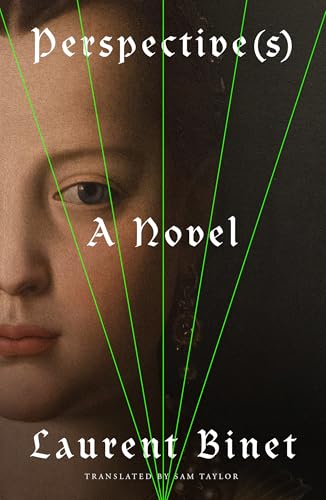
PERSPECTIVE(S): A Novel, Laurent Binet being his most sibylline self

PERSPECTIVE(S): A Novel
LAURENT BINET (tr. Sam Taylor)
FSG (non-affiliate Bookshop.org link)
$18.00 paperback, available now
Rating: 4.5* of five
LONGLISTED for the 2026 Dublin Literary Award...the shortlist of six will be announced on 7 April 2026, the winner(s) in May's festival.
The Publisher Says: A pulse-quickening murder mystery set in Renaissance Florence by the renowned author of HHhH.
As dawn breaks over the city of Florence on New Year’s Day 1557, Jacopo da Pontormo is discovered lying on the floor of a church, stabbed through the heart. Above him are the frescoes he labored over for more than a decade—masterpieces all, rivaling the works of Michelangelo in the Sistine Chapel. When guards search his quarters, they find an obscene painting of Venus and Cupid—with the face of Venus replaced by that of Maria de’ Medici, the Duke of Florence’s oldest daughter. The city erupts in chaos.
Who could have committed these crimes: murder and lèse-majesté? Giorgio Vasari, the great art historian, is picked to lead the investigation. Letters start to fly back and forth—between Maria and her aunt Catherine de’ Medici, the queen of France; between Catherine and the scheming Piero Strozzi; and between Vasari and Michelangelo—carrying news of political plots and speculations about the identity of Pontormo’s killer. The truth, when it comes to light, is as shocking as the bold new artworks that have made Florence the red-hot center of European art and intrigue.
Bursting with characters and historical color, Laurent Binet’s Perspective(s) is a whodunit like no other—a labyrinthine murder mystery that shows us Renaissance Florence as we’ve never seen it before. This is a dark, dazzling, unforgettable read.
I RECEIVED A DRC FROM THE PUBLISHER VIA NETGALLEY. THANK YOU.
My Review: From the framing device of a trove of discovered letters forward, this book represents the kind of games I most enjoy authors playing. Binet's the son of an historian, and it shows...for good and ill. The good is the playfulness of his choices to focus narrative attention on; the ill is his necessary fictionalizing of real figures of the well-studied past at times slipping into...absurdity, silliness, OTT recherche Proustian locutionary excess?...well, too-muchness, anyhow.
It is, I'll say clearly and now, well worth the effort to accept without engaging too much critical overdrive. (My worst readerly failing.)
Sort out fact from fiction exactly as much as suits you; nothing in your pleasure will change knowing more than you're told on the pages of the story about the people (note I did not say characters) on these pages. The murdered man emerges as we all do from the memories of those around us, as a blurry-edged shadow. It is unclear to me if he was actually guilty of lèse-majesté—and I do not care to establish this. Or any other of the many interesting side-lights Author Binet shines onto Savonarola's Florence. (I'd be a really bad puritan. I've always got a question they don't like, and am absolutely guaranteed to perform every sex act they abominate...in public, to show how they can't tell *me* what to do!)
The character Vasari is, in a word, adroit. No matter what he's asked to do, or be, or fix, he's got it, understands the assignment and the subtext, has a guy who knows a guy on his side. It's always good to know a Vasari because he might be oily but he's effective. People in power love Vasari-type guys. If you're the guy he knows who's got the connections he can use, you will never get public credit—that's all his—but he won't forget you. Until he does.
No, not a bestie to rely on, but a great guy to read about, and a top-notch sleuth.
As the pages flew by I realized I was in that reading flow state that's ever elusive. I was deep into Author Binet's imagination (Michelangelo as gossipy old queen, Marie de'Medici as old queen in political hot water) and unaware of the ever-advancing hour. When I closed the cover at two-thirty, I was sad to see it all end. I'm not sure why the very slightly repetitious recaps Binet's Vasari offers the reader to explain the resolution of the killing didn't weigh more heavily on my pleasure in the read...my conclusion is that I like Vasari's very natural-feeling shifts in tone. These do, however, slow the story's roll a but more than I myownself would prefer (that missing half-star above). Vasari is, as mentioned before, an operator, so he's bound to have different conversational registers for different people. In an epistolary novel that's both easy to present and easy to explain. No one in this collection of invented letters has an overview of the situation, just one corner of the composition, so everyone's responding to events as honestly as they feel safe doing; but they're all watching their tone because this was a dangerous time (see link to Savonarola above). It's similar to the effect of my doted-on The Case of Cem.
I'm delighted with this read. I'm recommending it to most all y'all because it's fun to see an author summon the attitudes of people long-dead in this honest, ambivalent way. I don't think the readers averse to history will be that tempted, though I hope one or two will try it out.
Monday, January 17, 2022
THE MAID, a lightly-sweetened lemonade of a book...refreshing!
THE MAID
NITA PROSE
Ballantine Books
$27.00 hardcover, available now
NOW $2.99 ON KINDLE (non-affiliate Amazon link)
Rating: 4* of five
The Publisher Says: Molly Gray is not like everyone else. She struggles with social skills and misreads the intentions of others. Her gran used to interpret the world for her, codifying it into simple rules that Molly could live by.
Since Gran died a few months ago, twenty-five-year-old Molly has been navigating life’s complexities all by herself. No matter—she throws herself with gusto into her work as a hotel maid. Her unique character, along with her obsessive love of cleaning and proper etiquette, make her an ideal fit for the job. She delights in donning her crisp uniform each morning, stocking her cart with miniature soaps and bottles, and returning guest rooms at the Regency Grand Hotel to a state of perfection.
But Molly’s orderly life is upended the day she enters the suite of the infamous and wealthy Charles Black, only to find it in a state of disarray and Mr. Black himself dead in his bed. Before she knows what’s happening, Molly’s unusual demeanor has the police targeting her as their lead suspect. She quickly finds herself caught in a web of deception, one she has no idea how to untangle. Fortunately for Molly, friends she never knew she had unite with her in a search for clues to what really happened to Mr. Black—but will they be able to find the real killer before it’s too late?
A Clue-like, locked-room mystery and a heartwarming journey of the spirit, The Maid explores what it means to be the same as everyone else and yet entirely different—and reveals that all mysteries can be solved through connection to the human heart.
I RECEIVED A DRC FROM THE PUBLISHER VIA NETGALLEY. THANK YOU.
My Review: This is a locked-room mystery, narrated by a naïve narrator who genuinely, unfeignedly does not understand what is happening or why it unfolds the way it does. Its bones, then, are excellent. A well-trodden path is a gift and a curse for writer and reader. What makes or breaks the reading experience is the voice the author tells the story in.
Having edited books for a living, Author Prose is very much aware of this reality. It makes her achievement in creating Molly the Maid, ironically surnamed "Gray", contextually appropriate but nonetheless impressive. Molly loves her world, the job of being a maid at the Regency Grand Hotel.
There’s nothing quite like a perfectly stocked maid’s trolley early in the morning. It is, in my humble opinion, a cornucopia of bounty and beauty. The crisp little packages of delicately wrapped soaps that smell of orange blossom, the tiny Crabtree & Evelyn shampoo bottles, the squat tissue boxes, the toilet-paper rolls wrapped in hygienic film, the bleached white towels in three sizes—bath, hand, and washcloth—and the stacks of doilies for the tea-and-coffee service tray. And last but not least, the cleaning kit, which includes a feather duster, lemon furniture polish, lightly scented antiseptic garbage bags, as well as an impressive array of solvents and disinfectants, all lined up and ready to combat any stain, be it coffee rings, vomit—or even blood. A well-stocked housekeeping trolly is a portable sanitation miracle; it is a clean machine on wheels. And as I said, it is beautiful.
There is nothing about a housekeeping trolley that has ever creased my cranium before now. I'll never be so blind again. It's a rolling chemistry experiment, though I don't see that with Molly's appreciative eyes.
What strikes the neurotypical reader is how very clearly Molly isn't One of Us. She has her meltdowns, logically enough, when overwhelmed by the chaos of Life (which of necessity includes death); we'd do the same if Chaos obtruded on our day the way it did Molly's as she discovers the lifeless body of repeat hotel guest Mr. Black. The fact is, Black is well named. His death wasn't an accident or an illness...he was Murdered and the police, unfamiliar with Molly's, um, state of being, rapidly assign her the role of Suspect.
And then the Universe springs into action.
Molly, you see, is a gem. She's being used by some bad people whose moral compasses aren't calibrated right, she's being set up to take a fall she can't even see, and she is...crucially...possessed of seriously good luck in her friends. There is no question that she is the proof one always wishes for that there are some Forrest-Gumpian stories that aren't cloying. However, I will not lie to you: anyone...and I mean ANYone...who says "we are all the same in different ways" to me is going to get a truly Tongan response.... Still there is a beauty in the repetition and reassembly of cliché in service of a Message. Well, when that Message is a positive and a constructive one, which is what this fun read exemplifies to the point of being the illustration in the dictionary under "message fiction." It is, though, this Message-y nature that leaves a fifth star off my rating. I could hang with the repetitive reminders of Molly's neurodivergence. I was not quite so willing to overlook the "different ≠ bad" catechism, or the "pretty ≠ good" catechism. Learning to see beyond surfaces? Yes, yes, a maid whose oft-repeated mantra is to "return your suite to a state of perfection" is the perfect messenger for it, got it, stop now. But there was no Stop button....
What happens as a result, though, is the unraveling of a long and ugly strand of American society, a series of horrible crimes that are so...repellent...to persons and so easy to distract institutions from pursuing, that it really isn't on for me to go into it. I will say that there's not one miscreant who gets through this wringer unsqueezed. That's enough about the crime parts. The resolution parts are shaped to suit Molly the Maid's comprehension level, which expands exponentially as she navigates the shoals of her grieving for her Gran's death, for her sad coming-to-awareness of the venality of people, and her sudden awakening to the fragility of Truth and Innocence in a world that needs answers instead of solutions.
Molly and Gran used to watch Columbo reruns together, so Molly's primed for a policing style that doesn't exist in reality when she's enmeshed in a dreadful web of lies and betrayals in her safe place, The Regency Grand Hotel. She's arrested for a crime she knows she didn't commit, and her tormentors aren't even slightly interested in her life-long passion for truthfulness. The issue is, of course, that even her truthfulness is weaponized against her by the miscreants using her innocence to cover their crimes. But, crucially, Gran's long shadow nurtured relationships that Molly, all unknowing, can depend on for her very life. Right there in the hotel! And she surprises herself by being able to reach back to the hands held out to her. Though there is a serious difficulty in that she doesn't immediately see them as helping hands.
Seeing is a recurring theme for Molly. Her being seen, being acknowledged, is a huge issue in her life...people don't see maids, and even her co-workers don't as a rule see Molly. The names of the characters are almost all colors or qualities of sight...Stark, Rosso, Green among others...and Molly's perceptions of the Regency Grand are of its colors and presentations of shiny, glossy surfaces. It's not subtle, goodness knows, but it's very effective because of the narrator's neurodivergence. It's very easy to see that this brightness of vision is intentional and it's all down to interpretation for Molly to be able to present what she's so clearly seen in self-exculpatory ways.
The final scene, a lovely piece of courtroom theater, will make Florence Pugh a bigger star than she is when the film is eventually released. It is so very,very satisfying that I can only blush while reporting the honest truth that I cheered a little and even had a humidity condensation event around my ocular area.
Don't tell anyone.
Tuesday, April 27, 2021
FUGITIVE TELEMETRY, sixth Murderbot story & a fun locked-room mystery...what Murderbot needed it got
FUGITIVE TELEMETRY
MARTHA WELLS (Murderbot #6)
Tor.com Publishing
$11.99 ebook editions, available now
Rating: 4.75* of five
WINNER OF THE 2022 LOCUS AWARD—BEST NOVELLA! Watch the award ceremony here.
WINNER OF THE HUGO FOR BEST SERIES, 2021 WORLDCON: DisCon III!
The Publisher Says: No, I didn’t kill the dead human. If I had, I wouldn’t dump the body in the station mall.
When Murderbot discovers a dead body on Preservation Station, it knows it is going to have to assist station security to determine who the body is (was), how they were killed (that should be relatively straightforward, at least), and why (because apparently that matters to a lot of people—who knew?)
Yes, the unthinkable is about to happen: Murderbot must voluntarily speak to humans!
Again!
I RESERVED THIS BOOK AT MY LOCAL LIBRARY THE *INSTANT* I FOUND OUT IT WAS COMING OUT!
My Review: This is a locked-room murder mystery with Twelve Years a Slave overtones. Much much good action and some serious character development. Don't start here, but don't let the door hit you standing around waiting for it to go on sale before reading it.
When we come onto Preservation Station, we're greeted by a world that...doesn't work like the one you and I are used to:
(Preservation had two economies, one a complicated barter system for planetary residents and one currency-based for visitors and for dealing with other polities. Most of the humans here didn’t really understand how important hard currency was in the Corporation Rim but the council did, and Mensah said the port took in enough in various fees to keep the station from being a drain on the planet’s resources.)
Thus Author Wells makes plain that Preservation Station and Alliance doesn't exist on the Corporate Rim's terms...it interfaces with them, but doesn't make their system its own. I'd wondered about that. I'm very grateful she took the time to say out loud (well, in parenthesis, where Murderbot says a lot of important stuff) what I'd been trying to figure out.
What isn't hard to figure out is what Murderbot's appeal is to us unaugmenteds:
...the humans on the Station wouldn’t have to think about what I was, a construct made of cloned human tissue, augments, anxiety, depression, and unfocused rage, a killing machine for whichever humans rented me, until I made a mistake and got my brain destroyed by my governor module.
–and–
(I don’t know why bot behaviors that are useless except to comfort humans annoy me so much.) (Okay, maybe I do. They built us, right? So didn’t they know how this type of bot took in visual data? It’s not like sensors and scanners just popped up randomly on its body without humans putting them there.)
There's nothing more fun than hearing your inner monologue made outer by a belovèd character speaking it in words. I, too, find the stupid soothing behaviors necessary to interact as frictionlessly as possible with people I don't like very irritating...especially when they get in the way of accomplishing stuff that needs doing, now.
What makes the series especially appealing to me, apart from Murderbot, is the grace notes that Author Wells give us. Murderbot came close to getting a sidekick bot this installment, and something suggests to me that it could still happen. A bot working in the hotel where Murderbot has traced our murder victim to is **eager** to help with the investigation. Murderbot isn't eager to be helped once it has what it needs. "(The bot’s name is Tellus. They name themselves and hearing about it is exhausting.)" thinks Murderbot of the poor basic bot. Now go look at the layers in this simple throw-away here. "Hearing about it is exhausting" doesn't even *begin*, Murderbot! But what a lovely easter-egg for the restlessly curious.
Then there's Murderbot's ongoing quest to discover what its origins mean. The corporate entities out after Murderbot and its chosen family (Dr. Mensah and her folk) have occupied Murderbot's threat-assessment module and its tactical programs for so long that it hasn't seen how very human it's becoming:
Maybe I’d been waiting too long for GrayCris to show up and try to kill us all. I was thinking like a CombatUnit, or, for fuck’s sake, like a CombatBot.
–and–
I pulled the schematic from the instructions and found the transponder was buried in the sealed drive unit.
Oh, you have to be kidding me. I’d be pissed off at the humans but I had brought this thing up here without checking.
–and–
This meant no bot pilot that I could get information from. That was depressing. I had no idea what else I was supposed to do as a member of this group and just following humans around listening to them talk felt a lot like just being a SecUnit again. I mean, I am a SecUnit, but … You know what I mean.
Yes, Murderbot, we all know what you mean. It's the way many of us feel a lot of the time, too. You'd be amazed how human you really are.
And don't stalk off all offended. You're really the best of us, not just the rest of us. Not Festivus for you. Now what's wrong with me, warbling these praises but not giving the story the Full Five? It's the dull thud of a dropped plot-point that I needed more of...what the heck was Lutran doing all those years to stay off Preservation Station's radar? Did the smugglers plant the eventual murder weapon and then have it hacked against them? *aaarrrgh*
So no perfect score for you, Author Wells. Harrumph.
Sunday, August 31, 2014
MURDER ON THE ORIENT EXPRESS, Poirot at his peak

MURDER ON THE ORIENT EXPRESS (Hercule Poirot #10)
AGATHA CHRISTIE
William Morrow
$3.99 Kindle edition, availble now
Rating: 5* of five, mostly for the Agatha Christie's Poirot adaptation
The Publisher Says: Just after midnight, a snowdrift stopped the Orient Express in its tracks. The luxurious train was surprisingly full for the time of the year. But by the morning there was one passenger fewer. A passenger lay dead in his compartment, stabbed a dozen times, his door locked from the inside.
My Review: Well, that was a concise-to-the-point-of-terseness summary. But I suspect most of us who are voracious or even simply serious readers of mystery fiction don't need too much more than that to recall the details to mind.
The novel, published in 1934, is a bit of a stretch for a modern mystery-reader's sense of fair play. Poirot's famous/infamous "little gray cells" are pumpin' full-bore and lead him to near-miraculous feats of deduction. The novel's Poirot is, at the end, almost cavalier about the hugely out-of-character ending. It almost feels as if Christie said to herself, "Self, I've had enough of this character's ethics and am writing MY ending not his."
Her book, her rules.
The filmed version offers more scope for fair play with the reader as Poirot is seen to do things and discover things that lead him to a startling and evidently disturbing conclusion. In keeping with the films' expansion of the Poirot character, the book's resolution is more nuanced, and affords a modern viewer more satisfaction in that the character of Poirot is clearly emotionally involved in the murder's resolution and becomes a richer, more relatable person as a result.
Both versions of the story are so improbable as to be absurd, on the face of it. But in a world run on decent principles, such a story and such a resolution would be more common than not. I feel very Old-Testament-y about people who harm children or animals for cruelty or sport.
The film's other deviations from the novel are also deepening the sense of Poirot's reality as a person, and indicative of just how very surprising this ending is within the understanding Christie has given us of Poirot's essential relationship to crime-solving. A scene at the beginning of the film, between Poirot and a soldier, is particularly important in setting the tone for this story's exceptional place in the Poirot canon. Another early scene in Istanbul is, in my opinion, gratuitous; well conceived, but not necessary, and frankly unpleasant in the light it sheds on Poirot.
But the sheer visual beauty of this film! The pitch-perfect Poirot of David Suchet! Ah mes amis, this is the treat most exceptional, this feast is the repast most gustatorial for the lover of the how you call a crime drama. It is the pleasure most complete. Replenish yourselves and your little gray cells!
This work is licensed under a Creative Commons Attribution-NonCommercial-ShareAlike 3.0 Unported License.
Subscribe to:
Posts (Atom)