Showing posts with label FSG. Show all posts

Sunday, August 9, 2026

QUEEN MAB, debut surreal mother-fiction


QUEEN MAB
EMILY McBRIDE

FSG (non-affiliate Bookshop.org link)
$14.99 ebook, available now

Rating: 4.5* of five

The Publisher Says: In this debut novel, a new mother—a scholar steeped in fairy lore—wrestles with the legacies and madness of motherhood.

There is a changeling in this story—but who is it?

Madeleine is young for motherhood, a promising grad student in Victorian and modernist literature, twenty-three and not long married. Even her mother worries about the timing. But Madeleine’s ambivalence is pushed aside by Tom’s elation and her own desire to bring new life into a world marked by loss.

Then comes Maud, perfect and fresh, despite a traumatic labor. But just a few nights into their life, something seems amiss. Maud is changed. The child never stops crying. Her hunger is insatiable. Her eyes glint with some kind of ancient mischief. Could Maud be a fairy child, swapped when Madeleine wasn’t paying attention? Is the real Maud dancing in the half-light, with the fairies and the foxes? Did the gray cat hide her behind the hedge?

Tom goes about the day-to-day, working toward a promotion and urging Madeleine to connect with other moms. Her parents come to clean out her grandmother’s house, her father newly obsessed with genealogy and DNA tests. Madeleine, interrupted by violent visions, panicked at her lack of maternal love, shut out from her old life, frantically searches for answers. The old stories end in sorrow and bloodshed, and the fairies don’t just kidnap babies—they’re also partial to young women. Is Maud the changeling, or is Madeleine? And if she’s been swapped, how will she find her way back?

Emily McBride’s Queen Mab is a riveting portrait of madness, motherhood, the myths that haunt us, and the families who keep us tethered.

I RECEIVED A DRC FROM THE PUBLISHER VIA NETGALLEY. THANK YOU.

My Review
: I speak from experience when I say psychosis is terrifying to experience. I do not wish it on the very lowest, worst human beings on the planet.

Not even MAGAts. Besides, most of 'em are already there.

Queen Mab is probably the best fictional evocation I've ever read as to *why* psychosis is utterly terrifying. Something Madeleine lnows cannot be true...is true. Everything she is, has learned, made her own mental world with, tells her this hideous impossibility: her child is a faery changeling. It is simply the truth.

What ensues is the other horrifying reality of psychosis: to get back to consensus reality means admitting you've left it, and that is a terrible, terrible moment in a person's life. It does not help that her career is the study of Victorian literature. Irish folklore. Made-up stuff that's now horrifyingly real in her brain, and she has to tell the people in her life that this is where she is. And she has to grapple with, not only having given birth, something her mother could not do and did not do so has no insights to offer but now Madeleine has to re-grapple with her status as an adoptee. Is this congenital? Is there something permanent wrong?

I'm well-known for not being in the Cult of Mother. Madeleine is probably burning her membership card. But a story like this one that carefully flenses the bullshit rainbows-and-lollipops stuff off the bones of the life-altering disaster-movie destruction of pregnancy, delivery, neonatal care, social rearrangement, marital instability...and all without making the process feel artificially predetermined....

It's quite a feat. It's a first novel so it can go over the top at times. It can seemingly forget where it's been to go where the author wants it to go. But it never fails to ground itself in Madeleine's world as she sees it at thee moment. It makes for a deep, unnerving reading experience. Madeleine's fear is we-the-reader's fear.

I'm very impressed. I'm intrigued by what Author McBride will create next.

Monday, September 29, 2025

VLADIMIR SOROKIN'S PAGE: Oprichnik's Russia duology


THE SUGAR KREMLIN (Oprichnik's Russia #2)
VLADIMIR SOROKIN (tr. Max Lawton)
Dalkey Archive Press (non-affiliate Bookshop.org link)
$18.95 trade paper, preorder for fulfillment tomorrow

Rating: 4* of five

The Publisher Says: A puzzle of colorful, sardonic episodes that come together as a portrait of totalitarian society as a whole.

Sugar Kremlin follows the near-future universe of Sorokin’s Day of the Oprichnik, crafting a set of 15 chapters that all return to the symbol of the The Sugar Kremlin. Thousands of these creations are being given away to citizens on the street, from lucky children to secret political dissidents, torture-obsessed civil servants, sex workers in a nearby bordello, and more.

As Sorokin moves from story to story, he draws the reader through the dark streets of life in Russia, creating a metaphysical encyclopedia of the Russian soul through a deceptively sweet sugary treat. Presenting a wide variety of genres and tones, Sugar Kremlin lays out a frightening vision of speculative mercilessness and quirky political horror.

I RECEIVED A DRC FROM THE PUBLISHER VIA EDELWEISS+. THANK YOU.

My Review
: Not a novel. A collection of fifteen stories set in the storyverse of Day of the Oprichnik but without overlapping or recurring characters. The structure here is centered around a literal "sugar Kremlin", a treat made of sugar in the shape of the Kremlin that's like an Advent calendar or a fruitcake or other holiday treat in ubiquity and celebratory affect.

That alone makes this unnerving, dystopian fantasia of a 2028 Russia unsettlingly like the Project 2025 US we're living in. The characters are constantly munching on, consuming, discussing the lusciousness of, this nutritionless pure sugar abomination.

On the nose much, Author Sorokin?

Expect the usual transgressive behaviors (I've been uneasily eyeing my hammer), the expected degradation and cruelty, the obligatory violent and vicious conduct. Sorokin is not going to coddle your imagination. The stakes here are too high. This duology (this one published in 2008 in Russian, 2025 in English, printed now that Dalkey Archive's under new ownership) is a trumpet blast, containing every dissonant and perverse note in Literature's instrumentation, to get the reader to see, really see, what is going on. It's been the brief of this press since its founding in 1984.

What made this a slightly-less-stellar read than Day of the Oprichnik for me was the episodic nature of stories...they don't really synergize to create a paralyzing terrified awareness of the overarching story's validity and possibly even applicability to 2025 US life. It's not what stories do, nor are they supposed to. What they've done as collected here is make the whole feel more melodramatic than dramatizing reality as a novel does. I was a bit thrown by a story titled "The Queue" because that's also an (unrelated) novel by Author Sorokin. It was brief but it threw me out of my flow state.

I am, then, one of those who are not au fait with Author Sorokin's contention that "The contemporary world is so complex and protean that it is no longer possible to describe it with linear prose and squeeze it into a traditional novel's structure." (From his interview with Joshua Cohen that forms the Introduction to the book.) I read a lot of linear novels; they do a creditable job of linear presentation of an inherently nonlinear world; I do not see that what I've just read has a notable advantage over, say, The Words That Remain (a linear-prose novel that presents complexity, pathos, cruelty, and love effectively). I readily stipulate that I'm possibly missing the point of his statement, or too dull of apprehension to get more than a dim gist of it.

Nonetheless, I experienced this read as a collection of well-made stories ready to épater les bourgeois as they...we...so badly need literature to do. Author Sorokin is ready, willing, and able to do this duty, with verve and panache, and scatology and violence.

It needs doing. It needs reading.

++++++++++++++++++++++++++++++++++++++++++++++++++++++++++++++++


DAY OF THE OPRICHNIK (Oprichnik's Russia #1)
VLADIMIR SOROKIN (tr. Jamey Gambrell)
FSG
$9.99 ebook, available now

Rating: 4.5* of five

The Publisher Says: Moscow, 2028. A cold, snowy morning.

Andrei Danilovich Komiaga is fast asleep. A scream, a moan, and a death rattle slowly pull him out of his drunken stupor—but wait, that’s just his ring tone. And so begins another day in the life of an oprichnik, one of the czar’s most trusted courtiers—and one of the country’s most feared men.

Welcome to the new New Russia, where futuristic technology and the draconian codes of Ivan the Terrible are in perfect synergy. Corporal punishment is back, as is a divine monarch, but these days everyone gets information from high-tech news bubbles, and the elite get high on hallucinogenic, genetically modified fish.

Over the course of one day, Andrei Komiaga will bear witness to—and participate in—brutal executions; extravagant parties; meetings with ballerinas, soothsayers, and even the czarina. He will rape and pillage, and he will be moved to tears by the sweetly sung songs of his homeland. He will consume an arsenal of drugs and denounce threats to his great nation’s morals. And he will fall in love—perhaps even with a number of his colleagues.

Vladimir Sorokin, the man described by Keith Gessen (in The New York Review of Books) as “[the] only real prose writer, and resident genius” of late-Soviet fiction, has imagined a near future both too disturbing to contemplate and too realistic to dismiss. But like all of his best work, Sorokin’s new novel explodes with invention and dark humor. A startling, relentless portrait of a troubled and troubling empire, Day of the Oprichnik is at once a richly imagined vision of the future and a razor-sharp diagnosis of a country in crisis.

I RECEIVED A DRC FROM THE PUBLISHER. THANK YOU.

My Review
: From the vantage point of late 2025, a post-Putin neo-medieval Russia in 2028 sounds...oddly optimistic...as well as wrong. From 2005's standpoint it probably seemed more likely; even though nothing in this book could be called hopeful, it was probably sounding good to Sorokin just not to have Little Vladdy Pu-Pu on the tsar's throne.

Predictions always miss something. Usually they're too optimistic, too hopeful, and weird to say that's the problem with this bleak prediction-fest. *waves at Little Vladdy Pu-Pu on his throne* I'm not entirely convinced the religious fervor of the Oprichnia, as revived from the days of Ivan the Terrible (an epithet with multiple valences in English, all of them applicable to the bearer then...and by extension now), is not active in 2025 let alone 2028.

With his characteristic OTT revulsion-inducing behaviors foregrounded, this book is automatically beyond the pale of all too many squeamish readers. I would say "try to get past it" but honestly...don't. One is meant to be revolted and put off by it, much as the 1972 John Waters shocker Pink Flamingos is not meant to titillate but shock and offend (fifty-plus years on, it still does). The world Author Sorokin posits is intended to be just as appalling and revolting, to disgust you and repel you! The entire reason to hold a dark mirror of satire up is to draw attention to the wrongness and cruelty of the world being posited. By no means is it accidental that so much of it is grimly familiar. The theocratic angle is the one not quite fully rolled out by our allegedly separate government. Just wait.

This edition was published in 2011, and it is only more relevant and more horripilating in 2025's world of ICEstapo and wholesale social upheaval caused and inflamed by the most powerful in our country.

Friday, August 8, 2025

THE SOUTH, Booker-Prize longlisted first queer love in Malaysia


THE SOUTH
TASH AW

Farrar, Straus and Giroux (non-affiliate Bookshop.org link)
$14.99 ebook, available now

One of The Guardian's The best fiction of 2025 list!

Time's The 100 Must-Read Books of 2025 selection

A New York Times 100 Notable Books of 2025 selection

Longlisted for the 2025 Booker Prize.

Rating: 4.25* of five

The Publisher Says: A luminous and intimate novel about the weight of inheritance, the bonds of loyalty, and the awakening of love, set against the backdrop of a changing Malaysia.

The South unfolds during a visit by the Lim family to their rural clan estate after a long absence. Jay, in his mid-teens, and his two older sisters are less than thrilled to leave their city for the remote house in the south, but their parents, Sui Ching and Jack, are adamant.

Jay finds he's expected to share a room with Chuan, the son of the estate's overseer, a bit older than Jay but seemingly much more mature and capable in the world. The two soon form an intense bond, but with their very different backgrounds, and even more disparate expectations for the future, the course of their relationship is always an unspoken question.

Meanwhile, change presses in, including the destruction of the farm's beloved orchards, and the sale of the estate is mooted. The relationships between Chuan's father and Jack and Sui Ching go deep, but pressures both internal and external threaten to sever old bonds and upend an entire way of life. The South, at once sweeping and intimate, is a masterful portrait of a family navigating a period of great transformation.

I RECEIVED A DRC FROM THE PUBLISHER VIA NETGALLEY. THANK YOU.

My Review
: Farms feed us. At the vast, unceasing exaction of labor, they feed us. Do they feed farmers? That is, do farmers get fulfillment and satisfaction from the labor they do? (Are there people being farmers in 2025?) And the cost of that labor, the relationships it bends to exigencies city-dwelling consumers don't worry their pretty heads about, how is it borne? Never equally...Nature seems to forbid anything like ease in farming, droughts, excesses of rain, it is literally always something on the socially elite Lim family's inherited land.

Author Tash Aw has done that thinking in this story. He observes and occasionally examines the workings of a family with a farm in Malaya (as it was at the beginning of the narrative) as they farm, live, love, doubt, together and apart. It's a book of calm, eerie stillness as the characters live lives they begin to question...is this necessary? am I necessary to it? am I doing good for the world?...and analyze how things are and aren't making them happy. Love is in the air between boys whose families have known each other most all their lives; loves slides out of mom Sui and dad Jack's grasp; love, true to its reputation, ruins everything with its exquisite torturous promises of pleasure, happiness, belonging that are so elusive to the Lim siblings. “We feel as though our entire world changes when we get older, every object, every person, has been rearranged into some strange new configuration, but in fact nothing at all has changed.” Nor will it ever. That realization stymies and disheartens many. I find it exhilarating in its challenge to redistribute attention, wisdom, knowledge within the unchanging reality of Life.

Maybe Jay Lim won't get Chuan, the boy he loves (In that moment, forever seems like a comforting notion. But at that age, what does either of them really know about time?), maybe Jack Lim will stop him as his culture demands despite his own complicated past, maybe Sui Lim won't be able to move past regrets for things undone. Maybe Malaysia's long tradition of relative harmony among its constituent groups is about to blow up into full-on Sinophobia. What will the Lims do then? We can't call it an orchard if it no longer bears fruits pretty much sums up the dilemmas in the whole book.

Family drama is evergreen because family is universal. Jay's older sisters are plumping for connection in the form of religious nuttery, the other in the embrace of rejection. (Parents believe this, so she rejects it; a stance adolescence damn near demands.) Jay's struggles with finding queerness in his world, knowing it's there and just out of his reach, is how I know the author understands me across generations and cultures: "This emptiness feels like hunger but Jay thinks that it is really a longing, though he doesn't know what he is longing for."

I was delighted to read this story of queer self-discovery against a backdrop of cultural and economic shifts that both enable and inhibit the journey. It is not a negative, but an observation, that hearing from so many points of view does not center queerness in the story quite the way I'd thought it would based on how it's marketed. It wasn't enough Jay to make the queer angle the only one in the telling, so I took three-quarters of a star back.

But how very beautiful and quietly profound and enfolding this read was! I recommend it to all including the "eww-ick" homophobes.

Wednesday, April 9, 2025

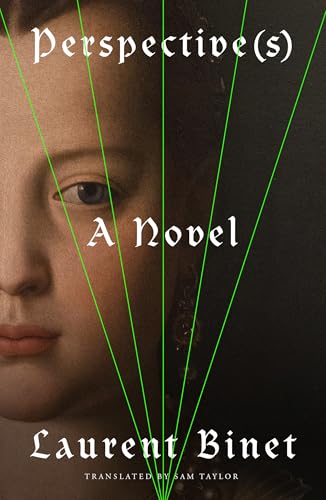
PERSPECTIVE(S): A Novel, Laurent Binet being his most sibylline self


PERSPECTIVE(S): A Novel
LAURENT BINET (tr. Sam Taylor)
FSG (non-affiliate Bookshop.org link)
$18.00 paperback, available now

Rating: 4.5* of five

LONGLISTED for the 2026 Dublin Literary Award...the shortlist of six will be announced on 7 April 2026, the winner(s) in May's festival.

The Publisher Says: A pulse-quickening murder mystery set in Renaissance Florence by the renowned author of HHhH.

As dawn breaks over the city of Florence on New Year’s Day 1557, Jacopo da Pontormo is discovered lying on the floor of a church, stabbed through the heart. Above him are the frescoes he labored over for more than a decade—masterpieces all, rivaling the works of Michelangelo in the Sistine Chapel. When guards search his quarters, they find an obscene painting of Venus and Cupid—with the face of Venus replaced by that of Maria de’ Medici, the Duke of Florence’s oldest daughter. The city erupts in chaos.

Who could have committed these crimes: murder and lèse-majesté? Giorgio Vasari, the great art historian, is picked to lead the investigation. Letters start to fly back and forth—between Maria and her aunt Catherine de’ Medici, the queen of France; between Catherine and the scheming Piero Strozzi; and between Vasari and Michelangelo—carrying news of political plots and speculations about the identity of Pontormo’s killer. The truth, when it comes to light, is as shocking as the bold new artworks that have made Florence the red-hot center of European art and intrigue.

Bursting with characters and historical color, Laurent Binet’s Perspective(s) is a whodunit like no other—a labyrinthine murder mystery that shows us Renaissance Florence as we’ve never seen it before. This is a dark, dazzling, unforgettable read.

I RECEIVED A DRC FROM THE PUBLISHER VIA NETGALLEY. THANK YOU.

My Review
: From the framing device of a trove of discovered letters forward, this book represents the kind of games I most enjoy authors playing. Binet's the son of an historian, and it shows...for good and ill. The good is the playfulness of his choices to focus narrative attention on; the ill is his necessary fictionalizing of real figures of the well-studied past at times slipping into...absurdity, silliness, OTT recherche Proustian locutionary excess?...well, too-muchness, anyhow.

It is, I'll say clearly and now, well worth the effort to accept without engaging too much critical overdrive. (My worst readerly failing.)

Sort out fact from fiction exactly as much as suits you; nothing in your pleasure will change knowing more than you're told on the pages of the story about the people (note I did not say characters) on these pages. The murdered man emerges as we all do from the memories of those around us, as a blurry-edged shadow. It is unclear to me if he was actually guilty of lèse-majesté—and I do not care to establish this. Or any other of the many interesting side-lights Author Binet shines onto Savonarola's Florence. (I'd be a really bad puritan. I've always got a question they don't like, and am absolutely guaranteed to perform every sex act they abominate...in public, to show how they can't tell *me* what to do!)

The character Vasari is, in a word, adroit. No matter what he's asked to do, or be, or fix, he's got it, understands the assignment and the subtext, has a guy who knows a guy on his side. It's always good to know a Vasari because he might be oily but he's effective. People in power love Vasari-type guys. If you're the guy he knows who's got the connections he can use, you will never get public credit—that's all his—but he won't forget you. Until he does.

No, not a bestie to rely on, but a great guy to read about, and a top-notch sleuth.

As the pages flew by I realized I was in that reading flow state that's ever elusive. I was deep into Author Binet's imagination (Michelangelo as gossipy old queen, Marie de'Medici as old queen in political hot water) and unaware of the ever-advancing hour. When I closed the cover at two-thirty, I was sad to see it all end. I'm not sure why the very slightly repetitious recaps Binet's Vasari offers the reader to explain the resolution of the killing didn't weigh more heavily on my pleasure in the read...my conclusion is that I like Vasari's very natural-feeling shifts in tone. These do, however, slow the story's roll a but more than I myownself would prefer (that missing half-star above). Vasari is, as mentioned before, an operator, so he's bound to have different conversational registers for different people. In an epistolary novel that's both easy to present and easy to explain. No one in this collection of invented letters has an overview of the situation, just one corner of the composition, so everyone's responding to events as honestly as they feel safe doing; but they're all watching their tone because this was a dangerous time (see link to Savonarola above). It's similar to the effect of my doted-on The Case of Cem.

I'm delighted with this read. I'm recommending it to most all y'all because it's fun to see an author summon the attitudes of people long-dead in this honest, ambivalent way. I don't think the readers averse to history will be that tempted, though I hope one or two will try it out.

Friday, February 7, 2025

THE BEE STING, Paul Murray's calling-card book


THE BEE STING
PAUL MURRAY

Farrar, Straus and Giroux (non-affiliate Amazon link)
$12.99 ebook editions, available now

Rating: 3.5* of five

The Publisher Says: From the author of Skippy Dies comes Paul Murray's The Bee Sting, an irresistibly funny, wise, and thought-provoking tour de force about family, fortune, and the struggle to be a good person when the world is falling apart.

The Barnes family is in trouble. Dickie’s once-lucrative car business is going under―but rather than face the music, he’s spending his days in the woods, building an apocalypse-proof bunker with a renegade handyman. His wife Imelda is selling off her jewelry on eBay, while their teenage daughter Cass, formerly top of her class, seems determined to binge-drink her way through her final exams. And twelve-year-old PJ is putting the final touches to his grand plan to run away from home.

Where did it all go wrong? A patch of ice on the tarmac, a casual favor to a charming stranger, a bee caught beneath a bridal veil―can a single moment of bad luck change the direction of a life? And if the story has already been written―is there still time to find a happy ending?

I RECEIVED A DRC FROM THE PUBLISHER VIA NETGALLEY. THANK YOU.

My Review
: This book is A Lot. Long, deep, densely packed.

I enjoy reading anything that plays in the quantum fields of many worlds. The idea of one.little.change. making all the difference in one's life is very empowering, as well as nonsense, and honestly hazardous. All of those are reasons we love to mess with it safely in our fiction. Here Paul Murray goes full-tilt boogie down this waterslide, wets us to the bone in the spume of his landing, and completely destroys our hairdos.

Is it good anyway? Well...honestly...yes, but in a curious way no. Want to laugh hollowly at the folly of the merely mortal? Come hither, disciple dearest. Want to process your grief at the titanic (or Titanic) sinking of the life you planned? This is your altar call. Or is the appeal of a stonking novel immersive and redemptive reading? Hie thee hence, pilgrim. Nothing for you here...there is no redemption here, no one's gettin' what they think they deserve before the Apocalypse that's looming calypses. Need rigorous copyediting with Oxford commas, periods, line breaks, and other such embankments to channel the flow of the words? Ite, missa est. No communion cookies for you, though madeleines will be served in the Sodality of Marcel's post-tea.

Digressive is my word for this seemingly Irish specialty of novels (Milkman's another favorite) that don't give a feck for your English rules. Me, I'm down with it, I like things that don't slavishly straiten their gates to some Authority's pre- and proscriptions just cuz. Cry havoc and let slip the dogs of the culture wars! Whatever you do, don't be boring!

That said...well, honestly I found the central thesis of the family tedious and predictable: Dad's crushed, Mom's hogtied and struggling, Junior's got his antennae out so far they can find meaning in electric currents imperceptible to an ammeter, Sis is in thrall to the Mother of All Crushes on the most dreary poseur in all of literature...really, does this need retelling? The Man in the Grey Flannel Suit, To the Lighthouse, The Prime of Miss Jean Brodie, and every Colleen Hoover book ever written fill these separate niches extremely ably...have for most of a century. (It felt like a century passed when I read 102pp of It Ends With Us. *shudder* I {mildly mis-}quote that nasty little creep Truman Capote: "That's not writing, that's typing.")

So my bag was mixed. I loved parts, liked most of it, and was impatiently awaiting liftoff that never quite generated enough thrust to get me over the literary Kármán line. Hence my stingy-feeling 3.5 stars. It might be stingy but it's waaay better than most stuff I read and toss aside. I'm really umpressed with Author Murray's swinging for the fences in all his writing and storytelling. I mean, mad respect for going toe-to-toe with the twentieth century's greats (and megabestselling hack Hoover)! But coming for the monarch isn't safe lest you fail to slay them.

No slaying here, though some serious wounds were delivered.

Friday, July 14, 2023

THE KINGDOM OF SAND, older isn't always wiser


THE KINGDOM OF SAND
ANDREW HOLLERAN

FSG
$18.00 trade paperback, available now

Rating: 4* of five

LONGLISTED for the 2023 Andrew Carnegie Medal for Excellence in Fiction!

The Publisher Says: One of the great appeals of Florida has always been the sense that the minute you get here you have permission to collapse.

The Kingdom of Sand is a poignant tale of desire and dread—Andrew Holleran’s first new book in sixteen years. The nameless narrator is a gay man who moved to Florida to look after his aging parents—during the height of the AIDS epidemic—and has found himself unable to leave after their deaths. With gallows humor, he chronicles the indignities of growing old in a small town.

At the heart of the novel is the story of his friendship with Earl, whom he met cruising at the local boat ramp. For the last twenty years, he has been visiting Earl to watch classic films together and critique the neighbors. Earl is the only person in town with whom he can truly be himself. Now Earl’s health is failing, and our increasingly misanthropic narrator must contend with the fact that once Earl dies, he will be completely alone. He distracts himself with sexual encounters at the video porn store and visits to Walgreens. All the while, he shares reflections on illness and death that are at once funny and heartbreaking.

Holleran’s first novel, Dancer from the Dance, is widely regarded as a classic work of gay literature. The Kingdom of Sand displays all of Holleran’s considerable gifts; it’s an elegy to sex and a stunningly honest exploration of loneliness and the endless need for human connection, especially as we count down our days.

I RECEIVED A DRC FROM THE PUBLISHER VIA NETGALLEY. THANK YOU.

My Review
: I'm getting older. No, let's not be American about it: I'm old. Stories are very comforting when they tell you about yourself as you'd like to be. They're less comforting when they hold a mirror to ourselves as we are.
This isn't a comforting story for me to read.

Dancer from the Dance was the roadmap for how I wanted to be in the 1970s: Rooms full of men fucking each other's brains out? Parties with mind-altering substances galore?! Sign me up! I'm ready to start this kind of life! This book, not so much.

Mostly because illness, isolation, and the slightly tedious repetitiveness of sex are my reality, and aren't very interesting to me unless they're freshly observed. Let's be honest, what's ever going to make this stuff fresh to those within it? It is not, as far as I can see, possible to make excitement and anticipation from the routine, mundane, quotidian life of Getting Old. Bearing in mind as I do daily that getting old is a privilege denied to most people, it is a curiously samey process. I'm aware that there are people aging vigorously and pursuing, in their seventies, activity levels I never attained. I'm also aware that I am stunningly lucky not to be dead or permanently cognitively impaired after January 2023's strokes. I don't mean there's only one way to get old: I mean getting old, no matter which way you slice it, has certain common themes that don't rev my readerly engine above idle speed.

I looked over what I've just written, thought "this doesn't sound like a four-star review," and called my Young Gentleman Caller to read it to him. Thank goodness I did! After A Long Silence, he finally said, "Tedious repetitiveness? Thanks a lot." Explaining to him what I actually meant, aside from reassuring his bruised feelings about my real opinion of his prowess, clarified the subject that's bothered me about the book since I read it.

Holleran's over a decade older than I am. As I read about the life he was describing, I thought about the sameness of the unnamed PoV character's life as repetitive, even...perhaps especially...his unchanged relationship to sex. The expectation of desire for the same kind of sex into one's older age isn't a sign of vigor to me, but a sign of arrested adolescence. The concerns about isolation, in that context, also read as adolesent fears of not being Hot, of never finding friends/boyfriends/partners when it feels like everyone around you has them, in general of FOMO.

Seriously? You're still on about this? is what I'd say to this guy if I met him. I don't want an orgy or a three-way anymore, I want to spend that hour and a half in the more rewarding, interesting leisurely touching, stroking, and communing with Rob, the man I know and want to know better. That's a whole different experience from cruising the porn store as does our aging Casanova. Part of that is, again, down to my good luck. There is someone in my life who elicits these feelings from me, and is willing to reciprocate them. That's what I thought Earl meant to our PoV character, whose lack of a name feels to me like a reinforcement of this guy's utter and complete adolescent narcissism. "Only I am Real, everyone else is an extra in the movie of my life." And this is in spite of the fact that PoVman is basically spending the whole of his time in this book narrating Earl's decline and fall into the Endless!

Oh dear, again I'm veering into the not-highly-rating territory.

This is why I've had such trouble reviewing the book. It's a much better literary experience than I'm making it sound like. Look at the thoughts it's causing me to examine! Look at the depth of attention it summons out of me! I'm having interesting, important conversations with my Young Gentleman Caller because I need his help to process my feelings about the read.

Author Holleran is a fine wordsmith, with an opera librettist's ear for sentences that sing in my ear:
I believed somehow in the absurd idea that if you ate right you could live indefinitely. Even when, a decade after my mother‘s death, I began getting skin cancers, all I could think of was: how could this be? Given all the broccoli I’ve eaten? It must be loneliness, I concluded, the lack of a person to live for other than myself, since we are also told that health is psychosomatic.
–and–
The town to which Earl and my father retired was not one of those artificial communities created for people in the last stage of life with which Florida is associated. But it had its share of the elderly. It was good to be reminded by the Regular of another stage of life, especially when I stopped off at the post office on my way home from his shack. The people moving slowly toward the post office on walkers when I went to get the mail induced both pity and admiration; pity for their condition, admiration for their determination to keep going.
–and–
The Church believes in the Resurrection, and at the Resurrection the body and soul are united. What age the body is, and exactly how the two are rejoined , I don’t know; when I asked my friend, he said, “I’ll have to get back to you on that one.”

There's a lot of this kind of thoughtful, careful observation in the book. Given the gargantuan tragedy and Black-Death-level reaping of the men in his generation's cohort, observing is safer than involving. The porn store isn't a casual or haphazard choice for the narrator's sex life. The reporting of life is safer than the living of it:
One of the great appeals of Florida has always been the sense that the minute you get here you have permission to collapse.
–and–
Leaving Florida, nevertheless, I always felt regret; though when I found myself back in New York my mother's voice on the telephone seemed so shrunken and small, I vowed that I would never waste time in that town again. How could I? I was not responsible for her happiness; she wanted me to live, and life was wasted every day I was there. Look how the noiseless spider, the relentless metronome, the secret thief, had staked their claim on even these two people, these once glamorous parents who had turned into a pair of country mice.
–and–
Florida was where they lived, where I kept coming back, though nobody asked me questions anymore about what I was doing. One day, when I was sitting in the back seat of the car as we were waiting for a railroad train to go by on our way to the mall, my mother turned back to me and said, apropos of something I forget, "You are a separate person, you know," but I felt I wasn't. I couldn't get away from them, which is why I kept coming back to Florida.
–and–
I see in the distance on streets I don’t usually take, merely because I can see the glow of blue and green lights, the two most satisfying Christmas colors, no doubt because they are so melancholy.

I didn't find my life changed by this book but I did find in it much to interrogate, about myself, my present, my past; and that's a very rare thing for a book to do in a world of escapism and avoidance of the depths of experience. That Author Holleran did this while using surfaces and appearances and absences made it impressive to me on a literary level while keeping me at a greater distance from PoVman's life than I'd require to give the book my highest accolades.

Make no mistake, this is a good book. It's not great, but it's good, and I hope you'll read it one day soon.

Maybe borrow it from the library, though.

Friday, December 30, 2022

A FRACTURED INFINITY, the depths and lengths a man will travel for his true love & OTHER NAMES FOR LOVE, Pakistani gay coming-of-age family saga


OTHER NAMES FOR LOVE
TAYMOUR SOOMRO

Farrar, Straus & Giroux
$26.00 hardcover, available now

Rating: 4* of five

The Publisher Says: A charged, hypnotic debut novel about a boy's life-changing summer in rural Pakistan: a story of fathers, sons, and the consequences of desire.

At age sixteen, Fahad hopes to spend the summer with his mother in London. His father, Rafik, has other plans: hauling his son to Abad, the family's feudal estate in upcountry, Pakistan. Rafik wants to toughen up his sensitive boy, to teach him about power, duty, family—to make him a man. He enlists Ali, a local teenager, in this project, hoping his presence will prove instructive.

Instead, over the course of one hot, indolent season, attraction blooms between the two boys, and Fahad finds himself seduced by the wildness of the land and its inhabitants: the people, who revere and revile his father in turn; cousin Mousey, who lives alone with a man he calls his manager; and most of all, Ali, who threatens to unearth all that is hidden.

Decades later, Fahad is living abroad when he receives a call from his mother summoning him home. His return will force him to face the past. Taymour Soomro's Other Names for Love is a tale of masculinity, inheritance, and desire set against the backdrop of a country's troubled history, told with uncommon urgency and beauty.

I RECEIVED A DRC FROM THE PUBLISHER VIA NETGALLEY. THANK YOU.

My Review
: What there is to say about fathers and their gay sons...well, that's just an ocean of story without any limits that I'm aware of. Fathers and sons...disappointments...sadness and silence, rage and screaming...all and none and more. It's a relationship most sons have, even if sometimes it's a relationship with an absence or a cipher. It's always going to resonate with fathers because of the terror of being inadequate, as their own fathers were, and with sons for the same reason.

This short, powerful read is the kind of take on the evergreen that leaves the reader not sure where his sympathies lie. Rafik is not really sure what the hell to do with Fahad; and equally, Fahad is not sure how to take Rafik's overbearing attempts to induct him into a life and lifestyle inimical to him. Not solely heterosexuality...the powerful political and economic family that Rafik comes from and wants to perpetuate.

I don't suppose anyone reading this is surprised that this is the crux of the story.

What transpires, and how we respond to it, is all down to the manner in which this eternal and evergreen tale is told. I wasn't always sure I liked the third-person narrator's abrupt shifts from Rafik's to Fahad's point of view. It's effective, in the sense that it conveys the broken relationship and poor communication between father and son. It's not always pleasant, though. It can feel jarring, and while I accept that was Author Soomro's intent, it's not always a positive service to the story.

What the family saga, no matter how compact one makes it, always does is spread the emotional focus of a story. Mousey, Rafik's cousin and rival for control over their feudal family estate, is limned deftly in relatively few words. His presence is more air than flesh...and then Ali, the local of Rafik's family estate, the one whom he entrusts with manning-up his fey son, is from the moment he appears a fleshly figure, outlined in the light of young love and intense desire. And, like those things, as fleetingly there but always, always part of one's mind, heart, body.

The beautiful as well as beastly problems of family, then, are our roadmap. And their inevitable end. There's no one gets out of this family alive, my father once said to me; I've never been sure if it was humor, threat, or sad truth he spoke. And so it is with all families. I'm totally sure the events of this novel...and its multivarious progenitors, from Lawrence's Sons and Lovers back to Balzac's Sarrasine...took place in slightly different form somewhere, sometime. The gift Author Soomro offers us is that he found the uniquely, specifically Pakistani iteration of this deviant's tale, and deftly turned it into the Platonic solid of the story.

While the son never has a father he can relate to, he never gives his father any kind of solidity by denying him a future. A lot of what Rafik can't reconcile himself to is the way the world changes, has changed. It's a grandparent's trick, to turn that terror of loss into an anchor of immanence. Rafik and Fahad don't ever see the world through the same lenses. (Where did those glasses come from?) They, like real fathers and sons, never wonder "what can I do?" but bemoan "what could I have done?"

A story of great affecting power, told elegantly, with honest sadness and truthful anger. Sounds like a great way to spend a winter's afternoon reading.

++++++++++++++++++++++++++++++++++++++++++++++++++++++++++++++++


A FRACTURED INFINITY
NATHAN TAVARES

Titan Books (non-affiliate Bookshop.org link; any website that will not even allow you to search for its products without enabling cookies is not going to get redirects from me)
$15.95 trade paper, available now

Rating: 4* of five

The Publisher Says: A thrilling race across the multiverse to save the infinite Earths—and the love of your life—from total destruction for fans of The First Fifteen Lives of Harry August, The Time Traveller's Wife and Rick and Morty.

Film-maker Hayes Figueiredo is struggling to finish the documentary of his heart when handsome physicist Yusuf Hassan shows up, claiming Hayes is the key to understanding the Envisioner—a mysterious device that can predict the future.

Hayes is taken to a top-secret research facility where he discovers his alternate self from an alternate universe created the Envisioner and sent it to his reality. Hayes studies footage of the other him, he discovers a self he doesn’t recognize, angry and obsessive, and footage of Yusuf...as his husband.

As Hayes finds himself falling for Yusuf, he studies the parallel universe and imagines the perfect life they will live together. But their lives are inextricably linked to the other reality, and when that couple's story ends in tragedy Hayes realises he must do anything he can to save Yusuf's life. Because there are infinite realities, but only one Yusuf.

With the fate of countless realities and his heart in his hands, Hayes leads Yusuf on the run, tumbling through a kaleidoscope of universes trying to save it all. But even escaping into infinity, Hayes is running out of space—soon he will have to decide how much he’s willing to pay to save the love of his life.

I RECEIVED A DRC FROM THE PUBLISHER VIA NETGALLEY. THANK YOU.

My Review
: Likeable people can be reprehensible. Gay men who will do literally...literally...anything for the men they love can be villains. Because, you realize as Hayes perpetrates some truly terrible actions while retaining the same charm and winning ways as led you to invest in him from the beginning, the world doesn't have that many univalent monsters.

What I love best about stories with flawed protagonists is how relatable they are. We're all flawed. And Hayes, he's flawed enough to make him a menace, what he does...causes...to be the engine of this exciting and action-heavy multiverse thriller. Being awakened to an undreamt-of reality, to be chucked into a world that one never once thought might be real, to have the shocking and sudden revelation that someone until now a stranger is, in fact, The One...that's just the first few pages! This script is gonna keep the butts in the seats with no popcirn trips for sure!

Well...okay, that's a small exaggeration. It's not quite that action-packed but it sure as hell feels as though it is. The strangeness of a filmmaker being the one and only person who could resolve the problem of how to use, whether to believe, a fortune-telling device was, honestly, short-changed. It's a point raised, dealt with by saying, "yep that's how it is" and we're off to the races! In fact, there is a lot of the world-building that is treated in this "just the facts, ma'am" laconic way and then it's Gospel.

You did notice the absence of a fifth star...now you know (most of) why.

The merry chase that Hayes and Yusuf, the inamorato, go on across the dimensions is like reading a spec script from a super-excitable young person with not clue one what "budget" means. What makes that fun is the budget is your mind's dopamine-reward system. What makes that sometimes wearing is the film metaphor is the spine of the book...it is literally holding every scene in the story up, leading them together, and the casting of the characters is exactly that: Casting. It's going to be a rough ride for some. I am one. But the roughnss of the ride isn't a deal-breaker because the way this sled handles is *chef's kiss*

Think of Boston. English people, think of Oxford. Got the picture set? Now...change the color of the streetlights and make the roofs green. That's the experience of traveling in Hayes's multiverse...it really is his, he (one of him) is the inventor of the device that enables all this traveling that we're here talking about. And that Hayes, whom the characters we're following most closely refer to as "Figueiredo" to be clear that they mean the evil SOB who wants (for perfectly understandable reasons) to blow the multiverse up one strand at a time, even he isn't a caricature. Insane. Lost to Humanity. But not ever a risible over-the-top cartoon villain.

But those green-roofed mercury-vapor-lit alt-timelines are real, and he's made it impossible for "our" Hayes and Yusuf not to know, and deal with knowing, what it costs to stay alive in a truly random quantumverse. It changes a person to realize what carnage they've left in their wake through this one "wild and precious life" that Mary Oliver so beautifully committed poetry to describe. Now...think about this...there's a lot more than one, and you now know because you can't not know exactly what carnage you've left behind in it all.

It's damned hard to believe this is Author Tavares's first novel. The economy with which he built the pyre of stakes for each strand of the multiverse...and the aplomb with which he lights the stakes into an inferno of loss and rage and gut-hollowing sadness...usually come to a later-career novelist. It takes time to build faith and willingness to go all in and all out at the looming obstacles armed only with one's talent. Yet here he is, attempting and succeeding first time out.

So maybe a few details fell under the table. A last serving of your favorite dish disappeared and you don't have a dog to blame. Big fat deal! You're in great hands as a truth gets told you: Gay men love hard, care deeply, and fight dirty to protect their man.

Even when it's not pretty.

This is what I look for. It's what I want more of. And it's only his first novel! What a great way to celebrate a new year: Read a high-delivery first novel.

Monday, October 31, 2022

FRACTURE, Holocaust gay love affair & BEFORE ALL THE WORLD, gay Jew and his Black lover in Depression-era Philadelphia


BEFORE ALL THE WORLD
MORIEL ROTHMAN-ZECHER

Farrar, Straus & Giroux
$27.00 hardcover, available now

Picador's trade paper edition out 10 October 2023 for $19.00

One of NPR's Best Books of 2022!

Read Jean Hets's review here!

Rating: 4.5* of five

The Publisher Says: A mesmerizing, inventive story of three souls in 1930s Philadelphia seizing new life while haunted by the old.

"ikh gleyb nit az di gantze velt iz kheyshekh."
"I do not believe that all the world is darkness."


In the swirl of Philadelphia at the end of Prohibition, Leyb meets Charles. They are at a former speakeasy called Cricket’s, a bar that welcomes, as Charles says in his secondhand Yiddish, feygeles. Leyb is startled; fourteen years in amerike has taught him that his native tongue is not known beyond his people. And yet here is suave Charles—fingers stained with ink, an easy manner with the barkeep—a Black man from the Seventh Ward, a fellow traveler of Red Emma’s, speaking Jewish to a young man he will come to call Lion.

Lion is haunted by memories of life before, in Zatelsk, where everyone in his village, everyone except the ten non-Jews, a young poet named Gittl, and Leyb himself, was taken to the forest and killed.

Then, miraculously, Gittl is in Philadelphia, too, thanks to a poem she wrote and the intervention of a shadowy character known only as the Baroness of Philadelphia. And surrounding Gittl are malokhim, the spirits of her siblings.

Flowing and churning and seething with a glorious surge of language, carried along by questions of survival and hope and the possibility of a better world, Moriel Rothman-Zecher’s Before All the World lays bare the impossibility of escaping trauma, the necessity of believing in a better way ahead, and the power that comes from our responsibility to the future. It asks, in the voices of its angels, the most essential question: What do you intend to do before all the world?

I RECEIVED A DRC FROM THE PUBLISHER VIA NETGALLEY. THANK YOU.

My Review
: I fear what I am about to say will doom a very fine read in too many of y'all's eyes: This isn't a standard-English-only novel. The characters sometimes speak Yiddish, sometimes speak as though mentally translating Yiddish into English on the fly, and all of it at the author's preferred energetic pace. The best I can say about those whose reading doesn't often stretch to variants of English is, there are very helpful footnotes.

Oh well. I had to say it despite the fact that most of y'all just clicked over to I Can Has Cheezburger? for a chuckle or two.

If you're still here, let me assure you that there's a lot to love about this story. Leyb/Lion, a gay Jew, is really and truly alive for me; his on-again, off-again love for the surprising Charles, a Black labor-organizing socialist-sympathizing Yiddish-speaking multihyphenate whose precarious identities are beautifully balanced. Their love story, to my gay eye vanishingly light on sex, is only one of the story's love stories. Gittl, a poet/seer of angels, is Leyb/Lion's nowsister who was presumed killed in a Red Army pogrom he avoided by being thrown out of Zatelsk for his faggoty ways. She shows up in Philadelphia, mirabile dictu, and is fêted by the middle-class Jewish community led by a soi-disant Baroness there as a harbinger of socialist paradise...despite almost dying at the hands of the "socialist" Soviets. This lionization ends when Gittl and Charles, um, well.

How this dissonant collection of adherents and believers and practitioners harmonizes their modes of being, their inner identities, and their actions is as one would expect: inconsistently and imperfectly and, all too often, inconsiderately. Every adult has learned to accept that others love in their own ways, or has been carted off to a safe place with lots of lovely pills to manage the aftermath of refusing the lesson. Leyb/Lion and Charles with their utterly amazing intersections of identity are, to no one's surprise, among the most wounded. Charles's belief in the socialist revolution survives the movement's apathy towards acknowledging the hideous harm caused by slavery, and its continuing horrors and cruelties. Leyb/Lion's gayness, well...Jews weren't mad for it then, though I understand there are more accepting branches of Judaism in modern times, and have no reluctance about letting him know he's less than, lower down in their esteem because of it. Gittl's a woman. What else needs be said, that fully explains the horrors she has and will endure before, during, and likely after amerike, philadelphiye, the doctor who slurmed out (of) his amerikanische, tooth jutting mouth the horrible, cruel orders to sedate her...are all in Life's past. It is this dissonance, however, that shaved a half-star off my rating. I wasn't as convinced as I thought the author expected me to be that these people would enact the steps they danced to. I was close to believing it for Gittl and less so for Leyb/Lion; Charles, the man made of and for Love, perhaps least of all. It wasn't an existential, "what are you even talking about?" level of dissonance but a quietly uneasy mental drumbeat of "...really...?" throughout the read.

“What will you do before all the world?”

That is the heart of the novel; that is the wisdom the reader is offered by the read. It's not clear to me that the characters *answer* this question. It is clear to me that they live in its words, that they think inside the whorls of that question mark and fall onto the finality of the period at its base.

++++++++++++++++++++++++++++++++++++++++++++++++++++++++++++++++


FRACTURE
ELYSE HOFFMAN

Project 613 Publishing (non-affiliate Amazon link)
99¢ Kindle edition, available now

Rating: 4* of five

The Publisher Says: A heart-wrenching WW2 story of forbidden love and torn allegiances.

Franz Keidel is a monsterous SS soldier: loyal, hateful, and devoted to Hitler. With a cold heart, he hunts down his Führer’s enemies, but one fateful mission will fracture his shield of ice.

While hunting for Jews, Franz stumbles across a familiar face: Amos Auman, his childhood friend. Amos is the only source of joy in Franz’s life, but he is also a Jew. Unable to bring himself to kill his friend, Franz vows to protect Amos from his fellow Nazis.

As Franz spends more time with Amos, bringing him food and books, he falls in love with his kind-hearted friend. How could he fall in love with a man, a Jew? How can he continue to hate Jews when a Jew has thawed his icy heart?

And what will Franz do if he has to choose between Amos and his loyalty to Hitler? What choices does he have when he is already beyond redemption?

I RECEIVED A DRC FROM THE PUBLISHER VIA NETGALLEY. THANK YOU.

My Review
: I think a lot of us in the QUILTBAG community have forgotten, or at least not paid much attention to, the fact that Jews who were gay during the Nazi era were doubly endangered by their identities (where do y'all imagine the pink triangle symbol still widely used in our community came from if not a repurposing of a hate symbol?). It's simple, really, to focus on the six-million-dead mantra; there's no such count, either kept or kept alive in the public's awareness, for QUILTBAG or other victims of the eugenic nightmare of Nazi Germany and its eager hench-rats all over conquered Europe.

Amos is doubly blessed, then, as a gay Jew...two targets on his thin shoulders. Franz, abused and brutalized all childhood long, found such refuge as was possible with Amos and his family. But events conspire to separate the boys, as is usual in life. What counts for more with Franz than any memories of happiness is the community and sense of belonging that he finds in the hate-filled and -fueled ideological mob of brutes and bastards that replicate his abusive family...from the inside this time, as he gets to be the abuser instead of the abused.

Meeting fugitive Jew Amos again, knowing it's his friend Amos, and being in the position of power over Amos instead of dependent on him, his family, for such kindness as he ever knew, enables Franz to find a way through the maze of rage and pain he's carried inside for his whole life. He chooses, in a split second, a course of honor and love when he has accepted the course of hatred and violence that come naturally to him. To all humans, really. His decision to lie in order to save Amos's life is the crack in his armor that will lead him to accept the truth about himself and thus about his world. He loves Amos as a friend, he desires Amos as a lover, and he must then reject the lies and distortions he's been embracing as fundamental to his sense of himself to be the self who deserves Amos's return of love.

The first-kiss scene between the young men was very moving.

That might have made the inevitable ending more saddening, more painfully awfully real. One knows this can't, outside the realm of fairy tale, end in Happily Ever After. But the actual events are a gut-punch of reality after a honeymoon of discovery and love. (Side note: The Epilogue wasn't successful to me. It's a full-star deduction for silliness.)

But the four-star rating above should tell you what you need to know about my opinion of the story. It's a shame nothing made by human hands can be perfect, or at least not often, but perfect is the enemy of good. This is a good story told well. If it didn't actually, factually happen this way somewhere, I'll be surprised. And that ain't nothin' in my reading life.

Wednesday, August 18, 2021

SMILLA'S SENSE OF SNOW, maybe more timely now than it was in the 1990s


SMILLA'S SENSE OF SNOW
PETER HØEG
(tr. Tiina Nunnally)
Farrar, Straus and Giroux (non-affiliate Amazon link)
$11.99 Kindle edition, available now

Rating: 4* of five

The Publisher Says: She thinks more highly of snow and ice than she does of love. She lives in a world of numbers, science and memories--a dark, exotic stranger in a strange land. And now Smilla Jaspersen is convinced she has uncovered a shattering crime...

It happened in the Copenhagen snow. A six-year-old boy, a Greenlander like Smilla, fell to his death from the top of his apartment building. While the boy's body is still warm, the police pronounce his death an accident. But Smilla knows her young neighbor didn't fall from the roof on his own. Soon she is following a path of clues as clear to her as footsteps in the snow. For her dead neighbor, and for herself, she must embark on a harrowing journey of lies, revelation and violence that will take her back to the world of ice and snow from which she comes, where an explosive secret waits beneath the ice....

My Review: This story isn’t cli-fic, but is very cold nonetheless. Smilla is a native Greenlander living in Denmark, where her father was from. Her life in her mother’s world has taught Smilla a thing or two about snow and the stories it tells, as well as about the European world’s insular refusal to see anyone not like them as valuable, real people. (Not like that’s timely or anything...and the book’s 25 years old.) Smilla involves herself in solving the murder of a young Greenlander living in Denmark, since no one there seems all that interested in doing it for her. Her determination not to let this expendable little life go unaccounted for raises many hackles, pokes many sleeping dogs, and never so much as sniffs above-freezing air. An ideal and deeply engrossing leisure read. Even if it’s a re-read for you, a second trip through the complexities of Smilla’s colonial Danish milieu won’t come amiss. Many details snap into focus on a second read on these 480 pages. At $12 (or less, if you choose the abundant used trade paperbacks) it is a wee smidge pricey for exposure to sand and suntan lotion. As always, the less energetic shoppers can contact Amazon and spend $4 for a decent copy that won’t be painful to watch float away in the foam, should that nap coincide with an incoming tide.

There. A thought to be getting on with for the sweltering weekend ahead. It's already almost 100° heat index here at the beach! Ecccchhhh. Excuse me, I'm booked on a flight to Ushuaia to meet the Antarctica-bound ship. Be back after Mother Nature's hot flashes subside.

Sunday, August 15, 2021

COUP DE GRÂCE, a concentrated gut-punch dealing with Love's corrosive, destructive power


COUP DE GRÂCE
MARGUERITE YOURCENAR
(tr. Grace Frick)
Farrar, Straus & Giroux (non-affiliate Amazon link)
$17.00 trade paper, available now

Rating: 3.5* of five

The Publisher Says: Set in the Baltic provinces in the aftermath of World War I, Coup de Grâce tells the story of an intimacy that grows between three young people hemmed in by civil war: Erick, a Prussian fighting with the White Russians against the Bolsheviks; Conrad, his best friend from childhood; and Sophie, whose unrequited love for Conrad becomes an unbearable burden.

I CHECKED THIS BOOK OUT OF MY COUNTY'S LIBRARY SYSTEM VIA INTERLIBRARY LOAN. USE YOUR LIBRARIES, PLEASE! THEY NEED OUR PATRONAGE.

My Review
: Told in the first person past perfect, this tale is of three young people caught in a highly hormonal passage of their lives at the same moment the Russian Revolution overthrows the privileged existences they'd led until that time. It purports to be the memory of Erick von Lhomond as he sits in a train station cafe. Erick is on his way to who knows where after his career as a soldier of fortune has led to a wounding in the 1930s Spanish Civil War then newly ended. He recalls his strange, unequal love for sibling aristos Conrad and Sophie, children of the Count of Reval; they are his cousins. Sophie falls in love with him; he and Conrad are already involved in some sort of...it's not spelled out, but it feels to my gay twenty-first century self like it's a sexual relationship. Triangle collapses, the two siblings die, and cowardly, culpable Erick soldiers on. It's all in the hows, as life so often is when one is young; now, in the fullness of his wasted years, Erick is seeing the whys, and they're keeping him up nights. And not a moment too soon, if you ask me.
Perhaps I am generalizing from a wholly individual case of moral impotency: of all the men I know I am least disposed to seek out ideological incitements in order to love or hate my fellow beings; it is only for causes in which I do not believe that I have been willing to risk my life.

This, then, is a near-perfect example of a récit (French: “narrative” or “account”). These are brief novella-like things, usually with a simple narrative line; studiedly simple but usually steeped-in-irony tales in which the first-person narrator reveals the inherent moral ambiguities of life by means of reminiscences.

It's a very French narrative form, is the récit, the novella's Goth cousin, all chains and weird makeup effects and scary-looking hair. It's a perfect form to use in telling this sort of moralizing by a man with no morals story. There just aren't that many English-language writers willing to do this without oodles of padding and the crutch of multiple characters, apart from Fitzgerald in his finest work, the scathing takedown of anomie and amorality that is The Great Gatsby. Author Yourcenar, whose Memoirs of Hadrian lives as one of my all-time favorite reads, published this particularly difficult take on the pointlessness of war in 1939...barely beating WWII's official starting gun. She was quite clearly aware that war was inevitable and imminent, and wrote it as a protest against the further damage inevitable in a war. She was also, according to facts relayed by her biographer, Josyane Savigneau, in Marguerite Yourcenar: Inventing a Life, settling an old score with a man for whom she had developed a similar and similarly unrequited passion:
We are so used to seeing in wisdom a residue of dead passions that it's difficult to recognize in it the hardest and most condensed form of ardour, the gold nugget pulled out of the fire, not the ashes.

The ending of the book, stark and violent and horrfying, sums up the expectations of this Belgian survivor of the War to End All Wars, and it was not in the least bit too dark or pessimistic. Only extremely painful to read, as I suppose it was to live as well. As a side note, Translator Frick was Author Yourcenar's lover as well as business manager. I can only feel sad that her opinion of this acid-bath of a read doesn't seem to have survived, if it was ever shared with anyone else.

I found the casual, unremarked-on anti-Semitism of the book jarring. I know it was a part of the culture Yourcenar lived in, but it hasn't aged well. I wasn't very impressed with Erick, the narrator's, casual, caddish sexuality either...gentle, clueless Conrad could certainly have done better, and tempestuous, grasping Sophie's awakening has such tragic consequences that it makes one doubt the sanity of the child (she's sixteen to Conrad's and Erick's twenty during the brief span covered by this book). This is a ménage à trois that belies the three-legged stool analogy. It could be the people involved are simply too young to make a stable combination; it could be that Erick simply could never bring himself to lose the battle for supremacy that he wages with himself and against the world (but especially Sophie) in favor of someone he is not in love with:
Nothing moves me more than courage: so total a sacrifice deserved complete trust from me. But she never believed that I trusted her, since she did not suspect how much I distrusted others. In spite of appearances to the contrary, I do not regret having yielded to Sophie as much as it lay in my nature to do; at the first glance I had caught sight of something in her incorruptible, with which one could make a compact as sure, and as dangerous, as with an element itself. Fire may be trusted, provided one knows that its law is to burn, or die.

Recommended? Well, on the whole, not unreservedly. It's not a casual book, and it would offer too few cheap thrills for most people in the modern audience for short reads...deeply transgressive when Yourcenar wrote it in 1939, it's fairly tame today. Gay boy loves bisexual boy, who loves him back but also fancies his teen sister? There couldn't really be that much to shock an audience whose culture served them up Blue Velvet and Natural Born Killers and Bonnie and Clyde on movie screens, let alone in the rarefied, private world of a book's pages.

For me, I'm glad I read it, but I won't re-read it ever.

Monday, April 27, 2020

SHARKS IN THE TIME OF SAVIORS, a glittering gem of a debut QUILTBAG novel


SHARKS IN THE TIME OF SAVIORS
KAWAI STRONG WASHBURN

MCDxFSG Books
$27.00 hardcover, available now

PENAmerica Hemingway Award for Debut Novel Winner!

Rating: 4.5* of five

The Publisher Says: In 1995 Kailua-Kona, Hawaii, on a rare family vacation, seven-year-old Nainoa Flores falls overboard a cruise ship into the Pacific Ocean. When a shiver of sharks appears in the water, everyone fears for the worst. But instead, Noa is gingerly delivered to his mother in the jaws of a shark, marking his story as the stuff of legends.

Nainoa's family, struggling amidst the collapse of the sugarcane industry, hails his rescue as a sign of favor from ancient Hawaiian gods--a belief that appears validated after he exhibits puzzling new abilities. But as time passes, this supposed divine favor begins to drive the family apart: Nainoa, working now as a paramedic on the streets of Portland, struggles to fathom the full measure of his expanding abilities; further north in Washington, his older brother Dean hurtles into the world of elite college athletics, obsessed with wealth and fame; while in California, risk-obsessed younger sister Kaui navigates an unforgiving academic workload in an attempt to forge her independence from the family's legacy.

When supernatural events revisit the Flores family in Hawai'i—with tragic consequences—they are all forced to reckon with the bonds of family, the meaning of heritage, and the cost of survival.

THE PUBLISHER SENT ME AN ADVANCE REVIEW COPY. THANK YOU.

My Review
: I stared at the cover of this ARC for long, long minutes when I opened its garishly orange bubble-mailer. It is *lush* and deeply, for the shark-o-phobic like me, disturbing; its colors unsubtle reminders of the intensity of tropical existence, its acrobatic predator giving me the heebie-jeebies while reminding me that its life-force greatly exceeds mine, its lust for eating casts my puny efforts at survival into the shade; and its typographical choice, the handlettered look of the information about what I was holding, capped off my impression that this was vital and urgent storytelling.

My jam, in short.

Families suck. The one you were born into probably isn't the one you'd be happiest growing up in. This is an immutable law of existence and a giant gift to storytellers everywhere. But the fact is it's what you got, and you got to work with it for the rest of your life. That's hell and that's a gift. What it leaves most of us with is an aching, unfillable void of loneliness. But what your family would be, could be, is a nest of itchy twigs that poke you to go find and build and be something entirely other to its system:
Years already I'd been trying to understand what was inside me, while the rest of the world was trying it to tear it out.
–and–
There was this one philosophy class I been in at the university, where the professor was talking about force. He said people think force and power is the same thing, but really force is what you use when you don't got power.
–and–
Whenever I've made a choice in my life, a real choice... I can always feel the change, after I choose. The better versions of myself, moving just out of reach.
The voices of these characters whose family, that awful itchy nest, is wrapped in a golden mist of mythological reality, are shouting their horror and pain at the void inside them, the one that Being Different opens in all of us...and who could possibly be more different than a boy saved by a shark? Author Washburn will gladly fill you in on who: The whole damned crew, that's who, every single life suddenly changed without any notion of consent. Gods don't ask, they give-take. There's never a single uncomplicated act in a god's repertoire, that is not how the Universe works. Author Washburn knows this. He has plumbed some depths in order to bring this story to us.
If a god is a thing that has absolute power over us, then in this world there are many. There are gods that we choose and gods that we can't avoid; there are gods that we pray to and gods that prey on us; there are dreams that become gods and nightmares that do, as well.
–and–
I wanted us together, wanted them to feel with me the big nameless thing we'd worked our way into, a silence like the presence of our own private God.
He knows his god-onions, don't you agree? I get the distinct impression that he's been on the end of a god's pole before. He knows too much for it to be otherwise, imagination can not create this level of Knowing. (And anyone who wants to argue that imagination is all there is is firmly directed back to philosophy class. I got no patience to have that discussion on the forty-seventh anniversary of the first time I had it, thanks awfully.)

It's funny to say it, but this book's exuberant life-force is, at its heart, about silence.
I go itchy with want, thin on sleep. I feel her fingers in mine. The way we could be both hard and soft on each other. Her sandy voice calling out as I climb one exposed cliff after another. ... All night this all goes through me, the four hours of sleep I get.
–and–
The more I understood what we were all made of, the more everyone I'd touched stayed inside me, still crying out, showing me their injuries over and over and over and over and over.
The cacophony that is silence, the absence of color that is white, the depth of addiction and the height of passion: All facets of the same unfillable void. We do contain multitudes, as Walt Whitman famously said of himself. And still there is room for more: More life, more joy, more more more...and there can never be enough, because the essence of wanting is needing and without wanting there is no point whatever to any of this.
Take a match and hold it to the strip, start the strike. Somewhere at the microscopic level there are whole worlds of hot light that gather and jump to the match tip. That's what we were.
La commedia è finita.

Friday, August 26, 2016

MOONSTONE, who feels very much like he WAS there despite the novel's subtitle

MOONSTONE: The Boy Who Never Was
SJÓN
(tr. Victoria Cribb)
Farrar, Straus and Giroux
$11.99 ebo0ok editions, available now

Rating: 5* of five

The Publisher Says: The mind-bending miniature historical epic is Sjón's specialty, and Moonstone: The Boy Who Never Was is no exception. But it is also Sjón's most realistic, accessible, and heartfelt work yet. It is the story of a young man on the fringes of a society that is itself at the fringes of the world--at what seems like history's most tumultuous, perhaps ultimate moment.

Máni Steinn is queer in a society in which the idea of homosexuality is beyond the furthest extreme. His city, Reykjavik in 1918, is homogeneous and isolated and seems entirely defenseless against the Spanish flu, which has already torn through Europe, Asia, and North America and is now lapping up on Iceland's shores. And if the flu doesn't do it, there's always the threat that war will spread all the way north. And yet the outside world has also brought Icelanders cinema! And there's nothing like a dark, silent room with a film from Europe flickering on the screen to help you escape from the overwhelming threats--and adventures--of the night, to transport you, to make you feel like everything is going to be all right. For Máni Steinn, the question is whether, at Reykjavik's darkest hour, he should retreat all the way into this imaginary world, or if he should engage with the society that has so soundly rejected him.

**THE PUBLISHER PROVIDED ME WITH A REVIEW COPY AT MY REQUEST**

My Review
: The first two paragraphs:
The October evening is windless and cool. There is a distant throb of a motorcycle. The boy puts his head on one side to get a better fix on the sound. Holding it still, he tries to work out the distance; to hear if the bike is coming closer or moving away; if it's being ridden over level or marshy ground, or up the stony slope on the town side of the hill.

A low groan escapes the man standing over the kneeling boy. With his back pressed to the cliff, the man appears to have merged with his own shadow, become grafted to the rock. He groans again, louder, in increasing frustration, thrusting his hips so his swollen member slides to and fro in the boy's mouth.
I don't have any idea what I was expecting from this story, but this surely was not it. I had heard tell of Sjón as I expect most serious readers will have done. I hadn't either noticed or encountered those who had mentioned the fact that he is perfectly comfortable discussing the meatiness of sex and the cultural hypocrisy that surrounds sexuality all over the world. I haven't heard of Iceland being particularly enlightened about queerness. Combine all these lacks and you get a surprised old man gaping at the first page of this internationally acclaimed novel, wondering (not for the first time) if those warbling from the treetops about how wonderful this book is have really read it.

Color me cynical, I guess.

Máni Steinn, Moonstone in English, has led a stressful and unhappy life. His loss of family and inability to fit in to his peer group are central to his sense of himself as Other, not one of the lads or lasses. He creates his own family of sorts by turning tricks for his cash and living his real life in the cinemas (two!) of Reykjavík. The boy lives with his great-aunt because no one else could or possibly would take him in. As she is well past her prime and unable to do a lot for him socially, Máni is left as free as any misfit could ever wish to be, enabling him to act freely and without fear of discovery as he memorizes the important things in a lad's life: the sound that each unique vehicle in the small country makes, the faces and trades and residences of his tricks, the existence of the Cool Kids' Set and their activities. This being 1918 Máni is about to learn something of the outside world in stark and cruel relief. The Spanish Flu is creeping up the shores of Iceland where it will alter his life forever:
The photographer hands the boy three krónur:
--I'm afraid you won't be as busy for a while, pal.

The boy shrugs and heads back out into the rain.

The photographer was one of his first gentlemen. It was from him that he acquired the photograph of Muggur. The picture shows the artist in a black suit, with bangs down to his eyes and a roguish smile on his lips. There is a cigarette in his hand, which he must have lowered the instant the shutter opened.

The movement of his arm is sketched in the air as if Muggur had made a brushstroke in time.
The moments of 1918 will be limned in Máni's mind's eye forever. As well as World War I reaching its spavined conclusion, 1918 saw Iceland freed from the long colonial rule of Denmark and one of its immense supply of volcanoes erupting near to Reykjavík. For Máni, all of this was merely background noise as his survival from the flu and his discovery in flagrante delicto with a Danish sailor on the day that Iceland's independence was formally announced leads his unsettled life into yet another configuration. His adoration for the film world and its probable effect on his abnormality is clearly analyzed by a famous doctor whose henchman Máni had been until the dalliance with the Danish sailor comes to light:
Anyone who has observed a child playing with a doll will know how intently the child examines it by touch as well as gaze. Fingers and eyes probe the physical form with the precision of a master surgeon who has been assigned the duty of dissecting a body to the bone. Every nook and cranny is inspected; nape of neck and ear, groin and instep are caressed.

In the same fashion, the cinema audience scrutinizes the light-puppets on the silver screen, and whether it is the curve of Asta Nielsen's back, Theda Bara's naked shoulders, Pina Menichelli's sensual eyelids, Clara Kimball Young's slim ankles, Musidora's Cupid's bow, Gunnar Tolnæs' strong fingernails, Douglas Fairbanks' firm thighs, or Max Linder's soft eyes, the body part in question and its position will become the focus of the viewer's existence and etch itself into his psyche, while the size of the image and the repeated close-ups of lips, teeth, and even tongues will exacerbate the effects until few have the strength to resist them.

Film is thus immoral by its very nature, transforming the actor into a fetish and fostering perversion in the viewer, who allows himself to be seduced like a moth to the flame. The difference lies in that the cinema audience's appointment is with the cold flicker of the flame rather than the searing fire itself.
(itals in original)
It amazes me the facility with which Sjón operates equally lyrically when describing the antiquated views of the doctor and the simple survival techniques of Máni. Never does one feel like a foil for the other. In this compact and beautiful novel, each character is accorded that respectful tacit acknowledgment of his or her uniqueness and validity.

Such a terrific feat in life, still less in art. This story is a joy to read; Sjón is a welcome addition to my pantheon of superb writers, and his translator Victoria Cribb earns my slack-jawed admiration for her sterling craftsmanship and fearless honesty in searching out the exact, precise word that conveys the very shade of meaning one can sense was there in the original; and last but far from least, Farrar, Straus and Giroux gets a prolonged standing ovation for making this joyous discovery possible for the US audience.

Thank you all. And happy birthday, young Sjón, on the 27th of August!

Sunday, July 31, 2016

A WRINKLE IN TIME, Madeleine L'Engle's 1962 bestseller, is as revolutionary now as then


(this cover is for an out-of-print edition, but is still my favorite)

A WRINKLE IN TIME
MADELEINE L'ENGLE
(The Time Quintet #1)
Farrar, Straus & Giroux Books for Young Readers
$24.99 hardcover, available now

Rating: 4* of five

The Publisher Says: It was a dark and stormy night; Meg Murry, her small brother Charles Wallace, and her mother had come down to the kitchen for a midnight snack when they were upset by the arrival of a most disturbing stranger.

"Wild nights are my glory," the unearthly stranger told them. "I just got caught in a downdraft and blown off course. Let me be on my way. Speaking of way, by the way, there is such a thing as a tesseract."

Meg's father had been experimenting with this fifth dimension of time travel when he mysteriously disappeared. Now the time has come for Meg, her friend Calvin, and Charles Wallace to rescue him. But can they outwit the forces of evil they will encounter on their heart-stopping journey through space?

This text is from the edition I encourage you to buy:

Fifty years ago, Madeleine L'Engle introduced the world to A Wrinkle in Time and the wonderful and unforgettable characters Meg and Charles Wallace Murry, and their friend Calvin O'Keefe. When the children learn that Mr. Murry has been captured by the Dark Thing, they time travel to Camazotz, where they must face the leader IT in the ultimate battle between good and evil—a journey that threatens their lives and our universe. A Newbery Award winner, A Wrinkle in Time is an iconic novel that continues to inspire millions of fans around the world. This special edition has been redesigned and includes an introduction by Katherine Paterson, an afterword by Madeleine L'Engle's granddaughter Charlotte Jones Voiklis that includes photographs and memorabilia, the author's Newbery Medal acceptance speech, and other bonus materials.

THE BIG NEWS: A 2017 RELEASE NEW FILM ADAPTATION!

Okay, it's an *April 2018* release but principle photography is over at least.

My Review: Meg Murry's daddy left home unexpectedly and without saying goodbye. The adored parent left behind an adolescent daughter, three sons, and a beautiful and smart wife. Meg cannot make herself get used to his absence and can't even pretend that she's not hurt by the town's opinion that he ran off leaving her mother. This, plus braces, wildly curly hair, an intelligence far greater than her contemporaries', and glasses, isolate the girl with her even weirder little brother Charles Wallace against their normal brothers and the rest of the world.

In time-honored tradition, these misfits are actually being prepared to fight the ultimate battle of Good Versus Evil, no pressure on the children no no no, and save their Daddy, not like it's gettin' piled even higher oh no! One fine day, Meg and Charles Wallace are called to their destiny by Mrs Which, Mrs Who, and Mrs Whatsit, the eccentric old ladies who prove to be avatars of interdimensional good beings with the agenda of making the Universe safe for goodness and happiness again.

The children are joined by fellow misfit Calvin, a popular boy athlete in their town whose hidden depths have tormented him all his life, in the quest to make the evil entity, a disembodied brain called "IT," that slowly takes over planets and compels all life thereon to submit to being in a group mind, erasing individuality and leaching away happiness.

This is a YA novel, so all turns out well, with Mr. Murry coming home and the children being brought home all safe and sound. But how they get home is very interesting: They travel via tesseract, a geometric figure that extends into a fifth dimension beyond spacetime. Mr. and Mrs. Murry have been researching this in their roles as scientists, and Mr. Murry has used the tesseract to get to the planet from which he's rescued. The Mrs Who/Which/Whatsit interdimensional beings use the tesseract to "tesser" or wrinkle the fabric of spacetime to get the children there as well.

Fascinating stuff for a Christian housewife to be writing about in 1960-1961! And make no mistake, the book is a very Christianity-infested Message about the perils of brains without hearts leading to Communistic group-think. Mrs. Murry, a capable scientist, stays home with the kiddos and makes dinner over Bunsen burners so she can keep working while she stays home to be a wife and mom. Ew.

And Meg, poor lamb, worries that she's not pretty enough because she needs braces and glasses and she's not all gorgeous like her mom is. Then Calvin, a popular boy and an athlete, shows hidden depths and falls for little Meg. So bells ring, doves coo, and hands are held, so all is well. Ew.

But it ain't Twilight, so I'm good with it. In fact, because I first read it before I was ten, I'm good with all of it. The stiff, unrealistic dialogue, the socially regressive and reprehensible messages, the religiosity...all get a benign half-smile and an indulgent wink.

Because sometimes you just need to know that someone out there believes that good CAN triumph over evil.