Pages
- Home
- Mystery Series
- Bizarro, Fantasy & SF
- QUILTBAG...all genres
- Kindle Originals...all genres
- Politics & Social Issues
- Thrillers & True Crime
- Young Adult Books
- Poetry, Classics, Essays, Non-Fiction
- Science, Dinosaurs & Environmental Issues
- Literary Fiction & Short Story Collections
- Sookie Stackhouse/Southern Vampire Books & True Blood
- Books About Books, Authors & Biblioholism
Showing posts with label WWII in Germany. Show all posts
Monday, October 31, 2022
FRACTURE, Holocaust gay love affair & BEFORE ALL THE WORLD, gay Jew and his Black lover in Depression-era Philadelphia
BEFORE ALL THE WORLD
MORIEL ROTHMAN-ZECHER
Farrar, Straus & Giroux
$27.00 hardcover, available now
Picador's trade paper edition out 10 October 2023 for $19.00
One of NPR's Best Books of 2022!
Read Jean Hets's review here!
Rating: 4.5* of five
The Publisher Says: A mesmerizing, inventive story of three souls in 1930s Philadelphia seizing new life while haunted by the old.
"ikh gleyb nit az di gantze velt iz kheyshekh."
"I do not believe that all the world is darkness."
In the swirl of Philadelphia at the end of Prohibition, Leyb meets Charles. They are at a former speakeasy called Cricket’s, a bar that welcomes, as Charles says in his secondhand Yiddish, feygeles. Leyb is startled; fourteen years in amerike has taught him that his native tongue is not known beyond his people. And yet here is suave Charles—fingers stained with ink, an easy manner with the barkeep—a Black man from the Seventh Ward, a fellow traveler of Red Emma’s, speaking Jewish to a young man he will come to call Lion.
Lion is haunted by memories of life before, in Zatelsk, where everyone in his village, everyone except the ten non-Jews, a young poet named Gittl, and Leyb himself, was taken to the forest and killed.
Then, miraculously, Gittl is in Philadelphia, too, thanks to a poem she wrote and the intervention of a shadowy character known only as the Baroness of Philadelphia. And surrounding Gittl are malokhim, the spirits of her siblings.
Flowing and churning and seething with a glorious surge of language, carried along by questions of survival and hope and the possibility of a better world, Moriel Rothman-Zecher’s Before All the World lays bare the impossibility of escaping trauma, the necessity of believing in a better way ahead, and the power that comes from our responsibility to the future. It asks, in the voices of its angels, the most essential question: What do you intend to do before all the world?
I RECEIVED A DRC FROM THE PUBLISHER VIA NETGALLEY. THANK YOU.
My Review: I fear what I am about to say will doom a very fine read in too many of y'all's eyes: This isn't a standard-English-only novel. The characters sometimes speak Yiddish, sometimes speak as though mentally translating Yiddish into English on the fly, and all of it at the author's preferred energetic pace. The best I can say about those whose reading doesn't often stretch to variants of English is, there are very helpful footnotes.
Oh well. I had to say it despite the fact that most of y'all just clicked over to I Can Has Cheezburger? for a chuckle or two.
If you're still here, let me assure you that there's a lot to love about this story. Leyb/Lion, a gay Jew, is really and truly alive for me; his on-again, off-again love for the surprising Charles, a Black labor-organizing socialist-sympathizing Yiddish-speaking multihyphenate whose precarious identities are beautifully balanced. Their love story, to my gay eye vanishingly light on sex, is only one of the story's love stories. Gittl, a poet/seer of angels, is Leyb/Lion's nowsister who was presumed killed in a Red Army pogrom he avoided by being thrown out of Zatelsk for his faggoty ways. She shows up in Philadelphia, mirabile dictu, and is fêted by the middle-class Jewish community led by a soi-disant Baroness there as a harbinger of socialist paradise...despite almost dying at the hands of the "socialist" Soviets. This lionization ends when Gittl and Charles, um, well.
How this dissonant collection of adherents and believers and practitioners harmonizes their modes of being, their inner identities, and their actions is as one would expect: inconsistently and imperfectly and, all too often, inconsiderately. Every adult has learned to accept that others love in their own ways, or has been carted off to a safe place with lots of lovely pills to manage the aftermath of refusing the lesson. Leyb/Lion and Charles with their utterly amazing intersections of identity are, to no one's surprise, among the most wounded. Charles's belief in the socialist revolution survives the movement's apathy towards acknowledging the hideous harm caused by slavery, and its continuing horrors and cruelties. Leyb/Lion's gayness, well...Jews weren't mad for it then, though I understand there are more accepting branches of Judaism in modern times, and have no reluctance about letting him know he's less than, lower down in their esteem because of it. Gittl's a woman. What else needs be said, that fully explains the horrors she has and will endure before, during, and likely after amerike, philadelphiye, the doctor who slurmed out (of) his amerikanische, tooth jutting mouth the horrible, cruel orders to sedate her...are all in Life's past. It is this dissonance, however, that shaved a half-star off my rating. I wasn't as convinced as I thought the author expected me to be that these people would enact the steps they danced to. I was close to believing it for Gittl and less so for Leyb/Lion; Charles, the man made of and for Love, perhaps least of all. It wasn't an existential, "what are you even talking about?" level of dissonance but a quietly uneasy mental drumbeat of "...really...?" throughout the read.
“What will you do before all the world?”
That is the heart of the novel; that is the wisdom the reader is offered by the read. It's not clear to me that the characters *answer* this question. It is clear to me that they live in its words, that they think inside the whorls of that question mark and fall onto the finality of the period at its base.
++++++++++++++++++++++++++++++++++++++++++++++++++++++++++++++++
FRACTURE
ELYSE HOFFMAN
Project 613 Publishing (non-affiliate Amazon link)
99¢ Kindle edition, available now
Rating: 4* of five
The Publisher Says: A heart-wrenching WW2 story of forbidden love and torn allegiances.
Franz Keidel is a monsterous SS soldier: loyal, hateful, and devoted to Hitler. With a cold heart, he hunts down his Führer’s enemies, but one fateful mission will fracture his shield of ice.
While hunting for Jews, Franz stumbles across a familiar face: Amos Auman, his childhood friend. Amos is the only source of joy in Franz’s life, but he is also a Jew. Unable to bring himself to kill his friend, Franz vows to protect Amos from his fellow Nazis.
As Franz spends more time with Amos, bringing him food and books, he falls in love with his kind-hearted friend. How could he fall in love with a man, a Jew? How can he continue to hate Jews when a Jew has thawed his icy heart?
And what will Franz do if he has to choose between Amos and his loyalty to Hitler? What choices does he have when he is already beyond redemption?
I RECEIVED A DRC FROM THE PUBLISHER VIA NETGALLEY. THANK YOU.
My Review: I think a lot of us in the QUILTBAG community have forgotten, or at least not paid much attention to, the fact that Jews who were gay during the Nazi era were doubly endangered by their identities (where do y'all imagine the pink triangle symbol still widely used in our community came from if not a repurposing of a hate symbol?). It's simple, really, to focus on the six-million-dead mantra; there's no such count, either kept or kept alive in the public's awareness, for QUILTBAG or other victims of the eugenic nightmare of Nazi Germany and its eager hench-rats all over conquered Europe.
Amos is doubly blessed, then, as a gay Jew...two targets on his thin shoulders. Franz, abused and brutalized all childhood long, found such refuge as was possible with Amos and his family. But events conspire to separate the boys, as is usual in life. What counts for more with Franz than any memories of happiness is the community and sense of belonging that he finds in the hate-filled and -fueled ideological mob of brutes and bastards that replicate his abusive family...from the inside this time, as he gets to be the abuser instead of the abused.
Meeting fugitive Jew Amos again, knowing it's his friend Amos, and being in the position of power over Amos instead of dependent on him, his family, for such kindness as he ever knew, enables Franz to find a way through the maze of rage and pain he's carried inside for his whole life. He chooses, in a split second, a course of honor and love when he has accepted the course of hatred and violence that come naturally to him. To all humans, really. His decision to lie in order to save Amos's life is the crack in his armor that will lead him to accept the truth about himself and thus about his world. He loves Amos as a friend, he desires Amos as a lover, and he must then reject the lies and distortions he's been embracing as fundamental to his sense of himself to be the self who deserves Amos's return of love.
The first-kiss scene between the young men was very moving.
That might have made the inevitable ending more saddening, more painfully awfully real. One knows this can't, outside the realm of fairy tale, end in Happily Ever After. But the actual events are a gut-punch of reality after a honeymoon of discovery and love. (Side note: The Epilogue wasn't successful to me. It's a full-star deduction for silliness.)
But the four-star rating above should tell you what you need to know about my opinion of the story. It's a shame nothing made by human hands can be perfect, or at least not often, but perfect is the enemy of good. This is a good story told well. If it didn't actually, factually happen this way somewhere, I'll be surprised. And that ain't nothin' in my reading life.
Friday, July 22, 2022
THE VANISHING SKY, home-front chronicle of German commonfolk & NAZI WIVES: The Women at the Top of Hitler's Germany, uppermost class' viewpoint
NAZI WIVES: The Women at the Top of Hitler's Germany
JAMES WYLLIE
St. Martin's Press (non-affiliate Amazon link)
$17.99 Kindle edition, available now
Rating: 4* of five
The Publisher Says: Goering, Goebbels, Himmler, Heydrich, Hess, Bormann—names synonymous with power and influence in the Third Reich. Perhaps less familiar are Carin, Emmy, Magda, Margarete, Lina, Ilse and Gerda...
These are the women behind these infamous men—complex individuals with distinctive personalities who, as they fell under Hitler's spell, were drawn deeper and deeper into a perverse version of reality.
In Nazi Wives James Wyllie skilfully interweaves their stories, exploring their roles in detail for the first time against a backdrop of the rise and fall of Nazism and in the context of the aftermath, notable for the resolute lack of contrition from those wives who survived.
I RECEIVED A DRC FROM THE PUBLISHER VIA NETGALLEY. THANK YOU.
My Review:
When the Himalayan peasant meets the he-bear in his pride,–Rudyard Kipling, "The Female of the Species"
He shouts to scare the monster who will often turn aside.
But the she-bear thus accosted rends the peasant tooth and nail,
For the female of the species is more deadly than the male.
We're not supposed to notice things like this in the time of "Believe Women"...yes, of course, if they're telling the truth, but always, always LISTEN to women with open minds...but the women in this book were not exemplars of twenty-first century womanhood's new (!) course. They were awful, racist, anti-semitic, and deeply spoiled people, as one would expect.
Ilse, Carin, Emmy, Gerda, Eva, Margaret, Lina, and Magda married men who ran the worst, most heinous government of the twentieth century. They knew, either from direct evidence or from the unavoidable lessons of sheer propinquity, the kind of men they were married to, and they acquiesced at the minimum and ably assisted in other cases (thinking of Magda Goebbels most especially) in forming and maintaining the ethos of the Reich.
Not one of the women who survived WWII ever expressed regret or remorse for her, or her husband's, actions. These women were prototypical, stereotypical Mean Girls. They reveled in their luxurious lifestyle, they shut down whatever empathy they possessed when confronted with anything that challenged their world, and most especially in the case of Magda Goebbels (who went so far as to murder her children when defeat was inevitable) showed no obvious signs of possessing a conscience.
That made the read kind of revolting on some levels and deeply upsetting on others. I wasn't aware of the facts presented by Author Wyllie. In many ways I wish I still wasn't! But the truth is, the authorial choice to refer to the men by their surnames and the women only by their first names made teasing apart which horrible woman was attached to what vile man more complicated than it needed to be. This is also a function of the organizational principle used, that of dealing with the entire pack of wolves as a whole. I found myself flipping around, looking to connect (eg, Gerda Bormann's, the most often) strands. Gerda was far and away the woman I found least interesting, coming across to me as a Stepford wife without much to recommend her in either positive or negative ways.
All that said, the organizational longueurs are the source of the rating but the informational content earns the author and the book my recommendation. I'm glad someone has, at long last, foregrounded the role that women played in the Third Reich, at the highest levels, in setting, supporting, and even exemplifying the worst of an awful regime.
++++++++++++++++++++++++++++++++++++++++++++++++++++++++++++++++
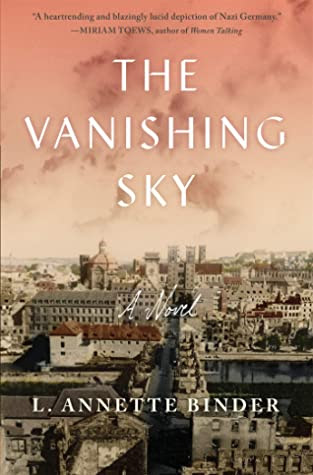
THE VANISHING SKY
L. ANNETTE BINDER
Bloomsbury USA (non-affiliate Amazon link)
$9.99 Kindle edition, available now
Rating: 3.25* of five
The Publisher Says: For readers of Warlight and The Invisible Bridge, an intimate, harrowing story about a family of German citizens during World War II.
In 1945, as the war in Germany nears its violent end, the Huber family is not yet free of its dangers or its insidious demands. Etta, a mother from a small, rural town, has two sons serving their home country: her elder, Max, on the Eastern front, and her younger, Georg, at a school for Hitler Youth. When Max returns from the front, Etta quickly realizes that something is not right-he is thin, almost ghostly, and behaving very strangely. Etta strives to protect him from the Nazi rule, even as her husband, Josef, becomes more nationalistic and impervious to Max's condition. Meanwhile, miles away, her younger son Georg has taken his fate into his own hands, deserting his young class of battle-bound soldiers to set off on a long and perilous journey home.
The Vanishing Sky is a World War II novel as seen through a German lens, a story of the irreparable damage of war on the home front, and one family's participation-involuntary, unseen, or direct-in a dangerous regime. Drawing inspiration from her own father's time in the Hitler Youth, L. Annette Binder has crafted a spellbinding novel about the daring choices we make for country and for family.
I RECEIVED A DRC FROM THE PUBLISHER VIA NETGALLEY. THANK YOU.
My Review: First, read this:
“You’ve got to do the right thing. You’ve got to use your mind,” she said. “That’s what the real God wants. People should do the right thing but they never do.”
–and–
They should have hung their heads, but people didn’t feel shame anymore. They lied and after a while they believed the lies they told, and this is how it went.
–and–
“He’s not coming back,” Ushi pushed her cup aside. “People leave and they don’t come back. My Jens is gone and my Jürgen, too.” Her voice quavered. “They’ve wrecked the world, these men, and still they’re not done. They’d take the sky if they could. They’d take the air we breathe, and there’s nothing we can do to stop them.”
The Stockholm Syndrome of an entire nation, an entire class of people, is the shocking subject of this novel based on the facts as the author knows them surrounding her own family's WWII experience.
Etta Huber is frantic, as what wife of a dementia-suffering husband (Josef) trying to get into the war wouldn't be; as what mother of a returned soldier (Max) suffering from what we would call PTSD wouldn't be; as what loving, protective mother of a young teenager (Georg) caught up in a vision of glamour obfuscating the war's reality wouldn't be. The situation with Max is, of course, the one she's got the most emotional room for. No sane recruiter would take her retired-schoolteacher husband whose grasp of reality is deficient to wield a weapon, surely? Max, the bright and shining boy who left, is gone forever and here in his place is...a burden, frankly. In a time when the food-growing region the Hubers live in is getting less and less well-fed, another mouth isn't a joy...then Georg is sent to the Eastern front, which destroyed his brother Max, to dig defenses in what everyone knows is a vain effort to stop Allied tanks attcking German troops.
Etta isn't coping well with any of this. What she doesn't know is that she's got a stronger boy in Georg than she thought. He's been unable to believe the nonsense he's been fed in the Hitler Youth. He's fallen in love with one of the other boys, which (since this is simply unthinkable and impossible for Hitler Youths) has formed a strong resistant core in him. He ends up deserting before the boys get to the front, and walks home. Through war-torn Germany. On his own.
Max's horrors are always with him, and his behaviors worry his Mutti. Of course, he was always the odd kid:
Even when he was little Max had a way of fixing his eyes on her and asking questions that had no easy answers or no answers at all. "Mutti?" he'd asked her once when he was only six, "where do birds go to die? I see birds every day and never a dead one. Where do they go then?" and Etta could only shake her head at her boy, who thought of such things.
"They go someplace nice," she told him, "where it's quiet and the cats won't find them and the wolves and foxes neither. That's why we don't see them. They go to bird heaven." He looked at her a long while and then he nodded, satisfied with her response. It made sense that birds could find their way to heaven. They flew beneath it every day. It would only take a breeze to bear them up and through the gates, only a breeze and they were gone.
Much like Max himself disappears, vanishes from his loving mother's ability to care for him...forever. It's one of many heartbreaks in Etta's world.
What a world it was. She, and her other bog-standard German neighbors, have noticed there are people disappearing. Most of them simply note this fact without a lot of interest, but note it they do. The rare German whose instinct is to help in whatever small way she can the disappearing ones, is fighting a losing battle as we-the-readers know. But the fact is no one, inside or outside Germany, knew what was going on in the camps where the disappeared went. It wasn't good...but it was factually unknown until after the war. This novel is set *during* the war, and the author presents the unease of the people with the ever-increasing evidence of their leadership's lies and obfuscations.
In the end, what earned this book a mere shade over three stars was its overly slow pace. Many things were dwelt on that could've been done away with or been less of a focus. The voices of the Germans are, on the other hand, exactly how the German folk I knew in my life sounded: Formal, deliberate, and slightly obscured behind any words they did say. This doesn't mean it was always fun to read their ponderous utterances. But it was the purpose of the author to tell a family story. I expected it to have more of that feel to it. Instead it became a deeply personal historical account of the agonies of your way of life's death.
Subscribe to:
Posts (Atom)