Pages
- Home
- Mystery Series
- Bizarro, Fantasy & SF
- QUILTBAG...all genres
- Kindle Originals...all genres
- Politics & Social Issues
- Thrillers & True Crime
- Young Adult Books
- Poetry, Classics, Essays, Non-Fiction
- Science, Dinosaurs & Environmental Issues
- Literary Fiction & Short Story Collections
- Sookie Stackhouse/Southern Vampire Books & True Blood
- Books About Books, Authors & Biblioholism
Showing posts with label Germany setting. Show all posts
Friday, August 28, 2026
THE LIPETSK CONSPIRACY: The True Origins of Hitler's Luftwaffe (Tom Munro Aviation and Espionage Series #4), interwar Bonding
THE LIPETSK CONSPIRACY: The True Origins of Hitler's Luftwaffe (Tom Munro Aviation and Espionage Series #4)
WILLIAM FERNIE
Fernie Publishing Ltd (non-affiliate Amazon link)
$5.99 Kindle edition, available now
Rating: 4* of five
The Publisher Says: Before the Luftwaffe terrorised Europe, it was forged in secrecy.
In the uneasy peace before WWII, Captain Tom Munro is flying for Deutsche Luft Hansa when he uncovers a clandestine military airfield hidden deep within Soviet Russia.
Coerced into supporting Germany's secret rearmament programme, he risks his life flying experimental aircraft and developing new, untested operational techniques all prohibited under the Treaty of Versailles. This test flying provides a unique opportunity to gather military intelligence of immense value to the British Secret Intelligence Service.
But Tom knows that he will not be allowed to survive with this vital intelligence and must attempt the impossible: escape with Germany's secrets before he disappears forever.
An interwar aviation/espionage thriller for readers of David Downing, Philip Kerr and Robert Harris.
I RECEIVED A DRC FROM THE PUBLISHER VIA NETGALLEY. THANK YOU.
My Review: Tom Munro is a very enjoyable PoV to follow as this based-on-facts thriller of Nazi Germany's preparations for war in the air. The prior three volumes in the series deal with the Great War, the Treaty of Versailles era, and now the period that enables the rise of the Nazi state.
It's a period I'm very interested in, and one that saw gigantic advances inn aeronautical engineering, materials science, and other sciences that are useful in wartime. As always it's the horrors of slaughter that drive change, and the economy's growth, and the terrible Othering of people in no way wrong, bad, or evil as the scum at the top try to justify the war "They" want by manufacturing enemies within and without.
What makes Tom fun to follow is mostly his test-pilot nous. It's fun for me to read about the planes realy being tested, really being studied in this pre-Depression time that has so much hope for a peaceful future that recedes and recedes while Tom and his ilk try to keep it alive. Yet here he is flying violation-of-treaty equipment to a secret base! One in Russia, no less...more serious skulduggery...and consequences for Tom in terms of using spycraft for...good?
Come for the history, stay for the gearhead talk, which you'll need to be getting along with that to be in the full story. I was captivated, you might not be, so be aware the jargon is plentiful and needed to make sense of the Lipetsk Russian airfield subplot. There are many politicosocial developments but they almost all incorporate technology and discussion of same.
There is yearning for his lost, belovèd fellow spy Alice, which is getting a bit wearing if I'm honest. Oh well. One must have a woman in a thriller, she motivates the main man. *sigh*
A complex and very very sensitive matter, Germany's resurgent ambitions and rebounding desire to lead the technological world, and the worries of her very recent opponents all buried in piles of dead people from that stupid war. And an ending to this story that's exactly right. All designed to give this old man reader the happy.
Be ready for the complexities on multiple fronts and it might do the same trick for you.
Monday, June 22, 2026
BONE OF MY BONE, latest of Johanna van Veen's sapphic historical fiction/horror tales
BONE OF MY BONE
JOHANNA van VEEN
Poisoned Pen Press (non-affiliate Bookshop.org link)
$19.99 paperback, available now
Rating: 4.5* of five
The Publisher Says: Bram Stoker Award–nominee and USA Today bestseller Johanna van Veen unveils a sapphic folk-horror tour de force—perfect for fans of The VVitch and The Salt Grows Heavy. A skull's grin is eternal…
The year is 1635.
Sister Ursula, a young nun fleeing the ruins of her convent, and Elsebeth, a sharp-witted peasant, escape a band of marauding soldiers and disappear into the Bavarian forest. War scorches the land, and no one survives it alone. Amid the devastation, they find something in the arms of a dying man: the gilded skull of a saint.
It is said that if you reunite the saint's skull with her body, a wish will be granted. Desperate for salvation, and each with secret desires of their own, Ursula and Elsebeth follow a ragged map across the blighted countryside. But darkness follows them. A necromancer, drawn to the relic's power. The saint herself, whispering at night. And as the lines between blessing and curse blur, the women must face a harrowing the magic they seek comes at a cost.
At the journey's end, they'll face an impossible choice—one that could tear apart everything they know… or bind them to each other forever.
I RECEIVED A DRC FROM THE PUBLISHER VIA NETGALLEY. THANK YOU.
My Review: There is a period in History with no war. Statistically there must be.
This is not it. As usual, Religion...and religion...are at the heart of the Thirty Years' War that Author van Veen chose as her backdrop for the love between Elsebeth the canny formerly-Protestant peasant and Ursula the Catholic nun. Their meet-cute involves marauding soldiers and an unlikely act of salvation from the usual fate of women in a war. A bond formed then is unbreakable, and it helps that Elsebeth has already lost her religious faith. An odd sort of reward comes to the women for acting on human decency and female solidarity: the discovery of a first-class "holy relic" that both women understand the mythology behind (follow both links to see why that isn't unusual or anachronistic).
At that moment we leave the ordinary world behind. This is now a supernatural tale of pilgrims on a quest to perform an action for a reward. The background is war, violence, and its usual consequences for humanity caught up in it. That's the horror, and as I've said before, the kind of horror I can relate to; the supernatural horror so common in books is not scary to me because I don't believe in the supernatural or, maybe more accurately, in its innate power to act independently on reality. The women must protect the relic they've been charged with safekeeping from a necromancer who wants to use the thing to Perform Eville Acts.
It could as easily be a greedy bastard wanting to disassemble the adornments of the relic for onward sale and profit. Likewise the women's desire to protect the relic could as easily be motivated by their own need to survive, thus making returning the relic to its institutional owners for a presumably significant reward makes sense. Would change nothing, really, but the supernatural edge is used very well to heighten stakes that I myownself found entirely high enough. This is the origin of my half-star reduction in the rating: artificially (to my mind) inflating the stakes.
I genuinely enjoyed the women's love story more than any of the silly supernatural stuff. I got really invested in Ursula and Elsebeth reaching the understanding that their quest gave them the very best gift of all gifts in each others' love. It's a lovely process to follow no matter what other story beats an author uses around it. The love of same-sex couples will always garner my supportive interest in a story (see my reviews of Nicked and Recital of the Dark Verses for other examples). My joy at the women falling in love outweighed any reflexive eye-rolling at the notion of necromantic powers being able to create a kind of zombie-slave of poor Otto, for example.
I'm all in on recommending the read to my fellow queers. Author van Veen is a stylistic writing monadnock. Her eye for what makes a story compelling to a reader, not just a genre addict, is second to none. If you worry about gore and scariness in horror fiction, ,I'll tell you that I found all the trappings of horror less worrying than the awful limning of humanity's viciousness that's inherent in any story set in wartime.
Religion, the big public-facing institution, and its private-practice cousin, religion, come off poorly in this story. So y'all know going in. It's the genesis of the war being fought after all.
Wednesday, February 18, 2026
SADEQA JOHNSON'S PAGE: KEEPER OF LOST CHILDREN; THE HOUSE OF EVE
KEEPER OF LOST CHILDREN
SADEQA JOHNSON
37 Ink/Simon & Schuster (non-affiliate Bookshop.org link)
$14.99 ebook, available now
Rating: 4.25* of five
The Publisher Says: In this new novel from the New York Times bestselling author of The House of Eve, one American woman’s vision in post WWII Germany will tie together three people in an unexpected way.
Lost in the streets and smoldering rubble of Occupied Germany, Ethel Gathers, the proud wife of an American soldier spots a gaggle of mixed-race children following a nun. Desperate to conceive her own family, she feels compelled to follow them to learn their story.
Ozzie Philips volunteers for the army in 1948, eager to break barriers for Black soldiers. Despite his best efforts, he finds the racism he encountered at home in Philadelphia has followed him overseas. He finds solace in the arms of Jelka, a German woman struggling with the lack of resources and even joy in her destroyed country.
In 1965, Sophia Clark discovers she’s been given an opportunity to integrate a prestigious boarding school in Maryland and leave behind her spiteful parents and the grueling demands. In a chance meeting with a fellow classmate, she discovers a secret that upends her world.
Toggling between the lives of these three individuals, Keeper of Lost Children explores how one woman’s vision will change the course of countless lives, and demonstrates that love in its myriad of forms—familial, parental, and forbidden, even love of self—can be transcendent.
I RECEIVED A DRC FROM THE PUBLISHER VIA NETGALLEY. THANK YOU.
My Review: On a kernel of fact, Author Sadeqa coaxes a mighty oak of a story about the power of determination and the motivation of compassion. Three characters are entwined in a narrative of prejudice endured, triumphally defeated by love, and made into the beautiful thing that is selfhood.
Ethel Gathers has the most nominitively determinative name ever. I understand why Author Sadeqa chose it in place of the rather blander name of the woman who started the Brown Baby Plan, Mabel Grammer. Of course I, a white child of privilege, did not ever hear of this marvelous plan or its tutelary spirit. Being both about Black folks and established by a woman, that information is not startling. I have never been so heartened by the factual roots of a story! It entwines Ozzie, a "colored" man in the post-WWII US Army who merits and desires a promotion into the Intelligence service only to be stymied because, what else, racism shuts doors nominally opened by executive order; Ethel, as her time in 1951 Germany as an Army wife introduces her to the issue central to the story; and Sophia, a biracial teen in 1965 when we meet her.
No points for sussing out the interconnections among them all.
It's not an advanced storytelling technique that draws on into this read, it's the human connection, the fellowship of people who know anger, feel frustration and loss and sadness, and revel in goodness and rightness triumphing. Our older PoV characters proceed into the future while Sophia is mostly looking into her own past as she works to escape her truly awful upbringing. All three threads come together at a powerfully symbolic and racially charged moment in the 1960s.
It's not coyness that leaves me with lamentably vague language there. As you read along you'll see the interconnections forming. I'm not going to reveal them because they're a very big part of the finale of the story, giving it a lot of its oomph. I hate when reviewers do that but...trust me, you want to take this ride innocent of these facts.
++++++++++++++++++++++++++++++++++++++++++++++++++++++++++++++++
THE HOUSE OF EVE
SADEQA JOHNSON
37 Ink/Simon & Schuster (non-affiliate Bookshop.org link)
$13.99 ebook, available now
Rating: 3.75* of five
The Publisher Says: 1950s Philadelphia: fifteen-year-old Ruby Pearsall is on track to becoming the first in her family to attend college. But a taboo love affair threatens to pull her back down into the poverty and desperation that has been passed on to her like a birthright.
Eleanor Quarles arrives in Washington, DC, with ambition and secrets. When she meets the handsome William Pride at Howard University, they fall madly in love. But William hails from one of DC’s elite wealthy Black families, and his parents don’t let just anyone into their fold. Eleanor hopes that a baby will make her finally feel at home in William’s family and grant her the life she’s been searching for. But having a baby—and fitting in—is easier said than done.
With their stories colliding in the most unexpected of ways, Ruby and Eleanor will both make decisions that shape the trajectory of their lives.
I RECEIVED A DRC FROM THE PUBLISHER VIA NETGALLEY. THANK YOU.
My Review: Playing the mother card does not earn a story my esteem. The Cult of Mother is, oddly, not the focus of Author Sadeqa's stories...it's about how women, in relation to motherhood, are required to make hard decisions and come to terms with how fathers create mothers but mothers do not create fathers. Many factors haunt Author Sadeqa's mothers in this story of how becoming pregnant is not always, or in all ways, a happy moment for a woman. Leaving aside the permanence of motherhood, the social milieu a child is brought into is almost more important than the love, or lack of it, a mother feels for that child.
In exploring these complexities in a 1950s racist US Author Sadeqa brings struggles and battles to light that can not help but move the reader. It is a sentimental story, it will cause you to well up with tears (or you're a sociopath), it does its romantic-fiction job with verve and gusto. It is not a prose megalith to be held up in future literary seminars, and is not meant to be, but it is effective at its chosen task. It entertains, it informs about the deep emotional ties humans form...willingly or not...to those they might or might not admire.
It's a good read for a dull weekend that will give you a solid satisfying ending for its story.
Monday, November 10, 2025
FATEFUL HOURS: The Collapse of the Weimar Republic, a political analysis of a difficult transition
FATEFUL HOURS: The Collapse of the Weimar Republic
VOLKER ULLRICH (tr. Jefferson Chase)
W.W. Norton (non-affiliate Bookshop.org link)
$35.00 all editions, preorder now for delivery tomorrow
Rating: 4.75* of five
The Publisher Says: From the New York Times best-selling historian, the riveting story of the Weimar Republic—a fledgling democracy beset by chaos and extremism—and its dissolution into the Third Reich.
Democracies are fragile. Freedoms that seem secure can be lost. Few historical events illustrate this as vividly as the failure of the Weimar Republic. Germany’s first democracy endured for fourteen tumultuous years and culminated with the horrific rise of the Third Reich. As one commentator wrote in July 1933: Hitler had “won the game with little effort. . . . All he had to do was huff and puff—and the edifice of German politics collapsed like a house of cards.” But this tragedy was not inevitable.
In Fateful Hours, award-winning historian Volker Ullrich chronicles the captivating story of the Republic, capturing a nation and its people teetering on the abyss. Born from the ashes of the First World War, the fledgling democracy was saddled with debt and political instability from its beginning. In its early years, a relentless chain of crises—hyperinflation, foreign invasion, and upheaval from the right and left—shook the republic, only letting up during a brief period of stability in the 1920s. Social and cultural norms were upended. Political murder was the order of the day. Yet despite all the challenges, the Weimar Republic was not destined for its ignoble end.
Drawing on letters, memoirs, newspaper articles, and other sources, Ullrich charts the many failed alternatives and missed opportunities that contributed to German democracy’s collapse. In an immersive style that takes us to the heart of political power, Ullrich argues that, right up until January 1933, history was open. There was no shortage of opportunities to stop the slide into fascism. Just as in the present, it is up to us whether democracy lives or dies.
I RECEIVED A DRC FROM THE PUBLISHER VIA EDELWEISS+. THANK YOU.
My Review: This is a complicated subject...how a democracy dies...and, as a result, a complex read. There were a lot of moving parts to the death of the Weimar Republic. It was not inevitable, a foregone conclusion; the economic disasters wrought by the vengeful Treaty of Versailles were even surmountable, as proved by Hjalmar Scacht; given the authority to control hyperinflation, he did so by staying outside the control of the politicians. The personalities, in other words, of the players in the government were largely to blame for that very government's demise.
A hearty share of the blame for the fall was on the Communist Party's plate. Their strong base of disaffected workers and sailors, reeling economically from the kaiser's stupid management of the economy in the war,was frittered away in insistence on Purity and perfect adherence to untested (and, it would turn out, unwise) Soviet policies. This resulted in an uncompromising, self-destructive inflexibility. Doom in politics is always inflexibility. Their rigidity and refusal to support a more center-left candidate led to Paul von Hindenburg, an old-line reactionary, being elected president in 1925. Quite simply, the destruction of the Weimar Republic was inevitable then. Right-wing ultranationalist parties had a friend in high office, one who refused to countenance the suppression of their terrorism.
Army veterans and the moneyed classes weren't innocent in the fall of the republic. Anger and hatred at the vicious Treaty of Versailles' immiseration of millions of ordinary Germans made a fertile breeding ground for paramilitaries, for well-funded but ineptly led coups against the government, and for the ultimate rise of Hitler and his National Socialist party. (You clocked that last word, right? The post-WWII US rebranded them as "Nazis" because can't have anything remotely resembling socialism getting attention.) The greedy classes were delighted to fund Hitler, in no small part because Hjalmar Schacht...the one banker who succeeded in reducing war reparations payments...was a hero among them and he said to. Sadly, all those "wise heads, leadership material" men wildly miscalculated their influence over Adolf and Co. They were never more than opportunistically interested in Hitler's plans. Rearming Germany was, to them, a way to make immense profits; the war that followed was suicidal on economic terms.
Democracy is fragile. It is always under attack from within by authoritarians, because they can make more money and get their sick fantasy high-control rocks off. The Nazi book-burnings are branded, in the US at least, as burnings of Jewish and dangerous books.
Jewish, for sure; the "dangerous" books, the ones that were "polluting German youth," were Magnus Hirschfeld's works in the Institute for Sexual Science. Weird how you were never taught that, isn't it. And isn't it just so coincidental that the current scum in power are ramping up the rhetoric against sexual and ethnic minorities. Book burning, before some annoying little twidgee says a word, looks a lot worse to people than banning, so they have learned some lessons...but the effect is the same.
A timely read. Not comfortable, not easy, but very very much a book for these times.
And the future, if we can claw one out of "Their" hands.
Tuesday, October 3, 2023
THE SECRETS THEY HID, WWI family drama
THE SECRETS THEY HID
ROBERTA KAGAN
Self-published (non-affiliate Amazon link)
$5.99 Kindle edition, available now
Rating: 3.5* of five
The Publisher Says: All's not fair in love and war.
As the Great War rages, two brothers, Leo and Alex, are ensnared in a captivating love triangle with the stunning Adelaide. While Leo is the unwavering protector, Alex, the enigmatic seducer, ultimately captures Adelaide's heart.
Their lives are further complicated by a baby girl of hidden Jewish lineage—a secret burden Leo chooses to bear alone. When the brothers are drafted to war, their world is torn apart, leaving Adelaide to navigate the treacherous waters of survival and betrayal.
As years go by and the landscape of their homeland changes with Hitler's rise, the family secrets become a ticking time bomb. Margot's true lineage, hidden in plain sight, becomes the very thing that may tear the family apart.
Dive into Roberta Kagan's heart-stopping saga of love, secrets, and the harsh price of betrayal during one of history's darkest times.
I RECEIVED A DRC FROM THE PUBLISHER VIA NETGALLEY. THANK YOU.
My Review: Another day, another family saga.
Secrets, lies, reprobate men, stupid women who believe them; why does this plot still appeal? Because all of us like to see the struggle of life played out in such a deeply misguided way so we can feel smug, is my guess. "I wouldn't do that," we say, without thinking of the innumerable bad decisions we've made on any number of fronts.
I myownself liked the viewpoint of an ordinary, working-class family coping with the endless horrific challenges of economic and social chaos in the wake of devastating wartime losses and privations. Not so great for this reader was the writing style, which I'll characterize as "serviceable." So the focus of my attention is squarely on the way the grim costs of war and then defeat are borne by women. The role Adelaide fulfills, provider, nurturer, support and helpmeet, is frankly superhuman. The stoic resignation of the Heroic Woman was overplayed; the longing, yearning, crying out stuff wore on me.
The second part of the book is clearly the one that the author was more interested in. The three sisters raised by Saint Adelaide the Mother are coming of age just as Hitler is rising to power by promising to Make Germany Great Again. (This line never fails to get the stupids into line behind it, does it?) Of course, we know the future they're groping towards will explode a time-bomb that Alex planted decades ago, and Saint Adelaide the Mother isn't even aware of the awfulness ahead despite knowing only a little of the story.
Kitchen-sink drama and a setting we don't see often, from a viewpoint we see even less of than the setting. The one caution I'll repeat is that the writing isn't more than okay at any point, so if the time and place don't appeal, it's not likely to thrill you.
Friday, July 22, 2022
THE VANISHING SKY, home-front chronicle of German commonfolk & NAZI WIVES: The Women at the Top of Hitler's Germany, uppermost class' viewpoint
NAZI WIVES: The Women at the Top of Hitler's Germany
JAMES WYLLIE
St. Martin's Press (non-affiliate Amazon link)
$17.99 Kindle edition, available now
Rating: 4* of five
The Publisher Says: Goering, Goebbels, Himmler, Heydrich, Hess, Bormann—names synonymous with power and influence in the Third Reich. Perhaps less familiar are Carin, Emmy, Magda, Margarete, Lina, Ilse and Gerda...
These are the women behind these infamous men—complex individuals with distinctive personalities who, as they fell under Hitler's spell, were drawn deeper and deeper into a perverse version of reality.
In Nazi Wives James Wyllie skilfully interweaves their stories, exploring their roles in detail for the first time against a backdrop of the rise and fall of Nazism and in the context of the aftermath, notable for the resolute lack of contrition from those wives who survived.
I RECEIVED A DRC FROM THE PUBLISHER VIA NETGALLEY. THANK YOU.
My Review:
When the Himalayan peasant meets the he-bear in his pride,–Rudyard Kipling, "The Female of the Species"
He shouts to scare the monster who will often turn aside.
But the she-bear thus accosted rends the peasant tooth and nail,
For the female of the species is more deadly than the male.
We're not supposed to notice things like this in the time of "Believe Women"...yes, of course, if they're telling the truth, but always, always LISTEN to women with open minds...but the women in this book were not exemplars of twenty-first century womanhood's new (!) course. They were awful, racist, anti-semitic, and deeply spoiled people, as one would expect.
Ilse, Carin, Emmy, Gerda, Eva, Margaret, Lina, and Magda married men who ran the worst, most heinous government of the twentieth century. They knew, either from direct evidence or from the unavoidable lessons of sheer propinquity, the kind of men they were married to, and they acquiesced at the minimum and ably assisted in other cases (thinking of Magda Goebbels most especially) in forming and maintaining the ethos of the Reich.
Not one of the women who survived WWII ever expressed regret or remorse for her, or her husband's, actions. These women were prototypical, stereotypical Mean Girls. They reveled in their luxurious lifestyle, they shut down whatever empathy they possessed when confronted with anything that challenged their world, and most especially in the case of Magda Goebbels (who went so far as to murder her children when defeat was inevitable) showed no obvious signs of possessing a conscience.
That made the read kind of revolting on some levels and deeply upsetting on others. I wasn't aware of the facts presented by Author Wyllie. In many ways I wish I still wasn't! But the truth is, the authorial choice to refer to the men by their surnames and the women only by their first names made teasing apart which horrible woman was attached to what vile man more complicated than it needed to be. This is also a function of the organizational principle used, that of dealing with the entire pack of wolves as a whole. I found myself flipping around, looking to connect (eg, Gerda Bormann's, the most often) strands. Gerda was far and away the woman I found least interesting, coming across to me as a Stepford wife without much to recommend her in either positive or negative ways.
All that said, the organizational longueurs are the source of the rating but the informational content earns the author and the book my recommendation. I'm glad someone has, at long last, foregrounded the role that women played in the Third Reich, at the highest levels, in setting, supporting, and even exemplifying the worst of an awful regime.
++++++++++++++++++++++++++++++++++++++++++++++++++++++++++++++++
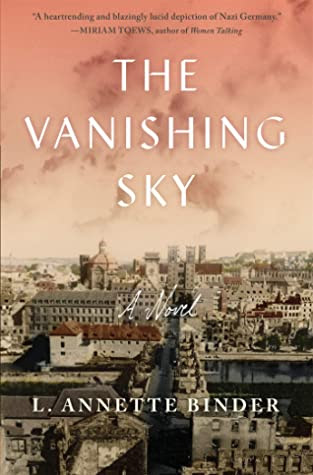
THE VANISHING SKY
L. ANNETTE BINDER
Bloomsbury USA (non-affiliate Amazon link)
$9.99 Kindle edition, available now
Rating: 3.25* of five
The Publisher Says: For readers of Warlight and The Invisible Bridge, an intimate, harrowing story about a family of German citizens during World War II.
In 1945, as the war in Germany nears its violent end, the Huber family is not yet free of its dangers or its insidious demands. Etta, a mother from a small, rural town, has two sons serving their home country: her elder, Max, on the Eastern front, and her younger, Georg, at a school for Hitler Youth. When Max returns from the front, Etta quickly realizes that something is not right-he is thin, almost ghostly, and behaving very strangely. Etta strives to protect him from the Nazi rule, even as her husband, Josef, becomes more nationalistic and impervious to Max's condition. Meanwhile, miles away, her younger son Georg has taken his fate into his own hands, deserting his young class of battle-bound soldiers to set off on a long and perilous journey home.
The Vanishing Sky is a World War II novel as seen through a German lens, a story of the irreparable damage of war on the home front, and one family's participation-involuntary, unseen, or direct-in a dangerous regime. Drawing inspiration from her own father's time in the Hitler Youth, L. Annette Binder has crafted a spellbinding novel about the daring choices we make for country and for family.
I RECEIVED A DRC FROM THE PUBLISHER VIA NETGALLEY. THANK YOU.
My Review: First, read this:
“You’ve got to do the right thing. You’ve got to use your mind,” she said. “That’s what the real God wants. People should do the right thing but they never do.”
–and–
They should have hung their heads, but people didn’t feel shame anymore. They lied and after a while they believed the lies they told, and this is how it went.
–and–
“He’s not coming back,” Ushi pushed her cup aside. “People leave and they don’t come back. My Jens is gone and my Jürgen, too.” Her voice quavered. “They’ve wrecked the world, these men, and still they’re not done. They’d take the sky if they could. They’d take the air we breathe, and there’s nothing we can do to stop them.”
The Stockholm Syndrome of an entire nation, an entire class of people, is the shocking subject of this novel based on the facts as the author knows them surrounding her own family's WWII experience.
Etta Huber is frantic, as what wife of a dementia-suffering husband (Josef) trying to get into the war wouldn't be; as what mother of a returned soldier (Max) suffering from what we would call PTSD wouldn't be; as what loving, protective mother of a young teenager (Georg) caught up in a vision of glamour obfuscating the war's reality wouldn't be. The situation with Max is, of course, the one she's got the most emotional room for. No sane recruiter would take her retired-schoolteacher husband whose grasp of reality is deficient to wield a weapon, surely? Max, the bright and shining boy who left, is gone forever and here in his place is...a burden, frankly. In a time when the food-growing region the Hubers live in is getting less and less well-fed, another mouth isn't a joy...then Georg is sent to the Eastern front, which destroyed his brother Max, to dig defenses in what everyone knows is a vain effort to stop Allied tanks attcking German troops.
Etta isn't coping well with any of this. What she doesn't know is that she's got a stronger boy in Georg than she thought. He's been unable to believe the nonsense he's been fed in the Hitler Youth. He's fallen in love with one of the other boys, which (since this is simply unthinkable and impossible for Hitler Youths) has formed a strong resistant core in him. He ends up deserting before the boys get to the front, and walks home. Through war-torn Germany. On his own.
Max's horrors are always with him, and his behaviors worry his Mutti. Of course, he was always the odd kid:
Even when he was little Max had a way of fixing his eyes on her and asking questions that had no easy answers or no answers at all. "Mutti?" he'd asked her once when he was only six, "where do birds go to die? I see birds every day and never a dead one. Where do they go then?" and Etta could only shake her head at her boy, who thought of such things.
"They go someplace nice," she told him, "where it's quiet and the cats won't find them and the wolves and foxes neither. That's why we don't see them. They go to bird heaven." He looked at her a long while and then he nodded, satisfied with her response. It made sense that birds could find their way to heaven. They flew beneath it every day. It would only take a breeze to bear them up and through the gates, only a breeze and they were gone.
Much like Max himself disappears, vanishes from his loving mother's ability to care for him...forever. It's one of many heartbreaks in Etta's world.
What a world it was. She, and her other bog-standard German neighbors, have noticed there are people disappearing. Most of them simply note this fact without a lot of interest, but note it they do. The rare German whose instinct is to help in whatever small way she can the disappearing ones, is fighting a losing battle as we-the-readers know. But the fact is no one, inside or outside Germany, knew what was going on in the camps where the disappeared went. It wasn't good...but it was factually unknown until after the war. This novel is set *during* the war, and the author presents the unease of the people with the ever-increasing evidence of their leadership's lies and obfuscations.
In the end, what earned this book a mere shade over three stars was its overly slow pace. Many things were dwelt on that could've been done away with or been less of a focus. The voices of the Germans are, on the other hand, exactly how the German folk I knew in my life sounded: Formal, deliberate, and slightly obscured behind any words they did say. This doesn't mean it was always fun to read their ponderous utterances. But it was the purpose of the author to tell a family story. I expected it to have more of that feel to it. Instead it became a deeply personal historical account of the agonies of your way of life's death.
Subscribe to:
Posts (Atom)