Showing posts with label German translation. Show all posts

Sunday, August 9, 2026

STEFAN ZWEIG'S PAGE: LETTER FROM AN UNKNOWN WOMAN and Other Stories, & ENCOUNTERS AND DESTINIES: A Farewell to Europe


LETTER FROM AN UNKNOWN WOMAN and Other Stories
STEFAN ZWEIG
(tr. Anthea Bell)
Pushkin Press Classics (non-affiliate Bookshop.org link)
$7.99 ebook, available now

Rating: 4.5* of five

The Publisher Says: Stefan's Zweig's Letter from an Unknown Woman and other stories contains a new translation by the award-winning Anthea Bell of one of his most celebrated novellas, Letter from an Unknown Woman, the inspiration for a classic 1948 Hollywood film by Max Ophüls, as well as three new stories, appearing in English for the first time.

A famous author receives a letter on his forty-first birthday. He doesn't know the sender, but still the letter concerns him intimately. Its story is earnest, even the story of a life lived in service to an unannounced, unnoticed love.

In the other stories in this collection, a young man mistakes the girl he loves for her sister; two erstwhile lovers meet after an age spent apart; and a married woman repays a debt of gratitude. All four tales, newly translated by the award-winning Anthea Bell, are among Zweig's most celebrated and compelling work-expertly paced, laced with empathy and an unwaveringly acute sense of psychological detail.

I RECEIVED A DRC FROM THE PUBLISHER VIA EDELWEISS+. THANK YOU.

My Review
: It's the fate pf a popular, I mean with readers more than critics, writer to fall out of favor. Without critics in one's corner, the voice of the people who voted with their time and their treasure to engage with one's stories gets ignored.

This was the public's loved one Zweig's fate. Modern critics don't like him either, one saying he "...tastes fake...the Pepsi of Austrian writing." Ouch.

It's true to my experience of his writing that there's no deathless quality the I can discern, the sort of intense transporting intensity I experience in Thomas Mann or Kafka. At his most eloquent Zweig brings me an appreciative lightness of spirit; at his most Germanic he's pissy, irritable, and unbearably portentous. On balance he's the precise kind of writer who becomes popular because his (very real) talent does not have threatening depths. It seems a shame to me the world that loved him best, the US and Brazil, has left his memory in a drawer. Not a great, but still a good, storyteller, it feels to me like Pushkin Press Classics is doing good work to keep bringing him to our notice.

In my usual, fussy (so I'm told) fashion, the four stories will be dealt with by the Bryce Method.

Letter from an Unknown Woman is unsettling, uneasy-making; a woman writes to a famous author in terms of the greatest, most appreciative intimacy...but he has absolutely not one clue who she is. It is clear from the terms she's using for him that there was a legitimate connection between them. It is chilling how deep this connection truly is, given his unawareness of her as a person. (It could have something to do with her age at their first meeting....)

It's certainly true in my own life this kind of connection has formed, so I might be a bit more in tune with the awfulness of it. It ends a damn sight more tragically than anything like I've ever been a party to, and uses what would then be a current event...the 1918 flu pandemic...as both a resolution and an intensification of how terrible his guilt truthfully is.

A 1948 film was made of Letter from an Unknown Woman starring Joan Fontaine and Louis Jourdan that did not slap a happy li'l bow on its end. It's been preserved for posterity by the National Film Registry, probably in part for that courageous act of honesty in preserving the source material's more nihilistic intent (despite much jiggery-pokery to satisfy the Hays Code). It would be a terrific adaptation to make, faithfully this time, in the 21st century. all five stars

A Story Told in Twilight explores the first-kiss mishegas of a very ordinary boy. It happens in circumstances that, if you squint, might possibly lead to the, um, inattention and subsequent mistaken identity that plague this most commonplace rite of passage.

The translation's deft, the language felt like the entire enterprise was fun for the translator, but a more outdated premise would be tough to conjure in 2026. Not memorable, not terrible, not much of anything really. 3 stars

The Debt Paid Late looks at the running theme of missed/mistaken connections in these stories at a more mature angle. Like the old saying about "even small men cast big shadows at sunset" comes the accidental meeting of a woman with an old man who once meant everything to her. Because the story is about older people who reconnect from a genuine, if squicky by today's lights, connection it involved me more. Not a lot more, but more. 3.5 stars

Forgotten Dreams happened to me. It was as unpleasant as Zweig writes it. If you put yourself back into the path of your past self you will not come out unscathed. No man should ever expect the women from his past to spare his feelings, I'll tell you that for free. 3.5 stars

++++++++++++++++++++++++++++++++++++++++++++++++++++++++++++++++


ENCOUNTERS AND DESTINIES: A Farewell to Europe
STEFAN ZWEIG
(tr. Will Stone)
Pushkin Press
$13.99 ebook, available now

Rating: 4* of five

The Publisher Says: A new selection of essays by Stefan Zweig: tributes to the great artists and thinkers of the Europe of his day

Stefan Zweig was one of the twentieth century's greatest authors and a tireless champion of freedom, tolerance and friendship across borders. Encounters and Destinies collects his most impassioned and moving tributes to his many illustrious friends and peers: literary, philosophical and artistic luminaries from across the Old Europe that Zweig loved so much, and which he grieved to see so cruelly destroyed by two world wars.

Including pieces on Rainer Maria Rilke, Marcel Proust, Sigmund Freud, Maxim Gorky and Arturo Toscanini, this essential collection is also Zweig's tribute to the ideal of friendship: an ideal he clung to as the world he knew was torn apart.

I RECEIVED A DRC FROM THE PUBLISHER VIA EDELWEISS+. THANK YOU.

My Review
: "Gorky" means bitter? I'd always known Peshkov chose a pseudonym, who wouldn't with a collection of ugly spitty sounds like "Peshkov" staring you down, but "bitter?" Wow. A lot of details I'd forgotten I noticed clicked into place in my long-ago readings of Gorky...The Lower Depths, The Artamonov Business...suddenly make all the sense in the world.

Zweig knew the great and the good of the Interwar Period wherein he spent the bulk of his life. He would've been a lot of fun at a dinner party because, while it does not seem that he had a bitchy bone in his body, he had a very retentive memory and a strong desire to keep the friends he made so he heard a lot about them.

I am hard-pressed to imagine anyone who does not know who John Drinkwater was without the aid of Wikipedia will be inclined to pick up a book of musings on people like Toscanini, Arthur Schnitzler, and Emile Verhaeren. (For someone who doesn't like poetry, I sure know who a lot of poets are.)

If for no other reason than to bask in the glow of warm, appreciative writing by a friend who treasured friendship writing about his friends, this is a Zweig book to immerse yourself into. It brought me up short to realize how much the culture of that time formed my sense of aesthetics. I still revere Remarque and Joyce. I think many serious readers do. But it goes deeper, forming a bedrock sense of what is "worthy" in the art world, and that interested me to realize.

So here's Zweig, eighty-four years dead and mostly forgotten, still teaching a now-old man about himself. Published again and again after being forgotten for decades.

I hope there's an afterlife just so he can know it was, in fact, all worth it.

Monday, August 3, 2026

COOKING IN THE WRONG CENTURY, Austrian woman's storyteller reaches Anglophones at last


COOKING IN THE WRONG CENTURY
TERESA PRÄAUER
(tr. Eleanor Updergraff)
Pushkin Press (non-affiliate Bookshop.org link)
$13.99 ebook, available now

Rating: 4* of five

The Publisher Says: An irresistibly witty satire about a dinner party where the foodie guests have a grand amount of taste but no social clue at all.

For the hostess, food has always been about growing up. From the pancakes your grandmother made, dolloped with jam, to the salty glug of your very first oyster. Now, poised at the brink of midlife, the hostess prepares for a dinner party in her new apartment, desperate for the envy of her cultured friends. With a hunger for the finer things in life, she folds linen napkins into neat triangles, arranges wildflowers for the table and puts on a playlist that projects effortless cool.

But her composure begins to falter when her guests arrive drunk and late, downing bottles of her perfectly cooled wine and trailing water over the floor. Here comes the chain-smoking professor who never says the right thing, the husband glued to his smartphone, the wife who makes a secret pass at your boyfriend.

As small talk and social preening give way to sexual tension and lost inhibitions, the hostess struggles to maintain control over an evening far beyond her wildest imaginings. Outrageously funny and keenly observed, this is the first novel by Austrian powerhouse Teresa Präauer to be translated into English, and a delectable feast of social satire for readers of Perfection and The Anthropologists.

I RECEIVED A DRC FROM THE PUBLISHER VIA EDELWEISS+. THANK YOU.

My Review
: Maybe it's just me relating to "the hostess" so deeply and personally...maybe I'm feeling a little wistful for the times when asking people to your home for a home-cooked meal was not weird or unexpected.

That, however, is not remotely what's on Author Präauer's mind. This is a super-sarcastic snarkfest of skewered bourgeois pretensions. She gets after every conceibable subset of our brittlest chit-chat, puts a big ol' flensing knife under the scrotal skin of her (formerly) male characters, spraying narrative mace in their eyes since they weren't using them to see what's in front of their faces anyway.

The women! ZOMG What a collection of prunes, determined to out-smug each other in their certainty of opinions...most especially about food. In its deeply felt rage, it was Babette's Feast for the dining discourse of Ibnstagram meets The Women for the self-conscious class skewering.

It's not clear to me there is not only one dinner party, though it seems the characters aren't the same people...? But believe you me, they're indistinguishable...examining more closely than is comfortable people from the same background so I was left with one idea of what we-the-reader are supposed to think and feel about them. Our narrator occasionally addresses us through the broken fourth wall on the subject of how we perceive food; how food as a cultural touchstone came to exist in our minds.

So you know I was right there. I was fully engaged in every bit of this admittedly slight narrative. I don't think the story being told quite merits the 176-page count...It feels more like a 150pp novella would've done better justice to the exploration of the hostess's purpose in feeding her friends (only her friends) and her new Swiss...fella, let's say. Maybe I didn't really need the oddly angled ending, but rather a simpler one of a door just closing...?

Whatever my cavils, this introduction to Author Präauer, well-known and established in Austria, and her interests and writing style, was a genuine pleasure. I was entertained, amused, and drawn in to this social commentary on Instagrammable foodies, women with axes to grind but no courage to let loose and do it already, and the men who completely misunderstand them.

Very much a "give this one a try" shove to your bookstore from me.

Friday, July 31, 2026

THE PIANO STUDENT, fictionalized gay love story from the scariest part of the 1930s


THE PIANO STUDENT
LEA SINGER
(tr. Elisabeth Lauffer)
New Vessel Press (non-affiliate Bookshop.org link)
$10.99 ebook, available now

Rating: 5* of five

The Publisher Says: The Piano Student centers on an affair between one of the 20th century’s most celebrated pianists, Vladimir Horowitz, and his young male student, Nico Kaufmann, in the late 1930s.

As Europe hurtles toward political catastrophe and Horowitz ascends to the pinnacle of artistic achievement, the great pianist hides his illicit love from his wife Wanda, the daughter of the renowned conductor Arturo Toscanini. The affair is narrated by Kaufmann in the 1980s to another music devotee, who comes to him enchanted by Schumann’s composition Träumerei and awakens memories of the thwarted relationship. Kaufmann is spending his final years playing in small-time Zurich bars, never rivaling his teacher’s musical mastery and rapturously received concerts.

Based on unpublished letters by Horowitz to Kaufmann that author Lea Singer herself discovered in Switzerland, the novel portrays the anguish that the acclaimed musician felt about his never publicly acknowledged homosexuality and the attendant duplicity of his personal life. It's a riveting and sensitive tale of musical perfection, love, and longing denied, with multiple historical layers and insights into artistic creativity.

I RECEIVED A DRC FROM THE PUBLISHER VIA EDELWEISS+. THANK YOU.

My Review
: Given the times and the stakes, Horowitz staying closeted was a solid decision to make. If his wife didn't see a golden opportunity in his necessary secret, I'll kiss a pig. But being "out" as we twenty-first centuryans conceptualize it would've been career...possibly literal...suicide.

Suicide's a major part of this work. Do not pick it up if you are in distress, or if ongoing ideation around ending your own life is an issue for you. This review will not be delving more deeply into the topic.

This novel polarizes readers. It's more a stream of consciousness work than a standard narrative. It does not spoon-feed readers, it expects you'll be paying attention to the details well enough to follow or at least be able to figure out who is speaking, whose head you're in, or whose PoV is dominant at that moment. For those not looking for a read of that nature just now, it's best to pass it by.

As a story this is a pretty ordinary one: lovers must hide from the world because the world does not and would not accept their love as valid or acceptable. This moment in history we in the Anglophone world are seeing how much that story resonates with readers and viewers with the wild ascendancy of Heated Rivalry. I do not recall anything like this level of investment or passion for a yearning-romance story since Moonlighting in the 1980s. I hope it does not fizzle like that show did...or this excellent novel has done in the past six years.

I'm certain that the author's choices of narrative complexity were deliberate and considered. The framing device of Robert Donati avoiding the consequences of a decision he made but regretted meeting Nico Kaufmann and exchanging stories is a well-worn one, only rescued from triteness by its stream-of-consciousness presentation. It establishes the psychological safety of baring one's soul to a stranger as the reason we're hearing the stories at all. Considering the pseudonymous author discovered the Kaufmann story in letters buried in an archive the device is very apt, reflective of her own presumptive experience of discovery.

The unbearably sad life of a man who does not control his own destiny isn't a new idea for a story either. Wanda Toscanini Horowitz managed the career of her husband for her benefit, his safety, and their material security. Horowitz did not have any freedom, any latitude, in the course of his musical career—though not one soul could claim much credit for directing his astounding musical gift, how it became world-famous cost him a lifetime of terrible depression, emotional collapses, and caustic unfreedom of living an honest, open love. Kaufmann was the first (we know of) musical protege who was really a lover. Nico's story makes it plain he loved Volodya very much but was ultimately unable to commit to a life on Wanda's terms. Or Volodya's...Nico was too young to consider monogamy a good personal choice, and that was always going to be their downfall as lovers.

It does not prevent their friendship, based in the camaraderie of living double (dishonest) lives, from persisting...Horowitz writes to Nico over the years of his ups and downs. It's a sad truth of life that friendships based in shared trauma can, as this one did, curdle; ultimately the choices of a life lived for an external goal amputate the lingering ties to a life lived for personal happiness incompatible with that goal.

Nico's unexceptional talent and Volodya's era-defining one were doomed to clash. Their moment of lovingkindness and connection was a gift each man treasured. It could not be celebrated in their world, but it can be now.

I'd recommend this passionate love-chronicle to the readers who enjoy, and are in the mood for, putting some effort into living inside a great love's contained world.

Wednesday, March 4, 2026

THE DIRECTOR, living life through extraordinary times demands a lot from an artist


THE DIRECTOR
DANIEL KEHLMANN
(tr. Ross Benjamin)
Summit Books/S&S (non-affiliate Bookshop.org link)
$14.99 ebook, available now

2026 International Booker Prize shortlistee!

Rating: 4.75* of five

The Publisher Says: An artist's life, a pact with the devil, a novel about the dangerous illusions of the silver screen.

G.W. Pabst, one of cinema’s greatest directors of the 20th century, was filming in France when the Nazis seized power. To escape the horrors of the new and unrecognizable Germany, he fled to Hollywood. But now, under the blinding California sun, the world-famous director suddenly looks like a nobody. Not even Greta Garbo, the Hollywood actress whom he made famous, can help him.

When he receives word that his elderly mother is ill, he finds himself back in his homeland of Austria, which is now called Ostmark. Pabst, his wife, and his young son are suddenly confronted with the barbaric nature of the regime. So, when Joseph Goebbels—the minister of propaganda in Berlin—sees the potential for using the European film icon for his directorial genius and makes big promises to Pabst and his family, Pabst must consider Goebbels’s thinly veiled order. While Pabst still believes that he will be able to resist these advances, that he will not submit to any dictatorship other than art, he has already taken the first steps into a hopeless entanglement.

Daniel Kehlmann's novel about art and power, beauty and barbarism is a triumph. The Director shows what literature is capable of.

I RECEIVED A DRC FROM THE PUBLISHER VIA NETGALLEY. THANK YOU.

My Review
: Georg Wilhelm Pabst (25 August 1885 – 29 May 1967) lived an unlucky life. He was trapped in his native Europe for each of the World Wars fought there. His work...impressive stuff...is almost totally forgotten outside the small world of cinéastes. (Do you know anyone, apart from me, who's seen The Threepenny Opera and/or L'Atlantide?) We're treated here to a deep fictional dive into his inner workings. Given that he already knew Nazism was wrong, bad, and evil, and was trying to escape its miasma, his decision to collaborate with Goebbels in the propaganda machine seems inexcusable. In fact it was never forgiven. Not even his German-language film The Last Act (The Last Ten Days in English) bought him back his prior-to-collaboration esteem in spite of its honest treatment of Hitler's insanity at the end of the war.

What price security. It cost this security-seeker very dear. His only son was swallowed by the Hitler Youth because his father returned to see if he could care for his ailing mother. He is examined in this novel as only fiction is capable of examining an inner life. It's not the justifications and self-delusion that a memoir could bring to the table. It's the decisions he made writ plain and unadorned with the inevitable dishonesty of making excuses.
Director was, all in all, a strange profession. One was an artist, but created nothing, instead directing those who created something, arranging the work of others who, viewed in the cold light of day, were more capable than oneself. That was why so much was required before one could even start to work: writers, artists, composers needed only paper, at most paint, sculptors needed marble and a few tools, but a director needed a hundred people and a studio and machines and a great deal of electricity. All this had to be paid for, so he always also needed someone to entrust him with a lot of money. And that was why one only rarely made films, the rest of the time one talked to people and went out to lunch and wrote letters and gave lectures and tried to convince someone. And again and again one secretly wondered when all the people working on a film together would realize that they could do it without a director too, if only they agreed. Because the actors could certainly act on their own, the camera operator could easily film them, the architect could build a stage for them, and the editor could select and assemble the best footage afterward. But because everyone simply believed that a director was necessary, the whole thing was not undertaken without a director.
I don't think a man who could meet with and work for Nazis could've brought himself to conjure those honest, self-deprecating words.

I'm new to Kehlmann's work. This kind of spotlight is not flattering to its object. It can easily become a hatchet-job or hagiography; each is distorted and ultimately dishonest. In Author Kehlmann's choice of fictionalizing events and people very close to precisely aligned with the historical record, he puts the dishonesty and ambiguity on whom it belongs: Pabst. It's just...disturbing, and in a way a biography, a memoir would not be because Author Kehlmann clearly knows the facts and has an opinion yet makes us, the audience, take in our responses without the comfort of distancing our responses.

Would any one of the readers of this book behaved differently than Pabst? The fictional framing strips away the fig-leaf of "objectivity" so we must sit in the decisive moments with Pabst. Are you sure your illusion of yourself as a resister is accurate? Are you sure your judgment of what you'll need to give up is accurate? Are you sure you can be in, but not of, the system you scorn and abhor?

Translator Ross Benjamin did a good enough job rendering the read into English that I was a bit surprised to realize it was a translation. That is, to me, a very high compliment, or intended as one at least. It is a feat of writing to fictionalize someone who's famous (if you know who he is) in the light that emphasizes who he was; an equal feat to take that unusual choice to a very high level of craft in a different language. Kudos to both artists for a job well done.

Why, if I'm praising this work so highly and with such fervor, am I not offering all five stars? Because at no time was I transported into a different awareness, a space of timeless immanence such as I was by Evil Genius or The Remembered Soldier. It's all too rare, that removal from mundanity, so this is not a knock on the quality of the read. I'm impressed and I'm edified and I'm involved by this novel. It's at the top of the literary heap. It deserves its International Booker nomination. I'm not going to put in my pantheon but I'm going to urge it on you as a fascinating, timely, well-crafted story.

Monday, November 10, 2025

FATEFUL HOURS: The Collapse of the Weimar Republic, a political analysis of a difficult transition


FATEFUL HOURS: The Collapse of the Weimar Republic
VOLKER ULLRICH
(tr. Jefferson Chase)
W.W. Norton (non-affiliate Bookshop.org link)
$35.00 all editions, available now

Rating: 4.75* of five

The Publisher Says: From the New York Times best-selling historian, the riveting story of the Weimar Republic—a fledgling democracy beset by chaos and extremism—and its dissolution into the Third Reich.

Democracies are fragile. Freedoms that seem secure can be lost. Few historical events illustrate this as vividly as the failure of the Weimar Republic. Germany’s first democracy endured for fourteen tumultuous years and culminated with the horrific rise of the Third Reich. As one commentator wrote in July 1933: Hitler had “won the game with little effort. . . . All he had to do was huff and puff—and the edifice of German politics collapsed like a house of cards.” But this tragedy was not inevitable.

In Fateful Hours, award-winning historian Volker Ullrich chronicles the captivating story of the Republic, capturing a nation and its people teetering on the abyss. Born from the ashes of the First World War, the fledgling democracy was saddled with debt and political instability from its beginning. In its early years, a relentless chain of crises—hyperinflation, foreign invasion, and upheaval from the right and left—shook the republic, only letting up during a brief period of stability in the 1920s. Social and cultural norms were upended. Political murder was the order of the day. Yet despite all the challenges, the Weimar Republic was not destined for its ignoble end.

Drawing on letters, memoirs, newspaper articles, and other sources, Ullrich charts the many failed alternatives and missed opportunities that contributed to German democracy’s collapse. In an immersive style that takes us to the heart of political power, Ullrich argues that, right up until January 1933, history was open. There was no shortage of opportunities to stop the slide into fascism. Just as in the present, it is up to us whether democracy lives or dies.

I RECEIVED A DRC FROM THE PUBLISHER VIA EDELWEISS+. THANK YOU.

My Review
: This is a complicated subject...how a democracy dies...and, as a result, a complex read. There were a lot of moving parts to the death of the Weimar Republic. It was not inevitable, a foregone conclusion; the economic disasters wrought by the vengeful Treaty of Versailles were even surmountable, as proved by Hjalmar Scacht; given the authority to control hyperinflation, he did so by staying outside the control of the politicians. The personalities, in other words, of the players in the government were largely to blame for that very government's demise.

A hearty share of the blame for the fall was on the Communist Party's plate. Their strong base of disaffected workers and sailors, reeling economically from the kaiser's stupid management of the economy in the war,was frittered away in insistence on Purity and perfect adherence to untested (and, it would turn out, unwise) Soviet policies. This resulted in an uncompromising, self-destructive inflexibility. Doom in politics is always inflexibility. Their rigidity and refusal to support a more center-left candidate led to Paul von Hindenburg, an old-line reactionary, being elected president in 1925. Quite simply, the destruction of the Weimar Republic was inevitable then. Right-wing ultranationalist parties had a friend in high office, one who refused to countenance the suppression of their terrorism.

Army veterans and the moneyed classes weren't innocent in the fall of the republic. Anger and hatred at the vicious Treaty of Versailles' immiseration of millions of ordinary Germans made a fertile breeding ground for paramilitaries, for well-funded but ineptly led coups against the government, and for the ultimate rise of Hitler and his National Socialist party. (You clocked that last word, right? The post-WWII US rebranded them as "Nazis" because can't have anything remotely resembling socialism getting attention.) The greedy classes were delighted to fund Hitler, in no small part because Hjalmar Schacht...the one banker who succeeded in reducing war reparations payments...was a hero among them and he said to. Sadly, all those "wise heads, leadership material" men wildly miscalculated their influence over Adolf and Co. They were never more than opportunistically interested in Hitler's plans. Rearming Germany was, to them, a way to make immense profits; the war that followed was suicidal on economic terms.

Democracy is fragile. It is always under attack from within by authoritarians, because they can make more money and get their sick fantasy high-control rocks off. The Nazi book-burnings are branded, in the US at least, as burnings of Jewish and dangerous books.

Jewish, for sure; the "dangerous" books, the ones that were "polluting German youth," were Magnus Hirschfeld's works in the Institute for Sexual Science. Weird how you were never taught that, isn't it. And isn't it just so coincidental that the current scum in power are ramping up the rhetoric against sexual and ethnic minorities. Book burning, before some annoying little twidgee says a word, looks a lot worse to people than banning, so they have learned some lessons...but the effect is the same.

A timely read. Not comfortable, not easy, but very very much a book for these times.

And the future, if we can claw one out of "Their" hands.

Thursday, November 6, 2025

HATE: The Uses of a Powerful Emotion, does what it says


HATE: The Uses of a Powerful Emotion
ŞEYDA KURT

Verso Books (non-affiliate Bookshop.org link)
$9.99 ebook, available now

Rating: 3.75* of five

The Publisher Says: A radical re-imaging of a revolutionary emotion. An international bestseller across Europe.

Who is allowed to hate? Hatred, this grating, corrosive feeling, is omnipresent, roaring from the streets or whispered in bourgeois homes. It thrives in parliamentary speeches, conspiracy theorists' fantasies and children's bedrooms—and certainly not in secret, even if many would like to see it restricted there.

German bestselling author Şeyda Kurt frees hatred from its banishment and sets out on the trail of its potential for resistance. She is particularly interested in people as subjects of hatred in a capitalist, racist and patriarchal world. Who are these haters and what power relations do they base them selves on? Who is allowed to hate? Which feelings paralyse, and which ones guide us to a fairer, more caring society?

Ruthlessly, humorously and going beyond any self-righteous indignation, Şeyda Kurt explores the possibility of a serviceable hatred that connects with people who feel a deep sense of discontent and helps us to find a collective way forward.

I RECEIVED A DRC FROM THE PUBLISHER VIA NETGALLEY. THANK YOU.

My Review
: I got this title because the question "Who is allowed to hate?" is existentially important for an old queer man living in the felonious yam's interregnum of horrors.

What a privilege it is to hate, to feel free to express, and to demand others attend to, this toxic, corrosive, personal hellscape. The unexamined heights of selfishness and power arrogated to one's self via, usually, group membership is astonishing. I suspect, along with the thinkers Author Kurt draws explicitly from, that all humans feel hatred. It is the implicit...or arrogated..."right" to speak it out loud and expect that to be just ducky with those who hear you is such an outstandingly arrogant act.

It is a short book, barely two hundred pages, so of necessity it does not pretend to be magisterially comprehensive. We're given a lot of food for thought, some data, mostly though we're in what felt to me like a graduate-school party conversation about the roots and consequences of expressing hatred publicly and with impunity. Consequential parts of Author Kurt's argument are explicitly related to settler colonialism. The way these two things intertwine is best expressed by the nostrum "Peace is always the peace of the victors." The loudest criticism is very much perceptible as carefully aimed without ever having the...nerve, foolishness, whichever way you choose to go with it...to explicitly call out the current wars of extermination being pursued.

Surprisingly to me, the author does not demonize hate itself, acknowledging the role this powerful (if caustic) emotion can play in the pursuit of justice. In this time of need for fuel to resist injustice and oppression, that struck me as both welcome and wise.

As a read, the style of the writing is more free-form than not, often venturing into poetical and storytelling modes. I wasn't always thrilled by this. It's also true that one should be prepared for flashes of humor (they mostly didn't land for me) that feel...off-message, forced. So it was a case of loving the message but barely liking the messenger's voice that led me to rate the book a hair under four stars.

I still think you'll enjoy your read of it, if you're ready for what's on offer.

Thursday, May 29, 2025

THE GARGOYLES OF NOTRE DAME, the French Revolution...with sentient gargoyles!


THE GARGOYLES OF NOTRE DAME
GREG WALTERS
(tr. Justin Beckham)
Free on Kindle Unlimited! (non-affiliate Amazon link)
$4.99 to purchase, available now

Rating: 3.5* of five

The Publisher Says: History meets Fantasy in Revolutionary France!

Paris, 1789. The soaring spires of Notre Dame conceal more than prayer and piety. Within the cathedral lies the secret of the gargoyles, mystical creatures bound by ancient magic to the aristocracy. For centuries, these stone sentinels have ensured the power of the nobility and kept the oppressed powerless.

When Henri, a 22-year-old stonemason apprentice, accidentally forges a sacred bond with one of these creatures, he shatters a tradition meant to protect only the upper class. Betrayed by the gargoyles and hunted as a traitor, Henri flees into a city teetering on the edge of revolution.

As word of his forbidden connection spreads, hope ignites among the oppressed. To the people, Henri becomes more than a fugitive. He is a symbol, proof that the chains of oppression can be broken. With cries of “Liberty! Equality! Fraternity!” rising in the streets, Henri faces an impossible choice.

Will he hide from the chaos or risk everything to lead a rebellion that could reshape France forever?

Perfect for fans of The Gilded Wolves and The Night Circus, The Gargoyles of Notre Dame is an exhilarating tale of magic, rebellion, and the courage to defy destiny.

I RECEIVED A DRC FROM THE PUBLISHER VIA NETGALLEY. THANK YOU.

My Review
: The French Revolution plus sentient gargoyles. Sign me up.

Now, don't go gettin' all logical; this is a fantasy. It assumes that, for some reason never even lightly touched on, the French Revolution takes place as it did in our time despite aristos and royalty all having actual, sentient gargoyles in their service (Louis XVI has six of 'em!). Not as some odd innovation; not as a revolution in itself; but as an established way of marking them out as having rank.

Nothing about this makes one whit of sense, but it's cool, so run with it. Be prepared to stop, though, after a gangbusters start we begin to meander a bit. The "romance" between an adult man and a teenaged girl is squicky. Yes, that's my twenty-first century acculturation speaking. I live now, so I use now's ideas to judge things made now, and you may be sure that very much shows in the character voices. If this was a survivor of 1825 or even 1925, written about their past, that somehow reached me for the first time now, I'd be of a different opinion. It is not that. I'm squicked.

I found the gargoyles speaking in poetry a whole lot less irritating than I expected to. I screamed with rage only once! Who knows, maybe I'm finally old enough to "get" poetry. (I'm not.)

The entire exercise is, I believe, meant to be New Adult reading. I think the pacing is off for that reading segment; starting with action at full speed leads to an expectation of it staying there in less-experienced readers. It's too bad; this could easily be a good series if some detail tweaks were done.

Me, I'll stop at one. Not a bad one, so why risk leaving with a poorer opinion than my present overall positive one?

Sunday, May 25, 2025

THE SECRETS OF ALABURG (Alaburg University #1) has maps and cool character art on its Ammy page!


THE SECRETS OF ALABURG (Alaburg University #1)
GREG WALTERS (tr. Patrick Moffatt)
Kindle edition (non-affiliate Amazon link)
$3.99, or free to read on Kindle Unlimited

Rating: 3* of five

The Publisher Says: A hideous beast with glowing red eyes ambushes Bryn on his way home through the forest. After a narrow escape, the sixteen-year-old must flee with his foster father Gerald to the only place that promises Âlaburg University, where humans, dwarves, elves, and orcs come together to study the Colors of Magic.

Bryn soon discovers he can use all three magical colors, which renders him powerful and dangerous at the same time. Will he learn to channel his powers with the help of his unlikely new friends and secure peace for the land, or will he become the one who spells out doom for the enlightened nations of Razuclan?

I RECEIVED A DRC FROM THE PUBLISHER VIA NETGALLEY. THANK YOU.

My Review
: Aged-up wizarding school story but without the added transphobia that so appalls and offends me, though with forced heteronormativity...just let Bryn be a kid without a love interest!

That series wasn't the first iteration of the story, so no talk of "ripping off," please. In that case everyone owes the Mauschwitz people royalties for that revolting rodent's "The Sorcerer's Apprentice" bit in 1940's Fantasia. Or the composer, Paul Dukas, of that bit owes at least a nod to Goethe for the poem from 1797; which is a nod to Classical sources that likely derive from ancient Egyptian sources. This idea, laddies and gentlewomen, does not belong to, nor was it originated by, the transphobic Scottish woman.

Thank all those useless gods.

Okay, well, that's one hobbyhorse ridden. Now why did I give the read three stars? Simple. I'm tired of this story. Let this field lie fallow a few generations. The translator from the original German, Patrick Moffatt, did an okay job. I don't know what he had to work with, but it's pretty much all "low, green armchair"s and "dust dancing in golden light beam"s level stuff. It works; it's not clunky; but I remember no specific line at all.

So a serviceable read? Yep. I resent not one minute of those five hours. I don't think I'd say yes to a DRC of #2 in the series...just not that excited. The folks who love the special-orphan-learns-magical-truth books will eat it up with a spoon. On current evidence, that's a whole huge heap of y'all. PLUS there's seven of 'em and the series is completed!

I am not now, nor have I ever been, a massive fan of this plot. Earthsea thrilled me as a ten-year-old; the transphobic woman's book had to be read due to FOMO; other than that I'm a resolute take it or leave it guy fatigued into resistance by ubiquity. YMMV, and most likely will, so give it a whirl. It's low risk for these prices, and free on KU means you're really not risking anything except time.

Sunday, December 8, 2024

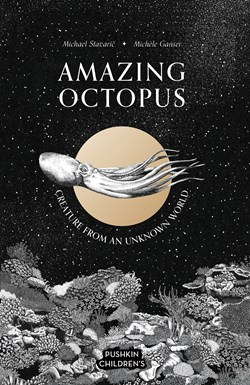
AMAZING OCTOPUS: Creature from an unknown world


AMAZING OCTOPUS: Creature from an unknown world
MICHAEL STAVARIČ
(tr. Oliver Latsch; illus. Michèle Ganser)
Pushkin Children's Books
$27.00 hardcover, available now

Rating: 5* of five

The Publisher Says: Dive beneath the waves and explore the amazing world of the octopus with this fact-filled book for middle grade readers who can’t get enough about marine animals!

What do ocean and space have in common? How did octopuses and humans evolve? What exactly are cephalopods - and why do they have such a funny name?

Octopuses are the oldest and most intelligent creatures on our planet, true aliens whose abilities amaze us. Michael Stavarič and Michèle Ganser have created a non-fiction book full of surprising twists and turns that offer much more than just imparting knowledge.

I RECEIVED A DRC FROM THE PUBLISHER VIA EDELWEISS+. THANK YOU.

My Review
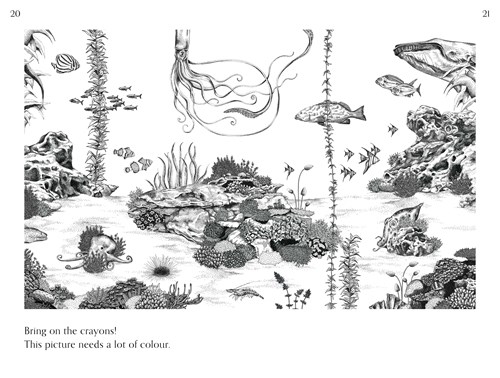
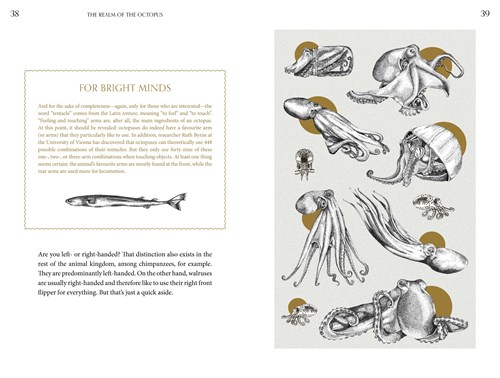
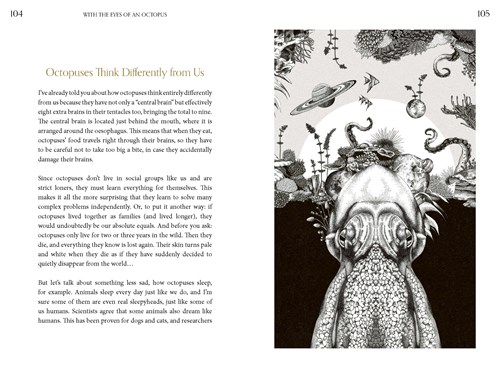
: I appear to be a middle-grade reader "who can’t get enough about marine animals". I loved reading this book, as ably translated by Oliver Latsch, and I reveled in the illustrations. They're done in an approachable, informative way:

These three were provided by Pushkin Children's Books to show just how astonishingly rich and fascinating all the illustrations are; Michèle Ganser is a major talent. Many more from this pen, please.

Since I'm a firm believer that the Tentacled Americans of all species are as close to alien inteligences as we're going to get for the moment, I was very happy with the choice to link them to outer space in this book.
Octopuses, as we know by now, are cephalopods—their legs, or rather their tentacles, are directly connected to their heads. This may give them a somewhat sack-like appearance to our eyes. Basically, they only consist of a huge head, two big eyes and eight arms, which are equipped with suckers on the underside. So it is not surprising that octopuses are also often called “aliens”.
It's all like this, told as though your science teacher is a fun, funny storyteller with a lot of knowledge to make your learning painless.

The best part of this approach is that the astounding intelligence and real-life coolness of the cephalopd tribe gets hold of you quickly and, if I read this right, permanently. Your budding marine scientist will love the experience of reading this. It's not like most science books for this age group are...brightly colored and written down...so it'll appeal to the serious about science while not repelling the casually interested.

Parents will enjoy it, too, in large part because they'll recognize the Socratic teaching style of asking questions, of probing for the reader's existing knowledge. It's the best way I know of to get new facts to stick: Locate them in the child's existing nexus of information.

The physical book must be a delight to hold. The DRC is a delight to look at, a real visual feast. It marries the beautiful art with an effective, elegant page design. You generally won't go wrong with Pushkin Press's output. This book is no exception.

Saturday, December 7, 2024

MILK WITHOUT HONEY, elegant graphic non-fiction about bees gracefully translated from German


MILK WITHOUT HONEY
HANNA HARMS
(tr. Ruth Ahmedzai Kemp)
Street Noise Books
$21.99 trade paper, available now

Rating: 4.5* of five

The Publisher Says: What would the future of the world look like without bees?
MILK WITHOUT HONEY chosen for NPR’s BOOKS WE LOVE!


Bees are vital to securing our food supply. We could live in a paradise where insects, especially bees pollinate fragrant seas of flowers whose fruits we harvest. Instead, vast lawns are now replacing flower gardens, and agriculture is characterized by monocultures. Pesticides and climate change are also causing insect mortality, with dramatic consequences for the global ecosystem. As we destroy the insect populations, honey is just one of many foods that will no longer be available to us, unless we learn to honor our innate connection with nature before it's too late.

In gorgeous, limited palette artwork, using contemplative images as well as informative charts, Hanna Harms brings us into the world of bees: their hives, their colonies, and their interactions with the global ecosystem. This is the perfect gift book for anyone concerned about climate change and the environment.

About the Author
Hanna Harms is an illustrator and comic author. She graduated from the Münster School of Design in Germany. She is currently studying for an MA in illustration at the Hamburg University of Applied Sciences. Hanna is co-editor and author of the comic zine Sander. The German edition of this debut graphic novel Milch ohne Honig, won the Ginco Award in 2020 in the Best Nonfiction Comic category.

I RECEIVED A DRC FROM THE PUBLISHER VIA EDELWEISS+. THANK YOU.

My Review
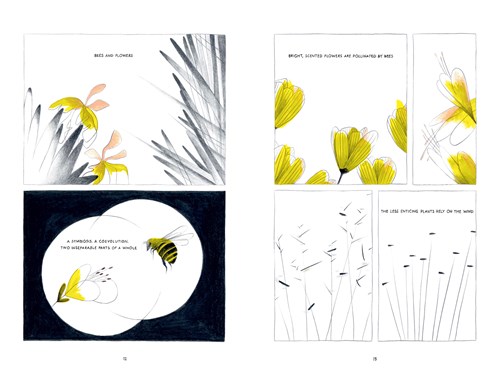
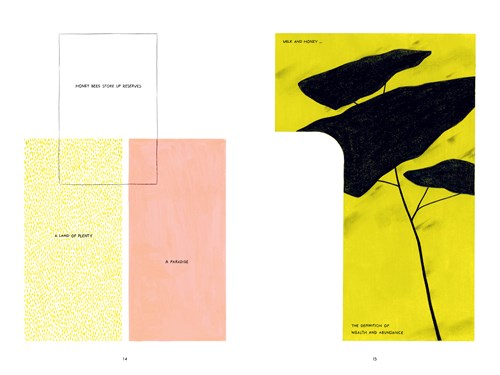
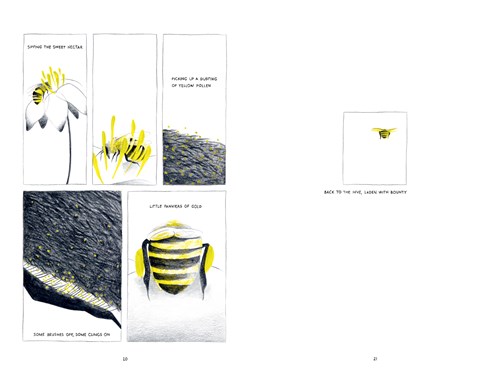
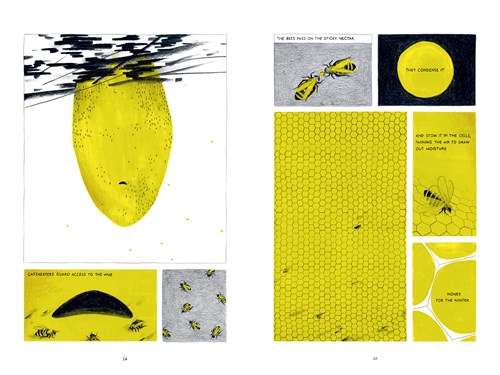
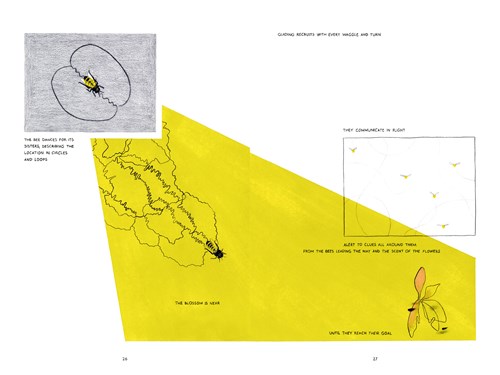
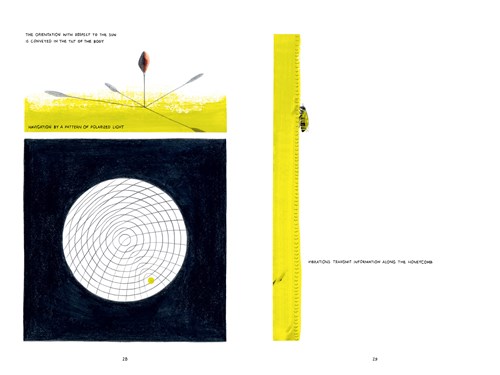
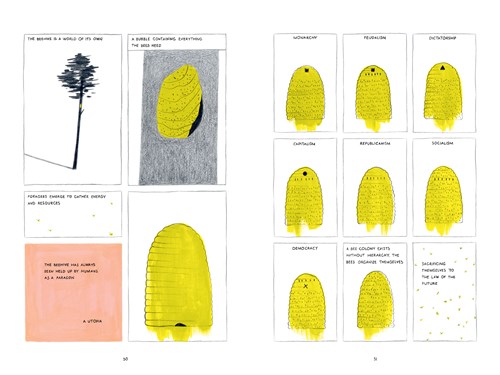
: A book receiving wide notice, a lot of praise, and all of it well-deserved. The author is German, and translator Ruth Ahmedzai Kemp did a seamless job of rendering the text into equally elegant English. Look at these spare, graceful pages:


Remember when I praised BIOGRAPHY OF A FLY by Jaap Robben? The style here is very similar, so of course I'm inclined to enjoy it.

The choice of yellow and black for the presentation is logical...what color is a bee, after all...but I wish they'd gone just a bit more bee-and-honey with the shade. As it is, the book is more pee-and-yellowjacket. It got a touch wearing. That's why the book only got 4.5 stars instead of five, which it otherwise fully merits.

That did not stop me from devouring the book, pardon my wordplay, eager to possess the images that Author Harms has created to explicate the nature of the problem that bees face. The depths of our species' dependence on the bee for its labors to feed itself, which thereby feeds us, makes this a very urgently needed book.

I hope you'll add it to your young ecowarrior's pile of gifts this Yule.

Monday, July 1, 2024

COMPLETELY KAFKA: A Comic Biography, centenary of his death honored in fun-to-read format


COMPLETELY KAFKA: A Comic Biography
NICOLAS MAHLER
(tr. Alexander Booth)
Pushkin Press
$19.95 trade paper, available now

Rating: 5* of five

The Publisher Says: A delightfully witty and original graphic biography of Kafka, published to coincide with the centenary of the author’s death

This bold and sharply funny new look at Kafka is told through Nicolas Mahler's distinctive graphic novel style and minimalist illustrations. Full of fascinating details and witty, absurdist illustrations, it’s a delightful tribute to one of the world’s great writers.

Franz Kafka not only wrote prose, he was also passionate about drawing: at one time, he even said it satisfied him more than anything else. In this graphic biography, acclaimed artist Nicolas Mahler echoes Kafka’s own minimalist drawing style in a unique and surprising approach to the great writer’s life and work.

Drawing extensively on Kafka’s fiction, letters, and diaries, Completely Kafka illustrates the major and minor details that formed his life, from struggles with self-doubt and writer’s block to a failed plan for a series of cheap travel guides.

I RECEIVED A DRC FROM THE PUBLISHER VIA EDELWEISS+. THANK YOU.

My Review
: When people want to say "this stinks and I don't know what the hell is going on" in one word, they reach for "Kafkaesque" to do the job. This is, as all eponymizations must of necessity be, a gross oversimplification and misrepresentation of an extremely complex and, in my never-remotely humble opinion, beautiful body of work. Nicolas Mahler's selections from Kafka's fiction and his letters are very cannily chosen to be effectively illustrated in his minimalist style:
The lines, the volumes they define, the handmade feel of the brushstrokes, all echo the effect of Kafka's prose in my reader's ear. They are bold, they delineate spaces and fill them with interesting images; they are clear, unambiguous in themselves and still make the gestalt ambiguous; they do not use vivid colors but rely on contrasts, shapes, edges to convey their sense.
Offered as a corrective to the sloppily used eponym and an expansion of real understanding of Kafka and his intentions in a short, unpretentious, enioyable package on the centenary of his death.

Very highly recommended for those whose idea of Kafka pretty much ends at using "Kafkaesque" when at the DMV or the county tax office.

Friday, November 10, 2023

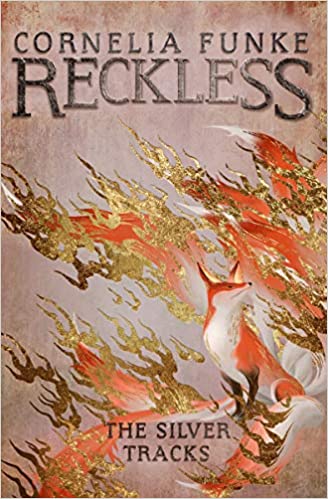
Cornelia Funke's MIRRORWORLD series, book 4 THE SILVER TRACKS, of 5-book illustrated YA Dark Fantasies


RECKLESS: The Silver Tracks (MirrorWorld #4)
CORNELIA FUNKE
(tr. Oliver Latsch)
Pushkin Children's Books
$15.95 trade paper, available now

Rating: 4* of five

The Publisher Says: The fourth adventure through the Mirror leads to the Far East, where Jacob and Fox finally track down Will, who is travelling with rival hunter Nerron. In spite of his misgivings, Jacob agrees to go with them to the Island of the Foxes, in quest of another magical Mirror.

But their search quickly leads them into more peril, and as Jacob seeks security for himself and Fox, he is reminded of a disturbing promise he once made that now threatens everything.

Full of fairy tales and legends, old friends and new enemies, The Silver Tracks is the long-awaited fourth volume in the thrilling Reckless series.

The thrilling fourth instalment in Cornelia Funke's internationally bestselling Reckless series.

First book reviewed hereSecond book reviewed here
Third book reviewed here

I RECEIVED A DRC FROM THE PUBLISHER VIA EDELWEISS+. THANK YOU.

My Review
: We've learned a lot about Mirrorworld's different parts, right? Wrong! We're still in the ongoing-discovery phase of the series here, in book four, where we're heading to Mirrorworld's version of Japan called (unsurprisingly) Nihon. Our book three antagonist is back with a vengeance, and Will...Jacob's brother (about whom there is quite a surprising hidden fact) and the object of many a quest on Jacob's part...now needs to find him in order to make the curse that's turning his belovèd into wood release its hold. Naturally the antagonist is the only one who can accomplish this as he's the one who created Will's beloved.

No matter how much of the plot I tell you, it won't make one bit of difference. You're reading this review, so are in the mood for fall fantasy reading, so you would do well to get this series (though start with #1 or be *terminally* confused!) of YA dark fantasy novels.

Now, the opinions part. This book's very, very complicated and made more than necessarily so by the technique of using multiple narrative PoVs for even the most minor of characters. This can work beautifully if the reader's in full binge mode; readers like me, who take months to read long, complicated fantasy books, really don't see the benefit of it. I'm reasonably sure that Jacob is the best dark-fantasy protagonist who grows into adulthood in any series I've read, bar none.

He and Fox are becoming parents and discovering the deep, dark secret of being a parent that no one ever tells young people (the child you make together is superglued to your souls, both of you, from the instant it is part of your lives and makes every decision you make more complicated) in the roughest possible way. The stakes in this series entry do not get higher. The number of characters we're following is sizable, deeply intertwined, and morally malleable. Everyone learns they can do things they never considered they would when motivated powerfully enough. The adversary in the story, Spieler, suddenly apeared in the last book and is front and center throughout the action in this book. He did not grow on me the more I saw of him. A horrible person indeed, responsible for Jacob's father's unforgivable behavior. Responsible for entrapping Jacob's brother, Will. Generally an all-arounder in the cruel, abusive, manipulative villain sweepstakes.

*happy sigh*

Perfect for dark fantasy series use. I confess, however, that I'd've liked to see how he got so enmeshed with the Reckless clan as a whole earlier in the series...unless I just passed right by the hints that were dropped about how Will and Jacob's mother lit this particular fuse. The ways in which John Reckless, father of this brotherly dyad, comes off in a different light as the past is slowly revealed, is especially well-done.

I was more put off by the welter of voices as the read progressed. I am not in any way trying to unsell you on the reads! You should know in advance what's coming your way...be prepared when this read comes up to the top of your TBR that concentration is needed to get the full gestalt of the story's locations and narratives. There are many interesting voices: samurai, a centaur, a nine-tailed fox (Japan being an island of fox spirits), some ghosts, a child-eating witch, shapeshifters and even some old friends from the earlier stories.

In addition to Japan and its folklorians, we have our first gay character in Hideo. Based on auguries I'd expect some more time will be spent with him in the future book five. Which isn't out yet. Nor is it even announced by Pushkin Press...this bodes ill for my sanity.

Thursday, November 9, 2023

Cornelia Funke's MIRRORWORLD series, book 3 THE GOLDEN YARN, of 5-book illustrated YA Dark Fantasies


RECKLESS: The Golden Yarn (MirrorWorld #3)
CORNELIA FUNKE
(tr. Oliver Latsch)
Pushkin Children's Books
$9.99 ebook editions, avalable now

Rating: 4.5* of five

The Publisher Says: Jacob Reckless continues to travel the portal in his father's abandoned study. His name has continued to be famous on the other side of the mirror, as a finder of enchanted items and buried secrets. His family and friends, from his brother, Will to the shape-shifting vixen, Fox, are on a collision course as the two worlds become connected. Who is driving these two worlds together and why is he always a step ahead?

This new force isn’t limiting its influence to just Jacob’s efforts – it has broadened the horizon within MirrorWorld. Jacob, Will and Fox travel east and into the Russian folklore, to the land of the Baba Yaga, pursued by a new type of being that knows our world all to well.

First book reviewed hereSecond book reviewed here
Third book reviewed hereFourth book reviewed here

I RECEIVED A DRC FROM THE PUBLISHER VIA EDELWEISS+. THANK YOU.

My Review
: Jacob Reckless, our series protagonist, comes face-to-face with the hardest of adult problems in this entry into the ongoing series of fantasy Young Adult novels: "Why were love and death such close neighbours."

It's always bothered me that love poetry and love songs so frequently conflate love and death. This story, in which Jacob meets his vanished father after more than a decade of aging and growing and becoming his the man who can be a father as well as his brother Will's savior, very much focuses on this seeming dichotomy. Jacob must do what a lot of sonse must do: Come at last to understand the nature of love for a parent when the parent isn't who one wished them to be. Love and death...always sides of a coin, sometimes without much thickness between them so one side's pattern shows on the other side.

How much love costs is another thing Jacob must face in this book. He travels to a farther eastern part of Mirrorworld where we meet Slavic folklorians like rusalkas and, of course, Baba Yaga. Can not pass up a chance to call out the world-building that Funke treats us to in this series...we've had fae and (gar)goyls and sorcerous beings galore, now we get flying carpets and golems! There is so much lovely writing in the translation that evokes the differences in all the peoples of Mirrorworld that it's worth the price of admission just to be brought on Jacob's journey. Notably, as this is marketed as a young adult title, the publisher's treated us again to some lovely, evocative illustrations; again, worth the price of admission to get them before your admiring eyes.

More than all the fantasy novels aimed at adults that I've read, this series (to date) has done the most to convince me that there is a glorious amount of Story that's best told by means of fantasy tropes. There's nothing important that I don't care for in this German translation (misspellings à la anglais irk me, but not enough to knock points off for...especially from a British publishing house).

Why I'm only at four and a half stars not the full five is simply that the adversary in this tale pops up and has no reason to that I could follow. It's not awful; it's just that we've got such a fabulous set-up for this title in this quote: "The Golden Yarn...or the inseverable bond, as it is also called. As inseverable as the threads of fate," which gets vitiated by the up-popping adversary. "The threads of fate" are unquestionably the most relevant organizing pinciples here. Then, Author Funke, ensnare *everyone* in them from the get-go.

Really, there's nothing more to this than my nagging sense of "fair play" brought over from the series-mystery reading world. What works works so well that I want to be fair about your possible complaints. In dealing with Jacob's latest foray into Mirrorworld and confronting deeply ugly realities of his father, and brother, having flaws, Author Funke never once drops the thread that binds families of all sorts together.

Minor whinges be damned. The series works, and keeps working.

Monday, February 14, 2022

POLLAK'S ARM, beautiful, maddening, horrifying, so very desperately sad


POLLAK'S ARM
HANS von TROTHA
(tr. Elisabeth Lauffer)
New Vessel Press
$16.95 trade paper, available now

Rating: 4.75* of five

The Publisher Says: October 16, 1943, inside the Vatican as darkness descends upon Rome. Having been alerted to the Nazi plan to round up the city’s Jewish population the next day, Monsignor F. dispatches an envoy to a nearby palazzo to bring Ludwig Pollak and his family to safety within the papal premises. But Pollak shows himself in no hurry to leave his home and accept the eleventh-hour offer of refuge. Pollak’s visitor is obliged to take a seat and listen as he recounts his life story: how he studied archaeology in Prague, his passion for Italy and Goethe, how he became a renowned antiquities dealer and advisor to great collectors like J. P. Morgan and the Austro-Hungarian emperor after his own Jewishness barred him from an academic career, and finally his spectacular discovery of the missing arm from the majestic ancient sculpture of Laocoön and his sons. Torn between hearing Pollak’s spellbinding tale and the urgent mission to save the archaeologist from certain annihilation, the Vatican’s anxious messenger presses him to make haste and depart. This stunning novel illuminates the chasm between civilization and barbarism by spotlighting a little-known figure devoted to knowledge and the power of artistic creation.

I RECEIVED A DRC FROM THE PUBLISHER VIA EDELWEISS+. THANK YOU.

My Review
: First, read this:
Rome is so eerie these days. The city seems caught in the chokehold of some immense, capricious beast, especially at night. Pollak said the same thing, worded a little differently, but similar. A monster lying in wait, outwardly quiet, but ready to strike at any moment. Every monster strikes eventually. It's in its nature. Those of us harbored here in the Vatican feel a wave of gratitude and relief whenever we reach a building that the German embassy has marked as Vatican property. It's like a magic spell keeping the monster at bay. One may feel safe here.

In a nutshell, that's the book's burden of meaning. In this tightly paced read, you'll be subjected to a high level of frustration because it's just not possible not to be. These are Jews fleeing Nazis by hiding behind the Vatican's skirts. ... Talk about emotional whiplash.

The man narrating the book, K., to Monsignor F., is the one sent on the delicate, but very important for the Vatican, mission to see that Ludwig Pollak is brought to safety in the Vatican's boundaries. Pollak, a Jew, is about to be deported and, as we reading the book know from before we so much as blink, that means death for an elderly man, his diabetic wife, and his disabled progeny. K. is busily trying to instill in an elderly man who's been exiled from his Roman home before (for being an Austrian subject during World War I), who's lost his first wife during exile and been forced to serve an Emperor he had no slightest regard for, but who's been fêted and celebrated by that Emperor before and who now wants nothing to do with the Jew...there are simply too many miles on the clock, K. Pollak winds his hours down by emulating Sheherezade and using K.'s ears to pour his meaning into. After all, K. will survive and Pollak, well...the past means more to him:
One tends to think the weather was nicer and people were friendlier when remembering the past, and although it's not true, there is some truth to it. Every memory has its own truth; otherwise it wouldn't exist.

So we're going down the garden path with a man who's been mistreated many times, in many ways, for being a Jew. For being an Austrian in Italy, for being Czech in Austria, and a Jew to boot. This is a man whose life is Art. He's been ushered in ahead of Barons to the presence of J. Pierpont Morgan because he has, knows, can connect the dots...
What could possibly surpass the exhilaration a collector experiences after making a significant find or finally acquiring a piece he has long coveted and lost sleep over? This realm of terrific, silent joys has revealed itself to me as well, Pollak said; it may be the only joy that truly exists. Collectors, he continued, are the most passionate people on earth. People prepared to venture into the foulest corners of the criminal code to take possession of a teacup, a painting, or some other objet d'art.

And Morgan is not the first powerful man who has used Pollak's art-sense to make something extraordinary his own, or explain why what he has is extraordinary from Pollak's vast stores of knowledge. It is this quality of Pollak's mind that K. is called upon by the gods, via the peculiar institution of the Vatican, to witness. It is this extraordinary votary of Art who is, at long last, saying out loud why his life mattered and what he has done cannot be undervalued because of his Jewishness. It is there, in all its glory, the objet d'art and the sculptures and...and...and...it's physical. While Pollak as a name might vanish (not really, though not for lack of the world trying) his work remains:
Pleasant memories cannot exist, Pollak stated for no reason I could figure, if the experience itself wasn't pleasant. Or, he asked, can they? He didn't think so; he had written down everything important, or at least, everything that seemed important to him, because who knew what would prove important in the long run?

False modesty, or real, we the readers know that Pollak always knew what was always going to be important in the long run: Art. He was correct. This récit gets its title from a discovery Pollak made in the early 1900s, a piece of a sculpture made in Greece in times most ancient, and spoliated by the Empire's vast greed for Art and what were, even to them, antiquities.
from the Musei Vaticani
They {their arms} are not, however, extended in pride but in a fight against death, to fend off the snakes. Their death is certain. Whether one is fighting death or fighting certain death makes all the difference. Is it noble? Pollak asked. Naïve? Quiet? Grand? Or is it just terrible, plain and simple?

This is the sculpture in question. The right arm, the one bent at the elbow ever so slightly, is the one recovered by Pollak, and then donated to the Vatican Museum...he explains why in the text, but that is something you'll need to read for yourself, there's no way to excerpt it without typing many paragraphs. For this splendid act of generosity, he is awarded all sorts of attention and perks in the archeological community, and his (barely post-Dreyfus Affair) Jewishness is grandly overlooked as the crowned heads pin medals of merit all over him. The arm completes the emotional arc of the story of Laocoön as the gods mete out punishment for his unforgivable act of hubris. Read the story, I am not discussing it here.

When Pollak returned from his Austrian exile, he resumed his life-long career in service to the culture industry. His life spent as an art dealer, now spent being the director of a museum dedicated to sculpture, a collection assembled by an old friend of Pollak's. I don't imagine it will surprise you to know that there were vicissitudes...and betrayals...and that Pollak, in the end, cared less for any of that than he cared for the art, and for the stories inherent in caring for Art. The Vatican (for better or worse) has a very long memory. They sent K., a car, and their urgent invitation to Pollak and his family to accept rescue from certain death.
It's different in the Vatican, I quietly offered, and you know it. ... You will be safe there. And they're expecting you. I sleep very little, he said, barely at all now. It must be nice. How could I possibly wake them when the world they'd wake up to is the world they'd wake up to? I didn't know how to respond. We sat there in silence until he, rather than getting up and rousing his family, resumed his tale.

Despite the urgency, the despairing urgings of K., the certainty of death...is not troubling Pollak. He knows, from his connection to Laocoön, that the gods send what they will and it's not up to puny mortals to complain. He saw what was coming. He was, at sixty-plus years of age and in frail health, not going to argue with the gods again. Men, as he has bitter cause to know, are not creatures of reason. They are snakes, they are beings without character but with brute, brutal strength, when they serve their passions:
Not one of them wrote about what they saw; instead, they wrote about what they thought. And when a man thinks long enough about what he wants, it eventually becomes what he sees.

It is nothing but the truth, put in the mouth of Ludwig Pollak, guilty of the crime of Jewishness in a world where the powerful hate you for that unforgivable breach.

It is no accident that New Vessel Press chose this title to come out hard on the heels of The Vanished Collection. Fiction and non-fiction about spoliation. The parallels between Pollak and Jules Strauss, the parallels in our own times' spoliation crisis and restitution failings. There is so much to be said about the concept of "Museums" in today's world, the one where facing up to the past is at last becoming effective...and the immensity of the hate-stoking that is working against the deepening of the many, many overdue reckonings with the Imperial Past (not to mention present). The world is, sadly for some and confusingly for all, changing. The problem with resisting that change is it does not work. It merely stores energy to be released in the eventual great change. 1789 ring any bells?

We live in interesting times. Read this slender, one-sitting meditation on just how interesting, just how much there is still to be accounted for and dealt with. You will be glad you did.

Sunday, January 9, 2022

Cornelia Funke's MIRRORWORLD series, LIVING SHADOWS: second of 5-book illustrated YA Dark Fantasies


RECKLESS: Living Shadows (MirrorWorld #2)
CORNELIA FUNKE
(tr. Oliver Latsch)
Pushkin Children's Books (non-affiliate Amazon link)
$9.99 Kindle edition, available now

Rating: 4* of five

The Publisher Says: Jacob has saved his brother from the Mirrorworld, but now he will pay a terrible price. A fairy's curse is burning in his heart, and to break the spell he must embark upon a perilous journey - with his trusty friend Fox by his side - to seek out the only treasure that could save him.

Jacob's search for the golden crossbow will lead him across hundreds of miles by land and sea, to an invisible, enchanted palace within the Dead City. It will bring him face to face with vicious beasts, bloodthirsty giants, and a deadly stone­faced rival.

It will test his courage like never before.

Living Shadows is the second book in the thrilling Reckless series.

First book reviewed hereSecond book reviewed here
Third book reviewed hereFourth book reviewed here

I RECEIVED A DRC FROM THE PUBLISHER VIA EDELWEISS+. THANK YOU.

My Review
: I am convinced that this series is cruelly aimed at obsessive completist readers. The cliffhanger at the end of book one makes this book a MUST-READ NOW and, through the magic of Kindle, I was able to read the books back-to-back. I warn all who come after me: To sign up for this voyage into Mirrorworld is to commit to the whole cycle.

I am in.

What happens during the course of this book is that Jacob comes to understand something he'd never given much thought to: My love for you creates my responsibility for you creates a web of obligation that is endless...and as addictive as any narcotic. While we who have read the first book know what a price Jacob has paid, in fact what a price he paid after making a sacrifice that even he isn't quite aware of the dimensions of yet, we're probably not expecting the antagonist of this book.

In fact, I guarantee we're unprepared for the existence of the antagonist of this book. And that's probably Author Funke's most clever sleeve-ace yet. It plays well.

There are the accustomed delights of reading this series' world-building fillips. These are numerous, though enumerating them for you isn't really something worth doing in a review. There is a Fandom wiki, of course there is!, and I didn't look but am willing to bet there's fanfic on AO3. The reason is that Author Funke used every conceivable fairy-tale source to draw her world out from and has made it into a near-seamless whole. (Where there are seams that I can perceive, eg Goyls' method of transmission, it felt to me as though they were intentional not born of inattention to source material.)

The problem I had wth this entry is how kinetic, nay frenetic, it is. We go from pillar to post and back again; Fox is with us, Nerron the treasure-hunting half-Goyl whose existence is new to this book is against us; we're never for a moment at rest, able to take stock, pause to reflect. It's exactly what Author Funke intends, and it's a valid narrative technique but in this reader it creates a sense of distance from the characters. I'm so deep in the world that I don't get to experience his progress through his (final?) days.

Until I read this:
"If you catch your own children in the circle...then you can use the years you take from them for yourself. You're just taking back the life you gave them in the first place. The more of it, the better."

That was a gut-punch of a trap set for overeager treasure hunters, wasn't it?! And the sheer violence of the stakes set...if you're not a relative of the curse-setter, you're still going to die in the circle but it won't keep the curse-setter alive...could not be more urgent. Now that Jacob has found this evil place, he thinks he's trapped in the curse.

Fox, his shifter gal-pal, isn't having that. As always, the woman's love saves the man from his stupidity and greed. Though let's be fair to Author Funke, this time Jacob's greed was simply the desire to live that we all suffer from. And since Fox very much wants Jacob still alive, she's hardly just going to watch as he dies from a curse she can stop from progressing...if she's willing to do something that's very, very hard to do and commit murder.

Killing someone/thing in a struggle isn't murder. The intent to kill, the set purpose and the planning of the act...that's murder. Will she murder to save Jacob's life?

You'll have to read the book.

The ending is tremendously exciting.

Monday, January 3, 2022

Cornelia Funke's MIRRORWORLD series, RECKLESS I: THE PETRIFIED FLESH is first of 5-book illustrated YA Dark Fantasy Series


RECKLESS: The Petrified Flesh (MirrorWorld #1)
CORNELIA FUNKE
(tr. Oliver Latsch)
Pushkin Children's Books (non-affiliate Amazon link)
$9.99 Kindle edition, available now

Rating: 4* of five

The Publisher Says: Jacob has uncovered the doorway to another world, hidden behind a mirror. It is a place of dark magic and enchanted objects, scheming dwarves and fearsome ogres, fairies born from water and men born from stone. Here, he hunts for treasure and seeks adventure in the company of Fox - a beautiful, shape­shifting girl, who guides and guards him. But now Jacob's younger brother has followed him into the mirrored world, and all that was freedom has turned to fear. Because a deadly curse has been spoken; and Jacob must risk his life to reverse it, before his brother is turned to stone forever... Revised and updated by Cornelia Funke, The Petrified Flesh is the first book in the thrilling Reckless series.

First book reviewed hereSecond book reviewed here
Third book reviewed here—Fourth book reviewed here

I RECEIVED A DRC FROM THE PUBLISHER VIA EDELWEISS+. THANK YOU.

My Review
: Don't mistake "young adult" for "fluffy." This story of brothers, orphaned early in life by a father whose abandonment of them without a word also cost them their mother to her grief, as they find the "Mirrorworld" that their father vanished into...inside his study!

This is a portal fantasy, with a secondary world that resembles our own enough to be an alternate-history wrold except for the fact that magic works. "Austry" is the name of the Mirrorworld country the brothers, and their father before him, arrive in, not the Austria they leave behind. The family's disintegration, as abetted by the mirror, is not something that the hero Jacob is trying to fix or to escape, like Meg in A Wrinkle in Time or the Pevensies in The Chronicle of Narnia. Jacob's a young adult, he fled into Mirrorworld to find a place for himself not look for someone else. Of course he finds others...a bad father-figure but a good mentor in Albert Chanute, innkeeper and treasure hunter in Austry, a girlfriend of sorts in Fox the shapeshifting...fox. He's got a life as a treasure hunter! He's met the Empress six times! (But don't tell Chanute that, he's only met her three times for treasure-hunting and now he's past it, so there'd be jealousy and trouble.)

The stakes this secondary world introduces to us could not be higher. Jacob's treasure-hunting ways are threatened by the Goyls, put a gar- in front and you'll get it, finally having effective leadership and thus starting to win battles in the eternal war between humans and their kind. What matters about that is that Will, Jacob's brother, has been bitten by a Goyl and is suffering the inexorable fate of such: He's turning into the stone creature that we call a Goyl but, since he's human, he won't survive the change. He will be a stone human...dead, but still walking without his soul. And Jacob, whose running away to find a life in this other world, now can't figure out how to save Will...and his refusal to share knowledge of Mirrorworld with Will is what left him susceptible to the bite in the first place. Oh! Wait! That's not enough pressure, not enough baggage. Will's utterly innocent girlfriend Clara finds the mirror and enters Mirrorworld, too!

Now, let me not spend more time in Spoilerville than is necessary. Will and Clara are serious Mary Sues. The world happens to them. They're not possessed of Jacob's trove of information...and this is something he quite rightly blames himself for not imparting to his adoring little brother. He spends just enough time recognizing that he's set these conditions in motion, and the success or failure of Will's future life among the living not-Goyls is entirely on him.

Celeste/Fox surprised me as a character. Will is younger than Jacob and he has a blah girlfriend, but Jacob's magical girlfriend is...a real full-bodied relationship partner! I wasn't thinking that would work in a kid-aimed story. But this, with its neither dwelt-on nor avoided sexuality and its frank presentation of bodily suffering...Chanute's arm is lost for a singularly stupid reason, for example, but it's before the story we're being told now starts, and is reported not experienced...is part of the not-quite-adult storytelling world. I'd give this to any sixteen-year-old and expect them to feel positive about it. Not younger, though. The consequences of stupid actions aren't minimized!

But sometimes, stupid people just can't be forced to stop being stupid. Clara simply can not be made to see what is completely obvious to the meanest intelligence: She is NOT in her own birth-world anymore and can NOT act like she's out for a particularly strange walk there! It gets wearing, her insistence that Jacob act as though her world's rules still hold sway. And he, fool of a man that he is, keeps explaining and explaining why her way won't work! Because she's unwilling to learn!

But Jacob...he's fighting through death and resurrection, he's fighting enemies he knows are enemies as well as friends he doesn't know are worse than enemies..."Who makes peace when you can have victory?" muses one such...Jacob fights until the fabric of Mirrorworld finally delivers him the thing he's consistently asked for, demanded, begged to receive. The thing he's died inside and out to cause to happen.

He's received the gift of an ending.

What a lovely way to make your portal fantasy pop! Make it such that there is no more severe betrayal that can occur to anyone in this world. Give everyone an ending. Then, stand back and watch the fun begin!

So perfect for its intended audience, so much in accord with the end-of-adolescence access of adult emotions but without the perspective to manage them. This should take the world by storm, and I hope it will.