Showing posts with label octopus science. Show all posts

Wednesday, July 30, 2025

SEA WONDERS: The Octopus, the Cuttlefish, and the Squid, beautiful, informative, and very reasonably priced


SEA WONDERS: The Octopus, the Cuttlefish, and the Squid
MARCO COLOMBO & FRANCESCO TOMASINELLI
(illus. Giulia De Amicis)
Princeton Architectural Press (non-affiliate Bookshop.org link)
$13.99 ebook, available now

Rating: 4.75* of five

The Publisher Says: Explore the world of extraordinary marine creatures in this beautifully illustrated guide to thirty species of octopuses, cuttlefish, and squids.

In Sea Wonders, discover the remarkable characteristics of cephalopods, enigmatic sea creatures with arms directly attached to their heads, who are masters of survival and transformation. Thirty species are collected in this fascinating guidebook, detailing their most surprising habits and abilities:
  • Enterprising, resourceful, and intelligent, they know how to solve problems and can use objects as tools.
  • They are notorious for escaping from aquaria.
  • They can recognize people and can even feel dislike for some!
  • Some species, such as the orchid cuttlefish, are among the most colorful organisms in the oceans
  • Others, like the blue-ringed octopus, are famous for their lethal bite.
  • Some of the world’s largest invertebrates are cephalopods—including giant squids the size of a bus—about which very little research exists to this day.

  • The first half of the book contains fifty gorgeously detailed and realistic illustrations and delves into the species' main characteristics and the secrets of their underwater world. The second half features specimen cards with scientific information and fun facts for easy reference.

    REMARKABLY BRIGHT CREATURES: Cephalopods are fascinating creatures increasingly understood as intelligent, sophisticated, and resourceful animals. Their unexpected cognitive capacities encourage us to reflect on how we relate to the natural world, making it clear that it is not only mammals and birds who deserve our empathy.

    THOROUGHLY RESEARCHED SCIENTIFIC FACTS: Various species of octopuses, squids, and cuttlefish are explored in these pages, with in-depth information on habitats and habits as well as fun facts.

    FOREWORD BY OSCAR-WINNING FILMMAKER: Craig Foster, producer of the 2020 Academy Award–winning documentary My Octopus Teacher is a naturalist, ocean explorer, and author of Underwater Wild: My Octopus Teacher's Extraordinary World.

    Perfect for:
  • Anyone with an interest in marine creatures and the undersea world
  • Birthday, housewarming, or seasonal gift for nature lovers
  • Oceanography and marine biology students, teachers, and professionals
  • Fans of animal and nature books like Amphibious Soul, Oceanology: The Secrets of the Sea Revealed, and The Soul of an Octopus

    Marco Colombo (co-author) is an environmental guide, scuba diving master, TV scientific consultant, and wildlife and underwater photographer. His photographs and articles have appeared in National Geographic, BBC Wildlife, Nat'Images, and elsewhere. Colombo has won multiple categories in the Natural History Museum, London’s Wildlife Photographer of the Year competition. He is the author of more than ten books about biodiversity and conservation issues, a frequent speaker, and a university instructor.
    Francesco Tomasinelli (co-author) is a freelance biologist, science communicator, and photographer. As a photojournalist, he has joined several scientific expeditions in the Tropics and has documented various conservation programs in Italy and abroad. Tomasinelli has written more than three hundred magazine articles and fifteen books on natural sciences, served as an animal expert for Italian television, worked as an instructor for various learning institutions, including Università di Genova, Pavia, dell’Insubria, and Politecnico di Milano, and created a number of scientific exhibitions.
    Giulia De Amicis (illustrator) is a designer and illustrator who presents complex information through infographics, data visualization, cartography, and illustration. She focuses on projects related to environmental issues, marine conservation, animal welfare, human rights, and human geography for clients including newspapers, research institutes, NGOs, and the educational sector. De Amicis has illustrated several picture books for National Geographic Kids and other publishers. She works and lives in Brighton, UK.

    I RECEIVED A DRC FROM THE PUBLISHER VIA EDELWEISS+. THANK YOU.

    My Review
    : My affection for Tentacled Americans is well-known enough not to need restating here and now. You can imagine my excitement when this beauty, about my dotes, written and illustrated by real scientists, endorse by the My Octopus Teacher guy, came onto my radar.

    I'll say that I love the way we're taught about the life and the habitat of each species covered. It's lovely to have such evocative illustrations to enjoy as well. There's a corking "further reading" section, and as this is a popular science book intended to bring the cephalopods to our homes and thoughts, I wasn't distressed by the lack of inline citations.

    The Table of Contents should act as a pretty fair guide to the purpose and organization of the book:
    The first text/illustration spread for aesthetic evaluation.
    Interior spreads, showing the text/illustration interrelationships found throughout the book.

    I'm really impressed that there was as much detail as exists in the text. As mentioned, it's not intended as more than an overview to present the amazing beings in quick, absorbable way. What a beautiful set of illustrations! They're not precisely correlated with the introductory text but close enough to make them handy references.

    All in all a lovely (self-)gift for the fancier of these remarkable creatures. It's also a great gift item for the younger person considering the world's ocean as a subject of study. Older middle-grade students will be challenged, scientists not involved, but the amateur of any age will love it.
    The species-by-species section's all organized this way.
    Too cool to leave out! Enjoy them all.


  • Sunday, December 8, 2024

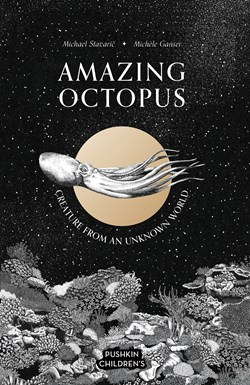
    AMAZING OCTOPUS: Creature from an unknown world


    AMAZING OCTOPUS: Creature from an unknown world
    MICHAEL STAVARIČ
    (tr. Oliver Latsch; illus. Michèle Ganser)
    Pushkin Children's Books
    $27.00 hardcover, available now

    Rating: 5* of five

    The Publisher Says: Dive beneath the waves and explore the amazing world of the octopus with this fact-filled book for middle grade readers who can’t get enough about marine animals!

    What do ocean and space have in common? How did octopuses and humans evolve? What exactly are cephalopods - and why do they have such a funny name?

    Octopuses are the oldest and most intelligent creatures on our planet, true aliens whose abilities amaze us. Michael Stavarič and Michèle Ganser have created a non-fiction book full of surprising twists and turns that offer much more than just imparting knowledge.

    I RECEIVED A DRC FROM THE PUBLISHER VIA EDELWEISS+. THANK YOU.

    My Review
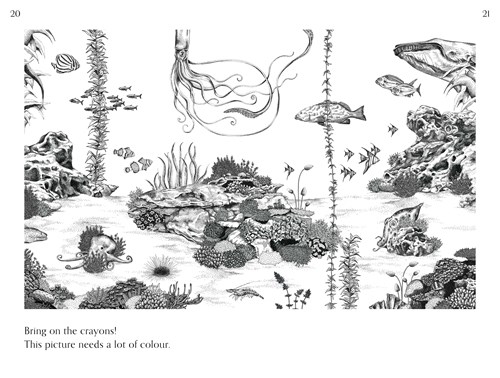
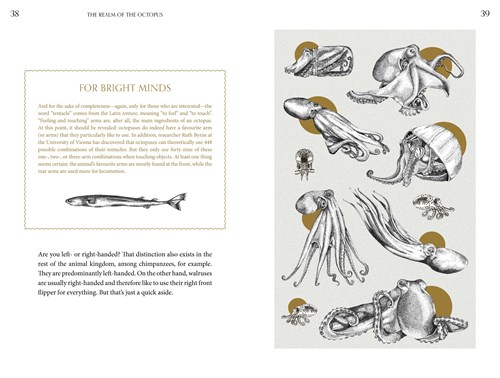
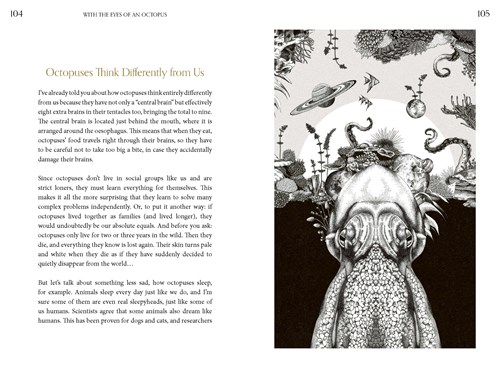
    : I appear to be a middle-grade reader "who can’t get enough about marine animals". I loved reading this book, as ably translated by Oliver Latsch, and I reveled in the illustrations. They're done in an approachable, informative way:

    These three were provided by Pushkin Children's Books to show just how astonishingly rich and fascinating all the illustrations are; Michèle Ganser is a major talent. Many more from this pen, please.

    Since I'm a firm believer that the Tentacled Americans of all species are as close to alien inteligences as we're going to get for the moment, I was very happy with the choice to link them to outer space in this book.
    Octopuses, as we know by now, are cephalopods—their legs, or rather their tentacles, are directly connected to their heads. This may give them a somewhat sack-like appearance to our eyes. Basically, they only consist of a huge head, two big eyes and eight arms, which are equipped with suckers on the underside. So it is not surprising that octopuses are also often called “aliens”.
    It's all like this, told as though your science teacher is a fun, funny storyteller with a lot of knowledge to make your learning painless.

    The best part of this approach is that the astounding intelligence and real-life coolness of the cephalopd tribe gets hold of you quickly and, if I read this right, permanently. Your budding marine scientist will love the experience of reading this. It's not like most science books for this age group are...brightly colored and written down...so it'll appeal to the serious about science while not repelling the casually interested.

    Parents will enjoy it, too, in large part because they'll recognize the Socratic teaching style of asking questions, of probing for the reader's existing knowledge. It's the best way I know of to get new facts to stick: Locate them in the child's existing nexus of information.

    The physical book must be a delight to hold. The DRC is a delight to look at, a real visual feast. It marries the beautiful art with an effective, elegant page design. You generally won't go wrong with Pushkin Press's output. This book is no exception.

    Thursday, October 13, 2016

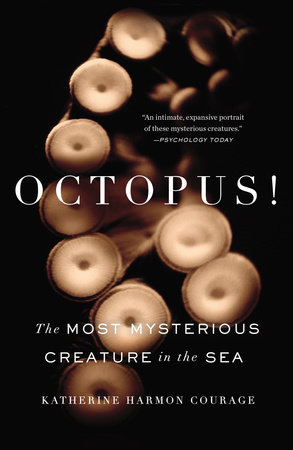
    OCTOPUS!, an interesting read about a fascinating creature

    OCTOPUS!: The Most Mysterious Creature in the Sea
    KATHERINE HARMON COURAGE

    Current Books
    $17.00 trade paper, available now

    Rating: 3.75* of five

    I received an ARC from Current Books for review, but I don't remember why.

    The Publisher Says: We eat, study, copy, and idealize the octopus. Yet this strange creature still eludes our understanding. With eight arms, three hearts, camouflaging skin, and a disarmingly intelligent look behind its eyes, it appears utterly alien. But octopuses have been captivating humans for as long as we’ve been catching them. Cultures have created octopus-centric creation myths, art, and, of course, cuisine. For all of our ancient fascination and modern research, however, we still haven’t been able to get a firm grasp on these slippery beasts.

    Now journalist Katherine Harmon Courage dives into the fascinating underwater world of these mysterious cephalopods. From her transatlantic adventures to Spain and Greece, expeditions in the Caribbean and back to Brooklyn, she invites readers to experience the scientific discoveries, deep cultural ties, and delicious meals connected to the octopus.

    Courage deftly interweaves personal narrative with interviews with leading octopus experts. She provides an entertaining yet informative romp through the world of these infinitely interesting creatures.

    My Review: Anyone who's paid me the slightest bit of attention over the years knows I'm a fan of Tentacled Americans. They're delicious. They're delightfully ookie. They're probably the closest things I'll ever have to soul mates: They don't like their own kind, regard other species as prey or enemies, and possess a deeply misunderstood intelligence.

    All I lack is six more arms.

    And now Katherine Harmon, a writer for Scientific American who appears to have married into the coolest last name ever, writes a Mary Roach-esque monograph on the 'pus! Oh frabjous day callooh callay! I dived (!) into the book the instant the mailman shoved it into the door-slot.

    What a dive that was. I landed in the sea-water off Vigo, Galicia, with the seasick Harmon Courage (love that new name!), thinking about the *a*maz*ing* octopus preparations prevalent in the region. The trip to Greece's Octotropolis Gythio was a drool-inducing litany of same-ol' same-ol' octopus preparation: wail on the dead body on the ever-present beach rocks, hurry home and boil it then saute the tentacles in olive oil and then make a tasty accompanying sauce. You can not go wrong doing this. It is never-fail deliciousness, with the added bonus of being nutritious and heart-healthy.

    I'm drooling. Pardon me, need to clean the keyboard.

    So for sixty pages, I existed in a haze of hunger and longing for some fresh octopus instead of the canned smoked stuff from Vigo. Page sixty-one began the lessons, or as a pal of mine says, "the eat-your-spinach part."

    Fortunately, I enjoy "eating my spinach" and learning about stuff. The only television I'm really interested in is informational/educational stuff...if I'm going to do something I don't enjoy (sit still in front of a screen and stare fixedly), I'm at least going to get something memorable out of it....so I trotted happily along in Harmon Courage's wake as she chatted up the scientists who study these fascinating creatures. The locations she gets herself sent to are anathema to me, being largely warm-water beachy places, locales I'd pay good money never to have to visit. But the scientists are opening an immense realm of knowledge by living and working there, and no one's making me do it, so here I sit in air-conditioned splendor reading about the fascinating conclusions from this research.

    Modern life, for a first-worlder, is excellent.

    Octopus skin is near-miraculous in its mimetic ability. Octopus brains are only barely beginning to be studied but are already causes for fascinating discoveries. Octopus bodies are marvels of efficiency, and inspiring research into imitative robotic design.

    Wondrous stuff, and that's not even half of the scientific amazement. How does a delicious creature without a shell avoid being din-din for every hungry thing in the sea? We've all heard about the ink-squirting defense, we've all heard of the prodigies of camouflage, but who knew that the wriggly ones could emit a *sound* that distracts vibration-sensitive predators? How? From WHERE?! Still being studied, stay tuned....

    All of the above is my yodel of praise and my warble of enticement for you to dash out and buy a copy of this informative, enjoyable book. But the attentive reader will note that my rating is under four stars, while my enthusiasm is (I hope) evident. My rating might then seem ungenerous.

    I feel bad about it, but I have to be a little ungenerous. The first sixty pages, with recipes and culinary enticements, do not fit comfortably with the science and research bits in the second part. The transition is handled as smoothly as it can be, but still isn't comfortable, because the nature of the book changes completely at that point. Harmon Courage's amusing, light touch doesn't change. She has a bit less to work with in humor terms. Not to say that, all of a sudden, we're in a textbook. It's simply a change from chatty, dinner-table food discussion, to after-dinner talk with slides and charts. Both are pleasurable, but in very different ways.

    I want to be clear: This book gave me a lot of pleasure to read. I immersed myself in the lore and the science and the witty banter like they were a warm, salty bath, easing my literary aches and pains from reading so much forgettable snack-food in search of a good reader's meal. I got what I wanted from this read, and I suspect that any fan of light, amusing, informative reads will as well.

    But like an octopus, I'm sensitive to the subtle shifts in my natural medium. Octopus blood is copper-based, which is why the darlings bleed blue. It's a less robust base for oxygen transmission than mammailan iron, and renders the octopus very vulnerable to changes in the ocean's acidity...too far outside its comfort zone, and the octopus dies. The climate change issues we've wished on the world include acidifying oceans.

    The problem isn't a disaster, like the mismatch within the book isn't a disaster. But it's there, and it's something that needs mentioning, so that it might be cured for the future.