Showing posts with label social psychology. Show all posts

Friday, July 17, 2026

BALSAM KARAM'S PAGE: using pieces of the SFF toolkit to great effect without writing SF or F


EVENT HORIZON
BALSAM KARAM
(tr. Saskia Vogel)
The Feminist Press (non-affiliate Bookshop.org link)
$16.95 all editions, available now

Finalist for the 2026 Cercador Prize for Literature in Translation.

Rating: 4.5* of five

The Publisher Says: From the author of The Singularity, a saga of one girl's resistance and exile in the stars and soil of empire.

Seventeen-year-old Milde is from the Outskirts, a place beyond the mountains where the dirt is corpse-rich and mothers and daughters make their living banished from society—without rights, access to care, or legal status. Simmering under the surface of their day-to-day survival is a desire for change—and one day, Milde and her friends act on it, setting fire to government buildings in the city that has rejected them.

When Milde is framed as the instigator of the uprising, she is arrested, imprisoned, tortured, and eventually presented with a final choice: to be executed publicly or to be launched into space, into a black hole called the Mass, for an experiment. Milde chooses the Mass.

Event Horizon is an exquisite existential novel, dark as deep space, woven with reflection on oppression, solidarity, trauma, and loss. With a completely unique voice, Balsam Karam writes about the swirl of hope and despair in the lives of the marginalized and a young woman’s unwavering belief in a better world.

I RECEIVED A DRC FROM THE PUBLISHER VIA EDELWEISS+. THANK YOU.

My Review
: First, read this:
They're talking about deportation, we told them, Do you understand what that means? They're talking about taking us across the border and leaving us there, they're saying we have to go home, but what home do we have other than this one, I told them. I was born here and my child was born here, I told them—It's true that we've been living without papers for all these years, but now were being deported—is that acceptable? These are our lives I told them, but no one wanted to listen and so we ended up here. Milde listens to her mother and sits down beside her, watching the buildings rise one by one, wishing she already knew how to build a home.
Maybe I resonate with this despairing cry because I experienced a similar feeling, if not legal process, with my own homeplace rejecting my very being as a gay man. Displacement is a violent painful amputation without mercy or understanding or empathy...and it goes on every single day all over the world, in homes in cities in countries in (especially) religions.

Every time it occurs it is an evil, a wound to the spirit of all who perpetrate and/or experience it. It is a wound on the masses of people who, like those who stay in Omelas, ignore it. Milde chooses a course of action in recation to this wrong that commits the most terrible crime imaginable: It is meant to, in the metaphorical structure of Omelas, show the complacent, the docile and unquestioning, the cost of their dreamworld. Terrorism! the shout rises, led by those terrorizing Others to please and entertain the unthinking and disengaged. Milde must be punished, must be seen to be punished, not to deter future "terrorists" but to satiate the appetite for cruelty of the dociles, passive entertainment to slake the human thirst for blood.

Milde makes an ugly bargain with the evil system:
Sure, I can go to space and die, why not? I'd rather die in the depths of a black hole than wait around to be executed here, if you see what I mean. I'm doing this so that I can sit back and rest for once, no knife or metal lid hidden under my pillow, and so that, if only for a day, I won't have to look at those same white faces that wish me harm.
Her consent to be sent into the uttermost unknown to die while providing data (her suffering and death) is about as meaningful to the "white faces that wish {her} harm" as clicking "accept and close" is. There is no meaningful other option, but make it look good for those who can't be arsed to see how wrong, how painful it really is.

Swedish Kurdish author Balsam is the child of a man who experienced the horrors of a "terrorist" who chose his course of action to resist colonization. That crime resulted in his daughter being a Swede not a Kurd by nationality, a displacement that will reverberate through her entire life short or long. Everyone makes these decisions for their children, it's inherent in having them; but as all parents know it's never what you say but what they hear that counts. Author Balsam's feelin' some kinda way about these choices, and seeing the world in a unique cast of light as a result.

All of us Anglophones can see it because she let us in on experiences we don't precisely share, but still can find ways to be with. We can all feel echoes pressing on our emotional eardrums that come from a similar place of "injustice happened to me, to my life, that I had no pwer to resist"...maybe enabling us as a result to make the effort to help the world resist, reject the bloody hunger for revenge or simply the vicious desire to hurt Others to slake Humanity's thirst for it.

Eminent Translator Vogel has been at work for a good long time so it's no surprise her skills make this feel like a native English speaker wrote it. In fact I bring it up here because I was suddenly struck about the halfway point that I was not having my usual internal debate about "what word was that in {language}?" I checked the copyright twice during this read...yep, translation. This is very unusual for me. It's even more surprising because this is Author Balsam's first book.

The outrage that simmers under this lovely surface is definitely part of the reading experience. There is not sweetness in the story, or in the language; there is precision, but not distance, or chill. It's going to make emotional demands of you-the-reader. Milde experiences the constant reminder of difference that is used by polite people to maintain their superiority in the hierarchy. Her mother Essa is not even as far into the acculturation process as she is; it's a process defined by exclusion, rejection, after all. Milde's course as a resister is set thereby and this her fate sealed.

Her violent terrorism is what is left to a powerless woman in the face of an entire power structure built for the purpose of excluding her forever. Her resistance is all she has; it can only be what it compelled her to enact; so her phases of punishment *must* result in her body being launched into a black hole to die in as-yet-unknown suffering that must be public. It must be shared, this last and most intimate violation of her humanity. Otherwise she will not have paid for her "crime."

It is the best of all possible validations for the power structure. It is the best of all possible tricks to play on the power structure for Milde. It was chilling how much courage Milde possessed accepting this final, long act of her life. Even Christ only suffered for hours.

++++++++++++++++++++++++++++++++++++++++++++++++++++++++++++++++
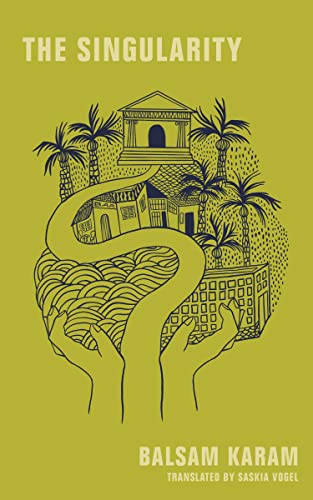

THE SINGULARITY
BALSAM KARAM
(tr. Saskia Vogel)
The Feminist Press (non-affiliate Bookshop.org link)
$16.95 all editions, available now

Rating: 4.25* of five

The Publisher Says: Lyrical and devastating, The Singularity is a breathtaking study of grief, migration, and motherhood from one of Sweden’s most exciting new novelists.

In an unnamed coastal city filled with refugees, the mother of a displaced family calls out her daughter’s name as she wanders the cliffside road where the child once worked. The mother searches and searches until, spent from grief, she throws herself into the sea, leaving her other children behind. Bearing witness to the suicide is another woman—on a business trip, with a swollen belly that later gives birth to a stillborn baby. In the wake of her pain, the second woman remembers other losses—of a language, a country, an identity—when once, her family fled a distant war.

Balsam Karam weaves between both narratives in this formally ambitious novel and offers a fresh approach to language and aesthetic as she decenters a white European gaze. Her English-language debut, The Singularity is a powerful exploration of loss, history, and memory—an experience akin to “drinking directly from a flood of tears” (Aftonbladet).

I RECEIVED A DRC FROM THE PUBLISHER VIA EDELWEISS+. THANK YOU.

My Review
: Published first but written second in Author Balsam's career.
The grandmother picked them up and held them close in sleep almost no sleep at all and then muttered that no one beyond the ruined wall wished them well and that she couldn’t bear another loss – again and again she said she couldn’t bear any more loss and even though the children didn’t understand how or why, they knew that the loss was now a part of them and that at any moment it could strike again.
It's the world of Event Horizon (review above) on Swedish soil in the camp the women live in as they have no recourse or options:
It’s your first winter in the house with the little garden, the darkness outside. Something hard hits the windows and your brother stands up, puts on his coat. After a while he comes back in, says he needs something to wipe off the dog shit from the window and the postbox. In his hand is a blue and yellow sticker that he’s torn off, like the ones you’ve seen high up on lampposts around town.

–and–
Later, your mum tells you that the first thing she was told after talking about how she had been tortured in prison was that no one would hire a person like her. One eye missing, older and not entirely fluent – it’ll be tough, the caseworker had said.
Nice people do not shout racist slogans in your face. It does not mean they are not going to behave in racist ways. The story's narrative risk-taking is more evident in its middle third:
/ do you think of her often, Marcus or Magnus asks softly / we ate bean stew with rice and yoghurt and I drank a whole pot of tea afterwards / you nod, of course you do / Gran was the happiest of us all I think / I think of her and of my grandmother you say and put the cup down / she took you in her arms and then I made sure to sleep while I had the chance / do you know anything about black holes? you later ask the counsellor / and I only got out of bed the next morning can you imagine? / inside a black hole is a place that is also a state — do you know about this? you ask, facing Patrick or Henry in his chair / a few days later Rozia's mother visited with little Rozia in her arms and a basket full of fruit /no, I'm afraid I don't know much about space, says Eric or Martin and continues to take no notes / then the two of you would meet up practically every day / you say it's called the singularity - that's what the place is called and lean over the bed / you and Rozia were like twins, we thought - the same round face and your hair as big and black / inside the singularity, the force of gravity is so strong it can't be calculated, can you imagine? you tell the counsellor / the pair of you often played in Rozia's yard and sometimes you stood by the big road even though you weren't allowed to and the soldiers could show up at any moment / that force pushes bodies together and renders the distance between them nil / because you both liked Gran's fried potatoes and her bean stew, you mostly ate at ours Mum says / you use your hands to show how no space remains between bodies in the singularity
It doesn't scan easily, but I promise you it is not flummery, a brummagem gaud of "Style" that distracts with difference without adding into meaning. In the more conventional first and last parts, the harrowing tales told do the work of impacting you in dark corners of your Safe Place, you are not safe, ever, as long as you are Other. While you are reading Author Balsam's story you are Other along with her.

It's a passionate document about grieving. It is a horrible chronicle of losing a child, losing an infant, losing losing losing without a moment of respite and never once ever giving up.

Until the final act of control is yours.

If you need a—any—content warning, do not pick this read for yourself.

Monday, March 30, 2026

BLACK BAG, award-winning poet/novelist tantalizes with identity-exploring novel


BLACK BAG
LUKE KENNARD

Zando (non-affiliate Bookshop.org link)
$14.99 ebook, available now

The Independent Press Top 40 Bestsellers: Fiction For the week ending September 29, 2026

SHORTLISTED FOR THE 2026 BOOKER PRIZE Winner will be announced on 9 November.

Rating: 3.75* of five

The Publisher Says: An out-of-work actor accepts the role of a lifetime—sitting soundlessly in a lecture theater, zipped into a large leather bag—to aid a professor’s psychological experiment. What could possibly go wrong?

In Luke Kennard’s audacious new novel, a penniless and out-of-work actor picks up a job working for Dr. Blend, a university professor who is conducting a psychological experiment. How will Dr. Blend’s students react to someone zipped into an oversized bag, sitting at the back of the lecture hall over a series of Fall lectures? The role, eagerly accepted, soon has unexpected consequences. A professor of post-humanism develops research questions of her own—in particular, can you love someone secreted away inside a black bag?—and the actor’s childhood friend forms a vision for monetizing this new situation . . .

A warped campus novel, an investigation into the crisis of masculinity, and an off-kilter love story, Black Bag is a firework of a blazingly funny and profoundly humane.

I RECEIVED A DRC FROM THE PUBLISHER VIA NETGALLEY. THANK YOU.

My Review
: I...don't know about the impact, impression, image this one's left on and in my brain. It's kind of a lot as a read. Many will flinch at the punctuation and dialogue tags being unorthodox. Others (me among 'em) will get cold collywobbles from the fact this is based around a real experiment performed in an academic setting.

I'll never be fully easy around stories where people do bizarre, kind of abuse-enabling things for money. Please see Docile by K.M. Szpara for my perfect squeam-book. This story is worse...it basically happened, though this is not non-fiction about the real events.

The premise, as you've seen, is weird...the jacket illustration is about the best match for the subject one will ever find. So there is no ambiguity or misdirection in aesthetic or factual presentation. That's where unambiguous territory ends in this story. Our actor MC, hereinafter "Black Bag" because his name is never vouchsafed to us, is slightly desperate for a paying gig, but as we discover over time he is generally slightly desperate. Dr. Blend (!) chose him well, deliberately, and knowingly as we learn over the course of the story. His job is to be physically present in the back of this psychology class, featureless and silent, for some socially experimental purpose.

It doesn't take long for the students to attempt interactions with Black Bag. Could you resist a looming presence that's giving nothing of any human sort? No eyes? No face? No noises of normal body functioning...breathing, swallowing, sighing...all muffled by the bag? What sounds uncanny would naturally become deeply unsettling, irresistibly fascinating, unnervingly alluring, as it sat among, but not a part of, the entire class. There are characters attempting to get responses from Black Bag. There are characters thinking of Black Bag, not obviously gendered, as a sexual challenge. Others as a gender-wars provocation. Others still as a threat of undetermined severity and unknown nature. What those responses start as, and how they morph through Black Bag's unresponsive presence, is utterly unexpected to the participants in the experiment.

Is that an entire over-300-page novel's-worth of story? It's true I was always interested in the read. As it happened, the story flowed from sentence to sentence with pleasurable facility of expression as one would expect of award-winning Author Kennard. At the end of the chapters...and there are 89 of 'em...I'd lose steam in the reading experience and it would take a week or more for me to feel prompted to pick it up again. I'm not entirely sure this is not related to my own participation in the experiment through the read...was I ever not part of the experiment, as in did Author Kennard not envision that the act of reading this story was another facet of responding to Black Bag? Was he also responding to the experiment by getting fascinated by the story, writing it...always an act of externalization as writing requires, at its core, a version of narrative therapy?

As we travel through the course being taught, the effects of the experiment on Black Bag himself morph and grow more and more pervasive. It's not surprising, on the one hand, that he becomes really comfortable in the protective space of the black bag. He's a struggling actor. His career prospects, before the anonymity of the black bag, weren't great. But inside the black bag, his identity is mysterious, intriguing, alluring...all things an actor loves, relies on for securing and doing his job. He wasn't being seen as those things walking around in his normal condition and now he is.

So walking around the campus and the town as Black Bag makes perfect sense, then.

Not to my claustrophobic self. I battled a sense of desperate, breathless resistance every time he put the stupid thing on.

So that might explain why I found the ending...wanting. Justine, a true and complete freak, enters into Black Bag's orbit with the firm intent of making Black Bag a conquest. Claudio, more reserved but still excitable and into Black Bag (apparently platonically though there's ambiguity and vibey-ness enough to make my gaydar ping) is the other side character who interested me. Others are involved, but honestly, they're just not that fascinating to me. Squishy, blah Sophie most of all. All the way through the read he's Black Bag, he's there as a screen for these people to project fantasies, needs, fears onto all blank and visually heavy like black objects tend to be.

The experiment, the last one Dr. Blend will conduct as he is retiring after this course, is ambiguous in design by design. That means it ends ambiguously. I was expecting that. I felt, however, this iteration of the story left the events unresolved in the dramatic sense...the final scene as an ending wasn't, the real ending as in the place the story resolved itself was earlier, with this musing inner speech from Black Bag:
Have you ever met a man who got exactly what he wanted? They always seem a little confused, even shell-shocked, They speak at one remove, as if delivering their own eulogy.
I wish to be alive, to continue to live, even should that mean a state of constant deferral. How much do you want to appear in other people's thoughts at all? As little as possible, I think. If I could, I would take everything I have ever thought about anyone else and delete it forever.

I think the story is fascinating but the not-main characters less so. I'd say this is an ideal library borrow, one that will reward you for reading it but not compel most of us to revisit it time and again.

Friday, March 6, 2026

THE BEGINNING COMES AFTER THE END: Notes on a World of Change, essays about the one true constant


THE BEGINNING COMES AFTER THE END: Notes on a World of Change
REBECCA SOLNIT

Haymarket Books (non-affiliate Bookshop.org link)
$9.99 ebook, available now

The Independent Press Top 40 Bestsellers: Non-Fiction For the week ending October 6, 2026

Rating: 4* of five

The Publisher Says: Rebecca Solnit offers a thrilling survey of the sheer breadth and scale of social, political, scientific, and cultural change over the past three quarters of a century.

In this sequel to her enduring bestseller Hope in the Dark, Solnit surveys a world that has changed dramatically since the year 1960. She argues that, despite the forces seeking to turn back the clock on history, change is not a possibility, it is an inevitability, and the nature of that change is determined by who participates and how.

The changes amount to nothing less than dismantling an old civilization and building a new one, whose newness is often the return of the old ways and wisdoms. In this rising worldview, interconnection is a core idea and value. But because the transformation has happened in so many disparate arenas, and within a longer arc of history, the scale of that change is seldom recognized.

While the backlash of white nationalist authoritarianism, Manosphere misogyny, and justifications for callousness, selfishness, economic inequality, and environmental destruction collectively drive individualism and isolation, the elements of this new world are related in their vision of more inclusion, equality, interconnection. This new vision embraces antiracism, feminism, a more expansive understanding of gender, environmental thinking, and indigenous and non-Western ideas, particularly Buddhism, as well as breakthroughs in the life sciences and neuroscience, pointing toward a more interconnected, relational world.

I RECEIVED A DRC FROM THE PUBLISHER VIA EDELWEISS+. THANK YOU.

My Review
: Collections often draw from existing bodies of work. Author Solnit began drawing acclaim for her robust, tendentious writing in the early Aughts, and has never fallen out of the cultural conversation. She won't stop telling the truth, though, so her honesty wins her detractors and even enemies across the political spectrum.

One knows a thinker is doing it right when everybody is mad at them for something.

This essay collection breaks no new ground in her public thinking. It is, if I'm honest, a highlight reel with a bit more sameness than I wanted to read. It is also a collection drawn from decades of work. I found myself thinking, "I remember this, move on," and finding it necessary to recall in the moment that it's collected not commissioned to be written anew or afresh. Not every essay chosen was necessarily up to the highest standards in the book. Again, it's a function of a collection...it's not possible to be perfect, but it's possible, like Author Solnit, to be trenchant and to add value to the consideration of organizing theme of this particular project.

Progress is relative. In any consideration of the societal norms prevailing now that has even a modest degree of perspective, things are hugely better for women, queers, trans folk, and people of color. We're always being bombarded with messaging to the contrary, for reasons y'all need to read Paul Linebarger's book to really connect with. A collection of work like this one is a good corrective to the easy-to-internalize message of the world sucks always has always will. It's true; it's also wrong; both these things can and do coexist because, faithless to your entire life's training, almost nothing in the observable universe is a binary. All physical systems are spectrums and there's mounting evidence literally everything is in fact spectrum...look into quantum physics and certainty vanishes to be replaced by probabilities (aka spectra). Author Solnit stressing that each ending is also a beginning is very much in line with this mode of thinking.

It's new enough to most of her audience that repetition is probably a good idea to deploy in examining the topic. Like any new-to-you theory, perspective, or fact, it's going to need some hammering home to become part of one's mental structural supports. I'm ahead of this curve so it wore on my nerve a bit more than it will for others. I hope you'll pick it up and give it a try if you're sinking under the wight of the world's idiocies and evils.

We need the perspective of one who has been decades in the trenches, struggling against the dying order's loud and lousy distractions, to remind us we've come far. We need to keep moving ahead. It's easier to find the will to do that if we've got a stedy hand and an encouraging voice like Author solnit's telling us to remember it can be done.

Because it has been done. It's not finished, this work; it never really is. Now, get back to it!

Sunday, January 18, 2026

THE RUNAWAYS: A Novel, flawed, interesting, but beware the animal cruelty


THE RUNAWAYS: A Novel
FATIMA BHUTTO

Verso Books (non-affiliate Bookshop.org link)
$9.99 ebook, available now

Rating: 3.5* of five

The Publisher Says: The lives of three radicalized Muslim teenagers—two from Pakistan, one from the United Kingdom—intersect in the Iraqi desert as they travel to a jihadi training camp in Mosul.

Anita lives in Karachi’s biggest slum. Her mother is a maalish wali, paid to massage the tired bones of rich women. But Anita’s life will change forever when she meets her elderly neighbor, a man whose shelves of books promise an escape to a different world.

On the other side of Karachi lives Monty, whose father owns half the city and expects great things of him. But when a beautiful and rebellious girl joins his school, Monty will find his life going in a very different direction.

Sunny’s father left India and went to England to give his son the opportunities he never had. Yet Sunny doesn't fit in anywhere. It’s only when his charismatic cousin comes back into his life that he realizes his life could hold more possibilities than he ever imagined.

These three lives will cross in the desert, a place where life and death walk hand in hand, and where their closely guarded secrets will force them to make a terrible choice.

I RECEIVED A DRC FROM THE PUBLISHER VIA EDELWEISS+. THANK YOU.

My Review
: What is the process of radicalization? It's ever more timely a question. We in the US are not accustomed to thinking the radicalization process applies to women. In this story, Author Bhutto, whose family has been deeply damaged by radicalized people, treats the process as gender-blind.

I'm glad she did that. In 2026, we need to be aware of how readily educated minds can be co-opted into fields of endeavor I can only think of as anti-social. I'm quite sure Author Bhutto knows each of these people. I'm clear she does not want us to think of them as pieces of a monolithic belief group, but people who found a path to serve a larger purpose and discover a way to live a meaningful life.

Religion being a human thing I dislike and decline to participate in, this story is one I simply read to gain some semblance of understanding for its apparent magnetic appeal to others. I'm no more clear about it now. None of these misguided young people, particularly gay young Sunny, make any tiniest bit of sense to me. I understand none of their motivations any better after the read than before. They're tedious rebellious adolescents. Their path to selfhood and separation from their parents is not one I like or support; I expected that. I wanted to understand at least a little better what inflames the young passions in this cause I don't like or wish success for; not forthcoming. Instead there is an animal cruelty scene I'll never be able to unread.

Not a success for my aims, then; as a novel curiously unsuccessful too. Three PoVs, one deep (Sunny the gay lad...what the hell, Sunny, they'll kill you when they know you're queer!); Monty the vapid rich boy, a gray fog of words and no lightning except an obsession with a girl; Anita...well, what was Anita's PoV? Why was she included when she changed the least of the three?

Monty's mother's religious faith, surprisingly, plays a very small role in this tale pf Muslims becoming radicalized. She is a believer who is not radicalized; why is she not given a role in trying to explain his path's consequences to Monty, instead of abetting him in his course? She is not at all committed to it, that's clear.

I wasn't satisfied on a craft level, then; I didn't get what I'd hoped for; so why am I rating it over three stars? Because Author Bhutto herself is part of a family (follow the link above) terribly impacted by the dreadful roiling cauldron of extremism. I felt her presence in the spaces sh left for me to contemplate the fates of her runaways. It was enough for me to connect emotionally with this flawed novel.

I warn off those squeamish about animal cruelty. Others less sensitive, particularly gay Muslim lads, might get more of a satisfying reading experience.

Thursday, November 6, 2025

HATE: The Uses of a Powerful Emotion, does what it says


HATE: The Uses of a Powerful Emotion
ÅžEYDA KURT

Verso Books (non-affiliate Bookshop.org link)
$9.99 ebook, available now

Rating: 3.75* of five

The Publisher Says: A radical re-imaging of a revolutionary emotion. An international bestseller across Europe.

Who is allowed to hate? Hatred, this grating, corrosive feeling, is omnipresent, roaring from the streets or whispered in bourgeois homes. It thrives in parliamentary speeches, conspiracy theorists' fantasies and children's bedrooms—and certainly not in secret, even if many would like to see it restricted there.

German bestselling author Åžeyda Kurt frees hatred from its banishment and sets out on the trail of its potential for resistance. She is particularly interested in people as subjects of hatred in a capitalist, racist and patriarchal world. Who are these haters and what power relations do they base them selves on? Who is allowed to hate? Which feelings paralyse, and which ones guide us to a fairer, more caring society?

Ruthlessly, humorously and going beyond any self-righteous indignation, Åžeyda Kurt explores the possibility of a serviceable hatred that connects with people who feel a deep sense of discontent and helps us to find a collective way forward.

I RECEIVED A DRC FROM THE PUBLISHER VIA NETGALLEY. THANK YOU.

My Review
: I got this title because the question "Who is allowed to hate?" is existentially important for an old queer man living in the felonious yam's interregnum of horrors.

What a privilege it is to hate, to feel free to express, and to demand others attend to, this toxic, corrosive, personal hellscape. The unexamined heights of selfishness and power arrogated to one's self via, usually, group membership is astonishing. I suspect, along with the thinkers Author Kurt draws explicitly from, that all humans feel hatred. It is the implicit...or arrogated..."right" to speak it out loud and expect that to be just ducky with those who hear you is such an outstandingly arrogant act.

It is a short book, barely two hundred pages, so of necessity it does not pretend to be magisterially comprehensive. We're given a lot of food for thought, some data, mostly though we're in what felt to me like a graduate-school party conversation about the roots and consequences of expressing hatred publicly and with impunity. Consequential parts of Author Kurt's argument are explicitly related to settler colonialism. The way these two things intertwine is best expressed by the nostrum "Peace is always the peace of the victors." The loudest criticism is very much perceptible as carefully aimed without ever having the...nerve, foolishness, whichever way you choose to go with it...to explicitly call out the current wars of extermination being pursued.

Surprisingly to me, the author does not demonize hate itself, acknowledging the role this powerful (if caustic) emotion can play in the pursuit of justice. In this time of need for fuel to resist injustice and oppression, that struck me as both welcome and wise.

As a read, the style of the writing is more free-form than not, often venturing into poetical and storytelling modes. I wasn't always thrilled by this. It's also true that one should be prepared for flashes of humor (they mostly didn't land for me) that feel...off-message, forced. So it was a case of loving the message but barely liking the messenger's voice that led me to rate the book a hair under four stars.

I still think you'll enjoy your read of it, if you're ready for what's on offer.

Wednesday, September 24, 2025

ANOINTED: The Extraordinary Effects of Social Status in a Winner-Take-Most World, sets out to do just that


ANOINTED: The Extraordinary Effects of Social Status in a Winner-Take-Most World
TOBY STUART

Simon & Schuster (non-affiliate Bookshop.org link)
$14.99 ebook, available now

Rating: 4* of five

The Publisher Says: A leading organizational theorist takes us deep into the realm of humanity’s most powerful invisible force—social status—and how it shapes everything from who we trust and what we value to which ideas and innovations change the world and who gets credit for their success.

Why does an authentic Rembrandt fetch hundreds of millions while a nearly identical painting by his most talented disciple goes for a tiny fraction of that price? What makes a restaurant “hot,” a neighborhood “up-and-coming,” or a technology “the next big thing”? Why do people often choose the same seats in recurrent office meetings? Who is most likely to interrupt someone else mid-sentence? Why do big name lawyers earn so much? Why are health disparities so pronounced? And why, when someone gets a bit ahead in life, does the small advantage so often compound?

The answer to all these questions is social status—invisible hierarchies that influence every aspect of our lives, from our health to our personal relationships and careers to how we behave in social and work settings to the tastes and preferences we form. Without it, we’d be lost and paralyzed when faced with even the simplest decisions. But it comes at a steep status works as a powerful amplifier, turning small initial advantages into insurmountable leads. Inequality is baked into its core.

Through compelling examples from business, economics, literature, art, fashion, and beyond, Anointed demonstrates how status cascades through society, creating winners and losers in ways that often have little to do with merit. And how new technology offers a glimpse of a more equitable future.

I RECEIVED A DRC FROM THE PUBLISHER VIA NETGALLEY. THANK YOU.

My Review
: Analyzing what inequality *does* is pretty much the most important topic in the vastly-more-polarized world of 2025. Why it does those things is harder to pin down because that makes the researcher confront very touchy topics like racism, sexism, class snobbery...all very germane to the topic but also more fungible due to their seeming inevitability. In a world with slavery going on in it this exact instant yet that fact being unacknowledged, unacknowledgable in fact, how does one tease out the roots of the practice? Never mind that it goes back over five thousand years. That we're sure of.

So what's the evidence we have, mountains and mountains of it, say? That inequality exists, that it does some good things...you specifically and personally have the following choices based on your status is a good way to avoid overload when making decisions...and bad ones like "this thing you need to save your life is not available to people of your status." There are obviously many points along the continuum between those arbitrarily opposed points. The author is more careful in framing his examples than I choose to be in this review. As you'd expect.

The conferred prestige of social worth by being in some specific in-group is a golden passkey to benefits at every level of human endeavor. The author does a cracking job of putting this fact before us in blue-chip language backed by stellar research done in prestigious institutions. What does it mean is permaybehaps not always as clear. Does the author, does the data more importantly, support the common perception that this is unjust?

To whom?

There is a lot of data digested, a lot of analysis done, and at the end of the read...copiously annotated and with a very impressive bibliography...I do not have an answer to give you. There may be no answer to be found in the data.

So, my idea is: look at the data left unexamined. No one can look at everything. Do this same himalaya of work with the other stuff. This book is a terrific curiosity lighter, an excellent introduction to the study of inequality, and not an epitome or summation of it. Nor does the author present it as such. He makes no claims to resolving any debates, he presents case studies...the Rembrandt one he opens with is very trenchant indeed...he leads you through facts that illuminate the issues and then expects you'll do some work.

People who vaguely wonder "why does my boss get a reserved spot near the door?" are well-advised to get this study into their grasp. Status and prestige are very important in your daily life, it behooves you to get a handle on how and (to an extent) why they exist.

The best companion read to this book is Steven Pinker's latest, When Everyone Knows That Everyone Knows...: Common Knowledge and the Mysteries of Money, Power, and Everyday Life. "What everyone knows" is a hugely powerful forever.