Showing posts with label societal collapse. Show all posts

Sunday, July 19, 2026

FORTRESS OF THE FORGOTTEN ONES, don't delay learning about them


FORTRESS OF THE FORGOTTEN ONES
FAHMIDA RIAZ
(tr. Sana R. Chaudhry)
Open Letter Books (non-affiliate Bookshop.org link)
$15.95 paperback, available now

Rating: 4* of five

The Publisher Says: Winner of the Armory Square Prize for South Asian Literature in Translation

In Fortress of the Forgotten Ones, Fahmida Riaz transports readers to fifth-century Ctesiphon, the zenith of the Sassanian Empire, in a brilliant historical novel that blends rich cultural memory with striking political relevance. Set against the backdrop of fire worshippers, Parsi kings, and the ancient Avesta, this ambitious tale follows Mazdak, the first socialist revolutionary in history, as he challenges the power structures of his time.

With vivid depictions of the Great Palace of King Qobad, the lands of the White Huns, and the impoverished masses, Riaz delves deep into the forces of history that shaped Mazdak’s quest for social justice. A masterpiece of historical fiction, Fortress of the Forgotten Ones is a powerful meditation on erasure, cultural identity, and the fight for justice that resonates with our contemporary world.

I RECEIVED A DRC FROM THE PUBLISHER VIA EDELWEISS+. THANK YOU.

My Review
: What a fascinating read! I was constantly intrigued by the strangeness of the settings, and eager to get the next interesting tidbit of knowledge.

And that's where my problem lies. I genuinely could not wait for my lessons in history to commence but I was never empathetically crushed when the history was dark. I am still not sure who the characters are, but I am very clear on what happened to them. Ctesiphon is no longer a name on a map of archaeological sites, it's a place. It vibrates with events so huge their echoing claps of collapse, of rupture, their crackling roars of inflammation, reverberate (I now see) in 2026's tragedies.

That's heady stuff. It's why there are four stars up top. There'd be six if I could remember anyone's name. Events occur...curiously impersonally. Power vanishes...but no one lost it. It's a narrative choice that other authors have made over time, and more particularly when telling sweeping historical stories. If one isn't willing to create a doorstopper like War & Peace, Jean-Cristophe, or their ilk, a narrower focus on facts and events will keep pages turning.

It worked on me. It would most likely have worked on me with many more pages, too. As things stand I'm a happy reader, sated in my desire to be presented with a very interesting story about places and events completely new to me in a landscape foreign to my eyes.

I missed the portraits that could've showed me the people is all.

Friday, March 6, 2026

THE BEGINNING COMES AFTER THE END: Notes on a World of Change, essays about the one true constant


THE BEGINNING COMES AFTER THE END: Notes on a World of Change
REBECCA SOLNIT

Haymarket Books (non-affiliate Bookshop.org link)
$9.99 ebook, available now

The Independent Press Top 40 Bestsellers: Non-Fiction For the week ending September 9, 2026

Rating: 4* of five

The Publisher Says: Rebecca Solnit offers a thrilling survey of the sheer breadth and scale of social, political, scientific, and cultural change over the past three quarters of a century.

In this sequel to her enduring bestseller Hope in the Dark, Solnit surveys a world that has changed dramatically since the year 1960. She argues that, despite the forces seeking to turn back the clock on history, change is not a possibility, it is an inevitability, and the nature of that change is determined by who participates and how.

The changes amount to nothing less than dismantling an old civilization and building a new one, whose newness is often the return of the old ways and wisdoms. In this rising worldview, interconnection is a core idea and value. But because the transformation has happened in so many disparate arenas, and within a longer arc of history, the scale of that change is seldom recognized.

While the backlash of white nationalist authoritarianism, Manosphere misogyny, and justifications for callousness, selfishness, economic inequality, and environmental destruction collectively drive individualism and isolation, the elements of this new world are related in their vision of more inclusion, equality, interconnection. This new vision embraces antiracism, feminism, a more expansive understanding of gender, environmental thinking, and indigenous and non-Western ideas, particularly Buddhism, as well as breakthroughs in the life sciences and neuroscience, pointing toward a more interconnected, relational world.

I RECEIVED A DRC FROM THE PUBLISHER VIA EDELWEISS+. THANK YOU.

My Review
: Collections often draw from existing bodies of work. Author Solnit began drawing acclaim for her robust, tendentious writing in the early Aughts, and has never fallen out of the cultural conversation. She won't stop telling the truth, though, so her honesty wins her detractors and even enemies across the political spectrum.

One knows a thinker is doing it right when everybody is mad at them for something.

This essay collection breaks no new ground in her public thinking. It is, if I'm honest, a highlight reel with a bit more sameness than I wanted to read. It is also a collection drawn from decades of work. I found myself thinking, "I remember this, move on," and finding it necessary to recall in the moment that it's collected not commissioned to be written anew or afresh. Not every essay chosen was necessarily up to the highest standards in the book. Again, it's a function of a collection...it's not possible to be perfect, but it's possible, like Author Solnit, to be trenchant and to add value to the consideration of organizing theme of this particular project.

Progress is relative. In any consideration of the societal norms prevailing now that has even a modest degree of perspective, things are hugely better for women, queers, trans folk, and people of color. We're always being bombarded with messaging to the contrary, for reasons y'all need to read Paul Linebarger's book to really connect with. A collection of work like this one is a good corrective to the easy-to-internalize message of the world sucks always has always will. It's true; it's also wrong; both these things can and do coexist because, faithless to your entire life's training, almost nothing in the observable universe is a binary. All physical systems are spectrums and there's mounting evidence literally everything is in fact spectrum...look into quantum physics and certainty vanishes to be replaced by probabilities (aka spectra). Author Solnit stressing that each ending is also a beginning is very much in line with this mode of thinking.

It's new enough to most of her audience that repetition is probably a good idea to deploy in examining the topic. Like any new-to-you theory, perspective, or fact, it's going to need some hammering home to become part of one's mental structural supports. I'm ahead of this curve so it wore on my nerve a bit more than it will for others. I hope you'll pick it up and give it a try if you're sinking under the wight of the world's idiocies and evils.

We need the perspective of one who has been decades in the trenches, struggling against the dying order's loud and lousy distractions, to remind us we've come far. We need to keep moving ahead. It's easier to find the will to do that if we've got a stedy hand and an encouraging voice like Author solnit's telling us to remember it can be done.

Because it has been done. It's not finished, this work; it never really is. Now, get back to it!

Wednesday, September 3, 2025

THEIR FOUR HEARTS, intense, appalling, urgent, amazing


THEIR FOUR HEARTS
VLADIMIR SOROKIN
(illus. Gregory Klassen; tr. Max Lawton)
Dalkey Archive Press (non-affiliate Bookshop.org link)
$17.95 all editions, available now

Rating: ?5*? but on what scale....

The Publisher Says: In many respects, Their Four Hearts is a book of endings and final things. Vladimir Sorokin wrote it in the year the Soviet Union collapsed and then didn't write fiction for ten years after completing it—his next book being the infamous Blue Lard (q.v.), which he wrote in 1998. Without exaggerating too much, one might call it the last book of the Russian twentieth century and Blue Lard the first book of the Russian twenty-first century. It is a novel about the failure of the Soviet Union, about its metaphysical designs, and about the violence it produced, but presented as God might see it or Bataille might write it.

Their Four Hearts follows the violent and nonsensical missions carried out by a group of four characters who represent Socialist Realist archetypes: Seryozha, a naive and optimistic young boy; Olga, a dedicated female athlete; Shtaube, a wise old man; and Rebrov, a factory worker and a Stakhanovite embodying Soviet manhood. However, the degradation inflicted upon them is hardly a Socialist Realist trope. Are the acts of violence they carry out a more realistic vision of what the Soviet Union forced its "heroes" to live out? A corporealization and desacralization of self-sacrificing acts of Soviet heroism? How the Soviet Union truly looked if you were to strip away the ideological infrastructure? As we see in the long monologues Shtaube performs for his companions—some of which are scatological nonsense and some of which are accurate reproductions of Soviet language—Sorokin is interested in burrowing down to the libidinal impulses that fuel a totalitarian system and forcing the reader to take part in them in a way that isn't entirely devoid of aesthetic pleasure.

As presented alongside Greg Klassen's brilliant charcoal illustrations, which have been compared to the work of Bruno Schulz by Alexander Genis and the work of Ralph Steadman as filtered through Francis Bacon by several gallerists, this angular work of fiction becomes a scatological storybook-world that the reader is dared to immerse themselves in.

I RECEIVED A DRC FROM THE PUBLISHER VIA EDELWEISS+. THANK YOU.

My Review
: Before I begin, let me say:
→H↔E↔E↔D↔T↔H↔E↔C↔O↔N↔T↔E↔N↔T↔W↔A↔R↔N↔I↔N↔G←

If you need a content warning for gore, body horror, transgressive...anything...horseman, pass by. This is Sorokin, of Blue Lard fame, playing Literature's organ with the unsettling pedal fully depressed and the weird stop pulled all the way out. Comme d'habitude, then.

So, the audience now being self-winnowed, I'm going to tell you as little as I can about the transgressions and more about why I care enough to suggest you read this tooth-ripped bloody gobbet shoved in a sweaty gym sock of a book. Because you still can, that's why. This is a litmus test for collapse. If you read it and are not repulsed fairly often, you're probably on the barricades now. If you read this and think, "oh my gawd how'd he geta away with THAT?!" twice a chapter, you're marching somewhere, and shitposting about the 2025ness of it all, and postcarding the hell out of red districts. Everyone else, the "this is repulsive!" to the "this should be banned!" folk, why are you even here? It is not safe for you to be reading anything here when you're under curfew. Off to The New York Times, now, quick as you like, no hands outside the windows!

Like Blue Lard, like Moderan, like everything Burroughs or Dennis Cooper ever wrote, this weird, janky, slightly collapsing edifice of artifice requires you to participate. Very few things in the content-consuming 2025 we live in *require* you to participate to make them work. Sorokin's works aren't simple, even simplistic, slickly made entertainments, they are viscera of story hoicked out of places you didn't think there was spare narrative flesh. There wasn't spare narrative flesh. Vital organs of awareness and complicity and oblivious cruelty are wrenched out and held up before your dumbfounded gaze...and the chapter-opening art adds to that impact.

Sound unappealing? It's not here to appeal to you, it's here to make you reach inside yourself and find the pieces...they're only going to be pieces, I don't think inchoate monstruous sadists read my blog...of these characters in crises they did not make, or try to make better in any way. It is in all of us to look away, to accept pretty surfaces on ugly things, ugly selves. That response is not possible while reading Their Four Hearts.

And that's the point of reading it. I think it could do you a power of good between retches.

Friday, September 2, 2022

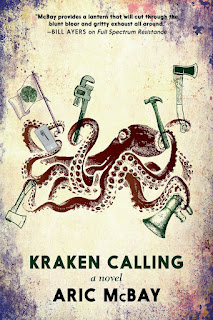
KRAKEN CALLING, best be sure to pick up *now*


KRAKEN CALLING
ARIC McBAY

Seven Stories Press
$22.95 trade paper, available now

Rating: 4* of five

The Publisher Says: A sweeping near future dystopic fantasy in the Octavia Butlerian vein of the Parable of the Sower novels.

Political activist and anarchist author Aric McBay (Full Spectrum Resistance) toggles between the years 2028 and 2051 to give us the experience, with breathtaking realism, of what might happen in the span of just one generation to a society that is already on the brink of collapse.

In 2028 environmental activists hesitate to take the fight to the extreme of violent revolution. Twenty years later, with the natural environment now seriously degraded, the revolution is brought to the activists, rather than the other way around, by an authoritarian government willing to resort to violence, willing to let the majority suffer from hunger and poverty, in order to control its citizens when the government can no longer provide them with a decent quality of life.

So it is the activists who must defend their communities, their neighbors, through a more humane and in some ways more conservative status quo of care and moderation.

And the outcome here is determined by the actions of those who resist more than it is by the actions of the nominally powerful.

I RECEIVED A DRC FROM THE PUBLISHER VIA EDELWEISS+. THANK YOU.

My Review
: Non-fiction writer (Peak Oil Survival, Deep Green Resistance) Aric McBay makes his points in fictional form. What he has done is not the usual thing for him, analyzing and contextualizing social and political trends for a left-leaning audience; this has always been his forte as a writer.

I think it still is. This novel makes a very trenchant attempt to put human skin on the bones of social movements for change, favoring equitable and reasonable restructuring of our self-evidently unsustainable lives.
“It’s always hard to tell, isn’t it? How the future could change from the smallest actions,“ Simón mused. “I believe we made things better. We bought time. Breathing room. We stopped one more. We didn’t improve things as dramatically as we hoped. But we made room for a hundred other movements to flower. Some of them failed, but some of them are amazing....”

“The tides always rise and fall for us,”Simón said. “That’s the nature of struggle. There is no guarantee, no permanent victory.”

“The work of the revolutionary is to plow the sea,” Addy quoted.”

It is indeed, Addy. It is indeed. To see your best efforts subsumed under the heaving mass of humanity in its indifference and fearful rejection of change. To know you're not ever going to prevail, no matter how many times you win. But to be sure you're harrowing the surfaces of the waters plowed and allowing things buried to come to the surface? It's a reward beyond price.

Dystopia, then, is inevitable? I don't think it is, though a lot depends on the individual's concept of "dystopia" and their tolerance for ambiguity. Most revolutionaries are absolutists, and should be kept far, far away from the levers of power. We're seeing that in the House of Representatives in the US during 2022. Revolution is hard, and requires people to be very, very hard...and these revolutionaries are obdurate, but brittle.

This means that, like Evelyn in our near-term future (2028), we need to be sure to combat that obduracy effectively. Or the 2051 sections of the story won't be a warning klaxon but a sad prediction.