Showing posts with label social contract. Show all posts

Saturday, July 18, 2026

THE SIXTH NIK, we need a new literary adjective..."Krausian"


THE SIXTH NIK
DANIEL KRAUS

Saga Press (non-affiliate Bookshop.org link)
$14.99 ebook, available now

Rating: 4.75* of five

The Publisher Says: Perfectly aligned for readers of Iain M. Banks’s The Culture series and Ursula K. Le Guin’s “The Ones Who Walk Away from Omelas”, The Sixth Nik is a galaxy spanning adventure from the New York Times bestselling and Pulitzer Prize–winning author of Angel Down and Whalefall.

Deep into space, far past the triworld outposts, beyond range of the lethal trollbot internet, soars The Sickness: a ship woven from biomatter and capable of reacting to every need of its human crew. Sisilla, a nine-year-old cultist with a brain enhanced by arcane tech known as “niks,” has boarded to investigate the enigma of Fém—a plague-riddled planet that has abruptly gone rogue.

The mysterious crew includes a faceless assassin, a beautiful engineer jigsawed by plastic surgery, a peyote-addicted medic, and—most lethal of all—a rugged, NonModded captain with a score to settle with Sisilla. Other dangers abound. A hacked robot begins to believe Sisilla is its daughter. The Sickness itself is mutating, possibly even pregnant. And the secret of Fém is more horrific than anyone could have imagined. To survive, Sisilla will need to forsake her predetermined fate and embrace the unknown.

I RECEIVED A DRC FROM THE PUBLISHER VIA NETGALLEY. THANK YOU.

My Review
: Sisilla is a weird protagonist. She knows when she will die: after she completes her "Chore," the issue/problem/situation her birth family gave her life to resolving with the aid of major surgical brain modification and enhancement by alien tech. It's...distancing, for we-the-reader and most certainly for the Inuit people her birth family sent her to live among (it's the custom, it's required). She is the fifty-fifth child to have this life wished on her before she's got anything like the ability to offer consent, and then there's the fact that she will be killed when her "Chore" is complete. The alien-tech brain mods, the "niks," will be removed from her dead brain, the next sacrificial child will be found and modified, and giant social/technical/existential problems will be solved.

I was appalled and repulsed by this system of abusive exploitation. I was revolted by the most bizarrely powered transport that took Sisilla from her place of education and preparation into distant reaches of space, that "plasmagraphic" ship's name...The Sickness...apt for the ship and the "Chore" Sisilla is to accomplish at the cost of her life. This being Author Kraus, I was expecting seriously effective descriptive language everywhere. I got it in spades. I've seldom liked a character I sympathized with *less* than Sisilla, mostly because the Omelas-ness of her world is a truly effective backdrop for creating kind feelings by way of contrast. I was actually nauseated by The Sickness, thus felt a reluctant protective urge towards the child it was created to transport. A misplaced emotion...Sisilla is not a person in need of protection, but one to be protected against as normalizing a brutal, utilitarian corruption of innocence in a very questionable enterprise. I won't call it a cause.

I finished this read in May. I wrote three reviews, discarded them for being inaccurate and overly emotive. This review goes up no matter what. Author Kraus does a tremendous job of creating fascinating, flawed, awful human being protagonists in the two books of his I have now read. I know a lot of people read Angel Down (review linked on first reference) very differently than I did...it is my favorite WWI novel, despite the war being only the setting of a far, far more damning commentary on capitalism, anomie, and sociopathy writ large. Its commentary would not be as effective as it is were it set in another time and place. That is why I call it my favorite WWI novel. I won't call The Sixth Nik my favorite SF novel, or my favorite alien-contact novel; it is my favorite body horror novel. This is a finely gauged story that evokes sympathy and disgust simultaneously. There is a direct presentation of revolting meaty awfulness. Then there is, as one thinks about it, an awful emotionally excavating familiarity to its meaty awfulness. It is a story wherein People...that giant amorphous guilt-ameliorating construct...have chosen to sacrifice the humanity and the life of a little girl to solve a problem more quickly, more expeditiously, more seamlessly, at that cost.

Is the bell ringing yet?

So this read is not for everyone, not likely to be one you'll undertake unless you are willing to spelunk some dark caves of the soul with only a little light to carry with you. It will reward you with an undistorted assessment of the world, the humans in it, and (from Shakespeare in Love, remember that film?) a bit with a dog aptly named "Positive Roy." I suspect the fairly heavy-handed symbolism of the ship's mode of propulsion...one of my few true objections to the not-subtle nature of the story's worldbuilding...will cause eye-rolling. I offer to the rolled eye a reminder of "the Snarl," an equally unsubtle but much more palatable metaphor for tech-mediated human communication, and quite possibly an equally useful organizing principle to use along with Cory Doctorow's "enshittification."

Would I recommend you read this story? Yes. Do I expect you will? Not many of you. Do I hope you will try to overcome your reluctance to engage with something this complicated emotionally?

Very much. I did. I got a lot out of reflecting, revisiting, rethinking my ideas in this story's mirrors.

Wednesday, June 24, 2026

THE ONE AND THE NINETY-NINE: Forging Identity in the Age of Social Contagion, your words aside Religion is not a good answer to Society's ills


THE ONE AND THE NINETY-NINE: Forging Identity in the Age of Social Contagion
LUKE BURGIS

St. Martin's Press (non-affiliate Bookshop.org link)
$15.99 ebook, available now

Rating: 3.25* of five

The Publisher Says: How to become yourself without losing everyone else.

We’re living in a time when it’s harder than ever to become a whole person—and to stay in authentic community. Some people dissolve into their group identities and lose themselves entirely. Others withdraw into ephemeral, online collectives they can float into and out of without consequence. Both are symptoms of the same a fragmented sense of self in an age of social contagion. This fragmentation is more than a personal crisis—it’s the soil in which hollow and often dangerous mass movements take root, offering counterfeit belonging to those desperate for meaning.

The One and the Ninety-Nine is a timely and inspiring exploration of what it means to forge a stable identity in the face of coercion, conformity, and the contagious desires of the crowd. Through compelling and original insights drawn from philosophy, psychology, and personal experience, author Luke Burgis examines how our lives are shaped by the groups we belong to—and how we, in turn, shape those groups. He offers a roadmap for engaging with modern society without losing our unique sense of personhood, and reveals the essential rites of passage and personal challenges that differentiate a life of meaning from one dictated by societal expectations.

People who are able to find their solid self and thrive in the space between the one and the many—who can act with integrity while being part of a community—live freer and more comfortable lives and become models for others. The One and the Ninety-Nine is a call to reject passive conformity, rediscover the depth of personality, and choose a life that is both truly personal and deeply connected.

I RECEIVED A DRC FROM THE PUBLISHER VIA NETGALLEY. THANK YOU.

My Review
: I don't approve of religion in general; I have an abiding bone-deep dislike for christians in particular, as a gay man with no interest in "overcoming my sinful nature" or whatever other nonsense "They" spew at me to coerce me into feeling a need to placate "Them" by behaving in a way comfortable to "Them." So when the author admitted to being a christian in the first few pages of the book, I set it aside with no intention of finishing the DRC.

I'm very worried about the undesigned social experiment we as a society are running in the form of algorithmically-mediated social media. I don't trust the tech scum to design the algorithms with the betterment of a person, but a bottom line, as its goal. Ample evidence of the role greed plays in the industry makes me all but positive no attention is paid to human needs when designing systems used by all of us.

Those two prior things are causally linked. I finished reading The Reverse Centaur's Guide to Life After AI (qv) and got more urgently agitated by what I read there; I recalled the DRC of this book, dealing with forming an authentic self. I opened it back up to see what I could glean.

Lots of christian nonsense. Parables and Bible quotes galore. Stating that (in his opinion, to be fair stated as such) people are more selfish now after *heavily*implying* the reason is we're more secular/less christian. Which...well...who's selfish, my dude? the people doing their best to navigate the world in ways you don't like, or you for saying your religion has The Answers to making people better and more empathetic? (Leave aside The Troubles, in the Ireland where you start your book, were an intra-christian spat that's half a millennium old.)

So no, I'm no big fan of his, nor did I think his shepherd/sheep needing rescue framing was anything other than seriously condescending.

But.

He's correct. The education system carefully indoctrinates us to accept Authority and seek conformity. It's a real thing, intentionally designed to do what we see around us: create sheeple. It's been done by his co-religionists for millennia now, to equally destructive effect, not ever acknowledged or examined by him. It's a giant problem for every society throughout time. Cohesion good, public morality good, conformity and scapegoating bad. Since christianity is a major source of both pressure to conform and assigning blame onto Others (those who don't pray like you, sexual-behavioral minorities, the Devil) I think it takes big brass ones not to examine *that* in great detail while quietly assuming the adding-back of religion will go a long way to fixing the very real problem he's identified.

I admire you, Brother Luke, for being so vulnerable and forthcoming about your experiences with your father's dementia. It was very moving. It was a long struggle, of course, and from the inside must've felt interminable. I do not think it was quite the connective tissue you intended it to be. It was rather more confessional than professional.

I did not, in other words, find solutions I want to support or even effect to the very real, well-stated societal stressors I'm eager to address. It's not likely to fix things by doing yet again things that helped society fracture before now.

Wednesday, April 15, 2026

THE INFINITE SADNESS OF SMALL APPLIANCES, cute while being trenchant


THE INFINITE SADNESS OF SMALL APPLIANCES
GLENN DIXON

Atria Books (non-affiliate Bookshop.org link)
$12.99 ebook, available now

Rating: 3.9* of five

The Publisher Says: In a near future, where even the smallest of appliances are sentient, a young Roomba vacuum sets out to save the humans of her house from a rising technological power in this compelling, original novel.

In a self-running, smart house, a young and sentient Roomba listens as her owner, Harold, reads aloud to his dying wife, Edie. Mesmerized by To Kill a Mockingbird and craving the human connection she witnesses in Harold’s stories, the little vacuum renames herself Scout and embarks on a journey of self-discovery.

But when Edie passes away, Scout and her fellow sentient appliances discover that there are sinister forces in their midst. The omnipresent Grid, which monitors every household in the City, seeks to remove Harold from his home, a place he’s lived in for fifty years.

With the help of Adrian, a neighborhood boy who grows close to Scout and Harold, as well as Kate, Harold and Edie’s formerly estranged daughter, the humans and the appliances must come together to outwit the all-controlling Grid lest they risk losing everything they hold dear.

I RECEIVED A DRC FROM THE PUBLISHER VIA NETGALLEY. THANK YOU.

My Review
: I was pretty sure this read would be very twee and deeply, annoyingly cute. I might've sat through a few too many playings of The Brave Little Toaster in the late 1980s, resulting in my willingness to read about Kirby the vacuum cleaner's great-grandappliance Scout the Roomba.

That's my story and I'm stickin' to it.

I was charmed by Scout as she becomes self-aware, chooses her name based on what she overhears abour Scout in Harold's reading aloud, then decides to become Atticus and fight the Grid (aka AI-dominated society) to keep Harold in his home.

Why Harold and Adrian become aware of the self-awareness of the machines around them and do not immediately light out for the hills, I could not tell you. I went with it because I also watched WALL-E raptly and accepted its lapses of logic because I was enchanted by the pluck li'l guy's selfhood. Same situation here. I did not think the worldbuilding was very well-handled but I was willing to skip it because this is a feel-good story with elements of social commentary that I agree with. As a card-carrying old man I thought Harold was very well-drawn compared to anyone else. Except Scout. She's the star of the show. A Roomba on a mission is clearly not to be messed with. Kate, the daughter he and Edie lost to her own foolish stiff-necked pride, was not much more than a place-holder, and that was just fine by me. I saw plenty of her in the flesh over the decades so no further text needed please and thank you.

So my verdict? Check it out of the library on the day you're a bit bored of the world's evils yet not steaming mad at the idiots who keep shoving their unwanted greed-increasing systems into our homes. You'll be rewarded by a gentle, sweet individual in Roomba form who wants to do the right thing by those she has learned to care for.

I wish Sam Altman and that fuck Zuck were more like Scout and less the bastards behind the Grid.

Friday, March 6, 2026

THE BEGINNING COMES AFTER THE END: Notes on a World of Change, essays about the one true constant


THE BEGINNING COMES AFTER THE END: Notes on a World of Change
REBECCA SOLNIT

Haymarket Books (non-affiliate Bookshop.org link)
$9.99 ebook, available now

The Independent Press Top 40 Bestsellers: Non-Fiction For the week ending July 21, 2026

Rating: 4* of five

The Publisher Says: Rebecca Solnit offers a thrilling survey of the sheer breadth and scale of social, political, scientific, and cultural change over the past three quarters of a century.

In this sequel to her enduring bestseller Hope in the Dark, Solnit surveys a world that has changed dramatically since the year 1960. She argues that, despite the forces seeking to turn back the clock on history, change is not a possibility, it is an inevitability, and the nature of that change is determined by who participates and how.

The changes amount to nothing less than dismantling an old civilization and building a new one, whose newness is often the return of the old ways and wisdoms. In this rising worldview, interconnection is a core idea and value. But because the transformation has happened in so many disparate arenas, and within a longer arc of history, the scale of that change is seldom recognized.

While the backlash of white nationalist authoritarianism, Manosphere misogyny, and justifications for callousness, selfishness, economic inequality, and environmental destruction collectively drive individualism and isolation, the elements of this new world are related in their vision of more inclusion, equality, interconnection. This new vision embraces antiracism, feminism, a more expansive understanding of gender, environmental thinking, and indigenous and non-Western ideas, particularly Buddhism, as well as breakthroughs in the life sciences and neuroscience, pointing toward a more interconnected, relational world.

I RECEIVED A DRC FROM THE PUBLISHER VIA EDELWEISS+. THANK YOU.

My Review
: Collections often draw from existing bodies of work. Author Solnit began drawing acclaim for her robust, tendentious writing in the early Aughts, and has never fallen out of the cultural conversation. She won't stop telling the truth, though, so her honesty wins her detractors and even enemies across the political spectrum.

One knows a thinker is doing it right when everybody is mad at them for something.

This essay collection breaks no new ground in her public thinking. It is, if I'm honest, a highlight reel with a bit more sameness than I wanted to read. It is also a collection drawn from decades of work. I found myself thinking, "I remember this, move on," and finding it necessary to recall in the moment that it's collected not commissioned to be written anew or afresh. Not every essay chosen was necessarily up to the highest standards in the book. Again, it's a function of a collection...it's not possible to be perfect, but it's possible, like Author Solnit, to be trenchant and to add value to the consideration of organizing theme of this particular project.

Progress is relative. In any consideration of the societal norms prevailing now that has even a modest degree of perspective, things are hugely better for women, queers, trans folk, and people of color. We're always being bombarded with messaging to the contrary, for reasons y'all need to read Paul Linebarger's book to really connect with. A collection of work like this one is a good corrective to the easy-to-internalize message of the world sucks always has always will. It's true; it's also wrong; both these things can and do coexist because, faithless to your entire life's training, almost nothing in the observable universe is a binary. All physical systems are spectrums and there's mounting evidence literally everything is in fact spectrum...look into quantum physics and certainty vanishes to be replaced by probabilities (aka spectra). Author Solnit stressing that each ending is also a beginning is very much in line with this mode of thinking.

It's new enough to most of her audience that repetition is probably a good idea to deploy in examining the topic. Like any new-to-you theory, perspective, or fact, it's going to need some hammering home to become part of one's mental structural supports. I'm ahead of this curve so it wore on my nerve a bit more than it will for others. I hope you'll pick it up and give it a try if you're sinking under the wight of the world's idiocies and evils.

We need the perspective of one who has been decades in the trenches, struggling against the dying order's loud and lousy distractions, to remind us we've come far. We need to keep moving ahead. It's easier to find the will to do that if we've got a stedy hand and an encouraging voice like Author solnit's telling us to remember it can be done.

Because it has been done. It's not finished, this work; it never really is. Now, get back to it!

Friday, January 2, 2026

AUDITION, Kiwi social SFF-lite that sets a tendentious trap of prose


AUDITION
PIP ADAM

Coffee House Press (non-affiliate Bookshop.org link)
$17.99 ebook, available now

SHORTLISTED for the 2026 Ursula K. Le Guin Prize for Fiction.

Rating: 4.8* of five

The Publisher Says: A genre-defying novel—part science fiction, part social realism—from one of the most powerful voices in New Zealand literature today.

A spaceship called Audition is hurtling through the cosmos. Squashed immobile into its largest room are three giants: Alba, Stanley and Drew. If they talk, the spaceship keeps moving; if they are silent, they resume growing.

Talk they must, and as they do, Alba, Stanley and Drew recover their shared memory of what has been done to their former selves—experiences of imprisonment, violence and misrecognition, of disempowerment and underprivilege.

Pip Adam’s uncategorisable new novel, part science fiction, part social realism, asks what happens when systems of power decide someone takes up too much room—about how we imagine new forms of justice, and how we transcend the bodies and selves we are given.

I RECEIVED A DRC FROM THE PUBLISHER VIA EDELWEISS+. THANK YOU.

My Review
: Like Stand on Zanzibar a half-century ago, this story is making a point along multiple fronts of effort. Stylisically it's resolutely avant-garde, modernist, and uses that tradition of liberation from centuries old linear narrative convention to oppose itself as completely as possible. Oppose from what? That verb needs a subject!

It takes the opportunity to set oppositional positions to, well, modernity; the way the modern world steadily relentlessly inexorably shrinks the essential liberty, autonomy, self-determination of Humanity. This is a powerful theme to pursue. It leads into some dark meditations on confinement.

It is most evidently a story in support of the anticarceral abolitionism gaining ground among progressives. More quietly it enables, encourages, examination of the ways individuals accept labels and thus limitations, even when the labels aren't very good fits. It's not foregrounded the way opposition to the carceral state is. It's there for you to consider.

I enjoy novels that expect me to bring my own ideas and knowledge to bear on reading them. I enjoy being asked to hold a thought more than a page or two before the thought pays off, hooks into another thought to make a distinctive picture. It is a pleasure to be exercised and entertained and experience elucidation of a viewpoint while immersing oneself in lovely phrasemaking.
Alba searches around her body and there is not an ounce of homesickness. She misses nothing. She was born into the world and it was not happy to see her. This isn’t her home. She doesn’t want to take advantage or be any more of a burden than she already is here. They hadn’t asked her to come, she hadn’t asked to be there. It isn’t a welcome—it’s an extremely advanced form of attack and defence.
I think that, in its compactness and its rhythm, carries more than surface meaning. Alba's is a point of view I think many could and should attend to. Her sense of...wrongness...is it all external? Is it self-recognition without self-acceptance? Is Alba...are Drew and Stanley as well...forced to keep talking as the means of propelling their starbound prison moving away from Earth in order to get their pasts out of their heads? What does the taking up of physical space have to do with the implied relationship to psychic...emotional...space? All the way into eternal exile and utter Othering in order to get permission to be ecstatically oneself. A price paid without any kind or sort of reward is rare, if one becomes an other self in response to it. A different self, an intentional self, a truthful self.

The ending of this story offers that future of selfness to the giants. It's not found the way a lot of readers will be comfortable with. But if you can read about people told they are too much for this world being thrust out of that world by being squashed into sealed containers and hurled into lethal vacuum, you really should look at why this particular ending bothers you (if it does..I found it the most liberating part of the story).

Pip Adam is a writer who reckons with ideas in her fiction. It's not always clear to me that I'm on the same train of thought as she is. That is, for me as a reader, very interesting and gives a dynamism to the words I'm reading. I experience the need to consider, "did I read that sentence and change my view of the story I thought I was reading by Pip Adam's design or my own?" very involving.

It's a story I felt repaid my attention with well-honed ideas I'd had in duller forms before that. I'd wished, during the read, for...ornamentation...flourishes...a bit of zhuzhery. I can't say the directness of prose was unpleasant or uninvolving, so I can't call it a flaw. I can say that me, reader me, the id that devours Story, wanted it; so I can't offer a perfect five but I can't take much away from that height. It's a cruel place to land:
It’s a strange feeling to know that they will never have to explain this to any of their kind. They will never return. They had been sent to die. That’s clear now. Maybe they had been sent to take over this world, as some kind of front guard or maybe no one that sent them could imagine this. But they are lost to their own world now. They don’t belong where they have have come from and they don’t belong here. They are the only ones of their kind who will make it.
Pip Adam made it.

Thursday, November 6, 2025

HATE: The Uses of a Powerful Emotion, does what it says


HATE: The Uses of a Powerful Emotion
ŞEYDA KURT

Verso Books (non-affiliate Bookshop.org link)
$9.99 ebook, available now

Rating: 3.75* of five

The Publisher Says: A radical re-imaging of a revolutionary emotion. An international bestseller across Europe.

Who is allowed to hate? Hatred, this grating, corrosive feeling, is omnipresent, roaring from the streets or whispered in bourgeois homes. It thrives in parliamentary speeches, conspiracy theorists' fantasies and children's bedrooms—and certainly not in secret, even if many would like to see it restricted there.

German bestselling author Şeyda Kurt frees hatred from its banishment and sets out on the trail of its potential for resistance. She is particularly interested in people as subjects of hatred in a capitalist, racist and patriarchal world. Who are these haters and what power relations do they base them selves on? Who is allowed to hate? Which feelings paralyse, and which ones guide us to a fairer, more caring society?

Ruthlessly, humorously and going beyond any self-righteous indignation, Şeyda Kurt explores the possibility of a serviceable hatred that connects with people who feel a deep sense of discontent and helps us to find a collective way forward.

I RECEIVED A DRC FROM THE PUBLISHER VIA NETGALLEY. THANK YOU.

My Review
: I got this title because the question "Who is allowed to hate?" is existentially important for an old queer man living in the felonious yam's interregnum of horrors.

What a privilege it is to hate, to feel free to express, and to demand others attend to, this toxic, corrosive, personal hellscape. The unexamined heights of selfishness and power arrogated to one's self via, usually, group membership is astonishing. I suspect, along with the thinkers Author Kurt draws explicitly from, that all humans feel hatred. It is the implicit...or arrogated..."right" to speak it out loud and expect that to be just ducky with those who hear you is such an outstandingly arrogant act.

It is a short book, barely two hundred pages, so of necessity it does not pretend to be magisterially comprehensive. We're given a lot of food for thought, some data, mostly though we're in what felt to me like a graduate-school party conversation about the roots and consequences of expressing hatred publicly and with impunity. Consequential parts of Author Kurt's argument are explicitly related to settler colonialism. The way these two things intertwine is best expressed by the nostrum "Peace is always the peace of the victors." The loudest criticism is very much perceptible as carefully aimed without ever having the...nerve, foolishness, whichever way you choose to go with it...to explicitly call out the current wars of extermination being pursued.

Surprisingly to me, the author does not demonize hate itself, acknowledging the role this powerful (if caustic) emotion can play in the pursuit of justice. In this time of need for fuel to resist injustice and oppression, that struck me as both welcome and wise.

As a read, the style of the writing is more free-form than not, often venturing into poetical and storytelling modes. I wasn't always thrilled by this. It's also true that one should be prepared for flashes of humor (they mostly didn't land for me) that feel...off-message, forced. So it was a case of loving the message but barely liking the messenger's voice that led me to rate the book a hair under four stars.

I still think you'll enjoy your read of it, if you're ready for what's on offer.

Saturday, October 11, 2025

FUCK NEOLIBERALISM: Translating Resistance, ignore the "worty dirds" to focus on what needs resisting


FUCK NEOLIBERALISM: Translating Resistance
SIMON SPRINGER
PM Press (non-affiliate Bookshop.org link)
$9.99 ebook, available now

Rating: 5* of five

The Publisher Says: In a long history of ruination and destruction, neoliberalism is the most recent and virulent form of capitalism. This book is a call to action against the most persistent and pestilent disease of our time. Translated into over twenty different languages, the book offers a call to action that transcends local contexts and speaks to the violent global conditions of our neoliberal age.

Fuck Neoliberalism: Translating Resistance is a worldwide middle finger to the all-encompassing ideology of our era.

With translations into languages from across the globe, including Mandarin, German, Indonesian, Spanish, Hindi, Italian, Korean, and many more, this book brings those translations together, accompanied with short essays from each translator that explain the reasons why they translated the text and describes the struggles against neoliberalism in their regions. With these translations, this book highlights the international nature of resistance to the totalitarian ideology of neoliberalism.

Featuring a cover produced by renowned artist Ed Repka (a.k.a. the King of Thrash Metal Art), this internationalized, heavy-metal rant against the all-powerful ideology highlights a chink in its armor. When people across the world find a way to communicate a shared message and stand together, resistance can be both beautiful and inspiring.

I RECEIVED A DRC FROM THE PUBLISHER VIA EDELWEISS+. THANK YOU.

My Review
: You're on board with the sentiment or you're not; but on or off, it would do all y'all a power of good to read words from those who've chosen to translate this (surprisingly mild, given its épater-la-bourgeoisie title) essay into their languages of choice, usually of their homelands.

Understand that book-banning, speech-squelching, and thought-controlling has gone on forever and becomes the default when too many "nice" people do not make the affirmative effort to resist it. Yes, even when it bothers you, even when it...gasp...offends you. Unless the speech is advocating violence, hate crimes, or censorship of those disliked by the powerful, it is in your personal interest to actively support free speech.

Worty dirds are not grounds for censorship. Rude gestures are not grounds for censorship. Demands for brown-skinned people to "go home" are. Demands for personal enemies to be persecuted by state power are. Let's stay clear about this.

Even if you never read a word of this loudmouthed little book, buy one to support firebrand publishers in their mission to save us from the worst consequences of our lazy, "nice" conformity.

Saturday, November 9, 2024

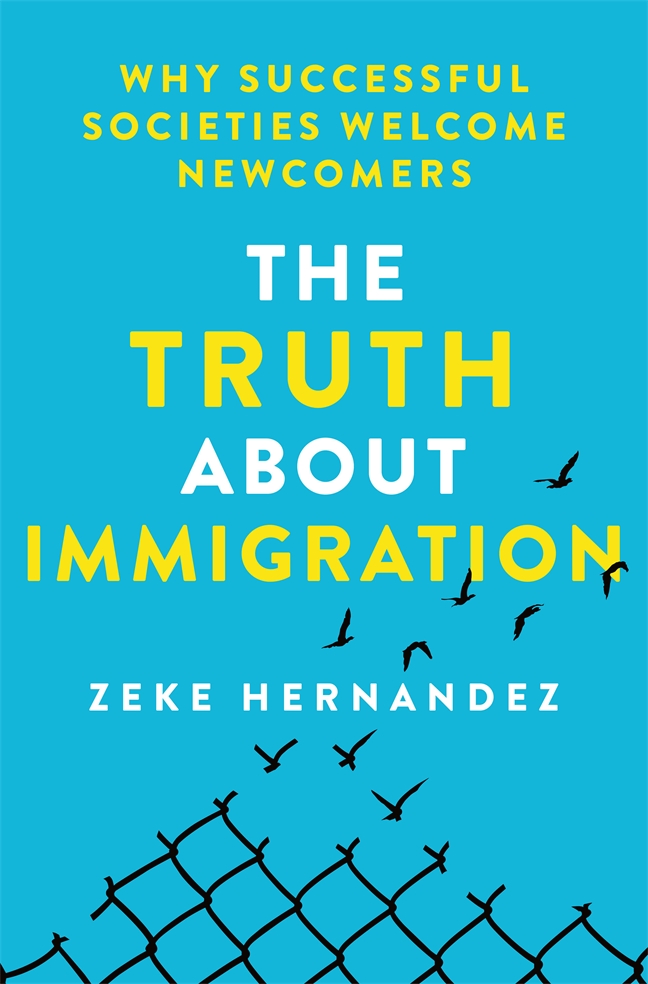
THE TRUTH ABOUT IMMIGRATION: Why Successful Societies Welcome Newcomers, careful, honest, trenchant and tendentious


THE TRUTH ABOUT IMMIGRATION: Why Successful Societies Welcome Newcomers
ZEKE HERNANDEZ

St. Martin's Press
$30.00 hardcover, available now

Rating: 4* of five

The Publisher Says: The go-to book on immigration: fact-based, comprehensive, and nonpartisan.

Immigration is one of the most controversial topics in the United States and everywhere else. Pundits, politicians, and the public usually depict immigrants as either villains or victims. The villain narrative is that immigrants pose a threat—to our economy because they steal our jobs; our way of life because they change our culture; and to our safety and laws because of their criminality. The victim argument tells us that immigrants are needy outsiders—the poor, huddled masses whom we must help at our own cost if necessary. But the data clearly debunks both narratives. From jobs, investment, and innovation to cultural vitality and national security, more immigration has an overwhelmingly positive impact on everything that makes a society successful.

In The Truth About Immigration, Wharton professor Zeke Hernandez draws from nearly 20 years of research to answer all the big questions about immigration. He combines moving personal stories with rigorous research to offer an accessible, apolitical, and evidence-based look at how newcomers affect our local communities and our nation. You'll learn about the overlooked impact of immigrants on investment and job creation; realize how much we take for granted the novel technologies, products, and businesses newcomers create; get the facts straight about perennial concerns like jobs, crime, and undocumented immigrants; and gain new perspectives on misunderstood issues such as the border, taxes, and assimilation.

Most books making a case for immigration tell you that immigration is good for immigrants. This book is all about how newcomers benefit you, your community, and your country. Skeptics fear that newcomers compete economically with locals because of their similarities and fail to socially assimilate because of their differences. You'll see that it's exactly the opposite: newcomers bring enduring economic benefits because of their differences and contribute positively to society because of their similarities. Destined to become the go-to book on one of the most important issues of our time, this book turns fear into hope by proving a simple truth: immigrants are essential for economically prosperous and socially vibrant nations.

I RECEIVED A DRC FROM THE PUBLISHER VIA NETGALLEY. THANK YOU.

My Review
: Do you like to eat? Thank an immigrant, an economic migrant, as you chow down on those tomatoes and cucumbers.

*You* sure didn't go pick 'em.

Do you use Google, chat on Twitter, watch TikTok every day? Thank an immigrant. In this case, you're thanking said immigrant with your data being harvested to fatten his (they're all men, at least so far) coffers.

But that law'n'order fetish you got goin' on...surely that's the real reason to oppose immigration, to keep 'em out and chuck 'em out when they come anyway, right? The president-elect has more felonies on his record than a random immigrant. But they cost us money! Take money from needy Murrikinz! You're thinking of the GOP in the various legislatures. Immigrants pay taxes through their (upright & honest, or shady) employers. They're barred by law from getting any of those taxes back.

The author, unlike me, is apolitical. He has done the research and these are the facts he found. If you support immigration, read this book for talking points. There's a lot of 'em. If you don't support immigration, why the hell are you reading my reviews? If someone you care for is anti-immigrant, maybe this non-partisan voice will reach them. It sure can't hurt to try.

I'm not calm enough to care to engage with people like that. They're wrong. I needn't fuss about it because that kind of wrong loves a fight. Got nothin' left for that uselessness. If you do, great! And here's you a swiss army knife of evidence-backed facts to use in your noble work of Enlightenment.

Wednesday, October 23, 2024

THE SOUL OF CIVILITY: Timeless Principles to Heal Society and Ourselves, a concept that works to call forth better behavior


THE SOUL OF CIVILITY: Timeless Principles to Heal Society and Ourselves
ALEXANDRA HUDSON

St. Martin's Press
$29.00 hardcover, available now

Rating: 5* of five

The Publisher Says: Alexandra Hudson, daughter of the "Manners Lady," was raised to respect others. But as she grew up, Hudson discovered a difference between politeness―a superficial appearance of good manners―and true civility. In this timely book, Hudson sheds light on how civility can help bridge our political divide.

From classical philosophers like Epictetus, to great twentieth-century thinkers like Martin Luther King Jr., to her own experience working in the federal government during one of the most politically fraught eras in our nation's history, Hudson examines how civility―a respect for the personhood and dignity of others―transcends political disagreements. Respecting someone means valuing them enough to tell them when you think they are wrong.

It’s easy to look at the divided state of the world and blame our leaders, the media, or our education system. Instead, we should focus on what we can accomplish ourselves. The Soul of Civility empowers readers to live tolerantly with others despite deep differences, and to rigorously protest wrongs and debate issues rather than silencing disagreements. A robust public discourse is essential to a truly civil society, and respecting others means telling hard truths. If enough of us decide to change ourselves, we might be able to change the world we live in, too.

Provocative, personal, and acutely relevant, The Soul of Civility is an essential book for our era.

I RECEIVED A DRC FROM THE PUBLISHER VIA NETGALLEY. THANK YOU.

My Review
: A definition and an etymology:
civility /sĭ-vĭl′ĭ-tē/, noun.
  1. Courteous behavior; politeness.
  2. A courteous act or utterance.
  3. The state of society in which the relations and duties of a citizen are recognized and obeyed; a state of civilization.

civility (n.) late 14c., "status of a citizen," from Old French civilite (14c.), from Latin civilis "relating to a citizen, relating to public life, befitting a citizen; popular, affable, courteous" (see civil). Later especially "good citizenship" (1530s). Also "state of being civilized" (1540s); "behavior proper to civilized persons" (1560s).
The source of civility, then, is the same as the source of citizenship and civilization. All of these are concepts for the state of living together; the implication is, in harmony or at least not at daggers drawn. These concepts then give rise to the precepts that make the concepts concrete...from adjective to noun.

The ideas in this book are very much attempts to concretize the concept of being civil, being a citizen among citizens, to allow and encourage a general state of civility to flourish in wider society. The very best way, in centuries of study on the subject, to effect this change is to begin in one's own self. Applying the principles of civility feels impossible when one sees so little evidence for it outside one's orbit...often enough inside it. The idea of this book is to afford the reader some evidence that this internal work is, in fact, a worthwhile use of time and effort.

I'll tell my own story: I live (involuntarily if you're wondering as well as inalterably for complicated reasons I cannot control) with someone I deeply dislike and look down on, an active alcoholic who possesses no sense of his own affect on others whether drunk or sober. I'm never going to think of someone like that as worthy of respect. However, he is. And applying Auther Hudson's definition of forgiveness as regards his behaviors' effects on me:
Forgiveness doesn’t mean forgetting. It doesn’t mean allowing the same people or types of people to repeatedly harm us. Nor does forgiveness mean sweeping grievances under the rug, failing to confront the hurt in our own souls or confronting others with the hurt they’ve done to us. Forgiveness requires accountability, personal responsibility. It means respecting ourselves and others enough to be honest with them about the harm they may have caused.
...has made a huge difference in how my day-to-day life feels to me. I take accountability for the harms my judgment and anger cause; I offer myself forgiveness; and resolve to do better. Every single time I have applied this principle, I have experienced a positive change in his behavior. It is a process; it has fits and starts; I fail, he fails...but the point remains that, after seven years of angry resentment and much blaming and shaming from me to him, differences are stark and plain when they occur.

I think the fact that they *can* occur in this fraught a situation is proof that the author's point...being civil calls forth better from not only one's self but the others in our civilized orbit...is correct, and her instructional writing is very helpful.

Will it work in all situations? It has in all the situations where I have applied it, from angry, unhappy service providers to rude drunks. I'm pretty sure that's a testimonial to the conscious application of the learning I derived from this read.

It's a pleasant task to follow this erudite woman as she offers her learning to us. The fact is her beginnings in a world governed by manners is an enviably high platform from which to jump into the long, long history of writing on the subject of civility and its applications. I encourage even the most mannerly to engage with this expansion of the need for, and reasons behind, the practice of them in the society we live within.

Monday, September 9, 2024

THE IDEAL STATE: A Model Based on Analysis of Savagery, Feudalism, Capitalism and Beyond


THE IDEAL STATE: A Model Based on Analysis of Savagery, Feudalism, Capitalism and Beyond
TAYYIB AHMAD TAYYIB

Ideal Publishing Inc.
$18.00 Kindle edition, available now

Rating: 3* because I fully agree with the politics.

The Publisher Says: Previously published as "The Evil Within Evolution of Social Systems & The Ideal State"

This is a fully revised and expanded edition. Have you not wondered what kind of a country you would want to live in? What policies of its government would guarantee a secure and happy life for you and your children? We need to look at our past history and understand how our previous generations have fared under different social systems. Only then we can decide how a state should be structured and what policies it should adopt to ensure security and well-being of its population. It is important to know what makes a state into an imperial power and drives it to subjugate other states and peoples and exploit them. How could this tendency be avoided?

All civilized states and societies are moving towards more and more socialism and democratic control of their governments, despite temporary setbacks. What do you think lies ahead? States like Norway, Sweden, Denmark and most other European states are referred to as "social democratic states". Their citizens enjoy free education, universal health care and a guaranteed retirement income. China calls its socio-economic system as "Socialism with Chinese Characteristics". Despite being a developing country, it has eliminated extreme poverty and offers free high-school education to all its citizens and subsidized higher education and virtually universal health care. Bernie Sanders pleaded for a "democratic socialism" in the United States in his bid for the presidency of the US, a few years ago.

In this work, you would find a comprehensive analysis of the development of socio-economic and political systems from the age of savagery to feudalism and capitalism. You would find why, and how, capitalism leads to extreme exploitation, imperialism and violence, why it needs to be discarded and why a democratic socialist future for mankind is inevitable. The resulting ideal state should ensure equality of social, economic and political rights for all, without any distinction - racial, national, or gender. It should eliminate all kinds of economic exploitation resulting in development of all individuals to their full potential. Numerous illustrations are included and many political thinkers, economists and political leaders have, indirectly, contributed to this work. Quotations from their works are included on specific issues. Imagine what such an ideal state, or states, would mean for you and for the rest of humanity. Find out how humanity is progressing in that direction now and how this process would accelerate in the future. Let us not give up hope. The future of humanity is bright!

I RECEIVED A DRC FROM THE PUBLISHER VIA NETGALLEY. THANK YOU.

My Review:
This book is preaching to the choir, in terms of my belief the author is onto something good in his negative assessment of capitalism.

But, for four hundred pages, the prose is a lot like the synopsis above. That is to say, it's not fluid and readable like Yannis Varoufakis and Thomas Piketty (as translated by Arthur Goldhammer, anyway) are. I'm not in good conscience able to recommend the read to laypeople. If you're interested in leftist economics and social policy, come to the altar, but check your expectations at the door.

Thursday, August 1, 2024

OF SAINTS AND MIRACLES, family tragedy that creates a folk hero


OF SAINTS AND MIRACLES
MANUEL ASTUR
(tr. Claire Wadie)
New Vessel Press
$16.95 trade paper, available now

Rating: 4.5* of five

The Publisher Says: This mesmerizing novel opens with a fratricide in a beautiful if impoverished region of northern Spain.

The perpetrator, Marcelino, lives alone in his parental home where he recalls having doted on his baby brother and sought to protect their mother from their father’s drunken rages. Author Manuel Astur’s poetic language and seamless blend of lyricism with the grotesque renders this book a treasure for the reader that includes the mother’s bewitching tales about the sun, the moon, and an invisible horse-drawn carriage of death. Glimpses into other villagers’ lives reveal a community that gathers to slaughter pigs for feasts and to confront a mysterious plague of white worms.

The mountainous green of rural Asturias is as much a character as these residents, from whom Marcelino flees to the wild peaks after his brother’s slaying, becoming a cult hero as he evades authorities. Of Saints and Miracles is a sensuous portrayal of an outcast’s struggle to survive in a chaotic world of both tragedy and magical splendor.

I RECEIVED A DRC FROM THE PUBLISHER VIA EDELWEISS+. THANK YOU.

My Review
: What startled me most was being in medias res, knowing the murderer from the get-go and the inside out. That is a subversion of expectations that made me stick to the tale as it was being told. Normally I read murder-themed stories while looking for clues and hints from the off. I was made to think a different way about this true-life tale.

It worked in this read's favor, as the way the story's written is a joy to read:
When you see a weed in the vegetable plot you pull it out. When you've got more chickens than you need, you wring the neck of one and chuck it in the pot. When some dog mounts your bitch and she gives birth to a litter, you choose the best puppy, put the rest in an old potato sack with some stones and throw the sack in the river. When an apple tree no longer bears fruit, you cut it down and chop it up for firewood. When the grass in your field gets too long, you cut it, gather it up and store it in the hayloft. When a man in a suit comes and shows you some papers and tells you some stuff about mortgages and wants to take away your vegetable plot, your hens, your bitch and your fields, you defend yourself. Even if this man in a suit is your brother. And they can call you a revolutionary and talk about you on TV and in the papers and say who knows what about the oppressed peoples, or the last remaining guerrilla, but the truth is simpler, it's always simpler. And the truth is that you have to do what you have to do.
–and–
(Marcelino/)Leno's mother told him to give the little old lady a kiss. She smelled of cookies, earth, and bleach. Then she gave a toothless smile like a baby magpie and made a gurgling sound as if she had sand in her throat. She gurgled some more and his mother understood, even if he didn't. That was about all he could remember of the old world. The yellow smell of human piss and past lives filled with misery. A white washbowl with a tear shaped chip in its enamel, glowing in the darkness like an apparition. A one-eyed ginger cat asleep at the old woman's feet. A tatty old oil cloth on a rickety table. A few empty hooks, blackened by grease over the years. A handful of dried ears of corn tied up in a piece of cloth. Shadows dancing on the filthy wall. That's about it.

You like it, you don't...I don't think anyone can make much of a case that this isn't a robust storytelling voice. The way the voice comes across in telling this sad, brutal tale of a simple man solving problems he doesn't understand as best he can suited this reader as well as anything could.

The fearsomeness of committing a fratricide is never far from Marcelino's mind.
You see, this wound hurts just as much as yesterday’s wound, which hurt as much as the one before, and the one before the one before that, and as much as the first wound, the original wound that the first man feared. And though this wound is bleeding in the same way as all wounds bleed, and blood has always been the same, this wound thinks itself unique.
–and–
Death is never heroic. Life can be, but not death. Death comes to us all, but we know that if a woman watches over us on our deathbed, we’ll go to heaven.
–and–
All the dead are good because they are no longer alive and can therefore be imagined. As with fools and saints, we can lie about them because they can't defend themselves. They are a tale with countless morals, in illustration of whatever you like, a myth to be molded. The dead don't belong to the dead; the dead are ours.

These are simple thoughts, basic, grounded—even rooted—in the life of a man who has no sophisticated veneer to hide his innocent belief that the world can, and must, be made to make sense. Even or especially when it doesn't. Marcelino, based on a man called Tomasín whose life ended in exactly this concatenation of nightmares, becomes a symbol of the distant and rural province of Asturias's resistance to the rapidly modernizing economy of Spain after Franco's 1975 death. No one who's ever had a credit card or a cellphone contract won't, in some small way, fail to comprehend this desire to see someone stick it to The Man. No one whose family is normal won't, in some small way, recognize the urge to commit murder of a sibling who's just done you dirt.

Author Astur set out to tell us a story of a world, an old one, that is losing its battle to remain as it is. A world that pays attention, not compound interest. A world where Marcelino, salt of the Earth that he is, can be so in tune with Life that it becomes Art before his fulfilled eyes:
Just as a sun-soaked stone radiates heat for a while after nightfall, there is a point on still summer evenings whe objects appear to shine, as if to give back part of the generous daylight they've received. In such moments, Marcelino would stop what he was doing — clod of earth on the hoe, spade sunk deep in the hay, scythe dripping with fresh green blood — to stand up straight, wipe his brow with the back of his hand and contemplate the valley below. Everything would be gleaming, chiming like a bell of golden light. He would let his eyes fill with sky.

And so, as the sun set on that July evening, Marcelino stopped and contemplated. The house, the stilt granary, the cart with its shaft reaching skyward, the dry straw, the ears of corn, the cows in a single spine coming home along the track, the dog’s bowl, the rusty drum among the nettles, the axe in the tree stump, the woodchips and the logs, the sawdust on the ground, even the moss that hugged the stones in the walls of the small vegetable plot, even the trees in the nearby woods and the mountain peaks: everything shimmered, silhouetted against the deep-blue sky, in which a single bright star heralded the coming of a new age. Everything, that is, except the large bloodstain in the sawdust, and his brother’s body, both so dark they seemed to trap the light, as if the black ink that was slowly flooding the valley was seeping directly from them, saturating the sky and drawing the shapes of bats, which began to dance around the yellowish light of Cobre’s lone street lamp.

We go into this read certain murder is Wrong, murderers must be caught and required to suffer punishment; and come out without such a comfortable Certainty. Did Marcelino do wrong by killing his wicked brother? Yeah. Was he Wrong, was his action a rip in the fabric of society?

Dunno about you, but I came out of this read not at all sure. Read it soon, tell me what you thought.

Sunday, January 14, 2024

ACTIVATING THE COMMON GOOD: Reclaiming Control of Our Collective Well-Being, a goal more important than ever


ACTIVATING THE COMMON GOOD: Reclaiming Control of Our Collective Well-Being
PETER BLOCK

Berrett-Koehler Publishers
$27.95 hardcover, available now

Rating: 5* of five

The Publisher Says: A powerful, inspiring, and achievable vision of a society based on cooperation and community instead of competition and commodification.

This book counters the dominant and destructive story that we are polarized, violent, selfish, and destined to consume everything in sight. That is not who we are.

The challenge, Peter Block says, is that we are suffering under an economic theology that is based on scarcity, self-interest, competition, and infinite growth. We’re told we can purchase and outsource all that matters. Block calls this the “business perspective narrative.” It dominates not only the economy but also architecture, faith communities, journalism, arts, neighborhoods, and much more.

Block offers an alternative in the “common good narrative.” It embodies the belief that we are basically communal and cooperative. And that we have the capacity to communally produce what we care most raising a child, safety, livelihood, health, and a clean and sustainable environment.

This book describes how shifts to the common good perspective could transform many areas, fostering journalism that reports on what works, architecture that designs habitable spaces creating connection, faith collectives that build community, a market that is restrained and local, and leadership and activism that build social capital by creating trust among citizens. With these shifts, we would fundamentally change the world we live in for the better.

I RECEIVED A DRC FROM THE PUBLISHER VIA EDELWEISS+. THANK YOU.

My Review
: A business guru wrote this book, this loud call to rein in our enshrined attitude of greed and selfishness. That delights me more than anything else about the read. I resonate like a struck bell to the author’s call to rethink our cultural norms. Given how entrenched the mindset of me first, me on top is, the best thing to do is to begin the process of change at the personal and local level.

Visit the website, The Abundant Community, that the author and his collaborator John McKnight run. It is chock-a-block with ideas and resources to accomplish this. The book at hand is an excellent read to guide you to the areas that you most need to focus on, be they personal or community based. Our individual well-being is tied closely to our social well-being and this is a frequently discussed facet of life that the author is at pains to weave throughout the short book. From the Introduction, entitled “We Are Not Divided”, forward, Author Block makes the case for beginning one’s journey with the personal commitment to calibrating one’s mind to a "we are not alone" mindset. The difference between "alone" and "divided" recurs throughout the book, very much ringing through the ideas for actions we as citizens of this system of divide-and-conquer tactics can effectively take.

There is nothing at all unattainable in any of the goals Author Block offers to us as models for effecting change. That he offers them in actionable formats and in digestible, relatable examples makes the read both pleasant, easy, and short and offers real-world results to those willing to undertake his tried-and-tested steps toward a common-good focused world.

Thursday, December 22, 2022

THE ENGAGEMENT: America's Quarter Century Struggle Over Same-Sex Marriage & PROUD BOYS AND THE WHITE ETHNOSTATE: How the Alt-Right Is Warping the American Imagination


PROUD BOYS AND THE WHITE ETHNOSTATE: How the Alt-Right Is Warping the American Imagination
ALEXANDRA MINNA STERN
Beacon Press
$24.95 hardcover, available now

Rating: 4* of five

The Publisher Says: A critical analysis of the intellectual productions of the alt-right—necessary reading for all who seek to counter its appeal and expansion.

The "alt-right" has sadly become a household term. From a loose movement that lurked in the shadows in the early 2000s, it has achieved a level of visibility that has allowed it to expand significantly through America's cultural, political, and digital landscapes. But the alt-right is also mercurial and shape-shifting, encompassing a range of believers and ideas that overlap with white nationalism, white supremacy, and neo-Nazism. It provides a big and porous tent to those who subscribe to varying forms of race and gender-based exclusion.

In Proud Boys and the White Ethno-State, historian Alexandra Stern begins with the premise that alt-right literature, most of which exists online, should be taken seriously as a form of intellectual production that has distinct lineages, assumptions, and objectives. Applying the tools of historical analysis, cultural studies, and other interdisciplinary approaches, she explores its conceptual frameworks, language, and narratives. In doing so, she is able to probe the deeper meanings and underlying constructs, concepts, and frameworks that guide the alt-right and animate its overlapping forms of racism, xenophobia, sexism, and other social hostilities.

Like George Lakoff's Don't Think of an Elephant, Proud Boys and the White Ethno-State is a key tool for combating today's white supremacist ideologies.

I RECEIVED A DRC FROM THE PUBLISHER VIA EDELWEISS+. THANK YOU.

My Review
: What?! A four-star political review at Christmas?! That...that's not what you do, Sirrah.

Let's say I've still not learned my lesson. Political stuff is very much not what most people I know want to read, at least at this time of year. Y'all should read it because...never mind. No one's going to eat their spinach because I said to.

What I *will* say to the two or three whose noses are as yet unwrinkled and eyes still open is that the author delves deep into the cesspit of this reprehensible "ideology"'s apologetics. She does so without coming across as minatory or dismissive, as I do. She clearly shows what the "reasoning" is behind this claptrap and, being an academic, points out where it's deficient in its grasp.

What makes that so very valuable is that we, the unconvinced but still engaged, don't have to experience the awfulness of a people trying to talk themselves into believing they are Superior. I can barely type that sentence without wanting to laugh while barfing.

Anyway. The point of me reviewing it is to say you definitely would learn a LOT about the January 6th events if you read this; you would understand a lot more clearly why the movement is moving peristaltically through the Body Politic of the US; and your grasp of what is at stake in 2024 will impel you to action in place of apathy.

Learn what you don't know that you don't know.

++++++++++++++++++++++++++++++++++++++++++++++++++++++++++++++++


THE ENGAGEMENT: America's Quarter Century Struggle Over Same-Sex Marriage
SASHA ISSENBERG
Pantheon Books (Non-affiliate Amazon link)
$5.99 Kindle edition, available now

A NEW YORK TIMES NOTABLE BOOK FOR 2021!

Rating: 4* of five

The Publisher Says: A NEW YORK TIMES NOTABLE BOOK OF THE YEAR - The riveting story of the conflict over same-sex marriage in the United States—the most significant civil rights breakthrough of the new millennium

On June 26, 2015, the U.S. Supreme Court ruled that state bans on gay marriage were unconstitutional, making same-sex unions legal across the United States. But the road to that momentous decision was much longer than many know. In this definitive account, Sasha Issenberg vividly guides us through same-sex marriage's unexpected path from the unimaginable to the inevitable.

It is a story that begins in Hawaii in 1990, when a rivalry among local activists triggered a sequence of events that forced the state to justify excluding gay couples from marriage. In the White House, one president signed the Defense of Marriage Act, which elevated the matter to a national issue, and his successor tried to write it into the Constitution. Over twenty-five years, the debate played out across the country, from the first legal same-sex weddings in Massachusetts to the epic face-off over California's Proposition 8 and, finally, to the landmark Supreme Court decisions of United States v. Windsor and Obergefell v. Hodges. From churches to hedge funds, no corner of American life went untouched.

This richly detailed narrative follows the coast-to-coast conflict through courtrooms and war rooms, bedrooms and boardrooms, to shed light on every aspect of a political and legal controversy that divided Americans like no other. Following a cast of characters that includes those who sought their own right to wed, those who fought to protect the traditional definition of marriage, and those who changed their minds about it, The Engagement is certain to become a seminal book on the modern culture wars.

I RECEIVED A DRC FROM THE PUBLISHER VIA NETGALLEY. THANK YOU.

My Review
: I disagree with the publisher's decision to use the phrase "same-sex marriage" in the sales copy. It's not about the sex organs of the people involved. It's about the equality of access to the benefits of the legal state of marriage to all people who wish to avail themselves of it.

If marriage is a cornerstone of a properly functioning society, then what is the justification for denying access to it to the people who wish to engage in it? If your church doesn't choose to solemnize or recognize marriages between people of different faiths, or skin colors, or the same sex, no one can force you to do so. It's against the law that separates church from state.

Your personal fantasyland has no place in the county clerk's office where marriage licenses are issued.

If that's not how you see it, you're wrong.

This book's almost a thousand pages and there's a LOT to learn in here...the role of activists in changing the public conversation is delightfully thoroughgoing...and there's a lot of good reasons to learn it. What gives me pause is the sheer heft of the tome! I very definitely have a dog in this fight and it was still a serious commitment that I took a long time to fulfill. As the current Supreme Court has shown us, there is no such thing as established law when the scum of the Earth want to resist things changing in ways they're not comfortable with.

Might be time to get your eyes around this well-written and thoroughly sourced and closely argued tale of how Justice was finally served.

The Kindle edition's so cheap and it's SO much easier on your wrists...plus they've made checking endnotes a whole lot simpler in modern Kindles as well. A great bargain!

Wednesday, November 2, 2022

BEWARE..."BE AWARE"...OF SOCIAL MEDIA'S EFFECTS ON YOU & OTHERS: THE TWITTERING MACHINE, leftist thinker's assessment & ESCAPING THE RABBIT HOLE, what to do about it,


ESCAPING THE RABBIT HOLE: How to Debunk Conspiracy Theories Using Facts, Logic, and Respect
MICK WEST

Skyhorse Publishing
$18.99 trade paper, available now

Rating: 4* of five

The Publisher Says: The Earth is flat, the World Trade Center collapse was a controlled demolition, planes are spraying poison to control the weather, and actors faked the Sandy Hook massacre….

All these claims are bunk: falsehoods, mistakes, and in some cases, outright lies. But many people passionately believe one or more of these conspiracy theories. They consume countless books and videos, join like-minded online communities, try to convert those around them, and even, on occasion, alienate their own friends and family. Why is this, and how can you help people, especially those closest to you, break free from the downward spiral of conspiracy thinking?

In Escaping the Rabbit Hole, author Mick West shares over a decade’s worth of knowledge and experience investigating and debunking false conspiracy theories through his forum, MetaBunk.org, and sets forth a practical guide to helping friends and loved ones recognize these theories for what they really are.

Perhaps counter-intuitively, the most successful approaches to helping individuals escape a rabbit hole aren’t comprised of simply explaining why they are wrong; rather, West’s tried-and-tested approach emphasizes clear communication based on mutual respect, honesty, openness, and patience.

West puts his debunking techniques and best practices to the test with four of the most popular false conspiracy theories today (Chemtrails, 9/11 Controlled Demolition, False Flags, and Flat Earth) — providing road maps to help you to understand your friend and help them escape the rabbit hole. These are accompanied by real-life case studies of individuals who, with help, were able to break free from conspiracism.

With sections on:
  • the wide spectrum of conspiracy theories
  • avoiding the “shill” label
  • psychological factors and other complications
  • (and concluding with) a look at the future of debunking

  • Mick West has put forth a conclusive, well-researched, practical reference on why people fall down the conspiracy theory rabbit hole and how you can help them escape.

    I RECEIVED A DRC FROM THE PUBLISHER VIA EDELWEISS+. THANK YOU.

    My Review
    : Okay, I thought as I read The Twittering Machine, I've got the stakes clear in my head and I know where I fall in relation to the problem of social media's misuses by conspiracists. Now what?

    The reason I love social media, in a nutshell, is: This book's existence would never have made it to my attention without social media, specifically bookish social media eg, LibraryThing, Goodreads, and Edelweiss+. I am clear enough on the issues created that I saw immediately how useful this book's message and techniques would be to me. This leads me to a confession: I am very much in need of help figuring out how to speak to conspiracists respectfully, or even just politely. My contempt and derision for and of them is part of what entrenches their adherence to these beliefs. How better to express one's rejection of being rejected than to double down?

    Help me Obi-Mick West, you're my only hope, I thought as I began this read. My prayers were answered with a "sure, no sweat there, Grasshopper." (Have I used enough ancient-history media references to make my age obvious? I got more if you want 'em.) Author West is clearly in the business of debunking for a considerable span (see his amazing site Metabunk.org). He's lauded by the publishers of Skeptic and Skeptical Inquirer magazines, as well as producers of The David Pakman Show, The Skeptic Zone, and even The Joe Rogan Experience. He is, in short, in command of his material.
    It’s also tempting to simply label conspiracy theories as either "mainstream" or "fringe." Journalist Paul Musgrave referenced this dichotomy when he wrote in the Washington Post: Less than two months into the administration, the danger is no longer that Trump will make conspiracy thinking mainstream. That has already come to pass. Musgrave obviously does not mean that shape-shifting lizard overlords have become mainstream. Nor does he mean that Flat Earth, Chemtrails, or even 9/ 11 Truth are mainstream. What he’s really talking about is a fairly small shift in a dividing line on the conspiracy spectrum. Most fringe conspiracy theories remain fringe, most mainstream theories remain mainstream. But, Musgrave argues, there’s been a shift that’s allowed the bottom part of the fringe to enter into the mainstream.

    Finding someone else's words to make your central argument for you requires deep involvement in and command of the landscape you're describing. And describing the landscape is the first part of the task of teaching others what you know. An equally urgent need is to show the potential future debunkers what the stakes are, simply, directly, and convincingly:
    These false conspiracy theories are a problem. They hurt individuals by affecting their life choices, in terms of money, health, and social interactions. They hurt society by distracting from the very real problems of corruption and decreasing citizens’ genuine participation in democracy.

    –and–

    Helping a friend break free from the spiral of conspiracism is not easy and it will take time. No matter how politely you do it you are still challenging some fundamental aspects of their identity. They will push back, and they may fight you. But it is an immensely valuable thing that you are doing for them. Freeing their minds from the burden of conspiracy theories and letting them see and participate in the world more as it really is. Do not give up. The stories in this book prove that people do get out with help.

    What he does in the text that follows is provide simple and easily absorbed ways to get your embroiled friend or loved one to engage with you on their chosen "alternative facts" so you can get past the initial resistance that is inevitable. Anyone who seeks out alternative facts is already feeling lost, or powerless, or just fed up. The rabbit holes they fall down are coping mechanisms and become, like any group identification, part of their identity and sense of self and purpose in the world.

    This is something literally all of us seek. Some choose religious affiliations to build social networks through; others politics; still others identity issues. All of us, without exception, build identities. It is here that Author West does something I very badly needed done: He states that conspiracists aren't stupid, as a rule, but simply lack a wide array of "relevant information sources." It can be fatal to anyone's objective thinking to limit the sources of information one consults...it reduces the opportunities to compare and contrast the sources' sources, so to speak. Do I trust Fox News? Not to tell me the truth; but I still engage with it, in a limited fashion, to learn what will be floating past my deck chair as the great liner United States sinks.

    Where I got to after reading this book was someplace I really wanted to get: Accepting that, while I am sure there are conspiracies out there in the world, there are no reasons to accept conspiracies as the one true explanation for the events of the day. I think that belief, here reinforced, is the solid rock to stand on when speaking to people who aren't moored in consensus reality. It's a lot harder for me personally to engage with the people involved deeply in some of the conspiracy theories politely. That being a personal issue, rooted in my own mishegas, I didn't expect Author West's book to help me address it as much as it did.
    Most people can escape the rabbit hole of conspiracy thinking because most people who get stuck down there are ordinary people like you and me. They are not, as a rule, any more or less crazy than the general population. People don't get sucked into conspiracy theories because they are mentally ill or deficient, they get sucked in because they watched some videos at a point in their lives when those videos resonated. They stay down there because they lack exposure to other information sources. They lack relevant facts, they lack context, and they lack perspectives on, and other ways of thinking about, the issues. These are all resources you can bring to them. The most effective way to bring that information to your friend is with honesty and with respect. Mocking and harsh criticism do not work because people push back when they feel threatened. Even if you feel their position is ludicrous, respectful disagreement works better than derision.

    Simple. Actionable. Applicable to me, on a personal level. Maybe it can give you the support you need in resisting the encroachment of this dangerously misguided thinking deeper into the Body Politic of a threatened democracy.

    ++++++++++++++++++++++++++++++++++++++++++++++++++++++++++++++++


    THE TWITTERING MACHINE
    RICHARD SEYMOUR

    Verso Books
    $26.95 hardcover, available in the US and Canada only now

    Rating: 4* of five

    The Publisher Says: A brilliant probe into the political and psychological effects of our changing relationship with social media

    Former social media executives tell us that the system is an addiction-machine. We are users, waiting for our next hit as we like, comment and share. We write to the machine as individuals, but it responds by aggregating our fantasies, desires and frailties into data, and returning them to us as a commodity experience.

    The Twittering Machine is an unflinching view into the calamities of digital life: the circus of online trolling, flourishing alt-right subcultures, pervasive corporate surveillance, and the virtual data mines of Facebook and Google where we spend considerable portions of our free time. In this polemical tour de force, Richard Seymour shows how the digital world is changing the ways we speak, write, and think.

    Through journalism, psychoanalytic reflection and insights from users, developers, security experts and others, Seymour probes the human side of the machine, asking what we’re getting out of it, and what we’re getting into. Social media held out the promise that we could make our own history–to what extent did we choose the nightmare that it has become?

    I RECEIVED A DRC FROM THE PUBLISHER VIA EDELWEISS+. THANK YOU.

    My Review
    : The author, a trenchant leftist social and political analyst, refers in his choice of title for this book to artist Paul Klee's watercolor painting, "Twittering Machine," from 1922:
    Art critics have deeply divided opinions and interpretations of this small MoMA-owned piece of paper infused with artistic imagination, ink, watercolor paint, and gouache. Biomechanical pastoral, oppressive and unnerving enslavement of nature to the machine, triumphant use of machine for nature's purposes...it's not clear to anyone (except the Nazis who labeled it "degenerate art") what we should make of this cool-blue musically evocative strangeness.

    In many ways, Author Seymour couldn't have chosen a better image to hang his leftist social analysis of social media on. The facts of modern social life are such that we're enmeshed in the internet to a greater degree than even when he was working on this book, or even when the publisher brought it out in September 2020...the middle of the crisis times of COVID-19's ongoing plague. I literally can not interact with the bureaucracies that control my life without internet access. My assisted-living facility has always provided wi-fi access and a bank of desktop computers...recently they've upgraded our wi-fi to better serve an increasingly online population of elders. This is the best time to think about the issues surrounding social media's impact on the societal world we all, regardless of age or level of active participation, live in.
    If the social industry is an addiction machine, the addictive behaviour it is closest to is gambling: a rigged lottery. Every gambler trusts in a few abstract symbols—the dots on a dice, numerals, suits, red or black, the graphemes on a fruit machine—to tell them who they are. In most cases, the answer is brutal and swift: you are a loser and you are going home with nothing. The true gambler takes a perverse joy in anteing up, putting their whole being at stake. On social media, you scratch out a few words, a few symbols, and press ‘send’, rolling the dice. The internet will tell you who you are, and what your destiny is through arithmetic ‘likes’, ‘shares’ and ‘comments’.

    It is this weird truth that dictates our modern media landscape. It is a symptom and a cause, simultaneously. Gamblers don't gamble because gambling is available, they gamble because they must. Addicts aren't getting high, in whatever way they do so, because the means to do it exist; they do it because they must.
    The Twittering Machine may be a horror story, but it is one that involves all of us as users. We are part of the machine, and we find our satisfactions in it, however destructive they may be. And this horror story is only possible in a society that is busily producing horrors. We are only up for addiction to mood-altering devices because our emotions seem to need managing, if not bludgeoning by relentless stimulus. We are only happy to drop into the dead-zone trance because of whatever is disappointing in the world of the living. Twitter toxicity is only endurable because it seems less worse than the alternatives. "No addiction," as Francis Spufford has written, "is ever explained by examining the drug. The drug didn’t cause the need. A tour of a brewery won’t explain why somebody became an alcoholic."

    What this book does, and does well, is present the case that the social media landscape, while it requires social media to exist, doesn't exist in a vacuum but in an economic system that needs growth of use and therefore numbers of users to make its owners as powerful as they desire to be. The platforms offer us a digital space that enables connection and rewards separation from all but those we most want to be like.
    Yet, we are not Skinner's rats. Even Skinner's rats were not Skinner's rats: the patterns of addictive behavior displayed by rats in the Skinner Box were only displayed by rats in isolation, outside of their normal sociable habitat. For human beings, addictions have subjective meanings, as does depression. Marcus Gilroy-Ware's study of social media suggests that what we encounter in our feeds is hedonic stimulation, various moods and sources of arousal—from outrage porn to food porn to porn—which enable us to manage our emotions. In addition that, however, it's also true that we can become attached to the miseries of online life, a state of perpetual outrage and antagonism.

    What I enjoyed about this read was the sense that, in detaching his analysis from blaming Social Media™ and attaching it to the capitalist profit-motive driven mindset, he validated my sense that it's all, au fond, about greed...theirs for money and power, ours for meaning and purpose. The result is, as Elon Musk tweeted after his $44 billion acquisition of Twitter was completed last week, a situation in which a capitalist says that Twitter "...cannot become a free-for-all hellscape." I quibble with "become" in that sentence:
    ...if we get hooked on a machine that purports to tell us, among other things, how other people see us—or a version of ourselves, a delegated online image—that suggests something has already gone wrong in our relationships with others. The global rise in depression—currently the world's most widespread illness, having risen some 18 per cent since 2005—is worsened for many people by the social industry. There is a particularly strong correlation between depression and the use of Instagram among young people. But social industry platforms didn't invent depression; they exploited it. And to loosen their grip, one would have to explore what has gone wrong elsewhere.

    How this Brave New Twitter will cope with the simultaneous free-speech absolutism of Musk, the capitalist need to growgrowgrow, and the social need to reduce harm to the people who make up the ailing Body Politic will be a fascinating collision to watch. Armor yourselves against the smaller pieces of social-fabric shrapnel with the wise words of a man of principle, intellectual clarity, and a powerful communication style.

    I'll leave the last words to Author Seymour at his most openly anti-capitalist (thereby closest to my heart):
    The internet's history also shows us that when we rely on the private sector and its hallowed bromide of 'innovation,' quite often that will result in technical innovations that are designed for manipulation, surveillance and exploitation.

    The tax-evading, offshore wealth-hoarding, data-monopolizing, privacy-invading silicon giants benefit from the internet's 'free market' mythology, but the brief flourishing of Minitel shows is that other ways, other worlds, other platforms, are possible. The question is, given that there's no way to reverse history, how can we actualize these possibilities? What sort of power do we have? As users, it turns out, very little. We are not voters on the platforms; we are not even customers. We are the unpaid products of raw material. We could, if we were organized, withdraw our labor power, commit social media suicide: but then what other platforms do we have access to with anything like the same reach?

    Friday, May 27, 2022

    FREE: Two Years, Six Lives, and the Long Journey Home does not exaggerate or overstate its course


    FREE: Two Years, Six Lives, and the Long Journey Home
    LAUREN KESSLER

    Sourcebooks (non-affiliate Amazon link)
    $26.99 hardcover, available now

    Rating: 4.5* of five

    The Publisher Says: 95 percent of the millions of American men and women who go to prison eventually get out. What happens to them?

    There's Arnoldo, who came of age inside a maximum security penitentiary, now free after nineteen years. Trevor and Catherine, who spent half of their young lives behind bars for terrible crimes committed when they were kids. Dave, inside the walls for 34 years, now about to reenter an unrecognizable world. Vicki, a five-time loser who had cycled in and out of prison for more than a third of her life. They are simultaneously joyful and overwhelmed at the prospect of freedom. Anxious, confused, sometimes terrified, and often ill-prepared to face the challenges of the free world, all are intent on reclaiming and remaking their lives.

    What is the road they must travel from caged to free? How do they navigate their way home?

    A gripping and empathetic work of immersion reportage, Free reveals what awaits them and the hundreds of thousands of others who are released from prison every year: the first rush of freedom followed quickly by institutionalized obstacles and logistical roadblocks, grinding bureaucracies, lack of resources, societal stigmas and damning self-perceptions, the sometimes overwhelming psychological challenges. Veteran reporter Lauren Kessler, both clear-eyed and compassionate, follows six people whose diverse stories paint an intimate portrait of struggle, persistence, and resilience.

    The truth—the many truths—about life after lockup is more interesting, more nuanced, and both more troubling and more deeply triumphant than we know.

    I RECEIVED A DRC FROM THE PUBLISHER VIA NETGALLEY. THANK YOU.

    My Review
    : I'm the sort of bleeding-heart liberal who wrote to prisoners in for long stretches back when my hands could still write. I had one guy parole to my address. He was one of the luckier ones...his dad's car was his, he had a nest egg from dad's death, and he made it okay through re-entry. (Explaining ATMs was the mind-blowing moment of complete freak-out for him...a few years later it was the cellphone that utterly destroyed his brain.) But he was very, very lucky and knew it.

    Many more aren't. We, as a society, have made our laws such that anyone who went to prison was effectively unemployable and unusable after that. Now, having read my reviews of How Fascism Works and Racism, Not Race, do some threads come together in your privileged mind?

    Not one iota of this is accidental. It is designed carefully to have the effects it does. And on whom it does. You who vote for GOP candidates are disproportionately to blame for this tragic, wasteful, and hideously costly disaster that unfolds out of sight. "Law and order" is second only to "horrified and heartbroken" in the right-wing litany of useless at best, and harmful at worst, mealy-mouthing.

    What Author Kessler has done with her trademark facility is immerse herself into situations hitherto privately endured, suffered through, floundered deeper into. It's her gift. From the ridiculous (Raising the Barre: Big Dreams, False Starts, & My Midlife Quest to Dance The Nutcracker, 2015) to poignant (Dancing with Rose: Finding Life in the Land of Alzheimer's, 2007) to flat-out hilarious (My Teenage Werewolf: A Mother, a Daughter, a Journey Through the Thicket of Adolescence, 2010), she's been in the thick of stuff lots of us endure without guidance, and brought back either—or more often both—wisdom or insight. She does it again here, with the afterlife of prisoners as "free" people. I know you're shocked.

    A big part of what led Author Kessler to this topic was her frequent writing classes taught to incarcerated people. It's a shocking, unfathomable truth that teaching people to reach into themselves and bring out stories...their own or made-up ones...is a giant benefit to them! Imagine such a thing! And now imagine how comparatively few prisons offer such a simple, inexpensive thing....

    I digress. So Author Kessler knew firsthand what was going to happen before she decided to do her party trick and get into the nitty-gritty. When she does that, she brings the reader a volume of emotional reality that is hard to endure, but impossible to ignore. There are statistics. There is research and its concomitant eye-smartingly dull prose (that missing half-star making sense now?). But mostly, there's Arnoldo and Vicki and Leah and Sterling...there's a solid undertone in even the least scintillating passages that ties it to a person whose real life this is, and thus made this reader care deeply.

    It's hard to reach in and grab one's tiny remaining blossom of empathy to pluck and give to troubled, law-breaking people. And that's why I keep trying. I don't want to, but I also don't want to live in that world. The one that has room only for Me and Those Like Me. Because that world's never done a good turn for this particular reader and writer, has conditionally accepted what I offered only to eject me from its benefits when I wasn't able to keep giving.

    I'm hugely lucky, compared to the folks who're leaving prison. I have a lifeline they lack: The System works for old white men like me because it's meant to work for us. So I do this. I read their stories, I tell you about that reading, and say "you should read this, it's important that you know what's happening in your name."

    Consider it said.