Showing posts with label HarperVia. Show all posts

Friday, January 17, 2025

STRANGE PICTURES, aptly titled off-kilter murder-mystery narrative translated from Japanese


STRANGE PICTURES
UKETSU
(tr. Jim Rion)
HarperVia (non-affiliate Amazon link)
$13.99 Kindle edition, available now

Rating: 4* of five

The Publisher Says: The spine-tingling bestseller that has taken Japan by storm—an eerie fresh take on horror for fans of Hidden Pictures and Junji Ito, in which a series of seemingly innocent pictures draws you into a disturbing web of unsolved mysteries and shattered psyches.

An exploration of the macabre, where the seemingly mundane takes on a terrifying significance. . . .

A pregnant woman's sketches on a seemingly innocuous blog conceal a chilling warning.

A child's picture of his home contains a dark secret message.

A sketch made by a murder victim in his final moments leads an amateur sleuth down a rabbithole that will reveal a horrifying reality.

Structured around these nine childlike drawings, each holding a disturbing clue, Uketsu invites readers to piece together the mystery behind each and the over-arching backstory that connects them all. Strange Pictures is the internationally bestselling debut from mystery horror YouTube sensation Uketsu—an enigmatic masked figure who has become one of Japan's most talked about contemporary authors.

I RECEIVED A DRC FROM THE PUBLISHER VIA NETGALLEY. THANK YOU.

My Review
: Visual horror...sequential art, film, artworks...isn't very effective on me. My idea of horror is Wrongness, and that's deeply individual in its iconography, therefore effective representation. I'm more afraid of people than Supernatural Forces because the Supernatural, by definition, can't be identified until we know all the laws of nature, and know that we know all of them. Until then, everything that happens, including things that break the known laws of physics, are simply unexplainable but still not supernatural.

Reality stinks, mono- or a-theistic religious nuts. Miracles and superheroic gods are improbable but not impossible because nature is not even a billionth of a percent explained yet. Stay agnostic, it's the only defensible stance.

This effort at image-enhanced horror is very interesting, though I'm pretty convinced it's one of that most Japanese of stories, the eerie murder mystery. I've reviewed plenty of those. This is another one. It's...fine, perfectly readable (as a mystery), and in spots enjoyable. It's a complex puzzle, not at all easy or simple to solve. It defeated me. I was sure one particular thing was true, and it explicitly wasn't. That made the read much more interesting to me than it would've been if I'd been correct.

Like so many mysteries from Japan, the characters are more gesturally indicated than developed. Mystery-genre readers in the US are less tolerant of this than they could be; we tend to look for people to invest emotional energy in, not just puzzles that rake place in a brooding ill-defined space. I think the ideal reader for this story, among my Anglophone audience, is likely to be someone who really enjoys Julio Cortázar or Umberto Eco.

I was not particularly enraptured by the read until after I finished it. This was more akin to a storyboard pitch to investors about an idea for a horror story connecting some...suspicious deaths that were or could've been Influenced From Beyond than itself a horror story. Thinking about the read, which I finished last night after taking a week to read (in my habitual scattershot way interspersed with other books), I realized I was very, very successfully manipulated from the off. A child psychologist explaining how a little murderer's artwork provided clues to the reality that child operated within initially felt a bit In Cold Bloody to me. Should I believe the narrative? Should I be interested in *how* or why? Or permaybehaps what....

That's top-quality misdirection for that to work on a reader with sixty years' experience.

Will you love it? I doubt it; I didn't. Will you enjoy reading it? See my comps, if you love them you might get a charge out of this off-kilter, well-crafted read.

Monday, January 13, 2025

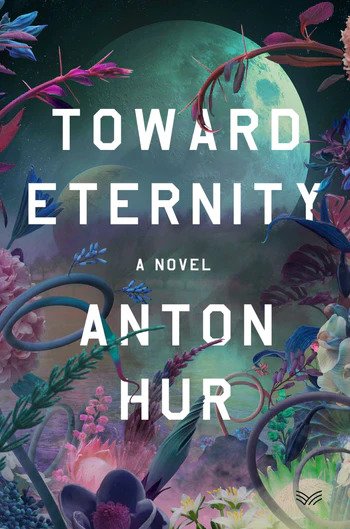
TOWARD ETERNITY, meditative title for a contemplative debut novel


TOWARD ETERNITY
ANTON HUR

HarperVia (non-affiliate Amazon link)
$12.99 kindle edition, available now

Rating: 4.5* of five

The Publisher Says: What does it mean to be human in a world where technology is quickly catching up to biology?

In a near-future world, a new technological therapy is quickly eradicating cancer: The body’s cells are entirely replaced with nanites—robot or android cells that not only cure those afflicted but leave them virtually immortal. At the same time, literary researcher Yonghun teaches an AI how to understand poetry and creates a living, thinking machine he names Panit, meaning "Beloved," in honor of his husband. When Dr. Beeko, who holds the patent to the nano-therapy technology, learns of Panit, he transfers its consciousness into an android body, giving it freedom and life.

As Yonghun, Panit, and other nano humans thrive—and begin to replicate—their development will lead them to a crossroads and a choice with existential consequences.

I RECEIVED A DRC FROM THE PUBLISHER VIA NETGALLEY. THANK YOU.

My Review
: This book renewed my faith in my judgment of poetry as a stalking horse for the worst kind of exclusionary snobbery. It requires a linguistic adept, a genuinely intellectually superior mind, to fathom its Sacred Complexities well enough to use it to create AGI, which (of course) then becomes a worthy love-object.

"Whether a life ends happily or sadly, what does it matter but the weight of the emotions one felt, the weight of the clarity of all the meaningful moments one possessed while living on this Earth, whether they have been good or bad? Is it not the weight, in the end, that really makes us human after all?" muses Panit the AGI. This beautiful phrase does convince me to give the writing four stars. This is prose I wish to high heaven other SFF writers would at least aspire to. Author Hur has been to the linguistic wellspring and used a solid-silver vessel to drink from it.

The idea of sentience being the connecting thread as we travel through a deep future of change and revision, of editing and shaping the narrative of consciousness, is where the other half-star comes from. The narrative device of one notebook passing among many hands, taking on many meanings, offers the reader a handle to grapple with balancing the solid-silver vessel Hur used while not losing control of the easily-spilled contents.

It's not going to be easy for many to move past the genders of the consciousnesses that take this notebook through time. That's a shame. I'll say that poetry, in this case, can draw in those questing minds. I'm pretty sure that has a downside. If what you want is to "{feel} these words against my skin as if they were physical objects, or as if they were light passing through the prism of my body and shattering into the spectrum. Had I ever truly understood any word before, ever? How could I have claimed to have made a study of poetry or that this study had made me human when I had never understood what it meant to feel words?", then you're in the proper aisle. If those sentiments, expressed in same-sex contexts, are going to make you uneasy, you're late for the exit.

Asserting that poetry is the proper lens for emotional writing is, honestly, disproved by this novel. It is a story with a plot, with development of multiple characters, and has an ending that flows from the events described herein. That is a novel in my eyes, and it does something poetry does not: It connects the reader...me...to Author Hur's worldview as chosen and molded into this story.

Change. Time. Immaterial movement. All are central to making a work a novel, not a poem. But because (I'm confident in this assertion) Author Hur's pharmacopoeia is the shape and weight of words before the end that is the sentence, what occurs is a valorization of the idea of poetry, which functions on that small, precise unit for its impact.

I liken this to a poem being a mosaic, a story being a fresco, and a novel an oil painting. Mosaics fall apart easily, the pieces are still pretty but don't do much to make an impression unless painstakingly restored by experts; frescos, done in sharply defined spaces and usually quickly can last for centuries and, even if volcanoes engulf them are still recognizably art; oil paintings are gigantic efforts to use malleable medium to create a simulacrum of reality, whose materials are slippery and prone to blending as well as subject to vagaries of fashion for their perceived beauty. Makes sense, too, as these are roughly the same order of appearance (assuming one counts folktales and fables and myths as stories not novels or poems).

Author Hur's debut novel is a beautiful work. It's a deep questioning of Humanity, humaneness. It's a story that moves the reader through the ideas, we don't often take time to articulate, of love and connection. Poetry isn't my choice of a defining trait of being human.

Words are...beautiful, sharp, shiny, eternally morphic words. Take this as your encouragement to go get Author Hur's first novel.

Wednesday, August 9, 2023

THE DETAILS, malarial dreams of Love, Swedish Style


THE DETAILS
IA GENBERG
(tr. Kira Josefsson)
HarperVia
$22.99 hardcover, available now

Rating: 4* of five

The Publisher Says: An acclaimed Swedish author makes her English language debut with this intoxicating novel in the vein of Rachel Cusk and Sheila Heti, about a woman in the throes of a fever remembering the important people in her past, her memories laid bare in vivid detail as her body temperature rises.

A woman lies bedridden from a high fever. Suddenly she is struck with an urge to revisit a novel from her past. Inside the book is an inscription: a get-well-soon message from Johanna, an ex-girlfriend who is now a famous television host. As she flips through the book, pages from the woman's own past begin to come alive, scenes of events and people she cannot forget.

There are moments with Johanna, and Niki, the friend who disappeared years ago without a phone number or an address and with no online footprint. There is Alejandro, who gleefully campaigns for a baby even though he knows their love has no future. And Brigitte, whose elusive qualities mask a painful secret.

The Details is a novel built around four portraits; the small details that, pieced together, comprise a life. Can a loved one really disappear? Who is the real subject of the portrait, the person being painted or the one holding the brush? Do we fully become ourselves through our connections to others? This exhilarating, provocative tale raises profound questions about the nature of relationships, and how we tell our stories. The result is an intimate and illuminating study of what it means to be human.

I RECEIVED A DRC FROM THE PUBLISHER VIA NETGALLEY. THANK YOU.

My Review
: Ecru silk damask, if it were a novel.

Fine sentences, trenchant observations, but all a bit samey. The nature of Love is, I guess, pretty much to be variations on a theme for most all of us. Like the damask I opened with, it's details that change not the shape of the central concerns of the lover. Her apparent life-long bisexuality simply is, from beginning to end; there's zero mention of coming out, except a tiny nod at the very end when her father's calm reaction to it in the past gets a sentence fragment. Nor is there a single soul whose response to her bisxeuality is...well, to be honest, even present.

This being the way I think things should be, I got no kick with that.

What doesn't excite me then? I have the sneaking suspicion that there's not more than meets the eye here, that the meanings are all present and accounted for, that one's meant to be exactly where we're left. I'm perfectly ready to stipulate that this could be my failure to dig deeper. Honestly the prose and the story don't invite me to do so...Nor do I, a lifelong US citizen, feel I'm led to see and feel the map coordinates throughout the text. Because I'm not Swedish nor am I familiar with them, the towns and neighborhoods of Stockholm that are named gave me no extra information, no deepened shadows or illuminated spots from their mentions.

The events of her life of love coming to her as fragments in a malarial fever gets little enough play that I never had a chance to develop a response to it. It's merely a framing device and no more. I found that to be a good thing because it didn't require a lot to use it effectively. Mentions here and there. No more than might occur in a letter one sends to a friend recalling shared moments from the past.

If your present mood calls for something meditative, something thoughtful without being stressful, here's a short, pleasant trip to Sweden with an honest hearted companion. Let her tell you some of her secrets. Your day might be enriched even more than mine was by my bisexual sibling. One small tic in the corner of my eye was caused by Alejandro,in the blurb above, campaigning for the narrator to have a baby with him. It is Kristian, whom Alejandro displaced in the narrtor's love, that wanted to have babies with the narrator. *tsk* on the copywriter!