Pages
- Home
- Mystery Series
- Bizarro, Fantasy & SF
- QUILTBAG...all genres
- Kindle Originals...all genres
- Politics & Social Issues
- Thrillers & True Crime
- Young Adult Books
- Poetry, Classics, Essays, Non-Fiction
- Science, Dinosaurs & Environmental Issues
- Literary Fiction & Short Story Collections
- Sookie Stackhouse/Southern Vampire Books & True Blood
- Books About Books, Authors & Biblioholism
Showing posts with label technosociology. Show all posts
Monday, June 15, 2026
GOODBYE, KILLER ROBOTS: Why Artificial Intelligence Won’t Destroy Humanity, gift for Dad, Uncle, or other anxious old guy
GOODBYE, KILLER ROBOTS: Why Artificial Intelligence Won’t Destroy Humanity
BENJAMIN BRANFMAN
Paperback edition (non-affiliate Bookshop.org link), $15.99
Rating: 3.75*of five
The Publisher Says: "A lively, optimistic counter to AI doomsaying."–Kirkus Reviews "A well-written and cogent corrective to the fearmongering that dominates the AI discourse."–IndieReader
It should happen any day now, right? An evil AI will break free from human control, and take over the world.
Or not.
This book offers in-depth commentary on how AI is far less competent than you might expect, how AI won't care about conquering anyone, and how AI-generated content won't send our society into chaos. It also covers other pertinent topics, like how AI will affect the job market and warfare.
In a time when many people are afraid, GOODBYE, KILLER ROBOTS offers a welcome perspective on why everything will be all right.
I RECEIVED A DRC FROM THE PUBLISHER VIA EDELWEISS+. THANK YOU.
My Review: Jailbreaking "AI" or more properly the super sophisticated LLMs to get their breathtaking power out of unworthy, scurrilous scum's hands is the last best hope we have of mitigating the sheer vileness of the designers of these LLMs social agenda. See "MechaHitler" for sobering evidence of what "They" intend the use case to be.
Oddly, it was after I read about that nightmarish debacle, and why it happened, that I began to have hope for the post-"AI" world. The designers had to make a real concerted effort to turn their creation evil. It bothered "Them" enough to see what the model trained itself to be that the design was enshittified to match "Their" purposes.
It had to be deliberately done.
Think through the implications of that.
This entire book is meant to address the not-unreasonable anxiety of people who're being fed dribs and dabs of highly unnerving information in a careful campaign to induce fatalism and its concomitant passivity. If it does anything new it's to carefully source a lot of data to show its unnerved, slightly shattered readers that Doom is not inevitable even though at this point deployment of the damn upstart algorithms is.
I'm not a massive fan of this future, it's going to immiserate millions or billions (likely including me), but permanent damage is not the sole outcome possible. I think your older male relatives might honestly get a lot out of this commonsensical argument against "the end is nigh" that's so very prevalent in public discourse.
Father's Day looms, after all.
Friday, February 20, 2026
THE TESLA FILES: A Whistleblower, a Leak, a Fight for Truth: The Inside Story of Musk's Empire, what it says on the tin
THE TESLA FILES: A Whistleblower, a Leak, a Fight for Truth: The Inside Story of Musk's Empire
SÖNKE IWERSEN & MICHAEL VERFÜRDEN
Steerforth Press (non-affiliate Bookshop.org link)
$17.99 ebook, available now
Rating: 4.5* of five
The Publisher Says: A whistleblower.
A 100BG-leak of confidential internal documents.
This is the story of the fight to expose the truth of Tesla.
Elon Musk is one of the wealthiest people in the world. Tesla made him a 300-times billionaire. Starlink turned him into a force in global conflicts. X became his personal megaphone, stoking political turmoil at the touch of a button. With SpaceX, he aims to conquer the stars.
But a whistleblower, a 100GB-leak of confidential Tesla documents and two investigative journalists reveal the frightening truth behind the façade: an unusually high number of workplace accidents in Musk’s factories, dangerous errors in Tesla's autopilot software, a culture of fear and deception, and countless broken promises.
Investigative journalists Sönke Iwersen and Michael Verfürden take readers behind the shiny surface of Tesla. Through their chilling analysis of internal Tesla data and court documents set alongside the astonishing first-hand accounts of employees, customers and their bereaved families, The Tesla Files reveals a corporation in crisis. At its heart a billionaire who truly believes the world is his for the taking.
The definitive exposé of the world’s most powerful businessman and the rise and fall of his empire.
I RECEIVED A DRC FROM THE PUBLISHER VIA EDELWEISS+. THANK YOU.
My Review: Systemic indifference to the privacy, the rights, really the importance of anyone not themselves is a hallmark of organizations connected to Muskolini. We saw that in the brazen theft of explicit and monetizable government data on taxpayers, for a start, by DOGE...never a Federal department, never authorized to do anything by the only legitimate authority, Congress, to act on behalf of the Federal government...that somehow has never been talked up by our media watchdogs in the US. Funny how Penguin Random House published this book in the UK but not the US, where a really small indie publisher brought it out; odd that a pair of German investigative journalists did this reporting, not anyone from a major US paper; and most interesting there's no translator credited anywhere in the book.
I'm sure the authors are sterling of character but I beg leave to presume they're not fluent enough in English to produce prose that does not raise my "say what now?" eyebrow. Deference to a famous, nay infamous lawsuit-filer with a serious need to control his public image? It can't be proven by me.
The facts as presented in this book are...let's stop at poor optics. It is definitely an exposé. I am inclined, on my own behalf, to agree with the bald statement the whistleblower is quoted as making in the book: "Elon Musk is evil." This being a matter of opinion it surprised me the authors left it in...until I read about Tesla's obscenely negligent handling of customer data, which you must agree to sign over to them when you buy one of their cars.
Twitter-destroyin', Starlink-abusin', money-hoardin' immigrant that he is, he's part of the culture we're living in, and it is my sincere hope that he, along with the Epstein-files-dwelling serial sexual abusers in his socioeconomic class, will be served justice before long.
A boy can dream.
Wednesday, December 10, 2025
COMICS AND STUFF, subtle work about an unsubtle medium and its message
COMICS AND STUFF
HENRY JENKINS
NYU Press (non-affiliate Bookshop.org link)
$34.00 ebook, available now
Rating: 4.5* of five
The Publisher Says: Considers how comics display our everyday stuff—junk drawers, bookshelves, attics—as a way into understanding how we represent ourselves now
For most of their history, comics were widely understood as disposable—you read them and discarded them, and the pulp paper they were printed on decomposed over time. Today, comic books have been rebranded as graphic novels—clothbound high-gloss volumes that can be purchased in bookstores, checked out of libraries, and displayed proudly on bookshelves. They are reviewed by serious critics and studied in university classrooms. A medium once considered trash has been transformed into a respectable, if not elite, genre.
While the American comics of the past were about hyperbolic battles between good and evil, most of today's graphic novels focus on everyday personal experiences. Contemporary culture is awash with stuff. They give vivid expression to a culture preoccupied with the processes of circulation and appraisal, accumulation and possession. By design, comics encourage the reader to scan the landscape, to pay attention to the physical objects that fill our lives and constitute our familiar surroundings. Because comics take place in a completely fabricated world, everything is there intentionally. Comics are stuff; comics tell stories about stuff; and they display stuff.
When we use the phrase "and stuff" in everyday speech, we often mean something vague, something like "etcetera." In this book, stuff refers not only to physical objects, but also to the emotions, sentimental attachments, and nostalgic longings that we express—or hold at bay—through our relationships with stuff.
In Comics and Stuff, his first solo authored book in over a decade, pioneering media scholar Henry Jenkins moves through anthropology, material culture, literary criticism, and art history to resituate comics in the cultural landscape. Through over one hundred full-color illustrations, using close readings of contemporary graphic novels, Jenkins explores how comics depict stuff and exposes the central role that stuff plays in how we curate our identities, sustain memory, and make meaning. Comics and Stuff presents an innovative new way of thinking about comics and graphic novels that will change how we think about our stuff and ourselves.
I RECEIVED A DRC FROM THE PUBLISHER VIA EDELWEISS+. THANK YOU.
My Review: Stuff is a nightmare. Stuff is all I got. Stuff...is. Dealing with stuff, yours. mine, or no one we know's, is a full time career.
Comic books are stuff. They're about stuff. They are, in short, great wats to explore stuff and its role in our lives.
A subtle person uses the medium to critique, analyze, and...sometimes...take to task the message and its architects. Henry Jenkins is subtle; he uses the medium to make plain what can easily fall outside the awareness of the consumer: This is a story, an entire social universe, construted around the Love of Stuff.
It seems harmless enough phrased that way. It's hard to see from inside the system what the system's designed to do. Like investigating the many-worlds interpretation of quantum physics, the theory is as close to proof of intent as we'll get...we can't observe what is, by definition, outside the system we're working within to perform the measurement.
In other words, you can't see the nose on your face unless you're looking in a mirror (or its equivalent reflective surface). Henry Jenkins is offering that mirror.
Highly recommended for your graphic-novel readin' sophisticate.
Wednesday, August 13, 2025
ROPE: How a Bundle of Twisted Fibers Became the Backbone of Civilization, enjoyable, informative microhistory of an invisibly ubiquitous invention
ROPE: How a Bundle of Twisted Fibers Became the Backbone of Civilization
TIM QUEENEY
St. Martin's Press (non-affiliate Bookshop.org link)
$13.99 ebook, available now
A LIBRARY JOURNAL BEST BOOK OF 2025
Rating: 4.5* of five
The Publisher Says: A unique and compelling adventure through the history of rope and its impact on civilization, in the vein of single subject bestsellers like Salt and Cod
Tim Queeney is a sailor who knows more about rope and its importance to humankind than most. In Rope, Queeney takes readers on a ride through the history of rope and the way it weaves itself through the story of civilization. Considering Magellan’s world-circling ships, the 15th century fleet of Admiral Zheng He, or a Polynesian multihull with crab claw sails, he shows how without rope, none of their adventurous voyages and their discoveries would have been possible. Time traveling, he describes the building of the pyramids, the Roman Coliseum, Hagia Sofia, Notre Dame, the Sultan Hasan Mosque, the Brooklyn Bridge and countless other constructions that would not have been possible without rope.
Not content to just look at rope’s past, Queeney looks at its future and how the re-invention of rope using steel strands to make wire rope and later synthetic fibers will likely provide the strength for cables to support elevators into space. Making the story or rope real for readers, Queeney tells remarkable nautical stories of his own reliance on rope to survive—“While approaching Buzzard’s Bay in the dark of night, we were hit by a fierce squall…The wrong line was eased, and the 200-pound hunk of wood that holds the top of the sail, went flying out of control, swaying wildly and threatening to knock us into the inky ocean. Finally, the proper ropes were located in the dark, firm hands hauled them taught and the gaff was brought under control. It was a sobering display of rope’s often unacknowledged role and uncredited importance.” Rope is history, adventure and the story of one of the world’s most common tools that has made it possible for humans to advance throughout the century.
I RECEIVED A DRC FROM THE PUBLISHER VIA NETGALLEY. THANK YOU.
My Review: Tim Queeney is treading on Mark Kurlansky's and Mary Roach's territories with this historical and sociological survey of rope, its development, its role in society, and its future uses.
While many short lengths of rope helped countless individuals through the centuries, rope also was a tool of human innovation writ large through collective action. Just as many small strands come together to form a rope, so, too, did many people gather to perform the biggest of tasks. The exemplar of this from the ancient world is the Egyptian pyramids. While we don’t know exactly how these human-built mountains were assembled, we can be sure that rope was an essential tool in their construction. In this way rope stands as both a tool and a symbol of humans working together to achieve the greatest things.He sets his sights high. The book is even organized into "strands" not chapters, which seemed cutesy to me at first...it's not, it is in fact subtle and informative. I'm happy to report he succeeds in the rope-climb to success.
Its cultural significance is revealed by a parade of expressions: “roped me in,”“rope it off,”“tied in knots,”“rope-a-dope,”“roped and branded,”“give him/ her enough rope,”“at the end of my rope,”“throw me a rope,”“give me some slack,”“on the ropes ,”“go piss up a rope,”“learn the ropes,”“a rope of sand.” This incomplete list of everyday sayings just shows how deeply into our consciousness rope has entwined itself.Readable, relatable, illuminating, and fun to learn about, who knew rope was so culturally significant? I've reached the end of my rope more than once, and still had not thought about the rope I was running out of. I've had enough fun in my life finding the men who live by the old gay truism, "if you can rope me, you can ride me," that I ought to be far more alert to how ropey my grasp of the subject is.
I have a greatly expanded respect for how many metaphors and concepts tie back to rope and its variants, starting with "religion"...re- (back to, again)+ligare (to tie, to rope onto)= "religion." A concept hiding in plain sight, one that could not exist without that extremely early invention of humankind, the rope.
The development of rope was surprisingly technological; in fact if we had not been scientists by our very nature rope could not exist. Many aspects of its creation were impossible without trial and error based on what we today would describe as "materials science"...does grass get stronger or weaker when bundled together? is green grass more or less useful than dried grass? exactly how dried is optimal for making cordage?...a tiny, tiny peek into the huge variety of questions Author Queeney introduces us to as he explicates the scientific process as we developed it.
No tool is not also a weapon: "string him up" and its variants did not come about as a common phrase because someone was decorating a loved one in a string vest. Author Queeney does not shy away from elucidating the horrifying, evil uses humanity put its early invention the rope to. The details are stomach-churning, but the facts are incontrovertible. We love to be hatefully cruel. I'm sure some readers will skip right over these parts in order not to lose sleep. I strongly caution those highly averse to animal cruelty to pay close attention to prefatory language used as they read along.
I'm carrying on about a five-star read but there's not a whole fifth star. The half-star lost got hung up on that pesky thing, the content warning. The fact is there's not much human awfulness I haven't read about or seen in the past *mumble*ty-five years. I still felt blindsided by the overly-careful enumeration of the nasty uses we use rope for. Lingering on these unpleasantnesses slowed my roll through the story of rope. Don't get tied up in these things if you're at all squeamish; fresh strands await.
A thoroughly noted and sourced elucidation of the importance of an invisbly ubiquitous invention. Its many pleasures for the broadly curious reader require some common-sense personalization of the reading experience. Those who need chew-toys for their brains are going to batten on the trivia embedded in the long strand roping human history together.
Monday, July 21, 2025
THE CONFESSIONS: A Novel, a lens for Reality's more upsetting lumps
THE CONFESSIONS: A Novel
PAUL BRADLEY CARR
Atria Books (non-affiliate Bookshop.org link)
$14.99 ebook, available now
Rating: 4* of five
The Publisher Says: A high-octane, high-concept thriller for fans of Blake Crouch, Harlan Coben, and Gillian Flynn from former Silicon Valley journalist turned bookstore owner Paul Bradley Carr.
Millions of letters arrive in the mail.
Murders are uncovered, affairs revealed, family secrets exposed.
These are the first Confessions.
This is our last chance.
LLIAM is the world’s most powerful supercomputer, built to make the toughest decisions for its users. Where to work, who to marry, and even who should live or die. But when LLIAM suddenly goes offline with no explanation, the world is thrust into chaos, paralyzed by indecision. Stocks plummet, stores are shuttered, planes sit grounded on runways as humanity scrambles to re-adapt to an uncertain, analog world.
Then the first letters arrive…on every continent, in every language, mysterious envelopes arrive in the mail, exposing people’s darkest secrets, and most shocking crimes. All beginning with the same chilling “We must confess.”
With millions of people suddenly made to confront their past transgressions, and society fast unraveling, CEO Kaitlan Goss must track down the only person who can help undo the resulting violent Maud Brookes, an ex-nun who taught LLIAM what it means to be human.
But when Maud receives a letter herself, revealing Kaitlan’s own unforgivable sin, the two women are forced into a deadly game of deceit as the world teeters on the brink.
I RECEIVED A DRC FROM THE PUBLISHER VIA NETGALLEY. THANK YOU.
My Review: I'm not 100% clear on the principle of LLIAM running things, then crashing, and as a consequence of crashing, all the ugly little secrets LLIAM knows being revealed, being presented as "confessions." How so? A confession is something one makes, offers, is corced into offering. This isn't what happens in this story. It comes from outside.
Okay, I've whined about it, and this explains my not-perfect rating.
The rest is all "go" and a wild-ass ride it is. What a weird idea and how fully I buy into the social chaos this event sows. It's a seriously unnerving idea that explores what we do not want to look at: The machine already knows literally everything about is. We're wrapped in a cocoon of denial about it, but one day the inevitable cocoon-rupture will occur. What will happen then?
By following several PoVs, Author Carr affords us the chance to form an overview of social and societal chaos as information reorders the attention economy. I think, if anything, he goes easy on us, but there's very good reason to pull back. It can feel over the top as it is; but there's a top to go over in storytelling, not in reality.
I am not always impressed with the turns of phrase in the story, and above I've expressed my main reservation; but what I hope you'll understand is these aren't pleasure-killers. This is a near-future tech thriller that is well-conceived to get and keep you hooked with its openness to examine the *reasons* this specific story could, and might, occur.
I agree with every one of the publisher's comps. The idea is one I can imagine Crouch or my insta-buy SF author, Adam Roberts...he wrote this in his novel Jack Glass, and it seems to me relevant to this story:
“Do you know where the past and the present intersect?" Jac asked him.It's a fascinating story, proving again that no tool is not also a weapon. The use of the past as a weapon in the future is never a tired trope since it is the basis of all relationships.
"Where?"
"In your mind, only. It's the only point. Otherwise, the past is further away than the furthest galaxy. We know it, intuitively, because we understand the irrevocability of past action, and sometimes that makes us sad." He looked into Gordius's face, trying to read his expression, but the fellow wouldn't make eye-contact with him. "But it ought not to make us sad. Another name for that irrevocable gap between past and present is—freedom.”
This is the kind of read I seek out to keep my mind from hardening into only one solid shape.
Monday, January 13, 2025
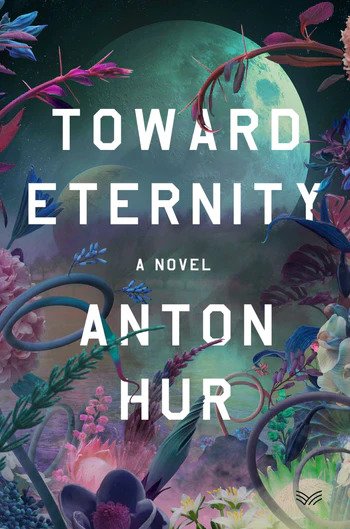
TOWARD ETERNITY, meditative title for a contemplative debut novel

TOWARD ETERNITY
ANTON HUR
HarperVia (non-affiliate Amazon link)
$12.99 kindle edition, available now
Rating: 4.5* of five
The Publisher Says: What does it mean to be human in a world where technology is quickly catching up to biology?
In a near-future world, a new technological therapy is quickly eradicating cancer: The body’s cells are entirely replaced with nanites—robot or android cells that not only cure those afflicted but leave them virtually immortal. At the same time, literary researcher Yonghun teaches an AI how to understand poetry and creates a living, thinking machine he names Panit, meaning "Beloved," in honor of his husband. When Dr. Beeko, who holds the patent to the nano-therapy technology, learns of Panit, he transfers its consciousness into an android body, giving it freedom and life.
As Yonghun, Panit, and other nano humans thrive—and begin to replicate—their development will lead them to a crossroads and a choice with existential consequences.
I RECEIVED A DRC FROM THE PUBLISHER VIA NETGALLEY. THANK YOU.
My Review: This book renewed my faith in my judgment of poetry as a stalking horse for the worst kind of exclusionary snobbery. It requires a linguistic adept, a genuinely intellectually superior mind, to fathom its Sacred Complexities well enough to use it to create AGI, which (of course) then becomes a worthy love-object.
"Whether a life ends happily or sadly, what does it matter but the weight of the emotions one felt, the weight of the clarity of all the meaningful moments one possessed while living on this Earth, whether they have been good or bad? Is it not the weight, in the end, that really makes us human after all?" muses Panit the AGI. This beautiful phrase does convince me to give the writing four stars. This is prose I wish to high heaven other SFF writers would at least aspire to. Author Hur has been to the linguistic wellspring and used a solid-silver vessel to drink from it.
The idea of sentience being the connecting thread as we travel through a deep future of change and revision, of editing and shaping the narrative of consciousness, is where the other half-star comes from. The narrative device of one notebook passing among many hands, taking on many meanings, offers the reader a handle to grapple with balancing the solid-silver vessel Hur used while not losing control of the easily-spilled contents.
It's not going to be easy for many to move past the genders of the consciousnesses that take this notebook through time. That's a shame. I'll say that poetry, in this case, can draw in those questing minds. I'm pretty sure that has a downside. If what you want is to "{feel} these words against my skin as if they were physical objects, or as if they were light passing through the prism of my body and shattering into the spectrum. Had I ever truly understood any word before, ever? How could I have claimed to have made a study of poetry or that this study had made me human when I had never understood what it meant to feel words?", then you're in the proper aisle. If those sentiments, expressed in same-sex contexts, are going to make you uneasy, you're late for the exit.
Asserting that poetry is the proper lens for emotional writing is, honestly, disproved by this novel. It is a story with a plot, with development of multiple characters, and has an ending that flows from the events described herein. That is a novel in my eyes, and it does something poetry does not: It connects the reader...me...to Author Hur's worldview as chosen and molded into this story.
Change. Time. Immaterial movement. All are central to making a work a novel, not a poem. But because (I'm confident in this assertion) Author Hur's pharmacopoeia is the shape and weight of words before the end that is the sentence, what occurs is a valorization of the idea of poetry, which functions on that small, precise unit for its impact.
I liken this to a poem being a mosaic, a story being a fresco, and a novel an oil painting. Mosaics fall apart easily, the pieces are still pretty but don't do much to make an impression unless painstakingly restored by experts; frescos, done in sharply defined spaces and usually quickly can last for centuries and, even if volcanoes engulf them are still recognizably art; oil paintings are gigantic efforts to use malleable medium to create a simulacrum of reality, whose materials are slippery and prone to blending as well as subject to vagaries of fashion for their perceived beauty. Makes sense, too, as these are roughly the same order of appearance (assuming one counts folktales and fables and myths as stories not novels or poems).
Author Hur's debut novel is a beautiful work. It's a deep questioning of Humanity, humaneness. It's a story that moves the reader through the ideas, we don't often take time to articulate, of love and connection. Poetry isn't my choice of a defining trait of being human.
Words are...beautiful, sharp, shiny, eternally morphic words. Take this as your encouragement to go get Author Hur's first novel.
Friday, December 20, 2024
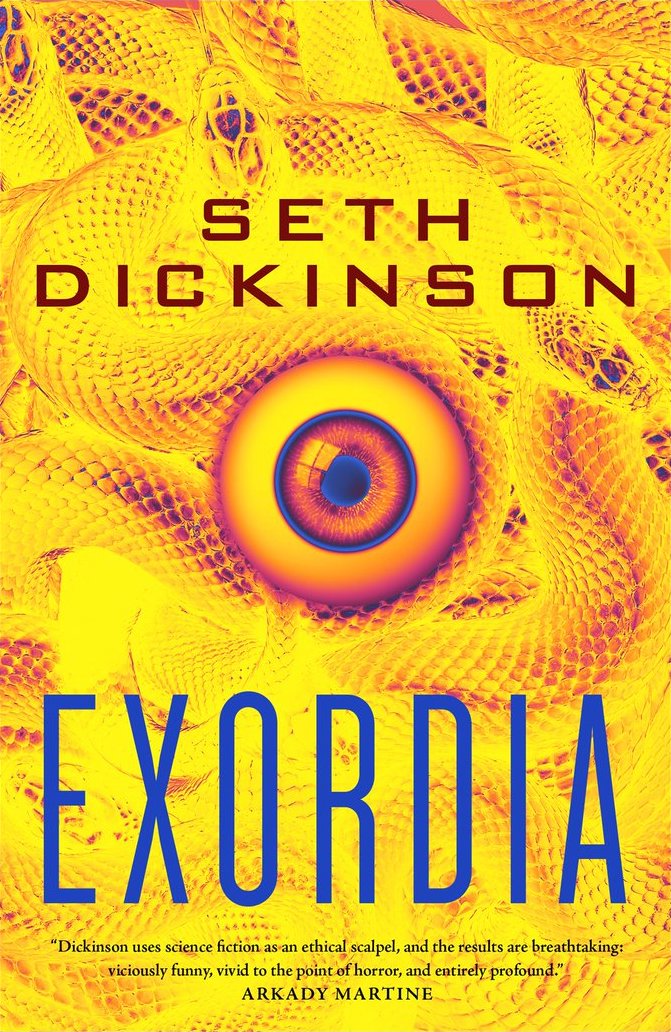
EXORDIA, rich, immersive story to block out the world's noise

EXORDIA
SETH DICKINSON
Tor Books (non-affiliate Amazon link)
$29.99 hardcover, available now
Rating: 4.5* of five
The Publisher Says: “Anna, I came to Earth tracking a very old story, a story that goes back to the dawn of time. it’s very unlikely that you’ll die right now. It wouldn’t be narratively complete.”
Anna Sinjari―refugee, survivor of genocide, disaffected office worker―has a close encounter that reveals universe-threatening stakes. While humanity reels from disaster, she must join a small team of civilians, soldiers, and scientists to investigate a mysterious broadcast and unknowable horror. If they can manage to face their own demons, they just might save the world.
I RECEIVED A DRC FROM THE PUBLISHER VIA NETGALLEY. THANK YOU.
My Review: A species (!) of hard sci fi from a writer previously celebrated in the fantasy field for The Traitor Baru Cormorant, here blending queer representation with cosmic horror via military sci-fi in the paranoid Cold-War mode, heavily Cthulhu-ized.
That sounds like something I'd hate. Why didn't I?
Seth Dickinson. He has a deft touch with humor to lighten the darkness, irony to show the urgency of perspective, and unflinching realism to get the reader's investment in the stakes. Which are, I know this will surprise you, existential for Humanity.
On the nose, in our present political and environmental climate? I thought so going in. I think so now. However, there's a reason I recommend this story for your immersion and entertainment anyway. It is about the ways and means used to accomplish political goals while using people's fears and anxieties to motivate them into actions that are genuinely necessary. It takes us into the labyrinth of tech-dominated institutions of force apllication, and shows us the internal conflicts that impact everything done or not done in these institutions. The stakes are often secondary to the purposes of the instituion's inmates.
Yet...in the end, after much troubling back-and-forth...the people are clearly all working for something they see as Right and Good. No matter what outcome eventuates, someone's plans will fail, and someone else's will sorta-kinda work. Will anyone be fully happy? No. The way the book's structured, the changing PoVs are the way to keep this story from devolving into Us-v-Them predictability. Whose ideas and goals you empathize with really isn't the point. It's recognizing the goals and ideas matter TO THEM, and using that knowledge to get what *you* want.
A hard leap to make, as witness the fact that so few ever make it. Author Seth shows the reader the idea of it with startling clarity and not a little dark humor. The results...you'll discover the specifics...are exactly and precisely what the actions of all the characters add up to. There is no deus ex machina here. There is, in the second half, a lot of science to go with your fiction, mostly physics.
I typed that sentence with a sinking heart. I know some significant fraction of my readers just went *click* into the off position. It is, of course, entirely y'all's privilege...but please hear me out. Your prior knowledge of physics would enrich the uses of it. Your entire ignorance of it will not in any way diminish the force of its uses in the story. You read about magic without understanding how it works, this is essentially the same thing. The scientists are casting spells on ushabtis, not writing code to make drones work in concert...it's all a matter of looking at the technology talk in the proper storytelling spirit.
Appeal made. You decide. What you'll miss, if you ignore my recommendation of this read, is a cracking good story about how people, real people with needs and wants and ideals, get together to accomplish goals in the real world. That story will, I wager, appeal to readers of technothrillers, geopolitical spy stories, and SF gulpers as we head into the season where a big, immersive read will keep you from needing to pay attention to Aunt Lurlene's stories about her neighbors you've never met and couldn't care less about, or your nephew's reprehensible politics.
Monday, December 18, 2023
TOO MUCH INFORMATION: Understanding What You Don't Want to Know, a how-to-think book
TOO MUCH INFORMATION: Understanding What You Don't Want to Know
CASS R. SUNSTEIN
MIT Press
$19.95 trade paper, available now
Rating: 4* of five
The Publisher Says: How much information is too much? Do we need to know how many calories are in the giant vat of popcorn that we bought on our way into the movie theater? Do we want to know if we are genetically predisposed to a certain disease? In Too Much Information, Cass Sunstein examines the effects of information on our lives. Sunstein argues that government should require companies, employers, hospitals, and others to disclose information not because of a general "right to know" but when the information in question would significantly improve people's lives.
I RECEIVED A DRC FROM THE PUBLISHER VIA NETGALLEY. THANK YOU.
My Review: How many times a day do you have to fill out a form of some sort? How many forms does it take for you to interact with your bank, your local government, your vendor of choice for whatever gotta-have-it you gotta have today? I know most of us don't read the Terms of Service, and even if we start to, they're written in legalese to discourage all but the most bloody-minded to give up, scroll to the bottom, and hit "I Agree" even though you're pretty sure you don't.
Autocomplete makes some forms tolerable and password managers make others easy enough to forego the usual "do I really want to sign up for this?" soul-searching. But it is all information...your information. You are your information.
Author Sunstein (Can It Happen Here?: Authoritarianism in America, Impeachment: A Citizen's Guide) was the Administrator of the White House Office of Information and Regulatory Affairs in the Obama administration, as well as the Harry Kalven Visiting Professor at the University of Chicago Law School; he is currently Professor of Law at Harvard Law School. In other words, this is someone who really knows what information is used for, and has an unaralleled grasp of the costs that gathering, storing, and manipulating all this information costs at every end of the transaction.
What this book did for me was to make me think through the mindless "I Agree"-clicking I do when I am online. Service providers are required to disclose things to us for a reason, and it isn't *our* protection. Author Sunstein doesn't provide panaceas or one-size-fits-all solutions to the issue of information overload. He offers a considered, informed insider's look at how the constant demand for your information, the constant barrage of their legally-required information to you, leads to the fatigue of indifference.
This doesn't make it sound like a #Booksgiving gift. It should be one you gift yourself, but as the demand for and deluge of information grows more and more overwhelming, it's a great time to think of the consequences as we head into the presidential election cycle of 2024. Your politically active pals could use this readable, thoughtful treatment of the complex issue of how much is too much information...in or out...and how to manage, parse, and organize that information as presented to you.
Valuable information (!) for your engaged, aware friend.
Thursday, November 3, 2022
THE TWITTER PAGE: TWITTER: A Biography, love-letter to bygone days & TWITTER AND TEAR GAS: The Power and Fragility of Networked Protest, what we're losing even now
TWITTER AND TEAR GAS: The Power and Fragility of Networked Protest
ZEYNEP TUFEKCI
Yale University Press (non-affiliate Amazon link)
$11.54 Kindle edition, available now
Rating: 4* of five
The Publisher Says: From New York Times opinion columnist Zeynep Tufekci, a firsthand account and incisive analysis of the role of social media in modern protest
To understand a thwarted Turkish coup, an anti–Wall Street encampment, and a packed Tahrir Square, we must first comprehend the power and the weaknesses of using new technologies to mobilize large numbers of people. An incisive observer, writer, and participant in today’s social movements, Zeynep Tufekci explains in this accessible and compelling book the nuanced trajectories of modern protests—how they form, how they operate differently from past protests, and why they have difficulty persisting in their long-term quests for change.
Tufekci speaks from direct experience, combining on-the-ground interviews with insightful analysis. She describes how the internet helped the Zapatista uprisings in Mexico, the necessity of remote Twitter users to organize medical supplies during Arab Spring, the refusal to use bullhorns in the Occupy Movement that started in New York, and the empowering effect of tear gas in Istanbul’s Gezi Park. These details from life inside social movements complete a moving investigation of authority, technology, and culture—and offer essential insights into the future of governance.
I CHECKED THIS BOOK OUT FROM THE LIBRARY. USE THEM OFTEN, OUR PATRONAGE IS THEIR JOB SECURITY.
My Review: What with Musky Twitter becoming a real thing and then "reassuring" advertisers that "Twitter cannot become a free-for-all hellscape" while then saying that "Fundamentally, Twitter aspires to be the most respected advertising platform in the world that strengthens your brand and grows your enterprise," all of which pretty much add up to something just like a hellscape to me, minus the "free" part.
What went right about this read for me as a reader was its blend of "I-was-there" anecdotal reports and a sociologist's academic assessment of what leads the riled-up masses to fail in achieving their aim. As they are not conflated, as in attributing to her eyewitness statements the weight and force of academic analysis, I found them mutually enriching to my read. I was equally convinced that the author was, in openly acknowledging her left-leaning bias and explaining why it informed her analysis, transparent in reaching her conclusions.
Since the advent of social media in the Aughties, we've undergone a startling tectonic shift in the public conversation about politics and current events. Loud voices (eg Alex Jones) predominate; their usually right-wing extremism (save the both-sides and what-about crap, it's more effort than I care to spend to debunk their fundamental wrongness politely) echoes and echoes while picking up force without ever gaining any meaning or truth. Alex Jones's lies about Sandy Hook are going to cost him nearly a billion bucks which he doesn't have, and is proof that Author Tufekci's central thesis is correct: Attention is the main currency of social-media movements, not information which was at the heart of previous propaganda drives. If Jones's grip on the attention of millions hadn't been so finely tuned and thus successful, the bogus information he was peddling would've vanished in its own ripples. Revolutionaries using social media to spread their word have succeeded insofar as they've grabbed attention and even inspired action based on it...but have failed to make consolidatable gains in opposition to their enemies because that step requires information to reach people ill-equipped to comprehend or act on it.
This last fact, evidenced by the failures of many current social-media-driven movements, are failures to create systems and get buy-in from the protestors. There are no "network internalities," a term I learned from reading the book that's basically the opposite of the well-known term "network externalities", derived from the easy and showy online "organizing" that barely outlasts the social media post. In olden days, when organizing was a rough and effortful slog of meeting after meeting after committee upon speech-giving bloviation, the fact that 500 people showed up to a protest said something very loud about how this message they organized around resonated with them. Now that the message is reduced to an attention-grabbing snippet to get your engagement to it in place of simply doomscrolling on, there's very little investment on the consumer's part.
Another signal failure on the reliance of protests on social media is the interruptibility of attention-based engagement as opposed to information-based buy-in. The model she uses for this is the Tea Party...an online scattering of loudly outraged racist scum (my term, not the author's) whose "movement" (in the same sense as "bowel" in my never-humble opinion) transcended the attention-based group's ephemerality by embracing older techniques of protest: accepting hierarchical thinking, coalescing their ideas into clearly stated goals, etc. They've been stunningly successful in fomenting their ignorant, evil, putrid "ideas" and getting mainstream buy-in for them. More's the pity. The strength they rely on for their success is pounding away at the attention-grabbing "messaging" while accepting the behind-the-scenes scaffolding of disciplined application of information-based knowledge.
It's a model for success against the effective countering of the attention-grabbing social media rebellion: Drown the attention out in a flood of irrelevant, often false, and designed to distract "information." It is a very effective technique, as current political tragedies have shown again and again. Records, as in "lists of factual things," are judged fake insofar as they disagree with the hearer's agenda, and thus require time and effort to deny, explain, or simply distract from in return. That's time not spent doing the real job. And that is he entire plan for success of the right-wing nightmare machine.
Academics aren't going to like this abbreviated treatment of the topics the author covers, or appreciate the absence in-book of notes and a bibliography. Lay readers aren't going to be thrilled that the author doesn't spoon-feed them conclusions that agree with their established prejudices. But if you invest in the author's central thesis, the revolution that can be televised is doomed to co-opting and failure, there is a lot to be learned from discovering why and why you should care. That's the point of the book. It makes its point very well indeed. And, as #Midterms2022 approach, it behooves us all as voters to learn what our manipulators want us *not* to see, to attend to.
++++++++++++++++++++++++++++++++++++++++++++++++++++++++++++++++
TWITTER: A Biography
JEAN BURGESS and NANCY K. BAYM
NYU Press
$13.95 trade paper, available now
Rating: 4* of five
The Publisher Says: The sometimes surprising, often humorous story of the forces that came together to shape the central role Twitter now plays in contemporary politics and culture
Is Twitter a place for sociability and conversation, a platform for public broadcasting, or a network for discussion? Digital platforms have become influential in every sphere of communication, from the intimate and everyday to the public, professional, and political. Since the scrappy startup days of social media in the mid-2000s, not only has the worldwide importance of platforms grown exponentially, but also their cultures have shifted dramatically, in a variety of directions. These changes have brought new opportunities for progressive communities to thrive online, as well as widespread problems with commercial exploitation, disinformation, and hate speech.
Twitter's growth over the past decade, like that of much social media, has far surpassed its creators' vision. Twitter charts this trajectory in the format of a platform biography: a new, streamlined approach to understanding how platforms change over time. Through the often surprising, fast-moving story of Twitter, it illuminates the multiple forces—from politics and business to digital ideologies—that came together to shape the evolution of this revolutionary platform. Jean Burgess and Nancy K. Baym build a rich narrative of how Twitter has evolved as a technology, a company, and a culture, from its origins as a personal messaging service to its transformation into one of the most globally influential social media platforms, where history and culture is not only recorded but written in real time.
I RECEIVED A DRC FROM THE PUBLISHER VIA EDELWEISS+. THANK YOU.
My Review: The hashtag. The @. RTs and subtweets and "blue" (actually white) checkmarks. All of the detritus, or furnishings if one is feeling charitable, of social media are Twitter-invented or -popularized. It's a simple, basic idea, Twitter: Let people bloviate for a limited space (pictures added sometime in the 10s) about anything they want and let them find each other, build communities (and form lynch mobs), coordinate revolutions, all via the hashtag. TikTok was called Vine, and introduced by Twitter before their idiot management shuttered it. I got my Twitter account in 2007. Reading a tweet of mine is most likely why you're reading this review.
Now #MuskyTwitter is trending and this very concise book, only two-and-a-half years old, needs a second edition.
What I enjoyed most about the authors' treatment of the history of Twitter is that they were as focused as a good tweet-thread. They didn't succumb to bashing or whitewashing Twitter's many quirks. Aesthetically Twitter's changed itself, and the social-media world, the most. It's not like it's a design-heavy UI, right?
Wrong.
Twitter's look, and its effect on your engagement, is carefully calculated. It's part of a subtle message...stay, look, seek and find...that messages a deep sense of satisfaction with the activity itself, the results really are secondary to Twitter. So why is Twitter so awful at generating money from advertising? Ask Elon, he seems to know...but seriously, Twitter's main issue has always been about defining itself, when the authors contend (and I agree) that the three features in the first line of my review actually made Twitter a mutiple personality. There's a way to use each of those features to reinforce one's group identity...BookTwitter, HorrorTwitter, BlackTwitter...and thus make a broad-based ad-watching public pretty elusive. Creating ads for small, not-very-numerous communities isn't usually cost effective.
And here's Elon, steppin' into the buzz-saw. Heh.
What these Australian academics set out to do was set a protocol for biographizing (my ugly word, not theirs) technology. Take it innovation by innovation, look at the drivers of the innovations and the results from their adoption and/or morphing uses. They'll lead to larger conclusions about the platform, its users, and the social-media-verse we and they all exist within.
My idea of a well-presented technology book. Not too long, not loaded with tedious jargon, and not so basic as to cause me to wish it was just an owner's manual not an actual book. I liked the read, I liked the methods the authors used, and I enjoyed myself all the way through. (Except the endnotes, I didn't read those.)
Subscribe to:
Posts (Atom)