Showing posts with label history. Show all posts

Thursday, February 5, 2026

THE UNFINISHED BUSINESS OF 1776: Why the American Revolution Never Ended


THE UNFINISHED BUSINESS OF 1776: Why the American Revolution Never Ended
THOMAS RICHARDS

The New Press (non-affiliate Bookshop.org link)
$29.99 all editions, available now

Rating: 4* of five

The Publisher Says: A clarion call for taking back the American Revolution from the far right, published for the 250th anniversary of the Declaration of Independence

Who gets to claim the legacy of the American Revolution and the mantle of patriotism that goes along with it? In a sharp, irreverent, deeply informed account of the nation’s founding moment and its enduring legacies, historian Thomas Richards Jr. invites us to see the Revolution not just as a one-time fight for political freedom from Britain but as an ongoing struggle for equality, justice, and social and political independence for all Americans.

A riveting work of narrative history, The Unfinished Business of 1776 shows that the Revolutionary struggle did not end in 1788 when the Constitution was ratified. Across nine dramatic chapters, Richards introduces readers to the vividly drawn characters who kept the Revolution alive for the next century and beyond, including the women’s rights advocate Judith Sargent Murray, the enslaved rebel Gabriel, the economic reformer Solomon Sharp, and the religious visionary Joseph Smith—each pushing for freedoms that extended well beyond the traditional narrative of the Revolution, and each revealing how the unfinished work of 1776 fueled demands for economic, social, and legal equality that lasted well beyond the Revolution itself.

A myth-busting book about the history we think we know, The Unfinished Business of 1776 is the perfect antidote to jingoistic celebrations of America—offering an inclusive vision of our common past.

I RECEIVED A DRC FROM THE PUBLISHER VIA EDELWEISS+. THANK YOU.

My Review
: The author's biography on his publisher's website is below:
Thomas Richards Jr. teaches history at Springside Chestnut Hill Academy in Philadelphia and holds a PhD in History from Temple University. The author of Breakaway Americas: The Unmanifest Future of the Jacksonian United States and The Unfinished Business of 1776 (The New Press), he lives in Gulph Mills, Pennsylvania, where George Washington once camped.
He's got credentials, he's teaching at a level I wish more PhD-holders would teach at, and he's singin' my song. He wants the left to take back the ideals of the 1776 Revolution from the the reactionaries and right-wingers.

The case studies for his assertion that the Revolution contained the seeds of progressive action are decent; I myownself flinch away from his inclusion of that lunatic religiosifier Smith. He belongs, however; my distaste for him and the people who have used his example to create a polity I abominate, reject, and hold in deep scorn notwithstanding, what he set in motion is part of what's foreseen and protected in the US Constitution.

I had not heard of Judith Sargent Murray, for example, or her advocacy of woman suffrage, and am glad I now know she existed despite her being primarily a poet. In filling the great gaps that exist in my own knowledge like this one, the author does me a great service. I suspect many will be less offended than i was by the pro-religious threads he weaves generously into his analyses.

I would rate this book lower than I do had I not found this passage in the author's epilogue:
Trumpism is also predicated on easily disprovable, often dangerous or malicious lies, unbridled demagoguery, and an open embrace of anti-intellectualism—all of which the Founding Fathers abhorred. The Founders were undoubtedly flawed, but they did not lie egregiously, embrace fanaticism, or celebrate stupidity.
Preach, Brother Richards.

Wednesday, October 8, 2025

A RAGE TO CONQUER: Twelve Battles That Changed the Course of Western History...not sure I agree


A RAGE TO CONQUER: Twelve Battles That Changed the Course of Western History
MICHAEL WALSH

St. Martin's Press (non-affiliate Bookshop.org link)
$16.99 ebook, available now

Rating: 2.5* of five

The Publisher Says: Award-winning author Michael Walsh looks at twelve momentous battles that changed the course of Western history.

A sequel to Michael Walsh’s Last Stands, his new book A Rage to Conquer is a journey through the twelve of the most important battles in Western history. As Walsh sees it, war is an important facet of every culture—and, for better or worse, our world is unthinkable without it. War has been an essential part of the human condition throughout history, the principal agent of societal change, waged by men on behalf of, and in pursuit of, their gods, women, riches, power, and the sheer joy of combat.

I RECEIVED A DRC FROM THE PUBLISHER VIA NETGALLEY. THANK YOU.

My Review
: I had a hard time with this book. It's very interesting. It's not a dry history, written to inform; it is tendentious and opinionated; it's just that I do not share the author's belief that war is anything but a curse and a cause for shame and contumely, not celebration.

Examining the careers of Achilles, Alexander the Great, Julius Caesar, Bohemond (of whom I do not recall ever hearing before now), von Clausewitz, and General George Patton, among others, the author continues the cultural valorization of men who slaughter other men in pursuit of their women, their land, or simply out of allegiance to a different "god."

Leaving aside the fact that two of the most famous of his examples...Achilles and Alexander...were famously in love with other men (Patroclus and Hephaistion), presenting these motivations as simply facts while editorializing his socks off about other things, really tips his hand as being very much in favor of this model of doing things in the world.

His opinion being at the greatest possible variance from mine, I'm not likely to offer much praise for the work. The praiseworthy things in this read are the author's evident erudition, his conscientious researching skills, and his ability to convey facts with sharp clarity.

Everything else, the jingoism, the valorization of the ugliest, most hateful parts of human nature, the reassertion (as though it's needed) that male = violent, and this is a good thing, I deplore.

Perfect in its celebration of death, gore, and unreflective immiseration of women and losers of battles, for #Deathtober. I recommend its ghoulish, violence-delighting, heteronormative nightmare of a world to anyone needing evidence for why no "devil" can ever scare me half as much as a human being.

Sunday, August 17, 2025

THE BOY BETWEEN WORLDS, the cruelty is the point


THE BOY BETWEEN WORLDS
ANNEJET van der ZIJL
(tr. Kristen Gehrman)
Amazon Crossing (non-affiliate Bookshop.org link)
$4.99 Kindle edition, available now

Rating: 3.75* of five

The Publisher Says: This is the emotionally stirring story of unlikely lovers who brave the bigotry of their era, only to be victims of the even larger forces of history at work in World War II.

The plight of Anna (a lively and charismatic woman) and her much younger second husband Waldemar (an immigrant from the Dutch colony of Suriname), and the fate of their only child, Waldy, after his parents are murdered in the Nazi concentration camp for the crime of harboring Jews in their boarding house is unforgettable.

Waldemar is unique as a biracial young man in post WWII Netherlands—and his search for his own path in life is sure to engage even the hardest hearts.

I RECEIVED A DRC FROM THE PUBLISHER. THANK YOU.

My Review
: A story that requires some investment of effort to acquire the specific time and place's attitudes to mostly understand the action. I's all here...you're not doing research. But for about 30ish percent of the read you're not being told the story of a boy, his parents, and how the forces of the outside world break in and break up a family.

World War II...care to guess who the villains are? You guessed it: the neighbors! Nazis are the means to the end of punishing people you hate because you feel like it. This is a read that twangs every string in your heart, that personalizes every childish sob, that removes the veil of routine from every cruel "rule" or "order" or "law" that was designed to hurt ordinary people living their lives because you either like that or do not care enough to oppose it.

It's a cheap read. Gift its drama and its deeply emotional true story to someone who needs it more than I'm sure you don't.

Wednesday, August 13, 2025

ROPE: How a Bundle of Twisted Fibers Became the Backbone of Civilization, enjoyable, informative microhistory of an invisibly ubiquitous invention


ROPE: How a Bundle of Twisted Fibers Became the Backbone of Civilization
TIM QUEENEY

St. Martin's Press (non-affiliate Bookshop.org link)
$13.99 ebook, available now

A LIBRARY JOURNAL BEST BOOK OF 2025

Rating: 4.5* of five

The Publisher Says: A unique and compelling adventure through the history of rope and its impact on civilization, in the vein of single subject bestsellers like Salt and Cod

Tim Queeney is a sailor who knows more about rope and its importance to humankind than most. In Rope, Queeney takes readers on a ride through the history of rope and the way it weaves itself through the story of civilization. Considering Magellan’s world-circling ships, the 15th century fleet of Admiral Zheng He, or a Polynesian multihull with crab claw sails, he shows how without rope, none of their adventurous voyages and their discoveries would have been possible. Time traveling, he describes the building of the pyramids, the Roman Coliseum, Hagia Sofia, Notre Dame, the Sultan Hasan Mosque, the Brooklyn Bridge and countless other constructions that would not have been possible without rope.

Not content to just look at rope’s past, Queeney looks at its future and how the re-invention of rope using steel strands to make wire rope and later synthetic fibers will likely provide the strength for cables to support elevators into space. Making the story or rope real for readers, Queeney tells remarkable nautical stories of his own reliance on rope to survive—“While approaching Buzzard’s Bay in the dark of night, we were hit by a fierce squall…The wrong line was eased, and the 200-pound hunk of wood that holds the top of the sail, went flying out of control, swaying wildly and threatening to knock us into the inky ocean. Finally, the proper ropes were located in the dark, firm hands hauled them taught and the gaff was brought under control. It was a sobering display of rope’s often unacknowledged role and uncredited importance.” Rope is history, adventure and the story of one of the world’s most common tools that has made it possible for humans to advance throughout the century.

I RECEIVED A DRC FROM THE PUBLISHER VIA NETGALLEY. THANK YOU.

My Review
: Tim Queeney is treading on Mark Kurlansky's and Mary Roach's territories with this historical and sociological survey of rope, its development, its role in society, and its future uses.
While many short lengths of rope helped countless individuals through the centuries, rope also was a tool of human innovation writ large through collective action. Just as many small strands come together to form a rope, so, too, did many people gather to perform the biggest of tasks. The exemplar of this from the ancient world is the Egyptian pyramids. While we don’t know exactly how these human-built mountains were assembled, we can be sure that rope was an essential tool in their construction. In this way rope stands as both a tool and a symbol of humans working together to achieve the greatest things.
He sets his sights high. The book is even organized into "strands" not chapters, which seemed cutesy to me at first...it's not, it is in fact subtle and informative. I'm happy to report he succeeds in the rope-climb to success.
Its cultural significance is revealed by a parade of expressions: “roped me in,”“rope it off,”“tied in knots,”“rope-a-dope,”“roped and branded,”“give him/ her enough rope,”“at the end of my rope,”“throw me a rope,”“give me some slack,”“on the ropes ,”“go piss up a rope,”“learn the ropes,”“a rope of sand.” This incomplete list of everyday sayings just shows how deeply into our consciousness rope has entwined itself.
Readable, relatable, illuminating, and fun to learn about, who knew rope was so culturally significant? I've reached the end of my rope more than once, and still had not thought about the rope I was running out of. I've had enough fun in my life finding the men who live by the old gay truism, "if you can rope me, you can ride me," that I ought to be far more alert to how ropey my grasp of the subject is.

I have a greatly expanded respect for how many metaphors and concepts tie back to rope and its variants, starting with "religion"...re- (back to, again)+ligare (to tie, to rope onto)= "religion." A concept hiding in plain sight, one that could not exist without that extremely early invention of humankind, the rope.

The development of rope was surprisingly technological; in fact if we had not been scientists by our very nature rope could not exist. Many aspects of its creation were impossible without trial and error based on what we today would describe as "materials science"...does grass get stronger or weaker when bundled together? is green grass more or less useful than dried grass? exactly how dried is optimal for making cordage?...a tiny, tiny peek into the huge variety of questions Author Queeney introduces us to as he explicates the scientific process as we developed it.

No tool is not also a weapon: "string him up" and its variants did not come about as a common phrase because someone was decorating a loved one in a string vest. Author Queeney does not shy away from elucidating the horrifying, evil uses humanity put its early invention the rope to. The details are stomach-churning, but the facts are incontrovertible. We love to be hatefully cruel. I'm sure some readers will skip right over these parts in order not to lose sleep. I strongly caution those highly averse to animal cruelty to pay close attention to prefatory language used as they read along.

I'm carrying on about a five-star read but there's not a whole fifth star. The half-star lost got hung up on that pesky thing, the content warning. The fact is there's not much human awfulness I haven't read about or seen in the past *mumble*ty-five years. I still felt blindsided by the overly-careful enumeration of the nasty uses we use rope for. Lingering on these unpleasantnesses slowed my roll through the story of rope. Don't get tied up in these things if you're at all squeamish; fresh strands await.

A thoroughly noted and sourced elucidation of the importance of an invisbly ubiquitous invention. Its many pleasures for the broadly curious reader require some common-sense personalization of the reading experience. Those who need chew-toys for their brains are going to batten on the trivia embedded in the long strand roping human history together.

Thursday, June 26, 2025

THE 2nd THOM HARTMANN PAGE: The Hidden History of Big Brother in America; The Hidden History of Monopolies

THE HIDDEN HISTORY OF BIG BROTHER IN AMERICA: How the Death of Privacy and the Rise of Surveillance Threaten Us and Our Democracy
THOM HARTMANN

Berrett-Koehler Publishers (non-affiliate Bookshop.org link)
$17.00 ebook, available now

TAKE NOTE: For just two days—June 26–27 (2025)—we’re giving you 30% off any book in any format at bkconnection.com.

Rating: 4* of five

The Publisher Says: America's most popular progressive radio host Thom Hartmann reveals how the government and corporate America misuse our personal data and shows how we can reclaim our privacy.

Most Americans are worried about how companies like Facebook invade their privacy and harvest their data, but many people don't fully understand the details of how their information is being adapted and misused. In this thought-provoking and accessible book, New York Times bestselling author Thom Hartmann reveals exactly how the government and corporations are tracking our every online move and using our data to buy elections, employ social control, and score and monetize our lives.

Hartmann uses extensive, vivid examples to highlight the consequences of Big Data on all aspects of our lives. Along with tracing the history of surveillance, he shows how we got to where we are today, how China—with its new Social Credit System—serves as a warning, and how we can and must avoid a similarly dystopian future.

By delving into the Constitutional right to privacy, Hartmann reminds us of our civil right and shows how we can restore it.

I RECEIVED A DRC FROM THE PUBLISHER VIA EDELWEISS+. THANK YOU.

My Review
: Not updated yet, I'll be very interested to see what Hartmann has to say about the extreme, upsetting effects of AI on the Body Politic.

While we are indeed starting to engage with the most important factor in this outdated screed against the Felonious Yam and his tech bro scum support/enablers, ie who's doing what with our deepest darkest secrets, it could really be much too late to do anything effective about it. Look at the *massive* data theft done by DOGE on behalf of Edolph Twitler. Why is no one in Congress screeching their fool lungs out about this?

Because, like Hartmann, they do not understand what the problem really is: Us. The userbase wants Big Data to store credit card numbers, passwords...16 billion of which were compromised on 18 June 2025 alone...so we don't have to think. Big Data will use its enormous database, its stunningly effective analytic software, and all the cash we've allowed it to pile up, to defeat any attempts to meaningfully deny it more and more and more data.

This is not to say we should not try. We should, starting right now.

Getting mad is the first stop on this train, so read this book and steam your way to Congress's inbox.

+++++++++++++++++++++++++++++++++++++++++++++++++++++++++++++++

THE HIDDEN HISTORY OF MONOPOLIES: How Big Business Destroyed the American Dream
THOM HARTMANN
(foreword by Ralph Nader)
Berrett-Koehler Publishers (non-affiliate Bookshop.org link)
$19.95 ebook, available now

TAKE NOTE: For just two days—June 26–27 (2025)—we’re giving you 30% off any book in any format at bkconnection.com.

Rating: 4* of five

The Publisher Says: “This is the most important, dynamic book on the cancers of monopoly by giant corporations written in our generation.”—from the foreword by Ralph Nader

American monopolies dominate, control, and consume most of the energy of our entire economic system; they function the same as cancer does in a body, and, like cancer, they weaken our systems while threatening to crash the entire body economic. American monopolies have also seized massive political power and use it to maintain their obscene profits and CEO salaries while crushing small competitors.

But Thom Hartmann, America's #1 progressive radio host, shows we've broken the control of behemoths like these before, and we can do it again.

Hartmann takes us from the birth of America as a revolt against monopoly (remember the Boston Tea Party?), to the largely successful efforts of both Presidents Theodore and Franklin Roosevelt and other like-minded leaders to restrain corporations' monopolistic urges, to the massive changes in the rules of business starting during the “Reagan Revolution” that have brought us to the cancer stage of capitalism.

He shows the damage monopolies have done to so many industries: agriculture, healthcare, the media, and more. Individuals have taken a hit as well: the average American family pays a $5,000 a year “monopoly tax” in the form of higher prices for everything from pharmaceuticals to airfare to household goods and food. But Hartmann also describes commonsense, historically rooted measures we can take—such as revitalizing antitrust regulation, taxing great wealth, and getting money out of politics—to pry control of our country from the tentacles of the monopolists.

I RECEIVED A DRC FROM THE PUBLISHER VIA EDELWEISS+. THANK YOU.

My Review
: More finger-pointing and right-wing-bashing than even I, for whom those activities are recreations I savor, found excessive. Nonetheless, as a way to get at the root of a problem not at all new, not uniquely American, and not quickly resolvable, this little ammo pile is good.

I think most of y'all know much of this history but quite likely haven't put it into this context before. That makes it a good, if tendentious (by design!), read for anyone who has a single qualm about greed.

I hope you'll try to get your head around why your wallet is always flat, why politicians say we can never "afford" things other countries have had for decades, and what to do about it.

THE THOM HARTMANN PAGE: Unequal Protection; The Hidden History of American Oligarchy; The Hidden History of American Healthcare


UNEQUAL PROTECTION: How Corporations Became "People" and How You Can Fight Back
THOM HARTMANN

Berrett-Koehler Publishers
$20.95 trade paper, presently backordered...wonder why...

Rating: 4* of five

The Publisher Says: Was the Boston Tea Party the first WTO-style protest against transnational corporations? Did Supreme Court sell out America's citizens in the nineteenth century, with consequences lasting to this day? Is there a way for American citizens to recover democracy of, by, and for the people?

Thom Hartmann takes on these most difficult questions and tells a startling story that will forever change your understanding of American history. He begins by uncovering an original eyewitness account of the Boston Tea Party and demonstrates that it was provoked not by "taxation without representation" as is commonly suggested but by the specific actions of the East India Company, which represented the commercial interests of the British elite.

Hartmann then describes the history of the Fourteenth Amendment—created at the end of the Civil War to grant basic rights to freed slaves—and how it has been used by lawyers representing corporate interests to extend additional rights to businesses far more frequently than to freed slaves. Prior to 1886, corporations were referred to in U.S. law as "artificial persons." but in 1886, after a series of cases brought by lawyers representing the expanding railroad interests, the Supreme Court ruled that corporations were "persons" and entitled to the same rights granted to people under the Bill of Rights. Since this ruling, America has lost the legal structures that allowed for people to control corporate behavior.

As a result, the largest transnational corporations fill a role today that has historically been filled by kings. They control most of the world's wealth and exert power over the lives of most of the world's citizens. Their CEOs are unapproachable and live lives of nearly unimaginable wealth and luxury. They've become the rudder that steers the ship of much human experience, and they're steering it by their prime value—growth and profit and any expense—a value that has become destructive for life on Earth. This new feudalism was not what our Founders—Federalists and Democratic Republicans alike—envisioned for America.

It's time for "we, the people" to take back our lives. Hartmann proposes specific legal remedies that could truly save the world from political, economic, and ecological disaster.

I CHECKED THIS BOOK OUT FROM THE PRIME LENDING SERVICE. USE THEM OFTEN, THEY PAY AUTHORS FOR OUR USE.

My Review
: If I need to spell out why this book's subject, fifteen years on, is still relevant...nay, even moreso, please accept my congratulations for your recent recovery from the coma.

Citizens United v. FEC is one of the most direct causes of the horrible politiscape of 2025. It is an outgrowth of the central argument of this book, that "corporate personhood" is the legal equal of natural personhood (ie being a human being, though even that isn't enough anymore) and therefore endows corporations with broad civil rights including First Amendment rights to free speech.

The lawyers are, of course, thrilled because this means their clients need hugely profitable PAC-running, fee-generating help. The rest of us? Totally screwed, you can have the justice you can pay for... Hartmann, to the political left in the US, argues this is absurd. It is. He goes on to ramble about stuff from history that isn't really well-supported by facts, and his anti-corporate bias goes a lot further than the nonsensical "personhood". It's a shame on some levels because the problems and abuses he rails against are real. Distracting from them by arguing the Boston Tea Party (of 1773!) was the first salvo of resistance to multinational corporations screwing over We-the-People is fanciful at best.

Had he stopped with noting that the notion of "corporate personhood" is explicitly NOT INCLUDED in the decision of Santa Clara County v. Southern Pacific Railroad Co. but is present only in a headnote written by a clerk. Headnotes do not form part of the judgment in Supreme Court decisions; this was ruled on in separate decisions on other cases, and acknowledged in this decision.

There is no Constitutional basis for "corporate personhood" as now constituted. I wish Hartmann had played less to his audience and stuck more closely to what I perceive to be his strong, central thesis. I'd rate this tendentious mash-up of political grievance (which I share!) with historical research into legal history higher had he done so.

Still it's a hugely important topic and a book whose emotional register will propel most who really don't care much for argument and prefer conclusions to finish the read.

+++++++++++++++++++++++++++++++++++++++++++++++++++++++++++++++


THE HIDDEN HISTORY OF AMERICAN HEALTHCARE: Why Sickness Bankrupts You and Makes Others Insanely Rich
THOM HARTMANN

Berrett-Koehler Publishers (non-affiliate Bookshop.org link)
$19.95 ebook, available now

TAKE NOTE: For just two days—June 26–27 (2025)—we’re giving you 30% off any book in any format at bkconnection.com.

Rating: 4* of five

The Publisher Says: Popular progressive radio host and New York Times bestselling author Thom Hartmann reveals how and why attempts to implement affordable universal healthcare in the United States have been thwarted and what we can do to finally make it a reality.

"For-profit health insurance is the largest con job ever perpetrated on the American people—one that has cost trillions of dollars and millions of lives since the 1940s,” says Thom Hartmann.

Other countries have shown us that affordable universal healthcare is not only possible but also effective and efficient. Taiwan's single-payer system saved the country a fortune as well as saving lives during the coronavirus pandemic, enabling the country to implement a nationwide coronavirus test-and-contact-trace program without shutting down the economy. This resulted in just ten deaths, while more than 500,000 people have died in the United States.

Hartmann offers a deep dive into the shameful history of American healthcare, showing how greed, racism, and oligarchic corruption led to the current “sickness for profit” system. Modern attempts to create versions of government healthcare have been hobbled at every turn, including Obamacare.

I RECEIVED A DRC FROM THE PUBLISHER VIA EDELWEISS+. THANK YOU.

My Review
: This book is for you if you've ever wondered why Luigi Mangione is being treated like a terrorist for allegedly killing a very rich "insurance" company executive, and why when we-the-people failed to rise in our millions against his heinous murderous act, he suddenly vanished from our media landscape.

Creating a martyr, a face that can act as a rallying image for people against the horrible system that delivers the worst results for the great majority of its consumers yet fattens wallets at an obscene clip, is not what "They" want.

What this book does is delve into the ways, the compromises, the roots of capitalist seizure of healthcare delivery. It's definitely not going to convert anyone on the political right. It is unabashedly tendentious. It makes no serious effort to come up with any idea to persuade the capitalists to loosen, still less release, their grip on the public purse.

In preaching to the choir, Hartmann is mostly issuing a rallying cry. The reason to read the book is to become motivated, to pick up a few bits and bobs to hurl at the enemy within. If you're tired of arguing, this is not your best investment of time and treasure.

If like me you're in search of fuel for the possibly-wavering fires of battle, here's you a book.

+++++++++++++++++++++++++++++++++++++++++++++++++++++++++++++++


THE HIDDEN HISTORY OF AMERICAN OLIGARCHY: Reclaiming Our Democracy from the Ruling Class
THOM HARTMANN

Berrett-Koehler Publishers (non-affiliate Bookshop.org link)
$19.95 ebook, available now

TAKE NOTE: For just two days—June 26–27 (2025)—we’re giving you 30% off any book in any format at bkconnection.com.

Rating: 4* of five

The Publisher Says: Thom Hartmann, the most popular progressive radio host in America and a New York Times bestselling author, looks at the history of the battle against oligarchy in America—and how we can win the latest round.

Billionaire oligarchs want to own our republic, and they're nearly there thanks to legislation and Supreme Court decisions that they have essentially bought. They put Trump and his political allies into office and support a vast network of think tanks, publications, and social media that every day push our nation closer and closer to police-state tyranny.

The United States was born in a struggle against the oligarchs of the British aristocracy, and ever since then the history of America has been one of dynamic tension between democracy and oligarchy. And much like the shock of the 1929 crash woke America up to glaring inequality and the ongoing theft of democracy by that generation's oligarchs, the coronavirus pandemic of 2020 has laid bare how extensively oligarchs have looted our nation's economic system, gutted governmental institutions, and stolen the wealth of the former middle class.

Thom Hartmann traces the history of this struggle against oligarchy from America's founding to the United States' war with the feudal Confederacy to President Franklin Roosevelt's struggle against “economic royalists,” who wanted to block the New Deal. In each of those cases, the oligarchs lost the battle. But with increasing right-wing control of the media, unlimited campaign contributions, and a conservative takeover of the judicial system, we're at a crisis point.

Now is the time for action, before we flip into tyranny. We've beaten the oligarchs before, and we can do it again. Hartmann lays out practical measures we can take to break up media monopolies, limit the influence of money in politics, reclaim the wealth stolen over decades by the oligarchy, and build a movement that will return control of America to We the People.

I RECEIVED A DRC FROM THE PUBLISHER VIA EDELWEISS+. THANK YOU.

My Review
: This is another provocatively unapologetic takedown of the right-wing slow coup that's been ongoing since "They" installed that fatuous old actor in the White House after manipulating the media into reporting insanity as facts.

Not gonna work to deradicalize your MAGAt relative, but definitely can offer you some armor against joining them for even a second. Staying alert to what their end game is will keep your from getting too far off the line "They" don't want you to draw. It's blatantly partisan and at times on the overkill side, but better that than playing nice with nasty people.

To fight intolerance, you must learn to be intolerant of it. Paradoxically that works for all topics in public life.

Friday, December 13, 2024

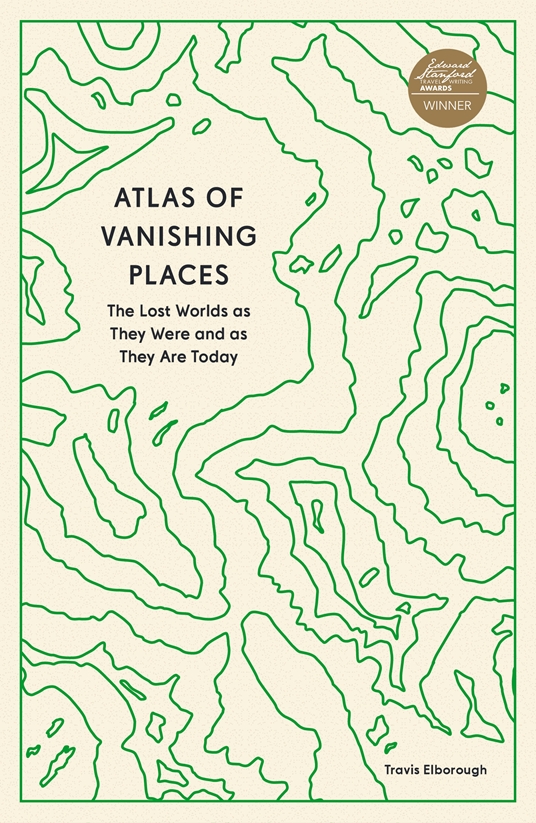
ATLAS OF VANISHING PLACES, great travel-guide gift that was the Illustrated Book of the Year - Edward Stanford Travel Writing Awards


ATLAS OF VANISHING PLACES: The Lost Worlds as They Were and as They are Today (Unexpected Atlases series)
TRAVIS ELBOROUGH; Cartography by Martin Brown
White Lion Publishing (non-affiliate Amazon link)
$15.99 trade paper, available now

Rating: 4.5* of five

The Publisher Says: Maps offer us a chance to see not just how our world looks today, and how it once looked. But what about the places that have vanished from modern atlases? With beautiful maps and stunning photography, Travis Elborough takes you on a voyage to all corners of the world in search of the lost, disappearing and vanished.

2020 WINNER OF THE EDWARD STANFORD TRAVEL ILLUSTRATED BOOK OF THE YEAR AWARD

Discover unusual and secret places that have disappeared from modern atlases, and revel in imagining what the world once looked like. Award-winning author Travis Elborough takes you on a fascinating voyage to all corners of the world in search of the lost, disappearing and vanished.

Unearth ancient seats of power and long-forgotten civilizations through the Mayan city of Palenque; delve into the mystery of a disappeared Japanese islet; and uncover incredible hidden sites like the submerged Old Adaminaby, once abandoned but slowly remerging.

With beautiful maps and stunning colour photography, Atlas of Vanishing Places shows these sites as they once were, together with how they look today—it’s a travel guide, a modern atlas and a passage through geography like no other: travel writing has rarely been so inspiring.

I RECEIVED A DRC FROM THE PUBLISHER VIA EDELWEISS+. THANK YOU.

My Review
: I love the idea of travel more than the reality of it. My disabilities aren't forgiving of the physical exertion of my body that travel requires. A book like this one is a grace note in a more restricted life than most are required to lead. I'm glad that I could go on these historic-site voyages with the eloquent guidance of Author Elborough.

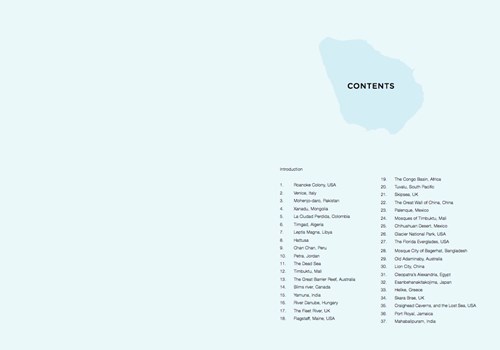
The Table of Contents is the clear road map of where we'll be going. It's always worth a close look, to gauge your giftee's interest in the book's direction.

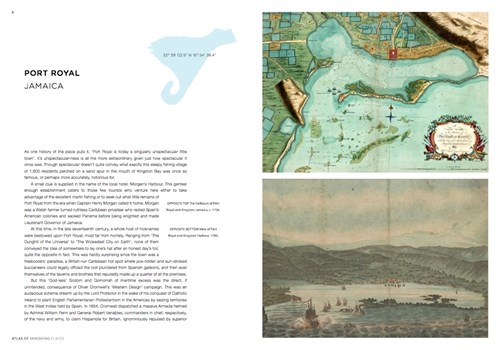
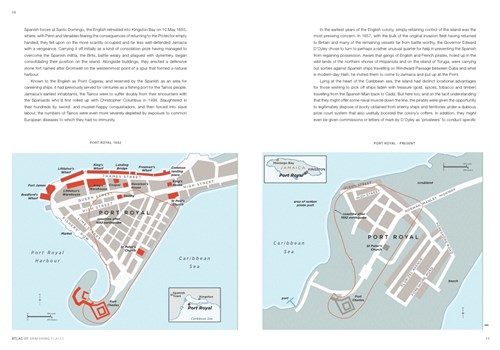
Vanished Port-Royal, Jamaica:

A modern city submerged by an earthquake? Cool beans, four hundred years later. The tragedy no longer stings but the place is a fascinating reminder of what can happen to human places when the planet shrugs its shoulders.

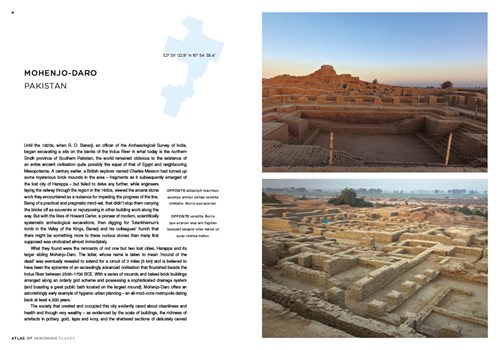
The ruins of Mohenjo-Daro in modern-day Pakistan, on the dried-up course of the ancient Indus River:

The Indus Valley civilization is deeply fascinating if very underknown in the US, and the global north generally. Comparatively little attention gets paid to it, partly because it had the misfortune to be uncovered at the same time King Tut's tomb was dominating world archaeological news. Lacking gold "treasures" and charismatic stone statuary, it simply failed to gain traction. It's never recovered in the world's attention. It is so much older than other urban centers, and well-preserved because the Indus River dried up millennia ago, so no one ever came along to reuse the land on which it stands.

Examples of Author Elborough's agenda...places vanished from our collective memory and yet still present, more or less, to be visitable. Armchair travel is, for me, the best kind. The fact that these are all places with really intriguing history attached to them is a huge plus to elderly me as a reader.

Who in your gifting circle needs this? Who needs an escape from where they are, but can't do it in body?

Here's a great value-for-dollar way to help them.

Monday, November 4, 2024

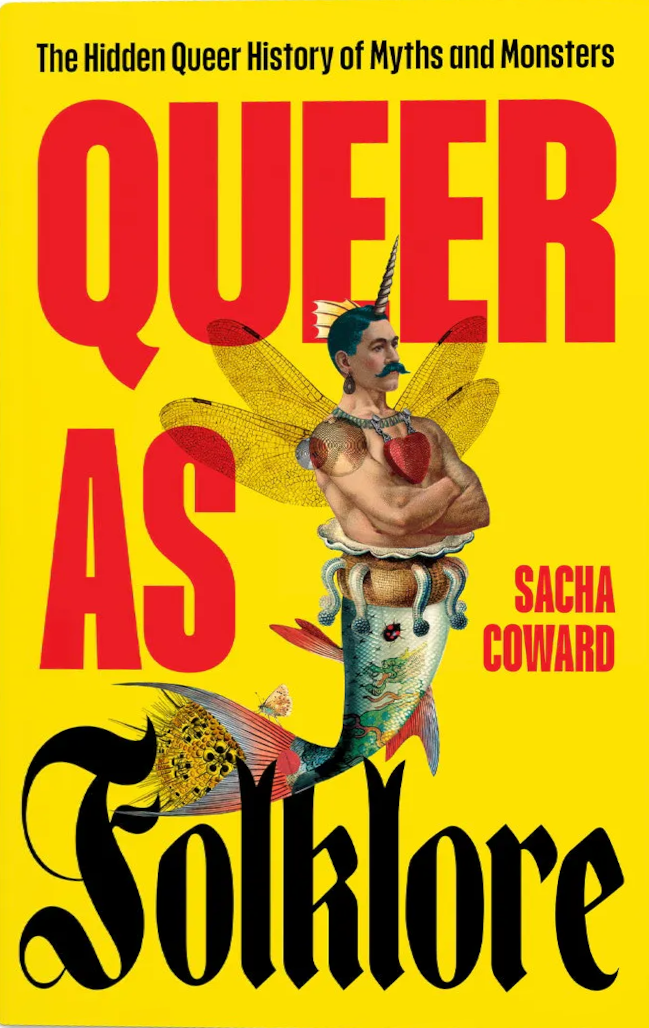
QUEER AS FOLKLORE: The Hidden Queer History of Myths and Monsters, straight-peoples' anxieties and hostilities seen from the other side


QUEER AS FOLKLORE: The Hidden Queer History of Myths and Monsters
SACHA COWARD

Unbound
$25.00 trade paper, available now

Rating: 4.5* of five

The Publisher Says: Queer as Folklore takes readers across centuries and continents which reveals the unsung heroes and villains of storytelling, magic and fantasy. Featuring images from archives, galleries and museums around the world, each chapter investigates the queer history of different mythic and folkloric characters, both old and new.

Leaving no headstone unturned, Sacha Coward will take you on a wild ride through the night from ancient Greece to the main stage of RuPaul’s Drag Race, visiting cross-dressing pirates, radical fairies and the graves of the ‘queerly departed’ along the way. Queer communities have often sought refuge in the shadows, found kinship in the in-between and created safe spaces in underworlds; but these forgotten narratives tell stories of remarkable resilience that deserve to be heard.

Join any Pride march and you are likely to see a glorious display of papier-mâché unicorn heads trailing sequins, drag queens wearing mermaid tails and more fairy wings than you can shake a trident at. But these are not just accessories: they are queer symbols with historic roots.

To truly understand who queer people are today, we must confront the twisted tales of the past and Queer as Folklore is a celebration of queer history like you've never seen it before.

I RECEIVED A DRC FROM THE PUBLISHER VIA NETGALLEY. THANK YOU.

My Review
: Funny how the stories of queerness, of love between same-sex couples, are so very often found in "monster" tales, isn't it. I mean, the rise of vampire fiction as AIDS bit gay men hard is a tough sell as coincidence. Back a way we have Dr. Fankenstein building his perfect man, who then gets all freaked out because he isn't just like the other boys; we have the enduring folktale of Beauty and the Beast, as queer a metaphor as you can find; we have the Greek gods taking outlandishly unlikely forms to get off with humans.

And that's just the Western world.

In modern times there are the just barely clothed superheroes in comic-book or filmed form, flaunting their junk in our faces at $25 a ticket or graphic novel (aka comic book) with oblivious or deeply in denial boys of all ages perving on their favorite characters' amazing prowess without seeming to have a single introspective neuron firing. These hypermasculine avatars of (mostly) toxic masculinity go around destroying things with their unstoppable powers; what better way for these theater-loads of bottoms to get their desperate need to be dominated, wrecked, brutalized met safely and without admitting to themselves their need is deeply, deeply sexual? Likewise the astonishing-to-me rise of RuPaul and drag as mass entertainment...male parodies of femininity enacted for the audience's titillated amusement. There is no filmed entertainment of any sort that doesn't rely on the universal human lust for voyeurism. If I'm at all honest, that applies to literature and reading as well.

Those sour reflections out of the way, let's talk about the *fun* of it all.

The author's done a creditable job of assembling fun examples of myths and folktales that present queerness in a framework of plausible deniability, as has ever been the case. We've always been here...just have to listen to the quiet parts in between the blaring trumpets of heteronormativity. Only in recent times have we been able to say the quiet parts out loud, and it makes the control freaks and haters absolutely wild with fury that anyone could not want to be exactly like them.

Hm. I seem not to have left the sourness behind after all. Well, take the rough with the smooth, laddies and gentlewomen. I listen to unreflective heteronormativity all day every day. Listen to how it feels to be consciously aware of the receiving end of a microaggression for a change. It's never been what you meant, it's always been what the audience hears.

The audience for this survey course in queer identity is in for a treat in terms of the author's clear desire to bring us history burnished to a mellow, shadow-melting glow of inclusion. The care with which he draws lines between what modern people mean by queerness, and the often very different understandings of gender and sexuality people held in earlier times, is both commendable and clarifying. It enables us to respond honestly from within our framework to stories coming from a different framework. It's often done anecdotally, using reports of experience, so data-driven readers might not like this narrative choice. We're in the unabahedly popular arena in this book. Applying academic rigor to the way the author informs us of the existence and the resonances of queer icons in our (Western) cultural history is unwarranted.

Breadth and anecdotality (I think I just invented that word) are both strengths and weaknesses. As always. No tool cannot also function as a weapon. I did wonder at times where the heck Author Coward found his examples of modern peoples' resonances with the stories we inherited from the foreparents. At times this is my favorite thing about the read; at others, it feels...grafted on, placed too carefully to feel entirely natural.

I am mostly unhappy, to the extent I actually am, with the absence of world cultures' representation. I understand this isn't sold or described as about world cultures, but tell me in the subtitle..."The Hidden Queer History of Western Myths and Monsters, f/ex...that I'm not getting this broader focus. I promise I'd still buy and read it. So now you know where that last half-star went.

Still a good read, still a great gift, still something I want people to know is available for their amusement and edification.

Tuesday, December 19, 2023

INTO SIBERIA: George Kennan's Epic Journey Through the Brutal, Frozen Heart of Russia, a sort of anti-travelogue


INTO SIBERIA: George Kennan's Epic Journey Through the Brutal, Frozen Heart of Russia
GREGORY J. WALLANCE

St. Martin's Press
$30.00 hardcover, available now

Rating: 4* of five

The Publisher Says: In a book that ranks with the greatest adventure stories, Gregory Wallance’s Into Siberia is a thrilling work of history about one man’s harrowing journey and the light it shone on some of history’s most heinous human rights abuses.

In the late nineteenth century, close diplomatic relations existed between the United States and Russia. All that changed when George Kennan went to Siberia in 1885 to investigate the exile system and his eyes were opened to the brutality Russia was wielding to suppress dissent.

Over ten months Kennan traveled eight thousand miles, mostly in horse-drawn carriages, sleighs or on horseback. He endured suffocating sandstorms in the summer and blizzards in the winter. His interviews with convicts and political exiles revealed how Russia ran on the fuel of inflicted pain and fear. Prisoners in the mines were chained day and night to their wheelbarrows as punishment. Babies in exile parties froze to death in their mothers’ arms. Kennan came to call the exiles’ experience in Siberia a “perfect hell of misery.”

After returning to the United States, Kennan set out to generate public outrage over the plight of the exiles, writing the renowned Siberia and the Exile System. He then went on a nine-year lecture tour to describe the suffering of the Siberian exiles, intensifying the newly emerging diplomatic conflicts between the two countries which last to this day.

I RECEIVED A DRC FROM THE PUBLISHER VIA NETGALLEY. THANK YOU.

My Review
: Russia always seems to have vicious, cruel, authoritarian governments. George Kennan documented the horrifying repressions of the tsarist regime of Alexander III, father of the ill-fated Nicholas II. The adventurous man whose trip through Siberia Author Wallance is epitomizing first went to Siberia, governed by our then-close ally Russia, to lay a telegraph line across the country beginning in 1864 and eventually have it reach Western Europe. There was an Atlantic cable to England, but the Atlantic has these terrible, damaging things called "hurricanes" every so often, and then there's that big line of volcanoes up the middle of it that periodically erupts here and there...think Iceland's Eyjafjallajökull, 2010...so it has always made sense to have a backup.

Kennan spent a couple years doing the work, and was in love with Siberia by the end of it. The US and Russia, after a long period of close ties that peaked after we bought Alaska from them in 1867, began getting terrible reports about the political prisoners being abused in Siberian prisons. Kennan, by now a professional journalist, was widely thought to be the best possible person to investigate the situation on behalf of the US. He was vocal in his love for Siberia. He said publicly that he felt the complaints of terrible conditions were unlikely to be true...prisoners' families could join them there, after all!

Kennan and artist George Albert Frost traveled through the tsarist penal system, documenting conditions as they found them. Kennan wrote an eleven hundred-page exposé of the horrors they witnessed; Frost's drawings and photographs were included. Frost himself suffered a breakdown—what we would call today PTSD—and really was never quite the same again.

Kennan never lost his love for Siberia and its people but he became an implacable detractor of the Imperial Russian government. He had the evidence to back his outrage and disgust up. He devoted his next decade to a lecture tour enlightening audiences to the facts of what was euphemistically called "the Exile System" of political repression. When, decades later, the October Revolution brought the Bolsheviks to power, Kennan famously said that "the Russian leopard has not changed his spots."

I read this fascinating history of events I'd had only a passing awareness of in the context of Kennan's report to Woodrow Wilson about the Bolsheviks and his subsequent criticism of the Wilson Administration's pusillanimous response to them. His 1885 trip was touched on, but I now know why he was tasked by Wilson with preparing the ignored report. This book, not at all a long read, brings the full awfulness of Kennan and Frost's experiences to life. It is nothing short of gut-wrenching at times. It is extremely carefully footnoted and supplied with an admirable bibliography. I believe Author Wallance has done everything except invent time travel to bring us the best report of the facts possible. His contextualization was emotionally honest, but not of the sort that leads me to mutter, "don't try so hard."

I recommend it highly...but with the warning that delicate fleurs who don't enjoy details of physical cruelty should pass right by. I did, to be honest, feel as though these facts were rather more abundant than was strictly necessary. I had a half-star knocked off for feeling like I was being knocked in the teeth. As Frost's art exists, I wanted to see it, or some of the photos, just to see the realities behind the descriptions of the place itself, though not the abuses!

Not always an easy read, but a wonderfully immersive and interesting historical light on a country whose past binds it to the US.

THE INVENTION OF SICILY: A Mediterranean Odyssey, a title that truly says every last thing about the book within


THE INVENTION OF SICILY: A Mediterranean Odyssey
JAMIE MACKAY

Verso Books
$26.95 hardcover, available now

Rating: 4* of five

The Publisher Says: A fascinating cultural history of this most magical of islands.

Sicily has always acted as a gateway between Europe and the rest of the world. Fought over by Phoenicians and Greeks, Romans, Goths and Byzantines, Arabs and Normans, Germans, Spanish and French for thousands of years, Sicily became a unique melting pot where diverse traditions merged, producing a unique heritage and singular culture.

In this fascinating account of the island from the earliest times to the present day, author and journalist Jamie Mackay leads us through this most elusive of places. From its pivotal position in the development of Greek and Roman mythology, and the beautiful remnants of both the Arab and Norman invasions, through to the rise of the bandits and the Cosa Nostra, The Invention of Sicily charts the captivating culture and history of Sicily.

Mackay weaves together the political and social development of the island with its fascinating cultural heritage, discussing how great works including Lampedusa’s masterpiece The Leopard and its film adaptation by Visconti, and the novels of Leonardo Sciascia, among many others, have both been shaped by Sicily’s past, and continue to shape it in the present.

I RECEIVED A DRC FROM THE PUBLISHER VIA NETGALLEY. THANK YOU.

My Review
: Sicily's thousands of years of documented history can't be done justice in a shortish survey book. It can, however, do the reader who loves Italy and longs for a Sicilian vacation a very big solid by explaining a bit about why Sicily is not like the rest of Italy. There is a significant prejudice against Sicilians, and Southerners more generally, in Italy as a whole...no country is without internecine conflict...but the reasons go back a very long way.

Starting from its origins as a Greek colony, Sicily has been fought over by outsiders for millennia. Different Greek city-states, Phoenicians, Normans on Crusade taking it from Arabs...if you want to understand how Sicilian culture gave rise to the ultimate Family, the Mafia, insulated from the rest of the world, look no further than its long history of being the prize in other peoples' wars.

Italy the current nation-state did not even exist until 1860. After that Unification, the country pretty much ignored the agrarian island. Riots and rebellions, official neglect and church corruption, all led to the rise of the chaotic present in which the Cosa Nostra/Mafia/organized crime has acted as a kind of de facto government substitute. The present-day refugee crises have had a powerful impact on the island's rickety infrastructure and led Sicilians to harden their opinion that the rest of Italy is not interested in helping them cope with this problem not of their own making...again.

The book is written very ably, and has a deft touch on the topics it does cover. It does not pretend to authoritative stature as a major history. It is clear about its purpose as a survey of a long, long history of a much-put-upon place. It will give Italophiles bad wanderlust, and spark curiosity in most history buffs. Any place that has Archaic Greek, Byzantine, Golden Age Muslim, Byzantine, medieval Norman, Spanish, and Catalan ruins and buildings still in use is a place very much worth getting to know. Don't go in expecting a deep dive into any one period's history, and this book will surprise, delight, inform, and astonish you.

But seriously...no images? *tsk*

FOLLOWING CAESAR: From Rome to Constantinople, the Pathways That Planted the Seeds of Empire, armchair travel with the best kind of guide


FOLLOWING CAESAR: From Rome to Constantinople, the Pathways That Planted the Seeds of Empire
JOHN KEAHEY

St. Martin's Press
$30.00 hardcover, available now

Rating: 4* of five

The Publisher Says: A travel narrative following three ancient roads and looking at more than two thousand years of history of Ancient Rome through the modern eye.

In 66 B.C., young, ambitious Julius Caesar, seeking recognition and authority, became the curator of the Via Appia. He borrowed significant sums to restore the ancient highway. It was a way to curry favor from Roman citizens in villages along the route, built from Rome to Brindisi between 312-191 B.C. He succeeded and rapidly grew in popularity. After achieving greatness in Rome and the far reaches of Gaul, he led armies along this road to battle enemies in Roman civil wars. And then, across the Adriatic Sea, he joined Via Appia's sister road, the Via Egnatia that began in today's Albania. Other armies followed these two roads that eventually connected Rome to Byzantium, today's Istanbul. Octavian, who became, in 27 B.C., Rome's first emperor, and his friend and later enemy Mark Antony traveled portions of both roads to defeat Caesar's murderers Brutus and Cassius at Philippi in eastern Macedonia. The great Roman statesman Cicero, the Roman poet Homer, the historian Virgil and many other notables traveled along one or both of these roads. In the first century of the Roman Empire in the earliest years of Christianity, the apostles Peter and Paul traversed portions of them. Pilgrims, seeking salvation in far-away Jerusalem, followed them as well throughout much of the Middle Ages. In the early second century A.D., the emperor Trajan charted a new coastal route between Benevento and Brindisi, later called the Via Traiana.

Today, short stretches of the original three roads can be seen in the ruins of ancient Roman cities, now preserved as archaeological wonders, and through the countryside near, and sometimes under, modern highways. Following those routes is the purpose of treading along the path that Caesar and so many others took over the early centuries. Modern eyes, seeing through the mists of more than two thousand years of history, lead the traveler along these three roads coursing through six countries between Rome and Istanbul. It is a journey full of adventure, discovery, and friendship―one one worth taking.

I RECEIVED A DRC FROM THE PUBLISHER VIA NETGALLEY. THANK YOU.

My Review
: I enjoy history for itself, and the many present-day echoes of historical events just add texture to my pleasure. This historical-tourism book was as deeply involving to me as a standard historical narrative because the conceit...following the Roman roads...is my idea of a great adventure vacation. The author was my guide on this escape from home. It worked as well as anything could because I knew I was in experienced hands (he has written four other books on touring Italy as a history buff.)

While I was very interested in his veteran-journalist's observations of the world traversed by the Roman roads he then traversed himself, and by his reports of his companions' responses to the modern world as well as the archaeology of the paths they traveled together, I was very disappointed that the book contained NO maps or photos.

Don't let that lapse stop you from enjoying the informed, intelligent voice of this forty-five-year veteran reporter as he shares his observations of the world he's moving through. His lifelong fascination with Italy and Rome (men really *are* obsessed with Rome!) gives him a very full view of the countries and regions he takes us through. This book is one of those rare books that, just as a reading experience, solely for the way the author builds an image and creates a simile, is a pleasure to read.

That his trip in Turkey, Asia Minor that was, coincided with COVID and its joys was very evocative for him. Plenty of plagues to meditate on. His religious ruminations are interesting to my deeply, faithfully atheist self...the road network of ancient Rome, and its internal postal connections enabled thereby, are largely responsible for the spread of the religion all across the empire. (There were christians in Pompeii...they found a ROTAS square there! By 79AD there were christians in Italy!)

I do want to mention that the "Caesar" of the title is not Julius; remember that Caesar was a title during the empire, and Trajan, whose Via Traiana is followed, was also a Caesar.

Self-gifting for a lovely time on #Booksgiving, as you settle down in your favorite reading spot, a beverage and a snack close at hand...Italy is involved, there is going to be food talk...and immerse yourself in a part of the world that could not possibly be richer in cultural highlights.

One star off for the absence of photos and/or illustrations.

Monday, December 12, 2022

PRETTY GIFT BOOKS: THE ATLAS OF ATLASES, a beautiful book perfect for your history and/or map nerd & COLORS OF LONDON, vintage photos of a world city colored perfectly


THE ATLAS OF ATLASES: Exploring the most important atlases in history and the cartographers who made them
PHILIP PARKER

Ivy Press
$40.00 hardcover, available now

Rating: 5* of five

The Publisher Says: This beatutiful book is a lavishly illustrated look at the most important atlases in history and the cartographers who made them.

Atlases are books that changed the course of history. Pored over by rulers, explorers, and adventures these books were used to build empires, wage wars, encourage diplomacy, and nurture trade.

Written by Philip Parker, an authority on the history of maps, this book brings these fascinating artefacts to life, offering a unique, lavishly illustrated guide to the history of these incredible books and the cartographers behind them.

All key cartographic works from the last half-millennium are covered, including:

  • The Theatrum Orbis Terrarum, considered the world’s first atlas and produced in 1570 by the Dutch, geographer Abraham Ortelius,
  • The 17th-century Klencke—one of the world’s largest books that requires 6 people to carry it,
  • The Rand McNally Atlas of 1881, still in print today and a book that turned its makers, William H. Rand and Andrew McNally into cartographic royalty.

  • This beautiful book will engross readers with its detailed, visually stunning illustrations and fascinating story of how map-making has developed throughout human history.

    I RECEIVED A DRC FROM THE PUBLISHER VIA EDELWEISS+. THANK YOU.

    My Review
    : There is, on every gifting list, that guy. The one you just...can't...figure...out what to gift. Often they're smart, and deeply interested in something, usually something you've never heard of or think is so boring you'd rather pluck your nose hairs with needlenose pliers than think about.

    This is the present you need for that guy, whatever gender they present and/or identify as.
    Politics? You damned well better bet that politics-obsessed guy knows about maps and their political implications. Author Parker does, too. There's a huge amount of trouble stirred up in this world by making changes to maps. The Gulf War of 1990 was sparked when Saddam Hussein published a map showing Kuwait as Iraq's nineteenth province. Yes, to be clear, it was an excuse but it passed the sniff test around the world...that is how powerful a map is as a political statement.

    India and Pakistan, created from one VAST swathe of land by a few strokes of the Imperial British pen...decades of war over Kashmir being there not here, here not there. Israel? Do I even need to type it? The Toledo Strip in the US? Your politics-obsessed guy
    The history guy...the one who, when awakened from sound slumber can rattle off the presidents of the United States in order starting from the ninth (actually pretty interesting, William Henry Harrison, he was...oh, right, back to what I was saying before) or the Khmer Empire's date of foundation (or as close as we can get, anyway, the seventh century CE wasn't a time with hugely good surviving material culture in writing since they didn't have...yeah, yeah, okay) certainly knows what maps really mean in the world.

    What better way to chart a culture's opinion of itself and its history, not to mention its future, than to look at its maps? Or maybe even more importantly, who drew or draws its maps and why...the US Government produced the Atlas of the United States on paper until 2007 then digitally until 2014, and now...Google does it. The GPS revolution, the web that Time Berners-Lee imagined and enabled with his hyperlinking technology, all depend on an infrastructure less than half a century old. Atlases and maps are centuries old. Paper is ephemeral, it's true, but pixels are barely even real.
    What makes a book like this one so fun for that guy to read is that it's readable. I adored GLOBES: 400 Years of Exploration, Navigation, and Power when I reviewed it for #Booksgiving in 2017 (and it's still available, in stock and ready to ship!), but it wasn't as readable as this book is. Part of that was the coffee-table-ness and part of it was the brief it set itself. This, too, is a coffee table book but it's got a different brief. The globe is an object with a special history, one that includes the social and historical importance that atlases have, but also a physicality and social statement of power and prestige that requires a denser academic argument than does a maps-and-atlases book. It also has an earlier end-point than does a book of map-making and -publishing history given that we are amid a technological revolution with even greater import to maps and atlases than to globes. They're beautiful objects but their role has become completely virtual with the massive increases in computing power and digital storage technology.

    The text of The Atlas of Atlases asks little enough of you to make it possible to skim while sitting around post-gifting and making small talk. There is enough heft to the subjects covered, from Ortelius's first-ever compilation of printed maps that he entitled "Atlas" after the world-supporting Titan of that name in 1570, to Google Maps and its ever-expanding and slightly threatening ubiquity, to keep anyone in this interest group riveted.
    The look of surprised happiness on that guy's face as this multi-layered feast for the eyes and the brain is revealed will more than recompense the mere $40 (less if you shop for it) you shell out. Hard to buy for people, when they get this kind of gift, are always so satisfying to please.

    +++++++++++++++++++++++++++++++++++++++++++++++++++++++++++++++


    COLORS OF LONDON: A History
    PETER ACKROYD

    Frances Lincoln Ltd
    $40.00 hardcover, available now

    Rating: 5* of five
    //
    The Publisher Says: Celebrated novelist, biographer, and critic Peter Ackroyd paints a vivid picture of one of the world's greatest cities in this brilliant and original work, exploring how the city's many hues have come to shape its history and identity.

    Think of the colors of London and what do you imagine? The reds of open-top buses and terracotta bricks? The grey smog of Victorian industry, Portland stone, and pigeons in Trafalgar square? Or the gradations of yellows, violets, and blues that shimmer on the Thames at sunset—reflecting the incandescent light of a city that never truly goes dark. We associate green with royal parks and the District Line; gold with royal carriages, the Golden Lane Estate, and the tops of monuments and cathedrals.

    Colors of London shows us that color is everywhere in the city, and each one holds myriad links to its past. The colors of London have inspired artists (Whistler, Van Gogh, Turner, Monet), designers (Harry Beck) and social reformers (Charles Booth). And from the city’s first origins, Ackroyd shows how color is always to be found at the heart of London’s history, from the blazing reds of the Great Fire of London to the blackouts of the Blitz to the bold colors of royal celebrations and vibrant street life.

    This beautifully written book examines the city's fascinating relationship with color, alongside specially commissioned colorised photographs from Dynamichrome, which bring a lost London back to life.

    London has been the main character in Ackroyd's work ever since his first novel, and he has won countless prizes in both fiction and non-fiction for his truly remarkable body of work. Here, he channels a lifetime of knowledge of the great city, writing with clarity and passion about the hues and shades which have shaped London's journey through history into the present day.

    A truly invaluable book for lovers of art, history, photography, or urban geography, this beautifully illustrated title tells a rich and fascinating story of the history of this great and ever-changing city.

    I RECEIVED A DRC FROM THE PUBLISHER VIA EDELWEISS+. THANK YOU.

    My Review
    : Gifting the Anglophile on your list is always a doddle, right? "Something about England!" the generous, but innocent, gifter thinks. "This will be a snap!"

    *cue hollow laughter at callow ignorance*

    What part of England...north, south, west, Kent? What time in English history...Thatcher's 1980s, Victoria's imperial experiment, William the Bastard's conquering hordes of French-speaking Vikings? England England or Britain...Britain as a whole, the constituent parts?
    I know it's not going to soothe your frazzled last nerve enough to make the idea of a cocktail unnecessary...but there aren't a lot of people who read seriously who haven't heard of, and probably read something by, Peter Ackroyd. He's a cultural monadnock. While one might not adore his prose, or even want to read about his relentlessly centered-on-London stories, it's a whole different kettle of fresh-from-the-Thames eels to think of reading his spear-sharp and sword-long prose about London...accompanied by these startlingly colorized vintage photos of London's past. The firm Dynamichrome makes this its business, and let me tell you that they are clearly destined to be leaders in a revolution for instead of the hitherto prevalent against the colorizing trend. These are images of London from all periods in its history. They're as beautiful as photos of London get. They're also enhanced by the careful and painstaking additions of colors commensurate with the time in history as well as the time of day that they reveal.

    The book's organizing principle is seen in the Table of Contents on the recto above presented. Ackroyd's essays, which I suggest is the best way to present and think of these nominal chapters, riff on the colors, the affects, the gestalt of the visual impact of London. The publishers then chose vintage images and Dynamichrome brought their intense, archivally trained eyes to bear on enlivening them with colors appropriate to and emblematic of the times.
    Bloody gorgeous, mate.

    London's suitability for gifting your Anglophile without getting the weak smile and the slide from a slack, uninterested hand that we all dread is nonpareil. It's been the focus of immense amounts of attention in the moments of history as well as scholarship about that history, so it is readily scannable. It is a major player in the world's economic life, and its social norms have both set and influenced the social norms of many, many countries with past and present ties to it. London isn't England (me, I prefer York, or Chester) but it is called "the Capital" for a reason. It is the head of the government, the home of the economy's engine-controlling bodies, the monarchy's most famous symbols reside there...London is part of the mental furniture of the world's mind.
    It's a simple task to find illustrations for a book about London, and an even easier one to gloss over the role of color in Humankind's experience of its world. We are fortunate to have photographic evidence of the reality of London's nineteenth-century past on forward. Beginning just slightly earlier, we have color illustrations of life in London from the eighteenth century. Printing technology has improved and improved in the centuries since Gutenberg married woodblock image-making to moveable type in 1454. That's been a key development in history's accelerating climb into prosperity from subsistence levels to reliable surpluses to wretched excess. Knowledge and ideas are easily transmissible when they're on paper.

    They're also ephemeral, and subject to manipulation; they're also incomplete and misleading. But they're less likely to vanish without a trace as, for example, the cure for scurvy did in the sixteenth century when French captain Jacques Cartier heard from Native Americans that his men's scurvy would vanish if he made them drink spruce-needle tisane. It did...but he didn't do much to make it known, and it got lost in archives. Much as that has impacted our view of scurvy's history, the lack of color in vintage photos has made our vision of the past flat and one-dimensional.

    We've always lived in a world of color. Nature's colors, but also mankind's. Rescue your Anglophile's imagination from the curse of flat black-and-white thinking with this book. It's vivid, and in its vividness lies its power to inform and to build on our knowledge of one of the world's most important cities: It was always modern, it was always intense, it was always brightly and intensely modern. Celebrate that this Yule gifting season.

    Wednesday, February 23, 2022

    CAROLINA BUILT, fictionalized story of a superbly determined woman's battles


    CAROLINA BUILT
    KIANNA ALEXANDER

    Gallery Books (non-affiliate Amazon link)
    $13.99 ebook edition, available now


    Rating: 4* of five

    The Publisher Says: This “exuberant celebration of Black women’s joy as well as their achievements” (Kate Quinn, New York Times bestselling author) novelizes the life of real estate magnate Josephine N. Leary in a previously untold story of passion, perseverance, and building a legacy after emancipation in North Carolina.

    Josephine N. Leary is determined to build a life of her own and a future for her family. When she moves to Edenton, North Carolina from the plantation where she was born, she is free, newly married, and ready to follow her dreams.

    As the demands of life pull Josephine’s attention away, it becomes increasingly difficult for her to pursue her real estate aspirations. She finds herself immersed in deepening her marriage, mothering her daughters, and being a dutiful daughter and granddaughter. Still, she manages to teach herself to be a businesswoman, to manage her finances, and to make smart investments in the local real estate market. But with each passing year, it grows more and more difficult to focus on building her legacy from the ground up.

    “Filled with passion and perseverance, Josephine Leary is frankly a woman that everyone should know” (Sadeqa Johnson, author of Yellow Wife) and her story speaks to the part of us that dares to dream bigger, tear down whatever stands in our way, and build something better for the loved ones we leave behind.

    I RECEIVED A DRC FROM THE PUBLISHER VIA NETGALLEY. THANK YOU.

    My Review
    : It's always been hard to be a woman. In the US, it's always been hard to be Black. Now put the two disadvantages together...that's what Josephine Leary is up against. She's equal to any task, though; the novel begins in 1870, during the last days of Reconstruction. Having lived her childhood as a slave, Josephine knows that every single act she takes in this life has to have as its aim the increase of freedom and the assurance of security for herself, her husband, and their two daughters, as each addition to her life is made.

    Her slaveowner was also her father, and that piece of "good luck" played out in her favor. She was able to buy the barbershop she and her husband ran together from him. And from there forward, it was all Mrs. Leary and all the way up Sweety, her husband, backed her.

    Until her success threatened his Manhood.

    It's a testament to the author's ability to pace a story that I didn't just quietly close the book and ignore it at that point. I know it happened; I am told it still happens. But it makes for dull reading, the expected flaw in the expected place. But to her credit, Author Alexander dwells on it not...it's not like it's played down but it's not protracted either.

    What made me so dad-blamed mad that I screamed at my Kindle (for which I apologize to my roommate, he was sleeping and was utterly terrified as I shouted "NO SHE DID NOT!!" into the dark) came close to the end of the book when there's a fire that deprives Mrs. Leary of her (uninsured, of course, she was a Black woman, who'd write that policy in the 1890s?!) hard-earned gains! But...and this is where I almost cheered but was too shy to wake the grouch up again...she still owned the land. And she chose to rebuild, to build back better.

    Unlike certain scumbag politicians with "R"s after their names.

    Well, that all sounds very five-starry, doesn't it? But there's a four up there...and I feel generous giving it. The fact is that this is a very dialogue-heavy novel and there's not much vigor in the dialogue. It's not awful but it doesn't lend itself to quoting the quotable quotes. There's not any.
    "The only thing that truly frightens me is the idea that I might not take full advantage of the gift of freedom. I refuse to let that happen."

    And that is as snappy as it gets. I'm in total agreement with the sentiment. I just wish it had more oomph behind it.

    But in the end, this is an historical novel and it's a lot better served by thinking of it as a novelized biography. Josephine Leary very much deserves to be remembered for her indomitable will, her savvy, and her sheer cussèd determination to overcome every obstacle the world shoves in front of her. Reading the story is a good, and a worthy, way to honor the memory of such a remarkable person.

    Sunday, February 20, 2022

    AN AFRO-INDIGENOUS HISTORY OF THE UNITED STATES, colloquial, conversational, controversial


    AN AFRO-INDIGENOUS HISTORY OF THE UNITED STATES
    KYLE T. MAYS

    Beacon Press
    $27.95 hardcover, available now

    Rating: 4* of five

    The Publisher Says: The first intersectional history of the Black and Native American struggle for freedom in our country that also reframes our understanding of who was Indigenous in early America

    Beginning with pre-Revolutionary America and moving into the movement for Black lives and contemporary Indigenous activism, Afro-Indigenous historian Kyle T. Mays argues that the foundations of the US are rooted in antiblackness and settler colonialism, and that these parallel oppressions continue into the present. He explores how Black and Indigenous peoples have always resisted and struggled for freedom, sometimes together, and sometimes apart. Whether to end African enslavement and Indigenous removal or eradicate capitalism and colonialism, Mays show how the fervor of Black and Indigenous peoples calls for justice have consistently sought to uproot white supremacy.

    Mays uses a wide-array of historical activists and pop culture icons, “sacred” texts, and foundational texts like the Declaration of Independence and Democracy in America. He covers the civil rights movement and freedom struggles of the 1960s and 1970s, and explores current debates around the use of Native American imagery and the cultural appropriation of Black culture. Mays compels us to rethink both our history as well as contemporary debates and to imagine the powerful possibilities of Afro-Indigenous solidarity.

    I RECEIVED A DRC FROM THE PUBLISHER VIA EDELWEISS+. THANK YOU.

    My Review
    : What a great idea for Beacon Press to do this series, ReVisioning History. Selecting creators for the almost infinite numbers of topics available to expand our existing explanations of US History must be a nightmare. Author Mays is a scholar of Popular Culture (Hip Hop Beats, Indigenous Rhymes: Modernity and Hip Hop in Indigenous North America, SUNY Press 2018), African American culture, Indigenous culture...among other things...working out of UCLA. In this book, he makes very plain the roots of racism in capitalist profit-seeking, and highlights the Indigenous dispossessions as another facet of capitalist settler colonialism's project to entrench white supremacy.

    So is this something to give your sugar dumplin' for a romantic read-along? Probably not. Is it something to give your sugar dumplin'? Yes. We're well past the stage of needing any help "feeling comfortable" my fellow white folk. The need now is for us to get with the program of what needs to come next. The subject this book has in its sights is how we got where we are, what where we are means, and how to move forward in a positive and inclusive direction.

    In the time of #BlackLivesMatter, I'm not sure I see a way forward that isn't plagued by violence. I'm not at all eager to find out I'm correct, of course. What I suggest to all reading this is, go get the book and see what got us here before opining upon the ways we should or should not proceed. Believe me when I tell you that the way you think we got here is, in fact, not that whole story and to effectively influence the course of future events you'd best be fully au fait with the full spectrum of facts.

    The toughest part of the read for me was the simultaneous sense that the author's boiling mad and icy furious, and reaches for the facetious blade in those circumstances. While it's not unjustified, the overall more controlled, academic prose suddenly breaking out in snark is jarring (eg, an early use of the pejorative "hotepness" made me wonder where this was going to recrudesce).
    Guns aren't the only weapon of choice for police officers. We must ask this question: Where do police officers learn the techniques that lead to the violent brutalization and death of Black, Indigenous, and Latinx peoples? The martial arts community. When we see a police officer mounting a Black person and controlling their wrists and legs, holding them in a chokehold, putting their knee on someone's neck, you know where they learned that from? A martial artist. They learn chokeholds from Brazilian jujitsu experts. ... In this regard, we also have to hold the martial arts community accountable. ... I've been to at least a few gyms in my life and always see someone who has all the signs of a white supremacist. Don't train them. I understand you have bills to pay and deserve to be paid for your labor, but you are actively teaching people who commit violence against Black and Indigenous people. If you want to help someone, actively recruit and train the people who are suffering from police violence in order that they can defend themselves.

    The end does not support the beginning. "I understand you have bills to pay" is pretty snotty...if I, over-sixty white guy, said it to the author, he'd be incandescent with rage...and there's absolutely no recognition that the end of the clause does not contain any sort of mechanism for the beginning to be dealt with.

    Anyway, while there's a lot to address in the world, there's also a lot to address in this book. It makes for a good read because perspective changes are urgently needed all around, and there's no bad place to start working toward a new, more flexible way of framing your personal conversation with it.