Pages
- Home
- Mystery Series
- Bizarro, Fantasy & SF
- QUILTBAG...all genres
- Kindle Originals...all genres
- Politics & Social Issues
- Thrillers & True Crime
- Young Adult Books
- Poetry, Classics, Essays, Non-Fiction
- Science, Dinosaurs & Environmental Issues
- Literary Fiction & Short Story Collections
- Sookie Stackhouse/Southern Vampire Books & True Blood
- Books About Books, Authors & Biblioholism
Showing posts with label Dutch translation. Show all posts
Sunday, August 17, 2025
THE BOY BETWEEN WORLDS, the cruelty is the point
THE BOY BETWEEN WORLDS
ANNEJET van der ZIJL (tr. Kristen Gehrman)
Amazon Crossing (non-affiliate Bookshop.org link)
$4.99 Kindle edition, available now
Rating: 3.75* of five
The Publisher Says: This is the emotionally stirring story of unlikely lovers who brave the bigotry of their era, only to be victims of the even larger forces of history at work in World War II.
The plight of Anna (a lively and charismatic woman) and her much younger second husband Waldemar (an immigrant from the Dutch colony of Suriname), and the fate of their only child, Waldy, after his parents are murdered in the Nazi concentration camp for the crime of harboring Jews in their boarding house is unforgettable.
Waldemar is unique as a biracial young man in post WWII Netherlands—and his search for his own path in life is sure to engage even the hardest hearts.
I RECEIVED A DRC FROM THE PUBLISHER. THANK YOU.
My Review: A story that requires some investment of effort to acquire the specific time and place's attitudes to mostly understand the action. I's all here...you're not doing research. But for about 30ish percent of the read you're not being told the story of a boy, his parents, and how the forces of the outside world break in and break up a family.
World War II...care to guess who the villains are? You guessed it: the neighbors! Nazis are the means to the end of punishing people you hate because you feel like it. This is a read that twangs every string in your heart, that personalizes every childish sob, that removes the veil of routine from every cruel "rule" or "order" or "law" that was designed to hurt ordinary people living their lives because you either like that or do not care enough to oppose it.
It's a cheap read. Gift its drama and its deeply emotional true story to someone who needs it more than I'm sure you don't.
Thursday, August 7, 2025
SLEEPLESS NIGHT, grief never really ends...so what do you do with it?
SLEEPLESS NIGHT
MARGRIET DeMOOR (tr. David Doherty)
New Vessel Press (non-affiliate Bookshop.org link)
$15.95 all editions, available now
Rating: 5* of five
The Publisher Says: A woman gets up in the middle of a wintry night and starts baking a cake while her lover sleeps upstairs. When it's time for her to take the cake out of the oven, we have read a story of romance and death. The narrator of this novel was widowed years ago and is trying to find new passion. But the memory of her deceased husband and a shameful incident still holds her in its grasp. Why did he do it?
Margriet de Moor, the grande dame of Dutch literature, tells a gripping love story about endings and demise, rage and jealousy, knowledge and ambiguity—and the possibility of new beginnings.
I RECEIVED A DRC FROM THE PUBLISHER VIA EDELWEISS+. THANK YOU.
My Review: When I get a deMoor translation, I hop right on reading it because I know I'll go deep into a fascinating place. First Grey, Then White, Then Blue seduced me into her fan club thirty-plus years ago; then, over the years, a few other tries at getting Anglophones interested in her storytelling have been made. None has riled up the delighted baying and howling I feel she deserves for her beautiful, considered, lapidary work.
Oh...I think I see why others aren't flocking to get her latest. More fools they be.
This story will speak loudest to those among us who have lost a love. Left behind to make sense of the life we now live, our love now unreturned, figuring out how the hell to keep plowing through endless, cheerless, drift-filled days and then...horror of self-sadism...those reflective contemplative unanswerable-questioning nights.
Bake a cake!
In this case a tulbandcake (here translated as a "bundt cake" which, yes, but in a curious way, no):
A tulbandcake showing its candied-fruit interior and cool fluting
Staying busy, trying to keep your thoughts out of the toxic death-spiral of loneliness, resentment, anger, hollowness; that's all so relatable, and more poignant because on this night she's come to her kitchen to escape a man she's trying to find a passion for who is sleeping (she thinks) in her bed. He's been left behind as well...though her abandonment is to the love of her life's suicide some time ago and his to his wife's unwillingness to be married to him. That's it, that's the sum total of his existence in this story; having been him before I'll say it's my considered opinion he's lying awake wondering what the hell he's doing where he is when she's not even willing to be there with him for afters.
That said, the love of her life gave up on her, their brand-new life together, and on Life. That leaves a scar. What this nocturnal awakening is about is that scar. Is she so puckered and warped by it there's no longer a way to lie flat again? Is this hopelessness real or imagined? Can she tell the difference? How can she tell the difference?
Is the cake ready?
Because if it is, it needs to come out and cool down so it can be eaten.
IYKYK.
Sunday, August 3, 2025
THE REMEMBERED SOLDIER, Flemish writer explores the Great War's breakage in intimate detail
THE REMEMBERED SOLDIER
ANJET DAANJE (tr. David McKay)
New Vessel Press (non-affiliate Bookshop.org link)
$22.95 all editions, available now
Rating:
WINNER of the Republic of Consciousness Prize, US & Canada, 2025!
FINALIST for the 2026 PEN Translation Prize
2026 International Booker Prize longlistee!
One of Publishers Weekly's Best Books of 2025!
One of LitHub's 100 Notable Small Press Books for 2025!
Wall Street Journal's The 10 Best Books of 2025
The Publisher Says: An extraordinary love story and a captivating novel about the power of memory and imagination.
Flanders 1922. After serving as a soldier in the Great War, Noon Merckem has lost his memory and lives in a psychiatric asylum. Countless women, responding to a newspaper ad, visit him there in the hope of finding their spouse who vanished in battle. One day a woman, Julienne, appears and recognizes Noon as her husband, the photographer Amand Coppens, and takes him home against medical advice. But their miraculous reunion doesn’t turn out the way that Julienne wants her envious friends to believe. Only gradually do the two grow close, and Amand’s biography is pieced together on the basis of Julienne’s stories about him. But how can he be certain that she’s telling the truth? In The Remembered Soldier, Anjet Daanje immerses us in the psyche of a war-traumatized man who has lost his identity. When Amand comes to doubt Julienne’s word, the reader is caught up in a riveting spiral of confusion that only the greatest of literature can achieve.
I RECEIVED A DRC FROM THE PUBLISHER VIA EDELWEISS+. THANK YOU.
My Review: Deeply satisfying, immersive, emotionally intense, and really long.
Okay. You can go buy one now. Ebook, trade paper, whatever, the choice is yours on format. Reading it ought not to be a choice not to.
Maybe this is the last time he will walk down the familiar corridor as the man called Noon Merckem, that door there on the left with those welcoming panes of glass could mean the end of his existence, weak in the knees like a man being dragged to the gallows, that's how he feels in this instant, as the hope that sustained him, the certainty that everything would be new and better beyond imagining and normal at last, that he would pass through that everyday door and be another man when he came out, a man with a home and a family and a life outside these walls, all drains away. And he comes to a halt on the sun-dappled tiles and Brother Reginald turns toward him and sees the desperation on his face and murmurs that God will never test Noon more harshly than he can bear, and gives an encouraging nod, and Noon remains silent, because in his four years here he has not seen much to reassure him about God's notions of what is bearable.
The ecstatic terror of being someone..."this is what it is like to be someone"...who belongs to someone, who is known to someone, whose voice and habits and smells aren't case notes but facts of a shared life...permeates Noon (Amand now) from every axis and angle. Julienne is now real. He has a wife and she not only knows him but wants him (unlike other men in the asylum whose wives families whoevers do not have strength to bear them up) back with her and their children (children? oh god) to create anew the life that war stole from them all. But here are losses too, what is to become of Basiel his electively mute buddy? what of Maurice Constant Jules? and this is where Julienne becomes, to my mind, the single luckiest person on this planet to rediscover a man she was amazingly lucky to find in the first place. He (Amand) has room in his hour of grace bestowed to care for and about those he will leave to become someone, restored to life, to his life again. At last. But the men he leaves in the asylum? Only in body. They're still with him.
Bodies. How incredibly important bodies are in, and after, war breaks them. A body is a thing we use to carry our memories that grow our feelings and shape our personas. All of those are plurals. Plurality and duality and dichotomy are the lot of all bodies, most especially as we move them through...whatever time is, listen if the physics geniuses assembled at Solvay in Belgium a mere five years after this book takes place didn't have a clue what time *is* what chance do I have...time, and things happen to around in us. Children, for example, happen. How? "The usual way" glibly tossed off, but how usual is any way?
What makes me so very happy as I re-experience this story after abandoning it back in March, stuck in my hate-fog as Felonious Yam and cronies began their assault on us, only to pick it up on Thursday morning and finish all close-to-six-hundred pages on Friday afternoon, is the respect for my intelligence this book embodies from beginning to end. Julienne never once comes across as anything other than sincere, Amand never steps into any role but the one of honorable man, no one tells me what to think of their foibles, failings, fallings-short.
What I look for, every time I pick out a story to read, is the one that will make it impossible for me to do the ordinary thing, find faults, even ones that normal people wouldn't care about, and instead surrender to the story's currents and tides, falling in falling down falling in love.
That's what happened here. I hope you'll follow me, hope you'll have that experience, hope this read will fulfill you the way it did me.
I'll note that Goodreads has hundreds of Flemish-language reviews that award four and five stars.
Friday, August 2, 2024
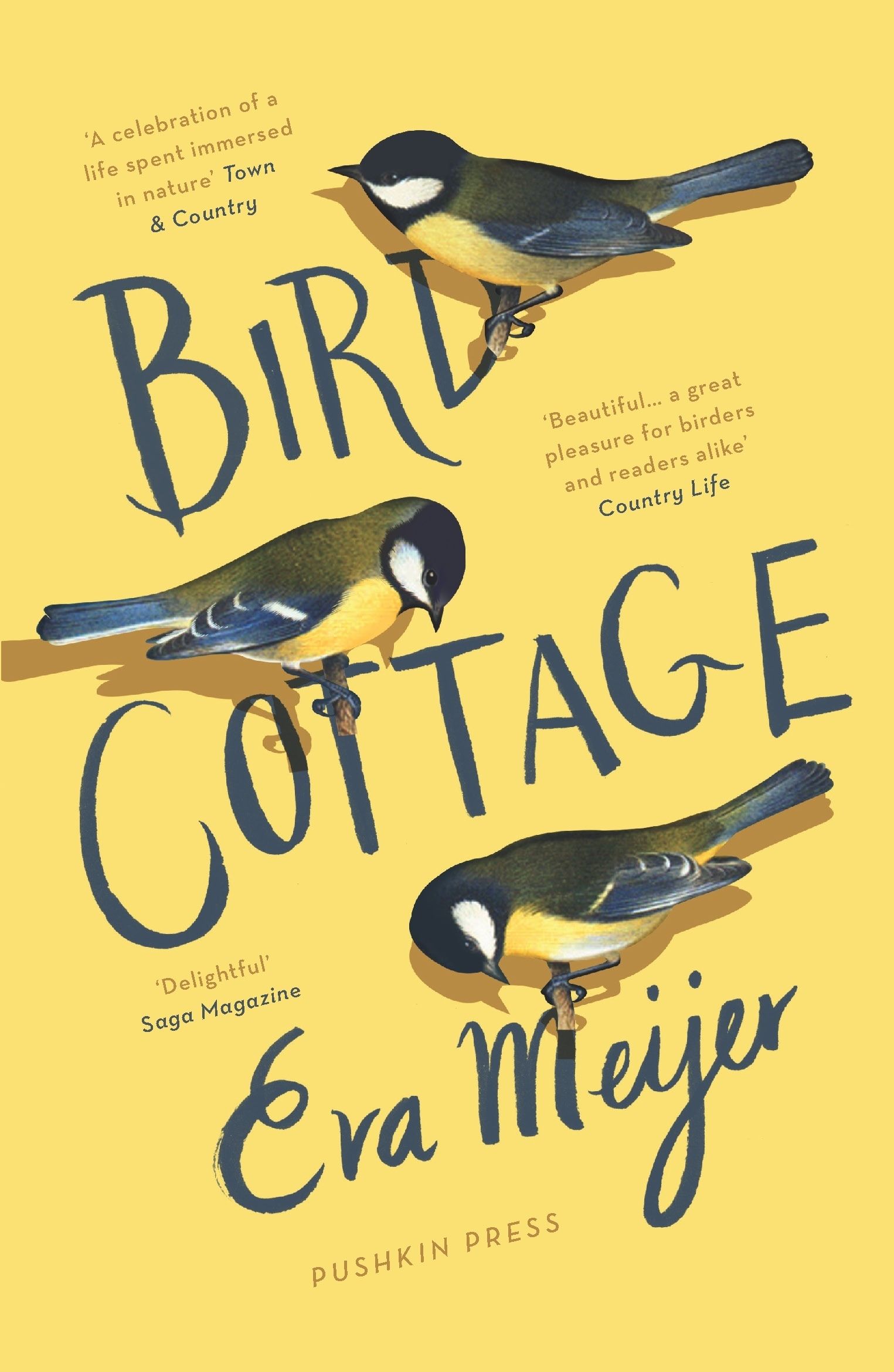
BIRD COTTAGE, perfect holiday read for #WITMonth

BIRD COTTAGE
EVA MEIJER (tr. Antoinette Fawcett)
Pushkin Press (non-affiliate Amazon link
$14.95 trade paper, available now
Rating: 4* of five
The Publisher Says: I want to find out how they behave when they’re free.
Len Howard was forty years old when she decided to leave her London life and loves behind, retire to the English countryside and devote the rest of her days to her one true passion: birds.
Moving to a small cottage in Sussex, she wrote two bestselling books, astonishing the world with her observations on the tits, robins, sparrows and other birds that lived nearby, flew freely in and out of her windows, and would even perch on her shoulder as she typed.
This moving novel imagines the story of a remarkable woman’s decision to defy society’s expectations, and the joy she drew from her extraordinary relationship with British garden birds.
I RECEIVED A DRC FROM THE PUBLISHER VIA EDELWEISS+. THANK YOU.
My Review: A non-fiction novel, a fictionalized (more than usual) biography, it's a read that solves the need I feel to derive some kind of new-to-me knowledge from my entertainment. Len Howard was a real woman, and the facts of her life are as presented here.
I don't think that's necessary to know to appreciate this celebratory telling of one woman's remarkable life. It's interesting, and raises the question: Why not go into a full biography of this powerful, if quiet, personality? She would stand out in any era but in her lifetime (1894 to 1973) she was a unicorn! So, from the start, I was inclined to stand a bit apart from the story. When I'm told it's based on a real person's life, but is fiction, I'll never settle in to a naturally flowing response now. The "which is this thing, fact or fiction?" will arise at every turn.
No fifth star for you, book.
That said, the story told...quiet, meditative, filled with Howard's own sense of wonder and awe at the beautiful world...is an enfolding, enriching experience. I'm not deeply interested in les burdies, unlike so many. Howard's decision to stop creating music to pursue a close and deep connection to them was surprising to me, as it was to those very few she was close to. Her desire to see what unthreatened birds would do differently from the ones she saw being "studied" in harrassing ways, as was the norm at the time, made me think she was trying to find a space free of threats, free of unnatural demands, for herself. What she does in this beautiful idyll is make careful observations, meticulously recorded and thoroughly analyzed. This led to two published books, in 1952 and 1957, now seemigly out of print in English, though not in Dutch...for obvious reasons. Author Meijer's deft hand at work, I suppose, though she did not translate the book.
It is the story of a restricted life, told beautifully, and fully. It reveals that even a woman of restrained temperament...nothing in Len's life before or after her assuming residence at the eponymous Bird Cottage suggests she was a repressed soul, just a quiet one...can feel pinched and coerced into a mold not to her liking. Often the quiet souls, uncomplaining and undramatic in their manners and manner, are mimstakenly supposed to be happy or at least contented. Len Howard was neither. She disliked most human interaction. When, at forty-five, she left the social demands of the world behind to be fully in the natural world, she began to achieve things, to see things, that simply would not be seen in the regimes of study then fashionable. She began, I think, to live her life for herself, as herself.
The strength of my own lurid energies makes me think "that can not be a happy life" but the evidence of her writing suggests it was. I'm appalled, fascinated, and very slightly amazed that someone could choose, at any age younger than I am now, a life without sex. Without companionship. Without others. She wasn't the first, or the last, but "really?" is my one thought.
So there's the missing star explained away; the other four represent my glad-hearted, deeply gruntled feelings as I immerse myself into a calm pool of beautifully clear word-water, telling me a satisfying story of a life lived on the terms its subject most wanted. That she was ucky enough to do this for almost half her years on this planet makes her one of the most fortunate and privileged of people.
This beautifully translated novel of an extraordinary woman's life is an excellent seasonal read. It's one that, during a vacation, will allow the reader to submerge into a truly different way of life. Even though I myownself wouldn't want to live Len Howard's life, I'm glad Author Meijer and Translator Fawcett shared it with me.
Sunday, May 12, 2024
AFTERLIGHT, love, loss, and learning as they look from The End
AFTERLIGHT
JAAP ROBBEN (tr. David Doherty)
World Editions
$19.99 all editions, available now
Rating: 4* of five
The Publisher Says: This moving novel gives voice to the silent grief of the mothers of stillborn children
The young free-spirited florist Frieda grew up in a strictly Catholic environment in the 1960s. When she steps onto a frozen river on a late winter afternoon, little does she know that everything is about to change for her. On the ice, she meets the married Otto. They experience a love that begins stormy and ends with Frieda becoming pregnant—a scandal in the world in which she moves. And so she must never be the mother of her secret child.
For decades she kept her memories of this episode in her life to herself. But the grief for the lost child remains, despite the later marriage, despite the son she still has. At the age of eighty-one, Frieda is suddenly alone again. The silent sorrow returns with force. Only then does she dare to face her story—and to share it.
With Afterlight, inspired by true events, Robben not only pulls back the veil on Frieda’s story but also shines a light on the experiences of countless women between the 1950s and 1980s. The result is an impressive story about buried female trauma, caused by society, organized religion, and the dominant social mores.
I RECEIVED A DRC FROM THE PUBLISHER VIA EDELWEISS+. THANK YOU.
My Review: I lost my love a lot earlier in life than Frieda did. He needed the level of care that Frieda does as the story begins, not me; nor have I yet reached the point where she is, of needing basic-living help.
Thank goodness the strokes I had in 2023 didn't make that help a lifelong need. But I still had the points of recognition and connection with Frieda from my life's story. I was right there with her as she adjusted to a new place to live that doesn't belong to her; I felt her dislocation as the night's disturbances had her groping around the unfamiliar space to find things she's sure she has, and still needs...only they aren't there and won't be again.
I am also familiar with the awful pains of being Othered by "religious" people, and told by The World that who you are is bad, and wrong, and will always cause their gawd to hate you and doom you to an eternity of punishment. Poor Frieda. I wouldn't say she overcomes that abusive horror in this story. I would say she makes her own way in life with the miracle of love offered her by the now-dead Louis...the one who fully expected he would survive her as she declined and lost more and more of herself. I asked Rob to read this book, and, after hearing what it was about, he looked at me through the computer screen and said, "No." Simple, final. Understandable.
It's a lot to ask: Frieda's happiness was bookended by a lot of pain. It is, though, the kind of pain that older people will relate to. It is a very familiar world that Frieda brings back to us in each time period. We've all been too young for some major life event that happened to us anyway. We've all felt unloved and abandoned...rightly, as in Frieda's case, or wrongly...and many, if not most, of us can relate deeply to loving someone and losing them. A lot of my readers are getting to the place where they, or their parents, are needing help that wasn't needed in the recent past. And all of that is what you and I share with Frieda.
Do you want to read about it for entertainment? Well, I did. I was pleased to have the fellow-feeling of Frieda's journey into the undignified, unpleasant (to me) world of bodily aging; as this is a story set in two timelines, though, I was expecting to be led into the sunnier meadows of the earlier life she led, and its youthful exuberance. Here is where the story fell short of the five stars all stories I read start with for me.
This is not a short book—three hundred-ish pages. There was space to develop the dual timeline, and it wasn't done. What's enjoyable about the way Author Jaap writes Frieda's story is the immediacy of it. He gets the sense of her, at every age, as a woman very much alert to the world around her; and yet unable to reach it, grasp it, without mediation...hearing aids, glasses, nurses, her husband, gawd...and so never fully having her own undiluted experience of anything.
Youthful inexperience prevented her from seeing the man who impregnated her in 1963 with any clarity, led to her downfall by the mediation of a religious upbringing that so starved her for genuine experience that she fell for the most unsubtle of lures. There's the consequences part of that in the book, but the stick gets applied without the carrot in my estimation.
That said, I liked this read. I liked its soft edges on hard realities...its gentle Impressionistic blur is, though, down to poor vision, not to a soft reality. That made it the more poignant to read. It's an enjoyable, relatable story well-told by an author who knows his subject. It's deftly translated...no clunks or clanks, and nothing that my early-learner study of Dutch saw as out of place...which helps.
Good is not the enemy of great when it is enough in itself.
Saturday, February 24, 2024
AN UNTOUCHED HOUSE, a flawed Dutch gem via Archipelago Books
AN UNTOUCHED HOUSE
WILLEM FREDERIK HERMANS (tr. David Colmer), introduction by Cees Nooteboom
Archipelago Books
$16.00 trade paper, available now
Rating: 4* of five
The Publisher Says: In this dark, unnerving work of wartime fiction, W. F. Hermans exposes humanity’s essential savagery, barely concealed by its mores and morals. The year is 1944, and a Dutch partisan chances on an abandoned estate, where he decides to take refuge during a lull in the hostilities. The house seems untouched by the war, a kind of haven, its ornament and grandeur intact (not to mention its walls), clothes and sheets to spare, a kitchen stocked with food and drink. He settles in, and begins to consider himself the owner. When the Nazis recapture the village and come knocking, they similarly assume the house to be his; they assume, also, its spare rooms, which they outfit as barracks.
It is all and well until the true owner and his wife return to their estate. Horrified at the thought of being caught in his subterfuge, our protagonist finds himself drawn into further deceit—and swept up in the violence that ensues.
Civilization comes face-to-face with brutality, truth meets the duplicity that has upended and challenged its certainty—Hermans’ prose searches for an order to the chaos and nihilism of war and life. What he cannot find is as telling as what he uncovers.
I RECEIVED A DRC FROM THE PUBLISHER VIA EDELWEISS+. THANK YOU.
My Review: Novellas are, by definition, brief and gestural as opposed to the novel in its deeper dives, its wider emotional landscape. These general observations are, of course, not true of every novel or novella. They serve to define nothing but an expectation of the reasonably experienced reader when picking up one or the other.
I went into this read, then, expecting to get a glancing blow to my interest in the topic of what the Second World War was like for those who lived it, who were involved in the conflict and not observing events from afar. That was an expectation met...but exceeded, at least as the read settled into my brain. The prose, as translated, was not showy or terribly Writerly; the story itself was simple enough, really more suited to a short story than a novella; but as I sat stunned after finishing the read, I realized why the author chose this length of telling for a story this uncomplicated.
Without the novella’s-worth of buildup, the ending would feel artificial and out of proportion to the story itself. As it is, the ending is a shocker. It arrives without fanfare and smacks the complacent, even slightly bored, reader in their readerly chops. At the end of a trip through one devious survivor’s opportunistic manipulations of everyone around him, all in service of maximizing his immediate personal comfort, the situation he has created from his selfish, self-serving and utterly believable actions comes to a loud, permanent conclusion.
The issue I had been nursing against this overgrown short story exploded in the events of the ending. There is a reason for the length the author chose to tell his simple tale. I was not ready for the impact of the ending, which to be clear would always have been powerful. The novella before it, however, was exactly right to create its seismic shifting of my emotional response. An entire novel with this ending would, honestly, have vitiated its power to stun; a short story, even a long one, would make the ending feel artificial and tacked on.
This read is an excellent example of what a novella can do best, when used to best advantage: satisfy the reader’s hunger for a powerful emotional experience in a one-sitting package. So why only four stars? In the end, the manner of telling the story, the simple unfussy writing, works against the needed investment in the story being told. It gets to the stage of thinking, "Really? is this IT?" before the truly impactful payoff occurs. That I soldiered on, finishing the read, was not assured by the manner of storytelling the author used. At times I was ready to jump ship just to be done with this really dislikable man, this solipsistic selfish creep. I am glad that I persevered, but also a little surprised that I did with the truly staggering number of reads I already have lined up.
So, to all who start this read, I say: Do stick it out for the whole distance. It *is* worth your time. But because I feel the need to say that, I can only in honesty rate it four of five stars.
Saturday, December 16, 2023
BIOGRAPHY OF A FLY, lovely gift item for someone who loves Art & Nature both, either...
BIOGRAPHY OF A FLY
JAAP ROBBEN (tr. David Doherty) Art by Paul Faassen
World Editions
$16.99 hardcover, available now
Rating: 4.5* of five
The Publisher Says: For readers of The Boy, the Mole, the Fox and the Horse comes a beautifully illustrated philosophical book on the value of friendship and life, told from the perspective of a fly, and a gift book for all ages.
What if you were thrown into existence in the middle of your life, with numbered days left ahead of you? Would you see the world in the same way?
In his inimitable style, Jaap Robben answers these questions through the unexpectedly witty lens of a fly, from the moment it enters the world as a larva right up to its deathbed. Watch this humble fly throw himself into life and his unlikely friendships with gusto, however short that life may be. Irresistibly charming, funny, and sprinkled with entomological details, this is a moving tale for any stage of life, about how we are all ultimately alone, and yet also together.
I RECEIVED A DRC FROM THE PUBLISHER VIA EDELWEISS+. THANK YOU.
My Review: Beautiful, weird little meditation on Nature, and the nature of Life. A fly’s life, from larva to deathbed, told in direct and (as far as I could tell without doing more research than seemed warranted) accurate manner.
That life being short, it’s good to follow it chronologically and to deal with the Stuff of Life (warning to the squeamish...lots of honest talk about shit) in a way that will inform the reader of, say, eight and up about more than just the biology involved in living.
I don’t find bodily functions as unpleasant to discuss as many seem to. The fact is, we all shit or we are dead. Eating, sleeping, shitting, sweating...take the stigma out of bodily functions for kids, I beg of you. It does no good at all to teach a child to feel disgust for their body.
A book like this is a very easy way to start that goal off. Enjoyable on many levels, for many ages...most art fans will like the minimalist color palette and the gloriously weird framing of the images, and thoughtful readers will enjoy the philosophizing.
What kind of squeamish speciesist could resist this face?
Thursday, April 30, 2020
Three new illustrated books: LEWSER!; BOG BODIES; I WISH
LEWSER!: More Doonesbury in the Time of Trump
GARRY B. TRUDEAU
Andrews McMeel Publishing
$16.99 oversized paperback, available for pre-order
Rating: 3.75* of five
The Publisher Says: A mirthful and merciless skewering of the Trump administration from the senior statesman of political cartooning, Garry Trudeau.
From the Pulitzer Prize-winning cartoonist whose acclaimed Yuge!: 30 Years of Doonesbury on Trump blew up the bestseller list, G.B. Trudeau's third (and final?) collection of Doonesbury Trump cartoons takes readers through the dark heart of Trump's presidency and into 2020 election mania. Including two years' worth of original Doonesbury Sundays, full-color spreads, and 18 previously unpublished strips, the completion of Trudeau's Trump trilogy arrives just as the 2020 election is in full swing.
I RECEIVED A DRC OF THIS TITLE FROM THE PUBLISHER VIA EDELWEISS. THANK YOU.
My Review: You already know if this book is for you. If you voted for 45 (why are you reading my reviews, for a start) you shouldn't even acknowledge it exists. If you didn't vote at all, pre-order it immediately for July delivery. If you didn't vote for 45, but voted, well...do you like banging your fingers in filing-cabinet drawers? Do you laugh at car wrecks? Your jam awaits.
For my part, I'm just thrilled that Garry Trudeau still has the mental and visual acuity to mirror that which is painfully obvious in terms both amusing and enlightening. Even though it's a bit much taken all together. Maybe space out the read.
In a cartooning career spanning decades of political chicanery, I don't think Garry Trudeau's ever had a target-rich environment like this one. Even Nixon, as horrendous a person and a president as he was, couldn't match this "administration" for vileness. His appointees, while evil, weren't incompetent and downright stupid like 45's are. Well, you either know that or reject knowing that already; this isn't a sophistic enterprise but a tendentious one. You've been informed. Decide according to your prejudices what to do about buying the book.
++++++++++++++++++++++++++++++++++++++++++++++++++++++++++++++++++++++++++++++++++++++++++++++++++++++++++++++++++++++++++++++++
BOG BODIES
DECLAN SHALVEY (writer); GAVIN FULLERTON (artwork); REBECCA NALTY (colorist)
Image Comics
$12.99 oversized paperback, available for pre-order
Rating: 4* of five
The Publisher Says: An Irish gangster on the run after a job gone wrong stumbles upon a young woman lost in the Dublin mountains. Injured and unarmed, the unlikely pair must try to evade their pursuers and survive the desolate bog that has served as a burial ground for unspeakable murder throughout history. DECLAN SHALVEY (INJECTION, SAVAGE TOWN) and GAVIN FULLERTON (Bags) deliver a cold and poignant story of crime, survival, and regret.
I RECEIVED A DRC OF THIS TITLE FROM THE PUBLISHER VIA EDELWEISS. THANK YOU.
My Review: This May 20, 2020, release from Image Comics is deeply Irish, using lots of Irish cuss words and ones we in the US think of as swear words...ladies in the audience, "cunt" does not mean the same thing in Ireland!...which you'd do well to consult the Urban Dictionary about as you run across them.
The flat, brutal art and the dark, flat colors are a fine tonal match for the story of Killian, a small-time wise guy and a major fuck-up whose rope has finally run out. The son of a murdered gangster, he followed in his dad's footsteps without the talent for it. It has led to the moment in this story, a brutal life's summation and judgment; it's a morality tale, of course, but it's got a few little grace notes. Is there some hope for Killian in the afterlife, after the major cock-up that's led him to his end?
Mad Maureen, the old woman who lives in a conveniently remote place, is a sheer delight. Her weird world, the one her nephew Keano...aging in an unforgiving world as "the Bishop"'s enforcer...has made for her. It suits. It really suits. Madness is always lonely; Maureen's isn't. She has plenty of company courtesy of Keano and the Bishop.
So at the end of the story, all the chickens come home to roost. There's closure. It's like the closure of a coffin lid, yes, but it's not less satisfying for all that. What it isn't is, well, conventional.
If you're up for a dark and cruel story of consequences and simple but brutal endings, this is your noir jam. Apart from the Irish-slang issues, it's a good solid crime read.
++++++++++++++++++++++++++++++++++++++++++++++++++++++++++++++++++++++++++++++++++++++++++++++++++++++++++++++++++++++++++++++++
I WISH
TOON TELLEGEN (poetry); INGRID GODON (artwork); DAVID COLMER (translation)
Elsewhere Editions
$14.00 ebook, $22.00 hardcover, available now
Rating: 4* of five
The Publisher Says: Bestelling Dutch children's author Toon Tellegen matches 33 imaginative prose-poems prompted by the statement "I wish" with luminous, old-fashioned portraits by Ingrid Godon in this beautiful, unique volume perfect for thoughtful young readers.
I Wish pairs writing with a gallery of portraits inspired by old-fashioned photographs - faces staring out at us with the serious, veiled expressions of a bygone time. Scattered among the paintings are young children, men and women, and babies, speaking through Toon Tellegen's yearning language. Like dozens of confessions poured from the page, the writing presents a glittering kaleidoscope of wishes, from imagined feats of heroism to reciprocated human love.
I RECEIVED A DRC OF THIS TITLE FROM THE PUBLISHER VIA EDELWEISS. THANK YOU.
My Review: Toon Tellegen is a Dutch poet whose work I've liked (Letters to Anyone and Everyone was a hit with me, illustrated by Jessica Ahlberg instead of Ingrid Godon's artwork inspiring Tellegen as in this book), aimed at younger readers though it is. Permaybehaps that's why I liked it from the moment I discovered it, come to think on it; unlike most poetry, it isn't gawdawful pit-sniffing slef-absorbed and -referential narcissism and condescension. It conveys its message simply and directly, though that message is subject to the reader's interpretation. The two pieces below will demonstrate that the knowledge one brings to the read will shape the poem's meaning.
CARL
I have a little list of conditions I have to fulfill to be satisfied with myself. When I read that list, I think, there are two things I can do: either make a list that's even shorter or never be satisfied with myself. What should I do?
JULIA
When I'm sad I always think: and the saddest is yet to come... Then, besides being sad, I'm scared too.
Why do I do that?
When I'm happy I never think:
and the happiest is yet to come...
When I'm happy, I'm always just
happy.
An adult reader will sense different layers of meaning; your twelve-year-old niece will feel understood, most likely, and thus happily seen and heard. It's a wonderful gift to be given at that age. Feeling seen is a jolt, an emotional high, for adults who can command it in so many more ways than a tween can. This book is for that tween, to elicit the joyous sense of release that is Existing in the World.
Don't hesitate: This moment, this quarantined and isolated moment, is the perfect time to give this gift to the young person in your life.
And, if I'm fully honest, yourself as well.
Sunday, November 27, 2016
FIRST GREY, THEN WHITE, THEN BLUE, first novel from Dutch artist Margriet de Moor, excellent
FIRST GREY, THEN WHITE, THEN BLUE
MARGRIET DeMOOR (tr. Ina Rilke)
Out of print
Various prices via Amazon and other sellers
Rating: 4* of five
The Publisher Says: Magda in life—no less than Magda in death—was an enigma. A free spirit, alluring but private, loving yet remote. Where did she go during the years of her disappearance? Was it truly to the world of the stars? For her husband Robert, who wanted to possess her, body and soul, what Magda gave him was never enough. He murdered her, leaving her lover to discover her body.
Now, as friends gather for her funeral, the mystery of Magda's life is slowly, tantalizingly, revealed. Who really knew Magda, and what truths has her death revealed? First Grey, Then White, Then Blue, Margriet de Moor's first novel, is a story of perception, love, and mortality, told with a bewitching power. Margriet de Moor's novels and stories have been garnering high praise on both sides of the Atlantic, and her feel for physical detail, psychological nuance, and the quiet power of her storytelling have made her one of the most interesting and provocative contemporary writers. First Grey, Then White, Then Blue will be sure to captivate lovers of last year's The Virtuoso, while finding new fans for a writer endowed with the gift for mapping emotional worlds with unerring accuracy.
My Review: When eye specialist Erik drives down the dune where his house occupies the topmost bit on his way to work, he is surprised to see his childhood friend Robert's wife's dog standing outside the gate to Robert's family home. How odd, out of character for the animal to be unaccompanied in such a place and with no obvious signs of activity to explain the mystery. Erik stops the car, curious, and sets in motion the end of several worlds.
Magda, blonde Czech-German Jewish refugee child of WWII, lies dead in her bed. Robert has stabbed her with his father's Tibetan dagger. Erik is unable to process Robert's part in killing his own wife, who was also Erik's lover. Twenty years before, Robert had brought Magda home with him from a trip to Canada. The couple were passing through Robert's home town to cock a snook at Noort family on their way to live a delightfully Bohemian life in France's Cévennes mountains. Historically these Southern French gorges and peaks have sheltered those not in good odor with the central authorities. The population is largely Protestant in Catholic France. A renegade runaway Dutchman and his blonde Canadian wife raise not a hair on the locals' eyebrows. Robert paints. Magda tries to become pregnant. Erik, his wife Nellie, and their autistic son Gaby visit the Noorts for the first time in the late 1960s:
Only now does he remember that that triumphant voice provoked a vague feeling of revulsion in him. Did he perhaps begrudge Robert his exalted ideas? Robert told him that he forced things to have an affair with him.It's a cogent question, one that Erik doesn't make sense of until a decade or more after he's asked it. Walking into the murder scene, he finds Robert unwilling to offer more than the minimum of interaction. He isn't raging. He isn't much of anything, really. Murdering his wife of twenty years has hollowed him out, leaving only a Robert-shaped shell, unable or unwilling to offer any explanations or resistance to his arrest by police Erik has summoned.
"A love affair, don't laugh. If I had to I would force to make them communicate, yield up their confidences. What do you think of this stuff? Has quite a kick, hasn't it? Here they see the mouse as the symbol of the loyal Joseph."
Erik did not reply. He looked at the canvas in front of him on an easel, a life-sized woman's portrait. Although it was not apparently like her, Magda had undoubtedly sat for it. The portrait was painted in crude areas of paint, not with a brush but with the palette knife, and it seemed to him, much more than the landscapes and the still-lifes, first and foremost an account of work in progress, a fever, a battle with light and color.
He asked, "Can't you love the landscape, objects, a woman, without wanting to turn everything into something that belongs to you?"
The narration now shifts to Robert's point of view, examining the roots of his obsession with Magda. He's a bourgeois boy in rebellion against his father. He's gone to New York City to join the burgeoning art world's ranks. His ambition to be a painter is nothing his industrialist father understands. Not the newest, freshest idea? Well no but then again there is a good reason that evergreens become evergreen. The conflict between fathers and sons is eternal and bitter; the sons no less than the fathers carry scars that don't make for attractive viewing. Robert responds to Magda's departure, unannounced and unexpected, with his father's wounds being laid bare again:
He opens the French windows, leaves off all the lights, slips off his shoes, his tie, finds a box of black cigarillos—lights one, pours himself a whisky—which he has not drunk for years—lies full length on the sofa and puts the bottle within reach. Her absence annoys him beyond words."Why don't you love me?" The lament of each generation to the one before, a source of eternal anger and stress, and the genesis of much trouble between intimate partners.
Evening sounds penetrate from the street. Footsteps of people out walking, a stifled laugh, a cry of surprise and then suddenly a passing bus: how dare you disappear just like that, tell me at once where you've got to and what time you're coming home. He shivers. This cold draught has nothing to do with you and me, with our lives, with our evenings by the fire. But when he gets up he leaves the French windows as they are, open, he simply fetches a heavy overcoat which he puts over his legs when he lies down again. There is no love at all in you!
Robert and Magda spend many years in each others' space. I don't know if I'd say they form a family unit so much as they have the same center of gravity and revolve around it, grinding grooves into each other, wearing channels in the other's bedrock along which their shared rages can flow:
His embraces are rough. Through a curtain of tears he immediately pushes his tongue deep in her mouth, although he knows that she really hates it. He grips her hips with his knees. He presses his fingers into her shoulders and then in hasty panic removes them in order to fiddle with the zip of his trousers. He pays no attention to her face, he does not listen to the sounds she makes, there is too much to do. At this blinding hour, in this cell of heat and fury where he has lost all patience and is as abrupt as the blade of a kinfe, Robert Noort, idealist, artist, utterly exhausted man, thinks his wife has been gone too long, that he has permission to rescue her from the underworld and at the same time to look back, that he can even grab her, that he can bury his head in the sweaty scent of her armpit, that he can drag her back by her hair to her warm beating heart, her skin, her hair, her eyes—your body is what you are, return to it, come on! so that we can learn everything about each other that is worth knowing—and bathed in sweat, his trousers around his ankles, he tries with actions that are essentially simple and, moreover, as old as the world, to restore order.The confusions of love and hate, desire and domination, mastery and stewardship are all played out in de Moor's creations.
The confusion you are born with.
Robert's rage to possess meets Magda's Teflon emotional surfaces. Her own father, a Czech Jew, was betrayed to the Nazis in 1944 when she was perhaps six; her mother spent the rest of the war on into the postwar period looking for her one love's fate. Unable to find him or any news of him, Magda's mother took them as far away from Europe as she was able to do. Wide-open Canada, umbilically connected to mother England, takes in refugees from the titanic convulsion that wracked Europe for six long years. Magda's mother gets them onto a Swedish ship that will land them, ultimately, in Gaspé on Quebec's shores of the St. Lawrence Seaway. The crossing gives Magda some of her most coherent childhood memories:
Passengers, officers, a row of sailors at attention with the baby in a white cardboard box on a table. When I got close, I looked carefully. It was a sturdy, pretty baby, with a face that looked calm and even a little proud. Under its long-lashed eyelids it succeeded very well in hiding what it is like to be dead. Contentedly I noticed the dark pink roses laid around the body.How exactly like a child. I was fully convinced that the murdered Magda, even so far in time from her unnatural demise, would note so carefully the ultimate end of all life's journeys, short or long. It made complete sense to me. Magda's trajectory was not showy. It was longer, perhaps, than it might have been, or shorter than it should have been, but it was a low one and left few signs of its transit.
They had been made from sanitary towels. I had seen the women at work, the previous afternoon. They had carefully pulled apart the sanitary towels, which consisted of a pink and a white layer, they could use only the pink layer to fold wonderfully ingenious roses, twist them round and secure them with a tacked stitch. Tell me, I asked the baby softly, is it true that everything first goes grey, then white, then blue, and then you fly to the stars? By the way, what do you think of those roses? I think they are the most beautiful thing I have ever seen.
Or did it? Magda was a presence, if not a star, in the spaces she chose to inhabit. She made an impression on people she met and she did this without any visible effort on her part. It might be as simple as her inner emotional landscape's silence, its immensity:
The spinning space. The night sky. A rising piece of land, blue as the ocean and equally impassable. I had not known such solitude since my childhood. I hunted cautiously for a cigarette, I wanted to let the others sleep, I wanted to smoke by myself and stay awake looking at the clouds obscuring the moon. I was exceptionally calm. I remember my calm, my emptiness deep inside. Trees...fields...a farmhouse like a boat under the stars...suddenly it occurred to me that my life with Robert had been a poem. Everything that mattered to me personally had taken a new twist in the light of that chance meeting. My eyes and skin: designed for other use. My past and my mother's: captured in words. My future—look: a sun-drenched plain that we were going to populate with mountains, trees and rivers that belonged to both of us. ... What I want to know is this. Would it also be possible to take that poem in my hands and drop it onto a stone floor? So that it smashed into fragments, into crude slivers... What I want to know is this. Among all those things it must surely be possible to find something which could not be swallowed up?These thoughts are the ones de Moor gives to a fleeing wife. A woman who, after close to twenty years with a man she selects on a whim as a teenager, leaves him with no more forethought or preparation than she chose to go with him earlier. Magda can't fill up the space she contains; Robert can't make a dent in her surfaces, let alone her interiority; and even an affair with his childhood friend, placing herself between Erik and his wife, Erik and his son, doesn't dent her formidable vastness. Most people stay inside the coloring book's lines because daring to go outside them means losing sight of boundaries. Magda is nothing but boundaries. She translates between languages as naturally as she adapts to living in new places. Leaving Czechoslovakia for the defeated Berlin of her mother's family; leaving Europe for Canada; leaving Gaspé and her solitary mother for a French life as a Dutch artist's wife; leaving France as her increasingly visually impaired husband reinvents himself as the savior of the business his father left behind. Nothing proves too great a challenge for Magda to adapt to, and that in the end was her demise. She had no solid, immutable core for her husband to break, satisfying his rage and hatred. So he had to kill her.
Chilling.
I read this book twenty or so years ago, and fancied it as a film. (A project unlaunched, alas.) I liked its spareness, and was completely unsurprised to learn that Margriet de Moor was trained first in music. I can imagine this tale as a song-cycle; a suite of voices telling the ordinary life of a group of ordinary people whose paths intertwine around war and tragedy. How simple, how baroque, how complete it is to make the fullness of a life into fiction. And how satisfying to experience that fiction. The Overlook Press edition of this book came out after I read the Picador UK translation; in fact, the editor at Overlook who acquired The Virtuouso and this novel for the US market was in my office once while I was an agent, and was deeply surprised that I had read the book. I've always thought that de Moor would have enjoyed that moment of mutual surprise each of us experienced, one that someone knew of her discovery and one that someone finally paid attention to his.
But first novels have flaws. The voices of Nellie, horned wife of Erik and betrayed best friend of Magda, is given short and unsatisfying shrift in the last 20-30 pages of the book. Gaby, the autistic son of Erik and Nellie, features in the book at too short a length for his presence to feel like more than a vase of flowers on the stage of this opera. If you take my advice and read this book, you'll stop at the end of part three and ignore part four entirely.
But I do hope you'll spend some time with Margriet de Moor and her quotidian drama. I still think of Magda fondly, a friend bobbing away from me in time's eddies.
Subscribe to:
Posts (Atom)