Showing posts with label The Overlook Press. Show all posts

Thursday, October 31, 2024

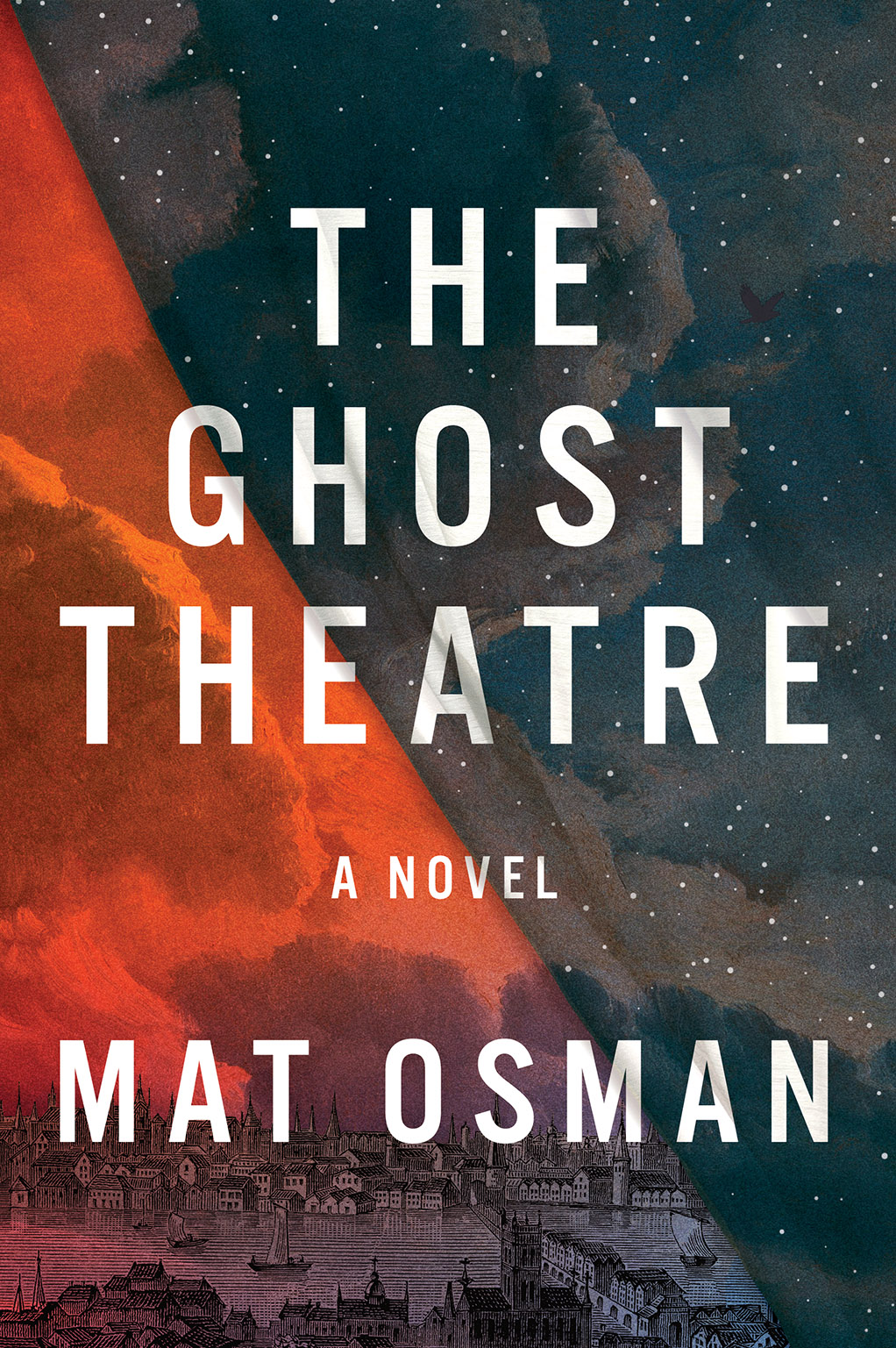
THE GHOST THEATRE, power to the alt-Elizabethan London lovers!


THE GHOST THEATRE
MAT OSMAN

The Overlook Press (non-affiliate Amazon link)
$12.99 Kindle edition, available now

Rating: 4.5* of five

The Publisher Says: A wild and hallucinatory reimagining of Elizabethan London, with its bird worshippers, famed child actors, and the Queen herself; a dazzling historical novel about theatre, magic, and the dangers of all-consuming love

London, 1601—a golden city soon to erupt in flames. Shay is a messenger-girl, falconer, and fortune teller who sees the future in the patterns of birds. Nonesuch is the dark star of the city’s fabled Blackfriars Theatre, where a cast of press-ganged boys perform for London’s gentry. When the pair meet, Shay falls in love with the performances—and with Nonesuch himself. As their bond deepens, they create the Ghost Theatre, an underground troupe that performs fantastical plays in the city’s hidden corners. As their fame grows the troupe fans the flames of rebellion among the city’s outcasts, and the lovers are drawn into the dark web of the Elizabethan court. Embattled, with the plague on the rise throughout the country, the Queen seeks a reading from Shay, a moment which unleashes chaos not only in Shay’s life, but across the whole of England too.

A fever-dream full of prophecy and anarchy, gutter rats and bird gods, Mat Osman’s The Ghost Theatre is a wild ride from the rooftops of Elizabethan London to its dark underbelly, and a luminous meditation on double lives and fluid identities and the bewitching, transformative nature of art and power, with a bittersweet love affair at its heart. Set amid the vividly rendered England of Osman’s imagination and written in rich, seductive prose, The Ghost Theatre will have readers under its spell from the very first page.

I RECEIVED A DRC FROM THE PUBLISHER VIA NETGALLEY. THANK YOU.

My Review
: Mat Osman, brother of Richard, tries his hand at fantasy noveling...outta the park, buddy, what a genre debut! Co-founder of Suede, a quintessential 90s Brit-emo-boy band, decides to write something not centered in the music culture. Great decision! Tackling the end of Elizabethan London, adding a layer of fantastical performance art to it, made this a book I approached with some trepidation. His earlier novel, The Ruins, was a powerful read set in a modern world heightened but still mudane. It was imperfect in its characters' grapplings with desire, the desire to be one's self, the desire to be valued and still free, but it was a fine read.

Here we get the thing I missed in The Ruins. Shay is a cross-dressing woman (it's safer in this world to present as a man) who falls in with young actor Nonesuch (recalling as you do that female roles in Elizabethan theaters were played by crossdressing boys) after her bird-worshipping cult is disrupted by violence. Violence, societal down to interpersonal, is the refrain of this operatic tale of escape, concealment, and ultimately discovery. Violence rules this novel. Shay, rescued from violence, and Nonesuch, accustomed to its sexual expression, decide to become performers of stories that aren't about the great and good. They tell stories like the one they've just shared in which they stave off rage and hate, but pay a price in the process. They know not to try to compete for center stage with those stories of the great and good. They take to the corners, they lurk in the shadows among those like themselves who, stunned, see themselves in the stories the Ghost Theatre duo are telling.

The power of seeing yourself in a story is hard to overstate.

Soon the pair, intimately connecting to the hoi polloi of their class, are attracting crowds. That means they're also attracting notice. The great and good, the primacy, inescapability, of whose stories drove the pair to rebel, are suddenly attentive and making them very much in fashion. They're getting noticed by the elite who never knew they were alive before.

Ask a gay person outed in heteroland, a Black person in whiteworld, a trans person anywhere, how that feels.

Passionately pursuing Truth is, I think, only safe for the young and powerless. They have little to lose. They have no kind of perspective, but this irresistible draw to honesty and truth and self-realization is the road traveled to acquire a lifetime's supply of that missing perspective. This is a subtractive, even divisive process. Shay and Nonesuch ignite passion and create magic with their Ghost Theatre. Fire metaphors for growing up, for attaining wisdom, are apt: annealed in flames of their own ignition, the entire troupe burn in the brightness of fame's flames.

When the bill comes due, the prices (plural) are high; the perspective, one is left to hope in the ending that gives no closure, they've earned will keep them safer than they are during the story.

I can't get to a fifth star because the way we move, bob, and weave in this narrative is sufficiently non-linear as to make the journey circular in affect. Has anything fundamental, or even just more than cosmetic, changed?

I'm not sure; I'm only sure I love the Aviscultans, and the Ghost Theatre, and the honest portrayal of the power of Love among the powerlessness of Others to make a life of struggle feel as though it's a Quest, a magical, important affirmation of Life.

Sadly it never really is, or not for long. That knowlege, though, is mine, not the characters'. Beautiful-sounding, complicated, and still the story's in the end slighter than it feels while you are within it.

Wednesday, October 20, 2021

NORTH, an immigration tale we all need & OH WILLIAM!, the third Amgash-based tale of Lucy Barton & Co.


NORTH
BRAD KESSLER

The Overlook Press (non-affiliate Amazon link)
$9.99 Kindle edition, available now

Rating: 3* of five

The Publisher Says: A powerfully moving novel about the intertwined lives of a Vermont monk, a Somali refugee, and an Afghan war veteran by the author of the acclaimed memoir Goat Song

As a late spring blizzard brews, Brother Christopher, a cloistered monk at Blue Mountain Monastery in Vermont, rushes to tend to his Ida Red and Northern Spy apple trees in advance of the unseasonal snowstorm. When the storm lands a young Somali refugee, Sahro Abdi Muse, at the monastery, Christopher is pulled back into the world as his life intersects with Sahro’s and that of an Afghan war veteran in surprising and revealing ways.

North traces the epic journey of Sahro from her home in Somalia to South America, along the migrant route through Central America and Mexico, to New York City, and finally, her dangerous attempt to continue north to safety in Canada. It also compellingly traces the inner journeys of Brother Christopher, questioning his future in a world where the monastery way of life is waning, and of veteran Teddy Fletcher, seeking a way to make peace with his past.

Written in Brad Kessler’s sharp, beautiful, and observant prose, and grounded in the author’s own corner of Vermont, where there is a Carthusian monastery, a vibrant community of Somali asylum seekers, and a hole left after a disproportionate number of Vermont soldiers were killed in Afghanistan, North gives voice to these invisible communities, delivering a story of human connection in a time of displacement.

I RECEIVED A DRC FROM THE PUBLISHER VIA NETGALLEY. THANK YOU.

My Review
: I'm sure you're looking askance at three stars as opposed to the fours and fives all around it. It was my Goodreads friend Sarah-Hope's five-star warble of delight that brought into focus my dissatisfaction with this well-written read.

A book about the refugee experience is, of necessity, a book in motion, a book of change and danger. There is a lot of literary precedent for this structure, from the original picaresque Don Quixote to the eternal shame-making escape narrative Twelve Years a Slave, on through West with the Night's risky but voluntary peregrinations, In Patagonia's curiosity-propelled diggings. But the issue with North is that this structure crashes into the wildly different voyages of Father Christopher (also the name of the Catholic saint, patron of travelers) to contemplation's deepest coves and Sahro's fear- and death-driven flight.

While I'm in the greatest possible sympathy with this novel's aims, I am not convinced that Author Kessler handled this crash with a convincing direction for these two characters to meet as opposed to collide. The core relationship of these people wasn't made into a meeting of like minds, but a compassionate man offering charity to a desperate woman in terrifying danger that she need not have suffered in a properly ordered US.

So while I read the book without pain (Author Kessler does craft a handsome image...Father Christopher "...reached the rise, his shoulders relaxed. In the warmth of the morning he saw the slopes white with blossoms. The apples carpeted in blooms," after a tense and fearful bout of worry about a freeze), I was left feeling that the travels inwards and outwards weren't brought to the same place at the same pitch of emotion. It meant I felt that I was led, steered, pushed, nudged; I wanted to feel that, after all the movement, I was somewhere I hadn't been before...but there was only more travel ahead.

All US royalties are to be donated to a refugee-aiding charity. Please factor that into your Holiday purchasing plans.

++++++++++++++++++++++++++++++++++++++++++++++++++++++++++++++++


OH WILLIAM!
ELIZABETH STROUT

Random House
$27.00 hardcover, $14.99 ebook editions, available now

On The Guardian's Best Fiction of 2021 list

A NEW YORK TIMES NOTABLE BOOK FOR 2021!

A 2021 NPR BEST BOOK OF THE YEAR!

Rating: 3.5* of five

The Publisher Says: The Pulitzer Prize-winning, #1 New York Times bestselling author traces the enduring bond between a divorced couple in a poignant novel about love, loss, and the family secrets that can erupt and bewilder us at any point in life.

Through her careful words and reverberating silences (The New York Times), Elizabeth Strout has long captured readers' hearts with her spare, exquisite insights on family, relationships, and loss. And never has her perfect attunement to the human condition (Hilary Mantel) been so evident as in these pages, as Strout's iconic heroine Lucy Barton, of My Name Is Lucy Barton, recounts her complex, tender relationship with William, her first husband—and longtime, on-again-off-again friend and confidant. Recalling their college years, through the birth of their daughters, the painful dissolution of their marriage, and the lives they built with other people, Strout weaves a portrait, stunning in its subtlety, of a decades-long partnership.

A masterful exploration of human empathy, Oh William! captures the joy and pain of watching children grow up and start families of their own; of discovering family secrets, late in life, that rearrange everything we think we know about those closest to us; and the way people live and love, despite the variety of obstacles we face in doing so. And at the heart of this story is the unforgettable, indomitable voice of Lucy Barton, who once again offers a profound, lasting reflection on the very nature of existence. This is the way of life, Lucy says. The many things we do not know until it is too late.

I RECEIVED A DRC FROM THE PUBLISHER VIA NETGALLEY. THANK YOU.

My Review
: I, alone among US adults 49-64, did not like Olive Kitteridge. I was lukewarm about My Name is Lucy Barton, but I didn't find it intolerably tedious. I truly can't think what made me ask Random House for a DRC of this book, but ask I did and they, unaccountably, said yes.

I'm really rather glad they did.

Lucy Barton is greatly more to my taste than Olive ever was. Amgash, her terrible isolated childhood, her absolutely clueless bumblings through parenthood, childhood's memories, learning to be Other with her mother, her *her*ness, rubbed me the right way as opposed to Olive's sandpaper-on-a-sore-tooth effect on me.

This story comes to me when I am Lucy's age, and I am also taking stock of my many pasts. William, father of Lucy's two daughters, wasn't the right husband for her nor was she the right wife for him. (Two more failed or failing marriages later, no one seems to be.) But they're friends. And as anyone who's ever been married or long-term-coupled will tell you, that's the thing that lasts. Their continued use of Button, her nickname from William, and Pillie, his nickname from her, is signaling this is a friendship for life. What her divorce stemmed from was, I suspect she is now coming to realize, a misunderstanding of what their true connection was.

But why, after decades apart, are we back in the position of hearing about William? Because the crisis in his life, learning an unwelcome truth about his own mother (whose relationship to Lucy was always cordial, if fraught on Lucy's side), and realizing that at seventy-one he is not going to Make It Right without trying (for once!), draws him right back to his heart-stealing first wife. She, whose second marriage was so very happy until he died on her, won't ever say No to Pillie. (Skip over the divorce bit.)

What transpires in this book was that rare and precious thing: Self discovery. Pillie and Button don't have all the time in the world, and they don't have a lot to lose as a result. Their relationship-long ability to connect in honesty (which is also why she left their marriage) is, at this late date, the most precious and unbelievably rare gift each has to give; the gift that each is now grateful to receive.

Lucy's old. She's had time to marinate in her failures. And she *still* obsesses about surfaces and appearances! Such a little thing, her snarky asides about what others are wearing and who can't make a decent speech; but so instantly relatable. Her life-long isolation and Otherness, relics of the childhood she survived, are never going to be gone, finished, dealt with. And that knowledge is how she can relate to William, how she can find her way to being his friend...he's got the issues she's got, just from other causes. Where Lucy was made to feel invisible, William was made to feel he could only be BIG. It comes to the same thing in the end: Are you going to leave a hole in the world when you leave it?
Grief is such a—oh, it is such a solitary thing; this is the terror of it, I think. It is like sliding down the outside of a really long glass building while nobody sees you.
–and–
I have always thought that if there was a big corkboard and on that board was a pin for every person who ever lived, there would be no pin for me.

I feel invisible, is what I mean. But I mean it in the deepest way. It is very hard to explain. And I cannot explain it except to say—oh, I don’t know what to say! Truly, it is as if I do not exist, I guess is the closest thing I can say. I mean I do not exist in the world. It could be as simple as the fact that we had no mirrors in our house when I was growing up except for a very small one high above the bathroom sink. I really do not know what I mean, except to say that on some very fundamental level, I feel invisible in the world.

These two people, these old friends, are groping towards the sense of life as it was lived being, when all is said and done, okay. Not great, not awful, okay. And the grief of that, the waste of "okay" to the world, is what they're learning to shrug off.

Eight decades on Earth and growing up never stops. If you're lucky. Pillie and Button are lucky. So are you and I, if we go with them.

Does my rating now seem mingy to you? I suspect it might. I'm not being unkind when I say there is a chemistry between writer and reader that I do not feel with Author Strout. Her phrase-making is often crazy-making for me. Her dithering women make me so so so so glad I'm gay. There are, of course, men who dither but thankfully I scare them off. I spent this whole book wanting to shout at Lucy, "GET TO THE POINT!!" when the point was that she doesn't. That made the read much more of a chore than a pleasure. But the story Lucy lived with her friend William, the story they're still living, was so very touching and moving and deeply agreeable to me that I powered through my desire to enact domestic violence upon her as she dithered and divagated and wittered *deep breath* Okay. Enough about that.

So there's the missing star-and-a-half. On the cutting-room floor, shall we say. But I want to be clear about this: Of the three books by Author Strout that I've read, this is head-and-shoulders above the rest and is the only one I will say, "read this, you will like it," about. It can be read as a stand-alone. It is better read after My Name is Lucy Barton, though. If you've already read Lucy Barton, you should trot right over to the bookery you prefer to patronize to get this before the COVID shortages make it impossible. Or, like me, get it on Kindle/e-reader.

But do get it.

Sunday, November 27, 2016

FIRST GREY, THEN WHITE, THEN BLUE, first novel from Dutch artist Margriet de Moor, excellent


FIRST GREY, THEN WHITE, THEN BLUE
MARGRIET DeMOOR
(tr. Ina Rilke)
Out of print
Various prices via Amazon and other sellers

Rating: 4* of five

The Publisher Says: Magda in life—no less than Magda in death—was an enigma. A free spirit, alluring but private, loving yet remote. Where did she go during the years of her disappearance? Was it truly to the world of the stars? For her husband Robert, who wanted to possess her, body and soul, what Magda gave him was never enough. He murdered her, leaving her lover to discover her body.

Now, as friends gather for her funeral, the mystery of Magda's life is slowly, tantalizingly, revealed. Who really knew Magda, and what truths has her death revealed? First Grey, Then White, Then Blue, Margriet de Moor's first novel, is a story of perception, love, and mortality, told with a bewitching power. Margriet de Moor's novels and stories have been garnering high praise on both sides of the Atlantic, and her feel for physical detail, psychological nuance, and the quiet power of her storytelling have made her one of the most interesting and provocative contemporary writers. First Grey, Then White, Then Blue will be sure to captivate lovers of last year's The Virtuoso, while finding new fans for a writer endowed with the gift for mapping emotional worlds with unerring accuracy.

My Review: When eye specialist Erik drives down the dune where his house occupies the topmost bit on his way to work, he is surprised to see his childhood friend Robert's wife's dog standing outside the gate to Robert's family home. How odd, out of character for the animal to be unaccompanied in such a place and with no obvious signs of activity to explain the mystery. Erik stops the car, curious, and sets in motion the end of several worlds.

Magda, blonde Czech-German Jewish refugee child of WWII, lies dead in her bed. Robert has stabbed her with his father's Tibetan dagger. Erik is unable to process Robert's part in killing his own wife, who was also Erik's lover. Twenty years before, Robert had brought Magda home with him from a trip to Canada. The couple were passing through Robert's home town to cock a snook at Noort family on their way to live a delightfully Bohemian life in France's Cévennes mountains. Historically these Southern French gorges and peaks have sheltered those not in good odor with the central authorities. The population is largely Protestant in Catholic France. A renegade runaway Dutchman and his blonde Canadian wife raise not a hair on the locals' eyebrows. Robert paints. Magda tries to become pregnant. Erik, his wife Nellie, and their autistic son Gaby visit the Noorts for the first time in the late 1960s:
Only now does he remember that that triumphant voice provoked a vague feeling of revulsion in him. Did he perhaps begrudge Robert his exalted ideas? Robert told him that he forced things to have an affair with him.

"A love affair, don't laugh. If I had to I would force to make them communicate, yield up their confidences. What do you think of this stuff? Has quite a kick, hasn't it? Here they see the mouse as the symbol of the loyal Joseph."

Erik did not reply. He looked at the canvas in front of him on an easel, a life-sized woman's portrait. Although it was not apparently like her, Magda had undoubtedly sat for it. The portrait was painted in crude areas of paint, not with a brush but with the palette knife, and it seemed to him, much more than the landscapes and the still-lifes, first and foremost an account of work in progress, a fever, a battle with light and color.

He asked, "Can't you love the landscape, objects, a woman, without wanting to turn everything into something that belongs to you?"
It's a cogent question, one that Erik doesn't make sense of until a decade or more after he's asked it. Walking into the murder scene, he finds Robert unwilling to offer more than the minimum of interaction. He isn't raging. He isn't much of anything, really. Murdering his wife of twenty years has hollowed him out, leaving only a Robert-shaped shell, unable or unwilling to offer any explanations or resistance to his arrest by police Erik has summoned.

The narration now shifts to Robert's point of view, examining the roots of his obsession with Magda. He's a bourgeois boy in rebellion against his father. He's gone to New York City to join the burgeoning art world's ranks. His ambition to be a painter is nothing his industrialist father understands. Not the newest, freshest idea? Well no but then again there is a good reason that evergreens become evergreen. The conflict between fathers and sons is eternal and bitter; the sons no less than the fathers carry scars that don't make for attractive viewing. Robert responds to Magda's departure, unannounced and unexpected, with his father's wounds being laid bare again:
He opens the French windows, leaves off all the lights, slips off his shoes, his tie, finds a box of black cigarillos—lights one, pours himself a whisky—which he has not drunk for years—lies full length on the sofa and puts the bottle within reach. Her absence annoys him beyond words.
Evening sounds penetrate from the street. Footsteps of people out walking, a stifled laugh, a cry of surprise and then suddenly a passing bus: how dare you disappear just like that, tell me at once where you've got to and what time you're coming home. He shivers. This cold draught has nothing to do with you and me, with our lives, with our evenings by the fire. But when he gets up he leaves the French windows as they are, open, he simply fetches a heavy overcoat which he puts over his legs when he lies down again. There is no love at all in you!
"Why don't you love me?" The lament of each generation to the one before, a source of eternal anger and stress, and the genesis of much trouble between intimate partners.

Robert and Magda spend many years in each others' space. I don't know if I'd say they form a family unit so much as they have the same center of gravity and revolve around it, grinding grooves into each other, wearing channels in the other's bedrock along which their shared rages can flow:
His embraces are rough. Through a curtain of tears he immediately pushes his tongue deep in her mouth, although he knows that she really hates it. He grips her hips with his knees. He presses his fingers into her shoulders and then in hasty panic removes them in order to fiddle with the zip of his trousers. He pays no attention to her face, he does not listen to the sounds she makes, there is too much to do. At this blinding hour, in this cell of heat and fury where he has lost all patience and is as abrupt as the blade of a kinfe, Robert Noort, idealist, artist, utterly exhausted man, thinks his wife has been gone too long, that he has permission to rescue her from the underworld and at the same time to look back, that he can even grab her, that he can bury his head in the sweaty scent of her armpit, that he can drag her back by her hair to her warm beating heart, her skin, her hair, her eyes—your body is what you are, return to it, come on! so that we can learn everything about each other that is worth knowing—and bathed in sweat, his trousers around his ankles, he tries with actions that are essentially simple and, moreover, as old as the world, to restore order.
The confusion you are born with.
The confusions of love and hate, desire and domination, mastery and stewardship are all played out in de Moor's creations.

Robert's rage to possess meets Magda's Teflon emotional surfaces. Her own father, a Czech Jew, was betrayed to the Nazis in 1944 when she was perhaps six; her mother spent the rest of the war on into the postwar period looking for her one love's fate. Unable to find him or any news of him, Magda's mother took them as far away from Europe as she was able to do. Wide-open Canada, umbilically connected to mother England, takes in refugees from the titanic convulsion that wracked Europe for six long years. Magda's mother gets them onto a Swedish ship that will land them, ultimately, in Gaspé on Quebec's shores of the St. Lawrence Seaway. The crossing gives Magda some of her most coherent childhood memories:
Passengers, officers, a row of sailors at attention with the baby in a white cardboard box on a table. When I got close, I looked carefully. It was a sturdy, pretty baby, with a face that looked calm and even a little proud. Under its long-lashed eyelids it succeeded very well in hiding what it is like to be dead. Contentedly I noticed the dark pink roses laid around the body.

They had been made from sanitary towels. I had seen the women at work, the previous afternoon. They had carefully pulled apart the sanitary towels, which consisted of a pink and a white layer, they could use only the pink layer to fold wonderfully ingenious roses, twist them round and secure them with a tacked stitch. Tell me, I asked the baby softly, is it true that everything first goes grey, then white, then blue, and then you fly to the stars? By the way, what do you think of those roses? I think they are the most beautiful thing I have ever seen.
How exactly like a child. I was fully convinced that the murdered Magda, even so far in time from her unnatural demise, would note so carefully the ultimate end of all life's journeys, short or long. It made complete sense to me. Magda's trajectory was not showy. It was longer, perhaps, than it might have been, or shorter than it should have been, but it was a low one and left few signs of its transit.

Or did it? Magda was a presence, if not a star, in the spaces she chose to inhabit. She made an impression on people she met and she did this without any visible effort on her part. It might be as simple as her inner emotional landscape's silence, its immensity:
The spinning space. The night sky. A rising piece of land, blue as the ocean and equally impassable. I had not known such solitude since my childhood. I hunted cautiously for a cigarette, I wanted to let the others sleep, I wanted to smoke by myself and stay awake looking at the clouds obscuring the moon. I was exceptionally calm. I remember my calm, my emptiness deep inside. Trees...fields...a farmhouse like a boat under the stars...suddenly it occurred to me that my life with Robert had been a poem. Everything that mattered to me personally had taken a new twist in the light of that chance meeting. My eyes and skin: designed for other use. My past and my mother's: captured in words. My future—look: a sun-drenched plain that we were going to populate with mountains, trees and rivers that belonged to both of us. ... What I want to know is this. Would it also be possible to take that poem in my hands and drop it onto a stone floor? So that it smashed into fragments, into crude slivers... What I want to know is this. Among all those things it must surely be possible to find something which could not be swallowed up?
These thoughts are the ones de Moor gives to a fleeing wife. A woman who, after close to twenty years with a man she selects on a whim as a teenager, leaves him with no more forethought or preparation than she chose to go with him earlier. Magda can't fill up the space she contains; Robert can't make a dent in her surfaces, let alone her interiority; and even an affair with his childhood friend, placing herself between Erik and his wife, Erik and his son, doesn't dent her formidable vastness. Most people stay inside the coloring book's lines because daring to go outside them means losing sight of boundaries. Magda is nothing but boundaries. She translates between languages as naturally as she adapts to living in new places. Leaving Czechoslovakia for the defeated Berlin of her mother's family; leaving Europe for Canada; leaving Gaspé and her solitary mother for a French life as a Dutch artist's wife; leaving France as her increasingly visually impaired husband reinvents himself as the savior of the business his father left behind. Nothing proves too great a challenge for Magda to adapt to, and that in the end was her demise. She had no solid, immutable core for her husband to break, satisfying his rage and hatred. So he had to kill her.

Chilling.

I read this book twenty or so years ago, and fancied it as a film. (A project unlaunched, alas.) I liked its spareness, and was completely unsurprised to learn that Margriet de Moor was trained first in music. I can imagine this tale as a song-cycle; a suite of voices telling the ordinary life of a group of ordinary people whose paths intertwine around war and tragedy. How simple, how baroque, how complete it is to make the fullness of a life into fiction. And how satisfying to experience that fiction. The Overlook Press edition of this book came out after I read the Picador UK translation; in fact, the editor at Overlook who acquired The Virtuouso and this novel for the US market was in my office once while I was an agent, and was deeply surprised that I had read the book. I've always thought that de Moor would have enjoyed that moment of mutual surprise each of us experienced, one that someone knew of her discovery and one that someone finally paid attention to his.

But first novels have flaws. The voices of Nellie, horned wife of Erik and betrayed best friend of Magda, is given short and unsatisfying shrift in the last 20-30 pages of the book. Gaby, the autistic son of Erik and Nellie, features in the book at too short a length for his presence to feel like more than a vase of flowers on the stage of this opera. If you take my advice and read this book, you'll stop at the end of part three and ignore part four entirely.

But I do hope you'll spend some time with Margriet de Moor and her quotidian drama. I still think of Magda fondly, a friend bobbing away from me in time's eddies.