Showing posts with label 3-star review. Show all posts

Monday, November 8, 2021

DAMNATION SPRING, true-life tale of the cost of living in a cheap, disposable world


DAMNATION SPRING
ASH DAVIDSON

Scribner
$28.00 hardcover, available now

PAPERBACK AVAILABLE NOW! Only $17.99.

SHORTLISTED FOR THE 32ND ANNUAL READING THE WEST BOOK AWARD FOR DEBUT FICTION! Follow the link to vote for it.

Rating: 3* of five

A BEST BOOKS OF 2021 – FICTION SELECTION FROM BOOKPAGE!

The Publisher Says:A stunning novel about love, work, and marriage that asks how far one family and one community will go to protect their future.

Colleen and Rich Gundersen are raising their young son, Chub, on the rugged California coast. It’s 1977, and life in this Pacific Northwest logging town isn’t what it used to be. For generations, the community has lived and breathed timber; now that way of life is threatened.

Colleen is an amateur midwife. Rich is a tree-topper. It’s a dangerous job that requires him to scale trees hundreds of feet tall—a job that both his father and grandfather died doing. Colleen and Rich want a better life for their son—and they take steps to assure their future. Rich secretly spends their savings on a swath of ancient Redwoods. Colleen, desperate to have a second baby, challenges the logging company’s use of herbicides that she believes are responsible for the many miscarriages in the community—including her own. Colleen and Rich find themselves on opposite sides of a budding conflict that threatens the very thing they are trying to protect: their family.

Told in prose as clear as a spring-fed creek, Damnation Spring is an intimate, compassionate portrait of a family whose bonds are tested and a community clinging to a vanishing way of life. An extraordinary story of the transcendent, enduring power of love—between husband and wife, mother and child, and longtime neighbors. An essential novel for our times.

I RECEIVED A DRC FROM THE PUBLISHER VIA NETGALLEY. THANK YOU.

My Review
: First, read this:
"Ask any of these guys. You won’t find a guy that loves the woods more than a logger. You scratch a logger, you better believe you’ll find an ‘enviro-mentalist’ underneath. But the difference between us and these people is we live here. We hunt. We fish. We camp out. They’ll go back where they came from, but we’ll wake up right here tomorrow. This is home. Timber puts food on our tables, clothes on our kids’ backs. You know, a redwood tree is a hard thing to kill. You cut it down, it sends up a shoot. Even fire doesn’t kill it. Those big pumpkins up in the grove, they’re old. Ready to keel over and rot. You might as well set a pile of money on fire and make us watch."
–and–
“The real timber’s gone,” Lark said. “What’s left, ten percent, including the parks? Two thousand years to grow a forest, a hundred years to fall it. No plague like man.”

There isn't a lot to argue with in this novel. The positions are made clear as glass, the townsfolk of the story are innocent of any wrongdoing except not wanting change and the corporate interests are extracting value from the land, the timber, and the people with no slightest regard for the costs.

This ain't rocket science. You know whose side you're on from the jump.

What price innocence...the townies aren't idiots, it's clear that their corporate masters pay them pittances to do dangerous jobs. They love those jobs, they love the life it affords them. So why the hell should they bitch if someone else lives fancier than they do? Ain't like they'd want to live like those folks do, even if they had all the money those folks have. So keep the trees fallin' and the pennies rollin' in.

The personal costs? Well, omelets ain't ever come out of whole eggs, have they. That's the way life is. Except...when you step in front of a woman who wants kids, you'd better be *well*armored*indeed*. Colleen wants babies. She's miscarried eight times! Her sister's had healthy ones, and with a man you'd have to be kind to describe as "grossly unfit." It clearly ain't her body....

And here's my problem: The pace of the novel is, to put it politely, magisterial. The language is limpidly clear, if a bit less than inspiringly lyrical. But the gender politics are awful. The conflict between husband and wife over her screaming NEED to mother a brood, her apostasy to community values (and with a man she has a history with! that gets what feels to me like a pretty insignificant amount of play) because her uterus hasn't popped out healthy babies, squicked me out. I hate it when women in stories play the Mother Card and get away with amazingly nasty shit (see my outraged shout about Gone Girl), unlike Colleen. But basically I don't care about Motherhood. It isn't necessary for you to reproduce yourselves, straight people, the planet's already working itself into a fever to get rid of us. So using it, as Author Davidson does here, as a reason for Colleen to do something that (objectively) is good but will end the way of life these people want to live, shouldn't be framed as "she did it for her babies to be born."

Listen, I don't think what mega-corporations do to the world is laudable, and they do it for the vilest, most selfish reasons. I'm right there with you on the "make it stop" front. But don't play "Sacred Motherhood" on your cards or you'll lose any serious argument for them to be held accountable. NOT being a mother is the responsible choice for all women. The only people who are carryin' on about having more babies are the white supremacists, and we need a lot fewer of them stat.

On balance, three stars was what I could muster, and I felt pretty questionable about that last half-star. The book's set in 1977. We already knew the cost of overpopulation then. The "Zero Population Growth" movement was organized in 1968. It's still a damned good idea. But Sacred Motherhood is used as a primary motivator to positive action in this story, and that sits wrong with me.

The ending wasn't particularly satisfying, after all we've been through; but there not being anything dramatically wrong with the structure or the writing (apart from there being too much of it) I couldn't bring myself to downgrade it. But it wasn't an easy decision. Three...that is, on Amazon's debased scale, a bad rating. I think it's a perfectly fine rating, a perfectly fine read got a perfectly fine rating, and I didn't beat it up beyond its just deserts. That will have to do.

Wednesday, October 20, 2021

NORTH, an immigration tale we all need & OH WILLIAM!, the third Amgash-based tale of Lucy Barton & Co.


NORTH
BRAD KESSLER

The Overlook Press (non-affiliate Amazon link)
$9.99 Kindle edition, available now

Rating: 3* of five

The Publisher Says: A powerfully moving novel about the intertwined lives of a Vermont monk, a Somali refugee, and an Afghan war veteran by the author of the acclaimed memoir Goat Song

As a late spring blizzard brews, Brother Christopher, a cloistered monk at Blue Mountain Monastery in Vermont, rushes to tend to his Ida Red and Northern Spy apple trees in advance of the unseasonal snowstorm. When the storm lands a young Somali refugee, Sahro Abdi Muse, at the monastery, Christopher is pulled back into the world as his life intersects with Sahro’s and that of an Afghan war veteran in surprising and revealing ways.

North traces the epic journey of Sahro from her home in Somalia to South America, along the migrant route through Central America and Mexico, to New York City, and finally, her dangerous attempt to continue north to safety in Canada. It also compellingly traces the inner journeys of Brother Christopher, questioning his future in a world where the monastery way of life is waning, and of veteran Teddy Fletcher, seeking a way to make peace with his past.

Written in Brad Kessler’s sharp, beautiful, and observant prose, and grounded in the author’s own corner of Vermont, where there is a Carthusian monastery, a vibrant community of Somali asylum seekers, and a hole left after a disproportionate number of Vermont soldiers were killed in Afghanistan, North gives voice to these invisible communities, delivering a story of human connection in a time of displacement.

I RECEIVED A DRC FROM THE PUBLISHER VIA NETGALLEY. THANK YOU.

My Review
: I'm sure you're looking askance at three stars as opposed to the fours and fives all around it. It was my Goodreads friend Sarah-Hope's five-star warble of delight that brought into focus my dissatisfaction with this well-written read.

A book about the refugee experience is, of necessity, a book in motion, a book of change and danger. There is a lot of literary precedent for this structure, from the original picaresque Don Quixote to the eternal shame-making escape narrative Twelve Years a Slave, on through West with the Night's risky but voluntary peregrinations, In Patagonia's curiosity-propelled diggings. But the issue with North is that this structure crashes into the wildly different voyages of Father Christopher (also the name of the Catholic saint, patron of travelers) to contemplation's deepest coves and Sahro's fear- and death-driven flight.

While I'm in the greatest possible sympathy with this novel's aims, I am not convinced that Author Kessler handled this crash with a convincing direction for these two characters to meet as opposed to collide. The core relationship of these people wasn't made into a meeting of like minds, but a compassionate man offering charity to a desperate woman in terrifying danger that she need not have suffered in a properly ordered US.

So while I read the book without pain (Author Kessler does craft a handsome image...Father Christopher "...reached the rise, his shoulders relaxed. In the warmth of the morning he saw the slopes white with blossoms. The apples carpeted in blooms," after a tense and fearful bout of worry about a freeze), I was left feeling that the travels inwards and outwards weren't brought to the same place at the same pitch of emotion. It meant I felt that I was led, steered, pushed, nudged; I wanted to feel that, after all the movement, I was somewhere I hadn't been before...but there was only more travel ahead.

All US royalties are to be donated to a refugee-aiding charity. Please factor that into your Holiday purchasing plans.

++++++++++++++++++++++++++++++++++++++++++++++++++++++++++++++++


OH WILLIAM!
ELIZABETH STROUT

Random House
$27.00 hardcover, $14.99 ebook editions, available now

On The Guardian's Best Fiction of 2021 list

A NEW YORK TIMES NOTABLE BOOK FOR 2021!

A 2021 NPR BEST BOOK OF THE YEAR!

Rating: 3.5* of five

The Publisher Says: The Pulitzer Prize-winning, #1 New York Times bestselling author traces the enduring bond between a divorced couple in a poignant novel about love, loss, and the family secrets that can erupt and bewilder us at any point in life.

Through her careful words and reverberating silences (The New York Times), Elizabeth Strout has long captured readers' hearts with her spare, exquisite insights on family, relationships, and loss. And never has her perfect attunement to the human condition (Hilary Mantel) been so evident as in these pages, as Strout's iconic heroine Lucy Barton, of My Name Is Lucy Barton, recounts her complex, tender relationship with William, her first husband—and longtime, on-again-off-again friend and confidant. Recalling their college years, through the birth of their daughters, the painful dissolution of their marriage, and the lives they built with other people, Strout weaves a portrait, stunning in its subtlety, of a decades-long partnership.

A masterful exploration of human empathy, Oh William! captures the joy and pain of watching children grow up and start families of their own; of discovering family secrets, late in life, that rearrange everything we think we know about those closest to us; and the way people live and love, despite the variety of obstacles we face in doing so. And at the heart of this story is the unforgettable, indomitable voice of Lucy Barton, who once again offers a profound, lasting reflection on the very nature of existence. This is the way of life, Lucy says. The many things we do not know until it is too late.

I RECEIVED A DRC FROM THE PUBLISHER VIA NETGALLEY. THANK YOU.

My Review
: I, alone among US adults 49-64, did not like Olive Kitteridge. I was lukewarm about My Name is Lucy Barton, but I didn't find it intolerably tedious. I truly can't think what made me ask Random House for a DRC of this book, but ask I did and they, unaccountably, said yes.

I'm really rather glad they did.

Lucy Barton is greatly more to my taste than Olive ever was. Amgash, her terrible isolated childhood, her absolutely clueless bumblings through parenthood, childhood's memories, learning to be Other with her mother, her *her*ness, rubbed me the right way as opposed to Olive's sandpaper-on-a-sore-tooth effect on me.

This story comes to me when I am Lucy's age, and I am also taking stock of my many pasts. William, father of Lucy's two daughters, wasn't the right husband for her nor was she the right wife for him. (Two more failed or failing marriages later, no one seems to be.) But they're friends. And as anyone who's ever been married or long-term-coupled will tell you, that's the thing that lasts. Their continued use of Button, her nickname from William, and Pillie, his nickname from her, is signaling this is a friendship for life. What her divorce stemmed from was, I suspect she is now coming to realize, a misunderstanding of what their true connection was.

But why, after decades apart, are we back in the position of hearing about William? Because the crisis in his life, learning an unwelcome truth about his own mother (whose relationship to Lucy was always cordial, if fraught on Lucy's side), and realizing that at seventy-one he is not going to Make It Right without trying (for once!), draws him right back to his heart-stealing first wife. She, whose second marriage was so very happy until he died on her, won't ever say No to Pillie. (Skip over the divorce bit.)

What transpires in this book was that rare and precious thing: Self discovery. Pillie and Button don't have all the time in the world, and they don't have a lot to lose as a result. Their relationship-long ability to connect in honesty (which is also why she left their marriage) is, at this late date, the most precious and unbelievably rare gift each has to give; the gift that each is now grateful to receive.

Lucy's old. She's had time to marinate in her failures. And she *still* obsesses about surfaces and appearances! Such a little thing, her snarky asides about what others are wearing and who can't make a decent speech; but so instantly relatable. Her life-long isolation and Otherness, relics of the childhood she survived, are never going to be gone, finished, dealt with. And that knowledge is how she can relate to William, how she can find her way to being his friend...he's got the issues she's got, just from other causes. Where Lucy was made to feel invisible, William was made to feel he could only be BIG. It comes to the same thing in the end: Are you going to leave a hole in the world when you leave it?
Grief is such a—oh, it is such a solitary thing; this is the terror of it, I think. It is like sliding down the outside of a really long glass building while nobody sees you.
–and–
I have always thought that if there was a big corkboard and on that board was a pin for every person who ever lived, there would be no pin for me.

I feel invisible, is what I mean. But I mean it in the deepest way. It is very hard to explain. And I cannot explain it except to say—oh, I don’t know what to say! Truly, it is as if I do not exist, I guess is the closest thing I can say. I mean I do not exist in the world. It could be as simple as the fact that we had no mirrors in our house when I was growing up except for a very small one high above the bathroom sink. I really do not know what I mean, except to say that on some very fundamental level, I feel invisible in the world.

These two people, these old friends, are groping towards the sense of life as it was lived being, when all is said and done, okay. Not great, not awful, okay. And the grief of that, the waste of "okay" to the world, is what they're learning to shrug off.

Eight decades on Earth and growing up never stops. If you're lucky. Pillie and Button are lucky. So are you and I, if we go with them.

Does my rating now seem mingy to you? I suspect it might. I'm not being unkind when I say there is a chemistry between writer and reader that I do not feel with Author Strout. Her phrase-making is often crazy-making for me. Her dithering women make me so so so so glad I'm gay. There are, of course, men who dither but thankfully I scare them off. I spent this whole book wanting to shout at Lucy, "GET TO THE POINT!!" when the point was that she doesn't. That made the read much more of a chore than a pleasure. But the story Lucy lived with her friend William, the story they're still living, was so very touching and moving and deeply agreeable to me that I powered through my desire to enact domestic violence upon her as she dithered and divagated and wittered *deep breath* Okay. Enough about that.

So there's the missing star-and-a-half. On the cutting-room floor, shall we say. But I want to be clear about this: Of the three books by Author Strout that I've read, this is head-and-shoulders above the rest and is the only one I will say, "read this, you will like it," about. It can be read as a stand-alone. It is better read after My Name is Lucy Barton, though. If you've already read Lucy Barton, you should trot right over to the bookery you prefer to patronize to get this before the COVID shortages make it impossible. Or, like me, get it on Kindle/e-reader.

But do get it.

Wednesday, October 6, 2021

CLOUD CUCKOO LAND, much-anticipated and praised successor to ALL THE LIGHT WE CANNOT SEE


CLOUD CUCKOO LAND
ANTHONY DOERR

Scribner
$30.00 hardcover, available now

WINNER OF THE 32ND ANNUAL READING THE WEST BOOK AWARD FOR FICTION!

A bargain at $7.99 on Kindle (non-affiliate link) until Monday, 27 June, that is.

Rating: 3* of five

On The Guardian's Best Fiction of 2021 list

A BEST BOOKS OF 2021 – FICTION SELECTION FROM BOOKPAGE!

A NEW YORK TIMES NOTABLE BOOK FOR 2021!

A 2021 NPR BEST BOOK OF THE YEAR!


AN ENTERTAINMENT WEEKLY BUZZIEST WORKPLACE BOOK OF 2021!

The Publisher Says: Thirteen-year-old Anna, an orphan, lives inside the formidable walls of Constantinople in a house of women who make their living embroidering the robes of priests. Restless, insatiably curious, Anna learns to read, and in this ancient city, famous for its libraries, she finds a book, the story of Aethon, who longs to be turned into a bird so that he can fly to a utopian paradise in the sky. This she reads to her ailing sister as the walls of the only place she has known are bombarded in the great siege of Constantinople. Outside the walls is Omeir, a village boy, miles from home, conscripted with his beloved oxen into the invading army. His path and Anna’s will cross.

Five hundred years later, in a library in Idaho, octogenarian Zeno, who learned Greek as a prisoner of war, rehearses five children in a play adaptation of Aethon’s story, preserved against all odds through centuries. Tucked among the library shelves is a bomb, planted by a troubled, idealistic teenager, Seymour. This is another siege. And in a not-so-distant future, on the interstellar ship Argos, Konstance is alone in a vault, copying on scraps of sacking the story of Aethon, told to her by her father. She has never set foot on our planet.

I RECEIVED A DRC FROM THE PUBLISHER VIA NETGALLEY. THANK YOU.

My Review
: My rating seems mingy, doesn't it. It did to me...I was fully expecting to five-star this bad boy. I wanted to five-star it. I five-starred All the Light We Cannot See, and it was (like this book) a braided-perspectives structure telling a deeply felt and emotionally fraught story.

I blame it on the sci-fi bona fides I have learned to demand of mainstream writers.

Author Doerr's gorgeous sentences are all here:
Almost overnight, the streets glow with meaning. She reads inscriptions on coins, on cornerstones and tombstones, on lead seals and buttress piers and marble plaques embedded into the defensive walls—each twisting lane of the city a great battered manuscript in its own right.
–and–
“Repository… you know this word? A resting place. A text—a book—is a resting place for the memories of people who have lived before. A way for the memory to stay fixed after the soul has traveled on.”
–and–
There is magic in this place, the owl seems to say. You just have to sit and breathe and wait and it will find you. He sits and breathes and waits and the Earth travels another thousand kilometers along its orbit. Lifelong knots deep inside the boy loosen.

His gift for the pithy aperçu is on display, too:
“Fear of the thing,” Maher murmurs, more to himself than to Omeir, “will be more powerful than the thing itself.”
–and–
"Boil the words you already know down to their bones," Rex says, "and usually you find the ancients sitting there at the bottom of the pot, staring back up."

That last is particularly resonant to me. Cloud-cuckoo Land, invented by Aristophanes in his play The Birds, never existed (as far as I am aware) in the form posited by Author Doerr in this story. Big ups to him for actually fooling me into looking up "Antonius Diogenes Cloud Cuckoo Land" to be absolutely sure of it, though.

So what was the problem? It was the generation-ship element in which Konstance, in all our future, resides. An Earth that can muster the resources to create such a massive object, which has AIs as sophisticated as Sybil (I had to check...I'd've named it "Sibyl," so I verified that it wasn't before typing this), would not need to flee their home world. (Also, is running away from home because we've made a mess really all that hopeful a message in the first place?) It's part of the charm of 1950s sci fi that there were generation ships launched to escape nuclear-war ravaged Earth without anyone saying, "waitaminnit waitaminnit all those resources would be just ducky used on Earth to help people!" but it's 2021 and those sorts of naïve assumptions are scrapheap-of-history material. And yes, I got to the end... I know about the twist...but it comes very late and, for me at least, doesn't change the jarring code-switch from its intended if not entirely successfully sold hope-full to hope-less. The point of making this last-minute course correction was simply lost on me. It ended up making the whole narrative line feel like a cheat.

Another thing that *needs* to be scrapheap-of-history'd is the coding of villains as neurodivergent. One entire star vanished for that. This is all I will say on the subject.

In the end, though, it's the gestalt that doesn't happen that costs this beautifully told tale another of my stars. I expect, if I'm following five (or six, depending on your take on Aethon) main threads, to experience a coming-together, a thematic unity that makes each strand of the story stronger after I've reached it. This was, I'm very sad to say, missing in my reading experience, much as it was in my unhappy read of Cloud Atlas. A much more successfully gestalted example from my own reading is the near-future India of SF chunkster River of Gods, or the outstandingly exciting present-day crime-story chunkster also set in India, Sacred Games.

It verges on misery porn to use children's PoVs in highlighting the cost to innocents of the great human-caused upheavals of History. I'm very glad Author Doerr presented the misery of unnatural change from both sides of the 1450s fall-of-Constantinople story; no triumphalism allowed here. I was less convinced that the overarching thematic reach for Hope was successful, in that these children are all facing the awful, wrenching adjustments whether or not the world actually collapses around them. I mean by that, that the collapses are hard-wired and the survivors are going to be powerless to do more than respond to the New World Order. This vitiates any real hope, at least to my mind it does. That's more than the usual problem for me in this book's case because by its very nature...a story about stories and libraries and words in their eternally exciting welter of meaning, connotation, metaphorical freight...Hope should be the one thing that each character finds, retains, develops, has by the end of the tale.

In the final analysis, this is an Anthony Doerr book. Reams and reams of printer paper, a metric ton of toner, all used to commit the MS's supremely descriptive language to the page. Deeply felt and beautifully written dialogue. Thought-provoking and well-presented explorations of significant thematic concerns of the world right now. But this many pages in the present tense? I felt pummelled with the immediacy! urgency! of that choice, the sense that I was being asked to move through the story at far too rapid a clip. Your book club will, I am pretty sure, love it anyway or even because of this, will discuss it for the required hour and probably go over.
In a life you accumulate so many memories, your brain constantly winnowing through them, weighing consequence, burying pain, but somehow by the time you're this age you still end up dragging a monumental sack of memories behind you, a burden as heavy as a continent, and eventually it becomes time to take them out of the world.
–and–
It's never easy. Past tense literally causes him back pain, the way it flings all the verbs into the dark. Then there's the aorist tense, a tense unbound by time, that makes him want to crawl into a closet and huddle in the darkness.
–and–
Each morning comes along and you assume it will be similar enough to the previous one—that you will be safe, that your family will be alive, that you will be together, that life will remain mostly as it was. Then a moment arrives and everything changes.

I needed things I didn't get...a faster pace in each timeline, fewer flowery passages (though they are gorgeous!)...got things I didn't want (coughSeymourcough), and yet read the book from giddy-up to whoa. Never once did I so much as contemplate abandoning the read, and that is saying something.

This title is a FINALIST for the 2021 Best Fiction Award! The winner will be announced on 17 November 2021. My most sincere well-wishes to the author and the publisher for their success in this contest.

Friday, September 17, 2021

SAVING PROXIMA, a real rocket scientist tells a first-contact story


SAVING PROXIMA
TRAVIS S. TAYLOR, LES JOHNSON

Baen Books
$25.00 hardcover, available now

Rating: 3* of five

The Publisher Says: A message from space leads to a desperate race against time and across space to our nearest stellar neighbor in a new hard science fiction thriller from Travis S. Taylor and Les Johnson.

THE ANSWER LIES OUT THERE

The year is 2072. At the lunar farside radio observatory, an old-school radio broadcast is detected, similar to those broadcast on Earth in the 1940s, but in an unknown language, coming from an impossible source, and originating at an equally impossible location—Proxima Centauri. While the nations of Earth debate making first contact, they learn that the Proximans are facing an extinction-level disaster, forcing a decision: will Earth send a ship on a multiyear trip to provide aid?

Interstellar travel is not easy, and by traveling at the speeds required to arrive before disaster strikes at Proxima, humans will learn firsthand the effects of Einstein’s Special Relativity and be forced to ponder the ultimate questions: Are we alone in the universe? What does it mean to be human?

I RECEIVED A DRC FROM THE PUBLISHER VIA EDELWEISS+. THANK YOU.

My Review
: What you need to know right up front is that the authors are actual rocket scientists. So, even when there's disbelief to be suspended (the planetary science of Proxima b isn't likely to stand up to a planetary scientist's scrutiny), it's made as easy as possible to suspend.

What made me want to read the book in the first place is Author Taylor's Aughties appearances on The Universe and the like. He's got a likable way about him, and clearly understands his subject well. That and a co-author with whom he has a lot of collaborative writing experience led me to expect I'd get a second helping of the character types I'd enjoyed from an earlier collaborative book of theirs (see below). He adds his very definite personality to the stories I've read by this team. I can hear his voice as I'm reading.

As to the story, I found some parts easier to accept than others. I wasn't convinced by the means they explained away our long-term SETI searches missing the Proximans. And now, suddenly, exactly when Earth tech is stretched-but-capable of making the trip, the Proximans make themselves known? Hm. I am allergic to such high doses of handwavium....

Anyway, the story's a good old-fashioned saddle-up-and-ride tale of interstellar derring-do. I liked the science that the middle third of the book handed to us in abundance, so I don't think of it as an imposition or an infodump. For me, it was involving and intriguing. What was permaybehaps not quite so effective was the ending. I don't think it's a huge spoiler to say that the mission to Proxima b is a success...would the title be SAVING Proxima if it failed?...and that there is a reason the Proximans are so very readily able to understand us, to relate in so many ways to Earth people. The notion of panspermia is ripe for exploration in what I confidently predict will happen, ie a sequel. There's no promo for it in this book, but it honestly would be a rotten trick to play on the readers not to give us one and a poor use of the well-loved set-up if the Baen folk don't!

In my never-remotely humble opinion, this read's success depends on you. If you're in the mold of traditional sci-fi readers, those who enjoy the adventure of space travel and the science that underpins it, then this is your book. I am numbered among you, so it was mine, and I enjoyed the heck out of the read.

++++++++++++++++++++++++++++++++++++++++++++++++++++++++++++++++


ON TO THE ASTEROID
TRAVIS S. TAYLOR, LES JOHNSON

Baen Books
$6.99 ebook editions, available now

Rating: 3* of five

The Publisher Says: Realistic thriller crackling with action and danger as an asteroid threatens the Earth, and dedicated astronauts and scientists try to save the planet.

LOOMING DESTRUCTION FROM SPACE!

It's the beginning of a new golden age of space exploration. Finally, humanity is taking the commercialization of space to the next level—mining asteroids. The new gold rush of the commercial space era has begun.

Another commercial venture, an attempt to put a hotel on the Moon, is seeking the space tourism gold of the ultra wealthy. And it seems as if the dream of finally sending people to Mars is finally going to happen using a ship propelled by a powerful nuclear rocket.

But space travel isn’t cut and dry, and there is nothing routine about it. In order to mine an asteroid the goal is to bring it closer to Earth, but orbital mechanics are tricky and close to Earth proves to be far too close for comfort—with looming destruction from space about to become a grim reality. Now astronauts, scientists, engineers, and people in all the burgeoning space businesses must team together to stop the asteroid before it is too late for humanity and the planet it calls home.

I RECEIVED A DRC FROM THE PUBLISHER VIA EDELWEISS+. THANK YOU.

My Review
: The authors wrote this book five years ago and here I am reviewing it at last...it was the SpaceX launch of Inspirati④n that brought it back to mind. I can honestly say that the Gold Rush into space has begun with Inspirati④n and its all-civilian crew. And that's the basic premise of this book: A crew of space capitalists are screwing with an asteroid in order to get the riches it contains close enough to Earth to profit from when it all goes sideways. Scientists and engineers and some seriously brave astronauts are going to fix what greed broke (if they can) and, in case you thought that wasn't a big deal, the situation if they fail will be Chicxulub-y. Well, maybe not *that* bad but nasty enough for it to matter a lot that it not happen.

I think my favorite thing about the read was the fact that there's never, and I mean this literally, ever a moment without action. The story is full-throttle adventure and would make a terrific film to supplant Armageddon at last. The authors are, in their day jobs, rocket scientists. They do not bring their B-game science to the table. But, unlike Saving Proxima above, there's not extensive explication in this book. Some science talk, I'd've been disappointed if there wasn't any, but not as much as above. To be expected...the problems to be solved aren't those of serious long-distance relativistic travel.

I'm not politically aligned with the authors, and that is noticeable. I think the Chinese rogue agent is a single mustachio-twirl away from being Dr. Fu Manchu. Since I grew up reading Golden Age sci fi, I'm pretty adept at filtering that into background noise. Luckily for me, it did not form a *huge* part of the narrative. Of course not at all would've been better....

Feminists...women in general, persons of Chinese descent, and my more vocally progressive friends are strongly cautioned. This isn't like Thanksgiving with your MAGA uncle. It's like ice-water tea with his wife. Quieter but still Very Very Sure They're RIGHT. One area where I think we can all agree is that the authors strongly disapprove of cutting corners out of greed. I'm not all the way convinced that Business can solve problems...but the action's great, the story's one I suspect they'll be hailed as prescient for writing, and sometimes one (this one, anyway) needs a solidly crafted action narrative. And here it is.

Monday, September 13, 2021

INSEPARABLE, a never-before-seen novel by Simone de Beauvoir


INSEPARABLE: A Never-Before-Published Novel
SIMONE de BEAUVOIR, intro. by Margaret Atwood
(tr. Sandra Smith)
Ecco Press
$26.99 hardcover, available now

Rating: 3 trepidatious stars of five

The Publisher Says: A never-before-published novel by the iconic Simone de Beauvoir of an intense and vivid girlhood friendship

From the moment Sylvie and Andrée meet in their Parisian day school, they see in each other an accomplice with whom to confront the mysteries of girlhood. For the next ten years, the two are the closest of friends and confidantes as they explore life in a post-World War One France, and as Andrée becomes increasingly reckless and rebellious, edging closer to peril.

Sylvie, insightful and observant, sees a France of clashing ideals and religious hypocrisy—and at an early age is determined to form her own opinions. Andrée, a tempestuous dreamer, is inclined to melodrama and romance. Despite their different natures they rely on each other to safeguard their secrets while entering adulthood in a world that did not pay much attention to the wills and desires of young women.

Deemed too intimate to publish during Simone de Beauvoir’s life, Inseparable offers fresh insight into the groundbreaking feminist’s own coming-of-age; her transformative, tragic friendship with her childhood friend Zaza Lacoin; and how her youthful relationships shaped her philosophy. Sandra Smith’s vibrant translation of the novel will be long cherished by de Beauvoir devotees and first-time readers alike.

I RECEIVED A DRC FROM THE PUBLISHER VIA NETGALLEY. THANK YOU.

My Review
: First, read this:
Madame Gallard had indulgently told Mama the story of Andrée’s martyrdom: the cracked skin, enormous blisters, paraffin-coated dressings, Andrée’s delirium, her courage, how one of her little friends had kicked her while they were playing a game and had reopened her wounds. She’d made such an effort not to scream that she’d fainted. When she came to my house to see my notebooks, I looked at her with respect; she took notes in beautiful handwriting, and I thought about her swollen thigh under her pleated skirt. Never had anything as interesting happened to me. I suddenly had the impression that nothing had ever happened to me at all.

All the children I knew bored me, but Andrée made me laugh when we walked together on the playground between classes. She was marvelous at imitating the brusque gestures of Mademoiselle Dubois, the unctuous voice of Mademoiselle Vendroux, the principal. She knew loads of secrets about the place from her older sister: these young women were affiliated with the Jesuits; they wore their hair parted on the side when they were still novices, in the middle once they’d taken their vows.

Here is a world limned in a few lines...we're given the vast scope of the world surrounding the small, claustrophobically so it will turn out, world of our story, and it is utterly impossible to look away from it.

Simone de Beauvoir was a master of the craft of storytelling.

Author de Beauvoir did not write solely for women, of course, though she deliberately treated subjects of importance to women. But, by her choice of this wildly romantic subject matter, it does not hurt to be deeply identified with women to obtain the fullest impact of the story. I acknowledge that it's simplistic to say that, to be fully satisfied with a deep dive into an adolescent passion, one would most likely need to be a woman. I am not alone in holding this reductive opinion, though, if one simply goes by the marketing materials of similarly-themed work. I am aware that this generalization will cause irritation and displeasure among significant parts of a book by Simone de Beauvoir's audience. But the subject matter limits the appeal, even if that's not the case with her writing. No criticism of her writing is really possible for me, as I have read translations of her work only; the most I can say is that, based on the pervasive beauty of the phrase-making in the work of de Beauvoir's I've read, the likelihood of her own creation being other than beautiful is very low.

That said, at some risk to my Comments section's peacefulness, I don't think the book should be down-rated for that quite piffling (if explanatory of the comparative dearth of male reviewers looking at it) quibble. The consensus of critical opinion comes down on the side of this work's value and beauty being high:

  1. Deborah Levy in The Guardian brings up the story's main thrust: "The enigma of female friendship that is as intense as a love affair, but that is not sexually expressed is always an interesting subject."

  2. Tatiana Nuñez in Los Angeles Review of Books says pithily, "Interestingly, the novel’s title is invoked not to show how close the girls are but rather how little they understand each other and, by extension, how difficult it is to be known, even by someone you love and with whom you want to share yourself."

  3. Merve Emre in The New Yorker reveals, "Sylvie’s feeling for Andrée as they grow up is not just love; it is a transcendent love, the love by which all other loves must be defined and judged."

  4. Publishers Weekly's unsigned review states baldly, "The trailblazing feminist writes bracingly of the complexity of female friendships. Beauvoir’s mastery of fiction further demonstrates her bravura."

  5. Normally phlegmatic-to-dour Kirkus Reviews' anonymous reviewer quite piercingly laments, "It is heartbreaking to think of the author, with her brilliant, incisive mind, absorbing Sartre's casual misogyny the way the tragic heroine of this book absorbs the narrow-minded values that destroy her," then gives the book its deeply coveted star.


So who the hell am I, a little nobody book-blogger with a few hundred faithful readers (hi y'all! thanks for coming!) AND that most unpopular of things, a (supremely cisgender) man, to say, "she was right to keep it in a drawer"?

Author de Beauvoir's fame stems in part from her long, convoluted, complicated Grand Passion for/with Jean-Paul Sartre. Much of what she said and why the Establishment of her day paid her to say it stemmed from his fame. Hers was a reflected fame during her lifetime; it is the modern world's absence of desire to continue to privilege men before women that has led to de Beauvoir's words increasingly being considered on their own quite considerable merits. Her critical reception is ever less bound to her relationship with Sartre. The brightening light of Fame she shines now is increasingly her own, independent of any other's existence or accomplishments. This is, to my mind, exactly and precisely as it should be; this is a development deeply to be desired and one that deserves celebration.

Margaret Atwood's Introduction to this edition of the book, excerpted at Literary Hub, reads in part:
Without Zaza {the Andrée character in the book}, without the passionate devotion between the two of them, without Zaza’s encouragement of Beauvoir’s intellectual ambitions and her desire to break free of the conventions of her time, without Beauvoir’s view of the crushing expectations placed on Zaza as a woman by her family and her society—expectations that, in Beauvoir’s view, literally squeezed the life out of her, despite her mind, her strength, her wit, her will—would there have been a Second Sex? And without that pivotal book, what else would not have followed?

Furthermore, how many versions of Zazas are living on the earth right now—bright, talented, capable women, some oppressed by the laws of their nations, others through poverty or discrimination within supposedly more gender-equal countries? Inseparable is particular to its own time and place—all novels are—but it transcends its own time and place as well.

Read it and weep, Dear Reader. The author herself weeps at the outset: this is how the story begins, with tears. It seems that, despite her forbidding exterior, Beauvoir never stopped weeping for the lost Zaza. Perhaps she herself worked so hard to become who she was as a sort of memorial: Beauvoir must express herself to the utmost, because Zaza could not.

So, I find myself in august company on the one hand...agreeing with Author Atwood entirely on all the above yet dissenting from the essential context of this Introduction to Inseparable. I don't think Author de Beauvoir is well-served by the publication of this slight and unenlightening tale.

I could go through some reasons I felt this way. I'm not a scholar, though, so no one who disagrees with me would fail to point out that fact with their (possibly) unspoken subtext being, "...and I should care what you think about this work by a monadnock of Feminism and Existentialism because...?" I will confine myself to this observation: "How is Sylvie's utter, consuming passion for Andrée, that so obsesses her and fascinates her that we-the-reader have little to no sense of Sylvie's essential being, any different from Simone's for Jean-Paul?"

I did not enjoy this fictionalization of the essentially destructive and rigidly confining nature of romantic obsession nearly as much as I would have had I seen some glimmer of recognition of that destruction and confinement's consequences for the subject...and, by not-very-great extension, the author.

Tuesday, March 23, 2021

CLEAN: The New Science of Skin and the Beauty of Doing Less, does too much therefore too little

CLEAN: The New Science of Skin and the Beauty of Doing Less
JAMES HAMBLIN

Riverhead Books
$14.99 ebook editions, available now

MAY 2021 UPDATE $2.99 on Kindle now!

Rating: 3* of five

The Publisher Says: One of Smithsonian‘s Ten Best Science Books of 2020

“A searching and vital explication of germ theory, social norms, and what the modern era is really doing to our bodies and our psyches.” —Vanity Fair

A preventative medicine physician and staff writer for The Atlantic explains the surprising and unintended effects of our hygiene practices in this informative and entertaining introduction to the new science of skin microbes and probiotics.


Keeping skin healthy is a booming industry, and yet it seems like almost no one agrees on what actually works. Confusing messages from health authorities and ineffective treatments have left many people desperate for reliable solutions. An enormous alternative industry is filling the void, selling products that are often of questionable safety and totally unknown effectiveness.

In Clean, doctor and journalist James Hamblin explores how we got here, examining the science and culture of how we care for our skin today. He talks to dermatologists, microbiologists, allergists, immunologists, aestheticians, bar-soap enthusiasts, venture capitalists, Amish people, theologians, and straight-up scam artists, trying to figure out what it really means to be clean. He even experiments with giving up showers entirely, and discovers that he is not alone.

Along the way, he realizes that most of our standards of cleanliness are less related to health than most people think. A major part of the picture has been missing: a little-known ecosystem known as the skin microbiome—the trillions of microbes that live on our skin and in our pores. These microbes are not dangerous; they’re more like an outer layer of skin that no one knew we had, and they influence everything from acne, eczema, and dry skin, to how we smell. The new goal of skin care will be to cultivate a healthy biome—and to embrace the meaning of “clean” in the natural sense. This can mean doing much less, saving time, money, energy, water, and plastic bottles in the process.

Lucid, accessible, and deeply researched, Clean explores the ongoing, radical change in the way we think about our skin, introducing readers to the emerging science that will be at the forefront of health and wellness conversations in coming years.

I CHECKED THE EBOOK OUT FROM MY LOCAL LIBRARY VIA OVERDRIVE. USE YOUR LIBRARY, SAVE MONEY, AND GET INFORMED AT THE SAME TIME.

My Review
: There are three books in here. Any one of them would be very interesting to read sequentially; simultaneously, there is too much and too little information on each topic. I'm interested in all three books...history of "cleanliness", politics of "health", and research into the existence of astonishing worlds we haven't been able to see until quite recently...but am satisfied by none of them in this busily overstuffed and distracted narrative.

These quotes should tell you why the topics interest me:
He explains that if you really wanted to kill all the bacteria on your countertop, you’d have to leave a disinfectant (like Clorox) in contact with the surface for ten minutes. The product isn’t “killing 99.9% of germs” in the way that anyone actually uses it—a quick wipe-down. This was, both in concept and in practice, misguided. And the magnitude of its effects on our lives is now starting to become clear.
–and–
Public-health advocates are pressuring the FDA to ban parabens in products sold in the U.S. The European Union did this in 2012—but the economic influence of industry on regulation in American politics makes this unlikely.
–and–
When we clean ourselves, we at least temporarily alter the microscopic populations—either by removing them or by altering the resources available to them. Even if we do not use cleaning products that specifically say they are “antimicrobial,” any chemistry applied to the skin will have some effect on the environment in which the microbes grow. Soaps and astringents meant to make us drier and less oily also remove the sebum on which microbes feed.

Because scientists and doctors didn’t have the technology to fully understand the number or importance of these microbes until recently, very little is known about what exactly they’re doing there. But as this new research elucidates the interplay of microbes and skin, it is challenging long-held beliefs about what is good and bad.

Any one of those statments by itself contains multitudes and is deserving of solid, sustained attention. They're not really given space to get that solid, sustained attention. This is by design: The book is written to be a popular-science title and is marketed as such...so, then what's that political anti-industry bit doing in there...? (And I am by no means pro-industry, remember: "Capitalism sells nothing so effectively as status" is music to my increasingly leftist ears.)

Even the chemistry bit, about the Clorox, is played for scares. "It doesn't work the way you're using it!" Nonsense. It works fine. The world isn't an operating theater, your kitchen and bathroom do not need to be germ-FREE they need to have fewer germs overall. The fluids and aerosolized solids present in the average dwelling-place would, if they were visible, cause most Westerners and more particularly Americans to collapse into screaming meemees. The point of cleaning is to keep the loads manageable for our immune systems, not create sterile bubbles. So the industrial concerns are promoting an unattainable, not to mention undesirable, end when they tell you their bleach kills 99.9% of germs? Umm...maybe hold off on tossing that bathwater. The scares outweigh the nuanced analyses in this regard.

The stuff about microbes and mites and the astonishing colonial organism that is our skin was what I came to the party ready to learn about and to kvell over. The fact that we *are* learning about the biology of our bodies outweighs, to me, the many ways that knowledge is flawed in its use.
Some of the most cutting-edge research is coming from people funded by or working directly for companies that are developing products to sell. There are few experts one can talk to who don’t have money in the skin care game.

Am I a naive oldster to believe that, uses be damned, the edge is still cutting? There are so many ways improved hygiene has improved lives via scar-tissue and skin-grafting research and the concomitant research into skin's many functions that it's hard for me to get exercised about Purell. Especially in the Plague Year.

Well, enough of that. There are points that the author makes which are, in my observation, largely unconsidered, disregarded, or wrongheadedly opposed:
We may not be doing a lot to change our biomes by showering less, but by conceptually getting over the idea that microbes are bad, we might consume less and use less of the antimicrobial products that do indeed create microbial “superbugs” that threaten all nonmicrobial life on Earth.
–and–
The best advice right now is to think of hygiene as similar to medicine—extremely important in some scenarios, and also very possible to overdo.
–and–
From pharmaceuticals to soaps and other personal care products, Americans are clearly overpaying for—and overusing—products and services that are supposed to make us healthier. The pattern of consumption is unsustainable, and much of it may be doing more harm than good.

This is an amusing read, packed full of good information, and as such deserves the attention of the general reader. Don't go into the read expecting to be more than backgrounded, not educated, and it will repay you with much food for thought.

Me? I wanted more of what the subtitle sounded like it promised but didn't deliver.

Saturday, December 26, 2020

GIFT CARDS! GIFT CARDS!! Now what shall I get myself....


The wrapping paper's all smoothed out and saved (right? RIGHT?! because it's hugely wasteful to just pile it into the landfill, and no one who reads my stuff is that selfish, RIGHT?!), the pile of returns is in something portable against the day the plague is beaten back, and now there are those lovely, lovely, lovely gift cards to spend!


Now, what to spend them on. Eternally recurring question, isn't it. I mean, mystery series: start or continue? Fantasy novels: Nonillionology or stand alone (rare things, those)? Science fiction: TV adaptation already out or being developed? Short stories: familiar author or start sampling some new work? Pize winners: this year, start from the inception of the prize, or just pick a date and read the winners from that year...you get my point, which book(s) to buy is a vexed and vexing question. (If you're the sort of person who buys clothes or tchotchkes, what are you doing here?)


There are over eight hundred review posts on this blog. Reading some of them, as I assume you have, you're bound to form an opinion of my taste and how it marches with yours. If this is your first visit, welcome! Click around. Nothing bad will happen to your browsing history. But the sheer number of options can feel overwhelming to some. (The more the merrier says I, but I bore easily so novelty and variety are my crack.) Use the search function! It's that little box at the top left of the Home page. Enter a term like "science fiction" or "mystery" or "economic royalists" and lots of options will magically present themselves in scrollable form! Don't care as much about genres, freeze when asked to think of spmething specific? The bottom of this post has all the star listings I've used...well, up to 200 characters it does...and there are the genre tabs to peruse, too.


I am always, um, taxed with the fact that some links go to a book's listing on Amazon. These are not affiliate links, which you can readily ascertain because they're all "Smile" links and those can not be affiliate links. Usually I've explained why it's to Amazon, but in general it's for books out of print or whose publisher sites make my nose hairs combust with frustration when trying to navigate. (Publishers: It's the 21st century. UPDATE YOUR STORES TO MODERN BEST PRACTICES.)

One final note: Only members of the blog, those who have Google accounts and click on the "Follow" button, can comment on here. People whose presence I find unpleasant have in the past exercised their free speech to say unkind, unpleasant, or unwelcome things. Don't do that. But please, if you find a broken link or a weird problem, please comment on that post! I can't keep track of everything that changes in the past eight years. I need and welcome the help. It's a kindness and a mitzvah.

Shop hearty!

Monday, September 2, 2019

LANNY, which by the time y'all see this, we'll know the Booker fate of


LANNY
MAX PORTER

Graywolf Press
$24.00 hardcover, available now

Rating: 3* of five

The Publisher Says: There’s a village sixty miles outside London. It’s no different from many other villages in England: one pub, one church, red-brick cottages, council cottages and a few bigger houses dotted about. Voices rise up, as they might do anywhere, speaking of loving and needing and working and dying and walking the dogs.

This village belongs to the people who live in it and to the people who lived in it hundreds of years ago. It belongs to England’s mysterious past and its confounding present. But it also belongs to Dead Papa Toothwort, a figure schoolchildren used to draw green and leafy, choked by tendrils growing out of his mouth.

Dead Papa Toothwort is awake. He is listening to this twenty-first-century village, to his English symphony. He is listening, intently, for a mischievous, enchanting boy whose parents have recently made the village their home. Lanny.

I BORROWED THIS BOOK (THANK GOODNESS!) FROM MY LOCAL PUBLIC LIBRARY. THANK YOU!

My Review
: This book is on the Booker Prize longlist. That means I, to remain engaged with the literary world as much as I can be, want to read it. I should've made a moment in my headlong rush to consider the portent of finding this typographical sensibility-bashing right up front:
from p9 (set in the fashion of the spread above):
and then he hears it, clear and true, the lovely sound of his favourite.
The boy.

It would have the head of a dolphin and the wings of a peregrine, and it would be a storm-warning beast, watching the weather while we sleep.
Dead Papa Toothwart hugs himself with diseased larch arms and dribbles cuckoo spit down his chin. ... Surgical longings invade him, he wants to chop the village open and pull the child out. Extract him.
***
I am old enough to remember concrete poetry's last go-round in the 1960s. But good lawsy me, the concept of using text design, then typography, to force the reader to step outside the linearity of the ordinary reading experience has been around for quite some time (Aldus Manutius, anyone? Hypnerotomachia Poliphilii jangling a distant bell?), even predating by over one thousand five hundred years the invention of moveable type.

So yes, Dead Papa Toothwort's sections weren't a surprise to me, and I was a wee bit unhappy to encounter this dratted artsy-fartsy over-the-top goof in a book so short it needs to be marketed as a novella. Really. You, Author Porter, don't trust me to be swept along by your words, so you play silly buggers with the poor printers and binders. I wonder what the spoilage rate was on this title.

So let's look at this book's actual text, shall we? That way it's not me offering my opinion, as I can hear the GOTCHA!! Gangers tuning up their tutters to tut at me, in YOUR opinion, goes the intended-to-be-caustic dismissal of my tedious, overbearing man-ness daring to say I think something without hedging it about with disclaimers etc etc etc:
from p31 (Pete is speaking):
This, Lanny, is a significant place.

Why?

This is the point at which you can no longer be seen. The village is always watching, but past this point you're beyond their gaze.
Basically, a more loudly trumpeted and darkly foreshadowed plot twist I have not seen.

from p35 (dinner party narrated by "Lanny's Mum" the nameless-so-far actress/novelist):
I vote it's not the slightest bit weird, said Greg. He's Peter Blythe, he was pretty famous back in the day, so you're getting a bargain. And if they get on well, and he needs the company, go for it.

'Needs the company' is exactly why it's not right. It's unprofessional, said Sally.

Exactly, says Robert, waving his expensive salad tongs. Who needs the company? Are we lending out our son to stave off Pete's loneliness? Like conversational meals on wheels for sad old artists?

Oh, fuck off, Robert, I said. Is it beyond your shrunken world view to imagine that something nice might exist without money ever needing to change hands?
Mum, Dad, and the Village arranging themselves on the sides they'll occupy when The Twist twists their collective nose hairs.

from p47 (Dead Papa Toothwort speaking, hence the boldface):
He leaves the village riding the smells from the kitchens, spinning and surfing, wafting and curling, from Jenny's lasagne to Larton's microwave stroganoff, Derek's hotpot-for-one, such rich sauces, so much sugar, was never so varied as this, not-very-recently-dead meat dressed in fancy flavours, he laughs, funny busy worker bees of the village stuffing their faces and endlessly rebuilding and replacing things. All they are is bags of shopping and bags of rubbish. He takes such offence to the smell of Pam Foy's stir-in jalfrezi sauce that he tears a bit of his nightmare skin off and shoves it through her window. A truly horrid dream. Sleep well Pam, he chuckles, as he floats homeward across the field.
Portentous. Are the frissons frissonning up your horripilating arms?

p61 (Lanny's mum, whose name we still haven't learned yet, is speaking):
One morning, I heard a little scream. A pained noise. Animal rasping. I couldn't tell where it was coming from. I didn't know what to do. I felt I needed a rural life-advice number I could call. Hello, there is tiny screaming, there is a small beast whining, and I am a depressed out-of-work actress and my husband is a city slicker who wouldn't know a cow from a boar.
***
The next page and a half aren't pleasant.
***
Now how do you feel?

I felt good.

I felt capable, competent, and clear-minded. I bleached the sink, washed the knife and returned it to the drawer. You and I have a little secret now, I said to the blade.
1) Actress? An actress who never hears or even thinks her own name? 2) What's your husband got to do with what happens? 3) ::eyeroll:: MEN WRITING WOMEN: WOMEN ARE NOT ALWAYS THINKING ABOUT US. GET OVER IT.

p68 (Pete is speaking):
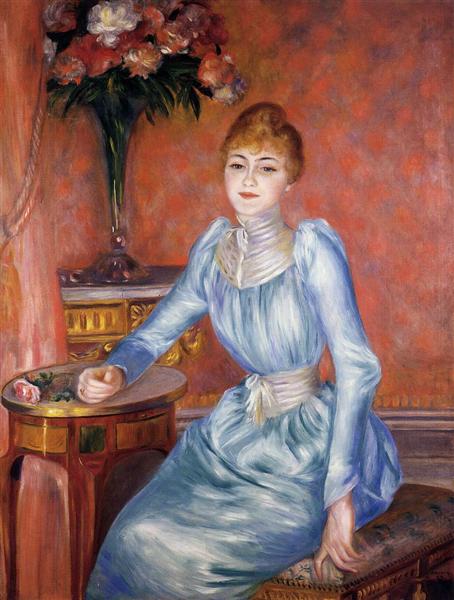
I can usually see a way to understand terrible things. Satanic worship, decaffeinated coffee, cosmetic surgery, but Renoir's portrait of Madame de Bonnières? No. It cannot be understood or forgiven. And framed in gold plastic and spot-lit from above? No offence intended, Charlotte, there is not a chamber in hell hot enough for a woman of your taste.

Portrait of Madame De Bonnières (Henriette Arnaud-Gentil, Gräfin De Bonnière), painted 1889
This is a meditation in response to a local mum whose...discomfort...with Mad Old Pete the faggot coming to pick up Lanny for his actress mum, as she makes him wait outside her sacred child-stuffed grotto while she calls actress-mum to be sure she's not sending the child to be raped and murdered by the slavering pedophile. *sigh* Familiar with that one, I am.

p76 (Pete still speaking):
In the bus shelter as we passed there was the Henderson boy with Oscar whatsisname from Yew Tree Cottage and they were passing back and forth a joint as big as a church candle, a floppy, knuckled, badly-built thing, and my word it smelled nice. We nodded as we passed and I raised a hand in greeting.

WEIRDO coughed one of them, spluttering into giggles.

We walked on.

I was a little stuck for what to say and then Lanny asked, Do you think they were talking about me or you?
Tedious petit-bourgeois snobs with the cultural nous of parsnips judge what they can't understand and, as The TWIST!!! approaches, Pete's gonna get it in the neck.

Seriously. Everybody got that? Are we all on the same page now? Permaybehaps not...

p85 (Peggy Something-or-other, the Town Crone, is speaking):
It says, in small letters at the end of the {Domesday Book} entry {about their dreary little village}, barely legible but I've seen a photograph of it, Puer Toothwort.

Oh Peggy, I tut, you rotter, what a load of old bollocks.

It says it, Peter. It is written. He's been here as long as there's been a here. He was young once, when this island was freshly formed. Nobody was truly born here, apart from him.

So he's older than you? Surely not. Right then, must deliver this little artist home to his parents.

Night night, Peggy, sweet dream, sings Lanny.

Sleep well good child, she says. Sleep well, Mad Pete, and she winks.
Now, are you there YET?! Seriously, do. you. get. where. the. train. is. headed.

Oh, and the horriblity of the w-bomb puts the moldy cherry on the shit sundae with extra worms we're being served, doesn't it.

p96 (Pete is speaking again):
The sound in the village was all wrong. I went for my walk around the block and got the ill feeling and hurried back. The darkness was uneven, slippery. I sought refuge in my kitchen but the pressure between different objects in my house was all wrong. Something was bad. I had a glass of drink on the table, a newspaper and a pen, and the three of them were fit to lift off and explode. Things were closing in.
Now. Not even the most backward, most challenged reader can possibly misunderstand The Import of that last sentence. Wait...can't count on it...best explain: PETE IS SOMEHOW AWARE THAT HE'S ABOUT TO BE BLAMED FOR A BAD BAD THING. Would you care to guess what that bad bad thing is, who the bad bad thing relates to? Anyone?

Now there are two more sections of this overblown sludge. I read them, but honestly, I do not think you need to. If you don't already know what happens, and allow me to assure you that there is indeed A Twist, please send me a message and I'll tell you.

Or I'll mess it up so the shy can still read it: Lanny survives to adulthood but Jolie the actress/novelist divorces tedious Robert and by goddesses they are well and truly better apart. The Toothwort thing doesn't end, it just stops. There's Pete and Lanny (now called something else) drawin' and drankin' in the purged-of-evil woods.

Seriously. We go all this fucking way and there are pages of typographical shenanigans and THAT. IS. FUCKING. IT.


I think Author Porter deserves some serious kudos for making the points he makes about how the very bones of reality are malevolent in some deeply alien ways. He doesn't spend a lot of time soppily sloshing tears and humidly summoning sobs, either, so there's that going for him. Hence all three of my stars. Seriously? Spare yourself. If this wins the (now-Man-less) Booker I'll eat your hat.

FLASH 3 SEPTEMBER 2019

But the news is *excellent*: This book wasn't on the shortlist!

Monday, May 13, 2019

THE HANGED MAN'S GHOST, first in a paranormal mystery series enhanced by bisexual male lead


THE HANGED MAN'S GHOST
MISSOURI DALTON

Self-published
$4.99 Kindle edition, available now

Rating: three fat stars of five

The Publisher Says: Detective Fynn Adder is embarking on the case that will change his life forever. The ghosts of murder victims are leaving him clues, his drinking problem is out of control, and no matter how nepotistic the Chicago Police Department might be, there are some forces his family’s reputation can’t save him from.

Just a few years ago, Fynn’s longtime partner Robert was murdered and the case went unsolved. As he gets deeper into a new investigation, it becomes apparent that somehow the two cases are connected. To make matters worse, it’s clear to Fynn that forces beyond this world have come into play.

Forces like Internal Affairs agent Daniel Voight, who’s determined to make dirt stick to Fynn any which way he can. The only real bright points in Fynn’s day are when he’s with Jack, his unfortunately straight partner. Fynn is going to have to pull himself together—because if the dead don’t kill him, his family will.

Edition includes the short story "A Girl With Two Faces"

My Review: I love series books that allow me to immerse myself in their made-up world. I adore mysteries that enable me to feel that Bad Guys lose, fail, get punished. I am a complete pushover for gay guys as main characters, a sucker for paranormal stuff that makes common sense, EAGER to see bisexual men in relationships...this book, in short, should light every fire in my mental hypocaust.

And it didn't.

I made forty (40) Kindlenotes, which is either Very Very Good or Really Really Bad news. This time it was both. This is a first novel, and begins the ongoing Night Wars series. There's a downside to revising first books, as was done for this one after its first publisher disappeared. The later books add to the series canon; that can require first-book additions. The author says in the Author's Note that the changes are minor. I wonder if one result of this is the strange choppiness of the narrative. As my most WTF-inducing example, why is Fynn's father "Da" sometimes and "Pops" others? In general, people choose a name for their parents and stick to it. My sisters and I called our mother by different names, but never by each others' name for her. (I called her Mama, Sister Old called her Mommy, Sister Middle called her Mom.) It's not A Rule to have your characters do this, but it's a distraction from the story when they don't. I don't like to have to take a moment to wonder who is being addressed.

The feeling of being popped out of the narrative also comes when details arise and disagree with each other but are never reconciled. An example of this is the first murder. The body has three bullet holes, the witness says four shots were fired with great confidence, which attitude is pointed out by the author. And nothing ever reconciles the mismatch. That's frustrating to a seasoned mystery reader accustomed to watching for clues.

A more macro-level issue for me is the damn-near real time narration of (particularly) the first third of the book. Fynn goes to a bar, sits on a stool, talks to the bartender, reaches for his wallet, gets out his money, pays the bartender, gets off the stool, goes out the door...you get what I'm talking about. It's purely a taste thing, not everyone is annoyed by this, but it isn't a narrative strategy I'd encourage anyone to use. Stage directions in a play aren't usually this detailed.

LOTS of coincidences and unsupported knowledge in here. How does Fynn know where his rescued almost-suicide is? Why is that individual's boss sitting there holding the kid's hand? And what astonishing luck that Fynn's in the same hospital, given that the city of Chicago fairly *bristles* with hospitals and people are triaged to different ones based on injury not on proximity. (This is true for all major metropolitan areas.) The sheer amazing stunning convenience of the existence of some blackmail materials used to manipulate Fynn is unaddressed. Why would these materials exist? In whose possession were they, how did they end up with the blackmailer, and WHY DOES NO ONE ASK THESE QUESTIONS in a POLICE STATION where chain of custody is an ingrained data point to be investigated?!

The latter issue is, I suppose, dealt with by the nature of the series: Paranormal. As in magical, as in manipulating the material world accepted. But this event occurs before the outing, so to speak, of the book's true nature. I can't accept that a cop, especially a senior cop like Fynn's boss, wouldn't bring this up despite the...spooky...nature of the blackmailer. He wants to save Fynn, a good cop from a cop family, from disgrace and dismissal.

Now for the biggest problem I had, and one that came close to closing the book to me for good: Jack, Fynn's cop-partner, serves a fresh-out-of-rehab drunk a drink, *overcomes the drunk's objection to being served a drink*, and proceeds to ply the drunk with four more.

BIG. HONKIN. NO-NO.

It's especially upsetting as this is the same person who expresses loving, tender concern for Fynn's recovery before and after this occurs. It's never mentioned again...like that's realistic!...Jack never asks forgiveness or makes amends. This would be a huge, huge issue in an alcoholic's trust inventory. As would the relationship between Jack and Fynn after this occurs. Not cool. Not realistic.

I hate smoking so I hate the mentions of Fynn lighting up. Personal peeve.

Anyway, from all the above, the question arises: Why'd you bother? What kept you reading, since this isn't a one-star rage review? Because the world the author's building appeals to me, like Charlaine Harris's paranormals appeal to me. I love the world-unseen-by-muggles trope. I grew up gay! In 1970s Texas! Of course I love unnoticed realities, I lived in one. And I understand viscerally the desire of the inhabitants of that world to be left the fuck alone to live as they are. The urgency of adopting a cover story. The skill at verbal deflection. The sensitivity to vibes, to the initiate's gaze identifying Our Own. This book strums my strings the right way in this regard.

I enjoy the Catholic parents of a gay kid making absolutely no waves about his sexuality. Their overbearing controlling behaviors are utterly unrelated to Fynn's man-lovin' just to his whoring around and drinking. Any parent of an addict will look at that and say, "that's exactly it, I love my child and want the self-destruction to stop!" Note the silence about gayness. Refreshing to see religious people portrayed as loving, nurturing, supportive parents. (If a tad on the meddlesome side.)

And last, most importantly, in fact crucially to my pleasure in the read, is the fact that the author dropped two...two!...w-bombs. One of which I felt was appropriate to the situation and was cheekily funny.

Anyone who can make ME, the arch-wink-hater, approve of a w-bomb, is a wizard and deserves a chance to make my eyeblinks focus on their work.

Thursday, August 31, 2017

WATER FOR ELEPHANTS, a rare film adaptation that does the book justice


WATER FOR ELEPHANTS
SARA GRUEN

Algonquin Books of Chapel Hill
$14.95 trade paper, available now

Rating: 3* of five

The Publisher Says: Though he may not speak of them, the memories still dwell inside Jacob Jankowski’s ninety-something-year-old mind. Memories of himself as a young man, tossed by fate onto a rickety train that was home to the Benzini Brothers Most Spectacular Show on Earth. Memories of a world filled with freaks and clowns, with wonder and pain and anger and passion; a world with its own narrow, irrational rules, its own way of life, and its own way of death. The world of the circus: to Jacob it was both salvation and a living hell.

Jacob was there because his luck had run out—orphaned and penniless, he had no direction until he landed on this locomotive “ship of fools.” It was the early part of the Great Depression, and everyone in this third-rate circus was lucky to have any job at all. Marlena, the star of the equestrian act, was there because she fell in love with the wrong man, a handsome circus boss with a wide mean streak. And Rosie the elephant was there because she was the great gray hope, the new act that was going to be the salvation of the circus; the only problem was, Rosie didn’t have an act—in fact, she couldn’t even follow instructions. The bond that grew among this unlikely trio was one of love and trust, and ultimately, it was their only hope for survival.

Surprising, poignant, and funny, Water for Elephants is that rare novel with a story so engrossing, one is reluctant to put it down; with characters so engaging, they continue to live long after the last page has been turned; with a world built of wonder, a world so real, one starts to breathe its air.

My Review: I don't want to give anyone the wrong impression here. I am not a sentimental old softie whose external resemblance to a conker

is meant to scare off the timid.

But books about old folks remembering their bittersweet pasts, books about people caring for and about the animals that they share their lives with, and books about losing your beloved far too damned soon in life do drive a teensy-tinsy little wedge into my sharp green spikes, revealing what I laughingly refer to as a "heart" for the briefest of moments.

Without spoilering anything, the clue I will give you to my rating of this novel is that all three stars are for Rosie.

When this book came out in 2006, it was a huge smash success. Sara Gruen touched a nerve with her evocation of the 1930s traveling-circus world. People resonated like rung bells from one end of the US to the other. I read the book then, and reacquainted myself with it recently, to remember what it was that caused the ruckus.
Age is a terrible thief. Just when you're getting the hang of life, it knocks your legs out from under you and stoops your back. It makes you ache and muddies your head and silently spreads cancer throughout your spouse.
***
Although there are times I'd give anything to have her back, I'm glad she went first. Losing her was like being cleft down the middle. It was the moment it all ended for me, and I wouldn't have wanted her to go through that.
I think many, if not most, of the book's fans really resonate with these assessments. I know I do. It's not the most original kind of observation ever made but it's presented in a pleasantly conversational tone, one that gives the meaning precedence over the words.

Gruen also has Jacob thinking through the problems of great age. Since the main body of the story is set quite a long time ago, Jacob gets to tell us his story unchallenged. His memories may be unreliable, how would we know?, but he gives them to us with gusto and a charming smile. That's what we all hope to do, isn't it, give the younger folks coming behind us a reason to smile as we share what we have stored in our Random Access Memory?
My platitudes don't hold their interest and I can hardly blame them for that. My real stories are all out of date. So what if I can speak firsthand about the Spanish flu, the advent of the automobile, world wars, cold wars, guerrilla wars, and Sputnik — that's all ancient history now. What else do I have to offer? Nothing happens to me anymore. That’s the reality of getting old, and I guess that’s really the crux of the matter. I’m not ready to be old yet.
***
Sometimes when you get older — and I’m not talking about you, I’m talking generally, because everyone ages differently — things you think on and wish on start to seem real. And then you believe them, and before you know it they’re part of your history, and if someone challenges you on them and says they’re not true — why, then you get offended because you can’t remember the first part. All you know is that you’ve been called a liar.
It's an indignity perpetrated on most of us by the vast legions of those addicted to Being Right. Really, I want to say to the I'm Right And Don't You Forget It judges, give it a rest. Believe me when I tell you your own turn in the unreliable memory chair is coming soon. It's better to treat those memories other folks choose to share with you as their stories and not be ready to hop on the Being Right Soapbox. It's a theme that Gruen seems to me to be developing, though rather in the breach than the observance.

So these quotes give you a fair sampling of the book's storytelling voice. These ideas are the ones that Gruen really bears down hard on exploring in Jacob's voice. So why am I giving all the stars to Rosie? Because this elephant, though she never utters a word, is the most vibrantly alive character in the book. Jacob is any-old-man. Rosie is not, I promise you, any old elephant! And the pleasure of Jacob and Rosie having their relationship makes this a book I didn't mind revisiting. The love affair that is the primary catalyst of all the story's action, that between Marlena and Jacob, centers on Rosie as Marlena performs her act for the circus with Rosie. Jacob, the vet, is Rosie's constant companion. Rosie is, in my mind at least, the real star of the circus and the book.

In 2011, Reese Witherspoon and Robert Pattinson added a layer to the book's luster by embodying (damn near perfectly, in my never-humble opinion) Marlena and Jacob, the star-crossed lovers at the human heart of the tale. I'm no great fan of ~meh~ movie adaptations to popular books. I've generally got some choice invective for incompetent or poorly handled film versions of books. This adaptation is one I felt got the tone, the indefinable something that made the book such a success, right. The adaptation is also visually stunning, simply pitch-perfect in its period details and an immersive delight to watch.

The one problem I had with both the book and the movie is a big one: I didn't buy the love story in either medium. I just do not get the sense that Jacob really had the grand passion for Marlena that's reported everywhere in the text and the script. I certainly don't think Ms. Witherspoon and Mr. Pattinson were attracted to each other. That kept cropping up in the way of my full investment in the story.

Rotten Tomatoes, the internet movie-review aggregator, counts this as a mostly-fresh release. Its total number of professional reviews is a whopping 191, making its Fresh rating of 60% quite impressive. 68,000 regular civilians who use Rotten Tomatoes to track their film likes and dislikes give the adaptation Fresh ratings 70% of the time. 1.1 million ratings on Goodreads average 4.07 out of five for the novel. No matter the medium, the message to the audience comes through loud and clear, and the audience agrees with it. That, my friends, is called "huge success" and deserves the rewards thereof.

The reading group guide lives here, free to download.