Showing posts with label healthcare industry. Show all posts

Friday, April 24, 2026

KILL DICK, a strangely compelling long stare at too-smooth, too-shiny surfaces


KILL DICK
LUKE GOEBEL

Red Hen Press (non-affiliate Bookshop.org link)
$9.99 ebook, available now

The Independent Press Top 40 Bestsellers: Fiction For the week ending April 19, 2026

Rating: 4.5* of five

The Publisher Says: A fever dream, Kill Dick is a literary thriller that plunges into the chaos of Los Angeles where addiction, privilege, and corruption combust.

At nineteen, Susie Vogelman should be she’s an NYU dropout with no responsibilities, endless prescription pills, and a Brentwood estate to waste away in. But Los Angeles has other plans. A string of brutal murders targeting addicts spreads through the city, and Susie’s ivory tower begins to crumble. The headlines point too close to her father’s ties to an opioid empire, a sinister secret society, and her own complicity in the systems holding it all together.

Then there’s Peter Holiday, a disgraced professor running a rehab scam so audacious it’s almost admirable. When their lives collide, Susie and Peter are dragged into a web of privilege, corruption, and violence, where every escape leads deeper into the rot.

Dark, satirical, and razor-sharp, Kill Dick is a modern literary thriller that unflinchingly dissects wealth, exploitation, and the perilous line between survival and self-destruction.

I RECEIVED A DRC FROM THE PUBLISHER VIA EDELWEISS+. THANK YOU.

My Review
: Health scammers, like Peter Holiday in this story, might be the lowest scum on this wide, green Earth. Preying on those desperate for their very lives...! My mother's father fell for the Laetrile scam in the 1970s. Luckily he survived more than a few years after it was exposed to all as a hoax, but it cemented my powerful disdain for health scammers as it was an expensive lesson. Fast-forward from my family's 1970s to Susie Vogelman, our PoV character, in a circle of hell called the glittering world of too-rich too-dimwitted 2016 LA.

What's worse than an addict without morals or boundaries? Worse even than an enabler of the addict? The addict turned enabler. Susie, who apparently never so much as once looked into a mirror that showed her anything except her surface, is a participant in a lot of different kinds of enabling in this story. It's very well done, it never lets the pace of revelations slacken, but it also never once shows even a glimmer of realization in Susie or her coterie of criminally negligent creeps. But their surfaces are pretty! And their credit cards are limitless!

I wanted to shake Susie into awareness of her hollowness, lest she implode causing still further damage. But Author Goebel is careful to make this world honest by giving it consequences despite no one in the cast being anything but appalling. Bad things are going to happen, and I didn't care about the consequences to any of the cast just to the folks who were victimized by the cast. The suppurating wounds of vapidity exacerbated by the absence of empathy (honestly, I'm not sure Susie in particular even has a theory of mind) in every character are never allowing anyone to escape dire consequences.

When they come I was deeply surprised to feel...sad is too strong, sympathetic is in the wrong emotional register, wistful is too kindly meant...to not feel triumphant? I think that's closer. I was eager for the comeuppances to be passed around, and Peter the scumbag to get seconds. After all, this was the moment that the country saw Trump installed in entirely the wrong kind of government housing. What use is fiction of not to redress horrifying imbalances?

Showing them to us, forcing us to see that the rot is there even when it's plastered over, and there are ways you can recognize it despite the glittering surface. Less wish fulfillment than cautionary tale. It's well done. Author Goebel (Fourteen Stories, None of Them Are Yours via the deeply cool publisher FC2) has storytelling chops. He has very cool film scripts in his CV, starring Jennifer Lawrence and Anne Hathaway in them. His current publisher is Kate Gale's always interesting and frequently tastemaking Red Hen Press. Given these bona fides why is this not a full-five review?

Because I got uneasy as I crested the halfway mark, feeling I was still outside Susie's world with my sarcastic voyeur of a guide being invited to laugh at and judge these buffoons. It's what they deserve! is implicit in each and every moment I'm in the story's flow. Which, fair—it is indeed what they deserve; but is it your point, Author Goebel, to stop there or is it to force me-the-reader into looking deep into the shine of these surfaces and ask myself "why are you still here with these tacky people." I didn't think it was terribly clear what your purpose was; the only reason that was an issue is its consequence of popping me out of the story-flow to examine the whole read again and again.

That's a big ask, but your story is a national bestseller so I guess it worked. I'm glad it did, and does, and will do the trick again in future.

Monday, December 30, 2024

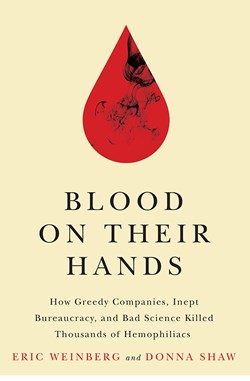
BLOOD ON THEIR HANDS, infuriating true story of the consequences of untrammeled greed


BLOOD ON THEIR HANDS: How Greedy Companies, Inept Bureaucracy, and Bad Science Killed Thousands of Hemophiliacs
ERIC WEINBERG & DONNA SHAW
Rutgers University Press (non-affiliate Amazon link)
$26.95 Kindle edition, available now

Rating: 4* of five

The Publisher Says: By the mid-1980s, over half the hemophiliacs in the United States had become infected with HIV. Blood on Their Hands reveals the toxic combination of corporate greed, governmental complacency, and medical negligence that exacerbated this public health disaster.

A few short years after HIV first entered the world blood supply in the late 1970s and early 1980s, over half the hemophiliacs in the United States were infected with the virus. But this was far more than just an unforeseeable public health disaster. Negligent doctors, government regulators, and Big Pharma all had a hand in this devastating epidemic.

Blood on Their Hands is an inspiring, firsthand account of the legal battles fought on behalf of hemophiliacs who were unwittingly infected with tainted blood. As part of the team behind the key class action litigation filed by the infected, young New Jersey lawyer Eric Weinberg was faced with a daunting task: to prove the negligence of a powerful, well-connected global industry worth billions. Weinberg and journalist Donna Shaw tell the dramatic story of how idealistic attorneys and their heroic, mortally-ill clients fought to achieve justice and prevent further infections. A stunning exposé of one of the American medical system’s most shameful debacles, Blood on Their Hands is a rousing reminder that, through perseverance, the victims of corporate greed can sometimes achieve great victory.

I RECEIVED A DRC FROM THE PUBLISHER VIA EDELWEISS+. THANK YOU.

My Review
: I was there for the AIDS years. I lost the love of my life to AIDS. It was harrowing to see people who did not have the option to avoid infection (after we knew what transmitted the virus) by using condoms then contract and die horribly from the awful virus's depredations. Author Weinberg was a lawyer seeking compensation for families and what few survivors there were in the 1990s. If ever there was a class of truly innocent victims, this group is it.

The way the virus entered these unfortunate sufferers was inescapable. It is a requirement of life as a hemophiliac that, to survive long term, you received donated blood products from normal donors to enable your body to form normal blood. The path to infection of these victims ran right through the corporate boardrooms where for-profit blood banks chose to accept donations from people using drugs. I absolutely know of my own personal knowledge that gay men were unable to donate blood, which would've widened the pool of donors. It was inevitable that a blood-borne infection, one unscreened for and untested for in the blood products harvested, would eventually cause the infection all dreaded as a death sentence at that time.

In the name of profits, lives were gambled with; predictably, those lives were lost.

The "regulatory state" that the incoming (as of 2024) US administration rails against ignored the risks these greedy entities were taking with people who had no choice, no alternative, no voice in or power over the risks their continuing lives required them to take. Author Weinberg and his cohort of counselors acted to force the casino of lives to close, though it took a lot longer than it should have.

The stakes that were paid by the deaths by those without a say in the gambles they were forced to take are currently under threat of being made useless. We're being forced back into a time where we have no say in the rollback of regulations that save lives. Greed like that of the insurance industry currently making news is causing outrage. That's great.

BUT WE HAVE FOUGHT THESE FIGHTS, AND WON THEM, BEFORE. Those victories and protections are the ones in the sights of the profit-motivated incoming administration.

Do not sit idly by as the gains we've won, that have demonstrably saved lives, evaporate in the all-consuming heat of greed and lust for profits. Call your congressional office in the Capitol or the local constituent services office. I realize that takes effort, and the way to say what needs saying isn't in everyone's capabilities. Using 5calls.org will make the process as painless as it's possible to be. The needed numbers, even a script to follow if you're phone-phobic, are all there.

The stakes are too high to sit feeling helpless, or to think "I won't make a difference" or any other excuse. All voices count. Your representatives at every level are *required* to listen to you.

Make them earn their money. Just like you have to.

Tuesday, March 23, 2021

CLEAN: The New Science of Skin and the Beauty of Doing Less, does too much therefore too little

CLEAN: The New Science of Skin and the Beauty of Doing Less
JAMES HAMBLIN

Riverhead Books
$14.99 ebook editions, available now

MAY 2021 UPDATE $2.99 on Kindle now!

Rating: 3* of five

The Publisher Says: One of Smithsonian‘s Ten Best Science Books of 2020

“A searching and vital explication of germ theory, social norms, and what the modern era is really doing to our bodies and our psyches.” —Vanity Fair

A preventative medicine physician and staff writer for The Atlantic explains the surprising and unintended effects of our hygiene practices in this informative and entertaining introduction to the new science of skin microbes and probiotics.


Keeping skin healthy is a booming industry, and yet it seems like almost no one agrees on what actually works. Confusing messages from health authorities and ineffective treatments have left many people desperate for reliable solutions. An enormous alternative industry is filling the void, selling products that are often of questionable safety and totally unknown effectiveness.

In Clean, doctor and journalist James Hamblin explores how we got here, examining the science and culture of how we care for our skin today. He talks to dermatologists, microbiologists, allergists, immunologists, aestheticians, bar-soap enthusiasts, venture capitalists, Amish people, theologians, and straight-up scam artists, trying to figure out what it really means to be clean. He even experiments with giving up showers entirely, and discovers that he is not alone.

Along the way, he realizes that most of our standards of cleanliness are less related to health than most people think. A major part of the picture has been missing: a little-known ecosystem known as the skin microbiome—the trillions of microbes that live on our skin and in our pores. These microbes are not dangerous; they’re more like an outer layer of skin that no one knew we had, and they influence everything from acne, eczema, and dry skin, to how we smell. The new goal of skin care will be to cultivate a healthy biome—and to embrace the meaning of “clean” in the natural sense. This can mean doing much less, saving time, money, energy, water, and plastic bottles in the process.

Lucid, accessible, and deeply researched, Clean explores the ongoing, radical change in the way we think about our skin, introducing readers to the emerging science that will be at the forefront of health and wellness conversations in coming years.

I CHECKED THE EBOOK OUT FROM MY LOCAL LIBRARY VIA OVERDRIVE. USE YOUR LIBRARY, SAVE MONEY, AND GET INFORMED AT THE SAME TIME.

My Review
: There are three books in here. Any one of them would be very interesting to read sequentially; simultaneously, there is too much and too little information on each topic. I'm interested in all three books...history of "cleanliness", politics of "health", and research into the existence of astonishing worlds we haven't been able to see until quite recently...but am satisfied by none of them in this busily overstuffed and distracted narrative.

These quotes should tell you why the topics interest me:
He explains that if you really wanted to kill all the bacteria on your countertop, you’d have to leave a disinfectant (like Clorox) in contact with the surface for ten minutes. The product isn’t “killing 99.9% of germs” in the way that anyone actually uses it—a quick wipe-down. This was, both in concept and in practice, misguided. And the magnitude of its effects on our lives is now starting to become clear.
–and–
Public-health advocates are pressuring the FDA to ban parabens in products sold in the U.S. The European Union did this in 2012—but the economic influence of industry on regulation in American politics makes this unlikely.
–and–
When we clean ourselves, we at least temporarily alter the microscopic populations—either by removing them or by altering the resources available to them. Even if we do not use cleaning products that specifically say they are “antimicrobial,” any chemistry applied to the skin will have some effect on the environment in which the microbes grow. Soaps and astringents meant to make us drier and less oily also remove the sebum on which microbes feed.

Because scientists and doctors didn’t have the technology to fully understand the number or importance of these microbes until recently, very little is known about what exactly they’re doing there. But as this new research elucidates the interplay of microbes and skin, it is challenging long-held beliefs about what is good and bad.

Any one of those statments by itself contains multitudes and is deserving of solid, sustained attention. They're not really given space to get that solid, sustained attention. This is by design: The book is written to be a popular-science title and is marketed as such...so, then what's that political anti-industry bit doing in there...? (And I am by no means pro-industry, remember: "Capitalism sells nothing so effectively as status" is music to my increasingly leftist ears.)

Even the chemistry bit, about the Clorox, is played for scares. "It doesn't work the way you're using it!" Nonsense. It works fine. The world isn't an operating theater, your kitchen and bathroom do not need to be germ-FREE they need to have fewer germs overall. The fluids and aerosolized solids present in the average dwelling-place would, if they were visible, cause most Westerners and more particularly Americans to collapse into screaming meemees. The point of cleaning is to keep the loads manageable for our immune systems, not create sterile bubbles. So the industrial concerns are promoting an unattainable, not to mention undesirable, end when they tell you their bleach kills 99.9% of germs? Umm...maybe hold off on tossing that bathwater. The scares outweigh the nuanced analyses in this regard.

The stuff about microbes and mites and the astonishing colonial organism that is our skin was what I came to the party ready to learn about and to kvell over. The fact that we *are* learning about the biology of our bodies outweighs, to me, the many ways that knowledge is flawed in its use.
Some of the most cutting-edge research is coming from people funded by or working directly for companies that are developing products to sell. There are few experts one can talk to who don’t have money in the skin care game.

Am I a naive oldster to believe that, uses be damned, the edge is still cutting? There are so many ways improved hygiene has improved lives via scar-tissue and skin-grafting research and the concomitant research into skin's many functions that it's hard for me to get exercised about Purell. Especially in the Plague Year.

Well, enough of that. There are points that the author makes which are, in my observation, largely unconsidered, disregarded, or wrongheadedly opposed:
We may not be doing a lot to change our biomes by showering less, but by conceptually getting over the idea that microbes are bad, we might consume less and use less of the antimicrobial products that do indeed create microbial “superbugs” that threaten all nonmicrobial life on Earth.
–and–
The best advice right now is to think of hygiene as similar to medicine—extremely important in some scenarios, and also very possible to overdo.
–and–
From pharmaceuticals to soaps and other personal care products, Americans are clearly overpaying for—and overusing—products and services that are supposed to make us healthier. The pattern of consumption is unsustainable, and much of it may be doing more harm than good.

This is an amusing read, packed full of good information, and as such deserves the attention of the general reader. Don't go into the read expecting to be more than backgrounded, not educated, and it will repay you with much food for thought.

Me? I wanted more of what the subtitle sounded like it promised but didn't deliver.

Monday, September 5, 2016

HOPE FOR A COOL PILLOW is a wonderful memoir and a timely discussion of end-of-life issues


HOPE FOR A COOL PILLOW
MARGARET OVERTON

Outpost19
$16.00 trade paper, available now

Rating: 4.5* of five

It's been a week, I can tell you. I am appalled to report that some idiot in management brought in a new resident with a nasty case of oppositional disorder. She's made life a living hell for those around her, and even *I* screamed at her when she started with me! Fortunately, it didn't interfere with my writing of a new style of think piece on publishers in the "Mittelstand" and the rewarding work they're publishing.

My essay on the publishing house Outpost19 and Margaret Overton's deeply moving and supremely timely memoir HOPE FOR A COOL PILLOW is live at Expendable Mudge Muses Aloud: My Reading Life.

This slim book should, in a properly ordered world, ignite a nation-wide conversation about the events at the end of our lives. It is a wonderful book.