Showing posts with label England setting. Show all posts

Monday, January 12, 2026

JEAN, adolescent heartbreak made tougher by class divide


JEAN
MADELEINE DUNNIGAN

W.W. Norton (non-affiliate Bookshop.org link)
$28.99 all editions, available now

Rating: 4* of five

The Publisher Says: Seventeen–year–old Jean, a troubled Jewish boy caught in the countercultural swirl of 1970s London, arrives at Compton Manor, a rural alternative boarding school for boys with “problems.” Though he is an outcast among these outcasts, he is befriended by Tom, a much wealthier, more popular classmate, and it seems as if Jean’s world might change.

When things turn romantic, Jean is tipped into a heady, overwhelming infatuation. What before seemed odd now brims with promise—the compulsory farming at school, reading poetry aloud, pagan ritual—and Jean thinks he might even pass his exams. But the differences between Tom and Jean—Tom is tuition–paying, Jean is on a scholarship; Tom social, Jean reclusive—create too wide a chasm to cross.

Set over one hot summer, Jean is a startlingly assured debut about the kinds of love that break us and make us whole.

I RECEIVED A DRC FROM THE PUBLISHER VIA NETGALLEY. THANK YOU.

My Review
: Choosing not to use conventional punctuation is the root of many novelists' downfall. As a debut novelist, Author Dunnigan set herself this monumental task, on top of several other monumental tasks in telling the story of a young Queer boy coming alive to sex and sexuality in a highly specific milieu. It is an uneven success at them all. The least successful is the sense of place; it's 1976 in London, but if you want to be transported to 1976 London, this is not your best choice of a read.

Jean is a scholarship boy in a behavioral-problem-student boarding school. It's a sketched in place, apart from some unpleasantly graphic dealings with animals dead and alive. Those are extremely particular environments; with a reader's expectations set on feeling immersed in the world they're not successful. I can't say I was ever more than tangentially aware of the environment. It is not described or, better still, evoked. It's stated this is where the action takes place. It works against the sense of place for the characters, teen boys mind you, to wander around in time as the narrative continues. This is how an older person experiences time...this connects to *that* and whatever happened to him anyway but this jerk can't cut in line! No! get back to your place while I find my damn wallet again did I leave it on the counter? oh good there it is.

Teenagers aren't prone to this yet, every moment is real! alive! pulsing with possibility! especially when you're newly In Love with the most gorgeous exciting amazing boy on the planet who has the sexiest...oh my he's hot. What this does give the reader is the World of Jean, all third person, all interior, all solipsistic as a boy usually is.

Punctuation keeps the stream of consciousness from bursting the banks and making a mess. This story is the mess that punctuation and dialogue tags prevent. It's not bad, as in not incompetent in any way. It's just more work than it needs to be to pick the threads of doomed adolescent heartbreak out of the verbs. As a superannuated version of Jean, I can say Author Dunnigan's chosen a strangely indirect way to deal with adolescent male libido by distancing the reader from it in this stream of consciousness. It's almost sexless sexuality presented in the flashes of memory and the internal asides and other tangential evocations.The way she's chosen to present him to us felt distancing to me because he is not experiencing the moment. He's a teen boy in love, he would be thinking A LOT about sex in direct and physical terms, since he isn't a virgin any more.

I'm still excited by the read. I liked the experience of Jean's rootlessness, his inability to see anything not directly pointed out to him. I think a big part of my desire to keep reading was rooted in my sense that, for all the author's odd choices and off framing that didn't work for me, I got to see the world from the haze of Wrongness that Jean has always felt...that so many like him, limited, ungainly, graceless, feel. It was a big mental leap to be in Jean's skin. He does not think ahead, he is not aware of others as real, he can't fully grasp his choices are in fact his own. Jean does not make choices. Things happen to Jean. The constant tobacco use and the uncontrolled drug use were deeply familiar, very much part of adolescence in the era. In the end, Jean is a boy whose manhood we don't get to see but which is not likely to be much better than his adolescence of betrayals has been.

My recommendation sounds grudging. It really isn't. This is a debut novel that takes a big swing. It is more successful than not; it's only that the presentation isn't going to entice readers who aren't already fans of stream-of-consciousness storytelling. It felt fine to me, and might to you if you're willing to make room for a man being born and broken at the same time.

Friday, December 20, 2024

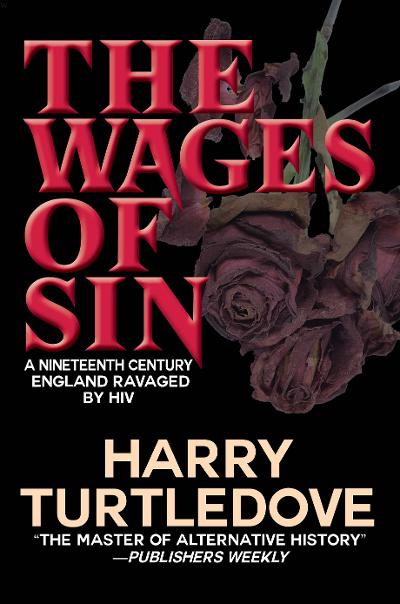
THE WAGES OF SIN, deeply disappointing alt-hist


THE WAGES OF SIN
HARRY TURTLEDOVE

CAEZIK SF & Fantasy (non-affiliate Amazon link)
$9.99 Kindle edition, available now

Rating: 2* of five

The Publisher Says: A terrifying tale about HIV spreading in the early sixteenth century by an author, Publisher Weekly calls “The Master of Alternate History.”

What if HIV started spreading in the early 1500s rather than the late 1900s? Without modern medicine, anybody who catches HIV is going to die. A patriarchal society reacts to this devastating disease in the only way it knows it sequesters women as much as possible, limiting contacts between the sexes except for married couples. While imperfect, such drastic actions do limit the spread of the disease.

The ‘Wasting’ (HIV) has caused devasting destruction throughout the known world and severely limited the development of technology as well, creating a mid-nineteenth century England and London almost unrecognizable to us. This is the world Viola is born into. Extremely intelligent and growing up in a house full of medical books which she reads, she dreams of travelling to far-off places, something she can only do via books since her actions and movements are severely restricted by both law and custom.

Meticulously researched and exquisitely detailed in a way only a master like Harry Turtledove can do, this book is a tour-de-force from one of the best historical and alternate history writers ever to write in the genre.

I RECEIVED A DRC FROM THE PUBLISHER VIA NETGALLEY. THANK YOU.

My Review
: Big ideas chopped to bits, tossed around some, then left to collapse where they collided. Are we in the 1509 Congolese-disease plot? The 1850s jerkoff's plot? (That is more literal than figurative here.) What made me read the book was Turtledove. Why I finished it was Turtledove. I disliked its underdeveloped alt-hist; I deeply disliked the crude and demeaning language, though both period and setting appropriate; I never felt as though, unlike a certain character, the story ever got near a climax as Viola and Peter, the straight people whose story I expected (not unreasonably) this to be, spend the entire story apart. Then, after a betrayal, a confession, and a shocking comeuppance(!), all conducted by letters between them, there's a wedding and...

...off you and I go. Contracts all fulfilled, we have a story thay does the absolute bare-bones minimum.This can't be all, thought I, but indeed it was. Please note there is absolutely not more than one tiny whiff of gayness, of sodomy as an act, of the merest hint of the existence of queers at all. In three hundred pages about AIDS.

Now it's the poor straight women get all the fallout of the AIDS epidemic because, I guess, there weren't gay people in 1509 Congo (great, let's put the source of the STD plague in Africa...at least it's a change from South America's factual syphilis plague...then switch to straight people in whiter-than-white England! Ignoring Africa thereafter! It's the twenty-fucking-first ventury, colonialism is on the cross so let's drop it, k?)

So I think I'm being pretty magnanimous with two stars.

Friday, July 28, 2023

BROUGHT TO BOOK, first of ten very, very cozy English-village mysteries


BROUGHT TO BOOK (Rona Parish #1)
ANTHEA FRASER
Severn House
$6.99 ebook platforms, available now

Rating: 3.5* of five

The Publisher Says: When Rona Parish is asked to write the biography of an acclaimed thriller writer who drowned in unusual circumstances, is she diving into danger?

Biographer Rona Parish is exhausted after finishing her latest project on Arthur Conan Doyle, but her hope for a break between jobs is dashed when the wife of late bestselling thriller writer, Theo Harvey, asks her to write his biography.

Theo Harvey drowned mysteriously six months ago. No one knows why . . .

Theo’s inexplicable death six months ago left many unanswered questions. Why did he retreat from the limelight six years ago, only to reappear three years later and produce two outstanding, if much darker, novels? And what is the truth behind his mysterious drowning? Rona Parish is determined to uncover the truth behind his death, but at what cost?

Intrigued, and with her golden retriever Gus by her side, Rona starts to piece together the author’s life. But someone doesn’t want her to uncover Theo’s secrets. And they’ll go to any lengths to make sure they stay hidden . . .

A page-turning cosy mystery set in the fictional English market town of Marsborough in the stunning Chiltern Hills.

I RECEIVED A DRC FROM THE PUBLISHER VIA NETGALLEY. THANK YOU.

My Review
: First published twenty years ago, this supremely cozy, very definitely page-turning first-in-series mystery introduces a biographer sleuth...first time I've run into that one!...with a happily unconventional home life, a tidy income from her main career, and a bottomless well of curiosity. It felt to me like a story, and is told in a style, from sixty years ago.

I do not intend an insult with this statement of an observation.

Gender politics will derail any discussion of why I personally find myself squicked out by stalkery behavior. The cultural conversation about this behavior was only just getting started back then, so I can't really point a shaming finger at it; just something I myownself find unpleasant to read. This book, like some of the ones we labeled "romantic" many decades ago, valorizes some things I characterize as really stalkery behavior. That's a very big nope from me. I get it, in the sense that, at a point near the end of the story, the plot really needed something to happen at precisely that juncture. Why the other something that was in already set in motion by a different character and was, in fact, in progress and that occurs with near simultaneity wasn't enough for the author only she knows. A choice she made that I was appalled by, and it really caused me to reassess the prior appearances of the stalkery character in a much less flattering (to the author) light.

A trope that just won't die is the villain infodump. There is one of these at the end. I really rolled my eyes so hard I saw my brain as the guilty party settles in for a cozy chat with people whose murders are essential to the sociopath's happy getaway. The sociopaths I've known wouldn't be that careless. This is, from their point of view, a necessary act not to be lingered over because the risk to them getting away with their awful decision decrease with every delay or diversion from its accomplishment. I've never known a stupid sociopath.

The age of the story shows in multiple ways, eg the fact that Rona goes to her publisher's office and hands him an envelope with a printed version of an article she's submitting. Wow, does that take me back...no one even five years later would conceptualize this as a possibility! It's actually a bit wistfully charming. It dates events, but that's not necessarily bad...just a passing note for informative purposes.

The series character's world is most charmingly set up, and I would absolutely love to live in that village. I would be seriously surprised if a revelation that genuinely shocked me regarding Rona's twin wasn't going to loom large in a future installment. The changing technology of the day wasn't ignored, because Rona does look up the subject of her proposed biography on the Internet (still capitalized back then) and discusses what she's found with the subject's widow. Rona also notes the biography subject's lack of a computer to the widow. So it became even more odd in my eyes that she submitted her article on paper.

There is an instance of an animal being harmed, but it is set up so that the event, while bad, doesn't kill the animal in question. It is used, I felt, gratuitously, though it's later revealed to have been the last straw for the one committing the harmful act. It fell short of my slam-the-book-shut threshold because it's clear there's not going to be fatal outcome very soon after it occurs.

What I most want to convey to you is how high my hopes were set up, and then to be let down by the issues I've detailed above was a deep disappointment. There was every reason to think I'd found a ten-book series that's clearly complete (the most recent was published in 2017) to dive into.

Unfortunately that's not to be. I don't care to risk my own money on books that bid fair to repeat these kinds of unwelcome to me tropes.

Monday, May 16, 2022

BITTER ORANGE TREE, vibrant, passionate, *alive* woman's dark desires & MISTER N, a frank discussion of getting old and its price (not what it costs)


BITTER ORANGE TREE
JOKHA ALHARTHI
(tr. Marilyn Booth)
Catapult
$26.00 hardcover, available now

Trade Paper Edition On Sale: 07/11/2023 | $16.95

Read the Electric Literature mutual interview between Author Alharthi and Translator Booth!

One of Time Magazine's 100 Must-Read Books of 2022

Rating: 4* of five

The Publisher Says: From Man Booker International Prize–winning author Jokha Alharthi, Bitter Orange Tree is a profound exploration of social status, wealth, desire, and female agency. It presents a mosaic portrait of one young woman’s attempt to understand the roots she has grown from, and to envisage an adulthood in which her own power and happiness might find the freedom necessary to bear fruit and flourish.

Zuhour, an Omani student at a British university, is caught between the past and the present. As she attempts to form friendships and assimilate in Britain, she can’t help but ruminate on the relationships that have been central to her life. Most prominent is her strong emotional bond with Bint Amir, a woman she always thought of as her grandmother, who passed away just after Zuhour left the Arabian Peninsula.

As the historical narrative of Bint Amir’s challenged circumstances unfurls in captivating fragments, so too does Zuhour’s isolated and unfulfilled present, one narrative segueing into another as time slips and dreams mingle with memories.

I RECEIVED A DRC FROM THE PUBLISHER VIA EDELWEISS+. THANK YOU.

My Review
: Celestial Bodies, Author Alharthi and Translator Booth's previous literary collaboration, revolved around three women and their men...present, absent, loved, loathed, and longed for. It received the 2019 Man Booker International Prize, as it was called then. I myownself checked it out of the library and would've given it a three-star review had I bothered to review it at all...stories centering women organizing themselves and their worlds around men don't appeal to me. The prose was lyrical and pungent.

That last is what I love about this read:
I had gone. And then she had gone. And it wasn't possible to change anything. What the hand of fate had written could not be unwritten. That ancient line of poetry: All your tears, all your pleas, will erase not a line of that which is written. For I had gone, and I went away without smiling. I just went, in my cocky presumption that I could look the other way. That I didn't know; that I didn't need to know. And then remorse. Harsh, grating regret, making me more fragile than the brittle autumn leaves crumbling under the janitor's broom beneath my window.

–and–

"My grandmother would've given anything to be a peasant farmer," I said. And then immediately I regretted my abrupt reaction. Suroor raised her head. "Your grandmother?" Right. The words had come out and they couldn't be put back. I had said it: my grandmother. Why don't words come automatically with threads that we can yank to pull them back inside ourselves? But there are no threads attached. Those words had been said. What's done is done.

It's all there. Author Alharthi's style, the sentences not too terribly complex but the interrelationship of the words and images is dense, is active, is trellising the reader's vines of awareness into specific patterns that cast wildly distorting shadows on the life in the text.

It is exhilarating to read a simple story that reaches into shadows and under storage shelves and behind armoires in the reader. It means the writer and the translator have offered us everything they found when they rummaged through those spaces in themselves. If you, as I strongly suggest that you do, read the Electric Lit piece I've linked above, you'll come at this read with a vastly bigger experience of the intentionality of the writing. I think the best thing about that awareness, acquired before (in your case) or after (as in mine) finishing the novel, is its honing, its sharpening, of the decoding tools you have at your disposal to be in the read. I've chosen those two passages from the same early section of the story to illustrate that enriching quality.

What reading Bitter Orange Tree offered me was a stroll in a garden planted with almost-familiar-scented plants in service of a geometry slightly not what I am accustomed to (read: not centered so heavily on the women's men). The way the choices I've selected above interrelate and build on the character of Zuhour's perceptual world, the sensory and the eidetic, are the principal pleasure of this read. Like my stream-of-consciousness idol Virginia Woolf, the words build images and the images are shaped by the words as well as by the things the words evoke from us in their saying. Everything Zuhour senses is an image from her startlingly acute inner world...no fogs of forgetfulness (even when summoned, as above) cloud her quietly desperate longing for one more, once again, please just this single time.

Of course she gets none. No one does, and no depths of longing can break the iron arrow...crossbow quarrel, more like...of time. No matter how many times one says ignore, actually performing the act of ignoring is entirely different and often opposed by the metaphysical gravity of love. (I think it was this strange, off-kilter perceptual frame that reduced my rating from five to four stars, though....)

Because yes, this is a love story. Aren't they all. Yes, they all are but this love, Zuhour's love, is so tragically lacking self-love that it's the desperately sad kind of love-ungiven story that can reshape a life. Yours, o reader, if you will allow it; better or worse, as you use it.

++++++++++++++++++++++++++++++++++++++++++++++++++++++++++++++++


MISTER N
NAJWA BARAKAT
(tr. Luke Leafgreen)
And Other Stories
$17.95 trade paper, available now

Rating: 4* of five

The Publisher Says: Modern-day Beirut is seen through the eyes of a failed writer, the eponymous Mister N. He has left his comfortable apartment and checked himself into a hotel—he thinks. Certainly, they take good care of him there. Meanwhile, on the streets below, a grim pageant: poverty, violence and fear.

How is anyone supposed to write deathless prose in such circumstances? Let alone an old man like Mister N., whose life and memories have become scattered, whose family regards him as an embarrassment, and whose next-door neighbours torment him with their noise, dinner invitations, and inconvenient suicides. Comical and tragic by turns, his misadventures climax in the arrival in what Mister N. had supposed to be his “real life” of a character from one of his early novels – a vicious militiaman. Now, does the old writer need to arm himself…or just seek psychiatric help?

I RECEIVED A DRC FROM THE PUBLISHER VIA EDELWEISS+. THANK YOU.

My Review
: And Other Stories publishes unusual and often puzzling books. This one feels a little bit like someone found Kafka's Akashic records and channeled them through a Lebanese American writer's intense psychedelic dreams.
He liked precision and hated rough estimates. The approximate was arbitrary, the arbitrary was random, the random was chaotic, and chaos was a killer. Mr. N liked to cut away the imprecise, as he did with his pencils when he sharpened them, shaving their tips into points to make their lines clear and defined. Pens? Pens were unacceptable. Pens could leak, flooding pages with smothering ink. Ink behaved like a dictator: ordering, forbidding, controlling, brooking no dissent. Lead, meanwhile, was merciful, quick to forgive mistakes. Whatever your soul was brooding over, lead would let it speak. Ink soiled the white page; lead dissolved upon the surface, exactly as pain dissolved in the act of writing…

–and–

The human ability to adapt—to things positive and negative, to plenty and scarcity, to life and death—is terrifying. I watched {her} transform day by day. She contracted within the apartment; then she expanded to fill it. She feared her pimp would find her; then she relaxed into her new situation and her new identity. … …I felt her skin expanding, her limbs lengthening, her face settling into gladness. I saw her unwinding into something more tender, like dough when it relaxes.

Mister N is a guest in a swanky hotel. Mister N's a writer...published several novels, well-received ones...whose home is Beirut with all that implies. Mister N's...not feeling himself. Mister N's been through some stuff. Mister N's older brother is the last vestige of family he has, dead father, dead mother, in fact only his old, established nemesis, his Moriarty, a man called Luqman, is visiting Mister N despite his many vociferous complaints to Mr. Andrew, the, um, concierge or owner or someone like that, that these are unwelcome and invasive occasions of great upset.

The blows to Mister N's fragile peace of mind never really stop coming. There are so many old issues that need to be put to rest. There are absurdly youthful old people acting like hormonal kids! (Not Mister N...beta blockers, don't you know, those desire-slayers, are among his meds.) Mister N witnesses a...a...hanging, certainly, though not actually a murder as Mister N tells it. Mister N rides herd on the unruly voices in his head, the ones that enable Mister N to write their stories. As I've always said, being a writer is actually the socially acceptable face of schizophrenia. And sometimes just barely that.

The blows to Mister N's reality don't stop coming. Author Barakat is not kind. In memory, in fantasy, in reality...none of these states, and they all exist in the course of Mister N's time with us, are delineated. I don't think one gains a single, solitary thing trying to tease out the "different" frames of reference in this story. It won't make passages such as this:
Our mosquitoes and other local insects have developed quite the work ethic in recent years. They toil now not only to feed themselves, but from the pleasure of causing pain, which, having tasted once, they find impossible to relinquish. Rats, mosquitoes, flies, cockroaches, feral cats, pariah dogs: all of them are vicious now and liable to get drunk on the simple taste of killing, much as humans do.

...one whit more or less effective to think of them as belonging to "reality" or "fantasy" within the book's constructed world. Mister N, you see, is not in the least who he thinks he is; and, as we are all the sum of our memories, that simple fact makes Mister N a construct, a chimera of parts from we can never know where. More to the point, neither can Mister N:
My head is a train of many cars, each of them going in a different direction. All I need to do is put them back in line so they might travel in the correct direction. Is this my entire life that I have put on the wall? How old have I become now?

The only necessary answer to this question, directed from and/or to wherever one may, is "as old as my eyes, a little older than my teeth." (The Santa Claus response.) Mister N can not really answer it as phrased. Reality passes at different rates on different scales...the days drag, the years fly by...for us all, but most of all for those of disordered thinking. And to some degree, that's my beef with the read. I don't think the story itself comes out of the time-frame-hopping all the way intact. I grant that characters in this récit are all internal to Mister N, but they still jar with their sudden vanishings and dangling conversations. An itchy lack-of-closure feeling pervaded my reading experience.

Exactly how disordered Mister N's thinking is, for all that, is one of the pleasures of reading this short, powerful, frequently authorially self-referential récit all the way to the end. I recommend you do that soonest. Preorder it now!

Tuesday, September 7, 2021

THE MATTHEW VENN MYSTERIES: THE HERON'S CRY second of Ann Cleeves's "Two Rivers" mysteries


THE HERON'S CRY
ANN CLEEVES
(Two Rivers #2)
Minotaur Books (non-affiliate Amazon link)
Kindle edition on sale for $2.99

Rating: 4.5* of five

The Publisher Says: North Devon is enjoying a rare hot summer with tourists flocking to its coastline. Detective Matthew Venn is called out to a rural crime scene at the home of a group of artists. What he finds is an elaborately staged murder—Dr Nigel Yeo has been fatally stabbed with a shard of one of his glassblower daughter's broken vases.

Dr Yeo seems an unlikely murder victim. He's a good man, a public servant, beloved by his daughter. Matthew is unnerved, though, to find that she is a close friend of Jonathan, his husband.

Then another body is found—killed in a similar way. Matthew soon finds himself treading carefully through the lies that fester at the heart of his community and a case that is dangerously close to home.

DI Matthew Venn returns in The Heron's Cry, in Ann Cleeves powerful next novel, proving once again that she is a master of her craft.

Here's Author Cleeves reading a piece of this book in the landscape in which it's set.

I RECEIVED A DRC FROM THE PUBLISHER VIA NETGALLEY. THANK YOU.

My Review
: While I'm a fan of Author Cleeves's writing, I'm also a fan of her mystery chops...the way a story comes together from the bits and bobs she makes it out of. In this entry into the Two Rivers series, DI Venn has murders and suicides and some extremely upsetting issues to deal with.

Oh, and his husband invited the Gorgon who gave birth to him, then rejected him for being queer, round to theirs for her birthday. Sunday roast, yorkie puds, cream-embellinshed birthday cake...champagne even!

How he didn't pass out from the stress I do not know.

But family drama is always good for a mystery. Put three families under stress and, well...it multiplies. In this book, in most approved Cleevesian fashion, we see Lucy and Maurice from the book before; we visit several beauty spots marred by tragedy; Jonathan goes whole-hearted and unthinking into best-friend mode when he should stop and think a minute; Matthew, well, he thinks himself into many corners and gets out when Jen and Ross need him to fix things for them.

And, in the end, when the deaths are finally apportioned to their causal agents, he's there to be thanked by those who have lived and cursed by those whose guilt was narrowly revealed. Jen, god bless her cotton socks, is a good friend. And Ross, a seriously bratty entitled goofball, might be salvageable yet. A bit like Sandy in the Shetland mysteries, it's not like he's a bad person just bad at self-control and self-reflection.

But possibly the most grim and revolting parts of this death-fest are not to be spoiled. I want y'all to experience the, to me at least, appalling and nauseating manner in which some people choose to conduct themselves without any prior warning. When you come across the information I'm referring to, you will know immediately. To my disgust, this is not something Author Cleeves dreamt up. It is a very real thing. It just...words can not do justice to the *fury* it inspires in me. I had to research the reality of it, and then re-write my review several times before I realized I can't say anything at all about it.

I hope it goes without saying that you are never, ever alone if you need help with suicidal ideation or emotional crisis. In the US, the National Suicide Prevention Hotline number is 1-800-273-8255. The National Suicide Prevention Hotline fields calls 24/7 for anyone with suicidal thoughts or who are in crisis. You could also get US help by texting "HEAL" to the Crisis Text Line at 741741.

Web searches for other countries return the same kind of information in seconds. Take that action before taking any other actions. Please. It can not be said often enough: That investment of mere seconds can do you no harm.

I'm sure there are many out there who, like me, very much appreciate the severity of the mental health crisis in the world today. This story is one that will cause a goodly number of its readers to think about issues that they might not wish to think deeply about...but really very much should. I hope the way the story is told will help you, if you're simply unaware of it, to process the delicacy of the hold many people maintain on their relationship to life. Please, even if you think you know, check on the reality of those in your orbit who strike you as troubled.

(And Ross gets off too easily in the end!)

Monday, September 6, 2021

THE MATTHEW VENN MYSTERIES: THE LONG CALL starts Ann Cleeves' new "Two Rivers" mystery series


THE LONG CALL
ANN CLEEVES (Two Rivers #1)

Minotaur Books
$27.99 hardcover, available now

Rating: 4* of five

WINNER OF THE 2019 AGATHA AWARD FOR BEST CONTEMPORARY NOVEL!

SOON TO BE AN EVENT SERIES ON ITV/BRITBOX!

The Publisher Says: In North Devon, where two rivers converge and run into the sea, Detective Matthew Venn stands outside the church as his estranged father's funeral takes place. On the day Matthew left the strict evangelical community he grew up in, he lost his family too.

Now, as he turns and walks away again, he receives a call from one of his team. A body has been found on the beach nearby: a man with a tattoo of an albatross on his neck, stabbed to death.

The case calls Matthew back to the people and places of his past, as deadly secrets hidden at their hearts are revealed, and his new life is forced into a collision course with the world he thought he'd left behind.

I CHECKED THIS BOOK OUT FROM MY LIBRARY. BE SURE TO USE YOUR LIBRARIES, FOLKS! THEY NEED US.

My Review
: Don't you hate being Right? It's the police's job, though, isn't it; they have to be Right or the consequences are so dire for so many people...innocent people who don't know their trust has been abused.

And that's why we read mysteries! They're ma'at in action, aren't they? Small demonstrations that when our Negative Confessions come before Osiris, Hapi won't need to open those toothy crocodilian jaws and end our existence. And I'm using ancient Egyptian examples for a very specific reason.

Matthew Venn is a new series character for mystery veteran Cleeves, she of Vera and Jimmy Perez (Shetland) fame. She's chosen England's most beautiful county (and her own native ground), North Devon, for her setting. She's decided the twenty-first century's not going to take her down without a fight, so Matthew's gay, and a lapsed member of one of the seemingly innumerable weirdo strict-constructionist christian sects. His involvement in matters churchly having perforce lapsed when he came out, he doesn't have contact with his former friends despite being back among them in his posting as a Detective Inspector. He does have a lot of community ties, though, as he's married to the man responsible for the local arts-and-social-services venue.

And now that sense of place is established....

Murder and maleficent doings are afoot.

People who are possessed of money mistake its power for their own. They imagine that, because they can push money into open palms, they're the ones with Power. But the only ones without money, but who want it, are the only ones whose hands are open enough to close their minds, their eyes, their hearts. Those who don't care, whose worlds don't revolve around the money-god, are a sight more open to concerns that aren't important to the obsessed.
He was a man who’d turned his personal likes and dislikes into a moral code; because he didn’t enjoy spending money in the Woodyard cafe, there was something morally suspect about the people who did. The Brethren had been much the same. Matthew thought they’d created a God in their own image, hard, cold and inflexible.

It's this dichotomy that Author Cleeves mines for the plot of this tale. It is about power, and its abuse, and the only person who won't stay quiet about it is the one whose hands aren't outstretched for more, but in finger-pointing accusation. The moneyed, the influential, can't have that and they rally around the problem of their own positions, their absolutely justified and necessary access to More.
Looking at the assembled group, the families and the ardent young converts, Matthew had had a sudden understanding, as the early evening sunshine shone through the dusty glass, a vision close to a religious experience: this was all a sham. The earnest elderly women in their mushroom-shaped hats, the bluff good-natured men – they were all deluding themselves. They were here for their own reasons, for the power trip or because they’d grown up with the group and couldn’t let go.

It's such a shame that some Others must die to maintain it.

As always, Author Cleeves will lead you a merry chase and make your head spin with information you think could be important but...and then there's...what about...it's her stock in trade. All those Vera Stanhope and Jimmy Perez novels aren't accidental! But here's my beef with this book...like all Author Cleeves' work, there is a startling amount of sexlessness here. Matthew and Jonathan aren't even allowed a cuddle (British sense) on the page...there's no suggestion of sex in any of her books. Of the healthy sort.
All night, he’d been aware of Jonathan sleeping beside him, motionless, the gentle breaths not moving his body. Jonathan had a gift for sleep that Matthew envied more than anything. More than his husband’s easy confidence, his courage, his ability to laugh off hurt and insults. Now Matthew was alone in bed and that rarely happened. Usually he was the first up.

And that continues here. I quite strongly wish she'd move past this, what? reticence? distaste? whatever it is because this is new territory for her. These are the first gay people in her books! Use this freshness as a chance to stop pathologizing sex. Matthew needs Jonathan's comforting bodily presence as any husband who's just been through a physical and emotional ordeal would. But he isn't granted it. And it's true none of her other sleuths are, either, which is why I'm bringing it up now.

When Matthew's police work results in a resolution for this case that I must say I dismissed as improbable when it occurred to me, I was surprised. Author Cleeves brought in motives I didn't expect. She made me think, hard, about how she'd placed her tells and her Maguffins. If that isn't a sheer, unadulterated pleasure for an old, experienced bird-dogger, I don't know what is.

Book two of the series comes out tomorrow! You *will* want to get one. It's a new-series Cleeves mystery...how could you possibly resist?

Wednesday, June 30, 2021

NONBINARY, being a memoir via call-to-arms of Genesis P-Orridge...famous if you know who they are


NONBINARY: A Memoir
GENESIS P-ORRIDGE

Abrams Press
$9.99 Kindle edition, available now

Rating: ?? five, three, sixteen? how does one rate this sort of story?

A 2021 NPR BEST BOOK OF THE YEAR!

The Publisher Says: A revealing and beautifully open memoir from pioneering industrial music artist, visual artist, and transgender icon Genesis P-Orridge

In this groundbreaking book spanning decades of artistic risk-taking, the inventor of “industrial music,” founder of Throbbing Gristle and Psychic TV, and world-renowned fine artist with COUM Transmissions Genesis P-Orridge (1950–2020) takes us on a journey searching for identity and their true self. It is the story of a life of creation and destruction, where Genesis P-Orridge reveals their unwillingness to be stuck—stuck in one place, in one genre, or in one gender. Nonbinary is Genesis’s final work and is shared with hopes of being an inspiration to the newest generation of trailblazers and nonconformists.

Nonbinary is the intimate story of Genesis’s life, weaving the narrative of their history in COUM Transmissions, Throbbing Gristle, and Psychic TV. It also covers growing up in World War II’s fallout in Britain, contributing to the explosion of new music and radical art in the 1960s, and destroying visual and artistic norms throughout their entire life.

In addition to being a captivating memoir of a singular artist and musician, Nonbinary is also an inside look at one of our most remarkable cultural lives that will be an inspiration to fans of industrial music, performance art, the occult, and a life in the arts.

I RECEIVED A DRC FROM THE PUBLISHER VIA NETGALLEY. THANK YOU.

My Review
: There are no words for Genesis P-Orridge. Trans, genderqueer, non-binary; artist, musician, creator...or Creator. Not one of them can hope to do more than capture a slice of this astonishing being's self.

William S. Burroughs met them when they were twenty...he immediately posed them a life-long quest in a question:
"How do we short-circuit control?"

When William S. Burroughs asks you to solve a problem the first day you meet him, all of 20 to his rising-60, you have to know you are Someone. And Someone Genesis was, and became, and remained until their death from leukemia at seventy. Central to their identity was re-making a world in their irreplaceable self-image. From childhood, they found no pleasure in eating:
This struggle with food and eating has never ended. Even now, if I could absorb enough nourishment and vitamins by simply swallowing one pill with some water, I'd be thrilled. I have never been able to muster even the slightest interest in tastes, flavours, textures, or combinations of food. It has always struck me as a demeaning and primitive requirement of my body. A necessity that I totally resent.

It seems to me that, from a parenting perspective, this person would've been a bloody nightmare. And that was then, at the time and in a place where invasions of home life were significantly fewer and milder than they are now. Raising Genesis if born in 2000? Ye gawds, the spirit shies from such a travail.

Though Genesis born now would've found their QUILTBAGgery much less troublesome. Their life in a British "public school" (that's "expensive private school for the Ruling Class" to us in the US, think Choate or Boston Latin School) was a litany of torture and torment, unsurprisingly. These breeding grounds for Tory Government flunkies (Skull and Bones, to us in the US, breeding CIA and IMF fascists) were never going to be a congenial environment for a complete wanker like Genesis.

I think the problems of being Other, truly and genuinely Other, are never more clear than when Genesis tells (in clear and well-written English, when one expects something that sounds like their lyrics from Throbbing Gristle...translations from a future language via Akkadian texts) of their journey to the truly bizarre fame they found in the 1970s and 1980s. It reads a bit like a daVinci notebook does when one doesn't know that the writing's meant to be read in a mirror. The concepts are all there...the sheer panicky "what is happening to me" sense of it all, suavely undersold, makes the story into a truly unsettling read.

I think, in fact, that there is no better way to sum up Genesis P-Orridge's life's affect and effect than that: a lifelong sense of "what is happening to me," from birth to death; a need to surf on the curls of waves that one knows with great certainty are killers ready to end one's thin thread of a life.

Genesis discusses the sense they have always had of a non-linear self. An early description of their memories as glittering shards without connection or organizing principle explains everything, I think. How else but in those terms could a person sing so eerily about the awfulness...rape, cannibalism...that they did? When nothing connects to anything else, when experience and memory are frag-bombs of disorganized imagery, it is impossible to see the world as anything but sensory shrapnel as ready to rend and pierce as to please.

Don't pick this up as a celebrity bio; don't think the artsy-fartsy bits are going to be posh and the livin' be easy. No indeed. There's total hand-to-mouthery from beginning to end. The struggle that is their life could, in retrospect, never have been otherwise if they were to come out of it themself. For example, the name "Genesis P-Orridge" came out of their deep need to say "FUCK YOU" to bureaucrats at the dole office. And their mother was more upset about that than their decision to leave uni! So, of course, it was made legal and remained the cornerstone of their identity for their next fifty years.

I said before: Parenting this person *had* to be a seriously difficult and stressful experience.

I do not know if this reading experience will be for everyone; like Genesis, the audience is really down to self-selection. Their co-author on this extraordinary journey of a read said it best, I think:
These encounters were intimate and intense. Challenging, but not in the way that engaging with a strong personality like {Timothy} Leary challenged one's ego and assumptions with the power of his own. It was more a feeling of being taken in and invaded at the same time, where the boundary of my own individuality was immediately suspect. It was like making love or, better, being possessed. It was a nondual way of relating to people.

Does this give you the heebie-jeebies? Horseman, pass by. Does it give you a frisson? Buy, read, experience a corner of the strange, glorious, unique Other that was Genesis P-Orridge.

Thursday, June 10, 2021

TIME WAS, short and sad and very well-done gay-male romantic novella


TIME WAS
IAN McDONALD

Tor.com Publishing (non-affiliate Amazon link)
$3.99 Kindle edition, available now

Rating: 4* of five

The Publisher Says: A love story stitched across time and war, shaped by the power of books, and ultimately destroyed by it.

In the heart of World War II, Tom and Ben became lovers. Brought together by a secret project designed to hide British targets from German radar, the two founded a love that could not be revealed. When the project went wrong, Tom and Ben vanished into nothingness, presumed dead. Their bodies were never found.

Now the two are lost in time, hunting each other across decades, leaving clues in books of poetry and trying to make their disparate timelines overlap.

My Review: First, read this:
War is no reason to change your drinking habits.
–and–
I shared my world; he shares his. What I understand is that he sees a beauty—a sublime, something awesome and terrifying—that I do not.
–and–
If you want to write, you must write experience. What it is to be that thing. There is everything in a moment.

Listen to the dissatisfied bleats from MM-romance readers! This is NOT that book!

It is a fun time-travel tale, and the MM couple whose life together is really more of a life-apart treasure hunt for each other after being unhitched from Time's Arrow during a WWII experiment in quantum superposition is the animating spirit. The young straight bookhunter whose obsession with the gay couple leads him into very strange territory is much more present on the page than either man in the couple. That's disappointing on some levels because of what is promised in the marketing push. But adjust your expectations and read the story that's there and the experience is just fine.

Accepting the many-worlds interpretation of quantum mechanics is easier for most fictionphiles than is Copenhagen interpretation of it, which requires us to believe in the arrow of time or the eternal and immutable journey of all things from the past to the future. There are some cracks in the immutability of time's forward progress at the quantum level (you can look it up on your own this time) but no one is saying, at this moment in time, that gross assmblages of atoms like human bodies are about to be transportable whole, entire, and functioning in any direction at any speed of more than 60 seconds per minute.

So there's the fiction bit of the tale defined.
All written art is an attempt to communicate what it is to feel, to ask the terrifying question: Is what I experience in my head the same as what you experience? Terrifying because we can never know for certain. We hope; we risk.

The tale itself...lovers separated and striving to get back together despite seemingly insurmountable obstacles...is an evergreen because most of us have experienced it to some degree or another. The separated lovers in the story are both men and that, as I suspect does not need heavy emphasis, would've kept them apart in the world of 1940s England and not to mention the world of the military which both were in.

The tale of an obsessive quest for an elusive object is equally familiar. A man so utterly absorbed in his own world as to not notice the fact that his lover is being openly unfaithful to him is a familiar character, again as most of us have encountered this in real life relationships whether our own or those of the people close to us. (Well, I know *I* have, so everyone I know has as well.)

Weaving the two together in the way McDonald does is involving and interesting. This isn't something I'm surprised about, though, as I've read his excellent novel River of Gods set in a 2047 India that has quantum computing. He's been thinking about these matters for a long time and that makes his world-building dense and fulfilling to read.

Take the journey with him in this short work. If you like it, and I hope you will, move to the massive, excellent River of Gods and immerse yourself in just how weird the world is, and will be; this book will give you the "was."

Friday, December 4, 2020

SLIPPERY CREATURES, first in a trilogy of post-Great War spy romantic thrillers


SLIPPERY CREATURES
K.J. CHARLES
(Will Darling Adventures #1)
KJC Books (non-affiliate link to Amazon)
$3.99 Kindle edition, available now

30 November 2022: It's FREE for a limited time at this link.

Rating: 4.5* of five

The Publisher Says: Will Darling came back from the Great War with a few scars, a lot of medals, and no idea what to do next. Inheriting his uncle’s chaotic second-hand bookshop is a blessing...until strange visitors start making threats. First a criminal gang, then the War Office, both telling Will to give them the information they want, or else.

Will has no idea what that information is, and nobody to turn to, until Kim Secretan—charming, cultured, oddly attractive—steps in to offer help. As Kim and Will try to find answers and outrun trouble, mutual desire grows along with the danger.

And then Will discovers the truth about Kim. His identity, his past, his real intentions. Enraged and betrayed, Will never wants to see him again.

But Will possesses knowledge that could cost thousands of lives. Enemies are closing in on him from all sides—and Kim is the only man who can help.

THE AUTHOR PROVIDED ME WITH A REVIEW COPY. THANK YOU!

My Review
: If you remade Notorious with Steve Cochran
*swoon*
...opposite Cary Grant instead of Ingrid Bergman...
*double swoon*
...it would feel a lot like this read. And I hope y'all've been paying enough attention to me to know that I mean this as a deep and sincere compliment.

A lovely period piece in the vein of the above smoldering-hot film about finding Nazi spies. Will is the Ingrid character, damaged and fragile on the inside but a tough survivor. Kim is Cary's Devlin, a master manipulator. Kim is a man whose core principle is survival, and not necessarily yours, before love or friendship or even sex. (Imagine!) And he's not the least bit sure, when he meets Will, that he wants to alter his priorities. To his credit, Kim is clear that he is not reliable, and Will would do well to be cautious with his feelings around Kim. Since when has that ever mattered to a man in love, may I ask?

He had no idea what civilians, or civilised people, would say in these circumstances. Thanks for that, old chap, much obliged, perhaps? Ought he apologise for coming in his mouth? Would this be a good moment to restart the conversation about where Kim had learned to use a knife? Thank God they were British. He took a deep breath.

“Cup of tea?”


But there is, as one expects when one reads Author Charles's books, A Reason for Kim's dishonesty, dissembling, and frequent disappearances. He is a spy to serve his country, though not for ordinary reasons and not in ordinary ways. The secret is one you should discover on your own, but part of it is being gay in Edwardian England wasn't fun if it became too obvious or if it couldn't be politely ignored. Kim's used his upper-class manners and mores to keep problems from surfacing that could have terrible consequences for other people:
“I realise it’s none of my business. It’s just that there’s clearly something up, I liked the little I knew of your uncle, and mostly I am insatiably curious. It’s my besetting sin. So I will ask once more whether you’re really all right, and if I can help at all.” He raised his hands. “And if you say no, I’ll drop the subject.”–to Will early in the story
–and–
"...Kim says, Well, that needs to be dealt with, and he deals with it, and then you’ll be sorry. Whereas most people say, Oh, how dreadful, you poor dear, and they don’t do anything at all. Or they don’t say anything nice and they blame the person in trouble, so maybe Kim is kind by comparison even if he isn’t sympathetic in the slightest."–to Will from Kim's, umm, special lady-friend

Kim, then, is a Man of Action, if also a man of most pliable morals. And Will is a soldier, a man whose war was spent in the trenches, and a man in so far over his head in the peace that the additional stress of his late uncle's unknown-to-him secrets that bring Kim into his life almost sink his sanity as well as his badly needed and only way of making a living:
You couldn’t go out for a drink, you were ashamed of the shabby state of your clothes, you feared people might expect you to touch them for cash so you withdrew first rather than endure that additional humiliation on top of poverty’s many other insults. (US readers note that "touch" is used in the UK sense of "borrow")
–and–
He went through another box of his uncle’s letters at his desk, working mechanically, serving customers out of bloody-mindedness rather than enthusiasm. None of them seemed surprised by his attitude. Maybe he was getting the hang of bookselling.

Shades of Bernard Black! And such a very Will thing to do: His goddamned duty, no matter he hates it, no matter it makes no sense to him, D.U.T.Y. before all. In the end, that really is the thing he shares with Kim, as both men know what it is to do the right thing no matter the difficulty or personal cost:
"... But I’ll tell you this, young man, he asked me a few years ago not to believe anything he hadn’t told me himself, and I haven’t and shan’t. So if you want to know why he didn’t go home, it’s because not many people know him like his nanny, and them as should, don’t. But if I needed help, there’s nobody in the world I’d turn to before Master Kim. You remember that.”

Will, to his credit, does; Kim, to his credit, honors Will's trust with weird, off-kilter but effective help. It is a lovely and heartening thing to see, even if only on the pages of a novel.

This was as much fun as I can remember having in ages. And, as a note to lazier writers, I will point out that, at precisely no time did Author Charles drop a single, foul, heinously overused w-bomb. Not one. I assure you that the opportunity was present any number of times...I went back to re-read a certain bookstore scene to be quite, quite sure I hadn't simply elided the ghastly thing, it was so juicily ripe for one...but Author Charles never once depressed the giant red button.

For that, and for the delights of Will and Kim's wounding word-play, I am most profoundly grateful.

Monday, May 4, 2020

OLD FOOD


OLD FOOD
ED ATKINS

Fitzcarraldo Editions
$6.99 Kindle edition, available now

Rating: 3.5* of five

The Publisher Says: From one of the most lauded artists of his generation comes a purging soliloquy: a profound nowt delivered in some spent afterwards. Scorched by senility and nostalgia, and wracked by all kinds of hunger, Ed Atkins’ Old Food lurches from allegory to listicle, from lyric to menu, fetching up a plummeting, idiomatic and crabbed tableau from the cannibalised remains of each form in turn. Written in conjunction with Atkins’ exhibition of the same name, Old Food is a hard Brexit, wadded with historicity, melancholy and a bravura kind of stupidity.

Ed Atkins is an artist who makes all kinds of convolutions of self-portraiture. He writes uncomfortably intimate, debunked prophesies; paints travesties; and makes realistic computer generated videos that often feature figures that resemble the artist in the throes of unaccountable psychical crises. Atkins’ artificial realism, whether written or animated, pastiches romanticism to get rendered down to a sentimental blubber – all the better to model those bleak feelings often so inexpressible in real life.

I RECEIVED A DRC FROM THE PUBLISHER VIA EDELWEISS. THANK YOU.

My Review
: Listen, from *ME*, three and a half stars for poetry is a goddam rave review. I really, really dislike being condescended to; poets are, of necessity, self-referential and therefore can't avoid a certain amount of "what do you mean, what do I mean by that?" It's irritating as all get-out to me. I feel about it the way I suspect not-very-bright people feel about being forced to read The Classics. THEN there's the unrelenting Englishness of the poem! I mean, don't read a tree book of this, my fellow Murrikinz, you gonna NEED that Wikipedia/dictionary function A LOT.
Red spider mites paused
there, druft
down through the gone
skylight
with other and more real
bits of the
summer, seasoning a
generous spread
of pokey galantines, upset
duck and
I think quail. Charged with
waves of
mortadella, fagged little
Portuguese
chicken livers, garlic
mosaics. ...
Not so much, then, on the pleasure reading scale. "Druft" and "galantines" and so on and so forth, well, yes it's titled "Old Food" but good lord! Brand-name junk foods, exotic-to-Colonials preparations of things we don't eat that much of, and just flat gross mental pictures you can't unsee:
Oodles of
dropsical maggots and lice.
The
maggots moving fast like
junior
sea penises. They got all up
in her
mouth and in her ears so
that for the
longest time she could only
declaim
in Martian, hear distant
wars and/
or futures. Wiping tough
tits, is
what.
–and–
Thank you for just opening
your legs
the goose wishbone and the
gavage to
engorge to torture. On
thick, doorstop
toast with mustard seeds
and sweated
green onions, served with a
squat
glass of a cool, pale
Sauternes and
with Hannah.
But sticking with it, keeping the pace of reading, pays off in a very strange way for the uncultured oafs like me: Bend your brain a little. Crank the handle again, spread the jalousie just a fraction more than before, and the weird, unlyrical pleasure of the writing will catch you.

Might catch you. Could catch you. Let it catch you.

And did anyone who's read a significant portion of my over seven hundred forty blogged reviews, over eighteen hundred total reviews, ever expect to hear me say that?

Thursday, April 23, 2020

THE WHISPER MAN, Alex North's debut thriller, has so much more to say than "BOO!"


THE WHISPER MAN
ALEX NORTH

Celadon Books
$26.99 hardcover, available now

Rating: 4* of five

The Publisher Says: In this dark, suspenseful thriller, Alex North weaves a multi-generational tale of a father and son caught in the crosshairs of an investigation to catch a serial killer preying on a small town.

After the sudden death of his wife, Tom Kennedy believes a fresh start will help him and his young son Jake heal. A new beginning, a new house, a new town. Featherbank.

But the town has a dark past. Twenty years ago, a serial killer abducted and murdered five residents. Until Frank Carter was finally caught, he was nicknamed "The Whisper Man," for he would lure his victims out by whispering at their windows at night.

Just as Tom and Jake settle into their new home, a young boy vanishes. His disappearance bears an unnerving resemblance to Frank Carter's crimes, reigniting old rumors that he preyed with an accomplice. Now, detectives Amanda Beck and Pete Willis must find the boy before it is too late, even if that means Pete has to revisit his great foe in prison: The Whisper Man.

And then Jake begins acting strangely. He hears a whispering at his window...

THE PUBLISHER SENT ME A REVIEW COPY OF THIS TITLE. THANK YOU.

My Review
: The town of Featherbank has this as its primary claim to fame:
If you leave a door half open, soon you’ll hear the whispers spoken.
If you play outside alone, soon you won’t be going home.
If your window’s left unlatched, you’ll hear him tapping at the glass.
If you’re lonely, sad, and blue, the Whisper Man will come for you.
You're the young single dad of a weirdo son. You know this town's had five young boys kidnapped, interfered with, and murdered. So what do you do, give the place a three-hundred-mile berth as you decide where to run away from your grief and your complete inability to grok your sweet, sensitive son?

Not if you're Tom Kennedy! You *move*there*to*write*! TSTL, anyone? Exacerbated by the fact your spawn is prime meat for this lunatic?

But he's in jail, the perp's been caught, so there's no risk.

Horseshit, says I, my son and I will be moving to Mallorca or Auckland, NOT FEATHERBANK. However, I possess a strong streak of risk-averse-ness that Pa Kennedy doesn't.

Why'd you read it, I hear the review-readers asking. Knowing what was gonna happen, why put yourself through it, the crowd snorts inwardly.
That was the thing about going to sleep. It kind of scrubbed things. Arguments, worries, whatever. You could be scared or upset about something, and you might think sleep was impossible, but at some point it happened, and when you woke up in the morning the feeling was gone for awhile, like a storm passed during the night.
–and–
Guilt. Fear. Anger. Once loose, any one of them would charge off, dragging the others along like dogs chained in a pack. And that was no good at all.
–and–
It was a daunting prospect, because it was all such a jumble, and there was also so much I didn't know and perhaps never would. But then again, I wasn't sure that in itself was a problem. The truth of something can be in the feeling of it as much as the fact.
–and–
But he could read the whole book of his father now and he knew that none of it had ever been about him. His own book was separate, and always had been. He had only ever needed to be himself, and it had just taken time—too much time—to understand that.
This is not ground-breaking prose, jaw-dropping insight, beauteous lapidary phrase-making of a high order; it is, instead, the commonplace recognition of Life's Little Thumps said in ways that any one of us can feel, really and viscerally, instead of the more rarefied and intellectual pleasures of Writing for the Critics.

Tom and Jake, and ultimately the male reader whose relationship with his maleness is built on a partial vacuum, are males groping for a point of commonality that is uniquely theirs. The normal female intermediary is gone. Most men don't try very hard to reach around Ma to get to their sons. Tom has no choice. And, haltingly and awkwardly, he makes connections to and bridges with Jake.

That, theydies and gentlethem, is worth reading average-to-good prose and forgiving the *sheer*boggling*idiocy* of moving your son to a town of known serial-killing-boys past. This is a rare thing. This is a love story about a man who works his brain into a frenzy to find a way to let his son know what all sons most want to know:

Daddy loves you.

Sunday, December 8, 2019

TIMES WITHOUT NUMBER, an old-school (read: No effin' majgickq!) Alternate History by John Brunner


TIMES WITHOUT NUMBER
JOHN BRUNNER

Gateway Essentials
$1.99 Kindle/ebook edition, available now

Rating: 3.5* of five

The Publisher Says: If the past is tampered with, the present might be totally transformed. So the whole fabric of reality depends on the watchful efforts of the Society of Time. Don Miguel Navarro is a junior officer in this force dedicated to defending the Spanish Empire and the mother church from the results of meddling in history by time-travellers.

But he begins to wonder just how dedicated the Society really is when he has to deal with a case of corruption involving fellow officers...

After he has to rescue the entire court from death at the hands of Amazon warriors brought through time, his greatest trial becomes unavoidable. Facing a threat to the most vulnerable event in his world's history, can the young Don prevent catastrophe?

Or will the glorious triumph of the Spanish Armada never have occurred?

My Review: That was a nice ride. It took me several days to read its 156pp due to a 2017 siege of thrice-damned migraines. Loaded onto your device, however, it's a long-post-office-line's worth of interruptable reading.

The ISFDB entry on the book describes it as a collection of three stories, only loosely interconnected. I don't feel argumentative, so I'll stipulate that the book started out that way and, in the 1969 edition I read, was made into a reasonable stitch-up.

Brunner wasn't the best-loved British SF writer of his day but he was popular in the US because of Stand on Zanzibar (1969 BSFA Award for Best Novel as well as the Hugo that year), and The Sheep Look Up (1972). It appears to me that the UK readership liked his third famous book, The Jagged Orbit, which won the 1970 BSFA Award for Best Novel best of all, as the US reviewers simply chewed it up for continuing the typographical trickery of its elder sibling. Something got up their collective British nose, mutterings about Brunner being too American. For what, one wonders; his writing was at the peak of its development and uniformly of high quality; that seems to me to be without a nationality. What do I know, I like good wherever I find it from Gwyneth Jones (criminally underknown-to-US Welsh author) to Jo Walton (Canadian by way of Wales) to Elisabeth Vonarburg (Francophone Canadian also criminally underknown and seldom translated).

This book is a minor entry into the Brunnerverse, it's true, but it's one I'll treasure now that I've read it because I*AM*MORTALLY*SICK*OF*ALT*HIST*ABOUT*WWII (this from a big fan of THE MAN IN THE HIGH CASTLE, whether PKD's novel or his daughter Isa Dick Hackett's TV series) and/or the US Civil War. Good Kleio above us! History contains so incalculably many stories with so incalculably many potential outcomes! Get y'all's heads outta Hitler's stinkin' ass and away from fuckin' Gettysburg! It. Has. Been. Done. To. Death.

The Spanish Armada succeeding is a wonderful, refreshing change of PoD. I suspect that the idea occurred to Brunner when he needed something to fulfill a deadline, because he does not do anything like justice to the potential for the story's effects. The ending of the third part feels as though it was in his mind from the moment that the idea was born...it's a true ending, in other words, not a stopping point...but the immense amounts of fatty, yummy, bacony story left cavalierly on the butcher's block...! The merest hints of the Northern Native American nations's development without a United States resulting from Protestant pollution of these shores alone could fill a trilogy.

Well, anyway, I read it, I liked it, it's O.P. in print though not on your ereader platform of choice in the Gollancz SF Gateway series. Hunt it up, alt hist fans. Civilians...well, it's got the virtue of being short, so maybe it's a good quick intro to the idea that History isn't A Story but really and truly His Story.

Monday, December 2, 2019

GAIA, QUEEN OF ANTS is a rollicking good, weird, uncomfortable time


GAIA, QUEEN OF ANTS
HAMID ISMAILOV
(tr. Shelley Fairweather-Vega)
Syracuse University Press
$19.95 trade paper, available 13 December 2019

Save 40% off on direct-from-publisher purchases of all literature in translation with discount code 05WIT25 now through September 15, 2025.

Rating: 4* of five

The Publisher Says: From Uzbek author-in-exile Hamid Ismailov comes a dark new parable of power, corruption, fraud, and deception. Ismailov narrates an intimate clash of civilizations as he follows the lives of three expatriates living in England. Domrul is a young Turk with vague and painful memories of ethnic strife in the Uzbekistan of his childhood. His Irish girlfriend Emer struggles with her own adolescent trauma from growing up in war-torn Bosnia. Domrul is the caretaker for Gaia, the eighty-year-old, powerful wife of a Soviet party boss with a mysterious past.

One of Ismailov’s few novels written in Uzbek, Gaia, Queen of Ants offers a rare portrait of a complex and little-known part of the world. A plot centered on political corruption and ethnic conflict is punctuated with Sufi philosophy and religious gullibility. As Ismailov’s characters grapple with questions of faith, power, sex, and family, Gaia, Queen of Ants presents a moving tale of universal themes set against a Central Asian backdrop in the twenty-first century.

THE PUBLISHER PROVIDED A DRC FOR REVIEW VIA EDELWEISS+. THANK YOU.

My Review
: Corruption is universal, I suppose we can now agree. Politics and power corrupt innocents and attract the corrupt. Purity fetishists would do well to contemplate what their insistence on viewing all signs of corruption in a person wielding or seeking power costs, as well as being utterly unhelpful, bordering on destructive, in seeking a government. Then there is Gaia Mangitkhanova, the central powerful figure of the novel; she is Kali, the destroyer-to-create-again goddess of Hindu myth; she is also Gaia, Greek goddess of Creation, who parted Chaos to summon all order and logic into being. These divinities use their femaleness, their existence as sexual as opposed to unsexed divinities, to create and to destroy entire races; Gaia (or Goia, as we also learn to think of her) is very explicitly made in their mold.

We meet her in the lift of her geriatric-care home in Eastbourne, a new-by-English-standards resort town on the Sussex coast that's near Brighton. Like many seaside towns, Eastbourne houses a lot of the elderly who are waiting for God to notice them again...to die, that is...and among them was Friedrich Engels. You know, the codifier of Communism, together with that other German fellow...what was his name...well, anyway, here's Gaia:
Bringing with it the smell of mouse, the lift came for her, moving as ponderously as the old folk it carried. Old Lady Gaia pressed the G button and peered into the mirror. Her hair stuck out in clumps, and her eyelids were swollen. But what really broke her heart was that her mustache had thickened.
Her carer, here in the England of today, is Domrul. He is an Uzbeki refugee, whose childhood there was blighted by inexplicable (to him) agonies of threat and loss. His aunt carried him to the safety of England with a few stops in between, Istanbul and Cyprus among them. England accepted the family, and Domrul is now a thirtyish British citizen. Let's meet him:
He knew he was a very patient and tolerant person, but still, as he descended in that malodorous lift ride from the heavens to the earth, from the distant tongue of his childhood a curse came to him. F... yes fuck her, even if she is a begum!
Angels bless both good words and bad, as they say, and this absolute shame indeed came to pass in their second meeting.
Author Ismailov, Uzbeki political refugee and banned writer, is a deeply cruel person. Domrul's young life is about to go totally out of control again, and just when his prospects were looking up. He's floated through life meeting amazing people, about whom he feels as Forrest Gump is presented as feeling: "Oh, there you are, hi and welcome." He has had menial jobs, as an immigrant to England will have had, as well as been the darling of some powerful older peoples' lives. His bosses and his gurus have led him on a meandering path that culminates at the door of Gaia Mangitkhanova. It is here that this Turkic Uzbeki exile to the rainy cold of England will gain the energy to rocket home to Uzbekistan, to find the woman he thinks he loves, Emer the evangelical, and rescue her from imprisonment in the underworld of...

But you know...the story is best left for you to experience, its digressive and discursive style is less suited to a recapitulation or a review than it is to experiencing it directly, engaging with its storytelling and its layered meanings left to you to pick apart. The novel's charm, and it is plentifully endowed with charm, is in its voices. The storyteller, the novel itself, has a voice that breaks the fourth wall to address the reader in a conspiratorial first-person plural "we." I very often inveigh against that usage; here it felt appropriate, almost inevitable. Myths aren't best told at a narratorial remove. They're shared experiences of power and its victims, they're cries of outrage and triumph and unbearable, peak feelings. Domrul's young, virile body servicing Gaia's cronehood in body and in soul is a cruel and horrible perversion of lust's purpose: Connection to the Other is not easily attained but the shortest route is through the sexual acts—and what connection worth the name can be made between spent ending and burgeoning middle?

It will disturb some readers to know that Gaia exerts power over Domrul, her literal servant, in sexual terms. But think of the myths, the root stories of all cultures. Think of the Mother Goddesses who create all things and then, somehow, have husbands...modern squeamishness elides the glaringly obvious fact: Mother beds son. Goddess enfolds creation in her sacred body. Gaia fucks Domrul, and in the process, sets her life into a crystalline clarity of pattern. Remember, when you're reading these squirmy uncomfortable scenes, to contextualize the actions Gaia and Domrul take in mythic not quotidian terms. Goia Mangitkhanova is Gaia Calligeneia, the Maker of Good, the Good Mother of All. In the generative process, she creates Domrul to destroy him. In the process of creation, she carries the meaning of the novel in her vagina: Creation and destruction, joy and shame, sex and birthing, are sides of a coin that we all must use to pay the ferryman at the end.

This is very much a novel about endings, about the end of life, about how to end the agony that is emptiness. I disliked the character Emer most strongly. She is an evangelical christian and she is an utter void of a being. Her trajectory is tragic, but to me it felt more satisfying than pathetic, evoking pathos that is. Her last act in the book isn't credible, at least not to me; Domrul is the focus of it, and that takes away the power of her presence as the young Gaia-Creatrix. It is a sour note from a sour person, and I was expecting better of her story. But that was the last of my woes while reading. (There are far too many w-bombs dropped in this book, as seems to be a developing norm in litrachure. This cartoonish means of expressing...what? what is expressed in a wink that can't and shouldn't be expressed in another way?...must die in fire.) The other stories, of Gaia and Domrul, end in ways much less simple. They feel, therefore, more satisfying, more the thing the reader earned by confronting the uncomfortable use of sex as metaphor for destruction. This is where the story was meant to go. That it reaches the harbor, not a safe one, of the divine destruction wreaked on Gaia and Domrul together, is a satisfying payoff to a complex and unsettling journey.

Translator Fairweather-Vega is to be praised for her fidelity to the structure of a myth. She didn't impose a spurious order on her words, she clearly felt the power of this story and went to the full extent of her powers to render its soul in English prose. She had, I must surmise, more trouble with the baxshis' poetry-cum-songs (a baxshi is more or less a bard, the book tells us), as the inevitable complexity of expressing in poetry what prose is purported to be unable to carry weighs her efforts down:
A drunken nightingale took this road,
a land of flowers it found,
On it went with a flower,
goblets and good cheer did abound.

Finally it spoke the truth; in my ear I heard the sound,
Saying the sorrow was gone now,
but still no peace could be found.
Okay. Well. That's just perfectly corking, isn't it. It's not *bad* per se, but it's not something I'd seek a lot more of. That cavil aside, I encourage y'all to seek out the novel and to explore the end, the ending, and the process of ending a pattern.

Monday, September 2, 2019

LANNY, which by the time y'all see this, we'll know the Booker fate of


LANNY
MAX PORTER

Graywolf Press
$24.00 hardcover, available now

Rating: 3* of five

The Publisher Says: There’s a village sixty miles outside London. It’s no different from many other villages in England: one pub, one church, red-brick cottages, council cottages and a few bigger houses dotted about. Voices rise up, as they might do anywhere, speaking of loving and needing and working and dying and walking the dogs.

This village belongs to the people who live in it and to the people who lived in it hundreds of years ago. It belongs to England’s mysterious past and its confounding present. But it also belongs to Dead Papa Toothwort, a figure schoolchildren used to draw green and leafy, choked by tendrils growing out of his mouth.

Dead Papa Toothwort is awake. He is listening to this twenty-first-century village, to his English symphony. He is listening, intently, for a mischievous, enchanting boy whose parents have recently made the village their home. Lanny.

I BORROWED THIS BOOK (THANK GOODNESS!) FROM MY LOCAL PUBLIC LIBRARY. THANK YOU!

My Review
: This book is on the Booker Prize longlist. That means I, to remain engaged with the literary world as much as I can be, want to read it. I should've made a moment in my headlong rush to consider the portent of finding this typographical sensibility-bashing right up front:
from p9 (set in the fashion of the spread above):
and then he hears it, clear and true, the lovely sound of his favourite.
The boy.

It would have the head of a dolphin and the wings of a peregrine, and it would be a storm-warning beast, watching the weather while we sleep.
Dead Papa Toothwart hugs himself with diseased larch arms and dribbles cuckoo spit down his chin. ... Surgical longings invade him, he wants to chop the village open and pull the child out. Extract him.
***
I am old enough to remember concrete poetry's last go-round in the 1960s. But good lawsy me, the concept of using text design, then typography, to force the reader to step outside the linearity of the ordinary reading experience has been around for quite some time (Aldus Manutius, anyone? Hypnerotomachia Poliphilii jangling a distant bell?), even predating by over one thousand five hundred years the invention of moveable type.

So yes, Dead Papa Toothwort's sections weren't a surprise to me, and I was a wee bit unhappy to encounter this dratted artsy-fartsy over-the-top goof in a book so short it needs to be marketed as a novella. Really. You, Author Porter, don't trust me to be swept along by your words, so you play silly buggers with the poor printers and binders. I wonder what the spoilage rate was on this title.

So let's look at this book's actual text, shall we? That way it's not me offering my opinion, as I can hear the GOTCHA!! Gangers tuning up their tutters to tut at me, in YOUR opinion, goes the intended-to-be-caustic dismissal of my tedious, overbearing man-ness daring to say I think something without hedging it about with disclaimers etc etc etc:
from p31 (Pete is speaking):
This, Lanny, is a significant place.

Why?

This is the point at which you can no longer be seen. The village is always watching, but past this point you're beyond their gaze.
Basically, a more loudly trumpeted and darkly foreshadowed plot twist I have not seen.

from p35 (dinner party narrated by "Lanny's Mum" the nameless-so-far actress/novelist):
I vote it's not the slightest bit weird, said Greg. He's Peter Blythe, he was pretty famous back in the day, so you're getting a bargain. And if they get on well, and he needs the company, go for it.

'Needs the company' is exactly why it's not right. It's unprofessional, said Sally.

Exactly, says Robert, waving his expensive salad tongs. Who needs the company? Are we lending out our son to stave off Pete's loneliness? Like conversational meals on wheels for sad old artists?

Oh, fuck off, Robert, I said. Is it beyond your shrunken world view to imagine that something nice might exist without money ever needing to change hands?
Mum, Dad, and the Village arranging themselves on the sides they'll occupy when The Twist twists their collective nose hairs.

from p47 (Dead Papa Toothwort speaking, hence the boldface):
He leaves the village riding the smells from the kitchens, spinning and surfing, wafting and curling, from Jenny's lasagne to Larton's microwave stroganoff, Derek's hotpot-for-one, such rich sauces, so much sugar, was never so varied as this, not-very-recently-dead meat dressed in fancy flavours, he laughs, funny busy worker bees of the village stuffing their faces and endlessly rebuilding and replacing things. All they are is bags of shopping and bags of rubbish. He takes such offence to the smell of Pam Foy's stir-in jalfrezi sauce that he tears a bit of his nightmare skin off and shoves it through her window. A truly horrid dream. Sleep well Pam, he chuckles, as he floats homeward across the field.
Portentous. Are the frissons frissonning up your horripilating arms?

p61 (Lanny's mum, whose name we still haven't learned yet, is speaking):
One morning, I heard a little scream. A pained noise. Animal rasping. I couldn't tell where it was coming from. I didn't know what to do. I felt I needed a rural life-advice number I could call. Hello, there is tiny screaming, there is a small beast whining, and I am a depressed out-of-work actress and my husband is a city slicker who wouldn't know a cow from a boar.
***
The next page and a half aren't pleasant.
***
Now how do you feel?

I felt good.

I felt capable, competent, and clear-minded. I bleached the sink, washed the knife and returned it to the drawer. You and I have a little secret now, I said to the blade.
1) Actress? An actress who never hears or even thinks her own name? 2) What's your husband got to do with what happens? 3) ::eyeroll:: MEN WRITING WOMEN: WOMEN ARE NOT ALWAYS THINKING ABOUT US. GET OVER IT.

p68 (Pete is speaking):
I can usually see a way to understand terrible things. Satanic worship, decaffeinated coffee, cosmetic surgery, but Renoir's portrait of Madame de Bonnières? No. It cannot be understood or forgiven. And framed in gold plastic and spot-lit from above? No offence intended, Charlotte, there is not a chamber in hell hot enough for a woman of your taste.

Portrait of Madame De Bonnières (Henriette Arnaud-Gentil, Gräfin De Bonnière), painted 1889
This is a meditation in response to a local mum whose...discomfort...with Mad Old Pete the faggot coming to pick up Lanny for his actress mum, as she makes him wait outside her sacred child-stuffed grotto while she calls actress-mum to be sure she's not sending the child to be raped and murdered by the slavering pedophile. *sigh* Familiar with that one, I am.

p76 (Pete still speaking):
In the bus shelter as we passed there was the Henderson boy with Oscar whatsisname from Yew Tree Cottage and they were passing back and forth a joint as big as a church candle, a floppy, knuckled, badly-built thing, and my word it smelled nice. We nodded as we passed and I raised a hand in greeting.

WEIRDO coughed one of them, spluttering into giggles.

We walked on.

I was a little stuck for what to say and then Lanny asked, Do you think they were talking about me or you?
Tedious petit-bourgeois snobs with the cultural nous of parsnips judge what they can't understand and, as The TWIST!!! approaches, Pete's gonna get it in the neck.

Seriously. Everybody got that? Are we all on the same page now? Permaybehaps not...

p85 (Peggy Something-or-other, the Town Crone, is speaking):
It says, in small letters at the end of the {Domesday Book} entry {about their dreary little village}, barely legible but I've seen a photograph of it, Puer Toothwort.

Oh Peggy, I tut, you rotter, what a load of old bollocks.

It says it, Peter. It is written. He's been here as long as there's been a here. He was young once, when this island was freshly formed. Nobody was truly born here, apart from him.

So he's older than you? Surely not. Right then, must deliver this little artist home to his parents.

Night night, Peggy, sweet dream, sings Lanny.

Sleep well good child, she says. Sleep well, Mad Pete, and she winks.
Now, are you there YET?! Seriously, do. you. get. where. the. train. is. headed.

Oh, and the horriblity of the w-bomb puts the moldy cherry on the shit sundae with extra worms we're being served, doesn't it.

p96 (Pete is speaking again):
The sound in the village was all wrong. I went for my walk around the block and got the ill feeling and hurried back. The darkness was uneven, slippery. I sought refuge in my kitchen but the pressure between different objects in my house was all wrong. Something was bad. I had a glass of drink on the table, a newspaper and a pen, and the three of them were fit to lift off and explode. Things were closing in.
Now. Not even the most backward, most challenged reader can possibly misunderstand The Import of that last sentence. Wait...can't count on it...best explain: PETE IS SOMEHOW AWARE THAT HE'S ABOUT TO BE BLAMED FOR A BAD BAD THING. Would you care to guess what that bad bad thing is, who the bad bad thing relates to? Anyone?

Now there are two more sections of this overblown sludge. I read them, but honestly, I do not think you need to. If you don't already know what happens, and allow me to assure you that there is indeed A Twist, please send me a message and I'll tell you.

Or I'll mess it up so the shy can still read it: Lanny survives to adulthood but Jolie the actress/novelist divorces tedious Robert and by goddesses they are well and truly better apart. The Toothwort thing doesn't end, it just stops. There's Pete and Lanny (now called something else) drawin' and drankin' in the purged-of-evil woods.

Seriously. We go all this fucking way and there are pages of typographical shenanigans and THAT. IS. FUCKING. IT.


I think Author Porter deserves some serious kudos for making the points he makes about how the very bones of reality are malevolent in some deeply alien ways. He doesn't spend a lot of time soppily sloshing tears and humidly summoning sobs, either, so there's that going for him. Hence all three of my stars. Seriously? Spare yourself. If this wins the (now-Man-less) Booker I'll eat your hat.

FLASH 3 SEPTEMBER 2019

But the news is *excellent*: This book wasn't on the shortlist!