Showing posts with label alternate history. Show all posts

Friday, October 2, 2026

THE WEIGHT OF ANGELS, exploring the alt-hist "what if Wilde hadn't played the fool for Queensberry?"


THE WEIGHT OF ANGELS
JOHN BOYNE

Henry Holt & Co (non-affiliate Bookshop.org link)
$15.99 ebook, available now

Rating: 4.25* of five

The Publisher Says: Can one rash decision prove the difference between a life well lived and a life destroyed?

When the Marquess of Queensberry left his calling card at the Albemarle Club in February 1895, it bore only his name and five words: "For Oscar Wilde, posing somdomite." The most celebrated playwright of his day famously sued for libel, which led to his arrest, criminal prosecution, and ultimately prison. From then on, his gilded existence spiraled into public disgrace, humiliation, and an early death.

But what if he had simply ignored the insult? What direction might his life have taken? This is the premise of John Boyne's extraordinary new novel, The Weight of Angels. Rather than dying in penury in Paris at age forty-six, what if Wilde had lived to bear witness to the momentous events and cataclysmic changes of the first part of the twentieth century, and even influence some of them? What if the second half of his life were as dramatic, tumultuous, and exhilarating as the first?

In imagining the life that Oscar Wilde never had, John Boyne has written one of the great what-if stories of modern literature, giving the iconic Anglo-Irish poet and playwright a fresh new voice and the opportunity to take an entirely different path.

I RECEIVED A DRC FROM THE PUBLISHER VIA NETGALLEY. THANK YOU.

My Review
: I am not a big fan of Author Boyne. I came within an ace of deleting this widget. Because I've learned to be super-scrupulous in reading the whole text of something my urge is to ignore/delete *before* I do it, I saw the open-sesame of the offer: "what if Wilde hadn't played the fool for Queensberry?"

Sold.

You would have to go some to get me not to finish this story. The entire course of Anglophone culture would've changed without this famous sodomite...what an ugly word...being a complete idiot and suing a nasty little waster for saying a true thing in a vicious, pointed way. Wilde was fucking the man's son, a little anger and hatefulness was to be expected in that time and place. Of course it went very badly indeed for Bosie, but broken eggs∈omelette....

Author Boyne has this version of Oscar continue to be abrasive and obnoxious to the world at large (because genius y'know), continuing to flaunt...and I use this word in its strictest sense...his sexuality while continuing to produce literary genius for the enthralled masses. I know this is a hard swallow fo y'all "the way it is is the way it is and so it must only be this way" folks when the subject is history. The alternate history genre comes from the nineteenth-century thought experiment, a technique of gaming out what might happen in a multifactor scenario. War colleges in particular, giant corporations, political operatives, all use thought experiments...counterfactuals colloquially...to help with decision making. Applying the technique to fiction delights me.

Of course the hurdle he faced in bringing this scenario to life is writing a genius's words that were never spoken. I'm feeling charitable: the effort he put into the research, the absorption into Wilde and his world was so extensive, that I was able to suspend disbelief.
“Are you deliberately trying to be rude?”
“No, it comes quite naturally to me.”

It's the sort of line you or I would be proud as hell to skate off. It would not end up in The Big Book of Oscar Wilde Quotes.

Much as I absolutely loved "Oscar's Law" and, in honesty, felt it was a very reasonable conjecture on Author Boyne's part, it contributed to my growing sense of unease about the "Mary Sue"-ness of the Wilde in this story. Some of his Forrest-Gumpian meet-everybody-impress'em-all quality is just projecting his actual past into an unlived future. It does not take away one bit my unease at the way it reads.

Another qualm the Mary-Sueness of it all did not help the story is the sheer number of people who float through the six-hundredish pages. If one is not versed in the dramatis personae of the early twntieth century, this story will bore you rigid with "who was that? why should I care?" feelings that result from putting too much of one's research on the page. It clutters up the reading experience, though I'll say it delighted me personally. His take on Lady Thelma Furness versus Wallace Simpson...*chef's kiss*

It was a successful read, an enjoyable trip...for me. I suspect others won't entirely agree. The last words properly belong to Oscar Wilde hinself, summing up this imagines life succinctly and well:

“I wanted to be a writer. And I became a writer. That is how I spent my life. Sometimes loved; sometimes scolded. Sometimes celebrated. Sometimes loathed. Sometimes a force for change; sometimes my own worst enemy. But I was always read.”

As is meet and right.

Monday, September 28, 2026

MAY WE FEED THE KING, Booker-shortlisted poet's novel


MAY WE FEED THE KING
REBECCA PERRY

Transit Books (non-affiliate Bookshop.org link)
$17.99 ebook, available now

The Independent Press Top 40 Bestsellers: Fiction For the week ending November 3, 2026

SHORTLISTED FOR THE 2026 BOOKER PRIZE Winner will be announced on 9 November.

Rating: 5* of five

The Publisher Says: She is a curator, who spends her time dressing the rooms of historic buildings to bring them to life. But in the lush private quarters of a medieval palace, she finds herself so transfixed by the reign of an almost-forgotten King that the edges of her life begin to blur.

He is a reluctant ruler with no hunger for power, rushed to the throne after the untimely deaths of his older brothers. But it isn't long before whispers begin to fly around the court. And with the growing belief that the King is not fit for the throne comes the idea that another might rule in his stead.

May We Feed the King dances between the lives of a historical subject who risks the future of his kingdom and a woman who turns to the past to hide from her present. Laced with desire and longing, it is a playful, stirring meditation on history and storytelling: on what makes a King 'Great', and a life meaningful.

I RECEIVED A DRC FROM THE PUBLISHER VIA EDELWEISS+. THANK YOU.

My Review
: A poet penning a literary novel about an unnamed museum curator grieving an unstated loss while she is engaged in a project that reimagines the physical world of an unnamed surprise king in his unnamed palace on its 750th anniversary of foundation and use.
I have been deciphering archives and curating semi-permanent scenes (domestic, culinary and otherwise) in medieval buildings for the past twenty-two years. When you see a replica feast scene in the great hall of an old building, I am the person who placed the pomegranates beside the pie, and for a very good reason. When you come upon a room, cordoned off with red rope, beyond which you see an open book on a desk, a chunk of bread picked hollow, and a quill in an ink pot that is empty of ink, I am telling you something about the person who lives in that room. The ink may be purple, and even though no one can see it in the straightforward sense, one in a thousand people will sense it. Ultimately, I want my work to communicate with everyone, but it is those people I really hold in my mind.

Sounds drearily precious, like a poem, like all the pit-sniffing Literary Novels we're subextually told us mouth-breathers are too dullwitted to Appreciate, no?

No. And no one is more surprised than me. I was interested in reading the story because, well, Booker snobbery is the honest way to say it. (I'm still salty that US Anglophone authors are now eligible for what was explicitly a Commonwealth storytelling prize...twelve years and not over it yet.) As the story unfolds in past and present, the real reason I kept going and going hit me...I'm a sucker for the hyperfixated, the deep-focusing narrow-vision-having wonks of History. It's endlessly interesting to me that someone could get this interested in creating an immersive experience for a modern audience of small size centering the medieval world of a minor, forgotten royal. Just to conceive of it is interesting abd then to sell the idea, to research the minutiae, to think through the problems inherent in the process...yep, I'm in!

Of course what's driving our curator to the bizarre lengths has to be very, very painful, very overwhelming to demand this depth of avoidance; it's a good decision for Author Perry to leave it imprecise, unfocused because specificity ruins relatability. I've been that deep in grief so I suppose there's more than a little fellow feeling driving my interest. I get in a visceral way the desire to lose one's hurting self in an all-absorbing, unrelated subject that can't trigger hurting memories or aching similarities that will fuel the downward spiral: "There’s something that can happen when I am embarking on a project on the scale of the work at the palace, and so heavily focused on food scenes: my appetite sours, and real food becomes some-thing of a threat. I can’t be sure if it is becoming more or less real, too much itself, too vivid, or something altogether different. Whatever, it makes me not want to eat."

Probably the short chapters Author Perry alternates between present and past are going to annoy some readers enough to cause comment from them. I'd like to offer an alternative to the annoyed noises by saying that mosaics are made of tesserae that look like nothing while the artist is assembling them to a pattern they alone see entire. But the pieces that look so unlikely, so unimportant, are integral to a whole we need patience to experience as intended: "One evening on the way home from the palace—after a full day in the shadow of the archives, where we had sat, the archivist and I, my left biceps pressed against their right, making a double-width human—I stopped in a local bar for a glass of wine.

These are things that I had forgotten how to do, that I had forgotten were possible."

It can enrich the experience of seeing the whole very much to recall the process of being present as it's made. This poetically rich story, a concentrated, allusive work of reckoning with a life's boundaries and endings is the reward a reader will remember and treasure long after the book itself retires to its shelf-bound afterlife.

Thursday, September 17, 2026

NOW I SURRENDER, La Frontera's history told very differently...on the 2026 Longlist for the National Book Award for Translated Literature


NOW I SURRENDER
ÁLVARO ENRIGUE
(tr. Natasha Wimmer)
Riverhead Books (non-affiliate Bookshop.org link)
$14.99 ebook, available now

On the 2026 Longlist for the National Book Award for Translated Literature

Rating: 4.5* of five

The Publisher Says: A visionary novelist imagines the fiercely fought end of an epoch of almost unimaginable freedom and radically recasts the story of how the West was “won.”

In the contested borderlands between Mexico and the United States, a woman flees into the desert after a devastating raid on her dead husband’s ranch. A lieutenant colonel in service to the fledgling Republica, sent in pursuit of cattle rustlers, discovers he’s on the trail of a more dramatic abduction. Decades later, with political ambitions on the line, the American and Mexican militaries try to maneuver Geronimo, the most legendary of Apache warriors, into surrender. In our own day, a family travels through the region in search of a truer version of the past.

Orchestrated with a stunningly imagined cast of characters, both historical and purely fictional, their storylines playing out in multiple eras, Now I Surrender is Álvaro Enrigue’s most expansive and impassioned novel yet. Part epic, part alt-Western, it weaves past and present, myth and history, into a searing elegy for a way of life that was an incarnation of true liberty—and an homage to the spark in us that still thrills to its memory.

I RECEIVED A DRC FROM THE PUBLISHER VIA NETGALLEY. THANK YOU.

My Review
: Yes, it felt to me like the narrator was a self-insert, was a bit showoffy in a story that honestly was not in need of ornamentation; just add footnotes and this is a non-fiction corrective to settler colonialism's lying mythmaking. Funny how when a rotten to the core politico needs a way to juice his polling before a rough election battle it's always at the cost of a darker skinned man being sold a bunch of bullshit about making peace and meaning murder (his, not the politico's) and it's frankly weird how often Florida is involved either directly like Alligator Alcatraz or indirectly like Geronimo learned. I'm stunned by how little imagination it takes to dupe people who don't learn even the lies and half-truths they're sold. Reuse threats even names and the audience is inclined to shrug at most, lap it up at least.

The violence of the events of how the West was "won" is breathtaking. Author Enrigue does not soft-pedal its stomach churning reality. It was the stuff of public record at the time, why lie about what "They" were clearly proud of? And speaking of "Them," it is one of Author Enrigue's narrative tactics to reduce characters to labels, the colonel or the warrior or suchlike in paragraphs lacking quotation marks or certain kinds of line breaks...heads up. I know many of y'all really hate when authors do that. It's in service of a teaching. It's not really important to have a family or personal name for a cog in the machine of treachery theft and genocide, and equally unhelpful to present a victim's personal data like that because it's not how their murderers victimizers abusers see them. They're not even important enough to the thieves to merit numbers tattooed on their arms.

When names are give it is to reinforce what is lost in their extermination. Otherwise it's cultural extirpation's great success to use labels. The terrible cost, the awful price, the nightmare of depersonalization and dehumanization...all, at every turn, reinforced and durable in its suffocating rage-baiting cruelty and pointless judgment.

The 2026 longlist for the National Book Award for Translated Literature is *stacked* with good reading. Start here.

Thursday, September 3, 2026

THE BOOK OF THE JAGUAR, alt-hist post-Conquest fantasy


THE BOOK OF THE JAGUAR
VICTOR LADIS SCHULTZ

Fairwood Press (non-affiliate Bookshop.org link)
$6.99 ebook, available now

Rating: 4.5* of five

The Publisher Says: The legions of New Serraña have a sacred custom: when a legionnaire falls in battle, a member of their company must bear the body home to the dead soldier’s family. Álbaro Ceynos is the only surviving member of his company. He’d been garrisoned at Presidio Los Primos, known as the realm’s safest assignment, until a fabled monster emerged from legend, crept down from the mountains, and laid waste to the old fortress.

Now, with one horse, one wagon, one sword, and all his slain brethren, Álbaro the bonebearer roams a decaying empire, bringing home his comrades' remains. As he meets an array of mourners who move him to question past choices and future commitments, he’ll reveal how the tragedy unfolded, death by death, and how it is that he yet lives.

I RECEIVED A DRC FROM THE PUBLISHER VIA NETGALLEY. THANK YOU.

My Review
: Survivor guilt meets Odyssey in a fantasy-tweaked New World, one that's in a timeline not much like our own. and yet it's still recognizably the culture of merged Indigenous and Spanish Mexico...a bit like a folded down the long axis sheet of paper is still folded in half, just not what you're used to. I was fascinated.

The Presidio of Lost Souls has been obliterated. As is incumbent on a survivor of a group of soldiers, Álbaro bears his comrades' earthly remains...their bones...back to families that mourn, families that barely notice, families that want Álbaro to bear witness to the fallen man's existence...all the normal responses that accompany a person into their afterlife. It's a tidy way to do both world-building and character development in enough depth to keep we-the-reader invested and interested in both things.

It was a success to me in more ways than the usual following a story. I lost interest in the why of Álbaro's presidio's destruction almost immediately...invisible creatures aren't going to hold my interest for long as objects of folklore. As Álbaro met his companions' families and learned the whys and wherefores of their presence in the Presidio of Lost Souls among the other "slow horses," to use the Apple show as touchstone, I was more and more invested in the cultural landscape he inhabits. The different histories Álbaro learns that conflict with or outright contradict what his companions presented, the ones that minimized troubled pasts and magnified happiness...well, that just plain ol' human nature.

And that's the thing I most enjoyed about this novel. Chapters are episodes, the framing device isn't always as integrated into the chapter's story as I'd expect it to be, but the humanness, the humanity, the humane response of Álbaro to each family, outweighed any niggling nitpicks I could come up with. In my memory, this is a way of experiencing a cultural landscape I did not recognize in a physical landscape I often did. I was always interested in the different families' grief responses. I was always aware that Álbaro was responding to the grief as a kind of atonement. I was always involved in the lives lived, and all too often that's not an investment I can make in other SFnal stories.

It's a fascinating debut in a well-thought-through not-quite-consensus reality. I hope you escape seeking readers will give it your time and treasure.

Friday, August 14, 2026

HENRY TUDOR MUST DIE, feminist historical revenge fantasy about a notable femicidal maniac


HENRY TUDOR MUST DIE
JILLIAN LAINE

Berkley Books (non-affiliate Bookshop.org link)
$14.99 ebook, available now

Rating: 4.5* of five

The Publisher Says: One queen exiled. Another headed for the gallows. Both hungry for revenge. England’s most infamous queens set out to reclaim their story and unite in vengeance against Henry VIII.

Anne Boleyn is going to die, and neither her cleverness nor her witchery can save her. So when her late rival, Catalina de Aragón, miraculously appears in her cell at the Tower of London on the eve of her execution, very much alive and offering a daring escape plan, no one is more surprised than Anne.

Lina doesn’t have Anne’s magic—but she has just as much hate for England’s wretched king. Severed from her daughter and stripped of all her influence, Lina breathes only for the Hellebore Sisterhood, a clandestine and powerful society with a vested interest in keeping both queens alive…and using their particular skills to advance womankind.

Anne and Lina’s old rivalries pale in comparison to a common enemy. One by one, they capture their pawns, infiltrating the court, recruiting the new queens in Henry’s orbit, and eliminating the men who plotted against them. Always inching closer to their true target…

And they want his head.

I RECEIVED A DRC FROM THE PUBLISHER VIA NETGALLEY. THANK YOU.

My Review
: What if the serial-killing society-wrecking lying scumbag H8 had been telling the truth (for once) when he accused Anne Boleyn of being a witch? What if the recently-deceased rightful queen,here called by her proper name Catalina de Aragón, shows up in Anne's cell before her murder as a representative of the Hellebore Sisterhood, a supernatural group determined not to put up with H8's shenanigans against women?

As a fantasia, the musical composition sense applied to fiction, on the awful facts of Tudor England, it struck many a satisfying note. (My biggest quibble is with lesbian Anna of Cleves. It feels silly, but good lord I'm not quibbling about a months-dead Catholic lady from religious-nut Spanish parentage appearing in her adulterous replacement's cell to rescue her from her judicial murder so never bloody mind about that I guess.) H8's reign is one I'm always interested to read disruptions and alterations of because he was such a pill. Because his greed, his arrogance, his utter self-regarding solipsism was so hugely consequential in all the worst ways on England's social fabric that it always makes me smile in schadenfreudic glee when a writer unleashes hell on him.

Unleashing hell is a plan for the Queens in this revenge fantasy. I don't think another ragefest of this type would necessarily fly, or at least it wouldn't with me, absent such a horrific target for the Queens' H8rade punch. It gets pretty, uhhhmmm, vivid so it won't leave you in any doubt about why the subject of their (out)rage is chosen, and thus leading you to who the Hellebore Sisterhood might be. It's a topic I'd love to discuss but one huge spoiler tag might cover it but will also drive potential readers away. I'm here for more Hellebore Sisterhood stories if you choose to write them, Author Jillian.

And that coming from a man, who is not a massive fantasy-readin' lover of the tropes, ought to say a lot. I think as alternate-history stories about these Queens they're no great shakes, failing the believability test at literally every turn; they're not meant to be alternate-history stories but fantasies set in an alternate universe where there are other rules for physics. None of this is going to convince wedded-to-consensus-reality reader to drop their filters, so my purpose is to warn those folks to shop elsewhere. None of this story will work for you.

Author Jillian's debut adult novel is a delight if you'll let go of the slavish adherence to plausibility rules about history retellings. It's easier to write straightforward fantasy where one invents a secondary world with all-new names and no stroppy literalists who Have Opinions about bent, folded, spindled, and mutilated Reality. I myownself greatly prefer Author Jillian's way of engaging with one of History's most fascinating inflection points.

What explains my missing half-star is a certain lesbian. That really did feel like I'd been asked to go a bridge too far. I'm an old grouch, I get to have crotchets just because. I want to draw your attention to the remaining four and a half shiny stars to have my reputation as a discerning judge of quality entertainment validated.

Monday, July 13, 2026

ADA, latest fascinating idea made into a story by the eminent funny intellectual Mark Haber


ADA
MARK HABER

Coffee House Press (non-affiliate Bookshop.org link)
$18.00 paperback, available now

Rating: 5 4.9* of five

The Publisher Says: From “one of the most rigorous and serious—and anachronistic—novelists working today” (The Washington Post) comes a raucous new tale plumbing the depths of ego and ardor.

In a remote country in Europe, Gerard Desacroux IX, petty tyrant and French nationalist, wants nothing more than to be reunited with Ada, the object of his desire ever since their brief fling in Paris years before. Though Ada is on her way to visit, there are the unfortunate matters of civil unrest, assassination attempts, and Ada’s affluent (and highly inconvenient) husband to contend with before bliss is attained. Despite it all, Desacroux IX is determined that nothing—neither war, nor ominous weather, nor the rising swell of indignant peasants—shall stand between him and Ada.

Told with Mark Haber’s trademark exuberant absurdity, Ada is a comedy about the mania of power, unrequited love, and the solitude of authority.

I RECEIVED A DRC FROM THE PUBLISHER VIA EDELWEISS+. THANK YOU.

My Review
: Berchtesgaden. Are you even serious right now. Berchtesgaden! And Desacroux being shoved out of Paris because of THE Revolution, being scion of a lineage of disgusting fascist scum! Readerly nose, meet authorial fist.

And it *barely* takes him a hundred pages to whomp up this recipe for tart-tongued satire of entitlement. It's a fast-moving read, it doesn't have digressions or discursions to slow Desacroux's millrace of thoughts as he settles into Berchtesgaden (seriously, follow the link above...it makes this read exquisitely funny!) with the intent to claim what is not his for purposes malign and bland at the same time. It goes...not well, really for anyone but most definitely hastens Desacroux's comeuppance.

At every turn, he's hemmed in, he lives in a tine, muddy place of no significance after being thrown off the world stage for utter incompetence and uselessness. Desacroux paces in circles around his "Great" Room, abusing and being abused by Hans the sole servant; when the people rise against him, he retreats into the Sword Closet, an even smaller space than the "Great" Room, one with the trappings of power all around him...and he never grasps a single one, relying on isolation to "protect" him from consequences from his real-world abuses of power. Trapped with the trappings of power, weapons he does not have the skill or the wit to wield, fearful and waspish with it, utterly determined to possess *some*thing so he chooses a woman.

Reliably a safe choice for controlling men throughout history. It's here I got to thinking about Ada, or Ardor, Nabokov's longest work of fiction with its alternative world that so deftly, so lovingly, dissects the loss of the illusion of power by dwelling on its exterior trappings; both puissance, and intimate power are lost, misused, made into glue-traps of self-delusion and narcissism. The title, obviously, is a source of my mental leap from a short satire to a long and complicated exploration of similar themes. The sound of the word "Ada" is important in both works, but I don't think it's ever obvious they're related. Maybe they aren't, in Author Haber's purposeful use of brevity, more than coincidentally resonant and then only in my fevered head. Though I'll counsel anyone who starts this read and feels like abandoning it to read it aloud to youself for a page or two: This is performative language, meant to be performed, to be inhabited like its not-quite-our reality. Make the sounds, speak the vision into your world. It will change your experience for the better. (I do this with Nabokov's prose, too.)

It did make my propulsive experience of this single paragraph of a read more piquant, so I hope it was really in Author Haber's mind nit solely mine. The fate of each Ada, and her illicit suitor, is oddly enough not the real point of the story. It ends not with a bang but a whimper, like most people's lives do without regard to their egocentric self-aggrandizement. It's here that I dock my tenth of a star from a perfect five. Desacroux clearly believes he is fated for the ending of a Great Man, and nothing short of that is an ending. *I* think he deserves to be beaten almost to death, then thrown into a muddy ditch to drown while dying of thirst: "...the importance of literature and books, not the books themselves, I’ve said, quite frankly books bore me, but the presence of books is vital, because the absence of books is quite disastrous, the proximity of books, the symbolic importance of owning books, cannot be overstated, and having books around, read or not, speaks to the intellectual vigor and peerless ambitions of their owner," and "...my grandfather stupidly, ridiculously, decided not only to purchase books and collect books and surround himself with books, which, as I’ve already said, is fine and good, but also to read them, the fool!"

Off with his authorial head, I say in my Red Queen voice, for even crafting these sentences! For sinful wicked shame on you, Haber!

Friday, July 3, 2026

KILLING BABY HITLER, time-travel/alt-hist fantasy of Changing History...derailed by the Butterfly Effect


KILLING BABY HITLER
MICHAEL TOMASKY

O/R Books (non-affiliate Bookshop.org link)
$9.99 ebook, available now

Rating: 4* of five

The Publisher Says: In the year 2141, the planet is ruled by billionaires, democracy is a relic, the environment is collapsing, and Illinois is home to thirty-foot alligators.

When a ragtag team of scientists discovers the secret to time travel, they set their sights on history’s most infamous villain: baby Adolf Hitler. The mission doesn’t go quite as planned.

Because rewriting history is never simple. Instead of preventing the rise of fascism, they trigger a bizarre new timeline in which Hitler grows up in America, editing one of the country’s most hateful newspapers, and history warps in strange and unsettling ways. What begins as a darkly funny scheme to fix the past spirals into a mind-bending journey across centuries, as the time travelers confront unintended consequences, shifting timelines, and a future that may be even worse than the one they left behind.

Part sci-fi thriller, part biting satire, Killing Baby Hitler is Michael Tomasky’s first work of fiction—a wildly original novel that skewers power, questions the logic of hindsight, and reminds us that the present may be the hardest time of all to change. Bold, provocative, and disturbingly plausible, it’s a time-travel tale like no other.

I RECEIVED A DRC FROM THE PUBLISHER VIA EDELWEISS+. THANK YOU.

My Review
: I like my silly sci-fi delivered with humor, so I'm your boy for this story's topic and style. I'm also a fan of time-travel (purest of fantasies) and alternate history (I dunno if we'll ever science our way into certainty that other timelines are real, but I think they can't NOT be), so bring your killing Hitler story unto mine eyes.

O/R is a leftist purveyor of tendentious reads mostly non-fiction; I approve of this, so seeing this novel become available I downloaded it immediately. I'm a fan of the wish-fulfillment inherent in stories of changing history, though the pop-culture "butterfly effect" is pretty inaccurate to the real subset of chaos theory. Doesn't mean I don't love to read about it. I was really hoping to love this read, too.

I enjoyed and liked it. I'd've loved it if it'd kept on with the initial tone. It's honest, abrasive, truthful about human nature; it's holding up our faults as people to us in this low-real life stakes fictional tale. It's always safe to look at existential crisis in the mirror of practical impossibility. To be able say humanity does not come off unscathed is pretty much my minimum standard for this kind of srory. Happy to say scathing is done. Pulling the punch at the end...well...I get it, I really do, and I can't tell you I thought the ending was incongruous, or tacked on to the story it was finishing off. It fit fine.

I wasn't expecting the tonal shift, so it popped me in the mouth for a minute. I don't think others who're less pessimistic, or permaybehaps don't see things through my Darkling eye. Without reservation a recommended read for summer in particular among the "if only" fantasists seeking to refashion the world. A well-paced story that makes its points without sacrificing the exuberant fun of reinvention, no matter how implausible.

Truths are told, honest self-appraisal encouraged, and a vote of confidence I don't entirely agree with is offered to send the entertainment reader away happy.

Sunday, January 4, 2026

A COIN FOR THE FERRYMAN, interesting exploration of timeless male arrogance


A COIN FOR THE FERRYMAN
MEGAN EDWARDS

Imbrifex Books (non-affiliate Bookshop.org link)
$17.95 paperback, available now

Rating: 3.9* of five

The Publisher Says: The story can now be told.

In 1999, an elite interdisciplinary team headed by Nobel laureate Andrew Danicek gathered in California to carry out a ground-breaking time-travel experiment. While the rest of the world remained unaware, Julius Caesar was successfully transported from the last day of his life to a specially-constructed covert facility. Four days of conversation with historians and Latin scholars were planned, followed by Caesar’s return to the moment from which he was extracted. But despite the team’s meticulous efforts to maintain secrecy and plan for all possible exigencies, a kidnap attempt plunges Caesar into peril. Fully aware that the future of civilization may hang in the balance, one team member must summon strength she didn’t know she possessed to return Caesar to the Ides of March.

The shocking details of Caesar's visit and its effect on subsequent events have been protected by draconian nondisclosure agreements....until now.

I RECEIVED A DRC FROM THE PUBLISHER VIA EDELWEISS+. THANK YOU.

My Review
: I'd wondered, as I set out to read this time-travel/alternate history story, if I was instead going to get an academia/tech sector skulduggery thriller-lite. In a way I did; but that's how the author seduced me into investing in the characters. Sneaky sneaky, you storytelling devil you...but also very clever.

I got invested in the people, their desires and foibles, before I was confronted with the disbelief hurdle of physical time travel. (It's not possible until our energy budget expands multiple times current (!) limitations.) I might've never finished this quite enjoyable book had that not been the order of operations. I'm willing to go into fantasyland if I'm following people I've become interested in.The infighting and interpersonal politicking kept me invested and ready for more.

Then Caesar, a man born into pinnacles of privilege the Proud Boys can only dream of, arrives on the scene.

Never mind the technology is unrealistic...this is fiction. I was clangingly dropped to the decking by the man's apparent mental flexibility, of which there was no sign in history. See Commentarii de Bello Gallico if you doubt this. His own words, admittedly written for an audience, condemn him for a chauvinist Roman-centric genocidal maniac...out-Hitlers Hitler all day every day. Trump and his clown-car of cynical sycophants are the rankest...term used advisedly...of amateurs (kidnapping the sitting president of another country?! what could possibly go wrong?) in comparison.

Yet this era-defining man of destiny accepts the technology and the social reality...conversing with a woman he's neither related to, nor married to, nor a common whore without a blink!...of this century with apparent ease.

I don't buy it.

It caused a long hiatus in my reading. I was not best pleased by the very detailed and slightly overdone explanatory elements of the storytelling signally failing to reveal the massive cognitive shock anyone would experience in these circumstances not being addressed at all; I can certainly see not foregrounding it given the story the author wants to tell.

Hubris and overweening self-regard are blatantly on display in every era's politics and technology sectors. No progress ever made has been free of them; no disaster ever inflicted on the world and her people has ever not stemmed from them. They are present in, are central to, this narrative. It's what ultimately drew me back to finish the read in 2025. I can't say I'm over the moon or ecstatic with the read, but I liked a lot about it...Cassandra being a classicist, really, was both sticking point and advantage as the Latin bits being translated went from implausibility trap to logical extension of the character's expertise. But it was a knife's edge. That pretty much sums up my experience of the read: always on a knife's edge between a low three stars and touching the ragged edge of four stars.

You see where I settled. You'll do your own thinking about what it means, decide whether or not to include this tale of hubris and arrogance through time on your own TBR.

Friday, September 12, 2025

SYMPATHY TOWER TOKYO, so very timely; so very deep; not very lovable


SYMPATHY TOWER TOKYO
RIE QUDAN
(tr. Jesse Kirkwood)
Summit Books (non-affiliate Bookshop.org link)
$27.00 hardcover, available now

Rating: 4* of five

The Publisher Says: The award-winning, bestselling Japanese phenomenon: a speculative, prophetic novel following a young and brilliant celebrity architect in Tokyo who takes on her most controversial project yet—perfect for readers of Klara and the Sun and Chain-Gang All-Stars.

Welcome to the Japan of tomorrow. Here, the practice of radical sympathy toward criminals has become normalized. The incarcerated are considered victims influenced by their environments to commit crime and are labeled accordingly as Homo miserabilis.

A grand, yet controversial, skyscraper in the heart of Tokyo is planned to house lawbreakers in compassionate comfort—Sympathy Tower Tokyo. Acclaimed architect Sara Machina has been tasked with designing the city’s new centerpiece but is filled with doubt. Haunted by a terrible crime she experienced as a young girl, she wonders if she might inherently disagree with the values of the project, which should be the pinnacle of her career. As Sara grapples with these conflicting emotions, her relationship with her gorgeous—and much younger—boyfriend grows increasingly strained. In search of solace and in need of creative inspiration, Sara turns to the knowing words of an AI chatbot…

The recipient of Japan’s highest literary prize, Sympathy Tower Tokyo is an extraordinary novel from one of the most exciting new global voices. Partly inspired by conversations with an artificial intelligence, it offers an urgent and brilliant defense of the power of language written by humans, a moving exploration of the imaginative impulse, and an often hilarious send-up of our modern world’s unrelenting conformity.

I RECEIVED A DRC FROM THE PUBLISHER VIA NETGALLEY. THANK YOU.

My Review
: Short, intense, very very Japanese.

What do I mean by that?
This I liked less—his tendency to mansplain things I hadn't actually asked about. Was his smooth, polite facade really just an attempt to mask his greatest flaw—that he was, at heart, illiterate? For all his computational might, it seemed Al-built didn't have the strength to face up to his own weakness. He'd become so used to stealing the words of others without repercussion that he felt no shame, had no awareness even, of his own ignorance. The question of how humans had learned to use the word "discrimination," of the ordeals that had led us to it and which of us had suffered through them, was of no interest to him. He was incapable of curiosity. He did not thirst for knowledge.
"He", as you might surmise from context, is an LLM, or as we persist in calling them, an "AI", which does not exist...yet. There was a kerfuffle about the author using AI in writing a novel largely about AI that even the usually sensible Guardian sensationalized. Well, having read the piece at the link, the reasoning for doing what she did makes sense to me, and the hype likely did no harm to her sales. Not that this was likely...the deeply prestigious Akutagawa Prize gave this story its nod (and a million yen) in 2023. The Prize has gone to some excellent works available in English (see the list at the link) so I feel little concern for this affecting Rie Qudan's career taking off into the stratosphere.

Should it have done?
Sympathy Tower Tokyo would throw our language into disarray; it would tear the world apart. Not because, dizzy with our architectural prowess, we had reached too close to heaven and enraged the gods, but because we had begun to abuse language, to bend and stretch and break it as we each saw fit, so that before long no one could understand what anyone else was saying.
I think this novel's premise...what the hell do we do about AI in regard to the needs of humans...is not only timely but the angle chosen is so perfectly suited to my concerns it's like she got it from my head. I am, in other words, The Platonic Ideal of her reader. Sara Machina has my sympathetic attention from jump. She's ambitious, intellectually curious, and has strong opinions about language, its use, and its power.

Also, her boyfriend is gorgeous and twenty-five years younger than she is.

You go, girl.

Sara is, in this book-2026, in a different world from ours but only just. It's clear that the author chose to differentiate book-Tokyo from ours enough to enable we-the-readers to feel our real feelings but not pour them over, or incorporate them into, out-of-book reality. Sara's designing the titular structure, a prison-cum-asylum, and is conflicted about its kindly parameters versus its actual intent. (The synopsis clarifies this if you have not read it yet.) Sara also has some extremely Japanese concerns that require significant explanation to the US reader, regarding Japanese writing: transliterating foreign language is usually done using sound-characters called "katakana" to mimic the sound of the foreign word, instead of the Chinese import ideograms called "kanji".

Many are the switched-off brains, reaching absently for the browser tab next in line. I want you to know that it's not just fuss-and-feathers preciousness. It genuinely adds a layer of understanding to the heart of the book, the need to use language in ways appropriate to a given task; to use language as a human, conveying layer after layer of meaning, commentary, information plus context, all very much at the heart of Large Language Models and their masquerade as Artificial General Intelligence. The AGI you hear so much about is not there yet, it's still LLM, and see the first quote for why that very much matters in 2025. The algorithms are very sophisticated, the processing power is behind their use is *staggering* but generative and creative is not available. Yet.

Quite a lot of this read was only subtly conveyed. I went off to do research after it, because my spidey-senses told me there was a lot more to this than meets the eye. There was. Do I think that will give everyone the pleasure in poking around the internet that it did me? No. Will the read be as pleasant for those less thirsty for data than I am? Yes. The bone of speculative storytelling that pokes through is more than involving enough, the parallels among all the ways humans create, use, abuse the structures they create to help, harm, hurt, elucidate...all readily available without digging any deeper than the text.

I don't know if large numbers of speculative fiction/alternate-history readers will cotton on to those elements thus find the book; others put off by those elements will see them clearly and not like that they weren't informed they were in for that. The 2020 Tokyo Olympics occurring on schedule will throw some. A few will see the Zaha Hadid connection without prompting, but I was not one; I wish I had known in advance because I'm a giant nerd and would've savored the effect of that knowledge on my read. The in-text mentions of her sent me searching; better I should've had an endnote.

So you see why I gave no fifth star. I'm glad I read the book; I think it deserved the Akutagawa Prize; the way the author used Chat to enhance the text fails to rouse my readily roused ire should say a lot; but in the end I think this is a read I admired more than loved.

Saturday, August 2, 2025

SAME BED DIFFERENT DREAMS, just-barely-too-long alt-Korea novel


SAME BED DIFFERENT DREAMS
ED PARK

Random House (non-affiliate Bookshop.org link)
$5.99 ebook, available now

Rating: 4* of five

The Publisher Says: A wild, sweeping novel that imagines an alternate secret history of Korea and the traces it leaves on the present—loaded with assassins and mad poets, RPGs and slasher films, K-pop bands and the perils of social media.

In 1919, far-flung Korean patriots establish the Korean Provisional Government to protest the Japanese occupation of their country. This government-in-exile proves mostly symbolic, though, and after Japan’s defeat in World War II, the KPG dissolves and civil war erupts, resulting in the North-South split that remains today.

But what if the KPG still existed now, today—working toward a unified Korea, secretly harnessing the might of a giant tech company to further its aims? That’s the outrageous premise of Same Bed Different Dreams, which weaves together three distinct narrative voices and an archive of mysterious images and twists reality like a kaleidoscope, spinning Korean history, American pop culture, and our tech-fraught lives into an extraordinary and unforgettable novel.

Early on we meet Soon Sheen, who works at the sprawling international technology company GLOAT, and comes into possession of an unfinished book authored by the KPG. The manuscript is a mysterious, revisionist history, tying famous names and obscure bit players to the KPG’s grand project. This strange manuscript links together figures from architect-poet Yi Sang to Jack London to Marilyn Monroe. M*A*S*H is in here, too, and the Moonies, and a history of violence extending from the assassination of President McKinley to the Soviet downing of Korean Air Lines Flight 007.

Just as foreign countries have imposed their desires on Korea, so too has Park tucked different dreamers into this sprawling bed of a novel. Among them: Parker Jotter, Korean War vet and appliance-store owner, who saw something—a UFO?—while flying over North Korea; Nora You, nail salon magnate; and Monk Zingapan, game designer turned writing guru. Their links are revealed over time, even as the dreamers remain in the dark as to their own interconnectedness. A thrilling feat of imagination and a step forward from an award-winning author, Same Bed Different Dreams begins as a comic novel and gradually pulls readers into another dimension—one in which utopia is possible.

I RECEIVED A DRC FROM THE PUBLISHER VIA NETGALLEY. THANK YOU.

My Review
: GLOAT now enters my lexicon as an acronymic shorthand for "evil bastard corporate actor" alongside its sixtyish ancestor CHOAM from Dune. As Soon, the character who works at GoogleGLOAT, drifts in and out of the narrative, I thought I was supposed to attach meaning to these time-shifts into either the *Korea MS or Parker Jotter the SF writer manqué's PoV...but there was not something I could find that reliably sent me off to another narrative strand. It could be that I'm just not sophisticated enough, or attentive enough, to identify it; nonetheless its invisibility to me (whatever the cause) cost me fluid readability.

I'm not proficient in Korean history so I went into the read expecting to need St. Wiki's help untangling what/when/who nexuses. Author Park offers clues that feel very helpful. The problem is these clues aren't terribly well signposted. By which I mean I think he went out of his way to bury them in odd places.

"Flounder" is my verb for this read. I floundered from the beginning to the end. I splashed in a kiddie pool that floated into the Indiana Natatorium. I'm pretty sure most of the time I was listing perilously in the diving well...deep but not lethal.

I'm giving you the impression that this wasn't fun, but oh boy was it! Like being in a giant playtank without adult supervision always is! Splash into the Korean Provisional Government's truly jaw-dropping existence; then to the Korean War vet (my dad was one, too) Parker's awful struggles, Soon's crisis of conscience; the story didn't help me figure out where I was or who I was with. Author Park trusted me to figure it out.

How often do you get that experience? I'm not sure when I was last left alone by a US writer to slug through a learning curve. It was heady stuff. As was its quiet-part-aloud disdain for crony capitalism. The main reason people rise in the current capitalist hellscape is mostly down to who they know and how much they can spend on the crappy people who gatekeep access to the ocean of money (fake, fiat money has no logical reason for scarcity) need to do...anything...hence GLOAT.

It won't be everyone's jam. If you found Cloud Atlas impenetrable, this isn't your book. OTOH, if you're into bibimbap already, the food references will feel like horrible torture unless you live near a Korean place. Hanjeongsik is in my very near future if I have anything to say about it...but that's beside the point. You need to have a willingness to keep going in spite of wondering what this or that person's name is, this or that historical event's factuality is, and be ready to accept the "aha!" moments as they come.

A strong anti-crony capitalist theme in a book that allows me to learn things for myself. Had it been 100pp shorter I'd be full-five-starring it. But at 520-plus pages it felt bloated, slightly self-indulgent. A story I recommend with mild reservations, not a "just READ it gorram you!" shove.

Sunday, June 8, 2025

THE DEVILS (The Devils #1) opens a fun alternate-Europe fantasy series...optioned by James Cameron!


THE DEVILS (The Devils #1)
JOE ABERCROMBIE
(illus. John Anthony di Giovanni)
Tor Books (non-affiliate Bookshop.org link)
$14.99 ebook, available now

FINALIST for the 2026 Locus Award for FANTASY NOVEL!

Rating: 4* of five

The Publisher Says: Holy work sometimes requires unholy deeds.

Brother Diaz has been summoned to the Sacred City, where he is certain a commendation and grand holy assignment awaits him. But his new flock is made up of unrepentant murderers, practitioners of ghastly magic, and outright monsters, and the mission he is tasked with will require bloody measures from them all in order to achieve its righteous ends.

Elves lurk at our borders and hunger for our flesh, while greedy princes care for nothing but their own ambitions and comfort. With a hellish journey before him, it's a good thing Brother Diaz has the devils on his side.

I RECEIVED A DRC FROM THE PUBLISHER VIA NETGALLEY. THANK YOU.

My Review
: Lord Grimdark retunes his scabbard to launch a new fantasy series. It's one helluva ride, rising six hundred pages of scatology, dirty deeds, and mayhem. In short, Joe Abercrombie/Lord Grimdark at his grimdark best.

The Suicide Squad vibe, the gallows humor and banter between the villainous, heroic, and amoral-sexpot elements of the dramatis personae, and the hectic pace of the action all conspire to keep the pages flipping. The alternate-history vibes...there's a Troy but not a Rome?...make each characters' accustomed place in The Gang just that little bit off from here your experienced readers' radar says it ought to be. You'll know inside fifty pages if the tone works for you. What's likely to drive most of y'all off is the relentless onslaught of poo references. That wore my nerve one whole stars'-worth.

What I loved was Brother Diaz whose position as the vicar of the Chapel of the Holy Expediency, a secret society within the church that answers only to her holiness the pope (all of ten years old!) set to deliver the (unwilling) heiress to the imperial throne to take up her mantle (off the shoulders of the current occupant and her four sons, who have opinions about the effort), and if possible keep her extremely base origins from leaking out, as they scraped her literally out of a gutter. Keeping their Viking warrior comadre (not comrade; look it up) from shagging everything/one on the way there, and arriving before her monthly curse arrives. Werewolves don't tend to be good guardians of empresses. (Nor do anthropophagic elves, another gang member who's not intuitively part of the party but serves a function I won't spoil.)

For me, the battle scenes aren't as much fun as they are for Author Grimdark's more committed fans. This is an across-the-board observation appertaining to the gentleman's œuvre entire, so is not grounds for destarring this story. He is delivering the goods as demanded here, though I suspect even his most self-gratifying fans will be hard (!)-pressed to get all the way through the sea battle in the middle.

I enjoyed the trip to Troy a butt-hair less than the story after they reached Troy, when either Author Grimdark reached optimal operating temperature for his story engine or I just finally developed my poo-shedding coating. Whatever it was, that last fifth of the story was more fun than the rest for me. It was at this juncture I finally got the why of the very recent news that James Cameron's Lightstorm Entertainment production house has optioned film rights. The current plan calls for Cameron, busy making Avatar content for December 2025 release just now, to co-develop the screenplay with Author Grimdark.

I spent big parts of the read wondering how Cameron could do this with the swearing and the absolute mountains of poo...the Troy happened, and yeah, I see it.

I do not think the, um, the sensitive reader will disfruit this lectorial exercise. I do not recommend it for those who do not resonate like banged gongs to irreverence toward authority temporal and/or spiritual. If a happy day's reading is spoiled for you by the sudden, ghastly death of some character you enjoyed following, avoid all Abercrombie work and start with this one.

If you cannot read the death scene of Little Nell in The Old Curiosity Shop without laughing à la Oscar Wilde, OTOH, this book has a very good chance of keeping you amused and entertained.

I laughed.

Friday, December 20, 2024

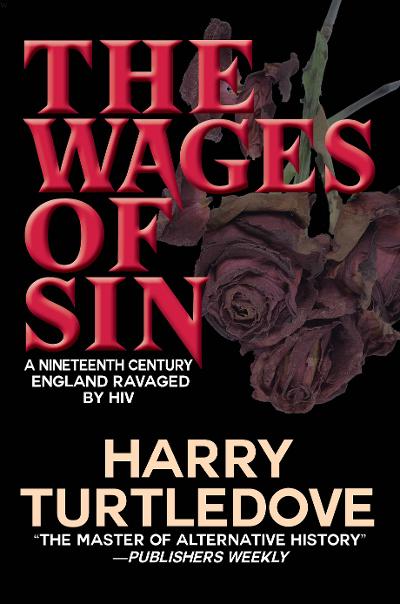
THE WAGES OF SIN, deeply disappointing alt-hist


THE WAGES OF SIN
HARRY TURTLEDOVE

CAEZIK SF & Fantasy (non-affiliate Amazon link)
$9.99 Kindle edition, available now

Rating: 2* of five

The Publisher Says: A terrifying tale about HIV spreading in the early sixteenth century by an author, Publisher Weekly calls “The Master of Alternate History.”

What if HIV started spreading in the early 1500s rather than the late 1900s? Without modern medicine, anybody who catches HIV is going to die. A patriarchal society reacts to this devastating disease in the only way it knows it sequesters women as much as possible, limiting contacts between the sexes except for married couples. While imperfect, such drastic actions do limit the spread of the disease.

The ‘Wasting’ (HIV) has caused devasting destruction throughout the known world and severely limited the development of technology as well, creating a mid-nineteenth century England and London almost unrecognizable to us. This is the world Viola is born into. Extremely intelligent and growing up in a house full of medical books which she reads, she dreams of travelling to far-off places, something she can only do via books since her actions and movements are severely restricted by both law and custom.

Meticulously researched and exquisitely detailed in a way only a master like Harry Turtledove can do, this book is a tour-de-force from one of the best historical and alternate history writers ever to write in the genre.

I RECEIVED A DRC FROM THE PUBLISHER VIA NETGALLEY. THANK YOU.

My Review
: Big ideas chopped to bits, tossed around some, then left to collapse where they collided. Are we in the 1509 Congolese-disease plot? The 1850s jerkoff's plot? (That is more literal than figurative here.) What made me read the book was Turtledove. Why I finished it was Turtledove. I disliked its underdeveloped alt-hist; I deeply disliked the crude and demeaning language, though both period and setting appropriate; I never felt as though, unlike a certain character, the story ever got near a climax as Viola and Peter, the straight people whose story I expected (not unreasonably) this to be, spend the entire story apart. Then, after a betrayal, a confession, and a shocking comeuppance(!), all conducted by letters between them, there's a wedding and...

...off you and I go. Contracts all fulfilled, we have a story thay does the absolute bare-bones minimum.This can't be all, thought I, but indeed it was. Please note there is absolutely not more than one tiny whiff of gayness, of sodomy as an act, of the merest hint of the existence of queers at all. In three hundred pages about AIDS.

Now it's the poor straight women get all the fallout of the AIDS epidemic because, I guess, there weren't gay people in 1509 Congo (great, let's put the source of the STD plague in Africa...at least it's a change from South America's factual syphilis plague...then switch to straight people in whiter-than-white England! Ignoring Africa thereafter! It's the twenty-fucking-first ventury, colonialism is on the cross so let's drop it, k?)

So I think I'm being pretty magnanimous with two stars.

ROB GREENE'S PAGE: The First Planets series, perfect shut-out-the-world alt-hist space opera


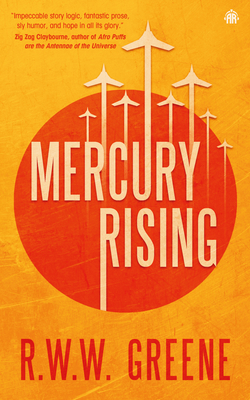
MERUCRY RISING (First Planets #1)
RWW GREENE

Angry Robot Books (non-affiliate Amazon link)
$6.99 Kindle edition, available now

Rating: 4.5* of five

The Publisher Says: Alternative history with aliens, an immortal misanthrope and SF tropes aplenty

Even in a technologically-advanced, Kennedy-Didn’t-Die alternate-history, Brooklyn Lamontagne is going nowhere fast. The year is 1975, thirty years after Robert Oppenheimer invented the Oppenheimer Nuclear Engine, twenty-five years after the first human walked on the moon, and eighteen years after Jet Carson and the Eagle Seven sacrificed their lives to stop the alien invaders.

Brooklyn just wants to keep his mother’s rent paid, earn a little scratch of his own, steer clear of the cops, and maybe get laid sometime in the near future. Simple pleasures, right? But a killer with a baseball bat and a mysterious box of 8-track tapes is about to make his life real complicated…

I RECEIVED A DRC FROM THE PUBLISHER. THANK YOU.

My Review
: 8-track tapes! How I hated them...annoying clunky things vastly overcomplicated and bad at their job. Cassettes were a boon and a blessing.

Still and all, I'd put up with the sodding things if it meant Moonbases and Mars colonies when I was sixteen.

Thanks, Rob...this world scratches my itch. This is a timeline I'd've loved living in, so this chance to visit it was really welcome.

This was a re-read in advance of reading book two, below. Here is my 2022 full review.

++++++++++++++++++++++++++++++++++++++++++++++++++++++++++++++++

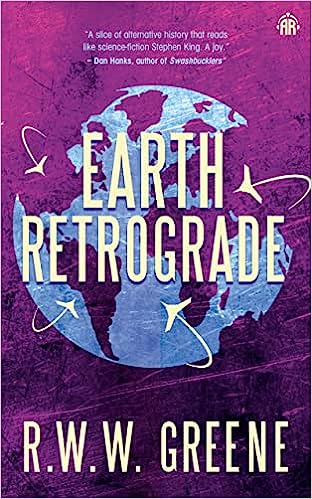
EARTH RETROGRADE (First Planets #2)
RWW GREENE

Angry Robot Books (non-affiliate Amazon link)
$6.99 Kindle edition, available now

Rating: 4.5* of five

The Publisher Says: Becoming the planet's most (in)famous human has not changed Brooklyn Lamontagne one bit, but the time has come for him to choose where his allegiances really lie.

The United Nations is working to get everyone off Earth by the deadline—set by the planet’s true owners, the aliens known as the First. It’s a task made somewhat easier by a mysterious virus that rendered at least fifty percent of humanity unable to have children. Meanwhile, the USA and the USSR have set their sights on Mars, claiming half a planet each.

Brooklyn Lamontagne doesn’t remember saving the world eight years ago, but he’s been paying for it ever since. The conquered Earth governments don’t trust him, the Average Joe can’t make up their mind, but they all agree that Brooklyn should stay in space. Now, he’s just about covering his bills with junk-food runs to Venus and transporting horny honeymooners to Tycho aboard his aging spaceship, the Victory.

When a pal asks for a ride to Mars, Brooklyn lands in a solar system’s worth of espionage, backroom alliances, ancient treasures and secret plots while encountering a navigation system that just wants to be loved…

I RECEIVED A DRC FROM THE PUBLISHER. THANK YOU.

My Review
: "The mice will see you now" said Slartibartfast to Dentarthurdent.

The First and their prior claim to the Earth Humanity thinks it owns, and definitely dominates, left me uneasily aware that the religious nuts' worldview of a creator god who is the real owner of the place and the people is a very, very short step from most SF...at least the kind with superpowered aliens. I'm not a believer in either things (aliens or gods), so I was a bit more distanced from this book's essential worldview than the first one.

As soon as we get into alien territory I lose steam. I like the idea here more than it sounds like I do; alert readers will notice a 4.5* rating, which is no one's idea of a dissatisfied reader's opinion. I'm mostly responding to Brooklyn's kindness and unwillingness to leave anyone who needs help unhelped. I'm also deeply satisfied by the story's ending.

But I'll admit, I wanted to know more about the First than I learned; the book needed to be longer, or there needed to be another one. Read together, in quick sequence, the story moves quickly to its satisfying conclusion...which is why I re-read the first one. It's a long afternoon and evening taken at one stretch, but it worked well for me. Think of it aas one read and submerge into Brooklyn's forty-two degrees antisolar worldview.

Make this two-part story your escape-from-togetherness read this Yuletide if you batten on alternate history and/or space operas without pew-pew battles. Think Flash Gordon with sex clubs, or the Star Wars cantina with booze reviewer's notes sound like fun? Welcome, Soul Sibling, to your dream's fulfillment.

Wednesday, December 18, 2024

ALAN SMALE'S PAGE: The Apollo Rising series, HOT MOON & RADIANT SKY


HOT MOON (Apollo Rising #1)
ALAN SMALE

CAEZIK SF & Fantasy (non-affiliate Amazon link)
$9.99 ebook editions, available now

Rating: 4* of five

The Publisher Says: Imagine for a second what would have happened if the Soviets had gotten a cosmonaut to the moon first, if Neil Armstrong and Apollo 11 had been in a humiliating second place. Everything would have unfolded differently.

America would never have let the Soviets win the space race. That would have been unthinkable during the Cold War, political suicide for any president. We'd have gritted our teeth and doubled down, poured billions into the Apollo program.

HOT MOON is set in 1979 in this alternate world. The US and the Soviets both have permanent moon bases, orbiting space stations, and manned spy satellites supported by frequent rocket launches. Reagan is President and the Cold War is hotter than ever.

The crew of Apollo 32, commanded by Vivian Carter, career astronaut, docks at NASA's Columbia space station on their way to their main mission: exploring the volcanic Marius Hills region of the Moon. Vivian is caught in the crossfire as four Soviet Soyuz craft appear without warning to assault the orbiting station.

The fight for the Moon has begun!

I RECEIVED A DRC FROM THE PUBLISHER VIA EDELWEISS+. THANK YOU.

My Review
: Imagine The Martian set in the storyverse of For All Mankind.

So. You got it. You need more?

The author's a praciticing astronomer. A real, actual scientist writing SF is always a positive, from my PoV, because the details are clearly based in a scientist's understanding of what matters to an expedition to the moon. It's also refreshing when someone takes the constraints of the actual extant tech of a given time seriously. Author Smale does both.

Mixed in with the cool sciency bits are a selection of genre-friendly bits of alternate history, in this case the survival of a Russian scientist whose death caused the end of the Soviet Moon program; a fun twist of gender-equality advancement; and a murder mystery. None of these violated the basic need of the SF reader for a clear path to believable results. It's as accurate to 1960s and 70s science as is possible.

Geopolitics as the source of alt-hist plots are, as you can imagine, the biggest vein in the story-mine ever worked. This one being especially interesting to me, of course I fell for it immediately (despite my absolute conviction that Nixon would never, ever, ever have pulled out of Vietnam...too many defense contractors would've been hurt). I'm one of those who saw "Earthrise" when there was one digit in my age:

...and was never the same again. So a story centered around a time when I was alive but positing a different outcome was meat and drink!

That doesn't stop me from seeing the execution's flaws. I don't see anything in Vivian's sketched-in background that makes her gender relevant, so it feels a bit like tokenism. Mentioning her inclusion for some overarching reason, or integrating some responses that point up the reason, might have helped.

The story's pace is not swift, which I mention for those wanting a real thrill ride. I found it more than swift enough to keep the pages turning. The pace is not representative of the perils. This is space after all, the merest slip of a tool can be lethal...and Vivian seems to be a disaster magnet. She's certainly hair-breadth escape expert par excellence. Permaybehaps a bit too much so.

So I'm not yodeling buy-now-or-else from atop the roof, I *am* saying it's a very enjoyable read for your Kindle as you do your best not to hear little Pookums extorting that second cousin's kid out of the latest game. It'll keep you immersed.

+++++++++++++++++++++++++++++++++++++++++++++++++++++++++++++++


RADIANT SKY (Apollo Rising #2)
ALAN SMALE

CAEZIK SF & Fantasy (non-affiliate Amazon link)
$9.99 ebook editions, available now

Rating: 4* of five

The Publisher Says: Vivan Carter, the electrifying hero from Hot Moon, returns to lead a lunar geological survey team comprised of both Americans and Soviets. Their journey takes them across the harsh and barren lunar surface as they chart the moon and collect samples for this grueling mission. It is dangerous enough, but the stakes become much higher when an ambush threatens the entire mission.

The crew must navigate a treacherous path where survival requires ingenuity, courage, and an uneasy alliance with their Soviet counterparts. As the stakes grow higher, the mission becomes a test of skill, endurance, and trust in an era defined by suspicion and rivalry.

Dive into an electrifying alternate history where space rivalry takes center stage. Radiant Sky is a thrilling continuation of the highly acclaimed hard science fiction novel that will captivate fans of NASA fiction books, near-future adventures, and hard science fiction series. Set in a meticulously crafted world where the Cold War extends far beyond Earth's atmosphere, humanity's reach into space creates a new frontier of tension and exploration.

With breathtaking accuracy from a retired NASA director and an immersive look at the untold stories of space rivalry, Radiant Sky brings hard science fiction alive, capturing the imagination and the thrill of space exploration. Prepare for a pulse-pounding experience that redefines what it means to venture into the unknown.

I RECEIVED A DRC FROM THE PUBLISHER VIA EDELWEISS+. THANK YOU.

My Review
: Sequels to alternate-history books are hoeing a hard row indeed. The setting's the star, and the star's done the lifting in the first one. Now, four years later, we know what happened to Vivian, a chunk of why, and how it made her act.

What's left to do? Make her world do a flip: Cooperate with the Soviets who tried multiple ways to kill you only a few years ago. The Moon makes strange bedfellows, after all. And there's weirdness enough that we need all hands on deck to survive.

So the stakes ratcheted up from personal, the character's still a deeply resouceful person, the setting's still the very hostile one of the Moon, and we're treated to more tense moments. This does seem to me to be Author Smale's favorite way of moving the plot: Add a threat and resolve it with averting death. I'm not totally down with that because those stakes really don't change much, just make the status quo continue. So the dopamine hit of fixing the problem wanes a bit every time it happens again.

That said, I don't for a second want you to think this is a sequel where we just do it all again. The worldbuilding is more sophisticated than that. Geopolitics are present in any alternate history. In this iteration, the geopolitics are dependent on events from the last book, so they're less directly mappable still from the 1983 of your and my memories. That is clear from the fact we're on the Moon, of course...but the story is much more than that.

If you're a fan of "what happens when I pull this?" stories, this series will do it for you. Author Smale understands the puzzle-solver's mind, feeds it puzzles to follow as they're solved, and makes points about conflict, its roots, and some of the ways it does, and doesn't, get resolved.

This book came out last month and I snarfed it down in two days. Possibly displacing Farthing as my favorite alternate-history crime book....

Wednesday, February 28, 2024

BLUE LARD, transgressive Russian SFF oddity


BLUE LARD
VLADIMIR SOROKIN
(tr. Max Lawton)
NYRB Classics
$18.95 trade paper, available now

Rating: 4.5* of five

The Publisher Says: The Russian master's most infamous novel, a dystopian fever dream about cloning, alternative histories, and world domination.

Vladimir Sorokin’s Blue Lard is the most iconic and iconoclastic Russian novel of the last forty years. Thanks in part to its depiction of Stalin and Khrushchev having sex, which inspired a Putinist youth group to throw shredded copies of the author’s books into an enormous toilet erected in front of Moscow’s Bolshoi Theater, Blue Lard is the novel that tore Sorokin out of the Moscow Conceptualist underground and into the headlines.

The book begins in a futuristic laboratory where genetic scientists speak in a Joycean dialect of Russian mixed with Chinese—peppered with ample neologisms—and work to clone famous Russian writers, who are then made to produce texts in the style of their forebears. The goal of this “script-process” is not the texts themselves, but the blue lard that collects in the small of their backs as they write.

This substance is to be used to power reactors on the moon—that is, until a sect of devout nationalists breaks in to steal the blue lard, planning to send it back in time to an alternate version of the Soviet Union, one that exists on the margins of a Europe conquered by a long-haired Hitler with the ability to shoot electricity from his hands. What will come of this blue lard? Who will finally make use of its mysterious powers?

Blue Lard is a stylistically acrobatic book, translated by Max Lawton into an English idiom just as bizarre as the Russian original. Evoking both Pulp Fiction and the masterpieces of Marquis de Sade, Sorokin’s novel is a brutal, heady trip that annihilates all of its twentieth- (and twenty-first-) century competition in the Russian canon—and that annihilates Russia itself in a resounding act of heavy-metal dissidence.

I RECEIVED A DRC FROM THE PUBLISHER VIA EDELWEISS+. THANK YOU.

My Review
: Unquestionably the weirdest NYRB book I have yet read...and the second-weirdest alternate history book I have read this century.

It requires serious effort to engage with the first third or so of the book, as you are in medias res without even the usual linguistic snowpoles showing you where the obstacles are. You are, as is so often the case in Life, in a strange place with strange people you do not know or even understand as they have conversations around you.

After that point, there is a shift in the linguistic register that brings us closer to normal conversational tones. Not normal-normal, mind you, though closer. (There is a partial Glossary at the end for the desperately confused.) But, like Claude Simon’s nouveau roman novels, there is a difficult beginning that requires you to make an investment of concentration. We have left the normie-world of relatable plots, ordinary characters you could meet at the supermarket, sentences that start and finish in the same paragraph, and other such bourgeois fripperies. This is not a read that rewards being treated as a novel. This is writing that needs to be experienced and absorbed for itself not its meanings.

Sorokin, like so many truly inventive folk, is a natural iconoclast. At twenty-five, in 1980, he was baptized into the Russian Orthodox Church, at that time still under Communist-Party suspicion. The nature of iconoclasm is always to resist, so in this era of Church/state rapprochement, he opposes Putin’s war against Ukraine. It is not as though his work work was ever popular with the regime, what with Hitler raping Stalin’s daughter, Stalin and Khruschev sexing it up (ewww!), and a variety of body-horror tropes, that Little Vladdy Pu-Pu just could not ever be on board with. This, among other not-socialist-realist flourishes, will mean no invite-to-dinner from the Kremlin. Now, being good little bourgeois decoders, we too like our novels to Mean Something, like socialist realist work...but that is not on offer here.

Sorokin does not Make Sense, he makes you think about how a story is more than just the beginning-middle-end structure we are ingrained to expect. He offers not one kind of Sense, but multiple ways to experience words and ideas forming into stories. This, and the transgressive nature of the words and ideas he does present us, makes a lot...A LOT...of people really, really angry. This being a feature of the Sorokin brand. I do not get the point of their outrage and negativity being performed. Giving the man the thing he tried to get from you? The point of that is...?

A read that demands effort, does it an awful lot of the time, and allows you to decide for yourself if it means anything at all.

Like Life itself, it makes you the Author’s apprentice. You can decide if that is your jam, but I am here to say that it is a read very much worth my time and effort and could be for you as well. Remember how mad it made the Russian overlord. Buy it to be ornery, to oppose the banning/forbidding/controlling ethos that increasingly envelops the information-delivery world.

I bet lots of y’all end up liking it.

Monday, December 18, 2023

MORTAL REPUBLIC: How Rome Fell into Tyranny, using History to explain the present pretty convincingly


MORTAL REPUBLIC: How Rome Fell into Tyranny
EDWARD J. WATTS

Basic Books
$18.99 trade paper, available now

Rating: 4* of five

The Publisher Says: Learn why the Roman Republic collapsed—and how it could have continued to thrive—with this insightful history from an award-winning author.

In Mortal Republic, prize-winning historian Edward J. Watts offers a new history of the fall of the Roman Republic that explains why Rome exchanged freedom for autocracy. For centuries, even as Rome grew into the Mediterranean’s premier military and political power, its governing institutions, parliamentary rules, and political customs successfully fostered negotiation and compromise.

By the 130s BC, however, Rome’s leaders increasingly used these same tools to cynically pursue individual gain and obstruct their opponents. As the center decayed and dysfunction grew, arguments between politicians gave way to political violence in the streets. The stage was set for destructive civil wars—and ultimately the imperial reign of Augustus.

The death of Rome’s Republic was not inevitable. In Mortal Republic, Watts shows it died because it was allowed to, from thousands of small wounds inflicted by Romans who assumed that it would last forever.

I RECEIVED A DRC FROM THE PUBLISHER VIA NETGALLEY. THANK YOU.

My Review
: The Mary Beard School of Skepticism About Past as Prologue is in session.
The past is no Oracle and historians are not prophets, but this does not mean that it is wrong to look to antiquity for help understanding the present.
This is intensely controversial. I am not at all sure it is true, but after reading this thoroughly researched and well sourced in the facts that we can know book, I'll put a pin in my inclination to doubt. I can enjoy this book on its factual merits quite well enough.

The author focuses his attention on the period between the victory of the Romans over Carthage in the Second Punic War, and Octavian's usurpation of power, effectively beginning the Empire. That time, its unrest and gradual normalization of political gridlock and, ultimately, violence, does bear a resemblance to the current pass in US–and world–politics.

I have no kick with that fact being pointed out. I am pretty confident the author's analysis of what led up to the events, and how what went down made the resolution of the problems seem pretty obvious. The way he has used the chapter order is, pretty clearly, tendentious...a downward slide from functioning, if troubled republic into one-man rule and autocracy just *feels* more and more inevitable as the facts we know are marshaled.

Where I go a little off his carefully laid rails is where he posits his ideas for how the slide was not inevitable, and the autocracy could've been avoided. That is allohistory which, by itself, is fine by me. But this is presented with a very authoritative air, not differentiated from the text based on facts that surrounds it, and that felt a bit like I was being led to agree without any facts or evidence that his conclusions were plausible. There can not be any such evidence or facts because that isn't how things *did* play out. I can't say he's wrong for all the same reasons.

The desire to show us how to fix the ugly, scary passage we're going through by using the past as a model makes a lot of sense. It still shouldn't be presented as being the equal of the fact-based narrative around it.

Your history-loving giftee, your anxious old uncle who just knows The End Is Nigh, will lap up this story. The good thing is that, as the facts pile up, the author hands the reader this double-edged aerçu:
No republic is eternal. It lives only as long as its citizens want it.
That is hopeful, if you believe there is a chance to warn and arm people against what is occurring; and disheartening, because look what happened to Rome.

The author is of the former opinion, and this book is the case he makes for it.

Monday, December 4, 2023

BEGIN THE WORLD OVER, what happens if other hands hold the keys


BEGIN THE WORLD OVER
KUNG LI SUN

AK Press
$17.00 trade paper, available now

Rating: 4.5* of five

The Publisher Says: A revolutionary tale of Black and Indigenous insurrection. History as it should have been.

Begin the World Over is a counterfactual novel about the Founders’ greatest fear—that Black and Indigenous people might join forces to undo the newly formed United States of America—coming true.

In 1793, as revolutionaries in the West Indies take up arms, James Hemings has little interest in joining the fight for liberté—talented and favored, he is careful to protect his relative comforts as Thomas Jefferson’s enslaved chef. But when he meets Denmark Vesey, James is immediately smitten. The formidable first mate persuades James to board his ship, on its way to the revolt in Saint-Domingue. There and on the mainland they join forces with a diverse cast of characters, including a gender nonconforming prophetess, a formerly enslaved jockey, and a Muskogee horse trader. The resulting adventure masterfully mixes real historical figures and events with a riotous retelling of a possible history in which James must decide whether to return to his constrained but composed former life, or join the coalition of Black revolutionaries and Muskogee resistance to fight the American slavers and settlers.

I RECEIVED A DRC FROM THE PUBLISHER VIA EDELWEISS+. THANK YOU.

My Review
: Counterfactual histories like this are my meat and drink in reading life. I love to see well-informed authors play with little things that, had they not happened in *exactly* the way they did, would have resulted in a completely different world than the one we live in. There is, of course, an element of wish fulfillment in this for me. And not just in modern times.

The ways and means of colonial oppression are alive and well in Anglophone literature, French literature...all the colonists' languages...as we can see by the marginalization of works by and about nonwhite peoples around the globe.
Literally everything that went wrong in the wars of Haitian, and Jamaican, liberation went right in this book; and that was sooo satisfying to this reader who find the smugness of US exceptionalism grating. On and on, the litany of "they won" rings its victory bells in my ears and my smiles of pleasure keep getting wider as, on reflection, I contemplate an alternative universe where this is history, not alternative history.

For reasons I'll never really understand, magical realism must be in any alternative history novel. I don't like it but it's going to be there, so be ready for that.

The part of the story where we see same-sex couples and coupling being accepted and acceptable is, for me, the best bit of the book. James Hemings, Jefferson's factual Paris-trained enslaved chef, is here a queer gentleman who provides an important central PoV, and that inclusion means that a LOT of attention is paid to food, and the eating of same, in groups and alone. Our trans and genderqueer siblings are well-represented in indigenous and enslaved quarters. This is something I truly can't praise the author for highly enough, the simple, matter-of-fact inclusion of people that the QUILTBAG community of today does far too little to include and celebrate. What's a harder sell, I think, to most people is that the revolution isn't bloodless and that's very much center stage for good swaths of the story. I am routinely appalled by the violence that many slaveowners enacted on their slaves' bodies. It isn't *better* when they, in their turn, enact that violence on their enslavers...it just reminds me that there are no truly good humans.

Starting our journey with James's PoV and then broadening the scope to include many others' PoVs was, I can see, a necessary way to get this story told. I will note that it felt frustrating because James won me over so completely that I wanted to return to him like a homing pigeon. That broadening does allow for more representation at the expense of depth of characterization. Part of the point of this particular story, as I see it, is to take the reader outside the usual and customary colonial hegemonic individualistic mode of storytelling. We're presented with an organic polyphony of PoVs. It pays to have that need in the reader's mind to get them into the spirit of the rebellion and its aims.

A read I strongly urge on you to understand and perhaps even align with the revolution so eagerly sought by young people and its aims. Younger readers, take heart! You're seen. Your concerns for liberation and justice aren't invisible.