Showing posts with label RWW Greene. Show all posts

Friday, December 20, 2024

ROB GREENE'S PAGE: The First Planets series, perfect shut-out-the-world alt-hist space opera


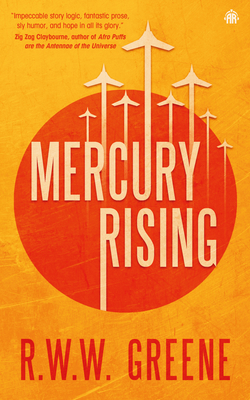
MERUCRY RISING (First Planets #1)
RWW GREENE

Angry Robot Books (non-affiliate Amazon link)
$6.99 Kindle edition, available now

Rating: 4.5* of five

The Publisher Says: Alternative history with aliens, an immortal misanthrope and SF tropes aplenty

Even in a technologically-advanced, Kennedy-Didn’t-Die alternate-history, Brooklyn Lamontagne is going nowhere fast. The year is 1975, thirty years after Robert Oppenheimer invented the Oppenheimer Nuclear Engine, twenty-five years after the first human walked on the moon, and eighteen years after Jet Carson and the Eagle Seven sacrificed their lives to stop the alien invaders.

Brooklyn just wants to keep his mother’s rent paid, earn a little scratch of his own, steer clear of the cops, and maybe get laid sometime in the near future. Simple pleasures, right? But a killer with a baseball bat and a mysterious box of 8-track tapes is about to make his life real complicated…

I RECEIVED A DRC FROM THE PUBLISHER. THANK YOU.

My Review
: 8-track tapes! How I hated them...annoying clunky things vastly overcomplicated and bad at their job. Cassettes were a boon and a blessing.

Still and all, I'd put up with the sodding things if it meant Moonbases and Mars colonies when I was sixteen.

Thanks, Rob...this world scratches my itch. This is a timeline I'd've loved living in, so this chance to visit it was really welcome.

This was a re-read in advance of reading book two, below. Here is my 2022 full review.

++++++++++++++++++++++++++++++++++++++++++++++++++++++++++++++++
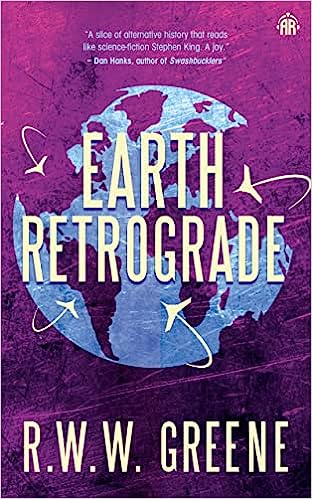
EARTH RETROGRADE (First Planets #2)
RWW GREENE

Angry Robot Books (non-affiliate Amazon link)
$6.99 Kindle edition, available now

Rating: 4.5* of five

The Publisher Says: Becoming the planet's most (in)famous human has not changed Brooklyn Lamontagne one bit, but the time has come for him to choose where his allegiances really lie.

The United Nations is working to get everyone off Earth by the deadline—set by the planet’s true owners, the aliens known as the First. It’s a task made somewhat easier by a mysterious virus that rendered at least fifty percent of humanity unable to have children. Meanwhile, the USA and the USSR have set their sights on Mars, claiming half a planet each.

Brooklyn Lamontagne doesn’t remember saving the world eight years ago, but he’s been paying for it ever since. The conquered Earth governments don’t trust him, the Average Joe can’t make up their mind, but they all agree that Brooklyn should stay in space. Now, he’s just about covering his bills with junk-food runs to Venus and transporting horny honeymooners to Tycho aboard his aging spaceship, the Victory.

When a pal asks for a ride to Mars, Brooklyn lands in a solar system’s worth of espionage, backroom alliances, ancient treasures and secret plots while encountering a navigation system that just wants to be loved…

I RECEIVED A DRC FROM THE PUBLISHER. THANK YOU.

My Review
: "The mice will see you now" said Slartibartfast to Dentarthurdent.

The First and their prior claim to the Earth Humanity thinks it owns, and definitely dominates, left me uneasily aware that the religious nuts' worldview of a creator god who is the real owner of the place and the people is a very, very short step from most SF...at least the kind with superpowered aliens. I'm not a believer in either things (aliens or gods), so I was a bit more distanced from this book's essential worldview than the first one.

As soon as we get into alien territory I lose steam. I like the idea here more than it sounds like I do; alert readers will notice a 4.5* rating, which is no one's idea of a dissatisfied reader's opinion. I'm mostly responding to Brooklyn's kindness and unwillingness to leave anyone who needs help unhelped. I'm also deeply satisfied by the story's ending.

But I'll admit, I wanted to know more about the First than I learned; the book needed to be longer, or there needed to be another one. Read together, in quick sequence, the story moves quickly to its satisfying conclusion...which is why I re-read the first one. It's a long afternoon and evening taken at one stretch, but it worked well for me. Think of it aas one read and submerge into Brooklyn's forty-two degrees antisolar worldview.

Make this two-part story your escape-from-togetherness read this Yuletide if you batten on alternate history and/or space operas without pew-pew battles. Think Flash Gordon with sex clubs, or the Star Wars cantina with booze reviewer's notes sound like fun? Welcome, Soul Sibling, to your dream's fulfillment.

Monday, May 9, 2022

MERCURY RISING, alternate space-race history with waaay trippy nukes


MERCURY RISING
R.W.W. GREENE

Angry Robot (non-affiliate Amazon link)
$6.99 Kindle edition, available now

Rating: 4.75* of five (the w-bombs! the w-bombs!)

The Publisher Says: Alternative history with aliens, an immortal misanthrope and SF tropes aplenty

Even in a technologically-advanced, Kennedy-Didn’t-Die alternate-history, Brooklyn Lamontagne is going nowhere fast. The year is 1975, thirty years after Robert Oppenheimer invented the Oppenheimer Nuclear Engine, twenty-five years after the first human walked on the moon, and eighteen years after Jet Carson and the Eagle Seven sacrificed their lives to stop the alien invaders.

Brooklyn just wants to keep his mother’s rent paid, earn a little scratch of his own, steer clear of the cops, and maybe get laid sometime in the near future. Simple pleasures, right? But a killer with a baseball bat and a mysterious box of 8-track tapes is about to make his life real complicated…

I PRACTICALLY HAD TO BEG THE AUTHOR FOR A DRC. I *THOUGHT* WE WERE FRIENDS. MY FEELINGS ARE STILL HURT.

My Review
: No, really. Mortally wounded that this wingèd not my way until I groveled. *sniff* (And seriously NO MORE W-BOMBS. Cut that crap out, dirty-old-man-in-training!) I was calmly enjoying the mental soundtrack, the 1970s jukebox that's permanently cued up in my head, when *wham* another revolting w-bomb.

But about that jukebox...would we, in fact, have the precise same pop-cultural artifacts in a world that didn't slow down its climb to the stars? The 1968 Cougar, well, okay, that was already on course from 1958. The planning window of a car in those days was five years...so the 1958s wouldn't've been much altered from our world, as I understand the timeline, which diverges first in the middle 1940s and so those cars can be explained. Pop culture spins on a nailhead. Elvis electrifying the country is one example, the Beatles knocking off his cool-cat cap is another, but both of those came in response to specific cultural stimuli. Wouldn't the world be more law-and-order oriented when the Oppenheimer Nuclear Drives are dangling before the lust-drenched gaze of every young testosterone factory? Can't get in one of those unless your nose is clean.

Which, of course, our PoV character (Brooklyn Lemontagne) flouts. But the reason he's able to flout that social control mechanism is simple: Invaders from Outer Space! The ultimate Golden Age of SF trope. This time they're Mercurians, the patent absurdity of whose existence gives even the Hero of the piece (who apparently dies early on) some pause. Can't argue with the presence of stonking hostile warships and evaporated cities, can you.

This takes place among Americans! Of course you can! The whole planet pulls together to combat the Enemy from Beyond...and there are ignorant goofballs talking conspiracy theories, there are hemi-hippies rebelling against the controlling hand of the grown-ups. This is the world, and honestly I agree with Author Greene's take on it. I quibble with some details, but I believe he's exactly correct that even an existential threat with ample death and destruction to demonstrate its reality won't create more than a façade of unity among the irredeemable mass of humanity. (Look around, tell me, and him, we're wrong.)

So I buy the premise. So I consent to set aside my niggling nuh-uh generator. I'm in for the ride.

Part One: Mercury Rising is straight out of Astounding's *1956 volume. Brave Americans and honorable Soviets lay down their grievances and get on with the job of killin' them some Mercurians. (Mercurians!) The Ultimate Price? Paid. Now what? When and where are we going next? I'm almost sure my Kindle screen cracked under the thumping of my thumb.

Part Two: Bad Blood shifts gears, gives us the rest of the battle story very effectively, and sends Brooklyn, our new PoV man, into some nasty corners. And not one of 'em anything but his own idiot fault. Some gross and very personal violence perpetrated later in the section...it starts to feel like we're going to be in Peckinpah territory through the book...and, on schedule, the fecal matter impacts the rotary air circulation device at warp speed.

The thing about living your life outside is that you learn to watch simple things like a hawk. It takes Brooklyn about three times as long as it should to come up with his get-out-of-jail-free card. But he decides there's nothing else for it: Go to space, full decade enlistment, and get the whole shootin' match handled...crimes forgiven, mother fed, and future still neatly fucked, same as if he'd gone to jail without solving the problems he most cares about solving. Yay...?

Part Three: Squeeze Box details the adjustments of life in military training. It's not like I wasn't expecting it. But I also wasn't enjoying it much until I suddenly twigged: Brooklyn's assigned buddy, Tommy, is gay. And nothing at all fazes Brooklyn, or anyone else it seems, about it.

It seems that the Mercurians (!) destroying Cleveland and causing climate change as well as serious ashfall issues gave people something more interesting than who's zoomin' who to fret over. As well as feed innumerable conspiracy theories that, oddly prove to be correct but misaimed.

Part Four: Take the Money and Run did very little for me, but brightened up the contrast between Brooklyn's America and my 1976 US.

There's a goodly amount of interpersonal violence in this story, fisticuffs to donnybrooking (to use old-fashioned terms); appropriate for a dead-end life such as Brooklyn was living and (I hope) merely his own process of molting that no-longer-needed carapace. The end of the part was oddly assorted with its beginning if that isn't to be the case; our man Brooklyn gets out of his mind instead of out of his head, and does so in the place I think something like Coachella or Burning Man *should* take place: The mass grave of an entire city's populace.

Part Five: The Rubberband Man pretty much just cemented the crazy-shit-men-do-together trope for all time. It's an adventure story, that was an adventure, but...not quite the thing I'd've chosen to prove "once a scofflaw, always a scofflaw" to ye olde readere.

Part Six: Flight '76 was apparently meant to earworm me in the most appalling possible way, including a w-bomb in the first five seconds of the awful, terrible, well-below-mediocre tune that refuses to get out of my head. I think SOMEone owes me some sort of reparations.

Part Seven: Boogie Nights starts with a much better earworm, thank the Nine Goddesses. But it's more transition time treats, ABBA on the Moon (!), and some interesting-to-me alt-hist entertainment...Vice-President JACKSON...then off into the Wild Black Yonder. It goes by really fast.

We do see a good, solid character whose trajectory is geting more interesting, though it's a glancing blow. I'm mostly intrigued by this *McCartney singing political rock opera....

Part Eight: Don't Let Me Be Misunderstood is an earworm I can live with, if without the good memories of Boogie Nights. It's also the best shorthand for the events of this part...there are so many mistakes and screwed-up connections to work out, the metaphor of upgrading the computer is especially apt.

The ship names are giving me little frissons. The (Marie-Madeleine) Fourcade is a woman-captained solo spy ship, the Baron von Steuben old-fashioned, obsolescent, and largely overlooked haven for the queer boys too useful to get rid of but not important enough to keep secure (much to the PTB's cost), each carrying its subtext like a homing beacon and not just one of the darn things. I mean, what did von Steuben do? And where (in Ohio) is Steubenville? And why is Carruthers so shifty?

Part Nine: Runnin' on Empty truly sets new stakes for literally everyone in this, our one wild and precious life. Titanically, existentially reorders whatever priorities you thought you'd formed by utterly altering the ground you plonk your trotters onto every time you think to move.

I do not know of an Odysseus I'd rather see handle this situation than the one who is.

Part Ten: Flash Light wafts its foully malodorously vapid earworm through the four-foot speaker towers in my mental disco.

But that is as nothing to the sudden but inevitable betrayal that This Land endures at the foul, gangrenous typing digits of Author Greene. I am too traumatized to say more.

Part Eleven: Boy from New York City introduces us to the real Jet...short for Jethro...Carson. And now the first part has closure. What we're doing I won't tell you, but I will say that there's a reason you'll want to read this and it's in this part.

Part Twelve: Take a Chance on Me is the first time I haven't wanted to claw my brain out to wash the earworm ichor off it.

There's a lot to cheer for, and a lot left to learn. This is a good solid familiar story arc and it's got lots of good gauds and gew-gaws bejazzling its basic curves. We're going to be offered another trip, right?

Rapture Right!

Monday, August 23, 2021

TWENTY-FIVE TO LIFE, a title with more layers than an onion and just as apt to make you cry


TWENTY-FIVE TO LIFE
R.W.W. GREENE

Angry Robot (non-affiliate Amazon link)
$6.99 Kindle edition, available now

Rating: 4* of five

SUPER ULTRA BARGAIN ALERT You can get the sale-priced Kindle edition here for 99¢!!

The Publisher Says: Life goes on for the billions left behind after the humanity-saving colony mission to Proxima Centauri leaves Earth orbit ... but what's the point?

Julie Riley is two years too young to get out from under her mother's thumb, and what does it matter? She's over-educated, under-employed, and kept mostly numb by her pharma emplant. Her best friend, who she's mostly been interacting with via virtual reality for the past decade, is part of the colony mission to Proxima Centauri. Plus, the world is coming to an end. So, there's that.

When Julie's mother decides it's time to let go of the family home in a failing suburb and move to the city to be closer to work and her new beau, Julie decides to take matters into her own hands. She runs, illegally, hoping to find and hide with the Volksgeist, a loose-knit culture of tramps, hoboes, senior citizens, artists, and never-do-wells who have elected to ride out the end of the world in their campers and converted vans, constantly on the move over the back roads of America.

AUTHOR GREENE SENT ME A DRC OF THIS TITLE AT MY REQUEST. THANK YOU.

My Review
: You know that itchy little something that lives in the back of your brain? The one that says "...but...wait...what was...?" in a still, small voice but never quite speaks what it is you've forgotten? That's what happened to me with this book. I knew I wanted it...go look at my review for The Light Years...but forgot it was coming out this month. Completely. Until about a week ago.

Way too late to hit up the publisher, in other words. Fuck!

But given that Rob and I follow each other on Twitter, I used my privileged access (snort!) and DMed him to beg for a DRC in my preferred format. Next thing I knew it was in my inbox and I was off to the races. A week, though, isn't a lot of time to read something for a review. Contrary to the openly expressed opinion of a Famous SF Writer who, on Facebook, called my reviews "mediocre," I do expend a goodly amount of effort to engage with what it is I think the writer is trying to do, and if they've succeeded at it, in my opinion. Are there longueurs of style, are there errors of fact, and how exactly did I end up feeling about the story I was being told?

The news is good, readers. Author Greene does it again. He's made a post-apocalyptic future of Left-Behinders not only readable but fun.

Julie, twenty-three, is on her way into an underage person's rave-type party as we meet her. Mother signed off on her attendance..."just don't let anyone film you!"...and here she is, ready to have all the pharma-fun she can! The state wants people happy, so there are implants that go in as soon as possible; they give out SSRIs like they're nothing because, well, that's what the people Left Behind on Earth can expect: Nothing. The planet's given itself a terrible fever to get rid of the infection of Humanity, and it's working. Hence the Best and Brightest going to the Stars.

Julie, goddesses please bless her, wants...something. It's not going to happen if she stays where she is, so she makes the changes necessary (hello, drug withdrawal aka "brain zaps"!) and joins the Volksgeist. They're the few remaining souls who'd rather experience life instead of simply existing through it. Julie joins their caravan of fools (das NarrenVan?) and begins Life with Ranger, an older woman who takes her in and renames her "Runner." (It really fits.) And the novel goes On the Road!

The way things unfold is partly a commentary on the difficulty of detoxing from the astonishingly complex cocktail of brain-altering stuff we routinely ingest. This means Runner has periodic, what to call them, lapses? lacunae? in her sense of time and in the narrative of the story. Since that means some sorts of things don't get described (a party is simply not dealt with, only its aftermath, for example), it can feel a bit frustrating. I wanted to, like Runner herself, experience it all...but what happens in the telling is that I was given the sense of experiencing it as Runner did herself...a subtle, but bold, decision on Author Greene's part. I think it was successful in reinforcing my sense of Runner's reality, her actual experience, though I might've chosen a different course given the chance.

What do road novels do best? They give you a broad spectrum of experiences...and that's here, as well. The community of the Volksgeist is one amorphous, boundary-permeable entity. The places it rests are both changed by the experience of the group being there and the group is changed by additions and deletions of personal choices to remain or join. It makes the entire novel feel as though the goal is Canterbury, and the Wife of Bath will be here momentarily. While I'm medievalizing, since we've already got the Ship of Fools and the Pilgrim's Tale, let me point out that this is very much a morality play as well. Ranger and Runner, the Odd Couple in a way, are experiencing in unmediated form the consequences of my generation's criminal neglect of the warning signs of catastrophe to come. There's not a single thing that happens to the Volksgeist that isn't perfectly possible to believe is happening now, or to see how it will in the term left to me of my own life.

It doesn't look good. It doesn't make my generation look good. And it makes for one helluva good story.

On sale the 24th, tomorrow from when I'm writing this; preorder it now. You WILL want to have it ASAP.

Wednesday, December 23, 2020

To celebrate the end of a long, long, bad, bad year...


...I'm going to make a new start on reviewing the books I liked, but don't feel called to perform a full review on. There are, without exaggeration, hundreds of books I'd like to alert people to, books that really deserve your eyeblinks, books I can happily if not enthusiastically encourage you to seek out. I just haven't had a framework to do it in, like the simple three-sentence review structure you see at right. That meme was posted by Author 'Nathan Burgoine on Twitter in 2019. He was, before becoming an author, a bookstore manager, and this is the structure he encouraged staff members who felt overwhelmed by the idea of Writing A Review to use.

I'm adopting it, and referring to the process as Burgoineing in the author's honor. (I hope he sees it as an honor.) I will fairly regularly, once or possibly twice a month as a baseline and more frequently as events warrant, post three- or four-Burgoined titles together. You can see I've already begun. In the next few days more Burgoines will appear, this being year-end and a perfect time to make the decks as clear as I possibly can for the *amazing* books I've already got in the works for 2021 reviews.

I have to give 2020 credit for one thing. While a lot of authors saw their book launches rescheduled, publishers canceled their tours, and everyone was hugely distracted by the nightmare of COVID-19 (I had it, you do not want it), no one can fault the astoundingly wonderful literature we got this year. My own annual six-stars-of-five read was Zaina Arafat's extraordinary debut novel YOU EXIST TOO MUCH (review lives here), a thirtysomething Palestinian woman telling me my life, my family, my very experience of relationships of all sorts. I cannot stress enough to you, this is the book you need to read in 2021. A sixtysomething man is here, in your email/feed, saying: This is the power. This is the glory. The writing I look for, the read I long to find, and all of it delivered in a young woman's debut novel. This is as good an omen for the Great Conjunction's power being bent to the positive outcomes as any I've seen.

I read fifty-seven books this quarter. That's nowhere near a personal best, but it's a lot more than I would've read if I hadn't had the bump that Burgoineing has given me! Liberation from the demands of making a deep dive into a book, instead being allowed by my own inner demons to enjoy then describe why I did that this vastly simpler and handily codified technique showed me. The reads were in the main first reads or review-induced second reads. The re-reads, mostly of old Agatha Christie stories or novels that I could blow through quickly because they're already familiar. At my age, I don't really want to devote a lot of time to rereading because, in the ~170-ish months I can expect to live, writers won't stop writing and publishers won't stop publishing. I see wonderful things, to paraphrase Howard Carter as he took in Tutankhamen's tomb goods.

Many of the most wonderful things I've seen in 2020 were translated things, What's Left of the Night quite possibly chief among them...or was it the first-ever translation from Yiddish of The Rivals & Other Stories, that dark and bitter draft of unsentimentalism about immigrant/emigrant Jewish life...permaybehaps it was The Slave Yards, that unexpected and welcome ray of hope centered in Benghazi. Those stories from far-away or long-gone places, more and more, have come to mean the most exciting reading I can do. New Vessel Press, Syracuse University Press, a raft of publishers are out there looking for and finding wonderful tales, translating them, and waiting for you to notice. I'd say it's a great year to set a challenge of reading a translation a month. Click on the tag "#2020Goals" and I'll bet you won't be at a loss of where to start for long.

There were some really pleasant surprises, like SHUGGIE BAIN winning the 2020 Booker Prize and selling over 200,000 copies. The Only Good Indians and Ring Shout appearing on endless "Best of 2020" lists. The Light Years appearing on my radar along with its mensch of an author, R.W.W. Greene. A good guy, one to watch, go follow him and see what a relief it is to have someone as classy and good-hearted as him imagining our future into being. Jennifer Marie Brissett, whose first novel Elysium I really loved, announced Destroyer of Light will come out in 2021, and Nicky Drayden's Symbiosis appears in February. On and on, a litany of things I look forward to, a long and happy and heartening trail of good news. I'm so grateful for it all, all the stuff there isn't room to celebrate here but there sure is room in my world for it!

On the other hand, I failed miserably at my goal of publishing an average of ten reviews a month in 2020. Months without reviews came largely because I was pretty miserable after I got this rotten COVID-19, and there are some long-term effects I'm not happy about but don't cause day-to-day killing fatigue and wretched headaches. I'm going to set the 2021 bar at fifteen reviews average per month...an ambitious one hundred eighty, more than I've managed since the earliest days of reposting reviews in the "Pages" to save them from being deleted (back in 2013, I had only Goodreads and LibraryThing as my review venues, and each had its issues). I'm a little bit anxious about that lofty goal, which is how it should be. Challenges, a little fear, and a whole new chance to make the 2020s rock instead of having them rock us.

Wednesday, December 9, 2020

THE LIGHT YEARS, debut SF novel that feels more heartfelt than any other I've read this year


THE LIGHT YEARS
R.W.W. GREENE

Angry Robot Books (non-affiliate Amazon link)
$6.99 Kindle edition, available now

Rating: 4* of five

The Publisher Says: Hisako Saski was born with her life already mapped out. In exchange for an education, better housing for her family, and a boost out of poverty, she's been contracted into an arranged marriage to Adem Sadiq, a maintenance engineer and amateur musician who works and lives aboard his family's sub-light freighter, the Hajj.

Hisako is not happy with the deal. The arcane branch of physics it requires her to study broke off a thousand years before, and she is not keen on the idea of giving up everything she knows to marry a stranger and move onto an aging spaceship.

Onboard the Hajj, Hisako soon learns her dilemmas are overshadowed by the discovery of ancient secrets, a derelict warship, and a chance at giving the survivors of Earth a fresh start.

I RECEIVED A DRC OF THE BOOK FROM THE AUTHOR. THANKS, ROB!

My Review
: I wasn't eager to read this book...I don't like being mean to people, and a first novel about relativistic space travel wasn't likely to excite me in a good way...but Rob asked me to read it in an unrefusable way: "I'll take my chances."

Major respect for that, dude.

So here I am reviewing it and recommending it for #Booksgiving. That's unusual for a first novel. A first novel with a casually bisexual male lead, a culture of selling unborn brides to traders on sub-light freighters that function like planets with clashing cultures. And I'm recommending it?

Yes. It's trenchant. I sat still for a minute after reading the teenaged ruminations of the bride bought for male lead, Adem, on learning the boy she was about to mess around with was her unmet fiancé's fanboy. That needs a bit of unpacking....

Adem messes around in his offtime from being a trader, the son of the captain of the ship, and a bored (sort of) twentysomething horndog by recording and broadcasting ancient Earth songs he's discovered. The City of New Orleans, A Boy Named Sue, that kind of thousand-year-old cultural relic. Hey, we have the Academy of St. Martin in the Fields so this isn't remotely far-fetched. Add to that the fact that there are literally thousands of broadcast hours of Earth music...well, something is going to survive. Maybe even some good stuff, though I wouldn't bet on it. And those lightspeed broadcasts have reached his bride's planet, Gaul, where she is about to take A Big Step with one of her fiancé's fanboys. (Her virginity wasn't required for the marriage contract to be honored.)

That's a moment, a passage from one part of life to another, that is frequently accompanied by music. Not usually that of one of the parties' intended marital partner. And that union set to occur quite a long time (a decade, almost) in her future. About which contract she's been aware since she was twelve...and the groom was twenty-six when it was contracted and will arrive on Gaul about twenty-six still because near-light-speed relativistic travel makes your brain hurt when thinking about its social consequences.

That brain-bending reality the two main caracters live in is really the reason I want you to read this. In the best possible way, this novel resembles a novel of manners set in a society where the people getting married come from two different worlds. What can possibly be better described as speculative fiction than that?

There are numerous caveats and addendums to the basic story, of course, though none of them involve explicit sex or even serious romantic entanglement. Again the echo of the novel of manners...and while the publisher's marketing push might lead one to expect something more on the salacious side, it will only bring disappointment to go into the read expecting this.

Don't think it's not involving, don't imagine it's got no narrative tension! Remember how utterly engrossing and un-put-downable The House of Mirth was? Lily Bart's rise from nothing is a lot like Hisako's...but there is so much fun to be had in following the path Author Greene is marking out for you that I'll avoid spoilering it for you. Developments don't stop with the inner worlds of the characters...in a late-stage capitalist future that accepts prenatal marriage contracts (shades of 1300!), you can bet there is a lot of Evil to be done. Quite a bit of it is done to/by Hisako's poet-father.

A keen eye was cast on the twenty-first century and a report card was issued in this novel's background. It wasn't an F, exactly. The room for improvement noted was pretty sizable.... As I'm in sympathy with this point of view, it was largely invisible to me until I started a second read-through. Many abuses of people, living people in your polity, are no better than the extremes posited here. And they need to be addressed. If this plague year has done nothing else good, it's made that fact clear to more people than were clear about it before.

But Rob...srsly my dude...NO MORE W-BOMBS.