Pages
- Home
- Mystery Series
- Bizarro, Fantasy & SF
- QUILTBAG...all genres
- Kindle Originals...all genres
- Politics & Social Issues
- Thrillers & True Crime
- Young Adult Books
- Poetry, Classics, Essays, Non-Fiction
- Science, Dinosaurs & Environmental Issues
- Literary Fiction & Short Story Collections
- Sookie Stackhouse/Southern Vampire Books & True Blood
- Books About Books, Authors & Biblioholism
Showing posts with label political violence. Show all posts
Friday, June 6, 2025
SEDITION HUNTERS: How January 6th Broke the Justice System, a primer on how to build a useable dossier
SEDITION HUNTERS: How January 6th Broke the Justice System
RYAN J. REILLY
PublicAffairs Books (non-affiliate Bookshop.org link)
$32.50 hardcover, available now
Rating: 4* of five
The Publisher Says: The January 6th attack is an unprecedented crime in American history. Sprawling and openly political, it can't be handled by the traditional rules and norms of law enforcement—threatening the very idea of justice and its role in society.
The attack on the Capitol building following the 2020 election was an extraordinarily large and brazen crime. Conspiracies were formed on social media in full public view, the law-breakers paraded on national television with undisguised faces, and with outgoing President Donald Trump openly cheering them on. The basic concept of law enforcement—investigators find criminals and serve justice—quickly breaks down in the face of such an event. The system has been strained by the sheer volume of criminals and the widespread perception that what they did wasn't wrong.
A mass of online tipsters—"sedition hunters"—have mobilized, simultaneously providing the FBI with valuable intelligence and creating an ethical dilemma. Who gets to serve justice? How can law enforcement still function as a pillar of civil society? As the foundations of our government are questioned, the FBI and Department of Justice are the first responders to a crisis of democracy and law that threatens to spread, and fast.
In this work of extraordinary reportage, Ryan Reilly gets to know would-be revolutionaries, obsessive online sleuths, and FBI agents, and shines a light on a justice system that's straining to maintain order in our polarized country. From the moment the police barriers were breached on January 6th, 2021, Americans knew something had profoundly changed. Sedition Hunters is the fascinating, high-stakes story of what happens next.
I RECEIVED A DRC FROM THE PUBLISHER VIA NETGALLEY. THANK YOU.
My Review: Keep up the good work, join the good work, do not stop shadowing the 1500 pardoned criminals in all these ways. We cannot afford to lose sight of the ugliness despite the shift at the top. We are not off the hook or out of danger by any stretch...the examples and the morals pf these folks are not to be betrayed now by not continuing the good work they did despite the betrayal at the very top.
“The essence of a democracy is that each citizen gets to express his views, exercise his choice with the right to vote,” {a judge} said. “What you were trying to do was undo the indisputable result of other people’s votes and to do it by force. And you were trying to stop the singular thing that makes America America, the peaceful transfer of power. That’s what "stop the steal’ meant. And that’s exactly the opposite of what the Constitution means.”
“Over the course of...thirty months, about 594 defendants pleaded guilty to at least one federal charge, and another ninety-eight were found guilty at contested trials. Of the 561 defendants who were sentenced, 335 were given periods of incarceration. At that point, online sleuths said, nearly 1,000 additional Jan. 6 participants who committed chargeable conduct at the Capitol had been identified, but not yet arrested. (emphasis added) That number included more than 100 rioters who were featured on the FBI’s Capitol Violence webpage.”
Do you listen to true-crime podcasts? Today's the day to try your hand at sleuthing. There's no reason to let your skills get rusty while the current regime is in power. Those in power are not going to do the sleuthing now when they wouldn't then. It is worth remembering that literal hundreds of tips that January 6th was going to get bad were given to law enforcement...and ignored. Use your internet skills to keep tabs on these people, keep watching what they say they're going to do, and believe them when they say out loud what their plan is.
It might not prevent whatever is planned, but good records will always help a reckoning come about.
It really is up to us. Read this (overcomplicated, if well-sourced) book to see how effective collective action can be.
Thursday, May 8, 2025
KEVIN NGUYEN's latest, MỸ DOCUMENTS, a near-future I do not want
MỸ DOCUMENTS
KEVIN NGUYEN
One World (non-affiliate Amazon link)
$13.99 ebook, available now
Time's The 100 Must-Read Books of 2025 selection
Rating: 4* of five
The Publisher Says: The paths of four family members diverge drastically when the U.S. government begins detaining Vietnamese Americans, in this sharp and touching novel about growing up at the intersection of ambition and assimilation.
Ursula, Alvin, Jen, and Duncan grew up as cousins in the sprawling Nguyen family, but the truth about their family is much more complicated. As young adults, they're on the precipice of new ventures—Ursula as a budding journalist in Manhattan, Alvin as an engineering intern for Google, Jen as a naive freshman at NYU, and Duncan as a promising newcomer on his high school football team. Their lives are upended when a series of violent, senseless attacks across America create a national panic, prompting a government policy forcing Vietnamese Americans into internment camps. Jen and Duncan are sent with their mother to Camp Tacoma while Ursula and Alvin receive exemptions.
Cut off entirely from the outside world, Jen and Duncan try to withstand long dusty days in camp, forced to work jobs they hate and acclimate to life without the internet. That is until Jen discovers a way to get messages to the outside. Her first instinct is to reach out to Ursula, who sees this as an opportunity to tell the world about the horrors of detention—and bolster her own reporting career in the process.
Informed by real-life events from Japanese incarceration, the Vietnam War, and modern-day immigrant detention, Kevin Nguyen gives us a version of reality only a few degrees away from our own—much too close for comfort. Moving and finely attuned to both the brutalities and mundanities of racism in America, Mỹ Documents is a strangely funny and touching portrait of American ambition, fear, and family. The story of the Nguyens is one of resilience and how we return to each other, and to ourselves, after tragedy.
I RECEIVED A DRC FROM THE PUBLISHER VIA NETGALLEY. THANK YOU.
My Review: How awful for Author Nguyen to publish this trenchant story at exactly the moment it becomes predictive. He didn't tell it with that in mind (it's not a paywall yet, you can dismiss it), saying in the article linked above that "...I worried that in all of the conversation around Mỹ Documents being timely, that its actual conflicts and themes had been obfuscated by the emphasis on the news cycle".
Steamrolled by events you thought you were extrapolating? It has to be the ultimate first sex in your stateroom on the Titanic feeling: Will I get to do this again? He's done it before. His first novel, New Waves, came out in March...of TWENTY-TWENTY. Melpomene seems to have it in for this poor author.
All that out of the way, let's have a look at the storyverse Author Nguyen's made for us. An absent father unites Ursula and Jen, half-sisters born to white and ethnically Vietnamese mothers respectively. Each woman has a full brother. Their appearance mirrors their mothers' features, so the elder appears white. She is a journalist, exempted from being incarcerated because of her less-visible paternal heritage. She is also not interested in exposing herself to difficulties by claiming kin with her incarcerated half-sibs...a continuation of her uninterest in becoming close to these people...until their connection can be useful
As the internment camp's realities begin to bite her, no internet, limited contact outside the confines of the camp or even within it, no access to any communication technology. Jen becomes part of an in-camp samizdat operation called Korematsu. Ow, my nose. That gives her something Ursula the journalist needs: reliable intel from the inside of a buttoned-up space. The sisters, with poor grace on both sides, cooperate to tell The Truth About It. How that pans out, well...white people, even half-white people prosper in correlation to their willingness to become exploiters, says Author Nguyen of Ursula; glittering kudos, lucrative contracts rain on her. Jen, her source, is traumatized by hellish deprivation and the loss of the brother she loved and Ursula did not care a fig about.
And here is where I talk about the characters, not their arcs. The absent father was a rolling stone who was too damaged...by what?...to contemplate settling down. Why the hell he didn't use a condom instead of fathering kids he wasn't around to raise remains unaddressed. (Selfishness, of course, but it's unaddressed.) Ursula and her full sib are All American White People, Jen and her full sib are not. My, that's tidy. The mothers barely registered on me. That's why there's no part of a fifth star.
The ending of the story finds Jen and Ursula...Ursula's sib vanishes somewhere along the line...completing their trajectories as set. It's all pretty pat. What it isn't is poorly told. I'm not saying "described" here by considered usage. We are not centered in a physical locale. That is not the story being told. There's little scene-setting beyond what is needed to get the immediate point across. This is, for some readers, a huge flaw. To my read of the book it is the way to immerse you in (mostly Ursula's) development, and by extension, the entire exercise's purpose of indicting our culture for simply accepting injustice, for treating injustice as infotainment, and criticizing the people seduced by empty plaudits into betrayals of human bonds that are, by rights, sacred and cherished.
Pay attention to the people who wander, all unmoored. Ask yourself why that is the choice they made for a life spent among other humans. Is it a choice you can understand?
Listening to Ursula, I can do so better than before I read this book.
Monday, November 11, 2024
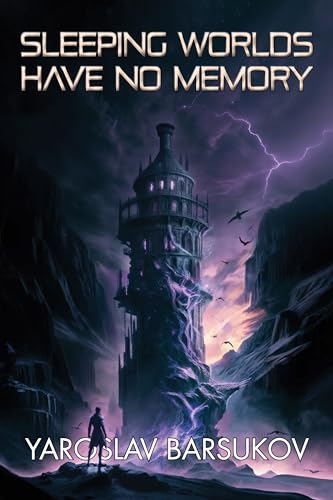
2024 NEBULA FINALISTS: SLEEPING WORLDS HAVE NO MEMORY, thought-provoking story with a hopeful twist
SLEEPING WORLDS HAVE NO MEMORY
YAROSLAV BARSUKOV
CAEZIK SF & Fantasy (non-affiliate Amazon link)
$4.99 Kindle edition, available tomorrow
Rating: 4.75* of five
FINALIST for the 2024 Nebula Award! Winner announced at the 2025 Nebula Conference, 5 through 8 June 2025.
The Publisher Says: When lies become truths and two kingdoms head to a bloody war, a man is exiled for his conscience
Refusing the queen’s order to gas a crowd of protesters, Minister Shea Ashcroft is banished to the border to oversee construction of the biggest defensive tower in history. However, the use of advanced technology taken from refugees makes the tower volatile and dangerous, becoming a threat to local interests. Shea has no choice but to fight the local hierarchy to ensure the construction succeeds—and to reclaim his own life.
Surviving an assassination attempt, Shea confronts his inner demons, encounters an ancient legend, and discovers a portal to a dead world—all the while struggling to stay true to his own principles and maintain his sanity. Fighting memories and hallucinations, he starts to question everything...
Sleeping Worlds Have No Memory is a thought-provoking meditation on the fragility of the human condition, our beliefs, the manipulation of propaganda for political gains, and our ability to distinguish the real from the unreal and willingness to accept convenient “truths.” The novel is a compelling exploration of memory, its fragile nature, and its profound impact on our perception of identity, relationships, and facts themselves.
A unique blend of science fiction, fantasy and noir, with zeitgeist and prophetic qualities (the original novella anticipated the Russo-Ukrainian War), this is a must for fans of China Miéville’s Bas-Lag series, Ted Chiang’s Tower of Babylon, and Robert Silverberg’s Tower of Glass.
I RECEIVED A DRC FROM THE PUBLISHER VIA NETGALLEY. THANK YOU.
My Review: We can use some entertainment. We can use a bit of moral instruction, it seems. Author Barsukov said these things to himself, at least in my reconstruction of the thought process that led to this book, and decided that he'd make a world and a man to resist its slide into darkness.
I found this book very inspiring. I'm inspired to bring it to y'all's attention because of this piece from The Guardian, "'It will renew your faith in humanity': books to bring comfort in dark times":
A surprising number of readers believe a happy ending should mean automatic disqualification from any serious literary award. Good luck to them: I wish them joy in their wallowing. In my turn, I’ve come to believe the opposite. To reach only for novels that reaffirm our darkest fears is merely to make an escape of a different sort, not the escapism of brooding heroes and wedding finales, but the security blanket of an equally foregone conclusion: the safety of imagining the worst. I would argue that to live only in that place is simply cowardice in better camouflage. The truth is that it’s far riskier to remain in uncertainty. Far braver, far more radical to keep hoping.The truth of this is in Shea's dogged determination to do what's Right; it's in his determination's effect on engineer Brielle, whose expertise is central in what their shared need to do what's Right creates.
There's a lot of the epic fantasy ethos in this urban-fantasy story, sans the usual military glorification; but there is a very welcome leavening of SF in the story that prevents me from the usual somnolent, glazed-eyed scanning to get to the ending. I was alert and involved as Brielle's skills were deployed to create the tower that Shea's tasked with defending, to little avail:
The tower took the length of the world—only it was an alien world, replicating itself over and over as it climbed to a distant, ghostly gap into the clouds. Or did he stare down a well? Shea's head spun again as up and down flip-flopped like axes on a gyroscope.Does this dimensionally daft structure need defending? Does this technology need help, or resistance to its implications? Can anyone, still less a proven-murderous tyrant, be trusted with a tool/weapon of this magnitude? Are the Others, the aliens, to be trusted, or are they there to treat Shea and his people as the Others...with the usual result?
Ethical questions, existential ones, that resonate clearly with our post-November 6th world. They aren't easy, or easily solved ones; Author Barsukov doesn't pretend his ending is a solution to them all. There aren't any escape routes from the consequences of greed and lust for power provided. There are stern meditations on what we try to use, though:
What makes guilt so grotesque is the fact that it adorns itself with whatever remains of our righteousness.
And so the sadness of life as a moral actor, as a being with agency and puissance outreaching the lessons of their past, is revealed and refined. The story, an expansion of his 2021 novella Tower of Mud and Straw, reminded me more and more of THE DEEP SEA DIVER'S SYNDROME (qv) which French translation also delves into the intersection between dreamlike states and meatspace with equal care. Does anyone really know what the Tower is/can do? Do their...reveries, memories, dreamlike experiences...come without cost yet replete with warning signs?
An ending that addresses these queries of reality yet doesn't wrap them in a tight, constricting little bow gave me both inspiration and information to examine this moment in which I am deeply unhappy, afraid, and emotionally bereft, with a dose of hope. There is a reason Author Barsukov chose this particular stream-of-consciousness style, and this superposed urban-fantasy/SF genre mashup, to tell you this story. Intrinsic to the story, the way everything meshes...and the things that don't...are all made to present a frame for a very intensely resonant meditation.
There is not a lot more valuable for a story to give as its gift than that.
Monday, January 22, 2024
MEMES TO MOVEMENTS: How the World's Most Viral Media Is Changing Social Protest and Power, slightly dated but very trenchant
MEMES TO MOVEMENTS: How the World's Most Viral Media Is Changing Social Protest and Power
AN XIAO MINA
Beacon Press
$24.95 hardcover, available now
Rating: 4* of five
The Publisher Says: A global exploration of internet memes as agents of pop culture, politics, protest, and propaganda on- and offline, and how they will save or destroy us all.
Memes are the street art of the social web. Using social media-driven movements as her guide, technologist and digital media scholar An Xiao Mina unpacks the mechanics of memes and how they operate to reinforce, amplify, and shape today's politics. She finds that the "silly" stuff of meme culture—the photo remixes, the selfies, the YouTube songs, and the pun-tastic hashtags—are fundamentally intertwined with how we find and affirm one another, direct attention to human rights and social justice issues, build narratives, and make culture. Mina finds parallels, for example, between a photo of Black Lives Matter protestors in Ferguson, Missouri, raising their hands in a gesture of resistance and one from eight thousand miles away, in Hong Kong, of Umbrella Movement activists raising yellow umbrellas as they fight for voting rights. She shows how a viral video of then presidential nominee Donald Trump laid the groundwork for pink pussyhats, a meme come to life as the widely recognized symbol for the international Women's March.
Crucially, Mina reveals how, in parts of the world where public dissent is downright dangerous, memes can belie contentious political opinions that would incur drastic consequences if expressed outright. Activists in China evade censorship by critiquing their government with grass mud horse pictures online. Meanwhile, governments and hate groups are also beginning to utilize memes to spread propaganda, xenophobia, and misinformation. Botnets and state-sponsored agents spread them to confuse and distract internet communities. On the long, winding road from innocuous cat photos, internet memes have become a central practice for political contention and civic engagement.
Memes to Movements unveils the transformative power of memes, for better and for worse. At a time when our movements are growing more complex and open-ended—when governments are learning to wield the internet as effectively as protestors—Mina brings a fresh and sharply innovative take to the media discourse.
I RECEIVED A DRC FROM THE PUBLISHER VIA EDELWEISS+. THANK YOU.
My Review: Definition of a meme, via Wikipedia:
A meme (/miːm/; MEEM) is an idea, behavior, or style that spreads by means of imitation from person to person within a culture and often carries symbolic meaning representing a particular phenomenon or theme.[4] A meme acts as a unit for carrying cultural ideas, symbols, or practices, that can be transmitted from one mind to another through writing, speech, gestures, rituals, or other imitable phenomena with a mimicked theme.Which has given rise to the Internet meme, again via Wikipedia:
An Internet meme, or simply meme (/miːm/, MEEM), is a cultural item (such as an idea, behavior, or style) that is spread via the Internet, often through social media platforms. Internet memes can take various forms, such as images, videos, GIFs, and various other viral sensations. Characteristics of memes include their susceptibility to parody, their use of intertextuality, their propagation in a viral pattern, and their evolution over time.I doubt a lot of my readers are unfamiliar with the concept of a meme, in its initial formulatiion by Richard Dawkins, or in its new sense from the internet. It pays not to be caught out by omitting the definitions, partial though they may be. There will always be someone who wants to invalidate any information that offers context for judging modern information culture.
The meme machine is decades old at this point, and a book six years old is going to miss some modern context...the internet moves very fast and seldom stays in one lane even when it isn't moving at top speed. That is clear, and undeniable, but it in no way invalidates the author's thesis that the internet and social media have a large, possibly growing, influence on how much and what kind of attention we pay to different cultural memes on the internet as well as in real life. There are examples of internet-inspired real life actions, eg The Arab Springs of the teens, so her thesis is that governments began to use countermemes to spread doubt, dissension, and overwhelmed apathy among internet users. The hashtag culture that looks for its own people via searching hashtags on Twitter (still refuse to call it X), and the multivarious pretenders to its throne, to find those whose views align with their own, and whose voices they wish to amplify by reposting or remixing their memes, has proven distractable and cooptable. This was at an earlier phase when the author was writing the book, and thus gets comparatively little play. I would have been more satisfied had there been illustrative memes in the text, but it had, I feel sure, pragmatic reasons like copyright clearances and the sheer exposure to malicious actors challenging the book. In other words, a species of the self-censorship the author discusses, as a consequence of state-sponsored botfarms etc. etc. that act in search of diluting messages they do not like.
That being more of a reason for the publisher to bring out a second edition, one including climate denial in its evolving, still spreading, form, than for you to skip reading it. I encourage you to get your eyes on the author's trenchant, intelligent analysis of the intersection between meme culture and personal resistance to oppression and totalitarian ambitions and actions.
Monday, January 15, 2024
JOHN LEWIS: In Search of the Beloved Community, a "Citty Upon a Hill" longed from since the time of Winthrop
JOHN LEWIS: In Search of the Beloved Community
RAYMOND ARSENAULT
Yale University Press
$35.00 hardcover, available tomorrow
Rating: 5* of five
The Publisher Says: The first full-length biography of civil rights hero and congressman John Lewis
For six decades John Robert Lewis (1940–2020) was a towering figure in the U.S. struggle for civil rights. As an activist and progressive congressman, he was renowned for his unshakable integrity, indomitable courage, and determination to get into “good trouble.”
In this first book-length biography of Lewis, Raymond Arsenault traces Lewis’s upbringing in rural Alabama, his activism as a Freedom Rider and leader of the Student Nonviolent Coordinating Committee, his championing of voting rights and anti-poverty initiatives, and his decades of service as the “conscience of Congress.”
Both in the streets and in Congress, Lewis promoted a philosophy of nonviolence to bring about change. He helped the Reverend Martin Luther King Jr. and other civil rights leaders plan the 1963 March on Washington, where he spoke at the Lincoln Memorial. Lewis’s activism led to repeated arrests and beatings, most notably when he suffered a skull fracture in Selma, Alabama, during the 1965 police attack later known as Bloody Sunday. He was instrumental in the passage of the Voting Rights Act of 1965, and in Congress he advocated for racial and economic justice, immigration reform, LGBTQ rights, and national health care.
Arsenault recounts Lewis’s lifetime of work toward one overarching realizing the “beloved community,” an ideal society based in equity and inclusion. Lewis never wavered in this pursuit, and even in death his influence endures, inspiring mobilization and resistance in the fight for social justice.
I RECEIVED A DRC FROM THE PUBLISHER VIA NETGALLEY. THANK YOU.
My Review: Almost six hundred pages. That is a lot of reading time. It is also, peculiarly enough, less than I would have liked it to be because the life of Representative Lewis took place in such interesting times, and among such towering figures of US history, that I would gladly have read more.
Most all my readers know I am a committed atheist, and either know or can guess why. It is people like John Lewis, who used their christian beliefs to leave the world a better, more equitable place for as many as he could advocate for, that make me especially bitter about the sleazy rotten souled creeps who embody my idea of christians and christianity. Lewis was such a committed christian that he, the victim of a violent attack by a racist who later regretted his actions and sought forgiveness from Lewis, referred to the man as his brother in a television appearance they made together. This is a prime example of what a friend of Lewis’s called his "moral jujitsu," a means of wrong-footing the hate-spewing opponents who confidently expected him to return fire.
Author Arsenault sites Lewis in his historical milieu with thorough, fully attributed research. He has relied on personal sources who knew him. Thus they, who were there, can give him the real flavor of a Jim Crow rural Alabama upbringing, one filled with the ritual humiliations and deprivations so beloved of our scumbag brethren the white nationalists. While this did radicalize young Lewis, his christian beliefs channeled his radicalism into a serach for justice, fairness, equitability, and all achieved without the rage and hate that marked his opponents. Admirable to me, and to generations of voters who returned him to Congress for much of his adult life.
His skills as a politician were honed in the arena of the Student Nonviolent Coordinating Committee, which he was instrumental in forming and from whom he broke away after they began calling for "Black Power," which he saw as provocative and counterproductive with its inherent message of conflict. Lewis opposed the simple reductive sloganeering of the Civil Rights Movement in its post-MLK era. This was, after all, one of the folk who thought they would be murdered in public on Bloody Sunday, in a protest on a bridge now named after him.
What that pointed to was a fact that I, no scholar of Representative Lewis’s life and career, had never known or even considered: John Lewis was not uniformly admired among his colleagues because he favored the cause of human rights over narrowly construed civil rights. He was, for example, taken to task for his vocal opposition to the confirmation of the Supreme Court’s first Black justice, Clarence Thomas...and how right he was about that! He was also a QUILTBAG ally in a community that does not, as a rule, support gay rights...at least not publicly. He very much did, and also supported the ongoing Jewish struggle against antisemitism.
John Lewis emerges from this telling of his life’s story as a man of high principles and powerful moral certainty. It did not make him universally loved, in fact made him a figure of hatred for many, but it gave him the grace of convictions not merely held, but lived. I hope you will spend some hours with John Lewis’s spirit by reading Author Arsennault’s wonderful telling of it. There are illustrative images in the text that enrich the older reader’s memory of the times he helped shape. It is a life worth knowing more about lived in times we still feel reverberations of...though not as positive a feedback as I myownself would prefer.
Monday, December 18, 2023
MORTAL REPUBLIC: How Rome Fell into Tyranny, using History to explain the present pretty convincingly
MORTAL REPUBLIC: How Rome Fell into Tyranny
EDWARD J. WATTS
Basic Books
$18.99 trade paper, available now
Rating: 4* of five
The Publisher Says: Learn why the Roman Republic collapsed—and how it could have continued to thrive—with this insightful history from an award-winning author.
In Mortal Republic, prize-winning historian Edward J. Watts offers a new history of the fall of the Roman Republic that explains why Rome exchanged freedom for autocracy. For centuries, even as Rome grew into the Mediterranean’s premier military and political power, its governing institutions, parliamentary rules, and political customs successfully fostered negotiation and compromise.
By the 130s BC, however, Rome’s leaders increasingly used these same tools to cynically pursue individual gain and obstruct their opponents. As the center decayed and dysfunction grew, arguments between politicians gave way to political violence in the streets. The stage was set for destructive civil wars—and ultimately the imperial reign of Augustus.
The death of Rome’s Republic was not inevitable. In Mortal Republic, Watts shows it died because it was allowed to, from thousands of small wounds inflicted by Romans who assumed that it would last forever.
I RECEIVED A DRC FROM THE PUBLISHER VIA NETGALLEY. THANK YOU.
My Review: The Mary Beard School of Skepticism About Past as Prologue is in session.
The past is no Oracle and historians are not prophets, but this does not mean that it is wrong to look to antiquity for help understanding the present.This is intensely controversial. I am not at all sure it is true, but after reading this thoroughly researched and well sourced in the facts that we can know book, I'll put a pin in my inclination to doubt. I can enjoy this book on its factual merits quite well enough.
The author focuses his attention on the period between the victory of the Romans over Carthage in the Second Punic War, and Octavian's usurpation of power, effectively beginning the Empire. That time, its unrest and gradual normalization of political gridlock and, ultimately, violence, does bear a resemblance to the current pass in US–and world–politics.
I have no kick with that fact being pointed out. I am pretty confident the author's analysis of what led up to the events, and how what went down made the resolution of the problems seem pretty obvious. The way he has used the chapter order is, pretty clearly, tendentious...a downward slide from functioning, if troubled republic into one-man rule and autocracy just *feels* more and more inevitable as the facts we know are marshaled.
Where I go a little off his carefully laid rails is where he posits his ideas for how the slide was not inevitable, and the autocracy could've been avoided. That is allohistory which, by itself, is fine by me. But this is presented with a very authoritative air, not differentiated from the text based on facts that surrounds it, and that felt a bit like I was being led to agree without any facts or evidence that his conclusions were plausible. There can not be any such evidence or facts because that isn't how things *did* play out. I can't say he's wrong for all the same reasons.
The desire to show us how to fix the ugly, scary passage we're going through by using the past as a model makes a lot of sense. It still shouldn't be presented as being the equal of the fact-based narrative around it.
Your history-loving giftee, your anxious old uncle who just knows The End Is Nigh, will lap up this story. The good thing is that, as the facts pile up, the author hands the reader this double-edged aerçu:
No republic is eternal. It lives only as long as its citizens want it.That is hopeful, if you believe there is a chance to warn and arm people against what is occurring; and disheartening, because look what happened to Rome.
The author is of the former opinion, and this book is the case he makes for it.
Subscribe to:
Posts (Atom)