Showing posts with label biography. Show all posts

Friday, April 17, 2026

EMILIO PUCCI: The Astonishing Odyssey of a Fashion Icon, fascinating man's interesting life well told


EMILIO PUCCI: The Astonishing Odyssey of a Fashion Icon
TERENCE WARD and IDANNA PUCCI

St. Martin's Press (non-affiliate Bookshop.org link)
$17.99 ebook, available now

Rating: 4.25* of five

The Publisher Says: The Drama of War and Postwar Italy Through the Life of One of Its Most Celebrated Icons

When people think of fashion designer Emilio Pucci, it is of his bright, swirling colors and easy, freeing fabrics, and everyone from Sophia Loren to Jackie Kennedy donning the eye-catching dresses that personify La Dolce Vita. What few know about Pucci, however, is that before creating his world-famous fashions, he played a critical role in the war against the Nazis, risking his life to smuggle out to the Allies one of the most important documents of World War II.

The authors bring to life Italy’s darkest and brightest days, with the extraordinary Emilio Pucci at its center. Italy at the end of the war was broken, and Florence, which the Pucci family had called home for seven centuries, lay in ruins. Pucci returned home bruised in body and soul, having endured trials that would have broken many, but, like Italy itself, rose from the ashes, and went on to design some of the most exuberant fashion of all time. He helped usher in a new era of creativity in Italy, which again became a mecca of fashion, art, design, film, and more.

A host of supporting characters—including Mussolini’s daughter and Allen Dulles, and, most importantly, the timeless city of Florence and the mythic island of Capri—enrich this compelling narrative that will draw readers of all kinds, from war and history buffs, to fashionistas and fans of espionage thrillers along with the millions of readers who devour books about Italy and her many charms.

I RECEIVED A DRC FROM THE PUBLISHER VIA NETGALLEY. THANK YOU.

My Review
: Born in the Kingdom of Italy midway through World War I, Pucci was in the prime of his life during WWII becoming a flyer in the Royal Italian Air Force; he was an aristocrat, deeply in the circles familiar with Mussolini and was his daughter Edda Ciano's BFF. He was responsible for the Ciano Diaries reaching Allied hands and Edda Ciano escaping the Germans' tender ministrations as the daughter of a traitor to the German cause. (Husband Galeazzo not so much; murdered by the Gestapo.) Pucci was himself tortured by the Gestapo as a follow-on consequence of being involved with Edda and her family. No great revelations were given by him, apparently.

It interested me that Idanna Pucci, his niece, co-created the story told herein. Pucci's daughter Laudomia maintains the Pucci archives; her mother Cristina is still living; how is it neither of them chose to write this fascinating story? It's possible the Idanna Pucci, being their elder, simply had more perspective; and she is an author of four decades' standing and her husband Ward (ten years her junior) slightly less duration at twenty-plus years. The couple have also produced documentaries.

It is clear Pucci deserves this attention because he was always somewhere interesting as world events unfolded. Never central, but frequently spotlighted, as he was after the frankly horrifying 1966 Florentine floods when he was instrumental in getting the US fashion industry as well as the general population to volunteer in the monumental cleanup as well as donate money and material aid. It is no exaggeration to say the assistance provided at his behest changed many Florentine lives.

Pucci's stamp on the pop culture of the 1960s was immense, as well. His color palette and choices of fabrics for his collections were widely emulated. He was well-enough known that my kid-self knew his name. I saw his work knowingly, because Braniff was my mother's preferred airline and their stewardesses (it's what they were called in those days) proudly discussed their suits as designed by Pucci. It accords well with the 1937 Reed College graduate's entire life spent in very classy social life...he designed the Reed College ski team's togs...and reinforces the perception of him as a member of a global elite.

It was a very interesting read that felt less like a biography (despite its chronological organization) than it did a family chat. If I'd been invited to an Easter feast in Palazzo Pucci, this is the kind of knowledge I'd've expected to come away with. Only here it's in depth and extensively footnoted.

Fashionistas, Italian and WWII as well as 1960s culture's history buffs are strongly encouraged to get themselves a copy. I suspect the most disappointment will be felt by the fashionistas, as that genre's devoted readers are not always terribly interested in name-dropping outside their area of fascination. Pucci being who he was, a staid local politician as well as a trendsetting designer, there are many diversions from purely the fashion world. It is, I promise, worth all y'all's time to venture a bit outside the boundaries of subject-matter interest. On all sides of Pucci's fascinating life's activities.

Saturday, February 21, 2026

BERNIE FOR BURLINGTON: The Rise of the People's Politician, not great not bad


BERNIE FOR BURLINGTON: The Rise of the People's Politician
DAN CHIASSON

Alfred A. Knopf (non-affiliate Bookshop.org link)
$14.99 ebook, available now

Rating: a scant 4* of five

The Publisher Says: The story of Bernie Sanders's quixotic but inexorable rise is told by a son of Burlington on a broad and vivid canvas, depicting the shaping of a people's politics, as he tracks a political signal that traveled from the hard-luck neighborhoods, general stores, traditional businesses, and county fairs to the Town Meetings and the ballot boxes of the last century, predicting much of what has happened to our nation writ large since then.

This utterly captivating symphonic story of city, a visionary, and the way our politics changed forever is told through the very specific people of Burlington, beginning with Dan Chiasson's own mall-punk friends of the 1980 in a video that would go viral decades later in 2020, they engaged with the itinerant carpenter turned socialist mayoral candidate, and there in that food court, the seeds of everything that was Bernie were sown. Dan, uniquely placed to bring a deep insider's perspective, knew all the the conservative French-Canadian Catholics whose great grandparents had worked in the mills (his own); the puppeteers and hippies and NYC transplants looking for land and "authenticity" in Vermont; the developers involved in the era's Robert Moses urban-renewal schemes; the corrupt old-school Dems at their table in the local dive; and even Ben and Jerry who became Ben and Jerry's right there in town. They all made up the mosh pit of the Burlington that Bernie captivated, running on the slogan "Burlington is not for sale," to become the modern era’s first socialist mayor, intimate with his constituents across workers, cops, lefties, and the little old ladies who organized their streets; he also boasted a foreign policy, a sudden national profile, and a bullhorn to speak to Ronald Reagan.

In the tradition of J. Anthony Lukas's Common Ground and the documentary films of Frederick Wiseman, this epic of American city life delves into the gossip—and the exhilaration—around Bernie's unlikely rise, as we watch an American place transformed one diner coffee, one neighborhood door-knock at a time.

Full of Sanders himself, reflecting and raging, hitting his themes, forging alliances with all comers, this is a mesmerizing portrait of a politician, a place, and a movement that would change America.

I RECEIVED A DRC FROM THE PUBLISHER VIA NETGALLEY. THANK YOU.

My Review
: Poet and academic Chiasson came of age under Mayor Bernie Sanders' Socialist administration in Burlington, Vermont. It's no surprise that he decided to write Senator Sanders' political biography.

The Bernie Bros were never a thing. The likeliest explanation for the chimera was state-sponsored misinformation campaigns led by an authoritarian polity that supports the current administration taking socially divisive cyberaction to help the 2016 campaign waged by the current president succeed. As is the norm in the US, the main supporters of progressivism are young women and people of color. It's a relief in one way...those trolls were obnoxious...and very sad in another, because so much hate and rage has been sown in young white men so successfully for so long it's hard to see a path back from the ugliness for them.

This story is about one of the few remaining Sixties radicals who stayed true to his vision and who made it a point to live out those principles loudly and publicly. A terrific opposition leader, in other words...but not a person of Presidential timber any more than the current occupant of the White House is. (Albeit I'd take Bernie in that office every damn day over felonious yam.)

I wasn't raised in Burlington, saw none of Bernie's achievements, and was not engaged by the nostalgic-bordering-on-elegiac tone of the read. I'm glad to have a blunt, mouthy, principled person in the Senate, and wish Bernie a long, useful life. I don't think anything in this book altered my overall positive opinion of him, I don't find the book a must-read, but am very glad it's out there. Someday we'll need a reminder there *were* idealists in US politics. As it is now, this feels more like a finger wagged in my face for not getting on board with Bernie. Offered the choice between voting for Harris or Sanders, I'd still vote for Harris.

Monday, December 1, 2025

THE SIX LOVES OF JAMES I, frankly opposing historical homophobia...and queer-identity appropriation


THE SIX LOVES OF JAMES I
GARETH RUSSELL

Atria Books (non-affiliate Bookshop.org link)
$16.99 ebook, available now

A LIBRARY JOURNAL BEST BOOK OF 2025

Rating: 4.75* of five

The Publisher Says: A groundbreaking and insightful exploration of King James I, enigmatic successor to Queen Elizabeth I, from the “meticulous researcher” (The Wall Street Journal) and author of the “enjoyable and readable” (Philippa Gregory, #1 New York Times bestselling author) The Palace.

From the assassination of his father to the explosive political and personal intrigues of his reign, this fresh biography reveals as never before the passions that drove King James I.

Gareth Russell’s “rollicking, gossipy” (Dan Jones, author of The Plantagenets), and scholarly voice invites us into James’s world, revealing a monarch whose reign was defined by both his public power and personal vulnerabilities. For too long, historians have shied away from or condemned the exploration of his sexuality. Now, Russell offers a candid narrative that not only reveals James’s relationships with five prominent men but also challenges the historical standards applied to the examination of royal intimacies.

This biography stands as a significant contribution to the understanding of royal history, illuminating the personal experiences that shaped James’s political decisions and his philosophical views on masculinity and sexuality.

I RECEIVED A DRC FROM THE PUBLISHER VIA EDELWEISS+. THANK YOU.

My Review
: I'm in two minds about this read. I like the writing; I'm open, if not warmly welcoming, to the subject being included among our queer ancestors; but he was still medieval about religious stuff, and was inimical to "witches" among his subjects. (There were not, and are not, witches in the sense these people used the term. Pace, modern wiccans.) It really, really bothers me that Edward Gorey is co-opted to be One of Us, when he explicitly said he was not. (Go read my review.) So James VI and I? I'm not mad at or about the folks who want to say he was gay.

It's evident to me, after reading this book, that his greatest love was George Villiers. It appears to have been reciprocated, as much as we can know these things about people 400 years dead (as of this year). The extant evidence supports the conclusion that this complicated, traumatized, deeply and passionately emotional man was lucky enough to find some people...his wife Anna of Denmark, the aforementioned George...in his lifetime who met him where he was, who offered him the precious gift of companionship. Inasmuch as a royal can experience such a commoner's thing, more especially then when royal power was less trammeled than today.

Author Russell is scrupulous in making you au fait with his sources. He specifically says, on the occasions he makes a logical leap, that this is what he's doing. Where people in the past used the lens of homophobia to "tar" a man's reputation (viz, Frank Barlow's William II) with the stench of sodomy, much more often than not the "charge" was made absent solid evidence, and for some sort of political or ideological reason. As my best example, in this book Esmé Stewart, 1st Duke of Lennox, frequently accounted as James's first love(r), is shown to have been at most a crush, with no evidence pointing to a more intense relationship.

So I'm happy to accept Author Russell's well-founded and -informed conclusions about the rest of the King's emotional life. As the life of a king, as the lives of us all, is mostly spent outside the bedchamber and away from our intimate partner, the pretext of the book must needs fall away as events demand attention depart Mary and George territory. (Excellent show, Nicholas Galitzine {George Villiers} naked is a most enjoyable view to have.)

The reign of the king was bound to be complex. He succeeded the longest-ruling, to that point, monarch of the country; he was the first ruler to have an explicit, publicly acknowledged right to both British thrones; he was in power at the dawn of the modern world with its marvels and mysteries supplanting the certainties of his own world, the one he was raised in. It was a morass of warring interests, as the world has always been; James was not always the best one to make good, for the time and information he could have, decisions.

An unenviable position as monarch of two countries who had been at war for centuries, and whose mother he never met because she was imprisoned and murdered by his predecessor. Fractious nobles, upstart commoners, churchmen jealous of their vanishing prerogatives (this despite or because of his commissioning if the King James Version of the Bible), kidnappings, assassination attempts...this is the "remember, remember, the Fifth of November" king...it's no wonder he was paranoid and prone to act as if people were out to get him. They all too often were. It still left me wishing he would pull his head out of his medieval ass and get with the modern world borning in his care. It's irrational, unfair, and quite pointless, but it shows how very invested Author Russell got me into King James.

In all, a read I enjoyed more than didn't, that I finished in a very good time, and found more reasonable and more honest about its royal subject than the vast majority of the biographies I've read.

Your royal-watcher should get one this Yule. A strong corrective for the ick-factor fall of Andrew Windsor.

Friday, November 7, 2025

WINNING THE EARTHQUAKE How Jeannette Rankin Defied All Odds to Become the First Woman in Congress, recovering the life of a great American


WINNING THE EARTHQUAKE How Jeannette Rankin Defied All Odds to Become the First Woman in Congress
LORISSA RINEHART

St. Martin's Press (non-affiliate Bookshop.org link)
$16.99 ebook, available now

A LIBRARY JOURNAL BEST BOOK OF 2025

Rating: 4.5* of five

The Publisher Says: The first major biography of Jeannette Rankin, a groundbreaking suffragist, activist, and the first American woman to hold federal office.

“Few members of Congress have ever stood more alone while being true to a higher honor and loyalty.” —President John F. Kennedy on Jeannette Rankin

Born on a Montana ranch in 1880, Jeannette Rankin knew how to drive a tractor, ride a horse, make a fire, and read the sky for weather. But most of all, she knew how to talk to people, how to convince them of her vision for America. It was this rare skill that led her, in 1916, to become the first woman ever elected to the House of Representatives.

As her first act, Rankin introduced the legislation that would become the 19th Amendment. Throughout her two terms in 1916 and 1940, she continued to introduce and pass legislation benefitting unions, protecting workers, and increasing aid for children in poverty. In 1941, she stood tall as the sole anti-war voice in Congress during WWII, advocating for pacifism in the face of tragedy and stating that you can no more win a war than you can win an earthquake.

A suffragist, feminist, peace activist, workers' rights advocate, progressive, and Republican, Rankin remained ever true to her beliefs—no matter the price she had to pay personally. Yet, despite the momentous steps she made for women in politics, overcoming the boys club of capitalists and career politicians who never wanted to see a woman in Congress, Jeannette Rankin’s story has been largely forgotten. In Winning the Earthquake, Lorissa Rinehart deftly uncovers the compelling history behind this singular American hero, bringing her story back to life

I RECEIVED A DRC FROM THE PUBLISHER VIA NETGALLEY. THANK YOU.

My Review
: I was aware of Rankin as the lone voice against declaring war in 1941. My 1970s public school education in Austin taught me that fact in seventh grade; nothing positive was ever added to it in any class I ever took on History, on sociology, or any other discipline at any later stage of my education. This book, published fifty years after that initial mention of Rankin's name, is the first comprehensive biography of a very very important voice in US politics in the first half of the twentieth century. This proves a point Author Rinehart makes:
"Nowhere in her education or prolific reading had she learned that in 1848, three hundred women gathered in Seneca Falls to declare their sovereign right to the ballot. Nor had she heard that since then, women in every state of the nation had been fighting for their right to vote. To her even greater amazement, they had won it in Wyoming, Colorado, Utah, and Idaho, all before the turn of the twentieth century. She and all American women seemed to have been purposefully denied knowledge of their own struggle for liberation."
My one cavil with this statement is the modifying presence of "seemed" since there is no better way to stop people from making change than to stop them from knowing about the changes that have already happened. If authoritarians do not want any changes either made again or expanded on, they simply erase the history that shows their way is not the only way from public discourse. Then the few places the awareness of the changes survives can be marginalized and shouted down.

Book banning is step one; book burning step two; reducing literacy overall is the final nail in the coffin the high-control society uses.

I was drawn in by the title of the book. It seemed so off-kilter, so self-evidently contradictory, that I wanted to know where it came from hence my desire to read a book about someone I knew nothing substantive about. It's from one of pacifist Rankin's well-known in her time sayings: "you can no more win a war than you can win an earthquake." Millennia of corroborative evidence has had no appreciable effect on war's prevalence.

I was impressed by the depth of Author Rinehart's scholarship. Her extensive notes and citations were all very enlightening and well-chosen from my layman's point of view. There are widely varying sources cited so this tells me how very much work it was to find all the factual crumbs she did. One major shock, though honestly it shouldn't've been, was that the representative from Montana was elected as a Republican. I'm so steeped in the post-LBJ empire of evil that is the modern GOP that I've lost sight of the entire progressive history of the Republicans. Go read about Robert La Follette and Teddy Roosevelt. Time was these were the progressive leaders, not the soulless evil bastards in the McConnell/Bush/Cheney ilk or the wild-eyed reactionary MAGAts.

How likely is the present base, let alone "leadership", of the party to embrace a pacifist follower of Gandhi, a campaigner for the abolition of the Electoral College, and vehement supporter of unions? Growing up in Montana in the 1880s (when their representatives were called "the gentlemen from Anaconda," the state's largest employer and main economic driver), Rankin recognized the evils of untrammeled capitalism. She emulated Jane Addams in her work for the betterment of ordinary folks. Rankin was, in short, the best kind of radical there is, a radical believer in people and their power to do good...when left to do it.

A role model for today who is finally getting her scholarly due, I hope the sudden awareness of Gen Z that things in the US do not have to be this way will lead some of them to discover this spirit-parent from our country's past.

Monday, August 18, 2025

RED PROPHET: The Punishing Intellectualism of Vine Deloria, Jr., flawed man with interesting ideas


RED PROPHET: The Punishing Intellectualism of Vine Deloria, Jr.
DAVID E. WILKINS

Fulcrum Publishing (non-affiliate Bookshop.org link)
$25.95 trade paper,, $20.99 ebook, available now

Rating: 3.5* of five

The Publisher Says: In the face of looming, tumultuous global change, this examination provides answers for those venturing into Vine’s work in Indigenous and non-Indigenous politics, ecology, and organization. David E. Wilkins’s insights, based on his personal relationship with Deloria, document the sacred life and legacy of “one of the most important religious thinkers of the 20th century, according to TIME.

A must-read for any deep examination of Indigenous legal, religious, social, and philosophical tactics.

I RECEIVED A DRC FROM THE PUBLISHER VIA NETGALLEY. THANK YOU.

My Review
: If we are, as a civilization, going to survive this existential inflection point we find ourselves at in 2025, we need fresh, better ideas.

Vine Deloria, Jr., presents some of the most underdiscussed, freshest contributions to the worldwide discussion of what we as a culture need to do to keep on living. The culture of the West, its capitalism and its greed and its solipsism, have landed us in a rotten mess. The same thinking that got us here will not get us out of here. Maps are handy, but they're limited by the mapmakers' ideas of what needs to be, what should be, included on them. It's time to look beyond the edge of the map.

Vine Deloria, Jr., is called "the Red Prophet"...an yclepture that makes my 1960s-trained self wince a bit...but justified by a family and personal background of Episcopal religious study. The man was son of an Episcopal missionary, and studied to be a missionary in his turn. Like all prophets, he spoke against orthodox thinking. The issue for me as I learned more about him is that he rejected consensus reality as much as any religious nut, eg Ken Ham, does, even claiming Native Americans coexisted with dinosaurs, that white peoples' science is a religion with unquestionable orthodoxies (there is truth in that analysis), and that the conclusions of geologists about the age of the Earth were lies to exploit Native Americans.

There are no full-throated convert's proselytic shouts forthcoming. I'm not going to defend the less acceptable to me parts of the man's thought. I am going to encourage you to do what I did, look into the overall analysis of the systems we in the West have imposed on the planet. Deloria was opposed to extractive industry's utter dominance of the means we all need to live. There are no reward systems for sustainability. It is the way we got into this mess. Equally, Marxism's orthodoxies came in for Deloria's disapproval for its hegemonic tendencies that exclude other ways of understanding the world.

So while this hagiography of a passionate, persuasive person is not The Way, the way leads past, eve through, his head. Many, many are the Native American ideas and reasons and methods that we ignore at our substantial, near-term peril. Don't dismiss them because the messenger was messy. You aren't perfect, I'm not perfect, why should we expect Vine Deloria, Jr., to be perfect? Read, think, take what you can from a thinking person's thoughts.

We're in trouble we haven't seen before. Dare to think thoughts you haven't before, maybe there are solutions not part of your usual thinking in them.

Wednesday, June 18, 2025

CAPTAIN KIDD: A True Story of Treasure and Betrayal, past as prologue?


CAPTAIN KIDD: A True Story of Treasure and Betrayal
SAMUEL MARQUIS

Diversion Books (non-affiliate Bookshop.org link)
$34.99 hardcover, available now

Rating: 4* of five

The Publisher Says: The breakneck adventure of war, romance, politics, and betrayal, where noble gentleman privateer William Kidd becomes a scapegoat, and Crown and crew sink to unfathomable depths to brand him pirate enemy #1.

Captain William Kidd stands as one of the most notorious “pirate” outlaws ever, but his notorious legend is tainted by a bed of lies. Captain Kidd has captivated imaginations for over three hundred years and inspired many stories about pirates, but was he really a criminal? Just how many ships did he plunder, how many men did he force to walk the plank, and how many throats did he slit? Or is the truth more inconvenient, that he was a buccaneer’s worst nightmare, a revered pirate hunter turned fall guy for scheming politicians?

In Captain Kidd, his ninth-great-grandson, writer Samuel Marquis, reveals the real story. Kidd was an English-American privateer and leading New York husband and father, dubbed “trusty and well-beloved” by the King of England himself and described by historians as a “worthy, honest-hearted, steadfast, much-enduring sailor” who was the “victim of a deliberate travesty of justice.” With honors far more esteemed than the menacing Blackbeard or any other sea rover at the turn of the seventeenth century, how can Kidd be considered both gentleman and pirate, both hero and villain?

Marquis’ biography clears the foggy haze of five centuries of legend and British propaganda to illuminate the seafaring adventurer and civic leader. He scrupulously recreates Kidd’s perilous world of explosive naval warfare, the daring integrity he exemplified as a pirate hunter, and the political scandal that entangled Kidd in British-American history, rocking the New World and the Old and threatening England’s valuable trade with India.

Captain Kidd is both thrilling and tragic. Behind the legend is a real man woven into the tapestry of early America, rendering him a unique colonial hero and scapegoat, whose life story was fascinating, exciting, bizarre, and heartrending.

I RECEIVED A DRC FROM THE PUBLISHER VIA NETGALLEY. THANK YOU.

My Review
: From "privateer" (government-endorsed pirate) to "pirate" (privateer who pissed someone powerful off), Captain Kidd really comes alive in his ninth(!)-great-grandson's retelling of his biography. It's quite a tale indeed. Even sticking to well-attested facts in court records and sources of like stature, it reads like a novel.

That is not an indictment of the author's veracity but a comment on his story's narrative flow. The endnotes, hugely extensive, are not included in the ebook. They are redirected to the publisher's website via a link or a QR code, both of which I followed to be sure they went where I expected them to go. I'm mildly disgruntled by this.It is a decision that, I suppose, stems from the publisher's presumption that most people don't give a toss about endnotes, so why not...what? does it cost less to do it this way? is the same thing done in the print book?...anyway, it cost the book a star.

While the horror of what happened to Kidd was in no way acceptable to modern eyes, neither were his actions. A privateer might be commissioned by the government of the day to do damage to others' economic well-being, that kind of mercenary fig-leaf is seen in today's world as dishonest whole and entire. It still happens, especially where official government involvement in an activity would cause major PR problems (as ICE is demonstrating very capably right now), but we can ignore it until someone gets pissed off who has the power to make the one they're mad at suffer the consequences widely spreadable.

Any of this ringing some bells?

Kidd's execution was awful to read about, again because the author's storytelling chops are very much on display. It is amazing how much documentary evidence, anecdotal or not, still exists about Kidd. Author Marquis has, I am morally certain, clapped eyes on every single extant source for this grisly tale. It is a feat that took decades, and determination far greater than the ordinary, to accomplish. That he is a descendant of the man unjustly accused, and hanged—twice!—no doubt turbocharged his natural-to-writers research skills. What made it fun to read was both the subject matter...what little boy, however old he may be, isn't delighted by a pirate story?...and knowing while reading it that the author's telling a true family tale.

Maps, and notes, added to the text and I'd be warbling my fool lungs out about the story. as it is, I/ recommend you procure one if you're a superannuated pirate-loving kid like me, or if your dad/grandpa is, or if you're in the market for a story of government-by-grumpiness story to make today feel a tiny bit less unprecedented.

You might not feel better but knowing it's happened before has much to teach us.

Wednesday, April 23, 2025

THE REBEL ROMANOV: Julie of Saxe-Coburg, the Empress Russia Never Had, not *quite* as advertised but enjoyable


THE REBEL ROMANOV: Julie of Saxe-Coburg, the Empress Russia Never Had
HELEN RAPPAPORT

St. Martin's Press (non-affiliate Amazon link)
$15.99 ebook, available now

Rating: 4* of five

The Publisher Says: From the New York Times bestselling author of The Romanov Sisters comes the story of a courageous young Imperial Grand Duchess who scandalized Europe in search of freedom.

In 1795, Catherine the Great of Russia was in search of a bride for her grandson Constantine, who stood third in line to her throne. In an eerie echo of her own story, Catherine selected an innocent young German princess, Julie of Saxe-Coburg, aunt of the future Queen Victoria. Though Julie had everything a young bride could wish for, she was alone in a court dominated by an aging empress and riven with rivalries, plotting, and gossip―not to mention her brute of a husband, who was tender one moment and violent the next. She longed to leave Russia and her disastrous marriage, but her family in Germany refused to allow her to do so.

Desperate for love, Julie allegedly sought consolation in the arms of others. Finally, Tsar Alexander granted her permission to leave in 1801, even though her husband was now heir to the throne. Rootless in Europe, Julie gave birth to two―possibly three―illegitimate children, all of whom she was forced to give up for adoption. Despite entreaties from Constantine to return and provide an heir, she refused, eventually finding love with her own married physician.

At a time when many royal brides meekly submitted to disastrous marriages, Julie proved to be a woman ahead of her time, sacrificing her reputation and a life of luxury in exchange for the freedom to live as she wished. The Rebel Romanov is the inspiring tale of a bold woman who, until now, has been ignored by history.

I RECEIVED A DRC FROM THE PUBLISHER VIA NETGALLEY. THANK YOU.

My Review
: Why on Earth does Rappaport need the figleaf of "allegedly" in the book description? A very minor figure in Russian history, and invisible outside it...this is barely non-fiction, there's so much reading between the lines...who's going to troll her for "disrespecting" this nonentity?

One big reason she's been ignored by history is she didn't make any. All she did was leave a husband she detested, run off and have adventures all across Europe, and do exactly nothing for anyone not herself. Pretty much the picture-perfect spoiled princess, sort of like "Sissi" only without the heir-bearing.

Why I liked it is it gave me a fascinating glance into a family that ought to be much netter studied: The Saxe-Coburg ducal dynasty, a branch of the Bavarian royals, the Wettins. Shake a royal family tree and a bunch of 'em will fall out. I mean, a branch of 'em is still on the throne of the United Kingdom and another of that of Belgium. Their close cousins used to be rulers of Portugal and Bulgaria. They were the mothers of Romanov tsars, and countless other royals, from the early 18th century onwards.

It's thrown into stark relief that, when reading this book, the long shadow of Napoleon and more generally the upheavals in France from 1789 forward have made a heavy screen against the study and awareness of the rest of Europe's eventful history at this time. Julie's peripatetic life, though little enough noted, did leave some personal traces. These are presented in their context so I got a good grounding in events seen from the not-Napoleon side. Dynastic marriages, border disputes resolved thereby, things about the power politics of the time I hadn't really been aware enough of to know I didn't know about them, all form this story's backdrop.

What this wasn't, however, was a spicy, entertaining, gossipy book about an interesting woman who had the principles to abandon a luxe life. That's what the title suggested I was going to get; it's a good, illuminating history of a time from an angle new to me. It's not juicy or gossipy. Much about this poor woman and her life was simply not worth risking the ire of Imperial Russia to preserve. I suspect this absence of source material is a calculated act by agents of the Romanovs, to disguise the extremely awful way this poor thing was treated by all and sundry in their court, and by her own family to disguise their sale of one of their own into what amounted to slavery (albeit gilded by trappings of wealth) to save their own hold on political power.

A survivor, this lady was; a rebel, not so much based on this story as told here.

Wednesday, March 5, 2025

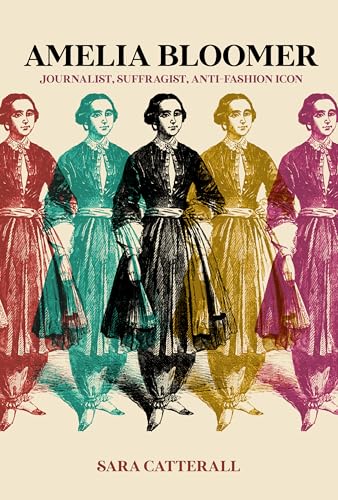
AMELIA BLOOMER: Journalist, Suffragist, Anti-Fashion Icon, a woman of moral certainty and impeccable rectitude who rebelled hard


AMELIA BLOOMER: Journalist, Suffragist, Anti-Fashion Icon
SARA CATTERALL

Belt Publishing (non-affiliate Bookshop.org link)
$11.99 ebook edition, available now

Rating: 5* of five

The Publisher Says: A fascinating look at an underappreciated woman in American history whose newspaper fostered a national conversation on women's issues.

Those who recognize the name Amelia Bloomer usually do so because of bloomers, the clothing item named after her. While she was a rational dress advocate for a time—calling on women to abandon rigid corsets and heavy petticoats and opt for long trousers, shorter skirts, and sensible boots—it was "but an incident" in the larger story of her life and impact.

Bloomer edited and published The Lily, the first newspaper for and by women. Much like Bloomer herself, it started as a temperance rag before broadening to include some of the most important issues to women in that day, including the right to vote, and included contributions from thinkers like Elizabeth Cady Stanton. The groundbreaking paper brought the conversation from Seneca Falls right to the doorsteps of women across the expanding nation.

Guided by a rigid sense of morality and a Puritan work ethic, Bloomer remained open-minded to new ideas. She refused to be swayed by social norms and wrote cutting responses to those who tried to intimidate or shame her and her friends, a group that included Stanton and Susan B. Anthony. This deeply researched biography by Sara Catterall follows the many chapters of her life: her humble upbringing in upstate New York, her role in the temperance movement (and its true legacy as a wellspring of the women's rights movement), her years at The Lily, her groundbreaking position as deputy postmaster in Seneca Falls, her troubled health, and her eventual move to Council Bluffs, Iowa, where she continued to move the needle on women's suffrage in the more flexible new governments of the West.

I RECEIVED A DRC FROM THE PUBLISHER VIA EDELWEISS+. THANK YOU.

My Review
: It had never creased my cranium that Amelia Bloomer was a temperance crusader before I read this book. Given that my mother the abuser never drank, and I had one boyfriend in my life who ever raised a hand to me and that never happened while he was drunk, temperance just did not ever cause me to think "good idea". All my associations with Mrs. Bloomer were around her ideas regarding the idiotic way women were caged inside their clothing during this era. Corsets really are the bound feet of Western culture.

I was utterly unprepared to meet this wildly different Bloomer. She was a woman of her time, in many ways moreso than the more famous ladies like her friends Stanton and Anthony...both of whom she knew from living in Seneca Falls, New York, and each of whom influenced her increasingly radical thinking about women's suffrage...as she was married with children and required to earn her living alongside her husband as best she was able while still raising children. Dexter and she were co-workers, as he hired her to work alongside him as a postmaster after his stint as a Whig-supporting newspaper editor landed him the job. A government salary for a woman no less!

Her position as a temperance crusader led her to make the connection that the only way to stop the unregulated flow of alcohol was to exert political pressure to regulate it. That was impossible, on a practical level, absent votes for women. (She didn't live to see Prohibition and its horrifying unintended consequences.) So her rational dress and votes for women all owe their influence on US culture to her christian temperance-movement work. It was spread wider than Seneca Falls by her opening The Lily, a newspaper for and by women that she, despite raising children, suffering chronic illness, and a complete lack of training except by Dexter's example from his newspaperman days. I am *gobsmacked* by her rigidly moral outlook leading her so far in opposition to the stupid cultural norms of "appropriate" behavior for women in a time where they were so very much more entrenched and enforced than they are now.

At this moment in US, and more broadly Western, political history, the example of a woman who looks at the world as she finds it, judges it harshly for its failings, and—at considerable personal cost to herself and her family—sets about opposing that world continuing down its present path, is invaluable. I'd also like to point out her starchy morality was inspired by an upbringing conventionally religious yet her response to it was radically, vocally, and consistently to apply its moral precepts in full and without exceptions.

If more christians were like Amelia Bloomer, the world would be a better place.

I did indeed just say that. Her acerbic wit, another surprise this book held for me, was deployed against obtuse and obnoxious followers of orthodoxy. Yet Mrs. Bloomer's touch with connecting to people who genuinely did not understand the stakes she saw so clearly in the direction society was heading was exemplary. She met those people on their own ground, without preaching or hectoring. I can only envy that skill; I myownself climb onto my ever-present high horse because I'm Right, that ever-losing strategy. Mrs. Bloomer's tone was always respectful...until she sensed ill-will or disingenuousness.

I knew exactly nothing of the substance of her life until Belt Publishing brought out this book. (I also now know that Dexter Bloomer wrote a biography of her in 1896, so I'll Gutenberg that up here directly.) Author Catterall and her publisher are to be praised, and I hope supported with purchases, for telling this unjustly neglected monadnock of probity and moral clarity's story to a needy new generation of readers. All five stars for bringing modern attention to this person from our past with so much to teach us for our future. It's involving prose, built on solidly shown foundations of information.

Friday, November 8, 2024

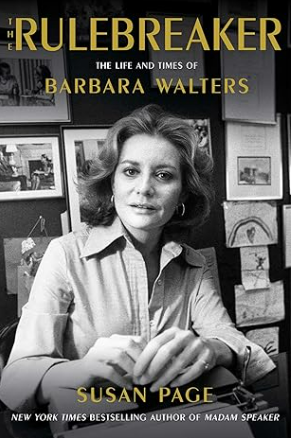
THE RULEBREAKER: The Life and Times of Barbara Walters, clarion call to women everywhere: get out of your own way, we need you


THE RULEBREAKER: The Life and Times of Barbara Walters
SUSAN PAGE

Simon & Schuster
$30.99 hardcover, available now

Rating: 4* of five

The Publisher Says: The definitive biography of the most successful female broadcaster of all time—Barbara Walters—a woman whose personal demons fueled an ambition that broke all the rules and finally gave women a permanent place on the air, written by bestselling author Susan Page.

Barbara Walters was a force from the time TV was exploding on the American scene in the 1960s to its waning dominance in a new world of competition from streaming services and social media half a century later. She was not just a groundbreaker for women (Oprah announced when she was seventeen that she wanted to be Barbara Walters), but also expanded the big TV interview and then dominated the genre. By the end of her career, she had interviewed more of the famous and infamous, from presidents to movie stars to criminals to despots, than any other journalist in history. Then at sixty-seven, past the age many female broadcasters found themselves involuntarily retired, she pioneered a new form of talk TV called The View. She is on the short list of those who have left the biggest imprints on television news and on our culture, male or female. So, who was the woman behind the legacy?

In The Rulebreaker, Susan Page conducts 150 interviews and extensive archival research to discover that Walters was driven to keep herself and her family afloat after her mercurial and famous impresario father attempted suicide. But she never lost the fear of an impending catastrophe, which is what led her to ask for things no woman had ever asked for before, to ignore the rules of misogynistic culture, to outcompete her most ferocious competitors, and to protect her complicated marriages and love life from scrutiny.

Page breaks news on every front—from the daring things Walters did to become the woman who reinvented the TV interview to the secrets she kept until her death. This is the eye-opening account of the woman who knew she had to break all the rules so she could break all the rules about what viewers deserved to know.

I RECEIVED A DRC FROM THE PUBLISHER VIA NETGALLEY. THANK YOU.

My Review
: Fighting misogyny, antisemitism, and the apathy of the public was one helluva training ground for becoming a powerful presence on the US cultural map. Her drive, and her zeal for journalism as a contact sport, were unprecedented in the pop culture of the 1960s. Her success was fueled by huge ambition...she would not fail in her duty to her chosen calling, like her father had done, and she would use every ounce of her will to make things happen her way.

These qualities are, annoyingly, still considered male. She out-manned the majority of men, then, and did it in a skirt and heels. It seems to me it's time to put down the bludgeon this kind of thinking represents to knock women back into antique roles that make "men" (boys, really) feel comfortable. Walters was a power in politics, a power in entertainment, and used her power to influence people to think. Even her celebrity interviews were impactful, raising or restoring some to new or renewed influence. She didn't lie to the people, she asked honest questions, and she never showed up unprepared.

The main thing I think made her a legend was her careful control...of herself, of her material, of her image. She didn't love Gilda Radner's SNL character "Baba Wawa" yet, when sending a condolence note to Radner's widower, she signed it "Baba Wawa"...and made sure this fact was known. Careful image curation is not the sole province of today's influencers. Her clarity of thought when she was at her peak was unrivaled. Even in later years her ability to present questions her audience would really like the answers to made her a popular figure on the cultural landscape.

Like all driven people, she left damage in her wake. She was rubbish as a mother, shouldn't've adopted a child; she was not a good wife, or a good partner, but there's no one to blame for that except societal expectations. No one ever whinges about the failings and failures of famous men in those regards. She was a force of nature. Those people are hurricanes, tornados, epic tsunamis. They aren't domesticated or domesticatable.

I suspect I'd've disliked the woman had I ever met her. She comes across in these interviews and the author's analysis as the kind of self-absorbed person who ignores you unless you're immediately useful. I dislike and mistrust those people. I can admire what she did without having warm personal feelings for her. Trailblazers and groundbreakers burn and break; it's in the epithets. Comfortable friends? Not likely. Powerful allies? Yes indeed, and that's enough! Adjusting expectations to match what's really there, what's on actual offer, is a key skill in the life of a person who sees a need for change and sets out to effect it.

Read this careful, honest, thorough story of one remarkable woman's life to feel inspired yourself. Gift it to your girlchild who is nosy, noisy, and obstreperous, that she may channel her talents into service. We need women to ask questions and require answers to them just like Barbara Walters did. We need women to confront idiots and show them up as idiots just like Barbara Walters did. Showing your girlchildren that it's been done, and done well, is a great way to get them to do the same.

Who knows who they'll end up photographed next to, or whose highlight reel they'll be responsible for, or whose foolishness they'll expose to end it? Barbara Walters had pages and pages and pages of evidence she had made a difference before she died. An ambition to be like her isn't a bad thing to ignite in young women.

Friday, September 20, 2024

STRAIGHT ACTING: The Hidden Queer Lives of William Shakespeare, needed corrective to heteronormativity


STRAIGHT ACTING: The Hidden Queer Lives of William Shakespeare
WILL TOSH

Seal Press
$32.00 hardcover, available now

Rating: 4.5* of five

The Publisher Says: A dazzling portrait of Shakespeare as a young artist, revealing how his rich and complex queer life informed the plays and poems we treasure today

“Was Shakespeare gay?” For years the question has sent experts and fans into a tailspin of confusion. But as scholar Will Tosh argues, this debate misses the sex, intimacy, and identity in Elizabethan England were infinitely more complex—and queer—than we have been taught.

In this incisive biography, Tosh reveals William Shakespeare as a queer artist who drew on his society’s nuanced understanding of gender and sexuality to create some of English literature’s richest works. During Shakespeare’s time, same-sex desire was repressed and punished by the Church and state, but it was also articulated and sustained by institutions across England. Moving through the queer spaces of Shakespeare’s life—his Stratford schoolroom, smoky London taverns and playhouses, the royal court—Tosh shows how strongly Shakespeare’s early work was influenced by the queer culture of the time, much of it totally integrated into mainstream society. He also uncovers the surprising reason why Shakespeare veered away from his early work’s gender-bending homoeroticism.

Offering a subversive sketch of Elizabethan England, Straight Acting uncovers Shakespeare as one of history’s great queer artists and completely reshapes the way we understand the Bard’s life and times.

I RECEIVED A DRC FROM THE PUBLISHER VIA NETGALLEY. THANK YOU.

My Review
: Whaaat?! You mean there's credible evidence that heteronormative readings of the Bard aren't the whole picture?! Well, I never! Next you'll tell me that William Rufus and Richard Lion-Heart *were* big ol' 'mos!

Folks...men brought Juliet, Portia, Lady Macbeth, Desdemona, et alii to life. Not because they were second best choices, or because this is boarding school and that's all there is, but because they brought these female roles vibrantly and intensely, convincingly and alluringly, to life. Actors were out in drag, making people believe, and lust for, the females Shakespeare knew as he was writing them would be played by males. He most likely had an image of who he wanted for each role. He was a man of the theatre, a playwright and actor, it would be weird if he had not.

That means...wait for it...he knew what made a man beautiful, and chose ones he knew could evoke the many, complicated responses his characters do from an audience. Including lust.

Time to stop the disingenuous "there was no such thing as gayness in Shakespeare's time! And look at all those sodomy laws! No homo, bro!" True, the entire QUILTBAG spectrum was not conceptualized then.

Because there was no need. Not like y'all heteronormative people think. There was no need in the culture to label things that didn't affect you, weren't relevant to your life. The Church was the self-appointed bedroom behavior regulator; sex lives of strangers was their job to judge and police, not some random dude on the street. This was the time of "don't make me notice you and I won't be forced to call in the law." That law, civil or religious, was Draconian. The denouncements of sodomites from the pulpit, in that god-ridden age, was as good as the Police Gazette in eighteenth and nineteenth century England was at getting the word out on who was a sodomite. But given how many men and women get up to a spot of sodomy (about 46% per good ol' Alfred Kinsey in his as-yet-unmatched surveys) we can feel sure it was the loudest, loosest, and least able (or willing) to pass by being quiet who make up the extensive case evidence in court archives the world over.

Shakespeare, operating in a world I'd call a straight guy's paradise aka the theatre, wouldn't have been much attended to as to his personal life. Married with children, no reason would've been found...unlike with Marlowe, who was aggressively Other in a time where conformity was more rigidly enforced on the surface than it is even now. His obscene plays, though no patch on PG-13 films today, his louche life of spying and, there's credible evidence to suggest, bonking the boys, all while knowingly on the radar of the Queen's secret police, was the index case for how to get yourself in bad trouble. There's a cautionary tale in Deptford. No such tale exists in our hero's life. He was rather shockingly absent from public records. He never appeared before a judge, he wasn't going to make waves...that family in Stratford needed supporting, even though he wasn't going to be there in the flesh. After all, even Will's "rival poet" Richard Barnfield, known to be author of a very explicitly homoerotic poem that he was later, when under fire from Authority for its naughtiness, glad enough to disavow, had asked for it by being indiscreet. Examples of consequences make it easy to justify internally toeing the line.

Using the technique of writing short fictional vignettes at the beginning of each chapter that set the scene for the reader will turn some off hard. I appreciated it because it wasn't presented as facts of Shakespeare's life. Still, as noted, we can't know if any of the things in those vignettes are realities Shakespeare would've experienced. As with all people long dead, we will never be possessed of certainty about his nature, his feelings, his thoughts and prayers.

This fact does not stop the heteronormies from saying, "see? see? he couldn't have been queer!"; as always, ignoring the giant flaw in their reasoning: Absence of evidence isn't evidence of absence.

Was he, wasn't he, will we ever know ye , Will?

Nope. And that's okay. It's got to be. There can never be a fully known person of his five-hundred-years-gone era. The evidence for his bisexuality and attraction to other men is all over his work. But it can never be proof, either to the heteronormies or the queering crowd.

Enjoy this excavation of sex, sexual identity, and societal accommodation of gender and sexual minorities in Shakespeare's time, and then think your own thoughts about him. He certainly won't care.

Monday, January 15, 2024

JOHN LEWIS: In Search of the Beloved Community, a "Citty Upon a Hill" longed from since the time of Winthrop


JOHN LEWIS: In Search of the Beloved Community
RAYMOND ARSENAULT

Yale University Press
$35.00 hardcover, available tomorrow

Rating: 5* of five

The Publisher Says: The first full-length biography of civil rights hero and congressman John Lewis

For six decades John Robert Lewis (1940–2020) was a towering figure in the U.S. struggle for civil rights. As an activist and progressive congressman, he was renowned for his unshakable integrity, indomitable courage, and determination to get into “good trouble.”

In this first book-length biography of Lewis, Raymond Arsenault traces Lewis’s upbringing in rural Alabama, his activism as a Freedom Rider and leader of the Student Nonviolent Coordinating Committee, his championing of voting rights and anti-poverty initiatives, and his decades of service as the “conscience of Congress.”

Both in the streets and in Congress, Lewis promoted a philosophy of nonviolence to bring about change. He helped the Reverend Martin Luther King Jr. and other civil rights leaders plan the 1963 March on Washington, where he spoke at the Lincoln Memorial. Lewis’s activism led to repeated arrests and beatings, most notably when he suffered a skull fracture in Selma, Alabama, during the 1965 police attack later known as Bloody Sunday. He was instrumental in the passage of the Voting Rights Act of 1965, and in Congress he advocated for racial and economic justice, immigration reform, LGBTQ rights, and national health care.

Arsenault recounts Lewis’s lifetime of work toward one overarching realizing the “beloved community,” an ideal society based in equity and inclusion. Lewis never wavered in this pursuit, and even in death his influence endures, inspiring mobilization and resistance in the fight for social justice.

I RECEIVED A DRC FROM THE PUBLISHER VIA NETGALLEY. THANK YOU.

My Review
: Almost six hundred pages. That is a lot of reading time. It is also, peculiarly enough, less than I would have liked it to be because the life of Representative Lewis took place in such interesting times, and among such towering figures of US history, that I would gladly have read more.

Most all my readers know I am a committed atheist, and either know or can guess why. It is people like John Lewis, who used their christian beliefs to leave the world a better, more equitable place for as many as he could advocate for, that make me especially bitter about the sleazy rotten souled creeps who embody my idea of christians and christianity. Lewis was such a committed christian that he, the victim of a violent attack by a racist who later regretted his actions and sought forgiveness from Lewis, referred to the man as his brother in a television appearance they made together. This is a prime example of what a friend of Lewis’s called his "moral jujitsu," a means of wrong-footing the hate-spewing opponents who confidently expected him to return fire.

Author Arsenault sites Lewis in his historical milieu with thorough, fully attributed research. He has relied on personal sources who knew him. Thus they, who were there, can give him the real flavor of a Jim Crow rural Alabama upbringing, one filled with the ritual humiliations and deprivations so beloved of our scumbag brethren the white nationalists. While this did radicalize young Lewis, his christian beliefs channeled his radicalism into a serach for justice, fairness, equitability, and all achieved without the rage and hate that marked his opponents. Admirable to me, and to generations of voters who returned him to Congress for much of his adult life.

His skills as a politician were honed in the arena of the Student Nonviolent Coordinating Committee, which he was instrumental in forming and from whom he broke away after they began calling for "Black Power," which he saw as provocative and counterproductive with its inherent message of conflict. Lewis opposed the simple reductive sloganeering of the Civil Rights Movement in its post-MLK era. This was, after all, one of the folk who thought they would be murdered in public on Bloody Sunday, in a protest on a bridge now named after him.

What that pointed to was a fact that I, no scholar of Representative Lewis’s life and career, had never known or even considered: John Lewis was not uniformly admired among his colleagues because he favored the cause of human rights over narrowly construed civil rights. He was, for example, taken to task for his vocal opposition to the confirmation of the Supreme Court’s first Black justice, Clarence Thomas...and how right he was about that! He was also a QUILTBAG ally in a community that does not, as a rule, support gay rights...at least not publicly. He very much did, and also supported the ongoing Jewish struggle against antisemitism.

John Lewis emerges from this telling of his life’s story as a man of high principles and powerful moral certainty. It did not make him universally loved, in fact made him a figure of hatred for many, but it gave him the grace of convictions not merely held, but lived. I hope you will spend some hours with John Lewis’s spirit by reading Author Arsennault’s wonderful telling of it. There are illustrative images in the text that enrich the older reader’s memory of the times he helped shape. It is a life worth knowing more about lived in times we still feel reverberations of...though not as positive a feedback as I myownself would prefer.

Friday, September 15, 2023

LARRY McMURTRY: A LIFE, and what a life it was!


LARRY McMURTRY: A LIFE
TRACY DAUGHERTY

St. Martin's Press
$35.00 hardcover, available now

Rating: 4* of five

The Publisher Says: A biography of the late Pulitzer Prize-winning American novelist and screenwriter Larry McMurtry from New York Times bestselling author Tracy Daugherty.

In over forty books, in a career that spanned over sixty years, Larry McMurtry staked his claim as a superior chronicler of the American West, and as the Great Plains’ keenest witness since Willa Cather and Wallace Stegner. Larry McMurtry: A Life traces his origins as one of the last American writers who had direct contact with this country’s pioneer traditions. It follows his astonishing career as bestselling novelist, Pulitzer-Prize winner, author of the beloved Lonesome Dove, Academy-Award winning screenwriter, public intellectual, and passionate bookseller. A sweeping and insightful look at a versatile, one-of-a-kind American writer, this book is a must-read for every Larry McMurtry fan.

I RECEIVED A DRC FROM THE PUBLISHER VIA NETGALLEY. THANK YOU.

My Review
: First, I want to salute Tracy Daugherty, fellow Texan and indefatigable researcher. This is a thoroughly sourced book withe compendious endnotes hyperlinked in the DRC I read. Some things didn't really need so much sourcing, being opinions of interviewees, but too much beats too little all hollow in non-fiction. More especially in the notes because reading them is entirely optional. I do it because I'm a fussbudget. I don't often comment about it either way, but here it's appropriate...a William Zinsser opinion from The American Scholar Magazine impressed me by being so niche a quote and being checkably sourced, I felt compelled to bring it up.

Then, I want to diss Larry McMurtry, petulant whiny adolescent of great age. No matter where he was, he was dissatisfied by it; no matter who he knew, he critiqued them with a flensing-knife of an eye; yest his curmudgeonliness gave the world some impressive art and a lot of filler. He had honesty enough to know it, though, that's a saving grace.

He was an inveterate lover of women. Married or not, he was always glad to meet another lady...with predictable results for the existing relationship...but he wasn't always sexually involved with them. He really just loved women as beings. His writing partner was Diana Ossana, and their closeness created a collaboration that made Annie Proulx's story "Brokeback Mountain" into a delight of a screenplay (one well worth reading on its own). He was friends with Merry Prankster and fellow novelist Ken Kesey, whose widow Faye he married in 2011—a decade after Kesey's death in 2001. This was a man who, in spite of a pretty spiky personality, could sustain a friendship!

He identified as a Texan. That in spite of his flensing-knife eye seeing, and his venom-filled pen chronicling, the failings of his fellow Texans in the gloriously angry The Last Picture Show, and his honest appraisal of Texas's self-aggrandizing mythology in the most famous book of his career Lonesome Dove. I think it's weird that people misinterpret Lonesome Dove as a celebration of the West, but that's another project that I can't tackle here. I rated this book more highly than my enjoyment of its subject would've led me to do because I so enjoyed reading McMurtry's opinions of the fans of his books. I'm not going into details because spoilers but this was one serious curmudgeon.

That's where I ran into a problem. I ended up knowing McMurtry better but not liking him more. This wasn't promised to me, so I'm not complaining that I was led to believe something was going to be offered that was not. I wasn't his biggest fan, actively disliking Texasville and the sequels to Lonesome Dove; but I always admired his clearsightedness. Now I know what I do about him as a person, I don't see it as clearsightedness any more. He was a chronic fault-finder who made, so far as I could tell or the author reported to me, no effort to use this in any constructive way in his own life. The consequences are predictable, and largely suffered by others.

That moody snort aside, I am sure that my world is enriched by his work, and I'm glad that this fascinating, difficult man came along to tell us all about our dirty, grubby, grasping, grouchy selves. I expect my Young Gentleman Caller is on to something when he remarked, "he reminds me of you."

Thursday, November 4, 2021

PROPHET AGAINST SLAVERY: Benjamin Lay, A Graphic Novel is a stark work of art about a forgotten radical egalitarian


PROPHET AGAINST SLAVERY: Benjamin Lay, A Graphic Novel
DAVID LESTER
(artist); MARCUS REDIKER, PAUL BUHLE (text)
Beacon Press
$15.00 trade paper, available now

Rating: 5* of five

The Publisher Says: The revolutionary life of an 18th-century dwarf activist who was among the first to fight against slavery and animal cruelty.

Prophet Against Slavery is an action-packed chronicle of the remarkable and radical Benjamin Lay, based on the award-winning biography by Marcus Rediker that sparked the Quaker community to re-embrace Lay after 280 years of disownment. Graphic novelist David Lester brings the full scope of Lay’s activism and ideas to life.

Born in 1682 to a humble Quaker family in Essex, England, Lay was a forceful and prescient visionary. Understanding the fundamental evil that slavery represented, he would unflinchingly use guerrilla theatre tactics and direct action to shame slave owners and traders in his community. The prejudice that Lay suffered as a dwarf and a hunchback, as well as his devout faith, informed his passion for human and animal liberation. Exhibiting stamina, fortitude, and integrity in the face of the cruelties practiced against what he called his “fellow creatures,” he was often a lonely voice that spoke truth to power.

Lester’s beautiful imagery and storytelling, accompanied by afterwords from Rediker and Paul Buhle, capture the radicalism, the humor, and the humanity of this truly modern figure. A testament to the impact each of us can make, Prophet Against Slavery brings Lay’s prophetic vision to a new generation of young activists who today echo his call of 300 years ago: “No justice, no peace!”

I RECEIVED A DRC FROM THE PUBLISHER VIA EDELWEISS+. THANK YOU.

My Review
: In today's world, Benjamin Lay woud be a firebrand and a demanding moral force. IMAGINE how he came across in the slave-owning times of the early eighteenth century. A dwarf...an iconoclast...an uncompromising, flinty, arrogantly sure of himself and his rightness, public speaker with a real gift for propaganda.

He would be literally inescapable in this media landscape.

We are the poorer for the absence of someone like him, taking on the horrors of international capitalism. The export of jobs has meant the export of problems like labor relations and environmental regulations, which no one can ever convince me was serendipity. Author and Artist Lester (The Listener and The Gruesome Acts of Capitalism are some of the other titles he's created) clearly understands the value of theater and public perception in the winning of the culture wars:
He's got the entire subject of the Quaker dwarf with an outsider's grasp of the social and moral corruption around him in the economical monochrome of these spreads. Things *are* black-and-white when one reduces them to lines drawn in the sand. Using the palette he chose makes the starkness of Benjamin Lay's moral universe simply part of the experience of learning about him.

It is unsurprising that, in this twenty-first century of information overload, we're needing to learn about Benjamin Lay. His brand of vegan, animal-rights activism, his uncompromising adherence to his moral understanding of the world, reminds me of Greta Thunberg. Only louder. While he had less command of the broader public's attention than she does, he used his voice, his mind's single focus on The Greatest Good, and his unique viewpoint as she has. His unswerving opposition to slavery was so broad in its intellectual base that he refused to ride horses or eat slaughtered animals. In the eighteenth century.

After the Confederacy won the US Civil War in the courts, and gifted us with the Jim Crow laws and the voter suppression laws that they're succeeding in re-installing, the life of a man like Lay would've been deeply threatening to their agenda. A shining moral example? And one who took it to the extremes that Lay did...throwing fake blood on slave owners?! writing angry screeds filled with passion and yet based on reason?! blasphemy to the Capitalist Elite!...well, best to bury him again.

They did; it worked. I'd never heard of him before I was granted this graphic novel's DRC by Beacon Press, that monadnock of Unitarian probity in publishing. The graphic-novel format has never been my favorite among publishing choices. I'd say that, despite this one's five-star rating, it still isn't. I've also given the full five stars to Nationalist Love, and the same reason obtains here: The only effective tool to use in bringing this story to a broad audience is the one used here. There's no way most people would pick up an all-text biography of Benjamin Lay, eighteenth-century dwarf; marry it to this format, they're more likely give it a shot.

What Lay accomplished, in practical terms, was to change the hearts and minds of younger people...which is what the Ruling Elite did in the 1970s and 1980s with rampant consumerism and cheap, disposable goods. This long-buried story will make the effectiveness of that trick very obvious. Ray Bradbury, a true autodidact, famously said, "You don't have to burn books to destroy a culture. Just get people to stop reading them." The books by and about Benjamin Lay aren't widely read today, and there's a good reason for that: Their message is still resonant, and still damaging to the System's actions and inactions.

Before anyone says it to me, let me say now that I am no Benjamin Lay. I'm a meat-eating cheap-goods-buying 21st-century consumer. That does not make me insensible to the man's message; it merely means that my inner struggle, to reconcile the way I live with the way I understand the world, is apparently endless. It's never a comfortable place to be. I exist because modern exploitive capitalism created medicines that prevent me from dying. I eat because of factory farming and cheap electricity. I am not naked because the supply chain includes vast quantities of cotton goods. The chemical industry has gifted me power, shoes, soaps and shampoos and tooth-cleaning goop.

I am the problem Benjamin Lay railed against: I exist inside a system that requires others to be outside its benefits in order to function. He chose the morally superior course of opting out. He chose a lifetime of rejection and excoriation and outrage heaped upon him, in the name of standing up to be counted for his beliefs. I admit: I lack that courage.

That does not impair my ability to see his message and know its rightness. It makes me more willing to shout and point and wave my arms at this simple, beautiful expression of a simple, beautiful soul's purpose on this Earth. We can all aspire to be celebrated Home as was Benjamin Lay.

Friday, March 31, 2017

FINDING DOROTHY SCOTT, belated light on a valorous unsung woman hero


FINDING DOROTHY SCOTT: Letters of a WASP Pilot
SARAH BYRN RICKMAN

Texas Tech University Press
$24.95 hardcover, available now

Rating: 4* of five

The Publisher Says: More than eleven hundred women pilots flew military aircraft for the United States Army Air Forces during World War II. These pioneering female aviators were known first as WAFS (Women's Auxiliary Ferrying Squadron) and eventually as WASP (Women Airforce Service Pilots). Thirty-eight of them died while serving their country.

Dorothy Scott was one of the thirty-eight. She died in a mid-air crash at the age of twenty-three.

Born in 1920, Scott was a member of the first group of women selected to fly as ferry pilots for the Army Air Forces. Her story would have been lost had her twin brother not donated her wartime letters home to the WASP Archives. Dorothy's extraordinary voice, as heard through her lively letters, tells of her initial decision to serve, and then of her training and service, first as a part of the WAFS and then the WASP. The letters offer a window into the mind of a young, patriotic, funny, and ambitious young woman who was determined to use her piloting skills to help the US war effort. The letters also offer archival records of the day-to-day barracks life for the first women to fly military aircraft. The WASP received some long overdue recognition in 2010 when they were awarded the Congressional Gold Medal-the highest honor that Congress can bestow on civilians.

THE PUBLISHER PROVIDED A REVIEW COPY AT MY REQUEST. THANK YOU!

My Review: It's amazing the depth and breadth of my ignorance about women's roles in military history. As World War II cranked up, the need for planes to get from where they were built to the place they were needed grew critical. Men had been ferrying the planes for the Army Air Force before open hostilities broke out. Naturally enough, these men were needed as combat pilots after Pearl Harbor was attacked, since they had the proper gentialia to be fighters. That left a vacuum for women to fill, much like wartime exigencies made in so many industries and walks of life.

That much I'd sort of assumed. I had no notion of the roots or the branches of the womens' role in this vital area of military endeavor. We've probably all heard of Amelia Earhart because she died on that round-the-world flight. But the world she came out of, the raw, rough early flying days, had plenty of women piloting these primitive fabric-and-wood crates in air circuses and barnstorming shows and everywhere there was flying to be done. Unsurprisingly, these were the women who filled the ranks of experienced flyers training raw recruits as the Army Air Force lunged to the limits of physics getting planes built, trained in, flown, and all around the town to coin a phrase.

I, to my surprise, was surprised. Logically the use of the women whose aerobatics were skilled from surviving the flying entertainment industry is no leap, but I just didn't know such a thing had existed. So score one for Author Rickman, a dedicated scholar of the WASP and WAFS, in the educate a man column. Score another one for making a couple thousand words bringing the whole readership up to speed so efficiently without missing a chance to entertain us with anecdotes from the era. I was sure, then, from the earliest pages of this book, that I was going to enjoy learning about Dorothy Scott and her world.

She was brought into the world by weird parents; her mother was well past thirty when she married her father, a man slightly her junior who was what we would now call a serial entrepreneur. For the early, World War I, days of their marriage, the Scotts lived on a fishing boat sailing between Alaska and Seattle. G.M. Scott bought the boat to make his fortune. Then sold it because he made his wife pregnant a second time, and the mere idea of two adults, a baby, and a three-year-old on a working boat made me claustrophobic 100 years later. It turned out to be an extra-good idea because the baby was twins, Dorothy and her brother Ed.

The boat morphed into a Ford dealership in rural Washington State. (I'm still chuckling over a man known as "G.M." to all and sundry selling Fords.) The three Scott siblings were shown the value of turning your hand to anything that needs doing; their family survived the Depression well enough for all three to discover a shared love of flying that led all of them to enter the Army Air Force or its equivalent, the WAFS, as soon as WWII started. What failed was the parental Scotts' marriage, as Mrs. Scott left rural Washington to settle in Los Angeles to be near a sister, apparently preferring this to being near a husband who "had a well-recognized temper."

Dorothy Scott was a lovely young woman, as the ample illustrations in the book demonstrate. She was as conventional as her parents: until she was accepted for WAFS training she was a flight instructor after not-quite graduating from college. Her father, concerned for the future of his clearly unusual daughter, had wanted her to enter the business world. That was out when her one, and I get the feeling from what's not said half-hearted, stab at it failed to pan out. Reading this passage from one of Dorothy's letters home to him, I think G.M. probably realized that the best solution to a problem is, sometimes, the least ordinary one:
Then we climbed in BTs [Basic Training planes]...To do it up right, we made a formation take off between smudge pots lining the runways. Remember, it was night! Oh pop, I'll never in all my life forget that ride! There we were nearly touching the next plane and guided only by small lights [on each plane] and the flare of the exhaust.

I was so busy watching the next plane that for a moment I forgot to look around, but soon I did, and the rapidly fading field looked like a million small fires.

We cruised in close formation for quite a ways, then we separated some. All of a sudden—swish, and we were in a snap-roll! I'd tightened my belt but did it even more, and from there to Memphis I had trouble telling when we were right side up and when we weren't. Loops, slow rolls, Immelmans, and everything else kept me plenty on the jump. I've never had such a ride. It was a very clear night but dark so the stars above looked a lot like the small clearing fires below and I had to check the instruments to believe anything.
The young woman penning those lines was never, ever going to be a stewardess or a housewife or a secretary. She was not built for those things, she was built to fly airplanes and be in the sky away from ordinary life.

And so it is, perhaps, for the best that a transition from the exciting and important flying life that Dorothy led until 3 December 1943 was unnecessary. Dorothy died in a terrible, pointless training accident as she was beginning a new flying skill: Pursuit aircraft, the powerful fighter planes that feature so heavily in war movies! How she would have loved that phase of her career. How incredibly poignant that, while she was taking her first steps on that path, an error in a control tower where she knew no one yet cost her, her trainer, and another pilot their lives.

Not to mention three mothers. Three fathers. Unknown numbers of siblings, spouses, cousins, aunts...death doesn't stop taking. It is so very unfair.

Now, listen carefully: Author Rickman made me care enough about this long-gone lady, that enthusiastic and engaged and excited young woman on her way up in her career and her life, that I sniffled a little when reading about her death. In a biographer, that level of nice and accurate rendering of the subject is a gift. Since this is not the first WASP biography from her, I suppose the author's skills in reanimating this long-gone world and its already collected stakes are in fine fettle from use and experience. But still, this was more than I expected when I saw this title while researching possible Women's History Month review subjects.

I've read other books published by Texas Tech University Press, and have liked each of them. A collection of short fiction largely set in the part of South Texas I'm from; a novel of the Plains Indians; a story of the settling of the part of Central Texas I grew up in. Each one was an excellent reading experience, and I'm very pleased to add FINDING DOROTHY SCOTT to their ranks.

Tuesday, March 14, 2017

NOTORIOUS, a major Hollywood star's life of being her own damn self in the unforgiving spotlight


NOTORIOUS: The Life of Ingrid Bergman
DONALD SPOTO

Da Capo Press
$22 trade paper, available now

Rating: 3.5* of five

The Publisher Says: The life of Ingrid Bergman (1915–1982) is as compelling as that of any of the women she portrayed in dozens of unforgettable movies and plays—a list that includes Casablanca, Intermezzo, Gaslight, The Bells of St. Mary's, Notorious, Anastasia, and Hedda Gabler. Hers is a story that begins with a tragic childhood in Sweden, then moves on to the nightmare of Germany under the Nazis and later to Hollywood in its golden age. From her position as America's most beautiful, admired, and loved actress, she was plunged into national disgrace and branded "an apostle of degradation" for her adulterous love affair with Roberto Rosellini in the late 1940s. But her independent spirit triumphed in the end, winning her honors and accolades even as she fought an eight-year battle with cancer. Donald Spoto, who knew Ingrid Bergman and had unprecedented access to her husbands, friends, lovers, directors, and costars, as well as to her papers, letters, and diaries, has written a biography that the San Francisco Chronicle called "mesmerizing" and "deeply moving"—the definitive account of a consummate actress who dared to live the truth.

My Review: The subtitle says it all. For those who might be unfamiliar with Planet Earth, Ingrid Bergman was a stunningly beautiful film and stage actress of the 1930s to the 1980s. Donald Spoto, the author, will celebrate his 76th birthday this year (2017); he was a monk, a teacher, and then a pop-culture apologist/celebrist/analyst with some 20-plus celebrity biographies to his credit, plus several books on Christian/mystical themes.

Preston Sturges. Alfred Hitchcock. Grace Kelly. Miss Bergman. Diana, Princess of Wales. All subjects of Spoto's apparently unstoppable urge to biographize, expressed over the past 35-plus years. So look at that list: Is this author gay? Oh my goodness, yes. Gladly and openly so.

I start out each book, then, with a very strong connection to the author. He's One Of Mine. Small moments that might slip past a non-gay reader are here, smirking at me. I *love* that sense of being in on the joke. And that right there? That's the reason people read celebrity bios. They're in the know, they're totally equipped with gossip material, they are Inquiring Minds that are now sated. It's fun. It's harmless. It's hugely profitable.

Well....

IS it fun? For readers of the better quality books about figures of their personal interest, yes...for the fussbudgetty writers, probably...for the cooperative subjects, maybe. At any point in that chain, whether it be a writer whose passion for organizing and categorizing gives out before the job is done, finishing this type of fact-checking nightmare of a book can be awful, and not to mention the bliss and heaven of a source recanting important testimony! Or a cooperative subject who turns uncooperative!

Harmless? Hardly. Harmful in the extreme. We The People do *not* have the right to know what, for example, Ingrid Bergman felt in her last days on this earth as she slowly and painfully died of metastatic breast cancer. That her friends and family cooperated with Spoto, as Bergman herself had in a different context (a series of interviews about Alfred Hitchcock gave birth to this bio of Bergman, because she was very forthcoming with the author), does not absolve the reader of such a book as this of a defensible charge of prurience, and passive or active participation in a cultural trend that leaves those who are not resolutely anonymous with no zone of privacy anywhere ever. Contemplate that for a few seconds. What a horrifying thought. So spend that $30 and feel entitled to ALL THE DIRT!! The dirtier, the better. Then imagine that it's *your* life under this scrutiny.

Profits are made in stacks, for sure and certain, because the books keep a-comin'. Spoto alone has published 29 books to date. The publishers aren't in the charity game, so they're minting the spondulix or there wouldn't be any more.

Okay, all that said...this book was a blast! It gossiped my ears off for two whole days and the pictures were so cool! I loved the evocation of some of my favorite actors and movies and learned interesting new stuff about them all.

I admit it: I am part of the problem. But I have a smile on my face!

Monday, March 13, 2017

IRREPRESSIBLE, Jessica Mitford's life as role model for today's privileged millennial girl


IRREPRESSIBLE: The Life and Times of Jessica Mitford
LESLIE BRODY

Counterpoint Press
$18.95 trade paper, available now

Rating: 3* of five

The Publisher Says: Admirers and detractors use the same words to describe Jessica Mitford: subversive, mischief-maker, muckraker. J.K. Rowling calls her her “most influential writer.” Those who knew her best simply called her Decca. Born into one of Britain’s most famous aristocratic families, she eloped with Winston Churchill’s nephew as a teenager. Their marriage severed ties with her privilege, a rupture exacerbated by the life she lead for seventy-eight years.

After arriving in the United States in 1939, Decca became one of the New Deal’s most notorious bureaucrats. For her the personal was political, especially as a civil rights activist and journalist. She coined the term frenemies, and as a member of the American Communist Party, she made several, though not among the Cold War witch hunters. When she left the Communist Party in 1958 after fifteen years, she promised to be subversive whenever the opportunity arose. True to her word, late in life she hit her stride as a writer, publishing nine books before her death in 1996.

Yoked to every important event for nearly all of the twentieth century, Decca not only was defined by the history she witnessed, but by bearing witness, helped to define that history.

My Review: A chronological retelling of the strange life and exciting times of America's finest 20th-century muckraker, from her aristocratic Fascist upbringing to her time in the Communist Party USA, then her years of fame and glory after writing The American Way of Death, her most lasting contribution to literature. Her heartbreaking family life is presented with as many warts as can be expected; her relationships with her equally famous sisters Nancy Mitford, Lady Diana Mosley, Her Grace the Duchess of Devonshire, and Unity Mitford the Nazi are discussed in some detail; her husbands and her children are woven through the story, perhaps less so than her birth family.

And yet...and still...Flat. Lacking fizz. Champagne the next day.

It felt to me like the book was the proposal for the book and not the whole enchilada. Taking on a larger-than-life personality like Mitford is always challenging. She's not a person whose dimensions are easy to grasp! This daughter of privilege was unquestionably sincere in her rejection of the world she was born into, and she was completely consistent in making her anger and disdain at the family she left behind clear. (I relate.)

But a biographer who dedicates a mere 344pp to this Force of Nature risks reporting the facts but leaving the feelings behind. I felt that it was too short, so the book was frustrating...I want to know more about *her* and yet I can't imagine a book more thorough than this one is factually.

So what happened? Jessica took the place of Decca (her family nickname)? Mmmaybeee...but no, not entirely. What I think happened is, the balance between Decca and Jessica shifts dramatically after Mitford's first husband Esmond Romilly dies in 1942. We get more Jessica and less Decca. And it ends up not being a satisfying trade-off.

So should you read this fact-stuffed tale of one of life's hellions, a scamp and an imp from the get-go? Yes. She's interesting enough to make familiarity with her life an overall good thing. But don't come in expecting your notions (if you had any) about her to change, they won't. She'll still appeal to you or not based on the well-known and hand-crafted image of a rebel and a scalawag already known.

Still and all, in today's political climate, I want lives like Mitford's to be exhumed and exhibited in front of the entire reading public. Once there were giants, once there were privileged little girls who grew into fierce, antagonistic, brave, *necessary* women who knew fuck-all about fear. Let's grow more of them!