Showing posts with label 17th century. Show all posts

Monday, December 1, 2025

THE SIX LOVES OF JAMES I, frankly opposing historical homophobia...and queer-identity appropriation


THE SIX LOVES OF JAMES I
GARETH RUSSELL

Atria Books (non-affiliate Bookshop.org link)
$16.99 ebook, available now

A LIBRARY JOURNAL BEST BOOK OF 2025

Rating: 4.75* of five

The Publisher Says: A groundbreaking and insightful exploration of King James I, enigmatic successor to Queen Elizabeth I, from the “meticulous researcher” (The Wall Street Journal) and author of the “enjoyable and readable” (Philippa Gregory, #1 New York Times bestselling author) The Palace.

From the assassination of his father to the explosive political and personal intrigues of his reign, this fresh biography reveals as never before the passions that drove King James I.

Gareth Russell’s “rollicking, gossipy” (Dan Jones, author of The Plantagenets), and scholarly voice invites us into James’s world, revealing a monarch whose reign was defined by both his public power and personal vulnerabilities. For too long, historians have shied away from or condemned the exploration of his sexuality. Now, Russell offers a candid narrative that not only reveals James’s relationships with five prominent men but also challenges the historical standards applied to the examination of royal intimacies.

This biography stands as a significant contribution to the understanding of royal history, illuminating the personal experiences that shaped James’s political decisions and his philosophical views on masculinity and sexuality.

I RECEIVED A DRC FROM THE PUBLISHER VIA EDELWEISS+. THANK YOU.

My Review
: I'm in two minds about this read. I like the writing; I'm open, if not warmly welcoming, to the subject being included among our queer ancestors; but he was still medieval about religious stuff, and was inimical to "witches" among his subjects. (There were not, and are not, witches in the sense these people used the term. Pace, modern wiccans.) It really, really bothers me that Edward Gorey is co-opted to be One of Us, when he explicitly said he was not. (Go read my review.) So James VI and I? I'm not mad at or about the folks who want to say he was gay.

It's evident to me, after reading this book, that his greatest love was George Villiers. It appears to have been reciprocated, as much as we can know these things about people 400 years dead (as of this year). The extant evidence supports the conclusion that this complicated, traumatized, deeply and passionately emotional man was lucky enough to find some people...his wife Anna of Denmark, the aforementioned George...in his lifetime who met him where he was, who offered him the precious gift of companionship. Inasmuch as a royal can experience such a commoner's thing, more especially then when royal power was less trammeled than today.

Author Russell is scrupulous in making you au fait with his sources. He specifically says, on the occasions he makes a logical leap, that this is what he's doing. Where people in the past used the lens of homophobia to "tar" a man's reputation (viz, Frank Barlow's William II) with the stench of sodomy, much more often than not the "charge" was made absent solid evidence, and for some sort of political or ideological reason. As my best example, in this book Esmé Stewart, 1st Duke of Lennox, frequently accounted as James's first love(r), is shown to have been at most a crush, with no evidence pointing to a more intense relationship.

So I'm happy to accept Author Russell's well-founded and -informed conclusions about the rest of the King's emotional life. As the life of a king, as the lives of us all, is mostly spent outside the bedchamber and away from our intimate partner, the pretext of the book must needs fall away as events demand attention depart Mary and George territory. (Excellent show, Nicholas Galitzine {George Villiers} naked is a most enjoyable view to have.)

The reign of the king was bound to be complex. He succeeded the longest-ruling, to that point, monarch of the country; he was the first ruler to have an explicit, publicly acknowledged right to both British thrones; he was in power at the dawn of the modern world with its marvels and mysteries supplanting the certainties of his own world, the one he was raised in. It was a morass of warring interests, as the world has always been; James was not always the best one to make good, for the time and information he could have, decisions.

An unenviable position as monarch of two countries who had been at war for centuries, and whose mother he never met because she was imprisoned and murdered by his predecessor. Fractious nobles, upstart commoners, churchmen jealous of their vanishing prerogatives (this despite or because of his commissioning if the King James Version of the Bible), kidnappings, assassination attempts...this is the "remember, remember, the Fifth of November" king...it's no wonder he was paranoid and prone to act as if people were out to get him. They all too often were. It still left me wishing he would pull his head out of his medieval ass and get with the modern world borning in his care. It's irrational, unfair, and quite pointless, but it shows how very invested Author Russell got me into King James.

In all, a read I enjoyed more than didn't, that I finished in a very good time, and found more reasonable and more honest about its royal subject than the vast majority of the biographies I've read.

Your royal-watcher should get one this Yule. A strong corrective for the ick-factor fall of Andrew Windsor.

Saturday, December 2, 2023

THE WITCHES AT THE END OF THE WORLD, supernatural novel set in wintry, beautiful Norway


THE WITCHES AT THE END OF THE WORLD
CHELSEA IVERSEN

Sourcebooks Landmark
$16.99 trade paper, available now

Rating: 4* of five

The Publisher Says: Rage burns brighter than any spellfire...Deep in the birchwoods of Norway, magic courses through the veins of two sisters. For years they've been alone, but sweet-tempered Kaija is tired of living in shadows and longs for a life filled with community, even if it means stifling her magic. But Minna is a witch through and through, with wrath always simmering just below the surface.

Different as they may be, both will never forget the day they were driven from their village. The day their mother burned. When Kaija leaves to pursue a new life, Minna is left alone in the darkness of the forest.

Devastated and outraged at the betrayal, Minna casts a curse to punish those who took everything from her. What she doesn't realize is that this act will incite a deadly chain of events. Soon it will destroy everything, including the life Kaija has lovingly built. But once a witch's rage boils, regret means nothing—she can't take back what's already done.

Someone will have to burn.

I RECEIVED A DRC FROM THE PUBLISHER VIA NETGALLEY. THANK YOU.

My Review
: The nicest surprise of Deathtober's reading. I hadn't read anything by Author Iversen before this, and was expecting a more horror-tinged read...what I got was a revenge story, featuring sisters whose lives were upended by small-minded christian hatemongers. There is definitely a supernatural element to the story. It isn't, however, the kind of all-in horror that ends up with your psyche splattered in gore.

A big part of the reason for that is this is a story that unspools slowly, and in a very interior way. It is almost a récit à deux, a double recit, though such a beast doesn't exist (that I know of). Minna is angry, bitter, and filled with the inexhaustable fuel of contempt for those not as smart as she is. Kaija, on the other hand, is genuinely kind if extremely Other by virtue of who she is and whom she knows best. She is the sister whose path is always set by her desire to see, and be, the best it's possible to, in herself and others. Her decision to return to their home village where their mother was burned alive as a witch causes Minna to react violently She casts a curse on the whole village. Her rage can never be extinguished, but can be thrust outward to burn others.

The reason the book appealed to me is probably the reason some found it frustrating. I liked the slower pace that the author chose, as it left more time for me to get to feel the sisters' differences of character. The third-person narration, told in short chapters alternating between the sisters, was spangled with lovely sentences that use Norwegian terms, that unfold into images of the birch woods and the village, in three mental dimensions. Shadows and light are lovely almost characters.

The Norse "pagan" craft is wonderfully used, with figures from the Norse mythos making their presences known without coming across as intrusions into Reality by pagan gods...they feel like characters whose names we happen to know. The worldbuilding is thus made that much more enjoyable for a twenty-first century atheist. The way that Kaija, the elder sister, yearns for life in the village as a christian wife and a mother did not sit well with me...selling herself short and out to be average, when she could be a Power? Not the kind of message I'd choose to send. But Minna's rageful reponse to her sister's absconding, while understandable, skates perilously close to Evil. The author was very wise to be sure we know that Minna's curse is not the cause of Kaija's different life challenges. That made what could've been unpleasant horror into not-entirely-pleasant, deeply thought through, supernatural fiction.

Set at the crossroads where Norway had to choose between its old, established supernatural beliefs and the newfangled ways of the christian church in a lasting, final way, this story of sisters whose choices define the stakes, and the costs, of each course is one I think is ideal for anyone on your Yule list who loves immersive reads. Investing the time to be in this world with Kaija and Minna is easiest to make happen now that the nights are long and the winds are cold. It was a pleasure to meet Author Iversen. I would commend Minna, and Kaija (though less so), to your long nights of deep reading.

Wednesday, January 12, 2022

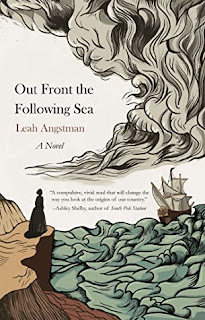
OUT FRONT THE FOLLOWING SEA, historical thriller of 17th century America


OUT FRONT THE FOLLOWING SEA
LEAH ANGSTMAN

Regal House (non-affiliate Amazon link)
$9.99 Kindle edition, available now

Rating: 4* of five

The Publisher Says: Out Front the Following Sea is a historical epic of one woman’s survival in a time when the wilderness is still wild, heresy is publicly punishable, and being independent is worse than scorned — it is a death sentence. At the onset of King William’s War between French and English settlers in 1689 New England, Ruth Miner is accused of witchcraft for the murder of her parents and must flee the brutality of her town. She stows away on the ship of the only other person who knows her innocence: an audacious sailor — Owen — bound to her by years of attraction, friendship, and shared secrets. But when Owen’s French ancestry finds him at odds with a violent English commander, the turmoil becomes life-or-death for the sailor, the headstrong Ruth, and the cast of Quakers, Pequot Indians, soldiers, highwaymen, and townsfolk dragged into the fray. Now Ruth must choose between sending Owen to the gallows or keeping her own neck from the noose.

Steeped in historical events and culminating in a little-known war on pre-American soil, Out Front the Following Sea is a story of early feminism, misogyny, arbitrary rulings, and the treatment of outcasts, with parallels still mirrored and echoed in today’s society.

I RECEIVED A DRC FROM THE PUBLISHER VIA EDELWEISS+. THANK YOU.

My Review
: I've been acquainted with, and even published by, Leah Angstman for the past decade. I am absolutely sure that I'd've rated this book even more highly if I hadn't been...such are the wages of sin, I'm afraid. I'm extra sure that nothing I've read in this COVID year has affected me as much as the tale of Ruth, a child of sixteen!, suffering under the sheer violent rage of an entire community of religious nuts. Regulars will recall my affection for the comic book Prophet Against Slavery, which trod similar outcast-for-being-honest ground. At least the Quaker prophet Lay was outcast, cruelly treated, with more than one slender reed of lovingkindness to support him...and I think Ruth's belovèd Owen, his oft-professed love for her notwithstanding, was a slender reed indeed...while being *actually*guilty* of what they accused him of.

That is not the case in this story.

Ruth's powerful mind, her greatest curse in a society that mistrusts women whole and entire but smart women most of all, also leads her to the only possible solution to her impossible conditions (given that the local Pequots aren't going to risk a world of trouble to take her in although they do offer her more honorable assitance than she had a right to expect)...and straight into a situation where she's in the path of life-storms and STORMS!!

It is as breathless a ride of a read as I'm able to take at my advanced age.

What made me invest myself so deeply in this unflattering depiction of theocratic society from the outside was my antipathy towards That Kind of Person. What kept the pages turning was my need to know: Are Ruth and Owen going to make it to the last page? will their love be rewarded with togetherness? And, this being a romantic novel not a category romance, there is no way to be sure. And I'll not spoil that for you.

(That was me being very cruel, but only to be kind...you need to read this book.)

Friday, December 1, 2017

THE TRADESCANTS' ORCHARD, a spectacular gift book for your garden lover


THE TRADESCANTS' ORCHARD
The Bodleian Library
$65.00 hardcover, available now

Rating: 5* of five

The Publisher Says: In the early seventeenth century, England’s leisured classes took an eager interest in fruits from the Mediterranean and beyond, introducing species from abroad into the kitchen gardens and orchards of grand homes. A charming collection of sixty-six early watercolors showing fecund trees with fruits hanging heavily from their branches, The Tradescants’ Orchard is a testament to these broadening horticultural horizons.

The Tradescants’ Orchard reproduces for the first time the entire manuscript, traditionally associated with the renowned father-and-son nurserymen the John Tradescants. The paintings pose many questions: Who painted them and why? What is the significance of the wildlife—birds, butterflies, frogs, and snails—that appear throughout? Why is there only one depiction of an apple tree despite its popularity? Were there others that have since gone missing?

A visual feast that will appeal to botany and gardening enthusiasts, the book also includes an introduction that maps out the mystery of how and why these enigmatic watercolors were made.

My Review: Visual perfection, this. A gorgeous old book, not a scientific treatise but more likely (or so scholarly opinion has it now) a sort of seed catalogue made to entice the wealthy landowners of its century (the 17th century, we're pretty sure) into planting fashionable gardens and orchards. How can this be a sure analysis of the book's origin? We have many examples of herbals and botanical texts from earlier and contemporary times...this book's charming and attractive artwork isn't scientifically accurate. It's even whimsical at times, and how many whimsical scientists have you ever met? Or even heard of?

Look at this! Just look at the itty-bitty bugs! How totes adorbs are they?!

But they're fantasy bugs, not carefully rendered anatomically observed type models, and those things are present in the academic books produced at and before the time this book was made.

The Bodleian Library, an ancient (to my American eyes) repository of bookish treasures from all ages of England's long, long history of literary greatness, publishes facsimiles like this as well as fascinating and little-known treasures once common, for this generation's curious and cultured to consume. This is God's Work from my point of view. There is no more important duty for a library than to preserve and disseminate the words, ideas, images, thoughts and prayers, of the past to the present. In this sacred trust they are assisted by their US distributor, the University of Chicago Press, which has the Great Chicago Book Sale running. This book was a birthday gift to me from a friend who gave me a gift card. It was only $19 in the book sale! A perfect amount of money to spend on a lavish-looking gift given to your slightly distant but important to remember giftee this Yuletide. And, bookish friends, you won't be able to leave the book sale without acquiring a few treasures for yourownselves. This link takes you to the sale catalog. Use code AD1647 to get the discounted prices when checking out.

Can you resist spending a lousy $20 to get over 100 pages of joy like this image of a cherry varietal?

I though not. You're welcome.

Tuesday, May 24, 2016

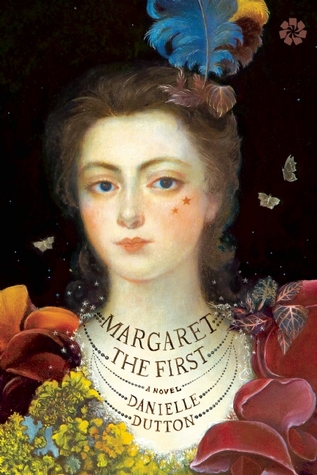
MARGARET THE FIRST by Danielle Dutton, 2016's six-stars-of-five read


MARGARET THE FIRST
DANIELLE DUTTON

Catapult
$15.95 trade paper, available now

Rating: 6* of five

The Publisher Says: Margaret the First dramatizes the life of Margaret Cavendish, the shy, gifted, and wildly unconventional 17th-century Duchess. The eccentric Margaret wrote and published volumes of poems, philosophy, feminist plays, and utopian science fiction at a time when “being a writer” was not an option open to women. As one of the Queen’s attendants and the daughter of prominent Royalists, she was exiled to France when King Charles I was overthrown. As the English Civil War raged on, Margaret met and married William Cavendish, who encouraged her writing and her desire for a career. After the War, her work earned her both fame and infamy in England: at the dawn of daily newspapers, she was “Mad Madge,” an original tabloid celebrity. Yet Margaret was also the first woman to be invited to the Royal Society of London—a mainstay of the Scientific Revolution—and the last for another two hundred years.

Margaret the First is very much a contemporary novel set in the past, rather than “historical fiction.” Written with lucid precision and sharp cuts through narrative time, it is a gorgeous and wholly new narrative approach to imagining the life of a historical woman.

My Review: Every year, there is one book...rarely are there two...that moves me so profoundly and give me so much reading joy that I need to give it the highest, best accolade I possess: This book broke the scale. This is the bar I'll be judging many other books by. We're pretty much done with the first half of 2016 and I was getting a bit restless for a sighting of the six-star book. I've read some excellent books this year, but until Danielle Dutton's publisher, Catapult, sent me this book at my request, none that would come close to the six stars level.
He tapped his hat for shade. A crow pecked near his feet. He was about to give it up, and then: 'Mad Madge!' someone cried in the street. 'Mad Madge!' someone repeated, as her black-and-silver carriage came roaring down the path. But the horses were forced to a stop, for the crowd had grown to a mob. 'I see her,' someone shouted. He saw her then, through the window glass--black stars, white cheeks. That night in his diary he wrote: 'The whole story of this lady is a romance, and everything she does.'
Pepys, on page four. Okay then, thinks I, we're on the way up from five stars on page four! The golden apple is Ms. Dutton's to lose.

She never lost it. Never came close.

The early days of Margaret Lucas's life were fairly typical of those for a girl of her station. She was from minor nobility, the county set as it would come to be called. She was odd even to her family, she was not meant to fit in anywhere, and she honestly seems never to have tried. It was her bad luck to be born at the time of the Civil War, and to a Royalist family. Her entire life she would deal with, be circumscribed by, defined by the Civil War and its long, long aftermath. Her youth was spent in various exiles, for example Paris, where the English Queen Henrietta Maria had Margaret as a very junior and unpopular lady-in-waiting:
"'I had rather be a meteor, single, alone.'

Plus Paris itself was noisome. Even with its glittering bridges and orangeries, even if the birthplace of ballet.

'I had rather been a meteor, than a star in a crowd.'"
How did a teenaged girl, in an era that discouraged all non-conformity and frequently punished female "rebelliousness," reach the strength of mind to think such thoughts and the strength of character to live her life according to that simple principle, so hard to do? It has to be something inborn. Anyone who has ever parented an infant knows that they arrive with personalities (blank slates my lily-white patootie!). What must Margaret's beloved mother have gone through, worrying about her willful young daughter so far away from her almost all their lives?

Mother needn't have worried too much. While at Queen Henrietta Maria's court, Margaret meets the widowed, exiled Marquess of Newcastle, a man more than twice her age with adult children. Ordinarily this would be unremarkable; Margaret isn't considered marriageable. The Marquess, however, disagrees; he falls in love with her very oddness and originality of mind. This is one amazingly lucky woman. The Queen, whose consent to such an alliance is necessary, doesn't stand in the way but expresses her amazement that such a bizarre match could take place.

Life as an aristocratic exile is precarious. Money is tight, sources of income lost, and only the Queen repaying a loan let the newlyweds enjoy a modestly comfortable exile in Antwerp (much cheaper than Paris!). All of Holland was then and is now quite cosmopolitan, so the new Marchioness is exposed to many, many new ideas, people she would never meet in Paris or London (Jews!), and she revels in it all with her loving and supportive husband:
One night, the Duarte girl sang poems set to music in a voice so clear I felt my soul rise up inside my ear. In a garden of clematis, with servants dressed like Gypsies placing candles in the trees, we assembled on the grass, between a Belgian wood and {the Duchess of Lorraine}'s glassy pond. In a pale orange gown I read two pieces I'd prepared...When the ladies clapped their approval in the dark, everything, to me, was suddenly bright and near.
How amazing for the shy Marchioness to read in public, how delicious to be applauded, how very different from any life she could reasonably have expected to have. And how perfect Dutton's prose is, representing such a magical moment. I was starry-eyed myownself when I read that passage.

Margaret's response to such an extraordinary life is to become even more extraordinary herself. She writes a book published under her own name, with her husband William's complete and excited support; encouraged by that and the kerfuffle she has caused in the educated world, she publishes a second and then third book. Writing has become a way of life, an addiction, a refuge and a podium both:
Still, Antwerp, the parties, my husband's talks--all of it fed my mind. I'd hardly set down my quill before I took it up again, writing stories unconnected--of a pimp, a virgin, a rogue--strung up like pearls on a thread. ... 'I am very ambitious, yet 'tis neither for Beauty, Wit, Titles, Wealth, or Power, but as they are steps to raise me to Fames Tower.'

O minor victory! O small delight! My star began to rise.
Anyone whose writing has caused others to respond strongly will know how the Marchioness feels.

And of course, this being the world ruled by evil-tempered gods, all good things come to an end. William and Margaret, in need of money to live and desiring the return of estates confiscated by the ended Republic, cash in on the Marchioness's fame and the restored King's interest in her outrageous persona. A fête in His Majesty's honor is held:
'An utter success,' her stepdaughters confided to Margaret as they prepared to take their leave. 'The handsome king! That spoof!' Still the rain persisted, and the bishop had lost his hat. Maids danced in and out. Where was the bishop's hat? Alone at the window, Margaret didn't hear. The reflection of the parlor was yellow and warm. She watched it empty out. Then, an interruption. A voice came at her side: 'What do you look at with such interest, Lady Cavendish?' What did she see in the glass? She saw the Marchioness of Newcastle. She saw the aging wife of an aged marquess, without even any children to dignify her life.
The Marchioness's interlocutor is one Richard Flecknoe, a young man barely known to her in Holland, and who becomes her playmate and teacher and arm-candy. William, bless him, voices faith in and approval of Margaret's friendship, canceling any scandal.

And then (you know what's coming, right?) William and Margaret leave their precarious London existence for the newly returned Cavendish estates near Colchester. As soon as things begin to go smoothly.... But the most wonderful thing happens while they are there: Margaret's long-missing crates of writings, her "modest closet plays," arrive and are printed at last:
She was reading Francis Godwin's Man in the Moone--its man was borne into space in a carriage drawn by swans--when she heard the sound of wheels upon the gravel. Two boxes from Martin & Allestyre were set down on the drive. 'My modest closet plays,' she said. She nearly ran down the stairs--for the recovery of her wayward crates that spring and the preparation of her plays for publication had rekindled inside Margaret a flame she'd feared had gone out. ... But now, in turning the pages, she grew concerned and then incensed: 'reins' where she had written 'veins,' 'exterior' when she had clearly meant 'interior.' The sun went down. The room grew dim. ... 'Before the printer ruined it,' she cried, 'my book was good!'

'Could it be,' {her husband} asked, soaking his bread in {lamb's} blood, 'that you were yourself the cause of this misfortune?'
An autodidact, Margaret's spelling is, ummm, idiosyncratic; a passionate writing addict, she's always rushing through her work to begin something new. In spite of her resentment of William's criticism, she goes to work to fix the book's problems as he advises.

As life goes on, as she grows older in body, she grows more and more powerful in her mind and fearless in her imagination:
On the fifth night of this solitude, she falls asleep with a candle burning and dreams herself a mermaid with a thick and golden tail, a crown of shimmering conch shells, then awakens with a start. Whether the ship hit something or something hit the ship, another change has come. The ship is dying; she can feel it slipping away. She waits beneath the blanket for icy water to greet her. But instead of the sea, it's a bear that opens the door.

A great white bear up on its hind legs steps across the threshold.

'Good morning,' he says, and reaches out a paw.
The writing of a seventeenth-century woman, elderly by the standards of the day. This is simply glorious imagination, simply astonishing to realize it is over 350 years old. This childless woman, forgotten by our modern world and only "famous if you know who she is," would be delighted to be brought to vivid life again by Danielle Dutton. How can I be sure of that?
Off come her skirts and petticoats, her lace cuffs and collar, her shoes and whalebone stay, until she lies on her side in nothing but a cotton shift and endless strands of pearls. Dust hangs in a crack of light between red velvet drapes, like stars.

Her dreams are glimpses, bewildered--celestial charts, oceanic swells, massive, moving bodies of water, the heavens as heavenly liquid, familiar whirlpools, the universe as a ship lost at sea--but the ship she imagines arrived safely, years ago, loaded with their possessions.
Show me a writer, past or present, who would not beam joyfully at being so unclothed, so beautifully described, so wonderfully and comprehensively understood.

It is Dutton's gift to write beautifully. It is also her gift to find the perfect publisher for her work. The cover is glorious; the design of the book is lovely, and completely transparent to anyone not looking for it; it is, in short, an author's dream of a book. Equally it is a publisher's dream to publish a novel about a now-obscure woman dead for centuries about which a jaded old reviewer (ie, me) can, completely without reservation or reluctance, say that this book is:
Yet how hard it is to point to a moment. To say: there, in that moment, I changed.