Showing posts with label misogyny. Show all posts

Thursday, February 19, 2026

SKYLARK, Author Paula McLain's dual-timelines historical Paris novel


SKYLARK
PAULA McLAIN

Atria Books (non-affiliate Bookshop.org link)
$14.99 ebook, available now

Rating: 3* of five

The Publisher Says: The New York Times bestselling author of The Paris Wife weaves a mesmerizing tale of Paris above and below—where a woman’s quest for artistic freedom in 1664 intertwines with a doctor’s dangerous mission during the German occupation in the 1940s, revealing a story of courage and resistance that transcends time.

1664: Alouette Voland is the daughter of a master dyer at the famed Gobelin Tapestry Works, who secretly dreams of escaping her circumstances and creating her own masterpiece. When her father is unjustly imprisoned, Alouette's efforts to save him lead to her own confinement in the notorious Salpêtrière asylum, where thousands of women are held captive and cruelly treated. But within its grim walls, she discovers a small group of brave allies, and the possibility of a life bigger than she ever imagined.

1939: Kristof Larson is a medical student beginning his psychiatric residency in Paris, whose neighbors on the Rue de Gobelins are a Jewish family who have fled Poland. When Nazi forces descend on the city, Kristof becomes their only hope for survival, even as his work as a doctor is jeopardized.

A spellbinding and transportive look at a side of Paris known to very few—the underground city that is a mirror reflection of the glories above—Paula McLain’s unforgettable new novel chronicles two parallel journeys of defiance and rescue that connect in ways both surprising and deeply moving.

I RECEIVED A DRC FROM THE PUBLISHER VIA NETGALLEY. THANK YOU.

My Review
: Tunnels, underground/out of sight communication, hidden pathways...thematically this is the heart of Author McLain's story. The literal, factual tunnels under Paris start us out on the careful and hazardous reality of being a woman or, later, that other despised minority a Jew...yes, women were a social minority, rendered voiceless and affectless the way minorities always are...so we're going underground to follow them as they fight to survive without being Seen and still being effective actors in society. Spoiler alert: It doesn't go well.

There ya go. That's the story. It took almost five hundred pages of pretty sentences to get there.

They are pretty sentences but honestly, taken out of context they're pretty much meaningless. Describing a sculpture made by a side character, "... a lark with wings unfurled, fashioned from pale limestone with such delicate precision that it seems almost alive," is lovely...but its entire reason for being described is in fact its meaning and that's a gestalt. This is not a criticism of the writing, it's a statement of why I'm not quoting a lot more pretty sentences.

In my opinion reading this really interesting story-idea could have been a lot more fun had the author been less pretty and more concise in her writing. It's a fine way to spend a weekend in the company of two people marginalized for being...unpopular because they're Other...but I don't know that I felt adequately entertained to justify the length of time it all took to come together.

Wednesday, October 8, 2025

THE WAX CHILD, chilling and brutal example of misogyny


THE WAX CHILD
OLGA RAVN
(tr. Martin Aitken)
New Directions (non-affiliate Bookshop.org link)
$17.48 ebook, available now

WINNER OF the 2026 Locus Award for TRANSLATED NOVEL!

The Independent Press Top 40 Bestsellers: Fiction For the week ending July 28, 2026

One of Ancillary Review of Books' 2025 Notable Books!

Rating: 4.75* of five

The Publisher Says: Based on a real-life seventeenth century Danish witch trial, The Wax Child tells in vivid prose the story of Christenze Kruckow, a noblewoman long pursued by a scandal of sorcery. People whisper that in her wake one finds illness, death, and unsettling behaviour by pigs and cats. Some even say she once fashioned out of wax a child, an instrument of the most sinister magic. Christenze will flee the rumours to Aalborg, that great city of seawater and mist. But even there suspicion and fear rule, and once a rumour of witchcraft has taken hold, it can prove hard to shake…

I RECEIVED A DRC FROM THE PUBLISHER VIA EDELWEISS+. THANK YOU.

My Review
: Beginning at about the time this book does, the Lutheran Reformation of Denmark was a bolt from the blue regarding social roles. Women, never favored as a class of beings in christian social organization, had carved out a side-hustles as "cunning folk" or "wise women" whom we would learn to call witches quite soon. Funny, that's part of what the cunning folk were helping their clients protect against..."witch curses lifted one laying hen" or similar verbiage would've been on the cunning folk's roadside signs had they had roadside signs. Or roads.

Author Ravn did a whole huge heap of research on folk magic and its practitioners, relying on court cases and church sources as they are the only extant words about the (mostly) women who worked in this field. This specific story is from court records of Danish women tried and executed for witchcraft.

The creation of a poppet, the European precursor to the voodoo doll (that terrible calumniating lie of a thing), was...faithless to the pop-culture b.s. written and shown for generations now...a bridge created to the intended recipient of health and healing and good fortune.

Once anything gets entangled in the filthy web of christianity it gets perverted and misused.

At all events, Author Ravn used her research heavily in making this story deeply unnerving and spooky. She's created on Christenze's factual bones a story of a woman who simply said "no" to patriarchal control systems, to compulsory heterosexuality, to life spent bearing baby after baby many, even most, of whom will die. Becoming, then, a beacon of sense and independence while attracting to herself a group of like-minded women who resonate to the lures of freedom from "femininity" and its subjugations and humiliations; well, that couldn't be tolerated in the brave new Lutheran world that demanded conformity to its rules and submission to its precepts (as all freshly installed orthodoxies must or face destruction by dissent). Christenze must be stopped, foiled, negated.

Our wax child narrator is created by Christenze prior to her final (dis)solution. The wax child, the poppet, is buried...and survives Christenze. Somehow, not ever vouchsafed us an explanation as to how, we meet the wax child and begin to learn Christenze's story, the story of the communities she inhabited, the story of her downfall...all from the poppet's "mouth" and memory. "How do I know this? The dead fly in the window-sill told me, the grass-pollen as it puffed into the air told me, a brass candlestick told me, a speck of grit. Everything remembers and speaks to those who will listen," we're told.

What elevates this read to all-but five stars is the sharpness of the wax child's awareness of the horrible price we exact, all unthinking, on the whole of creation for our simple continuation of existence as we want, selfishly, it to look. We demand and demand and demand but do not stop to reckon up the cumulation of effects that demanding exacts. "The reason is behind us. All reasons are behind us. The fire has its own reason. The future is already visible. It is over there by the exits. I want you to look directly into the fire—You will hear me in the night under the breath—You will hear me when spring turns to summer, and there in the light an opening occurs...will you come with us to the Lucia fest...? Magic is possible. Laughter is possible. There is a way out...there is a way out…" In this incantatory language, this cadence of a summoning, I want to believe the wax child knows and will vouchsafe.

Way out there might well have been. Might even, for all I know, be. It will not be easy, and it will demand reckoning with the fire. "It is in the depths of her vessels, in that which we call horn and hair. In the smallest sequences it resides there still. I don't need to tell so much, I am merely a reminder, a down that settles upon your brow, and I am with you."

I do not see it coming to pass.

Monday, August 25, 2025

THE SIMPLE ART OF KILLING A WOMAN, brutally honest recounting of the reality of femicide


THE SIMPLE ART OF KILLING A WOMAN
PATRÍCIA MELO
(tr. Sophie Lewis)
Restless Books (non-affiliate Bookshop.org link)
$9.99 ebook, available now

Rating: 4* of five

The Publisher Says: From best-selling Brazilian crime novelist Patrícia Melo comes a genre-defying tale of women in the Amazon and their reckoning with brutal oppression

By turns poetic, humorous, dark, and inspiring. The Simple Art of Killing a Woman vividly conjures the epidemic of femicide in Brazil, the power women can hold in the face of overwhelming male violence, the resilience of community despite state-sponsored degradation, and the potential of the jungle to save us all.

To escape her newly aggressive lover, a young lawyer accepts an assignment in the Amazonian border town of Cruzeiro do Sul. There, she meets Carla, a local prosecutor, and Marcos, the son of an indigenous woman, and learns about the rampant attacks on the region’s women, which have grown so commonplace that the cases quickly fill her large notebook. What she finds in the jungle is not only persistent racism, patriarchy, and deforestation, but a deep longing for answers to her enigmatic past. Through the ritual use of ayahuasca, she meets a chorus of Icamiabas, warrior women bent on vengeance―and gradually, she recovers the details of her own mother’s early death.

The Simple Art of Killing a Woman resists categorization: it is a series of prose poems lamenting the real-life women murdered by so many men in Brazil; a personal search for history, truth, and belonging; and a modern, exacting, and sometimes fantastical take on very old problems that, despite our better selves, dog us the world over.

I RECEIVED A DRC FROM THE PUBLISHER VIA EDELWEISS+. THANK YOU.

My Review
: You know a book has said something profound, moving, and honest when more about fifteen hundred Goodreads reviews are very positive to four hundred profoundly negative. Goodreads ain't the Land of Woke, yet four times as many people chose to express a positive opinion of this story of violence and murder against women as bothered to bash it.

I'm praising it, too. The way Author Melo weaves magical, intensely sensual words...
Death has been kind to me, I thought. I haven't been run over by a lorry. I haven't fallen to a stray bullet. I have not been hastened toward death—rather, death has only dreamed of me; it has only knocked at my door. Tap, tap, tap. "I'm thinking of coming for you tonight at nightfall," death had said.
–and–
It seemed to be raising a piece of me that had been forgotten, something stifled inside me, a piece that on coming free levered up another, and so on and so on, down to the last lost piece, the furthest fallen, as good as buried—the one called "mother."
...into lovely images as well as wields word-scalpels as she detachedly discusses the murder of women simply for being (or presenting as) women is brutal and effective in conveying the sickness at the heart of femicide.
You never imagine that a guy like this, a Wittgenstein reader and yoga fan, will hit you in the face at a lawyers’ New Year’s Eve party. But the statistics show that it happens a lot. And that lots of men don’t stop at a slap. They’d actually rather kill you.
–and–
The conclusion I reached by my second week in court was this: we women are dying like flies. You men get hammered and kill us. Men want to fuck and kill us. Men get enraged and kill us. Men want a bit of fun and kill us. Men discover our lovers and kill us. We leave them and men kill us. Men get another lover and kill us. Men come home tired after work and kill us.
It is as Author Melo has Carla say: "It doesn't matter where you are or what social class you belong to and it doesn't matter what you do for a living. It's dangerous being a woman."

From many directions, for reasons and for no reason at all, it is dangerous to be a woman.

That simple, statistically verifiable truth is really all the impetus I think you should need to get and read this book.

I couldn't offer a fifth star, as the subject matter alone merited, because the reading experience was not well-integrated; the tonal shifts were effective but were also overused. The characters aren't really developed because there is so very much to say about the reason we-the-reader are here; but that means, at times, we-the-reader don't get the real horror-movie-esque impact only the documentary, evidentiary disgust and outrage.

A story to admire, to absorb and retain lessons from; not one to follow your spouse or equivalent around, reading bits and snatches to.

Sunday, August 10, 2025

BRING THE HOUSE DOWN, every level of the title's meaning is the truth of the story


BRING THE HOUSE DOWN
CHARLOTTE RUNCIE

Doubleday Books (non-affiliate Bookshop.org link)
$14.99 ebook, available now

Rating: 4* of five

The Publisher Says: A theater critic at the Edinburgh Festival Fringe writes a vicious one-star review of a struggling actress he has a one-night stand with in this sharply funny, feminist tinderbox.

Alex Lyons always has his mind made up by the time the curtain comes down at a performance—the show either deserves a five-star rave or a one-star pan. Anything in between is meaningless. On the opening night of the Edinburgh Festival Fringe, he doesn’t deliberate over the rating for Hayley Sinclair’s show, nor does he hesitate when the opportunity presents itself to have a one-night stand with the struggling actress.

Unaware that she’s gone home with the theater critic who’s just written a career-ending review of her, Hayley wakes up at his apartment to see his scathing one-star critique in print on the kitchen table, and she’s not sure which humiliation offends her the most. So she revamps her show into a viral sensation critiquing Alex Lyons himself—entitled son of a famous actress, serial philanderer, and by all accounts a terrible man. Yet Alex remains unapologetic. As his reputation goes up in flames, he insists on telling his unvarnished version of events to his colleague, Sophie. Through her eyes, we see that the deeper she gets pulled into his downfall, the more conflicted she becomes. After all, there are always two sides to every story.

A brilliant Trojan horse of a book about art, power, misogyny, and female rage, Bring the House Down is a searing, insightful, and often hilarious debut that captures the blurred line between reality and performance.

I RECEIVED A DRC FROM THE PUBLISHER VIA NETGALLEY. THANK YOU.

My Review
: Well, that was fun. Eviscerating, puncturing schadenfreude.
How enormous a thing it must be to face the sum total of your flaws, and find that they were worse than you imagined, and obvious to everyone in the world except you. Maybe, like trying to look at the sun, it wasn’t quite possible yet for Alex to look at the truth about himself without experiencing so much pain that he then immediately had to look away again, dazzled by the brightness of his own cruelty.
See? There's just one problem. It's Hayley's book. Alex whimpers “Haven’t you ever done something you regret? Why am I the only one who has to learn something here?” at one point, though, and it really hit me. No, you're not; but you are the one resisting the lessons. And Hayley's just the one to deliver them. She's decided that his misogynistic takedown of her show is misogynistic for the sake of it; therefore must be resisted and retaliated against. She takes no stock of his points. Self-examination would tell her she has a far more insidious enemy within the gates that poses far more of a threat to her future in the form of her partner Josh.

So I don't think this is a truly good story. It's mean, satisfying fun, though. Flaws and all I laughed where Author Runcie wanted me to, I winced at the pains inflicted and received, and stared in quiet hostility at the enemy within.

A well-spent afternoon of reading.

Wednesday, May 29, 2024

OUT AT THE PLATE: The Dot Wilkinson Story, deep dive into a QUILTBAG legendary life


OUT AT THE PLATE: The Dot Wilkinson Story
LYNN AMES

Chicago Review Press
$28.99 hardcover, available now

Rating: 4.25* of five

The Publisher Says: “Dot Wilkinson is the greatest female catcher ever to play softball . A bold, pioneering athlete, she refused to let others define her and instead defined herself. Her story is an inspiration to people everywhere.” — Billie Jean King, Sports Icon and Champion for Equality

It’s not simply that Dot Wilkinson was one of the most decorated women’s softball players, bowlers, and athletes of all time and one of the original players from the three-time-world-champion PBSW Phoenix Ramblers softball team (1933–1965). Nor was it the length of her time here on Earth—over a century—although any of these things by itself would be impressive.

The magic of Dot’s story is in the details. It’s the tale of a childhood spent in poverty, an indomitable, unbreakable spirit, a determination to be the very best to play whatever sport she undertook, the independence to live her personal life on her own terms, and her tremendous success at all of it.

Over more than a decade of countless conversations and interviews, Dot shared all of it with her dear friend, author Lynn Ames. Dot held nothing back. Out at the Plate , told through the lens of Dot and Lynn’s friendship, is the story of a forgotten era in women’s history and sports, and one extraordinary woman’s place at the center of it all.

I RECEIVED A DRC FROM THE PUBLISHER VIA EDELWEISS+. THANK YOU.

My Review
: I had a lesbian "grandma" of sorts, older than Dot Wilkinson, but with the same kind of unwillingness to submit to woman=weakness stereotyping. She saw what she wanted and went out of all ladylike bounds to get it. This included the love of her life, a widow with a son, and the family they made.

Dot Wilkinson is my kinda woman. (Or man, if I'm honest.) Reading about her life, its ups-downs-failures and unimaginably exciting successes, made me smile uncontrollably. QUILTBAG folk are fed a steady diet of disaster and crime with us as the victims, expecting that this will keep us quiet and invisible. This is the classic Linebarger tactic, used for generations now on "minorities" of all sorts. It is now modulated by stories of assimilation, of increased access to "The American Dream" of mortgaged house, kids who need college funds, etc etc. The Dot Wilkinsons who decide to do what the hell they want to do when they want to do it do not, oddly enough, get a lot of overcultural attention.

I can't think why this should be.

Dot Wilkinson deserves every bit of attention you have at your command because she actually was what we're told we love the most, should strive to be, here in the USA. She was strong by every metric, she was a maverick. She was routinely successful in her careers (plural). She lived with the love of her life for almost a half-century. Her example of grace and graciousness under pressure is one to emulate. She never turned it into any kind of doormat behavior. She was likable and well-liked at a time when her rejection of "normative womanhood" could easily have made her a pariah. Lynn Ames manages to convey all this without becoming cloying, though her fangirling over Dot is not at all veiled...or misplaced.

The one thing that leads to, on the "missing three-quarters-star" front, is the tendency to overexplain and repeat. By using many primary sources, Author Ames falls into the "it's really cool how much stuff there is" ditch and doesn't climb out. The sources very often concur, and maybe picking one quote then saying "this is one of the half-dozen angles on this story" could've been less wearing on the reader's nerve. My interest in softball, Dot's biggest claim to Fame and spotlights, is significantly less than hers....

Family issues weren't minimized. It was heartbreaking to learn of Dot's first love's early passing from the then-untreatable scourge of metastatic breast cancer. It was more heartbreaking still to read of Dot's mother's callous...let me be fair, surprisingly insensitive...response to Dot's deep grief at her loss. The fact is a sapphic love wouldn't register with most people as "real" in that day and time, so grief of that depth and duration would seem odd. Still, it's your child! Wouldn't that attune you to the reality of the feeling and thus summon up empathy not dismissiveness?

Apparently not. And honestly that bit upset me as much as the loss did. I was, as you can tell from that, fully invested in Dot Wilkinson's life, and was very, very happy I had this chance to learn about this older sister in queerness. I hope you will give it a chance to grab you, too.

Sunday, May 28, 2023

MAGNIFICENT REBEL: Nancy Cunard in Jazz Age Paris


MAGNIFICENT REBEL: Nancy Cunard in Jazz Age Paris
ANNE DE COURCY

St. Martin's Press
$14.99 ebook editions, $29.99 hardcover, available now

Rating: 4* of five

The Publisher Says: Anne de Courcy, the author of Husband Hunters and Chanel's Riviera, examines the controversial life of legendary beauty, writer and rich girl Nancy Cunard during her thirteen years in Jazz-Age Paris.

Paris in the 1920s was bursting with talent in the worlds of art, design and literature. The city was at the forefront of everything new and exciting; there was no censorship; life and love were there for the taking. At its center was the gorgeous, seductive English socialite Nancy Cunard, scion of the famous shipping line. Her lovers were legion, but this book focuses on five of the most significant and a lifelong friendship.

Her affairs with acclaimed writers Ezra Pound, Aldous Huxley, Michael Arlen and Louis Aragon were passionate and tempestuous, as was her romance with black jazz pianist Henry Crowder. Her friendship with the famous Irish novelist George Moore, her mother’s lover and a man falsely rumored to be Nancy’s father, was the longest-lasting of her life. Cunard’s early years were ones of great wealth but also emotional deprivation. Her mother Lady Cunard, the American heiress Maud Alice Burke (who later changed her name to Emerald) became a reigning London hostess; Nancy, from an early age, was given to promiscuity and heavy drinking and preferred a life in the arts to one in the social sphere into which she had been born. Highly intelligent, a gifted poet and widely read, she founded a small press that published Samuel Beckett among others. A muse to many, she was also a courageous crusader against racism and fascism. She left Paris in 1933, at the end of its most glittering years and remained unafraid to live life on the edge until her death in 1965.

Magnificent Rebel is a nuanced portrait of a complex woman, set against the backdrop of the City of Light during one of its most important and fascinating decades.

I RECEIVED A DRC FROM THE PUBLISHER VIA NETGALLEY. THANK YOU.

My Review
: How the hell do I rate and review this book? Author de Courcy writes very well, has clearly done research I have no reason to suspect contains careless errors (ie, I as a non-expert possess no knowledge that contradicts anything contained in here), and clearly understands the role of conflict and drama in non-fiction...yet I hated every minute of the read.

Let me explain.

Nancy Cunard knew everyone, went everywhere, did everything adventurous and fun one can dream up to do when there is a giant pot of cash under one's checkbook. She was also a narcissist, and probably a sociopath. She had no moral compass I could discern from any anecdote herein. She was "mad, bad, and dangerous to know," because she could and did turn on people who had given her no cause to dislike them.

And men flocked to her orbit! They wanted sex, of course, but quite a lot of them fell for her! All the mor amazing because of her one reasonably good quality, by modern standards: she never bothered herself to dissemble. As the great majority of people prefer to be told pretty little lies by their lovers, I'd say this shows that the men who fell for her really, truly fell, to accept her honest and usually very scathing opinion of them and keep coming back. Her "honesty" (which, as presented herein, is really just brutal unnecessary unkindness) comes in for a helping of praise I don't feel is warranted. She did many laudable things in pursuit of social justice, which no one should try to minimize. Her addiction issues and mental illness, which the author is careful to make unmistakable for the reader, is obvious in hindsight from the present century's ludicrously low "heights" of enlightenment, do not excuse the abusive and manipulative behaviors she displayed. To Author de Courcy's credit, she makes no excuses for the troubling behviors but goes out of her way to explain how the Cunards were less a family than threesome of selfish, oblivious rich people. How else could Nancy have turned out?

So I liked the book. But I loathed the subject. I am not glad I know more about her than my previous awareness of her name and sterling literary taste and activities. I feel...soiled...by the knowledge that this awful person is a feminist icon to some because she was as free as the male abusers and rotters of her day. Yuck! "But they were worse!" hardly seems like a justification for someone to behave badly.

I've settled on four stars, all for the felicity of Author de Courcy's discourse, and none for this awful, abusive human being.

Friday, September 16, 2022

MISS ICELAND, exploring the reality of how much society has changed ***SPOILERS***


MISS ICELAND
AUÐUR AVA ÓLAFSDÓTTIR
(tr. Brian FitzGibbon)
Black Cat (non-affiliate Amazon link)
$10.99 Kindle edition, available now

Rating: 4.5* of five

The Publisher Says: Iceland in the 1960s. Hekla is a budding female novelist who was born in the remote district of Dalir. After packing her few belongings, including James Joyces's Ulysses and a Remington typewriter, she heads for Reykjavik with a manuscript buried in her bags. There, she intends to become a writer. Sharing an apartment with her childhood and queer friend Jón John, Hekla comes to learn that she will have to stand alone in a small male dominated community that would rather see her win a pageant than be a professional artist. As the two friends find themselves increasingly on the outside, their bond shapes and strengthens them artistically in the most moving of ways.

I RECEIVED A DRC FROM THE PUBLISHER VIA NETGALLEY. THANK YOU.

My Review
: It's always been true that, to be a success, a woman must do twice as much and can expect half the reward a man would get for the same labor. Hekla, cursed with both attractiveness and intelligence in a smugly patriarchal culture, learns that to be a writer who is taken seriously while also being a pretty female is a Sisyphean task. The 1960s were not yet times of change in Iceland....

Hekla's ambitions lure her away from her rural home and, when she arrives in Reykjavík, her efforts are...Herculean. Yes, lots of mythology referred to here, and honestly it's only down to the fact that there isn't a better metaphor for what she is required to expend. Jón John, her gay BFF, preceded her to Reykjavík because if there's a worse thing to be in rural Iceland than a smart, ambitious, pretty woman, it's a queer man. They take up residence together while he does the kind of labor he can find, gets laid when someone's horny and their wife isn't willing, and ponders with her why they should be reduced to such crummy exigencies for getting mere crumbs of what they really want.

I was ready to give the book five stars until I got to the ending. What happened there, I fear, was me smacking my nose on the sad, true realization that Jón John's deeply ingrained homophobia will, in fact, be the death of him; and that Hekla, in accepting a very terrible and unfair life for herself, has resigned herself to the way the world is. Is this how the book should end? Yes, I can certainly see that it would make the most sense for it to end as it has. I still wanted, on an emotional level, to feel the striving I'd seen the characters enact pay off. I expected Surtsey to come roaring up faster than it did and give the characters new, hot, fire-powered land to live their new, hot, fire-powered lives on.
“Men are born poets. By the time of their confirmation, they’ve taken on the inescapable role of being geniuses. It doesn’t matter whether they write books or not. Women, on the other hand, grapple with puberty and have babies, which prevents them from being able to write.”

No, not for humans as fully, honestly drawn as these humans were, to be given a fairy-tale ending. They got reality. It felt like a cheat; it wasn't, of course, but it felt like one. I will say that the emotional core of the book is sadness and that was not the source of my half-star docking. It was the changes Jón John and Hekla made not amounting to an improvement of their lives. It could have; it seemed to me that, once the Faustian bargain of marriage was struck between them, they could've used that energy to propel themselves to happier endings. But the core of sadness was too powerful. The end of the story is, in this book, really and truly an end. Hekla's book being published? A major achievement! And it's all her ex-boyfriend Starkadur's because otherwise, without his man's name on it, the book won't *get* published. Miss Iceland was beautifully, poignantly sad all the way through. But when a story has one note, it's hard to maintain one's taste for that, and only that, note.
The skylight has misted up in the night, a white patina of snow has formed on the windowsill. I drape {Starkadur}'s sweater over me, move into the kitchen to get a cloth to wipe it up. A trail of sleet streams down the glass, I traced it with my finger. Apart from the squawk of seagulls, a desolate stillness reigns over Skolavordustigur.

Understand your journey, don't undertake it if you're not in the mood for exactly that journey. If you are, this will repay your attention with exquisitely lovely, painfully honest images and you'll be honestly unable to see for sad tears that won't quite fall.

Wednesday, January 12, 2022

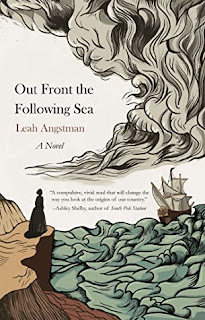
OUT FRONT THE FOLLOWING SEA, historical thriller of 17th century America


OUT FRONT THE FOLLOWING SEA
LEAH ANGSTMAN

Regal House (non-affiliate Amazon link)
$9.99 Kindle edition, available now

Rating: 4* of five

The Publisher Says: Out Front the Following Sea is a historical epic of one woman’s survival in a time when the wilderness is still wild, heresy is publicly punishable, and being independent is worse than scorned — it is a death sentence. At the onset of King William’s War between French and English settlers in 1689 New England, Ruth Miner is accused of witchcraft for the murder of her parents and must flee the brutality of her town. She stows away on the ship of the only other person who knows her innocence: an audacious sailor — Owen — bound to her by years of attraction, friendship, and shared secrets. But when Owen’s French ancestry finds him at odds with a violent English commander, the turmoil becomes life-or-death for the sailor, the headstrong Ruth, and the cast of Quakers, Pequot Indians, soldiers, highwaymen, and townsfolk dragged into the fray. Now Ruth must choose between sending Owen to the gallows or keeping her own neck from the noose.

Steeped in historical events and culminating in a little-known war on pre-American soil, Out Front the Following Sea is a story of early feminism, misogyny, arbitrary rulings, and the treatment of outcasts, with parallels still mirrored and echoed in today’s society.

I RECEIVED A DRC FROM THE PUBLISHER VIA EDELWEISS+. THANK YOU.

My Review
: I've been acquainted with, and even published by, Leah Angstman for the past decade. I am absolutely sure that I'd've rated this book even more highly if I hadn't been...such are the wages of sin, I'm afraid. I'm extra sure that nothing I've read in this COVID year has affected me as much as the tale of Ruth, a child of sixteen!, suffering under the sheer violent rage of an entire community of religious nuts. Regulars will recall my affection for the comic book Prophet Against Slavery, which trod similar outcast-for-being-honest ground. At least the Quaker prophet Lay was outcast, cruelly treated, with more than one slender reed of lovingkindness to support him...and I think Ruth's belovèd Owen, his oft-professed love for her notwithstanding, was a slender reed indeed...while being *actually*guilty* of what they accused him of.

That is not the case in this story.

Ruth's powerful mind, her greatest curse in a society that mistrusts women whole and entire but smart women most of all, also leads her to the only possible solution to her impossible conditions (given that the local Pequots aren't going to risk a world of trouble to take her in although they do offer her more honorable assitance than she had a right to expect)...and straight into a situation where she's in the path of life-storms and STORMS!!

It is as breathless a ride of a read as I'm able to take at my advanced age.

What made me invest myself so deeply in this unflattering depiction of theocratic society from the outside was my antipathy towards That Kind of Person. What kept the pages turning was my need to know: Are Ruth and Owen going to make it to the last page? will their love be rewarded with togetherness? And, this being a romantic novel not a category romance, there is no way to be sure. And I'll not spoil that for you.

(That was me being very cruel, but only to be kind...you need to read this book.)

Wednesday, September 15, 2021

SLEWFOOT, Brom's latest tale of unease and injustice


SLEWFOOT: A Tale of Bewitchery
BROM

Nightfire Books
$29.99 hardcover, available now

Rating: 4* of five

The Publisher Says: A spirited young Englishwoman, Abitha, arrives at a Puritan colony betrothed to a stranger – only to become quickly widowed when her husband dies under mysterious circumstances. All alone in this pious and patriarchal society, Abitha fights for what little freedom she can grasp onto, while trying to stay true to herself and her past.

Enter Slewfoot, a powerful spirit of antiquity newly woken… and trying to find his own role in the world. Healer or destroyer? Protector or predator? But as the shadows walk and villagers start dying, a new rumor is whispered: Witch.

Both Abitha and Slewfoot must swiftly decide who they are, and what they must do to survive in a world intent on hanging any who meddle in the dark arts.

I RECEIVED A DRC FROM THE PUBLISHER VIA NETGALLEY. THANK YOU.

My Review
: Maybe it was the teen angst. Maybe it was my allergy to Villains Without Nuance. Maybe I'm just getting old.

I don't like this book much. I should...spooky dos in Puritan times? folk horror? Revenge?! yes please...and I think I might have if I hadn't taken against Abitha so very strongly. Adolescents whose sense of themselves as Right and Hard Done By aren't enjoyable companions for an entire book. I felt Abitha's difficulties with Authority were period appropriate...totally bought that she was justifiably angry with the entire male world...but she comes across as a modern woman. Then when Slewfoot-the-character wins her over with no effort? He's an innocent, albeit one with tremendous Powers, and with...um...horns? Literal goatly horns. But Abitha just...accepts. It strained me to buy into that.

I'm not insensitive to the appeal of the Other to those trapped in rigid, conformity-enforcing social milieus. But Abitha's ready acceptance of this, um, extremely Other that resembles the goat we meet her losing...and she even calls him "Samson" after the goat...it didn't scan for me with a seventeenth-century woman. Not even one whose upbringing was as peculiar, her mother a root woman and her father a drunken sot, as hers was.

My most favoritest thing is the animate Forest that Slewfoot (he has other names throughout the story, all of which carry their own shades of meaning and of humor) cohabits with, that has re-summoned Slewfoot from a liminal state to deal with Forest's concerns about its future. (I loved Jesus Thunderbird's name for Slewfoot...Hobomok...as it carried so many levels, from a beautiful butterfly to a scary demon via an early American novel about the Noble Savage slur. A quick trip to the internet will give you literal *hours* of perusing pleasure.) Perhaps the most unsettling of Brom's illustrations is the one he made for Creek:

It's perfect, it's unsettlingly Other, and completely relatably familiar all at the same time. What's missing here is the essence of Creek's Wrongness, Otherness...scale...Creek is tiny and looks like that. Sweet dreams!

These being hallmarks of Brom's works, and the source of my relatively high rating for a book I wasn't all the way in sympathy with, so I was rolling along fine until...the torture porn began. Abitha and her mother, women accused of witchcraft, were in for a bad time. I accepted that. But I was revolted by the deeply prurient recounting of the torments meted out to the women, guilty as charged by the lights of the community they lived in though ambiguously so in modern eyes. They transgressed...they paid dearly for it...
"I want to burn them to the ground, All of them. All of it. Their church, their commandments, their covenants, their riles, edicts, and laws, their fields, their homes, and most of all their fucking bonnets and aprons. I want to hollow them out, make them know what it is to lose everything, everything, to lose their very soul!"

Nothing in this life comes for free...the bigger the ask, the bigger the price. There is more truth than you can fully know in the ancient adage, "Be careful what you wish for lest the answer be Yes."

Friday, August 13, 2021

EDGE CASE, YZ Chin's wry assessment of how "love and marriage" ≠ security


EDGE CASE
YZ CHIN

Ecco Press
$26.99 hardcover, available now

Rating: 4* of five

A BEST-OF-2021 PICK FROM NPR BOOKS!

The Publisher Says: When her husband suddenly disappears, a young woman must uncover where he went—and who she might be without him—in this striking debut of immigration, identity, and marriage.

After another taxing day as the sole female employee at her New York City tech startup, Edwina comes home to find that her husband, Marlin, has packed up a suitcase and left. The only question now is why. Did he give up on their increasingly hopeless quest to secure their green cards and decide to return to Malaysia? Was it the death of his father that sent him into a tailspin? Or has his strange, sudden change in personality finally made Marlin and Edwina strangers to each other?

As Edwina searches the city for traces of her husband, she simultaneously sifts through memories of their relationship, hoping to discover the moment when something went wrong. All the while, a coworker is making increasingly uncomfortable advances toward her. And she can’t hide the truth about Marlin’s disappearance from her overbearing, eccentric mother for much longer. Soon Edwina will have to decide how much she is willing to sacrifice in order to stay in her marriage and in America.

Poignant and darkly funny, Edge Case is a searing meditation on intimacy, estrangement, and the fractured nature of identity. In this moving debut, YZ Chin explores the imperfect yet enduring relationships we hold to country and family.

I RECEIVED A DRC FROM THE PUBLISHER VIA NETGALLEY. THANK YOU.

My Review
: First, read this:
Being very polite to train conductors and building security guards for the past decade has made my deferential way of speaking second nature. Though what an odd saying. What is my first nature?
–and–
He stood out, his skin a shade that I had seen compared to food items like chocolate or coffee in American books. Looking at him, I thought not of food, but of a neutral coolness that disguised something else, like an envelope that contained either really good tidings or earth-shattering bad news.

First novelist YZ Chin isn't playing around. She wrote those two passages early in this book. There isn't, this writing informs you, going to be any false modesty in here. I am going to talk about how a Straits Chinese woman married to a Chindian man, a fat woman married to a lean, athletic man who loves her, feels when "America" does its number on them together, separately, and as Symbols. They're two damaged people, they're altogether too small to withstand the pressure of being Symbols, and they're cracking under the strains. Which is why the book is narrated by Edwina in phone-and-internet conversations with her not-quite-licensed (it's just a paperwork thing, nothing important) therapist (see INS form I-693) after Marlin leaves her.

Edwina is an abused daughter of a harridan of a mother (The Banana Tree Spirit Story! OMG!!), a vegetarian to her dark, lean husband's more exacting veganism, a "quality control analyst" in a dudebro startup firm called, fully explanatorily, "AInstein," that lost its VCs a boatload of money by screwing some important code up and still releasing it to a client. Oopsie. Get a girl to handle it...an immigrant who won't dare make much trouble, cause any stress but will fill the role...one who won't be missed when we have to fire her for whatever screw-up she can't make us fix.
The bug was what’s called an integer overflow, which is when a number is too large for its assigned storage capacity and thus can manifest instead as a negative figure. For example, if the number 128 were forced into a signed field that could express only up to 127, the input would ‘overflow’ and be displayed as ˗128. It was mildly gratifying to learn that the human body could also overflow. I idly wondered if, any day now, my pain would grow so great that it converted into happiness.

What a terrific job, no? Not even a company-sponsored green card application, no no, you'll get your H1-C visa and that's it. Why, if she didn't really, really, really want to stay away from the poisonous reach of her mother's awful, barbed "past-life stories." Marlin's job, less pointless it seems, even affords him a few American friends, like best buddy Eamon and the guys he goes to the rock-climbing gym with. But everything changes when Marlin's father suddenly dies back in Malaysia.

At his funeral, the pair of them expensively in attendance as the ceremonies take place, along comes Edwina's mother to tell the Banana Tree Spirit story about betrayal, misery, and hateful ignorance carrying the day. That was bad enough, being about her daughter's "past life," but the many, many echoes this latest piece of cruelty has bids fair to have broken poor Marlin. At this lowest, most grief-ridden moment, the words have twisted themselves into a noose around his logical self so the corpse is all that's left in an ever-darkening relationship to Edwina.

A little detail about the pair returning from Malaysia into Trump's Murruhkuh, how they were treated at Customs, should make your blood boil, your mouth taste sour, and your eyes reflexively leak tears. I half-wondered if Edwina's speculation that "America made Marlin feel unwelcome, and so he left me," wasn't at least half right....
The US government actually monitored immigrants online, and anything I typed might be used against me—that was what internet advice hinted at. Resources for immigrants cautioned that we should "avoid profanity and the use of aggressive or threatening language" while posting online, which really voided the whole purpose of being on Twitter.

Of course, that internet false-identity therapy makes all the sense in the world in that light, doesn't it. Especially since the internet has a random, unidentifiable Crazy Person (or two, or fifty) to tell the suffering how, exactly, not to suffer anymore:
Surely I was better than these people with their loud, false bravado. Yet wasn’t I on the internet precisely because I wanted someone to give me a to-do list? I objected to the content of the lists, found them laughable, but still—I wanted my hand held, didn’t I?

Oh Edwina...that kind of comfort is so, so cold.
I decided the problem was that none of the results mentioned meddling by spirits.

Attagirl!
But when I typed in "spirits told my spouse to leave me," there was a tidal wave of marriages ended by alcoholism.

See? See what I mean, Edwina? Cold comfort...there're people out there a lot more fucked up than you and/or Marlin.
What good is marriage if you can just cancel it like cable?

Well. Now we're gettin' somewhere, Edwina. "Grieving in the form of research, because we believed in productivity above all else," might as well be tattooed on every modern workerbee, don't you think?

Well...she wanted a way to manage her grief at Marlin's weird, sudden abandonment...what about being told you're so unvalued at work that your serious problems with the MVP beta are being ignored? Before one of the dudebros tries to kiss you at a company party? And yes, Edwina, in today's world that IS sexual assault. Her revenge? Condign. (If premature...?)

It was no wonder to me that Edwina ended up doing what she did at the Korean deli. And it was actually a lovely surprise, a way of taking charge of her unhappiness. I can't help but wonder if this isn't, in fact, something that's in fact true and just not being discussed:
I didn't buy that depression was caused by low serotonin levels. No, what I felt was way more aggressive than a simple deficiency of certain neurotransmitters. There had to be another neurotransmitter that carried sadness, that handed out hopelessness like drugged candy. After all, even matter had antimatter.

But when matter and antimatter don't find a safe place to co-exist, what do they do then?
I'd send nail clippers (he was fastidious that way, or at least he used to be when he lived with me), ramen noodles (the fancy, super spicy ones, not the kind that tasted like boiled water that someone had farted in), a throw, maybe even a handheld gaming console.

No one who can write that sentence is done with being A Wife. Edwina, my dear lady, I've spent a grand total of five hours in your company, and they were grand hours! that ramen line!, but your modern-love-immigrant-style story isn't a huge revelation to me. Not once have you startled me, or surprised me, or done anything the least bit out of character.

And do you know what? I wouldn't have it any other way.

Monday, April 22, 2013

THE MADE-UP MAN, short & sweet Faustan-bargain tale in 1980s Manhattan


THE MADE-UP MAN
KAREN HEULER

Livingston Press (non-affiliate Amazon link)
$4.95 Kindle edition, availale now

Rating: 3.75* of five

The Publisher Says: Self-pity will only get you so far. When Alyson Salky finds that her lover is having an affair with her best friend and he takes the dog with him when he moves out and a man with worse credentials is hired over her at work, it's time to make some major life decisions. She keeps running into the neighborhood fortune teller, Madame Hope, who promises she can make Alyson's wishes come true any wish, so why not a big wish? As far as Alyson can determine, the problem with her life is that she's getting all the crap that women get, and none of the free passes that men get. It's time to switch it's time to see what life is like as a man and while Madame Hope can get that done for her (in exchange for her soul), nothing really goes as planned. The devil, it turns out, has a sense of humor. But who will have the last laugh?

I RECEIVED AN ARC FROM THE PUBLISHER. THANK YOU.

My Review
: Alyson Salky lives in 1980s New York with her beloved, Peter, their dog Dingo, and a few friends that Alyson can't really account for liking. One of those friends, Maggie, snatches Peter out from under Alyson, which is as we all know a painful experience. So what does Alyson do? She sells her soul to the devil, here called Madame Hope the fortuneteller. Several stinging ironies in that, eh what?

So now we get to the title: Alyson chooses, as her first step in this revenge of hers, to become a man. Yes, actually become a man, as in physically transforming herself into the enemy. Madame Hope, an evil glint in her eye (I confess, it's a horrible pun, but it had to be said), agrees with relish to the proposal and *poof* Alyson becomes Bob. Everyone still remembers Alyson, but Bob is part of each memory now, too. Bob is friends, through Alyson, with Maggie and Peter; Bob is now part of the magazine staff where Alyson once worked; and it's these things that allow Bob to wreak his devilish (!) havoc on the lives of Maggie and Peter.

He does a damn fine job of his revenge! Oh my my, does he do a good job! I was quite awed by Heuler's vicious imagination, and I'd hate to be a character at *this* author's mercy. In the end, though, Alyson passes through her revenge fantasy, and her dark night of the soul, and emerges as a fascinating, multi-dimensional character one would like to have on the next barstool. That would be one interesting conversation.

Heuler, a well-published short-story writer and novelist, has a deft hand with prose. There's a nice economy to her storytelling, as she brings this sardonic take on the Don Giovanni story home in under 230pp. It's very easy to see how the characters, all of them, fall into the pits and traps and snares that await all humanity. It's a lot harder to judge them for it than it is other writers' characters precisely because Heuler has such a keen sense of what to say and what to leave out.

There are two problems I have with the book: First, as Bob, the author has some characters think he's gay and in love with Peter, while others don't think so at all, including Peter; second, the last paragraphs of the ending seem to me a cheat, an added-on afterthought that adds nothing to the character or the story.

My first issue is a serious one. Structurally, this mooshy-splooshy confusion isn't dealt with in any kind of story-advancing constructive way. Emotionally, it makes little difference, really, simply keeping two characters from getting inconveniently involved at a certain point; and it gives little depth to any of the interactions Bob has. I took a whole star off because of the unnecessary complication and confusion it caused me in reading the book.

The ending, well, it's not in me to spoiler it, but I can say it bothered me a lot less than the botched gay subplot because it was so short-lived, only a few sentences at the very end of this wicked little book.

A nicely made how-the-other-half-lives cautionary tale, a sharp and sarcastic "Mephistopheles in Manhattan," and a darn good candidate for the title "Love's Labours Won and Lost and Won and Lost and...." Read it soon.