Showing posts with label Restless Books. Show all posts

Monday, September 21, 2026

EDEN AT DAWN, queer love between Palestinian men...nominated for the National Book Award for Translated Literature


EDEN AT DAWN
KARIM KATTAN
(tr. Jeffrey Zuckerman)
Restless Books (non-affiliate Bookshop.org link)
$9.99 ebook, available now

Finalist for the 2026 Cercador Prize for Literature in Translation.

On the 2026 Longlist for the National Book Award for Translated Literature

Rating: 4.5* of five

The Publisher Says: A heart-wrenching love story between two young Palestinian men in a land swept by sandstorms, burdened by occupation, and haunted by spirits.

In the labyrinthine city of Jerusalem, where poets woo their lovers with tales of jinns, lions, and warriors, Isaac and Gabriel pass in the streets, unaware of one another until a fifty-day wind brings enough sand to blot out the heavens. From their first meeting, desire blooms, hesitates, withdraws, and returns in a heady romance recounted by the sky itself, who cranes past rooftops and through windows to glimpse the pair. Defying checkpoints, desert squalls, and blazing heat, Gabriel and Isaac embark on a road trip through Jericho and past the Dead Sea to a storied village in the West Bank—a daring act in a divided country.

Lyrical and languorous, shattering and profound, Eden at Dawn is a feast of love in the midst of war. With this North American debut, lauded author Karim Kattan proves that storytelling is the ultimate act of devotion.

I RECEIVED A DRC FROM THE PUBLISHER VIA EDELWEISS+. THANK YOU.

My Review
: As omniscient narrators go, it'd be quite a feat to go bigger than the actual sky itself. I'm impressed at the bold claim Author Kattan stakes with that choice. "I'm telling you about 'forbidden love' from the one PoV that literally everyone on Earth cannot escape from, that sees literally ALL from one or another angle."

I love that the sky sees all, but doesn't always catch little details, like who someone is based on what they look like. Perfect...omniscient, inattentive, fallible, so we-the-reader are never spoonfed too much of the story.

Grace notes like this abound but the entire story centers love between men who live on a patch of Earth where their essential selves are rejected by some people all of the time and all people some of the time...Palestinian, male, queer...SOMEone is mad at you 100% of the time. Love for a man is BAD in this motherland of two religions that shriek their LOVE for ALL MANKIND out of mouths stained red with the blood of the men they've ripped the throats out of for daring to speak their love for each other.

Isaac and Gabriel (you can look up the cultural relevance of choosing those two names yourselves) speak to each other in...heightened...language. They're hella eloquent and very willing to put it on display at the drop of their briefs. A lot of the discussion of their love and their plight taking place in this supernatural, seemingly eternal khamsin felt on-the-nose. A sad truth is, the more eloquent about love, being in love (the genitive case of the verb), the characters wax, the more...artificial...this external obscuration feels. It started out with this being the sky's omniscience failing, but became a labored device as its qualities were belabored.

I was charmed and entertained by the read, I genuinely wanted Gabriel and Isaac to strengthen their loving bond. It was very much about the feels, the emotional frisson, the men's illusions of Love, but that's how the first fifty days of every love affair I've ever had felt, too. I'm sure the read will come across as passionate, fervent, to Anglophones, which is certainly how it ought to be received. I suspect, based on long acquaintance, that there was a great musicality in the original French; I do not know how to explain it better than to say that I heard ringing church bells in the background as I read.

It is a beautiful way to feel, being in love; Love feels marvelous...full of and creating simultaneously marvels, its a drug so potent that it convinces you others will feel its power and accede to Love's demands, willingly.

I think my readers will all be old and scarred enough to know what Life does to love.

But we go back, but we go on, but we love and Love by this means conquer (us) All.

Thursday, September 4, 2025

YOSS'S PAGE: A PLANET FOR RENT, bitterly personal takedown of capitalist tourism, & RED DUST, same except it's law'n'order/security


RED DUST
YOSS
(tr. David Frye)
Restless Books (non-affiliate Bookshop.org link)
$14.99 ebook, available now

Rating: 4* of five

The Publisher Says: From beloved Cuban science fiction author Yoss comes a bitingly funny space-opera homage to Raymond Chandler, about a positronic robot detective on the hunt for some extra-dangerous extraterrestrial criminals.

On the intergalactic trading station William S. Burroughs, profit is king and aliens are the kingmakers. Earthlings have bowed to their superior power and weaponry, though the aliens—praying-mantis-like Grodos with pheromonal speech and gargantuan Collosaurs with a limited sense of humor—kindly allow them to do business through properly controlled channels.

That’s where our hero comes in, name of Raymond. As part of the android police force, this positronic robot detective navigates both worlds, human and alien, keeping order and evaporating wrongdoers. But nothing in his centuries of experience prepares him for Makrow 34, a fugitive Cetian perp with psi powers. Meaning he can alter the shape of the Gaussian bell curve of statistical probability—making it rain indoors, say, or causing a would-be captor to shoot himself in the face. Raymond will need all his training—and all his careful study of Chandler’s hardbitten cops—to meet his match.

As he did in his brilliantly funny and sharp science-fiction parables A Planet for Rent, Super Extra Grande, and Condomnauts, Yoss makes the familiar strange and the strange familiar in Red Dust, giving us an unforgettable half-human hero and a richly imagined universe where the bad guys are above the laws of physics.

I RECEIVED A DRC FROM THE PUBLISHER VIA EDELWEISS+. THANK YOU.

My Review
: Raymond (short for Raymond Chandler), a pozzie living on space station William S. Burroughs of the Galactic Trade Confederation, presses an already-imprisoned Gaussical into helping him catch a fellow Gaussical whose probability-bending is getting too greedy. Raymond believes like will call to like, and trusts he's Philip Marlowe not Miles Archer.

If none of that made sense, but you're still intrigued, sign up for this voyage of the Cuban-registered spaceship Yoss powered by much the same sense of absurdity that powered Douglas Adams to fame and fortune. Only he wrote it in Spanish. Lots of kinetic to-and-fro, lots of pseudo-hardboiled dialogue, innumerable odd lifeforms (the Gaussians, psionically gifted Cetian benders of probability, are my favorites but are not alone) pack the under-two-hundred pages set in the same fictional universe as A Planet for Rent (q.v.) very full.

Too full, most likely; and almost entirely male, so the misogyny Yoss is known for doesn't flare up. But don't think he's at a loss for slurs! Or any other colorful language, this man's right up there in the inventiveness standings. While I just said the short book's maybe a bit too packed, it's not filler...but it's also not moored onto a solid foundation unless you have read A Planet for Rent. They are not interconnected in plot or characters, but in background assumptions like Humanity's made up of wildly unpredictable, untrustworthy wild cards who need watching and controlling for their own good. (And their overlords' profit.) And our pozzie Raymond (positronic-brained android) is part of the machinery that keeps conflict between Humanity and the Xenoids to a dull roar. It's because of that the fascination with Raymond Chandler got hold of MSX-3482-GZ. We're all friends so let's use keynames, though. Sets the proper tone. As the events unfold we should be getting set up for the two Gaussians (you know, Gauss? numerical analysis, conformal mapping, all that stuff y'all already know too much about for me to go into it) confronting each other with one (reluctantly) representing Order and one not. And it never happens. Fifth star gone.

Rooted in Yoss's experiences of the 1990s collapse of socialist Cuba, his well-founded mistrust and anger at capitalism is loud and clear in the stories that precede this novella, where they reach a high shine. It's clear to me that the loud clanging of alarm bells in these two titles should have been heeded quite a while ago.

Best ten years ago; second-best, today.

+++++++++++++++++++++++++++++++++++++++++++++++++++++++++++++++


A PLANET FOR RENT
YOSS
(tr. David Frye)
Restless Books
$14.99 ebook, available now

Rating: 4* of five

The Publisher Says: Out of the modern-day dystopia of Cuba comes an instant classic from the island’s most celebrated science fiction author: a raucous tale of a future in which a failing Earth is at the mercy of powerful capitalist alien colonizers.

In A Planet for Rent, Yoss critiques life under Castro in the ‘90s by drawing parallels with a possible Earth of the not-so-distant future. Wracked by economic and environmental problems, the desperate planet is rescued, for better or worse, by alien colonizers, who remake the planet as a tourist destination. Ruled over by a brutal interstellar bureaucracy, dispossessed humans seek better lives via the few routes available—working for the colonial police; eking out a living as black marketeers, drug dealers, or artists; prostituting themselves to exploitative extraterrestrial visitors—or they face the cold void of space in rickety illegal ships.

This inventive book marks the English-language debut of an astonishingly brave and imaginative Latin American voice.

I RECEIVED AN ARC FROM THE PUBLISHER. THANK YOU.

My Review
: The Intergalactic League has been to Earth, has looked around, and has decided this shithole of a place is good for sex work and raw materials. The Planetary Tourism Authority licenses the visitors under some (largely notional not actual) rules, including the ready availability of Body Spares (humans to be...inhabited) for tourists who can't handle our atmosphere.

It's not terribly subtle; it is terribly biting. As satire often is.

Your tolerance for the howling outrage of a man who's seen his country get so desperate that it encouraged the "mulatta" women to become sex workers to balance the country's economic health on their bodies will determine your pleasure in the read.

Every facet of the capitalist colonization of "smaller" countries is brought into angry focus as the Xenoids, our spacefaring overlords, best us at sports we've never heard of, as they watch eagerly while a human performance artist uses his own, slow and painful, suicides (assisted by their superior technology to remain alive and reassemble afterwards) as artistic statements they can savor; most horribly, and pointedly, there is Buca, a Social (sex) worker, who's headed offworld with her Xenoid client to...nope. That one you need to read.

It is chilling to think immigrants to capitalist countries are sufficiently desperate to see what they know awaits them as preferable to what they're leaving.

And we, obliviously, heap more and worse atop them. It cannot last forever. Read about it from the other side, see at last why that's so.

Monday, August 25, 2025

THE SIMPLE ART OF KILLING A WOMAN, brutally honest recounting of the reality of femicide


THE SIMPLE ART OF KILLING A WOMAN
PATRÍCIA MELO
(tr. Sophie Lewis)
Restless Books (non-affiliate Bookshop.org link)
$9.99 ebook, available now

Rating: 4* of five

The Publisher Says: From best-selling Brazilian crime novelist PatrĂ­cia Melo comes a genre-defying tale of women in the Amazon and their reckoning with brutal oppression

By turns poetic, humorous, dark, and inspiring. The Simple Art of Killing a Woman vividly conjures the epidemic of femicide in Brazil, the power women can hold in the face of overwhelming male violence, the resilience of community despite state-sponsored degradation, and the potential of the jungle to save us all.

To escape her newly aggressive lover, a young lawyer accepts an assignment in the Amazonian border town of Cruzeiro do Sul. There, she meets Carla, a local prosecutor, and Marcos, the son of an indigenous woman, and learns about the rampant attacks on the region’s women, which have grown so commonplace that the cases quickly fill her large notebook. What she finds in the jungle is not only persistent racism, patriarchy, and deforestation, but a deep longing for answers to her enigmatic past. Through the ritual use of ayahuasca, she meets a chorus of Icamiabas, warrior women bent on vengeance―and gradually, she recovers the details of her own mother’s early death.

The Simple Art of Killing a Woman resists categorization: it is a series of prose poems lamenting the real-life women murdered by so many men in Brazil; a personal search for history, truth, and belonging; and a modern, exacting, and sometimes fantastical take on very old problems that, despite our better selves, dog us the world over.

I RECEIVED A DRC FROM THE PUBLISHER VIA EDELWEISS+. THANK YOU.

My Review
: You know a book has said something profound, moving, and honest when more about fifteen hundred Goodreads reviews are very positive to four hundred profoundly negative. Goodreads ain't the Land of Woke, yet four times as many people chose to express a positive opinion of this story of violence and murder against women as bothered to bash it.

I'm praising it, too. The way Author Melo weaves magical, intensely sensual words...
Death has been kind to me, I thought. I haven't been run over by a lorry. I haven't fallen to a stray bullet. I have not been hastened toward death—rather, death has only dreamed of me; it has only knocked at my door. Tap, tap, tap. "I'm thinking of coming for you tonight at nightfall," death had said.
–and–
It seemed to be raising a piece of me that had been forgotten, something stifled inside me, a piece that on coming free levered up another, and so on and so on, down to the last lost piece, the furthest fallen, as good as buried—the one called "mother."
...into lovely images as well as wields word-scalpels as she detachedly discusses the murder of women simply for being (or presenting as) women is brutal and effective in conveying the sickness at the heart of femicide.
You never imagine that a guy like this, a Wittgenstein reader and yoga fan, will hit you in the face at a lawyers’ New Year’s Eve party. But the statistics show that it happens a lot. And that lots of men don’t stop at a slap. They’d actually rather kill you.
–and–
The conclusion I reached by my second week in court was this: we women are dying like flies. You men get hammered and kill us. Men want to fuck and kill us. Men get enraged and kill us. Men want a bit of fun and kill us. Men discover our lovers and kill us. We leave them and men kill us. Men get another lover and kill us. Men come home tired after work and kill us.
It is as Author Melo has Carla say: "It doesn't matter where you are or what social class you belong to and it doesn't matter what you do for a living. It's dangerous being a woman."

From many directions, for reasons and for no reason at all, it is dangerous to be a woman.

That simple, statistically verifiable truth is really all the impetus I think you should need to get and read this book.

I couldn't offer a fifth star, as the subject matter alone merited, because the reading experience was not well-integrated; the tonal shifts were effective but were also overused. The characters aren't really developed because there is so very much to say about the reason we-the-reader are here; but that means, at times, we-the-reader don't get the real horror-movie-esque impact only the documentary, evidentiary disgust and outrage.

A story to admire, to absorb and retain lessons from; not one to follow your spouse or equivalent around, reading bits and snatches to.

Sunday, August 10, 2025

FISHING FOR THE LITTLE PIKE, Finnish language translation of folk/cozy horror-tinged fantasy murder mystery...no, really


FISHING FOR THE LITTLE PIKE
JUHANI KARILA
(tr. Lola Rogers)
Restless Books (non-affiliate Bookshop.org link)
$9.99 ebook, available now

Rating: 4.5* of five

The Publisher Says: In the utterly original, genre-defying, English-language debut of Finnish author Juhani Karila, a young woman’s annual pilgrimage to her home in Lapland to catch an elusive pike in three days is complicated by a host of mythical creatures, a murder detective hot on her trail, and a deadly curse hanging over her head.

When Elina makes her annual summer pilgrimage to her remote family farm in Lapland, she has three days to catch the pike in a local pond or she and the love of her life will both die. This year her task is made more difficult by the intervention of a host of deadly supernatural creatures and a murder detective on her tail.

Can Elina catch the pike and put to rest the curse that has been hanging over her head since a youthful love affair turned sour? Can Sergeant Janatuinen make it back to civilization in one piece? And just why is Lapland in summer so weird?

Fishing for the Little Pike is an audacious, genre-defying blend of fantasy, folk tale, and nature writing.

I RECEIVED A DRC FROM THE PUBLISHER VIA EDELWEISS+. THANK YOU.

My Review
: I'm endlessly absorbed in stories about the Arctic, and learning to be so about stories in the Sámi culture. The more I learn about these complex interrelationships, and the fascinating people and cultures they produce, the more acutely aware of climate change's personal costs I grow.

At no time was I sure what was going on. That's by the author's design. Is the mythic world of the Sámi real? I mean on the consensus-reality scale, none of what happens ought to happen; so is the Sámi model of reality real? It is to Elina, and the consensus-reality world of the story's framing device can't account for the stranger events, so....

It's just delightful to be in that "no, that thing can not exist but she's...omigawd, what?!" head when there's a police detective from the consensus-reality world as flummoxed as we are, as stymied as possible in the execution of an apprehension, and just as bewildered as we are. The people of Vuopio don't hesitate to gossip around her, like the time the mayor, well...her consensus-reality mind doesn't accept that.

The nature writing in this story is evocative enough to make me feel summer sunburnt and skeeter-bit, colorful enough to fit seamlessly around the frankly disturbing delineation of Sámi supernatural entities, and the gestalt becomes as immersive as The Man Who Spoke Snakish. I'm charmed, I'm unnerved, I've laughed, I've stressed my limbic system into believing I've Seen Things.
Slabber Olli told her about the places he had been. He had been to the bottom of the sea and wandered endless gardens of stars in outer space. He said that human time as we know it was over. That the waters would rise and then fall, and then fiery waters would come. The Earth would be reshaped into something new. Mud would flow. Boiling canyons would open up.

"The mountains are already starting to move,” Slabber Olli said.

He told her about creatures that used to live in the sea, like reptiles with two mouths, a horizontal one and a vertical one. He told her about creatures at the bottom of the sea shaped like elm leaves, with five eyes and long, bendy elephant trunks and scissors on their heads.

About sharks with anvils growing on their backs. Flightless birds three meters tall that ran after deer on graceful, muscular legs that bent and stretched, bent and stretched, their beaks opened wide. He told her about the rockets people would build to shoot themselves off to other planets, and how badly it would turn out. Humans would continue their journey. They would find doors to knock on and portals that wouldn't open when they knocked, and the humans would break them down, and the ones they couldn't break they would build keys for. And all the while, humans would be changing. Humans would be changed not just by time but by humans themselves, and before long you'd have to call them human derivatives, and then something else entirely. In the end, it was just matter rearranging itself over and over. What was the Earth? Nothing more than an entrance hall where humanity had once briefly waited.

The consensus-reality world doesn't knowingly or willingly contain these things. Elina, in her calm way, accepts this deluge of weirdness, and then goes on about being in Lapland to prevent a curse from activating and ruining her life.

After all, why else are there raskels, or frakuses, or that bloody murderous knacky who's trapped her into the highest-imaginable stakes card game? And was the mayor of her hometown really...disappeared...by a wraith? The consensus-reality detective, who just wants to bring Elina in for questioning as there's reason to believe she's, um, involved in a murder, certainly thinks so. The villagers say so, too. (The wraith thing not the murder, although....)

I'd give this truly wacky, fun, off-kilter setting all five stars alone. I can't get that high because Elina's curse is unsatisfyingly acquired and self-perpetuated. She's taken it on to process a set of guilts that do not properly belong to her. I'm down for the fantasy aspects of the story but I draw the line at emotionally self-sabotaging women.

I'm as close to all five stars as that grunt of dissatisfaction will allow me to get. I'll read anything Author Juhani Karila writes that's translated, though, because I had a fine old time with this story.

Friday, December 13, 2024

ROBINSON CRUSOE, specifically Restless Books' gloriously illustrated Three-Hundredth Anniversary Edition of it


ROBINSON CRUSOE
DANIEL DEFOE
(illus. Eko; introduction by Jamaica Kincaid)
Restless Books (non-affiliate Amazon link)
$19.99 trade paper, available now

Rating: 5* of five

The Publisher Says: Restless Classics presents the Three-Hundredth Anniversary Edition of Robinson Crusoe, the classic Caribbean adventure story and foundational English novel, with new illustrations by Eko and an introduction by Jamaica Kincaid that contextualizes the book for our globalized, postcolonial era.

Three centuries after Daniel Defoe published Robinson Crusoe, this gripping tale of a castaway who spends thirty years on a remote tropical island near Trinidad, encountering cannibals, captives, and mutineers before being ultimately rescued, remains a classic of the adventure genre and is widely considered the first great English novel.

But the book also has much to teach us, in retrospect, about entrenched attitudes of colonizers toward the colonized that still resound today. As celebrated Caribbean writer Jamaica Kincaid writes in her bold new introduction, “The vivid, vibrant, subtle, important role of the tale of Robinson Crusoe, with his triumph of individual resilience and ingenuity wrapped up in his European, which is to say white, identity, has played in the long, uninterrupted literature of European conquest of the rest of the world must not be dismissed or ignored or silenced.”

I RECEIVED A DRC FROM THE PUBLISHER VIA EDELWEISS+. THANK YOU.

My Review
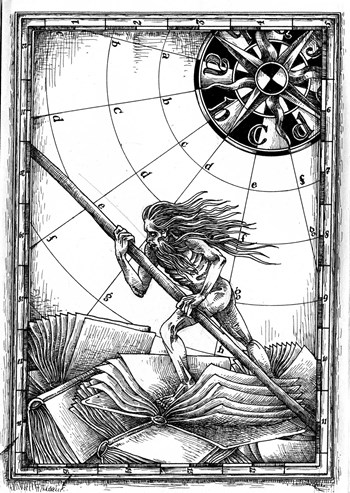
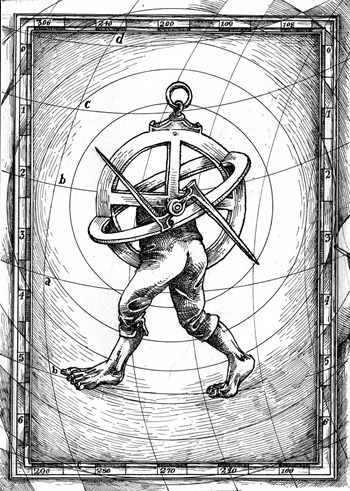
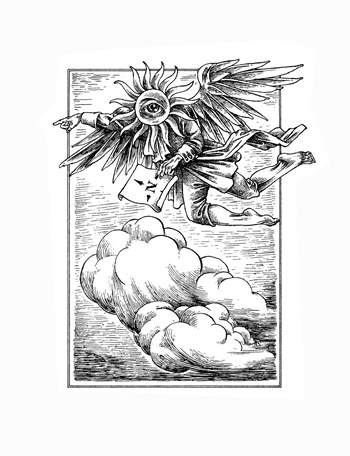
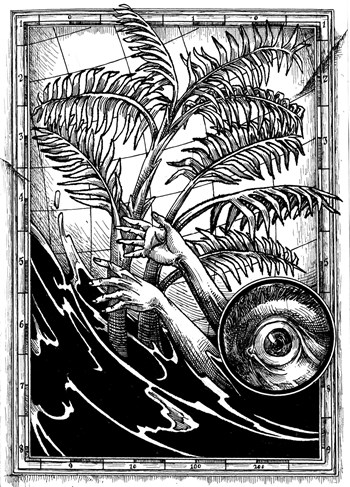
: You really don't need me to mention anything about Defoe or his writing. Or, if you do, go to gutenberg dot org and download a free ebook of the text. You need to read it. Go on! Scoot! Come back when you've downloaded the ugly version. Or, if you're really lazy, go read the Wikipedia article to find out what it's about, so you can look at these illos with a properly appreciative eye.

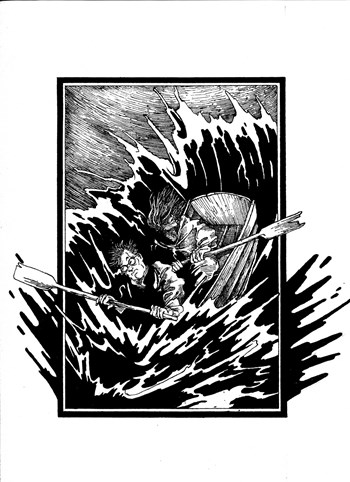
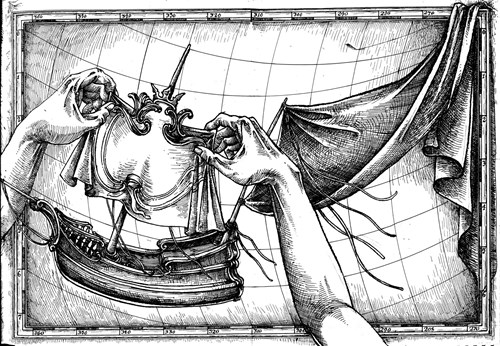
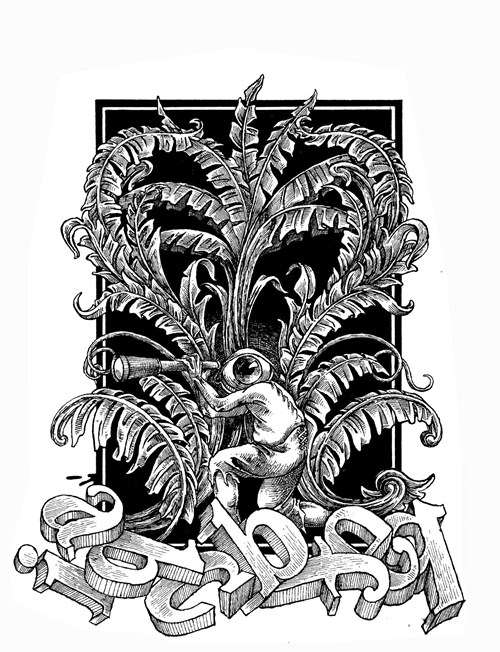
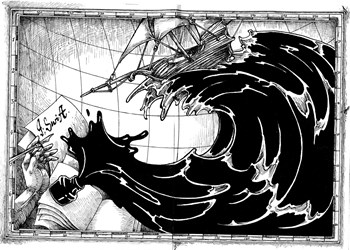
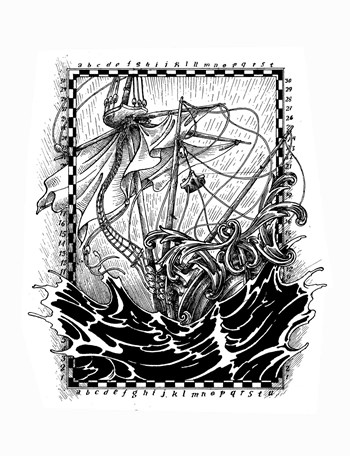
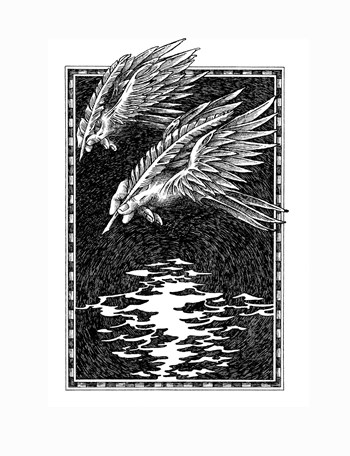
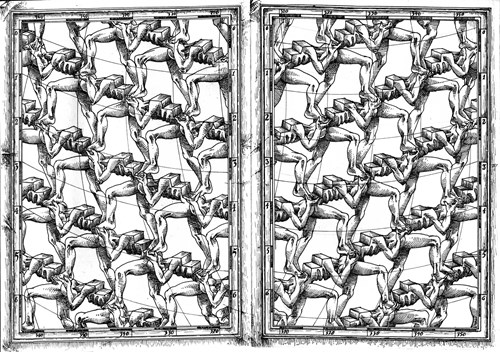
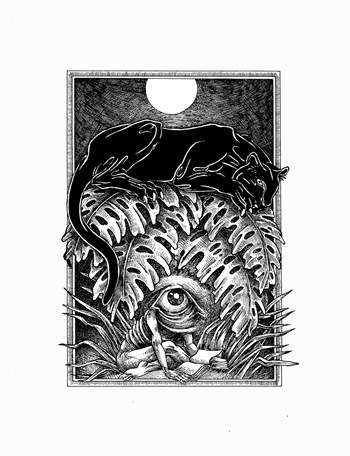
This gorgeously illustrated tricentennial edition is entirely meant to be celebratory not introductory. I mean, look!


What stunning artwork, no? Any of them, but most especially #2 and #4 above, would work as wall art for me.

This is an elegant, easily-shelvable edition that will give you an æsthetic thrill every time you look at it. Anyone who already loves this fantastical story would enjoy the look and feel of it. Anyone who enjoys pretty editions of books as shelf decor would like it too, though I admit I frown on buying books that sit in one spot their whole lives by design. SOMEONE ought to read it. That's what a book is for!

Still and all I do not run the world (terrible oversight on the goddesses' part) so you enjoy things your own way. O.o

As Yule comes screaming in blazing hot like the ball of destruction it is on one's budget, reasonably priced beautiful things like this are welcome gifts. Especially to yourself.

Friday, August 30, 2024

MY PART OF HER, a parting in no way sweet but replete with sorrow


MY PART OF HER
JAVAD DJAVAHERY
(tr. Emma Ramadan)
Restless Books
$17.99 trade paper, available now

Rating: 4.5* of five

The Publisher Says: In exiled Iranian author Javad Djavahery’s captivating English debut, a youthful betrayal during a summer on the Caspian sea has far-reaching consequences for a group of friends as their lives are irrevocably altered by the Revolution.

For our unnamed confessor, the summer months spent on the Caspian Sea during the 1970s are a magically transformative experience. There, he is not the “poor relative from the North,” but a welcome guest at his wealthy cousin Nilou’s home and the gatekeeper of her affections. He revels in the power of orchestrating the attentions of her many admirers, granting and denying access to her would-be lovers. But in a moment of jealousy and youthful bravado, he betrays and humiliates an unlikely suitor, setting into motion a series of events that will have drastic repercussions for all of them as the country is forever transformed by the Iranian Revolution a few short years later.

Over the next twenty years, the lingering effects of that betrayal set the friends on radically different paths in the wake of political, religious, and cultural upheaval. Their surprising final reunion reveals the consequences of revenge and self-preservation as they each must decide whether and how to forget the past. Urgent and gorgeously written, My Part of Her captures the innocence of youth, the folly of love, and the capriciousness of fate as these friends find themselves on opposing sides of the seismic rifts of history.

I RECEIVED A DRC FROM THE PUBLISHER VIA EDELWEISS+. THANK YOU.

My Review
: Layers of response to this book. Most of them uncomfortable with the narrator, his assumption of power over the life of his female cousin, over the lives of the men who pursue her, and the general awfulness of a culture where that's just the way it is.
You'll see. It'll happen to you, if it hasn't already, and you will know as I do that the life you spent wanting to forget was in fact nothing but a life spent remembering.

This storytelling voice is the one used throughout the book. You're told what the story will do next, where it will lead you the reader. That isn't going to be everyone's favorite technique, but it's integral to the book. It is, per Translator Ramadan, a cultural staple and thus a vital part of the story being told. As she's translated other works from French in ways that delighted me, I'm willing to trust her.

How far will a male go to possess a female? How high is up, the answer ends up being; the young woman in this iteration of that seemingly eternally fresh story represents the startlingly awful answer of "into depths of manipulation and depravity that will revolt and surprise you."

The details aren't unique, or even any more distasteful than the fact that he uses his position of trust to rifle his cousin's underwear drawer; to cause a discovery to be made that screws up her chances at escaping an ugly, exploitive sysytem; and to ruin her suitor's life entirely in his home place while simultaneously looking virtuous to a powerful man.

So we're listening to the confession of a truly despicable boy...why?

Because all this takes place on the cusp of Iran's 1979 Islamist rebellion against the Shah and his paymasters. Everything changes...for the worse...very soon after the events of the story. Even here, my goodness if he doesn't try to finagle a way to weasel in with the new, hardline regime. The risks of playing a double game with True Believers come home to him. His much-desired cousin is suddenly more vulnerable than he is. She's a woman with an education and counterrevolutionary ideas.

She disappears.

An exiled Iranian author makes his Anglophone debut in this disturbing tale of moral turpitude and the cost of power to those who only want its benefits. The story the narrator tells us, finally revealing his ugly, wizened by lust soul to the gaze of others, doesn't so much edify its readers as provide a horrible example of the wages of the truest, most unforgivable sin:

Greed.

I read it with a strong desire to douse my brain in bleach to get the pervy little bastard's cringing Uriah Heeply gloating over his power cleaned off its surfaces. To no avail, obvs. I'm decidedly not edified at the end of the read. I'm damned glad I've never met this little lickspittle. I'm even more glad I can judge him from the untested heights of US cultural privilege. I've confronted that gift again and remain knee-shakingly grateful I was never tested in this way. Would I have done better?

Wednesday, August 21, 2024

COUNSEL CULTURE, quiet story of interiors, edges, and brutal insensititity


COUNSEL CULTURE
KIM HYE-JIN
(tr. Jamie Chang)
Restless Books
$18.00 trade paper, available now

Rating: 4.25* of five

The Publisher Says: From prize-winning Korean author Kim Hye-jin comes the contemplative, superbly-crafted story of a woman scapegoated by sudden tragedy, and the unexpected paths she must wander in search of redemption.

Haesoo is a successful therapist and regular guest on a popular TV program. But when she makes a scripted negative comment about a public figure who later commits suicide, she finds herself ostracized by friends, fired from her job, and her marriage begins to unravel. These details come to the reader gradually, in meditative prose, through bits and pieces of letters that Haesoo writes and finally abandons as she walks alone through her city.

One day she has an unexpected encounter with Sei, a 10-year-old girl attempting to feed an orange cat. Stray cats seem to be everywhere; they have the concern of one other neighborhood woman and the ire of everyone else. Like Haesoo and Sei, the cats endure various insults and recover slowly. Haesoo, who would not otherwise care about animals or form relationships with children, now finds herself pulled back by degrees into the larger world.

I RECEIVED A DRC FROM THE PUBLISHER VIA EDELWEISS+. THANK YOU.

My Review
: A respectful look at "cancel culture" and its multivarious issues. I was not fond of any of the characters, or rooting for them but also lacked animosity towards them. It was a peculiar reading experience as a result: I wanted to know what happened next but felt no frisson, no personal involvement in the story.

I don't remember a comparable sensation while reading fiction, though given the number of books I've read it statistically must have happened before.

More than anything else, Haesoo evoked from me the nostrum, "Physician, heal thyself." The entire time she is in the frame I expect there to occur another breach of empathy from or towards her. This makes the reading experience almost adversarial, but always compelling. She seems to be presented as a thoroughly ordinary person cast adrift in deeper waters than she can realistically navigate. That she swam out beyond her capability to move safely is, in the end, a completely ordinary, in fact universal, issue for humanity in general. Back in the 1970s we called it "The Peter Principle". It's been a truth of human organizational behavior since forever, no matter what trendy name one gives it: Haesoo has failed upwards to her limit of incompetence. She now reaches that interesting lagoon out of the deeper waters where storms from the outside can still reach her, but she is no longer at risk of being dragged to the bottom from which she cannot rise alive.

All of this is, however, much like real life, to be found in pauses, spaces, unfinished sentences. You aren't with Haesoo in the storm. We join her in the lagoon, a place she realizes keeps her safe but feels like a disappointment in its comparative shallowness. The waters are fresh-ish now, much having been dragged out of the space to be redeposited elsewhere. The nature of smaller spaces is, however, that they get full of junk far faster than bigger ones.

Haesoo's letters form a large part of the story. They're the way the author shows us her isolation, her growing sense of the limitations her post-cancellation will be lived within. Letters...things we create in deep isolation that are meant to be sent out to others...are both medium and message in a story like this one that focuses on the quiet parts of Trouble. Haesoo never sends her letters. Her outreach doesn't ever get completed. She focuses on a street cat and an abandoned child, determined to rescue someone as she can not rescue herself, her career, her marriage...some positive thing must come from this diminishment of her self!

It's a self very much built on her identity as a therapist. That's a job of nuances, edge cases, silences unfilled. It did not seem to me to be a job Haesoo should've done. There's a ghostly past event that explains it, I won't offer details because that calls too much attention to what's better experienced as a slow burn. The fact is that Haesoo won't be rehabilitated before your eyes, so if you're after a triumphal overcoming of obstacles story this isn't your best choice.

Read this story if your appetite is for tapas, not smorgasbord. Don't think sushi, those rarefied tastes that come directly from the sea. You're at the end of the food chain not the center. There's a little sip of sherry every so often, dry and cleansing then sweet and masking by turns. It's a case of satisfaction with the presentation, not satiation from the quantity either way.

You'll end up replete not stuffed. I found it very enjoyable. I expect y'all will too.

Friday, June 17, 2022

ANTIMAN: A Hybrid Memoir will hoick you out of your lazy ease into a better one


ANTIMAN: A Hybrid Memoir
RAJIV MOHABIR

Restless Books
$27.00 hardcover, available now

Rating: 5* of five, or maybe even six....

The Publisher Says: Winner of the Restless Books Prize for New Immigrant Writing, Rajiv Mohabir’s Antiman is an impassioned, genre-blending memoir that navigates the fraught constellations of race, sexuality, and cultural heritage that have shaped his experiences as an Indo-Guyanese queer poet and immigrant to the United States.

Growing up a Guyanese Indian immigrant in Central Florida, Rajiv Mohabir is fascinated by his family’s abandoned Hindu history and the legacy of his ancestors, who were indentured laborers on British sugarcane plantations. In Toronto he sits at the feet of Aji, his grandmother, listening to her stories and songs in her Caribbean Bhojpuri. By now Aji’s eleven children have immigrated to North America and busied themselves with ascension, Christianity, and the erasure of their heritage and Caribbean accents. But Rajiv wants to know more: where did he come from, and why does he feel so out of place?

Embarking on a journey of discovery, he lives for a year in Varanasi, on the banks of the Ganges, perfecting his Hindi and Bhojpuri and tracing the lineage of his Aji’s music. Returning to Florida, the cognitive dissonance of confederate flags, Islamophobia, and his father’s disapproval sends him to New York, where finds community among like-minded brown activists, work as an ESL teacher, and intoxication in the queer nightlife scene. But even in the South Asian paradise of Jackson Heights, Rajiv feels like an outsider: “Coolie” rather than Desi. And then the final hammer of estrangement falls when his cousin outs him as an “antiman”—a Caribbean slur for men who love men—and his father and aunts disown him.

But Aji has taught Rajiv resilience. Emerging from the chrysalis of his ancestral poetics into a new life, he embraces his identity as a poet and reclaims his status as an antiman—forging a new way of being entirely his own. Rapturous, inventive, and devastating in its critique of our own failures of inclusion, Antiman is a hybrid memoir that helps us see ourselves and relationships anew, and announces an exciting new talent in Rajiv Mohabir.

I RECEIVED A DRC FROM THE PUBLISHER VIA EDELWEISS+. THANK YOU.

My Review
: If you read one sentence from this review, make it this one:
I'd never thought of writing as a gift, but a skill and a bravery that you have after refusing to burn up in flame. It was an act against death.

That's as perfect a description of the reason writers write, creators of anything create, as I can imagine there being.

Now. Remember who this is, talking to you: An avowed anti-poetry zealot. This is a person, the one writing this review, who reads poetry with a pained grimace (if required to in public) or not at all (if it can possibly be avoided).

You, my fellow Western people, need to read this poet's poetry of love and passion and the terror of not knowing what life is, what Life is we understand, but life? Why is there life? And what you will learn is that everyone fears death and hates loneliness and eagerly whores their body out for a brief look-in from connectedness to another.

It's all down to Ajiya, the author's grandmother, you see. Without her strength of will and flowering of soul, your author would not have come to be or learned to be. She powered his being, his existence in this Vale of Tears, with a dirty veil of Life cast aside at last so she could finally, finally! be where she belonged all along, with her grandson, her boy of the heart.

Inside, then, all of us. Everyone who reads this book. Everyone who has read the poems she gave to her grandson who turned them into words they weren't forged from and thus pounded a new meaning from the gold, the silver, the lead. We all have Rajiv Mohabir's Ajiya in us and we're lucky we do. It's a simple truth that our belovèd others are not always what we would've wished them to be. Immigrants are required to make themselves anew and Ajiya wasn't made of malleable stuff so she didn't. Instead she waited, quiet as she could make herself, until the ears she had got in exchange for the mouth she turned off showed up again.

So it is that her outsider Other grandson became the channel of her frequency and spoke its truth and its stories and its poems into our indifference-clouded intoxicated-with-vanity white/Western/privileged ears. His soul and hers...two for one...and you'll just have to pay for a single book. It's an amazing reading experience, with its Creole passages and its polyphonic choruses of lifestuff. Its ebullience carries you through the passages where cruel, small people following a character from a bad fantasy novel reject and belittle when they can be induced to notice anyone not like themselves.

That attitude is a specialist product, turned out by the megaton, of the US and its more revolting useless eaters.

There is absolutely a need for all y'all to come to this table, to sit down with all your long-lost spiritkin, and learn the songs and the poems of their walk through our world. Yours has shadows, but their light might help dispel those that frighten you the way night terrors and sleep paralysis...the states between states that humans do not want to inhabit...release you when they are rolled away.

I wait for years for reads like this to come along.

Wednesday, January 11, 2017

SUPER EXTRA GRANDE, Cuban SF giant Yoss's hilarious, trenchant space opera


SUPER EXTRA GRANDE
YOSS
(translated by David Frye)
Restless Books
$15.99 trade paper, available now

Rating: 4.5* of five

The Publisher Says: “Intergalactic space travel meets outrageous, biting satire in Super Extra Grande…. Its author [Yoss] is one of the most celebrated—and controversial—Cuban writers of science fiction…. Reminiscent of Douglas Adams—but even more so, the satire of Rabelais and Swift.” —The Washington Post

In a distant future in which Latin Americans have pioneered faster-than-light space travel, Dr. Jan Amos Sangan Dongo has a job with large and unusual responsibilities: he’s a veterinarian who specializes in treating enormous alien animals. Mountain-sized amoebas, multisex species with bizarre reproductive processes, razor-nailed, carnivorous humanoid hunters: Dr. Sangan has seen it all. When a colonial conflict threatens the fragile peace between the galaxy’s seven intelligent species, he must embark on a daring mission through the insides of a gigantic creature and find two swallowed ambassadors—who also happen to be his competing love interests.

Funny, witty, raunchy, and irrepressibly vivacious, Super Extra Grande is a rare specimen in the richly parodic tradition of Cuban science fiction, and could only have been written by a Cuban heavy-metal rock star with a biology degree: the inimitable Yoss.

My Review: Page one, first paragraph:
"Boss Sangan, sludge al frente and a la derecha, ten centĂ­metros knee," Narbuck peevishly announces through my earbuds.

His voice reminds me unpleasantly of a screechy old machine in need of lube job. But that's not the worst of it. Worst is, he seems to go out of his way to mangle the grammar and syntax of the Spanglish language, stubbornly dropping prepositions and mutilating verbs like he's doing a bad impression of a native in a third-rate holoseries.
That's all you need to know to determine of this is a read for you. If this grates or fails to strike an agreeable note, go away now, because it's not gonna change and I like it, so I'll be quoting more of it.

Okay, all ashore who's goin' ashore? Bueno. Andemos al ruedo.

I'm tempted to make a stab at writing this review in Spanglish just because it would be fun and would make me feel all cool and stuff. Then I realized that old white men, even ones with a decent command of Spanish, don't get to have that kind of fun. Then I realized that showing off really is a major hoot and fuck all the haters. They're gonna hate anyway, so....

Nope. Can't. #ReadingIsResistance all right, but the thing I need to resist is being the center of attention when this book is rightfully the star of this show. Yoss wrote this story seven years ago and is probably hazy, after all this time and all his intervening books, on exactly what he wrote and why. What he wrote is a comedic space opera set in a future where the GonzĂ¡lez Drive, invented by an Ecuadorian Catholic priest who won two Nobel Prizes—Physics, Mathematics—for it, gave humanity unfettered access to the galaxy. Once out there, humanity discovered that one species made it out before us, and then five more followed in short order because that's how probability would arrange it, all the technologically capable species figuring the solution to the problem of how to run away from home around the same time.

That's enough right there for me to fall in love. Then add in the copious word-play, the multilingual puns, the rampant sexism, the unambiguous human male bisexual experiences, the interspecies communication in Spanglish because it's so much easier than trying to teach dimwitted Earthlings any one of the other species' languages (not to mention the hydrogen-breathing species' telepathy, a whole different level of impossible to teach), the narrator named Jan Amos Sangan Dongo (hint: if you speak any Spanish at all, if you know any Cubans, wear a lifter's belt while reading this book or your diaphragm will hurt like sixty tomorrow). I read the book in one uproarious sitting. It's like the slightly high, vaguely tipsy conversation you had with your Hispanic crush-object back in college. (Y'all had one of those, right?)
FIRST SYLLOGISM
First Premise: Garden planet with oxygen atmosphere, relatively nonaggressive fauna, and exuberant flora, third from a type G2 yellow dwarf star; that is, very similar to the humans' Sun. A tempting nugget for any colony scheme.

Second Premise: Planetary system on the border between the human and Cetian zones. Humans name the promising planet Canaan. Cetians call it Urgh-Yhaly-Mhan, which in the language of the Goddess means "we deserve this because we are who we are."

Third Premise: Both species are highly expansionistic and will not hesitate to turn to violence if they think it necessary to support and/or safeguard their interests.

Conclusion: To avoid sparking a large-scale armed conflict, in the years following the First Battle of Canaan (a minor skirmish that left thousands of casualties on both sides), neither race risks settling the tempting border world. They sign a solemn treaty sanctioning this unstable but reassuring equilibrium. A tiny joint garrison of troops from both species will oversee compliance.
Some points: First, the Cetians are not, as you're saying it in your head, SEE-shuns. They're SETTEE-uns, beings from a planet around Tau Ceti. Second, Jan Sangan (chuckle) is a biological veterinarian specializing in the biggest of the big creatures around the galaxy. He's almost eight feet tall and very strong. You gettin' the vibe for why this is Super Extra Grande? He's a graduate of the Anima Mundi (Animal Planet, get it?) University for Biological Sciences where he had to study logic, hence the syllogistic format. Up to speed? Okay:
SECOND SYLLOGISM
First Premise: Far, far from Canaan, the grassland planet Olduvaila, a First Wave human colony world, has barely eight-tenths the gravity of Earth. Its inhabitants, descendants of the Maasai people, average seven feet in height as adults and specialize in cattle ranching.

Second Premise: Bwana, a gas giant approximately the size of Saturn and the fourth planet in the same system, passes near Olduvaila every fourteen years, and with each pass it overwhelms the colonial world's weaker gravity and captures a bit more of its atmosphere. This process has been going on for millions of years...but after two or three more passes, the declining density of the local atmosphere will leave it too thin for the humans and their herds to breathe. Already the air on Olduvaila is barely equivalent the atmosphere at an altitude of five thousand meters on Earth.

Third Premise: The Maasai, a cattle-herding African people from whom the human colonizers on Olduvaila are descended, have a strong warrior tradition and have never resigned themselves to being defeated by drought, famine, other natural disasters...or any enemy.

Conclusion: The warlike and desperate inhabitants of the dying planet Olduvaila are seeking another world where they can move. Urgently and en masse, no matter where it is and no matter whose bodies they have to step over to get there.
Some points: The wonderful planet name Canaan/"we deserve this because we are who we are" now meets the equally wonderful "Olduvai-la." The Maasai do indeed count the Olduvai Gorge in their territory. The Cradle of Humankind, Lucy's backyard. Planet Bwana, "master," is stealing the very air from the Africans. If there's a more amusing and apt way to handle an info-dump, I've yet to encounter it.

And on goes Yoss for four more syllogisms, outlining the course of a cracking good space opera replete with battleships and explosions and feats of derring-do! And not one bit of that happens! Well, there's a battleship, but it's the place where the telepathic hydrogen-breathing Juhungans have offered to host a diplomatic summit (shades of the Enterprise, eh what?) to avoid the looming interspecies war. Enter Jan Sangan (chuckle), Biological Veterinarian to the Super Extra Grande, because the negotiators are trapped on Brobdingnag (Swift is spinning about now) inside a two-hundred-kilometer living lake of protoplasm called Cosita. (The closest English equivalent I can come up with for this in its intended nickname use is the Southern American affectionate contronym "Little Bit.") Bonus: the negotiators are both former employees of his! Added extra bonus: they're both female and desirable! But wait, there's more: they're each in love with Jan Sangan (chuckle), quite famously and publicly, even though he fired them because he won't sleep with the help!

This kind of playful, gonzo storytelling always gets my vote for escapist reading. Yoss's jabs at the Arab-Israeli conflict, his not-very-veiled anti-imperialism, and his willingness to subvert every convention he can find even while embracing them is more than the sum of the parts. He makes it very clear that, bumbling fools though we be, humanity survives and thrives in all its messy, smelly, squabbly squalor because.

Yep. That period is exactly where I intended it to be. And the ending Yoss made for the story is exactly where he intended it to be. Resist cultural blindness, read a genre not your usual, like science fiction. Resist social conformism, read a Cuban rocker-cum-writer's book publicly, displaying the cover for all your fellow commuters to see and wonder about. Resist your natural urge towards despair as the world, as it ever does and ever will, descends into ever-deeper chaos: Yoss reminds us that humanity is a glorious, idiotic, hyperbolic mess.

Thank goodness.