Showing posts with label Women's History Month. Show all posts

Wednesday, July 30, 2025

WOMEN IN INTELLIGENCE: The Hidden History of Two World Wars, solid history of how women have always contributed everything they have


WOMEN IN INTELLIGENCE: The Hidden History of Two World Wars
HELEN FRY

Yale University Press (non-affiliate Bookshop.org link)
$22.00 trade paper, available now

Rating: 4* of five

The Publisher Says: From the twentieth century onwards, women took on an extraordinary range of roles in intelligence, defying the conventions of their time. Across both world wars, far from being a small part of covert operations, they ran spy networks and escape lines, parachuted behind enemy lines and interrogated prisoners. And, back in Bletchley and Whitehall, women’s vital administrative work in MI offices kept the British war engine running.

In this major, panoramic history, Helen Fry looks at the rich and varied work women undertook as civilians and in uniform. From spies in the Belgian network ‘La Dame Blanche’, knitting coded messages into jumpers, to those who interpreted aerial images and even ran entire sections, Fry shows just how crucial women were in the intelligence mission. Filled with hitherto unknown stories, Women in Intelligence places new research on record for the first time and showcases the inspirational contributions of these remarkable women.

I RECEIVED A DRC FROM THE PUBLISHER VIA NETGALLEY. THANK YOU.

My Review
: Every machine has cogs. No machine moreso than the War Machine, and perhaps the total wars fought between 1914 and 1945 did more cog-making than any others in human history.

As men were perceived as more suitable to the killing parts of war than women, and as modern war is hugely more industrial than at any prior time, who did the admin? Who answered the phones, staffed the production lines, translated the intelligence intercepted in all the newfangled ways?

Women. Not that the men who mostly documented the wars, then wrote about the wars, ever gave them much credit for their work. Comme d'habitude. It does mean that there are tantalizing holes in the records. I hope generations of future scholars will feel the itch to fill them in.

This 2023 book set out to restore the women who worked in the ever-more-important field of military intelligence to their place in the historical record. Author Helen Fry had her finger on the pulse, a pulse that current powers-that-be are doing their best to still in every way possible. The crisis of the World Wars caused old attitudes about women, and society more broadly, to shift. These advances are what make the men (mostly, still men at the top) in charge so uneasy and eager to turn the clock back.

For my part I oppose this. After reading this chronicle of just how central women doing the work that needed doing, doing it well, and maintaining the everyday functioning of the world for the fighting men, you might just agree with me.

Reading the book is not always a joy...Author Fry's narrative voice is well-honed but not always euphonious in my reader's ear...but it's really the sources that let the reader down. Many aren't available, remaining "classified" for some variety of reason. Some were just never there in official records, needing tracking down and interpreting implied or obfuscated truths from elsewhere.

A fan of spy fiction would do well to look into how it was really done by those whose need of answers was pressing. A reader of women's history will find rabbit hole after rabbit hole. The resister of regression will find a pile of reasons not to give up, nor give in, to the regressive pressures on us all.

I want, perhaps naïvely, to believe there are enough of us unwilling to lose what we have all as a society gained to make that our reality.

Thursday, March 20, 2025

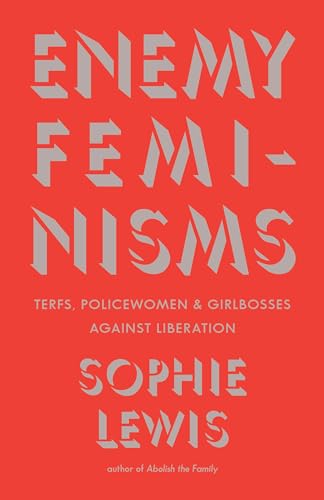
ENEMY FEMINISMS: TERFs, Policewomen, and Girlbosses Against Liberation, challenging and emotionally difficult read...necessary, too


ENEMY FEMINISMS: TERFs, Policewomen, and Girlbosses Against Liberation
SOPHIE LEWIS

Haymarket Books (non-affiliate Amazon link)
$9.99 ebook, available now

Rating: 4* of five

The Publisher Says: From the author of Abolish the Family, a provocative compendium of the feminisms we love to dismiss and making the case for the bold, liberatory feminist politics we’ll need to stand against fascism, nationalism, femmephobia, and cisness.

In recent years, “white feminism” and girlboss feminism have taken a justified beating. We know that leaning in won’t make our jobs any more tolerable and that white women have proven to be, at best, unreliable allies. But in a time of rising fascism, ceaseless attacks on reproductive justice, and violent transphobia, we need to reckon with what Western feminism has wrought if we have any hope of building the feminist world we need.

Sophie Lewis offers an unflinching tour of enemy feminisms, from 19th century imperial feminists and police officers to 20th century KKK feminists and pornophobes to today’s anti-abortion and TERF feminists. Enemy feminisms exist. Feminism is not an inherent political good. Only when we acknowledge that can we finally reckon with the ways these feminisms have pushed us toward counterproductive and even violent ends. And only then can we finally engage in feminist strategizing that is truly antifascist.

At once a left transfeminist battlecry against cisness, a decolonial takedown of nationalist womanhoods, and a sex-radical retort to femmephobia in all its guises, Enemy Feminisms is above all a fierce, brilliant love letter to feminism.

I RECEIVED A DRC FROM THE PUBLISHER VIA EDELWEISS+. THANK YOU.

My Review
: Oh dear. Another excellent, necessary message to everyone in the US lost to a wide audience. I'm in the choir and I still felt hectored, lectured at, and blamed personally by the author's tone.

I did not enjoy the experience.

I can't fault Author Lewis's collection of facts or her citations. Capitalist feminism is indeed a huge existential threat to women's rights. I'd say, however, that the Cult of Mother needed a much, much more savage pounding than capitalism receives. Apparently not one of the author's targets, though, in spite of being so ready to condemn the woman-controlling bodily autonomy denial of abortion restriction.

I question how effective the chapter against "girl-boss" glamorization really is. It's gendered, but is this not a case where celebrating the still-rare sight of women in control of their economic future, and the economy in general, not worth it? I don't think this is the threat to female equality it's presented as, but it's certainly made me consider the issue in a new light. Which, come down to it, is the great strength of this book and books like it, as well as the reason I give it four stars.

So it's style, not substance, that I find unwelcoming and unpleasant. That does not mean I didn't take a lot of positive information, and a hefty amount of psychic homework, away from the read. I found her challenging the hidden enemy in us all bracing and grounds for a lot of self-reflection. Ironic given my whinging about her tone, I know, but in a review for readers I'm not aiming for critical standards of an essay but information, and I hope a shove to get it and read it, for the laity.

Monday, December 16, 2024

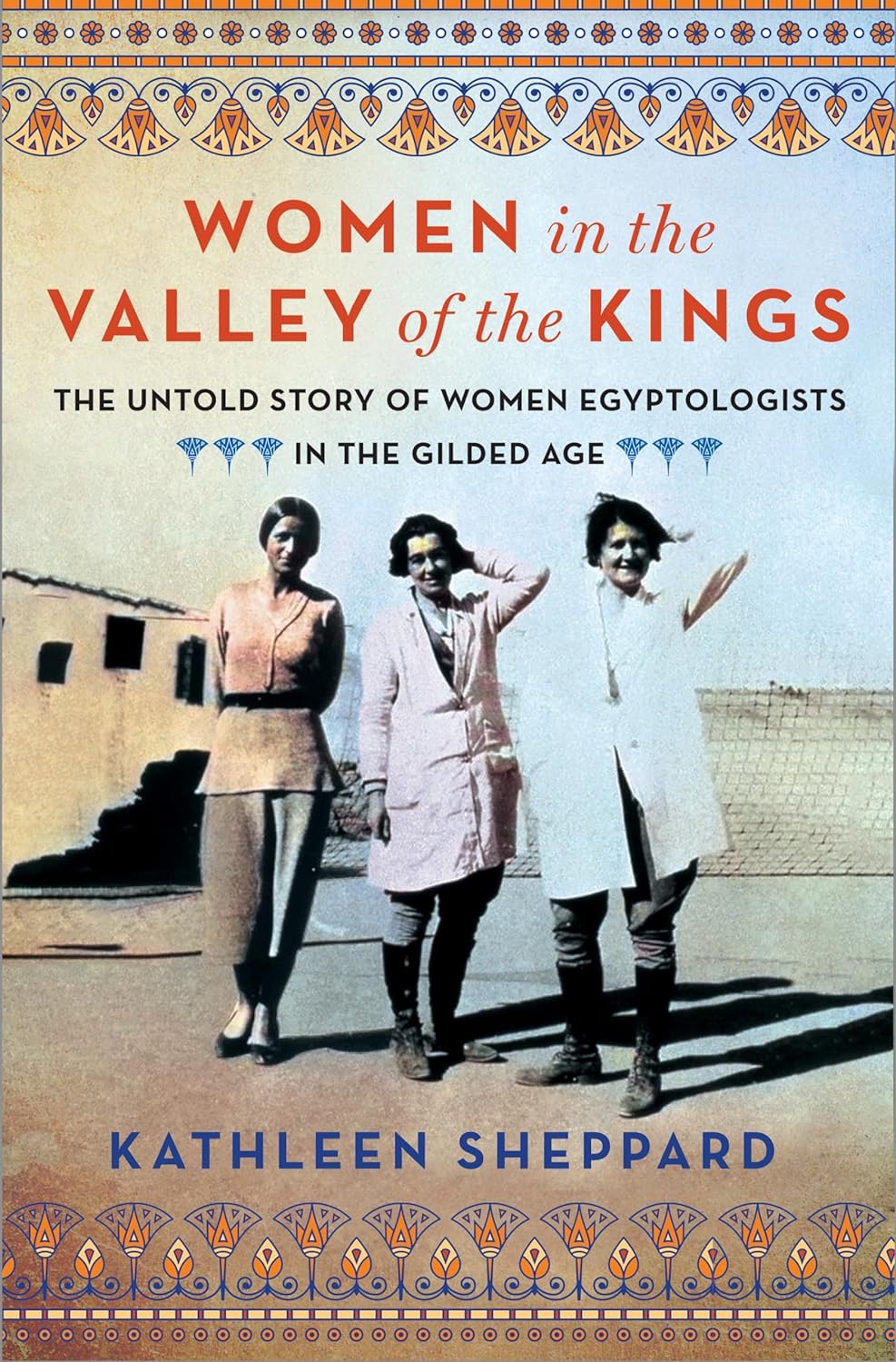
WOMEN IN THE VALLEY OF THE KINGS: The Untold Story of Women Egyptologists in the Gilded Age, well worth your effort to be amazed at your foremothers' strength


WOMEN IN THE VALLEY OF THE KINGS: The Untold Story of Women Egyptologists in the Gilded Age
KATHLEEN SHEPPARD

St. Martin's Press (non-affiliate Amazon link)
$30.00 hardcover, available now

Rating: 4* of five

The Publisher Says: The never-before-told story of the women Egyptologists who paved the way who paved the way for exploration in Egypt and laid the groundwork for Egyptology

The history of Egyptology is often told as yet one more grand narrative of powerful men striving to seize the day and the precious artifacts for their competing homelands. But that is only half of the story. During the so-called Golden Age of Exploration, there were women working and exploring before Howard Carter discovered the tomb of King Tut. Before men even conceived of claiming the story for themselves, women were working in Egypt to lay the groundwork for all future exploration.

In Women in the Valley of the Kings: The Untold Story of Women Egyptologists in the Gilded Age, Kathleen Sheppard brings the untold stories of these women back into this narrative. Sheppard begins with some of the earliest European women who ventured to Egypt as travelers: Amelia Edwards, Jenny Lane, and Marianne Brocklehurst. Their travelogues, diaries and maps chronicled a new world for the curious. In the vast desert, Maggie Benson, the first woman granted permission to excavate in Egypt, met Nettie Gourlay, the woman who became her lifelong companion. They battled issues of oppression and exclusion and, ultimately, are credited with excavating the Temple of Mut.

As each woman scored a success in the desert, she set up the women who came later for their own struggles and successes. Emma Andrews’ success as a patron and archaeologist helped to pave the way for Margaret Murray to teach. Margaret’s work in the university led to the artists Amice Calverley’s and Myrtle Broome’s ability to work on site at Abydos, creating brilliant reproductions of tomb art, and to Kate Bradbury’s and Caroline Ransom’s leadership in critical Egyptological institutions. Women in the Valley of the Kings upends the grand male narrative of Egyptian exploration and shows how a group of courageous women charted unknown territory and changed the field of Egyptology forever.

I RECEIVED A DRC FROM THE PUBLISHER VIA NETGALLEY. THANK YOU.

My Review
: There's a reason workers are called that. They do the many practical tasks that make discoveries whose credit is assigned to some colonial "master" for the purpose of making "history"; never have I typed his story with more bilious growling.

Kathleen Sheppard does a lot for my mood by not focusing on the colonial "mistresses" shall we say without some acknowledgment of the role of the normally so unacknowledged as to be invisible workers. There is a kind of grim humor in these men and women vanishing into the role of shabtis. I don't know that this term, or even this concept, had made it into Egyptology by the time Author Sheppard writes about (c.1880–1930). I found it...ironic.

Now, to be clear, none of the women under discussion were free of colonial mentality, some more than others. As people experiencing a pretty dramatic regime of prejudice themselves, with belittlement, credit-grabbing, and harrassment their daily lot, one would like to imagine they would be sensitized to the issue of discounting another's labor based on irrelevant externalitites. Alas, real life seldom shows a smooth face to the future.

One thing I was surprised to learn was that not all the men working in Egyptology were abusive in the various ways it was possible for them to be. Few of them hurdled even that low bar, but it was positive that a few did. I myownself wonder if the utter novelty of learning about the ancient culture and its rules, its people, and its existence in relation to its peers for the very first time in thousands of years didn't have some damping effect on them...can't lord it over others when you yourself know so very little. I know it will surprise no one that many tried the tack anyway.

Author Sheppard took time to delve into lives of some women more than others, which is down to survival of records...look at the notes. I'm also unsurprised at the presence of many of my lesbian siblings in these ranks. If there's a place people can be found doing hard, intellectually rigorous work, my siblings will be there and in the forefront as often as not. In dealing with these women's personal lives Author Sheppard is without period-appropriate coyness or reticence, thank goodness. The world has changed for the better in so many ways since the time we're discussing. This is a huge one: Being queer is fairly unremarkable now. It's this reality that makes the hate-filled control freaks so damn mad.

What that leads me to is, in fact, the source of my missing star on the book's rating. It's a terrific breeze of openness and transparency to have the lives, not just the work, of figures from the past openly discussed. It's inevitable that some deeply uncomfortable details emerge, like one woman's husband getting physical with her when she was twelve and he twenty-three, tolerated by her mother in full knowledge of it because she fancied the man herself. *ew* But these are all presented in a way that I found more than a bit irksome. Nothing like an internal chronology of a woman's life is followed, only the general structure of chapters being about one woman in the main, and other women's entries and exits from her story are handled as they arise not placed aside as references to that other woman's chapter (eg, "See chapter 77, page 666"). The narrative thrust of following one story is thus squandered in Wikipedia searches and/or note-taking. It does leave me a bit bumfuzzled as to who in the publishing house signed off on such an organizational idea.

It's a genuine complaint, but the truth is most of these women were unknown to me at all, even as names, so honestly I'd've been doing that searching anyway. In a few hundred pages about one of the most explosive developmental regimes in the entire course of historiography and archaeology as disciplines, and the birth and exponential growth of Egyptology, this was going to be the case.

So don't take this as code for "avoid this read" but as an urging to do the opposite. Get this book and start appreciating that, when our parents, grands, and greats were kids, Humanity was first learning about the people of the distant past in their own fragmentary words, and from their own uncovered material possessions. Author Sheppard has brought the palpable excitement of the women who were there, whose presence and guidance made much of the progress we now stand in top of to look still deeper into the past from the mountains their work made.

It was a flawed, slightly disorganized book, but so was the story its subjects were busy living. A strong recommendation for a self-gift to enjoy on #Booksgiving.

Friday, December 6, 2024

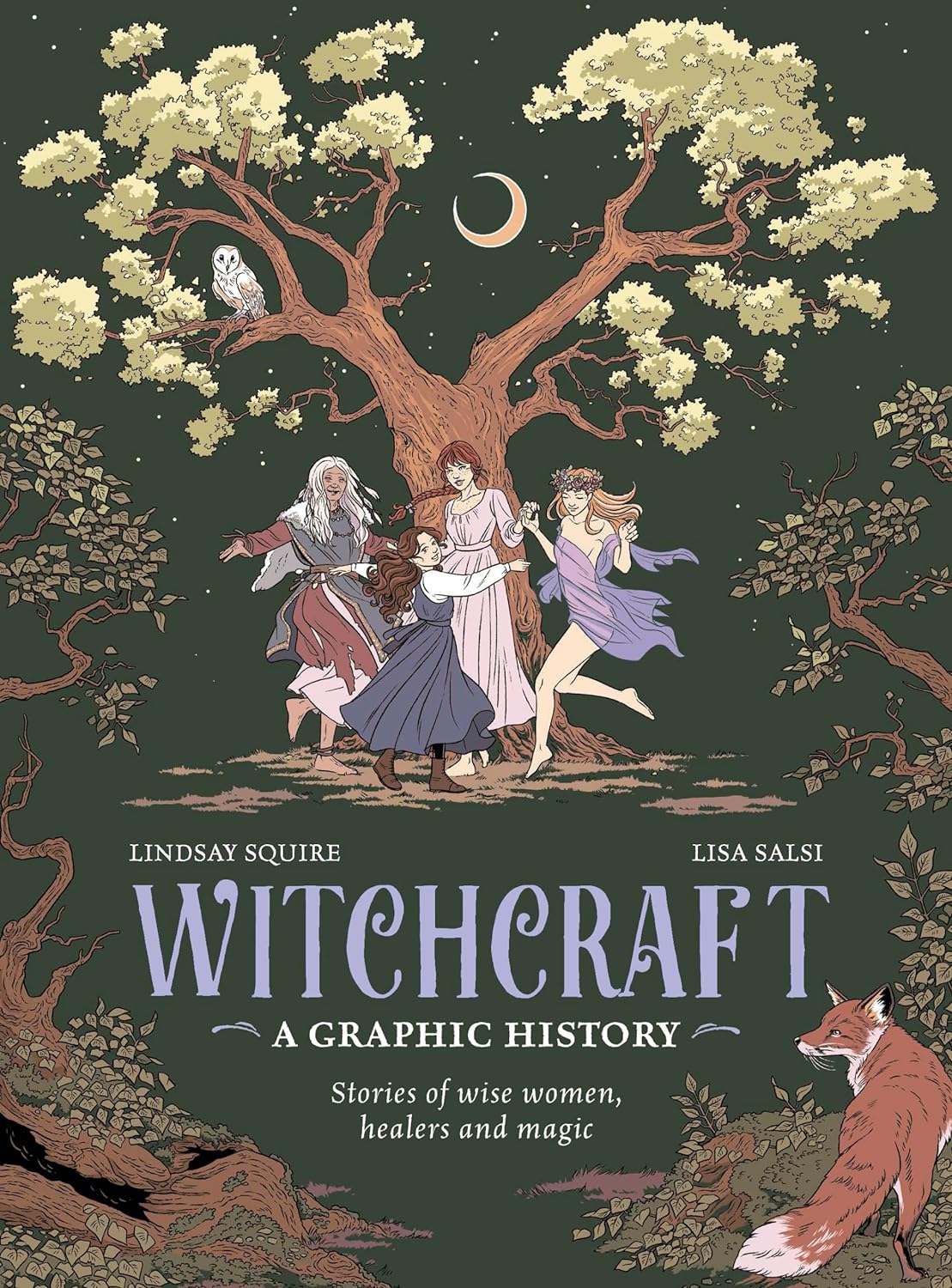
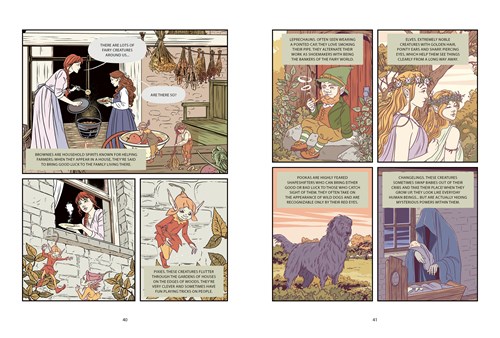
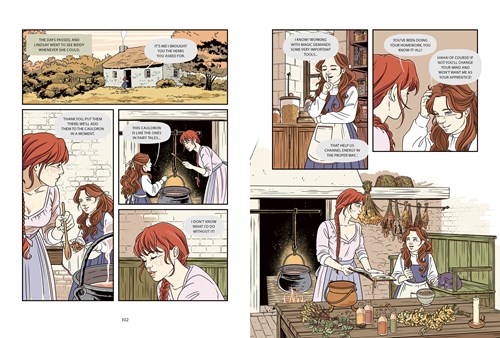
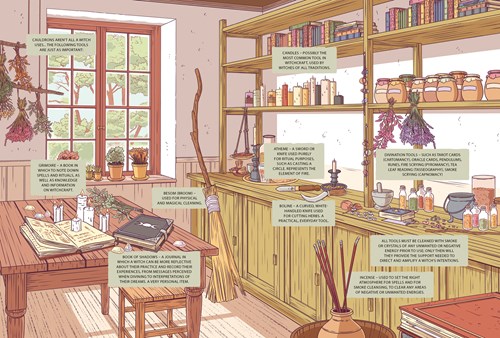
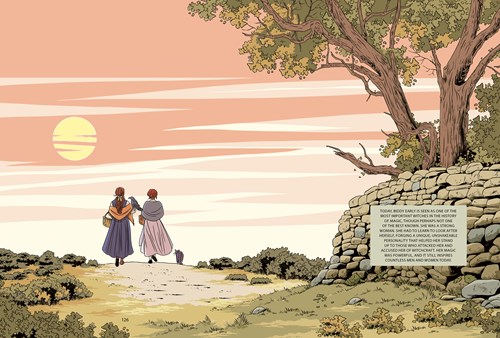
WITCHCRAFT: A Graphic History, Stories of wise women, healers and magic, beautiful book to gift the young Wiccan on your list


WITCHCRAFT: A Graphic History, Stories of wise women, healers and magic
LINDSAY SQUIRE
(illus. Lisa Salsi)
Leaping Hare Press
$19.99 hardcover, available now

Rating: 5* of five

The Publisher Says: Discover the enchanting character and story of Biddy Early, the first known witch in herstory as she guides us on a magickal journey.
'Every witch uses her magic differently. I use mine to heal people, while others ...' 'What do the others do!? Are there many different types of witches!?'
'Oh yes! Many ...'
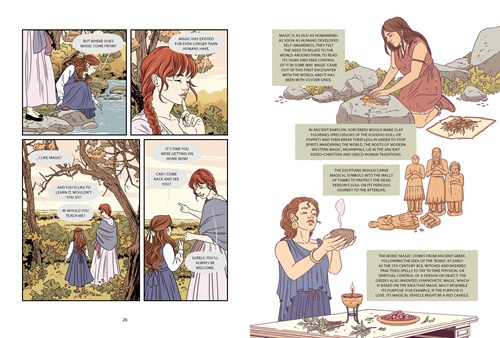
Join Lindsay, a young and curious 19th-century lady, as she meets Biddy Early, the famous 'wise woman of County Clare', and learns all about the magickal arts—from which plants can be used to make healing poultices and potions, to how people dealt with the social and political stigma of practicing witchcraft.

Biddy Early, who lived from 1798–1874 in Ireland, was by no means the first-ever witch, but she was the first to appear on the historical record. Before her, fears and superstitions surrounding practitioners of 'the nameless art' were too strong. It is said that Biddy took an apprenticeship with the 'good folk', sidhe or faeries, when she was very young, and it was from them that she learned her skill as a healer.

Never one to accept monetary payment for the help she offered, Biddy would often swap home-brewed alcohol for her services, which in turn, made her ramshackle cottage in Feakle a hub for the local community. When her little corner of the county drew the attention of the Catholic Church and the local authorities, things became very difficult for this unusual woman…

Encompassing self-empowerment, feminism, dealing with stigma, and eco-spirituality, as well as plant magic, traditions, and green wisdom, Witchcraft: A Graphic History is a fresh take on an endlessly fascinating subject.

I RECEIVED A DRC FROM THE PUBLISHER VIA EDELWEISS+. THANK YOU.

My Review
: I cannot imagine anyone reading one of my reviews really needs telling that magic is a way of understanding the world. It is appealing to younger folk because the evidence all around them shows up the manifest, and manifold, failures of their elders' way of comprehending the world.

The appeal of witchcraft to young women is, in my view, down to its offer of a power unshared by the majority (that works overtime to lock them out of possessing and using more conventional forms of power). As the parlous state of affairs in the modern world needs new and different viewpoints and uniquely nature-centered ideas to escape the dual traps of materialism and capitalism, this book suggests itself as a wonderful corrective.

I'm quite enamoured of the art. YMMV on that score, but I hope anyone reading this is already on board with the truth that seeing one's self and one's identity in the mirror of the past is deeply healing and invaluably enriching and validating.

As a #Booksgiving gift, I hope you'll agree that this is a worthy goal. As an object to possess, a book to put on the coffee table, this is a statement of your belief in, and faith offered to, a way of understanding the world through a woman's eyes. Positive gynergy emanates from this book in a glorious nimbus.

Trade some treasure and some time for this peace-spreading book.

Wednesday, March 2, 2022

DREAMING OF ROSE: A Biographer’s Journal, a deeper dive into the life of a pre-feminist ikon of independence


DREAMING OF ROSE: A Biographer’s Journal
SARAH LeFANU

Handheld Press
$9.99 Kindle edition, available now

Rating: 4* of five

The Publisher Said: The companion to Sarah LeFanu's biography of Dame Rose Macaulay.

Dreaming of Rose: A Biographer’s Journal is a fascinating account of a biographical quest and of a personal journey. While working on her biography of the writer and traveller Rose Macaulay, Sarah LeFanu kept a journal that charts the details of that quest: the people she met, the places she visited, and her strange dreamworld encounters with the very subject of her biographical pursuit.

Research trips to Varazze in Italy to look for Rose’s childhood, and to Trabzon in Turkey to find traces of The Towers of Trebizond, were remarkably intuitive ventures that found treasures in unexpected places.

Dreaming of Rose is also a memoir of a woman juggling the demands of teaching, research and writing while patching together a living. LeFanu’s work on Rose was squeezed in between many other commitments and responsibilities: she wrote for the BBC and taught creative writing and English literature. Suffused with the tensions and dramas of everyday life, and the necessity for intellectual integrity, this is an important memoir of women and writing.

I RECEIVED A DRC FROM THE PUBLISHER VIA EDELWEISS+. THANK YOU.

My Review
: Do you watch the end-credits of films? Are you by nature (or nurture, can't be sure which) a completist? Is the world a maze of maddening omissions and lacunae that you *know* were worth including but simply got...left behind?

My friend, do I have a reading experience for you!

I'll begin my praise for this book with things that will cause Some Eyebrows to rise like theatre (note: misspelling intentional) curtains: 1) I am a man; 2) I am an American; and 3) I am utterly ignorant of Rose Macaulay as anything except the author of Towers of Trebizond and its utterly mesmerizing, loathsome Father Chantry-Pigg, that personification of Religion in all its malevolent, seductive self-righteousness. There was, I am now aware, a LOT more to Rose Macaulay than I ever knew.

And the weird part is that I never knew that I never knew this entire life existed. Macaulay doesn't get a lot of public mention, though goodness knows it seems she should. Author LeFanu wrote an entire biography of Macaulay (non-affiliate Kindle link), for heavens' sake! And how I wish I'd read it first....

What makes me say that about a read I'm rating four stars, you could reasonably ask. Well, it's this simple: While this is not a book about Rose Macaulay, it *is* about the author's quest for her life and doings. The fact is that Author LeFanu went down several rabbit-holes in her quest to comprehend the life of a very, in fact a notoriously, private person. Had I had a sense of Macaulay's trajectory (beyond reading a single, late work of fiction by her) I would've had a frame of reference to put the anecdotes into. The challenges of LeFanu's quest would've felt more immediate to me had I had the recent experience of learning Macaulay's life's details.

I liked the read a lot. I wanted to know what the heck was going on to cause Author LeFanu to have these specific collywobbles, so I would've benefited from reading her biography of the writer...and that is something I shall now do. I will, as I've only recently read this fascinating companion to the main book, have an even richer experience of the read.

I urge the read on anyone who thinks the conundrum of living life and making art has one correct answer.

Sunday, April 1, 2018

MISS MORISON'S GHOSTS, proof yet again that women face higher hurdles than men


MISS MORISON'S GHOSTS; aka GHOSTS OF THE TRIANON: The Complete "An Adventure"
C.A.E. MOBERLY and ELEANOR F. JOURDAIN

Miss Morison's Ghosts
Internet Archive 1913 illustrated edition

The Book Description: This is the true story of two Englishwomen getting caught up in one of the most fascinating and inexplicable "time travel" experiences ever recorded. After travelling down to the grand French palaces of Versailles, they proceed to take a walk along the various pathways and gardens outside, only to lose their way and on top of that, get lost in a time warp, literally. It takes them back in time to the palace gardens at the time of the French Revolution and to a face-to-face confrontation with Marie Antoinette, among others. No, this is not fiction, it purports to be fact. The two women, both prominent academics, give us a very convincing and staggering account of their claims. This book is their clear and thought-provoking explanation of exactly what happened to them. Were they mistaken? Was it a hoax? Was the experience real? You decide. This is a truly fascinating book, which quickly sold 10, 000 copies when it was first published. Here it is back in print again at long last.

The Film Description: Two British women claim to have been thrown into a time warp where they saw Marie Antoinette as they were strolling through the gardens at Versailles Palace in France. After they tell their story to a psychic society, they find themselves the objects of derision and their jobs are threatened.

My Review:

Monday, August 7, 2017

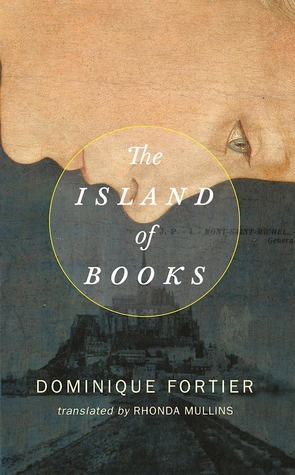
THE ISLAND OF BOOKS, romantic historical escapism


THE ISLAND OF BOOKS
DOMINIQUE FORTIER
(translated by Rhonda Mullins)
Coach House Books
$15.95 trade paper, available now

Rating: 4* of five

The Publisher Says: The library at Mont Saint=Michel was once known as the city of books. It is there, within the grey walls of its monastery, that a portrait painter grieving the sudden death of the woman he loved finds refuge. And it's there, between the sea and the sky, five centuries later, that a novelist tries to find her words again. They meet in the pages of a notebook left out in the rain.

Like the manuscripts out bereaved—and illiterate—painter is asked to copy over earlier texts, The Island of Books reveals traces of a time before Gutenberg beneath its present. With all the passion and intellect we've come to expect from her, Dominique Fortier offers us a moving homage to books and to those who write them.

***I RECEIVED THIS REVIEW COPY FROM COACH HOUSE PRESS AT MY REQUEST. THANK YOU!***

My Review: Exquisitely rendered grief. Author Fortier is outstanding at making the experience of life-altering grief full and real:
Seen from above, the monks all looked like with their brown cowls, the pale halos of their tonsures on the tops of their heads. They were small and interchangeable.


Friday, March 31, 2017

FINDING DOROTHY SCOTT, belated light on a valorous unsung woman hero


FINDING DOROTHY SCOTT: Letters of a WASP Pilot
SARAH BYRN RICKMAN

Texas Tech University Press
$24.95 hardcover, available now

Rating: 4* of five

The Publisher Says: More than eleven hundred women pilots flew military aircraft for the United States Army Air Forces during World War II. These pioneering female aviators were known first as WAFS (Women's Auxiliary Ferrying Squadron) and eventually as WASP (Women Airforce Service Pilots). Thirty-eight of them died while serving their country.

Dorothy Scott was one of the thirty-eight. She died in a mid-air crash at the age of twenty-three.

Born in 1920, Scott was a member of the first group of women selected to fly as ferry pilots for the Army Air Forces. Her story would have been lost had her twin brother not donated her wartime letters home to the WASP Archives. Dorothy's extraordinary voice, as heard through her lively letters, tells of her initial decision to serve, and then of her training and service, first as a part of the WAFS and then the WASP. The letters offer a window into the mind of a young, patriotic, funny, and ambitious young woman who was determined to use her piloting skills to help the US war effort. The letters also offer archival records of the day-to-day barracks life for the first women to fly military aircraft. The WASP received some long overdue recognition in 2010 when they were awarded the Congressional Gold Medal-the highest honor that Congress can bestow on civilians.

THE PUBLISHER PROVIDED A REVIEW COPY AT MY REQUEST. THANK YOU!

My Review: It's amazing the depth and breadth of my ignorance about women's roles in military history. As World War II cranked up, the need for planes to get from where they were built to the place they were needed grew critical. Men had been ferrying the planes for the Army Air Force before open hostilities broke out. Naturally enough, these men were needed as combat pilots after Pearl Harbor was attacked, since they had the proper gentialia to be fighters. That left a vacuum for women to fill, much like wartime exigencies made in so many industries and walks of life.

That much I'd sort of assumed. I had no notion of the roots or the branches of the womens' role in this vital area of military endeavor. We've probably all heard of Amelia Earhart because she died on that round-the-world flight. But the world she came out of, the raw, rough early flying days, had plenty of women piloting these primitive fabric-and-wood crates in air circuses and barnstorming shows and everywhere there was flying to be done. Unsurprisingly, these were the women who filled the ranks of experienced flyers training raw recruits as the Army Air Force lunged to the limits of physics getting planes built, trained in, flown, and all around the town to coin a phrase.

I, to my surprise, was surprised. Logically the use of the women whose aerobatics were skilled from surviving the flying entertainment industry is no leap, but I just didn't know such a thing had existed. So score one for Author Rickman, a dedicated scholar of the WASP and WAFS, in the educate a man column. Score another one for making a couple thousand words bringing the whole readership up to speed so efficiently without missing a chance to entertain us with anecdotes from the era. I was sure, then, from the earliest pages of this book, that I was going to enjoy learning about Dorothy Scott and her world.

She was brought into the world by weird parents; her mother was well past thirty when she married her father, a man slightly her junior who was what we would now call a serial entrepreneur. For the early, World War I, days of their marriage, the Scotts lived on a fishing boat sailing between Alaska and Seattle. G.M. Scott bought the boat to make his fortune. Then sold it because he made his wife pregnant a second time, and the mere idea of two adults, a baby, and a three-year-old on a working boat made me claustrophobic 100 years later. It turned out to be an extra-good idea because the baby was twins, Dorothy and her brother Ed.

The boat morphed into a Ford dealership in rural Washington State. (I'm still chuckling over a man known as "G.M." to all and sundry selling Fords.) The three Scott siblings were shown the value of turning your hand to anything that needs doing; their family survived the Depression well enough for all three to discover a shared love of flying that led all of them to enter the Army Air Force or its equivalent, the WAFS, as soon as WWII started. What failed was the parental Scotts' marriage, as Mrs. Scott left rural Washington to settle in Los Angeles to be near a sister, apparently preferring this to being near a husband who "had a well-recognized temper."

Dorothy Scott was a lovely young woman, as the ample illustrations in the book demonstrate. She was as conventional as her parents: until she was accepted for WAFS training she was a flight instructor after not-quite graduating from college. Her father, concerned for the future of his clearly unusual daughter, had wanted her to enter the business world. That was out when her one, and I get the feeling from what's not said half-hearted, stab at it failed to pan out. Reading this passage from one of Dorothy's letters home to him, I think G.M. probably realized that the best solution to a problem is, sometimes, the least ordinary one:
Then we climbed in BTs [Basic Training planes]...To do it up right, we made a formation take off between smudge pots lining the runways. Remember, it was night! Oh pop, I'll never in all my life forget that ride! There we were nearly touching the next plane and guided only by small lights [on each plane] and the flare of the exhaust.

I was so busy watching the next plane that for a moment I forgot to look around, but soon I did, and the rapidly fading field looked like a million small fires.

We cruised in close formation for quite a ways, then we separated some. All of a sudden—swish, and we were in a snap-roll! I'd tightened my belt but did it even more, and from there to Memphis I had trouble telling when we were right side up and when we weren't. Loops, slow rolls, Immelmans, and everything else kept me plenty on the jump. I've never had such a ride. It was a very clear night but dark so the stars above looked a lot like the small clearing fires below and I had to check the instruments to believe anything.
The young woman penning those lines was never, ever going to be a stewardess or a housewife or a secretary. She was not built for those things, she was built to fly airplanes and be in the sky away from ordinary life.

And so it is, perhaps, for the best that a transition from the exciting and important flying life that Dorothy led until 3 December 1943 was unnecessary. Dorothy died in a terrible, pointless training accident as she was beginning a new flying skill: Pursuit aircraft, the powerful fighter planes that feature so heavily in war movies! How she would have loved that phase of her career. How incredibly poignant that, while she was taking her first steps on that path, an error in a control tower where she knew no one yet cost her, her trainer, and another pilot their lives.

Not to mention three mothers. Three fathers. Unknown numbers of siblings, spouses, cousins, aunts...death doesn't stop taking. It is so very unfair.

Now, listen carefully: Author Rickman made me care enough about this long-gone lady, that enthusiastic and engaged and excited young woman on her way up in her career and her life, that I sniffled a little when reading about her death. In a biographer, that level of nice and accurate rendering of the subject is a gift. Since this is not the first WASP biography from her, I suppose the author's skills in reanimating this long-gone world and its already collected stakes are in fine fettle from use and experience. But still, this was more than I expected when I saw this title while researching possible Women's History Month review subjects.

I've read other books published by Texas Tech University Press, and have liked each of them. A collection of short fiction largely set in the part of South Texas I'm from; a novel of the Plains Indians; a story of the settling of the part of Central Texas I grew up in. Each one was an excellent reading experience, and I'm very pleased to add FINDING DOROTHY SCOTT to their ranks.

Thursday, March 30, 2017

THE OTHER EINSTEIN, the reconstructed life of the first Mrs. Einstein


THE OTHER EINSTEIN
MARIE BENEDICT

Sourcebooks Landmark
$25.99 hardcover, available now

Rating: 3.5* of five

The Publisher Says: A vivid and mesmerizing novel about the extraordinary woman who married and worked with one of the greatest scientists in history.

What secrets may have lurked in the shadows of Albert Einstein’s fame? His first wife, Mileva “Mitza” Marić, was more than the devoted mother of their three children—she was also a brilliant physicist in her own right, and her contributions to the special theory of relativity have been hotly debated for more than a century.

In 1896, the extraordinarily gifted Mileva is the only woman studying physics at an elite school in Zürich. There, she falls for charismatic fellow student Albert Einstein, who promises to treat her as an equal in both love and science. But as Albert’s fame grows, so too does Mileva’s worry that her light will be lost in her husband’s shadow forever.

A literary historical in the tradition of The Paris Wife and Mrs. Poe, The Other Einstein reveals a complicated partnership that is as fascinating as it is troubling.

THE PUBLISHER SENT A REVIEW COPY AT MY REQUEST. THANK YOU!

My Review: Marie Benedict, I salute you. The decision to tell the story of Albert Einstein's first wife, physicist Mileva Marić, and her intense intellectual beginnings fading into parental tragedy, emotional aridity, and ultimately humiliating drudgery, was bold beyond belief. There was quite simply no way on this wide green earth to make everyone with an interest in the story happy. Many would be satisfied with nothing less than a jargon-laden, drily scientific reconstruction of the potential/probable debates the couple most likely had. Others would faint from terror at the mere mention of names like Boltzmann, Mach, Drude, et alii. The line Benedict chose to tread was weighted in favor of broad strokes on all fronts. Imagine a woman...an Eastern European woman...arriving at one of the world centers of scientific inquiry at all, at a time in history when women had no vote to cast, no right to own property, and the very real risk of dying in socially mandatory childbirth across the entire world.

That was Mileva. Really, that is all that must be said of her. She was so exceptional that she arrived in this place at all, held her own academically, and but for meeting a charming rogue who wiled her out of her virginity and thus her rightful place in the world, might well have been as much a name to conjure with as Madame Marie Curie. Benedict does this by whisking us through the social life of Mileva's bluestocking buddies as they have musicales and climb local beauty spots, the whirl of cafe society among Mileva's male colleagues as they discuss and dispute their subject's roil and ferment over coffee, introducing us to the extraordinarily supportive Serbian father whose dreams and fears for Mileva come through his comparatively few actual lines. All in barely a hundred pages.

It is the fate of any author telling a private person's personal story to be an inventor. Dialogue can't be anything but invented. Letters, especially in the Belle Epoque, can (if Clio so wills it) be found and either quoted or digested, but Life isn't a novel and so doesn't offer the precise words needed for dramatic purposes. After all, fiction is a bunch of lies that, properly stuck together, make the truth undeniably visible to all. Benedict has very clearly made her way through a great deal of research material and has selected from the piles, stacks, boxes, shelves those moments and matters and words that best fit her plot.

The saddest part of the above, to me, is that she wasn't required to do very much discarding or eliding to make Albert Einstein into a proper shit of a man. The daughter he never saw, born out of wedlock because his harpy of a mother wouldn't countenance Mileva as a wife for her unemployed wastrel of a darling, was only the beginning of a life-long pattern of verbal abuse...there exists a letter from him to Mileva listing an appalling, humiliating list of conditions she must follow to be allowed to remain with the Great Man...and emotional neglect that extended to his two sons from their marriage. Not that he was any too cuddlesome to his cousin Elsa, aka Mrs. Einstein the Second: He proposed to her younger, prettier daughter after finally wearing Mileva down into agreeing to a divorce. Wise lady said no; her mama married Einstein anyway, knowing what was what.

Mileva's later Einsteinless life was one of economic deprivation, despite the eventual arrival of the Nobel Prize money promised to her in the divorce settlement. (Her own family's economic comfort evaporated with the Austro-Hungarian Empire in the Great War.) One of her sons was schizophrenic. Investing in a Swiss boarding house didn't work out well. Mileva was born under an unlucky star, and was so very clearly an intelligent, decent human being who deserved better than she settled for in life.

She was a tragic pioneer of women's rights to a place at the table in the sciences. She was a fascinating character. She deserves to be discussed, celebrated, lauded along side her famous ex-husband, and Marie Benedict has made a sold stride in that direction by writing The Other Einstein. September is National Science Club Month, and if I were in a science club, I'd demand we read this book. There is so very much to discuss in these pages, discussions that will last well beyond the club meeting itself.

Wednesday, March 29, 2017

WHAT BECOMES US, abusive relationship escapee lands in fascinating trouble


WHAT BECOMES US
MICAH PERKS

Outpost19
$16 trade paper, available now

Rating: 4* of five

The Publisher Says: A modern-day pioneer in search of a new life, pregnant Evie leaves her abusive husband and lands in a close-knit community divided by local colonial history a story that goes deep to the roots of the American conscience. Following a near fatal accident, Evie, a mild-mannered, pregnant school teacher, abandons her controlling husband and flees Santa Cruz, California for the wilds of western New York. She rents a farm house on a dead end road in a seemingly ideal, multi-cultural community. When she begins teaching at the local high school, she becomes obsessed with an assigned book, The Captivity and Restoration of Mary Rowlandson. This early American classic is the first book written by a woman in the Americas and details Rowlandson's harrowing captivity during King Philip's War in the seventeenth century. As Mary Rowlandson's insatiable hunger begins to fill Evie's dreams, Evie wonders if she may actually be haunted. At the same time, Evie becomes obsessed with her neighbor, a married Chilean immigrant. As she grows more pregnant, her desires/hunger grows out of control, and threaten to destroy her adopted community.

THE PUBLISHER SENT ME A REVIEW COPY AT MY REQUEST. THANKS Y'ALL!

My Review: Micah Perks has some big brass ones. It's not every novelist, even one whose previous novel received a lot of praise, who would choose to narrate her novel of a woman's decision to take her own power back from a controlling and very unempathetic man from the point of view of the couple's unborn twins.

I do believe we have a new narrative option for future writers: Multiple third-person unborn.

Add into this the author's tale within the novel, a factual historical account written by the captured and enslaved Mary Rowlandson (a white woman) during King Philip's War. A tale that's apparently also a portal, kind of a non-Potterverse Horcrux, as Evie (our uterus-bearer) travels (?--the "dreams" Evie has are, well, you decide when you read the book) into the time Mary Rowlandson suffers the torments of being prisoner to the Wampanoag people's powerful Queen Weetamoo.

But Evie isn't a stranger to the feeling of being a prisoner. Her husband, so strong, so handsome, so omnicompetent, had her completely under his iron sway. He is Right; she is wrong, incompetent, weak. She can't even wipe a kitchen counter properly. It started as a willing submission on Evie's part, a sense of being coddled and protected and, in the agricultural sense, husbanded. As is so often the case, relationships founder on the rocks once used as foundations. Evie realizes she and her unborn children must not live as her husband's captives...though in all honesty, I suspect an unpregnant Evie would simply have stayed. Just my thought on the matter since the text offers no speculation on the subject.

Running away from home in a scene that's a comic parody of the classic shin-down-the-tree trope, Evie leaves the beautiful anti-Paradise of Santa Cruz and lights out for the territory. In this case the territory is upstate New York, an obscure corner of same, populated by crazies, eccentrics, and people who probably shouldn't be given the vote. It's perfect for Evie. She even stumbles across the perfect house in the first minutes of her presence in Lonely Rincon Road:
She shuts the door and examines it, no lock, loose in the frame. She rests her hand on the crack between the door and the wall and feels that cool, moist, radon-breath on her palm. This basement is the only part of the house she dislikes. Californians don't have basements. She doesn't like the idea of the ground underneath a house hollowed out, destabilizing the whole structure. She duct tapes stiff old sponges she finds under the sink across the crack between the basement door and the floor in hopes of sopping up the radon before it enters the house. Then she pulls a strip of the duct tape across the door to the wall.
Perfect! Across the street from an unsettlingly handsome Chilean immigrant, his felonious war-protester wife (this is set in the first Bush administration), their headstrong young daughter, his super-Christian brother and that family of wackos (the normal one ran away to New York City so they pretend she's dead), his wife's ne'er-do-well brother and sons (Juniper, their mom, is Not All There and wisps through the narrative like really good hash smoke); well, you get the drift. And the house, radon-filled basement and all, is Evie's dream. Her husband is a continent away and unlikely to think of looking for her where she is; she's left no clues she can avoid leaving to lead him there.

Add in Evie's job at the local high school and the elements are there for a darn fine life.

Stories wither and shrivel without conflict. The conflict on Lonely Rincon Road centers on Narrative of the captivity and Restoration of Mrs. Mary Rowlandson. Evie encounters the book for the first time as she prepares to teach high school history in place of a fired Evangelical friend of her nutty Christian neighbors. His take on the book was, shall we say, not to community standards. Evie has a much more disturbing relationship to the book.

She's possessed by Mrs. Mary Rowlandson. They're dreams, thinks Evie, who has developed perinatal somnambulism. They're dreams so vivid they come to life in her mind in ways the book she's reading and teaching cannot possibly record:
Then it's grey morning, and Sarah has disappeared.

Mother rises up. She feels light, light in her body, light-headed, achingly stiff and run through with panic. She rushes hither and thither, asking everyone what have they done with her child, her papoose. Sarah, her baby? She rocks her arms to show who she means.

Finally, someone points to the ridge above the village and mother climbs up there and finds the grave. She places her hands on the fresh dirt. She thinks, Don't leave me here alone. She will dig Sarah up, and she even pulls up a fistful of dirt to begin, but then she stops.

When Mother rises this time, she is a hollow thing, a ghost thing, a thing filled with air. She can imagine herself a dandelio gone to fluff, blown by her little girl's last breath, dissolving into a thousand separate seeds each with its own wing to fly off the ridge and away.
Remembering that the book is narrated by Evie's unborn twins explains the use of "Mother" and remembering that the dream being narrated is accompanied by sleepwalking and remembering...hell, don't remember anything, just read that passage and tell me you don't *get* in the depths of your guts the horror of a parent losing a child. That Evie is given this vision or transported to this moment in history, or however you choose to construct it in your reading, while pregnant with twins, tells the true story here. Evie is a terrified emotional cracked vessel. Evie, whose waking time teaching the teenagers of her neighbors is fraught with the usual angst and rage teens bring; whose nights are spent unkowingly wandering, possibly stealing but certainly taking others' belongings; whose undivorced ex looms in every thought she has about the men in her world; whose sanity just might be slipping away from her, is kept at just the right distance from the reader by the unborn twin narrators:
Holding her belly with one hand she hurries down the stairs in her long nightgown, through the living room, bangs painfully into the table with her hip, pulls open the door, and rushes into the spindly woods. She stumble-runs for a while, then finally stops, leans against a smooth grey beech tree, trying to catch her ragged breath. She leans her head against the slim trunk. She can see a bit of moon through the trees. She presses into her belly again, and again she feels us, something that is not her inside her. She can't stop smiling and poking at us. It's a wild, satisfied animal smile. She thinks, How good not to be caught in Joan's bedroom, how good here in the woods. How good my babies are both alive, and they lived under my ribs. She begins to walk again, humming one of those songs she'd taught to her students in California. This land is your land, this land is my land, it was made for you and me. She sings off key, and fiercely.
Like all the best ghost stories, this one is rife with funny moments...a Passover seder that's a hoot, a wardrobe malfunction whose hilarity leads to a sad and poignant moment with the religious family's denial and prudery; and the spooky but (to me, anyway) really hilarious ending of the novel, all meet in one moment which demonstrates that Micah Perks has big, big brass ones like I told you up top. Nothing is resolved, like in life, just gears shifted and four-wheel-drive mode engaged as all Perks' characters experience massive, painful, life-altering transformations in the circle of a fire on a beautiful night.

Welcome to the world, y'all. It doesn't get less screwed up outside Mother's womb. But y'all are in a world enviably rich and passionately alive. Most poor suckers don't get in a lifetime even half the fun of just y'all's gestational residence in Evie!

Buy, read, laugh; think; cry; you won't be sorry.

Tuesday, March 28, 2017

AGNES MARTIN, overlooked for pop-fame but not for artistic recognition of her genius


AGNES MARTIN: Her Life and Art
NANCY PRINCENTHAL

Thames and Hudson
$39.95 hardcover, available now

Rating: 5* of five

The Publisher Says: Over the course of a career that spanned fifty years, Agnes Martin s austere, serene work anticipated and helped to define Minimalism, even as she battled psychological crises and carved out a solitary existence in the American Southwest. Martin identified with the Abstract Expressionists but her commitment to linear geometry caused her to be associated in turn with Minimalist, feminist, and even outsider artists. She moved through some of the liveliest art communities of her time while maintaining a legendary reserve. I paint with my back to the world, she says both at the beginning and at the conclusion of a documentary filmed when she was in her late eighties. When she died at ninety-two, in Taos, New Mexico, it is said she had not read a newspaper in half a century. No substantial critical monograph exists on this acclaimed artist the recipient of two career retrospectives as well as the National Medal of the Arts who was championed by critics as diverse in their approaches as Lucy Lippard, Lawrence Alloway, and Rosalind Krauss. Furthermore, no attempt has been made to describe her extraordinary life. The whole engrossing story, told here for the first time, Agnes Martin is essential reading for anyone interested in abstract art or the history of women artists in America."

THIS SPECTACULARLY LOVELY BOOK WAS PROVIDED BY THAMES AND HUDSON AT MY REQUEST. I AM DEEPLY GRATEFUL TO YOU.

My Review: Agnes Martin's life began in complexity, proceeded in complexity, and ended in complexity. She wasn't from a happy family, evidence suggesting her father's existence added little to her mother's happiness or material success; his life appears to have diverged from his family's before Agnes could possibly have known anything of him, as early as 1914 (she was born in 1912) when her mother assumed ownership of the Saskatchewan land where he brought them to homestead. The famously close-mouthed Martin spent most of her youth on Canada's West Coast, not the Saskatchewan prairie; yet it was that prairie, vast and limitless vistas defined by the unique quality of unmodulated light, that ever and always lived in her eye.

Author Princenthal's unenviable task in biographizing Martin was set early on, in that closed-mouthedness and its close relative "is this real or is it Memorex?" Can the few recorded utterances of a quiet, and often quietly under the heavy burden of mental illness...symptoms recorded by friends suggest schizophrenia dogged Martin's life, undiagnosed and gratefully not severe enough to cause outside intervention...be rationalized into a single narrative, or is it even important and relevant to make this attempt?

I myownself say no to that. I think what survives in the way of others' memories of Martin and her life and her utterances are best read, viewed, absorbed as simply as possible, representative of Martin's preferred presentation of self. Let us leave the private and inner world of the artists to the artist, accept what she said at a given moment as her truth, and recognize that her truth evolved with her spirit and her magnificent, mathematical, ultimately and beautifully spiritual artwork.
Martin's retrospective evaluation of the artwork she made during her initial years in New Mexico was categorical: "At Taos I wasn't satisfied with my paintings and at the end of every year I'd have a big fire and burn them all." ... The ouevre begins modestly, with several small watercolor landscapes strongly reminiscent of John Marin; they could be among those of which she said, "I used to paint mountains here in New Mexico and I thought my mountains looked like anthills." This is not necessarily a failure of representation. The clarity of the atmosphere in New Mexico (see above for reference to unmodulated light) does make distant mountains look deceptively close, hence oddly small, and Martin's depictions are sprightly and fresh, capturing the regal blue sky and hurrying clouds so characteristic of the high desert.
This 1947 image of Taos' mountainous amazing landscape is a rare survivor of Martin's tendency to destroy her works, a female Cronus (Crone-a? heh), when they weren't up to her demanding standards. Princenthal on this specific piece:
...a confident sketch of deeply shadowed mountains in bright sunlight, rendered with quick, precise strokes.
This is precisely how the image hits my eyes and the words could have come from my own brain; this is the moment when I began to trust Author Princenthal to lead me, not simply to inform me of facts, but lead my eyes to moments and places I would have gone to had I the erudition and the visual vocabulary to know of them. In reading a book about an artist, this sense is (for me) irreplaceable; it is akin to the feeling I get when, as a recent and deep disappointment with Edward Hoagland's latest novel demonstrated on the downside, an editor and/or author demonstrates a solid and deep grasp of detail.

Martin's early and unsatisfactory landscapes, journeyman works no doubt but fine ones indeed, gave way in her middle age...she was forty in 1952...to the Abstract Expressionist-ish work of her second round of schooling at Teachers College of Columbia University in New York. The heady art atmosphere of 1950s New York could not possibly have passed Martin by, though Author Princenthal makes plain the comparatively more conservative art culture of the college. I suppose that's inevitable in an academic setting where preparing a person for a career in art instruction is the purpose. This image is, in my eyes, one of the most Agnes Martin-ly images she produced in that time, superior in its emotional affect on me to several more derivative Abstract Expressionist canvases:
Martin spent much of her life...well into her 50s...either in poverty or damned close to it. Not so very unusual for an artist, I suppose, but I can't help but feel when I look at this huge 48" x 72" work that the cost to her for the materials must have been ruinous; and to my eye, the painting itself should have sold for Jackson Pollock money. Princenthal has this to say about the work:
More robustly narrative, Expulsion of Adam and Eve from the Garden of Eden, tentatively dated 1953, is, at 4 by 6 feet, a very large painting by Martin's standards at the time.... It is executed in oil on board, and in feeling is decidedly graphic, with delicate contours, executed in finely drawn, ink-black lines, and vaporous washes of color. The biblical narrative is given a sharp twist into what clearly seems, not the exodus of two mortals fallen from a state of grace, but the escape of a terrified woman from a powerful if irresolute man. Adam's head, outlined in profile, faces up, howling; a star shoots across the sky above him. Though reaching forward, he seems immobilized, perhaps by the horseshoe-like shapes that link his slightly bent knees. His upright form spans the surface, an anchoring column. Eve, by contrast, is in chaotic flight. Facing us, her arms wide in appeal, she is lifted up by a graceful, bounding leg, and also by a spinning, propeller-shaped foot; she appears as well to be supported by wings. Windswept green leaves adorn her back. The colors, thinly applied, are mostly pale shades of pink, blue, and white, though a bright red form scythes across Adam's midsection; flying toward his chest is what seems to be a disembodied breast. For all the inscrutability of its symbolism, the composition is powerfully integrated; its emotional register is of baffled panic, as in a dream from which the sleeper desperately tries, without success, to scream herself awake.

This 1958 work is unusual and deeply interesting to me. Martin's creation of it is structural as well as painterly. It fits my idea of Martin as an artist of space and time. The author has this insight to offer:
Without question she would come to resist, in the most vigorous terms, any suggestion that her work represented landscape, water, weather, light, or any other natural conditions or forms. But the natural allusions in titles persist for some time...what is arguably clearest, in these works of the late 1950s and early '60s, is the difficulty of giving up such references to landscape and water, of turning away from the kind of natural beauty to which she was so clearly alive, and which offered so much in the way of painterly, and emotional, resources. ...Martin was experimenting with reliefs and fully three-dimensional constructions made from materials found around the [New York] seaport. The Laws, 1958...consists of a tall, narrow wooden board (it is 93-1/2 by 18 by 2 inches) that is painted grey below and black on top; a gridded pattern of boat spikes is driven into the black field. ... "The life of the work depends upon the observer," [Martin] wrote. And, "if we can know our response, see in ourselves what we have received from a work, that is the way to the understanding of truth and all beauty."
So for all Martin's strenuous rejection of Nature as Muse, Martin the artist knew and said in words that the viewer perceives the work and derives from it the meaning and beauty that she can, and will. So while the intent was not to re-create the world on canvas or board, the perception of the viewer inarguably takes precedence over the intent of the artist. Constructions like The Laws can be seen as attempts to reject Nature but end up, at least to this viewer, evoking the very seaside that provided their materials. I don't think Martin was done with the natural world.

Martin's many years in New Mexico were a wildly mixed bag, monetarily speaking; her art never stopped its endless refining process. Sometimes it's only in deprivation that a spiritual seeker can find a way to speak her truth. Martin's explicit rejection of Nature as her muse will always ring hollow to me. She herself said, "Almost everyone believes that art is from the of the artist meaning the intellectually grasped experience. ... I want to repeat: there are no valid thoughts about art. If your sensibilities are awake you will respond."
This 1992 untitled image presents the Agnes Martin I suspect most people are familiar with. Her color planes and smooth geometry and gorgeously realized symmetry create a calm mood, a lot like looking at a Taos springtime landscape or a visit to a sunrise seashore. Agnes Martin's limitless vistas and perfectly tuned spaces, colors, shapes, and ideas are timeless...literally outside of time. Her art, in that sense, truly does reject nature as a muse. It's impossible to paint a landscape or a still life that is outside of time. Light forbids it.

Agnes Martin's endless journey into the symmetry and beauty of shape, form, geometry, and color's softest subtlest corners, really constitute a biography told in awakened images. The work absolutely perfectly reflects this summation by Author Princenthal:
The way Martin lived, the way she dressed and ate, socialized ans spent her private time, the way she furnished her homes and traveled, conformed to no one's notions of high style. She didn't wear black, she wasn't svelte or soignée. While she never owned a television (or a computer), neither did she live off the grid...She loved fancy cars and ocean liners. She liked being honored. She valued humility above all else. She was at once a consummate insider and a lifelong outsider, a devoted student of Zen and Christian mysticism, ans a sworn skeptic. She was of sound mind (and to the extent that such a state can be defined), and at times she was not. Her most reliable testimony remains her majestic work.


NOTICE All Agnes Martin artworks are copyrighted. For information on reproduction rights, contact Agnes Martin/Artists Rights Society, New York.

Saturday, March 25, 2017

CLOSING THE BOOK, essays proving the urgency of women being at the cultural table


CLOSING THE BOOK: Travels in Life, Loss, and Literature
JOELLE RENSTROM

Pelekinesis
$20 trade paper, available now

Rating: 4.5* of five

The Publisher Says: CLOSING THE BOOK: TRAVELS IN LIFE, LOSS, AND LITERATURE explores the intersection of literature and life in personal essays about traveling, teaching, reading, writing, living, and dying. Each essay's narrative arc is formed and informed by the act of reading literature that makes a reader feel like the book she's reading was somehow written specifically for her to read in that exact moment. Renstrom relies on science fiction as a catalyst for grief, as well as a means of pushing past grim realities to begin envisioning life reconstructed and to embrace the idea that "there's nothing wrong with rebuilding forever."

My Review: Joelle Renstrom, like most of us in adulthood, has lost loved ones to death. Her father died of cancer at the disturbingly young age of sixty-three (given that I'm within hailing distance of that landmark and possessed of siblings well beyond it, this perturbs my emotional orbit), her world then darkens bit by bit as more and more adult griefs mark her passage through time.

Passing through time and space is a long-term interest of Renstrom's. Her blog, Could This Happen?, is dedicated to the topic of science intersecting with science fiction. Her ruminations on the near-miraculous reach of modern technology with the humdrum existence of thee and me are well worth your eyeblinks and earhairs. As one would expect of an MFA recipient, her ruminations are fueled by reading widely and voraciously. The methodology of her processing the pain of losing her dad is also, and unsurprisingly, based on the books she has read. The processing begins with an unsurprising lens: White Noise.

A Sense of Homecoming (Don DeLillo—White Noise) rather unsurprisingly deals with an academic and his wife who fear, with irrational intensity, death. The idea of it, the fact of it, the sheer unknowable scope of death causes Jack and Babette to run from the void and directly into the unknown scientific ameliorations of death's traumas pre-mortem. Or, in other words, into the void of the unknown but outlined by the comprehensible present:
Before Dad got sick, visiting Kalamazoo and the icons of my childhood was gratifying and indulgent—it stoked my appreciation for the people and places that shaped me. Now it feels as though I've gone back to my childhood home only to find it full of crumbling plaster and frayed wires; yet my only option is to stay there, trapped between desperate nostalgia and the rapidly darkening future.
As Peter Weller famously said in "The Adventures of Buckaroo Banzai," "after all, no matter where you go, there you are." We bring with us all the associations of happier or sadder times to every physical place we inhabit no matter how temporarily. When we're at our least profound passages we're still moving towards death and consuming the life we've got in making sure death is held at bay:
The supermarket is a recurring location in White Noise. All those people pushing carts, contemplating trying to right the squeaky wheel that keeps veering left, buying things they think will keep them alive. All those people I think are nothing like me until we shuffle together under the bright white lights, cheekbones sinking, chests caving.
It is a place brimful of life's supports, lit like a hospital delivery room, and there is no place on earth less life-affirming to be. Renstrom makes her shopping choices, not her usual ones, and in her change of life's habits in this stark shining anteroom to the inevitable dark grave, comes to terms with the scope of her problem: Jack and Babette's terror of the end.

Making Luck (Kurt Vonnegut—Sirens of Titan) starts young Joelle's early adulthood with a double-barreled shock: As she unpacks her boxes in a tiny Manhattan space, there is an indescribable noise as planes hit the Twin Towers. From her roof, Joelle watches a shaky rump of consensus collapse in fire and dust and death; coming back into her room, her beloved cat has, in panic, vanished from the premises. Her new job evaporates. Her friends are as shocked as she is, offer nothing real, satisfying, even logical to the hurting grieving lass? Her bookcase offers help, how shocking, as The Sirens of Titan with its chrono-synclastic infundibulum fitting together antithetical truths, its seemingly persecuted Malachi Constant batted willy-nilly about the Solar System at the malign will of Winston Niles Rumfoord as he surfs the infundibulum's Universe-spanning spirals after escaping a Martian-ruled Earth pacified by the Rumfoordian invention, The Church of God the Utterly Indifferent. Intervention, explanation, causation arrive from (unsurprisingly, to those familiar with Vonnegut) Tralfamadore in the form of a missing but minor bit of Tralfamadorian technology called the UWTB: the Universal Will To Become.
As I skimmed through, Vonnegut seemed to pat my knee and tell me nothing was my fault. Like Malachi Constant, my present circumstance was created by a series of accidents, dice rolls, short straws. Bad luck. Initially, I found the idea comforting—what was [a friend]'s flippant psychobabble next too the infinite wisdom of Kurt Vonnegut?

If luck is the force that moves the world, not everything is about me, or you, or anyone—perhaps not much is. As I stood, my hand pressed to the book as though it were a Bible, I realized that accepting my luck, or the sheer arbitrariness of my situation, was tantamount to admitting that there was nothing I could do, now or ever. While there's a certain comfort in powerlessness and in the idea that all we can do is keep going, I found it problematically passive.
Remembering Malachi Constant in the time before Joelle finds her cat and her post-9/11 footing after the attacks recalls her deep questioning of the comforts of pain's trivialization by the tempting path of predestination. Her father's stage IV cancer is part of the plan. We make our own destiny, it's part of the cosmic plan, it's illusory freedom within an iron cage of karma.
Perhaps it's reductive, but I can't shake the notion that someone's behind the curtain. Luck, even if random, is a force with energy and movement. It has to come from somewhere—every force has a genesis. Is luck born like a thunderclap when certain conditions exist? What or who is luck? Karma raises the same question—if karma is a reaction, who or what is reacting? Who or what determines the poetic justice that will extend over multiple lifetimes? Karma is a system, which suggests that it needs to be managed. Luck seems to be a system, too, though I can't discern what rules or ruler governs it. If luck operates on a scale or system, why can't the outcomes be programmed or predicted?
All the questions everyone who went to college with a philosophy major, or a theology student, spent at least one smoky night discussing. But after 9/11 the issues became more urgent for us all again, and for the author the possession of a well-stocked bookshelf offered up the perfect companion on another midnight ramble down the Path of Least Resistance on our way to the Treadmill of Futility. Vonnegut, in his wise indifference, allowed Joelle to take the control she could of the things she could reach and affect. A lesson that her later self would need to have buried deep in her mental foundations as she comes to terms with her beloved dad's unfair, unearned, undeserved, yet inevitable death.

Letters to Ray Bradbury (Zen in the Art of Writing and The Martian Chronicles) is the author, a teacher and a daughter and a writer, struggling to get up each morning, step on the annihilating landmine of reality, and spend her day, her life, reassembling the atomized bits into a self.
[My dad and I] were supposed to go to Sweden together—we'd talked about the trip for ages. Now, I had in my bag a glass jar filled with his ashes. The last day of my trip I would spread them over Hedemora, where my grandfather's grandparents had lived. I got up every morning and had to figure out how I would say goodbye that day. Each footfall was a goodbye. Every blink, every yawn, every drop of rain.
This experience of loss is the experience of mindfulness. Every action, performed mindfully, is a connection to all that is and all that was and all that ever will be. Eternity is the experience of now. It's easy to dismiss this insight as facile or puerile. It's harder to find someone who, once the now has fully entered them, snorts or curls a lip at the reality of its immense power to change us.

The Progress of Souls (Walt Whitman—Leaves of Grass Song of Myself #81) takes Joelle on her tireless tour of Scandinavia, allowing us to bridge her grieving self and her healing self in anecdotes personal yet curiously universal, like the post-death sex that most of us have, that animal coupling devoid of connection or commitment that simply affirms the continued vitality of the animal; then the more healing sex of a compatriot, a being whose existence is real to us before, during, and after the encounter.

Whitman's the perfect book-companion for this part of the journey of healing. His verse was very like intimacy, its lines like the smell of your lover's ears or the feel of his ball-sack in your palm. Joelle's men aren't men, they're theraputic appliances, and there's no reason for that to be a bad thing. She needs healing, they need whatever brings them to her side, and both parties are ready, willing, and able to perform their appointed parts in the acts to come. (You should forgive.)

Fighting the Sunday Blues with Albert Camus (Albert Camus—The Stranger) pulls Joelle into her chosen role as teacher, where her students serve as surrogate selves in her search for the edges of her grief. What better way to explore the idea of grieving than to go into Camus' absurd rejection of meaning in The Stranger. Meaning can't be ascribed to any of Meursault's actions, he says so himself, and Camus clearly agrees with him:
Despite their feelings of discomfort regarding Meursault I suggest to my students that because Meursault remains true to himself and to his belefs, and because he thwarts society's attempt to impose its values onto him, he's a hero—at least, in Camus' eyes. This makes the class squirm. They ask how a murderer can be a hero. It's a question so reasonable that it seems almost rhetorical. But more importantly, it's an opening; the best teaching moments come from flipping the obvious, subverting the expected.
So how can grief have meaning? How can the author's Sunday blues have meaning? There's no meaning to find because it isn't there.

Strong meat for a teen. Stronger perhaps for the cicerone charged with explaining the system to the perspectiveless adolescents who, sadly, are often trapped by the idea of meaninglessness and its corollary, the eternal unchanging now, and take a final solution to a problem that's really just a matter of faulty perspective: Why worry about meaning? Life isn't the question, as in "why are we alive?" Life is the answer, as in "In a Universe of absurd, improbable things, how can we not be alive?"

How I Spent My Free Will (Kazuo Ishiguro—Never Let Me Go) explores the adolescent class under Joelle's tutelage responding to the purpose-driven life, the existence filled to the brim with meaning and predestination.

It's chilling and horrible, though, isn't it, the existence these beings are born into, that's designed for them, that's inevitable from cradle to grave? (And, not coincidentally given the last essay in Renstrom's book, this novel won the 2006 Arthur C. Clarke Award.) Can anyone who has read this book ever look at a purpose-driven life with the same blithe certainty that it's a good thing? I certainly didn't; I don't think Joelle or her kids did, either. A corrective to the absolute freedom of Camus? Merely identifying the poles between which the metaphysical gravity flows?
Absence of hope takes many shapes. It's not the quiet and muted scarcity of something wonderful and luxurious, like chocolates or soft sheets. The absence of hope is the absence of something utterly essential. The absence of hope crumples your chest like cellophane. How ugly the world becomes when the clouds hang hopeless, how suffocating and stagnant. Nothing will ever move or change again. The clouds sag lower and lower until they bind you up like a beetle in a spider's web, unable even to contemplate the possibility of escape. You walk through days as though you're in a CGI movie; some grey shadow has filled your soul, digitally grafted over your image so that you look and feel sooty, dirty, damaged.
Purpose, then, excises free will? Free will obviates purpose? Surely the truth is in the middle!

Isn't it. Isn't it?

Finding Fathers (Barack Obama—Dreams from My Father) takes us with Joelle as the amazing, beautiful moment of Barack Obama's election to the presidency hits the whole country like the sledgehammer that it truly represented. Shattering the ancient white privilege...though not the more ancient male privilege...that dominated US politics was the moment when she looked up at the sky and asked her dead father, "Are you seeing this?"

Never before a believer in an afterlife, by her own report, she reached into immensity and sought a return touch from the source of her life and her hope for purpose. I think it's the act that makes the result.

Closing the Book (Gabriel García Márquez—Love in a Time of Cholera) was the author's somewhat odd choice of reading material for the days of her father's final bouts of chemotherapy. After his death, the book remained on each night table she had for four years. Finishing the book would, I suppose, feel like finishing her journey through grief. Anyone who has been through a profound grieving can tell you that the grief itself becomes a way to feel the beloved's presence. It's as necessary to us, the bereft, as the beloved was in life.

Four years after his death, living in Boston, teaching her teenagers about the landscape of literature and the how the emotional map is not the country, Joelle picks up this deeply fraught read and finishes it. She does so in the unearthly beauty of Mount Auburn Cemetery. But at last she brings into her heart and mind the beautiful and sad tale of time's best, cruelest trick: passing, passing, passing:
Now, as the act of reading Love in a Time of Cholera catalyzes...memories, I feel as though I'm remembering a horrible movie I once saw. Maybe I'm preventing myself from fully accessing those moments, making sure I stay outside them. I have flashes of rememberinghow very real those moments are. Yet a few minutes later I read over the words curiously, thinking, oh yeah, that's right—that happened. Even though I lived it, I still cannot fathom this happening. All I know is that I wouldn't go through it again for anything.
And yet, in the inevitable course of life lived with love, you will. And you will be glad that you did.

The Stars Are Not For Man (Arthur Clarke—Childhood's End) draws on the author's stint teaching a course at her father's university, where he taught for decades, called "The Evolution of Science Fiction." As with all truly well-thought-out courses of action, this one had unanticipated side effects: an intergenerational friendship that blooms in the garden of Joelle's gym. Her friend is an older man whose scientific interests have led him down paths fictional and metaphysical, and the discussions the two of them have are deep, profound, moving; they include the unknowable nature of dark matter and the inscrutable nature of cancer and the sixty-four-year-old miracle that is Childhood's End. Arthur C. Clarke, whose resume includes many fine works of fiction and much wonderful scientific origination...his practical research and analysis made satellite communication possible...wrote of the Overlords and their unasked-for gift of evolution to Humankind in terms that echo the journey Joelle and her friend are on:
"How little we really know about ourselves," [my friend] said. "Regardless of my boundless lack of understanding, I have faith in the way things work. I have faith that they do work," he said. ... "After all, what's the likelihood of you and me becoming friends?" he asked.
What's the likelihood of anything at all existing? What's the likelihood of there having been an imbalance of matter and antimatter in the vanishingly tiny fractions of time following whatever it was that banged in the Big Bang, resulting in the minuscule variations in radiation levels (aka heat) that we've seen and named "the cosmic microwave background" and that underpins the very existence of the universe we so impatiently, demandingly prod and poke and shout, "WHY?!" at with our every breath.

"There lay the Overmind, whatever it might be, bearing the same relation to man as man bore to amoeba...Now it had drawn into its being everything the human race had ever achieved. This was not tragedy, but fulfillment."

And so a daughter lays to rest her father's being inside a structure so vast there is no superlative for it: Herself.

Friday, March 24, 2017

THE SPRUCE GUM BOX, historical novel about a corner of history little recalled today or outside Maine


THE SPRUCE GUM BOX
ELIZABETH EGERTON WILDER

Red Dobie Press
$15.95 trade paper, available now

Rating: 4* of five

The Publisher Says: Addie loved to run along the river’s edge so the wind could blow through her long hair, released from the strict bun her father demanded. When Jed returned from the lumber harvest in the spring, she would fly into his arms, releasing her pent-up passion from its winter prison. Little did they know their forbidden love would set in motion a series of events that would forever change their lives and make Jed a fugitive.

With a bounty on his head and his infant son hidden beneath his coat, Jed turned to the only man he felt he could trust—the leader of a nearby Micmac settlement. The unlikely partnership that ensued defied all odds, overcoming bigotry, betrayal, and the unforgiving 1820s Maine wilderness, to stake a claim on the primitive New England landscape.

As the strife escalated between Great Britain and the United States over the border of Maine and the rights to its lucrative lumber industry, determination to survive and create a life for his young son drove Jed into uncharted territory and perilous adventure.

My Review: When a man falls in love with a pretty woman in our world, things take their course pretty much without drama most of the time. This makes this moment in history almost unique. The consideration of who the woman's father is, the idea that a woman is off-limits due to her family, is a bad and fading memory in Western culture. Unless you're a royal, of course, but there are very very few of them left.

Mercy me. The idea would have seemed like paradise to Jed, the hero of this tale. He and his "bastard" son are driven away, in a profane rage, by Adelaide Wingate's English father. His only recourse is to put them both at the mercy of the local Indian people, the Micmac. Guess what? The welcome mat is rolled out! Jed and Ben, his son, are made to understand they're family. Addie, by contrast, is sent back to their native England, leaving their lives forever.

Separating a mother from her child is a horrible act of cruelty and violence. To deprive a child of its mother is a lifelong wound inflicted on the spirit of a child. The saving grace is the acceptance and kindness of the native American people, believing as they do in the necessity of life's continuing in as much kindness as is possible.

But the glory of the book is its beautiful evocation of the County...Aroostook's old name in Maine...as it is the subject of boundary disputes between the fledgling US and Canada, as well as the setting for an economic boom of the logging industry in the old-growth forest.

For anyone who would like to read a story of a father and son relationship that is loving, respectful, and characterized by reciprocal loyalty, this is the only book I can think of to recommend to you. That alone makes it worth reading! I'd recommend any historical fiction fan dip in because of the geopolitical goings-on. And sexism gets a battering from every angle in this book. Good stuff, all!

Wednesday, March 22, 2017

MY LIFE IN FRANCE, culinary goddess Julia Child tells enough to keep the pages turning...but not all


MY LIFE IN FRNACE
JULIA CHILD (with Alex Prud'homme)

Anchor Books
$16 trade paper, available now

Rating: 4* of five

The Publisher Says: Julia Child single handedly awakened America to the pleasures of good cooking with her cookbook Mastering the Art of French Cooking and her television show The French Chef, but as she reveals in this bestselling memoir, she didn't know the first thing about cooking when she landed in France. Indeed, when she first arrived in 1948 with her husband, Paul, she spoke no French and knew nothing about the country itself. But as she dove into French culture, buying food at local markets and taking classes at the Cordon Bleu, her life changed forever. Julia's unforgettable story unfolds with the spirit so key to her success as a cook and teacher and writer, brilliantly capturing one of the most endearing American personalities of the last fifty years.

My Review: Truth in advertising had no greater champion than Julia Child. Her book is called exactly and precisely what it is: The narrative of her life in France. She begins her book on November 3, 1948, with the Child family landing at Le Havre, getting into their gigantic Buick station wagon, and motoring off across northern France towards Paris. They stop at thirty-six-year-old native Californian Mrs. Child's first French restaurant, La Couronne, where her husband Paul (already fluent in French from his first stint living there more than 20 years before) consults with M. Dorin, the maitre d', and decides the young marrieds (relatively speaking, as he's 46 by then) will have a sole meuniere with a glass of wine! I mean! A nice Republican-raised gal from Pasadena, California, drinking wine with lunch! Who heard of this?! Mais certainement not Mme. Child, nee McWilliams!

It was the beginning of a life-long love affair between Julia Child and la belle France, and Julia Child and la cuisine Francaise. It led to several books, several TV series, and a long, happy life spent teaching, teaching, teaching. Mme. Child had found her metier, at close to forty, in a day and time where living past sixty-five was ** considered to be ancient. In the process, the person she became changed the American, and possibly the world as a result, culture surrounding food. Yet Julia Child wrote this book with her husband's great-nephew Alex Prud'homme, who tells us in his brief Foreword that getting his garrulous old relative to open up about the feelings and secrets that make up the majority of any human life. His degree of success was formidable, given the generational and gender-induced reticence he fought against to extract the juicy bits from her.

Bravo, M. Prud'homme, et merci bien par tout le faire.

Julia Child was a fixture around our house when I was young. I got the TV-watching habits I carry with me to this good day at a tender age, and part of the formative process was The French Chef. My mother didn't like Mrs. Child much. She was a fan of M.F.K. Fisher's food work, which wasn't in sympathy with Mrs. Child's careful and precise measuring and nice and accurate timing. Mama was a feast-maker, not a dinner-preparer, and that's why she watched Julia Child programs.

I learned about enthusiastic appreciation of food from my mother and Mrs. Child. I was never a picky eater, and only rejected a few foods. (I still hate corn on the cob.) It always seemed like the ladies were having so much fun making these weird dishes! It made sense to me that it would be fun to eat them, and so it proved to be.

In reading this memoir, I immersed myself in the flow of Child's later-life awakening to the joy of food and the sheer exhilaration of preparing special and delicious and carefully thought-out meals for one's loved ones. While I understand the co-author's challenge in balancing the need to afford the famous personality privacy against the buying public's desire to know the dirt, I can only lament that Prud'homme either didn't or couldn't press Child on the topic of her childlessness. I suspect burying herself in research and in obsessive experimentation was a means of assuaging her sadness at not being a mother. She was, or at least she is painted in this book as being, a very nurturing person, and given the prevailing attitudes of the era, it is unlikely that this absence did not cause her pangs of regret. I would have liked to see some exploration of that, mostly because I think glittering surfaces (which this book limns in loving detail) are even more beautiful when seen with shadows. It's like sterling silver flatware: When dipped into a cleaning bath as opposed to hand-polished, it's true that all the tarnish comes off, but all the character does too, and the pattern is flat and blah for lack of a bit of dark contrast that is left by the more labor-intensive hand polishing method.

The delight of the book was in Child's almost orgasmic recollections of the foods and wines she and her dearly beloved husband Paul Child ate and drank across the years. In the course of learning to cook the haute bourgeoise cuisine that she made famous in her native land, Child came alive to the joys and thrills of sight, smell, and taste in a way that only truly delicious food can cause a person to become. It was the positive counterpoint to her manifold frustrations in collaborative cook-bookery. The travails of preparing the Magnum Opus that is Mastering the Art of French Cooking simply don't do enough to make the author come off the page and join me in my reading chair. I rate books based on this type of measure, this degree of ability to enfold and immerse me in the narrative and the emotional reality of the tale being told. I thoroughly enjoyed this book, but I wasn't swept into it and away to France circa 1950, and that was what I came to the read expecting to happen. In fact, when I saw the film partially based on this book, Julie & Julia, I was completely swept away and eager to read the source material.

In the end, I got more out of watching Meryl Streep enact Julia Child than I did reading Julia Child reporting herself. I was disappointed.

And hungry.