Showing posts with label women in science. Show all posts

Monday, December 16, 2024

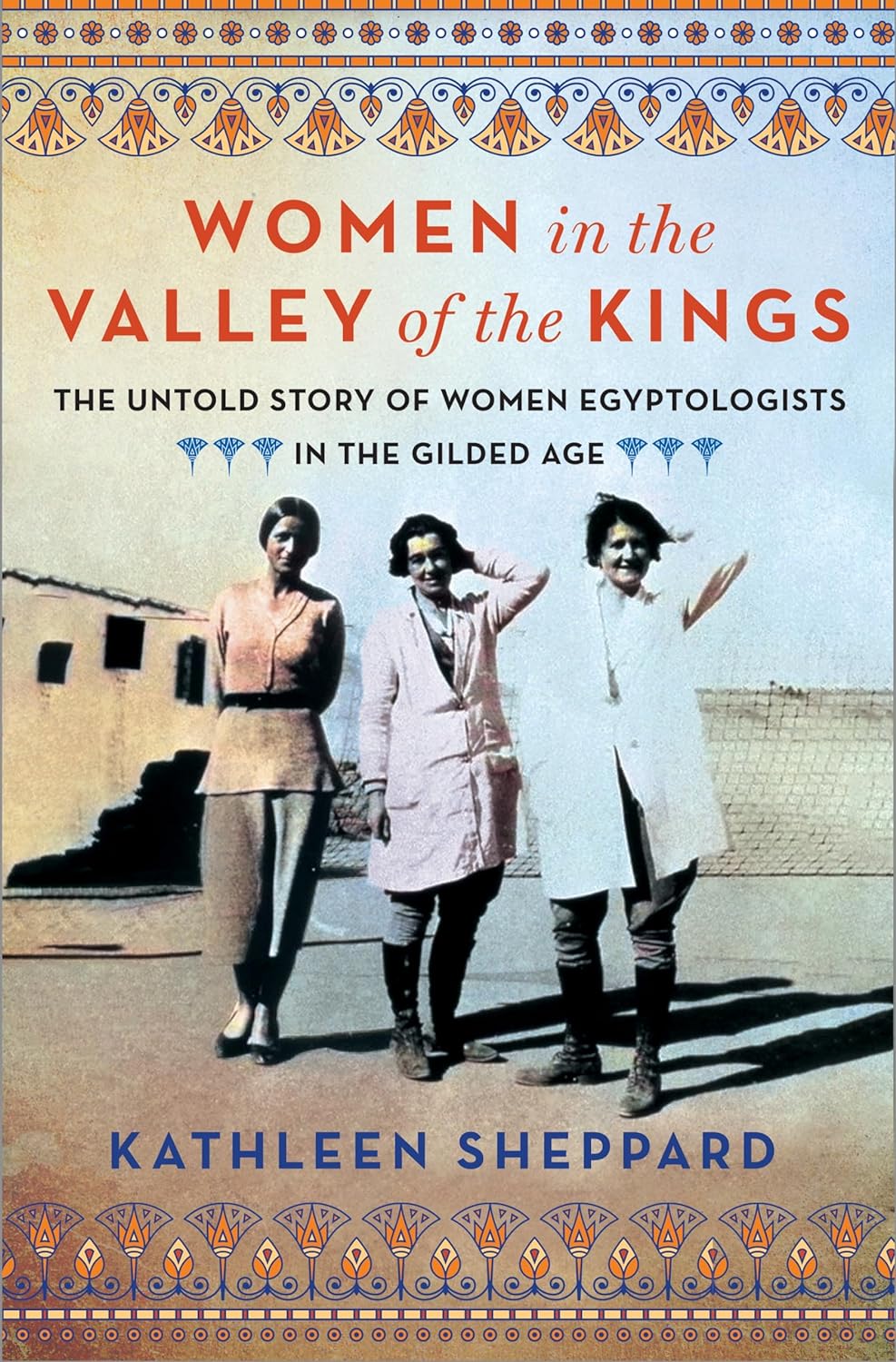
WOMEN IN THE VALLEY OF THE KINGS: The Untold Story of Women Egyptologists in the Gilded Age, well worth your effort to be amazed at your foremothers' strength


WOMEN IN THE VALLEY OF THE KINGS: The Untold Story of Women Egyptologists in the Gilded Age
KATHLEEN SHEPPARD

St. Martin's Press (non-affiliate Amazon link)
$30.00 hardcover, available now

Rating: 4* of five

The Publisher Says: The never-before-told story of the women Egyptologists who paved the way who paved the way for exploration in Egypt and laid the groundwork for Egyptology

The history of Egyptology is often told as yet one more grand narrative of powerful men striving to seize the day and the precious artifacts for their competing homelands. But that is only half of the story. During the so-called Golden Age of Exploration, there were women working and exploring before Howard Carter discovered the tomb of King Tut. Before men even conceived of claiming the story for themselves, women were working in Egypt to lay the groundwork for all future exploration.

In Women in the Valley of the Kings: The Untold Story of Women Egyptologists in the Gilded Age, Kathleen Sheppard brings the untold stories of these women back into this narrative. Sheppard begins with some of the earliest European women who ventured to Egypt as travelers: Amelia Edwards, Jenny Lane, and Marianne Brocklehurst. Their travelogues, diaries and maps chronicled a new world for the curious. In the vast desert, Maggie Benson, the first woman granted permission to excavate in Egypt, met Nettie Gourlay, the woman who became her lifelong companion. They battled issues of oppression and exclusion and, ultimately, are credited with excavating the Temple of Mut.

As each woman scored a success in the desert, she set up the women who came later for their own struggles and successes. Emma Andrews’ success as a patron and archaeologist helped to pave the way for Margaret Murray to teach. Margaret’s work in the university led to the artists Amice Calverley’s and Myrtle Broome’s ability to work on site at Abydos, creating brilliant reproductions of tomb art, and to Kate Bradbury’s and Caroline Ransom’s leadership in critical Egyptological institutions. Women in the Valley of the Kings upends the grand male narrative of Egyptian exploration and shows how a group of courageous women charted unknown territory and changed the field of Egyptology forever.

I RECEIVED A DRC FROM THE PUBLISHER VIA NETGALLEY. THANK YOU.

My Review
: There's a reason workers are called that. They do the many practical tasks that make discoveries whose credit is assigned to some colonial "master" for the purpose of making "history"; never have I typed his story with more bilious growling.

Kathleen Sheppard does a lot for my mood by not focusing on the colonial "mistresses" shall we say without some acknowledgment of the role of the normally so unacknowledged as to be invisible workers. There is a kind of grim humor in these men and women vanishing into the role of shabtis. I don't know that this term, or even this concept, had made it into Egyptology by the time Author Sheppard writes about (c.1880–1930). I found it...ironic.

Now, to be clear, none of the women under discussion were free of colonial mentality, some more than others. As people experiencing a pretty dramatic regime of prejudice themselves, with belittlement, credit-grabbing, and harrassment their daily lot, one would like to imagine they would be sensitized to the issue of discounting another's labor based on irrelevant externalitites. Alas, real life seldom shows a smooth face to the future.

One thing I was surprised to learn was that not all the men working in Egyptology were abusive in the various ways it was possible for them to be. Few of them hurdled even that low bar, but it was positive that a few did. I myownself wonder if the utter novelty of learning about the ancient culture and its rules, its people, and its existence in relation to its peers for the very first time in thousands of years didn't have some damping effect on them...can't lord it over others when you yourself know so very little. I know it will surprise no one that many tried the tack anyway.

Author Sheppard took time to delve into lives of some women more than others, which is down to survival of records...look at the notes. I'm also unsurprised at the presence of many of my lesbian siblings in these ranks. If there's a place people can be found doing hard, intellectually rigorous work, my siblings will be there and in the forefront as often as not. In dealing with these women's personal lives Author Sheppard is without period-appropriate coyness or reticence, thank goodness. The world has changed for the better in so many ways since the time we're discussing. This is a huge one: Being queer is fairly unremarkable now. It's this reality that makes the hate-filled control freaks so damn mad.

What that leads me to is, in fact, the source of my missing star on the book's rating. It's a terrific breeze of openness and transparency to have the lives, not just the work, of figures from the past openly discussed. It's inevitable that some deeply uncomfortable details emerge, like one woman's husband getting physical with her when she was twelve and he twenty-three, tolerated by her mother in full knowledge of it because she fancied the man herself. *ew* But these are all presented in a way that I found more than a bit irksome. Nothing like an internal chronology of a woman's life is followed, only the general structure of chapters being about one woman in the main, and other women's entries and exits from her story are handled as they arise not placed aside as references to that other woman's chapter (eg, "See chapter 77, page 666"). The narrative thrust of following one story is thus squandered in Wikipedia searches and/or note-taking. It does leave me a bit bumfuzzled as to who in the publishing house signed off on such an organizational idea.

It's a genuine complaint, but the truth is most of these women were unknown to me at all, even as names, so honestly I'd've been doing that searching anyway. In a few hundred pages about one of the most explosive developmental regimes in the entire course of historiography and archaeology as disciplines, and the birth and exponential growth of Egyptology, this was going to be the case.

So don't take this as code for "avoid this read" but as an urging to do the opposite. Get this book and start appreciating that, when our parents, grands, and greats were kids, Humanity was first learning about the people of the distant past in their own fragmentary words, and from their own uncovered material possessions. Author Sheppard has brought the palpable excitement of the women who were there, whose presence and guidance made much of the progress we now stand in top of to look still deeper into the past from the mountains their work made.

It was a flawed, slightly disorganized book, but so was the story its subjects were busy living. A strong recommendation for a self-gift to enjoy on #Booksgiving.

Thursday, May 26, 2022

RACISM, NOT RACE: Answers to Frequently Asked Questions & THE INCREDIBLE UNLIKELINESS OF BEING: Evolution and the Making of Us


RACISM, NOT RACE: Answers to Frequently Asked Questions
ALAN H. GOODMAN & JOSEPH L. GRAVES, Jr.

Columbia University Press (non-affiliate Amazon link)
$15.15 Kindle edition, available now

Rating: 4* of five

The Publisher Says: The science on race is clear. Common categories like "Black," "white," and "Asian" do not represent genetic differences among groups. But if race is a pernicious fiction according to natural science, it is all too significant in the day-to-day lives of racialized people across the globe. Inequities in health, wealth, and an array of other life outcomes cannot be explained without referring to "race"--but their true source is racism. What do we need to know about the pseudoscience of race in order to fight racism and fulfill human potential?

In this book, two distinguished scientists tackle common misconceptions about race, human biology, and racism. Using an accessible question-and-answer format, Joseph L. Graves Jr. and Alan H. Goodman explain the differences between social and biological notions of race. Although there are many meaningful human genetic variations, they do not map onto socially constructed racial categories. Drawing on evidence from both natural and social science, Graves and Goodman dismantle the malignant myth of gene-based racial difference. They demonstrate that the ideology of racism created races and show why the inequalities ascribed to race are in fact caused by racism.

Graves and Goodman provide persuasive and timely answers to key questions about race and racism for a moment when people of all backgrounds are striving for social justice. Racism, Not Race shows readers why antiracist principles are both just and backed by sound science.

I RECEIVED A DRC FROM THE PUBLISHER VIA NETGALLEY. THANK YOU.

My Review
: Author Graves is a biologist; Author Goodman is a biological anthropologist. These are scientists answering a series of questions that have, for over a century, pretended to be scientific excuses for the hate-based ideology of racism.

There is one race: Human. Homo sapiens is the genus and species of each and every one of us.

The format of this book is supremely simple. Its chapters, titled eg "Everything You Wanted to Know About Genetics and Race" and "Intelligence, Brains, and Behaviors" (bonus points for not forcing me to retrofit the series/Oxford comma, gents!), are organized around questions, eg "What do geneticists mean by the structure of human variation?" and "In the twentieth century, were Jews, Italians, and Irish thought to be separate races?" and "When doctors, epidemiologists, and other medical scientists say that race is a risk factor, what do they mean?" There is, at the very front of the Kindle book, a hyperlinked list of all the questions raised in this book. It could not be easier to use if it was an audiobook that read itself to you.

The Notes section, which (I realize and suspect the authors do, too) you aren't all that likely to read, is more than a simple list of people and projects cited; the authors also provide some editorial comments worth your time to follow the hyperlinks to see. There are quite a lot of them, but there's such a thing as telling too much (in fiction, called "spoilering" and apparently a thing I do a lot despite trying to think like a spoilerphobe).

I'll conclude with a ringing endorsement of this exercise in calm, logic- and fact-based debunking of enduring hate-based myths. The authors said it best of all:
Antiracism starts with understanding what race is and isn't. Antiracism is not just an ethical and scientifically correct position; it is necessary for our survival.


+++++++++++++++++++++++++++++++++++++++++++++++++++++++++++++++++


THE INCREDIBLE UNLIKELINESS OF BEING: Evolution and the Making of Us
ALICE ROBERTS

Heron Books (non-affiliate Amazon link)
$5.99 Kindle edition, available now

Rating: 3.75* of five

The Publisher Says: The presenter of the BBC's The Incredible Human Journey gives us a new and highly accessible look at our own bodies, allowing us to understand how we develop as an embryo, from a single egg into a complex body, and how our embryos contain echoes of our evolutionary past.

Bringing together the latest scientific discoveries, Professor Alice Roberts illustrates that evolution has made something which is far from perfect. Our bodies are a quirky mix of new and old, with strokes of genius alongside glitches and imperfections which are all inherited from distant ancestors. Our development and evolutionary past explains why, as embryos, we have what look like gills, and as adults we suffer from back pain.

This is a tale of discovery, not only exploring why and how we have developed as we have, but also looking at the history of our anatomical understanding. It combines the remarkable skills and qualifications Alice Roberts has as a doctor, anatomist, osteoarchaeologist and writer. Above all, she has a rare ability to make science accessible, relevant and interesting to mainstream audiences and readers.

I RECEIVED A DRC FROM THE PUBLISHER VIA NETGALLEY. THANK YOU.

My Review
: A narrative approach to a complex scientific study that's occupied Humanity for millennia is going to fall short in both rigor and scope. In that sense, Dr Roberts was doomed from the outset. What anyone who undertakes such an enterprise anyway chooses, then, is to fail in a particular way. In the case of Dr Roberts, an actual, practicing scientist, the choice was obvious: rigor, begone therefore to allow me the scope to speak directly to the audience for this book.

I'm quoting this bit from the chapter entitled "RIBS, LUNGS, AND HEARTS":
When I look at an archaeological skeleton, the first thing I do is lay out the bones in an anatomical arrangement, as though the individual were laying on {their} back, arms by the sides, palm uppermost. Then I make an inventory of the bones, before moving on to look at each bone more carefully, taking note of features that might help me to determine the age and sex of the individual, as well as any telltale signs of disease.

Ribs can be a real pain—they're often broken into short fragments—but after some patient work on this jigsaw puzzle, it's possible to put them in order. A human chest is shaped like a barrel that has been squashed front to back, and the shape of the individual ribs reflects their position.

Careful, clear, and just a bit humorous...you got the "pain" play on words, right?...but the next sections are peppered with "rectus abdominis muscles" and a list of hominin names like Homo rudolfiensis and Homo habilis and we're way out of most people's comfort zone. This explains, I hope, my mingy-seeming rating.

What this book is doing, that is presenting the astounding evolutionary development of the Homo sapiens writing and reading this review, is very valuable. In and of itself, the existence of this project is heartening and necessary. There is an audience for science stuff that wants to know a lot of the material in here. But there aren't that many of us. Dumbing down, as any scientist wishing to communicate with laypersons absolutely must do, is a process of selection and elision. Author Roberts (I typoed "Riberts" and thought long and hard about just leaving it to see if anyone noticed) chose well, for me at my level of interest and information. But what about everyone else?

Choices, in any event, were made and they were illustrated with interestingly detailed line drawings and they were developed to a deeper level than I would've advised she take them; but Professor Doctor Author Roberts is a skilled communicator and (if one is willing to put in the work) will reveal to her readers an astoundingly inspiring story of unlikely events that came up with the form and function of the Homo sapiens she wrote this fascinating, but dense, book to inform and educate.

Thursday, March 30, 2017

THE OTHER EINSTEIN, the reconstructed life of the first Mrs. Einstein


THE OTHER EINSTEIN
MARIE BENEDICT

Sourcebooks Landmark
$25.99 hardcover, available now

Rating: 3.5* of five

The Publisher Says: A vivid and mesmerizing novel about the extraordinary woman who married and worked with one of the greatest scientists in history.

What secrets may have lurked in the shadows of Albert Einstein’s fame? His first wife, Mileva “Mitza” Marić, was more than the devoted mother of their three children—she was also a brilliant physicist in her own right, and her contributions to the special theory of relativity have been hotly debated for more than a century.

In 1896, the extraordinarily gifted Mileva is the only woman studying physics at an elite school in Zürich. There, she falls for charismatic fellow student Albert Einstein, who promises to treat her as an equal in both love and science. But as Albert’s fame grows, so too does Mileva’s worry that her light will be lost in her husband’s shadow forever.

A literary historical in the tradition of The Paris Wife and Mrs. Poe, The Other Einstein reveals a complicated partnership that is as fascinating as it is troubling.

THE PUBLISHER SENT A REVIEW COPY AT MY REQUEST. THANK YOU!

My Review: Marie Benedict, I salute you. The decision to tell the story of Albert Einstein's first wife, physicist Mileva Marić, and her intense intellectual beginnings fading into parental tragedy, emotional aridity, and ultimately humiliating drudgery, was bold beyond belief. There was quite simply no way on this wide green earth to make everyone with an interest in the story happy. Many would be satisfied with nothing less than a jargon-laden, drily scientific reconstruction of the potential/probable debates the couple most likely had. Others would faint from terror at the mere mention of names like Boltzmann, Mach, Drude, et alii. The line Benedict chose to tread was weighted in favor of broad strokes on all fronts. Imagine a woman...an Eastern European woman...arriving at one of the world centers of scientific inquiry at all, at a time in history when women had no vote to cast, no right to own property, and the very real risk of dying in socially mandatory childbirth across the entire world.

That was Mileva. Really, that is all that must be said of her. She was so exceptional that she arrived in this place at all, held her own academically, and but for meeting a charming rogue who wiled her out of her virginity and thus her rightful place in the world, might well have been as much a name to conjure with as Madame Marie Curie. Benedict does this by whisking us through the social life of Mileva's bluestocking buddies as they have musicales and climb local beauty spots, the whirl of cafe society among Mileva's male colleagues as they discuss and dispute their subject's roil and ferment over coffee, introducing us to the extraordinarily supportive Serbian father whose dreams and fears for Mileva come through his comparatively few actual lines. All in barely a hundred pages.

It is the fate of any author telling a private person's personal story to be an inventor. Dialogue can't be anything but invented. Letters, especially in the Belle Epoque, can (if Clio so wills it) be found and either quoted or digested, but Life isn't a novel and so doesn't offer the precise words needed for dramatic purposes. After all, fiction is a bunch of lies that, properly stuck together, make the truth undeniably visible to all. Benedict has very clearly made her way through a great deal of research material and has selected from the piles, stacks, boxes, shelves those moments and matters and words that best fit her plot.

The saddest part of the above, to me, is that she wasn't required to do very much discarding or eliding to make Albert Einstein into a proper shit of a man. The daughter he never saw, born out of wedlock because his harpy of a mother wouldn't countenance Mileva as a wife for her unemployed wastrel of a darling, was only the beginning of a life-long pattern of verbal abuse...there exists a letter from him to Mileva listing an appalling, humiliating list of conditions she must follow to be allowed to remain with the Great Man...and emotional neglect that extended to his two sons from their marriage. Not that he was any too cuddlesome to his cousin Elsa, aka Mrs. Einstein the Second: He proposed to her younger, prettier daughter after finally wearing Mileva down into agreeing to a divorce. Wise lady said no; her mama married Einstein anyway, knowing what was what.

Mileva's later Einsteinless life was one of economic deprivation, despite the eventual arrival of the Nobel Prize money promised to her in the divorce settlement. (Her own family's economic comfort evaporated with the Austro-Hungarian Empire in the Great War.) One of her sons was schizophrenic. Investing in a Swiss boarding house didn't work out well. Mileva was born under an unlucky star, and was so very clearly an intelligent, decent human being who deserved better than she settled for in life.

She was a tragic pioneer of women's rights to a place at the table in the sciences. She was a fascinating character. She deserves to be discussed, celebrated, lauded along side her famous ex-husband, and Marie Benedict has made a sold stride in that direction by writing The Other Einstein. September is National Science Club Month, and if I were in a science club, I'd demand we read this book. There is so very much to discuss in these pages, discussions that will last well beyond the club meeting itself.

Sunday, March 19, 2017

REMARKABLE CREATURES, two women of science in 19th century Dorset


REMARKABLE CREATURES
TRACY CHEVALIER

Penguin Books
$17.00 trade paper, available now

Rating: 3* of five

The Publisher Says: A voyage of discoveries, a meeting of two remarkable women, and extraordinary time and place enrich bestselling author Tracy Chevalier's enthralling new novel

From the moment she's struck by lightning as a baby, it is clear that Mary Anning is marked for greatness. On the windswept, fossil-strewn beaches of the English coast, she learns that she has "the eye"—and finds what no one else can see. When Mary uncovers an unusual fossilized skeleton in the cliffs near her home, she sets the religious fathers on edge, the townspeople to vicious gossip, and the scientific world alight. In an arena dominated by men, however, Mary is barred from the academic community; as a young woman with unusual interests she is suspected of sinful behavior. Nature is a threat, throwing bitter, cold storms and landslips at her. And when she falls in love, it is with an impossible man.

Luckily, Mary finds an unlikely champion in prickly Elizabeth Philpot, a recent exile from London, who also loves scouring the beaches. Their relationship strikes a delicate balance between fierce loyalty, mutual appreciation, and barely suppressed envy. Ultimately, in the struggle to be recognized in the wider world, Mary and Elizabeth discover that friendship is their greatest ally. 

Remarkable Creatures is a stunning novel of how one woman's gift transcends class and social prejudice to lead to some of the most important discoveries of the nineteenth century. Above all, is it a revealing portrait of the intricate and resilient nature of female friendship.


My Review: A middling book about interesting times and people. Not extraordinarily well, or poorly, written. Not unusual or original in plotting or in, frankly, any way I can think of. Like all of Chevalier's work, a solid, well-made entertainment, about a subject most of us have never given one instant's thought to.

Therein its charm. Mary Anning and Elizabeth Philpot weren't the women of Jane Austen's novels, and they weren't subjected to the same constraints as those women were. They lived in poverty whether genteel or grinding, and they followed their own interests instead of doing what was thought to be necessary to get a husband. Chevalier points up the ways in which this freedom made the women best able to pursue the passions each might never have known had she been a mother and a wife.

We owe our knowledge of plesiosaurs and other aquatic beasts of the era to these remarkable women, who hunted for and preserved fossils along England's Dorset coast. That Mary Anning was the more productive of the two and that it was she who found the major finds does not minimize the better-off Miss Philpot's many contributions, both emotional and financial, to the process.

In the end, it is the usual suspect, jealousy, that ends the friendship across a generation and a class divide. Mary Anning and Elizabeth Philpot fall in love with the same man. It leads to the eruption of their other jealousies, of course, and the many things we think but never say come out of each woman's mouth.

Years pass, and many events occur, but unlike theirs, endings are only rarely as good as beginnings. Anning and Philpot lived in a time when the role of a woman was to be of service. Neither had a man to serve, so they served Mankind with their old rock-boned beasts. Much of what we think today would have been harder and later in coming without them, their small but vital role in making modern science what it is.

Remarkable creatures indeed.