Showing posts with label 1900s setting. Show all posts

Sunday, April 1, 2018

MISS MORISON'S GHOSTS, proof yet again that women face higher hurdles than men


MISS MORISON'S GHOSTS; aka GHOSTS OF THE TRIANON: The Complete "An Adventure"
C.A.E. MOBERLY and ELEANOR F. JOURDAIN

Miss Morison's Ghosts
Internet Archive 1913 illustrated edition

The Book Description: This is the true story of two Englishwomen getting caught up in one of the most fascinating and inexplicable "time travel" experiences ever recorded. After travelling down to the grand French palaces of Versailles, they proceed to take a walk along the various pathways and gardens outside, only to lose their way and on top of that, get lost in a time warp, literally. It takes them back in time to the palace gardens at the time of the French Revolution and to a face-to-face confrontation with Marie Antoinette, among others. No, this is not fiction, it purports to be fact. The two women, both prominent academics, give us a very convincing and staggering account of their claims. This book is their clear and thought-provoking explanation of exactly what happened to them. Were they mistaken? Was it a hoax? Was the experience real? You decide. This is a truly fascinating book, which quickly sold 10, 000 copies when it was first published. Here it is back in print again at long last.

The Film Description: Two British women claim to have been thrown into a time warp where they saw Marie Antoinette as they were strolling through the gardens at Versailles Palace in France. After they tell their story to a psychic society, they find themselves the objects of derision and their jobs are threatened.

My Review:

Friday, March 30, 2018

MAELSTROM, seventh Whyborne & Griffin Lovecraft-tinged adventure


MAELSTROM
JORDAN L. HAWK
(Whyborne & Griffin #7)
Kindle edition
$4.99 available now

Rating: 5* of five

The Publisher Says: Between his father’s sudden—and rather suspicious—generosity, and his own rash promise to help Christine plan her wedding, Percival Endicott Whyborne has quite enough to worry about. But when the donation of a mysterious codex to the Ladysmith Museum draws the attention of a murderous cult, Whyborne finds himself in a race against time to unlock its secrets.

Meanwhile, Griffin has a case of his own: the disappearance of an historic map, which quickly escalates to murder. Someone is sacrificing men in dark rituals—and all the clues lead back to the museum.

With their friends Christine and Iskander, Whyborne and Griffin must discover the cult’s true goal before it’s too late. For dark forces are afoot at the very heart of the museum, and they want more than Whyborne’s codex.

They want his life.

***THIS IS A REVIEW OF THE SEVENTH BOOK IN A SERIES SO DO NOT UTTER A SYLLABLE OF COMPLAINT ABOUT SPOILERS***

My Review
: Here's an amazing fact for y'all. I hate the c-a-t in this series because, well, it's a c-a-t. In point of fact the presence of a c-a-t in a book as a suitable companion for a male human is grounds for a one-star deduction from the five total a book can earn. And yet the sharp-eyed habitué of these precincts will note that this book has a five-star rating! Has His Growling Curmudgeonliness softened in his disdain and disgust for Felis catus?!

Don't register for those classes in the aerodynamics of pork just yet, pigs ain't a-flyin'.

While the c-a-t is prominent in this book and is even presented as capable of performing actions not directly beneficial to itself (which is how we know we're reading a novel), the main focus of this book is on a subject near and dear to my heart: Hating your siblings and your parents, while acknowledging their ability to throttle back their intrinsic evil enough to perform actions that, when squinted at from a far enough distance and lit exactly perfectly, can be construed by an unbiased observer as not entirely destructive. Whyborne's selfish and self-centered father has lost his wife, his adored elder son, and both his daughters; it's no surprise that the poor chump realizes he'd best mend fences with his remaining son, faggot or no. Also no surprise is the said son's unwillingness to let go of his grudge against the old bastard.

And here's where that star comes from. This plot arc has developed over the course of the entire series. It's a difficult task to keep a reader involved in an arc over more than one book without making frequently eyerollingly hamfisted attempts to wedge the damn thing into stories better off without it. Author Hawk has magical fingers. This series doesn't suffer from the dreaded hamfistedness. The presence of Whyborne's father is always plausible or he's left out. While he's there, he acts in character. Even when it's obvious to the reader he's doing his level best to make it up to Whyborne, the man is his abrasive and selfish self. No miracles are adduced. Just as we see the attempts as well as the selfishness, Whyborne does not.

Griffin, however, does, and he tries to offer his dearly beloved a perspective not wholly hostile to Whyborne père. The offer is rebuffed with brusqueness, even a scoche of hurt feelings. Whyborne begins to fear that his beloved husband has been bought off by the sudden generosity his father has shown Griffin. It's even enabled Griffin to purchase a motor car! A (period appropriate) Curved Dash Oldsmobile:
Is that not the most amazing thing! It is in Widdershins, Massachusetts, I can promise you. Griffin is almost bursting with eagerness to take Whyborne for a ride!

In the car, you dirty-minded dregs. In the car.

So Whyborne's fears for Griffin's loyalty are not unfounded; plus he now has to ride in a motor car or risk hurting his dearly beloved's feelings. So into the damned thing he climbs (greater love hath no fuddy-duddy), thence to be sped at a blistering pace (almost twenty miles an hour!) hither, thither, and yon. Worse yet, Christine and her intended groom Iskander the half-Egyptian are enraptured by the damn thing as well. Has Whyborne père cast his net so wide as to deprive his son of all support and succor? The rotter! Then, if that isn't enough to frame Whyborne père in the most villainous light imaginable, he has the audacity to all-but-demand his son visit the evildoer of his childhood, formerly fair-haired boy Stanford, in the comfy sanitorium where he's confined in lieu of a prison cell (greatly to Whyborne's disgruntlement) for the crime of murdering various and sundry people including their mutual sister.

In acceding to his father's barely-not-a-demand to visit Stanford, Whyborne acts like a mulish, unforgiving, spiteful brat towards Stanford as the latter brandishes sweet words and requests for reconciliation. How petty, how small-souled of him, no? Even Griffin advocates for peace! Griffin!! The man was nearly sacrificed to the Elder Gods by Whyborne père and then nearly blown away by Stanford's (badly aimed, thank goodness) gun! Whyborne's feelings of isolation make sense.

I am fully aware of his faulty reasoning and his sense of injustice being perpetrated on him and his pettish whining all from the inside. I see it in myself when dealing with my own "family." (I hasten to add that my siblings have never aimed firearms at anyone nor are they, to the best of my knowledge, sharktoothed half-fish.) So Author Hawk was already singin' my song. The way the family drama and the story drama each resolve in step with the other felt natural, inevitable to me. The fact that Whyborne's loving husband and his best friend both support him emotionally as well as nudge him towards a more charitable view of his intimate enemies is a great enrichment of the emotional facet of the series. It's one reason I keep reading the books. By now most series stories are thin, floppy things. Not Whyborne & Griffin. The world the men occupy is different from our own but keeps adding layers and nuances and even, just like life, harks back to remembered events both fun and not so much.

As this installment of the loving, exciting lives of Whyborne & Griffin approaches its end, there is a chapter...57 to be precise...that will profoundly expand your appreciation for Author Hawk's chops, and will most likely move you as well. For that alone I will read the other two books already out in the series. But I do so in the hope that there will be others to come. It's rare that I feel a desire to continue a series to this length. I feel a strong need to finish what's out before I being the tedious process of waiting for more.

Trigger warning to the squeamishly heterosexual. Depictions of loving and consensual but still filthy-pig-dirty sex exist in here, just like they do in life; avoid if that's disagreeable to you. Also start at the beginning or you'll be utterly at sea reading the later books.

Tuesday, March 13, 2018

HOARFROST, sixth Whyborne & Griffin paranormal romp...set in Gold-Rush era ALASKA!


HOARFROST
JORDAN L. HAWK
(Whyborne & Griffin #6)
Kindle edition
$4.99 available now

Rating: 4.5* of five

The Publisher Says: Sorcerer Percival Endicott Whyborne and his husband Griffin Flaherty have enjoyed an unprecedented stretch of peace and quiet. Unfortunately, the calm is shattered by the arrival of a package from Griffin’s brother Jack, who has uncovered a strange artifact while digging for gold in Alaska. The discovery of a previously unknown civilization could revive the career of their friend Dr. Christine Putnam—or it might kill them all, if the hints of dark sorcery surrounding the find are true.

With Christine and her fiancé Iskander, Whyborne and Griffin must journey to the farthest reaches of the arctic to stop an ancient evil from claiming the life of Griffin’s brother. But in the rough mining camp of Hoarfrost, secrets fly as thickly as the snow, and Whyborne isn’t the only sorcerer drawn by the rumors of magic. Amidst a wilderness of ice and stone, Griffin must either face his greatest fear—or lose everyone he loves.

My Review: And here is where everything changes.

The first words of this book, Griffin's words which marks the first big change, are:
Pa was dead.
POW just like that you, the series' reader on through this sixth entry, are busted in the chops. The long history of Griffin and his adoptive father is now over. The possibility of a reconciliation is gone forever. Now Griffin has to find a way to forgive. Forgiveness is vital to an injured, abused child. It doesn't always mean restored relationships. But Griffin is now past the point where that can happen.

First words of the first page. THAT is bravery, Author Hawk.

Will it surprise you to learn that Griffin's revelation is but the first painful wrench in this journey? I thought not. Griffin's father's memorial service, as he was asked by his adoptive mother not to attend the funeral, brings comfort to Griffin from the depths of the sea that Widdershins abuts, and allows him to hope in his desolated heart that the letters his father returned to sender unopened will finally reach the hard, unforgiving heart of the old man via their smoke.

The events of the book begin on a beach in Widdershins and end on a dockside in Alaska, and there is not one moment of downtime anywhere along the way. We're treated to mushing across the frozen tundra, spelunking for relics of an ancient civilization, sibling and familial rivalries that can never fully be resolved, and meetings with old enemies that change the course of countless lives. Whyborne and Griffin are, through it all, steadfastly each others' rock and refuge. Their misunderstandings are all based in the intense desire of the lover to protect the beloved at all costs. Their ultimate challenge is always "how can I be sure my own true love is safe? how can I make him safe first, then whole, then happy?"

The answers are, for the first time, given in chapters told from alternating points of view. It's about time that Author Hawk gave Griffin some real, extended attention. I welcome this new format. Also welcome is Griffin's newfound brother Jack. He's got possibilities, and I hope we'll see him again. The memory he shared of giving his coat to Griffin as he was taken in by a different family, one that wasn't like Griffin's, was deeply moving.

If my previous warblings of pleasure haven't convinced you to give the series a try, this one won't either. But you are missing a treat.

Monday, March 12, 2018

BLOODLINE, fifth Whyborne & Griffin Lovecraft-flavored paranormal adventure


BLOODLINE
JORDAN L. HAWK
(Whyborne & Griffin #5)
Kindle edition
$4.99 available now

Rating: 4.75* of five

The Publisher Says: Between his bullying father and dissolute brother, Percival Endicott Whyborne has quite enough problematic family members to deal with. So when his sister returns to Widdershins asking for help solving the mystery of a derelict ship, Whyborne is reluctant to get involved. Until, that is, a brutal murderer strikes, leaving Whyborne and his lover Griffin no choice but to take the case.

The investigation leads them deep into a conspiracy of blackmail, murder, and darkest sorcery. But worst of all are the secrets held within the family itself, one of which will destroy everything Whyborne believed to be true, not only about his family, but about himself.

My Review: Guinevere, Lady Gravenwold, is Whyborne's elder sister. She was never on his side as a child locked in battle with Stanford, his lout of a louse of a lush of an older brother. As such she didn't and doesn't loom large in his life, being a married and titled English matron. She is, nevertheless, the vector for an abrupt and painful change in Whyborne's life and in his loving relationship with Griffin. She brings the Endicott twins, Theo and Fiona, English scions of the matrilineal ancestry shared by Whyborne's siblings. They're everyhting a country bumpkin American cousin expects English aristocrats to be: Sophisticated, glamorous, amorous (at least Theo is, noticing Whyborne "like a dessert he wants to sample" according to Griffin's sour, unimpressed take on things), and very, very eager to make their American relatives among their social conquests.

Social, and other, kinds of conquests. Many other kinds.

This entry in the series is a very different beast from the others. Yes, Whyborne still lies-by-omission to a worried Griffin about his "dabblings" into sorcery. Yes, Griffin still tries his best to stop Whyborne from taking ridiculous risks with life and limb, since he as a former Pinkerton understands how quickly a controlled situation can unravel into monstrous chaos. He's got the mental scars to prove it. But what makes this entry's stakes higher is the extremely close position of each of the story's lines to Whyborne's most beloved and cherished people.

Guinevere's biggest surprise for Whyborne is her knowledge that he's a sorceror. The Endicott twins' biggest surprise for Whyborne is their true identities. Griffin's biggest surprise for Whyborne is that he loves his Ival (awful nickname, I'd prefer "Percy" if I were Whyborne) completely and unswervingly. And it should tell you something major about this book that those aren't spoilers significant enough to rate as problematic within the events of this book.

The true nature of Widdershins is revealed. The true fate of the Whyborne family comes to fruition. The true nature of Whyborne's sorcerous powers blasts through any remaining walls of fear to be brought fully into his intimates' lives.

A new people, the ketoi, play their most significant role to date. The beauty of their existence is heart-hurting by the end of the book.

Author Hawk has made these books cumulative in their emotional effect. Read them in order. And I strongly recommend you read them.

Monday, February 12, 2018

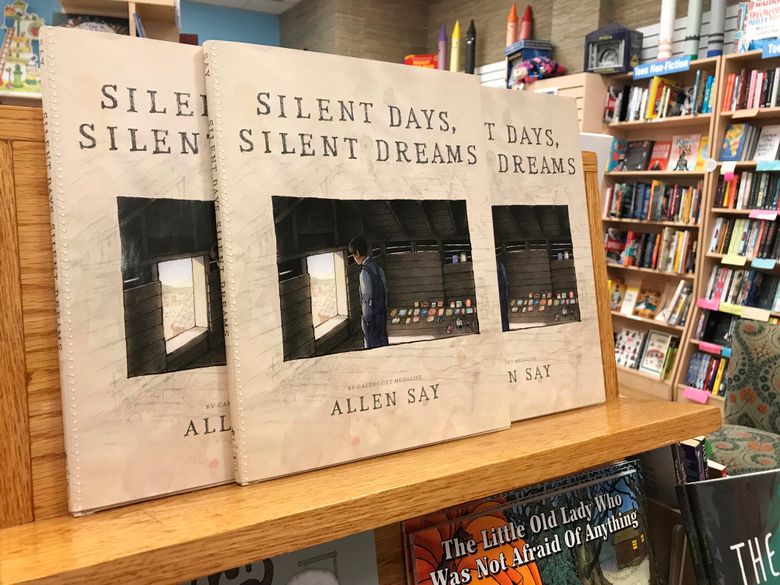
SILENT DAYS, SILENT DREAMS is a kids' book in name only


SILENT DAYS, SILENT DREAMS
ALLEN SAY

Arthur A. Levine Books
$21.99 hardcover, available now

Rating: 5* of five

UPDATE! AWARD NEWS! The 2018 American Library Association Awards honored Author Say's work with its Schneider Family Book Award for books that embody an artistic expression of the disability experience! Well-earned, well done, and congratulations.

The Publisher Says: James Castle was born two months premature on September 25, 1899, on a farm in Garden Valley, Idaho. He was deaf, mute, autistic and probably dyslexic. He didn't walk until he was four; he would never learn to speak, write, read or use sign language.

Yet, today Castle's artwork hangs in major museums throughout the world. The Philadelphia Museum of Art opened "James Castle: A Retrospective" in 2008. The 2013 Venice Biennale included eleven works by Castle in the feature exhibition "The Encyclopedic Palace." And his reputation continues to grow.

Caldecott Medal winner Allen Say, author of the acclaimed memoir Drawing from Memory, takes readers through an imagined look at Castle's childhood, allows them to experience his emergence as an artist despite the overwhelming difficulties he faced, and ultimately reveals the triumphs that he would go on to achieve.

My Review: I will never be able to thank my friend Joe enough for bringing this book, this artist, this art, into my life. I am so profoundly grateful to you, old friend.


James Castle with the tools of his trade. I don't know the date, but he died at 78 in 1977, so I'll venture a guess at early 1960s...? I'm actually surprised, given how very little the people he lived among seem to have liked him, that someone took his photo at all.

Artist and Caldecott Medalist Allen Say created this artwork at the request of an Idaho-based friend of his. It was his introduction to James Castle...he says of this amazing moment, "I opened the catalog and suddenly remembered the excitement of seeing a van Gogh for the first time." I rang like a bell when I read that. I had just had the same experience opening this book and seeing Say's artworks based on Castle's.

A spread from this gorgeous book.

I've got a reasonably sophisticated knowledge of art. I'm up to speed on "outsider art" and its importance in our visual vocabulary, to our aesthetic landscape. But there hasn't been an experience quite like discovering, via Artist Say, the astonishing work of James Castle in a very, very long time. The sheer breadth of the material he left behind is astounding! Sculptural constructions, drawings in their thousands, mobiles, it's like the man was working against a deadline that only he knew about and was determined to finish saying what he had no other way to say.

The publisher, Arthur A. Levine Books (the imprint responsible for bringing Harry Potter to the US market), is bringing this to us via a damned-near perfect design and production job. The aesthetics of the design you can see for yourself above. If you don't think that it's outstandingly lovely, look at it in person. If you still don't agree, okay, but why? What failing do you adduce to this presentation of two-color artwork mixed with four-color artwork and all presented in a beautiful matte-coated glowingly white space? What artistic flaw do you find with Artist Say's beautiful, spare evocations of the grim and terrible world of James Castle?

And it was a grim and terrible world, a kind of hell that I fear with all my wobbly, trembling emotional heart isn't unique except in its reasonably happy ending. Artist Say has gone as deep as one can into the little factual material of this ordinary life. His bibliography is quite substantial...and disturbingly complete...for someone who, absent Fate's intervention, would simply have vanished without a trace from the collective memory of US society. I knew I could trust Artist Say to tell me the truth about James Castle when I read:
To emulate his unschooled style, I used the same kinds of odd materials he had used: soot and spit, liquid laundry bluing, and shoe polish, to name a few.
I had help. My wife meticulously made dolls and birds out of wastepaper and cardboard that I think the artist would have approved. I drew on ninety-year-old letters and envelopes that {his friend} found in an antique shop; and to mimic James's unsteady lines, I often switched lands—to my left hand, which hadn't learned to tell lies.
Artist Say is the right one to lead us into James Castle's work, and his life and times insofar as any of us can know them.

The Seattle Times gives us the jacket of this glorious book in its native environment, the store where you'll be going to spend USD 21.99 (higher in Canada) to bring it home with you. And now you're able to do it legally, since a Federal judge ruled that Artist Say didn't violate Castle's estate's copyrights in offering us, in 28 cases from the 150 drawings in this book, his own artistic impression of specific Castle pieces.

Isn't that a sad statement of our current society's obsession with ownership? A beautiful illustrated biography would quite probably have pleased Castle, whose early relationship with books (despite being unable to read or write) was a loving and profound one. Not at issue were any facts, any alleged misrepresentations of Castle, his family, anything...just ownership of the images and therefore the right to profit from them.

Had I been related to Castle I'd've cringed in shame for the picture painted of a cold, uncaring, even cruel "family" that frankly seems to me to be culpably negligent and abusive of their child/sibling/educational charge. They sound like horrible people and I'm glad they're dead.

Wednesday, August 31, 2016

IMPERIAL WOMAN, Nobel Prize-winning novelist Pearl S. Buck's 1956 take on events of her own childhood


IMPERIAL WOMAN
PEARL S. BUCK

Open Road Media
$9.99 Kindle edition, available now

Rating: 3.5* of five

The Publisher Says: Imperial Woman is the fictionalized biography of the last Empress in China, Ci-xi, who began as a concubine of the Xianfeng Emperor and on his death became the de facto head of the Qing Dynasty until her death in 1908. Buck recreates the life of one of the most intriguing rulers during a time of intense turbulence. Tzu Hsi was born into one of the lowly ranks of the Imperial dynasty. According to custom, she moved to the Forbidden City at the age of seventeen to become one of hundreds of concubines. But her singular beauty and powers of manipulation quickly moved her into the position of Second Consort. Tzu Hsi was feared and hated by many in the court, but adored by the people. The Empress's rise to power (even during her husband's life) parallels the story of China's transition from the ancient to the modern way.

My Review: Few women in China's very long history have been as well-documented as rulers as Cixi. I suspect that Mrs. Buck, daughter of missionaries to China and a reluctant missionary herself, wrote of this larger-than-life figure because she felt great kinship with her. Cixi was an outsider in a closed world, the Imperial Court, but whose sterling native qualities gave her tremendous influence over that closed world. Buck was in much the same situation vis-a-vis the Chinese culture she was native to for the first forty years of her life. Her parents raised her to be bilingual in Chinese and English, gave her no model for a racist view of the Chinese, and allowed her to mingle with the children of their Chinese converts to Presbyterianism mostly without interference. This made her a fish out of water everywhere, but also gifted her with an amazing insight into the cross-cultural communication disasters that have plagued China's relations with the world forever.

Cixi was an intelligent young woman of relatively modest, though not humble, birth, gifted with great personal grace and beauty. Her enormous elevation to the relatively modest in Imperial Court terms position of Imperial Concubine afforded Cixi the opening to become a powerful woman; her excellent fortune in giving birth to the Emperor's only son allowed her to move well beyond the considerable but constrained power of a favored concubine/consort into a full governing partnership as a Regent for her son, with a council appointed by her late Imperial master.

Buck portrays Cixi as a schemer, but not a wastrel as she is often portrayed. Her intrigues had at their heart a sincere and abiding belief that dynastic continuity was the sole means by which the Chinese body politic could be served by their government as foils against the colonial depredations of the Western powers. All the pomp and the excess Cixi loved was put on for the demonstration of her dynasty's power and dominance. All the machinations she undertook were meant to keep her position—but so that she might continue to fight against China's diminution and beggarment.

Fundamentally, Cixi behaved no differently than the Communist Party has since Chairman Mao's death in 1976. She was a strong leader, and a flawed person; she was also too late to do much about the long, slow fall of her for of government. History's tides catch up with all governments eventually; the Party's current grandees know this, and are behaving in their stewardship of China as Cixi herself did 125 years ago.

As all Pearl S. Buck novels are, this gracefully told tale is a pleasure to read and a treasure house of outside/insider information and opinions now irreplaceable with the death of the author. It is an exciting story, a well-told tale, and a still-invaluable look into a difficult life lived in service to a misunderstood ideal. A must-read for all Sinophiles.