Showing posts with label women's suffrage movement. Show all posts

Friday, November 7, 2025

WINNING THE EARTHQUAKE How Jeannette Rankin Defied All Odds to Become the First Woman in Congress, recovering the life of a great American


WINNING THE EARTHQUAKE How Jeannette Rankin Defied All Odds to Become the First Woman in Congress
LORISSA RINEHART

St. Martin's Press (non-affiliate Bookshop.org link)
$16.99 ebook, available now

A LIBRARY JOURNAL BEST BOOK OF 2025

Rating: 4.5* of five

The Publisher Says: The first major biography of Jeannette Rankin, a groundbreaking suffragist, activist, and the first American woman to hold federal office.

“Few members of Congress have ever stood more alone while being true to a higher honor and loyalty.” —President John F. Kennedy on Jeannette Rankin

Born on a Montana ranch in 1880, Jeannette Rankin knew how to drive a tractor, ride a horse, make a fire, and read the sky for weather. But most of all, she knew how to talk to people, how to convince them of her vision for America. It was this rare skill that led her, in 1916, to become the first woman ever elected to the House of Representatives.

As her first act, Rankin introduced the legislation that would become the 19th Amendment. Throughout her two terms in 1916 and 1940, she continued to introduce and pass legislation benefitting unions, protecting workers, and increasing aid for children in poverty. In 1941, she stood tall as the sole anti-war voice in Congress during WWII, advocating for pacifism in the face of tragedy and stating that you can no more win a war than you can win an earthquake.

A suffragist, feminist, peace activist, workers' rights advocate, progressive, and Republican, Rankin remained ever true to her beliefs—no matter the price she had to pay personally. Yet, despite the momentous steps she made for women in politics, overcoming the boys club of capitalists and career politicians who never wanted to see a woman in Congress, Jeannette Rankin’s story has been largely forgotten. In Winning the Earthquake, Lorissa Rinehart deftly uncovers the compelling history behind this singular American hero, bringing her story back to life

I RECEIVED A DRC FROM THE PUBLISHER VIA NETGALLEY. THANK YOU.

My Review
: I was aware of Rankin as the lone voice against declaring war in 1941. My 1970s public school education in Austin taught me that fact in seventh grade; nothing positive was ever added to it in any class I ever took on History, on sociology, or any other discipline at any later stage of my education. This book, published fifty years after that initial mention of Rankin's name, is the first comprehensive biography of a very very important voice in US politics in the first half of the twentieth century. This proves a point Author Rinehart makes:
"Nowhere in her education or prolific reading had she learned that in 1848, three hundred women gathered in Seneca Falls to declare their sovereign right to the ballot. Nor had she heard that since then, women in every state of the nation had been fighting for their right to vote. To her even greater amazement, they had won it in Wyoming, Colorado, Utah, and Idaho, all before the turn of the twentieth century. She and all American women seemed to have been purposefully denied knowledge of their own struggle for liberation."
My one cavil with this statement is the modifying presence of "seemed" since there is no better way to stop people from making change than to stop them from knowing about the changes that have already happened. If authoritarians do not want any changes either made again or expanded on, they simply erase the history that shows their way is not the only way from public discourse. Then the few places the awareness of the changes survives can be marginalized and shouted down.

Book banning is step one; book burning step two; reducing literacy overall is the final nail in the coffin the high-control society uses.

I was drawn in by the title of the book. It seemed so off-kilter, so self-evidently contradictory, that I wanted to know where it came from hence my desire to read a book about someone I knew nothing substantive about. It's from one of pacifist Rankin's well-known in her time sayings: "you can no more win a war than you can win an earthquake." Millennia of corroborative evidence has had no appreciable effect on war's prevalence.

I was impressed by the depth of Author Rinehart's scholarship. Her extensive notes and citations were all very enlightening and well-chosen from my layman's point of view. There are widely varying sources cited so this tells me how very much work it was to find all the factual crumbs she did. One major shock, though honestly it shouldn't've been, was that the representative from Montana was elected as a Republican. I'm so steeped in the post-LBJ empire of evil that is the modern GOP that I've lost sight of the entire progressive history of the Republicans. Go read about Robert La Follette and Teddy Roosevelt. Time was these were the progressive leaders, not the soulless evil bastards in the McConnell/Bush/Cheney ilk or the wild-eyed reactionary MAGAts.

How likely is the present base, let alone "leadership", of the party to embrace a pacifist follower of Gandhi, a campaigner for the abolition of the Electoral College, and vehement supporter of unions? Growing up in Montana in the 1880s (when their representatives were called "the gentlemen from Anaconda," the state's largest employer and main economic driver), Rankin recognized the evils of untrammeled capitalism. She emulated Jane Addams in her work for the betterment of ordinary folks. Rankin was, in short, the best kind of radical there is, a radical believer in people and their power to do good...when left to do it.

A role model for today who is finally getting her scholarly due, I hope the sudden awareness of Gen Z that things in the US do not have to be this way will lead some of them to discover this spirit-parent from our country's past.

Wednesday, March 5, 2025

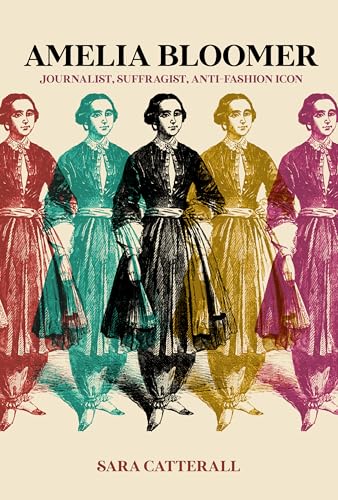
AMELIA BLOOMER: Journalist, Suffragist, Anti-Fashion Icon, a woman of moral certainty and impeccable rectitude who rebelled hard


AMELIA BLOOMER: Journalist, Suffragist, Anti-Fashion Icon
SARA CATTERALL

Belt Publishing (non-affiliate Bookshop.org link)
$11.99 ebook edition, available now

Rating: 5* of five

The Publisher Says: A fascinating look at an underappreciated woman in American history whose newspaper fostered a national conversation on women's issues.

Those who recognize the name Amelia Bloomer usually do so because of bloomers, the clothing item named after her. While she was a rational dress advocate for a time—calling on women to abandon rigid corsets and heavy petticoats and opt for long trousers, shorter skirts, and sensible boots—it was "but an incident" in the larger story of her life and impact.

Bloomer edited and published The Lily, the first newspaper for and by women. Much like Bloomer herself, it started as a temperance rag before broadening to include some of the most important issues to women in that day, including the right to vote, and included contributions from thinkers like Elizabeth Cady Stanton. The groundbreaking paper brought the conversation from Seneca Falls right to the doorsteps of women across the expanding nation.

Guided by a rigid sense of morality and a Puritan work ethic, Bloomer remained open-minded to new ideas. She refused to be swayed by social norms and wrote cutting responses to those who tried to intimidate or shame her and her friends, a group that included Stanton and Susan B. Anthony. This deeply researched biography by Sara Catterall follows the many chapters of her life: her humble upbringing in upstate New York, her role in the temperance movement (and its true legacy as a wellspring of the women's rights movement), her years at The Lily, her groundbreaking position as deputy postmaster in Seneca Falls, her troubled health, and her eventual move to Council Bluffs, Iowa, where she continued to move the needle on women's suffrage in the more flexible new governments of the West.

I RECEIVED A DRC FROM THE PUBLISHER VIA EDELWEISS+. THANK YOU.

My Review
: It had never creased my cranium that Amelia Bloomer was a temperance crusader before I read this book. Given that my mother the abuser never drank, and I had one boyfriend in my life who ever raised a hand to me and that never happened while he was drunk, temperance just did not ever cause me to think "good idea". All my associations with Mrs. Bloomer were around her ideas regarding the idiotic way women were caged inside their clothing during this era. Corsets really are the bound feet of Western culture.

I was utterly unprepared to meet this wildly different Bloomer. She was a woman of her time, in many ways moreso than the more famous ladies like her friends Stanton and Anthony...both of whom she knew from living in Seneca Falls, New York, and each of whom influenced her increasingly radical thinking about women's suffrage...as she was married with children and required to earn her living alongside her husband as best she was able while still raising children. Dexter and she were co-workers, as he hired her to work alongside him as a postmaster after his stint as a Whig-supporting newspaper editor landed him the job. A government salary for a woman no less!

Her position as a temperance crusader led her to make the connection that the only way to stop the unregulated flow of alcohol was to exert political pressure to regulate it. That was impossible, on a practical level, absent votes for women. (She didn't live to see Prohibition and its horrifying unintended consequences.) So her rational dress and votes for women all owe their influence on US culture to her christian temperance-movement work. It was spread wider than Seneca Falls by her opening The Lily, a newspaper for and by women that she, despite raising children, suffering chronic illness, and a complete lack of training except by Dexter's example from his newspaperman days. I am *gobsmacked* by her rigidly moral outlook leading her so far in opposition to the stupid cultural norms of "appropriate" behavior for women in a time where they were so very much more entrenched and enforced than they are now.

At this moment in US, and more broadly Western, political history, the example of a woman who looks at the world as she finds it, judges it harshly for its failings, and—at considerable personal cost to herself and her family—sets about opposing that world continuing down its present path, is invaluable. I'd also like to point out her starchy morality was inspired by an upbringing conventionally religious yet her response to it was radically, vocally, and consistently to apply its moral precepts in full and without exceptions.

If more christians were like Amelia Bloomer, the world would be a better place.

I did indeed just say that. Her acerbic wit, another surprise this book held for me, was deployed against obtuse and obnoxious followers of orthodoxy. Yet Mrs. Bloomer's touch with connecting to people who genuinely did not understand the stakes she saw so clearly in the direction society was heading was exemplary. She met those people on their own ground, without preaching or hectoring. I can only envy that skill; I myownself climb onto my ever-present high horse because I'm Right, that ever-losing strategy. Mrs. Bloomer's tone was always respectful...until she sensed ill-will or disingenuousness.

I knew exactly nothing of the substance of her life until Belt Publishing brought out this book. (I also now know that Dexter Bloomer wrote a biography of her in 1896, so I'll Gutenberg that up here directly.) Author Catterall and her publisher are to be praised, and I hope supported with purchases, for telling this unjustly neglected monadnock of probity and moral clarity's story to a needy new generation of readers. All five stars for bringing modern attention to this person from our past with so much to teach us for our future. It's involving prose, built on solidly shown foundations of information.

Friday, June 18, 2021

THE DICTIONARY OF LOST WORDS, Victorian setting--usual suspects--good story


THE DICTIONARY OF LOST WORDS
PIP WILLIAMS

Ballantine Books
$28.00 hardcover, available now

Rating: 4* of five

The Publisher Says: In this remarkable debut based on actual events, as a team of male scholars compiles the first Oxford English Dictionary, one of their daughters decides to collect the "objectionable" words they omit.

Esme is born into a world of words. Motherless and irrepressibly curious, she spends her childhood in the "Scriptorium," a garden shed in Oxford where her father and a team of dedicated lexicographers are collecting words for the very first Oxford English Dictionary. Young Esme's place is beneath the sorting table, unseen and unheard. One day a slip of paper containing the word "bondmaid" flutters to the floor. She rescues the slip, and when she learns that the word means slave-girl, she withholds it from the OED and begins to collect other words that have been discarded or neglected by the dictionary men.

As she grows up, Esme realizes that words and meanings relating to women's and common folks' experiences often go unrecorded. And so she begins in earnest to search out words for her own dictionary: The Dictionary of Lost Words. To do so she must leave the sheltered world of the university and venture out to meet the people whose words will fill those pages.

Set during the height of the women's suffrage movement with the Great War looming, The Dictionary of Lost Words reveals a lost narrative, hidden between the lines of a history written by men.

Based on actual events and combed from author Pip Williams's experience delving into the archives of the Oxford English Dictionary, this highly original novel is a delightful, lyrical, and deeply thought-provoking celebration of words and the power of language to shape the world.

I CHECKED THIS BOOK OUT FROM MY COUNTY'S LIBRARY SYSTEM. USE YOUR LIBRARY, FOLKS! THEY NEED US!

My Review
: First, read his:
Some words are more than letters on a page, don't you think? They have shape and texture. They are like bullets, full of energy, and when you give one breath you can feel its sharp edge against your lip.
–and–
I often wondered what kind of slip I would be written on if I was a word. Something too long, certainly. Probably the wrong colour. A scrap of paper that didn't quite fit. I worried that perhaps I would never find my place in the pigeon-holes at all.
–and–
A vulgar word, well placed and said with just enough vigour, can express far more than its polite equivalent.

There is an immense gulf between thoughts and words...Esme, as a girl in the almost-all-male world of dictionary-obsessed dad Harry, discovers again and again that the ideas we robe in words aren't seen by those who hear them as we've made them in our minds. The factual world of making the Oxford English Dictionary (OED) presided over by Dr. James Murray is expanded to include a fictional word-mad girl-child whose run-ins with lying adults, oblivious adults, and peers without her ruling passion for The Words We Use are the meat of this delicious, if difficult to deal with at times, novel. Esme Nicholl does not spend her life the way Dr. Murray's typically Victorian daughters do. Her days are spent being educated at school; her afternoons with the men at the Scriptorium as they collate and pigeonhole and excise the tens of thousands of definitions and attestations through usage that arrive in Dr. Murray's home/workhouse from around the world. Careless dropping or deliberate deletion, it makes no never-mind to young Esme. She re-homes them in her treasure-chest, under a housemaid's bed, their shared secret.

The dropped words, Esme notices as her life gives her more analytical tools, are often words commonly used by, among, and about women and their activities. Her world is coming for her, bent on controlling her and bending her to its will. Her Godmother Edith, a factual person really nicknamed Ditte, is a very unconventional woman and a prolific contributor the OED. She's acted as a co-parent, in a limited way, to Esme; yet she fails her when Esme desperately needs her simply because Ditte doesn't live in Oxford, let alone in daily contact with Esme.
“Dr. Murray said you and Beth were proflitic contributors,” I said, with some authority.

“Prolific,” Ditte corrected.

“Is that a nice thing to be?”

“It means we have collected a lot of words and quotations for Dr. Murray’s dictionary, and I’m sure he meant it as a compliment.”

The relationship is pretty tidily encapsulated there. Older mentor, not quite understanding the mentee but giving great guidance anyway; just not quite what was really needed. The words for things are centered; the denotations are generously given, while the connotations are left more or less to Esme's maturing brain to construct as best she can. She is, after all, equipped with well-designed tools...but no manuals to train their user in their best use.

In her word-collecting fever, Esme amasses much raw data, many denotations. Her goal for it remains unfocused until she realizes that the words' connotations give her the needed feminist perspective: she and her half of humanity are doomed to be controlled until they can participate in life as political actors instead of passive observers. Yes, she discovers Feminism and becomes a suffragette. And uses her life-long capacity to work with words to give sharp focus to her purpose.
If war could change the nature of men, it would surely change the nature of words.
–and–
“Words change over time, you see. The way they look, the way they sound; sometimes even their meaning changes. They have their own history.”

Something I wish people who fuss over neologisms and redefinitions would process. Things are growing or dying. There is no stasis in natural systems, and no homeostasis doesn't count...it is a finely balanced state but predicated on constant shifts and changes that must support a larger whole's proper, healthy functioning. Just like language...the words are always tip-tilting, reconfiguring themselves, shedding pieces and adding others; but the language as a whole lives and thrives and, broadly, remains the same. Only different.
It struck me that we are never fully at ease when we are aware of another's gaze. Perhaps we are never fully ourselves. In the desire to please or impress, to persuade or dominate, our movements become conscious, our features set.

That snapshot effect, the mask of Persona slid over a person's face, is what Esme is resisting as she rescues rejected and deleted words from the magisterial OED. Her women's words are the ones men most need, and are supremely reluctant, to hear. Esme's project, fictional of course, is the titular dictionary, with words like "menstruation" (simply too earthy and shuddersome for the frail little men making the OED) to "knackered" because it's vulgar and ugly when a more refined person could say "exhausted" or "listless." Esme thinks "bollocks to that" and spends her adulthood on the many pieces that must be moved around and reconfigured to make a society that can even properly think about a way to include women as adult beings.

And herein the reason I don't give this book a five-star warble of ecstasy...the passage of time. It doesn't. I'm herky-jerkyed into different stages of Esme and the world's life but the setting remains...internal. It's The Esme Show, instead of Truman; she's the star and no doubt. But there's a degree of alienation in that. Thank goodness there are so many dates to open chapters! Too bad they don't mean more. It's certainly true that we, in our daily rounds, don't think carefully about where the screens in the piston of our french-press coffeepot come from, or how and when to clean or replace them. But some sense of Esme's adjustments to the world around her, since her project is to effect true change upon it, would've helped me grasp the maturation parts of time's passage. I felt the lack of that connection keenly.

Esme's relationships were also a bit troubling to read for this reason. Lizzie, her female exemplar in residence, was a lower-class girl whose best hopes weren't as high as she's actually risen by working for the Murrays and becoming Esme's comadre. By rights she should be a dead young worn-out whore. So the way the privileged miss and the rough serving girl should practically leap off the page at me, right?
“Me needlework will always be here,” she said. “I see this and I feel…well, I don’t know the word. Like I’ll always be here.”

“Permanent,” I said. “And the rest of the time?”

“I feel like a dandelion just before the wind blows.”
–and–
My mother was like a word with a thousand slips. Lizzie’s mother was like a word with only two, barely enough to be counted. And I had treated one as if it were superfluous to need.

It's really the fate of most of us...we vanish into nothingness as soon as we assume room temperature. Ephemeral as life is, what I found wantimg in those perfectly lovely passages was the solidity of Life beating Esme with her own responsibility to and for the older but more vulnerable on a practical life-level woman.

Still and all, I'm so pleased that I read this wonderful story. I think it could have made more of an impact on me had some stylistic choices been made differently; that is always the way with making art, no one can create something as powerful and fully realized as this book is without making choices that won't work for everyone. I felt very strongly the aura of choices and decisions affirmatively, consideredly made at every turn. This is in no way a slapdash or ill-made work of fiction. Its real and its fictional characters are treated with equal gravitas. That the factual characters take up less screen time is a decision that the author and editor clearly planned carefully and executed deftly. I can offer no more heartfelt recommendation than "read this book soon." I *could* have, if certain other, less distancing, choices had been made, turned obnoxious pest and shouted at you to get the book NOW read it on the Jitney or in the Admiral's Club but just GET IT!!

But really, does it get that much better than this?
I thought about all the words I’d collected from Mabel and from Lizzie and from other women: women who gutted fish or cut cloth or cleaned the ladies’ public convenience on Magdalen Street. They spoke their minds in words that suited them, and were reverent as I wrote their words on slips. These slips were precious to me, and I hid them in the trunk to keep them safe. But from what? Did I fear they would be scrutinised and found deficient? Or were those fears I had for myself? I never dreamed the givers had any hopes for their words beyond my slips, but it was suddenly clear that no one but me would ever read them. The women’s names, so carefully written, would never be set in type. Their words and their names would be lost as soon as I began to forget them. My Dictionary of Lost Words was no better than the grille in the Ladies’ Gallery of the House of Commons: it hid what should be seen and silenced what should be heard.

Pip Williams: I salute you for writing a grown-up book for real, passionate readers.