Pages
- Home
- Mystery Series
- Bizarro, Fantasy & SF
- QUILTBAG...all genres
- Kindle Originals...all genres
- Politics & Social Issues
- Thrillers & True Crime
- Young Adult Books
- Poetry, Classics, Essays, Non-Fiction
- Science, Dinosaurs & Environmental Issues
- Literary Fiction & Short Story Collections
- Sookie Stackhouse/Southern Vampire Books & True Blood
- Books About Books, Authors & Biblioholism
Showing posts with label coming of age. Show all posts
Friday, May 22, 2026
SHAKESPEARE IN SOUTH FLORIDA, good story I feel is being misunderstood by not-targeted readers
SHAKESPEARE IN SOUTH FLORIDA
CHRISTOPH PAUL & CAROLINE MACON FLEISCHER
CLASH Books (non-affiliate Bookshop.org link)
$5.99 ebook, available now
Rating: 3.75* of five
The Publisher Says: In this coming-of-age romantic comedy, a 17-year-old virgin film nerd, Joseph Caldo, who sees himself as a real-life art film, experiences first love, first sex, and first heartbreak in the surreal setting of South Florida while trying to make sense of Shakespeare’s stupid plays.
Caldo has no real social life, unless arguing about film online counts. Having seen so many films while struggling romantically, he has formed a theory that women pick romantic partners the way they pick which movie to watch. He’s definitely not a blockbuster, a rom com, or even a horror film, he’s more of an indie art film that is unfortunately funny. He worries he’ll never find the person who will accept and love him, the way that he accepts and loves his favorite obscure films.
That is until he meets Alexia at his grandmother's retirement home. Alexia was court-ordered to do volunteer work for her DUI but it's cool, Caldo has issues too, and it feels like they have a real connection. But there's also Valerie. The new girl at Caldo's awkwardly small school. She's a straight-A student who is attending on scholarship and is assigned the difficult task to mentor him in Shakespeare's plays. The two opposites have nothing in common except for being romantics who do nothing but fail at romance.
With first jobs that go very wrong, untimely food poisoning, and fake prom dates, Caldo unintentionally reenacts Shakespearian tropes in the heart of South Florida. Humor award-winning author, Christoph Paul, and Caroline Macon Fleischer's Shakespeare in South Florida is a quirky romantic comedy about being 17 and falling in love.
I RECEIVED A DRC FROM THE PUBLISHER VIA EDELWEISS+. THANK YOU.
My Review: "Unless you're rich, a model, athlete, or a cocaine dealer, South Florida is not as glamorous as people think. It's somewhere between Hell and Purgatory."
Word.
It could be just me, but a lot of people who've read this book and weren't thrilled by it seemed to me, as I was surveying the opinion landscape around the rewad, to be fundamentally off the mark in interpreting the read. Maybe it's me that's wrong, but what I saw in the very things the reader-response reviewers took issue with and exception to, was deliberate, calculated stylistic choices.
I myownself read this as Caldo's book, the way a seventeen-year-old would write a book with maybe some stuff that isn't necessarily *correct usage* but says what he needs to say. I can't say the typos were deliberate...I only possess a DRC not a finished copy...but it gave me the feeling I was right there, in that moment, with Caldo while he figures out what the hell all these feelings are by reaching for what he's been told are Humanity's most relatable romantic thoughts and expressions (Shakespeare) and mixing it up with the cultural zeitgeist-bearers he hears and his peers accept as authoritative on love (Billie Eilish).
Author Christoph's over thirty, so I've no authentic clue as to whether he got it right for the seventeen-year-olds I want to read this book; but I grew up being told Holden Caulfield spoke to my generation of boys, which he didn't, so I'll hold off on that conversation. I'm old enough to be Caldo's grandpa. I see what I think Author Christoph's tryig to do, and I approve, like my mother approved of what Salinger was trying to do in Catcher in the Rye. I saw how different the twenty years between Salinger's book and my reading of it had made the world, yet still *got* the story and liked it a lot. No such time-gap exists here, so I hope it will be even more intimately relatable.
In a slightly muddled way I'm trying to get across the fact that I think most who rated this story lower than my four stars did so out of a misreading of what was being done in the book. I saw the same words but from a different, more immediate and more personal angle, framed by authorial intent to speak to an audience that only peripherally includes me.
If I had a late-adolescent grandson I'd give him this book. I think we'd have a grand time reading it and talking about it.
It's not a costly ebook, so maybe read a sample through my proffered lens and see if you don't put it on your ereader for real.
Monday, March 9, 2026
BIG NOBODY, why is smoking back in positive framing?
BIG NOBODY
ALEX KADIS
Random House (non-affiliate Bookshop.org link)
$13.99 ebook, preorder now for delivery 10 March 2026
Rating: ? anywhere from 2, 2.5 to 5...
The Publisher Says: A wickedly funny coming-of-age novel about a misfit teenager in London determined to eliminate the one thing standing between her and a good life: her father
I think it’s safe to say that my father was probably always an abomination of nature.
It’s 1974 in London and Connie Costa’s already pitiful life has gone off the rails. She’s spiraling from the loss of her mother and younger brothers in a tragic accident. And the man responsible is her Dad—otherwise known as “The Fat Murderer.”
Kept at home under his increasingly tyrannical rule, Connie is an outcast who spends her nights conversing with the David Bowie poster on her wall and raiding her stash of whiskey and chocolate. Her only social outlet is the weekly gatherings with her father and their immigrant community of Greek “Freaks.” There she finds her life’s one bright sneaking off with her friend Vas to smoke cigarettes, debate literature, and joke about whether it is finally time to run away together. But when Connie sees an opportunity to get out from under her father’s thumb for good, she must make a perilous decision that will change her forever.
Devastatingly tender and riotously funny, Alex Kadis’ Big Nobody tells a warmhearted story about the rocky path to finding ourselves and the people who keep us afloat.
I RECEIVED A DRC FROM THE PUBLISHER VIA NETGALLEY. THANK YOU.
My Review: Connie annoyed me from giddy-up to whoa. Being in her stream of consciousness required me to grab my mental reins and pull firmly back onto the path to...wherever it is we're going, Connie and her party of readers.
Greek immigrant culture in the 1970s was very patriarchal, making little room for female autonomy at any age let alone a teenager's urgently desired absence of supervision. After all, her controlling and abusive...we're told...father didn't bother to protect her from pedophilic abuse by her grandfather, so what good is it to her?
And here's where I get tired of the read. All of this emotional heat is Connie's stream of consciousness. I'm an incest survivor myself, so I can relate to the searing rage, hatred, and desire to escape in Connie's narration. I'm not sure the narrative choice to trap me in Connie's head serves the story well, because the casual slaps and the general oppressive misogyny start to feel like Connie being a bit overdramatic. It's not that the abuse did not occur, but that she could simply be so isolated, so without anyone to talk to, that her age-appropriate lack of perspective makes her point of view untrustworthy.
Since we're watching her evolve a plan to murder her father, that feeling is too powerful to ignore for this reader. I know why a teenager who's been victimized in body then re-victimized by being disbelieved about it is this enraged and this obsessed with revenge fantasies. But the voice, the sarcastic nasty voice, wore on me a lot. There's maybe 25% of the book set in 2007, where I'd've expected Connie to have developed a nuanced understanding of the events of the 1970s. Spoiler alert: Nope.
As a read, I'd rate it as pretty poor; as a story, not so much...it's a kind of strident klaxon blaring a message of "PAY ATTENTION! VICTIMS SHOULD BE BELIEVED!" that my own experience demands I support without any reference to my lack of enjoyment in reading this claustrophobic, overheated screech of rage.
So what the hell do I do now? Ask you to read a story whose storytelling was a bad miscalculation in my estimation, because the story being told is that urgently necessary to me?
Anyone? Anyone? Bueller?
Monday, July 7, 2025
THE LAKE'S WATER IS NEVER SWEET, apt title for people who can't catch a break
THE LAKE'S WATER IS NEVER SWEET
GIULIA CAMINITO (tr. Hope Campbell Gustafson)
Spiegel & Grau (non-affiliate Bookshop.org link)
$29.00 ebook, available now
Rating: 4.5* of five
The Publisher Says: In her English-language debut, award-winning Italian novelist Giulia Caminito follows a teenage girl as her family transitions from Rome’s impoverished outskirts to a fraught new beginning in a tranquil lakeside town, capturing the disillusionment, loneliness, and rage that defined a generation.
In the 1990s, Gaia’s family moves from the neglected peripheries of Rome to an idyllic lakeside town twenty miles away, in search of a new life that will lift them out of poverty. Each of them bears their own scars: Gaia’s strong-willed mother is fiercely determined to secure a better future for her children at any cost; her father, a once proud man, now suffers in bitter silence after a devastating accident; her anarchist older brother rebels against the political apathy he sees at home; and her young twin brothers wordlessly bear witness to a family in decay.
When Gaia meets two local girls, Agata and Carlotta, the trio builds a fragile friendship throughout their adolescence based as much on their insecurities and jealousies as it is on their mutual affection. Gaia’s encounters with callous boys and contemptuous teachers convince her that she might always be an outsider—excluded from a privileged life and perhaps even beyond the possibility of happiness. Faced with bullying and betrayals among her peers and immense pressure from her mother to excel, Gaia turns inward and her world becomes increasingly insular. Then tragedy strikes her friend group. As more friends slip away and her family fractures, Gaia vows to make the world pay for all the things it has denied her.
Winner of the Campiello Prize, The Lake’s Water Is Never Sweet is an unflinching portrait of a generation, striving to make a place for themselves in a world markedly different from the one their parents promised them. With psychological acuity and stylish prose, Caminito takes us into the volatile, searching mind of a young woman torn between her desire to connect with others and her drive for self-preservation. In a novel that has been acclaimed by readers around the world, Caminito shows how tenderness and fragility often lie just beneath the surface of simmering fury.
I RECEIVED A DRC FROM THE PUBLISHER VIA NETGALLEY. THANK YOU.
My Review: Gaia narrates this story to us, in all her adolescent angst, pain, confusion, bewilderment...all the usual things an adolescent in the middle of the utterly mystifying process of finding out who she is, what she wants, how she's going to set about getting it, feels.
That does not sound like a book I'd like very much. And yet you see those four stars up there. Where'd they come from?
From a scaffolding that wasn't safe. From a stable that showed Gaia she didn't have the power to heal the wounds betrayal leaves. From a bag of rotting lemons, from a carnival shooting game, from texts that can't be answered...from, in other words, life as it is lived.
Watching in real-time someone coming of age is *maddening* because you're helpless. Reading a novel about a young woman becoming herself is both faster and friendlier on the patience. Gaia's got a hard row to hoe in this life, her entire family's very badly broken in real, honest ways. That leaves her to do what she can with what she's got, and that is never enough. Nothing is ever enough when you're working on, working out, yourself. You paste together the bits you can find, then paper over the holes and cracks and voids. It is how humans have always done it, don't be fooled by fools telling you it used to be easier, it was better when..."when" is the slipperiest word in English. "When" never comes, never came, isn't coming, got lost. "When" immigrated from Old Frisia, from Proto-Indo-Europe whatever wherever whenever that happened. Who needs "when" because we have "now."
And "now" is Gaia's native land.
It was clear to me the story here was not purely foundationally fiction. The author says so in her last word on the subject. She's Gaia; other girls from her past were Iris and Agata. It doesn't help, particularly, to know that but it does make me trust the author more. She's honest; she wrote a novel about realness by using reality, and one person's reality is never, ever enough...see above...for a whole novel. It's too much and never enough, like Mary Trump says. We're not enough for fiction; we're too much for Life. It's a puzzlement, remember Yul Brynner talking those lines on pitch? And no king like The King and I ever spoke greater sooth. Imagine not feeling puzzled! Imagine feeling so sure of yourself that you, a teen anarchist boy, run your family! Imagine how *little* you feel in the face of Life, and you power through anyway, and rotten-souled bastards take your life, your living, your family's home.
Imagine.
And yet here we are. Absolutely in the same place we were, only without instead of with.
Read The Lake's Water Is Never Sweet by Giulia Caminito as translated by Hope Campbell Gustafson and imagine.
Friday, December 6, 2024
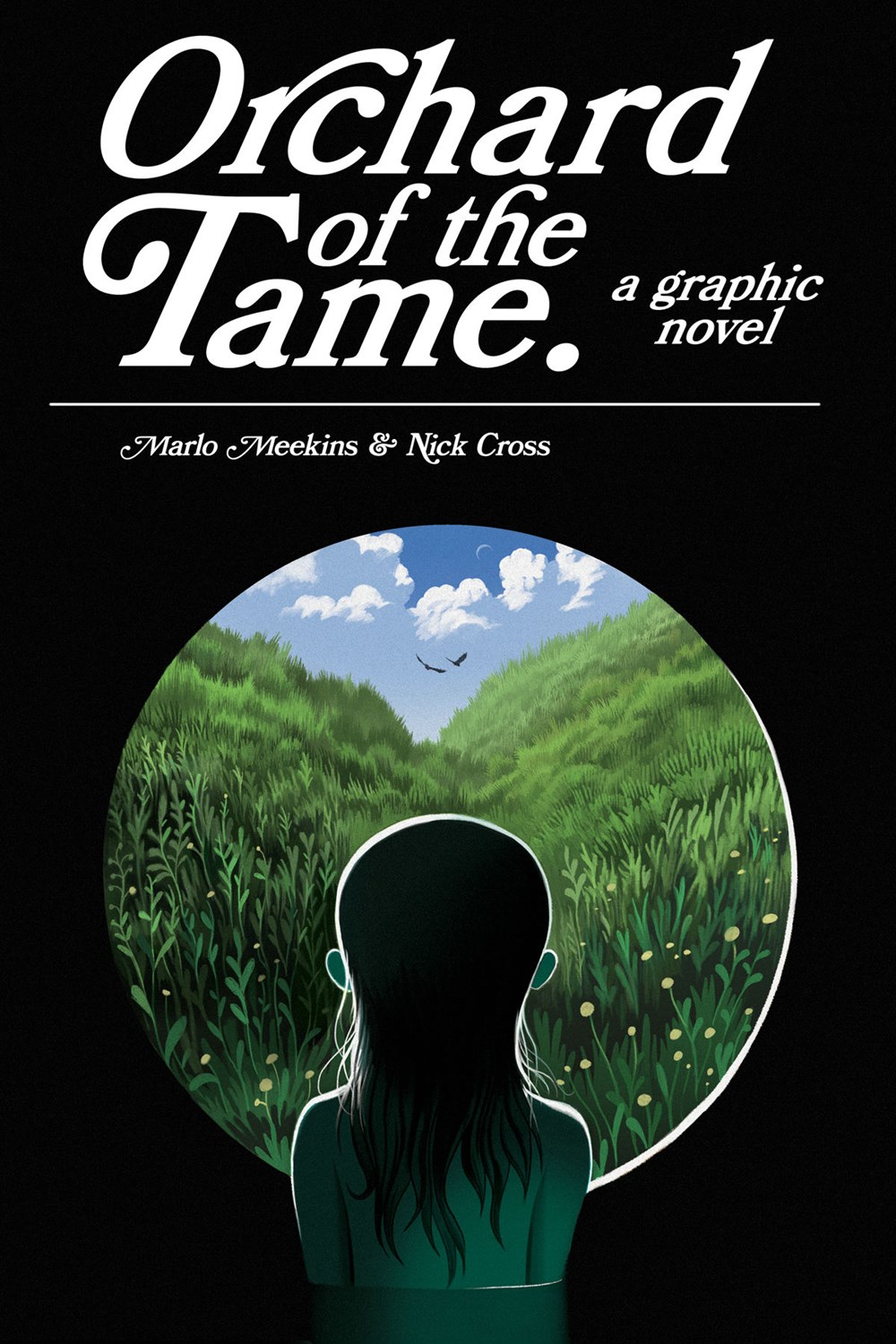
ORCHARD OF THE TAME, graphic novel that was a 2024 NEW YORK PUBLIC LIBRARY SELECTION FOR BEST NEW COMICS OF 2024
ORCHARD OF THE TAME
MARLO MEEKINS (illus. Nick Cross)
Pegamoose Press
$24.99 hardcover, available now
Rating: 4.5*of five
The Publisher Says: A 2024 NEW YORK PUBLIC LIBRARY SELECTION FOR BEST NEW COMICS OF 2024
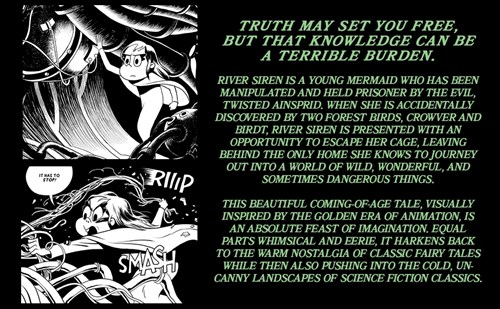
Truth may set you free, but that knowledge can be a terrible burden.
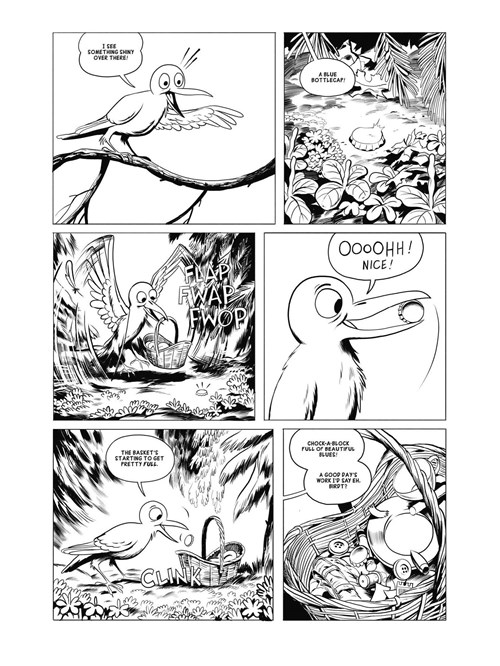
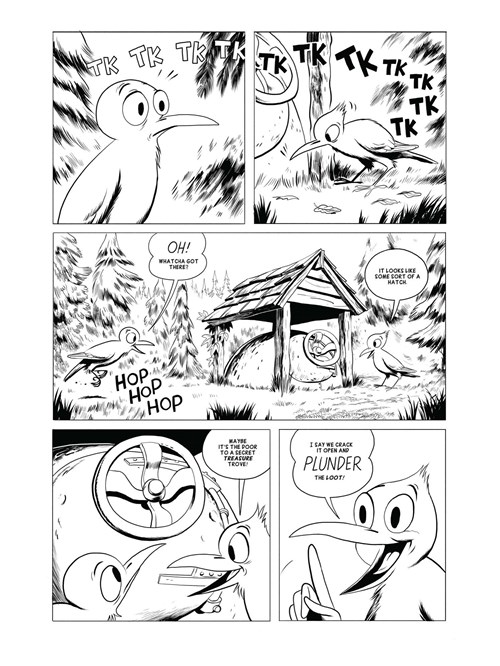
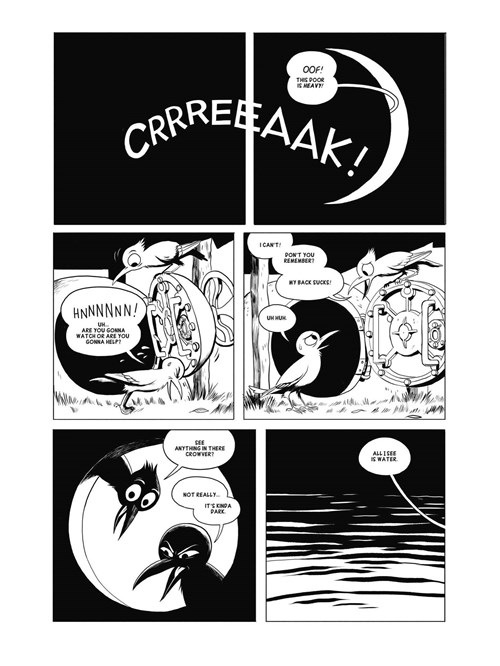
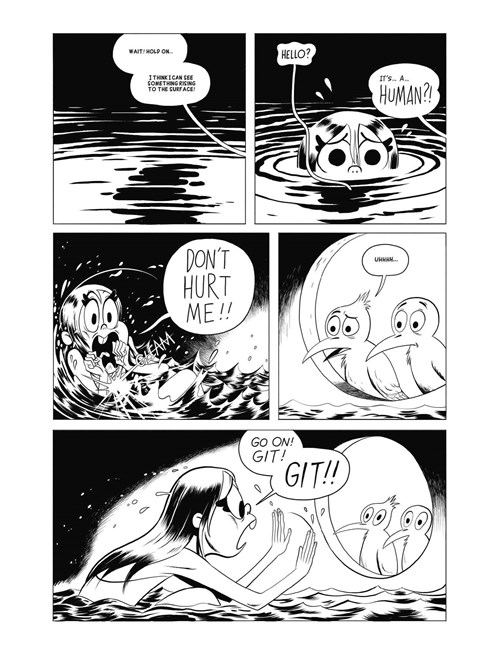
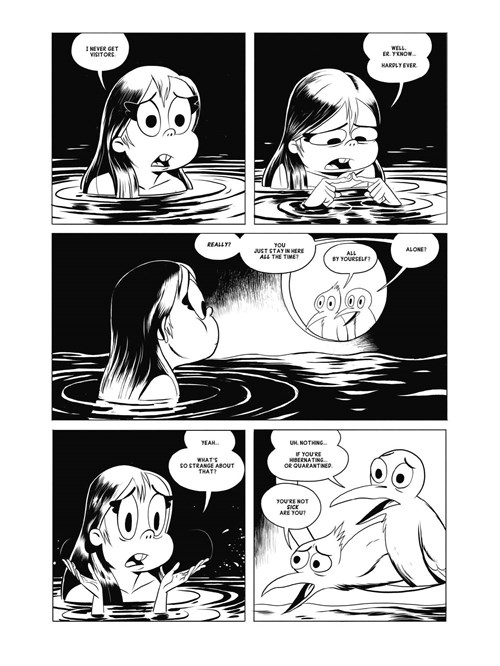
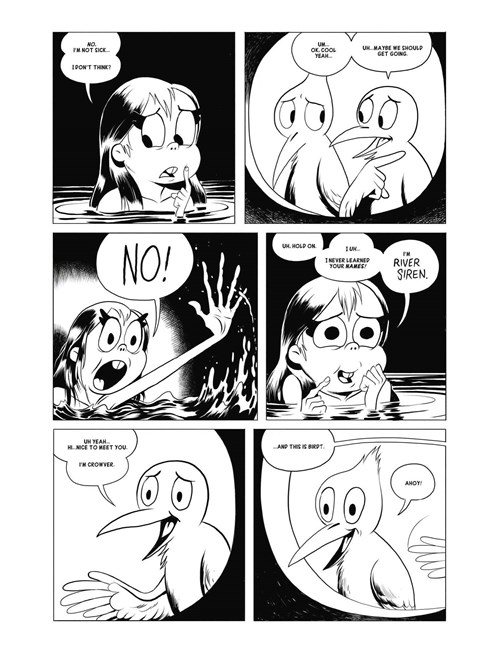
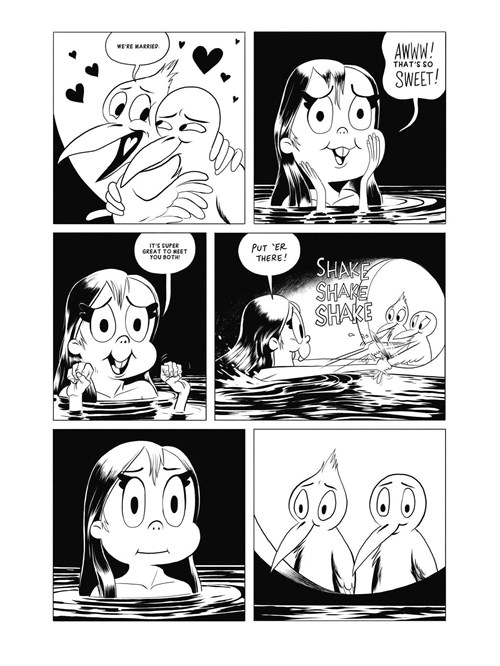
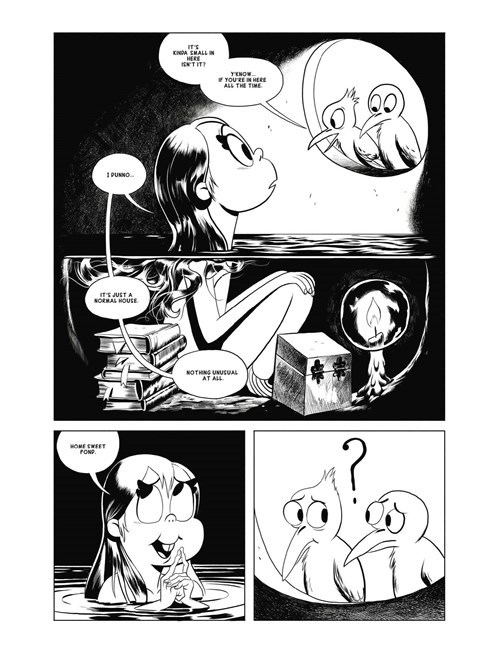
River Siren is a young mermaid who has been manipulated and held prisoner by the evil, twisted Ainsprid. When she is accidentally discovered by two forest birds, Crowver and Birdt, River Siren is presented with an opportunity to escape her cage, leaving behind the only home she knows to journey out into a world of wild, wonderful, and sometimes dangerous things.
This beautiful coming-of-age tale, visually inspired by the golden era of animation, is an absolute feast of imagination. Equal parts whimsical and eerie, it harkens back to the warm nostalgia of classic fairy tales while then also pushing into the cold, uncanny landscapes of science fiction classics.
I RECEIVED A DRC FROM THE PUBLISHER VIA EDELWEISS+. THANK YOU.
My Review: Such a beautiful book. I myownself am seldom that interested in the art in sequential-art storytelling. This year I've run across multiple comics that have art I'm actually interested in for itself.

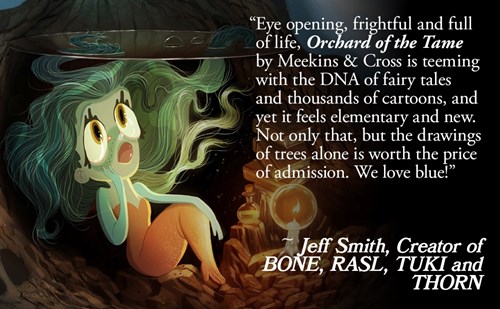
promo pages, all handsomely done

There's a flavor of 1940s cartoons in this artwork that makes me smile. I'm always in favor of stories that show young women that they *can* make major changes for themselves, ones that better their lives and allow them freedom to act on their own behalf.

Make no mistake, the New York Public Library offered this story its imprimatur because its message of personal empowerment and overcoming of anxiety and fear is both loud and clear, and done with the honesty that allows it to transcend "message fiction"'s dread solemnity and tedium.
I don't quite get to five stars because it is quite a long read for a comic book. It isn't my preferred medium, as all who read my reviews know; and it's aimed squarely at an audience I am not. But it wins my approving recommendation over my minor cavils.
Sunday, June 23, 2024
PRIVATE WORLDS: Growing Up Gay in Post-War Britain, elegy for a life spent without
PRIVATE WORLDS: Growing Up Gay in Post-War Britain
JEREMY SEABROOK
Pluto Press
$19.95 trade paper, available now
Rating: 3.5* of five
The Publisher Says: In 1950s suburban England, a friendship bloomed between Jeremy Seabrook and Michael O’Neill—two gay men coming of age at a time when homosexuality was still a crime. Their relationship was inflected by secrecy and fear; the shadows that had distorted their adolescent years were never wholly dispelled, long into their adult life. Lyrical, candid and poignant, this is a tale of sexual identity, working-class history and family drama. A memoir of unparalleled authenticity, Private Worlds is an elegy for a doomed friendship.
I RECEIVED A DRC FROM THE PUBLISHER VIA EDELWEISS+. THANK YOU.
My Review: The US class system impacted me far less than the UK version did young Seabrook, thank all the nonexistent gods. The possession or absence of a "posh" accent is greatly deterministic of one's future; the comparable thing here is the Southern twang, which (no matter where the business is centered) will keep one in the lower ranks. I, being gay and really unwilling to pretend otherwise, felt the sting of exclusion, so that reality was shared by the author and me. His eventual success has been built on being a self not supported by the world he came from; escape by jettisoning the weight of his class identity. Seabrook and O'Neill each accomplished this by being bolshie leftists in an England that was convulsing from the wounds of Empire, birthing today's hideous US-style fascist plutocratic class system.
That doomed, deep love, found and lost early, was part of my life as well. The friendship blighted by the need to dissemble; the deeper connection denied by the caustic effects of powerlessness, of the absence of role models for doing the open and honest thing by each other, was all too painfully relatable to me. It's shocking to me, looking back, that my life was not more blighted by this distorting pressure to be someone I was not and, moreover, did not ever want to be...his life, from my outsider point of view, was more so than mine.
That story is not mine to tell. Author Seabrook and O'Neill have a longstanding public connection, and have each analyzed the way their milieu had them jointly "fail{ing} to grow up together"...a phrase, and an idea behind it, I'd like to pay honor to by saying I wish to hell I'd said that first. The class system's role in this failure was, probably because I'm from the US, not as real as was the way the precocious thwarted-single-mother-raised boy was forced to dissemble. His friendship with O'Neill, ostensibly the focus of this book, feels more like a well-polished lens for him to examine himself and his failed world-beating dreams.
Seabrook and O'Neill (born and raised a Londoner, a key component of his identity as an outsider in the English North) affected a caustic ironical distance from their neighbors. An intellectual pose of studying these Others, who in their turn Othered these bumptious boys for being queer, froze into an outsider identity, an observer stance, that would enable them to "overcome" their background only by treating it as fodder, material for their real life's work in sociological study. Dealing with this really unappealing trait now, Author Seabrook seems paralyzed by his recognition of its cruelty. That this is cruelty returned for cruelty given is not, to my surprise, part of his path to self-forgviness. The ironic separation has an inevitable distancing effect between the friends...how could it not...and that gets his focus. I was surprised by how bitterly he seems to regret the dark space left by O'Neill's separate personhood, and how little kindness he seems to extend to that early Seabrook boy. Judging one's earlier self is easy. Forgiving them is, apparently, not.
A fascinating dive into an intelligent man's past love for his intellectual equal and emotional opposite. I'm sure anyone who's read and liked Édouard Louis or Jon Fosse as tellers of personal and immutable truth will batten on this book.
Sunday, February 25, 2024
SEARCHING FOR VAN GOGH, coming-of-age novel set in 1960s Michigan
SEARCHING FOR VAN GOGH
DONALD LYSTRA
Omena Hills Press
$5.99 Kindle edition, available now
Rating: 4* of five
The Publisher Says: Set in Michigan during the tumultuous closing weeks of 1963, "Searching for Van Gogh" is a heart-wrenching story of two young souls bravely navigating life's challenges.
A young woman is inspired by a cinematic heroine to find meaning in a world that has cast her aside.
A teenage math and science prodigy turns to art as he struggles with the pain of losing his beloved elder brother.
Their unlikely friendship is a beacon of hope, reminding us that in tough times the best defense is the help we can give to one another.
Reminiscent of timeless classics like Ordinary People and To Kill a Mockingbird, this story celebrates the power of friendship and understanding in an often unforgiving world.
I RECEIVED A DRC FROM THE PUBLISHER VIA NETGALLEY. THANK YOU.
My Review: Do you need a break from the nastiness and unapologetic hatemongering of the world outside your door? Do you want to take a trip back to a world still slowly moving into full awareness of how cruel it has become?
Here's you a read.
Two people carrying a lot of sadness find each other at very vulnerable moments in each one's life. Their entire worlds have narrowed into coping with loss and loneliness. Then...they meet, they connect, and they tentatively learn to communicate.
What on Earth is happening to this old man, I can hear you wondering. This kind of story never appeals to him! Quite true, it is not my native land, well-trodden paths to and fro everywhere one looks in my catalog of reads. I was pleased to read something with the personal stakes of this story...grief, loss, coming to terms with the way the world works, how families fail each other at crucial times. The prose is direct and unpretentious, the voices of the characters distinct, and that plus the storyline and setting gave me what I craved most: Investment and involvement with neither anger nor outrage, just the pleasant sense that this time the world handed these two hurting souls the balm instead of the liniment.
I needed an emotionally real story, uncomplicatedly told, with people in believable emotional pain that was not going to cause Disaster. I needed that story to end believably well without absurd, over-the-top machinations, like it does in the happier passages of Real Life. And I got what I needed. I am glad I read this direct, involving, kind story.
So, kindness seekers, come to Donald Lystra's doorstep and be fed.
Monday, July 24, 2023
LOW EXPECTATIONS, riffing on Dickens goes right for a change
LOW EXPECTATIONS
STUART EVERLY-WILSON
Text Publishing
$9.99 Kindle edition, available now
Rating: 4.5* of five
The Publisher Says: I begin to record the history of it all, because if I don’t I will explode, leaving nothing to tell of me but a pile of ash. In this history I will try to leave nothing out, but I will also be careful not to incorporate any extraneous unnecessary shit. Like objectivity. Objectivity is for those who don’t have a point to make, or a side to take. There is only one side to this story and that’s mine.
1970s, Western Sydney. A boy and his mum living in a street where neighbours keep an eye on everyone else’s business. A detested bully. And a family secret, barely hidden.
Devon Destri flies under the radar. He doesn’t talk to anyone, calls himself hard of speaking, and doesn’t correct anyone’s assumptions of his low intelligence. If no one knows otherwise, no one will expect anything of him, and maybe he won’t need to expect anything of himself—that is, beyond running a highly lucrative porn-magazine racket. Only his fiercely loyal friend Big Tammy and Krenek the Hungarian refugee know that Great Expectations is his favourite book, or that he can read at all. But when Devon starts to piece together his mother’s secret, his intellect and charm are put to startling and devastating use.
Stuart Everly-Wilson’s Low Expectations is a heartbreaking and hilarious story of resilience, revenge and love that captures the complexity of vulnerability and bravado. Devon Destri, with his sharp wit and gift for one-liners, is a character you’ll never forget.
I RECEIVED A DRC FROM THE PUBLISHER VIA NETGALLEY. THANK YOU.
My Review: Anyone who's read anything I've written here in the past ten years knows that I admire one thing about Dickens: nothing. A chore to read at best, an excruciatingly twee sentimental boor at least, he's famous wherever English is spoken because he makes average people feel smart, and smart people feel godlike, for "getting" his stories and their layers. To me, that's like congratulating yourself for knowing tomatoes are fruits but having the sense not to put them in fruit salad.
Low Expectations stars a teen, one with multivalent social and physical challenges, whose favorite book is Great Expectations. So coming of age, Dickens veneration, and Australian setting. Not an immediate fit for my US-centric, anti-Chuckles the Dick self, then.
I got within an ace of giving it five stars just for being raucously its ownself.
You who belong to the Church of Chuckles know he's fond of the sesquipedalian sentence, the orotund ekphrasis, the hifalutin verbiage. Quite why Devon, our PoV character, loves him, then is Dickensianly (in the "stop-hitting-me-with-the-message" sense) clear. He's "hard of speaking," a beautiful little Dickensian (in the best sense of fulfilling a need for a phrase that no one knew was there except him) creation for someone who simply doesn't want to speak much. Better not to let anyone in on his secret: he is a smart, observant, sensitive guy stuck in a world that just has no place for that kind of time-wasting, but expects people to be hard, both -working and -hearted, to make it in their working-class world. Devon feels safe in his hidey-hole with the special needs kids, he refers to it as the "spaz Gulag" and now let's talk about lanuguage. Diametrically opposite to Dickens, Devon's narrative voice is choppy and frequently heavy on the "worty dirds," as a teacher of mine called them. He absolutely has no respect for anyone who isn't worthy in his eyes, including himself. For the 2020s US audience this can lead to pursed lips and furrowed brows. Either check your fifty-years-later, wildly different culture expectations of politeness at the door, or don't pick the book up...and I strongly encourage the former choice. The alchemy of the story is, like Devon's favorite story, in the way the entire experience of reading it subverts the thoughts and expectations you started out with so often that the wonder is you emerge with any expectations left.
This bitter draft of gall and wormwood comes about because our hard-of-speaking narrator learns a truly life-changing secret about the mother he disrespects and denigrates. As she's raised him by herself, I don't think you need a lot of brainpower to figure out what it's about. I will say that it didn't seem hugely surprising to me when it was revealed; I was by that time exasperated with Devon for not picking up on it before he did. What matters in this rough-tongued kid's world is keeping himself a small enough target to avoid more than the irreducible minimum of abuse and also attention. It makes him a more-than-ordinarily solipsistic adolescent. His eyes are sharp...his attention is not focused outside his self-defined sphere of defense. As he's breaking the law, he's wise to keep his thoughts from straying too far afield. Adult readers who're parents will, I'm sure, think the right thoughts about how the family-related things end up before they do.
With the laundry list of CWs, why would I rate this book so highly? Because I'm Devon's age and, even though I grew up in Texas, the culture of cruelty wasn't a lot different there. Instead of someone telling a loudly pruriently foulmouthed and prejudiced tale of the modern day in order to shock and appall and titillate, this story recounts the way it was in that time and place, and does so with clarity and purpose. The world was what it was, but Devon is a work in progress, and by the end of the book the Devon we met is appreciably more adult in the postive ways than I ever expected him to be.
But for all that, peruse the CWs and make sure you're not going to pass out when they come to pass because they all do.
Saturday, December 3, 2022
DIRT ROAD HOME, charming young-adult/coming-of-age novel I expected not to like but did
DIRT ROAD HOME
ALEXANDER NADER
Winding Road Stories (non-affiliate Amazon link)
$2.99 Kindle edition, available now
Rating: 4* of five
The Publisher Says: City kid Logan Davis is about to find the family he never knew he was missing at the end of a country road.
Logan has no interest in leaving Detroit. But when his impulsive mother shoves him and his brother, Dex. in the back of her old Buick to chase her newest husband in Tennessee, he thinks heading south will be the end of the world. A physical confrontation with a local football star on his first night in town seems to confirm his worst notions.
Prepared to encounter every stereotype in Pigeon Forge, Tennessee, Logan soon discovers his new home might not be all that different. His knack for fixing up fast cars helps him fit right in with the wild and loud southern attitude. A chance encounter at a back road street race leads him directly into the path of the undeniable spirit of the south; her name is Leah.
Dirt Road Home is a novel about finding yourself and realizing that sometimes you have to travel five hundred miles away from your house to find your home.
I RECEIVED A DRC FROM THE PUBLISHER. THANK YOU.
My Review: My god, I hear regular readers saying under their breaths, what the hell got into this old man? TWO books you can call YA in two days...with four stars!
Yep. The publisher reached out to me on Twitter before the book came out...not all the way sure why...and said "you'll like this book." And I did, really surprising myself most of all.
Logan's a kid about to become a young man. He's got some skills at car-related mechanical work. He's got a mother who's a disaster at picking men. He's got a jock as an enemy in their new town. His just-barely-younger brother is his wing man, and his fellow gearhead. It's all gonna go just swell, ain't it, thinks annoyed frustrated Logan.
Cue the girl, please.
Leah's the kind of girl who goes to the street races. Not with someone, she goes on her own because she likes it. The best thing about this story for me was the way these two slightly weird kids felt the gravity of each others' existence. There's the key to the story being a coming of age/young adult book: they have that feeling for each other and the whole time, they don't even question it. They're each thrilled with their luck.
Then there's the man his mother dragged her boys to Pigeon Forge, Tennessee, to be with. Another disaster, I though cynically. Another antagonist. Indeed not, cynics. Greg is the absolute best guy...patient, kind, accepting...that everyone in the family could have hoped to meet. He's a prince among men.
I *did* say it was aimed at young adults.
Why I liked it, though, was the economical prose wasn't at the expense of the characters being realized. It felt to me that the details Author Nader gave us were quite simple, but carefully chosen.
My phone beeps, interrupting my late-night, early-life crisis.
–and–
I'm trying to decide if it would look better if I dug a giant sleep-booger out of my eyeball or just left it and hope she doesn't notice.
I came away thinking Logan finally got something good out of the craptastic life his mother had led for them. I was glad for them all that Greg (for unknowable reasons) decided this was the woman he wanted out of the billions there are. Luck for them all, he did.
I'm surprised at how much pleasure I got from this long-afternoon's read. I hope y'all give the story a chance to beguile you, too.
Wednesday, June 1, 2022
THE REDSHIRT, Southern American football culture meets gay first love & BATH HAUS, gay thriller about unraveling your own life with plenty of help
BATH HAUS
P.J. VERNON
Doubleday Books
$26.95 hardcover, available now
Rating: 3.75* of five
FINALIST FOR THE 34th Lambda Literary Award—BEST LGBTQ Mystery! Winners announced 11 June 2022.
The Publisher Says: Oliver Park, a recovering addict from Indiana, finally has everything he ever wanted: sobriety and a loving, wealthy partner in Nathan, a prominent DC trauma surgeon. Despite their difference in age and disparate backgrounds, they've made a perfect life together. With everything to lose, Oliver shouldn't be visiting Haus, a gay bathhouse. But through the entrance he goes, and it's a line crossed. Inside, he follows a man into a private room, and it's the final line. Whatever happens next, Nathan can never know. But then, everything goes wrong, terribly wrong, and Oliver barely escapes with his life.
He races home in full-blown terror as the hand-shaped bruise grows dark on his neck. The truth will destroy Nathan and everything they have together, so Oliver does the thing he used to do so well: he lies.
What follows is a classic runaway-train narrative, full of the exquisite escalations, edge-of-your-seat thrills, and oh-my-god twists. P. J. Vernon's Bath Haus is a scintillating thriller with an emotional punch, perfect for readers curious for their next must-read novel.
I CHECKED THIS BOOK OUT OF MY LOCAL LIBRARY. USE YOUR LIBRARIES, FOLKS! THEY NEED US AND WE NEED THEM MORE THAN EVER.
My Review: I love flawed gay protagonists! They don't come more flawed than Oliver. What he did, how he did it, all truly contemptible. Why? Lower still. By the end of the story, he is the sort of creepy little loser it's easy to hate. Yet I never *quite* learned to hate him. I was certainly contemptuous of his actions...for which he paid a steep price.
Nathan, well...he's a rotten-souled chip off the fetid, foul-smelling old block. He does nothing for anyone but himself. He is a walking, talking scion of White Privilege, and not worth the powder it would take to blow him up. Nathan (and family, and friends) I hated with force and vigor.
Why I kept going despite serious problems with the characters peopling the book is simple: the pace picked up after about the 40% mark. It got so involving I couldn't stop. But I will say this, I wouldn't have been kind about the whole thing if Tillie had not been okay.
Borrow it from the library. Not a book you'll want to re-read.
++++++++++++++++++++++++++++++++++++++++++++++++++++++++++++++++
THE REDSHIRT
COREY SOBEL
The University Press of Kentucky
$29.95 hardcover, available now
Rating: 4.5* of five
The Publisher Says: Shortlisted for 2020 Center for Fiction's First Novel Prize
Corey Sobel challenges tenacious stereotypes in this compelling debut novel, shedding new light on the hypermasculine world of American football. The Redshirt introduces Miles Furling, a young man who is convinced he was placed on earth to play football. Deep in the closet, he sees the sport as a means of gaining a permanent foothold in a culture that would otherwise reject him. Still, Miles's body lags behind his ambitions, and recruiters tell him he is not big enough to compete at the top level. His dreams come true when a letter arrives from King College.
The elite southern school boasts one of the best educations in America and one of the worst Division One football programs. King football is filled with obscure, ignored players like Miles—which is why he and the sports world in general are shocked when the country's top recruit, Reshawn McCoy, also chooses to attend the college. As brilliant a student as he is a player, the intensely private Reshawn refuses to explain why he chose King over other programs.
Miles is as baffled as everyone else, and less than thrilled when he winds up rooming with the taciturn Reshawn. Initially at odds with each other, the pair become confidants as the win-at-all-costs program makes brutal demands on their time and bodies. When their true selves and the identities that have been imposed on them by the game collide, both young men are forced to make life-changing choices.
I RECEIVED A DRC FROM THE PUBLISHER VIA EDELWEISS+. THANK YOU.
My Review: Let's start with the easy bits: Clearly Author Sobel, football alum of DUKE University, knew the sports parts inside out. Clearly he understood the racism and exploitation inherent in King/Duke University inviting Black players to its program, and campus. And I strongly suspect he knew some closeted players. He himself is not gay, and it shows.
This is not a knock. The man understands viscerally the cost of hiding and sneaking. But he doesn't get the longing for a man to touch you and be touched by you because I'll wager he's never felt it. What he does get is the way love, real true first love, makes a man out of a boy. That part is absolutely crystal clear, and is the heart of my appreciation for this story. Reshawn the phenom's hatred for the entire enterprise of college football, possibly the game itself, gets serious exploration. It's counterpointed to Miles's "I-am-a-camera" absorption in the colors and the personalities and the panoply of the game's celebrants, as Author Sobel directly describes them:
Here came the celebrant. Coach Zeller's vestments were a purple polo shirt, pressed white khakis, and unscuffed tennis shoes he reserved for games. He took his place at the head of the half circle, and once the last people squeezed inside and the doors closed he began his first pregame speech as King's head coach.
It's not necessary to reproduce Zeller's blather about either rising or sliding, about choosing and losing. It's not like it makes any difference, but it does show the author's clear grasp of the milieu and his own keen perception of the performative and ritualistic elements of football at this school.
What the author also gets is what it takes to be Other in a world that has no room, no time, no oxygen for Otherness. What happens is cruel and vicious and mean-spirited. Miles is the most intensely tested character in this book and it is unbelievable to me that his power and strength could go unnoticed by the people around him. The adults clearly see it and clearly want it...but on their own terms.
The end of the story is not at all what one would expect it to be. The end of the story is, in so many ways, the end of childhood's sweet spot in adolescence and the entry of Miles...and Reshawn...into the dark, cold, stinking pool of adulthood. Reshawn is, like Miles himself, tested and comes through a man. The others? The team, the coaches, not one of them is anything other than a dupe. They're fools caught on the deck of Plato's ship of fools, all the worse because they see it and choose it.
I can't imagine all that many of my fellow queer gents are football-mad enough to want to wade through the games and practices. There's no compensatory sex to make the enterprise less...cishet...and that is deeply too bad. I think, if y'all can pry open your rage-sealed hatred for the way team sports treated you, you'll find a story about personal power, about truly accepting yourself and your place in this world, and about how important it is to know your friends are fully, completely there for you if you're to make any kind of success out of adult life. And thus how very satisfying Miles's story is. That is what you get; you should come experience it; and take some time to appreciate that this is not some lame fantasy of The Lockerroom, but the voice of experience telling you how it goes when it goes right.
Friday, June 18, 2021
THE DICTIONARY OF LOST WORDS, Victorian setting--usual suspects--good story
THE DICTIONARY OF LOST WORDS
PIP WILLIAMS
Ballantine Books
$28.00 hardcover, available now
Rating: 4* of five
The Publisher Says: In this remarkable debut based on actual events, as a team of male scholars compiles the first Oxford English Dictionary, one of their daughters decides to collect the "objectionable" words they omit.
Esme is born into a world of words. Motherless and irrepressibly curious, she spends her childhood in the "Scriptorium," a garden shed in Oxford where her father and a team of dedicated lexicographers are collecting words for the very first Oxford English Dictionary. Young Esme's place is beneath the sorting table, unseen and unheard. One day a slip of paper containing the word "bondmaid" flutters to the floor. She rescues the slip, and when she learns that the word means slave-girl, she withholds it from the OED and begins to collect other words that have been discarded or neglected by the dictionary men.
As she grows up, Esme realizes that words and meanings relating to women's and common folks' experiences often go unrecorded. And so she begins in earnest to search out words for her own dictionary: The Dictionary of Lost Words. To do so she must leave the sheltered world of the university and venture out to meet the people whose words will fill those pages.
Set during the height of the women's suffrage movement with the Great War looming, The Dictionary of Lost Words reveals a lost narrative, hidden between the lines of a history written by men.
Based on actual events and combed from author Pip Williams's experience delving into the archives of the Oxford English Dictionary, this highly original novel is a delightful, lyrical, and deeply thought-provoking celebration of words and the power of language to shape the world.
I CHECKED THIS BOOK OUT FROM MY COUNTY'S LIBRARY SYSTEM. USE YOUR LIBRARY, FOLKS! THEY NEED US!
My Review: First, read his:
Some words are more than letters on a page, don't you think? They have shape and texture. They are like bullets, full of energy, and when you give one breath you can feel its sharp edge against your lip.
–and–
I often wondered what kind of slip I would be written on if I was a word. Something too long, certainly. Probably the wrong colour. A scrap of paper that didn't quite fit. I worried that perhaps I would never find my place in the pigeon-holes at all.
–and–
A vulgar word, well placed and said with just enough vigour, can express far more than its polite equivalent.
There is an immense gulf between thoughts and words...Esme, as a girl in the almost-all-male world of dictionary-obsessed dad Harry, discovers again and again that the ideas we robe in words aren't seen by those who hear them as we've made them in our minds. The factual world of making the Oxford English Dictionary (OED) presided over by Dr. James Murray is expanded to include a fictional word-mad girl-child whose run-ins with lying adults, oblivious adults, and peers without her ruling passion for The Words We Use are the meat of this delicious, if difficult to deal with at times, novel. Esme Nicholl does not spend her life the way Dr. Murray's typically Victorian daughters do. Her days are spent being educated at school; her afternoons with the men at the Scriptorium as they collate and pigeonhole and excise the tens of thousands of definitions and attestations through usage that arrive in Dr. Murray's home/workhouse from around the world. Careless dropping or deliberate deletion, it makes no never-mind to young Esme. She re-homes them in her treasure-chest, under a housemaid's bed, their shared secret.
The dropped words, Esme notices as her life gives her more analytical tools, are often words commonly used by, among, and about women and their activities. Her world is coming for her, bent on controlling her and bending her to its will. Her Godmother Edith, a factual person really nicknamed Ditte, is a very unconventional woman and a prolific contributor the OED. She's acted as a co-parent, in a limited way, to Esme; yet she fails her when Esme desperately needs her simply because Ditte doesn't live in Oxford, let alone in daily contact with Esme.
“Dr. Murray said you and Beth were proflitic contributors,” I said, with some authority.
“Prolific,” Ditte corrected.
“Is that a nice thing to be?”
“It means we have collected a lot of words and quotations for Dr. Murray’s dictionary, and I’m sure he meant it as a compliment.”
The relationship is pretty tidily encapsulated there. Older mentor, not quite understanding the mentee but giving great guidance anyway; just not quite what was really needed. The words for things are centered; the denotations are generously given, while the connotations are left more or less to Esme's maturing brain to construct as best she can. She is, after all, equipped with well-designed tools...but no manuals to train their user in their best use.
In her word-collecting fever, Esme amasses much raw data, many denotations. Her goal for it remains unfocused until she realizes that the words' connotations give her the needed feminist perspective: she and her half of humanity are doomed to be controlled until they can participate in life as political actors instead of passive observers. Yes, she discovers Feminism and becomes a suffragette. And uses her life-long capacity to work with words to give sharp focus to her purpose.
If war could change the nature of men, it would surely change the nature of words.
–and–
“Words change over time, you see. The way they look, the way they sound; sometimes even their meaning changes. They have their own history.”
Something I wish people who fuss over neologisms and redefinitions would process. Things are growing or dying. There is no stasis in natural systems, and no homeostasis doesn't count...it is a finely balanced state but predicated on constant shifts and changes that must support a larger whole's proper, healthy functioning. Just like language...the words are always tip-tilting, reconfiguring themselves, shedding pieces and adding others; but the language as a whole lives and thrives and, broadly, remains the same. Only different.
It struck me that we are never fully at ease when we are aware of another's gaze. Perhaps we are never fully ourselves. In the desire to please or impress, to persuade or dominate, our movements become conscious, our features set.
That snapshot effect, the mask of Persona slid over a person's face, is what Esme is resisting as she rescues rejected and deleted words from the magisterial OED. Her women's words are the ones men most need, and are supremely reluctant, to hear. Esme's project, fictional of course, is the titular dictionary, with words like "menstruation" (simply too earthy and shuddersome for the frail little men making the OED) to "knackered" because it's vulgar and ugly when a more refined person could say "exhausted" or "listless." Esme thinks "bollocks to that" and spends her adulthood on the many pieces that must be moved around and reconfigured to make a society that can even properly think about a way to include women as adult beings.
And herein the reason I don't give this book a five-star warble of ecstasy...the passage of time. It doesn't. I'm herky-jerkyed into different stages of Esme and the world's life but the setting remains...internal. It's The Esme Show, instead of Truman; she's the star and no doubt. But there's a degree of alienation in that. Thank goodness there are so many dates to open chapters! Too bad they don't mean more. It's certainly true that we, in our daily rounds, don't think carefully about where the screens in the piston of our french-press coffeepot come from, or how and when to clean or replace them. But some sense of Esme's adjustments to the world around her, since her project is to effect true change upon it, would've helped me grasp the maturation parts of time's passage. I felt the lack of that connection keenly.
Esme's relationships were also a bit troubling to read for this reason. Lizzie, her female exemplar in residence, was a lower-class girl whose best hopes weren't as high as she's actually risen by working for the Murrays and becoming Esme's comadre. By rights she should be a dead young worn-out whore. So the way the privileged miss and the rough serving girl should practically leap off the page at me, right?
“Me needlework will always be here,” she said. “I see this and I feel…well, I don’t know the word. Like I’ll always be here.”
“Permanent,” I said. “And the rest of the time?”
“I feel like a dandelion just before the wind blows.”
–and–
My mother was like a word with a thousand slips. Lizzie’s mother was like a word with only two, barely enough to be counted. And I had treated one as if it were superfluous to need.
It's really the fate of most of us...we vanish into nothingness as soon as we assume room temperature. Ephemeral as life is, what I found wantimg in those perfectly lovely passages was the solidity of Life beating Esme with her own responsibility to and for the older but more vulnerable on a practical life-level woman.
Still and all, I'm so pleased that I read this wonderful story. I think it could have made more of an impact on me had some stylistic choices been made differently; that is always the way with making art, no one can create something as powerful and fully realized as this book is without making choices that won't work for everyone. I felt very strongly the aura of choices and decisions affirmatively, consideredly made at every turn. This is in no way a slapdash or ill-made work of fiction. Its real and its fictional characters are treated with equal gravitas. That the factual characters take up less screen time is a decision that the author and editor clearly planned carefully and executed deftly. I can offer no more heartfelt recommendation than "read this book soon." I *could* have, if certain other, less distancing, choices had been made, turned obnoxious pest and shouted at you to get the book NOW read it on the Jitney or in the Admiral's Club but just GET IT!!
But really, does it get that much better than this?
I thought about all the words I’d collected from Mabel and from Lizzie and from other women: women who gutted fish or cut cloth or cleaned the ladies’ public convenience on Magdalen Street. They spoke their minds in words that suited them, and were reverent as I wrote their words on slips. These slips were precious to me, and I hid them in the trunk to keep them safe. But from what? Did I fear they would be scrutinised and found deficient? Or were those fears I had for myself? I never dreamed the givers had any hopes for their words beyond my slips, but it was suddenly clear that no one but me would ever read them. The women’s names, so carefully written, would never be set in type. Their words and their names would be lost as soon as I began to forget them. My Dictionary of Lost Words was no better than the grille in the Ladies’ Gallery of the House of Commons: it hid what should be seen and silenced what should be heard.
Pip Williams: I salute you for writing a grown-up book for real, passionate readers.
Saturday, May 1, 2021
HEARTSTOPPER VOL. ONE, a graphic novel YA coming-of-age coming-out story
HEARTSTOPPER vol. 1
ALICE OSEMAN
Graphix (non-affiliate Amazon link)
$9.99 on Kindle
Everyone else on the planet luuuvs these stories and, on 20 May 2022, Netflix viewers (including me, actually) are getting two more seasons with two cute-enough English boys playing the leads. Enjoy!
Rating: 3.5* of five
The Publisher Says: (from the author's site) Boy meets boy. Boys become friends. Boys fall in love. An LGBTQ+ graphic novel about life, love, and everything that happens in between - for fans of The Art of Being Normal, Holly Bourne and Love, Simon.
Charlie and Nick are at the same school, but they've never met ... until one day when they're made to sit together. They quickly become friends, and soon Charlie is falling hard for Nick, even though he doesn't think he has a chance.
But love works in surprising ways, and Nick is more interested in Charlie than either of them realised.
Heartstopper is about love, friendship, loyalty and mental illness. It encompasses all the small stories of Nick and Charlie's lives that together make up something larger, which speaks to all of us.
This is the first volume of Heartstopper, with more to come.
(from Goodreads) Charlie, a highly-strung, openly gay over-thinker, and Nick, a cheerful, soft-hearted rugby player, meet at a British all-boys grammar school. Friendship blooms quickly, but could there be something more...?
Charlie Spring is in Year 10 at Truham Grammar School for Boys. The past year hasn't been too great, but at least he's not being bullied anymore. Nick Nelson is in Year 11 and on the school rugby team. He's heard a little about Charlie - the kid who was outed last year and bullied for a few months - but he's never had the opportunity to talk to him.
They quickly become friends, and soon Charlie is falling hard for Nick, even though he doesn't think he has a chance. But love works in surprising ways, and sometimes good things are waiting just around the corner...
MY GOODREADS FRIEND STEVEN LOVED IT TO BITS AND IT WAS CHEAP SO WHY NOT?
My Review: The reasons why not:
1) YA...how often have I bemoaned the depressing prevalence of YA books in publishing? It seems that what ain't Fifty Shades of Ptui is Twiphlegm.
2) Coming-of-age...hated that mess in 1972, no fonder of it 49 years on.
3) Coming out...never having been convincingly *in* I'm less emotionally invested in coming *out*.
4) Graphic novel...comic books weren't part of my childhood. My sisters are more like aunts, I have no memories of them before they were teens so, to me, adults. The boys I hung around with weren't comic-booky sorts, they were playscripts and Asimov readers, Star Trek fanfic writers...not superhero-worshipping guys. They could, however, decline the nouns in Elvish from Lord of the Rings and draw maps of Mordor from memory.
So what the hell was this oh-so-precious overbred individual doing here? Making a concerted effort not to die above the neck before dying below it. Must examine and challenge those prejudices lest they clog my mental arteries too far.
It was fun, in a weird way, to make it through the story in 25 minutes, then go back and really look at the art.
They meet after a random seating assignment:
They get interested in each other:
Things move along, Nick discovering that he's got Feelings for another guy and...liking it:
...and Life goes on.
That's where I start moving with the times. I LOVE the message of this story, I think the presentation of the big sporty boy who's really just never so much as thought about boys sexually finding out that falling in love means it's with the guy wearing the body, not the body alone.
Yeah. Absolutely perfectly in tune with the way I think about the world of sex and love. So very much what I'd've given my son!
So, on balance, a yes from me with the caveat that I wouldn't read more at the regular $9.99 price because of my own tastes...and I'd say the art is, at best, serviceable. I always knew at whom I was looking, and had a vague sort of feel for where the scenes were set, but...if I was wearing socks, they wouldn't be blown off. Again, that's a personal taste matter, and the pages above should tell you what you think of the art for yourself.
Smiles, not wreaths of joy, are more than good enough in the Plague Year.
Sunday, December 20, 2020
THE FALLS OF THE WYONA, a coming-of-age novel about last midcentury set in beautiful Appalachia
THE FALLS OF THE WYONA
DAVID BRENDAN HOPES
Red Hen Press
$16.95 trade paper, available now
Rating: 3.5* of five
The Publisher Says: In The Falls of the Wyona by David Brendan Hopes, four friends growing up on the banks of a wild Appalachian river just after WWII discover, almost at the same time, the dangerous, alluring Falls and the perils of their own maturing hearts. Seen through the eyes of his best friend Arden, football hero Vince falls in love with the new kid, Glen. They have no context for their feelings, and the next few years of high school become a tense, though sometimes funny, artifice of concealment. The winner of Red Hen’s Quill Prize, The Falls of the Wyona is the first of three achieved (and several more projected) novels by this author imbued with the magical atmosphere of Appalachian culture.
I RECEIVED A DRC OF THIS BOOK FROM RED HEN PRESS VIA EDELWEISS+. THANK YOU.
My Review: The thing about historical novels, ones set in a past deep enough to have lost its currency, is that they might as well be fantasy novels. On the other hand, historical novels that take place when one's parents were getting married and having their first children are in a peculiar place between contemporary and stuffy-old-fashioned nostalgia fests.
I went on this journey, to be sure, knowing where I was headed. The historical part wasn't that historical to my frame of reference; the queer part contained my frame of reference; so what was I doing here, exactly? Touristing a bygone age's homophobia, knowing it would end badly? Or listening to the gift of a story told by a person whose life was more firmly rooted in that time and place than mine? In the end, it's a matter of semantics, distinction without difference. I went to the Wyona River and I saw the Falls, felt the way it broke the people of its town into parts. Boys and girls led very separate lives when I was growing up, too, but the river being so exclusively (in the narrator, Alden's, mind) male rang me like a bell. The funny thing for me was seeing how open Vince, the coach's only child, was about his love for Glen...but only by the maleness of the Wyona.
Arden's narration of the moments that small-town Southern football-playin' boys shared then and now, if Friday Night Lights et alii are to be believed, came close to wearing my armor thin. I didn't like those guys, they didn't like me, and I was right back there in those awful, ugly hallways. Arden, a jock, and Tilden the smart jock, both orbit Vince or Vinny (depending on some weird social cue I never worked out, the nicknames interchanged) in a way that I saw clearly as a former high-school nobody. Glen finds them, and improbably gets to hang with them; many are the jealous glances the four received, I'm sure. Vince falls in love with Glen. Arden knows, but doesn't really care, because the knowledge doesn't touch his love for Vince or fondness for Glen. Tilden starts to figure it out, a little, but can't quite contextualize it.
High-school loves are always hotly urgently NEW and DEEP!! A parent as doting as Vince's former football-star father is begins to dread this reality...it's the 1940s, that was inevitable...and horrible, wicked, cruel things begin to happen. Poor Glen...a gloriously romantic tableau ends in as awful a passage as any I've read. The most poignant, delightful scene I read was when Glen's father visits Arden at his home, admits he knows that Glen was in love with Vince and says in effect, "I wouldn't have changed what I told Glen to do to win over his true love even if I'd known then what I do now." Arden doesn't know what this means, kid that he is, and Glen's dad asks him just to be Glen's friend. It was a heartbreaking, lovely moment, deeply felt and viscerally real. It gave me the true tragic heart of the story, and it is the best reason I can give you, straight or gay, parent or not, to read this story.
The ending of the book, of necessity I think, is crowded and over-wrought. People come to accommodations that are not adequately explained, the sudden realizations and restorations aren't very realistic, and the theme of Love Conquering All feels fragile and thin. I don't think there was a better way off this horse, though. The need to end the story at this point and in this specific gestalt really could not be gainsaid.
But that troubled my readerly gravity, pushing me out of the gravity well when I expected to be reeled in and landed. Author Hopes has a lot of storytelling behind him. It shows in every beat he counts. It is always agreeable to be guided by a steady, firm hand. In the end, this tour was ended abruptly and I left the read wishing, regretting ever so slightly, wondering how, or if, the ending could've been more rooted in the story told.
I can't answer that, and it is that fact which left me with a three-plus star rating instead of the four-plus I'd expected to leave.
DAVID BRENDAN HOPES
Red Hen Press
$16.95 trade paper, available now
Rating: 3.5* of five
The Publisher Says: In The Falls of the Wyona by David Brendan Hopes, four friends growing up on the banks of a wild Appalachian river just after WWII discover, almost at the same time, the dangerous, alluring Falls and the perils of their own maturing hearts. Seen through the eyes of his best friend Arden, football hero Vince falls in love with the new kid, Glen. They have no context for their feelings, and the next few years of high school become a tense, though sometimes funny, artifice of concealment. The winner of Red Hen’s Quill Prize, The Falls of the Wyona is the first of three achieved (and several more projected) novels by this author imbued with the magical atmosphere of Appalachian culture.
I RECEIVED A DRC OF THIS BOOK FROM RED HEN PRESS VIA EDELWEISS+. THANK YOU.
My Review: The thing about historical novels, ones set in a past deep enough to have lost its currency, is that they might as well be fantasy novels. On the other hand, historical novels that take place when one's parents were getting married and having their first children are in a peculiar place between contemporary and stuffy-old-fashioned nostalgia fests.
I went on this journey, to be sure, knowing where I was headed. The historical part wasn't that historical to my frame of reference; the queer part contained my frame of reference; so what was I doing here, exactly? Touristing a bygone age's homophobia, knowing it would end badly? Or listening to the gift of a story told by a person whose life was more firmly rooted in that time and place than mine? In the end, it's a matter of semantics, distinction without difference. I went to the Wyona River and I saw the Falls, felt the way it broke the people of its town into parts. Boys and girls led very separate lives when I was growing up, too, but the river being so exclusively (in the narrator, Alden's, mind) male rang me like a bell. The funny thing for me was seeing how open Vince, the coach's only child, was about his love for Glen...but only by the maleness of the Wyona.
Arden's narration of the moments that small-town Southern football-playin' boys shared then and now, if Friday Night Lights et alii are to be believed, came close to wearing my armor thin. I didn't like those guys, they didn't like me, and I was right back there in those awful, ugly hallways. Arden, a jock, and Tilden the smart jock, both orbit Vince or Vinny (depending on some weird social cue I never worked out, the nicknames interchanged) in a way that I saw clearly as a former high-school nobody. Glen finds them, and improbably gets to hang with them; many are the jealous glances the four received, I'm sure. Vince falls in love with Glen. Arden knows, but doesn't really care, because the knowledge doesn't touch his love for Vince or fondness for Glen. Tilden starts to figure it out, a little, but can't quite contextualize it.
High-school loves are always hotly urgently NEW and DEEP!! A parent as doting as Vince's former football-star father is begins to dread this reality...it's the 1940s, that was inevitable...and horrible, wicked, cruel things begin to happen. Poor Glen...a gloriously romantic tableau ends in as awful a passage as any I've read. The most poignant, delightful scene I read was when Glen's father visits Arden at his home, admits he knows that Glen was in love with Vince and says in effect, "I wouldn't have changed what I told Glen to do to win over his true love even if I'd known then what I do now." Arden doesn't know what this means, kid that he is, and Glen's dad asks him just to be Glen's friend. It was a heartbreaking, lovely moment, deeply felt and viscerally real. It gave me the true tragic heart of the story, and it is the best reason I can give you, straight or gay, parent or not, to read this story.
The ending of the book, of necessity I think, is crowded and over-wrought. People come to accommodations that are not adequately explained, the sudden realizations and restorations aren't very realistic, and the theme of Love Conquering All feels fragile and thin. I don't think there was a better way off this horse, though. The need to end the story at this point and in this specific gestalt really could not be gainsaid.
But that troubled my readerly gravity, pushing me out of the gravity well when I expected to be reeled in and landed. Author Hopes has a lot of storytelling behind him. It shows in every beat he counts. It is always agreeable to be guided by a steady, firm hand. In the end, this tour was ended abruptly and I left the read wishing, regretting ever so slightly, wondering how, or if, the ending could've been more rooted in the story told.
I can't answer that, and it is that fact which left me with a three-plus star rating instead of the four-plus I'd expected to leave.
Saturday, June 25, 2016
Gay Life sixty years ago was a lot like today: Read Tom Baker's FULL FRONTAL
FULL FRONTAL: to make a long story short
TOM BAKER
iUniverse
$20.95 hardcover, $3.99 Kindle edition, available now
Rating: 3.5* of five
The (Self-)Publisher Says: It is August of 1957, and Tim Halladay, a caddie at the Long Shore Country Club, is looking forward to beginning eighth grade at Assumption School. Tim and his best friend and fellow caddie, Jimmy, are oblivious to the fact that they are slowly transforming into young men with secret desires.
As Tim embarks on a journey of emotional and sexual development, he approaches the world around him with a "full frontal" attitude that allows him to somehow not only survive but thrive, beginning with his first gay experiences as a shy teenager in suburban Connecticut and moving through his escapades at a Virginia army base, the Hotel Manhattan, the Museum of Modern Art, the Polo Lounge at the Beverly Hills Hotel, and lavish suites at various upscale hotels and resorts. As Tim moves from one encounter to the next, he gradually transforms, moving toward a future as a rising star.
Full Frontal shares an intriguing glimpse into the life of a gay man, as told through his eclectic relationships as he eventually discovers that true happiness is all about give and take.
My Review: What happens when history isn't recorded by Official Sources? When the world as it is gets painted and groomed and tarted up for Posterity? Go look in a history book, that's what happens. No juice, no life-as-it's-lived-ness remains, just a skeleton of facts and some fatty tissue about the one-percenters' public actions.
In recent years, historians have discovered the joys of nosing into the private lives of ordinary people via their diaries and their letters. Jeb and Dash, a non-fiction work about two gay men who lived, loved, and larked about between the World Wars, is a fun and interesting look at life otherwise unrecorded and unseen by History-with-a-capital-H.
Then there are books like Full Frontal. Short stories, fictions, that read like entries in your gay uncle's diary, and give you the naughty-naughty sensation of finding the book and sneaking a read of it before he gets home.
The ordinary life of an ordinary young man, coming of age and coming into himself, is usually the stuff of nightmares to read, listen to, or watch. We've all come of age, well most of us have, and we've all had our issues large or small with crafting an identity to suit our sense of self and place in the world.
Here, in these stories, Tom Baker brings a character into focus, sometimes sharp and others soft, whose ordinary lived life as a gay man of the Stonewall generation is vanishing from the earth. This subject isn't utterly fresh and new, goodness knows, since there have been about a Roman Legion of gay-male writers mining the shaft (in joke, don't fuss if you don't get it) in the past 40 years. What makes this book different, and altogether more satisfying on one level, is the absence of angst in the tale.
Tim Halladay was born gay, came of age finding and spending time with other boys who wanted what he wanted, and there's an end to that drama. He's a bit shy, a little bit awkward physically, and pretty much a common-or-garden modestly talented dreamer of dreams.
And that is a lovely thing to find between book covers. I've known Tim Halladays all my life, and liked them, and found their company and their stories engaging and charming. Spending a few hours with this fictional man, now cresting 70 and on the down-slopes of life; looking back over the life he's led; it all gave me, as I slither into my sixties, a happy and wistful glow. Most gay men don't have children to tell their stories to; Tim Halladay, the stand-in for many an actual man, found Tom Baker's pen and made it work for him. It's a pleasure to spend time in his company.
Subscribe to:
Posts (Atom)