Pages
- Home
- Mystery Series
- Bizarro, Fantasy & SF
- QUILTBAG...all genres
- Kindle Originals...all genres
- Politics & Social Issues
- Thrillers & True Crime
- Young Adult Books
- Poetry, Classics, Essays, Non-Fiction
- Science, Dinosaurs & Environmental Issues
- Literary Fiction & Short Story Collections
- Sookie Stackhouse/Southern Vampire Books & True Blood
- Books About Books, Authors & Biblioholism
Showing posts with label Spiegel & Grau. Show all posts
Monday, July 7, 2025
CULPABILITY, a bruising, honest look at family, love, and the scary time we live in
CULPABILITY
BRUCE HOLSINGER
Spiegel & Grau (non-affiliate Bookshop.org link)
$30.00 ebook, available now
The Independent Press Top 40 Bestsellers: Fiction For the week ending September 29, 2026
Rating: 4.5* of five
The Publisher Says: Set at a summer rental on the Chesapeake Bay, a riveting family drama about moral responsibility in the age of artificial intelligence, from the bestselling author of the “wise and addictive” (New York Times) The Gifted School.
When the Cassidy-Shaws’ autonomous minivan collides with an oncoming car, seventeen-year-old Charlie is in the driver’s seat, with his father, Noah, riding shotgun. In the back seat, tweens Alice and Izzy are on their phones, while their mother, Lorelei, a world leader in the field of artificial intelligence, is absorbed in her work. Yet each family member harbors a secret, implicating them each in the accident.
During a weeklong recuperation on the Chesapeake Bay, the family confronts the excruciating moral dilemmas triggered by the crash. Noah tries to hold the family together as a seemingly routine police investigation jeopardizes Charlie’s future. Alice and Izzy turn strangely furtive. And Lorelei’s odd behavior tugs at Noah’s suspicions that there is a darker truth behind the incident—suspicions heightened by the sudden intrusion of Daniel Monet, a tech mogul whose mysterious history with Lorelei hints at betrayal. When Charlie falls for Monet’s teenaged daughter, the stakes are raised even higher in this propulsive family drama that is also a fascinating exploration of the moral responsibility and ethical consequences of AI.
Culpability explores a world newly shaped by chatbots, autonomous cars, drones, and other nonhuman forces in ways that are thrilling, challenging, and unimaginably provocative.
I RECEIVED A DRC FROM THE PUBLISHER VIA NETGALLEY. THANK YOU.
My Review: I am not used to this plot twist. The consequences of a fatal car crash? How many times...the crash was caused by AI doing the driving? *sits bolt upright*
That by itself gets my undivided attention. Of course you'd expect something more complex in the way of complications to sustain a novel-length story. You get it in the form of many, many questions, many...let's call them "obfuscations" by people who should know better, and many evil-intent lies told by scumbags.
It really is a novel of the moment. It's not a nonce book, though it has trappings still new to our culturally changed time. The real, deeper exploration is, as we're ever and always confronted with, how far will you go to protect someone you love? That is an evergreen plot because there is no one answer, no one way to think about your own answer, and a never-ending carnival of reasons the question keeps needing an answer.
Tragedy strikes an ordinary family somewhere every minute of every day. When the world is in the midst of an upheaval like the ever-increasing dominance of AI...which doesn't exist, it's really just a handy term for "data-mining executive algorithms" or some less punchy way of saying "fast, fancy databases"...the question of culpability (and Culpability) is a great way to interrogate personal responsibility. It's always worth interrogating. The parents who broke the rules and trusted AI to backstop them? Culpable. The kid who was, well, a bog-standard overconfident kid? Culpable. The vile scum who unleashed an ill-considered AI tool on the world without effective controls?
Do I even need to type it?
It was a very effective choice, making the mother an AI researcher; it left us without a clean shot at our tech-billionaire villain. (Wouldn't matter to me if he was the kindest, most fleecy-li'l-lambkin of a good guy; anyone involved in this AI nightmare of surveillance and control, with corporations acting as the Stasi, the KGB, and the CIA rolled into one, is guilty of something far worse than mere negligence.) The author's made it impossible to assign all blame in only one place. That means we're all left to think through who owes what to whom, in guilt terms; what happens as a result of our decisions is the root of all family relationships. This family's in crisis, but the way they got there? That started a long time ago.
Really back when these two Millennial solipsists had children; nay, when they hooked up the first time. No one seems to like anyone else in the autonomous van that wrecked; no one seems to know why anyone else feels the way they do; the parents are aware of their kids as entities but don't seem to understand why they're acting the way they are. In many ways, I got the impression that Author Holsinger was using the AI-aided disaster to interrogate whether the family in the van is a family at all. Are they in any fundamentally-human way related, or are they merely biologically similar in statistically significant degrees? The AI plot, then, is both point and pointed; we're asked to think about consequences, and should not stop at the simplest ones.
It's a story familiar in its outlines and so makes that deeper probing far clearer in purpose and execution. Because I've read a zillion family-in-crisis tales, that fact of defending your young was just expected and unsurprising. The last half of the story, after the consequences were pretty much on the table, was where I engaged my deeper reading skills. We're led to contemplate, and to contextualize, love and guilt and privilege and responsibility as a nexus; if you could do that without applying it, and its results, to yourself, I think you're deluded.
It is obvious Culpability was a carefully selected title. Guilt and responsibility twined like snakes around each other, and around duty and obligation. These are topics readers love in their stories because they are truly universal. The ending of this story is not going to please everyone. It is absolutely the best ending to my thinking, because it foregrounds the single greatest weakness of trusting, as in "with your life," A System:
Humans are chaotic, and no system will ever manage chaos.
THE LAKE'S WATER IS NEVER SWEET, apt title for people who can't catch a break
THE LAKE'S WATER IS NEVER SWEET
GIULIA CAMINITO (tr. Hope Campbell Gustafson)
Spiegel & Grau (non-affiliate Bookshop.org link)
$29.00 ebook, available now
Rating: 4.5* of five
The Publisher Says: In her English-language debut, award-winning Italian novelist Giulia Caminito follows a teenage girl as her family transitions from Rome’s impoverished outskirts to a fraught new beginning in a tranquil lakeside town, capturing the disillusionment, loneliness, and rage that defined a generation.
In the 1990s, Gaia’s family moves from the neglected peripheries of Rome to an idyllic lakeside town twenty miles away, in search of a new life that will lift them out of poverty. Each of them bears their own scars: Gaia’s strong-willed mother is fiercely determined to secure a better future for her children at any cost; her father, a once proud man, now suffers in bitter silence after a devastating accident; her anarchist older brother rebels against the political apathy he sees at home; and her young twin brothers wordlessly bear witness to a family in decay.
When Gaia meets two local girls, Agata and Carlotta, the trio builds a fragile friendship throughout their adolescence based as much on their insecurities and jealousies as it is on their mutual affection. Gaia’s encounters with callous boys and contemptuous teachers convince her that she might always be an outsider—excluded from a privileged life and perhaps even beyond the possibility of happiness. Faced with bullying and betrayals among her peers and immense pressure from her mother to excel, Gaia turns inward and her world becomes increasingly insular. Then tragedy strikes her friend group. As more friends slip away and her family fractures, Gaia vows to make the world pay for all the things it has denied her.
Winner of the Campiello Prize, The Lake’s Water Is Never Sweet is an unflinching portrait of a generation, striving to make a place for themselves in a world markedly different from the one their parents promised them. With psychological acuity and stylish prose, Caminito takes us into the volatile, searching mind of a young woman torn between her desire to connect with others and her drive for self-preservation. In a novel that has been acclaimed by readers around the world, Caminito shows how tenderness and fragility often lie just beneath the surface of simmering fury.
I RECEIVED A DRC FROM THE PUBLISHER VIA NETGALLEY. THANK YOU.
My Review: Gaia narrates this story to us, in all her adolescent angst, pain, confusion, bewilderment...all the usual things an adolescent in the middle of the utterly mystifying process of finding out who she is, what she wants, how she's going to set about getting it, feels.
That does not sound like a book I'd like very much. And yet you see those four stars up there. Where'd they come from?
From a scaffolding that wasn't safe. From a stable that showed Gaia she didn't have the power to heal the wounds betrayal leaves. From a bag of rotting lemons, from a carnival shooting game, from texts that can't be answered...from, in other words, life as it is lived.
Watching in real-time someone coming of age is *maddening* because you're helpless. Reading a novel about a young woman becoming herself is both faster and friendlier on the patience. Gaia's got a hard row to hoe in this life, her entire family's very badly broken in real, honest ways. That leaves her to do what she can with what she's got, and that is never enough. Nothing is ever enough when you're working on, working out, yourself. You paste together the bits you can find, then paper over the holes and cracks and voids. It is how humans have always done it, don't be fooled by fools telling you it used to be easier, it was better when..."when" is the slipperiest word in English. "When" never comes, never came, isn't coming, got lost. "When" immigrated from Old Frisia, from Proto-Indo-Europe whatever wherever whenever that happened. Who needs "when" because we have "now."
And "now" is Gaia's native land.
It was clear to me the story here was not purely foundationally fiction. The author says so in her last word on the subject. She's Gaia; other girls from her past were Iris and Agata. It doesn't help, particularly, to know that but it does make me trust the author more. She's honest; she wrote a novel about realness by using reality, and one person's reality is never, ever enough...see above...for a whole novel. It's too much and never enough, like Mary Trump says. We're not enough for fiction; we're too much for Life. It's a puzzlement, remember Yul Brynner talking those lines on pitch? And no king like The King and I ever spoke greater sooth. Imagine not feeling puzzled! Imagine feeling so sure of yourself that you, a teen anarchist boy, run your family! Imagine how *little* you feel in the face of Life, and you power through anyway, and rotten-souled bastards take your life, your living, your family's home.
Imagine.
And yet here we are. Absolutely in the same place we were, only without instead of with.
Read The Lake's Water Is Never Sweet by Giulia Caminito as translated by Hope Campbell Gustafson and imagine.
Thursday, May 29, 2025
FOREST EUPHORIA: The Abounding Queerness of Nature offers a bracing dose of Reality to "gender essentialists"
FOREST EUPHORIA: The Abounding Queerness of Nature
PATRICIA ONONIWU KAISHIAN
Spiegel & Grau (non-affiliate Amazon link)
$14.99 ebook, available now
The Independent Press Top 40 Bestsellers: Non-Fiction For the week ending October 13, 2026
Time's The 100 Must-Read Books of 2025 selection
Rating: 4.75* of five
The Publisher Says: A thrilling book about the abounding queerness of the natural world that challenges our expectations of what is normal, beautiful, and possible.
Growing up, Patricia Ononiwu Kaishian felt most at home in the swamps and culverts near her house in the Hudson Valley. A child who frequently felt out of place, too much of one thing or not enough of another, she found acceptance in these settings, among other amphibious beings. In snakes, snails, and, above all, fungi, she saw her own developing identities as a queer, neurodivergent person reflected back at her—and in them, too, she found a personal path to a life of science.
In Forest Euphoria, Kaishian shows us this making of a scientist and introduces readers to the queerness of all the life around us. Fungal species, we learn, commonly encompass more than two biological sexes—and some as many as twenty-three thousand. Some intersex slugs mutually fire calcium carbonate “love darts” at each other during courtship. Glass eels are sexually undetermined until their last year of life, a mystery that scientists once dubbed “the eel question.” Nature, Kaishian shows us, is filled with the unusual, the overlooked, and the marginalized—and they have lessons for us all.
Wide-ranging, richly observant, and full of surprises, Forest Euphoria will open your eyes and change how you look at the world.
I RECEIVED A DRC FROM THE PUBLISHER VIA EDELWEISS+. THANK YOU.
My Review: Honestly, our very much elder siblings the fungi, part of a family we do not share but the most distant connection with, have more to teach us about Life than I expected. Author Kaishian is a very well qualified guide into their world, having several degrees in mycological subjects and being the New York State museum's curator of mycology. An unimpeachable fount of expert knowledge, then.
I've never really thought about the gender realities of fungi before now. I knew they were ubiquitous...the wood-wide web...and enormous (that several-square-mile honey fungus in Oregon), for two memorable examples...but how they got it on was hazy, limited to fruiting bodies producing spores in my infobase. I am of greatly expanded consciousness now.
Fungus is just the beginning of queerness, of "gender non-conformity" that culture-specific ungeneralizable concept, in Nature. The examples are weird...eels? what the hell my dudes?...slugs *shudder* doing unspeakable things to each other after sex...and the list isn't even fairly begun. Vertebrates, our fellow spine-havers, get themselves up to some wild shenanigans, like the fish harems where the physically largest female becomes male when the old one dies. How do they know? Who thought this was a good idea?
But, overall, the thing I loved about this read was not the fount of factfulness but the fountain of meditative, calm reflection that Author Patty (she refers to herself as such on her website so I'm presuming to do so too) uses to soothe away the hurts being queer in a hostile world has wrought. Her Irish-Armenian heritages, her neurodivergent presentation of self, her life experiences, all give her the invaluable, painful gift of Otherhood. It is a thing I've been grateful for in my older years of life. It takes Otherhood to see the absurdity of the prejudices most people use in place of learning, thinking, meditating. Author Patty gets this on such a core level that as she lets us in on her uncoverings it feels organic (!) instead of calculated as is so often the case. Even her coinage of "eco-spirituality" to describe this manner of being in the world feels uncondescending. It could easily have read brummagem and insulting. Instead it's all of a piece with her shared factual information as viewed through her lens of personal reflection. Like this:
I like blurring the line between human and nature because I believe we, as a species, have become profoundly lonely in our self-enforced isolation. And it’s because of this that the planet is spinning through a devastating loss in biodiversity. The species that have brought me the most companionship, assurance, and inspiration are those furthest banished from human society, those least associated with the “desirable” traits of being human—upright and logical, two-legged and binary-sexed. My personal connections to these organisms have brought me a sense of queer belonging and comfort in the heaviest of times. In exchange, I hope to do my small part by sharing their stories. And I hope that in sharing these stories, you too will feel the closeness of the earth, the lack of space between our cells, and the memory of each other.I think the last word has been had. I'm just that hair away from five stars because I still find slugs utterly repugnant and with a gardener's eye of loathing.
Thursday, February 13, 2025
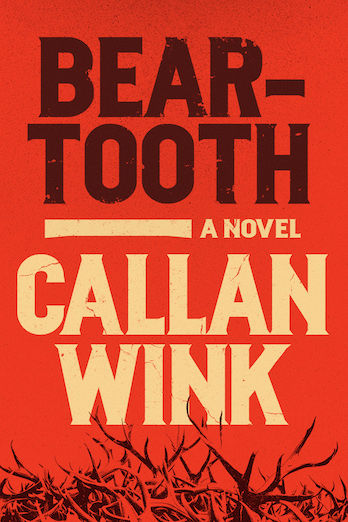
BEARTOOTH, Callan Wink's latest Great Outdoors tale of morally questionable choices

BEARTOOTH
CALLAN WINK
Spiegel & Grau (non-affiliate Bookshop.org link)
$9.99 ebook, available now
The Independent Press Top 40 Bestsellers: Fiction For the week ending April 19, 2026
Rating: 3.25* of five
The Publisher Says: Two brothers in dire straits, living on the edge of Yellowstone, agree to a desperate act of survival.
In an aging timber house hand-built into the Absaroka-Beartooth mountains, two brothers are struggling to keep up with their debts. They live off the grid on the fringe of Yellowstone, surviving after the death of their father. Thad, the elder, is more capable of engaging with things like the truck registration and the medical bills from their father’s fatal illness and the tax lien on the cabin their grandfather built, while Hazen is... different, more instinctual, deeply attuned to the natural world. Desperate for money, they are approached by a shadowy out-of-towner with a proposition and agree to attempt a heist of natural resources from Yellowstone, a federal crime.
Beartooth is a fast-paced tale set in the grandeur of the American West.
I RECEIVED A DRC FROM THE PUBLISHER VIA NETGALLEY. THANK YOU.
My Review: All y'all seem to be lovin' you some Western-set crime shows, like Costner's Yellowstone that lasted six years in a media landscape full of disposable shows. There are other series reads in this setting (eg C.J. Box's Joe Pickett books, Craig Johnson's five-year TV run for Longmire TV show and ongoing novel series) but all of those are borderline copaganda in their focus on police procedural plots, and valorization of the settler-colonial worldview endemic in the men of this family. The brothers in this story, coming as they do into control of valuable natural resouces after their father's expensive death that threatens their grandfather's stolen homestead.
It was pretty hard for me to work up much sympathy for Thad, the brother whose show of privilege leads them into the nightmare of property loss, which they agree to solve, and to restore their stolen "birthright" homestead, by doing things so far beyond the pale of acceptability that I had a lot of trouble pushing through the details to get to the ending.
Animal abuse is rife.
I'm impressed by Wink's ability to evoke the Montana setting with near-hallucinatory clarity. I could feel the unique quality of Yellowstone's air, see the special way light limns the edges of distant objects; I was a lot less excited when the poaching scenes were also evoked as clearly. Hazen, the more nature-oriented brother, still finds it in himself to commit acts I find reprehensible for short-term gain. It's almost always the case that criminals are simply bad at planning and lack foresight; that fits these brothers to a T. They're led into criminality to solve a problem they created with no shred of common sense to their behavior.
What happens is a drawn-out reckoning for the past and against the future. Their long-fled mother, Sacajawea, shows up to add her dose of unpleasantness. I expected to be more led along by the strands of family dissolution and reckoning. Their criminality, the means and motivation for it, led me to finish this short (under 300pp) tale of men acting like kids who need a spanking, in over a week.
I seldom take more than three days to finish 256pp, more often two.
Wink can write. His plotting is logical, his pace is chosen carefully to immerse the reader not whiz past anything. I wish I'd loved it by the end as much as I started out loving it.
Animal lovers are cautioned...the awful things done to them aren't valorized, but still happen with no sense on my part they were being condemned, either.
Sunday, February 5, 2017
GHETTOSIDE, being a jeremiad of a review of a jeremiad of a book

GHETTOSIDE: A True Story of Murder in America
JILL LEOVY
Spiegel & Grau
$16.00 trade paper, available now
Rating: 4.5* of five
The Publisher Says: On a warm spring evening in South Los Angeles, a young man is shot and killed on a sidewalk minutes away from his home, one of the thousands of black Americans murdered that year. His assailant runs down the street, jumps into an SUV, and vanishes, hoping to join the scores of killers in American cities who are never arrested for their crimes.
But as soon as the case is assigned to Detective John Skaggs, the odds shift.
Here is the kaleidoscopic story of the quintessential, but mostly ignored, American murder—a “ghettoside” killing, one young black man slaying another—and a brilliant and driven cadre of detectives whose creed is to pursue justice for forgotten victims at all costs. Ghettoside is a fast-paced narrative of a devastating crime, an intimate portrait of detectives and a community bonded in tragedy, and a surprising new lens into the great subject of why murder happens in our cities—and how the epidemic of killings might yet be stopped.
This book was a holiday gift from a special friend. "Thanks" honey, I love you too.
My Review: I had nightmares reading this damned book. I finish a book a day. This one took me a solid month of on-again, off-again "holy shit I can't, I just can't" reading to finish. I'm a privileged fuck. I always was. I think my one hope for any redemption is that I've never been under any illusion I wasn't. This is a read to make a decent soul scream and rage against the horrors of an everyday reality *in*our*own*country* that is so, so, I can't...I do not possess a word anywhere in my brain that's equal to the towering emotional and political indignation, fury, disgust, horror, agony, grief that I am experiencing.
I'll attempt to be a bit more rational from here on out. I think quoting Leovy herself will help with my incoherent outrage.
Start with this. Leovy's commonsensical reduction of the problem facing our country's law enforcement machinery, the notable lack of a will to do the right thing:
...[T]o assert that black Americans suffer from too little application of the law, not too much, seems at odds with common perception. But the perceived harshness of American criminal justice and its fundamental weakness are in reality two sides of a coin, the former a kind of poor compensation for the latter. Like the schoolyard bully, our criminal justice system harasses people on small pretexts but is exposed as a coward before murder. It hauls masses of black men through its machinery but fails to protect them from bodily injury and death. It is at once oppressive and inadequate.That's pretty much the entire book's point in a nutshell. Understand this, really get it, and you'll be able to read this book without feeling bitch-slapped by the facts. It won't help one iota with the emotional shellacking you're going to take. Yep, that's right laddies and gentlewomen, this another Eat-Your-Spinach Book! Oh boy oh joy, Jeremiah bar Derus slings another jeremiad at ya!
But c'mon, read this and tell me that you can't see why:
Society's efforts to combat this mostly black-on-black murder epidemic were inept, fragmented, underfunded, contorted by a variety of ideological, political, and racial sensitivities. When homicide did get attention, the focus seemed to be on spectacles — mass shootings, celebrity murders — a step removed from the people who were doing most of the dying: black men.These facts constitute an invitation to jeremiadize, no? The appalling stark factual truth makes for bad feelings but better votes, or so I hope. The facts of young Bryant Tennelle's murder aren't unusual. They're quite appallingly routine, in fact. I can't see any reason to pretend otherwise. His father is one of the good guys...a cop...but he was just like a million other young Black men in his neighborhood. And he paid with his life for his father's decision not to leave the world he grew up in, the world of violence and death and grief that generations of political and social inaction at the least destructive and targeted harassment at the worst have created. Make no mistake: Leovy shows clearly that this situation isn't new, isn't accidental, it isn't some ghastly malevolent internal evil inherent in South Central's men. It's us, the rich white people who vote for Law-n-Order for no free rides for moochers for the eternal unchallenged supremacy of Our Kind over the lower orders. Or, to put it simply, Trump's Murrika.
They were the nation's number one crime victims. They were the people hurt most badly and most often, just 6 percent of the country's population but nearly 40 percent of those murdered. People talked a lot about crime in America, but they tended to gloss over this aspect — that a plurality of those killed were not women, children, infants, elders, nor victims of workplace or school shootings. Rather, they were legions of America's black men, many of them unemployed and criminally involved. They were murdered every day, in every city, their bodies stacking up by the thousands, year after year.
The fact is that this carefully constructed economic and social apartheid has predictable consequences. Among them is the inevitable rise of illegal shadow economies centered around illegal activities. How the hell else are you supposed to be part of this giant consuming machine? It takes money to be one of those getting and spending, and flipping burgers at Mickey D's isn't going to get you an Escalade:
When your business dealings are illegal, you have no legal recourse. Many poor “underclass” men of Watts had little to live on except a couple hundred dollars a month in county General Relief. They “cliqued up” for all sorts of illegal enterprises, not just selling drugs and pimping but also fraudulent check schemes, tax cons, unlicensed car repair businesses, or hair braiding. Some bounced from hustle to hustle. They bartered goods, struck deals, and shared proceeds, all off the books. Violence substituted for contract litigation. Young men in Watts frequently compared their participation in so-called gang culture to the way white-collar businessmen sue customers, competitors, or suppliers in civil courts. They spoke of policing themselves, adjudicating their own disputes. Other people call the police when they need help, explained an East Coast Crip gang member. “We pick up the phone and call our homeboys.”Unpurse your fucking lips, hypocrite. You're right there with your VISA in your wallet and your mortgage payments met. You're in this hip-deep and you've made it look good in a big public way. Of course everyone else wants it too. Everyone in the world wants it too, and that's how we got this far down the rabbit hole that's rapidly turning into a black hole swallowing the entire substance of the planet. Bryant Tennelle could have had your kind of life, if he'd been able to keep his own. He was a middle-class kid in a world where walking the tables to middle classdom is only possible when you join the alternative economy and its social offshoots, or you sell out and support the "legitimate" system.
One of Skaggs’s colleagues picked up a word a Watts gang member used to describe his neighborhood: ghettoside. the term captured the situation nicely, mixing geography and status with the hustler’s poetic precision and perverse conceit. It was both a place and a predicament, and gave a name to that otherworldly seclusion that all violent black pockets of the country had in common—Athens, Willowbrook, parts of Long Beach, Watts. There was a sameness to these places and the policing that went on in them. John Skaggs was ghettoside all the way.The author has quite a case of hero worship for John Skaggs. I am right there with her on the fact that he is a decent and honorable man. Based on the book's portrayal of him, I think his desire to do the right thing is just a part of him, like his hair or his eyes.
I can genuinely understand how a man of his caliber would look around and say to himself, "No."
Explicitly confronting the reality of how murder happens in America is the first step toward deciding that it is not acceptable, and that for too long black men have lived inadequately protected by the laws of their own country.It's obvious and inescapable that this is reality. A man like John Skaggs isn't built to see this and not do what he can to change it. But there's a price to pay for this kind of starchiness. He doesn't come across as a very approachable person. Does that matter? In the wider scheme of things, not really; but it makes the book a bit hard to carry on with at times. Author Leovy's obvious admiration for Skaggs increases the effect.
But listen up, internet-enabled scions of generations of privilege and oppression: Change is Gonna Come. Get on board or you'll really, really, really regret it. Ask the poor white people who voted for Trump. They know.
Friday, April 12, 2013
THE OTHER WES MOORE, not my personal preference for positive reading about race in the US
THE OTHER WES MOORE: One Name, Two Fates
WES MOORE
Spiegel & Grau
$13.99 Kindle, available now
Rating: 3* of five
The Publisher Says: Two kids with the same name lived in the same decaying city. One went on to be a Rhodes Scholar, decorated combat veteran, White House Fellow, and business leader. The other is serving a life sentence in prison. Here is the story of two boys and the journey of a generation.
In December 2000, the Baltimore Sun ran a small piece about Wes Moore, a local student who had just received a Rhodes Scholarship. The same paper also ran a series of articles about four young men who had allegedly killed a police officer in a spectacularly botched armed robbery. The police were still hunting for two of the suspects who had gone on the lam, a pair of brothers. One was named Wes Moore.
Wes just couldn’t shake off the unsettling coincidence, or the inkling that the two shared much more than space in the same newspaper. After following the story of the robbery, the manhunt, and the trial to its conclusion, he wrote a letter to the other Wes, now a convicted murderer serving a life sentence without the possibility of parole. His letter tentatively asked the questions that had been haunting him: Who are you? How did this happen?
That letter led to a correspondence and relationship that have lasted for several years. Over dozens of letters and prison visits, Wes discovered that the other Wes had had a life not unlike his own: Both had grown up in similar neighborhoods and had had difficult childhoods, both were fatherless; they’d hung out on similar corners with similar crews, and both had run into trouble with the police. At each stage of their young lives they had come across similar moments of decision, yet their choices would lead them to astonishingly different destinies.
Told in alternating dramatic narratives that take readers from heart-wrenching losses to moments of surprising redemption, The Other Wes Moore tells the story of a generation of boys trying to find their way in a hostile world.
My Review: Chronic overachiever and Marine Wes Moore gets captivated by the fate of his fellow Baltimorean, who is a convicted murderer, Wes Moore. They meet and become friends, leading to this book.
More's the pity. This damn thing is like getting a sunshine enema. One feels far crappier about disliking this book than a mere novel, or a tendentious political screed from some libertarian or conservative wingnut *coughHannitycough*. I'm all for interrupting the prevailing narrative of Black failure and the misery of existing as a Black male in our society. I'd just prefer to have that experience without the regressive reminder that "there but for the grace of God go I" (wonderful, useful phrase but origin unknown despite my belief that John Bradford said it first). One certainly empathizes with Author Moore, his relief that he's not the one in the cell is palpable, but so is his compassion...and his quietly judgmental satisfaction. Or so it felt to me.
The author's breezy, anecdotal style is perfectly adequate to the task of telling his story. It's in no way unique or even very interesting, but the points are made, the language is limpidly clear, and I never once thought the publisher was crazy for acquiring but not copyediting (meaning there are only a few errors of spelling or grammar) the book. This is an increasingly rare feeling on my part.
So what's with the curmudgeonly reaction to it? I loathe being preached at. This book feels preachy and smug to me. I can almost feel Jesus in every word, and this is a most disturbing and disagreeable sensation to me. The entire time Author Wes is reporting the conversations he has with Murderer Wes, I wished the murderer was the one I was listening to...I am that averse to being chirped at.
I didn't like it, and I doubt I'd like either Wes Moore in the flesh either. I'm glad I read it, but I don't recommend it to anyone not in search of the Wonderbra experience: Uplifted beyond that which is natural (not to mention desirable).
Subscribe to:
Posts (Atom)