Showing posts with label poverty. Show all posts

Monday, August 16, 2021

GORDO, debut story collection from NorCal activist/artist/writer


GORDO
JAIME CORTEZ

Black Cat
$16.00 trade paper, available now

Rating: 4.75* of five

FINALIST FOR THE 34th Lambda Literary Award—BEST GAY FICTION! Winners announced 11 June 2022.

A BEST BOOKS OF 2021 – FICTION SELECTION FROM BOOKPAGE!

A 2021 NPR BEST BOOK OF THE YEAR!

The Publisher Says: The first ever collection of short stories by Jaime Cortez, Gordo is set in a migrant workers camp near Watsonville, California in the 1970s. A young, probably gay, boy named Gordo puts on a wrestler's mask and throws fists with a boy in the neighborhood, fighting his own tears as he tries to grow into the idea of manhood so imposed on him by his father. As he comes of age, Gordo learns about sex, watches his father's drunken fights, and discovers even his own documented Mexican-American parents are wary of illegal migrants. Fat Cookie, high schooler and resident artist, uses tiny library pencils to draw huge murals of graffiti flowers along the camp's blank walls, the words "CHICANO POWER" boldly lettered across, until she runs away from home one day with her mother's boyfriend, Manny, and steals her mother's Panasonic radio for a final dance competition among the camp kids before she disappears. And then there are Los Tigres, the perfect pair of twins so dark they look like indios, Pepito and Manuel, who show up at Gyrich Farms every season without fail. Los Tigres, champion drinkers, end up assaulting each other in a drunken brawl, until one of them is rushed to the emergency room still slumped in an upholstered chair tied to the back of a pick-up truck.

These scenes from Steinbeck Country seen so intimately from within are full of humor, family drama, and a sweet frankness about serious matters—who belongs to America and how are they treated? How does one learn decency, when laborers, grown adults, must fear for their lives and livelihoods as they try to do everything to bring home a paycheck? Written with balance and poise, Cortez braids together elegant and inviting stories about life on a California camp, in essence redefining what all-American means.

I RECEIVED A DRC FROM THE PUBLISHER VIA EDELWEISS+. THANK YOU.

My Review
: I'm always down for a story collection! This one is set in a world I liked the minute I landed in it, the Mexican American vibrant loud exuberant over-the-top everybody knows where you are, where you came from, and what to expect from you so watch it, FIESTA. Living in Mercedes, Texas, in the Sixties, I was The White Kid in my elementary school, and the Mexican American family who lived and worked on my great-aunt's place in Progreso were, well, welcoming. A little redheaded boy at the table? Okay, here's a tortilla, eat hearty. This was very much NOT to my mother's taste and she snatched me outta there to Austin by decade's end. I missed it. And when I got this collection of stories, I thought, yeah this works, I'm ready for a trip that far past the white-water rapids of Memory!

I'll use the time-honored (eight years and counting!) Bryce Method of short impressions with individual ratings for the stories so as to organize my thoughts and feelings, while hopefully allowing you to reach your own conclusions.

The Jesus Donut makes a point of being about the expectations of the have-nots...no one ever gets something for nothing, and sometimes not even for something...meeting in the quasi-religious, blasphemous use of a special donut as the Body of Christ.
"Twenty cents," {Mister Kentucky} says.
Everybody stops breathing. What's she gonna do? She don't got no money. She gonna take the bag and run? That would be stupid, cuz he could chase her in the van. Besides, if she did that, Grandma would hit her so hard, she'd see the Devil through a hole. I don't know what that means, but Grandma always says that, and it sounds pretty serious.
–and–
"Body of Christ." {Olga says}
"Amen," I say, and I open my mouth. She puts the piece of donut on my tongue. I close my mouth, I close my eyes. Mmm.

This is the way Jesus should taste.

This is the peak, the Best Moment of a transgression...a girl pretending to be a priest, who mysteriously has money no one else has, and her worst moment's seeds are right here. Their delivery is condign. 4 stars, a great start and a terrific introduction to this world.

El Gordo is what happens on that weird, ugly day when a queer kid understands the limits of accommodation.
Shiny white boxer boots with silver stripes and shoelaces and little dangly pom-poms on the side!

"Thank you," I say. "These are soooo pretty!" Pa gets real quiet. He opens his mouth like he's gonna say something, but he don't say nothing. He shakes his head like something bad just happened.

Something bad did just happen to Pa...his son's a maricón and it's not just his imagination. A jump-rope sing-song is the next affront to Macho; but then the script flips. Miguelito, a skinny kid with the same luchador mask that Gordo has, picks a fight to see who claims the wrestler's identity...and loses! Is Pa proud, or what? A strong lesson in the value Macho places on "winning" whether there's blood and pain or not. A Man Wins. Seriously bad, fucked-up worldview...but learning its codes and how to switch into them is survival for a fat queer kid. 4 stars

Chorizo slams into you like a brick. When impoverished farmhands are privileged to the point of granting favors to those even poorer, those whose existence is so precarious that sleeping on plastic sheets under a carport is the benison that makes the end of a day spent walking better, well...just how much more does one need to hear to know one's life is luxurious? And here's Gordo, taking *their* food as a handout! A grandmother's slap is only a small price to pay for such a lesson in class distinction. 4 stars

Cookie gives the generational spread of poverty and hopelessness a face. Mother too young, daughter too wild:
"Fuck her," she says again.

"She brought you into the world, pendeja. She made you in her stomach and pushed you out of her vaginus. That's a fact. She gave you life, the greatest gift in the solar system."

Pitch-perfect kid-fight. Big, scary words like fuck! Counter with smart-kid infowars! Ooohhh, who will win, Gordo (young but smart) or Cookie (wild but angry)? No one, pendejos, this isn't a battle. It's a war. Their side lost. 4 stars

The Nasty Book Wars are exactly what it sounds like. It's kind of a fake-out, because the beginning is Primitivo with the weird-shaped head, a wedding, and la migra...I was kinda wondering what the heck this had to do with nasty books:
By late July, the garlic had been pulled from the dirt and heaped in the fields, where it dried in the baleful San Benito County sun like mounds of tiny skulls. The stoop labor was performed in afternoon temperatures that hovered in the low nineties and sometimes more for weeks at a stretch.

So, while I *am* looking at the garlic heads a bit differently, what's gonna kick off this story? La migra collaring Primitivo (newly and hilariously yclept "Head and Shoulders" by Gordo's dad, the nicknamer in the community) and la jefa cleaning out his space, that's what. Gordo's four-member cousin-kid-gang find a way into Head and Shoulders's old room where they discover what la jefa didn't: Porn!

The natural split, two boys against two girls, occurs; Gordo's sister makes it three to two when she involves Fat Cookie (so this happens earlier than "Cookie"), and a battle of, well, we'll stretch the point and call it "wits" erupts with these dirty magazines getting hauled from pillar to post and trashed and scattered, until one fine day they suffer a permanent accident. As a result of which Gordo's grandmother finds a particularly, erm, juicy bit and blows a gasket. I've got to give this one the full five, not least because I will never again sing "Conjunction Junction" to myself quite the same way....

Fandango recounts one night of drunken stupidity the machos of the community go too far as their steam-blowing drunkenness gets bloody. Gordo's there to witness it because he begged at just the right moment, and got under his mama's defenses...his dad's, um, homophobia has a rest night. But another man's homophobia is on full display and leads him to the Linda Hawkins Memorial Hospital (always referred to that way, a kind of incantation) with a dumb, avoidable, and nasty injury whose nature I really appreciated for its symbolism. Gordo's sad, wistful little meditation on how the men feel about him is so poignant. 4.5 stars

Alex defies expectations...Alex isn't the most ordinary neighbor, nor the softest person to try to get to know, but Gordo's family are johnny-on-the-spot when a disastrous accident happens and a gigantic secret gets out. Sylvie, older sister style, makes Gordo feel bad for being ignorant of the secret...Pa and Mama are ambivalent but kind when it counts. But the night is young, my children. The night has dark and terrible shadows, conceals awful pain and sadness...wickedness is but a Human trait, after all. Basically a novella of the community taking care of their own, regardless of just deserts or origins. 4 stars

The Pardos doesn't really fit the structure of the book...these three vatos, Tinman, Shy Boy, and the mostly absent Spooky...aren't related to Gordo, they go to school with Sylvie (I suspect the editor said "bookhorn something into this to make it part of the collection" and voilà Tinman jacks off to Sylvia in his room) but fit in nowhere. Their father's a scary Salvadoran army vet, wifeless, and working as a janitor in the Jolly Giant broccoli-processing plant...a ticking time bomb, you ask me...their oldest brother's in reform "school" and there's nothing going to arrest this downward slide in Cali's strictly segregated ag economy. Not the star of the collection, 3.5 stars

The Problem of Style presents the solution to the eternal problem of homophobia: don't internalize it; externalize it! Spray the hate back in their ignorant faces with a fine, glittery spray of Style. Revolting, of course, but can you even imagine anything about middle school not being revolting? 4 stars for the ending

Raymundo the Fag does the honors for Shy Boy...the Final Honors...in his new station as Watsonville's Finest (Hairburner). (We're sort of left to assume that, through some odd time dilation, this is Gordo all grown up; I'm rollin' with it.)
"...They need you. It's a tragedy. It's special. Hey, do they pay good?"

"Olga! He's dead, remember?"

"Well, there you go. He won't be tipping, so you need to charge them good up front. For gasoline y todo."

"Yes, Mrs. Scrooge."

Good lawsy me, Olga, too! Does no one leave this town? Well, apart from Shy Boy, who from the way things turned out should'nt've. He saves the day, does our Ray, after a personal moment with the decedent, and more power to him for the gracious send-off he gives his old enemy. And a new love interest there in the cooler, I hope.... 4 stars

Ofelia's Last Ride takes us back to fifth-grade Gordo and the family on a momentous trip to Mexicali, where their parents are from. Nothing prepared them for the news that greets them: Doña Ofelia, a neighborhood pillar and the mother of the mute guy in an earlier story, has died suddenly. You know it's a cataclysm because it's all anyone can talk about. The main thing, for the visiting Chicanos, is that the wake and burial are happening while they're there, so it's all about the family getting its fix of Home. And Gordo, picked on in the approved Mexican style (you think American kids are rude? ha!) for his fatness, hangs around Mama a lot. He sees his first dead body! That's a major rite of passage. (And it explains how he's so sanguine when it's Shy Boy's body he works on above...assuming they're the same character, and I do.)

It's a raucous, vibrant story, and still feels weird to me as the last of the collection. But that doesn't dim the glory of it for a moment. 4.5 stars

Sunday, August 8, 2021

THE HOUR OF THE STAR, last work by Brazilian superstar novelist


THE HOUR OF THE STAR
CLARICE LISPECTOR
(tr. Giovanni Pontiero)
New Directions
$17.95 hardcover, available now

Rating: 4* of five

The Publisher Says: The Hour of the Star, Clarice Lispector's consummate final novel, may well be her masterpiece. Narrated by the cosmopolitan Rodrigo S.M., this brief, strange, and haunting tale is the story of Macabéa, one of life's unfortunates. Living in the slums of Rio de Janeiro and eking out a poor living as a typist, Macabéa loves movies, Coca-Cola, and her rat of a boyfriend; she would like to be like Marilyn Monroe, but she is ugly, underfed, sickly, and unloved. Rodrigo recoils from her wretchedness, and yet he cannot avoid realization that for all her outward misery, Macabéa is inwardly free. She doesn't seem to know how unhappy she should be.

Lispector employs her pathetic heroine against her urbane, empty narrator—edge of despair to edge of despair—and, working them like a pair of scissors, she cuts away the reader's preconceived notions about poverty, identity, love, and the art of fiction. In her last novel she takes readers close to the true mystery of life, and leaves us deep in Lispector territory indeed.

I RECEIVED A REVIEW COPY FROM THE PUBLISHER. THANK YOU.

My Review
: This is billed as Lispector, a Brazilian pyrotechnician of words, writing her last novel. It's about 80pp long, so I am hard pressed to see how it's anything but a novella as defined by length. Its content, the descent and fall of one of life's losers, places it firmly in novella territory as well. Its beauty and grace of language mark it as a poetic novella. But it's not a complex, nuanced, developed story, so not what I'm willing to call a novel. Perhaps, in a weird way, it's a reverse récit, a story all in one person's head; but it isn't the actor, the subject, whose head we're in. The narrative frame is like any other frame, a separation of the viewer from the object viewed. It does make seeing the whole object easier; it also makes becoming invested in the object less possible.

But it's brilliant, and it's beautiful, and it should form a part of your mental furniture. It's fascinating in its presumptive male narrator's chill and malign distance from the heat of life that makes Macabéa, the protagonist, both unfurl and wither seemingly simultaneously.
Things were somehow so good that they were in danger of becoming very bad because what is fully mature is very close to rotting.
–and–
First of all, I must make it clear that this girl does not know herself apart from the fact that she goes on living aimlessly. Were she foolish enough to ask herself "Who am I?", she would fall flat on her face. For the question "Who am I?" creates a need. And how does one satisfy that need? To probe oneself is to recognize that one is incomplete.

The relationships that Macabéa, immigrant to the cold cruel city from the cold cruel countryside, forms are classics of naive toxicity. She's seemingly unable to judge anyone around her...even herself...on any level deeper than the most glistening surface. She's not a bright girl, she's not a pretty girl, and she's got no discernable talent for anything. She's destined to come to a bad end.
She thought she’d incur serious punishment and even risk dying if she took too much pleasure in life. So she protected herself from death by living less, consuming so little of her life that she’d never run out. This savings gave her a little security since you can’t fall farther than the ground. Did she feel she was living for nothing? I’m not sure, but I don’t think so. Only once did she ask a tragic question: who am I? It frightened her so much that she completely stopped thinking.

But Lispector, the creatrix, pulls the Oz-curtain aside periodically, dropping the rudimentary and nugatory male narrator into the bin when she has something important to say:
Will I be condemned to death for discussing a life that contains, like the lives of all of us, an inviolable secret? I am desperately trying to discover in the girl's existence at least one bright topaz.

Could it be, I wonder at the end of the story, that there is no bright topaz in some lives? That the brightest sparkle in some humans is just the mineral potential of bones waiting for death to free it? Macabéa, "female Maccabee" for those interested in looking for some Biblical enrichment of the tale, makes me think...unwillingly, reluctantly, but honestly...that the answer is Yes.
Who has not asked himself at some time or other: am I a monster or is this what it means to be a person?

Tuesday, June 9, 2020

JOE, the late, great Larry Brown's first masterwork in novel form


JOE
LARRY BROWN

Algonquin Books
$15.95 paper, available now

Now only $1.99 on Kindle, so don't wait. (non-affiliate Amazon link)

Rating: 4* of five

The Publisher Says: Joe Ransom is a hard-drinking ex-con pushing fifty who just won’t slow down—not in his pickup, not with a gun, and certainly not with women. Gary Jones estimates his own age to be about fifteen. Born luckless, he is the son of a hopeless, homeless wandering family, and he’s desperate for a way out. When their paths cross, Joe offers him a chance just as his own chances have dwindled to almost nothing. Together they follow a twisting map to redemption—or ruin.

Kirkus, back in 1991 when they hated everything, said this of the book: "...Brown...pares his prose close to the bone, stripping away the slightest hint of sociology or regional color. This is white trash, lumpen fiction with a vengeance, and a vision of angelic desolation."

My Review: Selected as the May 2020 Moderator's Choice in the On the Southern Literary Trail Goodreads group, this is the novel that solidified Larry Brown's place in Grit Lit/Hick Lit's pantheon. He was a major talent; his short stories will, I think, be anthologized and lionized for a long time to come. He started out as a writer known for them; and I think that, like Hemingway, they will be his lasting contribution to Southern Literature's grittier edge.

This is not to denigrate or diminish his accomplishment in this, his most successful novel:
The road lay long and black ahead of them and the heat was coming now through the thin soles of their shoes. There were young beans pushing up from the dry brown fields, tiny rows of green sprigs that stretched away in the distance.
You know where you are; you know who you're with; you're not going for a madeleine with Proust. This is poverty, this is heat, this is misery on an epic scale but never ever looked at...it's witnessed, it's so real and so present that there is just not one doubt about its honesty. Heat and poverty are characters in this scene so cinematically framed. The people are, in fact, incidental if not ornamental. They exist as morality-play embodiments of Poverty, and they continue to do so throughout the book.

Is that a flaw? Is honest appraisal and presentation of reality ever a flaw?
“That boy,” he said. “I’ve done him ever favor I could. Some folks you can’t do nothing with. Just sorry. God knows I’ve done plenty of drinking and stuff in my time, but I be damn if I ever tried to cheat anybody out of any money.”
Is that a speech delivered to make an author's point, or is it the vox populi, the distilled belief of the Average Man that he is in fact average, the proper measure of a man's worth? It's certainly a refutation of the three-hundred-year-old moralism vox populi, vox dei! There is no god in this book, there is no numinous or immanent quality to anything. The landscape is hot, dry, miserable; the people are dumb, violent, miserable; the vox regis or deorum is notable only for its absence.

Also notably absent here are women's voices. They exist to bear children and beatings. They are adversaries to what low, animal joys men can find in sex (more akin to rape, in my opinion) and beer. Children are the punishment women inflict on men (as these men see it) for the fleeting pleasure of the rut. The idea of pleasure is, in general, absent from this world. It is a place where no one at all ever makes even a feint at a genuine smile.

What redeems this read from being a complete, utter, suicidal-depression-inducing downer? Joe Ransom. Drunken convict that he is, awful father that he may in fact be, to Gary Jones he is Jesus freshly down from the cross. Gary's sperm donor is a memorable...a matchless, actually...portrait of the kind of person I, in my damned close to infinite privilege, have never interacted with. He pimps out his prepubescent daughter. He does nothing of value to anyone, not even himself:
“She don’t like to be around anybody drinkin, don’t even like to smell it. I drink and I like to drink. That’s it.”
That's the least-offensive thing the man utters in this book. Probably in the whole of life. His son, his who-knows-how decent and good-souled son, makes him feel more worthless than he already does; not, however, as worthless as he actually is.

Gary goes to work for Joe on a county work crew. Joe, ex-con bad dad Joe, shines like a savior to him, modeling the astounding heights of not-stealing, of not-beating while being a man. Gary's life changes because he sees a possibility he never saw before. As events unfold, that possibility is embodied in a redemptive act of startling generosity, of genuine salvation.

And Joe chooses to save, not his own flesh and blood, but someone whose life trajectory makes Joe's own fucked-up life look like my wealth and privilege by comparison. If not for Larry Brown, I doubt I'd've made a second's time for these men.

Isn't this what fiction's meant to do? To make us, all of us really but especially the most shockingly privileged among us, pause and allow The Other to take unsentimental shape in our emotions?

Larry Brown did this to me, for me, and I am deeply grateful to him for it.

Tuesday, January 10, 2017

THE LONG SHADOW OF SMALL GHOSTS, an incredible story of failure and murder

THE LONG SHADOW OF SMALL GHOSTS: Murder and Memory in an American City
LAURA TILLMAN

Scribner
$12.99 ebook platforms, available now

Rating: 4* of five

The Publisher Says: In Cold Blood meets Adrian Nicole LeBlanc’s Random Family: A harrowing, profoundly personal investigation of the causes, effects, and communal toll of a deeply troubling crime—the brutal murder of three young children by their parents in the border city of Brownsville, Texas.

On March 11, 2003, in Brownsville, Texas—one of America’s poorest cities—John Allen Rubio and Angela Camacho murdered their three young children. The apartment building in which the brutal crimes took place was already rundown, and in their aftermath a consensus developed in the community that it should be destroyed. It was a place, neighbors felt, that was plagued by spiritual cancer.

In 2008, journalist Laura Tillman covered the story for The Brownsville Herald. The questions it raised haunted her, particularly one asked by the sole member of the city’s Heritage Council to oppose demolition: is there any such thing as an evil building? Her investigation took her far beyond that question, revealing the nature of the toll that the crime exacted on a city already wracked with poverty. It sprawled into a six-year inquiry into the larger significance of such acts, ones so difficult to imagine or explain that their perpetrators are often dismissed as monsters alien to humanity.

With meticulous attention and stunning compassion, Tillman surveyed those surrounding the crimes, speaking with the lawyers who tried the case, the family’s neighbors and relatives and teachers, even one of the murderers: John Allen Rubio himself, whom she corresponded with for years and ultimately met in person. The result is a brilliant exploration of some of our age’s most important social issues, from poverty to mental illness to the death penalty, and a beautiful, profound meditation on the truly human forces that drive them. It is disturbing, insightful, and mesmerizing in equal measure.

***I RECEIVED THIS REVIEW COPY FROM SCRIBNER AT MY REQUEST. THANK YOU.***

My Review: There is absolutely nothing easy about this book, not the story, not the agonized survivors, not the innocent dead children, nothing. I read In Cold Blood many years ago, and was very deeply affected by the story. The amazing writing, the very best thing Truman Capote ever made, seems suspiciously good...like Harper Lee, his cousin and collaborator, was a very very significant part of its creation. Laura Tillman touches me in many of the same places that In Cold Blood did, but she had no Harper Lee to wave the magic wand of genius over the text.

The genesis of the book came when Tillman began her journalism career at The Brownsville Herald, the big English-language newspaper of the Rio Grande Valley. A murder such as the Rubio case doesn't happen that often in the rinky-dink precincts of that rathole. (I spent formative years forty or so miles away in Mercedes, Texas, a horrible little wide spot in the road that exemplifies what city people never see and avoid even hearing about if they can help it.) Tillman describes her fascination thus:
The Rubio story was also especially affecting because it concerned small children. It grabbed hold of the reporters during these newsroom conversations, the revelation of each detail making the case suddenly raw, fresh, intense. A father and a mother killing three young children—three babies!—with the crude weapon of kitchen knives. The bodies in trash bags, the heads in buckets of water, washed clean of blood. For not one but both parents to be involved in such a horror was stunning and inexplicable.
Nothing is inexplicable. We might not like the explanation. We might reject the explanation in disgust, horror, terror. But an explanation there always, always is.

A mentally ill, psychologically abused, sexually pimped out by his mother, young man of good looks and no significant intellectual capabilities, gets hooked on drugs...self-medicating, in my opinion...finds and clings to a balsa-wood raft in the form of a pretty, even less intelligent girl-child who was being abused by a variety of men in her life. Hey presto! Children arrive, work doesn't, help ain't, and huffing paint is the only road to some tiny moment of pleasure. A lifetime of psychological disturbances, seeing people not visible to others, obsessions and violence, just don't merit institutional help. Especially in a place like Texas, where Medicaid is out of reach to anyone not licking the asphalt in the hospital parking lot to avoid starvation. It is disgusting what is NOT done with the Federal dollars sent to help the citizens of the state.

At the moment of John Rubio's massive psychotic break, this is what he reports believing:
According to John, something told him that killing the children was imperative, that he was engaged in a battle of good and evil, and he was on the side of good. He said that he had long seen himself as exceptional, chosen by God for some purpose, and had dreams where he battled demons. Where those thoughts and the message to kill his children came from is debatable, but John said he believed at the time that it was divinely sent. Regardless of whether the culpable influence was psychosis or a spiritual force, there was no contradicting intervention at the final moment.
The source of Tillman's meditation is the story of Abraham and Isaac in the Bible. It is one of the more appalling, disgusting passages in a book chock-a-block with horrible bar bets (eg, Job's trials set on him by God to win a wager with Lucifer) and reprehensible narcissistic tantrums (eg, destroying the whole of the world in a flood because his itty fee-fees was hurted by...what, I can't remember, something like impiety?). John's religious mania had been life long, and somehow no one anywhere connected to this case sees or says they see the central and vile role that this God person and the stories told to impressionable children about him played in this nightmare crime.

A friend of Angela and John's explains the bitter, scalding, bone-rattling terror of desperation.
"But when a difficult time comes and nobody helps you, no one listens to you, they leave you alone...I don't know how to explain it...You go to your neighbor's house and ask if they could lend you three dollars to eat and they say they don't have it. You go to another [neighbor] and they don't have it, no one has it. You're frustrated and you have hungry children. And you kill them. That's how people think."

You cannot know the power of desperation, Felix was saying, until you experience it in its raw form. Desperation can fuel acts that would otherwise be incomprehensible. And if you've never been filled with that kind of quaking, hysterical desperation, you simply cannot fathom the way it can make you behave.
Yep, been there. Try living at the complete legal, social mercy of a screaming emotional volcano, abusive in inventive and creative ways, who makes up to you with sex. And I was her son. I have been down there. I understand John's insanity from the inside, though blessedly I'm smart and almost incredibly tough so I survived. Just. John had none of my strengths, poor lad, and he cracked wide open. What he did can't be fathomed by the normal mind. The key words there are "normal mind." He didn't have, and never had, one of those. The State of Texas, in its rednecked viciousness, condemned this poor, broken, horrible person to die. To do what? To solve what? In order to serve what noble legal principle? We already know the Christians who argue for the death penalty are merely emulating their vile petty god, so can safely be discounted as moral forces.

Angela was represented by a court-appointed lawyer whose unique perspective on the central facts of Angela's participation in the murders probably served her in great stead:
In May of 2008, five years after John and Angela were arrested, Gamez said he saw demons for the first time. "I didn't imagine it." Gamez had suffered a heart attack that left him legally dead for several minutes, and in a coma for six days after that. "There is no rational, logical medical explanation, other than the grace of coming back and giving me a second chance." To him, the demons are not a vague vision, but a specific memory.

"They were compelling to take me to hell. They were reaching out. They wanted me but they couldn't get me. The grace of God wouldn't let them get me, but they let me know they're there."

Gamez believed he'd been enlightened to another dimension.

"There is an inner being, soul, within us and wants to live and wants everlasting life. And it fears the abomination of everlasting darkness. I really appreciate, when I crossed over, my ranches meant noting, my property meant nothing. I'm left with nothing. Nothing was important. You speak, not with your mouth, but your mind. You have no physical form. And I can prove it because I was dead. And all that spirit of yours wants is to reach that light I couldn't reach."

His voice commanded the empty room, rough and croaking, pushing past my attempts to ask questions during the long pauses between phrases.

"So I cannot say that what she saw wasn't real," Gamez said. "I don't make that judgment anymore—if she's crazy or sick or mentally retarded—no, I know they're there, and they make people do very bad things. Evil things. Demons' purpose in life is for us—to compel us to do bad things. There is no love with these creatures."
Gamez's experience, judge its merits how you may, very likely informed Angela's fate. She will be eligible for parole in 2045.

The fate of the children I cannot bring myself to recount.
In John's version of events, he decapitated the children because they seemed to rise and revive after being choked and stabbed.
That is really all you need to know.

Laura Tillman backs up at the end of the book:
The building drew me in, but the real pull was not the structure, it was the questions. I thought after all this time they would be resolved. Instead, I find myself more unmoored than when I started. Yet that doesn't bother me: resolution doesn't seem to be the purpose of questions like these. They open journeys, within and without, daring us after each step to go still further.
And here is where that fifth star, wavering in and out, went out for the last time. It seems to me a...bloodless...response to this journey through a layer of society that one can not see, still less live within for any length of time, and emerge unchanged in profound and irreparable ways.

Reading is resistance...even to the internal prettying-up and makeover that we call "denial."

Thursday, November 3, 2016

EVICTED, a nasty thing that happens to poor people every day, also my vote for 2016 Goodreads Choice Awards in Nonfiction

EVICTED: Poverty and Profit in the American City
MATTHEW DESMOND

Crown
$18.00 trade paper, available now

Rating: 5* of five

The Publisher Says: In this brilliant, heartbreaking book, Matthew Desmond takes us into the poorest neighborhoods of Milwaukee to tell the story of eight families on the edge. Arleen is a single mother trying to raise her two sons on the $20 a month she has left after paying for their rundown apartment. Scott is a gentle nurse consumed by a heroin addiction. Lamar, a man with no legs and a neighborhood full of boys to look after, tries to work his way out of debt. Vanetta participates in a botched stickup after her hours are cut. All are spending almost everything they have on rent, and all have fallen behind.

The fates of these families are in the hands of two landlords: Sherrena Tarver, a former schoolteacher turned inner-city entrepreneur, and Tobin Charney, who runs one of the worst trailer parks in Milwaukee. They loathe some of their tenants and are fond of others, but as Sherrena puts it, “Love don’t pay the bills.” She moves to evict Arleen and her boys a few days before Christmas.

Even in the most desolate areas of American cities, evictions used to be rare. But today, most poor renting families are spending more than half of their income on housing, and eviction has become ordinary, especially for single mothers. In vivid, intimate prose, Desmond provides a ground-level view of one of the most urgent issues facing America today. As we see families forced into shelters, squalid apartments, or more dangerous neighborhoods, we bear witness to the human cost of America’s vast inequality—and to people’s determination and intelligence in the face of hardship.

Based on years of embedded fieldwork and painstakingly gathered data, this masterful book transforms our understanding of extreme poverty and economic exploitation while providing fresh ideas for solving a devastating, uniquely American problem. Its unforgettable scenes of hope and loss remind us of the centrality of home, without which nothing else is possible.

My Review: I voted for this book in the 2016 Goodreads Choice Awards. Why? Because I'm a radical who wants to re-rig the system and change the course of the Ship of State 180 degrees.

“Every condition exists,” Martin Luther King Jr. once wrote, “simply because someone profits by its existence. This economic exploitation is crystallized in the slum.” Exploitation. Now, there’s a word that has been scrubbed out of the poverty debate—and there it is, simply and baldly put: The poor are exploited mercilessly by every single sector of capitalist society. Landlords charge small fortunes for horrendous living conditions. The Feds give counties money for Section 8 housing, but there is never any such housing available and the agencies don't maintain lists...or the wait is decades long. What happens to that money? Where does it go? Someone's pockets are fatter and the poor, the elderly, the disabled are no better housed.

“If poverty persists in America, it is not for lack of resources"—the author just made, in one short sentence, the only real and relevant case for Universal Basic Income.

Monday, September 26, 2016

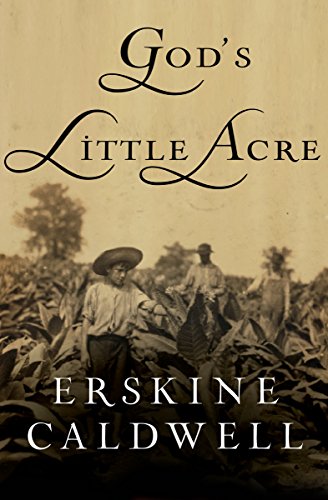
GOD'S LITTLE ACRE, a Banned Books Week sale from Open Road Media


GOD'S LITTLE ACRE
ERSKINE CALDWELL

Open Road Media
$1.99 Kindle edition, available now

Rating: 3.75* of five

The University of Georgia Says: Like Tobacco Road, this novel chronicles the final decline of a poor white family in rural Georgia. Exhorted by their patriarch Ty Ty, the Waldens ruin their land by digging it up in search of gold. Complex sexual entanglements and betrayals lead to a murder within the family that completes its dissolution. Juxtaposed against the Waldens' obsessive search is the story of Ty Ty's son-in-law, a cotton mill worker in a nearby town who is killed during a strike.First published in 1933, God's Little Acre was censured by the Georgia Literary Commission, banned in Boston, and once led the all-time best-seller list, with more than ten million copies in print. (This is the edition I read in 2012, which has a foreword by Lewis Nordan that I consider very important to read.)

Open Road Media Says: Caldwell’s blockbuster bestseller: In the Depression-era Deep South, destitute farmer Ty Ty Walden struggles to raise a family on his own

Single father and poor Southern farmer Ty Ty Walden has a plan to save his farm and his family: He will tear his fields apart until he finds gold. While Ty Ty obsesses over his fool’s quest, his sons and daughters search in vain for their own dreams of instant happiness—whether from money, violence, or sex.

God’s Little Acre is a classic dark comedy, a satire that lampoons a broken South while holding a light to the toll that poverty takes on the hopes and dreams of the poor themselves.

This ebook features an illustrated biography of Erskine Caldwell including rare photos and never-before-seen documents courtesy of the Dartmouth College Library.

**THE E-BOOK EDITIONS ARE ON SALE FOR BANNED BOOKS WEEK 2016**

My Review: First published in 1933, when the author was a mere slip of a thirty-year-old, this novel starts in a hole and keeps digging deeper and deeper. Literally, not metaphorically. Well, literally AND metaphorically.

Ty Ty and his sons are poor white Southern Americans in the grimmest economic times of the 20th century. There was revolution brewing because of the depth of the economic crisis, and the complete absence of any safety net for anyone at all. Ty Ty and his boys, like modern-day conservatives, are digging for gold in their unpromising Georgia home's unyielding land, and finding lots of dirt and not much else. The womenfolk are trying to keep food on the table and as many rapists as possible outside. The ones at home, well, we all have our crosses to bear, don't we?

Since the land's being dug up for gold instead of farmed for food, the boys go off to work in the textile mills. Yes Virginia, there once was a textile industry in the USA. Now it's all in Pakistan, where a couple dollars a month is a (barely) living wage. Mill owners naturally want to keep their costs down to maximize profits, and families are going hungry to make sure the rich get richer (is this sounding familiar?), until the unions come to town. With predictable results.

There's death, there's misery, there's hard work followed by failure, there's more misery, the end.

And what an end! What a beautiful piece of writing this is, and how very grim the picture it paints in its simple shapes and clear colors. There is nothing unclear or muddy about the book, except the minds of the characters, and that is by the author's design.

The search for gold isn't as stupid as it sounds. The Georgia north was Cherokee country until white folks found gold in them thar hills and booted the native inhabitants off the land. In the novel, some few flakes are found, but never enough to do what Ty Ty wants, which is free him and his family from want and dependence on others. It works well as a metaphor for the frayed and threadbare Murrikin dream, too: Keep working keep working keep working and the rewards will (not) come! Or if they come, at what cost, and ultimately to what end?

The title, God's Little Acre, refers to Ty Ty's gift of one acre of his farmland to God to support the church. But because Ty Ty wants gold for himself and his family, he moves the location of the acre at will, so he'll be sure not to give his gold away. Not so unfamiliar here, either, is it?

Murder, betrayal, lust, rage, and that's all before we get to the workplace! Is it any wonder this book was called obscene by the forces of reaction? It *was* obscene! The horrible exploitive relationships in every single nook and cranny of the world the characters inhabit is obscene. The dreadful ignorance, the grinding and maliciously intentional poverty, all of it obscene!

Sadly, with the slow withering of liberalism, the story's outlines are rapidly recrudescing in the modern Murrika being carved from the living flesh of the unwashed masses too drugged on the crack of an American Dream they will never, ever attain by Lotto or hard work or virtue rewarded. The horror is we've been here before, and a few brave and good men tried to steer us away from this hideous abyss. And here we are, back again.

Sick-making, isn't it? Read the book, and use it as a cautionary tale.

Friday, April 12, 2013

THE OTHER WES MOORE, not my personal preference for positive reading about race in the US


THE OTHER WES MOORE: One Name, Two Fates
WES MOORE

Spiegel & Grau
$13.99 Kindle, available now

Rating: 3* of five

The Publisher Says: Two kids with the same name lived in the same decaying city. One went on to be a Rhodes Scholar, decorated combat veteran, White House Fellow, and business leader. The other is serving a life sentence in prison. Here is the story of two boys and the journey of a generation.

In December 2000, the Baltimore Sun ran a small piece about Wes Moore, a local student who had just received a Rhodes Scholarship. The same paper also ran a series of articles about four young men who had allegedly killed a police officer in a spectacularly botched armed robbery. The police were still hunting for two of the suspects who had gone on the lam, a pair of brothers. One was named Wes Moore.

Wes just couldn’t shake off the unsettling coincidence, or the inkling that the two shared much more than space in the same newspaper. After following the story of the robbery, the manhunt, and the trial to its conclusion, he wrote a letter to the other Wes, now a convicted murderer serving a life sentence without the possibility of parole. His letter tentatively asked the questions that had been haunting him: Who are you? How did this happen?

That letter led to a correspondence and relationship that have lasted for several years. Over dozens of letters and prison visits, Wes discovered that the other Wes had had a life not unlike his own: Both had grown up in similar neighborhoods and had had difficult childhoods, both were fatherless; they’d hung out on similar corners with similar crews, and both had run into trouble with the police. At each stage of their young lives they had come across similar moments of decision, yet their choices would lead them to astonishingly different destinies.

Told in alternating dramatic narratives that take readers from heart-wrenching losses to moments of surprising redemption, The Other Wes Moore tells the story of a generation of boys trying to find their way in a hostile world.

My Review: Chronic overachiever and Marine Wes Moore gets captivated by the fate of his fellow Baltimorean, who is a convicted murderer, Wes Moore. They meet and become friends, leading to this book.

More's the pity. This damn thing is like getting a sunshine enema. One feels far crappier about disliking this book than a mere novel, or a tendentious political screed from some libertarian or conservative wingnut *coughHannitycough*. I'm all for interrupting the prevailing narrative of Black failure and the misery of existing as a Black male in our society. I'd just prefer to have that experience without the regressive reminder that "there but for the grace of God go I" (wonderful, useful phrase but origin unknown despite my belief that John Bradford said it first). One certainly empathizes with Author Moore, his relief that he's not the one in the cell is palpable, but so is his compassion...and his quietly judgmental satisfaction. Or so it felt to me.

The author's breezy, anecdotal style is perfectly adequate to the task of telling his story. It's in no way unique or even very interesting, but the points are made, the language is limpidly clear, and I never once thought the publisher was crazy for acquiring but not copyediting (meaning there are only a few errors of spelling or grammar) the book. This is an increasingly rare feeling on my part.

So what's with the curmudgeonly reaction to it? I loathe being preached at. This book feels preachy and smug to me. I can almost feel Jesus in every word, and this is a most disturbing and disagreeable sensation to me. The entire time Author Wes is reporting the conversations he has with Murderer Wes, I wished the murderer was the one I was listening to...I am that averse to being chirped at.

I didn't like it, and I doubt I'd like either Wes Moore in the flesh either. I'm glad I read it, but I don't recommend it to anyone not in search of the Wonderbra experience: Uplifted beyond that which is natural (not to mention desirable).