Showing posts with label loneliness. Show all posts

Friday, November 15, 2024

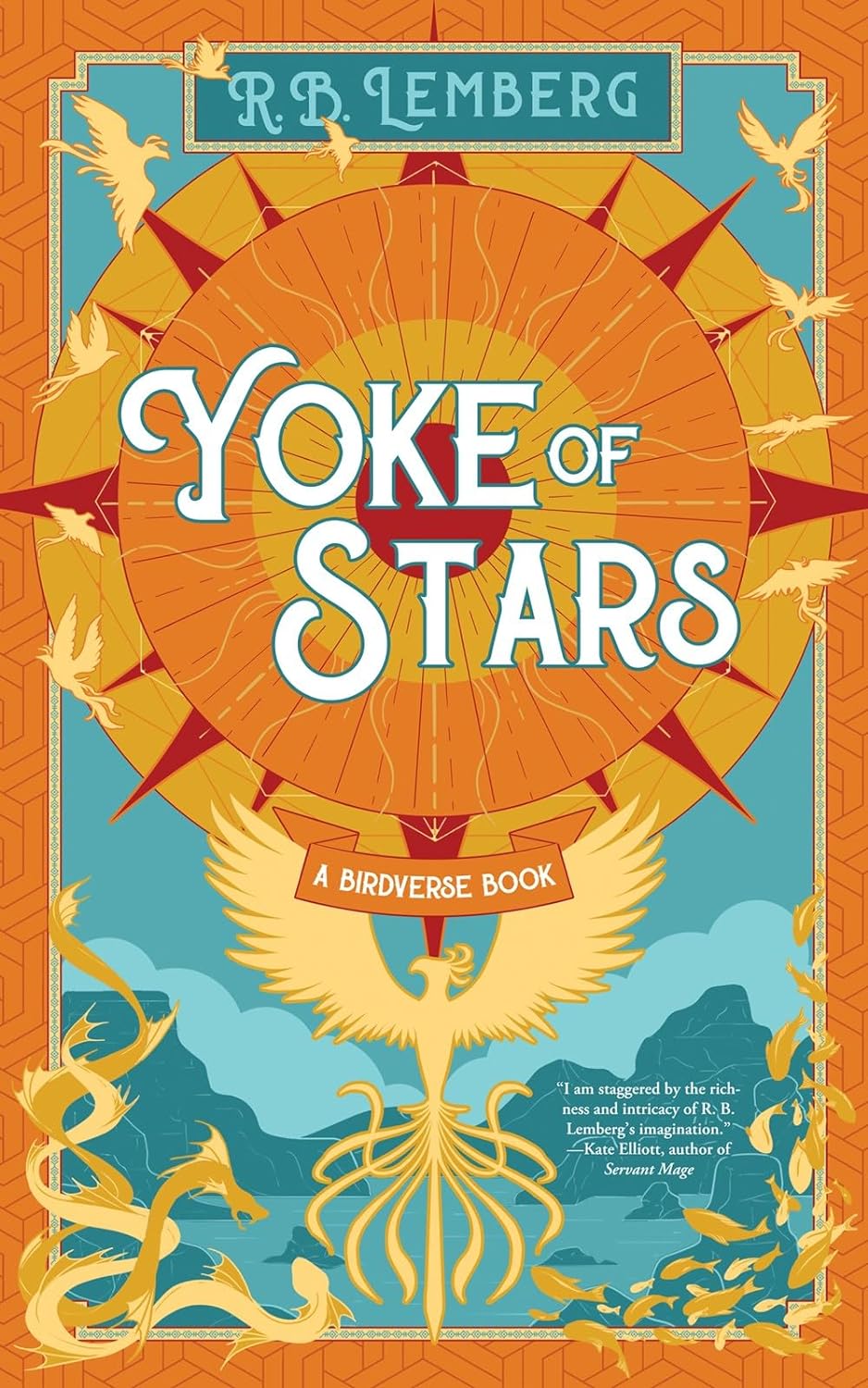
YOKE OF STARS, another concentrated dose of Lemberg's amazing Birdverse


YOKE OF STARS
R. B. LEMBERG

Tachyon Publications
$15.95 trade paper, available now

Rating: 4.75* of five

The Publisher Says: In the School of Assassins, Stone Orphan waits for a first assignment. After their first kill, they will graduate, and attain the coveted cloth of bone. But instead of a commission, Stone Orphan gets an inquisitive linguist, Ulín. By turns, Stone Orphan and Ulín narrate tales of love, suffering, exile, and self-determination, and two wounded souls try to find hope in each other through the radical act of listening.

I RECEIVED A DRC FROM THE PUBLISHER VIA NETGALLEY. THANK YOU.

My Review
: A storyverse like Lemberg's is not going to be for everyone. A person who can write this is not from the US and not on the gender binary and not wired like the usual drudge/drone in that they aren't very interested in the Overculture and its concerns. No one who was could've written this: "A story moves back and forth in translation, and it is remade every time. Each of us is a story translated to a language vastly different from its first. You can try to translate yourself back, but it won't be the same story."

This is not the thought, the distilled realization, of a person who lives in one language, or one who simply waits to talk again. There's a radical act of vulnerability in listening to what is actually said to you, not simply responding to how whatever is heard makes you feel. Life is not therapy. Author Lemberg lives in that reality.

The Birdverse is multiple tales old now. In accordance with my long-standing policy of not reviewing books I've spent my own United States dollars on, I have not reviewed earlier ones. I'm pretty sure that you can pick this book up and derive a delicious reading experience from its lush, limpid prose with no further background than is provided in the book. That is not to say it will be a doddle. You're wise not to think visually *first* in the Birdverse. There's a reason one main character here is a linguist.... I loved reading it because I am comforted by the Birdverse and its unremarked queerness and prevalence of spectrums. I think those things are background at this point but I also think someone whose first foray into it is this book might disagree with me (this explains the absence of the fifth star). I'm sad to say that is really not very important to me. I think the point of reading is to broaden horizons, to shape and sculpt and prune the thoughts in one's head. Books like the Birdverse ones are going to make themselves at home in spaces you yourself did not realize were there, or fit themselves onto and around ideas you are growing.

Not always comfortable but almost always very healthy for your worldview. I'm sure this book, light on the more troubling things I've heard others describe in Author Lemberg's œuvre as negatives in their reads, is short enough to make your reading pleasant as well as mind-expanding. These people are struggling through barriers we all recognize between ourselves and others. The overcoming of traumas, or not, is a constant. The manner these obstacles are illuminated in the story is enough to cause me to urge the read on you as soon as you can get it.

I don't imagine a lot of cishet people really think about gender othering. It's not asked of you very often. Try it here: Whenever an assumption made in the story brings you up short, don't dismiss it or snort past it; think, "how is my world this frustrating or confusing or nonsensical to another person?" It can open broad vistas. That can only be a good thing for you, and those around you.

At the end of the day, a read gives you what you reach for within it. I got the certainty that I'm not insane, I'm trying to translate from my own inner worldtongue into a different one, spoken by people who care very little for the nuances I love and live for.

And you?

Saturday, September 28, 2024

A BOOK I READ FOR MY LONG-AGO BOOK CIRCLE: SNOW COUNTRY by Nobel-winner YASUNARI KAWABATA


SNOW COUNTRY
YASUNARI KAWABATA
(tr. Edward G. Seidensticker)
Vintage Books
$11.99 Kindle edition, available now

Rating: 3.5* of five

The Publisher Says: Nobel Prize recipient Yasunari Kawabata's Snow Country is widely considered to be the writer's masterpiece, a powerful tale of wasted love set amid the desolate beauty of western Japan.

At an isolated mountain hot spring, with snow blanketing every surface, Shimamura, a wealthy dilettante meets Komako, a lowly geisha. She gives herself to him fully and without remorse, despite knowing that their passion cannot last and that the affair can have only one outcome. In chronicling the course of this doomed romance, Kawabata has created a story for the ages, a stunning novel dense in implication and exalting in its sadness.

I CHECKED THIS BOOK OUT OF MY LOCAL LIBRARY. USE THEIR SERVICES OFTEN, THEY NEED US!

My Review
: Married, bored (but I repeat myself) aesthete, philanderer, and flâneur Shimamura, an aficionado of Western ballet (although he's never seen one), takes a solo trip into Japan's Snow Country. While there in the wildest of boondocks Japan possesses, he meets Komako, probably the world's worst geisha, but apparently a fascinating contrast to all other women for Shimamura. They meet a total of three times in two years. Another woman, Yoko, hovers purposelessly around the narrative until, for no apparent reason, Komako and Shimamura have a fight over his feelings (?) for Yoko, who for some reason nursed Komako's not-quite-fiance Yukio while he died, despite the fact that Komako indentured herself to the (apparently quite unsuitable) career of geisha to pay for his death expenses.

Then a fire breaks out and Komako runs into the burning building and saves Yoko while Shimamura stands there and looks up at the sky. Fin.

No, seriously.

I spent the entire month I was reading this book, all 175pp of it, alternately claustrophobic and bemused. WTF, I kept thinking, why am I still at this rock-pile, trying to winkle out some small purpose to the narrative; then along would come a gem, eg:
It was a stern night landscape. The sound of the freezing of snow over the land seemed to roar deep into the earth. There was no moon. The stars, almost too many of them to be true, came forward so brightly that it was as if they were falling with the swiftness of the void.

p44, 1996 Vintage ed.

Oh wow, I thought, and plowed on. And on. And on. Every damn time Komako exhibits what today we'd call a bipolar break exacerbated by alcohol abuse, I'd find myself thinking, "This damned book is Come Back, Little Sheba directed by Kurosawa." Seriously. Shirley Booth did the same bloody role in that movie, only Burt Lancaster (whose role as her husband bewitched by a younger woman was pretty much exactly like Shimamura) is the one who drank.

I drank a good bit myself, trudging ever onward, marching off to war with the cross of Jesus going on before; okay, I'm a piss-poor Christian soldier, but you get the sense of futility I was experiencing. Then, it happened.
He had stayed so long that one might wonder whether he had forgotten his wife and children. He stayed not because he could not leave Komako nor because he did not want to. He had simply fallen into the habit of waiting for those frequent visits. And the more continuous the assault became, the more he began to wonder what was lacking in him, what kept him from living as completely...All of Komako came to him, but it seemed that nothing went out from him to her. He heard in his chest, like snow piling up, the sound of Komako, an echo beating against empty walls. And he knew he could not go on pampering himself forever. pp154-155
So there *is* a point to this hike! And a profound one: The sudden awakening of human feeling in an otherwise dead heart. It was a payoff, and a major one. But did it have to be such a Bataan Death March of a journey to get here? And the stupid-ass last line of the book, which made me so bloody angry that I began raining curses on the lady whose idea it was our book circle read the book...! INFURIATINGLY SOPHOMORICALLY PORTENTOUS, I shrieked. The dog ran away from me. The same dog who, at an earlier moment in my tossing about of the book, expressed her opinion of it by fanging the corner. She calmed down after I did, but really...does one *want* to read this book? I won't do it again. But, on balance and after sleeping on it, I'm glad that I did.

Friday, July 14, 2023

THE KINGDOM OF SAND, older isn't always wiser


THE KINGDOM OF SAND
ANDREW HOLLERAN

FSG
$18.00 trade paperback, available now

Rating: 4* of five

LONGLISTED for the 2023 Andrew Carnegie Medal for Excellence in Fiction!

The Publisher Says: One of the great appeals of Florida has always been the sense that the minute you get here you have permission to collapse.

The Kingdom of Sand is a poignant tale of desire and dread—Andrew Holleran’s first new book in sixteen years. The nameless narrator is a gay man who moved to Florida to look after his aging parents—during the height of the AIDS epidemic—and has found himself unable to leave after their deaths. With gallows humor, he chronicles the indignities of growing old in a small town.

At the heart of the novel is the story of his friendship with Earl, whom he met cruising at the local boat ramp. For the last twenty years, he has been visiting Earl to watch classic films together and critique the neighbors. Earl is the only person in town with whom he can truly be himself. Now Earl’s health is failing, and our increasingly misanthropic narrator must contend with the fact that once Earl dies, he will be completely alone. He distracts himself with sexual encounters at the video porn store and visits to Walgreens. All the while, he shares reflections on illness and death that are at once funny and heartbreaking.

Holleran’s first novel, Dancer from the Dance, is widely regarded as a classic work of gay literature. The Kingdom of Sand displays all of Holleran’s considerable gifts; it’s an elegy to sex and a stunningly honest exploration of loneliness and the endless need for human connection, especially as we count down our days.

I RECEIVED A DRC FROM THE PUBLISHER VIA NETGALLEY. THANK YOU.

My Review
: I'm getting older. No, let's not be American about it: I'm old. Stories are very comforting when they tell you about yourself as you'd like to be. They're less comforting when they hold a mirror to ourselves as we are.
This isn't a comforting story for me to read.

Dancer from the Dance was the roadmap for how I wanted to be in the 1970s: Rooms full of men fucking each other's brains out? Parties with mind-altering substances galore?! Sign me up! I'm ready to start this kind of life! This book, not so much.

Mostly because illness, isolation, and the slightly tedious repetitiveness of sex are my reality, and aren't very interesting to me unless they're freshly observed. Let's be honest, what's ever going to make this stuff fresh to those within it? It is not, as far as I can see, possible to make excitement and anticipation from the routine, mundane, quotidian life of Getting Old. Bearing in mind as I do daily that getting old is a privilege denied to most people, it is a curiously samey process. I'm aware that there are people aging vigorously and pursuing, in their seventies, activity levels I never attained. I'm also aware that I am stunningly lucky not to be dead or permanently cognitively impaired after January 2023's strokes. I don't mean there's only one way to get old: I mean getting old, no matter which way you slice it, has certain common themes that don't rev my readerly engine above idle speed.

I looked over what I've just written, thought "this doesn't sound like a four-star review," and called my Young Gentleman Caller to read it to him. Thank goodness I did! After A Long Silence, he finally said, "Tedious repetitiveness? Thanks a lot." Explaining to him what I actually meant, aside from reassuring his bruised feelings about my real opinion of his prowess, clarified the subject that's bothered me about the book since I read it.

Holleran's over a decade older than I am. As I read about the life he was describing, I thought about the sameness of the unnamed PoV character's life as repetitive, even...perhaps especially...his unchanged relationship to sex. The expectation of desire for the same kind of sex into one's older age isn't a sign of vigor to me, but a sign of arrested adolescence. The concerns about isolation, in that context, also read as adolesent fears of not being Hot, of never finding friends/boyfriends/partners when it feels like everyone around you has them, in general of FOMO.

Seriously? You're still on about this? is what I'd say to this guy if I met him. I don't want an orgy or a three-way anymore, I want to spend that hour and a half in the more rewarding, interesting leisurely touching, stroking, and communing with Rob, the man I know and want to know better. That's a whole different experience from cruising the porn store as does our aging Casanova. Part of that is, again, down to my good luck. There is someone in my life who elicits these feelings from me, and is willing to reciprocate them. That's what I thought Earl meant to our PoV character, whose lack of a name feels to me like a reinforcement of this guy's utter and complete adolescent narcissism. "Only I am Real, everyone else is an extra in the movie of my life." And this is in spite of the fact that PoVman is basically spending the whole of his time in this book narrating Earl's decline and fall into the Endless!

Oh dear, again I'm veering into the not-highly-rating territory.

This is why I've had such trouble reviewing the book. It's a much better literary experience than I'm making it sound like. Look at the thoughts it's causing me to examine! Look at the depth of attention it summons out of me! I'm having interesting, important conversations with my Young Gentleman Caller because I need his help to process my feelings about the read.

Author Holleran is a fine wordsmith, with an opera librettist's ear for sentences that sing in my ear:
I believed somehow in the absurd idea that if you ate right you could live indefinitely. Even when, a decade after my mother‘s death, I began getting skin cancers, all I could think of was: how could this be? Given all the broccoli I’ve eaten? It must be loneliness, I concluded, the lack of a person to live for other than myself, since we are also told that health is psychosomatic.
–and–
The town to which Earl and my father retired was not one of those artificial communities created for people in the last stage of life with which Florida is associated. But it had its share of the elderly. It was good to be reminded by the Regular of another stage of life, especially when I stopped off at the post office on my way home from his shack. The people moving slowly toward the post office on walkers when I went to get the mail induced both pity and admiration; pity for their condition, admiration for their determination to keep going.
–and–
The Church believes in the Resurrection, and at the Resurrection the body and soul are united. What age the body is, and exactly how the two are rejoined , I don’t know; when I asked my friend, he said, “I’ll have to get back to you on that one.”

There's a lot of this kind of thoughtful, careful observation in the book. Given the gargantuan tragedy and Black-Death-level reaping of the men in his generation's cohort, observing is safer than involving. The porn store isn't a casual or haphazard choice for the narrator's sex life. The reporting of life is safer than the living of it:
One of the great appeals of Florida has always been the sense that the minute you get here you have permission to collapse.
–and–
Leaving Florida, nevertheless, I always felt regret; though when I found myself back in New York my mother's voice on the telephone seemed so shrunken and small, I vowed that I would never waste time in that town again. How could I? I was not responsible for her happiness; she wanted me to live, and life was wasted every day I was there. Look how the noiseless spider, the relentless metronome, the secret thief, had staked their claim on even these two people, these once glamorous parents who had turned into a pair of country mice.
–and–
Florida was where they lived, where I kept coming back, though nobody asked me questions anymore about what I was doing. One day, when I was sitting in the back seat of the car as we were waiting for a railroad train to go by on our way to the mall, my mother turned back to me and said, apropos of something I forget, "You are a separate person, you know," but I felt I wasn't. I couldn't get away from them, which is why I kept coming back to Florida.
–and–
I see in the distance on streets I don’t usually take, merely because I can see the glow of blue and green lights, the two most satisfying Christmas colors, no doubt because they are so melancholy.

I didn't find my life changed by this book but I did find in it much to interrogate, about myself, my present, my past; and that's a very rare thing for a book to do in a world of escapism and avoidance of the depths of experience. That Author Holleran did this while using surfaces and appearances and absences made it impressive to me on a literary level while keeping me at a greater distance from PoVman's life than I'd require to give the book my highest accolades.

Make no mistake, this is a good book. It's not great, but it's good, and I hope you'll read it one day soon.

Maybe borrow it from the library, though.
Sunday, May 29, 2022

PUNCH ME UP TO THE GODS, what a joy to read a man's look at himself in his own mirror


PUNCH ME UP TO THE GODS
BRIAN BROOME

Mariner Books
$17.99 trade paper, available now

WINNER OF THE 34TH ANNUAL PUBLISHING TRIANGLE AWARDS: THE RANDY SHILTS AWARD FOR GAY NONFICTION!

A NEW YORK TIMES NOTABLE BOOK FOR 2021!

Listen to this interview with Author Broome!

Rating: 4* of five

The Publisher Says: Punch Me Up to the Gods introduces a powerful new talent in Brian Broome, whose early years growing up in Ohio as a dark-skinned Black boy harboring crushes on other boys propel forward this gorgeous, aching, and unforgettable debut. Brian’s recounting of his experiences—in all their cringe-worthy, hilarious, and heartbreaking glory—reveal a perpetual outsider awkwardly squirming to find his way in.

Indiscriminate sex and escalating drug use help to soothe his hurt, young psyche, usually to uproarious and devastating effect. A no-nonsense mother and broken father play crucial roles in our misfit’s origin story. But it is Brian’s voice in the retelling that shows the true depth of vulnerability for young Black boys that is often quietly near to bursting at the seams.

Cleverly framed around Gwendolyn Brooks’s poem “We Real Cool,” the iconic and loving ode to Black boyhood, Punch Me Up to the Gods is at once playful, poignant, and wholly original. Broome’s writing brims with swagger and sensitivity, bringing an exquisite and fresh voice to ongoing cultural conversations about Blackness in America.

I RECEIVED A DRC FROM THE PUBLISHER VIA NETGALLEY. THANK YOU.

My Review
: I'll start with a fact: The author's a poet.
One of the reasons I took this trip is to prove to myself that I am allowed to take up space in the world. I used to believe that the space I occupied was conditional. That I had to please anyone and everyone around me in order to exist because I had made the horrible mistake of being different.
–and–
It is only through your own lived experience that you will learn that living on the outside of "normal" provides the perfect view for spotting insecure and flimsy principles camouflaging themselves as leadership or righteousness.
–and–
Black boys don't get a long boyhood. It ends where white fear begins, brought on by deepening voices, broadening backs, and coarsening hair in new places beneath our clothing. Then there's our skin, which provides little middle ground.

You won't get a whisper of a whine from me about Author Broome's beautiful phrase-making. He is up there in the poetic-prose rankings. He could, and most likely will, give James Baldwin a run for his epoch-making money in the poetic eloquence on the Essence of Blackness derby.

Yes, I said that and I meant it. Moreso than other writers on Blackness, Author Broome's dual Othering of being a Black gay man adds the ingredient so often missing in manifestoes like Heavy or Between the World and Me. Worthy reads, even necessary ones. Tears We Cannot Stop offers a more religious, sentimental slant on the subject of Black maleness, and is an equally necessary voice to attend to. But James Baldwin, in his significant for its being so overlooked essay Nothing Personal, brings his religious past and his queer present and his uncertainty about the future into focus in much the same way that Author Broome does: as fact, as solid ground, as new, everlasting source of Otherness among the Othered. There being fifty-plus years between the two books, there are differences of tone made possible by the progress that has happened. There is not, however, a difference of kind in the subject of these books: The authors are Othered Others and are not allowed to make a life that doesn't center their Othered Otherness in this, our glorious country.

Author Broome uses the framing device of a young Black boy being psychologically shredded by the father who, I do not doubt for an instant, loves him and wants him to become a superstar in this world. To that father, as he browbeats and abuses his probably-queer young son, that means beating the gay out of him. That's also what it meant to Author Broome's father, emasculated by the same round of deindustrialization that created so many billionaires, and to Baldwin's religious-nut stepfather. The truth is these men, these fathers, aren't alone in thinking that they as well as their sons would be happier if the boys were either straight or dead. A quick flick of one's eyes over the statistics on adolescent suicide and teen drug use...this last plays quite a role in Author Broome's life...teaches us the toxic price paid by father, son, acquiescent or indifferent mother in death and destroyed personhood and family.

I think the power of reading the author's memories of growing up the Othered Other really rests in this: However easy it might have been for him to give in and let his addiction to drugs drag him into death, he does not. He stands on the rocks of his father's failed life, his mother's rage at...well, everything, and the cruel bonds of racist hatefulness (the dance party scene broke me), and he creates beautiful phrases and uses them to limn horrifying images onto my grotesquely privileged brain.
I have no method to persuade you that the act of shoving your most tender feelings way down deep or trying somehow to numb them will only result in someone else having to pick up your pieces later.

That, I feel, pretty much sums up the value in reading this book.

I've rated it four stars because, in service of being brought out in tree-book form, it's been made a little longer than it might should've been. About two-thirds of the way through the read, I realized I was using my commonplace book more than my Kindle's highlights function. The rapturous feeling of reading the beautiful words was ever-present. The story's painfully survived outlines weren't new to me. I don't expect them to be at my age. But the frankness about his sexual, um, adventures let us say, isn't fresh or new. It's raw, honest, and there for a reason, but what I think happened is that the otherwise too-loose narratives (from repetition) weren't a powerful enough frame to offer those very, very acute and sharp-edged memories their most effective perspective.

It is a small detraction from a large, loomingly menacingly honest, account of a Black Gay man's life in a world that hates each of those identites and conditions. The combination?

Read this book to find out.

Sunday, August 8, 2021

THE HOUR OF THE STAR, last work by Brazilian superstar novelist


THE HOUR OF THE STAR
CLARICE LISPECTOR
(tr. Giovanni Pontiero)
New Directions
$17.95 hardcover, available now

Rating: 4* of five

The Publisher Says: The Hour of the Star, Clarice Lispector's consummate final novel, may well be her masterpiece. Narrated by the cosmopolitan Rodrigo S.M., this brief, strange, and haunting tale is the story of Macabéa, one of life's unfortunates. Living in the slums of Rio de Janeiro and eking out a poor living as a typist, Macabéa loves movies, Coca-Cola, and her rat of a boyfriend; she would like to be like Marilyn Monroe, but she is ugly, underfed, sickly, and unloved. Rodrigo recoils from her wretchedness, and yet he cannot avoid realization that for all her outward misery, Macabéa is inwardly free. She doesn't seem to know how unhappy she should be.

Lispector employs her pathetic heroine against her urbane, empty narrator—edge of despair to edge of despair—and, working them like a pair of scissors, she cuts away the reader's preconceived notions about poverty, identity, love, and the art of fiction. In her last novel she takes readers close to the true mystery of life, and leaves us deep in Lispector territory indeed.

I RECEIVED A REVIEW COPY FROM THE PUBLISHER. THANK YOU.

My Review
: This is billed as Lispector, a Brazilian pyrotechnician of words, writing her last novel. It's about 80pp long, so I am hard pressed to see how it's anything but a novella as defined by length. Its content, the descent and fall of one of life's losers, places it firmly in novella territory as well. Its beauty and grace of language mark it as a poetic novella. But it's not a complex, nuanced, developed story, so not what I'm willing to call a novel. Perhaps, in a weird way, it's a reverse récit, a story all in one person's head; but it isn't the actor, the subject, whose head we're in. The narrative frame is like any other frame, a separation of the viewer from the object viewed. It does make seeing the whole object easier; it also makes becoming invested in the object less possible.

But it's brilliant, and it's beautiful, and it should form a part of your mental furniture. It's fascinating in its presumptive male narrator's chill and malign distance from the heat of life that makes Macabéa, the protagonist, both unfurl and wither seemingly simultaneously.
Things were somehow so good that they were in danger of becoming very bad because what is fully mature is very close to rotting.
–and–
First of all, I must make it clear that this girl does not know herself apart from the fact that she goes on living aimlessly. Were she foolish enough to ask herself "Who am I?", she would fall flat on her face. For the question "Who am I?" creates a need. And how does one satisfy that need? To probe oneself is to recognize that one is incomplete.

The relationships that Macabéa, immigrant to the cold cruel city from the cold cruel countryside, forms are classics of naive toxicity. She's seemingly unable to judge anyone around her...even herself...on any level deeper than the most glistening surface. She's not a bright girl, she's not a pretty girl, and she's got no discernable talent for anything. She's destined to come to a bad end.
She thought she’d incur serious punishment and even risk dying if she took too much pleasure in life. So she protected herself from death by living less, consuming so little of her life that she’d never run out. This savings gave her a little security since you can’t fall farther than the ground. Did she feel she was living for nothing? I’m not sure, but I don’t think so. Only once did she ask a tragic question: who am I? It frightened her so much that she completely stopped thinking.

But Lispector, the creatrix, pulls the Oz-curtain aside periodically, dropping the rudimentary and nugatory male narrator into the bin when she has something important to say:
Will I be condemned to death for discussing a life that contains, like the lives of all of us, an inviolable secret? I am desperately trying to discover in the girl's existence at least one bright topaz.

Could it be, I wonder at the end of the story, that there is no bright topaz in some lives? That the brightest sparkle in some humans is just the mineral potential of bones waiting for death to free it? Macabéa, "female Maccabee" for those interested in looking for some Biblical enrichment of the tale, makes me think...unwillingly, reluctantly, but honestly...that the answer is Yes.
Who has not asked himself at some time or other: am I a monster or is this what it means to be a person?

Thursday, August 5, 2021

DONA FLOR AND HER TWO HUSBANDS, fifty-five years old and going strong


DONA FLOR AND HER TWO HUSBANDS
JORGE AMADO
(tr. Harriet de Onís)
Vintage Books (non-affiliate Amazon link)
$16.95 trade paper, available now

Rating: 5* of five

The Publisher Says: It surprises no one that the charming but wayward Vadinho dos Guimaraes–a gambler notorious for never winning—dies during Carnival. His long suffering widow Dona Flor devotes herself to her cooking school and her friends, who urge her to remarry. She is soon drawn to a kind pharmacist who is everything Vadinho was not, and is altogether happy to marry him. But after her wedding she finds herself dreaming about her first husband’s amorous attentions; and one evening Vadinho himself appears by her bed, as lusty as ever, to claim his marital rights.

My Review: I've explained on my profile over at LibraryThing that I was in a book circle in RL for many years. I posted our group reading list with my one-line assessments of the books. Most of those books I read long long long before I LT or GoodReads existed, and so I've either never reviewed them or reviewed them for the long-vanished book blog.

Whatthehell, I figured, I should go back and glance over the list of one-liners I put onto them, maybe write some reviews of those oldsters.

So that's what I'm a-gonna do.

BkC1) DONA FLOR AND HER TWO HUSBANDS by Jorge Amado: Adored it! Ghosts get horny, too, and why not?

I stand by the one-liner. It's a wonderful book, so it deserves a real appreciation. A marriage of opposites whose love just...happens:
The whole street took part in the serenade to Flor, Flor leaning against her high window, all ruffles and lace, drenched in moonlight. Down below Vadinho, her gallant knight, with the red rose in his hand, so red it was almost black, the rose of her love.

Flor and Vadinho are as happy as any two opposites can be in a marriage. Their relationship doesn't make sense to any of Flor's stuffy, social-climbing family (really, whose relationship makes sense to the family?), as Vadinho spends and cheats and generally makes a spectacle of himself in dreary 1940s Bahia (provincial Brazilian city, think Baltimore or Philadelphia). Especially the day he drops dead in a Carnival street dance.

Flor grieves for him, but life goes on, and the aforementioned stuffy family won't tolerate a single woman in her prime to be left in peace. So Flor marries Babbitt. Oh dear, I mean Teodoro (which is Brazilian for Babbitt). He's not a lot of fun, but he's thoughtful, and gentle, and considerate of her feelings, and a BIG FAT BORE especially in bed. Flor settles in for a life of having settled. So many people of both genders and all persuasions can relate to this.
"And why don't I have the right to contribute to buying us a house? Or don't you consider me your helpmate in everything? Am I only good to clean up, look after your clothes, cook your meals, and go to bed with you?" Dona Flor was in a temper. "Just a servant and a strumpet."

Then...then...Vadinho's horny ghost shows up! Moral crisis: Is it cheating on your husband to sleep with your dead husband? Is this a serious question? To Flor it is, and to be frank, I was so bought in at that point that I took it seriously too.
He took her as though she were a toy, a toy or a closed rosebud which he brought into bloom each night of pleasure. [She] began to lose her timidity, giving herself over to that lascivious union, growing in response, turning into a heartsome, spirited lover.

I mean! Could you say no to the returned ghost of a lover who could do that to you?! Written in 1966, this novel felt as fresh as yesterday to me when I read it in the 1990s. It is subtle and grotesque and sly and, in the end, it's the way a real person is: Conflicted. Is the story in Flor's mind, a desperately bored woman's attempt to recapture some small sense of joy in life, or is Vadinho real?

I don't exactly know, even yet. But you know what? Don't matter one little speck. I believe Flor. She woould never lie to me.
All this took place; let him who will believe. It took place in Bahia, where these and other acts of magic occur without startling anybody. If anyone has his doubts, let his ask Cardoso e Sa., and he will tell him whether or not it is the truth. He can be found on the planet Mars or on any poor corner of the city.

Amado was that good. Recommended, ESPECIALLY for married people of all persuasions.

Friday, May 28, 2021

NOTHING PERSONAL, an overlooked essay by a master of the form

NOTHING PERSONAL
JAMES BALDWIN

Beacon Press
$10.99 ebook editions, available now
Save 30% on everything at their site (linked above) through December 31 using code HOL30!


Rating: 5* of five

The Publisher Says: James Baldwin's critique of American society at the height of the civil rights movement brings his prescient thoughts on social isolation, race, and police brutality to a new generation of readers.

Available for the first time in a stand-alone edition, Nothing Personal is Baldwin's deep probe into the American condition. Considering the Black Lives Matter protests in the summer of 2020--which were met with tear gas and rubber bullets the same year white supremacists entered the US Capitol with little resistance, openly toting flags of the Confederacy--Baldwin's documentation of his own troubled times cuts to the core of where we find ourselves today.

Baldwin's thoughts move through an interconnected range of questions, from America's fixation on eternal youth, to its refusal to recognize the past, its addiction to consumerism, and the lovelessness that fuels it in its cities and popular culture. He recounts his own encounter with police in a scene disturbingly similar to those we see today documented with ever increasing immediacy. This edition also includes a new foreword from interdisciplinary scholar Imani Perry and an afterword from noted Baldwin scholar Eddie S. Glaude Jr. Both explore and situate the essay within the broader context of Baldwin's work, the Movement for Black Lives, the COVID-19 pandemic, and the presidency of Donald Trump.

Nothing Personal is both a eulogy and a declaration of will. In bringing this work into the twenty-first century, readers new and old will take away fundamental and recurring truths about life in the US. It is both a call to action, and an appeal to love and to life.

I RECEIVED A DRC FROM THE PUBLISHER VIA EDELWEISS+. THANK YOU.

My Review
: It is hard for me to believe that this essay was, for a long time, relegated to text around Richard Avedon's amazing photos. The fact that Avedon and Baldwin knew each other, and since high school, hadn't made my radar screens either. This is the first time I've ever seen the essay, and how I wish it wasn't.
Generations do not cease to be born, and we are responsible to them because we are the only witnesses they have.

The sea rises, the light fails, lovers cling to each other, and children cling to us. The moment we cease to hold each other, the moment we break faith with one another, the sea engulfs us and the light goes out.

Author Baldwin was a man whose vision was clearer than most people's sight.

Possibly the best proof you can have that Baldwin, a skinny gay Black kid, was a man out of time is this:
We have all heard the bit about what a pity it was that Plymouth Rock didn't land on the Pilgrims instead of the other way around. I have never found this remark very funny. It seems wistful and vindictive to me, containing, furthermore, a very bitter truth. The inertness of that rock meant death for the Indians, enslavement for the {B}lacks, and spiritual disaster for those homeless Europeans who now call themselves Americans...

He already foresaw the gigantic changes in humor that our generation is undergoing; they were underway even then. The Smothers Brothers on their three-season comedy show sparked a revolution in what could and should be grounds for humor. It makes my eyes water to remember how much guff the "comedy" of my parents' generation desensitized them to. They were both alive before the last vestiges of vaudeville were destroyed by radio. Blackface and minstrel songs were things they heard and saw. Racism was in the air, was utterly pervasive...it was the time of Jim Crow laws, it was the time when lynchings were happening with regularity, and a flag was hung out in front of the NAACP Building in New York:
Baldwin, Harlem native that he was, would've seen that flag time and time again, would've associated it with his own Black body, his own maleness.
The violence was being perpetrated mainly against {B}lack men...the strangers; and so it didn't count. But, if a society permits one portion of its citizenry to be menaced or destroyed, no one in that society is safe.

This is something I understand viscerally. The police do not, as a rule, like faggots; if one is found in any place or at any time being faggoty in pubic, they will harass you and intimidate you to the maximum extent they can get away with; if reported, their defense is "that's a lie" and I promise you your word against their words amounts to less than nothing. This is my lived experience, so arguments are not welcome.

Imani Perry, author of the Foreword to this edition of Nothing Personal, says this of our deeply American inability to believe others' experiences are real:
Then, and now: we have acquired an endless habit of the most superficial forms of self-correction, makeup to make up for our perceived inadequacy as it were, nipping, tucking, coloring, all as a displacement for the possibilities of deeper self-reflection and self-creation.

It is fuctionally impossible to believe, believe in, trust another when you don't believe in your own value to the point that you feel compelled to ask your body to endure surgeries, toxic chemicals, and endless damaging stress in order to feel you're even acceptable to look at.

James Baldwin is a writer of great and unendingly valuable insight and moral authority. He was clear-sighted, his vision of what could be was articulated from a high moral base as a former believer in Christianity, and he never once backed down from his conviction that we could reach the City upon a Hill. He was a realist, however, schooled in the rejections of his gayness and effeminacy and Blackness by even those whose job it was to love him. He didn't believe we would reach that paradisiacal state; he never let go of the unshakeable assurance that we should never, ever cease to strive after it.

Happen I agree. Happy Memorial Day long weekend.