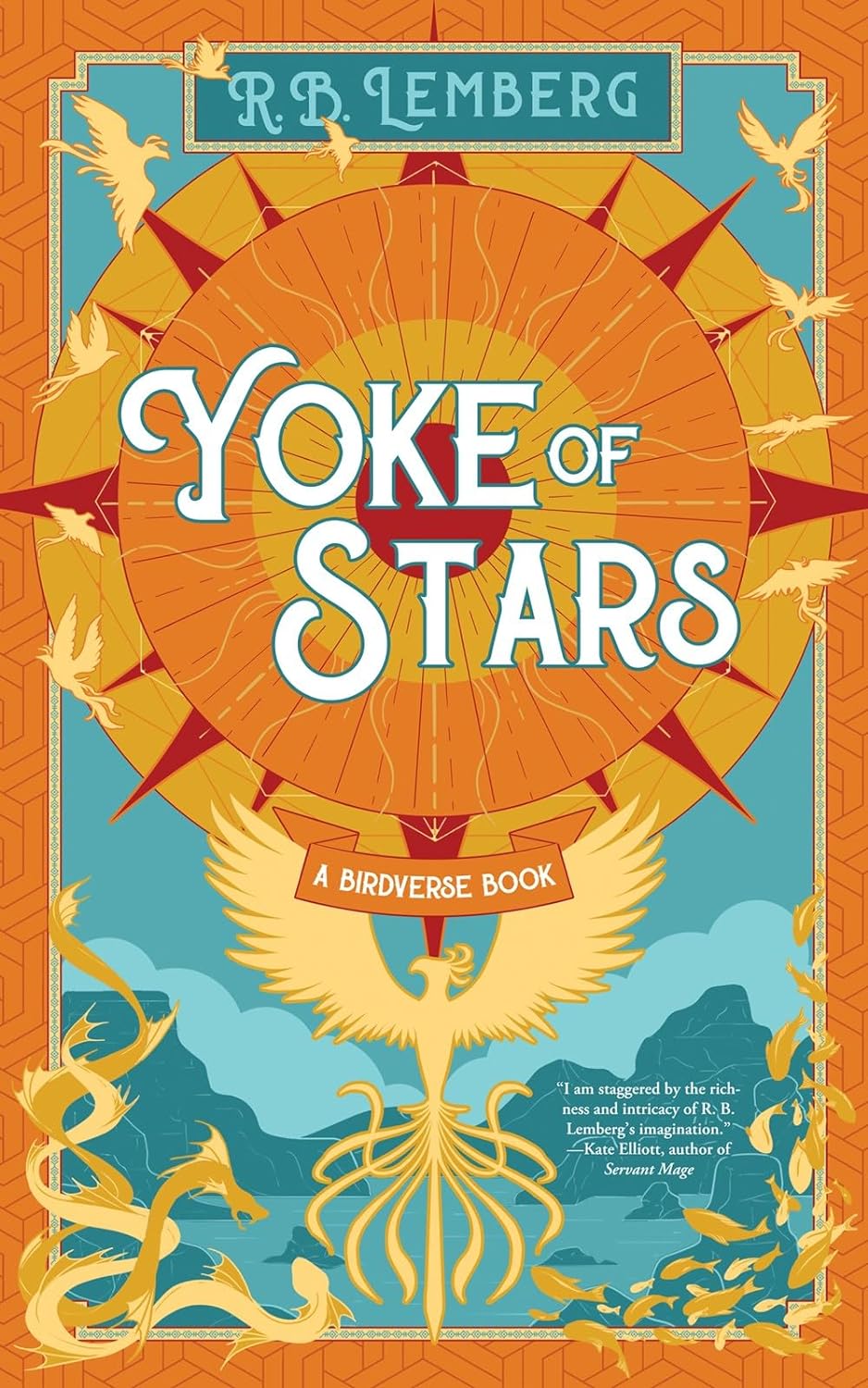
YOKE OF STARS
R. B. LEMBERG
Tachyon Publications
$15.95 trade paper, available now
Rating: 4.75* of five
The Publisher Says: In the School of Assassins, Stone Orphan waits for a first assignment. After their first kill, they will graduate, and attain the coveted cloth of bone. But instead of a commission, Stone Orphan gets an inquisitive linguist, Ulín. By turns, Stone Orphan and Ulín narrate tales of love, suffering, exile, and self-determination, and two wounded souls try to find hope in each other through the radical act of listening.
I RECEIVED A DRC FROM THE PUBLISHER VIA NETGALLEY. THANK YOU.
My Review: A storyverse like Lemberg's is not going to be for everyone. A person who can write this is not from the US and not on the gender binary and not wired like the usual drudge/drone in that they aren't very interested in the Overculture and its concerns. No one who was could've written this: "A story moves back and forth in translation, and it is remade every time. Each of us is a story translated to a language vastly different from its first. You can try to translate yourself back, but it won't be the same story."
This is not the thought, the distilled realization, of a person who lives in one language, or one who simply waits to talk again. There's a radical act of vulnerability in listening to what is actually said to you, not simply responding to how whatever is heard makes you feel. Life is not therapy. Author Lemberg lives in that reality.
The Birdverse is multiple tales old now. In accordance with my long-standing policy of not reviewing books I've spent my own United States dollars on, I have not reviewed earlier ones. I'm pretty sure that you can pick this book up and derive a delicious reading experience from its lush, limpid prose with no further background than is provided in the book. That is not to say it will be a doddle. You're wise not to think visually *first* in the Birdverse. There's a reason one main character here is a linguist.... I loved reading it because I am comforted by the Birdverse and its unremarked queerness and prevalence of spectrums. I think those things are background at this point but I also think someone whose first foray into it is this book might disagree with me (this explains the absence of the fifth star). I'm sad to say that is really not very important to me. I think the point of reading is to broaden horizons, to shape and sculpt and prune the thoughts in one's head. Books like the Birdverse ones are going to make themselves at home in spaces you yourself did not realize were there, or fit themselves onto and around ideas you are growing.
Not always comfortable but almost always very healthy for your worldview. I'm sure this book, light on the more troubling things I've heard others describe in Author Lemberg's œuvre as negatives in their reads, is short enough to make your reading pleasant as well as mind-expanding. These people are struggling through barriers we all recognize between ourselves and others. The overcoming of traumas, or not, is a constant. The manner these obstacles are illuminated in the story is enough to cause me to urge the read on you as soon as you can get it.
I don't imagine a lot of cishet people really think about gender othering. It's not asked of you very often. Try it here: Whenever an assumption made in the story brings you up short, don't dismiss it or snort past it; think, "how is my world this frustrating or confusing or nonsensical to another person?" It can open broad vistas. That can only be a good thing for you, and those around you.
At the end of the day, a read gives you what you reach for within it. I got the certainty that I'm not insane, I'm trying to translate from my own inner worldtongue into a different one, spoken by people who care very little for the nuances I love and live for.
And you?

