Showing posts with label genderqueer author. Show all posts

Friday, November 15, 2024

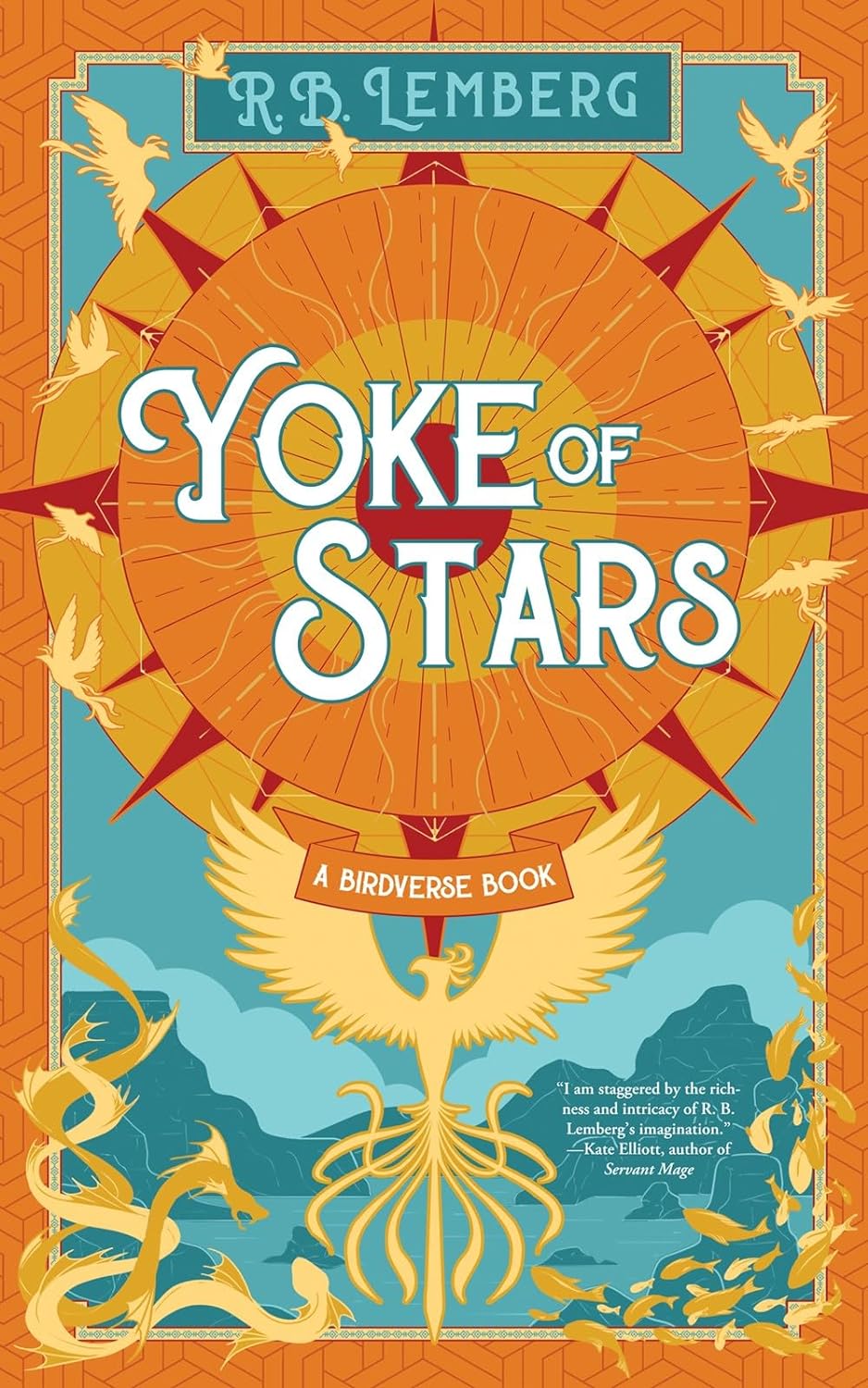
YOKE OF STARS, another concentrated dose of Lemberg's amazing Birdverse


YOKE OF STARS
R. B. LEMBERG

Tachyon Publications
$15.95 trade paper, available now

Rating: 4.75* of five

The Publisher Says: In the School of Assassins, Stone Orphan waits for a first assignment. After their first kill, they will graduate, and attain the coveted cloth of bone. But instead of a commission, Stone Orphan gets an inquisitive linguist, Ulín. By turns, Stone Orphan and Ulín narrate tales of love, suffering, exile, and self-determination, and two wounded souls try to find hope in each other through the radical act of listening.

I RECEIVED A DRC FROM THE PUBLISHER VIA NETGALLEY. THANK YOU.

My Review
: A storyverse like Lemberg's is not going to be for everyone. A person who can write this is not from the US and not on the gender binary and not wired like the usual drudge/drone in that they aren't very interested in the Overculture and its concerns. No one who was could've written this: "A story moves back and forth in translation, and it is remade every time. Each of us is a story translated to a language vastly different from its first. You can try to translate yourself back, but it won't be the same story."

This is not the thought, the distilled realization, of a person who lives in one language, or one who simply waits to talk again. There's a radical act of vulnerability in listening to what is actually said to you, not simply responding to how whatever is heard makes you feel. Life is not therapy. Author Lemberg lives in that reality.

The Birdverse is multiple tales old now. In accordance with my long-standing policy of not reviewing books I've spent my own United States dollars on, I have not reviewed earlier ones. I'm pretty sure that you can pick this book up and derive a delicious reading experience from its lush, limpid prose with no further background than is provided in the book. That is not to say it will be a doddle. You're wise not to think visually *first* in the Birdverse. There's a reason one main character here is a linguist.... I loved reading it because I am comforted by the Birdverse and its unremarked queerness and prevalence of spectrums. I think those things are background at this point but I also think someone whose first foray into it is this book might disagree with me (this explains the absence of the fifth star). I'm sad to say that is really not very important to me. I think the point of reading is to broaden horizons, to shape and sculpt and prune the thoughts in one's head. Books like the Birdverse ones are going to make themselves at home in spaces you yourself did not realize were there, or fit themselves onto and around ideas you are growing.

Not always comfortable but almost always very healthy for your worldview. I'm sure this book, light on the more troubling things I've heard others describe in Author Lemberg's œuvre as negatives in their reads, is short enough to make your reading pleasant as well as mind-expanding. These people are struggling through barriers we all recognize between ourselves and others. The overcoming of traumas, or not, is a constant. The manner these obstacles are illuminated in the story is enough to cause me to urge the read on you as soon as you can get it.

I don't imagine a lot of cishet people really think about gender othering. It's not asked of you very often. Try it here: Whenever an assumption made in the story brings you up short, don't dismiss it or snort past it; think, "how is my world this frustrating or confusing or nonsensical to another person?" It can open broad vistas. That can only be a good thing for you, and those around you.

At the end of the day, a read gives you what you reach for within it. I got the certainty that I'm not insane, I'm trying to translate from my own inner worldtongue into a different one, spoken by people who care very little for the nuances I love and live for.

And you?

Sunday, August 21, 2016

CORAL BONES, being a prose sequel of sorts to The Tempest, the fine late play written by William Shakespeare


CORAL BONES
FOZ MEADOWS
(Monstrous Little Voices #1)
Abaddon Books (non-affiliate Amazon link)
99¢ Kindle edition, available now

Rating: 5* of five

The Publisher Says: Miranda, daughter to Prospero, the feared sorcerer-Duke of Milan, stifles in her new marriage. Oppressed by her father, unloved by Ferdinand, she seeks freedom; and is granted it, when her childhood friend, the fairy spirit Ariel, returns. Miranda sets out to reach Queen Titania’s court in Illyria, to make a new future....

Monstrous Little Voices is a collection of five short novellas, a single long tale set in Shakespeare’s fantasy world of fairies, wizards and potions, in honour of the four-hundredth anniversary of the Bard’s death.

My Review: Probably my favorite of the five novellas. I love the conceit of Miranda finding the life of a wife, after a girlhood and youth free of conventional constraints though rife with unconventional unsavorinesses, to be boring, constrictive, and evoking in her a deep sense of ambivalent unhappiness. I suspect that many folks who jumped from the frying pan of youth into the open fire of adulthood will relate to Miranda's plight and wish for her good fortune in discovering an escape route.

One of Meadows's sinewy strengths is in smithing beautiful, enduring phrases from Shakespeare's native tongue:
Ariel's cure is a nostrum that tastes of moss and sunsets, scratching my throat like swallowed earth. It sits in the core of me like ice, a steady coolth radiating outwards, soothing my fever; soothing me. I stare at the painted angels overhead and wonder how unlike them I must be, that I can leave my father and husband to think me dead.
Words, ordinary words that you and I use every day, seemingly effortlessly placed in a shimmeringly lovely arabesque; the mighty effort it took to bend the armature of thought the words bedizen is unobtrusive. Meadows makes the struggle look easy. That is talent coupled with an iron will and work ethic.

A trend in modern fantasy writing that I find very agreeable is the presentation of faery creatures as truly other, not either Goody Goody or Evil Wicked Mean and Nasty as was the case for so long:
Puck laughs, warm and pealing. "Your concern is touching, but deeply unnecessary. Did Ariel not tell you, child? I'm a trickster, and though my enemies try as they might, it's tricky to trick a trickster with even the trickiest trickeries. And in any case, should anyone try to trick me"--his smile turns vulpine, sharper even than his teeth--"they must do so in the knowledge that I'll trick back."
"A boastful thing, aren't you?"
"Modesty is for saints, which I most certainly am not."
"Indeed? You shock me, sir!"
"Excellent! I do so love to be shocking."
The words flow like cold spring water, deceptive in limpid clarity, hiding a swift current and slippery rocks ready to lift one's feet from their footings and dump the inattentive into an icy bath of surprise: teeth, wits, mind, morals, all are sharp instruments to this ancient, soulless trickster.

I believe that Meadows has speared the wriggling fish of The Tempest's--indeed perhaps all of Shakespeare's works's--essential message, alluded to but never declaimed outright, in this long speech Miran-Miranda (you'll see what this means when you read the novella) makes to Puck as they travel away from Ferdinand and Prospero and the rest of the ordinary (!) world, together:
I am--I know I am new to desire, and all my husband taught me was that wanting should be his province alone, with granting those wants my chore. Certainly, I envied him the decision, but it was not--is not--the whole of it. On the island, there was hardly need to think of myself as girl or woman, except inasmuch as my father told me to, for I had no real source of comparison. Caliban was inhuman, my father defined himself as a sorcerer more than as a mere man, and Ariel could be anything she pleased. But then there was Ferdinand, and for his sake--and for my ease--I took the role I'd been told to take, but though I tried to obey, it was...I wish I could say it was just the skirts, that I chafed only at the expectation of manners, but it wasn't that, Puck, it was language, the words, the feel of them. I never knew words could be so sharp, until the wrong ones cut me. But they weren't always wrong, that's the worst of it; some days I revelled in being called a lady, but then the day would pass, the sun would rise and fall again, and the same name felt like a collar, bringing me to heel; or else a corset, squeezing me into wrongish shapes for the adoration of strangers.
But are they wrong? I still don't know. But, oh, I wish--I wish--I could change as Ariel does, that flicker-flash between girl and man; I wish my form could be all the forms my heart desires! The moon has phases, does it not? We call it full and half and harvest, but through its wax and wane, it remains the moon, and we love it no less--must I be any different? I must not, for I am not. My heart is a moon, and some days I am full and bright within myself, a shape that fits my name, and then I fade, and mirrors show only a half-light shared with a silhouette, an absence my form reflects; and then, in the dark, I am dark altogether, until I regrow again. Why should such a thing be any more difficult to grasp than the fact that some think me dead, and yet I live? The contradiction is only in their perception of what I am; and though killing me would perhaps solve it to their satisfaction, it would not undo the truth of me.
I am struck speechless. I can only say to this eloquent outpouring, "Yes, Foz, yes. You got it. You get it."