Showing posts with label exile's return. Show all posts

Friday, November 15, 2024

YOKE OF STARS, another concentrated dose of Lemberg's amazing Birdverse


YOKE OF STARS
R. B. LEMBERG

Tachyon Publications
$15.95 trade paper, available now

Rating: 4.75* of five

The Publisher Says: In the School of Assassins, Stone Orphan waits for a first assignment. After their first kill, they will graduate, and attain the coveted cloth of bone. But instead of a commission, Stone Orphan gets an inquisitive linguist, Ulín. By turns, Stone Orphan and Ulín narrate tales of love, suffering, exile, and self-determination, and two wounded souls try to find hope in each other through the radical act of listening.

I RECEIVED A DRC FROM THE PUBLISHER VIA NETGALLEY. THANK YOU.

My Review
: A storyverse like Lemberg's is not going to be for everyone. A person who can write this is not from the US and not on the gender binary and not wired like the usual drudge/drone in that they aren't very interested in the Overculture and its concerns. No one who was could've written this: "A story moves back and forth in translation, and it is remade every time. Each of us is a story translated to a language vastly different from its first. You can try to translate yourself back, but it won't be the same story."

This is not the thought, the distilled realization, of a person who lives in one language, or one who simply waits to talk again. There's a radical act of vulnerability in listening to what is actually said to you, not simply responding to how whatever is heard makes you feel. Life is not therapy. Author Lemberg lives in that reality.

The Birdverse is multiple tales old now. In accordance with my long-standing policy of not reviewing books I've spent my own United States dollars on, I have not reviewed earlier ones. I'm pretty sure that you can pick this book up and derive a delicious reading experience from its lush, limpid prose with no further background than is provided in the book. That is not to say it will be a doddle. You're wise not to think visually *first* in the Birdverse. There's a reason one main character here is a linguist.... I loved reading it because I am comforted by the Birdverse and its unremarked queerness and prevalence of spectrums. I think those things are background at this point but I also think someone whose first foray into it is this book might disagree with me (this explains the absence of the fifth star). I'm sad to say that is really not very important to me. I think the point of reading is to broaden horizons, to shape and sculpt and prune the thoughts in one's head. Books like the Birdverse ones are going to make themselves at home in spaces you yourself did not realize were there, or fit themselves onto and around ideas you are growing.

Not always comfortable but almost always very healthy for your worldview. I'm sure this book, light on the more troubling things I've heard others describe in Author Lemberg's œuvre as negatives in their reads, is short enough to make your reading pleasant as well as mind-expanding. These people are struggling through barriers we all recognize between ourselves and others. The overcoming of traumas, or not, is a constant. The manner these obstacles are illuminated in the story is enough to cause me to urge the read on you as soon as you can get it.

I don't imagine a lot of cishet people really think about gender othering. It's not asked of you very often. Try it here: Whenever an assumption made in the story brings you up short, don't dismiss it or snort past it; think, "how is my world this frustrating or confusing or nonsensical to another person?" It can open broad vistas. That can only be a good thing for you, and those around you.

At the end of the day, a read gives you what you reach for within it. I got the certainty that I'm not insane, I'm trying to translate from my own inner worldtongue into a different one, spoken by people who care very little for the nuances I love and live for.

And you?

Monday, November 11, 2024

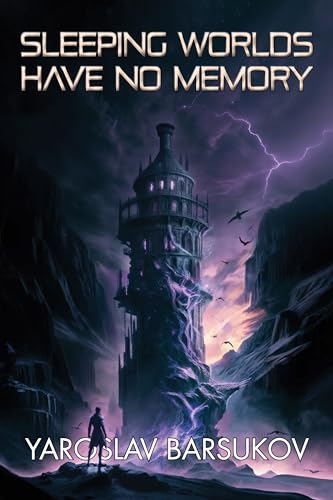
2024 NEBULA FINALISTS: SLEEPING WORLDS HAVE NO MEMORY, thought-provoking story with a hopeful twist


SLEEPING WORLDS HAVE NO MEMORY
YAROSLAV BARSUKOV

CAEZIK SF & Fantasy (non-affiliate Amazon link)
$4.99 Kindle edition, available tomorrow

Rating: 4.75* of five

FINALIST for the 2024 Nebula Award! Winner announced at the 2025 Nebula Conference, 5 through 8 June 2025.

The Publisher Says: When lies become truths and two kingdoms head to a bloody war, a man is exiled for his conscience

Refusing the queen’s order to gas a crowd of protesters, Minister Shea Ashcroft is banished to the border to oversee construction of the biggest defensive tower in history. However, the use of advanced technology taken from refugees makes the tower volatile and dangerous, becoming a threat to local interests. Shea has no choice but to fight the local hierarchy to ensure the construction succeeds—and to reclaim his own life.

Surviving an assassination attempt, Shea confronts his inner demons, encounters an ancient legend, and discovers a portal to a dead world—all the while struggling to stay true to his own principles and maintain his sanity. Fighting memories and hallucinations, he starts to question everything...

Sleeping Worlds Have No Memory is a thought-provoking meditation on the fragility of the human condition, our beliefs, the manipulation of propaganda for political gains, and our ability to distinguish the real from the unreal and willingness to accept convenient “truths.” The novel is a compelling exploration of memory, its fragile nature, and its profound impact on our perception of identity, relationships, and facts themselves.

A unique blend of science fiction, fantasy and noir, with zeitgeist and prophetic qualities (the original novella anticipated the Russo-Ukrainian War), this is a must for fans of China Miéville’s Bas-Lag series, Ted Chiang’s Tower of Babylon, and Robert Silverberg’s Tower of Glass.

I RECEIVED A DRC FROM THE PUBLISHER VIA NETGALLEY. THANK YOU.

My Review
: We can use some entertainment. We can use a bit of moral instruction, it seems. Author Barsukov said these things to himself, at least in my reconstruction of the thought process that led to this book, and decided that he'd make a world and a man to resist its slide into darkness.

I found this book very inspiring. I'm inspired to bring it to y'all's attention because of this piece from The Guardian, "'It will renew your faith in humanity': books to bring comfort in dark times":
A surprising number of readers believe a happy ending should mean automatic disqualification from any serious literary award. Good luck to them: I wish them joy in their wallowing. In my turn, I’ve come to believe the opposite. To reach only for novels that reaffirm our darkest fears is merely to make an escape of a different sort, not the escapism of brooding heroes and wedding finales, but the security blanket of an equally foregone conclusion: the safety of imagining the worst. I would argue that to live only in that place is simply cowardice in better camouflage. The truth is that it’s far riskier to remain in uncertainty. Far braver, far more radical to keep hoping.
The truth of this is in Shea's dogged determination to do what's Right; it's in his determination's effect on engineer Brielle, whose expertise is central in what their shared need to do what's Right creates.

There's a lot of the epic fantasy ethos in this urban-fantasy story, sans the usual military glorification; but there is a very welcome leavening of SF in the story that prevents me from the usual somnolent, glazed-eyed scanning to get to the ending. I was alert and involved as Brielle's skills were deployed to create the tower that Shea's tasked with defending, to little avail:
The tower took the length of the world—only it was an alien world, replicating itself over and over as it climbed to a distant, ghostly gap into the clouds. Or did he stare down a well? Shea's head spun again as up and down flip-flopped like axes on a gyroscope.
Does this dimensionally daft structure need defending? Does this technology need help, or resistance to its implications? Can anyone, still less a proven-murderous tyrant, be trusted with a tool/weapon of this magnitude? Are the Others, the aliens, to be trusted, or are they there to treat Shea and his people as the Others...with the usual result?

Ethical questions, existential ones, that resonate clearly with our post-November 6th world. They aren't easy, or easily solved ones; Author Barsukov doesn't pretend his ending is a solution to them all. There aren't any escape routes from the consequences of greed and lust for power provided. There are stern meditations on what we try to use, though:
What makes guilt so grotesque is the fact that it adorns itself with whatever remains of our righteousness.

And so the sadness of life as a moral actor, as a being with agency and puissance outreaching the lessons of their past, is revealed and refined. The story, an expansion of his 2021 novella Tower of Mud and Straw, reminded me more and more of THE DEEP SEA DIVER'S SYNDROME (qv) which French translation also delves into the intersection between dreamlike states and meatspace with equal care. Does anyone really know what the Tower is/can do? Do their...reveries, memories, dreamlike experiences...come without cost yet replete with warning signs?

An ending that addresses these queries of reality yet doesn't wrap them in a tight, constricting little bow gave me both inspiration and information to examine this moment in which I am deeply unhappy, afraid, and emotionally bereft, with a dose of hope. There is a reason Author Barsukov chose this particular stream-of-consciousness style, and this superposed urban-fantasy/SF genre mashup, to tell you this story. Intrinsic to the story, the way everything meshes...and the things that don't...are all made to present a frame for a very intensely resonant meditation.

There is not a lot more valuable for a story to give as its gift than that.

Sunday, August 1, 2021

SENSELESSNESS, short and bitter and galvanizing...literary double espresso, genocide and atrocities oh my


SENSELESSNESS
HORACIO CASTELLANOS MOYA
(tr. Katherine Silver)
New Directions
$15.95 trade paper & ebook editions, available now

Rating: 4* of five

The Publisher Says: A boozing, sex-obsessed writer finds himself employed by the Catholic Church (an institution he loathes) to proofread a 1,100 page report on the army's massacre and torture of thousands of indigenous villagers a decade earlier, including the testimonies of the survivors. The writer's job is to tidy it up: he rants, "that was what my work was all about, cleaning up and giving a manicure to the Catholic hands that were piously getting ready to squeeze the balls of the military tiger." Mesmerized by the strange Vallejo-like poetry of the Indians' phrases ("the houses they were sad because no people were inside them"), the increasingly agitated and frightened writer is endangered twice over: by the spell the strangely beautiful heart-rending voices exert over his tenuous sanity, and by real danger—after all, the murderers are the very generals who still run this unnamed Latin American country.

I RECEIVED A REVIEW COPY FROM THE PUBLISHER AT MY REQUEST. THANK YOU.

My Review
: It's a horrible, horrible story; it destroyed its narrator and bid fair to make me a whispering zombie; man's inexpressible vileness and irreducible cruelty are a weight too heavy for me to bear. His task is to copyedit a human-rights report commissioned by the Archbishop to ascertain the guilt and/or innocence of the parties to a genocide. Every step of the narrator's descent into mental illness's loudest darkest corners is punctuated by italicized phrases he's culled from this report...all one thousand one hundred pages...for their unusual, beautiful, euphonious horror: I am not complete in the mind greets the reader on page one. A man who lived beyond the violence that stole his family from him utters those words, to a psychologist, as the report takes shape, as the professional records the words and assesses the soul that left the body of the speaker, so as to bear witness.

I didn't read the original Spanish, but I'll wager there's nothing significant lost in Katherine Silver's translation. It's too precisely evocative. It's also extremely prolix in its one hundred forty-two pages. Words pile up, words wind around your eyestalks, words make dizzyingly alien geometries as they flow from the desperately purging narrator. Words distance him, though not the reader, from the blood and hate and evil he must view as structures and concepts in order to earn his five thousand United States dollars for copyediting one thousand one hundred pages of agony. The slaughter of untold bodies is actually the less revolting part of the tale...Wounded, yes, is hard to be left, but dead is ever peaceful is not something a grandmother should have cause to say of her murdered descendants...and the litany of one thousand one hundred pages reminds us that the narrator is doing a job, is taking the written results of an investigation, is applying grammar and punctuation to the massive, traumatized shouting of the victims of genocide.

We all know who are the assassins.