Showing posts with label #BlackLivesMatter. Show all posts

Thursday, March 13, 2025

THE MAN NOBODY KILLED: Life, Death, and Art in Michael Stewart's New York, forty-two years and it's still fresh as tonight's news


THE MAN NOBODY KILLED: Life, Death, and Art in Michael Stewart's New York
ELON GREEN

Celadon Books (non-affiliate Amazon link)
$14.99 ebook, available now

Rating: 4.5* of five

The Publisher Says: The first comprehensive book about Michael Stewart, the young Black artist and model who died after an altercation with the police in 1983, from Elon Green, the Edgar Award-winning author of Last Call.

At twenty-five years old, Michael Stewart was a young Black aspiring artist, deejay, and model, looking to make a name for himself in the vibrant downtown art scene of the early 1980’s New York City. On September 15, 1983, he was brutally beaten by New York City Transit Authority police for allegedly tagging a 14th Street subway station wall.

Witnesses reported officers beating him with billy clubs and choking him with a nightstick. Stewart arrived at Bellevue Hospital hog-tied with no heartbeat and died after thirteen days in a coma. This was, at that point, the most widely noticed act of police brutality in the city's history. The Man Nobody Killed recounts the cultural impact of Michael Stewart’s life and death.

The Stewart case quickly catalyzed movements across multiple communities. It became a rallying cry, taken up by artists and singers including Madonna, Keith Haring, Spike Lee, and Jean-Michel Basquiat, tabloid legends such as Jimmy Breslin and Murray Kempton, and the pioneering local news reporter, Gabe Pressman. The Stewart family and the downtown arts community of 1980s New York demanded justice for Michael, leading to multiple investigations into the circumstances of his wrongful death.

Elon Green, the Edgar Award–winning author of Last Call, presents the first comprehensive narrative account of Michael Stewart's life and killing, the subsequent court proceedings, and the artistic aftermath. In the vein of The Short and Tragic Life of Robert Peace and His Name is George Floyd, Green brings us the story of a promising life cut short and a vivid snapshot of the world surrounding this loss. A tragedy set in stark contrast against the hope, activism, and creativity of the 1980’s New York City art scene, The Man Nobody Killed serves as a poignant reminder of recurring horrors in American history and explores how, and for whom, the justice system fails.

I RECEIVED A DRC FROM THE PUBLISHER VIA NETGALLEY. THANK YOU.

My Review
: Elon Green's followup to Last Call, again centering the life and murder of someone very much not like his cishet Jewish self, gets the tones of his subject's life and murder spot-on.

It's a gift not all have. I think his evident curiosity about people, the whys that drive them to the wheres that force us to hear about them, shines through in this exploration of all parties to this crime. Stewart, a young man of borning fame for a talent still developing, does not have much of a documentary footprint outside his still-early recognition from the downtown Manhattan art scene. He is of necesity flattened in affect thereby; he had little time and no special reason to leave behind a trove of thinking, essays, manifestoes; he is known only because his death interrupted his rise to Basquiat-levels of celebrity. It doesn't change the outrage vented by the white establishment liberals on the MTA-cop murderers, it doesn't alter by a jot the klieg-lights-and-klaxons that the murder of young Black men by white men set off, only to subside as the relentless slopping of the media trough with more acceptable outrages that refocus attention away from systemic racism accomplishes its task.

Michael Stewart died in vain. His death did not stop cops from killing other young Black men on the regular, nor dissuade the occasional white amateur from trying it...getting tried...getting off.

Elon Green doesn't shy away from the ugliness inherent in this story. He uses the limited materials about the victim to flesh him out as much as possible. It's just that the system itself, the perps it's enabled, the horrors of living in a world that views your existence as a provocation deserving of death, has a much larger footprint. It's thus that the system and its publicity becomes the focus of the book (hence my docked half-star). That might leave the reader wondering why Stewart got such prominent billing on the cover. Because we are accustomed to centering the white person(s) over the victims of color, we're accustomed to the perps (eg Derek Chauvin) getting media attention. It was his fate to be the killer cop who ignited, finally, #BlackLivesMatter and #SayHisName...could as easily have happened with one of Ahmaud Arbery's murderers, or Michael Stewart's. Follow those links, white people. Look at the titles of each article. Think about what you are seeing. Really THINK.

I assume you're sentient and I don't need to spell it out for you.

It's an infuriating read. I wanted the results not to be the results. It is history so of course I was disappointed. But, and all y'all who "just can't, too hard," with these books on difficult topics, think about how supremely spoiled and privileged a stance that is. Michael Stewart and his mother couldn't just ignore it. They had to live it, she lived it until she died.

Does it still feel too hard? Or can you use that rage, outrage, sympathy for a mother who outlived her child, to power some practical resistance? The US is sliding into a new era of sanctioned violence against those They hate. Does that not seem important enough to do actual work to oppose?

Wednesday, December 6, 2023

WE ARE THE CRISIS, Convergence Saga #2 after NO GODS, NO MONSTERS


WE ARE THE CRISIS
CADWELL TURNBULL
(Convergence Saga #2)
Blackstone Publishing
$26.99 hardcover, available now

Rating: 4.5* of five

The Publisher Says: In We Are the Crisis—the second book in the Convergence Saga from award-winning author Cadwell Turnbull—humans and monsters come into conflict in a magical and dangerous world as civil rights collide with preternatural forces.

In this highly anticipated sequel, set a few years after No Gods, No Monsters, humanity continues to grapple with the revelation that supernatural beings exist. A werewolf pack investigates the strange disappearances of former members and ends up unraveling a greater conspiracy, while back on St. Thomas, a hurricane approaches and a political debate over monster’s rights ignites tensions in the local community.

Meanwhile, New Era—a pro-monster activist group—works to build a network between monsters and humans, but their mission is threatened by hate crimes perpetrated by a human-supremacist group known as the Black Hand. And beneath it all two ancient orders escalate their conflict, revealing dangerous secrets about the gods and the very origins of magic in the universe.

Told backward and forward in time as events escalate and unravel, We Are the Crisis is a brilliant contemporary fantasy that takes readers on an immersive and thrilling journey.

I RECEIVED A DRC FROM THE PUBLISHER VIA EDELWEISS+. THANK YOU.

My Review
: I think this series of novels that discuss the sources of Otherness and the artificiality of the idea of a permanent identity deserves all the praise I can heap on it. Using modern culture's delight in cryptids and monsters as real entities, Author Turnbull offers a wise and inclusive look at how identity can be imposed from outside and then used to oppress and persecute the recipient of that imposed "self". Horror fiction is supposed to scare us with the monsters, not FOR them. This subversion of the literary status quo is ideally suited to slide in under the resistant person's radar and make them think again about what a monster is, and who decides what that identity means. This is something that has needed doing since the days of myth...Beowulf is, at the end of the day, about a mother seeking vengeance for the harm done to her child...and what could be more subversive than that?

The very concept of debating rights is absurd on its face. You don't grant rights. Rights are, then they get denied by the controlling elites to serve their own purposes. Granting rights is best framed as removing impediments unjustly placed in the path of those attempting to exercise their natural rights. When that fact comes dangerously close to becoming part of the great mass of people's consciousness, a crisis must be manufactured to distract and re-Other the group that is deemed undesirable by the controlling elites.

The existence of Others is necessary for the forces of control to make the eternally useful and rouinely succesful lie of Us-vs-Them work to absorb the mass of humanity in fighting against those who have the most in common with them so the controlling elites don't have to worry about how they can keep their power, privilege, and prestige intact against the outrage and hatred of those they oppress to serve them, not their own needs.

Political fiction done so well that, unless you already knew it was political, you wouldn't know. For that reason, I encourage you to gift it to your videogame addicted teen boy. Anything we can do to wedge his mind open a wee tiny bit for non-authoritarian thoughts to enter is good.

Sunday, May 29, 2022

PUNCH ME UP TO THE GODS, what a joy to read a man's look at himself in his own mirror


PUNCH ME UP TO THE GODS
BRIAN BROOME

Mariner Books
$17.99 trade paper, available now

WINNER OF THE 34TH ANNUAL PUBLISHING TRIANGLE AWARDS: THE RANDY SHILTS AWARD FOR GAY NONFICTION!

A NEW YORK TIMES NOTABLE BOOK FOR 2021!

Listen to this interview with Author Broome!

Rating: 4* of five

The Publisher Says: Punch Me Up to the Gods introduces a powerful new talent in Brian Broome, whose early years growing up in Ohio as a dark-skinned Black boy harboring crushes on other boys propel forward this gorgeous, aching, and unforgettable debut. Brian’s recounting of his experiences—in all their cringe-worthy, hilarious, and heartbreaking glory—reveal a perpetual outsider awkwardly squirming to find his way in.

Indiscriminate sex and escalating drug use help to soothe his hurt, young psyche, usually to uproarious and devastating effect. A no-nonsense mother and broken father play crucial roles in our misfit’s origin story. But it is Brian’s voice in the retelling that shows the true depth of vulnerability for young Black boys that is often quietly near to bursting at the seams.

Cleverly framed around Gwendolyn Brooks’s poem “We Real Cool,” the iconic and loving ode to Black boyhood, Punch Me Up to the Gods is at once playful, poignant, and wholly original. Broome’s writing brims with swagger and sensitivity, bringing an exquisite and fresh voice to ongoing cultural conversations about Blackness in America.

I RECEIVED A DRC FROM THE PUBLISHER VIA NETGALLEY. THANK YOU.

My Review
: I'll start with a fact: The author's a poet.
One of the reasons I took this trip is to prove to myself that I am allowed to take up space in the world. I used to believe that the space I occupied was conditional. That I had to please anyone and everyone around me in order to exist because I had made the horrible mistake of being different.
–and–
It is only through your own lived experience that you will learn that living on the outside of "normal" provides the perfect view for spotting insecure and flimsy principles camouflaging themselves as leadership or righteousness.
–and–
Black boys don't get a long boyhood. It ends where white fear begins, brought on by deepening voices, broadening backs, and coarsening hair in new places beneath our clothing. Then there's our skin, which provides little middle ground.

You won't get a whisper of a whine from me about Author Broome's beautiful phrase-making. He is up there in the poetic-prose rankings. He could, and most likely will, give James Baldwin a run for his epoch-making money in the poetic eloquence on the Essence of Blackness derby.

Yes, I said that and I meant it. Moreso than other writers on Blackness, Author Broome's dual Othering of being a Black gay man adds the ingredient so often missing in manifestoes like Heavy or Between the World and Me. Worthy reads, even necessary ones. Tears We Cannot Stop offers a more religious, sentimental slant on the subject of Black maleness, and is an equally necessary voice to attend to. But James Baldwin, in his significant for its being so overlooked essay Nothing Personal, brings his religious past and his queer present and his uncertainty about the future into focus in much the same way that Author Broome does: as fact, as solid ground, as new, everlasting source of Otherness among the Othered. There being fifty-plus years between the two books, there are differences of tone made possible by the progress that has happened. There is not, however, a difference of kind in the subject of these books: The authors are Othered Others and are not allowed to make a life that doesn't center their Othered Otherness in this, our glorious country.

Author Broome uses the framing device of a young Black boy being psychologically shredded by the father who, I do not doubt for an instant, loves him and wants him to become a superstar in this world. To that father, as he browbeats and abuses his probably-queer young son, that means beating the gay out of him. That's also what it meant to Author Broome's father, emasculated by the same round of deindustrialization that created so many billionaires, and to Baldwin's religious-nut stepfather. The truth is these men, these fathers, aren't alone in thinking that they as well as their sons would be happier if the boys were either straight or dead. A quick flick of one's eyes over the statistics on adolescent suicide and teen drug use...this last plays quite a role in Author Broome's life...teaches us the toxic price paid by father, son, acquiescent or indifferent mother in death and destroyed personhood and family.

I think the power of reading the author's memories of growing up the Othered Other really rests in this: However easy it might have been for him to give in and let his addiction to drugs drag him into death, he does not. He stands on the rocks of his father's failed life, his mother's rage at...well, everything, and the cruel bonds of racist hatefulness (the dance party scene broke me), and he creates beautiful phrases and uses them to limn horrifying images onto my grotesquely privileged brain.
I have no method to persuade you that the act of shoving your most tender feelings way down deep or trying somehow to numb them will only result in someone else having to pick up your pieces later.

That, I feel, pretty much sums up the value in reading this book.

I've rated it four stars because, in service of being brought out in tree-book form, it's been made a little longer than it might should've been. About two-thirds of the way through the read, I realized I was using my commonplace book more than my Kindle's highlights function. The rapturous feeling of reading the beautiful words was ever-present. The story's painfully survived outlines weren't new to me. I don't expect them to be at my age. But the frankness about his sexual, um, adventures let us say, isn't fresh or new. It's raw, honest, and there for a reason, but what I think happened is that the otherwise too-loose narratives (from repetition) weren't a powerful enough frame to offer those very, very acute and sharp-edged memories their most effective perspective.

It is a small detraction from a large, loomingly menacingly honest, account of a Black Gay man's life in a world that hates each of those identites and conditions. The combination?

Read this book to find out.

Sunday, May 1, 2022

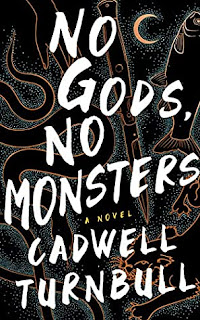
NO GODS, NO MONSTERS, first in a series, author's second novel, lauded and loved and awarded


NO GODS, NO MONSTERS
CADWELL TURNBULL
(Convergence Saga #1)
Blackstone Publishing (non-affiliate Amazon link)
$4.99 Kindle edition, avaiable now

Nominated for the BEST NOVEL AWARD—2021 SHIRLEY JACKSON AWARDS!

Rating: 4* of five, all for the slow-burn realization of the identity of the true main character

FINALIST FOR THE 2022 LOCUS AWARD—BEST FANTASY NOVEL! Winners announced 25 June 2022.

WINNER OF THE 34th Lambda Literary Award—BEST LGBTQ SPECULATIVE FICTION!

A NEW YORK PUBLIC LIBRARY 2021 BEST BOOK FOR ADULTS RECOMMENDATION!

The Publisher Says
: One October morning, Laina gets the news that her brother was shot and killed by Boston cops. But what looks like a case of police brutality soon reveals something much stranger. Monsters are real. And they want everyone to know it.

As creatures from myth and legend come out of the shadows, seeking safety through visibility, their emergence sets off a chain of seemingly unrelated events. Members of a local werewolf pack are threatened into silence. A professor follows a missing friend’s trail of bread crumbs to a mysterious secret society. And a young boy with unique abilities seeks refuge in a pro-monster organization with secrets of its own. Meanwhile, more people start disappearing, suicides and hate crimes increase, and protests erupt globally, both for and against the monsters.

At the center is a mystery no one thinks to ask: Why now? What has frightened the monsters out of the dark?

The world will soon find out.

I GOT THIS BOOK FREE WITH KINDLE CREDITS. SHOP OFTEN! THE REWARDS ARE REAL. (/irony)

My Review
: I think the worst part of reading this book was realizing that the monsters, the not-villainous villains of the piece, are me, my friends, my lover, all of us Othered by...so many factors.
“I’m sorry to do it this way, but I had to be safe,” Melku explains. “I won’t waste any more time. Our collective’s mission is to support the solidarity movement. Often, that has meant supporting marginalized peoples. Some of you are part of the queer and trans community, like me. Many of the most valuable monsters are also a part of these communities, which is why redefining to include them is so important. In that spirit, I think we should extend our support to monsters since it is likely that they’re already in the movement but have chosen to remain silent.”

A political meeting of anarchists in a collective...votes to include literal monsters...the kind that actually DO eat people...in its aims. This book...its imagination shames me.

I've never, ever once thought, "well, civil rights for werewolves should absolutely be guaranteed."

What is left for me to learn over the remainder of my life never, ever stops expanding. ...Yay...? And before anyone says it, no there are not actually werewolves or any other creatures we call monsters, but there are a LOT of humans I'd unhesitatingly call monsters all over the country where I live. All over the only planet we know of that has life on it. So there's clearly no god, either, because if so they're either weak or malevolent since they can't or won't fix things they broke. The book's title, then, snaps into focus: "NO GODS, NO MASTERS," the anarchist chant goes; now that "monsters" are real and have come out of their socially imposed hiding, it needs refreshing: "NO GODS, NO MONSTERS," or a simple acknowledgment that we are all on this lifeboat in the middle of a deadly environment and had all better get busy saving owrselves and each other from paying the ultimate price. No one above means no one below. And that, somehow, is terrible, bad, threatening...why, exactly? Because monsters are Evil? Because, if no one is In Control, things will be...worse? ("For whom" is left unstated. Obviously things will be worse for the ones who benefit from the way they are now.)

But the truth is, it never turns out that way. Marriage equality didn't turn Society into limp-wristed men in feather boas, or women in plaid shirts and bad haircuts. It resulted in a revolting boom in the wedding industrial complex. A lot of bigots making noise about being asked to bake cakes for people they didn't like much. COVID kills us all (in the USA, a million in two years which is more than the 698,000-plus AIDS has killed in 42), and capitalism couldn't care less about who's zoomin' who as long as the survivors consume consume consume.

The principal problem for me is the story's diffusion of narrative drive among so many characters. I do understand this fits the anarchist genesis of the story. But it plays into a problem that trumps political concerns: How am I supposed to sustain momentum in the read? I was able to make my way through the book but it took me longer than it usually does to finish it...almost a month. For fewer than three hundred pages.

I overcame that issue by remembering this phrase that I've entered into my commonplace book:
As he walks with the crowd, he understands what he had forgotten: that a march is not just a voice against violence and trauma, but also a reminder that even in a cause that is stacked against them, no one is alone.

Remember the Tiananmen Tank Guy? He is the reason governments work so hard to suppress free media; he is the reason many of us bother to protest in whatever ways we can. He stood alone, but crowds of protestors aren't when he appears in our minds' eyes. This is also why crowds become mobs, and why protest is something that deeply disturbs the Powers That Be.

When cops kill innocent people nowadays, we as a society are almost sure there will be protests. But now there is a complicating factor of monsters, creatures we're afraid of and whose means of making a living is violent by their very nature; they are, by the definitions we've all come to understand and possibly even accept, but certainly internalize, unnatural:
Near Ridley, a man yells, “No Gods.”

“No monsters,” the crowd chants back.

The chant is an evolution of an anarchist slogan: “No Gods, No Masters,” the original version meaning no human above. It is a call against hierarchy. Ridley assumes the variation means no human above, no human below, or something like it. A call against hierarchy and discrimination.


Simon-pure anarchist speak. Like being in a steering committee meeting for any politics at the local level organization. It is, in other words, bedrock truth that this story rests on. It is this meticulous inclusiveness by dint of hard-fought local battles that gives me little moments of happy recognition and pleasurable fellow feeling, of not being alone as I face a hostile-to-me world.

Go with Author Turnbull on the hunt for the truth of Power through these many points of view. Power resisted, power obtained, power flouted and abused...there is all the power any one being or group can ever use in the simplest truth of them all: Mystery exerts power in ways nothing else can hope to equal, still less surpass.

Thursday, February 24, 2022

THE TALENTED RIBKINS, Hubbard's debut novel & THE RIB KING, its prequel...very interesting!


THE RIB KING
LADEE HUBBARD

Amistad (non-affiliate Amazon link)
$11.99 Kindle edition, available now

Rating: 4* of five...truly on sentimental grounds

A BOOKRIOT BEST BOOK OF 2021!

The Publisher Says: Upstairs, Downstairs meets Parasite: The acclaimed author of The Talented Ribkins deconstructs painful African American stereotypes and offers a fresh and searing critique on race, class, privilege, ambition, exploitation, and the seeds of rage in America in this intricately woven and masterfully executed historical novel, set in the early twentieth century that centers around the black servants of a down-on-its heels upper-class white family.

For fifteen years August Sitwell has worked for the Barclays, a well-to-do white family who plucked him from an orphan asylum and gave him a job. The groundskeeper is part of the household’s all-black staff, along with “Miss Mamie,” the talented cook, pretty new maid Jennie Williams, and three young kitchen apprentices—the latest orphan boys Mr. Barclay has taken in to "civilize" boys like August.

But the Barclays' fortunes have fallen, and their money is almost gone. When a prospective business associate proposes selling Miss Mamie’s delicious rib sauce to local markets under the brand name “The Rib King”—using a caricature of a wildly grinning August wearing a jewel-encrusted crown on the label—Mr. Barclay, desperate for cash, agrees. Yet neither Miss Mamie nor August will see a dime. Humiliated, August grows increasingly distraught, his anger building to a rage that explodes in shocking tragedy.

Elegantly written and exhaustively researched, The Rib King is an unsparing examination of America’s fascination with black iconography and exploitation that redefines African American stereotypes in literature. In this powerful, disturbing, and timely novel, Ladee Hubbard reveals who people actually are, and most importantly, who and what they are not.

I RECEIVED THIS AS A YULE GIFT FROM MY DELIGHTFUL YOUNG GENTLEMAN CALLER. YOU'RE TOO KIND, ROB.

My Review
: A book of two halves...Mr. Sitwell, the risen-through-the-ranks butler of the Barclay family, has a fascinating tale to tell about how he becomes The Rib King™ and, in an access of passionate rage, pivots from a man who knows his worth, and protects it at all costs, into a, well, talented person set on revenge for some nasty wrongs. I myownself was quite invested in this story and would give it four stars were it the only one here.

Part two follows Jennie, who was another servant in the Barclay household, as she does what needs doing in New Orleans. She has a daughter and she is the only one who can look out for the young lady's future. This would seem to be well-trodden territory. It is. I don't want you to think there was nothing to say for it, and there are definitely reasons to follow Jennie and her child. But the process was three-star territory for sure.

What made me think and fuss about how to fix this reading experience in my memory is the fact that I read The Talented Ribkins (see below) before I read this book. It led me down the garden path a bit. I was expecting to get more of the reasons and the wherefores of the earlier book's characters. It didn't really fulfill that desire in me.

But the prose flowed over my eyes, the stories felt very *real* in their outlines and very relatable to the world we saw in The Talented Ribkins; so surely four stars, after all? And that, plus the verve of Mr. Sitwell's half of the story, gave me the nudge to go from the more-grounded-in-the-object three-and-a-half up to four stars.

I got four stars'-worth of pleasure from Ladee Hubbard's unique and entertaining characters. I expect most who read my reviews will, too. I do caution y'all to get and read The Talented Ribkins first. They make a better whole-story experience that way, and they're each well worth your eyeblinks.


+++++++++++++++++++++++++++++++++++++++++++++++++++++++++++++++++


THE TALENTED RIBKINS
LADEE HUBBARD

Melville House
$13.99 Kindle edition, available now

Rating: 4* of five...but barely...when it should've been five

WINNER OF THE 2018 Hurston/Wright Legacy Award for Debut Novel

The Publisher Says: At seventy-two, Johnny Ribkins shouldn’t have such problems: He’s got one week to come up with the money he stole from his mobster boss or it’s curtains.

What may or may not be useful to Johnny as he flees is that he comes from an African-American family that has been gifted with super powers that are a bit, well, odd. Okay, very odd. For example, Johnny's father could see colors no one else could see. His brother could scale perfectly flat walls. His cousin belches fire. And Johnny himself can make precise maps of any space you name, whether he's been there or not.

In the old days, the Ribkins family tried to apply their gifts to the civil rights effort, calling themselves The Justice Committee. But when their, eh, superpowers proved insufficient, the group fell apart. Out of frustration Johnny and his brother used their talents to stage a series of burglaries, each more daring than the last.

Fast forward a couple decades and Johnny’s on a race against the clock to dig up loot he's stashed all over Florida. His brother is gone, but he has an unexpected sidekick: his brother's daughter, Eloise, who has a special superpower of her own.

Inspired by W. E. B. Du Bois’s famous essay “The Talented Tenth” and fuelled by Ladee Hubbard’s marvelously original imagination, The Talented Ribkins is a big-hearted debut novel about race, class, politics, and the unique gifts that, while they may cause some problems from time to time, bind a family together.

A big-hearted novel about a family with special gifts who sometimes stumble in their efforts to succeed in life, The Talented Ribkins draws on such novels as Toni Morrison’s Sula and Colson Whitehead's The Intuitionist to weave themes of race, class, and politics into a wonderfully accomplished and engaging novel.

THIS WAS A YULE GIFT TO ME FROM MY DELIGHTFUL YOUNG GENTLEMAN CALLER. YOU ROCK, ROB!

My Review
: First, read this:
“Johnny Ribkins, there was a time when you could've been anything you wanted to be, a doctor, lawyer or an Indian chief...instead all you are is a damn shame.”
–and–
"It’s not your job to try and compensate other people’s lack of vision. You’ve got enough to do just trying to be true to your own."

I'm not sure what you like in terms of first novels. I hope you're willing to run around on your usual genres with a superhero-adjacent tale of the, um, strange descendents of the yahoo who lost the rights to The Rib King™—the miracle delicious barbecue sauce of all time. Johnny Ribkins is the dishonest remaining scion of the line that's made its business to get in on that amazing concoction, rightfully theirs.

But Johnny and his line were, if not superpowered, at the least gifted in some peculiar ways other mortals aren't. He, for example, can map places. And they don't have to be real yet. His maps enable him to, when his time aiding "the Justice Committee" during the 1960s Civil Rights struggle (and sinful wicked shame on our country for allowing it to be dismantled while we watch), use his unique talent to hide in undiscoverable places the money he just knows he will need in the future. (Don't expect to go too deep into how and why that should be...it's not a huge piece of this book.)

Now that he's got the need for his funds, he and his teenaged niece (with a really, really cool "talent" that utterly eludes me, personally) travel from pillar to post together literally digging the future out of the muck and dirt of the past, while he shares with his brother's daughter all the stuff he wishes he'd said, the people he knew and their effects on him and the world, with the family's latest and last survivor.

So, that four star rating up there? That's all about the Ribkins not really getting into it, about the told-not-lived nature of a reflection and road novel. It isn't bad, it's got lovely sentences that say a lot about what it means to be Othered among others, and how very sad it is to leave so few things other people care about behind for them to enjoy.

But as a first novel being the same as a first at-bat, it swings for the fences and gets an RBI though not a home run. That's still a hell of an achievement.

Wednesday, February 23, 2022

THE SELFLESS ACT OF BREATHING, a deeply felt meditative look at the cost of modern life


THE SELFLESS ACT OF BREATHING
J.J. BOLA

Atria Books
$27.00 hardcover, available now

A FILM IS IN THE WORKS! "I thank my readers and I look forward to reaching a new audience, via a new medium, and helping us all — which is the reason I wrote this novel — to remember that no matter how we feel, we are not alone,” says Author Bola.

Rating: 4* of five

The Publisher Says: Transcendent Kingdom meets A Man Called Ove in this heartwarming novel about a Congolese-British Londoner who decides to go on one last adventure in the United States, determined to end his life once his savings run out.

As a charismatic teacher living in London, Michael Kabongo strives to alleviate the injustices he sees around him: for the students who long for better lives, in memory of his father’s tragic death, and to end the violent marginalization of Black men around the world.

But after a devastating loss, he decides to embark on an adventure in the land of the free—the United States of America. From Dallas to San Francisco, Michael parties with new friends, engages in fleeting romances, splurges on thrilling escapades, all with the intention of ending his life once all his savings run out.

As he makes surprising new connections and faces old prejudices in odd but exciting new settings, Michael alone must decide if his life is worth living after all...

I RECEIVED A DRC FROM THE PUBLISHER VIA NETGALLEY. THANK YOU.

My Review
: I tried to commit suicide in 2014. It was a very low point in my life. It was fortunate that my life didn't end because of the disordered thinking...a woman named Julie made a fortuitous call as I was beginning the process and sent the police to intervene...so I am here to write this review. This is also why I wanted to review this book, given the narrator's plan to end his life when his savings were blown. (Side note: Howinahell did he get so far on a lousy $9000?!)

It's not clear to me why the topic of suicide isn't a trigger for reupping the suicidal ideation machine in me. I can read about the deeply depressed and the suicidal in novels and feel so much compassion, so much sympathy...but no desire to emulate them, only to reach out to them and say "this is a permanent solution to a temporary problem." I've gone through a lot of introspective stuff (CBT works!) and think of the idea of death as, well, honestly it's undisturbing to me. Neither attractive nor repulsive, just a fact. And the manner of Michael, our PoV character, making his decision to go blow his money then die rang memory bells. "This final act, then nothingness" probably sounds better to the truly suicidally depressed than more emotionally overwrought ideation does.

Michael addresses us in the parts of the book set in London. He's fully present, he's struggling to do his teaching job well, and he's floundering in grief deeper than even he can tell...grief too deep to be solely about a recent loss. Michael's decision to leave for the US with that paltry $9000 and live until it runs out (he'd be in Delaware Water Gap, New Jersey, not San Francisco!) is narrated in third person, a choice I took to be representative of his dissociation from the life he was abandoning and refusal to invest in the life he was going to exist through in the US. It wasn't a choice I felt did the story any great service. I think it probably just confused most readers. And I'm not all the way sure I am correct in my analysis, there are other possibilities but I can't make one up that makes the least bit of sense to me except the dissociation one.

What elevates this debut novel above the pack it comes out with is the lovely poetical aphoristic phrase making:
We fight to be seen, for the world to know that we are here, only for us to be forgotten, to be invisible once again.

–and–

Have you ever loved, knowing it would end, but giving your whole heart regardless?

–and–

The thing about losing love is makes you feel like you can never love again, like you are not worthy.

–and–

Loneliness is being there for everyone, everyone, in the hope that someone will be there for you. But no one ever is. You are the sun, lighting the world of another, while setting yourself on fire.

–and–

And above all, it is love, that spark of bright light, that dazzling flame, ephemeral or eternal, may it find us, may it be us, the will that carries us forward, the bond that brings us back, from beyond this lonely feeling to healing; the selfless act of breathing.

The author might be making his fiction debut (correction this is the author's second novel, after 2017's No Place to Call Home) but he's an established poet (Elevate and Daughter of the Sun among others) and it's ever so clear that his phrases will sound gorgeous when spoken aloud. That is also, to be frank, the issue that led to me docking a star off the story's subjective rating: It's performative, it's got an eye on its look in the mirror of your regard. It is, in other words, like poetry is to me: phonied up, heightened, exaggerated to make some point that I think you, O Writer, should trust me to get all on my own. If, that is, you've done your part of the job....

What I hope you'll do is sample the book. Put a bit on your Kindle and see if the way the author slings the lingo hits your sweet spot. If so, there's nothing to prevent you from enjoying the book in its entirety. The first chapters are a good index for the voice the entire book has. While I'm here today because suicide didn't turn out to be the best option for me, this is not an apologia for the act or I'd tell you to avoid it. What leads a person to consider suicide: depression, a sense of alienation from the world around them, a loneliness that pervades this world of exclusion and judgment...all this is the subject of Author Bola's work.
This sadness, how it falls upon you, like mist or fog, not there, then sudden and all at once; a greyness, enveloping you, submerged under water. This sadness in your bones, each step heavier than the last raises questions: how much longer is this journey? How much longer can I walk?

This is an elegant distillation of the greyness of depression and the desperation of feeling it's endless because you've got no perspective where this isn't what you see...all of that is very, very real and very salutary for all of those whose world doesn't have it anywhere (all five of you) to get into your brains. It could make your empathy bumps bigger, spread your hugging arms wider, and tune up your "there, there, my friend" to a fresher pitch.

Wednesday, February 2, 2022

BLACK BUCK, savagely funny & supremely fun send-up/roast/take-down of US business culture


BLACK BUCK
MATEO ASKARIPOUR

Mariner Books (non-affiliate Amazon link)
$26.00 hardcover, available now

AN ENTERTAINMENT WEEKLY BUZZIEST WORKPLACE BOOK OF 2021!

The Young Lions Fiction Award shortlist has the author on it! The New York Public Library will announce the winner on 16 June 2022.

Rating: 4* of five

The Publisher Says: There’s nothing like a Black salesman on a mission.

An unambitious twenty-two-year-old, Darren lives in a Bed-Stuy brownstone with his mother, who wants nothing more than to see him live up to his potential as the valedictorian of Bronx Science. But Darren is content working at Starbucks in the lobby of a Midtown office building, hanging out with his girlfriend, Soraya, and eating his mother’s home-cooked meals. All that changes when a chance encounter with Rhett Daniels, the silver-tongued CEO of Sumwun, NYC’s hottest tech startup, results in an exclusive invitation for Darren to join an elite sales team on the thirty-sixth floor.

After enduring a “hell week” of training, Darren, the only Black person in the company, reimagines himself as “Buck,” a ruthless salesman unrecognizable to his friends and family. But when things turn tragic at home and Buck feels he’s hit rock bottom, he begins to hatch a plan to help young people of color infiltrate America’s sales force, setting off a chain of events that forever changes the game.

Black Buck is a hilarious, razor-sharp skewering of America’s workforce; it is a propulsive, crackling debut that explores ambition and race, and makes way for a necessary new vision of the American dream.

I RECEIVED A DRC FROM THE PUBLISHER VIA NETGALLEY. THANK YOU.

My Review
: Please, please, someone in Black Hollywood make this into a movie! I can't think of a better time, or a better story, to use this terrific twist on The Man in the Gray Flannel Suit to skewer the shrinking opportunity pool! The Economist cites statistics that show that white bros are more eager than BIPoC employees to return to the office, stop remote working. Reading this book will give you a visceral, intense sense of why that most likely is true...and what the grim consequences for diversity in the workplace could turn out to be.

Not, however, if Author Askaripour has anything to say about it.

You see, there's some truth to the old adages "be careful what you wish for, lest the answer be 'yes'" and "you get back what you give out." Darren, twenty-two and a barista with a pretty good life (he thinks; his mom disagrees), sees one of his regulars ordering the same boring thing every morning. He does what a good sales person always does: suggests an alternative, a different and more interesting drink. Without being crappy about it, he persists until the customer agrees to try the new item. Which he loves.

Darren's brewed his last latte. He upsold the founder of SumWun and now he has a high-powered sales job waiting for him. That maybe he doesn't want...or isn't sure he wants...but let me tell you, when someone who's got what it takes to grab enough money to found a viable tech company wants you, it would do you best to get your stuff out of your locker and go with him right then. There will be no rest until your onboarding process is complete and your world revolves around Selling the Widget.

Author Askaripour chose to frame this narrative as one of those metastatic "positivity/self-help/I succeeded you can too" memoirs recrudescing all over bookstores like lesions on a cancer patient. It was, I thought for about two chapters, going to make me a crazy person. "I have to bail," I whimpered to my Young Gentleman Caller. "I might get seriously ill, this is reminding me of all those years selling!"

"Read me some," he said, "just enter {position number} and let's go."
“Ain’ no Black people need no therapists, ’cause we don’ be havin’ those mental issues. OCD, ADD, PTSD, and all those other acronyms they be comin’ up with every day. I’m tellin’ you, the only acronyms Black folk need help with is the NYPD, FBI, CIA, KKK, and KFC, ’cause I know they be puttin’ shit in those twelve-piece bucket meals to make us addicted to them.”

"That was funny! You haven't got that far yet, you have to find out why that's there," I was ordered.

You rock, Rob. I took the ride, I enjoyed the whole ride, and you're the one who made it happen.

It was sometimes cringe to me how close Author Askaripour sailed to the winds of snottiness. It was often the case, however, that he found my ticklish spot right after that. I am not going to say I think everyone should read the book because the humor-deficient will be blankly confused why it's supposed to be funny or outraged that their demographic is being scored off ("He reeked of privilege, Rohypnol, and tax breaks" is one of the most memorable snorts of derision). For me, possibly for you, there's an aesthetic hill to climb in the format being parodied; but there is something so very good to gain by persevering: Belly laughs at the sheer inventive snark leveled at targets who could use some dings and scratches on their cheap veneer.

Recommended for some good, cathartic belly laughs.

Monday, January 31, 2022

THE VIOLIN CONSPIRACY, novel of greed, racism, and triumph


THE VIOLIN CONSPIRACY
BRENDAN SLOCUMB

Anchor Books
$28.00 hardcover, available tomorrow

Rating: 4* of five

One of NPR's Best Books of 2022!

The Publisher Says: A riveting tale about a Black classical musician whose family heirloom violin is stolen on the eve of the most prestigious classical music competition in the world.

Ray McMillian loves playing the violin more than anything, and nothing will stop him from pursuing his dream of becoming a professional musician. Not his mother, who thinks he should get a real job, not the fact that he can't afford a high-caliber violin, not the racism inherent in the classical music world. And when he makes the startling discovery that his great-grandfather's fiddle is actually a priceless Stradivarius, his star begins to rise.

Then with the International Tchaikovsky Competition—the Olympics of classical music—fast approaching, his prized family heirloom is stolen. Ray is determined to get it back. But now his family and the descendants of the man who once enslaved Ray's great-grandfather are each claiming that the violin belongs to them.

With the odds stacked against him and the pressure mounting, will Ray ever see his beloved violin again?

I RECEIVED A DRC FROM THE PUBLISHER VIA NETGALLEY. THANK YOU.

My Review
: Want to know what people really think of you? Stand between them and a big, fat payday. You will get your actual, genuine position in their hierarchy delivered at express speed and before the varnish could be applied, still less dried.

Rayquan (usually "Ray") McMillian learns that there's nothing in this world like the benjamins to bring stuff into focus very early: He grows up without anything extra and the minimum was as cheap as it could reasonably be (often enough cheaper). As soon as it became possible, Ray was pressured to stop wasting time with his stupid fiddling and get a shelf-stockin' job to "help the family" (aka his selfish mother). Time to make horrible noises on his fiddle was more than merely grudged, it was a source of actual anger...seen as selfish, unproductive, the action of a loser. (All those fingers pointin' back from the accusatory poking one missed her notice, it seems.)

You knew there'd be a grandmother in here, right? One who Believes in Ray? You were right, there is.

And a more wonderful soul it's hard to conjure. I was all ready to Pearl-Rule this bad boy before Grandma Nora (she whose belief in Ray makes her "talk so sweet {about him} it could give you diabetes") came on stage, I was so pissed off at the Philistines and money-grubbers Ray has to call family! What malign genetic flub gave Grandma Nora a daughter like Ray's mom?! And there's no end to the nasty, of course, since this is a thriller/mystery. But that's the tour I signed up to take, and was ready for. A bracing dose of lovingkindness later, it was all gas no brakes and that finish line won't know what hit it.

Ray, as you'll have gathered, is a fine musician and to hell with his grasping, whiny mother complaining about the "racket" his practicing makes. He perseveres, Grandma Nora's staunchness in his corner, and actually begins to climb the ladder of classical violin's performance hierarchy. What he faces along the way is no surprise to anyone reasonably sentient, as his ethnicity is used by everyone around him. Only rarely to help him, I'm sure you'll be stunned to learn. His other shining light is his teacher, his one professional mentor, Dr, Janice Stevens. She makes school a haven, a place where someone really gets him and sees the music in his being.

Ray's early training in Keep Calm and Carry On within the loving bosom of his family pays off. That ability to focus is his superpower. It leads him to the *pinnacle* of a violin soloist's ambitions: the International Tchaikovsky Competition, a quadrennial classical-music Olympics that unquestionably makes a musician's career. Even competing there is a leg up...and for a Black man raised with nothing, it is damned near unprecedented for him to be there.

That? That's enough novel for most of us. But Author Slocumb said, "...now, what happens if the Black man happens to get a Stradivarius from his grandmother...?"

What happens is betrayal, heartbreak, and the kind of publicity you damn sure can't pay for. Broken hearts mend; wounds don't fester forever; a career launched into the stratosphere by a juicy scandal leads to a lifetime of opportunities. Ones Ray's absolutely up to taking full advantage of, coming away with a silver medal in spite of the horrors around his violin's rape from him. This one unique possession, it will surprise no one to learn, opens so many doors to him. It will not surprise anyone, either, that he walks boldly up to the doors expecting them to open...and they do.

Ray's search for the thief of his prized possession, his almost desperate desire not to believe where the search leads him, and his dogged perseverance through it all speak volumes for the value of adversity surmounted in creating character. I think Author Slocumb did exactly the right thing by enabling Ray to reach back, to offer a hand of fellowship from his place of privilege.
Ray made it a point to highlight music by Black and Latinx composers. After all those years fighting and proving wrong the preconceptions that people who looked like him couldn't play the music of dead white men, he dove into the phenomenal music written by those people who did indeed look like him.

It is the thing that defines my memory of Ray McMillian, fictional character: He worked his ass off, he focused on the problem at hand, and he stomped the daylights out of the inner voices installed early that demanded he think about unimportant stuff instead of powering himself, supercharging his gifts with well-honed talents.

In the end, what matters in a life? Looking back, what difference does any of what we do make?
"Music's the gift. Caring's the gift. There are a lot of ways apart from a concert hall to make a difference in someone's life."

That's Dr. Janice Stevens, if you're wondering, having a ghostly chat with post-disaster Ray. Thanks, Janice. Whatever your name, wherever you might be...whichever one of us you reached out for, gave a hand to...Thanks to the Janices the world over who do something easy for them and priceless to the recipient.

Care.

Wednesday, December 8, 2021

THE BLACK FLAMINGO, YA coming-of-age novel in verse that I read. For real.


THE BLACK FLAMINGO
DEAN ATTA

Balzer & Bray (non-affiliate Amazon link)
$10.49 Kindle edition

Rating: 4* of five

The Publisher Says: Stonewall Book Award Winner * A Time Magazine Best YA Book Of All Time

A fierce coming-of-age verse novel about identity and the power of drag, from acclaimed poet and performer Dean Atta. Perfect for fans of Elizabeth Acevedo, Jason Reynolds, and Kacen Callender.


Michael is a mixed-race gay teen growing up in London. All his life, he’s navigated what it means to be Greek-Cypriot and Jamaican—but never quite feeling Greek or Black enough.

As he gets older, Michael’s coming out is only the start of learning who he is and where he fits in. When he discovers the Drag Society, he finally finds where he belongs—and the Black Flamingo is born.

Told with raw honesty, insight, and lyricism, this debut explores the layers of identity that make us who we are—and allow us to shine.

I USED MY YULE GIFTCARD TO BUY THIS ON SALE. LOVE YOU, SWEETIENUBBINS. (But seriously, no more.)

My Review: Y’all. Get down on your poetry-lovin’ knees and say “Hallelujah” cuz your anti-Homeric un-Shelleyed non-Ginsbergly poetry Grinch just read a five zillion page YA coming-of-age book of it.

In full. No skippity-hoppity-next-please.

I shall accept your plaudits in the comments below. Books suffice as tribute. Please consult my Elfster list for recommendations.

What I didn’t do was much enjoy myself. The story’s fine, read it a million times, but that’s hardly the point with a coming-of-age tale in the hands of one from the vaults, as Frank N. Furter once said. I’m perfectly happy, then, as I am not the one being addressed, to step into observer mode and make my judgments on what the Author’s story sets out to do without the distracting sense of seeing myself and my struggles in his words.

First, of course, we have that perennial whine, “why poetry? just come out and say it!” For me to read the whole book, there needs to be something I can hang my hat on, some protuberant part that absolutely can not be expressed without Author Atta committing poetry before my affronted eyes. (This is also how I feel about comic books…I mean graphic novels!...as regular readers have heard and heard and heard me say.)

The Black Flamingo, in all its tremulous adolescent fumbling for Identity in a world that strongly prefers safe, restrictive labels, goes over that bar with room to spare. Lovely Mikey and his first…the bloke he loses his virginity and his innocence to…that simply could not have worked in prose. It would’ve made the entire exercise into a late 1950s kitchen-sink drama, something only slightly more authentic than EastEnders. The way Michael comes out to his mother…the way his grandfather and he communicate with the television story about the black flamingo…all of those moments are not adequately renderable in simple (or even fancy and complicated) prose.

Of course the story ends on a high note. It has to; those are the coming-of-age/YA rules for gay fiction nowadays. And, may I just say from my standpoint as someone who never had anything remotely like this book to read as a teenager, y’all GO! Write it, read it, talk about it, make it spread far and make it spread wide, get these words in front of as many who might maybe kinda sorta almost be confused or wondering or just plain curious.

This is the world the men who died of AIDS while I held their hands wanted to bring to life. I’m so far beyond happy that I’ve lived to see it, to know it flourishes, and to say “thank all those useless gods it’s here at last.” Now…you lot need to make sure it lasts. Nothing is free, if you’re not out there pushing and shouting and making noise then it’s all under the radar and the threats to women’s and Black peoples’ and all the other folks They don’t like will be the small end of the wedge.

Your turn will come.

If you can’t do anything publicly, do it privately…make calls to legislators (don’t know what to say? https://5calls.org/ has you covered) to let them know you’re a constituent, you pay attention to them and their votes, and you will vote them out. If you live in a scary place, send money through the big organizations like ActBlue. They don’t give anyone anything personal about you, just your money to people who maybe aren’t exactly perfect but they are a lot better than Them.

And that’s it. That’s the review, that’s the speech, that is all I know how to say to break someone, anyone, free from paralysis and inaction.

Thursday, November 4, 2021

PROPHET AGAINST SLAVERY: Benjamin Lay, A Graphic Novel is a stark work of art about a forgotten radical egalitarian


PROPHET AGAINST SLAVERY: Benjamin Lay, A Graphic Novel
DAVID LESTER
(artist); MARCUS REDIKER, PAUL BUHLE (text)
Beacon Press
$15.00 trade paper, available now

Rating: 5* of five

The Publisher Says: The revolutionary life of an 18th-century dwarf activist who was among the first to fight against slavery and animal cruelty.

Prophet Against Slavery is an action-packed chronicle of the remarkable and radical Benjamin Lay, based on the award-winning biography by Marcus Rediker that sparked the Quaker community to re-embrace Lay after 280 years of disownment. Graphic novelist David Lester brings the full scope of Lay’s activism and ideas to life.

Born in 1682 to a humble Quaker family in Essex, England, Lay was a forceful and prescient visionary. Understanding the fundamental evil that slavery represented, he would unflinchingly use guerrilla theatre tactics and direct action to shame slave owners and traders in his community. The prejudice that Lay suffered as a dwarf and a hunchback, as well as his devout faith, informed his passion for human and animal liberation. Exhibiting stamina, fortitude, and integrity in the face of the cruelties practiced against what he called his “fellow creatures,” he was often a lonely voice that spoke truth to power.

Lester’s beautiful imagery and storytelling, accompanied by afterwords from Rediker and Paul Buhle, capture the radicalism, the humor, and the humanity of this truly modern figure. A testament to the impact each of us can make, Prophet Against Slavery brings Lay’s prophetic vision to a new generation of young activists who today echo his call of 300 years ago: “No justice, no peace!”

I RECEIVED A DRC FROM THE PUBLISHER VIA EDELWEISS+. THANK YOU.

My Review
: In today's world, Benjamin Lay woud be a firebrand and a demanding moral force. IMAGINE how he came across in the slave-owning times of the early eighteenth century. A dwarf...an iconoclast...an uncompromising, flinty, arrogantly sure of himself and his rightness, public speaker with a real gift for propaganda.

He would be literally inescapable in this media landscape.

We are the poorer for the absence of someone like him, taking on the horrors of international capitalism. The export of jobs has meant the export of problems like labor relations and environmental regulations, which no one can ever convince me was serendipity. Author and Artist Lester (The Listener and The Gruesome Acts of Capitalism are some of the other titles he's created) clearly understands the value of theater and public perception in the winning of the culture wars:
He's got the entire subject of the Quaker dwarf with an outsider's grasp of the social and moral corruption around him in the economical monochrome of these spreads. Things *are* black-and-white when one reduces them to lines drawn in the sand. Using the palette he chose makes the starkness of Benjamin Lay's moral universe simply part of the experience of learning about him.

It is unsurprising that, in this twenty-first century of information overload, we're needing to learn about Benjamin Lay. His brand of vegan, animal-rights activism, his uncompromising adherence to his moral understanding of the world, reminds me of Greta Thunberg. Only louder. While he had less command of the broader public's attention than she does, he used his voice, his mind's single focus on The Greatest Good, and his unique viewpoint as she has. His unswerving opposition to slavery was so broad in its intellectual base that he refused to ride horses or eat slaughtered animals. In the eighteenth century.

After the Confederacy won the US Civil War in the courts, and gifted us with the Jim Crow laws and the voter suppression laws that they're succeeding in re-installing, the life of a man like Lay would've been deeply threatening to their agenda. A shining moral example? And one who took it to the extremes that Lay did...throwing fake blood on slave owners?! writing angry screeds filled with passion and yet based on reason?! blasphemy to the Capitalist Elite!...well, best to bury him again.

They did; it worked. I'd never heard of him before I was granted this graphic novel's DRC by Beacon Press, that monadnock of Unitarian probity in publishing. The graphic-novel format has never been my favorite among publishing choices. I'd say that, despite this one's five-star rating, it still isn't. I've also given the full five stars to Nationalist Love, and the same reason obtains here: The only effective tool to use in bringing this story to a broad audience is the one used here. There's no way most people would pick up an all-text biography of Benjamin Lay, eighteenth-century dwarf; marry it to this format, they're more likely give it a shot.

What Lay accomplished, in practical terms, was to change the hearts and minds of younger people...which is what the Ruling Elite did in the 1970s and 1980s with rampant consumerism and cheap, disposable goods. This long-buried story will make the effectiveness of that trick very obvious. Ray Bradbury, a true autodidact, famously said, "You don't have to burn books to destroy a culture. Just get people to stop reading them." The books by and about Benjamin Lay aren't widely read today, and there's a good reason for that: Their message is still resonant, and still damaging to the System's actions and inactions.

Before anyone says it to me, let me say now that I am no Benjamin Lay. I'm a meat-eating cheap-goods-buying 21st-century consumer. That does not make me insensible to the man's message; it merely means that my inner struggle, to reconcile the way I live with the way I understand the world, is apparently endless. It's never a comfortable place to be. I exist because modern exploitive capitalism created medicines that prevent me from dying. I eat because of factory farming and cheap electricity. I am not naked because the supply chain includes vast quantities of cotton goods. The chemical industry has gifted me power, shoes, soaps and shampoos and tooth-cleaning goop.

I am the problem Benjamin Lay railed against: I exist inside a system that requires others to be outside its benefits in order to function. He chose the morally superior course of opting out. He chose a lifetime of rejection and excoriation and outrage heaped upon him, in the name of standing up to be counted for his beliefs. I admit: I lack that courage.

That does not impair my ability to see his message and know its rightness. It makes me more willing to shout and point and wave my arms at this simple, beautiful expression of a simple, beautiful soul's purpose on this Earth. We can all aspire to be celebrated Home as was Benjamin Lay.

Monday, July 12, 2021

GIVE MY LOVE TO THE SAVAGES, stories in the key of Black (fantasy) life


GIVE MY LOVE TO THE SAVAGES: Stories
CHRIS STUCK

Amistad Books
$25.99 hardcover, available now

FINALIST FOR THE PEN/Robert W. Bingham Prize for Debut Short Story Collection! Winners announced on 28 February 2022.

Rating: 4* of five

The Publisher Says: A provocative and raw debut collection of short fiction reminiscent of Junot Diaz’s Drown.

A Black man’s life, told in scenes—through every time he’s been called nigger. A Black son who visits his estranged white father in Los Angeles just as the ’92 riots begin. A Black Republican, coping with a skin disease that has turned him white, is forced to reconsider his life. A young Black man, fetishized by an older white woman he’s just met, is offered a strange and tempting proposal.

The nine tales in Give My Love to the Savages illuminate the multifaceted Black experience, exploring the thorny intersections of race, identity, and Black life through an extraordinary cast of characters. From the absurd to the starkly realistic, these stories take aim at the ironies and contradictions of the American racial experience. Chris Stuck traverses the dividing lines, and attempts to create meaning from them in unique and unusual ways. Each story considers a marker of our current culture, from uprisings and sly and not-so-sly racism, to Black fetishization and conservatism, to the obstacles placed in front of Black masculinity and Black and interracial relationships by society and circumstance.

Setting these stories across America, from Los Angeles, Phoenix and the Pacific Northwest, to New York and Washington, DC, to the suburbs and small Midwestern towns, Stuck uses place to expose the absurdity of race and the odd ways that Black people and white people converge and retreat, rub against and bump into one another.

Ultimately, Give My Love to the Savages is the story of America. With biting humor and careful honesty, Stuck riffs on the dichotomy of love and barbarity—the yin and yang of racial experience—and the difficult and uncertain terrain Black Americans must navigate in pursuit of their desires.

I RECEIVED A DRC FROM THE PUBLISHER VIA NETGALLEY. THANK YOU.

My Review
: I seriously doubted that I'd get deeply enmeshed in this book because Race. Such a stupid, racist thought...and so untrue in the end. I feel vindicated in continuing to prosecute my ongoing battle against the ossification of my brain. Why, I even read another YA book recently and y'all *know* how much I don't like teenagers. Even gay ones.

But this collection, now, this is the stuff I think I'll find every time I try something fresh. I am so often disappointed...not always the author's fault...that, when I find writers like Author Stuck I'm a little wary. "Is this the only one? Can and/or will he do more, get even better?" I'm hoping he can, and will, because a writer who looks at the world from his oddball angle is a deep pleasure to read.

I will, by long-established custom, use the Bryce Method of short, separate impressions and distinct individual ratings for the stories to come to a gestalt understanding of this debut collection.

Every Time They Call You Nigger uses the Satanic Second (person) for a chest-pokey yuck-ptui feel. Still:
"You like this because you now know the difference between Black people and niggas,the difference between niggers and niggas. You think you're a Jedi in understanding the code. Though you walk through the valley of the shadow of race, you will fear no evil."

But you will fear The Void...adulthood, with its hostages to fortune, comes to us all and gives us perspectives we never expected to get. We're all going to be in the struggle to make a future we can stand to leave behind. 4 stars

How to Be A Dick in the Twenty-First Century presents Richard Dickerson, fifty-something bald five-six Black billionaire, as his apotheosis into Dickhood is attained:
No matter the season, my entire body was always aroused, itchy, throbbing. That was my mentality, too. The testosterone, it was how I got ahead, my assertiveness, my swagger. As a man, it was expected of me. As a Black man, it was required.

This satirical take on end-stage capitalism via "Metamorphosis" made me chuckle a lot. No matter what one tries, has done or does, the fact is you're always you. For better or worse. 4.5 stars

Lake No Negro takes polyamory to the weird, domestic-drama cleaners...Andre's got a lot to prove, Tanya's got nothing to lose. The Senior Moments in that ménage are about to get dramatically more Fraught. Kind of fun...pretty seriously slight. 3 stars

And Then There Were the Norrises contains the multitudes of a gay twelve-year-old kid (called "Chuck" for fuck sake!) in WITSEC with a depressingly dysfunctional pair of "parents" and a bad habit of being way, way too smart:
By then, my mother was the only one in the family who would speak to me in civil tones. At dinner that night, she asked if I'd met anyone at school. Before I could answer, my older sister, Trudy, muttered, "highly unlikely, Mother," in her little look-at-me, I-suddenly-have-boobs way.

But in fact, and not for the first time, Love blooms with a low-class no-count white kid named Sterling Silver. Who probably saved the kid's life by introducing him to normal-boy shit. When you're twelve, three months changes the world. Sad, also really funny, and very, very 1980s. 4 stars

Cowboys doesn't make you long for the Good Old Days of being midtwenties and middlin' stupid on the sauce. But gettin' a job at the Waxsonian Museum, owned by Dick Doberman the Vietnamese refugee made good enough to keep the doors of the place open? THEN, listen to this!, THEN lettin' your loser cracker co-worker talk you into helping his brother the bail bondsman collar a skiptrace wanted for felony grand theft...yeah. That's where we're headed. Funny, grisly, just stinkin' awful. 4 stars

Chuck and Tina Go On Vacation doesn't break new ground, but does remind us that we're all alive even when we're not Living.
Chuck hit the Book It Now button and saw the final price. Really, it wasn't that bad. But all he could think was their next credit card bill, and their student loans. Their balances were up there, a frothy wave of already-spent cash cresting over their heads.

It's just that there's no way to keep score, they aren't tethered to any one or thing, not even each other really...when Chuck gets so sick he longs for death and Tina gets so high she can't remember why she cared what anyone thought (but don't tell Chuck!) they still fail to be together. Not even when their social-media lameness results in a back-home disaster. It's like Marla, Tina's "friend" says after scoffing at her tears: "Girl, this is New York. Either move or stop crying." This is not Tina's world, and Chuck doesn't even belong in this one still less the one she belongs in...in her dreams. 4 stars because it's The Little Horses of Tarquinia only Black and in Mexico.

This Isn't Music uses the Satanic Second again, gawd how I hate having my chest poked! and also gets Nick and Lily to cross several Black-plus-white lines...he says he's her Mandingo! And she doesn't file for divorce from her phone!...and then they relapse into intimate apathy with his dementia-addled father. Or they will, you can bet, after he sorta-kinda ends his, what is it?, not so much affair as too-good-friendship with fellow white-on-Black sufferer Billie. Whose white is Tyrone (not Black, Irish!), who doesn't want to fuck anymore because...well, if what happened to him had happened to me I'd never so much as undress in front of anyone ever again. And still...there's the Big Nothing at the center of this Life that barely feels alive inside, "Know this: No matter how much you hate it, this is your life," Nick. I was enrapt. I read bits to my Young (mixed race) Gentleman Caller, and watched him furrow his brow.... 4.5 stars

The Life and Loves of Melvin J. Plump, Esq. showed me my ugliest self, and my worst self, but by gawd I will be damned if I'll be identified with a rotten-souled Repulsivecan!
{The therapist} deflated with one of her nose-whistling sighs. "And just what kind of people are they?"
"You know, sun visors and fanny packs, socks and sandals. The true soul of America."
–and–
The vessel was Vegas and the Mall of America but with a rudder and lifeboats. And I kept wondering how the behemoth didn't sink.

(I myownself quietly wondered "why" as well....) See? That's how these stories get to you. Sneakily. With stealth. In pieces and by increments. 5 stars

Give My Love to the Savages means, basically, exactly what you think it should mean. Junie, a twenty-year-old slacker without any discernible sense of self-worth, comes to Los Angeles to spend spring break with his shyster father, the used-car magnate. The catch is, it's the Rodney King Uprising of 1992 and there is a giant fire taking the space LA usually leaves for its nasty racism.

As an interracial-marriage kid, he's got no fixed identity and the Great Urge Downward to atone for the rotten hate crime he did nothing to stop. His white father, a narcissistic user, accidentally...irresponsibly...puts him in the right place to really hit the loud pedal on his psycho-social slide. 4 stars

Maybe it's the fact that I knew his editor long, long ago (hi Tracy!); maybe it's my inability to pass up writers whose taste and talent is for grit lit, Negro Noir, the potholes-and-passions writers...this is a debut I really want to see get more book-siblings.

Friday, May 28, 2021

NOTHING PERSONAL, an overlooked essay by a master of the form

NOTHING PERSONAL
JAMES BALDWIN

Beacon Press
$10.99 ebook editions, available now
Save 30% on everything at their site (linked above) through December 31 using code HOL30!


Rating: 5* of five

The Publisher Says: James Baldwin's critique of American society at the height of the civil rights movement brings his prescient thoughts on social isolation, race, and police brutality to a new generation of readers.

Available for the first time in a stand-alone edition, Nothing Personal is Baldwin's deep probe into the American condition. Considering the Black Lives Matter protests in the summer of 2020--which were met with tear gas and rubber bullets the same year white supremacists entered the US Capitol with little resistance, openly toting flags of the Confederacy--Baldwin's documentation of his own troubled times cuts to the core of where we find ourselves today.

Baldwin's thoughts move through an interconnected range of questions, from America's fixation on eternal youth, to its refusal to recognize the past, its addiction to consumerism, and the lovelessness that fuels it in its cities and popular culture. He recounts his own encounter with police in a scene disturbingly similar to those we see today documented with ever increasing immediacy. This edition also includes a new foreword from interdisciplinary scholar Imani Perry and an afterword from noted Baldwin scholar Eddie S. Glaude Jr. Both explore and situate the essay within the broader context of Baldwin's work, the Movement for Black Lives, the COVID-19 pandemic, and the presidency of Donald Trump.

Nothing Personal is both a eulogy and a declaration of will. In bringing this work into the twenty-first century, readers new and old will take away fundamental and recurring truths about life in the US. It is both a call to action, and an appeal to love and to life.

I RECEIVED A DRC FROM THE PUBLISHER VIA EDELWEISS+. THANK YOU.

My Review
: It is hard for me to believe that this essay was, for a long time, relegated to text around Richard Avedon's amazing photos. The fact that Avedon and Baldwin knew each other, and since high school, hadn't made my radar screens either. This is the first time I've ever seen the essay, and how I wish it wasn't.
Generations do not cease to be born, and we are responsible to them because we are the only witnesses they have.

The sea rises, the light fails, lovers cling to each other, and children cling to us. The moment we cease to hold each other, the moment we break faith with one another, the sea engulfs us and the light goes out.

Author Baldwin was a man whose vision was clearer than most people's sight.

Possibly the best proof you can have that Baldwin, a skinny gay Black kid, was a man out of time is this:
We have all heard the bit about what a pity it was that Plymouth Rock didn't land on the Pilgrims instead of the other way around. I have never found this remark very funny. It seems wistful and vindictive to me, containing, furthermore, a very bitter truth. The inertness of that rock meant death for the Indians, enslavement for the {B}lacks, and spiritual disaster for those homeless Europeans who now call themselves Americans...

He already foresaw the gigantic changes in humor that our generation is undergoing; they were underway even then. The Smothers Brothers on their three-season comedy show sparked a revolution in what could and should be grounds for humor. It makes my eyes water to remember how much guff the "comedy" of my parents' generation desensitized them to. They were both alive before the last vestiges of vaudeville were destroyed by radio. Blackface and minstrel songs were things they heard and saw. Racism was in the air, was utterly pervasive...it was the time of Jim Crow laws, it was the time when lynchings were happening with regularity, and a flag was hung out in front of the NAACP Building in New York:
Baldwin, Harlem native that he was, would've seen that flag time and time again, would've associated it with his own Black body, his own maleness.
The violence was being perpetrated mainly against {B}lack men...the strangers; and so it didn't count. But, if a society permits one portion of its citizenry to be menaced or destroyed, no one in that society is safe.

This is something I understand viscerally. The police do not, as a rule, like faggots; if one is found in any place or at any time being faggoty in pubic, they will harass you and intimidate you to the maximum extent they can get away with; if reported, their defense is "that's a lie" and I promise you your word against their words amounts to less than nothing. This is my lived experience, so arguments are not welcome.

Imani Perry, author of the Foreword to this edition of Nothing Personal, says this of our deeply American inability to believe others' experiences are real:
Then, and now: we have acquired an endless habit of the most superficial forms of self-correction, makeup to make up for our perceived inadequacy as it were, nipping, tucking, coloring, all as a displacement for the possibilities of deeper self-reflection and self-creation.

It is fuctionally impossible to believe, believe in, trust another when you don't believe in your own value to the point that you feel compelled to ask your body to endure surgeries, toxic chemicals, and endless damaging stress in order to feel you're even acceptable to look at.

James Baldwin is a writer of great and unendingly valuable insight and moral authority. He was clear-sighted, his vision of what could be was articulated from a high moral base as a former believer in Christianity, and he never once backed down from his conviction that we could reach the City upon a Hill. He was a realist, however, schooled in the rejections of his gayness and effeminacy and Blackness by even those whose job it was to love him. He didn't believe we would reach that paradisiacal state; he never let go of the unshakeable assurance that we should never, ever cease to strive after it.

Happen I agree. Happy Memorial Day long weekend.

Sunday, December 27, 2020

2020...the year the world stopped for a minute


THE DARK FANTASTIC: Race and the Imagination from Harry Potter to the Hunger Games
EBONY ELIZABETH THOMAS

NYU Press
$16.95 trade paper, available now

Rating: 4* of five

Many thanks to Edelweiss+ and NYU Press for my DRC of this book

This past November 1st, Author Ebony Elizabeth Thomas won the 2020 World Fantasy Special Award for Professionals in recognition of this title's outsized importance in its field. Any in-depth review of the book will simply be retyping it; the author is adept at stating home truths in trenchant, relatable ways: "Maybe it’s not that kids and teens of color and other marginalized and minoritized young people don’t like to read. Maybe the real issue is that many adults haven’t thought very much about the radicalized mirrors, windows, and doors that are in the books we offer them to read, in the television and movies we invite them to view, and in the fan communities we entice them to play in." It is a wonder to find someone as adept as Octavia Butler was at making the nature of the wrongs embedded in our lush, vibrant SF literary world clear and present and, as a result, actionable. If you're white, love to read fantasy, science fiction, or horror fiction, this is a must read.

++++++++++++++++++++++++++++++++++++++++++++++++++++++++++++++++


THE SECRET LIFE OF GROCERIES: The Dark Miracle of the American Supermarket
BENJAMIN LORR

Avery
$27.00 hardcover, $15.99 ebook editions, available now

Rating: 4* of five

Many thanks to Edelweiss+ and Avery for my DRC of this book

In a five-year odyssey through the world created to feed American consumers, Author Lorr sees the behind-the-scenes costs of the cornucopia you visited weekly if not daily....and now likely use the internet to have delivered to you. The appalling conditions of Asian slave laborers, the crushing debts of US truckers, and the battle to prevent consumers from knowing the true cost of cheap food come flying at you as fast as you can turn the pages. Those of us holed up in isolation need to read about those who have no choice but to risk plague to keep us from the risks of stepping outside. Given how many discovered the sheer creative joy of manipulating our food to taste even better might've slightly reduced our own carbon footprints...but others took up our slack. My dote Mary Roach (Stiff, Bonk, Packing for Mars) said it best in her blurb:
The modern shopper wants groceries that are ethical, sustainable, humane, affordable, fresh, and convenient. But as Lorr discovers, the costs of our demands are recouped from the bottom of the food chain: debt-ruined truckers, foreign slave labor, and Whole Foods workers in our own communities — the people whose lives Lorr shared (and sometimes lived) for weeks or months. Does it sound grim? It’s not! The Secret Life of Groceries is a terrific read. The stories flow, and the hard truths are seasoned with wit and hope.


++++++++++++++++++++++++++++++++++++++++++++++++++++++++++++++++


VESPER FLIGHTS
HELEN MACDONALD

Grove Press
$27.00 hardcover, available now

Rating: 3.5* of five

Many thanks to NetGalley and Grove Press for my DRC of this book

Alone among the literate world, I was made uncomfortable by the relationship between naturalist Macdonald and Mabel the formerly wild hawk told in H is for Hawk. These essays on many topics are written in Author Macdonald's justly celebrated elegant prose, and include so many aperçus that my commonplace book blew up. If you don't share my unease with people venerating wildness while taming it out of a fellow being, you'll enjoy this collection without my unshakeable unease.

++++++++++++++++++++++++++++++++++++++++++++++++++++++++++++++++


CLIMATE CHANGE AND THE HEALTH OF NATIONS: Famines, Fevers, and the Fate of Populations
ANTHONY J. MCMICHAEL
Oxford University Press
$26.95 trade paper, available now

Rating: 4* of five

Many thanks to NetGalley and Oxford University Press for my DRC of this book


I wanted to see what the world has done to challenge us as hard as unchecked climate change is doing at this very moment. With a startlingly immense grasp, the scope of Humankind's long fight to survive despite the ways Earth changes is calmly but urgently expressed by Author McMichael. Anyone who loves to learn the ins and outs of a complex topic with a master teacher will lap this book up. The regime change due in the US on 20 January 2021 is the perfect time to learn why we should force our lawmakers to focus on responding effectively to climate change's many effects on health, wealth, and food security.