Pages
- Home
- Mystery Series
- Bizarro, Fantasy & SF
- QUILTBAG...all genres
- Kindle Originals...all genres
- Politics & Social Issues
- Thrillers & True Crime
- Young Adult Books
- Poetry, Classics, Essays, Non-Fiction
- Science, Dinosaurs & Environmental Issues
- Literary Fiction & Short Story Collections
- Sookie Stackhouse/Southern Vampire Books & True Blood
- Books About Books, Authors & Biblioholism
Showing posts with label gay horror. Show all posts
Wednesday, December 10, 2025
IT CAME FROM THE CLOSET: Queer Reflections on Horror, a genre the community embraces...hard
IT CAME FROM THE CLOSET: Queer Reflections on Horror
JOE VALLESE (Editor)
The Feminist Press (non-affiliate Bookshop.org link)
$25.95 all editions, available now
Rating: 4* of five
The Publisher Says: Through the lens of horror—from Halloween to Hereditary—queer and trans writers consider the films that deepened, amplified, and illuminated their own experiences.
Horror movies hold a complicated space in the hearts of the queer community: historically misogynist, and often homo- and transphobic, the genre has also been inadvertently feminist and open to subversive readings. Common tropes—such as the circumspect and resilient “final girl,” body possession, costumed villains, secret identities, and things that lurk in the closet—spark moments of eerie familiarity and affective connection. Still, viewers often remain tasked with reading themselves into beloved films, seeking out characters and set pieces that speak to, mirror, and parallel the unique ways queerness encounters the world.
It Came from the Closet features twenty-five original essays by writers speaking to this relationship, through connections both empowering and oppressive. From Carmen Maria Machado on "Jennifer’s Body", Jude Ellison S. Doyle on "In My Skin", Addie Tsai on "Dead Ringers", and many more, these conversations convey the rich reciprocity between queerness and horror.
I RECEIVED A DRC FROM THE PUBLISHER VIA EDELWESS+. THANK YOU.
My Review: I'll put it this way: It seemed to me, when I began reading, that queer people are really barkin' up the wrong tree to look to horror, homophobic, transphobic, misogynistic medium it is, for representation. Anti-models, maybe...but representation carries (to me, anyone else?) positive or at the minimum neutral connotations for the represented.
I do not see this in horror stories, where the evil queer has survived long past its rejection in most mainstream media.
"All of us together are smarter than any one of us" has never been more amply and aptly demonstrated than in this collection of essays. It is true that some are hits and others misses; it's in the nature of collections for this to be the case. My miss could easily be your hit. It's the reason that essays are so very valuable collected together, to maximize the reader's exposure to new, different ideas that might resonate...or clang dissonantly. Both, and all the shades of experience between, are valuable for pointing out and pointing up one's blind spots.
I'd never once, when watching Jaws in 1975, considered the homoerotic subtext in the film. (I've never read the novel.) I only watched it the once because, fifty years later, I still won't go into the ocean above my ankles because I'm *still* scared by that buoy scene. (IYKYK) Jen Corrigan saw it. I didn't think she was right at first; then I kept thinking about the points being raised and came to think she was correct. Fifty years later, I'm thinking about a film I saw once, and can't forget for bad reasons, reassessing it in light of a stranger's thoughts and appreciating it more positively for doing that.
Recontextualizing an object of fear, fifty years later, actually reduces the terror I've always felt due to Spielberg's genius-level indirect threat building, not making it grimly obvious therefore dismissable, reducible to whether we think the effect was "good enough" or not. What strikes unseen is always more frightening, look at Alien, look at ICEstapo's masked raids, look at the fear of the unknown everywhere in our culture.
So essays by queer people about the films that scare all of use make the scares, even the ones at our expense like Tucker Lieberman's essay on childhood trauma and A Nightmare on Elm Street, are the best use of our mental energy around these cultural products designed to elicit fear in the viewer. When we, the queers of the world, are targets of evil everywhere in our quotidian lives it pays to forearm yourself with context to battle the inner demons "They" want to feed, to convince you are REAL and YOUR FAULT...which they aren't.
A book to be savored in sips, not down-in-one belted into your eyeholes. Well worth gifting to your horror-obsessed friend of any sexuality, or your queer media-studies nibling/grand, or just some guy who was traumatized by Jaws as a teen.
You never know where healing will come from.
Wednesday, December 6, 2023
WE ARE THE CRISIS, Convergence Saga #2 after NO GODS, NO MONSTERS
WE ARE THE CRISIS
CADWELL TURNBULL (Convergence Saga #2)
Blackstone Publishing
$26.99 hardcover, available now
Rating: 4.5* of five
The Publisher Says: In We Are the Crisis—the second book in the Convergence Saga from award-winning author Cadwell Turnbull—humans and monsters come into conflict in a magical and dangerous world as civil rights collide with preternatural forces.
In this highly anticipated sequel, set a few years after No Gods, No Monsters, humanity continues to grapple with the revelation that supernatural beings exist. A werewolf pack investigates the strange disappearances of former members and ends up unraveling a greater conspiracy, while back on St. Thomas, a hurricane approaches and a political debate over monster’s rights ignites tensions in the local community.
Meanwhile, New Era—a pro-monster activist group—works to build a network between monsters and humans, but their mission is threatened by hate crimes perpetrated by a human-supremacist group known as the Black Hand. And beneath it all two ancient orders escalate their conflict, revealing dangerous secrets about the gods and the very origins of magic in the universe.
Told backward and forward in time as events escalate and unravel, We Are the Crisis is a brilliant contemporary fantasy that takes readers on an immersive and thrilling journey.
I RECEIVED A DRC FROM THE PUBLISHER VIA EDELWEISS+. THANK YOU.
My Review: I think this series of novels that discuss the sources of Otherness and the artificiality of the idea of a permanent identity deserves all the praise I can heap on it. Using modern culture's delight in cryptids and monsters as real entities, Author Turnbull offers a wise and inclusive look at how identity can be imposed from outside and then used to oppress and persecute the recipient of that imposed "self". Horror fiction is supposed to scare us with the monsters, not FOR them. This subversion of the literary status quo is ideally suited to slide in under the resistant person's radar and make them think again about what a monster is, and who decides what that identity means. This is something that has needed doing since the days of myth...Beowulf is, at the end of the day, about a mother seeking vengeance for the harm done to her child...and what could be more subversive than that?
The very concept of debating rights is absurd on its face. You don't grant rights. Rights are, then they get denied by the controlling elites to serve their own purposes. Granting rights is best framed as removing impediments unjustly placed in the path of those attempting to exercise their natural rights. When that fact comes dangerously close to becoming part of the great mass of people's consciousness, a crisis must be manufactured to distract and re-Other the group that is deemed undesirable by the controlling elites.
The existence of Others is necessary for the forces of control to make the eternally useful and rouinely succesful lie of Us-vs-Them work to absorb the mass of humanity in fighting against those who have the most in common with them so the controlling elites don't have to worry about how they can keep their power, privilege, and prestige intact against the outrage and hatred of those they oppress to serve them, not their own needs.
Political fiction done so well that, unless you already knew it was political, you wouldn't know. For that reason, I encourage you to gift it to your videogame addicted teen boy. Anything we can do to wedge his mind open a wee tiny bit for non-authoritarian thoughts to enter is good.
Sunday, May 1, 2022
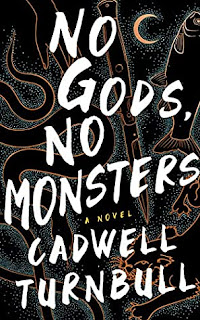
NO GODS, NO MONSTERS, first in a series, author's second novel, lauded and loved and awarded
NO GODS, NO MONSTERS
CADWELL TURNBULL (Convergence Saga #1)
Blackstone Publishing (non-affiliate Amazon link)
$4.99 Kindle edition, avaiable now
Nominated for the BEST NOVEL AWARD—2021 SHIRLEY JACKSON AWARDS!
Rating: 4* of five, all for the slow-burn realization of the identity of the true main character
FINALIST FOR THE 2022 LOCUS AWARD—BEST FANTASY NOVEL! Winners announced 25 June 2022.
WINNER OF THE 34th Lambda Literary Award—BEST LGBTQ SPECULATIVE FICTION!
A NEW YORK PUBLIC LIBRARY 2021 BEST BOOK FOR ADULTS RECOMMENDATION!
The Publisher Says: One October morning, Laina gets the news that her brother was shot and killed by Boston cops. But what looks like a case of police brutality soon reveals something much stranger. Monsters are real. And they want everyone to know it.
As creatures from myth and legend come out of the shadows, seeking safety through visibility, their emergence sets off a chain of seemingly unrelated events. Members of a local werewolf pack are threatened into silence. A professor follows a missing friend’s trail of bread crumbs to a mysterious secret society. And a young boy with unique abilities seeks refuge in a pro-monster organization with secrets of its own. Meanwhile, more people start disappearing, suicides and hate crimes increase, and protests erupt globally, both for and against the monsters.
At the center is a mystery no one thinks to ask: Why now? What has frightened the monsters out of the dark?
The world will soon find out.
I GOT THIS BOOK FREE WITH KINDLE CREDITS. SHOP OFTEN! THE REWARDS ARE REAL. (/irony)
My Review: I think the worst part of reading this book was realizing that the monsters, the not-villainous villains of the piece, are me, my friends, my lover, all of us Othered by...so many factors.
“I’m sorry to do it this way, but I had to be safe,” Melku explains. “I won’t waste any more time. Our collective’s mission is to support the solidarity movement. Often, that has meant supporting marginalized peoples. Some of you are part of the queer and trans community, like me. Many of the most valuable monsters are also a part of these communities, which is why redefining to include them is so important. In that spirit, I think we should extend our support to monsters since it is likely that they’re already in the movement but have chosen to remain silent.”
A political meeting of anarchists in a collective...votes to include literal monsters...the kind that actually DO eat people...in its aims. This book...its imagination shames me.
I've never, ever once thought, "well, civil rights for werewolves should absolutely be guaranteed."
What is left for me to learn over the remainder of my life never, ever stops expanding. ...Yay...? And before anyone says it, no there are not actually werewolves or any other creatures we call monsters, but there are a LOT of humans I'd unhesitatingly call monsters all over the country where I live. All over the only planet we know of that has life on it. So there's clearly no god, either, because if so they're either weak or malevolent since they can't or won't fix things they broke. The book's title, then, snaps into focus: "NO GODS, NO MASTERS," the anarchist chant goes; now that "monsters" are real and have come out of their socially imposed hiding, it needs refreshing: "NO GODS, NO MONSTERS," or a simple acknowledgment that we are all on this lifeboat in the middle of a deadly environment and had all better get busy saving owrselves and each other from paying the ultimate price. No one above means no one below. And that, somehow, is terrible, bad, threatening...why, exactly? Because monsters are Evil? Because, if no one is In Control, things will be...worse? ("For whom" is left unstated. Obviously things will be worse for the ones who benefit from the way they are now.)
But the truth is, it never turns out that way. Marriage equality didn't turn Society into limp-wristed men in feather boas, or women in plaid shirts and bad haircuts. It resulted in a revolting boom in the wedding industrial complex. A lot of bigots making noise about being asked to bake cakes for people they didn't like much. COVID kills us all (in the USA, a million in two years which is more than the 698,000-plus AIDS has killed in 42), and capitalism couldn't care less about who's zoomin' who as long as the survivors consume consume consume.
The principal problem for me is the story's diffusion of narrative drive among so many characters. I do understand this fits the anarchist genesis of the story. But it plays into a problem that trumps political concerns: How am I supposed to sustain momentum in the read? I was able to make my way through the book but it took me longer than it usually does to finish it...almost a month. For fewer than three hundred pages.
I overcame that issue by remembering this phrase that I've entered into my commonplace book:
As he walks with the crowd, he understands what he had forgotten: that a march is not just a voice against violence and trauma, but also a reminder that even in a cause that is stacked against them, no one is alone.
Remember the Tiananmen Tank Guy? He is the reason governments work so hard to suppress free media; he is the reason many of us bother to protest in whatever ways we can. He stood alone, but crowds of protestors aren't when he appears in our minds' eyes. This is also why crowds become mobs, and why protest is something that deeply disturbs the Powers That Be.
When cops kill innocent people nowadays, we as a society are almost sure there will be protests. But now there is a complicating factor of monsters, creatures we're afraid of and whose means of making a living is violent by their very nature; they are, by the definitions we've all come to understand and possibly even accept, but certainly internalize, unnatural:
Near Ridley, a man yells, “No Gods.”
“No monsters,” the crowd chants back.
The chant is an evolution of an anarchist slogan: “No Gods, No Masters,” the original version meaning no human above. It is a call against hierarchy. Ridley assumes the variation means no human above, no human below, or something like it. A call against hierarchy and discrimination.
Simon-pure anarchist speak. Like being in a steering committee meeting for any politics at the local level organization. It is, in other words, bedrock truth that this story rests on. It is this meticulous inclusiveness by dint of hard-fought local battles that gives me little moments of happy recognition and pleasurable fellow feeling, of not being alone as I face a hostile-to-me world.
Go with Author Turnbull on the hunt for the truth of Power through these many points of view. Power resisted, power obtained, power flouted and abused...there is all the power any one being or group can ever use in the simplest truth of them all: Mystery exerts power in ways nothing else can hope to equal, still less surpass.
Thursday, February 10, 2022
JAWBONE, making deities out of desperation in MeanGirlLand
JAWBONE
MÓNICA OJEDA (tr. Sarah Booker)
Coffee House Press
$16.95 trade paper, available now
Long-listed for the 2022 National Book Award for Literature in Translation!
Rating: 4.75* of five
The Publisher Says: Fernanda and Annelise are so close they are practically sisters: a double image, inseparable. So how does Fernanda end up bound on the floor of a deserted cabin, held hostage by one of her teachers and estranged from Annelise?
When Fernanda, Annelise, and their friends from the Delta Bilingual Academy convene after school, Annelise leads them in thrilling but increasingly dangerous rituals to a rhinestoned, Dior-scented, drag-queen god of her own invention. Even more perilous is the secret Annelise and Fernanda share, rooted in a dare in which violence meets love. Meanwhile, their literature teacher Miss Clara, who is obsessed with imitating her dead mother, struggles to preserve her deteriorating sanity. Each day she edges nearer to a total break with reality.
Interweaving pop culture references and horror concepts drawn from from Herman Melville, H. P. Lovecraft, and anonymous “creepypastas,” Jawbone is an ominous, multivocal novel that explores the terror inherent in the pure potentiality of adolescence and the fine line between desire and fear.
I RECEIVED A DRC FROM THE PUBLISHER VIA EDELWEISS+. THANK YOU.
My Review: White. Menacing, toothy, bony white. You'll need to recalibrate your horror-meter away from the endless dark.
I think many people are a little skittish about reading books that have truly, deeply dysfunctional women and girls as the predators as well as prey in a "human is wolf to human" tale. It seems to skeeve the Sanctity of Motherhood crowd the most, which is predictable and unsurprising. What it isn't is realistic. The three characters in this English-language debut horror/psychological thriller-adjacent story are actors in psychodramas they both inherited and participated in perpetuating...they are not, not one of them, victims.
I'd give Author Ojeda a gold medal for that, if I had one. I am mortally sick of sending women and girls the unending message that if uterus, then victim is a) immutable fact 2) a good dodge to avoid personal responsibility and accountability and iii) a necessary precondition to discovering one's agency. Anna/Annelise is, plain and simple, a stunningly effective manipulator. She is absolutely in control of her fate. She orchestrates everything around her to suit a narrative she builds, changes, improves to get more of the oxygen she craves: Attention. Fernanda, oh the poor thing I can hear readers thinking, is totally tuned in to her needs: she seeks extremes, she wants to defy and thus define her limits. And when we meet her, she is at last smashed against the hard limit of being immobilized. Fernanda, deeply and darkly aware of her young body's power to seduce, reward, pleasure her victims in motion and action, is never more completely the center of her captor's world than when she is rendered incapable of movement.
But Miss Clara, the nominal adult whose tenuous leash on her id has snapped, the possessor of power over her students as their guardian and cicerone, is utterly unable to exercise even a shadow of that power because she is so cracked and broken by her past. Her charges, like those things that prosecutors level at malefactors, like those vessels of energy that impart their essential power to a needy receptacle for it, are charged with the true nature of the quest in this polyphonic Passion Play: Boundaries.
Miss Clara has immobilized Fernanda to remove her from the harm she causes and is caused by Anna. In so doing, she creates the most brazen crucible for Horror among the "innocent" I've read in a solid decade or more. I've read that other reviewers, as well as some critics, conjure the shade of H.P. Lovecraft in describing the affect of this story. There is an element of the eldritch horror miasma inherent in any book entitled Jawbone wherein that word is used without distancing irony. But I myownself think this is horror of the Our Lady of the Flowers ilk, of the Juliette, or Vice Amply Rewarded strain. The events herein aren't of the explicit-conduct variety. They are sexual, these women, and they are absolutely sure that sexual is what they mean their acts to be, thus Genet; they are psychologically subtle, they are seeking and thirsting for subtler refreshment than just vaginal wetness, thus de Sade.
It is anxiety-crippled Miss Clara's terrible, terrible luck to meet privileged perverted Annelise. The young mistress of domination's most brilliantly subtle expression, the psychic force of the story on the unbalanced, determines to make of her youth a supreme weapon, the myth of purity. The White God she invents and that god's immediate claim on the unwavering attention of all with whom Annelise shares the words, is so carefully inflected that Miss Clara does not see but feels with blinding intensity the repeated reiterated regurgitated violations that broke her to begin with, that made with White no purity but putridity. No nobility and cleanliness and finality of bone. There is only the powder of mold as it rots flesh in wetness. There is the liminal space of menstrual cloth not yet used as a blood-dam. Annelise conjures the cruel capable whiteness of teeth, hardest objects in a body, necessary to rip and mangle the very stuff Humanity must have or simply lose all power and cease. Die. Though perhaps not entirely, if there is will and enough lust to use it.
As an act of Literature, translation is alchemical. Take this gleaming, golden thing, this extant object of crafted and intended meaning, and use the solvents and reagents of a different meaning-regime to produce gold. Again. In Jawbone, Translator Booker explains her kerotakis and its subtle distillates in a note before one reads the novel. I understand that impulse to assist the mainly monoglot US audience. It feels to me, at least, more like a way to emulate Annelise: I will take all the pain, hurt me and make me bleed, that I may give your dark input of uninterest or unwillingness to work for this experience of distillation into a finer, lighter, more potent Enlightenment its ashes and sands, its heats from sources not like the results. Not for this translator the mere bain-marie. Its coddling of like fluids to make of one the best and most palatable form it can take is too bland for this alchemy of hers. No custard of double-boiled entertainment comes from here. It is the hottest ash, the slowest heat exchange of crater-hot sand that takes the already intoxicating vodka into Everclear, into its superlative...but brutally unforgiving of misuse...form.
It is a high-wire act, as I would guess translating Joyce's Ulysses into hieroglyphics would be. Surviving tweaks to reality like multi-hyphenated English terms, which would make a Spanish-speaking ear and eye agog with Otherness, aren't readily apparently Othered. I fully understand and support the editorial decision not to use italics to indicate foreignness. For Spanish. But permaybehaps some of these oddities could be italicized for the Othering of English as it would be in an Ecuadorian ear? As it is, they just stub my reader's toe on their odd height and unyielding hardness.
It can feel, in the course of the read, humid to be in the abandoned spaces and the wildlands. I mean this in a visceral way. The reading of the games that Fernanda enacts, at huge, huge existential risk to Annelise, calls forth actual sweat from my reader's brow. In the stories, the words spun to whip the parties to Dionysian ecstasy and Pan-ic from the god itself work. That is not always to the benefit of Author Ojeda's actual novel. Overall, minding my place as bystander and accomplice but not perpetrator, I can't give the entire reading experience a perfect score because of those very few points where The Story showed herself from behind the obscuring mask.
Make no mistake, though, this is Literature and big, big fun entertainment caught in the slick, wet act of making passion real. Read it without your lady-gloves on. Read it with your speed turned lower than usual but used longer. Read it while you're avoiding something Social, some obligation that couldn't be said no to.
But read it now.
Friday, October 8, 2021
THE CITY BEAUTIFUL, atmospheric horror-adjacent QUILTBAG fiction aimed at older teens
THE CITY BEAUTIFUL
ADEN POLYDOROS
Inkyard Press (non-affiliate Amazon link)
$9.99 ebook editions, available now
FINALIST FOR THE 34th Lambda Literary Award—BEST LGBTQ YA FICTION! Winners announced 11 June 2022.
A BEST BOOKS OF 2021 – YOUNG ADULT SELECTION FROM BOOKPAGE!
Rating: 4.5* of five
The Publisher Says: Chicago, 1893. For Alter Rosen, this is the land of opportunity, and he dreams of the day he’ll have enough money to bring his mother and sisters to America, freeing them from the oppression they face in his native Romania.
But when Alter’s best friend, Yakov, becomes the latest victim in a long line of murdered Jewish boys, his dream begins to slip away. While the rest of the city is busy celebrating the World’s Fair, Alter is now living a nightmare: possessed by Yakov’s dybbuk, he is plunged into a world of corruption and deceit, and thrown back into the arms of a dangerous boy from his past. A boy who means more to Alter than anyone knows.
Now, with only days to spare until the dybbuk takes over Alter’s body completely, the two boys must race to track down the killer—before the killer claims them next.
Death lurks around every corner in this unforgettable Jewish historical fantasy about a city, a boy, and the shadows of the past that bind them both together.
I RECEIVED A DRC FROM THE PUBLISHER VIA NETGALLEY. THANK YOU.
My Review: I think there's nothing more delightful to me than queer representation in historical fiction. We were there, too, and deserve to be written into the zeitgeist.
This is Young Adult queer representation in the 19th century, and in my ongoing quest not to die above the neck before I do below it, I got the DRC. I'm really very glad that I did...this read was a great pleasure to me. The use of Jewish folk cultural touchstones...matchmakers, dybbuks being the most horrifying...the sprinkings of Yiddish, the focus...fierce focus...on family and loyalty, were all tastes of delight for this reader. The author doesn't spend inordinate time explaining things but he does provide context and some factual stuff for the more, um, ethnocentric stuff.
It is a sheer joy to see the story being set away from a) World War II, b) New York's Lower East Side, or c) the shtetl somewhere in Eastern Europe. The Jewish population of Chicago has never been teensy...the Great Lakes ports were as much a destination as New York, but they get less play. I'm also, since I read The Devil in the White City and read The Man Who Made Parks: The Story of Parkbuilder Frederick Law Olmsted by Frieda Wishinsky to my oldest grandson, a big aficionado of the 1893 World's Columbian Exhibition (aka "the White City") in Chicago. That venue plays quite a role in this murder mystery, though exactly how and why shall remain a secret lest I be set upon by spoilerphobes next time I go grocery shopping.
What I will say is that the squeamish should not pick the book up. There are graphic moments of bloodyness, there are awful physical violences, and of course the element of supernatural possession can't be left out. There are more 21st-century concerns like homophobia and anti-semitism (this last pervades the end of the book to a sometimes uncomfortable degree), but this is Spooktober! A few scares, some terrible spooky goins-on, that is what this month is for! Be prepared, also, for the politics of the book. It's solidly anti-capitalist, despite MC Alter's determination to earn earn earn so he can bring his mother and sisters to the Promised Land...Chicago! imagine...because that's really situational not aspirational capitalism. And Alter's failed match-cum-bestie, young Raizel from downstairs in his apartment building, is there to keep him from falling *too* deep into capitalism's cess pit. (She is, in fact, one of the book's most delightful characters, propensity to splash tea onto laps notwithstanding.)
Putting on my YA-unlover's hat, the usual prolixity...why say in ten words what can make an entire chapter?...is fully present, the stakes are APOCALYPTIC ZOMG THE UNIVERSE WILL END!! and that gets really tiring to an old fart like me who knows that, after I and you and the author are all dead the planet will keep spinning on. Probably all the better for our absence.
But that is an elderly person speaking, the audience that's here for YA is going to *eat*this*up* because every one of the elements are handled with aplomb and without the edge of tweeness I've reacted to in other YA books like they're coated in cat dander. I don't at all recommend giving this to a fourteen- or fifteen-year-old. The realities of sexual abuse aren't in any way soft-pedaled. The realities of sexual desire, that it doesn't obey rules or orders, are best left to the older end of the YA spectrum, which I think of as sixteen and up. I know y'all know y'all's kids better than I do, so understand I'm speaking in generalities and not prescribing anything.
The mystery aspect of the story, the resolution to the murders and disappearances of Jewish boys, is very well-handled and was solidly made in serious mystery form. If you're up for it, match wits with the author; if you're not, read the spooky book or the coming-out (sort of!) book or the immigrant-makes-it book. They're all here.
I think my point should be clear: Read The City Beautiful. It will please at least 80% of the folks who read my reviews.
Sunday, June 20, 2021
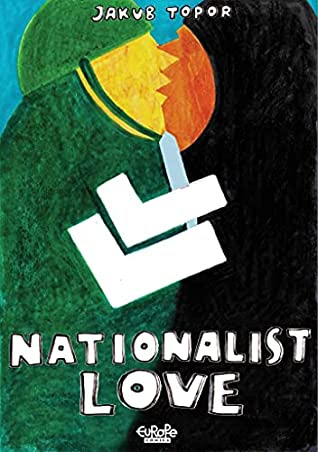
NATIONALIST LOVE, a Polish graphic novel about QUILTBAG people...just not the ones you're thinking of
NATIONALIST LOVE
JAKUB TOPOR
Europe Comics (non-affiliate Amazon link)
$11.99 ebook editions, available now
Rating: 5* of five
The Publisher Says: When Zapsky and Byro meet during a right-wing nationalist march, their joint escape from the police results in an unexpected and violent outburst of passion. Their initial euphoria quickly turns into doubt and fear—after all, if their buddies found out about them, the consequences would be terrible... But now that they’ve come together, will they be able to simply forget and move on with their lives? Or is it something more lasting, despite the risk it represents for both?
"Nationalist Love" is the third graphic novel by Jakub Topor, nominated for the graphic novel of the year award at the Lodz Comics Festival.
I RECEIVED A DRC FROM THE PUBLISHER VIA NETGALLEY. THANK YOU.
My Review: Two skinhead boys, Zapsky and Byro, meet at a hate-rally held in their Polish city. The Nationalists, our Proud Boys writ Euro, throw stuff and set fires and hurt cops. These are some revolting people. They're each stupider than the other, they got no class or brains, yet still they find each other...attractive? available? attainable maybe. Their stupid antics require them to hide from the cops...naturally they decide to do it together, since Zapsky's mother is away for a month. Hijinks ensue.
This isn't the first time I've seen these boys, just never so thoroughly reduced to their ugliest shapes and colors. As a not-especially-convinced experiencer of sequential art, this was always something I found irritating...this kind of "artwork" would get the horselaugh from so many artsy types I've known. I'd absorbed that prejudice and simply never bothered to challenge or examine it until the past few years. Now, I look at this art's clumsiness and its garishness and think...well, how better to narrate this story?
Whaddaya expect, anyway, in a world centered on two losers without a shred of class or decency between them? They are always gonna have to hide abnormal, sick sexual proclivities from the world their undereducated, credulous, angry, and powerless class lives in. Funnily enough, like so many who live in that hate-defined and -bounded world, it's also the one they resent. But Zapsky and Byro got lucky, found each other....found love...which is the most dangerous thing of all. Zapsky definitely feels this, after a brief and deeply unsettling period of being truly happy with Byro, and under pressure to prove he's not a fag to his co-workers, he sends a break-up text that callously dismisses Byro.
Zapsky's Mammele, escaping her loser son's ubiquity and her own pointless existence, is at a beach resort-cum-health spa. And guess what? She meets A Man too! (Called Manfred. No lie.) The sheer awfulness of the art, as in the ugliness of the people and the garishness of the colors, goes so well with this horrible tale of numerous disgusting creeps that it's almost eerie. And that's when I felt myself really giving up, shedding the weight of, that habit of contempt. It isn't pretty! But who said art needs to be pretty? I like Jackson Pollock and Agnes Martin, for gods' sweet sake. I'm not one of those Impressionism-über-Alles sofa-matching-art people!
Or maybe I am...and hide it from myself by liking things that made my mother cringe? That certainly includes comic books...I've been so snobby about them for so long that it feels fake to say, "there is no other way this story could've been told, and it very much needed to be told," but it's just the truth.
Chapter 3 is called "Spoiled Rich Kids"...seems to be a pattern among Polish émigré writers. Like Jedrowski in Swimming in the Dark, Topor gets a character (Byro Bad-skin here) among the wealthy who are privileged to consume and exist as they like. Then he lets him sink or swim...sink in this case. Byro's rebounding from his breakup text, and searches the Internet for gay clubs...he decides he's going to fix himself up, be less Nationalist looking, by dressing better and hiding his skinhead under his loser father's long-unused toupée. The club scene scares him, he doesn't know the culture and is about to get himself into serious trouble but is rescued by one of the rich kids. They decide to keep him when leaving the club becomes a good idea...he almost loses his cool when a "darkie" (an Arab guy called Jamal) is in the house party, too. He's eventually, and inevitably, outed as a Nationalist; but not until after kissing a straight guy at the party. The violence the posers inflict on Byro is pretty mild...more about humiliating him for not being like them. And that, despite the fact he doesn't *want* to be like them, is the worst rejection he suffers. (Not that he is recovered from being rejected by Zapsky, please understand. Just trying to figure out how to move on.)
Mammele gets lucky with Manfred. That scene's just grisly. Even Byro's parents decide to fool around (more grisly still). Byro's Dadzio figures out the kid's got his wig. That should be fun! I thought, watching him explain what the hell he was doing with the damn thing....
Chapter 4 is "Zapsky Looks for a Girlfriend"...the co-workers' plan to get Zapsky laid results in him finding one. Because he's never been in any relationship at all except the brief honeymoon with Byro, he ignores the red flags of an abusive, angry, selfish woman looking for something in exchange for the sex she doles out to him. In his months-long journey through this hell, Zapsky confronts low self-esteem, and his work pals do a lot to support him and care for him. They are crude but actually touchingly kind. Since we focus on Zapsky, we never learn anything more about what happened after Byro's night out...disappointingly...or about Mammele's reactions to the girl Zapsky gets with.
But long story short: Girl gets dumped. Zapsky gets lonely. One rainy day who does he see under a bus shelter but...BYRO!! It's a loving reunion, the bond of real love between them reasserts itself, and they, well, do what young guys do when under the heady influence of reciprocal attraction and genuine connection. They fool around.
...and there's a PoS from their earlier Nationalist lives filming their reunion.
Naturally, the evidence gets shown to the wrong people. All the old gang, I mean this literally, are on the hunt for Zapsky. They find him.
Things end as they so often do.
It's awful to know that this happens and happens and happens to men and women, cis and trans, all around the world because "don't be so sensitive" and "it's just a joke" aren't seen for what they are.
They are normalizations of hate, and soft volleys preparing the way for violence.
I downloaded this graphic novel from Europe Comics, an outfit with whom I am unfamiliar...how shocking...so, if you're in the same boat, here's their mission statement from NetGalley:
Europe Comics is a joint digital initiative run by 13 European comics industry players from 8 European countries. Its main purpose is the creation of a pan-European catalog of award-winning graphic novels from across the continent, published digitally in English and available through major retailers and library networks. Europe Comics also works towards the promotion of European authors and the creation of a European comics online directory, meant for both comics readers and professionals.
Well...so this Polish creator found his way to this American oldster via a social system intermediated by several levels of technology that are under a lot of pressure all the time to justify its worst users' behaviors. This is an example of positive social and personal results from being massively online. Say hallelujah and bring the jubilee.
Labels:
#LoveIsLove,
#PrideMonth,
5-star review,
anti-semitism,
comiXology,
Europe Comics,
fag-bashing,
gay horror,
graphic novel,
hate crime,
Jakub Topor,
Polish gay life,
prejudice,
QUILTBAG,
violence
Tuesday, October 27, 2020
DEOSIL, eleventh and final (sob) Whyborne & Griffin tale
DEOSIL
JORDAN L. HAWK (Whyborne & Griffin #11)
Kindle edition
$4.99, available now
Rating: 5* of five
The Publisher Says: Whyborne, Griffin, and their friends have faced down cultists, monsters, and sorcerers. But their greatest challenge is now upon them.
On the return voyage from Balefire Manor, Whyborne receives the worst news possible: Widdershins has fallen before the onslaught of the Fideles and their servants. There’s still time to stop the return of the Masters, but that window grows shorter by the hour.
Together with Christine and Iskander, Whyborne and Griffin must reach Widdershins to face the ultimate test—and decide the fate of the world, once and for all.
EVER FEEL LIKE THE WORLD'S ABOUT TO END? READ ALL ABOUT THE PEOPLE WHO *DO*SOMETHING*TO*STOP*IT* THEN GO OUT AND VOTE.
My Review: Seriously. These are people, straight and QUILTBAG alike, who know that surrendering agency in the face of overwhelming odds against your success in resisting Evil's conquest of the world is not going succeed. Maybe resisting isn't either. But it's absolutely positive that doing nothing will result in Evil winning. So they rile up every-damn-body they can find:
“I never asked for a cult of book-wielding librarians!” I exclaimed.
Whyborne, our lanky and gauche and lovably goofy savior-figure, can't see what possible use a pack of book-lovers like himself can do when the Apocalypse impends. And you know what? Their part is crucial, their role central, and the way forward wouldn't have been found without them.
Get up off your chair and go vote. Or drive housebound folks to the polls. Or call your lazy friends and go pick them up. Something.
This book will make no sense whatsoever to you if you haven't read the previous ten. If you have, you've probably already read it; if you haven't, start with Widdershins, and if you're hooked you'll keep buying until you get to this one.
I love series reads. I am a fan of the familiar, homely comforts of visiting old friends in their digs, and that's a lot of the appeal of series reads. It's also true that some series continue long past the point they have something new to say. Author Hawk decided that a good series needs an ending commensurate with its prior purpose. This book provides that ending.
And for a few bad minutes, I thought I was gonna have to call on the maelstrom to blight the author's homeplace with super-rust.
Patience and a furious refusal to believe I'd been had led me to finish the book before firing up the Lapidem. I was not disappointed. I was, in fact, quite pleased with the resolution and the ending, which are quite different things. Things end the way they quite simply had to end.
Widdershins, after all, knows its own.
Monday, October 26, 2020
BALEFIRE, tenth Whyborne & Griffin Lovecraftian nightmare-fodder monsterfest! Only fun!
BALEFIRE
JORDAN L. HAWK (Whyborne & Griffin #10)
Kindle edition
$4.99, available now
Rating: 4.75* of five
The Publisher Says: Whyborne’s Endicott relatives have returned to collect on the promise he made to help them take back their ancestral manor from an evil cult. In exchange, they’ll give him the key to deciphering the Wisborg Codex, which Whyborne needs to learn how to stop the masters.
To that end, Whyborne, his husband Griffin, and their friends Iskander and Christine travel to a small island off the coast of Cornwall. But when they arrive at Balefire Manor, Whyborne must not only face the evil within the ancient mansion, but the painful truth about his own destiny.
DON'T TAKE THE WORLD BACK TO A TIME WHEN MEN AND WOMEN HAD TO HIDE THEIR LOVE. KEEP THE MONSTERS FICTIONAL FROM NOW ON.
My Review: That, my chick-a-biddies, was a hellacious ride! More after I have knit the ravel'd sleave of care with some z's.
The next-to-last entry in this long-running series. The idea makes me a bit sad, but really when I think about it, this is a great time to go out: The ultimate threat to the humanity of Terra is about to rip its way through the veil of ignorance that traps us cattle in this vale of tears and kick-ass.
Not if Dr. Percival Endicott Whyborne, tall geeky sorcerer, and his dearly belovèd husband the ex-Pinkerton Griffin Flaherty, have a tiny tiny thread of the hope of a chance, they aren't.
This is something I treasure about reading these books: The superhero who's saving the world for the Great Unwashed is a gay goofus with the social skills of a teenager and no reason whatsoever to do the job he's doing. The world of Widdershins, Gilded Age America, hates fags. He's never been anything resembling straight. And *still* he saves the world the ungrateful jackasses infest with their seething rage at his audacity to claim love and happiness with another wounded survivor of straight people's hate.
You can have all those lushly muscled Captain What's-its and bounteously bosomed -womans and -girls. I'll take lanky, cranky, and awkward Whyborne every damn time. It matters to see yourself, the best part of yourself hopefully but yourself, in the tropes that dominate the age you live in. I myownself glory in this:
The creature was a blot on the world, a living darkness spreading corruption to everything it touched. Where {Whyborne} burned with pure, cleansing fire, it smeared a layer of sooty foulness across the very fabric of reality. It was every shape and none, a heaving, churning distortion that gave my shadowsight nothing to rest upon.
When Whyborne is done making the world safe for the people who want to make his world unsafe, he goes to his beloved Griffin (who is speaking in the above quote) for comfort and joy. And yes, that means sex. Usually two or three steamy scenes. I feel like y'all heterosexuals should be made to read some of our sex scenes since yours are flippin' EVERYWHERE and y'all think (often out loud) that we should just belt the eff up and watch/read/encounter them because they're normal.
Common, perhaps; not normal. Normal is an individual calibration to the world.
If this book held a disappointment for me, it was the one-and-only intimate scene between Whyborne and Griffin. I get it; this is a hectic book with multiple battles being fought; but damn. One little bitty round of easy-to-clean spoodging smacks of adolescent exploration, not two men in their 30s expressing their established and ongoing desire for each other.
And then I remember the stakes looming over the men....
Yeah, pretty much the only thing you could squeeze in, eh what, Author Hawk? Book 11 can't come soon enough and I don't ever want to see it because it's the last and how dare you not keep writing these delicious stories and yeah, it's time to let these poor bastards rest.
No, I'm not conflicted at all. Why do you ask?
Sunday, October 25, 2020
FALLOW, eighth Whyborne & Griffin tale from Widdershins, Massachusetts (near Innsmouth and Arkham)
FALLOW
JORDAN L. HAWK (Whyborne & Griffin #8)
Kindle edition
$4.99, available now
Rating: 4.5* of five
The Publisher Says: When Griffin’s past collides with his present, will it cost the lives of everyone he loves?
Between the threat of a world-ending invasion from the Outside and unwelcome revelations about his own nature, Percival Endicott Whyborne is under a great deal of strain. His husband, Griffin Flaherty, wants to help—but how can he, when Whyborne won’t tell him what’s wrong?
When a man from Griffin’s past murders a sorcerer, the situation grows even more dire. Once a simple farmer from Griffin’s hometown of Fallow, the assassin now bears a terrifying magical corruption, one whose nature even Whyborne can’t explain.
To keep Griffin’s estranged mother safe, they must travel to a dying town in Kansas. But as drought withers the crops of Fallow, a sinister cult sinks its roots deep into the arid soil. And if the cult’s foul harvest isn’t stopped in time, Fallow will be only the first city to fall.
Fallow is the eighth book in the Whyborne & Griffin series, where magic, mystery, and m/m romance collide with Victorian era America.
SINCE WE'RE AMID THE FORMATION OF A NEW, DOUBLE-LOVECRAFTIAN GILDED AGE...WHY NOT SEE WHAT HAPPENED THEN?
My Review: The half star off is for the slithering jim-jams the Big Baddie in this one has given me. I am not sleeping for the foreseeable future. *convulsive shudder*
***next day***
As predicted, sleep was elusive after reading this frightfest. I haven't had that response to any other book in the series but this one Did Me In. The name, "the rust," gave me all the horror-movie shudders I could ever (not) want.
Excuse me I need to bleach my every body part and scrub my innards with Lysol.
The main thrust of this story is betrayal. The awfulness of experiencing betrayal is, by definition, that it's only one's intimates that can perpetrate it. Author Hawk was so deft in portraying the double-edged sword of betrayal in each leg of the multiple relationships that underwent it that I can only applaud. All of the betrayals were very real, as in understandable and organic to the relationships involved. No overwrought "because I am eeeeeeviiiiiillllll" emotionality; instead the betrayals (very much in the plural) are simply fallible humans failing to reach for love when confronted by conundrums in coping with unmet expectations.
This is a phenomenon that all of us experience at some level, at some time; but gay people are a lot more likely than most US citizens to experience it, and more likely to have it come from within their families of origin; make no mistake, though, the betrayal also comes from Government and the social safety net bureaucracies as enabled by the filth and scum appointed by 45. In Griffin's uniquel awful case, he's experiencing the double betrayal of an adoptive family's rejection. It makes me want to unswallow when I think of the US Administration unleashing this life-defining, spirit-crushing betrayal on innocent children in 2020.
Along with the Big Baddie *wracking shudder* we're treated to Whyborne's meditations on Widdershins' magical vortex and its role in his life. We're given a short burst of Persephone Whyborne. We're teased with an oncoming apocalyptic confrontation. We're left to ponder the role of pragmatism in Whyborne and Griffin's mutual fate as allies become scarce. In short, book 8 is one helluva ride and I had a damn good time ripping through it.
Except for "the rust" *nauseated convulsive shudder* that is.
Saturday, December 15, 2018
DRAAKENWOOD, Whyborne & Griffin series doesn't sag at #9
DRAAKENWOOD
JORDAN L. HAWK (Whyborne & Griffin #9)
Kindle edition (non-affiliate Amazon link)
$4.99 ebook, available now
Rating: 4.9* of five
The Publisher Says: Someone is killing members of the old families…and the evidence points to Whyborne.
Widdershins has been unusually quiet for months. But now a mysterious creature from the Outside is on the loose, assassinating members of the town’s old families by draining their blood. Whyborne and Griffin set out to solve the mystery—but as the evidence piles up, the police begin to suspect Whyborne himself is the murderer.
Now Whyborne must both clear his name and stop the horrors the monster threatens to unleash. His only hope: an alliance with his old enemies the Endicotts.
Because something terrible lurks in the Draakenwood, and it will stop at nothing to seize control of the maelstrom itself.
Draakenwood is the ninth book in the Whyborne & Griffin series, where magic, mystery, and m/m romance collide with Victorian era America.
I purchased this book with my very own United States dollars...
... the same year that I realized I was losing out on DRCs because publishers realized I'd review books I bought for myself. Hence never having reviewed it before.
Oh myyy, as Takei would say. There's more than I expected in this ninth entry in the ongoing series. The ongoing plots never plod, but here they go from brisk trot to gallop both on the personal and overarching stakes fronts. Let me assure you that there is nothing series-drooping in this outing. I do most especially love the anachronistic way these men refer to their other halfs as "husbands"!
I was surprised and pleased that Whyborne's sister Persephone met her match. (Knock next time, you oaf!) I was also pleased that Whyborne Senior made such huge strides in his unwilling quest to become a decent human being. Streets to go, mind, but the growth curve is impressive. I like that redemption is still possible for even the worst of people in Author Hawk's world.
Speaking of worlds...Griffin continues to make Whyborne's miserable, first with that infernal rackety Oldsmobile, and this book with the ghastly newfangled telephone. Poor Whyborne, a fuddy-duddy at heart, is yoked by all-conquering love to a gadget-mad technophile. What's a man who is every inch a librarian in his soul to do?
Well, fight more evil, of course; the stakes are still there, the Endicotts have living relatives, Nyarlathotep isn't decisively defeated yet. Those hounds...!! And capable henches continue to abound. Christine, the ever-waspish, always faithful BFF, her husband Iskander (who is never that much limned, of course) and now Whyborne's librarian secretary Miss Parkhurst is in the family in every way. Really, isn't this the reason one reads series books? The stories are like our extended friend groups only easier to keep track of because they're in finished story arcs. Or about-to-be-finished story arcs...thinking of the Ketoi as truly underexplored arc-havers.
But here's the deal: The arcs all end. I wager that, if you start here (don't!), you'll feel the unnerved certainty that you've stumbled into a nest of nutjobs. Go back to #1, Widdershins, to get the place in the Cthuluverse and the dramatis personae straight. (So to speak.) I recommend them all, in order. Apart from my cavils over a certain inevitable monster-of-the-weekness and the double PoV in this story (out of keeping, not smoothly integrated), this story earns my smiling, loving approval.
Thursday, June 20, 2013
AMERICAN HONOR KILLINGS, revolting crimes committed by disgusting people
AMERICAN HONOR KILLINGS: Desire and Rage Among Men
DAVID McCONNELL
Akashic Books
$15.95 all editions, available now
Rating: 5* of five
The Publisher Says: In American Honor Killings, straight and gay guys cross paths, and the result is murder. But what really happened? What role did hatred play? What were the men involved really like, and what was going on between them when the murder occurred? American Honor Killings explores the truth behind squeamish reporting and uninformed political rants of the far right or fringe left. David McConnell, a New York-based novelist, researched cases from small-town Alabama to San Quentin's death row. The book recounts some of the most notorious crimes of our era.
Beginning in 1999 and lasting until the 2011 conviction of a youth in Queens, New York, the book shows how some murderers think they're cleaning up society. Surprisingly, other killings feel almost preordained, not a matter of the victim's personality or actions so much as a twisted display of a young man's will to compete or dominate. We want to think these stories involve simple sexual conflict, either the killer's internal struggle over his own identity or a fatally miscalculated proposition. They're almost never that simple.
Together, the cases form a secret American history of rage and desire. McConnell cuts through cant and political special pleading to turn these cases into enduring literature. In each story, victims, murderers, friends, and relatives come breathtakingly alive. The result is more soulful, more sensitive, more artful than the sort of "true crime” writing the book was modeled on. A wealth of new detail has been woven into old cases, while new cases are plumbed for the first time. The resulting stories play out exactly as they happened, an inexorable sequence of events—grisly, touching, disturbing, sometimes even with moments of levity.
I RECEIVED AN ARC FROM AKASHIC BOOKS. THANK YOU.
My Review: It is no secret that I'm a leftist, anti-religion queer. I loathe the existence of the systems of "Rightness" that the murderers in these crimes use to justify their actions. The mere ability of a person to point to a bible and have any segment of society secretly or not-so-secretly justify or even agree with the heinous crime of murder is shameful to us as a society.
That said, it's still true. These accounts of the motives and actions of some seriously mentally ill young men, certain that they are Right and they are Correct in the actions, are enlightening and chilling. The cases are appalling...Scott Amedure was shotgunned by a man he confessed to having a crush on on national TV, and his killer is now walking free after serving twenty years...the legal teams for the prosecution of the hate criminals are hampered by public sympathy for the killers, and the culture changes so so slowly....
I spent most of the time I read this book alternating between scaring my dog with loud, rasping screeches of outraged indignation that such stupidity is allowed to exist by this gawd person most of these boys, their families, and their communities profess belief in, and miserable, hopeless weeping of sympathetic pain at the agonies of loss, grief, and longing that the families, the parents, the loving friends of the murdered men will spend the rest of their lives experiencing, because the so-called "Holy Bible," actually full of holey babble, and its hellspawn idiot-friendly "christian values culture" don't like the idea of men having sex with each other.
Who cares what you think? Did someone ask you? Drag your mind out of the prurient gutter of thinking about what other people do in their bedrooms. It's often this fear of People Knowing that motivates a hate criminal to kill a gay victim...take the Matson and Mowder murder committed in 1999 by the Williams brothers. They were Living Faith Fellowship zealots who got too violent for even those yahoos. They ended up with an anti-semitic hit list, a list of synagogues to burn down...motivated in part by questions around their sexuality. Can't have people thinking we're fags...let's go kill the unclean scum infesting the world!
McConnell has written a book as horrifying and as necessary as In Cold Blood, and as likely to stand the test of time as a document of the consequences of sociopathic thinking. I can't recommend that you read it; but really, you should. Depressingly, most of you won't. It's not YOUR friend, brother, cousin, so why bother?
Because until people confront the horrible consequences of their smug, exclusionary language of "salvation" and the like, this won't be the last time a book like this is necessary.
Subscribe to:
Posts (Atom)