Pages
- Home
- Mystery Series
- Bizarro, Fantasy & SF
- QUILTBAG...all genres
- Kindle Originals...all genres
- Politics & Social Issues
- Thrillers & True Crime
- Young Adult Books
- Poetry, Classics, Essays, Non-Fiction
- Science, Dinosaurs & Environmental Issues
- Literary Fiction & Short Story Collections
- Sookie Stackhouse/Southern Vampire Books & True Blood
- Books About Books, Authors & Biblioholism
Showing posts with label cosmic horror. Show all posts
Wednesday, December 10, 2025
IT CAME FROM THE CLOSET: Queer Reflections on Horror, a genre the community embraces...hard
IT CAME FROM THE CLOSET: Queer Reflections on Horror
JOE VALLESE (Editor)
The Feminist Press (non-affiliate Bookshop.org link)
$25.95 all editions, available now
Rating: 4* of five
The Publisher Says: Through the lens of horror—from Halloween to Hereditary—queer and trans writers consider the films that deepened, amplified, and illuminated their own experiences.
Horror movies hold a complicated space in the hearts of the queer community: historically misogynist, and often homo- and transphobic, the genre has also been inadvertently feminist and open to subversive readings. Common tropes—such as the circumspect and resilient “final girl,” body possession, costumed villains, secret identities, and things that lurk in the closet—spark moments of eerie familiarity and affective connection. Still, viewers often remain tasked with reading themselves into beloved films, seeking out characters and set pieces that speak to, mirror, and parallel the unique ways queerness encounters the world.
It Came from the Closet features twenty-five original essays by writers speaking to this relationship, through connections both empowering and oppressive. From Carmen Maria Machado on "Jennifer’s Body", Jude Ellison S. Doyle on "In My Skin", Addie Tsai on "Dead Ringers", and many more, these conversations convey the rich reciprocity between queerness and horror.
I RECEIVED A DRC FROM THE PUBLISHER VIA EDELWESS+. THANK YOU.
My Review: I'll put it this way: It seemed to me, when I began reading, that queer people are really barkin' up the wrong tree to look to horror, homophobic, transphobic, misogynistic medium it is, for representation. Anti-models, maybe...but representation carries (to me, anyone else?) positive or at the minimum neutral connotations for the represented.
I do not see this in horror stories, where the evil queer has survived long past its rejection in most mainstream media.
"All of us together are smarter than any one of us" has never been more amply and aptly demonstrated than in this collection of essays. It is true that some are hits and others misses; it's in the nature of collections for this to be the case. My miss could easily be your hit. It's the reason that essays are so very valuable collected together, to maximize the reader's exposure to new, different ideas that might resonate...or clang dissonantly. Both, and all the shades of experience between, are valuable for pointing out and pointing up one's blind spots.
I'd never once, when watching Jaws in 1975, considered the homoerotic subtext in the film. (I've never read the novel.) I only watched it the once because, fifty years later, I still won't go into the ocean above my ankles because I'm *still* scared by that buoy scene. (IYKYK) Jen Corrigan saw it. I didn't think she was right at first; then I kept thinking about the points being raised and came to think she was correct. Fifty years later, I'm thinking about a film I saw once, and can't forget for bad reasons, reassessing it in light of a stranger's thoughts and appreciating it more positively for doing that.
Recontextualizing an object of fear, fifty years later, actually reduces the terror I've always felt due to Spielberg's genius-level indirect threat building, not making it grimly obvious therefore dismissable, reducible to whether we think the effect was "good enough" or not. What strikes unseen is always more frightening, look at Alien, look at ICEstapo's masked raids, look at the fear of the unknown everywhere in our culture.
So essays by queer people about the films that scare all of use make the scares, even the ones at our expense like Tucker Lieberman's essay on childhood trauma and A Nightmare on Elm Street, are the best use of our mental energy around these cultural products designed to elicit fear in the viewer. When we, the queers of the world, are targets of evil everywhere in our quotidian lives it pays to forearm yourself with context to battle the inner demons "They" want to feed, to convince you are REAL and YOUR FAULT...which they aren't.
A book to be savored in sips, not down-in-one belted into your eyeholes. Well worth gifting to your horror-obsessed friend of any sexuality, or your queer media-studies nibling/grand, or just some guy who was traumatized by Jaws as a teen.
You never know where healing will come from.
Saturday, December 7, 2024
MIDNIGHT RAMBLES: H. P. Lovecraft in Gotham, good, well-framed slice of a nasty man's life
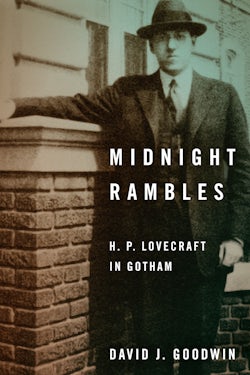
MIDNIGHT RAMBLES: H. P. Lovecraft in Gotham
DAVID J. GOODWIN
Empire State Editions
$29.95 hardcover, available now
Rating: 4.25* of five
The Publisher Says: A micro-biography of horror fiction’s most influential author and his love–hate relationship with New York City.
By the end of his life and near financial ruin, pulp horror writer Howard Phillips Lovecraft resigned himself to the likelihood that his writing would be forgotten. Today, Lovecraft stands alongside J. R. R. Tolkien as the most influential genre writer of the twentieth century. His reputation as an unreformed racist and bigot, however, leaves readers to grapple with his legacy. Midnight Rambles explores Lovecraft’s time in New York City, a crucial yet often overlooked chapter in his life that shaped his literary career and the inextricable racism in his work.
Initially, New York stood as a place of liberation for Lovecraft. During the brief period between 1924 and 1926 when he lived there, Lovecraft joined a creative community and experimented with bohemian living in the publishing and cultural capital of the United States. He also married fellow writer Sonia H. Greene, a Ukrainian-Jewish émigré in the fashion industry. However, cascading personal setbacks and his own professional ineptitude soured him on New York. As Lovecraft became more frustrated, his xenophobia and racism became more pronounced. New York’s large immigrant population and minority communities disgusted him, and this mindset soon became evident in his writing. Many of his stories from this era are infused with racial and ethnic stereotypes and nativist themes, most notably his overtly racist short story, “The Horror at Red Hook,” set in Red Hook, Brooklyn. His personal letters reveal an even darker bigotry.
Author David J. Goodwin presents a chronological micro-biography of Lovecraft’s New York years, emphasizing Lovecraft’s exploration of the city environment, the greater metropolitan region, and other locales and how they molded him as a writer and as an individual. Drawing from primary sources (letters, memoirs, and published personal reflections) and secondary sources (biographies and scholarship), Midnight Rambles develops a portrait of a talented and troubled author and offers insights into his unsettling beliefs on race, ethnicity, and immigration.
I RECEIVED A DRC FROM THE PUBLISHER VIA EDELWEISS+. THANK YOU.
My Review: S.T. Joshi's two-volume I Am Providence is the go-to biography of this awful human being whose fiction output changed what we know as horror fiction. It's a much more...worshipful isn't too strong a term, but let's use the slightly less judgmental term "positively inclined"...take on his entire life.
We don't get that tone here. The author focuses on Lovecraft's New York years. It's pretty much impossible to make the time he spent in the place that inspired the utterly despicably racist story "The Horror at Red Hook" anything but dark and negative.
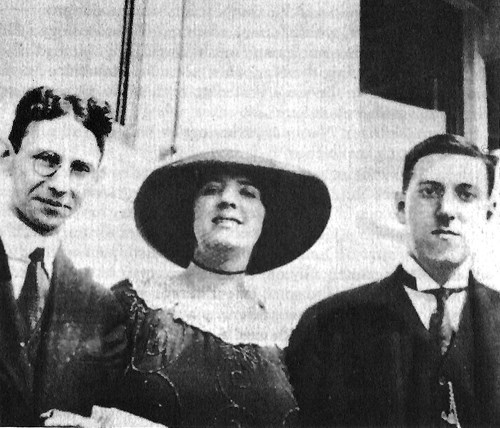
Rheinhart Kleiner introduced his mutual friends H. P. Lovecraft and Sonia H. Greene during a boat tour of Boston Harbor in July 1921. The three were attending an amateur journalism convention in the city.
That is both true, and misleading. This narrowly focused life of Lovecraft isn't a hatchet-job. It is, instead, a careful look at the whos, whats, and whys of Lovecraft coming into himself as a person and a writer.
That he wasn't a very nice person, well, you know what? Facing up to the real person who typed the words that formed the stories you love or loved is not something we can avoid in the twenty-first century. The fascinating part to me was that there needn't have been this curdling of his heart. There was a window for someone to reach into his heart and pull out a kinder human being. Sonia Greene certainly tried this feat.
Greene grew more intrigued by Lovecraft throughout the Boston convention. This marked the beginning of their relationship.
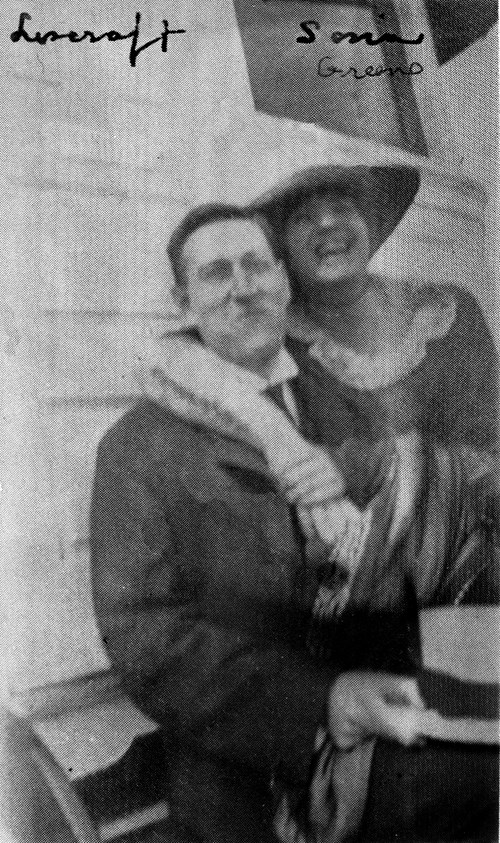
A brief moment of happiness. It beggars belief to me that this smiling boy is H.P. Lovecraft, whose sour unsmiling visage is reproduced on so many book covers.
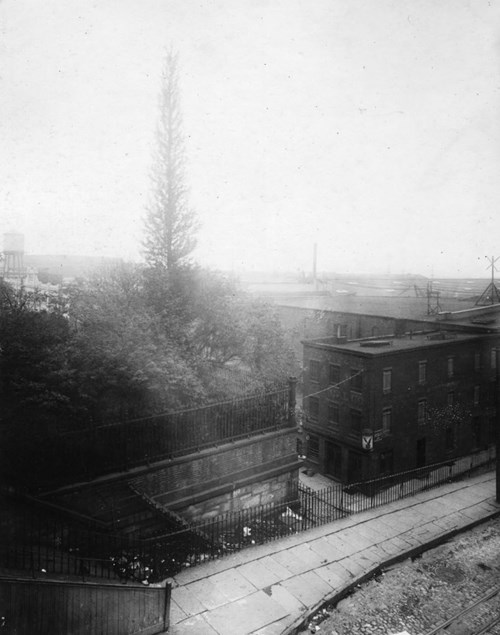
While Lovecraft strolled through Brooklyn Heights one evening, a neglected garden captured his attention. This might have been the grounds of the James S. Rockwell House.
His environs always influenced his creative process, naturally. Seeing such sights in Brooklyn, an urban space, would've charged up his future use of the surprising, hidden facet of his stories' settings. As a matter of fact he seems to have found the experience more formative than most others he would have while living in New York.
That it is! Still looks like this, too. It doesn't seem to have sweetened his world-view....
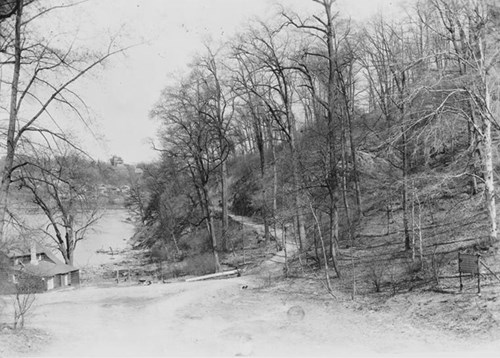
When exploring New York City, Lovecraft sought pockets of nature largely unblemished by urban development. Today’s Inwood Hill Park in Manhattan stood as such a space.
Holy carp! That's INWOOD?! My goodness, a hundred years makes a big difference.
I think my point's made. This is a terrific book about the nasty guy who refined and codified the tropes and topics that now make up "cosmic horror." He is seen here on the cusp of all the floods of words that would make this enduring contribution to our culture. I was drawn into this story by the details I did not know, despite the trajectory and ending being already familiar.
I'm convinced your young Lovecraft/horror reader will be as taken with this read as I was. I can't get all the way over the hump to five stars because I dislike Lovecraft that much. That's probably a testimonial to how well Author Goodwin did his job.
Monday, October 2, 2023
THE CIPHER, award-winning first novel from Kathe Koja republished after 30 years
THE CIPHER
KATHE KOJA
Meerkat Press
$3.99 ebook editions, available now
Rating: 4* of five
The Publisher Says: "Black. Pure black and the sense of pulsation, especially when you look at it too closely, the sense of something not living but alive."
When a strange hole materializes in a storage room, would-be poet Nicholas and his feral lover Nakota allow their curiosity to lead them into the depths of terror. "Wouldn't it be wild to go down there?" says Nakota. Nicholas says, "We're not." But no one is in control, and their experiments lead to obsession, violence, and a very final transformation for everyone who gets too close to the Funhole.
I RECEIVED A DRC FROM THE PUBLISHER VIA NETGALLEY. THANK YOU.
My Review: Republished thirty years on, this debut horror novel far exceeds my memory of it; when it came out, I wasn't interested in its eldritch overtones and dismissed its literary charms far too readily for that reason. Still not that interested in cosmic horror, as horror anyway, since the crap people do to each other every day scares me a lot more than some Evil Force somehow making people do awful stuff or, sillier still, does awful stuff to them despite being disembodied...possession and so forth come under the heading of mental illness untreated or undiagnosed in my materialist worldview.
But honestly, so what. This is a story, fiction with all that implies. Author Koja's been at this gig for decades now, and it's clear she started strong with this debut. Like all well-made fiction, this novel tells us truths about ourselves and our world. Self-harm, suicidal ideation, depression, all come into the story and are treated with due respect. This being thirty years ago, maybe not the way we'd talk about them now, but they aren't presented as reasons to become a victim.
The power dynamics of this book are very intricate. Upper hands slip. Control falters. People don't behave in reasonable ways, ever! The story unspools at a fairly brisk clip and rewards your attention to its details. Since this is a body horror novel, you know violent changes will be wrought on humans. It's part of our culture to revel in this strange obsession with involuntary body modification and/or death. Not always to my personal taste. This story's main appeal isn't its physical violence but its quieter, less obtrusive dealings with the power within a relationship, how it's used, what it does to the parties involved...and, on that level, this story *rocks*! Can't recommend it unreservedly, see the CWs, but recommend it I do to my fellow #Deathtober fans.
Monday, October 3, 2022
RED RIGHT HAND, Lovecraftian urban-fantasy violence by one pissed-off woman & TRAMPLING IN THE LAND OF WOE, Alexander + Hephaestion in the Underworld
TRAMPLING IN THE LAND OF WOE
WILLIAM L.J. GALAINI (The Patron Saints of Hell #1)
Evolved Publishing (non-affiliate Amazon link)
$4.99 Kindle original, available now
Rating: 4* of five
The Publisher Says: While the First World War rages on Earth's surface, Hephaestion discovers the ideal opportunity to rescue his general, king, and soulmate Alexander the Great from the lowest ring of Hell. The problem? No one’s ever dared such a feat before, and only a madman would try.
As Hephaestion descends into the pit of eternal torment, he discovers unlikely accomplices willing to assist his impossible plan…but complications and subterfuge leave Hephaestion and his allies scrambling for footholds in a world governed by demons, devils, and opportunists. Soon the fires of Hades are the least of his worries as he must outrun, outgun, and outmaneuver beasts and monsters hell-bent on his destruction.
With a cast of unexpected characters from civilizations long buried and historical figures you only thought you knew, Hephaestion must answer the true question of his quest: What does it mean to be known, to be remembered...and perhaps, to be human?
Loyalty, commitment, and love ignore the bounds of death and time in an adventure that explores culture, history, and obsession through the lens of a man who defies reason.
I RECEIVED A DRC FROM THE PUBLISHER VIA NETGALLEY. THANK YOU.
My Review: Spooktober starts with a crashing, steam-billowing bittersweet battle-heavy CRASH. Hell, where Alexander of Macedon, genocidal psychopathic horndog, has been spending his afterlife, is gonna have to give him up...Hephaestion, Alexander's earthly lover, best friend, confidant, and now rescuer, has had entirely enough of hanging around in Purgatory waiting for Alexander's sins to be expiated and for him to join up with the patient, still-loving man whose death precipitated Alexander's own.
But you, O Reader, already know...be careful what you wish for, lest the answer be "Yes."
Hephaestion's decision, now that the whole planet's gone mental and tossed itself a mechanized slaughter in the form of the Great War (as WWI was known then...really, it's obvious that our name for it is a retronym if one gives it even a minute's actual thought), is worthy of some demented I Love Lucy-in-Hell weirdness...dead bodies as disguises, inevitable exposure, meeting a new, improved Scooby-group. But it takes us quite a while to get to this point...we're in Hell, not Purgatory, but nowhere near finding Alexander.
The action is, while magisterially slow, quite well-thought-out, and Hephaestion's motives for his quest elicit a lot of push-back from many sources both helping and hindering him. (All the Jesuits in History ending up in Hell was one of my happiest reading-life moments. I love, love, love the little easter-egg moments Author Galaini chucks into this stew!) One character in particular, Yitz the Jew, was perilously close to a stereotype. I got the impression, fortunately, that the author was actually aiming for archetype and, being in Purgatory, then Hell, wasn't saying this is how Jews are but this is how Jews are seen as part of the horribleness of Hell.
The truly delightful conception of the Afterlife as a place where there are all periods of History and all levels of technology intermingling, to be like Doctor Who's episode where Winston Churchill is Caesar and Morris Minors fly through the air under giant balloons was designed: Wrongness, but playfully presented, is still wrongness and still evokes unease. As the struggle to reach his belovèd Alexander continues, Hephaestion remains obsessed with achieving his millennia-held goal of reuniting with him. All around him are people warning, hinting, offering other views. Blinders on, Hephaestion pursues his goal.
And achieves it.
This is not The Song of Achilles. There is no beautiful ending for anyone in Hell. And, as Hephaestion finally achieves his reunion, the full and terrible truth of the answer to a prayer being "Yes" is, at last, borne in upon him.
That is why I gave the story four stars in spite of its too-slow-for-me pace, in spite of its occasionally unpleasant characterizations, in spite of its flaws whatever they might be to you or me. The love one bears for the heart's own darling is not always the feeling the heart's own darling deserves.
A bitter dreg to drink. A truly powerfully importantly real, urgent Truth. Falling in love is not always, or even all that often, the happy end.
++++++++++++++++++++++++++++++++++++++++++++++++++++++++++++++++
RED RIGHT HAND
LEVI BLACK (Mythos War #1)
Tor Books
$21.99 trade paper, available now
Rating: 4* of five
The Publisher Says: Charlie Tristan Moore isn’t a hero. She’s a survivor. Already wrestling with the demons of her past, she finds herself tested as never before when she arrives home one night to find herself under attack by three monstrous skinhounds straight out of a nightmare. Just as hope seems lost, she is saved by a sinister Man in Black, dressed in a long, dark coat that seems to possess a life of its own and wielding a black-bladed sword in his grisly red right hand.
But her rescue comes at a cost. The Man in Black, a diabolical Elder God, demands she become his Acolyte and embrace a dark magick she never knew she possessed. To ensure her obedience, he takes her friend and possible love, Daniel, in thrall as a hostage. Now she must join The Man in Black in his crusade to track down and destroy his fellow Elder Gods, supposedly to save humanity from being devoured for all eternity.
But is The Man in Black truly the lesser of two evils–or a menace far more treacherous than the eldritch horrors she’s battling in his name?
Red Right Hand is the first book in the fantastically creepy Mythos War series by Levi Black.
I RECEIVED A DRC FROM THE PUBLISHER VIA NETGALLEY. THANK YOU.
My Review: Nyarlathotep! The Crawling Chaos!! I am so so sold on this read. People using ol' H.P.'s stuff in ways that'd probably make him scowl and whine? Bonus points! And Charlie Tristan Moore is someone who would make ol' H.P.'s hackles rise. A woman, a mutt, a person without a pedigree? *gasp* Bring it, say I, and fling it on his grave.
So in this trilogy-starting story, Charlie (our narrator) meets with some really scary, very weird...dog-things...inside her front door as she stumbles in drunk from a binge trying to drink a boy she liked off her mind. The action, in other words, is reported in first person and starts from the get-go, never slacks, and keeps getting higher and higher stakes riveted to it.
What works best about this is that Charlie (Charlotte, really) Tristan Moore's learning what the ruddy hell's going on at the same time we are. She's not narrating from either the Afterlife or a cozy chair in front of a fire, a brandy balloon a-swirl in her hands, relating her youthful wild adventures.
What slightly less impressed me was Charlie Tristan Moore's gradually revealed psych history...it was all a bit too pat, and too obviously engineered to make her the proper tool for Nyarlathotep. It led to the feeling that she was a created tool instead of what I understood her to be, a fortuitously shaped stick that Nyarlathotep found here in ordinary reality and co-opted for his use. If the former is the case, then what the heck would an entity that could exert its will so powerfully *need* with a hench-rat?
Well, no matter, what kept me happily reading was the pace of events once the Man in Black gets his hooks into her and sets her her tasks. I was in the mood for horror, it's Spooktober, we've got truly awful people trying to screw up reality even more than they've managed to do in the past six years...gimme the fake kind, with excitement but no danger, please. This first-of-three violent, gory supernatural-horror-defeating stories filled the bill admirably, used the Lovecraft Universe very creditably while still ringing changes on the themes so they didn't feel leaden and overburdened with MEANING. This is never easy. Author Levi did it well. I know I've slammed those dragon-tattoo books for their repugnant sexual violence against women before. It's not a subject I invite into my entertainment these days.
What made me respond differently to this story is that the violence of Charlie Tristan Moore's past is not presented pruriently, is not downplayed in its effects on her and her life as I felt was the case in those Swedish stories. As she puts herself into terrible situations to serve a man and his needs in this story, Charlie's furiously ragingly hating him, and expressly making herself remember why what happened to her is making Nyarlathotep's abuse of her worse.
It felt, then, for once like her pain was her enemy not her secret power.
And she still succeeds, she still lives, she still has Love to save. It worked for me. If Spooktober's going to mean something to you, try slotting this read into it.
Friday, August 6, 2021
THE GLASSY, BURNING FLOOR OF HELL, Brian Evenson's latest collection of literary horror
THE GLASSY, BURNING FLOOR OF HELL: Stories
BRIAN EVENSON
Coffee House Press
$16.95 trade paper, available now
Rating: 4.5* of five
The Publisher Says: "Here is how monstrous humans are."
A sentient, murderous prosthetic leg; shadowy creatures lurking behind a shimmering wall; brutal barrow men: of all the terrors that populate The Glassy, Burning Floor of Hell, perhaps the most alarming are the beings who decimated the habitable Earth: humans. In this new short story collection, Brian Evenson envisions a chilling future beyond the Anthropocene that forces excruciating decisions about survival and self-sacrifice in the face of toxic air and a natural world torn between revenge and regeneration. Combining psychological and ecological horror, each tale thrums with Evenson's award-winning literary craftsmanship, dark humor, and thrilling suspense.
I RECEIVED A DRC FROM THE PUBLISHER VIA EDELWEISS+. THANK YOU.
My Review: A collection from Brian Evenson, even one with some pieces that weren't quite as welcome to me as they ordinarily are (see below), will never not be greeted with warbles of delight from me. These tales are all from other homes, but they belong together. They're Family, much as a cult is.... Last Days, a pair of odd and deeply disturbing novellas linked by one hugely upsetting premise...and this premise is the *only* one I've ever encountered whereunder I am simply delighted to be called a "one"...made me think and shiver in 2014, and still does today. His short fiction tends to be very, very short (see my review of Windeye from 2013). This can render me almost mute, considering how very unreasonable the demands of reviewing collections, as opposed to anthologies of multiple writers, of short stories are. What's one meant to say? How to capture the gestalt of the collection? Is there a gestalt? If not, what the heck?! I get all verklempt and deeply verschmeckeled. But this is Brian Evenson. The peace is kept. These stories will take you, quickly, to places you're not at all sure you'd like to go.
I got a bit of a foretaste of the unease Author Evenson had in store for me when I kept thinking I should know that title, such a resonant phrase and so elegantly crafted! Is it a quote? A line from some famous poem by Milton, or permaybehaps Swinburne...turns out the author attributes it to Marguerite Young from Miss Mackintosh, My Darling! That monster hasn't been mined as thoroughly for titles as I'd've expected. I don't have any notion of where in the book it occurs, nor does he vouchsafe the information, but the sense of that exact phrase *belonging* somewhere has been answered and laid to rest. Unlike, it must be said, the science-fictional treatments of Otherness, the spooky treatments of cruelty and neglect, and the other many-sided polygons of storytelling he gets up to here. I agree that the planet's had it with us, and can even understand the more, um, arcane ways Author Evenson's come up with for it to shuffle us off. But they are as one expects from him: Unsettling, open-ended, and prettily told even when they aren't at all pretty.
With my usual éclat, I'll employ the Bryce Method of short impressions but no distinct individual ratings (no need; four fives, the rest but one four-and-a-halfs) for the stories so as to organize my thoughts and feelings, while hopefully allowing you to reach your own conclusions.
Leg is Hekla's, well, leg...only it isn't exactly a leg, and it's only hers until it doesn't want to be anymore. Then, well...you know who wrote it, you know what's likely to happen: Nothing you expect or predict. It's a quick, bitter hit of Evensonism.
In Dreams leads us to the sadly messed-about brain of a man whose very sense of himself is...flat, affectless. Much like, he muses, a psychopath's mind. But he has a familiar, a technological thing in his head, something that uses the parts of his brain that long-ago science said we, that is humanity, do not use...let us have it, they asked him, and he said yes.
That strange, almost fluttering sensation from deep within his mind, a sort of mental arrhythmia. It rose, it rose.
I could simulate dreams for you, it offered.
You've been listening in.
Of course I have, it said. I always am.
You always are, he acknowledged.
I could simulate them for you, it said again. They would be very well done. You wouldn't know the difference.
That was what frightened him, that perhaps he wouldn't know the difference.
I had a roommate when I was in the goofy garage who was schizophrenic. He was eerily like this character. Something else was in him, the C.I.A. was beaming imagery into his mind...it's a frightening thought, to be not-alone in your own head, and one that isn't obviously untrue sometimes....
Myling Kommer explains the unbearable burdens of family when Wrong is done to one of your own by one of your own. It is chilling and unfair; Jussi does not understand, can't possibly, the degree of hatred a child can feel for a selfish and terrible parent. Lucky boy, yet the future he inherits might not be quite so lucky.
Come Up for what, air? What good is air when you can't breathe? Breathing never got you anything good, never rewarded your life-long need to be seen or found to be important...but what do you do about it? You make sure you're never forgotten. Never. Even if it means making sure there isn't time to forget....
There was just a hole, a void where his wife had been. You couldn't feel anything about a void. All you could do was try desperately to keep it from swallowing you.
Good luck with that....
Palisade got built because someone, who remembers who, knew there was something that needed to be kept...in? out? hardly matters...and here you come, galumphing goofball that you are, head near empty and heart chock-full of nasty! Any wonder that the world around you gets angry? It's how angry that counts. One of the most persuasive arguments here for NetPriAppPeaDis to open up their vault and splash eight figures out on an all-Evenson anthology à la LOVE DEATH + ROBOTS.
Curator gives new meaning to the words "Mission Drift":
Here is how monstrous humans are, she felt the record should say. Humans are what they did to this world, their home. Here is why, once humans are extinct, they should never be brought back to life.
The Curator is absolutely correct. Wisdom comes at last, and too late.
To Breathe the Air is a master class in the beauty of launching the reader into a story in medias res. Simply superb science-fictional tale of two cities, and the horrors of Others being in control...exercising dominion over...those that do not consent and cannot benefit from it. Please, NetPriAppPeaDis, please make this an animated film!
The Barrow-Men makes you glad you don't live in Author Evenson's head. When Arnar claims an identity that isn't his, just to save himself, the barrow-men treat him to special, super-deluxe accommodations. Poor bastard.
The Shimmering Wall meditates on the power of love to make a person do what they believe they cannot and act as they swore they would not. It's also a bitter, angry denunciation of greed and selfishness and the disfiguring results of Institutional Superiority. And never once does it sound as strident as my reductive synopsis does.
Grauer in the Snow oh, how very much Grauer wishes he wasn't where he is! There but for the want of the presence of a ticket...he's quite sure his would've been punched; I wonder if anything in liminal space is ever for sure. Angels? An angel? If you like....
Justle makes a strong case for never pursuing family secrets! And Capgras syndrome? Maybe we don't really want to poke too deeply into it. No way to be sure there won't be a can of worms the size of Australia come poppin' up. Earth's revenge for our clever-clever uses and abuses, permaybehaps. Honestly, if this world's headed the way of Justle's Earth (assuming it is Earth), I'm not going to make book against this story coming to literal...life....
The Devil's Hand reminded me of an Aickman story, one about a weather house, that I read some time ago...the cruelty of the deprivations, the sheer indifference to bodily autonomy and integrity...just awful!
It was delicious.
Nameless Citizen or just "Nameless Person" in the end. No one lives through The End. The few clones of whatever is left aren't going to make it much past a few days apiece...by design? Or is this just another knock-on effect of the disaster that ends us?
Did I dream? I would say no—I never dream, at least not dreams I remember. I have not dreamt since the disaster changed me, as if the exchange for surviving the conflagration was to surrender my ability to dream.
Would that be a price you'd be willing to pay? Would there be a point to...continuing...if it cost you your dreams, your soul, along with your future?
The Coldness of His Eye reminds you, the reader, that no crime is perfect. Nothing on this Earth stays hidden forever...just hope that you're not interesting enough to be sought out for the wickedness you do without squaring it with the Universe. Because, rest assured, you will eventually pay the price, and the interest is a killer.
Daylight Come for the Eater of Darkness, the woman who can do what the men who think they need to know the future she might be able to tell them can't; so can it not actually come? The thing about power, true power, is that those who need it can never have enough and those who have it can never give enough.
Elo Havel is a take on that classic tale, The Ones Who Walk Away From Omelas, crossed with The Lottery, told by a character from an Edwardian Saki story. Short, to the point, not a wasted syllable.
His Haunting left me wondering how, in the end, inheritance works...your father to you, then you (a childless gay man) to...? Props to Author Evenson for mundanely, unspectacularly, introducing a gay guy into his fiction.
Haver brings the brutality of the shrink Haver trying to confine artist Festus to one measly lifetime, one lousy timeline, and to trap them there with chemical cocktails. Can anyone believe this is a full and complete life? I'd say Festus has some ideas about it. Maybe some Other does, and uses Festus? One thing I'll say for Haver: he knows his fate's condign.
The Extrication makes Dr. Mengele seem like your kid's pediatrician!
A Bad Patch recalls the chest-burster scene in Alien all too vividly and revoltingly...and it's not just one...and you're Sigourney Weaver strapped to a Vogon Poetry Appreciation chair.
Hospice is the story that I like the least. Distasteful to me to spend any time with this, this incel or just plain asshole, whatever he's meant to be. Thank goodness it's a short-short.
The Glassy, Burning Floor of Hell returns Hekla to us! Yes, Hekla from "Leg" and this is an earlier stage of her, um, partnership? with Leg. A trip to a yoga-ish retreat, where Hekla's just about the least valued and most ignored person there, arriving after everyone's asleep and helping herself to a room. Turns out it's the only room she can have...and the fat man (jarring note, making a villainous person fat) who's guru-ing this jamboree she doesn't want to be at is the Real Deal at Guruing. Only, and this is not particularly subtle, he's doing it out of greed. So, like, big not-cool points for fat-shaming and equating heaviness with greed.
This isn't enough to ruin the read for me, but YMMV of course.
Subscribe to:
Posts (Atom)