Pages
- Home
- Mystery Series
- Bizarro, Fantasy & SF
- QUILTBAG...all genres
- Kindle Originals...all genres
- Politics & Social Issues
- Thrillers & True Crime
- Young Adult Books
- Poetry, Classics, Essays, Non-Fiction
- Science, Dinosaurs & Environmental Issues
- Literary Fiction & Short Story Collections
- Sookie Stackhouse/Southern Vampire Books & True Blood
- Books About Books, Authors & Biblioholism
Showing posts with label Lambda Literary Award. Show all posts
Wednesday, December 6, 2023
WE ARE THE CRISIS, Convergence Saga #2 after NO GODS, NO MONSTERS
WE ARE THE CRISIS
CADWELL TURNBULL (Convergence Saga #2)
Blackstone Publishing
$26.99 hardcover, available now
Rating: 4.5* of five
The Publisher Says: In We Are the Crisis—the second book in the Convergence Saga from award-winning author Cadwell Turnbull—humans and monsters come into conflict in a magical and dangerous world as civil rights collide with preternatural forces.
In this highly anticipated sequel, set a few years after No Gods, No Monsters, humanity continues to grapple with the revelation that supernatural beings exist. A werewolf pack investigates the strange disappearances of former members and ends up unraveling a greater conspiracy, while back on St. Thomas, a hurricane approaches and a political debate over monster’s rights ignites tensions in the local community.
Meanwhile, New Era—a pro-monster activist group—works to build a network between monsters and humans, but their mission is threatened by hate crimes perpetrated by a human-supremacist group known as the Black Hand. And beneath it all two ancient orders escalate their conflict, revealing dangerous secrets about the gods and the very origins of magic in the universe.
Told backward and forward in time as events escalate and unravel, We Are the Crisis is a brilliant contemporary fantasy that takes readers on an immersive and thrilling journey.
I RECEIVED A DRC FROM THE PUBLISHER VIA EDELWEISS+. THANK YOU.
My Review: I think this series of novels that discuss the sources of Otherness and the artificiality of the idea of a permanent identity deserves all the praise I can heap on it. Using modern culture's delight in cryptids and monsters as real entities, Author Turnbull offers a wise and inclusive look at how identity can be imposed from outside and then used to oppress and persecute the recipient of that imposed "self". Horror fiction is supposed to scare us with the monsters, not FOR them. This subversion of the literary status quo is ideally suited to slide in under the resistant person's radar and make them think again about what a monster is, and who decides what that identity means. This is something that has needed doing since the days of myth...Beowulf is, at the end of the day, about a mother seeking vengeance for the harm done to her child...and what could be more subversive than that?
The very concept of debating rights is absurd on its face. You don't grant rights. Rights are, then they get denied by the controlling elites to serve their own purposes. Granting rights is best framed as removing impediments unjustly placed in the path of those attempting to exercise their natural rights. When that fact comes dangerously close to becoming part of the great mass of people's consciousness, a crisis must be manufactured to distract and re-Other the group that is deemed undesirable by the controlling elites.
The existence of Others is necessary for the forces of control to make the eternally useful and rouinely succesful lie of Us-vs-Them work to absorb the mass of humanity in fighting against those who have the most in common with them so the controlling elites don't have to worry about how they can keep their power, privilege, and prestige intact against the outrage and hatred of those they oppress to serve them, not their own needs.
Political fiction done so well that, unless you already knew it was political, you wouldn't know. For that reason, I encourage you to gift it to your videogame addicted teen boy. Anything we can do to wedge his mind open a wee tiny bit for non-authoritarian thoughts to enter is good.
Thursday, June 30, 2022
THIS CLEAVING AND THIS BURNING, what gay men coped with a century ago & DISORIENTAL, Lammy Award-winning bisexual fiction
DISORIENTAL
NÉGAR DJAVADI (tr. Tina Kover)
Europa Editions
$18.00 trade paper, available now
Rating: 4.5* of five
WINNER OF THE 31st Lambda Literary Award—BEST BISEXUAL FICTION!
The Publisher Says: Kimiâ Sadr fled Iran at the age of ten in the company of her mother and sisters to join her father in France. Now twenty-five and facing the future she has built for herself as well as the prospect of a new generation, Kimiâ is inundated by her own memories and the stories of her ancestors, which come to her in unstoppable, uncontainable waves. In the waiting room of a Parisian fertility clinic, generations of flamboyant Sadrs return to her, including her formidable great-grandfather Montazemolmolk, with his harem of fifty-two wives, and her parents, Darius and Sara, stalwart opponents of each regime that befalls them.
In this high-spirited, kaleidoscopic story, key moments of Iranian history, politics, and culture punctuate stories of family drama and triumph. Yet it is Kimiâ herself––punk-rock aficionado, storyteller extraordinaire, a Scheherazade of our time, and above all a modern woman divided between family traditions and her own “disorientalization”—who forms the heart of this bestselling and beloved novel.
I CHECKED THIS BOOK OUT OF AMAZON'S PRIME READING PROGRAM. USE THIS BENEFITS! WE'RE HOW THEY LIVE, SO TAKE ALL ADVANTAGES.
My Review: From the off, this is a very musical, music-like story, told in the form of "Side A" and "Side B." This alerts us "...old enough to remember 45 rpm vinyl records know that the B-side is usually less interesting that the A-side. Side B is the failed side, the weak side", that we should expect the whole read to be inflected by this frame of reference. And lo and behold, it is!
Kimiâ, or "alchemy" as the word has come to us in English, is a magical confabulation of stories and ideas and history. She is in a fertility clinic when we meet her...she is making the future, deliberately and calculatedly, in other words...and she begins with many skips and backtrackings and forward-lurchings to relate to us the recent history of Iran. ("Recent" is relative, of course, since Iran's history dates back to the invention of the idea of civilization so dwarfs silly Western concepts like "history" and the yet-more-modern "prehistory.") Kimiâ's family, the whole huge swath of them...six uncles, a grandfather who had a wife for ever week of the year...are in their different ways shaping the world's as well as their own world's history.
Sara and Darius, her mom and dad, are revolutionaries against the Shah, though very much antithetical to the theocratic horrors of the Islamic state that replaced one cruel oppressor with another. Their exile to France doesn't dim their ardor for and connection to an Iran free and liberated from repression and tyranny. For Kimiâ that includes her sex's oppression and reduction to the role of housewives. She's a bisexual woman and very much anathema to the present regime. They don't acknowlege the existence of gay or bi identities in Iran.
It gives special poignance to the read to realize that Home, when it doesn't want you, isn't home anymore; and France, the land they're living in if not part of, is in the awful, wrenching process of a rightward shift that rejects foreigners like her. It's a miserable truth that Négar Djavadi, the author of the work, is living in that same France, writing in French, and unable to conceptualize a safe return to the land of her birth.
Sleep isn't about resting, it's about letting yourself settle, like the sediment at the bottom of a wine barrel. I'm nowhere near trusting this world that much.
It is, in the end, the birth, "that dark hyphen between the past and the future which, once crossed, closes again and condemns you to wander"...her own, your own, the one Kimiâ is going to endure soon enough...that provides Kimiâ's final reckoning with the subject of exile:
With the passage of time, the flesh of events decomposes, leaving only a skeleton of impressions on which to embroider. Undoubtedly there will come a day when even the impressions will only be a memory. And then there won’t be anything left to tell.
She is compelled "to let myself be guided by the flow of images and free associations, the natural fits and starts, the hollows and bumps carved into my memories by time." She is the witness, the one whose between-state of emigrant/immigrant is definitional; her responsibility equally to the parents and family whose worlds are so different from hers, and the life she's making whose exostence will continue a line of existences that partake in many beautiful, braided strands of the bread we eat with our every act, that we call History.
++++++++++++++++++++++++++++++++++++++++++++++++++++++++++++++++
THIS CLEAVING AND THIS BURNING
J.A. WAINWRIGHT
Guernica Editions
$17.95 trade paper, available now
Rating: 4.5* of five
The Publisher Says: Two unrelated, aspiring writers, born on the same day in the same year to parents with the same first names, grow up together and eventually gain national prominence as authors. As the years pass, the complex sexual identities of Miller Sark and Hal Pierce undermine their intense private relationship, inflicting damage that cannot be undone by the distinction of their fiction and poetry. Inspired by the lives and works of American literary giants Ernest Hemingway and Hart Crane, This Cleaving and This Burning reveals the passion and purpose behind masks of public reputation and creative expression.
I RECEIVED A DRC FROM THE PUBLISHER VIA NETGALLEY. THANK YOU.
My Review: The bones of this story are based on Hemingway and Hart Crane, a sadly now-forgotten poet popular in the 1920s for his exaggeratedly obscurantist poetry. He was much on the model of T.S. Eliot, though far more, um, impressionistic in his vocabulary and stylistic affectations. For all that, he had a spark of some beautiful thing, a light that shone from his lines (as oddly heard as they were:
The willows carried a slow sound,
A sarabande the wind mowed on the mead.
I could never remember
That seething, steady leveling of the marshes
Till age had brought me to the sea.
These lines are from "Repose of Rivers" which is from his seminal collection White Buildings. Modern Queer Theory proponents like the late Thomas E. Yingling and Tim Dean have pushed back against heteronormative readings of Crane's poetry, arguing that his gayness was central to his sense of himself, and his sense of being a social pariah for his queerness was central to his poet's identity.
Any road, the friendship between Hemingway (a hugely overpraised writer in my never-remotely humble opinion) and Crane is not factual; it's factual that, had it happened, this is the way it would've ended given Hemingway's homophobia.
The thing that drew me ever deeper into this read was the beautiful creative world these two inhabited, the joyous freedom of childhood and adolescence spent with light supervision allowing them to muse and think and just *be*. The way the words knit and tat and crochet the strands of character and story together was magical. There's really very little said, apart from a seriously climactic scene, about their natural world...and even that scene is far more about Hal's thoughts and feelings. The characters, based on real men, are themselves and not merely mouthpieces for a plot full of contrivances. It hews as closely to the known life-events of the men as it's possible to do within the confines of writing one's own story.
While the ending was a saddening thing to read, it was factual in its results and outlines. What I'd recommend to readers is that they come to this tale of the valences of long-term friendships, especially same-gender ones, with a spirit of discovery. The novel is about the transformative nature of Love in its many, many, bizarre and unhappy and joyful forms. The love between men-friends is one of the toughest to show in fiction unless one resorts to sports as a central metaphor. In the case of Miller and Hal, the center of their long and loving friendship is Miller's appreciation of the adornments of Hal's poetical imagination and Hal's appreciation of Miller's grounded, practical masculinity. The tragedy of an ending is always there in the rapture of a beginning, isn't it.
It's actually a bit of a surprise to me how much I ended up enjoying this read. I don't generally like tragic endings to queer stories but this one's both factual and handled with a real sensitivity to the story that's led up to it. The characters, always forefronted in Author Wainwright's hands, are very clearly heading into inevitability. Their hidden selves and their public presentations of self collide and fragment on the rocks of Love. It has happened forever; it will happen myriad times again. It's a testament to that reality's careful construction in This Cleaving and This Burning that it failed for once to trigger my knee-jerk hostility to this kind of ending.
I'll say this for Author Wainwright. Decades of writing, both poetry and novels, has led him into a beautiful green pasture of story that only he could inhabit with the lightness and rightness of touch to sell my resistant soul on such a painful, sad to read, finale for two fascinating characters.
Wednesday, June 1, 2022
THE REDSHIRT, Southern American football culture meets gay first love & BATH HAUS, gay thriller about unraveling your own life with plenty of help
BATH HAUS
P.J. VERNON
Doubleday Books
$26.95 hardcover, available now
Rating: 3.75* of five
FINALIST FOR THE 34th Lambda Literary Award—BEST LGBTQ Mystery! Winners announced 11 June 2022.
The Publisher Says: Oliver Park, a recovering addict from Indiana, finally has everything he ever wanted: sobriety and a loving, wealthy partner in Nathan, a prominent DC trauma surgeon. Despite their difference in age and disparate backgrounds, they've made a perfect life together. With everything to lose, Oliver shouldn't be visiting Haus, a gay bathhouse. But through the entrance he goes, and it's a line crossed. Inside, he follows a man into a private room, and it's the final line. Whatever happens next, Nathan can never know. But then, everything goes wrong, terribly wrong, and Oliver barely escapes with his life.
He races home in full-blown terror as the hand-shaped bruise grows dark on his neck. The truth will destroy Nathan and everything they have together, so Oliver does the thing he used to do so well: he lies.
What follows is a classic runaway-train narrative, full of the exquisite escalations, edge-of-your-seat thrills, and oh-my-god twists. P. J. Vernon's Bath Haus is a scintillating thriller with an emotional punch, perfect for readers curious for their next must-read novel.
I CHECKED THIS BOOK OUT OF MY LOCAL LIBRARY. USE YOUR LIBRARIES, FOLKS! THEY NEED US AND WE NEED THEM MORE THAN EVER.
My Review: I love flawed gay protagonists! They don't come more flawed than Oliver. What he did, how he did it, all truly contemptible. Why? Lower still. By the end of the story, he is the sort of creepy little loser it's easy to hate. Yet I never *quite* learned to hate him. I was certainly contemptuous of his actions...for which he paid a steep price.
Nathan, well...he's a rotten-souled chip off the fetid, foul-smelling old block. He does nothing for anyone but himself. He is a walking, talking scion of White Privilege, and not worth the powder it would take to blow him up. Nathan (and family, and friends) I hated with force and vigor.
Why I kept going despite serious problems with the characters peopling the book is simple: the pace picked up after about the 40% mark. It got so involving I couldn't stop. But I will say this, I wouldn't have been kind about the whole thing if Tillie had not been okay.
Borrow it from the library. Not a book you'll want to re-read.
++++++++++++++++++++++++++++++++++++++++++++++++++++++++++++++++
THE REDSHIRT
COREY SOBEL
The University Press of Kentucky
$29.95 hardcover, available now
Rating: 4.5* of five
The Publisher Says: Shortlisted for 2020 Center for Fiction's First Novel Prize
Corey Sobel challenges tenacious stereotypes in this compelling debut novel, shedding new light on the hypermasculine world of American football. The Redshirt introduces Miles Furling, a young man who is convinced he was placed on earth to play football. Deep in the closet, he sees the sport as a means of gaining a permanent foothold in a culture that would otherwise reject him. Still, Miles's body lags behind his ambitions, and recruiters tell him he is not big enough to compete at the top level. His dreams come true when a letter arrives from King College.
The elite southern school boasts one of the best educations in America and one of the worst Division One football programs. King football is filled with obscure, ignored players like Miles—which is why he and the sports world in general are shocked when the country's top recruit, Reshawn McCoy, also chooses to attend the college. As brilliant a student as he is a player, the intensely private Reshawn refuses to explain why he chose King over other programs.
Miles is as baffled as everyone else, and less than thrilled when he winds up rooming with the taciturn Reshawn. Initially at odds with each other, the pair become confidants as the win-at-all-costs program makes brutal demands on their time and bodies. When their true selves and the identities that have been imposed on them by the game collide, both young men are forced to make life-changing choices.
I RECEIVED A DRC FROM THE PUBLISHER VIA EDELWEISS+. THANK YOU.
My Review: Let's start with the easy bits: Clearly Author Sobel, football alum of DUKE University, knew the sports parts inside out. Clearly he understood the racism and exploitation inherent in King/Duke University inviting Black players to its program, and campus. And I strongly suspect he knew some closeted players. He himself is not gay, and it shows.
This is not a knock. The man understands viscerally the cost of hiding and sneaking. But he doesn't get the longing for a man to touch you and be touched by you because I'll wager he's never felt it. What he does get is the way love, real true first love, makes a man out of a boy. That part is absolutely crystal clear, and is the heart of my appreciation for this story. Reshawn the phenom's hatred for the entire enterprise of college football, possibly the game itself, gets serious exploration. It's counterpointed to Miles's "I-am-a-camera" absorption in the colors and the personalities and the panoply of the game's celebrants, as Author Sobel directly describes them:
Here came the celebrant. Coach Zeller's vestments were a purple polo shirt, pressed white khakis, and unscuffed tennis shoes he reserved for games. He took his place at the head of the half circle, and once the last people squeezed inside and the doors closed he began his first pregame speech as King's head coach.
It's not necessary to reproduce Zeller's blather about either rising or sliding, about choosing and losing. It's not like it makes any difference, but it does show the author's clear grasp of the milieu and his own keen perception of the performative and ritualistic elements of football at this school.
What the author also gets is what it takes to be Other in a world that has no room, no time, no oxygen for Otherness. What happens is cruel and vicious and mean-spirited. Miles is the most intensely tested character in this book and it is unbelievable to me that his power and strength could go unnoticed by the people around him. The adults clearly see it and clearly want it...but on their own terms.
The end of the story is not at all what one would expect it to be. The end of the story is, in so many ways, the end of childhood's sweet spot in adolescence and the entry of Miles...and Reshawn...into the dark, cold, stinking pool of adulthood. Reshawn is, like Miles himself, tested and comes through a man. The others? The team, the coaches, not one of them is anything other than a dupe. They're fools caught on the deck of Plato's ship of fools, all the worse because they see it and choose it.
I can't imagine all that many of my fellow queer gents are football-mad enough to want to wade through the games and practices. There's no compensatory sex to make the enterprise less...cishet...and that is deeply too bad. I think, if y'all can pry open your rage-sealed hatred for the way team sports treated you, you'll find a story about personal power, about truly accepting yourself and your place in this world, and about how important it is to know your friends are fully, completely there for you if you're to make any kind of success out of adult life. And thus how very satisfying Miles's story is. That is what you get; you should come experience it; and take some time to appreciate that this is not some lame fantasy of The Lockerroom, but the voice of experience telling you how it goes when it goes right.
Sunday, May 1, 2022
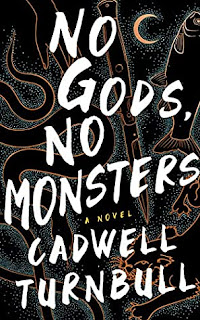
NO GODS, NO MONSTERS, first in a series, author's second novel, lauded and loved and awarded
NO GODS, NO MONSTERS
CADWELL TURNBULL (Convergence Saga #1)
Blackstone Publishing (non-affiliate Amazon link)
$4.99 Kindle edition, avaiable now
Nominated for the BEST NOVEL AWARD—2021 SHIRLEY JACKSON AWARDS!
Rating: 4* of five, all for the slow-burn realization of the identity of the true main character
FINALIST FOR THE 2022 LOCUS AWARD—BEST FANTASY NOVEL! Winners announced 25 June 2022.
WINNER OF THE 34th Lambda Literary Award—BEST LGBTQ SPECULATIVE FICTION!
A NEW YORK PUBLIC LIBRARY 2021 BEST BOOK FOR ADULTS RECOMMENDATION!
The Publisher Says: One October morning, Laina gets the news that her brother was shot and killed by Boston cops. But what looks like a case of police brutality soon reveals something much stranger. Monsters are real. And they want everyone to know it.
As creatures from myth and legend come out of the shadows, seeking safety through visibility, their emergence sets off a chain of seemingly unrelated events. Members of a local werewolf pack are threatened into silence. A professor follows a missing friend’s trail of bread crumbs to a mysterious secret society. And a young boy with unique abilities seeks refuge in a pro-monster organization with secrets of its own. Meanwhile, more people start disappearing, suicides and hate crimes increase, and protests erupt globally, both for and against the monsters.
At the center is a mystery no one thinks to ask: Why now? What has frightened the monsters out of the dark?
The world will soon find out.
I GOT THIS BOOK FREE WITH KINDLE CREDITS. SHOP OFTEN! THE REWARDS ARE REAL. (/irony)
My Review: I think the worst part of reading this book was realizing that the monsters, the not-villainous villains of the piece, are me, my friends, my lover, all of us Othered by...so many factors.
“I’m sorry to do it this way, but I had to be safe,” Melku explains. “I won’t waste any more time. Our collective’s mission is to support the solidarity movement. Often, that has meant supporting marginalized peoples. Some of you are part of the queer and trans community, like me. Many of the most valuable monsters are also a part of these communities, which is why redefining to include them is so important. In that spirit, I think we should extend our support to monsters since it is likely that they’re already in the movement but have chosen to remain silent.”
A political meeting of anarchists in a collective...votes to include literal monsters...the kind that actually DO eat people...in its aims. This book...its imagination shames me.
I've never, ever once thought, "well, civil rights for werewolves should absolutely be guaranteed."
What is left for me to learn over the remainder of my life never, ever stops expanding. ...Yay...? And before anyone says it, no there are not actually werewolves or any other creatures we call monsters, but there are a LOT of humans I'd unhesitatingly call monsters all over the country where I live. All over the only planet we know of that has life on it. So there's clearly no god, either, because if so they're either weak or malevolent since they can't or won't fix things they broke. The book's title, then, snaps into focus: "NO GODS, NO MASTERS," the anarchist chant goes; now that "monsters" are real and have come out of their socially imposed hiding, it needs refreshing: "NO GODS, NO MONSTERS," or a simple acknowledgment that we are all on this lifeboat in the middle of a deadly environment and had all better get busy saving owrselves and each other from paying the ultimate price. No one above means no one below. And that, somehow, is terrible, bad, threatening...why, exactly? Because monsters are Evil? Because, if no one is In Control, things will be...worse? ("For whom" is left unstated. Obviously things will be worse for the ones who benefit from the way they are now.)
But the truth is, it never turns out that way. Marriage equality didn't turn Society into limp-wristed men in feather boas, or women in plaid shirts and bad haircuts. It resulted in a revolting boom in the wedding industrial complex. A lot of bigots making noise about being asked to bake cakes for people they didn't like much. COVID kills us all (in the USA, a million in two years which is more than the 698,000-plus AIDS has killed in 42), and capitalism couldn't care less about who's zoomin' who as long as the survivors consume consume consume.
The principal problem for me is the story's diffusion of narrative drive among so many characters. I do understand this fits the anarchist genesis of the story. But it plays into a problem that trumps political concerns: How am I supposed to sustain momentum in the read? I was able to make my way through the book but it took me longer than it usually does to finish it...almost a month. For fewer than three hundred pages.
I overcame that issue by remembering this phrase that I've entered into my commonplace book:
As he walks with the crowd, he understands what he had forgotten: that a march is not just a voice against violence and trauma, but also a reminder that even in a cause that is stacked against them, no one is alone.
Remember the Tiananmen Tank Guy? He is the reason governments work so hard to suppress free media; he is the reason many of us bother to protest in whatever ways we can. He stood alone, but crowds of protestors aren't when he appears in our minds' eyes. This is also why crowds become mobs, and why protest is something that deeply disturbs the Powers That Be.
When cops kill innocent people nowadays, we as a society are almost sure there will be protests. But now there is a complicating factor of monsters, creatures we're afraid of and whose means of making a living is violent by their very nature; they are, by the definitions we've all come to understand and possibly even accept, but certainly internalize, unnatural:
Near Ridley, a man yells, “No Gods.”
“No monsters,” the crowd chants back.
The chant is an evolution of an anarchist slogan: “No Gods, No Masters,” the original version meaning no human above. It is a call against hierarchy. Ridley assumes the variation means no human above, no human below, or something like it. A call against hierarchy and discrimination.
Simon-pure anarchist speak. Like being in a steering committee meeting for any politics at the local level organization. It is, in other words, bedrock truth that this story rests on. It is this meticulous inclusiveness by dint of hard-fought local battles that gives me little moments of happy recognition and pleasurable fellow feeling, of not being alone as I face a hostile-to-me world.
Go with Author Turnbull on the hunt for the truth of Power through these many points of view. Power resisted, power obtained, power flouted and abused...there is all the power any one being or group can ever use in the simplest truth of them all: Mystery exerts power in ways nothing else can hope to equal, still less surpass.
Wednesday, January 19, 2022
BLUE-SKINNED GODS, one of my favorite 2021 demonstrations of social progress
BLUE-SKINNED GODS
S.J. SINDU
Soho Press
$26.00 hardcover, available now
Rating: 4.5* of five
FINALIST FOR THE 34th Lambda Literary Award—BEST BISEXUAL FICTION! Winners announced 11 June 2022.
GBH's virtual book club, BEYOND THE PAGE, features Author Sindu discussing this story and answering audience questions FREE Register at the link for tonight's 7p EST event!
The Publisher Says: From the award-winning author of Marriage of a Thousand Lies comes a brilliantly written, globe-spanning novel about identity, faith, family, and sexuality.
In Tamil Nadu, India, a boy is born with blue skin. His father sets up an ashram, and the family makes a living off of the pilgrims who seek the child’s blessings and miracles, believing young Kalki to be the tenth human incarnation of the Hindu god Vishnu. In Kalki’s tenth year, he is confronted with three trials that will test his power and prove his divine status and, his father tells him, spread his fame worldwide. While he seems to pass them, Kalki begins to question his divinity.
Over the next decade, his family unravels, and every relationship he relied on—father, mother, aunt, uncle, cousin—starts falling apart. Traveling from India to the underground rock scene of New York City, Blue-Skinned Gods explores ethnic, gender, and sexual identities, and spans continents and faiths, in an expansive and heartfelt look at the need for belief in our globally interconnected world.
I RECEIVED A DRC FROM THE PUBLISHER VIA NETGALLEY. THANK YOU.
My Review: A child is fed a diet of lies by his parents and all the adults around him. They seek many things from their lies, and he seeks only his truth.
Come for the writing, stay for the story...the sentences are lovely things, shining and glowing with the light of inspiration. The story's the one we all need to hear at this juncture, the one about the abuse of religion in service of religiosity and greed. The cost to this genuinely beautiful soul, Kalki, is so huge...the relationships he can not save are all built on the sand of lies.
What makes this story so extraordinarily resonant is that we're all surrounded by lies all day every day. Yes, it's true, Kalki's lies are costly to those he's lying to...not being a god and still trying to heal people is wrong...but he told the truth he had been sold all his life by the liars he was raised by and among. Kalki, unlike all the rest of us, has the weight of the literal world on him, has expectations of miracles mounded on him. That's his excuse for buying into the lies he's surrounded by. What's yours? What's mine?
The questions that this brutally honest look in the mirror of a story raises are urgently in need of everyone's answers, delivered with the honesty and the anger that Kalki uses as he does the absolutely unthinkable, the unbelievably god-like thing and takes control of his life: He forgives.
Being able to forgive is, I honestly believe, the single most important quality in a healthy person's happiness. I see it in stark relief as this novel winds its coils around my heart. Kalki, wronged on every level, betrayed and abandoned on every side, used and abused and ripped off...he forgives. And that is the most beautiful thing available for a mortal to do, to give. Come and be healed: Read BLUE-SKINNED GODS.
Wednesday, October 13, 2021
NEVER SILENT: ACT UP and My Life in Activism, an essential memoir about AIDS
NEVER SILENT: ACT UP and My Life in Activism
PETER STALEY (Foreword by Anderson Cooper)
Chicago Review Press
$26.99 hardcover, available now
Rating: 4* of five
FINALIST FOR THE 34th Lambda Literary Award--BEST GAY MEMOIR/BIOGRAPHY!
The Publisher Says: The previously untold stories of the life of the leading subject in David France’s How To Survive A Plague, Peter Staley, including his continuing activism
In 1987, somebody shoved a flyer into the hand of Peter Staley: massive AIDS demonstration, it announced. After four years on Wall Street as a closeted gay man, Staley was familiar with the homophobia common on trading floors. He also knew that he was not beyond the reach of HIV, having recently been diagnosed with AIDS-Related Complex.
A week after the protest, Staley found his way to a packed meeting of the AIDS Coalition To Unleash Power—ACT UP—in the West Village. It would prove to be the best decision he ever made. ACT UP would change the course of AIDS, pressuring the National Institutes of Health, the FDA, and three administrations to finally respond with research that ultimately saved millions of lives.
Staley, a shrewd strategist with nerves of steel, organized some of the group’s most spectacular actions, from shutting down trading on the floor of the New York Stock Exchange to putting a giant condom over the house of Senator Jesse Helms. Never Silent is the inside story of what brought Staley to ACT UP and the explosive and sometimes painful years to follow—years filled with triumph, humiliation, joy, loss, and persistence.
Never Silent is guaranteed to inspire the activist within all of us.
I RECEIVED MY DRC FROM THE PUBLISHER VIA EDELWEISS+. THANK YOU.
My Review: There is a certain kind of person who becomes a Wall Street "Master of the Universe," in their self-perpetuated self-applied description of their glorious, oversexed, hyper-entitled selves. The Eighties were the moments of national nightmare, both the ones we saw in Wall Street embodied by poor Michael Douglas delivering the "Greed is good" speech that haunts him to this day, and the ones we ignored, eg the S&L crisis whose little brother grew up to become the GFC of the Aughties. There was the moral crisis of the horror of the Reagan Administration's heinous, vile diplomatic disasters and raid on the Social Security Trust Fund. But these are large, generation-spanning structural and systemic disasters, unfolding on time scales not really important to ordinary people.
Then there was the AIDS crisis. Or, as it was at one point called, Gay-Related Immune Deficiency. This relates to the fact that the largest, most concentrated population suffering from the awful plague were urban gay men, whose "lifestyle" (how I loathe that term!) was recently, partially, and conditionally destigmatized. It burned through the New York gay-male community, it flared and killed in other gay-friendlier outposts across the country, and it was never a "gay disease" at all. Science, in its slow and ponderous way, had already established that the primary sufferers were Haitian and African heterosexuals by the end of the 1980s; this helped the disease get onto the Federal radar screens not at all.
Enter Peter Staley. Here's a Master of the Universe, a white male with all the privilege that conveyed then. And he's got AIDS-Related Complex. It was, in 1985, a kind of death sentence, a sort of scientific shrugging of the shoulders..."you ain't there yet, but it's where you're headed." And the poisonous priorities of the tax-cutting and faggot-hating "leaders" of the time meant little was being done, and that without much urgency, to discover and research the strange new disease.
This hateful cover, dated July 1985, was the moment I myownself realized why there were so many people I knew dying but not being discussed..."oh, that's them, that's something they get...not me, not my family. Sad, of course, but..." It's that poisonous little "but..." that makes the real source of the problem obvious. "As long as it stays among them, well, who really cares?"
So here's where Peter Staley was in the Eighties. He had an enviable future, one most white men regarded as dream-worthy; he had a fatal disease; and he had a country whose leadership wasn't interested in making his disease's cure or management or even treatment a priority, because by having it, he was Othered.
And he got mad.
Don't piss off the Peter Staleys of this world. They know how the world works, what value symbolism has, whose words will matter to the average person and whose story will move mountains. And, when they get mad, you will hear their voice. Loud and clear. ACT UP...AIDS Coalition To Unleash Power...was born when Staley had had enough of being told he was a dying victim, either of malevolent chance or a vengeful god or even a US government conspiracy to kill Africans. This book, in all its glorious (yet strangely not angry) insiderness, fills in a huge, huge gap in the history of a movement that forced the entire Federal medical-research machinery to create and implement more humane disease-treatment and prevention protocols. Part of that work has, no doubt, saved many many lives in the current COVID pandemic. Drug treatments and vaccine development are where they are, in part, because of a ten-year fight by the brave young men and women of that powerful coterie of angry queers.
The personal stories Staley tells, the intimate truths he reveals about the personal triumphs and sacrifices and battles that attended every step of ACT UP's early years, make the massive organization that it is today feel so much more important to me. Its continued work is very, very different from its genesis because it can be...ACT UP changed because it succeeded, and because it could start fighting for different things in this new millennium. And Staley, while no choirboy in youth or age, has never stopped fighting his demons and the dragons outside himself they light up. His life has had loss and tragedy and deep, dark passages...and he tells us about them honestly. What he doesn't do is score points off people who were once allies and friends. I admire that.
I admire Staley's work even more. ACT UP's safe-sex messages reached me, a Manhattan-resident sexually active queer in the Eighties, and very likely saved my life. The love of my life was an AIDS suffering Bajan wrestler, Bland (which he refused to answer to, "my name is B.J.!" he insisted). He was already diagnosed when we met, so all our sex was the safer sort. I lost him thirty years ago, when he was thirty-four; I miss him still.
But I am HIV-negative, and alive to do so, in no small part because of Peter Staley and the work he and his cohorts did. Thank you for my life, Peter Staley, all the awful and painful and joyous and rewarding moments of it happened because you wouldn't sit down and shut up. So now's your chance to get the story behind why he made the choices he did, what happened and to whom and when. But don't expect the unpleasant grinding noise of axes being honed to killing sharpness. A long life, longer than you ever thought it would be, teaches one the value of letting go of grudges and the futility of settling scores. Despite his own more recent challenges, Staley remains fully aware of grateful for the gift of his life. It is this that I hope our COVID-ridden youngers will absorb and embody. All who read NEVER SILENT: ACT UP and My Life in Activism have a great head start.
Friday, October 8, 2021
THE CITY BEAUTIFUL, atmospheric horror-adjacent QUILTBAG fiction aimed at older teens
THE CITY BEAUTIFUL
ADEN POLYDOROS
Inkyard Press (non-affiliate Amazon link)
$9.99 ebook editions, available now
FINALIST FOR THE 34th Lambda Literary Award—BEST LGBTQ YA FICTION! Winners announced 11 June 2022.
A BEST BOOKS OF 2021 – YOUNG ADULT SELECTION FROM BOOKPAGE!
Rating: 4.5* of five
The Publisher Says: Chicago, 1893. For Alter Rosen, this is the land of opportunity, and he dreams of the day he’ll have enough money to bring his mother and sisters to America, freeing them from the oppression they face in his native Romania.
But when Alter’s best friend, Yakov, becomes the latest victim in a long line of murdered Jewish boys, his dream begins to slip away. While the rest of the city is busy celebrating the World’s Fair, Alter is now living a nightmare: possessed by Yakov’s dybbuk, he is plunged into a world of corruption and deceit, and thrown back into the arms of a dangerous boy from his past. A boy who means more to Alter than anyone knows.
Now, with only days to spare until the dybbuk takes over Alter’s body completely, the two boys must race to track down the killer—before the killer claims them next.
Death lurks around every corner in this unforgettable Jewish historical fantasy about a city, a boy, and the shadows of the past that bind them both together.
I RECEIVED A DRC FROM THE PUBLISHER VIA NETGALLEY. THANK YOU.
My Review: I think there's nothing more delightful to me than queer representation in historical fiction. We were there, too, and deserve to be written into the zeitgeist.
This is Young Adult queer representation in the 19th century, and in my ongoing quest not to die above the neck before I do below it, I got the DRC. I'm really very glad that I did...this read was a great pleasure to me. The use of Jewish folk cultural touchstones...matchmakers, dybbuks being the most horrifying...the sprinkings of Yiddish, the focus...fierce focus...on family and loyalty, were all tastes of delight for this reader. The author doesn't spend inordinate time explaining things but he does provide context and some factual stuff for the more, um, ethnocentric stuff.
It is a sheer joy to see the story being set away from a) World War II, b) New York's Lower East Side, or c) the shtetl somewhere in Eastern Europe. The Jewish population of Chicago has never been teensy...the Great Lakes ports were as much a destination as New York, but they get less play. I'm also, since I read The Devil in the White City and read The Man Who Made Parks: The Story of Parkbuilder Frederick Law Olmsted by Frieda Wishinsky to my oldest grandson, a big aficionado of the 1893 World's Columbian Exhibition (aka "the White City") in Chicago. That venue plays quite a role in this murder mystery, though exactly how and why shall remain a secret lest I be set upon by spoilerphobes next time I go grocery shopping.
What I will say is that the squeamish should not pick the book up. There are graphic moments of bloodyness, there are awful physical violences, and of course the element of supernatural possession can't be left out. There are more 21st-century concerns like homophobia and anti-semitism (this last pervades the end of the book to a sometimes uncomfortable degree), but this is Spooktober! A few scares, some terrible spooky goins-on, that is what this month is for! Be prepared, also, for the politics of the book. It's solidly anti-capitalist, despite MC Alter's determination to earn earn earn so he can bring his mother and sisters to the Promised Land...Chicago! imagine...because that's really situational not aspirational capitalism. And Alter's failed match-cum-bestie, young Raizel from downstairs in his apartment building, is there to keep him from falling *too* deep into capitalism's cess pit. (She is, in fact, one of the book's most delightful characters, propensity to splash tea onto laps notwithstanding.)
Putting on my YA-unlover's hat, the usual prolixity...why say in ten words what can make an entire chapter?...is fully present, the stakes are APOCALYPTIC ZOMG THE UNIVERSE WILL END!! and that gets really tiring to an old fart like me who knows that, after I and you and the author are all dead the planet will keep spinning on. Probably all the better for our absence.
But that is an elderly person speaking, the audience that's here for YA is going to *eat*this*up* because every one of the elements are handled with aplomb and without the edge of tweeness I've reacted to in other YA books like they're coated in cat dander. I don't at all recommend giving this to a fourteen- or fifteen-year-old. The realities of sexual abuse aren't in any way soft-pedaled. The realities of sexual desire, that it doesn't obey rules or orders, are best left to the older end of the YA spectrum, which I think of as sixteen and up. I know y'all know y'all's kids better than I do, so understand I'm speaking in generalities and not prescribing anything.
The mystery aspect of the story, the resolution to the murders and disappearances of Jewish boys, is very well-handled and was solidly made in serious mystery form. If you're up for it, match wits with the author; if you're not, read the spooky book or the coming-out (sort of!) book or the immigrant-makes-it book. They're all here.
I think my point should be clear: Read The City Beautiful. It will please at least 80% of the folks who read my reviews.
Monday, August 16, 2021
GORDO, debut story collection from NorCal activist/artist/writer
GORDO
JAIME CORTEZ
Black Cat
$16.00 trade paper, available now
Rating: 4.75* of five
FINALIST FOR THE 34th Lambda Literary Award—BEST GAY FICTION! Winners announced 11 June 2022.
A BEST BOOKS OF 2021 – FICTION SELECTION FROM BOOKPAGE!
A 2021 NPR BEST BOOK OF THE YEAR!
The Publisher Says: The first ever collection of short stories by Jaime Cortez, Gordo is set in a migrant workers camp near Watsonville, California in the 1970s. A young, probably gay, boy named Gordo puts on a wrestler's mask and throws fists with a boy in the neighborhood, fighting his own tears as he tries to grow into the idea of manhood so imposed on him by his father. As he comes of age, Gordo learns about sex, watches his father's drunken fights, and discovers even his own documented Mexican-American parents are wary of illegal migrants. Fat Cookie, high schooler and resident artist, uses tiny library pencils to draw huge murals of graffiti flowers along the camp's blank walls, the words "CHICANO POWER" boldly lettered across, until she runs away from home one day with her mother's boyfriend, Manny, and steals her mother's Panasonic radio for a final dance competition among the camp kids before she disappears. And then there are Los Tigres, the perfect pair of twins so dark they look like indios, Pepito and Manuel, who show up at Gyrich Farms every season without fail. Los Tigres, champion drinkers, end up assaulting each other in a drunken brawl, until one of them is rushed to the emergency room still slumped in an upholstered chair tied to the back of a pick-up truck.
These scenes from Steinbeck Country seen so intimately from within are full of humor, family drama, and a sweet frankness about serious matters—who belongs to America and how are they treated? How does one learn decency, when laborers, grown adults, must fear for their lives and livelihoods as they try to do everything to bring home a paycheck? Written with balance and poise, Cortez braids together elegant and inviting stories about life on a California camp, in essence redefining what all-American means.
I RECEIVED A DRC FROM THE PUBLISHER VIA EDELWEISS+. THANK YOU.
My Review: I'm always down for a story collection! This one is set in a world I liked the minute I landed in it, the Mexican American vibrant loud exuberant over-the-top everybody knows where you are, where you came from, and what to expect from you so watch it, FIESTA. Living in Mercedes, Texas, in the Sixties, I was The White Kid in my elementary school, and the Mexican American family who lived and worked on my great-aunt's place in Progreso were, well, welcoming. A little redheaded boy at the table? Okay, here's a tortilla, eat hearty. This was very much NOT to my mother's taste and she snatched me outta there to Austin by decade's end. I missed it. And when I got this collection of stories, I thought, yeah this works, I'm ready for a trip that far past the white-water rapids of Memory!
I'll use the time-honored (eight years and counting!) Bryce Method of short impressions with individual ratings for the stories so as to organize my thoughts and feelings, while hopefully allowing you to reach your own conclusions.
The Jesus Donut makes a point of being about the expectations of the have-nots...no one ever gets something for nothing, and sometimes not even for something...meeting in the quasi-religious, blasphemous use of a special donut as the Body of Christ.
"Twenty cents," {Mister Kentucky} says.
Everybody stops breathing. What's she gonna do? She don't got no money. She gonna take the bag and run? That would be stupid, cuz he could chase her in the van. Besides, if she did that, Grandma would hit her so hard, she'd see the Devil through a hole. I don't know what that means, but Grandma always says that, and it sounds pretty serious.
–and–
"Body of Christ." {Olga says}
"Amen," I say, and I open my mouth. She puts the piece of donut on my tongue. I close my mouth, I close my eyes. Mmm.
This is the way Jesus should taste.
This is the peak, the Best Moment of a transgression...a girl pretending to be a priest, who mysteriously has money no one else has, and her worst moment's seeds are right here. Their delivery is condign. 4 stars, a great start and a terrific introduction to this world.
El Gordo is what happens on that weird, ugly day when a queer kid understands the limits of accommodation.
Shiny white boxer boots with silver stripes and shoelaces and little dangly pom-poms on the side!
"Thank you," I say. "These are soooo pretty!" Pa gets real quiet. He opens his mouth like he's gonna say something, but he don't say nothing. He shakes his head like something bad just happened.
Something bad did just happen to Pa...his son's a maricón and it's not just his imagination. A jump-rope sing-song is the next affront to Macho; but then the script flips. Miguelito, a skinny kid with the same luchador mask that Gordo has, picks a fight to see who claims the wrestler's identity...and loses! Is Pa proud, or what? A strong lesson in the value Macho places on "winning" whether there's blood and pain or not. A Man Wins. Seriously bad, fucked-up worldview...but learning its codes and how to switch into them is survival for a fat queer kid. 4 stars
Chorizo slams into you like a brick. When impoverished farmhands are privileged to the point of granting favors to those even poorer, those whose existence is so precarious that sleeping on plastic sheets under a carport is the benison that makes the end of a day spent walking better, well...just how much more does one need to hear to know one's life is luxurious? And here's Gordo, taking *their* food as a handout! A grandmother's slap is only a small price to pay for such a lesson in class distinction. 4 stars
Cookie gives the generational spread of poverty and hopelessness a face. Mother too young, daughter too wild:
"Fuck her," she says again.
"She brought you into the world, pendeja. She made you in her stomach and pushed you out of her vaginus. That's a fact. She gave you life, the greatest gift in the solar system."
Pitch-perfect kid-fight. Big, scary words like fuck! Counter with smart-kid infowars! Ooohhh, who will win, Gordo (young but smart) or Cookie (wild but angry)? No one, pendejos, this isn't a battle. It's a war. Their side lost. 4 stars
The Nasty Book Wars are exactly what it sounds like. It's kind of a fake-out, because the beginning is Primitivo with the weird-shaped head, a wedding, and la migra...I was kinda wondering what the heck this had to do with nasty books:
By late July, the garlic had been pulled from the dirt and heaped in the fields, where it dried in the baleful San Benito County sun like mounds of tiny skulls. The stoop labor was performed in afternoon temperatures that hovered in the low nineties and sometimes more for weeks at a stretch.
So, while I *am* looking at the garlic heads a bit differently, what's gonna kick off this story? La migra collaring Primitivo (newly and hilariously yclept "Head and Shoulders" by Gordo's dad, the nicknamer in the community) and la jefa cleaning out his space, that's what. Gordo's four-member cousin-kid-gang find a way into Head and Shoulders's old room where they discover what la jefa didn't: Porn!
The natural split, two boys against two girls, occurs; Gordo's sister makes it three to two when she involves Fat Cookie (so this happens earlier than "Cookie"), and a battle of, well, we'll stretch the point and call it "wits" erupts with these dirty magazines getting hauled from pillar to post and trashed and scattered, until one fine day they suffer a permanent accident. As a result of which Gordo's grandmother finds a particularly, erm, juicy bit and blows a gasket. I've got to give this one the full five, not least because I will never again sing "Conjunction Junction" to myself quite the same way....
Fandango recounts one night of drunken stupidity the machos of the community go too far as their steam-blowing drunkenness gets bloody. Gordo's there to witness it because he begged at just the right moment, and got under his mama's defenses...his dad's, um, homophobia has a rest night. But another man's homophobia is on full display and leads him to the Linda Hawkins Memorial Hospital (always referred to that way, a kind of incantation) with a dumb, avoidable, and nasty injury whose nature I really appreciated for its symbolism. Gordo's sad, wistful little meditation on how the men feel about him is so poignant. 4.5 stars
Alex defies expectations...Alex isn't the most ordinary neighbor, nor the softest person to try to get to know, but Gordo's family are johnny-on-the-spot when a disastrous accident happens and a gigantic secret gets out. Sylvie, older sister style, makes Gordo feel bad for being ignorant of the secret...Pa and Mama are ambivalent but kind when it counts. But the night is young, my children. The night has dark and terrible shadows, conceals awful pain and sadness...wickedness is but a Human trait, after all. Basically a novella of the community taking care of their own, regardless of just deserts or origins. 4 stars
The Pardos doesn't really fit the structure of the book...these three vatos, Tinman, Shy Boy, and the mostly absent Spooky...aren't related to Gordo, they go to school with Sylvie (I suspect the editor said "bookhorn something into this to make it part of the collection" and voilà Tinman jacks off to Sylvia in his room) but fit in nowhere. Their father's a scary Salvadoran army vet, wifeless, and working as a janitor in the Jolly Giant broccoli-processing plant...a ticking time bomb, you ask me...their oldest brother's in reform "school" and there's nothing going to arrest this downward slide in Cali's strictly segregated ag economy. Not the star of the collection, 3.5 stars
The Problem of Style presents the solution to the eternal problem of homophobia: don't internalize it; externalize it! Spray the hate back in their ignorant faces with a fine, glittery spray of Style. Revolting, of course, but can you even imagine anything about middle school not being revolting? 4 stars for the ending
Raymundo the Fag does the honors for Shy Boy...the Final Honors...in his new station as Watsonville's Finest (Hairburner). (We're sort of left to assume that, through some odd time dilation, this is Gordo all grown up; I'm rollin' with it.)
"...They need you. It's a tragedy. It's special. Hey, do they pay good?"
"Olga! He's dead, remember?"
"Well, there you go. He won't be tipping, so you need to charge them good up front. For gasoline y todo."
"Yes, Mrs. Scrooge."
Good lawsy me, Olga, too! Does no one leave this town? Well, apart from Shy Boy, who from the way things turned out should'nt've. He saves the day, does our Ray, after a personal moment with the decedent, and more power to him for the gracious send-off he gives his old enemy. And a new love interest there in the cooler, I hope.... 4 stars
Ofelia's Last Ride takes us back to fifth-grade Gordo and the family on a momentous trip to Mexicali, where their parents are from. Nothing prepared them for the news that greets them: Doña Ofelia, a neighborhood pillar and the mother of the mute guy in an earlier story, has died suddenly. You know it's a cataclysm because it's all anyone can talk about. The main thing, for the visiting Chicanos, is that the wake and burial are happening while they're there, so it's all about the family getting its fix of Home. And Gordo, picked on in the approved Mexican style (you think American kids are rude? ha!) for his fatness, hangs around Mama a lot. He sees his first dead body! That's a major rite of passage. (And it explains how he's so sanguine when it's Shy Boy's body he works on above...assuming they're the same character, and I do.)
It's a raucous, vibrant story, and still feels weird to me as the last of the collection. But that doesn't dim the glory of it for a moment. 4.5 stars
Wednesday, June 9, 2021
UNDER THE UDALA TREES, Nigerian QUILTBAG story of two women building a life
UNDER THE UDALA TREES
CHINELO OKPARANTA
Mariner Books
$16.99 trade paper, available now
WINNER OF THE 28TH Lambda Literary Award—BEST LESBIAN FICTION!
NOW ONLY $1.99 ON KINDLE!
Rating: 4.5* of five
The Publisher Says: Inspired by Nigeria's folktales and its war, Under the Udala Trees is a deeply searching, powerful debut about the dangers of living and loving openly.
Ijeoma comes of age as her nation does; born before independence, she is eleven when civil war breaks out in the young republic of Nigeria. Sent away to safety, she meets another displaced child and they, star-crossed, fall in love. They are from different ethnic communities. They are also both girls.
When their love is discovered, Ijeoma learns that she will have to hide this part of herself. But there is a cost to living inside a lie.
As Edwidge Danticat has made personal the legacy of Haiti's political coming of age, Okparanta's Under the Udala Trees uses one woman's lifetime to examine the ways in which Nigerians continue to struggle toward selfhood. Even as their nation contends with and recovers from the effects of war and division, Nigerian lives are also wrecked and lost from taboo and prejudice. This story offers a glimmer of hope — a future where a woman might just be able to shape her life around truth and love.
USE THAT LIBRARY, Y'ALL...AND *ASK* IF THEY DON'T ALREADY HAVE THE BOOK YOU'RE LOOKING FOR!
My Review: First, read this:
It was 1967 when the war barged in and installed itself all over the place.
–and–
Maybe love was some combination of friendship and infatuation. A deeply felt affection accompanied by a certain sort of awe. And by gratitude. And by a desire for a lifetime of togetherness.
–and–
Also, what if Adam and Ever were merely symbols of companionship? And Eve, different from him, woman instead of man, was simply a tool by which God noted that companionship was something you got from a person outside yourself? What if that's all it was? And why not?
Why not indeed...perhaps the most trenchant read of 2021, this one. Nigeria's "cracked down" on Twitter for disrespecting its dictator's trumpian "right" to spread lies with impunity; the plight of my QUILTBAG brothers and sisters is not getting one tiny smidge easier or safer there; and this is the story of two girls, too young by US standards to know anything about sex or sexuality, who fall deeply in love and desire a lifetime of companionship together. It's appalling to many that girls of twelve are having sex, still less with each other. I shake my head when I see the well-intentioned clucking and condemnation. You were thinking about sex at twelve, too, and denying it merely makes you a liar. The war-torn world these children live in merely makes knowledge of the subject fortunate if it's only theoretical and not experiential.
After the Biafran civil war opens up the ghastly wounds inflicted on the several pre-colonial states that now make up Nigeria, Ijeoma has every right to be a bit bemused that her mama is more focused on her daughter's sexuality to the exclusion of all else:
“You'll marry your studies? Marry your books? You already have one degree but you want another. You'll marry your degrees?”
–and–
And now she began muttering to herself. "God , who created you, must have known what He did."
–and–
After a moment I realized that I did know why. The reason was suddenly obvious to me.
I said, “Actually, Mama, yes, I do see why. The men offered up the women because they were cowards and the worst kind of men possible. What kind of men offer up their daughters and wives to be raped in place of themselves?”
Mama stared wide-eyed at me, then, very calmly, she said, “Ijeoma, you’re missing the point.”
“What point?”
“Don’t you see? If the men had offered themselves, it would have been an abomination. They offered up the girls so that things would be as God intended: man and woman instead of man and man. Do you see now?”
A headache was rising in my temples. My heart was racing from bewilderment at what Mama was saying. It was the same thing she had said with the story of Lot. It was as if she were obsessed with this issue of abomination. How could she really believe that that was the lesson to be taken out of this horrible story? What about all the violence and all the rape? Surely she realized that the story was even more complex than just violence and rape. To me, the story didn’t make sense.
There is no hope for someone who thinks their god is so vile and lost to morality that rape of any kind is acceptable; that sex is sinful when it isn't {pick their preferred act}; that religion is anything other than a horrible, cruel con game:
Man and wife, the Bible said. It was a nice thought, but only in the limited way that theoretical things often are.
–and–
There are no miracles these days. Manna will not fall from the sky. Bombs, yes, enough to pierce our hearts, but manna, no.
–and–
I wondered about the Bible as a whole. Maybe the entire thing was just a history of a certain culture, specific to that particular time and place, which made it hard for us now to understand, and which maybe even made it not applicable for us today. Like Exodus. Thou shalt not seethe a kid in its mother’s milk. Deuteronomy said it too. But what did it mean? What did it mean back then? Was the boiling of the young goat in its mother’s milk a metaphor for insensitivity, for coldness of heart? Or did it refer to some ancient ritual that nobody performed anymore? But still, there it was in the Bible, open to whatever meaning people decided to give to it.
Once education opens a person's eyes...
All in all, a read of great and timely importance. The plight of the young women is only the beginning of the story we're told, however, so don't think this is a YA navel-gazer. This is both a strength...I don't want to spend an entire book trapped with a teenager or a tween...and a weakness, because the story veers into some well-trodden paths about man = abusive asshole and woman = patient sufferer that I find very insulting to both men and women. Even though Ijeoma does not present herself as a *willing* victim, she does say, “I had become a little like a coffin: I felt a hollowness in me and a rattling at my seams,” and “Suddenly she could see her future in the relationship: a lifetime of feeling like an afterthought.” It isn't as though no one's ever said that before, and honestly if it had been a man saying it I'd've been only a scoche more interested.
That said, though, there's a reason I've given the read four stars out of five. It is a tremendously involving tale, though I frankly don't see how it's related to any folktales...not that I'd know this from having encountered Igbo folktales but rather from the relentless quotidian nature of the story. I was not as fully engaged in the story after Amina disappears from it. But I was always keenly aware of the need for this story, these women's story, to be in the world. I hope you're even now clicking on the non-affiliate Amazon link to get the $2.99 Kindle edition and spend a luxurious weekend's afternoon enjoying it.
Wednesday, July 1, 2020
YOU EXIST TOO MUCH, Queer Palestinian girl finds out how her world works...then says "BYE NOW"
YOU EXIST TOO MUCH
ZAINA ARAFAT
Catapult
$26.00 hardcover, available now
WINNER OF THE 33rd Lambda Literary Award—BEST BISEXUAL FICTION!
Rating: 6* of five
The Publisher Says: On a hot day in Bethlehem, a twelve-year-old Palestinian American girl is yelled at by a group of men outside the Church of the Nativity. She has exposed her legs in a biblical city, an act they deem forbidden, and their judgement will echo on through her adolescence. When our narrator finally admits to her mother that she is queer, her mother’s response only intensifies a sense of shame: “You exist too much,” she tells her daughter.
Told in vignettes that flash between the United States and the Middle East—from New York to Jordan, Lebanon, and Palestine—Zaina Arafat’s debut novel traces her protagonist’s progress from blushing teen to sought-after DJ and aspiring writer. In Brooklyn, she moves into an apartment with her first serious girlfriend and tries to content herself with their comfortable relationship. But soon her longings, so closely hidden during her teenage years, explode out into reckless romantic encounters and obsessions with other people. Her desire to thwart her own destructive impulses will eventually lead her to The Ledge, an unconventional treatment center that identifies her affliction as “love addiction.” In this strange, enclosed society she will start to consider the unnerving similarities between her own internal traumas and divisions and those of the places that have formed her.
Opening up the fantasies and desires of one young woman caught between cultural, religious, and sexual identities, You Exist Too Much is a captivating story charting two of our most intense longings—for love and a place to call home.
I RECEIVED A DRC OF THIS BOOK FROM THE PUBLISHER VIA NETGALLEY. THANK YOU.
My Review: The frustrations of being Othered by virtue of being your own self are not fresh ground to till. Eternally fertile ground growing evergreen crops, though not fresh. I read this book twice and that is a rare occurrence for me, at my age and with my TBR approaching mid-four figures. The reason I decided that I needed a second trip through the book was simple: I was so completely shattered by the honest and vulnerable story Author Arafat tells, a story that could with only minor tweaks be my own, that I didn't trust my opinion-forming ability. I was too close, too in the moment, to feel remotely analytical.
Start with the beginning, an anecdote from the US-raised narrator's childhood visit to her "homeland":
Then her girlfriend, four years of wondering what the hell is going on inside her partner's head, takes advantage of the narrator's absence to do the stupid, unforgivable thing that almost everyone does: She snoops. Reads emails not meant for her eyes. Be careful, partners, about this behavior. If you discover things that hurt you, no one is to blame but you yourself. "It's better to know!" rises the cry...and I say, "you already knew or you wouldn't have snooped." Anna snoops. Anna finds a mountain of lying and cheating. Bad Anna.
I don't want to spoiler the extremely moving ending. I don't think I can take you any farther into the text without running that risk. Suffice it to say that, for me, the beating heart of the book is anxiety and anger, an intergenerational gift from all the parts of the narrator's past from before she was born:
I was powerfully moved by this read. I identified with this young woman's pathology and her ancestry, although I'm not ethnically Arab or Palestinian or anything else the US looks down on. I totally understand misgendering and omitting details about one's significant others. Being situationally out, being "reserved" (the polite self-lie for "closeted"), being unable to see past the mountain of unworthy feelings that we stand under, behind, below.
She sought healing, our narrator did; I have as well; and I hope anyone who reads this book (I hope there will be many, many of you) can and will seek healing as well.
ZAINA ARAFAT
Catapult
$26.00 hardcover, available now
WINNER OF THE 33rd Lambda Literary Award—BEST BISEXUAL FICTION!
Rating: 6* of five
The Publisher Says: On a hot day in Bethlehem, a twelve-year-old Palestinian American girl is yelled at by a group of men outside the Church of the Nativity. She has exposed her legs in a biblical city, an act they deem forbidden, and their judgement will echo on through her adolescence. When our narrator finally admits to her mother that she is queer, her mother’s response only intensifies a sense of shame: “You exist too much,” she tells her daughter.
Told in vignettes that flash between the United States and the Middle East—from New York to Jordan, Lebanon, and Palestine—Zaina Arafat’s debut novel traces her protagonist’s progress from blushing teen to sought-after DJ and aspiring writer. In Brooklyn, she moves into an apartment with her first serious girlfriend and tries to content herself with their comfortable relationship. But soon her longings, so closely hidden during her teenage years, explode out into reckless romantic encounters and obsessions with other people. Her desire to thwart her own destructive impulses will eventually lead her to The Ledge, an unconventional treatment center that identifies her affliction as “love addiction.” In this strange, enclosed society she will start to consider the unnerving similarities between her own internal traumas and divisions and those of the places that have formed her.
Opening up the fantasies and desires of one young woman caught between cultural, religious, and sexual identities, You Exist Too Much is a captivating story charting two of our most intense longings—for love and a place to call home.
I RECEIVED A DRC OF THIS BOOK FROM THE PUBLISHER VIA NETGALLEY. THANK YOU.
My Review: The frustrations of being Othered by virtue of being your own self are not fresh ground to till. Eternally fertile ground growing evergreen crops, though not fresh. I read this book twice and that is a rare occurrence for me, at my age and with my TBR approaching mid-four figures. The reason I decided that I needed a second trip through the book was simple: I was so completely shattered by the honest and vulnerable story Author Arafat tells, a story that could with only minor tweaks be my own, that I didn't trust my opinion-forming ability. I was too close, too in the moment, to feel remotely analytical.
Start with the beginning, an anecdote from the US-raised narrator's childhood visit to her "homeland":
It occurred to me in that moment to question why, as a man, his bare legs were somehow less troubling than mine. It was a double standard, a shame I had simply accepted until then. I must've done something wrong. In acquiring my gender, I had become offensive.As though a young girl's walking apparatus could somehow be unacceptable! "Haram" or "forbidden" the old religious nuts shout at her. Among the many, many reasons I find religions and religious beliefs offensive in the extreme is the insanity of accepting that your being, whatever part of it the religious don't happen to like, is unacceptable, nay offensive, to the god they claim made you. But Author Arafat reclaims the space:
Ambiguity was an unsettling yet exhilarating space.I don't inhabit an ambiguous space, being bearded and so American in appearance that, in other countries, American tourists glom onto me for help dealing with the foreignness of their presence in wherever. But there's that inner thing, the queerness, that never, ever quite stays unnoticed. And that is probably why Author Arafat notices with such keenness that her ability to get by with chicanery is such excellent camouflage. It becomes an addicition, in fact. It's easy for someone like me, who also had a borderline personality disordered mother, to relate to her need, her survival-level desire, to camouflage, hide, obfuscate, not say the truth:
I could think of nothing more shameful—why was I doing this to her? At the time I thought the same thing: she should have had better. She didn't deserve this at all.Didn't deserve what, having a queer child? She's the one who's fucked up for making it such a huge stinkin' deal. Mother Abu Sa'ab and her utter inability to see people not herself as real, fully formed human beings with valid needs. Her child's needs are only seen as demands on her, unfair unjust "what did I do to deserve this?!" impositions. Affection is a conditional gift, not a right...not even a privilege. So Laila Abu Sa'ab, beautiful mother of a plain daughter who is awkward, unpolished, generally not like her, sets the stage for innumerable false trails her (always unnamed, this is all first-person present tense narration so she doesn't need to identify herself) child will follow:
–and–
"I don't care what you choose to do anymore," she said, and I crumbled. I needed her to care. Worse than anger was indifference.
I imagined she was judging me in that moment. I'm familiar with that judgment, after years of anorexia. I was past it by then, but still, how could I eat something so unsexy as a cheeseburger in front of the sexiest woman in the universe?Ah, the addict's favorite crutch: "{object} won't love me if..." and then the spiral goes down from there. "My image is only safe when others are at a safe distance!" and the distance, unsurprisingly, never gets smaller so the isolation becomes unbearable and the addiction comes back and "{object} won't love me now!" lather rinse repeat. It's inevitable. A mother without compassion plus a nature unacceptable to her world (the world, if I'm honest) can't be expected to create any other kind of result.
–and–
I was in between post-anorexia plump and all-night double sets, with no snack breaks—what if she didn't like my body? My mother had recently impersonated me, puffing up her cheeks and holding out her arms beyond her stomach like an ape.
Then her girlfriend, four years of wondering what the hell is going on inside her partner's head, takes advantage of the narrator's absence to do the stupid, unforgivable thing that almost everyone does: She snoops. Reads emails not meant for her eyes. Be careful, partners, about this behavior. If you discover things that hurt you, no one is to blame but you yourself. "It's better to know!" rises the cry...and I say, "you already knew or you wouldn't have snooped." Anna snoops. Anna finds a mountain of lying and cheating. Bad Anna.
The last line was the hardest to read, the one that made my throat burn: "Maybe one day you'll learn you can't treat people with such disregard. Even yourself."I get why Anna wrote that, I really do, but that's the nastiest and most judgmental formulation of the truth she could've spun up. This is why the snooping behavior is so toxic. The self-righteousness of Being Right is insufferable and makes those addicts to it very unpleasant people. But the hurt Anna caused did catalyze the narrator to go on a search for help:
Google had informed me that a woman named Pia Mellody ... was the foremost expert on love addiction. She sounded like a character out of a self-help fairy tale; I pictured her with a tiara and a wand.So did I. Not in a good way, either. These sorts of judgmental sunshine-enema-givers make me itch. "Love addiction"? Really. Addicted to the endorphin rush but short on follow-through, in my never-remotely-humble opinion. But off our narrator goes to this summer camp for the love-addicted. And runs smack into her anorexia anxiety:
I was too uncomfortable to eat, especially {burger buns} that looked like the cotton stuffing inside of furniture.Why I throw the buns away and get real bread to put around my home-brought fast food burgers. This place is a sham, and the food is the first warning. But the twenty-eight days are crucial to getting to grips with the out-of-control anxiety the narrator suffers.
I don't want to spoiler the extremely moving ending. I don't think I can take you any farther into the text without running that risk. Suffice it to say that, for me, the beating heart of the book is anxiety and anger, an intergenerational gift from all the parts of the narrator's past from before she was born:
At the time I didn't realize what it was that separated the two sides of my family: that my paternal cousins did not live in the noisy neighborhood, go to the community pool, and wait to eat hummus sandwishes at home by choice.What makes people from mismatched backgrounds think their marriages will work? Expectations unmet are more caustic than acid rain and do their damage just as devastatingly but far more quickly. Judgment is *lethal* to marital (any relationship, really) harmony and inevitable between the parties to an up/down marriage. And it is the gift that keeps on giving, passing to children and fucking them up royally. Add to this mental illness on one side, emotional deprivation and class consciousness on the other, and one gets this sad story of a woman facing the world with a raincoat and a butter knife when she needs a scuba suit and a spear-gun.
I was powerfully moved by this read. I identified with this young woman's pathology and her ancestry, although I'm not ethnically Arab or Palestinian or anything else the US looks down on. I totally understand misgendering and omitting details about one's significant others. Being situationally out, being "reserved" (the polite self-lie for "closeted"), being unable to see past the mountain of unworthy feelings that we stand under, behind, below.
She sought healing, our narrator did; I have as well; and I hope anyone who reads this book (I hope there will be many, many of you) can and will seek healing as well.
Friday, August 9, 2019
LOT: Stories might as well be in post-apocalyptic Houston, but you NEED to visit now
LOT: STORIES
BRYAN WASHINGTON
Riverhead Books
$25.00 hardcover, available now
Rating: 4.8* of five
WINNER OF THE 32ND Lambda Literary Award—BEST GAY FICTION!
The Publisher Says: Stories of a young man finding his place among family and community in Houston, from a powerful, emerging American voice.
In the city of Houston - a sprawling, diverse microcosm of America - the son of a black mother and a Latino father is coming of age. He's working at his family's restaurant, weathering his brother's blows, resenting his older sister's absence. And discovering he likes boys.
This boy and his family experience the tumult of living in the margins, the heartbreak of ghosts, and the braveries of the human heart. The stories of others living and thriving and dying across Houston's myriad neighborhoods are woven throughout to reveal a young woman's affair detonating across an apartment complex, a rag-tag baseball team, a group of young hustlers, the aftermath of Hurricane Harvey, a local drug dealer who takes a Guatemalan teen under his wing, and a reluctant chupacabra.
Bryan Washington's brilliant, viscerally drawn world leaps off the page with energy, wit, and the infinite longing of people searching for home. With soulful insight into what makes a community, a family, and a life, Lot is about love in all its unsparing and unsteady forms.
My Review: This is not, appearances to the contratry, autobiographical. It's art, inspired by lived life, and Author Washington isn't its only model. He knew the models better than privileged and pampered Reader Person can. But there's a smoothness and facility that's the hallmark of the born writer, the one who wouldn't fit in no matter what or where or how they grew up. He didn't live in Alief, or maybe he did exist in that space but he was always apart and different and queer...but mostly he was born to be a writer. As always, I will employ the Bryce Method and go story by story with my visceral impressions only lightly toned down and/or tarted up.
Lockwood is a quick hit of what it means to be down and out, illegal, and queer. Also black and queer.
Once, I asked Roberto if he liked it in Texas. He looked at me forever. Called it another place with a name.I live in the same world as these boys and might as well be Arcturian. Yep. This one's a winner. Anything that can tell you that you don't know one single goddamned thing about the city, the state, the country that spawned you? That's a voice you need to listen to.
Could be worse, I said. You could be back home.
Home's wherever you are at the time, said Roberto.
You're just talking. That doesn't even mean anything.
It would, he said, if you knew you didn't have one.
Alief gives the ragged and rowdy account of the end of several lives, two cheating bastards and a fool of a husband, with the full force and majesty of the Neighborhood behind it. Mistakes, obliviousness, the eternal unchanging voraciousness for Story that makes gossip so damned toxic yet irresistible, addictive. Like...well...reading, if we're all honest, dipping into the universes we weren't invited to inhabit. In this universe we're visiting, the Greek chorus of the folks living there is used to best effect as it dissects not predicts. A good choice, Author Washington.
610 North, 610 West locates us in Houston's geometry, using it as a quick way to orient us to the emotional poles of little man narrator's life. Ma isn't what Pa wants; he finds something he does want; life goes on, the myriad casualties spread in Houston's circular blast radius. Javi the vicious brother starts out ans stays shitty, abusive, homophobic; Jan the eldest sister vanishes, as so many without moorings but with ambitions do. Who's left? The gay little brother! Shocking! he murmured, clutching his pearls. Ma and her queer son. How did that ever happen.
Shepherd follows one young half-Jamaican to his summer of love, his Jamaican whore-cousin (the soursop woman!)'s summer of rest and recovery from multiple tragedies, his sister's sexed-up summer of post-college freshman-year freedom; lots of firsts, not a lot of happiness. Unlike the lower-class family's stories, the parents are window dressing. The boy doesn't become a man, but he knows he's going to and it isn't a comfortable thought. His cruelty to a kind woman is a harbinger of bad things to come, I fear.
Wayside a whole eight pages of horror. "Rick was...the most light-skinned out of all of us, and he carried himself like all of kindness in a bottle." We get down to the double horror of: Spoiler Alert!
...
...
...
When we made it to the body, my brother snatched my hand. He made me touch Rick's face. He told me this was what happened to fags.
...
...
...
And that, mijos, is the worst and nastiest thing ever felt, thought, said. Our little man narrator doesn't report this with a flinch, just a numb and vacant, deadened, dead-end voice.
Bayou brings us the chupacabra, myth made flesh, that can't or won't save two of life's losers. Boys with names like TeDarus and Mixcoatl don't even inherit the meek's mite of World. They call out for attention, demand to be seen, heard, but when they get it they don't know what to do with it. Mix, poor thing, is gay in a world that needs someone to hate for being Other so he's it. TeDarus is a space-taker. Nothing can save them from oblivion. Nothing is going to change or get better. Like the chupacabra they found, they slip away and there's no proof they were ever here.
Lot is the heart of the book, the heart of the family. Everything comes to a head, breaks, spills its rage-pus down the sides of the boil that these wretched people fester inside. Javi the hater, Jan the jilter, father, mother...all just don't want to see any of the cesspit's contents they're grinding the youngest's face into. RUN I want to scream, take money for the sex, escape however you can! And I know I'm shoutin' down the well. He's not even going to inherit the cesspit.
South Congress has poor Guatemalan illegal Raúl hooked into small-time street-drug sellin' Avery; it's a sad if common tale of someone who was never going to do more than just get by getting by in a place that hates him for being, won't forgive him for existing. Then how that, finally, in the end, blows into smithereens is a shock because I wasn't expecting Author Washington to leave Raúl with an opportunity that he's smart enough to seize but dreads succumbing to. Pungent and packed.
Navigation is such a freakin' hopeless mess of a life story getting *worse* FFS as Nameless the Narrator rejects two...two!...separate chances to get his shit in order, maybe get above water by a flippin' nostril, but NOOOOOO
Javi would be proud. /sarcasm
Peggy Park is like the Biblical begats in Chronicles, only this time it's baseball in the ghetto. Bored me. Hard to do with baseball stories, but yeah.
Fannin is the last will and testament of Jan, the jilting sister, who saw her father in a bad way one last time but did nothing. I didn't like her before, now I really despise her. The world she's made is built on, not a lie exactly, a hollow place...an excavation of the root-ball her life sprang from. People like that? I don't envy them one single possession.
Waugh teaches us the lesson that Love's got shit to do with reality but will fuck you up worse than anything else. Poke loves Rod but betrays him by leaving him at Rod's lowest point; all to be with Emil the middle-aged refugee from a place that no longer exists (I'm guessing Lebanon based on his age and backstory). He loves Poke, but can't ever figure in to his picture Poke's love of his calling, the streets. Rod? No one sees it, no one says "oh yeah, that guy" and no one, when he goes looking, can tell Poke anything.
There's no closure to be had on betrayal.
Elgin is the beauty of failure, the glory of losing, the passionate need to fuck up again. Nicolás. The name that means People's Victory. He alone of all his people...Javi, dead in the ground; Mam booked out to Louisiana; Pa? *shrug*; Jan the arriviste, dreams drowned by Harvey...stayed in his place, stayed long after he lost the will to make a life; he won the loser's lottery by existing, just that, as his life spun out of reach. Sex with one-nighters does nothing to fill you up no matter how big a dick he has. Then what? Go to the sea, sit in the water, leave a sad and lonely and worthy man in your bed and....
What's left is existing before exiting. All there is.
Those two-tenths of a point off perfect are for the tedium of Peggy Park and the last-minute narrator naming. Best left, or used throughout, as this feels contrived to me.
Subscribe to:
Posts (Atom)