Showing posts with label magical realism. Show all posts

Wednesday, September 23, 2026

THE STRANGERS, autofiction? metafiction? thought-provoking grief-study no matter how you look at it


THE STRANGERS
NAOMI ALDERMAN

Little Brown and Company (non-affiliate Bookshop.org link)
$14.99 ebook, available now

Rating: 4.5* of five

The Publisher Says: They came from nowhere, and now they are everywhere.

A few months after her mother dies, the novelist Naomi Alderman sets up a wildlife camera in the back garden of her parents’ home. It captures the first image of a strange new animal. Low to the ground, about the size of a badger, flat face, long, trunk-like nose. Suddenly these “mimmoths” are as common as foxes or dogs. And no one knows where they’ve come from.

As Alderman negotiates the territory of grief—a place with its own logic and rhythms – the mimmoths spread. From the UK east and west, to the United States, to Russia, to India. They seem harmless, but oddly intelligent. They cannot be captured, they will not take food from humans, they have their own purposes.

Alderman cannot shake the feeling that she has a particular connection to the creatures. Or is she just succumbing to ‘mimmoth psychosis’? As the impact of the mimmoths increases, she is pulled into the cross currents of conspiracy theories and global power struggles. Have her deeply personal forms of mourning lent recent events a surreal air, or is our reality changing drastically and irrevocably?

From the award-winning author of the international bestseller, The Power, The Strangers is a thrillingly original and devastatingly moving novel that blurs the lines between fiction and reality, inviting us to reconsider what it means to be human. It’s like nothing you’ll have read before.

I RECEIVED A DRC FROM THE PUBLISHER VIA NETGALLEY. THANK YOU.

My Review
: Grief does very weird things to a person. I'll hold up my hand and admit I've hallucinated (officially) the sound of my thirty-five ears gone belovèd's voice more than once over the years. That one, however, is nothing compared to the mimmoths.

Shared, collective grief powers the mimmoths, of course; no way are fun-sized mammoth-y entities that just...appear...as Naomi Alderman's mother dies, her father's decline speeds up, the planet's climate and civilization's bad-crazy frag-grenade era heat up, just totally unrelated. There is plenty of evidence that Naomi Alderman is not the only one seeing them!

Mass psychosis? Permaybehaps...the mimmoths being widely seen hasn't meant they're easily, or even at all, interacted with, no feedings by humans, no captures (just killings) by humans, nothing tangible except ubiquity. Oh, and lots of (potentially) related effects stemming from being in the vicinity of the mimmoths, healing or spontaneous abortion or death, but SOMEthing momentous occurs to some people (Naomi Alderman included), so of course the conspiracy-theory areas of society have new fodder for old conspiracies and material to make new ones.

Book-Naomi Alderman and Author Naomi Alderman are entwined narratively and intertwined emotionally, as the genesis of the story in mother-loss is real world; the mimmoths and their effects, well...the effects are real, and while I haven't seen a mimmoth I'd love to. What led to Author Naomi Alderman creating this lovely, odd, off-kilter sci-fi memoir is the awfulness of needing a way to work through the random events in a world where the god you thought was yours turns out not to exist and nothing you've thought was real is, in fact, enduringly persistently real, the stuff that god should prevent/ameliorate isn't getting better, and love does not conquer all...but Love persists, endures."Everyone knows the saying: Whatever doesn't kill you makes you stronger.

But it's not true. Some things don't kill you but just leave you permanently weaker," as Naomi Alderman muses.

A better way to present the fragmented sensation of living on after the death of a love object but not the love is hard for me to conjure. A mimmoth is real, if not tangible; it affects the world but has no effect on it, like a past, like a dead love; and comes from a silent nowhere without explanation like the Orthodox Jewish god that Naomi Alderman has lost.

It is in blurring the lines separating Author Naomi Alderman's terrible emotional, psychic blows, and the consensus-reality immiseration of end-stage capitalism, that this story's impact is most powerful. Creating, summoning the mimmoths, endowing them with potency of emotional and practical sorts...affect and effect...Author Naomi Alderman makes this a story to be reckoned with. As Author Naomi Alderman processes the profundity of her loss (mostly the loss of possibility, a different, better future) after her mother's death, Naomi Alderman reckons with the world's losses and the loss of the world through her semidivine, partly malign living-but-not mimmoths.

Like every other grief considered I've ever read, this is not a story for its own sake or an entertainment to be enjoyed for a while then largely forgotten. It's not tidy enough for that. Manicured Versailles gardens are not the analogues here, but the designed and controlled wildernesses of Capability Brown. Visibly as different as it's possible to be, yet each is a planned, designed, shaped, undergirded and attention-directing space to be within. Moving through The Strangers will give you the feels a great piece of writing is so good at delivering. Don't expect Versailles, enjoy the wilder, less trammeled world of Capability Brown, and I expect you'll feel amply rewarded.

Monday, August 24, 2026

PORTRAIT OF A WITCH UNDONE, charming and fun and amusing


PORTRAIT OF A WITCH UNDONE
K.S. SHAY

Erewhon Books (non-affiliate Bookshop.org link)
$22.95 ebook, available now

The Independent Press Top 40 Bestsellers: Fiction For the week ending September 2, 2026

Rating: 4* of five

The Publisher Says: Thirteen stolen works of art. One haunted marsh.
And a Boston witch willing to risk everything for the friend she’s already failed.


An atmospheric, eerie debut for readers of Starling House and A Discovery of Witches, Isabella Stewart Gardner art heist aficionados, witchy girls, burnt-out former gifted kids, New England history buffs, the coven curious, ride-or-die friends, folklore fanatics, and anyone who’s ever wanted to wander through the looking glass.

Once, Maeve Ryan was the strongest witch of her generation. But Maeve messed up a spell to contact the Lady of the Fens, an eerie Revenant who lures the unwary to their deaths in the brackish marshlands of the North Shore. Maeve destroyed her reputation, hurt her best friend Ash, and tainted herself with unbound, wild magic that transforms witches into insane Revenants.

With unbound power eating away at Maeve’s mind, all she wants is to get rid of her magic. Forever. But Ash’s research into how the spell went awry leads in an unexpected direction: the Isabella Stewart Gardner Museum, and a link between the Lady and a decades-old art theft worth $500 million. When Ash disappears through a stolen painting’s empty frame, Maeve has to follow.

Inside is the Other Marsh, a haunting, deadly realm where only the Lady’s rules apply. Within this half-world lie secrets about North Shore’s history, Maeve’s failure, and the fate of the masterpieces that disappeared over three decades ago. But as Maeve fights toward the truth, she risks her friendship, her coven, and her life against enemies hiding in plain sight.

I RECEIVED A DRC FROM THE PUBLISHER VIA EDELWEISS+. THANK YOU.

My Review
: The hardcover might be preferable to order, y'all:
Are these endsheets to die for or what?

And then there are the seven maps that this bloody program will not let me upload; just know that they'll enhance your reading experience for the mappish among you, like me. They're there because this is an undertaking to explain the long-ago, still unsolved, Isabella Stewart Gardner Museum heist. After almost forty years, I think it's safe to say the solution presented here...it's magic...might as well become the final word. Nothin' else but the death of some powerful people will bust open the truth and maybe not even then, so heck...why not magic?

Maeve, all of twenty-three during this story, is a really interesting magical practitioner. She's filled with insecurity after very publicly failing at an important working that unintentionally hurts her bestie in the Salem coven. This is the woman who still comes to her rescue when the cursed apartment she lives in is overrun by frogs...without harming the frogs. It was refreshing. Not a frog-fancier, me, but I do get the joke about witches who famously use frogs in magical working that don't turn out well for the frogs subverting that silly stereotype. Also subversive of stereotypes is the way these witches actually *fly*on*their*brooms* and still don't play it for a cheap snigger.

There's a male main character. He is Maeve's "love interest." Nothing about this part of the plot adds anything very interesting to the story. I'm moving on. The interplay among the coven members really exemplifies the use...bordering on overuse...of the miscommunication among people who have one big thing in common but little else drawing them together. It's a problem as the mystery of the art heist steadily takes over the coven's activities; the stolen artworks are, like much art, imbued with magical capability of being bridges between worlds. Maeve is forced to do her best magic in the scenes where she's working to focus everyone on the common goal of regaining these stolen portals. May not be all spells but it's for sure magic.

Maeve has the chops innate in her to be a leader, but she's twenty-three. The action spins out of her control as we-the-reader watch, amused and bemused, while the coven attempts solving the heist for their own, not-law-enforcing, purposes. It is clear Maeve could become the focus of a series with her coven as they redress imbalances and resolve mysteries. I hope they all come back soon. I also hope potential future lovely, fun reads will show Maeve grow into her leadership and not rely on the chaos that comes from poor communication again. Magic carries in its basis the wildness and chaos of Life, untrammelled; Maeve can shape that, can form it...if she's written that way.

Debuts seldom come with this much promise. Hope it's pointed in a positive way.

GHOST CITIES: A Novel, the trade of creating illusions at apotheosis


GHOST CITIES: A Novel
SIANG LU

Summit Books (non-affiliate Bookshop.org link)
$14.99 ebook, available now

Rating: 4* of five

The Publisher Says: From an award-winning international rising star, a dazzlingly inventive novel, spanning ancient and modern China, that interweaves stories of romance and showbiz

Inspired by the vacant, uninhabited megacities of China, Ghost Cities follows multiple narratives, including one in which a young man named Xiang is fired from his job as a translator at Sydney's Chinese Consulate after it is discovered he doesn't speak a word of Chinese and has been relying entirely on Google Translate for his work. The incident goes viral under the hashtag #BadChinese and attracts the attention of the eccentric film director Baby Bao, who uses Lu to attract press for his latest film. Bao’s movie, based on ancient legends, is to be filmed in one of China’s “ghost cities”.

How is his relocation to a ghost city connected to a parallel odyssey in which an ancient Emperor creates a thousand doubles of Himself? Or where a horny mountain gains sentience? Where a chess-playing automaton hides a deadly secret? Or a tale in which every book in the known Empire is destroyed—then recreated, page by page and book by book—all in the name of love and art?

I RECEIVED A DRC FROM THE PUBLISHER VIA NETGALLEY. THANK YOU.

My Review
: Xiang Lu...notice the author's first name's first letter is the sole difference in these names...is a man with excellent luck. Blagging his way into a job at the Sydney, Australia, consulate of China based on ethnicity and the ubiquity of Google Translate; getting fired when his incompetence at Chinese-language skills is exposed and then pilloried on social media; thereupon being discovered by a Chinese equivalent to Roger Corman, and getting hired to do the publicity on the guy's new film...no way could that be an unfolding, subtle plan on Xiang Lu's part, too much could go too wrong.

After joining Director "Baby Bao" in Port Man Tou, one of the infamous ghost cities of the title, Xiang Lu and Bao join a cast of thousands, and the spirits of Emperor Lu Huang Du and his willed-into-being alters across the multiverse. (Say the "Chinese" names aloud, more than once and with an approximate Aussie accent. It's a hoot.) The Wikipedia articles I've linked to offer some background will also afford a flattering angle of light on this slightly-too-long story, and should be read as they appear for best results. This story is subtle, is layered with jeux d'esprit, and that's the problem. Humor, satire oh dear oh my, is tough to convince people to read. Tristram Shandy and Candide aren't read as often as they're bought; and this skewering of the overweening egos that, in fact, summon their creators' visions into a weird kind of being is not at that celestial level.

Siang Lu is the 2025 Miles Franklin Award–winning author of this odd confection of past and present, reality as we know it and the self-aggrandizing reality-dismissing fantasies of two powerful creators of images. The Miles Franklin Award resembles the US Pulitzer Prize in that it is "...an annual literary prize awarded to 'a novel which is of the highest literary merit and presents Australian life in any of its phases'." So we know the author is either born or based in Australia; the utter absence of any indication of a translator on this or his first novel, The Whitewash (no US publisher, but available on Ammy's Kindle via the Aussie publisher University of Queensland Press), and the fact he "holds a Master of Letters from the University of Sydney" all rather makes me think he either writes novels directly in English or her self-translates his work. Author Lu also "...has written for television on Malaysia's Astro network. In 2021, {he} won the Glendower Award for an Emerging Queensland Writer for The Whitewash. He is based in Brisbane, Australia, and Kuala Lumpur, Malaysia," (all from his Goodreads bio) so I'm betting he's pretty thoroughly polygot; there's no way in hell this read was made using Google Translate! So the opposite of Xiang Lu he writes in this novel, in other words.

As a story it was fun to read the ever-increasing parallel delusions of Baby Bao and Lu Huang Du, and those delusions' assuming a mirror corporeality and a deeply unsettling unity of purpose. It says so much about the visionaries of the world who dream big and act small and petty. Xiang and Baby Bao's assistant/translator/enabler Yuan (I believe this is a word for cash, get it?) are endlessly discussing how eerie it is that all Portmanteau...I mean Port Man Tou, of course I do!...are so indistinguishable, in their empty expensiveness, chewing over how it takes a powerful mind to snatch low-hanging fruit before others seize it...well, it's all very undergrad-philosophy, very obvious and ye I am absolutely certain that it will zoom over most heads like the starship Enterprise.

Maybe I'm just letting my inner old snob run the show. It made me snerk and chortle and even nod along once in a while. It's a good story, and a fine read. I'm not rating it a full five because I suspect most target readers will feel lost at key moments.
"You know," she {Yuan} says, looking out the window, "I have always had this silly thought that maybe, somehow, every city is the same. So when you go from one place to another, it's simply an illusion of flight. The take-off and landing is a simulation. In reality, you've never left the ground, or maybe you have, but are simply flying around in circles for hours, waiting for the new city to 'load.'"
Either too obvious or too weird or too simplistic, but too-too is likely to be a common response. I'm glad Author Siang made the story and that Simon & Schuster's international-lit imprint brought it out here in the US because it's the kind of story that skewers the pretensions and pretentiousness of people badly in need of it.

I'm so glad this story's coming out now, before the US version of #Jólabókaflóð that we prosaically call "fall new book releases" but are really the Yuletide rush. It could get buried now, of course, but I hope some few of y'all will see the appeal and feel the need to chortle along with Siang Lu and me.

Sunday, July 12, 2026

EVERYTHING WAS BEAUTIFUL AND NOTHING HURT, how I would know I was dead is just that


EVERYTHING WAS BEAUTIFUL AND NOTHING HURT
BEN REEVES

Avid Reader Press (non-affiliate Bookshop.org link)
$14.99 ebook, available now

Rating: 4.5* of five

The Publisher Says: Travis is Death in the modern world. He wears jeans and a T-shirt and lives in a small, grey town. His job is to offer people comfort in their final hours of life. He’s stoic, gentle, and a little naive, despite everything he knows. He’s young and handsome, despite who he is. Each death he witnesses is meaningful to him; he listens, never judges, and most importantly, never tries to change anyone’s fate. He knows that every life must eventually end to maintain the balance of the universe and he respects the cycle.

Then he meets Dalia, a midwife, and her boisterous eight-year-old daughter Layla, who live across the hall. As Dalia and Layla come to embrace Travis, it becomes more difficult to maintain the detachment that’s allowed him to function for so long. Their time together teaches him what’s truly important in life—and what might be irrevocably lost in death.

Written with radiant warmth, wisdom, and compassion, Everything Was Beautiful and Nothing Hurt is a timeless story about appreciating life, accepting its end, and finding our place in the universe—especially when it feels most impossible—that will resonate with anyone who has ever loved and lost or worried at time’s passing.

I RECEIVED A DRC FROM THE PUBLISHER VIA NETGALLEY. THANK YOU.

My Review
: Remember Meet Joe Black? Or, if you're a reader my age, Salley Vickers' novel Mr. Golightly's Holiday? We're all interested in divine personifications of absolute power...god and death being in Western cosmology the two supreme beings...and we need to tell stories as much as we need to breathe, so it's inevitable that there will always be new and interesting ways to personify them. (And funny ones, if you're irreverent like Sir Terry Pratchett. Author Ben Reeves is staking out a bit of that territory in this story.

Travis is an ordinary guy who also happens to be Death. Literal Death. The Grim Reaper wears jeans and t-shirts. Sure, why not. Travis comforts and guides people into death, so you already know it's not going to be a Pratchetty jollification of a story. Seeing the personification of death as more or less a death doula is, on its face, reductive because Death is permanent, absolute, fundamental, and utterly unknowable like Life is. Reducing a terrifying cosmic power to a guy in jeans and a t-shirt who helps you, guides you with kindness and sympathy, through the emotional landscape of The End, feels like lèse-majesté to me. Like euphemising "he died" into "he has passed away," if feels like emotional dishonesty to me, like a pointless attempt to pre-feel the horrible twisting agony that is grief. (It doesn't work, any more than not saying "Voldemort" did. Any time one uses the passive voice, dishonesty is stinking up the sentence.)
Enough abstraction. The action in this story is heavy, the emotions surrounding death are never otherwise though sadness is not necessarily always foregrounded. Author Reeves chose, rightly in my view, to give Travis a first-person narrative voice in stream of consciousness style. It is how we experience life, so why wouldn't Life's intimate partner use it? It's also effective in conveying the immediacy of Death's role in one's life by distancing our mere mortal PoVs into third-person limited narratives.

I think that won't sit well with some readers, but it very much worked for me. It made the stakes so clear: at the end of life, Death is the main character. He (in this case) looms large, his thoughts and his emotional investment in us are all mortals have in that transition. It was a very interesting take, one I don't recall seeing in a novel before. (A dim, distant tocsin sounds about a short story set during a pogrom in Ukraine—anyone else hear it?)

What made this creative and intelligent Death-centered story so interesting to me was the clear intent to elicit powerful responses in the reader was never shortchanged by pulled punches. I find the central conceit just a bit dimmed down for softening sharp edges; but within that mild criticism of intentional diminishment of robustness, the action isn't kinetic to make the story external. It's a story of the interiority of death, as experienced and related to us by Death.

It's a superior read, told by a talented storyteller, in a creative way that enhances its message of coping with emotion at te end of life.

Monday, April 6, 2026

HONEY IN THE WOUND, Korean magical realist family saga


HONEY IN THE WOUND
JIYOUNG HAN

Avid Reader Press (non-affiliate Bookshop.org link)
$14.99 ebook, available now

Rating: 4.5* of five

The Publisher Says: A lyrical and suspenseful debut novel about a mysteriously gifted Korean family confronting the brutality of the Japanese empire, Honey in the Wound is an epic tale of survival and the reclamation of power.

A sister disappears and returns as a tiger. A mother’s voice compels the truth from any tongue. A granddaughter divines secrets in others’ dreams. These women are all of one lineage—a Korean family split across decades and borders by Japanese imperialism.

At this saga’s heart is Young-Ja, a girl who infuses food with her emotions. She revels in her gift for cooking, nourishing the people she loves with her cheerfulness. But her sunny childhood comes to an end in 1931 when Japanese soldiers crush her family’s defiance against the Empire. Young-Ja is cast adrift, her food turning increasingly bitter with grief. When a Korean rebel fighter notices her talents, however, she is whisked off to Manchuria to join a secretive sisterhood of beautiful teahouse spies. There, Young-Ja finds a new sense of belonging and starts using her abilities for the resistance. But the Imperial Army is not yet finished with her…

Decades later, Young-Ja lives alone in Seoul, withdrawn from the world until her Tokyo-born granddaughter Rinako bursts into her life with the ability to see into dreams. In cultivating a tentative bond, they confront the long-buried past in a stunning emotional climax.

As an unforgettable family perseveres in the long shadow of colonialism, Honey in the Wound transports readers to mountain forests where tiger-girls stalk, to Manchurian teahouses and opium dens where charming smiles veil secrets, and to the modern metropolises of Tokyo and Seoul where restless ghosts stir. This debut novel is a tender yet powerful multi-generational drama that shines light onto the twentieth century’s darkest corners and gives voice to those who bore witness.

I RECEIVED A DRC FROM THE PUBLISHER VIA NETGALLEY. THANK YOU.

My Review
: Brutality is colonialism's sole common legacy across all colonial regimes. Korea's half-century as part of Japan's empire was certainly no exception. Many are the stories of families ravaged by slavery, by economic disadvantages imposed to benefit the colonizers, by the horrors of the comfort women's suffering. It's not unique to Japan's imperial project...go look at Briseis' life after the fall of Troy, and I promise you she was nowhere near the first to suffer this fate...but its systematic, intentional social sanction somehow makes it a vile twentieth-century model of efficiency in evildoing.

So much of modern US culture is Korean inflected. I've reviewed a fair few Korean translations, Korean-themed stories written by members of its diaspora, stories set in Korea, all sorts really, because the culture of the place is ancient, rich, and deeply rooted as it smoothly takes on the modernity of this century as an economic, therefore cultural, powerhouse. As I gain more and more experience with the stories Koreans send into the Anglophone readership, I see one very, very frequent strand appearing: the Japanese occupation, usually framed in apocalyptic, folkloric ways to distance the reader from the brutal reality and to restore some agency, some meaning, to the country's suffering.

No exception this time. Starting in 1902 when Korea was an independent monarchy, the family we come to know and invest caring into is gradually Japanesed in personal names (pay careful attention, context will tell you if someone is being addressed or referred to as a Korean or as a Japanese imperial subject) and place names. It's like the British stealing India and naming "Mumbai" as "Bombay." (There are so many examples from all over the colonized world, that example is just the one I felt Anglophones would relate to most easily.)

The first 40% of the story is the slowest, with the highest concentration of double names. It's a debut novel. The fact is this is exactly reflective of the reality Author Han relates to us as we start our journey in 1902. Put in some effort and it will all begin to feel second nature to you quite quickly. The delight of a writer whose planning makes your reading more fluent with her intentional shifts in register is one who gets my highest regard. Time changes within few pages of each other are all quietly indicated with characters giving us clues, not with bold chapter or section headings that bring your readerly attention to the shifts themselves not the flow of the story.

This might not sound like it will suit you. I recommend reading a sample after publication day on the 7th. It feels more fluid than I'm making it sound. For example, you'll notice as you read through the book that there is a lot of use of, and description using, the color yellow. It would behoove you to go look into musok, the people's religion of Korea, and its use of colors. Like the shifts of names this is an enriching detail that clues the reader in to the larger thematic purpose of a passage, or a name, or an evocative word.

It made this read one I really looked forward to getting into, immersing myself into again and again. And a good thing indeed these moments were there because the horrific cost to the people of the colonial occupation, then the war, demanded much fortitude of me-the-reader to stay invested in people enduring so much. I had reservoirs of interested, sympathetic caring to draw down as horrors mounted up.

I will say I wish there had been a map in the book. I'm not sure where some place names were, whether they were really elsewhere or were Korean places I had read about renamed. Its lack was not fatal to my pleasure; but I felt it nonetheless.

A story I urge on readers and enjoyers of Pachinko and Whale. A story with depths deeper than its modest 320pp page count implies. An author who is a fine discovery in her debut novel.

Thursday, January 29, 2026

THE MIDNIGHT CAROUSEL, debut magical novel of loss, grief, and redemption


THE MIDNIGHT CAROUSEL
FIZA SAEED McLYNN

Park Row / Harlequin (non-affiliate Bookshop.org link)
$17.99 paperback, available now

Rating: 3.75* of five

The Publisher Says: The Night Circus meets Water for Elephants in this enchanting, darkly glittering story of grief, obsession, revenge, and enduring love.

Come children, come children from far and near. Come choose your steed, you galloping knights, to enjoy the fun of the carousel . . .

1920, Chicago
Maisie Marlowe has come to America for a fresh start. After discovering an antique fairground carousel, she is seized by the idea of running a glittering amusement park. But little does she know that the wondrous object has a sinister past of its own.

Paris
A decade ago, fairgoers inexplicably vanished riding an extraordinary carousel, and Detective Laurent Bisset closed the case with a suspect behind bars. So when rumors of fresh disappearances in Chicago also linked to a carousel make their way across the Atlantic, Laurent sets out for new answers to an old mystery.

Maisie and Laurent both hold clues to this dark puzzle.

But can they piece it together before the carousel claims someone else?

I RECEIVED A DRC FROM THE PUBLISHER VIA EDELWEISS+. THANK YOU.

My Review
: Carnivals are intentional, designed liminal spaces. Carousels, maybe more than most attractions at a carnival, are meeting-places for mundanity...powered separate spaces that go in endless circles like the ritual dances of so many cultures accompanied by endlessly repeating music...and magic.

Magic always demands a price, a sacrifice of treasure. It works like all the other balancing systems in nature. Benefit given, cost exacted...it is the universal law, it functions across time and (on terrestrial scales for sure) space, many cultures have a divinity whose purpose is maintaining or restoring balance: in my case I refer often to Ma'at, the Egyptian goddess of balance and rightness. In this story a terrible painful tragedy rips the balance utterly and without redress...so a perspectiveless human seeks out a powerful way to exact a price for it.

Tragedies ensue, all linked to that loss...though not obviously or directly.

What works best for me in this read is the atmosphere of unreality, made stark by the very quotidian writing. This enhances the surreal events being evoked in the direct prose. It's a debut novel, so I can't say from experience with the author if this is a stylistic trope of hers or not. As a novel, it's got some flaws. There is a great reliance on coincidence, which might or might not have been intended to heighten the sense of mysterious forces in action to redress that balance discussed above; there are dangling threads that could be intended to evoke the certainty that no pattern is ever truly complete.

Debut novels get the charitable interpretation from me. Especially debut novels that evoke similar reading experiences to The Night Circus, a read I adored in the Aughties. I hope some more work of Author McLynn's will come out soon for my delectation.

Wednesday, December 17, 2025

THE BULLET SWALLOWER, La Frontera's reckoning on the page


THE BULLET SWALLOWER
ELIZABETH GONZALEZ JAMES

Simon & Schuster (non-affiliate Bookshop.org link)
$13.99 ebook, available now

Rating: 4.25* of five

The Publisher Says: A dazzling magical realism western in the vein of Cormac McCarthy meets Gabriel García Márquez, The Bullet Swallower follows a Mexican bandido as he sets off for Texas to save his family, only to encounter a mysterious figure who has come, finally, to collect a cosmic debt generations in the making.

In 1895, Antonio Sonoro is the latest in a long line of ruthless men. He’s good with his gun and is drawn to trouble but he’s also out of money and out of options. A drought has ravaged the town of Dorado, Mexico, where he lives with his wife and children, and so when he hears about a train laden with gold and other treasures, he sets off for Houston to rob it—with his younger brother Hugo in tow. But when the heist goes awry and Hugo is killed by the Texas Rangers, Antonio finds himself launched into a quest for revenge that endangers not only his life and his family, but his eternal soul.

In 1964, Jaime Sonoro is Mexico’s most renowned actor and singer. But his comfortable life is disrupted when he discovers a book that purports to tell the entire history of his family beginning with Cain and Abel. In its ancient pages, Jaime learns about the multitude of horrific crimes committed by his ancestors. And when the same mysterious figure from Antonio’s timeline shows up in Mexico City, Jaime realizes that he may be the one who has to pay for his ancestors’ crimes, unless he can discover the true story of his grandfather Antonio, the legendary bandido El Tragabalas, The Bullet Swallower.

A family saga that’s epic in scope and magical in its blood, and based loosely on the author’s own great-grandfather, The Bullet Swallower tackles border politics, intergenerational trauma, and the legacies of racism and colonialism in a lush setting and stunning prose that asks who pays for the sins of our ancestors, and whether it is possible to be better than our forebears.

I RECEIVED A DRC FROM THE PUBLISHER VIA EDELWEISS+. THANK YOU.

My Review
: Inherent in any story set in the western part of the US is racism, is settler colonialism is the trauma of violence...institutionalized all the way to interpersonal. "The past is not so far away as you might think. Nor the future, for that matter. No man lives free from history." This is the beating heart of the story, in fact of the entire setting in real world terms. No one is free from history.

Jaime, in his reckoning with that aperçu's truth, receives...non-corporeal, I guess...divine, malign, either, probably both, but certainly not of consensus reality assistance from the aptly named Remedios. He's made privy to the, well, Akashic records of his family's deeds. I can only imagine the horrible burden of knowing the inalterable and undeniable facts of your very roots in reality.

Are we in fact our relatives' keepers after all? Is that the myth of Cain and Abel's longevity explained? I know Jaime believes the information he now has is true but he does not question what truth it tells. If an entity asserted I was responsible for balancing the scales of an entire lineage, I'd want to see some ID proving the authority of this assertion.

Jaime not being so suspicious and mistrustful, off we go into the blood-soaked deeds and violent cruelties of the past. It's an open question if this results in a better book than a "straight" magical-realist tale, as these limit their violences more than this full-throated shout of rage does.

When it comes to the acceptance of personal accountability for actions rendered unchangeable by time's passage I'm of two minds. We unquestionably live within the blast radius of our predecessors' decisions, actions, inactions. It is not logical to deny this fact. What do we owe the present for the actions of the past? Not nothing, that's absurd and greedy because it's only ever applied to the beneficiaries while the descendants of those who suffered and lost bear the consequences forever. Where is a reasonable balance point?

Jaime's resolution is the source of my missing star. In the final chapter there is a revelation that emphasizes the magical realism throughout the story was baked in from giddy-up to whoa. It vitiates the journey Jaime has been on from my point of view, but it is very much of a piece with the spooky frame we're looking at the picture within.

Solidly four stars, transported me to my kidhood in Mercedes, Texas, and will transport you, too. Needing to be somewhere your family is not for the Yuletide celebrations? Here's a book that's set in a uniquely characterful corner of the US that has a lot to answer for historically. What could be more apt for reading in family-togetherness time?

Monday, October 27, 2025

CAI EMMONS' PAGE: THE BELLS; two Bronwyn Artair cli-fics


THE BELLS
CAI EMMONS

Red Hen Press (non-affiliate Bookshop.org link)
$9.99 ebook, available now

Rating: 3.75* of five

The Publisher Says: As The Bells opens, thirty-three-year-old Niall O'Malley has failed a five-year mission to live as a monk and is attempting to redefine himself as a high school teacher in New Jersey. The transition has been bumpy. He loves teaching history to inner city teens, but he hits a roadblock when a belligerent student, Colton, possibly a white-supremacist, behaves in ways that threaten Niall.

As troubles mount at school, Niall's girlfriend Lluvia pressures him into make a deeper commitment to their relationship. She wants them to move in together with Lluvia's pre-teen daughter and elderly mother. Haunted by his failure as a Cistercian monk and his troubles with one man in particular, the abusive Brother Thomas, Niall abandons Lluvia and heads back to his old monastery in Massachusetts for a final showdown with Thomas, now dying of ALS. Redemption for Niall is elusive as he strives to mend his faith.

I RECEIVED A DRC FROM THE PUBLISHER VIA EDELWEISS+. THANK YOU.

My Review
: Odd as it sounds, unsympathetic people deserve sympathy and understanding, no matter how hard it is to offer. Niall, one of life's least-lovable characters, is a passive abuse sponge. In this story, we hear him absorbing the pressures that the predators around him...his female companion, one of his students in the high-school history class he teaches...sense his vulnerability and mount their cruelty campaigns against him to...what? prove they can? get a desired result from him?...it's this that resulted in my rating being under four full stars.

I completely get why this is a story worth telling. I know others will not be able to invest in Niall because he feels so passive, yet clearly feels rage about his many instances of abuse. As a horror story for the spooky season, this (to me) makes it a perfect read: Finally acting against Lluvia's pressures and demands, going back to the escape-turned-hellscape of his early adult life in the monastery, it seems as though Niall might at last lift the fog of rage that hides his horizons.

Resolving a lifetime of trauma is very very hard. Closer to seventy than fifty, I'm still mid-process. Niall's not even fiftyish, so I'm right there with him, understanding his issues and his weirdly ineffectual...has life taught him nothing?...attempts to gain a handle on the reality of a lifetime spent being acted on, not acting. It is a big ask to spend 250pp with someone floundering in wreckage he does not see clearly, has no map to understand, and no sense of agency (though plenty of urgency propelling him hither thither and yon) in coping with. It is truly psychological horror.

I'm sorry to say I wasn't satisfied by the resolution *on a story level* not based on the result that occurred. If I'd simply wanted a different resolution I'd be giving the writing alone 4+ stars. What I'm referring to is the resolution to the story does not use the beats to build to something, to make the read a journey. It is very probable that this is intentional, as Author Emmons was capable of writing effective outrage fueling logical story resolution.

It feels very poignant that Author Emmons gave the abuser her own fatal affliction as a trigger to cause Niall to act at last. ALS is a terrible, terrifying condition. It is nightmare fodder to understand what is happening to you and still to know what is happening can not be altered.

I'm not interested in most "horror" because it relies on tropes I find deeply silly and utterly incredible. The psychological horror of this story might, had the author lived longer, have resolved itself in a more effective manner commensurate with the investment of time and attention required of the reader. As it is I got genuine frissons of horror from this resolutely reality-anchored story of psychological abuse and its consequences.

+++++++++++++++++++++++++++++++++++++++++++++++++++++++++++++++


SINKING ISLANDS
CAI EMMONS

Red Hen Press (non-affiliate Bookshop.org link)
$9.99 ebook, available now

Rating: 4* of five

The Publisher Says: Sinking Islands continues the story of Bronwyn Artair, a scientist who possesses the power to influence the natural forces of the Earth. After several successful interventions, including one in Siberia, she has gone into hiding, worried about unintended consequences of her actions, as well as about the ethics of operating solo. But circumstances call her to action again, and an idea takes shape: What if she could impart her skill to other people?

Gathering a few kindred souls from climate-troubled places around the world—Felipe from São Paulo, where drought conditions are creating strains on day-to-day life; Analu and his daughter Penina from a sinking island in the South Pacific; and Patty from the tornado-ridden plains of Kansas—she takes them to the wilds of Northern New Hampshire where she tries to teach them her skill. The novel, realistic but for the single fantastical element, explores how we might become more attuned to the Earth and act more collaboratively to solve the enormity of our climate problem.

I RECEIVED A DRC FROM THE PUBLISHER VIA EDELWEISS+. THANK YOU.

My Review
: Now that Bronwyn's "out of the closet," so to speak, as someone with a unique and effective ability to change the world's weather as climate change bites us ever harder, she's got qualms.

The men who want to use her powers do not.Retreating from the pressures of the desperate world witb a scoobygroup of others she will teach how to use her newly discovered powers, Bronwyn learns, tests, grows.

Should she simply use her abilities to effect local changes without ever knowing in advance what the global consequences are? Should the same behavior, in other words, that was used to get us into this mess be used to try getting us out? Unlike lesser writers' heroes, Bronwyn considers this ethical and practical conundrum seriously. She does it collaboratively, not solipsistically. She does it with all due haste because the world is changing fast and the consequences are dire (I'd argue condign, as well, but I'm sorta Savonarola-y on the subject.) “Death turns everything inside out. After death, nothing’s the same, for the living or the dead.”

Then, when she's determined what the course of action should be based on all the evidence she can accumulate and all the counsel she can trust, the world feels her scoobygroup's efforts. As climate catastrophes mount, as Bronwyn and her support staff take more and more drastic action, things do change.

Change, then, is possible. Change is necessary. Change can...must...come from inside you as you effect it wherever you are, as you model its reality to anyone who looks or even watches you effect it, and those few who study your efforts to reproduce them for themselves.

This 2021 title deserves our attention, with its prequel for multiple reasons. One is the men and women who surround, support, and assist Bronwyn to bring her vision and her power to reality. Another is the sheer idiocy of male-dominated power structures in their dismissal or outright rejection of ideas from women. A further idea that needs wider currency is the need for women to simply up and do stuff because it all needs doing. Waiting for validation attention or perish forbid permission is no longer an option. The world is very badly in need of all hands running to the pumps to do their own best.

Author Emmons left Bronwyn and company here. I think that's a good thing. I felt the message was delivered, the ideas explored in the depth that informed and encouraged but stopped before overwhelm set in. The books are a good set, a good length of time with these admirable people, and that counts for a lot in a world with too much and not enough always tipping, tipping, tipping....

+++++++++++++++++++++++++++++++++++++++++++++++++++++++++++++++


WEATHER WOMAN
CAI EMMONS

Red Hen Press
$11.99 ebook, available now

Rating: 4* of five

The Publisher Says: 30-year-old Bronwyn Artair, feeling out of place in her doctoral program in Atmospheric Sciences at MIT, drops out and takes a job as a TV meteorologist, much to the dismay of her mentor, Diane Fenwick. After a year of living alone in Southern New Hampshire, enduring the indignities of her job, dumped by her boyfriend, she discovers her deep connection to the natural world has given her an ability to affect natural forces.

When she finally accepts she really possesses this startling capability, she must then negotiate a new relationship to the world. Who will she tell? Who will believe her? Most importantly, how will she put this new skill of hers to use? As she seeks answers to these questions, she travels to Kansas to see the tornado maverick she worships; falls in love with Matt, the tabloid journalist who has come to investigate her; visits fires raging out of control in Los Angeles; and eventually voyages with Matt and Diane to the methane fields of Siberia.

A woman experiencing power for the first time in her life, she must figure out what she can do for the world without hurting it further. The story poses questions about science and intuition, women and power, and what the earth needs from humans.

I CHECKED THIS BOOK OUT OF MY LOCAL LIBRARY. USE THEIR SERVICES OFTEN, THEY NEED US!

My Review
: What the heck are women supposed to do when they discover they have actual, utilizable power? Hide it, or course, because some man somewhere will feel threatened by it because he doesn't have it, or have a way to control it, or simply doesn't like that a woman can do something without needing to check it until a man approves of it.

Meet Bronwyn. She's an ordinary woman in an ordinary relationship with an ordinary man. It ends because he ends it. It ends, in other words, because someone not her has determined her worth is not sufficient to deserve his august attention.

So far this is realist fiction with the twist that the woman has Something Extra. But how she discovers that, what it is, and how extremely valuable it is...that's Cai Emmons' secret story sauce. In giving ordinary-everywoman Bronwyn the Something Extra, Author Emmons is sneaking into a realist-fiction piece the verity that all women have power through the metaphor of A Power. She does this as the world...hers of 2018, ours of 2025...faces unprecednted challenges to our future as a species. This passage in time is very reminiscent of the Black Death in its existential crisis. And here's unregarded Bronwyn discovering she could very well have the means to alter a seemingly inevitable death spiral.

Exploring that is, I think, the reason most reviews and ratings that ridicule and belittle the story are by men. Author Emmons dares to say, "what if a woman has the solution to our crisis? Not because a man worked on it, or because she earned it by studying under men, but in and of herself she possesses the answer, the solution, our collective way out?"

Watch the rats empty from the sinking ship to devour the rope tying us to reality.

That's why I'm offering a full four stars to this cli-fic story of how stupid it is to think you know everything thus shutting down possibly lifesaving ideas from outside your purview.

Thursday, September 4, 2025

THE JAGUAR MASK, a beautiful tale of working with people not like you to accomplish things that need doing


THE JAGUAR MASK
MICHAEL J. DeLUCA

Stelliform Press (non-affiliate Bookshop.org link)
$21.99 paperback, available now

Rating: 4.25* of five

The Publisher Says: Felipe K’icab doesn’t know who he is. He only knows he was born different than his human family, and he can’t relax unless he’s blasting reggaeton in his cab weaving through the streets of Guatemala City. The jaguar mask and his other human faces keep him safe–until El Bufo, a corrupt ex-cop, commandeers his cab and drags Felipe into a murder conspiracy investigation, trying to expose the foreign-backed regime’s ecocidal and genocidal past.

Cristina Ramos knows who her mother’s killers are. After witnessing the murder in a vision, she struggles to keep her grieving family from falling apart. When El Bufo’s relentless vendetta throws Felipe into her life amid increasing civil unrest, Felipe and Cristina must overcome generations of institutionalized silence, uncover the secrets of their powers, and forge a path to justice, or else be swept away by another wave of violence.

I RECEIVED A DRC FROM THE PUBLISHER VIA THE PUBLISHER. THANK YOU.

My Review
: A werejaguar and a corrupt ex-cop drive a revenge/vengeance plot that cuts the nonsense out of criminally culpable ecocide. Different agendas make them extremely effective in cooperation. Cristina adds a psychic flair to a deeply unlikely scoobygroup, all with very different...even conflicting...agendas for their actions.

But those actions are all in immediate harmony, so they go well. Proof that people with different agendas are well-advised to focus on an immediate goal that suits each. Let the longer-term issues go; make common cause with anyone who can help you get urgent business done; keep your ears open for what those you're working with do not know they are telling you because all information is useful.

Ki'cab, our werejaguar, is the most immediately appealing and relatable character for me. He feels unsafe in his home, so goes to the big city and flourishes in his own patchwork piecemeal way. His human mask is the one that fits least well, perfectly understandably given how awful Humanity is, how poorly the weres fare at their hands. I'm with ya all the way, soul sibling. He has many masks, though, and wears them to accomplish different tasks for which he needs to be a slightly different guy. It's fascinating! I love that Ki'cab lives with a woman who loves and commits to life with Aníbal, her transmasc boyfriend. I love that he cares more for the needs and dignity of his friends than for abstractions like Morality and Legality. Felipe Ki'cab, you're the human in this book that I want to grow up to be.

El Bufo and Cristina are decent enough characters, each is presented as a human being with motivations and reasons for their lives and actions; it's no fault of writing or characterization that I'm less interested in either of them. Cristina's got the grief of knowing the truth, seeing it clearly in front of her eyes, and not being able to alter its happening (Cassandra deserves a better rep in our culture); El Bufo ("The Toad") is presented such that empathizing with him is hard.

Hard for monoglot readers will be contextually-clued-in words from Spanish; I hear this, but it's so incomprehensible to me y'all find it troublesome to read "foreign" words when this amazing tool the internet will tell you what anything you don't know means in English. I'm more empathetic with those unfamiliar with Guatemala, as my own acquaintance is nodding at best, relying on a friend who lived there ages ago. I find learning about places dimly familiar or utterly unfamiliar fun; if you don't treat them like Mordor or Arrakis, places impossible and unreal, and just get on with reading.

I'll say that the beginning say 15% will challenge you. It is not entirely in medias res, but gets really close to it. If that's just intolerable to you as a reader, this might not be the read for you. I can't offer an all-5 rating because of that, but can say I think you'd do well to give the sample a read. Maybe the prose will woo you in....

Tuesday, August 5, 2025

ROBBIE ARNOTT'S PAGE: LIMBERLOST; and THE RAIN HERON—don't miss out on a major talent


LIMBERLOST
ROBBIE ARNOTT

Text Publishing (non-affiliate Amazon link)
$9.99 ebook, available now

Rating: 4.5* of five

The Publisher Says: In the heat of a long summer Ned hunts rabbits in a river valley, hoping the pelts will earn him enough money to buy a small boat.

His two brothers are away at war, their whereabouts unknown. His father and older sister struggle to hold things together on the family orchard, Limberlost.

Desperate to ignore it all—to avoid the future rushing towards him—Ned dreams of open water.

As his story unfolds over the following decades, we see how Ned’s choices that summer come to shape the course of his life, the fate of his family and the future of the valley, with its seasons of death and rebirth.

The third novel by the award-winning author of Flames and The Rain Heron{review below}, Limberlost is an extraordinary chronicle of life and land: of carnage and kindness, blood ties and love.

I RECEIVED A DRC FROM THE PUBLISHER VIA EDELWEISS+. THANK YOU.

My Review
: Dual timelines of Ned's life: the summer he was seventeen, at the end of WWII, as he works himself ragged to earn the money to buy a small boat; and the rueful musings of his old-man self, on that passage: "He suddenly felt very old. Felt the distance between his youth and what he was now. He flexed his wrists, touched his face, wondered if the troubled boy of that summer would recognize the man he'd become."

We all wonder that, Ned; no one moreso than a man whose life spread before him and then happened to him. Summer of that seventeenth year starts in his childhood memories with the appearance out of nowhere of a whale at the mouth of the river nearby. This whale is wreaking havoc, destroying boats and lives, all very dramatic thus certain to appeal to an adolescent and fire his dreams of boat ownership and its promise of escape, of freedom. That is always the illusion, isn't it. Young men urgently need to escape from their lives. Not so much of course, that Ned takes on the care and healing of an injured quoll, a cat-sized marsupial that didn't make it unscathed around Tasmania' settler-colonial farms (in Ned's case, an apple orchard called Limberlost). Ned's squeamish discomfort with killing even the verminous introduced rabbits hes hunting to provide pelts for slouch hats, Aussie soldiers' signature headgear means he commits to returning the quoll to health and its natural home.

Unlike the other stories from Author Arnott, this one has no tint of magical realism. It's a strong historical story, one that moves us into the waning years of an Australian colonial reality that was consciously reshaped beginning in the 1970s. That reshaping, which redressed in small ways moving towards larger ones the horrors that the settler colonials unleashed on Aboriginal Australians and the fauna of the continent, has its other face examined here. Ned has spent his entire existence working, the land that supports human life has received his best and tenderest care; now he must confront the way that looks to his own children: "He realized his recollections might not be as clear as he'd assumed. It was a horrible sensation, feeling that the facts of his life had blurred. He wondered if his past was slipping away?"

As it must, Ned. As it will away from us all.

The beauty of Author Arnott's prose makes this a read to savor for me; its focus on a man in his terminal decline to oblivion rethinking his life appeals to me in its deep familiarity.

I've reworked this review from its original in the "Literary Fiction & Short Story Collections" tab. I've added links to definitions.

++++++++++++++++++++++++++++++++++++++++++++++++++++++++++++++++


THE RAIN HERON
ROBBIE ARNOTT

FSG Originals (non-affiliate Bookshop.org link)
$12.99 ebook, available now

Rating: 5* of five

The Publisher Says: Ren lives alone on the remote frontier of a country devastated by a coup. High on the forested slopes, she survives by hunting and trading—and forgetting.

But when a young soldier comes to the mountains in search of a local myth, Ren is inexorably drawn into her impossible mission. As their lives entwine, unravel and erupt—as myths merge with reality—both Ren and the soldier are forced to confront what they regret, what they love, and what they fear.

The Rain Heron is the dizzying, dazzling new novel from the author of Flames.

I RECEIVED A DRC FROM THE PUBLISHER VIA EDELWEISS+. THANK YOU.

My Review
: "So much was ruined, either slowly or in red instants, and nothing was getting better and nobody was doing enough about it. And through the quiet carnage of the world I kept moving." A fascinating story made up of absences, of clothing not worn, of things not happening, of eyes unseeing. A novel centering absences sounds...unsatisfying. I can only advise you to trust Author Arnott, read the story, and see if my rating holds true for you, as well.
“A farmer lived, but not well. If she planted grain, it would not sprout If she grew rice, it would rot. If she tried to raise livestock, they would gasp and choke and die before they’d seen a second dawn (or they were stillborn, often taking their mothers, which the farmer had usually bought with the last of her coins and hope, with them). Success and happiness were foreign to her, and she had forgotten what it was like to go to bed unhungry. All she had was her hunger and her farm—and her farm, as far as she could tell, wanted her to starve.”
When an author creates a mythos for a place that has one well-known to most readers of English-language prose, we call it a retelling. What, then, is the word for Author Arnott's mythmaking for this exceedingly ancient land that Europeans don't know the mythos of, whose history is older than ours by many millennia, and yet it settles onto the mindspace of the people now there seamlessly? "When I first saw the bird burst into its high grotto, when I watched its dance of wet light, I was mesmerised by it. Then it took my eye, and that feeling was replaced by terror, and with the terror came extraordinary pain, as I felt the icicle of its beak pierce the jellied rim of my eyeball."

I don't really know but that's where we are.
“Paddling nearer, they saw that it was the unlucky farmer, dead or unconscious, her body draped over the branches like a nightgown hung out to dry. But more curious than this was what they saw next: a huge heron, the colour of rain, suddenly emerging from the flood in a fast, steep flight, leaving not even a ripple on the water beneath it. With a languid flap of its wings it came to rest in the crown of the oak, standing over the unlucky farmer, as if on guard.

The teenagers brought their boat to a stop. This water-risen heron was unlike any other they’d seen before—any other heron, any other living creature. Its blue-grey feathers were so pale, they claimed later, that they could see straight through the bird. Its body was pierced by strands of dusky light, and the tree was clearly visible directly behind its sharp, moist beak.

A ghost, one claimed. A mirage, said another. But before they could get closer the heron hunched its neck, flapped its wings and leapt into the sky. A thick spray of water fell from its wings, far more water than could have been resting on its feathers. Then it disappeared into the remnants of the storm.
Absences and spaces and takings-away and lacks...all make this near-future dystopian in an unflashy, unbombastic unnervingly real way. It could be that, as the 2025 US regime unleashes its evil agenda on the world, this feels too on-the-nose in the way that validates its rightness and essential truth-telling.
Why do they want it?
Who?
The generals or whoever’s in charge.
Men want things. They hear about something and pretty soon they’re convinced it belongs to them.
Nowhere in the text are there quotation marks or suchlike civilizing indicators. It's an effective technique for a post-apocalyptic story made of takings-away and spaces where things once were or might have been. Its message is "do more with less, things are not what they were, get used to providing things you're used to getting."

The Rain Heron does not come on demand.

I've reposted this review its original in the "Literary Fiction & Short Story Collections" tab.

Monday, August 4, 2025

DUSK, fourth Tasmania-set novel by Tasmanian author extraordinaire Robbie Arnott


DUSK
ROBBIE ARNOTT

Astra House (non-affiliate Bookshop.org link)
$15.99 ebook, available now

SHORTLISTED for 2026's The Climate Fiction Prize.

Rating: 4.75* of five

The Publisher Says: For fans of North Woods and The Vaster Wilds, Dusk is a propulsive, moody, and atmospheric take on the Western.

In the distant highlands, a puma named Dusk is killing shepherds. Down in the lowlands, twins Iris and Floyd are out of work, money and friends. When they hear that a bounty has been placed on Dusk, they reluctantly decide to join the hunt. As they journey up into this wild, haunted country, they discover there's far more to the land and people of the highlands than they imagined.

And as they close in on their prey, they're forced to reckon with conflicts both ancient and deeply personal.

I RECEIVED A DRC FROM THE PUBLISHER VIA NETGALLEY. THANK YOU.

My Review
: Do you remember my review of Flames? The debut novel from this author, I gave it all five stars six years ago. I'm still amazed how few people look at the tabs on the top bar, so it seems most of y'all missed my reviews of Limberlost and The Rain Heron, so I'm reposting them tomorrow as regular-blog posts. I'll carry on warbling about Author Arnott's prose and his evocations of a natural world I wish to hell I saw and felt as keenly as he does when I went outside, eg "They left at dawn, heading north-west, the steam of their horses cutting through the harshly cold air as they rode across frosted paddocks that soon gave way to plains of soft, snow-dusted buttongrass. The sun slanted onto their backs but did not warm them," from this story.

I badly want you to join me in the world of Arnott stans because he really puts in the work to make wonderful stories, in the older and current senses of that word. I think that merits our time and our treasure. The rewards for spending a bit of both in his quiet, unshowy company are many.

So, this latest novel: It's a Western, in the US sense, that follows twin brother and sister as they make a desperate attempt to eke out survival in a world harsher and less tolerant than we privileged computer-users have ever known. Offspring of a pair transported to distant Tasmania for absurdly trivial "crimes" (efforts to remain alive, really), the Renshaw twins had no chance of an "honest" start in life. They were trained up to thievery. Their long-since executed parents left them to fend for themselves and so they have.

Now, though, the life they were bred to lead has finally snapped shut the social trap of antisocial activity. Rob and cheat your neighbors long enough, they'll stop affording you the chance to do it. This is where we meet Iris and Floyd.

The desperation of hunger drives these parasites on the Body Politic to pursue a cockamamie plan to kill for a bounty a puma that's attacking shepherds in Tasmania's wild back-of-beyond meadows. How these very urban people will accomplish this...let's say I was never convinced it was a *good* plan, but everyone needs a plan, and some hope, for how to survive.
The fully risen sun built a morning of cold colour, of ripped clouds, sharp light washing onto wet wool and frosted fields. It afforded the twins a confidence that they hadn’t felt the previous day. With the sun unshielded, the mist absent, the land was robbed of menace. The river was no longer haunting but placid; the twisted trees appeared graceful and stoic in their contortions; the listless shepherds now seemed merely apathetic, rather than mysterious or threatening.
What strikes me in that passage is how one can read it as beautiful sentences; as simile on several levels; as Western-genre foreshadowing of developments. I always love writing that lets me in, that is roomy enough for my imagination to work on the beautiful imagery and its story direction. Like Cormac McCarthy before him, Author Arnott's playing an old instrument in a different way (though not a nihilistic one, I'll hasten to reassure those not fond of ol' Cormac's grimfests).

Iris and Dusk, the female protagonists of this story, and each driven by the actions of men to fight for their very survival against those men simply to sustain their lives. If that's not a metaphor for late-stage capitalism's effects on feminism, I do not know what is. It was not until I finished the book and sat mulling it over that I found this in its substance. Of course, I rest atop a Himalaya of old white male privilege so no tellin' how much faster women will see it...but there it is, Iris needs to survive, Dusk does too, they have to protect those unable to do so for themselves (Floyd's got what I expect is scoliosis and is crippled by it).

Their collision is inevitable. It is primal, cataclysmic. It is the conflict of colonials in a country that they've taken as their own (pumas are placental mammals, not one of which is native to Australia), and Author Arnott makes sure to give us this stonking clue in the form of Lydia's Aboriginal voice. It should be no surprise to anyone that Lydia, the bosslady of a crew of peat-cutters, is our voice given to those still more denied a place than colonializers' women are.

And yet, and yet...read through a US lens, this story's incongruities with actual Tasmanian colonial history (Outback cattle barons become sheep barons and never, for all I know, crudesced into the place) are all in service of Author Arnott's career-long cutting of Tasmania's story-cloth to suit the pattern of story he wants to tell. I myownself think he does a truly wonderful job of it; he tells his wonderful story, simple survival of females in a world colonized and exploited by men, with the enhancements and alterations of a talented imagination.

I'd argue it starts too slowly for its eventual pace, and permaybehaps the ending is "too open" for many readers (though not for me, I like the story to head off into the sunset without me when there's as much to think over as there is here), so I'm not quit at the full-five point.

Damn close, though. It's another exercise in superior storytelling by an established superior storyteller.

Monday, July 28, 2025

BEASTS OF CARNAVAL, debut Caribbean-set Taíno mythology-centered fantasy novel


BEASTS OF CARNAVAL
ROSÁLIA RODRIGO

MIRA Books (non-affiliate Bookshop.org link)
$14.99 ebook, out now

Rating: 4.25* of five

The Publisher Says: When night descends, el Carnaval de Bestias rises.

They come chasing paradise…

Within the shores of Isla Bestia, guests from around the world discover a utopia of ever-changing performances, sumptuous feasts and beautiful monsters. Many enter, but few ever leave—the wine is simply too sweet, the music too fine and the revelry endless.

Sofía, a freedwoman from a nearby colonized island, cares little for this revelry. Born an enslaved mestiza on a tobacco plantation, she has neither wealth nor title, only a scholarly pragmatism and a hunger for answers. She travels to el Carnaval de Bestias in search of her twin brother, who disappeared five years ago.

There’s a world of wonder waiting for her on the shores of this legendary island, one wherein conquerors profit from Sofía’s ancestral lands and her people’s labor. But surrounded by her former enslavers, she finds something familiar in the performances—whispers of the island’s native tongue, music and stories from her Taike’ri ancestors…a culture long hidden in the shadows, thrust into the light.

As the nights pass, her mind begins unraveling, drowning in the unnatural, almost sentient thrall of Carnaval. And the sense that someone is watching her grows. To find her brother and break free, Sofía must peel back the glamorous curtain and face those behind Carnaval, before she too loses herself to the island…

I RECEIVED A DRC FROM THE PUBLISHER VIA NETGALLEY. THANK YOU.

My Review
: I read this book back in May and enjoyed it; it was a good read, it hit many of my favorite notes of anti-colonialism, women empowering themselves to accomplish things, on and on. It's out this coming Tuesday so as I was picking Monday's review to write, I did the usual open-the-book-and-skip-around search for quotes...
...
...and reread the whole book. It's a magical fever dream first half, then the hangover...but still action packed...second half made up of problem-solving. It's a lot like The Maltese Falcon that way, only it's a more vivid first half than Chandler!

Sofía, a freedwoman who goes to Isla Bestia with her friend (and former owner) Adelina, to discover the fate of her five-years-missing brother Sol. Interesting that it was not Adelina who instigated this...Sol was valet to Reynaldo, her own father, the former main enslaver of both Sofía and Sol. The womens' multivalent relationship...owner/owned, friends, maybe more...intrigued me deeply because I found myself unable to predict what one would say to the other more than once in a while. Author Rodrigo's got "It" for dialogue in my ear. I wouldn't give her a note in that arena.

The problem is the two halves of the story aren't well knitted together. Like a sweater with rows of crochet holding the sleeves on, it's odd, but not *wrong*. The quest to Isla Bestia brings us into a world of Taíno mythology, bringing characters of whom I have no experience intensely alive. The events on the island lead us elsewhere, though, in fulfillment of the quest. So the hedonism, the vividness, the intensity of the pleasures so well evoked by Author Rodrigo's simile-rich prose, change to a more somber and menacing register when we get to Coaybay. It isn't a seamless transition, or an abrupt break; either of those would fulfil my desire for a narrative signpost that says "we're in a new narrative regime" clearly. It's a need I feel The Night Circus, which I *loved*, fulfilled a bit better than this read did.

I suppose this means I'm more like Sofía than anyone else here, the woman who muses that "{...h}ow much easier it would be to let faith patch the cracks in her knowledge, to accept that there were parts of this world not only beyond her understanding, but beyond all human understanding." She's not good at that, and neither am I. Her need to know, to be sure a thing's real and means what it's shown to mean, resonated with me. Myths are fun, interesting, but not real.

Until they are.

The questions that arise from that are the second half of the story. Adelina simply vanishes; she and her father just aren't involved after we leave Isla Bestia. There's a fascinating...fluidity...to meaning, definitions, certitudes in Coaybay. Gender roles there are, assigned by sex, not so much. It's one example of the intense Otherness that troubles Sofía, that causes her to feel she is not in control of the narrative of her life. Sol, whose long separation from her and residence in Coaybay have altered him into an Other to Sofía, offers more mysteries than certainties. For a twin, this is disorienting. Someone whose hearbeat was the soundtrack of your life, suddenly not reachable despite renewed proximity? This was less impactful in the positive sense; no exploration of what that means to the still-overworked-to-exhaustion Sofía's emotions. The world of Coaybay is, paradoxically, over-developed in its obstacles and under-developed in its sensawunda. Isla Bestia is the opposite.

A debut novel's issues, one and all. The lushness (yes, there are untranslated words, but you're not left to hang in tension by them) and the use of a fresh-to-me mythos was all the inducement I needed to finish the read twice.

A thing I very seldom do, read a story twice, since seventy is closer to me than forty is. Well done, Author Rodrigo!

Friday, June 13, 2025

THE PHOENIX PENCIL COMPANY, debut magical-realism Chinese culture novel...very worthy Reese's Book Club pick for #PrideMonth


THE PHOENIX PENCIL COMPANY
ALLISON KING

William Morrow (non-affiliate Bookshop.org link)
$14.99 ebook, available now

Rating: 4.75* of five

The Publisher Says: A REESE'S BOOK CLUB PICK!

In this dazzling debut novel, a hidden and nearly forgotten magic—of Reforging pencils, bringing the memories they contain back to life—holds the power to transform a young woman’s relationship with her grandmother, and to mend long-lost connections across time and space.


Monica Tsai spends most days on her computer, journaling the details of her ordinary life and coding for a program that seeks to connect strangers online. A self-proclaimed recluse, she's always struggled to make friends and, as a college freshman, finds herself escaping into a digital world, counting the days until she can return home to her beloved grandparents. They are now in their nineties, and Monica worries about them constantly—especially her grandmother, Yun, who survived two wars in China before coming to the States, and whose memory has begun to fade.

Though Yun rarely speaks of her past, Monica is determined to find the long-lost cousin she was separated from years ago. One day, the very program Monica is helping to build connects her to a young woman, whose gift of a single pencil holds a surprising clue. Monica’s discovery of a hidden family history is exquisitely braided with Yun’s own memories as she writes of her years in Shanghai, working at the Phoenix Pencil Company. As WWII rages outside their door, Yun and her cousin, Meng, learn of a special power the women in their family possess: the ability to Reforge a pencil’s words. But when the government uncovers their secret, they are forced into a life of espionage, betraying other people’s stories to survive.

Combining the cross-generational family saga and epistolary form of A Tale for the Time Being with the uplifting, emotional magic of The Midnight Library, Allison King’s stunning debut novel asks: who owns and inherits our stories? The answers and secrets that surface on the page may have the unerasable power to reconnect a family and restore a legacy.

I RECEIVED A DRC FROM THE PUBLISHER VIA NETGALLEY. THANK YOU.

My Review
: I so very badly want Meng's superpower of Reforging that, once I encountered it, I was unable...okay, unwilling but really, really unwilling...to stop reading the story. Injecting an author's actual words directly into my veins?

Magical pencil me, Yun! (Or Monica, if you're now possessed of the power.)

So there you have it, laddies and gentlewomen. My officially enthroned favorite fantasy trope that utterly bypasses my usual Chosen-One Hidden Powers flush button. There really is a way around every prejudice. What didn't really ring for me was Monica's modern-day iteration of these magically delicious pencils made by Yun and her cousin Meng in 1937 Shanghai (all you Iris Chang readers know what the implications of that are already; if you haven't read Chang, go do so.) EMBR, Monica's boss's startup, seems to be a not-evil iteration of Facebook, in my own crude and unnuanced terms, and that's a concept so toxified by that fuck Zuck and his henchrats that I was preemptively squicked out by it.

It's a cool idea for a story, and one that feels like Author King has really gone into to develop her world's natural development. I think the decision not to go into how and what Meng and Yun have as a power paradoxically let me just accept it...use one of the pencils they created and in a future that's never defined by length or relationship, someone hip to the trick can utterly exist within the words you've created. Trying to build out a system around this would not have made it easier to believe.

As to *why* these pencils exist, this brings me to the almost-all-five starrèdness of the read: The entire book is suffused with a deep and highly loving sadness as memory, its utter unreliability, its undeniable centrality to one's identity and selfhood, are examined. Monica, Yun, all their ties and all the facts of their family's life, swept away in the fires of war; recoverable with this one astonishing instrument, writing itself entire in a new head. Monica's journey to understanding this...power, gift, supernatural geas...is tied back to Grandmother Yun and forward to new lover Louise. I've said elsewhere that reading is the act of thinking with another head.

Writing, creating stories, are under direct and explicit threat in a time of rampant and overly successful suppression of books, ideas, and fields of study. NASA's proposed budget eliminates entirely astrophysical research, funding for space-sciences fellowships, all Earth sciences research. Libraries suffer huge challenges to remove particularly queer books and media...all orchestrated and funded by certain religious groups. This is something I'm morally certain Author King is indirectly, and all the more effectively for it, commenting on with Yun and Monica's interconnectedness via the magic of stories to pass forward the truth and the facts of a violent past.

If you wonder how this can happen in the modern world, look at what's under attack...learning, information-gathering, all the weapons against ignorance and chaos. Resisting this, refusing to simply accept it, why this is a thing to be worked toward and desired, you should trust Shakespeare:
Not marble, nor the gilded monuments
Of princes, shall outlive this powerful rhyme;
But you shall shine more bright in these contents
Than unswept stone, besmeared with sluttish time.

When wasteful war shall statues overturn
And broils root out the work of masonry,
Nor Mars his sword, nor war’s quick fire, shall burn
The living record of your memory:

’Gainst death, and all oblivious enmity,
Shall you pace forth; your praise shall still find room
Even in the eyes of all posterity
That wear this world out to the ending doom.

So, till the judgement that yourself arise,
You live in this, and dwell in lovers’ eyes.

It is impious to speak after Divinity has spoken.

Wednesday, April 2, 2025

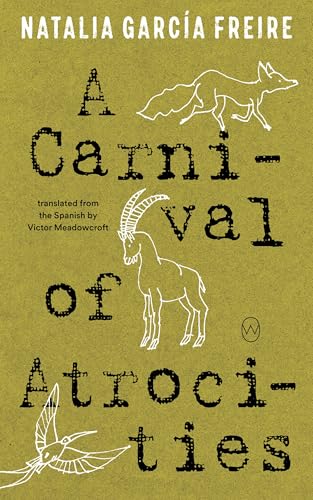
A CARNIVAL OF ATROCITIES, things going wrong? blame a woman!


A CARNIVAL OF ATROCITIES
NATALIA CARCÍA FREIRE
(tr. Victor Meadowcroft)
World Editions (non-affiliate Amazon link)
$14.99 ebook, available now

Rating: 5* of five

The Publisher Says: The residents of a desolate town nestled in the Ecuadorian Andes are forced to reckon with the legend of Mildred, a girl wronged by the town years ago

Cocuán, a desolate town nestled between the hot jungle and the frigid Andes, is about to slip away from memory. This is where Mildred was born, and where everything she had—her animals, her home, her lands—was taken from her after her mother’s death. Years later, a series of strange events, disappearances, and outbursts of collective delirium will force its residents to reckon with the legend of old Mildred. Once again, they will feel the shadow of death that has hung over the town ever since she was wronged. The voices of nine characters—Mildred, Ezequiel, Agustina, Manzi, Carmen, Víctor, Baltasar, Hermosina, and Filatelio—tell us of the past and present of that doomed place and Mildred's fate.

Natalia García Freire’s vivid language blurs the lines between dreams and reality and transports the reader to the hypnotic Andean universe of Ecuador.

I RECEIVED A DRC FROM THE PUBLISHER VIA EDELWEISS+. THANK YOU.

My Review
: Nine PoVs in under 160pp. Why is my rating even a speck over 3 stars?

Mildred.

How perfect that her memory is, not celebrated exactly, but very much incorporated into the life of the town she was Othered, abused, and abandoned by in life. She never once left the midrange of the townsfolk's memories. Funny about that, since all she ever got was a grudging corner in life. Now Cocuán, never a place that loomed large on the world's stage (or even Ecuador's), is slowly and steadily vanishing. It's an unnerving process to read about. The place is, under the pressure of shared guilt, Brigadooning itself as monsters (real? psychic?) claim all of Cocuán.

Told in the kind of prose that I'm reluctant to call "dreamlike" because that means all y'all will click away in search of meatier fare, it's akin to a folktale. A kind of Silver John the Balladeer reading experience. The nine (9) PoVs all expand, like in the Appalachian folktales I've referenced, the reach of Mildred's...presence? ghost? transitional object-iveness?...serves to illuminate the magic in magical realism. She (please attend to pronoun) is killing the place that killed her by causing (how?) the trauma they inflicted on her to make itself manifest in themselves. Revenge? Whose, and on whom?

It is as easy to see Mildred as Silver John the Balladeer's rejected suitor Evadare, pining unto death for what she is denied in life, as it is to see her as John the competent and potent restorer of ma'at to the town. It's a role that folktales love, the bringer of justice and balance who is not quite of this world, but was, and still cares about it.

As easily as that more esoteric take I can defend this story as a restoration of justice for a victim of cultural misogyny, whose maltreatment and displacement by the town was so deeply unjust that it haunts each perpetrator or passive unsavior unto death. The town's vanishing because their collective responsibility to a woman seeking only to exercise the rights they all demand to life and liberty signally failed. They project onto the space called Mildred all the consequences of their failings as women have always endured. Every bad thing is someone else's fault, never one's own. Othering and blaming Mildred for the forces shutting down their town gives Cocuán double psychic relief: exoneration for how they treated her, and an explanation for the advancing death rattles of Cocuán.

Plus it's got cool monstrous doins!

Real or fantasy, Mildred and Cocuán and their wildly entangled realities, as the author and the translator have thrown into relief with words of the most precisely calculated illumination, get all five stars from me.