Showing posts with label Victor Meadowcroft. Show all posts

Wednesday, April 2, 2025

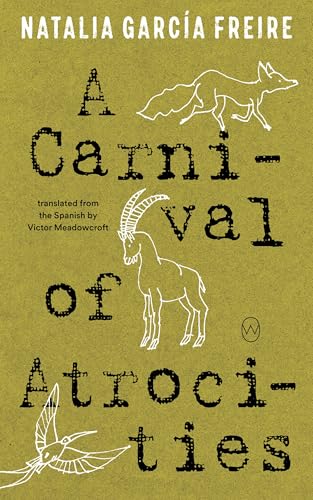
A CARNIVAL OF ATROCITIES, things going wrong? blame a woman!


A CARNIVAL OF ATROCITIES
NATALIA CARCÍA FREIRE
(tr. Victor Meadowcroft)
World Editions (non-affiliate Amazon link)
$14.99 ebook, available now

Rating: 5* of five

The Publisher Says: The residents of a desolate town nestled in the Ecuadorian Andes are forced to reckon with the legend of Mildred, a girl wronged by the town years ago

Cocuán, a desolate town nestled between the hot jungle and the frigid Andes, is about to slip away from memory. This is where Mildred was born, and where everything she had—her animals, her home, her lands—was taken from her after her mother’s death. Years later, a series of strange events, disappearances, and outbursts of collective delirium will force its residents to reckon with the legend of old Mildred. Once again, they will feel the shadow of death that has hung over the town ever since she was wronged. The voices of nine characters—Mildred, Ezequiel, Agustina, Manzi, Carmen, Víctor, Baltasar, Hermosina, and Filatelio—tell us of the past and present of that doomed place and Mildred's fate.

Natalia García Freire’s vivid language blurs the lines between dreams and reality and transports the reader to the hypnotic Andean universe of Ecuador.

I RECEIVED A DRC FROM THE PUBLISHER VIA EDELWEISS+. THANK YOU.

My Review
: Nine PoVs in under 160pp. Why is my rating even a speck over 3 stars?

Mildred.

How perfect that her memory is, not celebrated exactly, but very much incorporated into the life of the town she was Othered, abused, and abandoned by in life. She never once left the midrange of the townsfolk's memories. Funny about that, since all she ever got was a grudging corner in life. Now Cocuán, never a place that loomed large on the world's stage (or even Ecuador's), is slowly and steadily vanishing. It's an unnerving process to read about. The place is, under the pressure of shared guilt, Brigadooning itself as monsters (real? psychic?) claim all of Cocuán.

Told in the kind of prose that I'm reluctant to call "dreamlike" because that means all y'all will click away in search of meatier fare, it's akin to a folktale. A kind of Silver John the Balladeer reading experience. The nine (9) PoVs all expand, like in the Appalachian folktales I've referenced, the reach of Mildred's...presence? ghost? transitional object-iveness?...serves to illuminate the magic in magical realism. She (please attend to pronoun) is killing the place that killed her by causing (how?) the trauma they inflicted on her to make itself manifest in themselves. Revenge? Whose, and on whom?

It is as easy to see Mildred as Silver John the Balladeer's rejected suitor Evadare, pining unto death for what she is denied in life, as it is to see her as John the competent and potent restorer of ma'at to the town. It's a role that folktales love, the bringer of justice and balance who is not quite of this world, but was, and still cares about it.

As easily as that more esoteric take I can defend this story as a restoration of justice for a victim of cultural misogyny, whose maltreatment and displacement by the town was so deeply unjust that it haunts each perpetrator or passive unsavior unto death. The town's vanishing because their collective responsibility to a woman seeking only to exercise the rights they all demand to life and liberty signally failed. They project onto the space called Mildred all the consequences of their failings as women have always endured. Every bad thing is someone else's fault, never one's own. Othering and blaming Mildred for the forces shutting down their town gives Cocuán double psychic relief: exoneration for how they treated her, and an explanation for the advancing death rattles of Cocuán.

Plus it's got cool monstrous doins!

Real or fantasy, Mildred and Cocuán and their wildly entangled realities, as the author and the translator have thrown into relief with words of the most precisely calculated illumination, get all five stars from me.

Monday, February 3, 2025

RÍO MUERTO, 2025's first all-five read, though not for the fantasy-averse reader


RÍO MUERTO
RICARDO SILVA ROMERO
(tr. Victor Meadowcroft)
World Editions (non-affiliate Amazon link)
$14.99 ebook editions, available tomorrow

FINALIST for the 2026 PEN Translation Prize! Winner announced 31 March 2026.

Rating: 5* of five

The Publisher Says: On the outskirts of Belén del Chamí, a town that has yet to appear on any map of Colombia, the mute Salomón Palacios is murdered a few steps away from his home. His widow, the courageous and foul-mouthed Hipólita Arenas, completely loses her sanity and confronts the paramilitaries and local politicians, challenging them to also kill her and her two fatherless sons. Yet as Hipólita faces her husband’s murderers on her desperate journey, she finds an unexpected calling to stay alive.

This poetic and hypnotizing novel, told from the perspective of Salomón’s ghost, denounces the brutal killings of innocent citizens and at the same time celebrates the invisible: imagination, memories, hope, and the connection to afterlife.

I RECEIVED A DRC FROM THE PUBLISHER VIA EDELWEISS+. THANK YOU.

My Review
: South America's cultural impact is never more delightfully represented, to me at least, than when I read magical-realist works whether in translation or not. A novel narrated by a ghost definitely counts as "magical" in my book (!), so I was prepared for something to get me, to find the chinks in my emotional armor.

Not prepared enough.

That there's a civil war, a narcoterror regime, and immense unrest in Colombia was known to me. How pervasive it was didn't seem to me to be a reason to be surprised until I read the author's explanation that these events are fictionalized, not merely fiction...that "based on a true story" line we see so often hit home hard, because this is a friend's life skinned in fiction but boned by facts.

It's really down to this:
I am telling what I was told to me: that Salomón Palacios was gunned down only a few paces from his home and died and became a nameless thing in the gloom—the closing in—before returning from the dead. That he took an eternity in coming back, for the soul recovers memory in its own time, at its own rhythm, but that he must be out there now, and always will be, because death is the true present and because some murder victims do not depart.

Time passes subjectively, per Einstein; I'm not entirely ready to say velocity's the one governing factor until someone can really explain time fully. Maybe Death really does equal time; after reading this book, I have to be open to the possibility. For one of the few times in my reading life I find myself agreeing with a Pentecostal character: the apocalypse really has begun.

What makes Salomón such a great narrator is his ongoing physiological voicelessness. In life, in death, he makes no auditory impact. His existence as a ghost is in a powerfully evocative way a continuation of his voiceless, ineffectual life. Small gestures of kindness, his eking of a living by doing odd jobs, his very death carry the same burden of being a little guy living a little life that couldn't possibly threaten anyone who gets killed in spite of his death changing nothing.

Well, it unhinges his wife. She goes on a campaign to force his killers to kill her, and their sons, too. The sons have other ideas. Her plan to confront the boss who ordered Salomón's death to force him to martyr her, and her boys, in order to...what, exactly? no one in their town doubts who caused the thugs who did it to pull the triggers...or is she simply and selfishly out to commit suicide to avoid feeling grief for her genuinely loved with all his flaws husband? Insisting the sons she birthed join her in this spectacular suicide-by-provocation motivates Salomón in ghostly form to attempt to communicate love felt, love given to be received, to the maddened Hipólita to cause her to reinvest in life, to use her rage to pick up her boys and get the hell out of there. It would give his death, and his life, meaning.

How can a man voiceless in embodied life, in other words, find a voice now he's bodiless?

Author Silva Romero wrote a story I did not want to inhabit, but I did inhabit as fully as I have most stories I've read, because few kinds of story command my involvement more than grief, love, and power dynamics in emulsion. He chose a story I couldn't not get myself into. He chose a storytelling voice I could not avoid investing my empathy, sympathy, and tearducts into. Salomón loved deeply and mutely showed his love in practical simple deeds; he loved so much he was motivated to reach around the barrier of death. Author Silva Romero, ably served by his translator Victor Meadowcroft, did a fine job evoking a violent time's hideous human cost, as well as human beings' overpowering need to force the world to make those costs make sense.

It's impossible to do that, I say confidently, as I read the story of how it is done. All five stars.