Showing posts with label Andes setting. Show all posts

Monday, May 11, 2026

ELECTRIC SHAMANS AT THE FESTIVAL OF THE SUN, the most truth-telling title of 2026


ELECTRIC SHAMANS AT THE FESTIVAL OF THE SUN
MÓNICA OJEDA
(tr. Sarah Booker)
Coffee House Press (non-affiliate Bookshop.org link)
$20.00 paperback, preorder for delivery 12 May 2026

Rating: 4.5* of five

The Publisher Says: National Book Award finalist Mónica Ojeda returns with a blazing, psychedelic novel about girlhood, violence, and the loss of innocence.

In the near future, best friends Noa and Nicole flee their home in Guayaquil, Ecuador to attend the Solar Noise Festival, a week-long, retro-futuristic gathering at the foot of an active volcano. While Noa fully embraces the haze of narcotics and hedonism in an effort to obscure her true reason for attending, Nicole senses something darker at play behind the festival’s so-called “celebration of life.” Amid technoshamanic poetry, collective hallucinations, and ritualistic dances, each girl navigates her own path in an effort to escape her past and reclaim her right to a future.

Vivid, terrifying, and celebratory, Electric Shamans at the Festival of the Sunblends the primal with the supernatural, solidifying Mónica Ojeda as one of the most singular and exciting voices in Latin American and world literature today.

I RECEIVED A DRC FROM THE PUBLISHER VIA EDELWEISS+. THANK YOU.

My Review
: Sarah Booker, the translator whose job it was to make this...tale...accessible to Anglophone audiences, has The Best Job Ever. She and the Coffee House Press acquisitions team get to read good stuff all the time, most of which will never see US publication for a variety of reasons, and we on the outside will never know even exist. Translator Booker has the hard, intense job of creating in English (a very slippery tool, English, full of landmines and tiger-traps for translators) a story told in Spanish that's already sui generis. (Read the Spanish-language reviews on Goodreads, most mention how poetic/beautiful the language is.)

Starting a story at a music festival (I recommend googling the names of the musicians throughout the book, it's most instructive) is quite a flex. It's a loud, raucous thing by design, so having your characters start our acquaintance in such an intense and auditorily overwhelming way is going to sort the audience into pro and con very quickly. I suspect most people who liked Jawbone and/or Nefando will be averse to this intense introduction to our PoV women. I don't know if enough people are already on the Ojeda/Booker train to make that a sizable market but I sure as hell hope so...I want more.

After the characters are charged with the passionate energy that a music festival imparts to those willing to receive it, they begin the Hero's Journey to that gorgeous and mystical place, the Andes Mountains, for shamanic enlightenment. If you have never been to Cuzco or Machu Picchu, please make at least those places destination priorities. I found the evocation of place in this part of the tale we're investing in to be stellar, even better than the more divisive music festival with its more chaotic and uncontrolled atmosphere.

The common element of both segments of the tale, musical and mystical, are overcoming the breakage that a brutal and uncaring world inflicts on us all, and submerging into an overwhelming Otherness to find the path through the noise and pain of Life. It's done in the musical mode of counterpoint, so it unites seemingly disparate modes by their very difference.

I'm really not sure how better to explain the affect of the read than to say it helps to think of the gestalt as an opera libretto, structured to an underlying music that never stops and always leads you forward. The effect of this use of a constant, if quiet, through line is to make the crescendos hit harder, feel louder, than you expect them to be. Invest in Noa and her dad, accept the antiphonal others, and this read will propel you into the shamanic journey's end-point you didn't necessarily see coming.

Wednesday, April 2, 2025

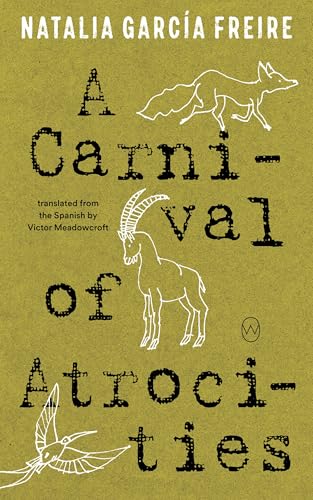
A CARNIVAL OF ATROCITIES, things going wrong? blame a woman!


A CARNIVAL OF ATROCITIES
NATALIA CARCÍA FREIRE
(tr. Victor Meadowcroft)
World Editions (non-affiliate Amazon link)
$14.99 ebook, available now

Rating: 5* of five

The Publisher Says: The residents of a desolate town nestled in the Ecuadorian Andes are forced to reckon with the legend of Mildred, a girl wronged by the town years ago

Cocuán, a desolate town nestled between the hot jungle and the frigid Andes, is about to slip away from memory. This is where Mildred was born, and where everything she had—her animals, her home, her lands—was taken from her after her mother’s death. Years later, a series of strange events, disappearances, and outbursts of collective delirium will force its residents to reckon with the legend of old Mildred. Once again, they will feel the shadow of death that has hung over the town ever since she was wronged. The voices of nine characters—Mildred, Ezequiel, Agustina, Manzi, Carmen, Víctor, Baltasar, Hermosina, and Filatelio—tell us of the past and present of that doomed place and Mildred's fate.

Natalia García Freire’s vivid language blurs the lines between dreams and reality and transports the reader to the hypnotic Andean universe of Ecuador.

I RECEIVED A DRC FROM THE PUBLISHER VIA EDELWEISS+. THANK YOU.

My Review
: Nine PoVs in under 160pp. Why is my rating even a speck over 3 stars?

Mildred.

How perfect that her memory is, not celebrated exactly, but very much incorporated into the life of the town she was Othered, abused, and abandoned by in life. She never once left the midrange of the townsfolk's memories. Funny about that, since all she ever got was a grudging corner in life. Now Cocuán, never a place that loomed large on the world's stage (or even Ecuador's), is slowly and steadily vanishing. It's an unnerving process to read about. The place is, under the pressure of shared guilt, Brigadooning itself as monsters (real? psychic?) claim all of Cocuán.

Told in the kind of prose that I'm reluctant to call "dreamlike" because that means all y'all will click away in search of meatier fare, it's akin to a folktale. A kind of Silver John the Balladeer reading experience. The nine (9) PoVs all expand, like in the Appalachian folktales I've referenced, the reach of Mildred's...presence? ghost? transitional object-iveness?...serves to illuminate the magic in magical realism. She (please attend to pronoun) is killing the place that killed her by causing (how?) the trauma they inflicted on her to make itself manifest in themselves. Revenge? Whose, and on whom?

It is as easy to see Mildred as Silver John the Balladeer's rejected suitor Evadare, pining unto death for what she is denied in life, as it is to see her as John the competent and potent restorer of ma'at to the town. It's a role that folktales love, the bringer of justice and balance who is not quite of this world, but was, and still cares about it.

As easily as that more esoteric take I can defend this story as a restoration of justice for a victim of cultural misogyny, whose maltreatment and displacement by the town was so deeply unjust that it haunts each perpetrator or passive unsavior unto death. The town's vanishing because their collective responsibility to a woman seeking only to exercise the rights they all demand to life and liberty signally failed. They project onto the space called Mildred all the consequences of their failings as women have always endured. Every bad thing is someone else's fault, never one's own. Othering and blaming Mildred for the forces shutting down their town gives Cocuán double psychic relief: exoneration for how they treated her, and an explanation for the advancing death rattles of Cocuán.

Plus it's got cool monstrous doins!

Real or fantasy, Mildred and Cocuán and their wildly entangled realities, as the author and the translator have thrown into relief with words of the most precisely calculated illumination, get all five stars from me.